




Abstract
This research explored how gender portrayals in video games affect gender-related attitudes. Two hundred participants from the United Kingdom and Malaysia participated across three experiments, where the appearance and behaviour of video game characters were manipulated with regard to target (enemy) gender (Study 1), sexually explicit attire (Study 2) and level of character agency (Study 3). We found minimal evidence that exposure to gender-stereotyped content resulted in differential gender-related attitudes (implicit associations, hostile and benevolent sexism, or rape myth acceptance). However, Study 1 findings showed that individuals who played a first-person shooter with male enemies showed lower endorsement of some (benevolent) sexist attitudes (cf. control) and showed difference in game behaviour (cf. female enemies). Together, our results suggest that short-term exposure to video games containing female characters (sexualised, passive, or otherwise) does not consistently lead to the endorsement of negative gender attitudes.
Historically, most video games have targeted, and indeed most players have been, young men (Beasley and Collins Standley, 2002; Ivory, 2006). However, this trend is changing, with video games no longer representing a niche male market (Jayanth, 2014). Nonetheless, female participation is still observed to be highly discriminatory, even within professional gaming contexts (Taylor et al., 2009), whereby the abilities of female players are often dismissed.
There have been concerns about how acts of gendered violence in games may relate to gender-related attitudes and behaviours. Ambivalent sexism theory (AST; Glick and Fiske, 1996, 1999) asserts that our social structures are driven by a hierarchy that positions men as dominant over women, who are regarded as inherently submissive. As a result, such social systems produce gender norms and societal attitudes towards men and women that are both benevolent and hostile. Indeed, women in video games are often represented as two opposing archetypes (Fox and Bailenson, 2009): the ‘virgin’ (pure, demure and in need of men to protect her from danger) or the ‘vamp’ (a dominant, controlling seductress). AST posits that these negative stereotypes serve to promote and maintain both benevolent and hostile sexism.
These negative female stereotypes may perpetuate rape myths: prejudicial, stereotyped, or false beliefs about rape, its victims and its perpetrators. Endorsement of rape myths is linked to entrenched gender role stereotypes and acceptance of interpersonal violence; when these myths become internalised, it leads to rape myth acceptance (RMA; Beck et al., 2012; Burt, 1980).
Concerning gendered violence in video games and gender-related attitudes, it has been observed that video game exposure is associated with hostile sexism, interpersonal aggression, sexual harassment perpetration and RMA (Beck et al., 2012; Fox and Bailenson, 2009). Dill et al. (2008) found that when asked to judge a scenario in which a female college student experiences sexual harassment, those who had been exposed to sexist video game imagery (although they had not actually played games) were the most tolerant of sexual harassment, although null results were observed for rape support attitudes. Moreover, participants who frequently played violent video games demonstrated greater rape-supportive attitudes. Similarly, Beck et al. (2012) found that video games depicting violence against women and sexual objectification of women produced an increase in RMA for men. However, this effect was not found in female participants.
A large-scale study of French teens (Bègue et al., 2017) observed that gaming frequency was positively associated with endorsing sexist ideals, regardless of gender, age, religion, or socioeconomic status. However, Bègue et al.’s (2017) findings have recently been shown to be more likely due to noise (given the large sample and small effect size) than indicative of an actual relationship (Ferguson and Heene, 2021). While Dill (2009) showed an increased amount of time playing violent video games correlated positively with a greater rate of RMA, these became null when entered in an analysis of covariance (ANCOVA). Regardless, they did not directly show that killing women while playing a video game increases RMA.
Indeed, other work has failed to replicate such findings. Ferguson and Colwell (2020) showed that while trait aggression predicted sexist attitudes and a lack of empathy towards a rape victim, exposure to sexualised video game content did not. Interestingly, results showed that those who consumed more sexualised video game content were, in fact, less sexist and had greater empathy for rape victims. The authors suggested that sexualised game content could perhaps be a ‘protective factor’, in that ‘such games may cause players to reflect on issues related to sexualisation, which they might not otherwise do, and be more inclined to reject sexism in real life’ (p. 24). Similarly, Beck and Rose (2018) exposed participants to two games differing in sexualised content, Grand Theft Auto and Madden NFL; while there was no significant difference in RMA between groups, those in the Grand Theft Auto group saw a decrease in RMA from baseline.
Clearly, there are mixed findings in this area, warranting further empirical inquiry. While the research above offers evidence for why exposure to gendered depictions in video games may relate to RMA and other sexist attitudes, an explanatory framework is needed to explain why these effects may occur. This, therefore, calls for a review of the factors which may feed these hostile attitudes and behaviours. While some of these may be attributed to endorsing stereotypical gender norms of gaming as a ‘male space’ (Paaβen et al., 2017), it is pertinent to consider how these are perpetuated within video games and gaming communities. The later sections outline each of these in turn, including under-representation, over-sexualization and level of agency/dominance in games. However, it is first essential to consider this from a theoretical stance to underpin how these factors integrate conceptually.
Explaining stereotyped attitudes
Given that RMA and the other outcomes mentioned earlier are associated with gendered violence in games are stereotyped attitudes, it is pertinent to adopt a theoretical framework that accounts for the social categorisation process. One such theoretical model which may be relevant is the Categorisation-Processing-Adaptation-Generalisation (CPAG) model (Crisp and Turner, 2011). The CPAG model provides a framework for exploring how stereotypical and counter-stereotypical experiences impact broader cognitive functioning. While exposure to stereotypical stimuli or experiences may lead to stereotyped attitudes, social categorisations may change when experiencing diversity in the form of counter-stereotyped content (Hall and Crisp, 2005). This may result in changes in how people categorise others (Crisp and Turner, 2011) and thus may be reflected in their attitudes towards targets. There may be pragmatic ways in which video games can depict counter-stereotypical representations of women to reduce gender-related negative attitudes. Previous work has considered subtle ‘threats’ in video games such as avatar gender, which may feed into the effects of gender-related stereotypes (Kaye et al., 2018). Some basic manipulations regarding under-representation, over-sexualization and agency of female characters may support these efforts.
Under-representation and over-sexualisation of women
Women’s under-representation and over-sexualization are not unique to video games themselves, but regrettably also the range of media associated with gaming, such as gaming magazines, game reviews and game trailers (Dietz, 1998). Gaming communities and sub-cultures, consisting of people involved in playing, developing and commentating on video games, are also relevant here. There has been a great deal of debate concerning gender representation within video games (Chabba, 2016). This tends to consist of two issues: the proportion of women featured in video games and their portrayals.
Early content analysis of popular video games (Dietz, 1998) revealed that 41% did not include female characters. Of those that did, 28% had women being presented as sex objects and 21% as the primary target of violence. On the contrary, men were typically depicted as heroes, concluding that the portrayal of women in video games is highly stereotypical if they are represented at all. This is by no means isolated evidence, as more recent studies do not seem to show an improved picture. Mounting empirical evidence suggests that it is relatively commonplace for female-gendered game characters to be represented significantly less than male ones, to be commonly relegated to secondary roles, and to be presented in a hypersexualized or seductive manner (Beasley and Collins Standley, 2002; Downs and Smith, 2010; Williams et al., 2009).
Game reviews and game trailers show similar trends. For example, Ivory (2006) analysed the content of game reviews, and their findings mirrored those of video game content analyses. Female playable characters were mentioned far less than male ones, and when they were, it was often regarding sexual attractiveness. In contrast, less than 1% of the reviews that mentioned male characters referenced their sex appeal. Male characters are overwhelmingly portrayed as aggressive and hypermasculine (Dill and Thill, 2007), with ‘masculine’ characteristics such as calloused attitudes towards romantic partners, disrespecting women, thrill-seeking and endorsing the notion that physical violence is inherent to male nature.
Research shows that asking male participants to attack sexualised female enemies in a First-person Shooter (FPS) game relates to post-game hostile sexism, but this is not the case when opponents are non-sexualized females or males (LaCroix et al., 2018). Under-representation and over-sexualisation of women in game content and marketing are counter-productive to addressing gender discrimination. This issue extends beyond physical representations to include character agency and behaviours afforded to female game characters.
Agency in games
A final issue that may perpetuate gender discrimination towards women in games is that female characters are typically assigned passive rather than active roles, often as non-player characters (NPCs) rather than playable characters; this arguably strengthens the association with a stereotypical view of women in society. Designers often portray women as victims or ‘damsels in distress’ (Dill et al., 2005), and they are less likely to be dominant characters or perpetrators of enacted violence. Female characters who are afforded more non-traditional roles in video games – for example, being active agents or killable enemies – may be essential for rectifying this issue. Recent games have tried to address this imbalance; for instance, Assassin’s Creed Syndicate features both male and female playable characters and includes equal numbers of male and female enemies. Introducing greater gender equality in video games by casting women in non-traditional roles will likely help challenge traditional gender role stereotypes that may play out in players’ attitudes, in-game behaviours and potentially real-world behaviours.
Although female character agency has received academic attention, strikingly, this has not been studied in relation to gender-related attitudes and behaviours. Research has tended to instead examine player-avatar agency and how this relates to player experience, such as avatar identification, the Proteus effects, immersion, presence and game enjoyment (e.g. Trepte and Reinecke, 2010; Yee and Bailenson, 2007). There is a lack of research addressing how character agency interacts with character gender depiction or game content such as acts of violence. For example, while Beck et al. (2012) begin to address the issue of gendered violence in video games and their associated adverse effects, there is no way of knowing whether the observed results were due to killing women or sexually objectifying women. The section of gameplay Beck et al. (2012) used in their research involved having sex and later killing a ‘hooker’, as well as visiting a lap-dancing club. Most gameplay did not involve violence or killing and concentrated more on sexual objectification. Second, study participants did not physically play a video game; instead, they watched someone else play on a large projection screen. This also negates player agency, which is perhaps one of the more critical functions afforded by video games. As such, research that has systematically and rigorously tested some of these issues is still lacking.
The current studies
Across three studies, this research explores whether violence towards female characters (compared to male characters, sexualisation of female characters and agency of female characters) in video games affect gender-related attitudes, including ambivalent sexism, hostile sexism and RMA. In addition to explicit attitudinal measures, we also explored implicit gender-related attitudes and in-game behaviour regarding whether character gender results in differences of violence enacted towards them. In line with the CPAG, we expected counter-stereotypical content presented in video games to differentially impact attitudes relative to stereotypical content. Specifically, we used modifications of commercially available games to vary physical features such as character gender in respect of non-player characters who are targets of enacted violence (Study 1) and sexualised appearance in the form of varied clothing (Study 2). Furthermore, we used games that vary in level of female character agency (Study 3). See Figure 1 for a conceptual overview of the research.
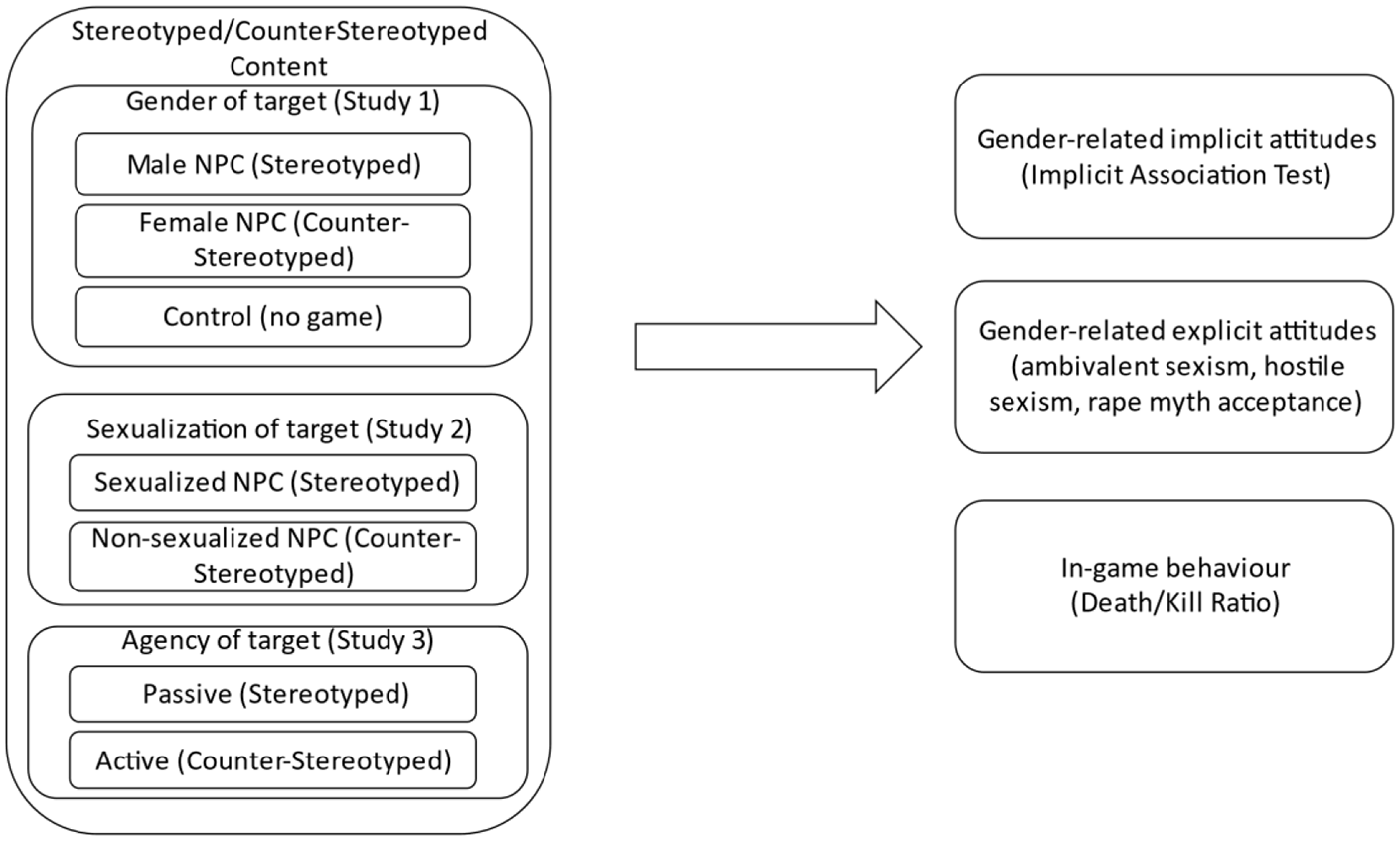
Conceptual summary of the research.
Specifically, we asked the following research questions:
RQ1. Does the gender of an NPC impact implicit and explicit sexist attitudes and RMA? (Study 1)
RQ2. Does the gender of an NPC impact in-game violence (i.e. number of kills) towards them? (Study 1)
RQ3. Does the sexualisation of female NPCs impact sexist attitudes and rape myth acceptance? (Study 2)
RQ4. Does female game characters’ level of agency (active vs passive) affect sexist attitudes and rape myth acceptance? (Study 3)
Study 1
Method
Design and procedure
Upon agreeing to take part, participants completed demographic questions and a measure of their gaming habits. Next, they played a custom-built level of an FPS game in which the targets that participants were instructed to kill varied by gender. A between-participants design was used in which there were three experimental conditions: male NPC, female NPC and control (where they were not exposed to the game). Participants were semi-randomly assigned to one of these three conditions in order of participation, with the number of males and females being equally distributed across the three conditions.
When playing the game, participants had a limited amount of health, which caused the character to die when depleted. After a short animation of the player’s death, they respawned. The game had no end goal, and as such, the player was instructed to kill as many enemies as possible for 15 minutes. Once this time had elapsed, the number of enemies the participant had killed and the number of times they died and respawned were logged. Participants were then asked to indicate from a list of options things present in the game they had played, including Fe/Male NPCs. Measures of implicit and explicit sexist beliefs and RMA (completed in order – detailed below) were recorded post-game. Upon conclusion, participants were informed as to the nature of the experiment and thanked for their time.
Participants
Participants comprised 90 students and staff (46 women; Mage = 20.36; SD = 4.87; age range = 18–63) from Sunway University in Malaysia and were recruited via opportunity sampling. There were 30 individuals per condition and an equal number of females and males in each (except for the control group, which had one more female and one less male). Participants were not paid but were offered the chance to enter a prize draw for a £150 (in local currency) voucher.
Stimuli
The video game stimuli were created using Garry’s Mod, a version of Half-Life which allows the user to create bespoke virtual environments. Two conditions were made, which shared identical environments, weapons, controls and playable character (set to appear as gender-neutral, wearing a combat suit hiding any masculine or feminine physical traits and was only seen when the player died and respawned). Gender of NPC enemies differed between conditions; one condition featured male enemies and the other female enemies. Examples of these NPCs are presented in Figure 2. While the gender of the enemies differed between conditions, their placement on the map, race, clothing, health and difficulty level was kept consistent across conditions.
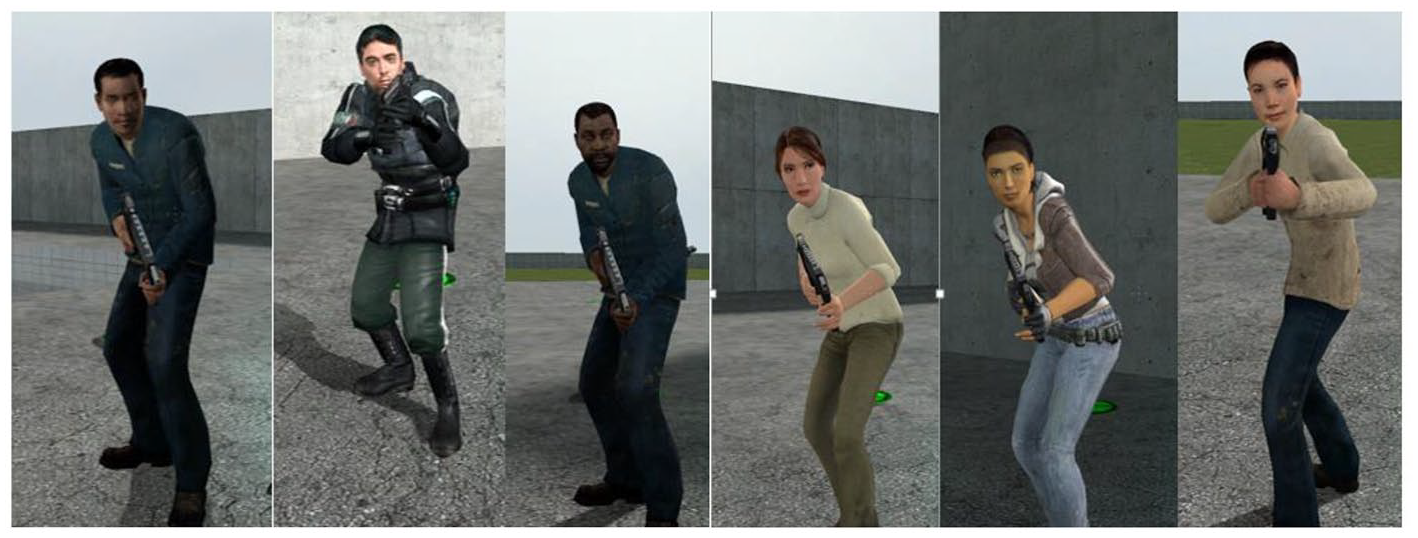
A selection of the male (left) and female (right) NPCs used in Study 1.
Materials
Video game playing habits were measured using a 5-point Likert-type scale assessing how often and for how many hours, on average, participants played video games per week (ranging from 0–3 to 15+ hours per week).
The Ambivalent Sexism Inventory (ASI) is a 22-item measure of sexism responded to on a Likert-type scale of 1 (strongly disagree) to 6 (strongly agree). It has been found to have high internal consistency, with alphas ranging from .83 to .92 (Glick and Fiske, 1996). The ASI consists of two 11-item subscales, measuring Hostile Sexism (HS) and Benevolent Sexism (BS). Both the total inventory and sub-scales were utilised in this research. Internal consistency of the ASI-B (benevolent sexism) scale did not reach an acceptable level in this study (Cronbach’s α = .66); however, removing one item (number 13) increased α to .73. Therefore, the full 11-item (including item 13) version and a 10-item version with item 13 deleted were analysed.
The Ambivalence Towards Men Inventory (AMI) is a 20-item version of the ASI applicable to men, with high internal reliability and alphas ranging from .79 to .87 (Glick and Fiske, 1999). Like the ASI, this measure consists of two sub-measures – hostile and ambivalent sexism – each containing 10 items responded to on the same Likert-type scale. Again both the total and sub-scales were utilised in this research.
The Short Form Illinois Rape Myth Acceptance (RMA) Scale assesses the degree to which someone accepts myths surrounding the issue of rape, using 19 items responded to on the same 6-point Likert-type scale as above. It is one of the most reliable rape myth measures available, with a high Cronbach’s α of .87 (Payne et al., 1999).
The Implicit Association Test (IAT) (Greenwald et al., 1998) measured implicit attitudes. It tests for implicit biases relating to male and female names and their association with career- and family-related words (e.g. Profession, Career, Wedding, Family). Participants are presented with either a male or female name or a family-/career-related word in the middle of the screen and instructed to categorise them (male or female/family or career) as quickly and accurately as possible, using two key presses. This includes several blocks in which some are congruent with gender stereotypes (i.e. trials where male and career words, and female and family words are categorised together), while others are incongruent (presenting the converse pairings). The implicit associations between these categories are then measured using error rate and reaction time. These metrics are used to create a ‘d score’, which ranges from −2 to +2 (with positive scores referring to a male-career vs female-family association and vice versa for negative scores) and indicates the strength of either association coupling. For more details on the IAT or d scoring procedure, see Greenwald et al. (2003). It is worth noting that the IAT has received various criticisms relating to the interpretation of implicit associations and construct, internal and predictive validity (for a discussion of these limitations, see Azar, 2008). Despite these criticisms, it remains a commonly used tool to assess associations between various categories and constructs and has been shown to relate to self-report attitudes (Lynott et al., 2019) and be sensitive to change following short experimental manipulations (Atherton et al., 2019).
Kill and death scores
These were calculated post-gameplay based on the number of enemies the participant killed and the number of times the participant’s character died and respawned.
Results
Descriptive analyses were conducted on all the study variables (see Tables 1 and 2).
Descriptive statistics for Study 1 showing means and SD.
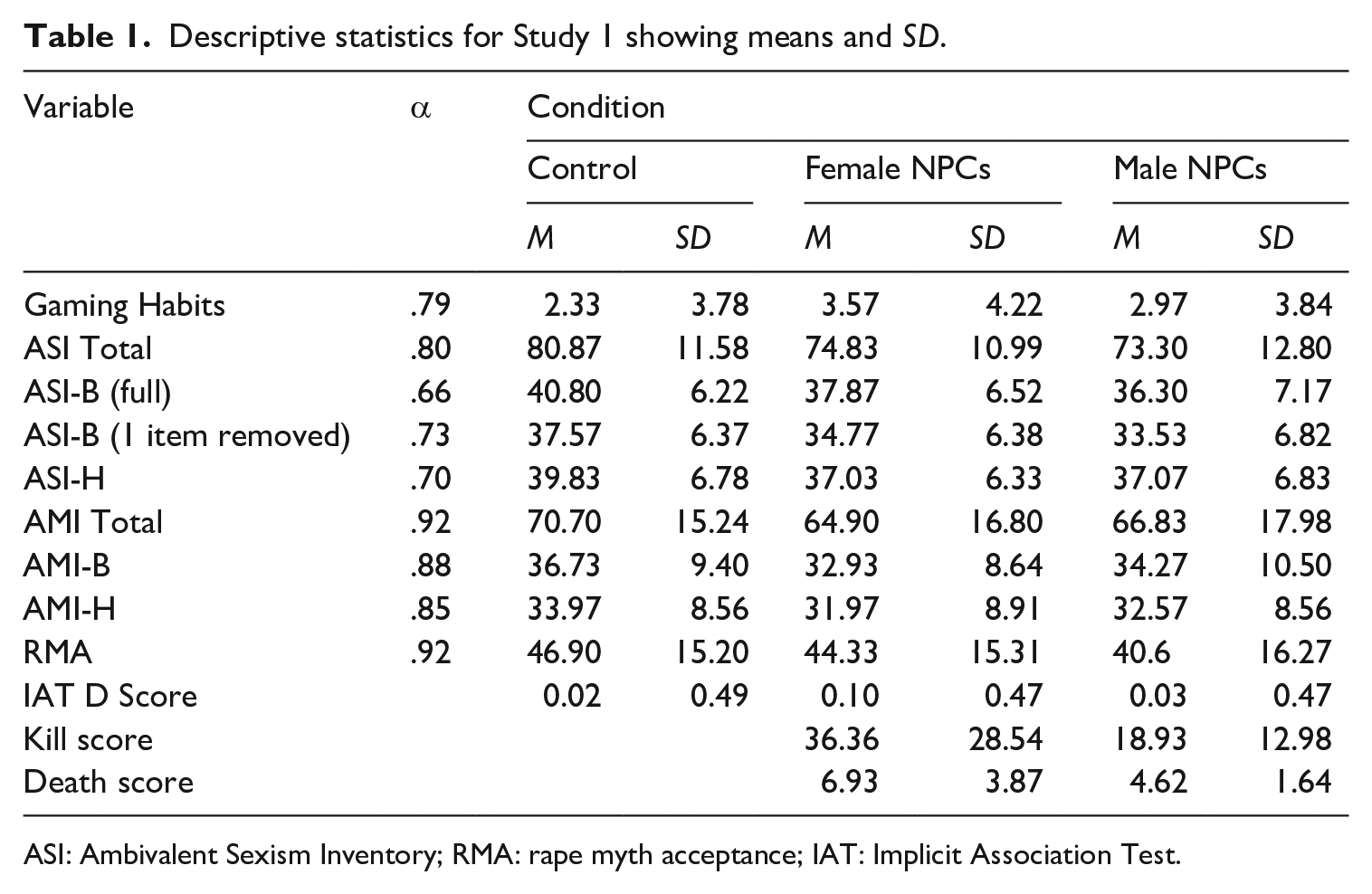
ASI: Ambivalent Sexism Inventory; RMA: rape myth acceptance; IAT: Implicit Association Test.
Descriptive statistics for Study 1 showing median and ranges.
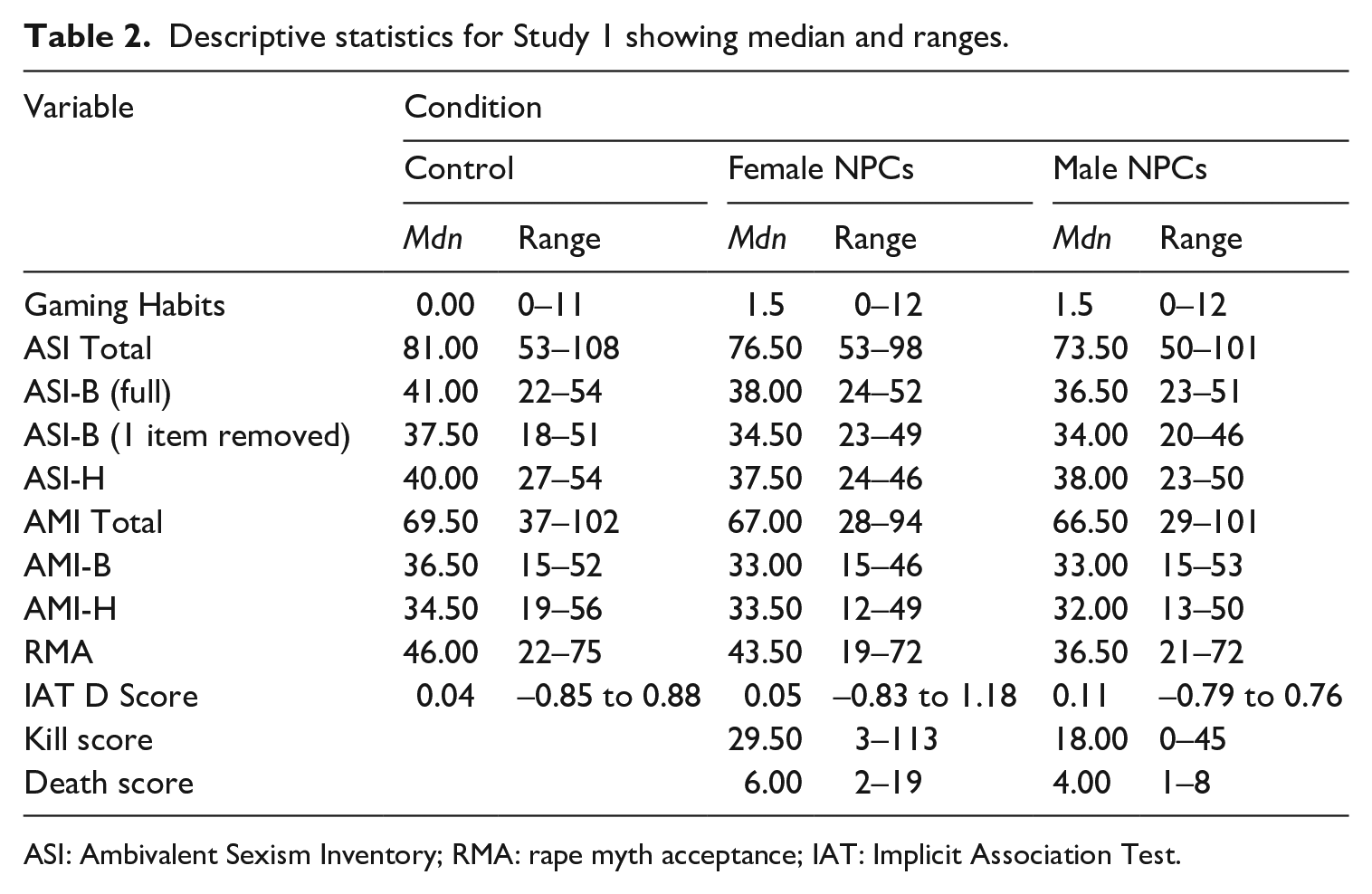
ASI: Ambivalent Sexism Inventory; RMA: rape myth acceptance; IAT: Implicit Association Test.
Following the recommendations of Dienes and McLatchie (2018), we report Bayes factors alongside p values for all 1-df analyses. Bayes factors provide a continuous measure of evidence for the alternative hypothesis (H1) relative to the null hypothesis (H0). To facilitate interpretation and decision making, we adopt Jarosz and Wiley’s (2014) interpretation of Bayes factors, interpreting results between 0.33 and 3 as weak, 0.05–0.33 and 3–20 as moderate evidence for H0 and H1, respectively, and <0.05 and >20 as strong evidence for H0 and H1, respectively. Justifications for the approximate scale-of-effect used to model H1 are provided throughout (based upon raw effect sizes reported in past research or common heuristics; for an overview, see Dienes, 2019), and H0 is approximated using a point-null. Robustness regions are reported to demonstrate the robustness of the conclusions to the model of H1 used (see McLatchie et al., 2020: p. 76, for an overview of robustness regions). Bayes factors were calculated using the Dienes and McLatchie (2018) R script.
First, video game playing habits were analysed to ensure that participants did not differ significantly across conditions regarding their gaming history. Gaming habits did not differ significantly across conditions, F(2, 87) = 0.73, p = .49,
There was a significant main effect of condition on the ASI total score F(2, 87) = 3.44, p = .04,
There was a significant main effect of condition on the full ASI-Benevolent score, F(2, 87) = 3.54, p = .03,
There were no significant differences between the conditions on male gender attitudes with Bayes factors indicating the data were inconclusive as indicated by the AMI total score, F(2, 87) = 0.94, p = .40,
The IAT dataset was cleaned for any potential outliers, as recommended by Greenwald et al. (2003). The mean of each block was calculated, and difference scores for the experimental blocks were computed. Difference scores were divided by the pooled SD of the relevant blocks; the average of the two resulting scores is referred to as a ‘d score’. There was no significant difference in d scores between the three conditions, F(2, 81) = 0.244, p = .784,
Finally, in respect of both kill and death scores, significant differences were observed between conditions. Namely, kill scores varied (U = 252, p = 0.022, r = 0.299, BN(0,18.18) = 20.35, 5 RR[2.25, 392.44]), in which kill score was significantly higher in the Female NPC condition (M = 36.36, SD = 28.54, Mdn = 29.50, range = 3–113) than in the Male NPC condition (M = 18.93, SD = 12.98, Mdn = 18.00, range = 0–45). For death score (U = 270, p = .011, r = 0.329, BN(0,3.47) = 16.21, RR[0.48, 23.61]), players also died more often in the Female NPC condition (M = 6.93, SD = 3.87, Mdn = 6.00, range = 2–19) than in the Male NPC condition (M = 4.62, SD = 1.64, Mdn = 4.00, range = 1–8).
As a supplementary analysis, we assessed the extent to which participants accurately identified the gender of the NPCs in their respective condition. A chi-square test indicated that incorrectly identifying NPC of a gender not present was related to condition, χ2(1) = 18.38, p < 0.001. For those placed in the male NPC condition, 96.79% of participants correctly indicated that they saw male NPCs, while only 10% mistakenly reported seeing female NPCs. However, in the female NPC condition, while 86.7% of participants correctly indicated they saw female NPCs, 63.3% of people mistakenly reported seeing male NPCs.
Discussion
We explored how manipulation of a target character’s gender resulted in differential attitudes and in-game behaviour. In line with the CPAG, we operationalised two game conditions (in addition to a non-game control condition). Utilising a counter-stereotyped content condition in which female NPCs were present in a video game relative to a stereotyped condition (male NPCs), we tested how this impacted sexist attitudes and players’ in-game behaviour.
Importantly, game condition did not appear to elicit significant effects on attitudes, with one exception. There were no significant differences in implicit gender-related attitudes, RMA, benevolent sexism (BS) towards women, hostile sexism (HS) towards women, BS towards men, or HS towards men. While Bayes factors indicated that the majority of evidence weakly favoured H0, there was moderate support for H0 when comparing Female NPCs to Controls on measures of benevolent sexism towards women (B = 0.11) and hostile sexism towards women (B = 0.11). There was also moderate evidence for H0 when comparing Female NPCs to Male NPCs on measures of hostile sexism towards women (B = 0.27) and hostile sexism towards men (B = 0.32). The only significant difference was in ambivalent sexism towards women (total scores) between those who did not play a game and those in the Male NPC condition. Those who had not played a game showed a more significant endorsement of sexist items than those in the Male NPC condition, and Bayes factors indicated this provided moderate evidence for H1 (B = 5.26). Although non-significant, there was moderate evidence that Female NPCs also reduced total sexism towards women relative to not playing a game (B = 4.10). This suggests that the presence of a counter-stereotypical agent may be partially related to promoting counter-stereotypical beliefs in line with the CPAG model (Hall and Crisp, 2005).
Patterns of in-game behaviour between conditions elicited some interesting findings. Participants in the female NPC condition had a significantly higher kill and death scores than those in the male NPC condition, with Bayes factors indicating the data provided moderate (death score: B = 16.21) to strong (kill scores: B = 20.35) evidence for H1. While it is unclear how this would affect a participant’s death score, it is noteworthy that greater kills were observed towards females relative to male targets. Therefore, although our counter-stereotype content condition did not appear to promote any more sexist attitudes than the stereotyped content condition, it did seem to elicit different in-game killing behaviour. However, in the female NPC condition, most participants also identified male enemies when there were none. As previous research indicates, female characters are underrepresented in video games (Downs and Smith, 2010), while male characters are likely to be considered the norm. Thus, participants may have automatically assumed characters were male, which may explain why participants in the male NPC condition did not wrongly identify the presence of female enemies to the same extent.
Other explanations for misidentification may be visual limitations of the game and that characters across conditions were similarly presented in non-provocative clothing. Although there are some exceptions, as previously discussed, many games depict females with exaggerated sexual features and suggestive clothing, so this may be a reason why female NPCs were not readily identified in Study 1. To investigate further, we adopted a broadly equivalent approach to Study 1 but instead used only female NPCs who varied in their sexualised depiction. Given the number of non-significant findings in Study 1 relating to the attitude measures, we reduced the number of variables to focus more exclusively on RMA and sexism in respect of female targets only.
Study 2
Method
Design, materials and procedure
Participants were semi-randomly allocated to play a custom-built FPS game level where they were tasked with killing female NPCs. Conditions varied whereby in the sexualised condition, the female NPCs were dressed in sexually provocative attire. In contrast, in the non-sexualised condition, they were dressed in clothing similar to male characters (see Figure 3). While the attire of the female enemies differed between conditions, their placement on the map, race and difficulty level were kept consistent.
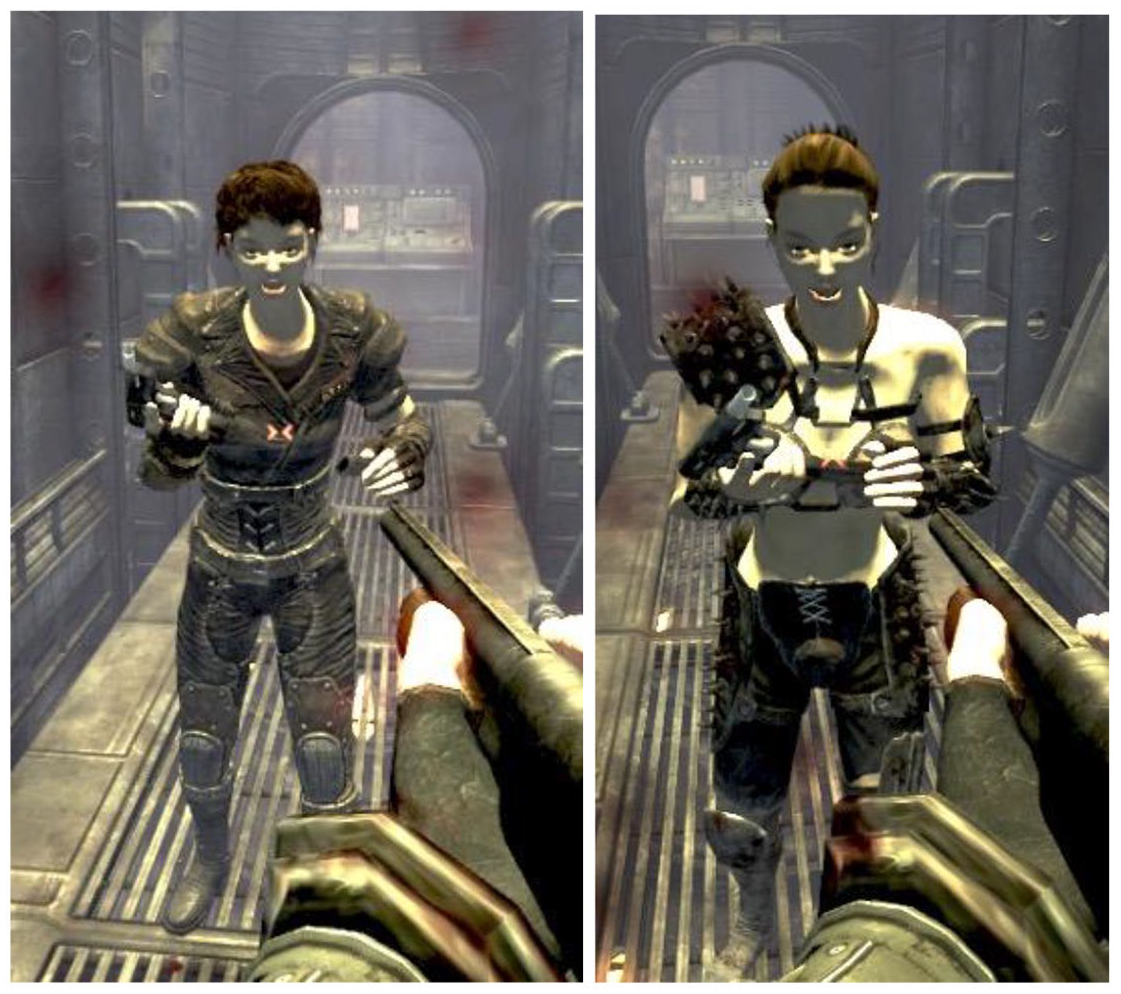
NPCs used in Study 2 – left: non-sexualised NPC; right: sexualised NPC.
Participants had unlimited health and were instructed to move from one location to another as quickly as possible while killing enemies encountered along the way (this took approximately 5 minutes). This was preceded by 10 minutes of free play to acclimatise the participants to the game, characters and controls. As in Study 1, both conditions shared identical environments, weapons, controls and playable characters. Following gameplay, participants responded to measures of RMA and hostile and benevolent sexist attitudes towards women using the same measures as in Study 1. There were a set number of enemies, all of which had to be killed to progress, while the avatars were set to invincible.
Participants
Participants comprised 50 university students and staff (27 women; Mage = 21.2, age range: 18–39 years) from Lancaster University in the Northwest of England and were recruited via opportunity sampling. Participant gender was distributed equally among experimental conditions. Student participants were given course credit for participation.
Results
Descriptive analyses were conducted on all Study 2 variables (see Table 3). It is worth noting that the ASI-B, passed scale reliability checks without the need to remove items in this sample.
Descriptive statistics for Study 2.
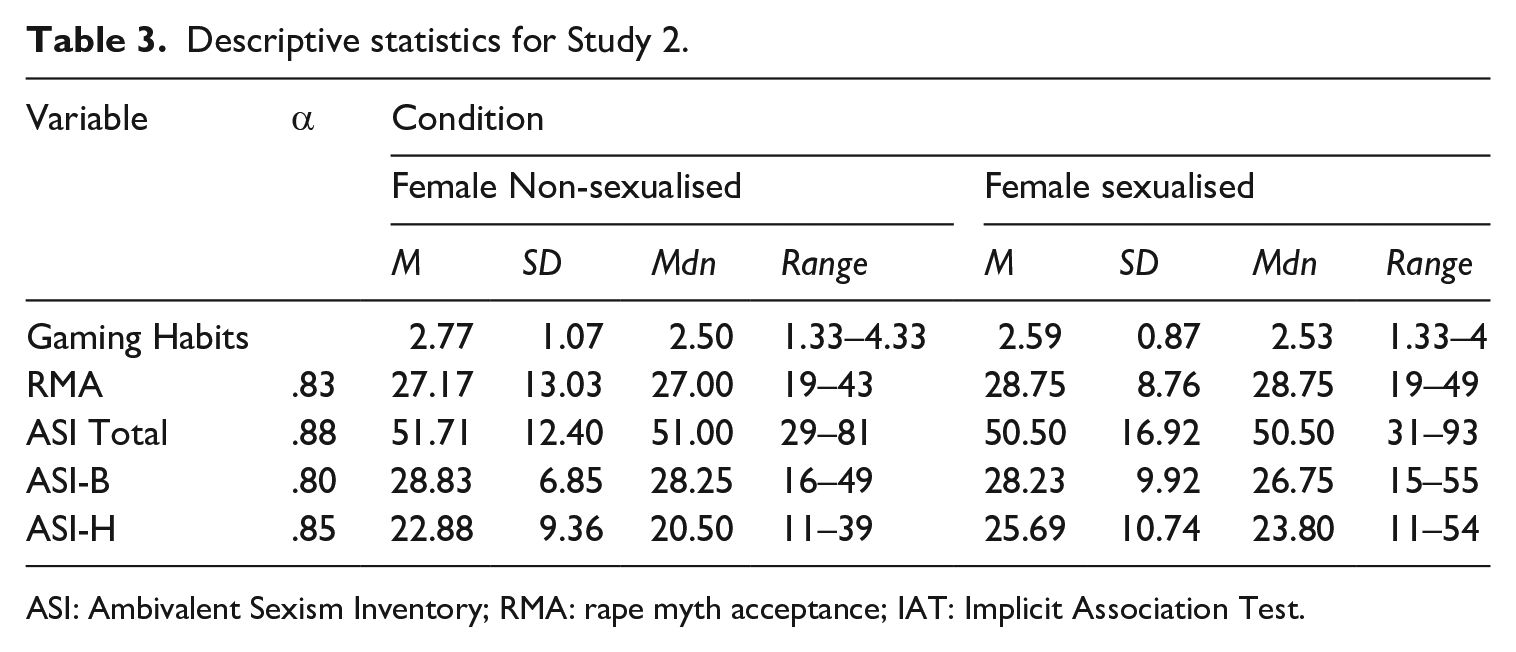
ASI: Ambivalent Sexism Inventory; RMA: rape myth acceptance; IAT: Implicit Association Test.
There were no significant differences across conditions for any of Gaming Habits, U = 61.00, p = .83, r = 0.035, BN(0,0.88) = 0.46, RR[0, 1.28]; RMA, U = 364.00, p = .31, r = 0.142, BH(2.22) = 0.66, RR[0, 6.04]; ASI total score, U = 325.50, p = .79, r = 0.037, BH(0, 6.14) = 0.47, RR[0, 9.37]; ASI-B score, U = 285.00, p = .60, r = 0.075, BH(0, 6.14) = 0.31, RR[5.56, ∞]; or ASI-H score, U = 353.00, p = .43, r = 0.113, BH(0, 6.14) = 1.03, RR[0, 22.84]. While most Bayes factors indicated the data were inconclusive, ASI-B was an exception providing just moderate evidence for the null.
Discussion
Despite adding a sexualised portrayal of female characters to the manipulation, Study 2 still failed to present any significant effects on sexist beliefs or RMA, although Bayes factors indicated that the data provided only weak evidence for H0 in most cases (with the exception of the ASI-B score for which there was just moderate evidence for H0). One possible explanation for this is that all the female characters used in Studies 1 and 2 were presented as active agents who retaliated against the players. However, this presentation fails to mirror the predominant theme in popular games, whereby female characters tend to be much more passive; indeed, in many instances, they are passive rather than active protagonists in the story. Consequently, in Study 3, we used commercially available games with a vast disparity in gender representations concerning female characters’ agency in the enactment of violence. In this way, we attempted to determine whether the manipulation would affect a more ecologically valid environment than Studies 1 and 2.
Study 3
Method
Design, materials and procedure
Participants played one of two commercially available action-adventure titles chosen for their divergent representations of women. These varied based on whether the female target was active or passive. For the ‘active’ agency condition, we used the game Tomb Raider, featuring the protagonist Lara Croft, as she is well regarded as a strong female character (e.g. Jansz and Martis, 2007). Although Lara Croft has traditionally been designed in a sexualised manner, we utilised the more recent Tomb Raider reboot game in which Croft is now presented as an active, non-sexualised female whose primary targets are male. Participants in this condition played a level of Tomb Raider where they were tasked with performing stunts and killing male NPCs.
In the ‘passive’ condition, participants played Grand Theft Auto (GTA) V. The GTA franchise is widely regarded as a quintessential example of poor gender representations and the endorsement of gendered violence in video games. Specifically, its protagonists are exclusively male, and women are often portrayed as passive, hypersexualised objects needing assistance from the male protagonist. In this condition, participants played as the male protagonist, completing a mission where the goal is to rescue a passive female character from a sexually exploitative situation. All measures were completed as previously described in Study 2.
Participants
Sixty participants (30 females) were recruited to take part from Edge Hill University in the Northwest of England. Participants ranged in age from 18 to 65 years (M = 23.32, SD = 9.44). There was an equal number of males and females in each condition. Participants were recruited via opportunity sampling and did not receive any incentive for taking part.
Results
Descriptive analyses were conducted on all Study 3 variables (see Table 4). It is worth noting that the full ASI-B again failed scale reliability checks in this sample, though again passed if one item (item 6 this time) was removed. Therefore, both the full and reduced scale are reported.
Descriptive statistics for Study 3.
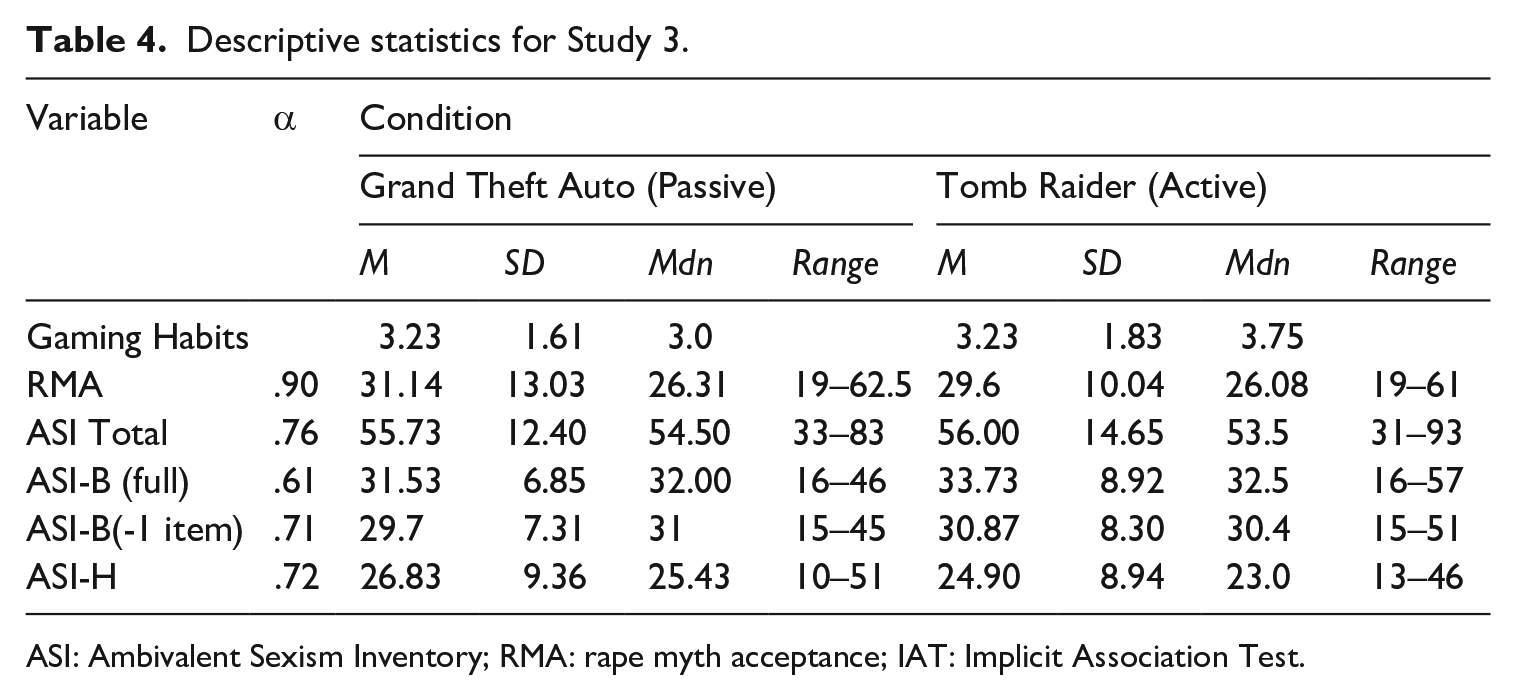
ASI: Ambivalent Sexism Inventory; RMA: rape myth acceptance; IAT: Implicit Association Test.
There were no significant differences across conditions for Gaming Habits, U = 441.50, p = .89, r = 0.017, BN(0,0.89) = 0.45, RR[0, 1.25]; RMA, U = 448.50, p = .98, r = 0.002, BH(0,2.22) = 0.64, RR[0, 5.74]; ASI total score, t(58) = 0.07, p = 0.95, d = 0.02, BH(0,6.14) = 0.52, RR[0, 10.48]; ASI-H score, t(58) = 0.82, p = .42, d = 0.21, BH(0,6.14) = 0.22, RR[3.72, ∞]; ASI-B score, t(58) = 1.07, p = .29, d = 0.28, BH(0,6.14) = 0.90, RR[0, 18.45]; or ASI-B score with item 6 removed, t(58) = 0.58, p = .57, d = 0.15, BH(0,6.14) = 0.52, RR[0, 9.88]. All results provided weak evidence for the null, with the exception of the ASI-H scores which provided moderate evidence for the null.
Discussion
Study 3 found no significant effects of avatar agency on sexist attitudes or RMA; again, although Bayes factors indicated that the majority of results provided only weak evidence for H0 (with the exception of the ASI-H score, where B = 0.22). When a female character was depicted as passive with players eliciting acts of violence towards her, this did not significantly prime sexist beliefs than when the female character was herself actively enacting violence on others (all-male NPCs). A complete examination of these findings and implications are given below.
General discussion
The current research used modified (Studies 1 and 2) and off-the-shelf games (Study 3) to test the effects of gender-related representations of female characters on implicit (Study 1 only) and explicit, sexist attitudes and RMA. We sought to test the principles of the CPAG in which the choice of modifications and games could manipulate our stereotypical and counter-stereotypical conditions.
Across the three studies, there was little evidence that depictions of female characters relative to male ones had a detrimental impact on sexist or stereotypical attitudes towards women, with Bayes factors typically indicating only weak evidence for the null. This was the case irrespective of whether the female character was an NPC, an active protagonist, or was depicted in a hypersexualised way. In Study 1, no significant differences were observed in RMA or implicit or explicit sexist attitudes between participants who had undertaken the gaming task with female NPCs and those in the male NPC condition. Interestingly, Study 1 provided moderate evidence that those who had not undertaken the task showed lower sexism scores (ASI) than those in the control.
To further explain Study 1’s attitudinal findings, Study 2 incorporated an additional manipulation, sexualised female NPC representations. We found no significant differences in sexist attitudes or RMA across these conditions, with Bayes factors again typically providing weak evidence for the null. Our results suggest that such exposure within a video game produces negligible effects. Study 3 used commercially available video games to manipulate female characters’ level of agency and determining whether this perpetuated differential sexist attitudes.
Studies 1 and 2 showed no significant differences in sexist attitudes or RMA between experimental conditions. We believe this offers a key contribution to the current literature, given that there is little discussion about female character agency. We advocate that the debate should move beyond content per se (e.g. physical appearance, gender depiction) to extend to a range of other game-related factors such as agency, procedural rhetoric and mechanics which pertain to the characterisation of (female) characters in video games. While our findings are null or inconclusive concerning the issue of agency, a worthwhile advancement in this field would be to explore this further in respect to both player and character agency. For players, this may vary according to whether they are permitted autonomy over being violent to others; for characters, a difference may emerge depending on whether they are player-controlled or NPCs, who are inherently more passive. Future research should therefore explore this potential for interesting interaction effects with character content.
Overall, we did not find extensive evidence supporting counter-stereotypical content resulting in differential gender-related attitudes, although to argue another way, stereotypical content did not appear to hold any more negative attitudes than control/counter-stereotypical content. This may suggest that (counter-stereotypical) content in games should be far less subtle than our study manipulations to elicit any differential effects. In line with Ferguson and Colwell’s (2020) observations, perhaps interacting with video game characters who do not fit the stereotypically male profile, who possess heightened sexualised features, and may actually be more evocative and make players more aware of gender-related biases and issues. It is also conceivable that when players engage violently with female characters in-game, they may experience less motivation to engage in such behaviours in a real-life setting. Such settings may also lead to players being more acutely aware of the inaccuracies between the video game and real life. Indeed, Denzler and Förster (2012) found evidence supporting this notion by examining the relations between aggression levels and goals within violent gaming. They discovered that venting aggression within violent gaming decreased post-gameplay aggression (see also Lee et al., 2020). The same effect may be expected with regard to gendered violence in games.
Others suggest that what may be more likely is that antisocial traits underpinning aggression and sexism are more deeply rooted in genetic and socio-environmental factors and that exposure to certain types of media will have negligible effects on actual behaviours (Ferguson et al., 2013). In support of this model, referred to as the Catalyst Model, research shows that over a 13-year longitudinal study, criminality, as measured through arrests, was not related to media usage but strongly predicted by genetic factors (Ferguson et al., 2013). Breuer et al. (2015) further tested the Catalyst Model in a 1-year longitudinal study examining the relationship between violent video games and aggression in adolescents and young adults. The results showed that for adolescents, aggression predicted the use of violent video games, which supports the idea of a selection effect, or that individuals with aggressive tendencies might be drawn to violent content. However, in older individuals, video game usage was not correlated with aggressive behaviour. Together, such research suggests that the use of violent video games does not substantially influence real-life behaviours, which are reflective of our null results across these three studies.
As with all research, there are several limitations to note. The first is that our samples were not sufficient to undertake analyses by gender. Future work should explore this avenue. Another limitation of this work regards player experiences in-game. Some research suggests that presence plays a role in transferring video game effects to real-life experiences, with greater immersion or presence leading to greater increases in aggression (Nowak et al., 2008) and hostile sexism (LaCroix et al., 2018). We did not take measures of player experiences within the gaming sessions, such as frustration or immersion (both of which affect presence) (Nowak et al., 2008). In addition, our participants were not purposively sampled in relation to familiarity or habitual gaming usage, but consisted of a randomly selected sample of individuals who varied in video game usage. More intricate or detailed assessments of gaming experiences may warrant further attention, given that evidence shows player experiences can impact subsequent behavioural changes (Nowak et al., 2008).
Finally, another limitation of these studies is the short exposure time. Thus, while our experimental approach is relevant for many studies in this field, this is not the case for all research on video games and sexism. This is primarily because experimental studies are restricted by short-term exposure to female character representation to test any attitudinal effects, whereas other studies have explored sexism-related experiences regarding real-world gaming contexts (e.g. Ferguson and Colwell, 2020). While the latter approach makes it more difficult to assert control over exposure time and content, it highlights that alternative methods may provide deeper insight into the issues with gender representation in video games. Namely, it may be the case that such short-term exposure is not sensitive enough to perpetuate such beliefs. Correspondingly, our measures were rather general to hostile and benevolent sexism, whereas other studies have taken measures of sexism in a more context-specific manner, such as in response to scenarios (e.g. Dill et al., 2008). Again, other studies may have more sensitive measures to illuminate sexism effects of gendered game character content. However, our custom-built game could be a fruitful educational tool for context-specific awareness-raising or training about specific sexist issues.
Conclusion
In line with the principles of the CPAG, we operationalised stereotyped and counter-stereotyped content conditions via modified commercial video games to test the impacts on gender-related attitudes (e.g. hostile sexism, benevolent sexism, RMA) towards women. Across three studies, we found minimal evidence that exposure to stereotypical gender-related content varied from counter-stereotypical content or controls regarding gender-related attitudes. We note that this may be partially because our manipulations were too subtle to elicit observable effects, but our findings do lend themselves to a wider literature that acknowledges null effects on this issue, indicating that gendered representations and violence in video games may not be as harmful on players’ attitudes and real-world behaviours as often theorised.
Footnotes
Funding
The author(s) received no financial support for the research, authorship and/or publication of this article.

Notes
Author biographies
Dr Liam Cross is a senior Lecturer at Edge Hill University. Their research interest are in social cognition and interpersonal interactions, particularly in the domain of group processes, joint action and pro-sociality. Dr Linda K. Kaye is a Reader in Psychology at Edge Hill University. She specialises in cyberpsychology, in particular how online settings promote social inclusion and well-being. Juris Savostijanovs is a psychology student at Edge Hill University. Their interests include the diverse world of Cyberpsychology, Virtual Reality applications exploring Theory of Mind and Perspective Taking.Dr Neil McLatchie was a lecturer in the Social Processes group in the Psychology Department at Lancaster University. His primary research interests included statistical inference and factors affecting pro- and anti-social behaviour, although he also had a keen interest in hypnosis, body perceptions and contributing to open science projects. He recently left academia and today spends more time walking his dog Louis.Matthew Johnston studied at Lancaster University. Currently works as an outreach worker with young people.Liam Whiteman is an aspiring clinical psychologist with a strong interest in research. He has an MRes in Clinical Psychology from University of Birmingham where he contributed to projects in the fields social psychology, eating disorders, and palliative care. Robyn Mooney is a Lecturer in Forensic Psychology at the University of Derby. Her research interests include personality, female offenders, and sex offending behaviour.Dr Gray Atherton is a Senior Lecturer in Psychology who specialises in social cognition. Relevant projects include developing visual perspective-taking paradigms for VR, with a focus on creating environments that can be customised to suit the special interests of autistic individuals.