




Abstract
By drawing on a communication-based approach to populism, this article argues that populism research should put more emphasis on the performative and stylistic dimension of the phenomenon, including its visual elements, in different media formats. The study theoretically refers to the distinction of populism through and by the media, which has been discussed to a great extent in populist political communication research. Empirically, the author focuses on visual representations of politicians on the covers of the German news weekly Der Spiegel as well as those of Compact – a far-right alternative magazine. The article argues that political magazines contribute to how the political is imagined, particularly by the visual messages they convey via their front pages. An image type analysis of both magazines’ covers between 2010 and 2020 is conducted (N = 103) in order to explore patterns in the visual representations of German politicians disseminated by the magazines. On the one hand, the comparison of a mainstream and far-right alternative medium enriches the theoretical debate of how populism is strengthened by opportunity structures through the media. On the other hand, the issue of how populism is actively promoted by the media is addressed.
Keywords
Introduction
The relationship between news media and populism has been of central interest to political communication scholars in the last 20 years (Aalberg et al., 2017; Mazzoleni, 2008; Waisbord, 2019). By taking a look at recent literature in this field, two observations can be made. First, empirical studies have primarily been focusing on verbal indicators, i.e. mostly content analyses of newspaper articles (e.g. Hameleers and Vliegenthart, 2020). Second, when it comes to the potential promotion of populist actors through media coverage, analyses traditionally distinguish between mainstream or elite media and tabloid media (Pallaver, 2018; Wettstein et al., 2018). This article aims to broaden this perspective, arguing, on the one hand, that populism research needs to acknowledge the affective role of aesthetic elements, such as images, and their ‘power to signify’ (Hatakka, 2019: 32). On the other hand, by drawing on the heuristic distinction between populism by and populism through the media (De Vreese et al., 2018; Esser et al., 2017), it compares the visual representations of a traditional German mainstream news magazine, Der Spiegel, to that of Compact, referred to as a far-right alternative outlet which attempts not to reach the intellectual vanguard but the ‘common man’ (Quent, 2019: 206). Viewing magazines as cultural artefacts that shape our understanding of politics (Kitch, 2018), they are considered a relevant object of study for the given research interest. Thus, the article explores the research question of how the distinction between populism through and populism by the media materializes on the covers of Der Spiegel and Compact. To this end, an image type analysis based on all their cover images that depict contemporary German political representatives between January 2010 and December 2020 is conducted.
In the following section, I will briefly review two approaches to populism and argue that a discourse and performance-orientated approach is useful for enriching our understanding of the visual aspects of populism in a media environment. In the Methods section I will then introduce the image type analysis developed by Grittmann and Ammann (2011). I then present the image types explored in the material before finally discussing the results against the background of the theoretical distinction between populism through and populism by the media as well as avenues for future research.
Theoretical Considerations
Populism from a communication perspective
For decades, the concept of populism has been studied in different academic disciplines (De la Torre, 2019) and with different epistemological and ontological presuppositions. The ‘thin ideological’ approach conceptualizes populism as an ‘ideology that considers society to be ultimately separated into two homogeneous and antagonistic groups, ‘the pure people’ versus ‘the corrupt elite’, and which argues that politics should be an expression of the volonté générale (general will) of the people’ (Mudde, 2004: 543, emphasis in original). Populism, in this understanding, does not have a single ideological core. Rather, it is dependent on a ‘host ideology’, i.e. socialism, conservatism and (economic) liberalism, which makes it a successful political agenda. The kind of ideology that is linked to the abstract concept of populism depends upon national as well as historical contexts. While it can be associated with anti-neoliberalism, e.g. in Spain (Podemos) and Greece (Syriza), it is of a nativist character in the Netherlands (Partij voor de Vrijheid), in Austria (Freiheitliche Partei Österreichs) and in Germany (Alternative für Deutschland). From an analytical standpoint, the ideational perspective may be fruitful in a discussion of consolidation of left-wing or right-wing populism within a country or in cross-country comparisons. However, as it neglects the creation of populist ideas and how they are maintained or disseminated, the approach reaches its limits when it comes to the way in which populism is created and negotiated in society. Thus, the downside to the ideational (or thin-ideological) approach is that it regards populism as a set of exogenous attitudes and ideas already present in the minds of citizens and politicians and therefore does not consider the processes involved in communicating these attitudes. (Hatakka, 2019: 31)
This is where a second perspective comes in: theorizing populism as discourse. Proceeding from the post-structuralist assumption that no idea about society is naturally given but has to be articulated into being (Laclau, 2005), scholars of this approach are interested in meaning-making processes which are driven by discourses. According to this view, populist political actors aim to unify unmet societal demands to create so-called chains of equivalence. These demands do not necessarily have to coincide with each other. Rather, what unites them is their distinction of a collectively imagined ‘other’ (Laclau, 2005: 73–74, 130). They gather around an empty signifier, ‘the people’, which stands in opposition to ‘the elite’. The question of concrete content, i.e. the interrelation between the different demands, is subject to discursive struggles and may change depending on context and political conjuncture. Whereas the discourse approach also draws on a dichotomy between ‘the people’ and ‘the elite’, it is not so much interested in the belief system itself but more in the process by which contents are articulated (De Cleen et al., 2018: 652).
In recent years, the discourse theoretical approach has been extended by the idea of mediation, understanding populism increasingly as a performative, stylistic and communicative phenomenon (De Vreese et al., 2018; Moffitt, 2016a, 2016b). The emphasis on performativity, ‘the stylistic, politico-cultural, and relational aspects of populism’ (Moffitt, 2016b: 53) is useful here for two reasons. First, this approach acknowledges a bottom-up dimension of populism by taking into account the media 1 as influential actors on a meso level, operating between the citizens (micro level) and structural factors (macro level), e.g. the political system (Reinemann et al., 2017: 22). Second, and this is crucial from an empirical perspective, it is not confined to purely verbal messages but also considers aesthetic elements, for example, images (Moffitt, 2016a: 22, 40), which are regarded as signifying discursive acts in their own right and not just supplements for illustrative purposes. Surprisingly, research in the field of media and populism is largely logocentric and the investigation of visual material has been underexposed (Bucy and Joo, 2021: 11; Mendonça and Caetano, 2021: 215).
Media and populism: populism and media
When it comes to research on the relationship between the media and populism, one of the main characteristics has been the distinction between populism through the media and populism by the media (De Vreese et al., 2018; Esser et al., 2017; Hameleers and Vliegenthart, 2020). 2 The first addresses the question of how far traditional mass media serve as a platform and have a catalysing function for populist movements and parties by offering opportunity structures. This strand of research not only refers to the coverage of politics in different news outlets (mostly contrasting mainstream with tabloid formats) and its implications but it also considers changes over time by analysing the relationship between the media and populist movements at different stages of their development. According to the ‘media life cycle’ model (Mazzoleni, 2008), for instance, mainstream media may support populist political actors in a ground-laying phase by focusing on the failures of established actors. Generally, the notion of populism through the media highlights the compatibility of the populist logic with the commercial logic of the media as far as the struggle for recipients’ attention is concerned, suggesting that both operate via personalization, emotionalization, stereotypization and simplification (Moffitt, 2016a: 76–77). Therefore, the relationship between the media and populist actors has been characterized as a mutual dependency (Mazzoleni, 2008: 50).
The second perspective, populism by the media, extends this view and conceptualizes a ‘media populism’ arguing that the media themselves can occur as populist political actors who promote an antagonistic structure of ‘us’ vs ‘the corrupt elite’. Media populism is defined as the use of . . . the construction and favoritism of in-groups, hostility toward, and circumvention of the elites and institutions of representative democracy, reliance on charisma and (group-related) commonsense [sic], and appeal to moral sentiments (thus on an emotionalizing, personalizing, and ostentatiously plainspoken discourse). (Krämer, 2014: 48)
In doing so, populist media may be completely independent of populist movements or political actors. They may, but do not necessarily, strive for a strategic alliance with populist politicians or parties. They can also speak in their own right ‘by being pro-active advocates on behalf of the people, with a critical attitude toward power holders’ (De Vreese et al., 2018: 429). To sum up, the concept of populism through the media suggests that the congruence of media logic and political populism is confined to the stylistic level, while populism by the media tends to assume an ideological congruence between the two.
The distinction between populism through and by the media thus serves as an heuristic background for a comparison of different media outlets by not focusing primarily on the salience of people-centrist or anti-elitist statements (as suggested by the ideational approach) but also by considering stylistic elements in visual representations. It allows further investigation of the underlying assumption that populism is (unintentionally) fostered (Mazzoleni, 2008: 50) through a mainstream medium such as Der Spiegel (populism through the media), while it is actively performed by a far-right alternative medium like Compact (populism by the media).
Populism and visual media
There are numerous studies with a focus on social media that investigate the growing importance of internet memes in populist political communication (e.g. Lobinger et al., 2020), visual self-presentations of populist leaders on Instagram (e.g. Bast, 2021; Bernhardt and Liebhart, 2017; Mendonça and Caetano, 2021) and potential differences in the visual communication of populist and non-populist parties on Facebook (Farkas et al., 2022). In addition, Moffitt (2022) has addressed the question of how visual representations of ‘the people’ differ in right and left populism by comparing Donald Trump and Bernie Sanders’ Instagram accounts. Researchers have also investigated populist political storytelling and mobilization strategies via images using discourse analysis (Doerr, 2021; Wodak and Forchtner, 2014) and visual narrative analysis (Freistein and Gadinger, 2020; Freistein et al., 2022). Finally, visual representations of populist actors in mainstream media have gained academic interest (Herkman, 2019; Klumpp, 2020). The present article contributes to this research field by drawing attention to the above-mentioned distinction of populism through the media and populism by the media. The comparative design complements recent works that have focused on the imagery of far-right alternative outlets (Schilk and Gegenfurtner, 2022; Tuomola and Wahl-Jorgensen, 2023).
In this context, studying magazines is promising because of their politico-cultural significance. Magazines fulfil multiple functions. They may serve as instruments of power in terms of the Gramscian notion of preserving hegemony. Furthermore, they can be seen as community creators by operating as platforms where social and cultural identity issues of an assumed homogeneous group are expressed and discussed. Finally, and more broadly, magazines are considered cultural artefacts containing elements of both (Kitch, 2018). The present study draws on this magazine-as-culture approach in that it searches visual content ‘for recurring stories and symbols’ (p. 13). Cover images are of particular interest here because they convey the magazines’ central messages in a pointed way. Their recognition value in newsstands and social media makes covers an important form of expression of how the political is imagined (Browne and Diehl, 2019).
Methods and Materials
Image type analysis
Image type analysis follows in the tradition of visual content analysis (Parry, 2020; Rose, 2016), but integrates the iconographic–iconological approach of art history as well (Grittmann and Ammann, 2011: 165). This allows for in-depth analysis of denotation and connotation. Both social science and art history are interested ‘in understanding and unravelling how individuals as well as groups of people make sense of cultural artifacts and how, in turn, the visuals shape cultural belief systems at a given time’ (Müller, 2011: 286). According to this understanding, image type analysis takes up art historian Erwin Panofsky’s assumption that image motifs conventionalize in cultural spaces and epochs, and that specific themes and ideas determine the world of images. Grittmann and Ammann (2011) argue that the notion of types (Panofsky, 1982), serving art historians as reference points enabling classification and dating of single works of art, is also fruitful for media and communication research in a discussion of patterns of visual media coverage and their multiple implicit meanings.
The method consists of two main steps. In a first step, the visual material is classified along recurring motifs following an inductive reasoning (Müller, 2011: 286). The second step consists of constructing image types. The method requires an in-depth knowledge of the visual material achieved through constant (re-)immersion (Müller, 2011: 287; Parry, 2020: 355). Due to the complex design of magazine covers, image types in this context cannot achieve the internal homogeneity and external heterogeneity that characterize conventional press photography (Grittmann, 2007). Thus, there may be overlaps and a cover can be assigned to more than one image type.
Characterization of the two magazines
Despite its occasional tendency towards tabloidization and its sometimes sarcastic prose (Gehrs, 2005), the newsweekly Der Spiegel has always been known for its investigative journalism and background reports. It is considered an elitist medium with a predominantly left-liberal orientation, although its political stance can be described as somewhat erratic, not only in the era of its founder and publisher Rudolf Augstein but also in the years since (Gehrs, 2005; Schrag, 2007: 163–164). The magazine has a leading function in the German media landscape not only in terms of a large readership 3 but also in the constitution of the public sphere in the way that other media and political communication experts regularly refer to it. Thus, issues set by this Leitmedium spill over into the media environment (Wilke, 2009).
It can be assumed that Compact is part of this environment, on the one hand reacting to the issues but, on the other, setting its own agenda which is characterized by an apocalyptic and conspiracist worldview (Quent, 2019: 206). In accordance with Cas Mudde’s (2019: 7) definition of the far right, the magazine has become a case of extremism, rejecting ‘the essence of democracy, that is, popular sovereignty and majority rule’. This not only becomes obvious when studying the magazine’s content (Schilk, 2017; Schilk and Gegenfurtner, 2022) but also when considering its close relationship to the Alternative for Germany (AfD) and, in recent years, to the party’s nationalist wing Der Flügel in particular. Since the dissolution of the latter by the Federal Office for the Protection of the Constitution in spring 2020, Compact has been listed as a suspected case of right-wing extremism. In 2021, the Federal Office classified the magazine as ‘definitely extremist’ (Bundesamt für Verfassungsschutz, 2021: 76). 4
Over the past few years, communication scholars have shown increased interest in the symbiotic interdependencies (Haller et al., 2019) between political actors and media outlets at the fringes of the political spectrum and how this affects the political climate. In this context, and independently of a medium’s ideological orientation, Kristoffer Holt and colleagues draw on the concept of alternative media referred to as ‘self-perceived corrective[s] of “traditional”, “legacy” or “mainstream” news media in a given sociocultural and historical context’ (Holt et al., 2019: 862). Following this reasoning, Compact is defined here as a far-right alternative magazine whereas Der Spiegel represents a traditional mainstream medium with a liberal tradition, leaning slightly to the left (Schrag, 2007). Taken together and bearing in mind Kitch’s (2018: 13) notion of ‘magazines as culture’, it seems reasonable to compare visual representations of politicians in these two magazines by asking whether and how they differ and what implications this may have on the distinction of populism through and by the media. Finally, this approach allows complementing content analyses of Compact (Culina and Fedders, 2016; Schilk, 2017) which have been so far mostly limited to a textual basis (but see Schilk and Gegenfurtner, 2022).
Data selection
For this study, all covers of Der Spiegel and Compact depicting contemporary German politicians from 2010 to 2020 were considered. The focus on the depiction of politicians chosen here is based on the relevance of personalized news coverage of politics which is expected to be especially prominent on a visual level (Diehl, 2017). From a symbolic and performative perspective, the politician’s body is considered a direct medium of communication. This has crucial implications for democratic representation as mass-mediated images of politicians compensate for the inevitable distance between them and the citizens, and serve as a medium of identification for the audience in two ways. On the one hand, images represent the respective claims and policies of representatives. On the other hand, they are able to connect citizens to the politician in a more personal way (Diehl, 2017: 365–366).
As Compact was first published in 2010, this year was chosen as a starting point for the investigation. Depictions of foreign and formerly active politicians were not included as they are of less importance for the German readership at the given time of publication. Furthermore, portraits covering less than one fifth of the image’s vertical extent were excluded from analysis. In total, the sample consists of 103 cover images (67 of Der Spiegel, a weekly magazine, and 36 of Compact, a monthly magazine). The main image of the title story was the unit of analysis, not considering banderols or smaller images. However, headlines, subtitles and captions provide crucial contextual information by underlining or opposing the connotation of the visual representation (Tseronis, 2021). Due to the covers’ multimodal character (Kress, 2010) the verbal messages are considered in the analysis, too.
In order to detect relevant material in the context of this study, it seemed useful here to draw on the elements which are theoretically attributed to populism in a communication context, such as personalization, emotionalization, dramatization and the accentuation of antagonistic structures in a mediatized political realm (Mazzoleni, 2014). The material was reviewed, with a view to identifying patterns linked to the above-mentioned attributes. The six cases (see Table 1) are discussed via the iconographic–iconological approach used in image type analysis for the purpose of detailed description and interpretation (Grittmann and Amann, 2011; Panofsky, 1982).
Examined covers (N = 103), Der Spiegel (67), Compact (36) (multiple coding possible).
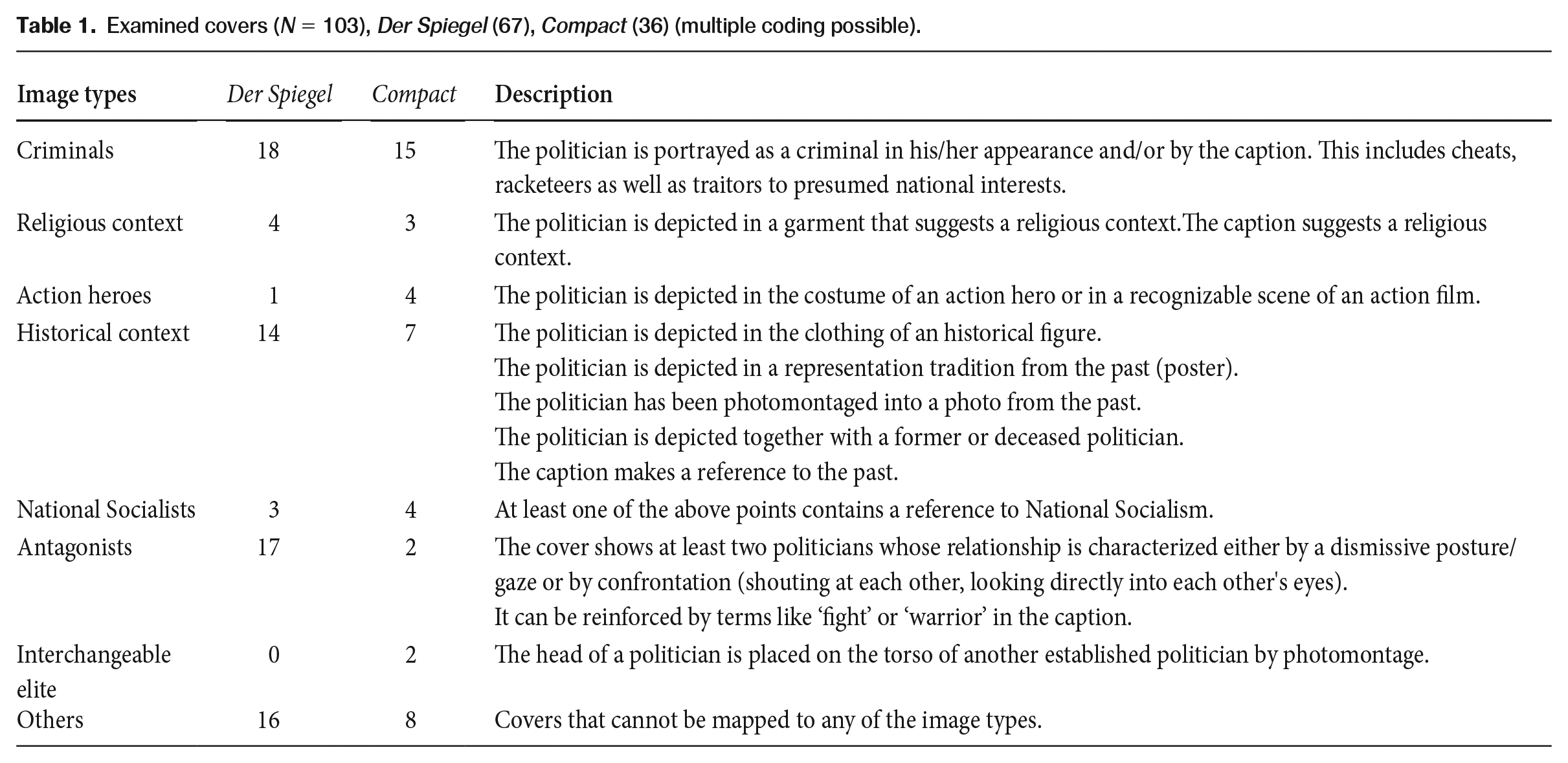
Of all selection criteria, the notion of emotionalization needs to be clarified in more detail. From a cognitive psychological perspective, emotions are conveyed more easily through visuals due to an associative logic, as opposed to a more rationally determined textual communication which is bound to grammatical and semantic conventions (Messaris and Abraham, 2001; Müller, 1999). However, without negating the circulation ‘through individual bodies’ (Wahl-Jorgensen, 2019: 5, emphasis in original), emotion is conceptualized here rather as a relational and discursively relevant phenomenon which is hence – at least partially – socially constituted. In this sense, ‘emotions circulate in public discourse in patterned ways that have profound social and ideological ramifications’ (Wahl-Jorgensen, 2019: 9). The media as well as political actors make use of this in their visual communication in order to attract people’s attention and/or to promote a specific political agenda.
Analysis and Results
Before the image types are presented, a few formal characteristics of the covers will be pointed out. Compact, for example, mostly uses close-up portraits whereas Der Spiegel draws on a broader range of portrait formats. Whereas Compact mostly depicts only a single politician, Der Spiegel more often shows politicians in interactive situations. Angela Merkel, the incumbent Chancellor at the time of study, was the most depicted politician in both magazines’ covers (Der Spiegel: 40, Compact: 16). Eight Der Spiegel covers show AfD politicians, on the part of Compact there are two. The background in the covers varies significantly depending on the topic and the context. Strikingly, however, all of the viewed Compact covers except for three operate with a black vignetting which not only focuses the viewer’s attention on the centre of the image but also fosters a dramatization of the depicted scene. Der Spiegel also uses this stylistic device, but to a lesser extent and in a rather context-dependent manner. In the case of Compact, it seems to be more of a trademark and an expression of the supposed truths that are obscured by the leading mainstream media and that the magazine purports to expose (Schilk and Gegenfurtner, 2022: 307). In the following, six prominent image types are exemplified. 5
Criminals
Figure 1 shows the cover of Der Spiegel no. 40/2013. We can see the close-up portraits of a man with short black hair on the left and a woman with medium-length brown hair on the right. The man wears a red bandana with lots of small identical imprints saying ‘SPD’. The cloth covers his mouth and nose. His stern gaze directly focuses upon the viewer. The woman, slightly in the background, looks in the same direction. She wears a mask covering the rims of her eyes. A source of light illuminates the two faces while a vignetting fades to a black background. The persons are Sigmar Gabriel, at that time party leader of the Social Democrats (SPD) and the Chancellor Angela Merkel (Christian Democratic Union, CDU). It is clearly recognizable that they are portrayed as bandits here. The caption saying ‘Hand over your money!’ underlines the notion of a hold-up situation. The close-up shots combined with a call for action create a performative image that attempts to incorporate the viewer (Ginzburg, 2001).
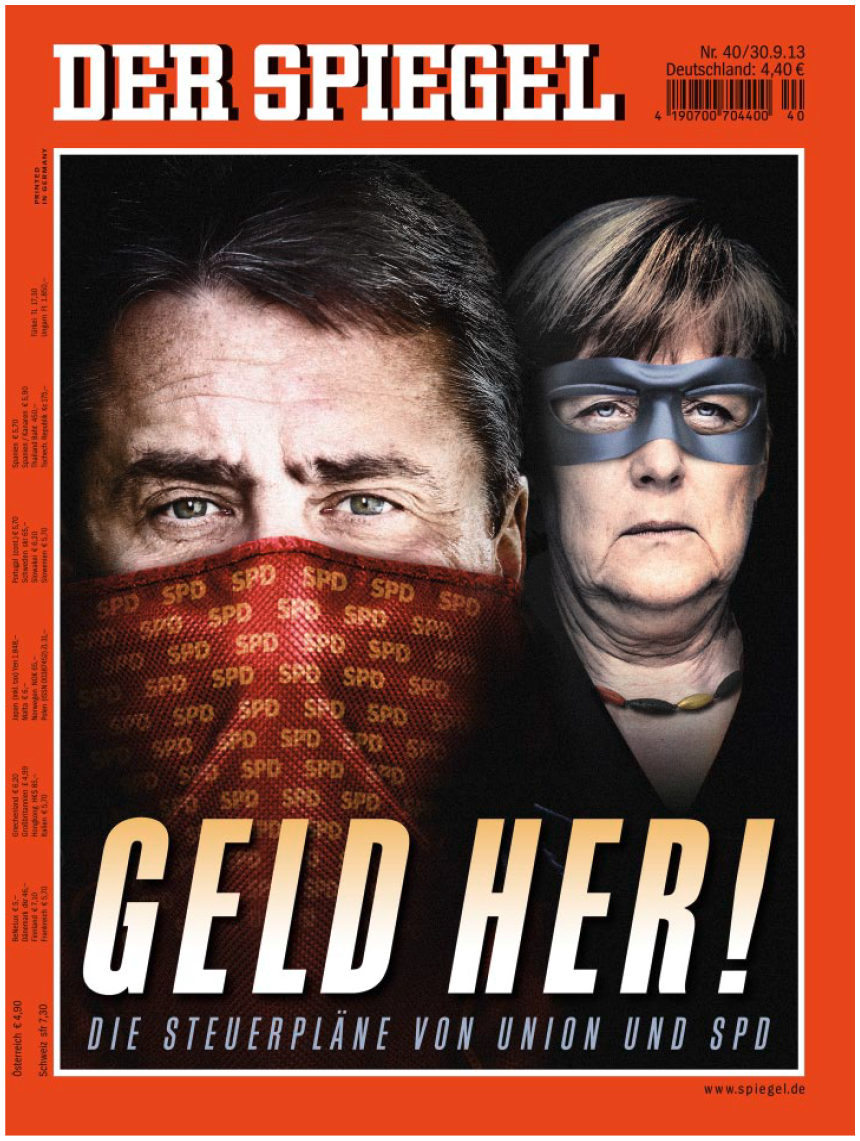
Der Spiegel, 30 September 2013. © DER SPIEGEL, reproduced with permission.
The subtitle reads, ‘The tax plans of the CDU/CSU and SPD’ and thus provides more information on the connotative level for an iconological interpretation. The cover refers to negotiations concerning tax policies between SPD and the CDU shortly after the federal election of 2013. The majority of voters opted for parties (above all the CDU) that had promised not to raise taxes. However, the election results created a situation in which the CDU had to make concessions to the SPD in order to reach a coalition agreement which was finally formed in December. The cover alludes to the idea that voters were cheated out of the announcement made in the run-up of the elections.
Compact also operates with the visualization of politicians as criminals, especially in connection with the so-called refugee crisis. Issue no. 12/2015 shows Merkel in a close-up portrait behind prison bars (Compact, 2015a). 6 Her face is illuminated, which makes her look pale against the black vignetting and the dark background of the prison cell. The corners of her mouth point downwards and she seems lost. The cover has to be seen in the context of Merkel’s refugee policy and her decision to open German borders to unregistered refugees in autumn 2015. As a result, conservative and right-wing populist actors accused her of breaking the law and filed criminal charges against her. Taking into account this background knowledge and the cover’s textual messages, a twofold enemy image is constructed here. On the one hand, the cover shows the dichotomy of ‘us’ (the people) and ‘them’ (the elite) as an inner enemy. On the other hand, it implicitly addresses an outer enemy (the refugees). The title ‘Merkel? Arrest her!’ reminds the viewer of a plebiscite and thus reveals the populist critique of liberal democracy. In this illiberal view, the homogeneous, spontaneous and direct will of the people replaces judicial review.
Within the category criminals, Der Spiegel focuses on misconduct, i.e. intrigues, cheatings and racketeering. Compact, in contrast, depicts politicians as traitors who act according to the will of foreign politicians or organizations. This goes hand in hand with a generalized elite enemy image and the reclamation of supposedly lost sovereignty.
Religious context
Visual references to religion have an emotionalizing potential, especially when national and cultural identities are at stake (Simpson, 2019). Figure 2 shows a close-up of Merkel wearing a white nun’s habit; a veil with blue horizontal stripes on the forehead covers her hair and falls over her shoulders. Her gaze focuses on the viewer with a discreet smile and shining eyes. In the background we can see an indistinct crowd. Two women are wearing headscarves. Above the crowd there is blue sky with some white clouds. Considering the date of publication as well as the caption ‘Mother Angela – Merkel’s policy divides Europe’ we can conclude that this cover is part of the debate on the so-called refugee crisis. Merkel is depicted as Mother Teresa, who is equally renowned for her charity towards the disadvantaged as well as for the poor conditions in the houses of her order (Sebba, 1997). Despite controversy surrounding Merkel’s generous refugee policy, this visual portrayal is quite positive and indicates support with regard to her decisions. Considering the brightness, the soft-focus effect, the aureole and the gleam of light in Merkel’s eyes, the cover makes her appear as a saint who gives hope to the refugees. This impression is reinforced by the Christian cross on her shoulder and the peace dove in the upper left corner – both known as symbols for hope (Klotz, 2009).
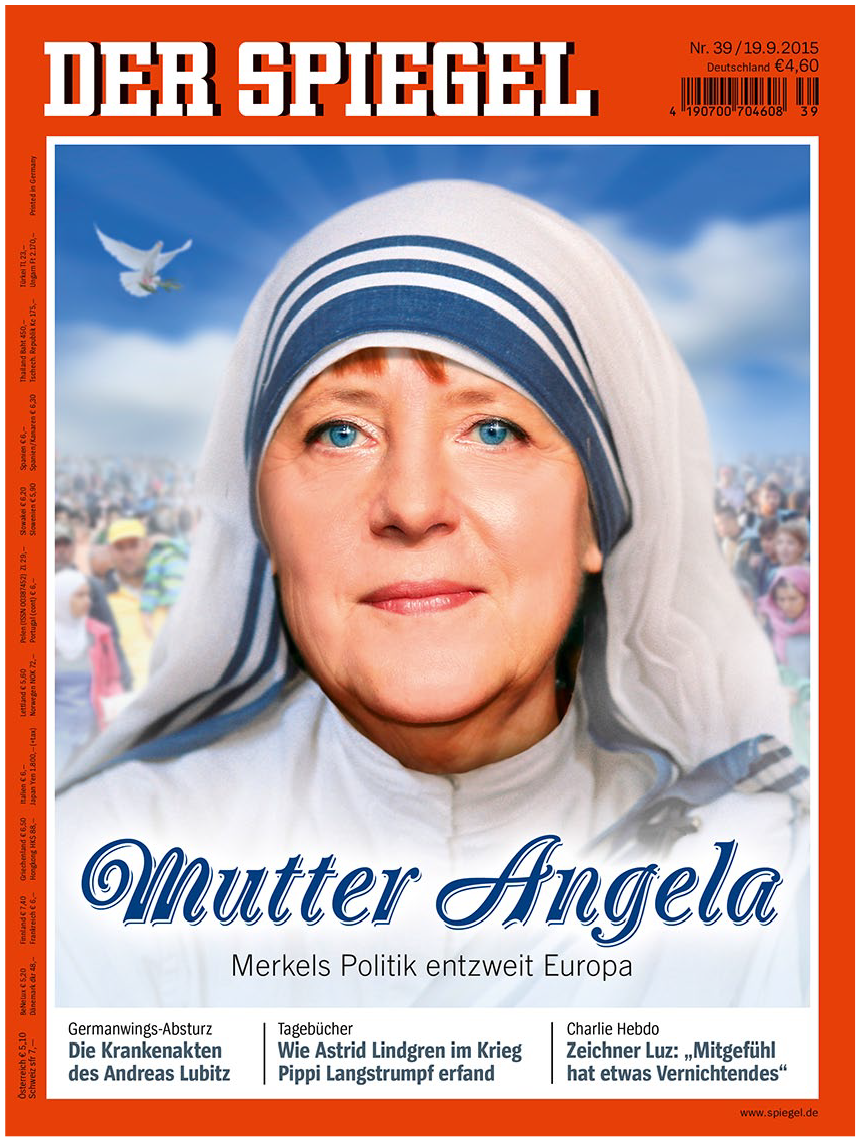
Der Spiegel, 19 September 2015. © DER SPIEGEL, reproduced with permission.
Compact issue no. 01/2015 depicts Merkel in a close-up shot, set on the right half of the cover (Compact, 2015b). She wears a greyish-green headscarf covering most of her hair, her ears and her neck. She stares at the viewer with a lethargic facial expression, the corners of her mouth pointing downwards. She looks pale and tired. To her left, in the background, we can see the Republic Square and the Bundestag building 7 with a crescent placed on top of its cupola. A blue sky with some white clouds completes the scene. Black vignetting extends to both the left and the top edge of the picture. Written in red letters the title reads ‘Mutti Multikulti’ and the subtitle says ‘Merkel’s migration policy’.
The cover was published months before the start of what would later be referred to as the refugee crisis. However, the issue of migration had been on the agenda long before. The release of this cover coincided with the founding period of the ethno-nationalistic PEGIDA 8 movement. We are confronted with a twofold framing of enemy images here. On the one hand, we can identify the notion of an ‘Islamization’ of Germany, the crescent being not only a widespread Muslim emblem used, for example, as finials on minarets, but also part of national symbols, such as flags (Schacht and Ettinghausen, 1986), is chosen here to promote the image of an ‘islamized’ German state. On the other hand, we can see Merkel depicted in a hijab, insinuating that she is one of ‘them’ and acting in their name. 9
Action heroes
Another image type uses the portrayal of politicians as action heroes, also for emotionalizing purposes. In February 2010, Der Spiegel depicts the Minister of Foreign Affairs Guido Westerwelle as an unmistakable incarnation of The Incredible Hulk from the film of the same title (Figure 3). He is equipped with a supernaturally muscular green-coloured body and the caption reads ‘The incredible Guido’. He wears a ripped muscle shirt in the colours of the Free Democratic Party (FDP). The imprint saying ‘18%’ hints at a widely ridiculed election campaign in 2002 in which the Liberals sought to triple their vote share from 6 to 18 percent. 10 With the torso slightly bent forward to the side and the legs in an offset position, Westerwelle rushes through the scene trampling anything standing in his way. His gaze is directed resolutely ahead and the facial expression reminds the viewer of an energetic speech. As the subtitle indicates, the cover refers to taking stock of his first 118 days as Vice Chancellor. At that time, public debate centred on the question of whether he is suited to hold office due to his provocative statements on the Hartz IV social welfare measures, taken up in the cover by a cracked luminous advertisement in the lower right section of the image. In the middle ground on the right we can see Chancellor Merkel burying her face in her hands, seemingly not believing what her coalition partner is about to do. In the background, a devastated Berlin is going up in flames with the Bundestag building in the upper left corner as well as the tumbling and smoking television tower and the Federal Chancellery in the upper right corner. The flag behind Westerwelle’s right shoulder alludes to a party donation scandal with the Mövenpick hotel group. The three-level image composition seems to trace his path. A helicopter flying over the scene spotlights the politician’s head, underscoring the attention on his person. This matches his attention-grabbing populist image in the public debate, both during the 18 percent campaign in 2002 and his statements on social welfare measures in 2010.
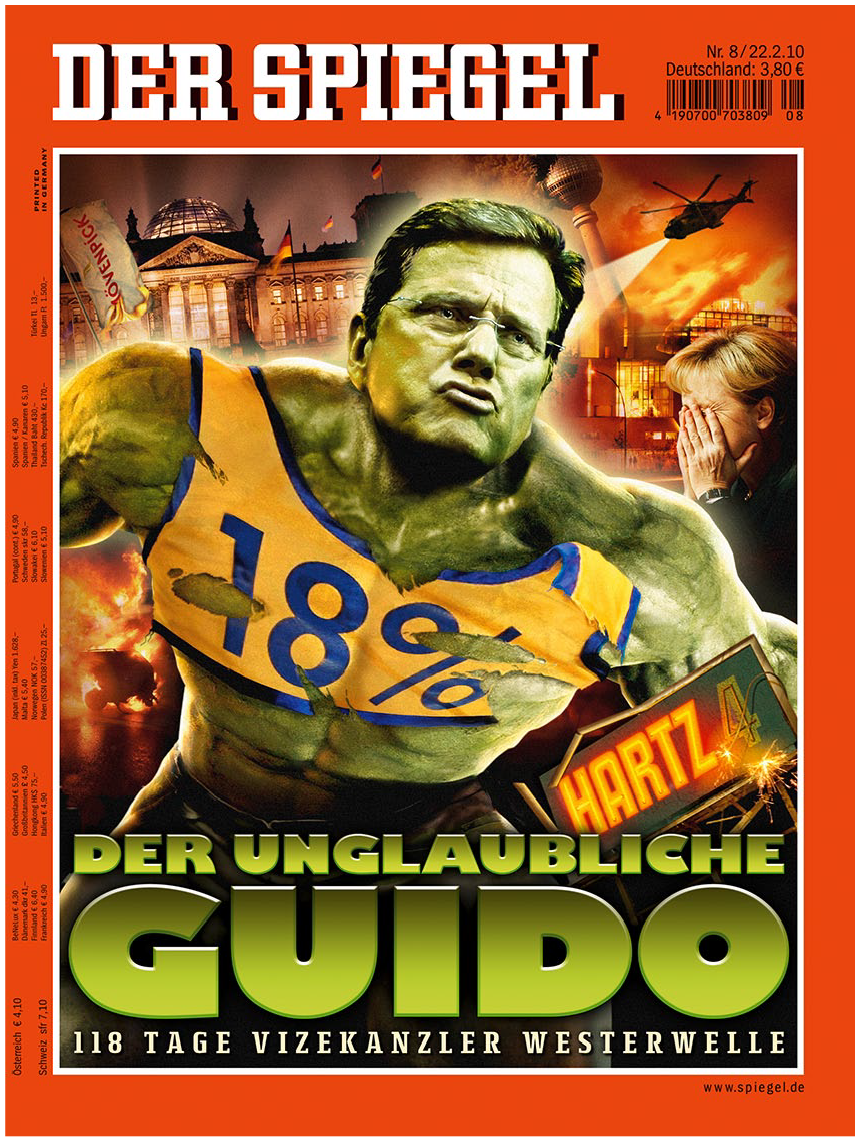
Der Spiegel, 22 February 2010. © DER SPIEGEL, reproduced with permission.
In a similar manner, though in a static way, the Minister-President of Thuringia Bodo Ramelow of the party The Left, is depicted on a Compact cover in March 2020 (Compact, 2020) as Rambo. The caption presents the catchy alliteration ‘Rambo Ramelow’ and the visual orchestration differs only slightly from the original Rambo II movie poster. Portrayed from the head to the hips and in a slight low-angle shot, Ramelow stands in an upright position catching the eye of the observer. He wears a red bandeau, a dark muscle shirt and poses with a rapid fire gun, holding it right in front of his waist. A source of light shines upon him from the upper right side. In the background we can see red flames and black smoke.
The cover has to be seen in the context of the Thuringian government crisis in February 2020 which was triggered by the election of Thomas Kemmerich (FDP) on 5 February. For the first time, a Minister-President was elected with votes from the right-wing populist and partly right-wing extremist AfD. In the first two ballots, Bodo Ramelow of the Left Party and Christoph Kindervater as the non-party candidate of the AfD were up for election. Since neither of them received an absolute majority in the Landtag, the FDP parliamentary group proposed its leader Kemmerich as a third candidate in the third ballot. The AfD parliamentary group maintained Kindervater’s candidacy for the third ballot, but unanimously voted for Kemmerich, who finally won the election. After severe criticism, he resigned three days later. The subtitle ‘The red coup’ alludes to the view that Kemmerich had been forced to resign and that a legitimate election had been cancelled. Instead, the ‘elite’ (The Left, SPD, The Greens and the CDU) had installed a left minority government. From this perspective, the visual reference reveals a twist as Rambo is usually referred to as an anti-communist hero (Sweeney, 1999). However, the cover presents Ramelow as coup leader who circumvents the ‘true’ will of the people.
Both covers relate the depicted representatives to action heroes, dominating the scene with their massive bodies. This popular cultural genre might also be appealing to an audience not interested in party politics and quarrelling between political actors. At the same time, the references foster a dramatization and emotionalization of politics.
National Socialists
Another image type found in the visualization of contemporary politicians concerns historical recontextualizations. Direct references to National Socialism (NS) play a major role in the portrayal of right-wing populist actors, e.g. in political cartoons (Herkman, 2019). Thus, two examples from this category are presented here. Especially in German political culture, analogies to NS have an emotionalizing potential. In issue no. 6 of 2016, Der Spiegel portrayed the AfD’s chairwoman Frauke Petry together with the well-known party official Alexander Gauland in the form of busts (Figure 4). Both show the same severe facial expression. They hold their heads high and their gaze seems to focus a distant target standing on the right side from the perspective of the viewer. In the background, we see a crowd gathering on a grandstand bordered by arcades at the top end. Whereas the two politicians are each inserted with a modern photograph, though in black-and-white and sepia, the background is depicted in the form of a somewhat blurred and dusty-looking old photograph. Continuing the analysis to the connotative level allows for the interpretation that the construction in the background is the grandstand of the Zeppelin Field on the National Socialist’s party (NSDAP) rally grounds in Nuremberg. Considering the image’s dimensions, the politicians are inserted at the site as if they were leaders of the NSDAP. The allusion is underscored by the slight low-angle shot which reminds the viewer of fascist propaganda photography (Herz, 1994) and films such as the well-known Triumph of the Will from 1935 by Leni Riefenstahl. The people in the background are waving different kinds of flags known from rallies of the ethno-nationalistic PEGIDA movement that have been taking place in Germany since October 2014. Together with the caption ‘the hate preachers’, the anachronistic visual orchestration hints at the relation between the AfD and PEGIDA and the implications this has for the political climate (Vorländer et al., 2018: 202). The issue’s publication preceded a provocative statement ascribed to Petry saying that the police – as ultima ratio – had to use firearms to stop illegal refugees at the border.
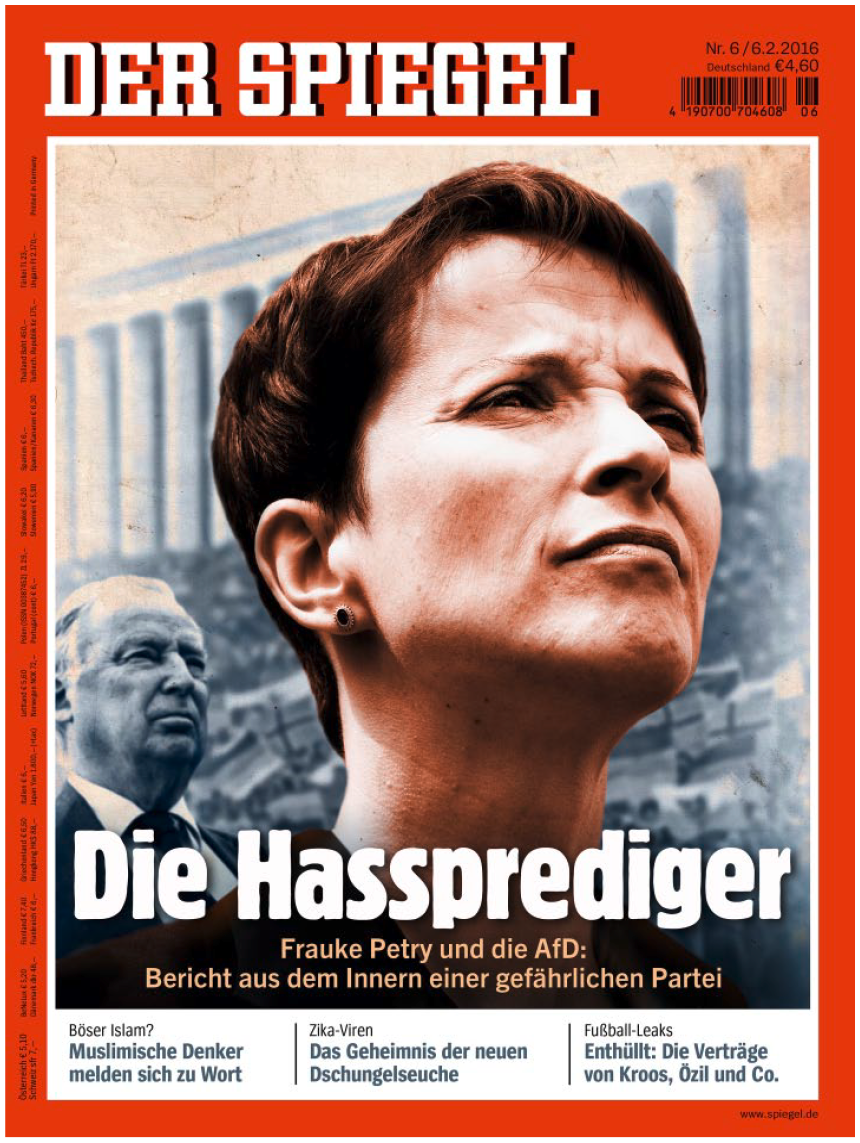
Der Spiegel, 6 February 2016. © DER SPIEGEL, reproduced with permission.
Strikingly, the reference to NS in the depiction of contemporary politicians is not restricted to representatives of right-wing parties’ depictions in a mainstream medium. The cover of Compact issue no. 01/2017 shows Chancellor Merkel in a bust portrait black and white photograph with a completely black background (Compact, 2017a). A source of light illuminates the right half of her face. In the lower left corner, we can see her right hand making a moderating gesture. It seems to be a typical depiction of her, except for the iconic ‘Hitler moustache’. The black-and-white photograph suggests a reference to the past. Combined with a low-angle shot it creates a perfect analogy to the iconography of NS propaganda (Herz, 1994).
As the caption ‘Merkel’s last battle. End time in the chancellor’s bunker’ reveals, the example refers to Adolf Hitler’s last days in the Führerbunker and the analogy of wishing for the end of Merkel’s tenure as chancellor. Thus, the cover draws a parallel between the delusional and self-centred dictator, who lived in seclusion, and the incumbent chancellor Merkel not reflecting upon her supposed mistakes. As a result of Donald Trump’s election and the global rise of illiberalism, she was called the ‘leader of the free world’ (Garton Ash, 2016). Compact counters this view with the following message: just as Nazi Germany could only come to an end with Hitler’s death, the ‘globalist elite’ and the ‘liberal world’ would only end with Merkel’s resignation. 11
To sum up, then, the two presented cases both make use of what is anchored in the collective memory as evil. However, the cover images point to two different developments perceived as dangerous. The outrage-provoking visualizations of Der Spiegel deal with the danger right-wing populist actors pose for liberal democracy. The cover of Compact, in contrast, purports to oppose a ‘liberal hegemony’ incarnated by Merkel who is depicted as a dictator. The linkage to Nazi dictatorship in Compact covers is also salient in representations of other politicians. The May 2011 issue depicts Renate Künast (The Greens) in the uniform of the Schutzstaffel. Heiko Maas (Social Democratic Party), Minister of Justice, equally shown in a uniform, was associated with Joseph Goebbels and his speech in the Berlin Sportpalast (1943) in July 2016 (Compact, 2011, 2016). In this sense, the reference to NS seems to be a popular visual stylistic device used by the far-right alternative magazine to depict leading members of government or the disdained Greens as members of an illegitimate elite.
Antagonists
Compact most often only depicts a single politician on its covers whereas Der Spiegel also focuses on interaction of representatives. However, negotiation and deliberation as ideal principles of democracy do not seem to characterize these visual representations. Rather, an antagonistic element comes to the fore. According to the notion of populism through the media, the tendency towards highlighting conflict and breakdown has been described as an opportunity structure for political populism, potentially catalysing general mistrust in representatives (Mazzoleni, 2008). The focus on dissent and on politicians as opponents is reflected visually in multiple ways. Der Spiegel of 4 June 2016 shows Chancellor Merkel and the Bavarian Minister-President Horst Seehofer arranged symmetrically yet clearly separated on a red couch (Figure 5a). They ostentatiously face away from each other, a setting which reminds the viewer of a couple in crisis, unwilling to communicate. Seehofer clenches his fists and presses his lips together tightly, expressing aggressiveness and Merkel’s posture, as well as her facial display, conveys defiance. The issue was published at a time when the two politicians’ parties were in a factional struggle about the conservative orientation of the Union. 12 The dispute had already begun during the so-called European refugee crisis in 2015 when Seehofer called for a restrictive immigration policy. The headline ‘Are you crazy?’ hints at its potential consequences for the stability of the grand coalition as well as at the assumed boost for the right-wing populist AfD which could ensue. The subtitle ‘The Chancellor and her Seehofer: A vain enmity becomes a danger to the country’ also points to the damage to the nation which is visually symbolized by the use of the German flag’s black, red and gold colours.
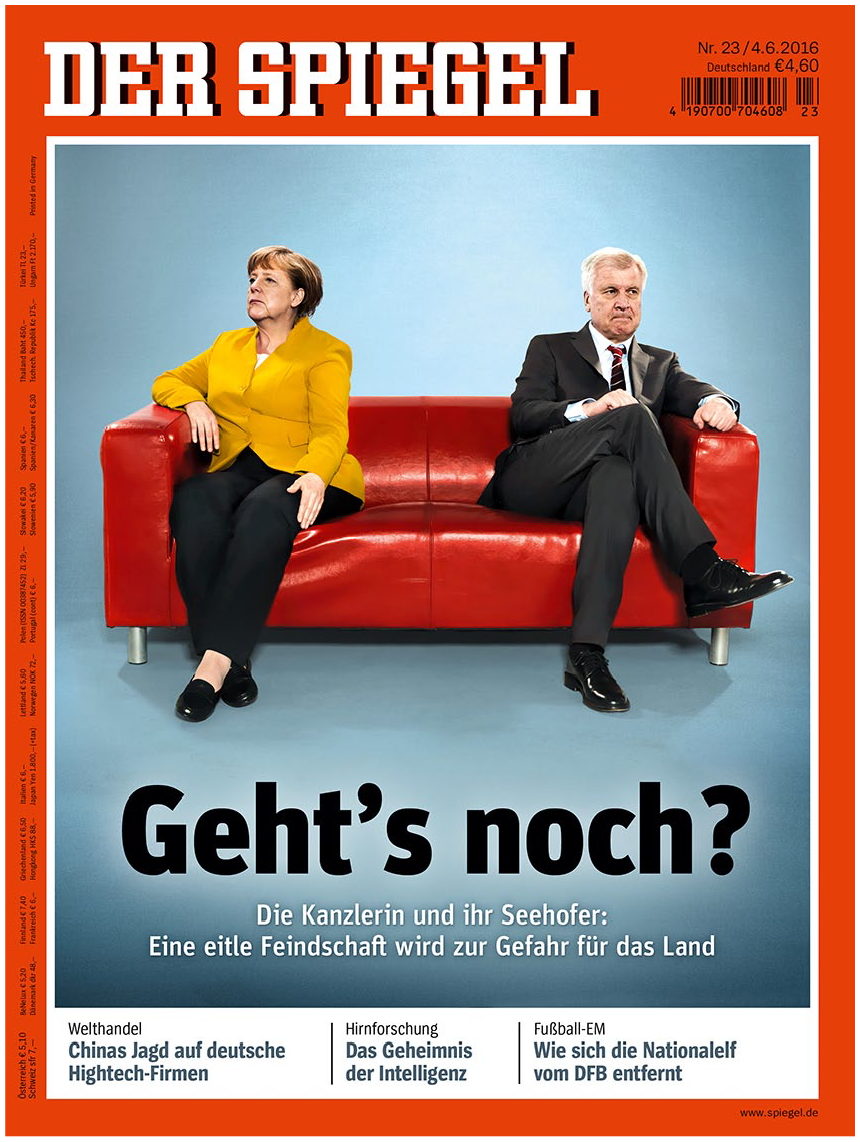
Der Spiegel, 4 June 2016. © DER SPIEGEL, reproduced with permission.
Figure 5b shows another display of visualized antagonism. This visually construed antithesis (Tseronis, 2021: 11) published in November 2014 deals with the Ukraine crisis, triggered by the annexation of the Crimea by Russia. On the upper left side, we can see Merkel’s severe looking face in a profile shot, looking directly into the eyes of Vladimir Putin, whose face opposes hers in exactly the same way. Both heads are bent slightly forward suggesting their readiness to fight. A virtual vertical line divides the image into two halves, symbolizing the two camps in the conflict. The opponents seem to be backed by their adherents, symbolically visualized by crowds waving the Ukrainian and the European flag on the one side and the Russian one on the other. The bluish cast in the faces and the background remind the viewer of ice. This impression is emphasized by the caption ‘Cold Warriors’, which is at the same time an insinuation of a possible immediate escalation. Taken together, the image type antagonists is interpreted as an expression of populism through the media as it stresses conflict and not the consensus-seeking aspects of democracy.
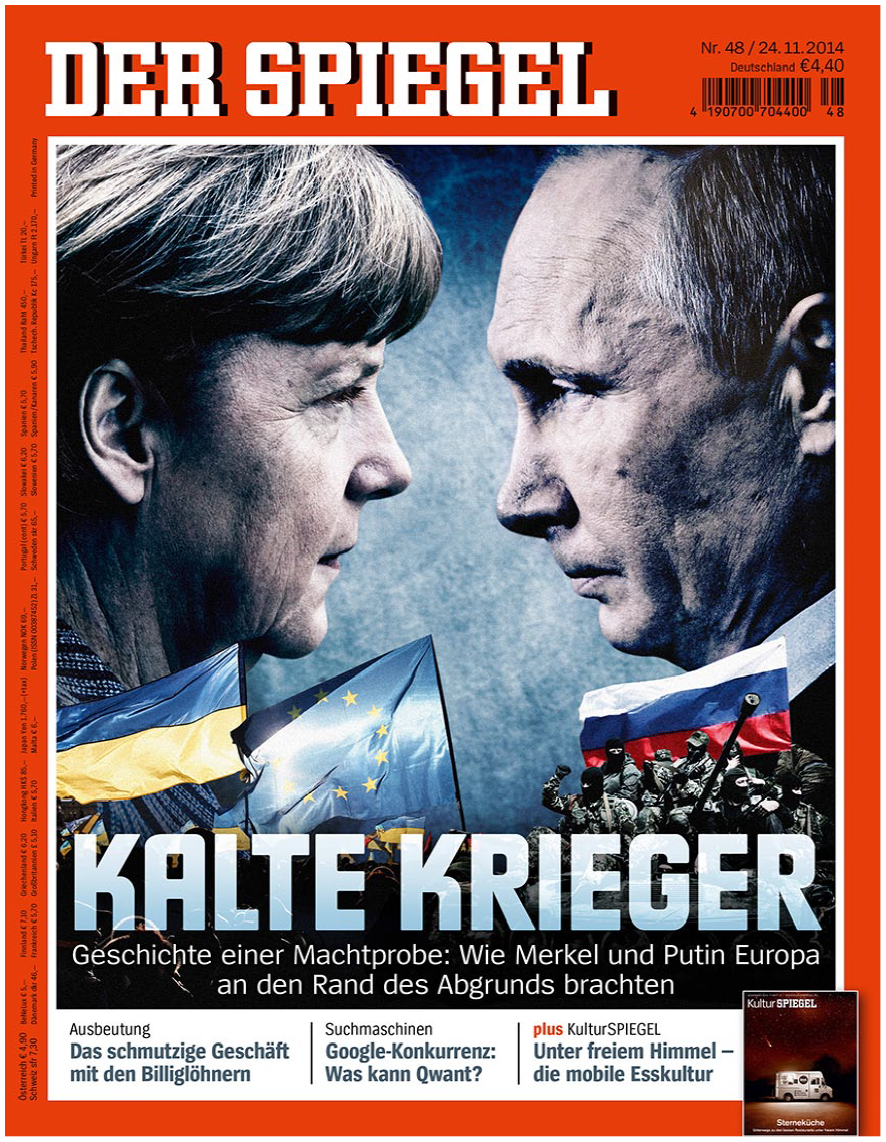
Der Spiegel, 24 November 2014. © DER SPIEGEL, reproduced with permission.
Interchangeable elite
The antagonistic type almost exclusively occurs in the images of Der Spiegel, due also to Compact’s focus on one politician per cover. The interchangeable elite, however, is an example exclusively present in the latter. Obviously using photomontage, the faces of the Social Democratic candidates for the chancellorship in the 2013 and 2017 campaigns were placed onto Merkel’s body.
Compact issue no. 11/2012 shows a bust portrait of Merkel with a fusion of Peer Steinbrück’s face, the dome of the Bundestag building appearing in the background (Compact, 2012). Steinbrück, who formerly led the Federal Ministry of Finance (2005–2009), was nominated as the candidate for chancellorship of the Social Democrats (SPD) in October 2012. 13 The caption saying ‘Steinbrück: Is she going to be the next chancellor?’ underscores the assumed arbitrary replaceability. Thus, in this image, Merkel and Steinbrück represent the entirety of the ‘corrupt elite’ who do not act in accordance with the will of the ‘people’. Following this interpretation, the dome’s symbolic meaning of parliamentarism and democratic transparency is challenged here. Its eclipse instead points to the elite’s dark deeds.
Similarly, we find a visualization of Martin Schulz in the Compact issue no. 03/2017 showing his face on Merkel’s body, unmistakably symbolized by her iconic diamond gesture and unicoloured blazer (Compact, 2017b). In the background, the European Flag is visible, pointing to his presidency of the European Parliament (2012–2017). The stars of the flag are orchestrated as a halo which alludes to Schulz’s glorification and the euphoria among German Social Democrats in the federal election battle. The former EU politician was very popular and his nomination as candidate brought back momentum for the stumbling SPD against Merkel’s CDU. 14 The headline ‘Schulz becomes Merkel’ as well as the subtitle ‘The new candidate of the elite’ support the visual message of an homogeneously constructed elite. These images take up the populist narrative of a conformist elite whose personnel is considered interchangeable in their political positions, no matter their party affiliation. The interpretation of the interchangeable elite presented here thus points to populism by the media.
Conclusion
This study has enquired into the question of how far a theoretical distinction between populism through and by the media becomes visible in a comparative analysis of the visualizations of German politicians on covers of the German news weekly Der Spiegel and the far-right alternative monthly Compact. The analysis offers insights into the visual communication of two German political magazines that are important mouthpieces of the potential electorate of mainstream parties and a right-wing populist and extremist party, respectively.
Of course, populism by the media on the part of Der Spiegel is not to be expected from the outset. However, an agitating style for attention-grabbing purposes is likely to be visible in both magazines, just as Christian, Social and Liberal Democrats may sometimes use provocative rhetoric. In order to further clarify the theoretical distinction between populism through and by the media, a linguistic differentiation between the adjective ‘populist’ and the noun ‘populism’ is considered useful. While the former refers to a temporary appealing rhetoric and style also used by mainstream media, the latter is understood as a political programme of a medium in the ideational sense (Puhle, 2021: 46). Within the notion of populism through the media, the visual highlighting of conflict and antagonism in democratic politics can be interpreted as opportunity structures for populist actors. An example is the image type antagonists. The prioritization of conflict is considered to be obstructive to democratic discourse and is closely linked to theoretical debates on the tense relationship between democracy and populism in a media and communication perspective. Although conflict is also at the heart of democracy, ‘a purely agonistic view dismisses the fact that the politics of consensus-seeking through communicative action is also central to democracy’ (Waisbord, 2019: 231).
However, as the analysis shows, populism as an ‘-ism’, i.e. populism by the media, only applies to Compact. Regarding the populist Manichean world view of ‘bad elites’ acting against the ‘good people’, this becomes visible in the image type of the interchangeable elite as well as in criminals. As far as xenophobic and Islamophobic imagery is concerned, this materializes in the type of religious context.
The image type action heroes reveals that both periodicals draw on this popular cultural genre, indicating an emotionalization and dramatization of politics. Such references to popular tastes are also reflected in the type of National Socialists, which has traditionally been a popular reference in German politics and culture and is widely used to defame and scandalize the political opponent, no matter its ideological orientation (Eitz and Stötzel, 2007: 489–504). Compact uses ostensibly unambiguous visual references to past regimes for new rule, power and representational purposes.
Admittedly, the results presented here are limited in scope, and this is mainly for two reasons. Firstly, the study relies on a relatively small sample, focusing only on depictions of politicians in magazine covers. This is a reasonable starting point for analysis given the high degree of personalization in political news coverage and the potential implications visual framing of politicians may have for identification purposes of the citizens in the context of populism (Diehl, 2017). However, future research should take into account various outlets as well as images with more policy-specific content. By looking at visuals dealing with issues that right-wing populist and far-right actors are considered to have ownership of, such as migration, future research could provide deeper insights with regard to the construction of populist chains of equivalence. Secondly, the semiotic approach does not allow for inferences of recipients’ reactions. Therefore, future research is encouraged to expand the approach by adopting an audience-centred perspective.
Notwithstanding these methodological caveats, this contribution has shown the potential of studying magazine covers in a populist communication context. Approaching populism from the performative and stylistic perspective has proved useful as it allows precise reflection upon the complex relationship between content and style. In order to arrive at a satisfactory iconological interpretation, we as observers are dependent on both contextual information in the sense of knowledge on current affairs as well as on paratextual knowledge (Genette, 1997), i.e. additional information that goes beyond the images such as captions and the journalistic stories behind them. Nonetheless, images should be considered as discursive acts within this theoretical approach because they are powerful instruments for simplifying, emotionalizing and dramatizing political issues. They are easily modified, re-contextualized and used for populist and anti-democratic purposes, as can be seen in the meme culture, hate speech and in targeted political disinformation campaigns. Therefore, it is crucial to further clarify the role of images in the problematic relationship between populism and liberal democracy, and the growing importance of post-truth politics (Waisbord, 2019). Within this context, research should also investigate mutual references in the imagery of mainstream and self-proclaimed alternative media. Fostering visual media literacy in this field will be increasingly necessary as visual communication and its emotional appeal are expected to gain relevance in years to come, online as well as offline.
Footnotes
Acknowledgements
An earlier version of this article was presented at the 2nd Helsinki Conference on Emotions, Populism and Polarisation (HEPP) in May 2021. I want to thank all the participants for their helpful comments. I am also indebted to two anonymous reviewers as well as Horst-Alfred Heinrich and Maximiliane Eckhardt who helped to improve the manuscript with their valuable thoughts. Jack Broughton took care of linguistic revisions. Finally, I am grateful to Jana Pflaeging, one of the journal’s editors, for her kind support in the publication process.
Declaration of Conflicting Interests
The author declared no potential conflicts of interest with respect to the research, authorship and publication of this article.
Funding
This study was conducted as part of the research project Visualisierung der Demokratie within the Bavarian Research Association ForDemocracy. The project was funded by the Bavarian State Ministry of Science and the Arts.

Notes
Author biography
Address: University of Passau Faculty of Arts and Humanities, Dr.-Hans-Kapfinger-Straße 14d, Passau, 94032 Germany. [ email: