




Abstract
This study explores voters’ populist alternative news use during (different types of) democratic elections and investigates starting points for preventing potentially harmful effects. We draw from two combined data sets of web-tracking and survey data which were collected during the 2017 German Bundestag campaign (1523 participants) and the 2019 European Parliamentary election campaign in Germany (1009 participants). Results indicate that while populist alternative news outlets drew more interest during the first-order election campaign, they reached only 16.5% of users even then. Moreover, most users visited their websites rather seldom. Nonetheless, our data suggest that alternative news exposure is strongly linked to voting for (right-wing) populist parties. Regarding the origins of exposure, our analyses punctuate the role of platforms in referring users to populist alternative news. About 40% of website visits originated from Facebook alone in both data sets and another third of visits from search engines. This raises questions about algorithmic accountability.
Following the rise of the Internet, “alternative” news sources increasingly complement legacy media in citizens’ political information diets (Downing, 2003). While early research on online alternative media stressed their deliberative and participatory potentials for democratic protest movements (e.g. Downey and Fenton, 2003; Fenton and Barassi, 2011; Harcup, 2011), alternative media have more recently been linked to problematic forms of protest and negative changes in democratic culture. There is evidence for the emergence of alt-right alternative news infrastructures in many countries across the globe (Figenschou and Ihlebæk, 2019; Heft et al., 2020; Kaiser et al., 2020), and several scholars identified them as one of many factors behind the growing success of right-wing populist politics in elections worldwide (Holt, 2020; Krämer, 2017; Müller and Schulz, 2021; Stier et al., 2020).
Considering the novelty of the phenomenon, it is still unclear which role voters’ populist alternative news use plays for (different types of) democratic elections—and whether anything should be done about it. To inform discussion of these questions, we investigate (1) the prevalence of populist alternative news use during two different types of campaign settings, namely, first- and second-order elections (Reif and Schmitt, 1980). Moreover, we analyze (2) which groups of voters are actually reached by the respective outlets’ coverage and (3) how exposure relates to voting for allegedly populist parties. In an attempt to identify causes of populist alternative news use beyond the individual user, we also study (4) the roles played by news intermediaries in generating attention for populist alternative news.
For this purpose, we build on two data sets from Germany that offer a unique combination of participants’ survey responses with fine-grained records of their browsing behavior. The first data set was collected during the 2017 German Federal Election campaign and the second one during the 2019 European Parliamentary elections in Germany. Using digital trace data circumvents many of the methodological pitfalls of survey-based research on alternative news exposure (Müller and Schulz, 2021; Noppari et al., 2019 Schulze, 2020). Moreover, comparing two subsequent election periods from the same country that, however, vary in election type enables us to offer a more nuanced perspective on the role of voters’ populist alternative news exposure than previous research focusing on single elections (Guess et al., 2020). It helps to determine whether alternative news use is only a phenomenon of highly mobilizing periods, such as national elections, or whether it occurs to a similar extent during less politically charged times and, thus, has become part of the “new normal” of the political communication landscape.
Voters’ alternative news use and populism
Different terminologies have been used to describe a novel group of online news outlets with links to political populism: Researchers arguing from a disinformation standpoint apply labels such as “untrustworthy news” (Guess et al., 2020). Content analyses suggest that these outlets do not mainly provide users with blatant disinformation but rather with a more subtle, yet not less toxic, combination of (oftentimes factual) news, conspiracy thinking, and populist reasoning (Boberg et al., 2020; Frischlich et al., 2020; Kaiser et al., 2020). Consequently, many scholars interested in the communicative aspects of right-wing populism speak of “alternative news” (e.g. Boberg et al., 2020; Figenschou and Ihlebæk, 2019; Holt, 2019; Kaiser et al., 2020; Müller and Schulz, 2021). This is based on a widely used definition by Holt, Figenschou, and Frischlich (2019) who argue that “alternative news” should be used as a non-normative term describing outlets with a self-ascribed counter-hegemonic mission in opposition to established mainstream news sources. This consorts with populism’s notion of a fundamental opposition against the societal elite (Mudde, 2004). Thus, political populism and alternative news outlets appear to be somewhat natural allies (Holt, 2019; Krämer, 2017). However, to reflect that not all types of alternative news are natural allies to political populism (see, for example, Downey and Fenton, 2003; Downing, 2003), we follow previous research which calls this specific group of outlets “populist alternative” news media (Boberg et al., 2020; Frischlich et al., 2020; Holt and Haller, 2017; Müller and Schulz, 2021).
Against the background of this proximity between (some) alternative media and political populism, it seems plausible to assume that exposure to these outlets contributes to the electoral success of political populism (Holt, 2020; Müller and Schulz, 2021; Stier et al., 2020). Since a strong position of populist parties in parliaments can have problematic consequences for the functioning of liberal democracy (Rummens, 2017), populist alternative news use would then have to be regarded problematic as well. However, empirical evidence on the prevalence of alternative news use during campaign periods and its relationship with populist voting is scarce. Our research helps to fill these gaps. Focusing on a European context, we explore the amount of populist alternative news use in the general population during two different types of election periods and its relationship with populist voting. In addition, we try to identify origins of populist alternative news use on two levels, the audience and the digital information ecosystem. Shedding light on these questions enables us to provide recommendations on whether and, if so, how populist alternative news use should be prevented.
Prevalence of voters’ populist alternative news use
From a methodological perspective, web-tracking data outshine survey self-reports in terms of validity and reliability for the assessment of online media use (Dvir-Gvirsman et al., 2016; Scharkow, 2016; Vraga and Tully, 2020). Thus, the prevalence of populist alternative news use can best be examined using such data sources. However, there is only one previous study that explicitly uses such data and looks at an election context. Using digital trace data from a US sample, Guess et al. (2020) estimate that 44.3% of Americans aged 18 or older visited an untrustworthy website at least once during the 2016 presidential election period. Through analyzing tracking data from a set of six countries, Stier et al. (2020) find that the average number of visits to “hyperpartisan news” websites is even lower in European countries France, Spain, Germany, Italy, Spain, than in the United States. At the same time, they also estimate a much lower share of hyperpartisan news exposure for the United States than Guess et al. (2020). But this latter study does not focus on election periods. Therefore, the role played by voters’ populist alternative news use during election periods in non-US contexts remains to be explored.
The relative amount of voters’ populist alternative news exposure during election periods can only be determined using comparative approaches. A first point of comparison could be to track the amount of exposure during the course of the election cycle. Previous research indicates that key events such as elections come along with increased audience attention for politics, which translates into a continuous increase in attention to newspapers, television newscasts, and online news during campaign periods (Strömbäck and Johansson, 2007; Tewksbury, 2006). After an election date, exposure to political media formats typically drops (Tewksbury, 2006). A simulation study (Song and Boomgaarden, 2017) suggests that particularly attitude-congruent media exposure is likely to increase during election periods—which may translate into partisan polarization. Different authors have argued that populist alternative news use can be considered partisan selective exposure, at least for individuals who visit respective websites regularly (Guess et al., 2020; Müller and Schulz, 2021). For voters who are only stumbling across populist alternative news content occasionally, for instance via social media platforms, this cannot be assumed (Downing and Dron, 2020; Müller and Schulz, 2021). At the same time, however, this is also more likely during campaign periods because of the increased overall attention to political news during these times. It might therefore increase over the course of a campaign, reach a peak immediately before an election, and drop after election day. This is why we ask the following:
RQ1a. Does the extent of populist alternative news use change over the course of an election period, or immediately afterwards?
Another relative perspective on voters’ populist alternative news use is to compare different election periods. Political scientists have argued that national elections draw higher voter attention resulting in higher turnout compared with supranational or regional elections. Therefore, the former should be regarded as “first-order elections” compared with “second-order elections” (see, for example, Lefevere and Van Aelst, 2014; Reif and Schmitt, 1980).
Research has shown that media coverage of first-order elections is more intense (de Vreese, 2003). During first-order elections, also partisan polarization will likely be at a peak level, which could also promote partisan selective exposure (Dvir-Gvirsman et al., 2016; Stroud, 2010). It can therefore be assumed that more voters turn to populist alternative news during first- than second-order election periods, such as the supranational European Parliamentary elections (see, for example, Lefevere and Van Aelst, 2014; Reif and Schmitt, 1980). At the same time, however, it has been shown that small and ideologically extremist parties are more successful in second-order elections as their partisan mobilization is dependent on election salience (Schmitt et al., 2020). If that notion translates into information behavior, partisan selective exposure could also increase among partisans of populist opposition movements during second-order election periods. In light of these ambiguities, we ask the following:
RQ1b. Are there differences in the extent of populist alternative news use between first- and second-order election periods?
One reason why previous research is inconclusive regarding exposure to alternative news is variation in the number of outlets considered. Guess et al. (2020) find that many users are exposed to untrustworthy news during the US presidential election of 2016 by studying exposure to a list of 490 domains in total. Stier et al. (2020), however, estimate much lower numbers for the United States in 2019. One explanation may be that in the latter study, a data-driven approach covering the 93% most frequently visited domains across all six countries studies, is employed, resulting in a total of only 48 alternative news domains across the six countries studied, and thus, only a handful of outlets per country. We would argue that as many outlets as possible should be considered to ascertain that a potential long tail of populist alternative news outlets is not missed. In this article, we rely on such an analytical approach.
Voters’ populist alternative news use and vote choice
To understand the actual impact of populist alternative news use, we need to assess whether populist alternative news use is associated with populist vote choice. Previous research finds that German users of populist alternative media indeed had a strong preference for the most popular German right-wing populist party AfD (Müller and Schulz, 2021). Moreover, users of populist alternative news exhibit stronger populist attitudes than non-users (Stier et al., 2020), and untrustworthy website visits in the United States significantly predict support for Donald Trump (Guess et al., 2020) who is considered a right-wing populist (see, for example, Inglehart and Norris, 2016; Kreis, 2017). So far, however, it is unclear whether this also applies to left-wing populist political actors which have not been considered in previous research. We therefore ask the following:
RQ2. Is populist alternative news use related to voting for allegedly left- or right-wing populist parties during first- and second-order elections?
Origins of voters’ populist alternative news use
If populist voters’ populist alternative news use indeed translated into populist voting to a problematic extent, it has to be asked subsequently what can be done to prevent such potentially malicious effects for liberal democracy. For this purpose, it is essential to understand the origins of exposure. In this perspective, two lines of reasoning can be distinguished: (1) a person-centered approach and (2) a technology-centered approach. The latter asks for the role of the online media ecosystem in creating favorable opportunity structures for the distribution of populist alternative news content. This means investigating the role of news intermediaries such as social media platforms and search engines in referring users to alternative news websites.
In high-choice media environments where users increasingly develop news-find-me perceptions toward information exposure (Gil de Zúñiga and Diehl, 2019), intermediaries are increasingly important in creating attention for news (Scharkow et al., 2020). To evaluate the democratic role of such algorithm-driven content hubs, it is important to investigate whether they steer users toward outlets with questionable content. For the US elections of 2016, Guess et al. (2020) find that Facebook played a crucial role as a gateway to untrustworthy news websites, while Twitter and Google were less important. For Germany, survey results highlight the importance of social media use in general (Schulze, 2020) and the role of Twitter and Facebook in particular (Müller and Schulz, 2021). Facebook, quite generally, seems to play an important role as a communication hub for citizens with populist attitudes (Müller and Schulz, 2019) and is a strong determinant of occasional populist alternative news use in particular (Müller and Schulz, 2021). In addition, Guess et al. (2020) observe that about 10% of untrustworthy website visits were preceded by visits to a web-mail service. This indicates that not only algorithm-driven selection but also interpersonal recommendations initiate populist alternative news use. Thus, not merely technologies, but also users’ communicative actions should be considered as news intermediaries. Findings on this latter aspect are, apart from Guess et al. (2020), scarce. Therefore, we ask the following:
RQ3. Which news intermediaries lead users to arrive at populist alternative news websites during first- and second-order elections?
Beyond technology, it is also important to look at the personal level predictors of populist alternative news use. Determining specific user groups who typically use these outlets as information sources helps, for instance, to tailor counter-narratives and in targeting the right audiences with them (Poole and Giraud, 2019). Previous research suggests that political interest is one of the most important person-level predictors of news exposure in general (Boulianne, 2011; Dahlgren, 2019). This seems particularly true in online environments which offer news opportunity structures for news avoidance (Skovsgaard and Andersen, 2020). At the same time, populist alternative news could be particularly attractive to people who are motivated to avoid legacy news outlets. Consequently, political interest seems to play an ambivalent role. While there is no significant predictor of alternative media use in a German survey study by Müller and Schulz (2021) and the multi-country web-tracking study by Stier et al. (2020), Guess et al. (2020) as well as Schulze (2020) find that it significantly increases the likelihood of using populist alternative news websites.
When it comes to the demographic profile of populist alternative news users, findings are somewhat more consistent. Previous studies unequivocally indicate that male gender (Guess et al., 2020; Müller and Schulz, 2021; Schulze, 2020; Stier et al., 2020) and higher formal education (Guess et al., 2020; Müller and Schulz, 2021; Stier et al., 2020) are significant predictors of more frequent alternative news exposure. At the same time, studies are inconclusive as to the role played by age: Tracking studies by Guess et al. (2020) and Stier et al. (2020) find that older individuals more frequently use populist alternative news, while younger age is a strong predictor of occasional exposure to populist alternative news in one German survey study (Müller and Schulz, 2021). One reason for these ambiguities might be that different sets of (control) variables were considered in previous research. When asking which users should be targeted with counter-narratives against populist alternative news, it seems important to determine how exposure is related to political interest and demographic factors when controlling for populist partisanship as populist partisans in total can quite effectively be targeted via online channels (Kruschinski and Haller, 2017). The question is: Are there specific sub-groups of populist partisans that are specifically attracted to populist alternative news? In doing so, we have to distinguish between people who are only occasionally exposed to populist alternative news and those who use these websites frequently (Müller and Schulz, 2021). We therefore ask the following:
RQ4. How are (a) socio-demographic characteristics and (b) political interest related to the amount of populist alternative news use when populist voting is controlled for?
Method
To investigate our research questions, we build on two data sets from Germany (collected in 2017 and 2019) that combine web-tracking observations of participants’ stationary and mobile Internet use with surveys of the same individuals. To achieve maximum comparability of the two data sets, data were collected by the same survey vendor (respondi AG) using the same methodological approach. The vendor operates a large-scale opt-in online-access panel for social research where individuals are usually recruited through banner ads placed on websites or on social media. Participation is usually open to everyone interested. To achieve a sample from this pool of individuals that mimics the population of German Internet users on pre-defined characteristics, a quota procedure based on age, education, and gender was used to invite participants for this project.
For both data sets, participants’ browsing behavior was logged using a web browser plugin that they installed on their personal computers and a research app that they installed on their mobile devices. Each time a participant navigated to a website, the complete URL and a time stamp were stored. Information about participants’ interactions with a website and the content they saw was not recorded. At any time, participants could opt to pause tracking temporarily or opt out of participation in data collection completely. All data were provided in pseudonymized and de-identified form to the authors of this article. Under these circumstances, our research has been exempted from ethics approval by the ethics committee of the University of Mannheim, Germany. Analysis codes, survey questionnaires, and additional materials of this research can be obtained from osf: https://osf.io/67rwq/
2017 data
The 2017 data were originally collected for a third party (SINUS Markt- und Sozialforschung GmbH) not involved in the design, analysis, and writing of this article. Data were collected from 15 August to 31 October, covering the German federal election on 24 September (Bundestagswahl). A total of n = 2538 persons (all eligible to vote) were invited for participation using quotas for age, gender, and education. Several criteria needed to be fulfilled to be included in the analysis sample for this study, however. First, invited participants had to provide tracking data during the whole field period (n = 1623, resulting in a participation rate of 63.9%). Second, participants could only be included in the analysis sample if they responded to a pre-election survey fielded between 21 August and 28 August (1623 complete responses, that is, a participation rate of 63.9%, 86 break-offs, 586 screened out, 247 did not start the survey) and a post-election survey fielded between 25 September to 2 October (1739 valid responses, that is, a participation rate of 68.5%, 51 break-offs, 586 screened out, 162 did not start the survey). With these criteria, our final analysis sample consists of 1523 participants (54.9% female; age: M = 42.4; SD = 14.4; 41.1% with highest secondary German school degree ‘Abitur’). For all further analyses, we weighted the analysis sample to represent the German adult population using the Internet in 2017. Population benchmarks for weighting were obtained from the Federal Statistical Office of Germany. Weights were calculated based on age, gender, and social status using ranking as implemented in the R package ‘survey’ (Lumley, 2004).
The pre-election survey collected information on participants’ socio-demographic background as well as their political interest (scale from 0 = no interest at all to 10 = very high interest; M = 6.29; SD = 2.70). The post-election survey asked for respondents’ vote choice in the election. Full questionnaires of the surveys are available via the osf link provided above. Tracking data were recorded at the URL level, allowing for more fine-grained analyses than records restricted to visited domains. However, the data do not include both, mobile and browser logs, for all participants. Mobile tracking data are available for a subset of 965 individuals, PC tracking data for 1250 persons. The reason for this is that participants either did not own both types of devices or did not install the data collection software on all devices. In addition, we cannot observe if, when, and how long users turned off data collection temporarily. However, the data contain many visits to potentially sensitive websites (e.g. featuring adult content or illegal video streaming), leading us to assume that users did not temporarily opt out of data collection very often.
2019 data
The 2019 data set was gathered in the forerun to the 2019 European Parliamentary elections. It also contains data on the election in Germany, which took place on 26 May. Data were collected in a way similar to the 2017 data collection. A quota sample of participants (n = 1636) was selected using the same quota sampling approach and the same survey vendor’s panel. Participants’ online behavior was tracked from 26 April through 27 May. PC (n = 737) and mobile tracking data (n = 554) are not available for all participants for the same reasons mentioned above. However, each participant in the analysis sample was tracked on at least one device. Different to the 2017 data, mobile browsing behavior was captured at the domain level only, not including full URLs.
Two surveys were conducted, one before (20 May–25 May) and one immediately after the election date (31 May–11 June). Eleven respondents broke off the pre-election survey and four did not finish the post-election survey. Moreover, one participant was screened out in the post-election survey. Applying the same criteria as above (tracking data collected during whole field period, participation in two surveys), the 2019 final analysis sample contains 1009 participants (overall participation rate 61.7%; 46.2% female; age: M = 47.8; SD = 12.9; 40.6% with highest secondary German school degree ‘Abitur’). For further analyses, the analysis sample was weighted using the same weighting procedure as the 2017 data, but with population benchmarks for 2019.
The pre-election survey featured questions about participants’ socio-demographics and their political interest. Political interest was assessed using a scale from 1 = no interest to 5 = high interest (M = 1.92; SD = 0.89). Full survey questionnaires are available via the osf link provided above.
Analyses
To answer our research questions, we analyzed both data sets in a similar way. All analyses were conducted in R, version 4.0.2 using weighted data sets. After joining survey and panel data, we identified populist alternative news impressions as well as other news website impressions at the domain level. For classification of visits as populist alternative news, we used a list of 137 German language websites that we identified as populist alternative news in a two-step process. First, we gathered a list of potentially relevant domains building on previous research from Germany (Bach et al., 2019; Boberg et al., 2020; Müller and Schulz, 2021; Stier et al., 2020) and two rounds of own online investigations which were conducted in 2018 and 2020. Second, we inspected all of these websites checking (1) whether they contained information on current political and societal affairs and (2) whether any one article presented at the respective website’s landing page at a reference date in July 2020 featured at least one type of populist key message as defined by previous research on populist communication (Müller et al., 2017).
Only if both criteria were met, a domain was classified as containing populist alternative news. The resulting list includes outlets from different ends of the political spectrum, although right-leaning websites are clearly predominant. Other news website impressions were captured using an exhaustive list of German news outlet domains provided by Scharkow et al. (2020). Populist alternative news websites as well as radio station websites without a substantial amount of written news items were removed from this list. Both domain lists can be obtained from the osf link provided above. Finally, we also comprised domain lists of relevant social media platforms, search engines, and web-mail providers in Germany to study the role of intermediaries in referring users to populist alternative news websites.
Preliminary analyses revealed that there is an excess number of cases with zero exposure to alternative news in both data sets. To account for this skewed distribution of our criterion variable, we opted to use hurdle models (see Mullahy, 1986) to analyze predictors of alternative news use. Hurdle models are two-part models. The first part specifies a process for zero counts (here, people who were not exposed to alternative news at all vs at least one visit), and the second part specifies a (left-truncated) count model for those with at least one visit. That is, in contrast to zero-inflated models which split up zeros into excess zeros and count zeros, hurdle models fully separate the zero and non-zero counts (Loeys et al., 2012). Following Rose et al. (2006), we let


That is,

where
To explore the role played by news intermediaries, we analyzed which websites a user visited before opening a site from a populist alternative news source. Since our mobile data do not allow to trace referrals from apps to websites, we limited our analyses on the role of intermediaries to PC browsing records. Our approach follows a study by Möller et al. (2020) We first identified individuals who accessed populist alternative news outlets at least once over the duration of data collection. We then grouped all weblogs of a respondent into browsing sessions. A browsing session is a continuous period of user activity. If the time gap between two URL entries of one user is longer than 20 minutes, we interpreted these two website visits as belonging to two different browsing sessions. Third, we limited the resulting data to those browsing sessions that contain at least one visit to populist alternative media outlets. We then investigated whether the URL preceding the visit to a populist alternative news article belongs to our predefined list of social media platforms, search engines, and web-mail providers or whether it had the same domain as the article itself (counted as a “direct” referral). However, in all cases, preceding URLs are only considered if they belonged to the same browsing session.
Results
To put the amount of populist alternative news use in perspective, we first present descriptive results before turning to the exploration of posed research questions. The data indicate that 16.5% of the participants (95% confidence interval [CI]: lower limit [LL] = 14.4%; upper limit [UL] = 18.6%) were exposed to populist alternative news media during the full observation period of 2.5 months in 2017 (at least one visit). The average number of populist alternative media page impressions within this group is M = 57.5 (95% CI: LL = 0; UL = 115.5) for the whole time period. However, this distribution is heavily skewed. The median number of visits is 3, indicating that the high mean results from a small number of outliers with a high amount of exposure. On average, the amount of populist alternative news website visits make up M = 7.7% (95% CI: LL = 5.7%; UL = 9.6%) of all news-related website impressions for those participants who used populist alternative news at all. Thus, the overall level of exposure to populist alternative news is relatively low and does not seem to substitute exposure to established news sources.
Looking at the temporal distribution of populist alternative news use (RQ1a), our findings suggest that the overall level of interest in the outlets under consideration was higher in the fore-run to the election than immediately afterwards. A plot of the aggregated amount of page impressions of populist alternative news websites per day (see Figure 1) suggests a slight increase of attention in the days prior to the election, followed by a sizable drop after the election has taken place. One month after the election, the plot indicates another rise of populist alternative news exposure to a level comparable with that of the pre-election period. However, this level does not seem to be permanent, as indicated by a second drop immediately before the end of data collection. For comparison purposes, we also plotted the amount of exposure to legacy news websites in Figure 1. Here, the pattern looks less intermittent with only one clearly detectable drop in the weeks after the election date.
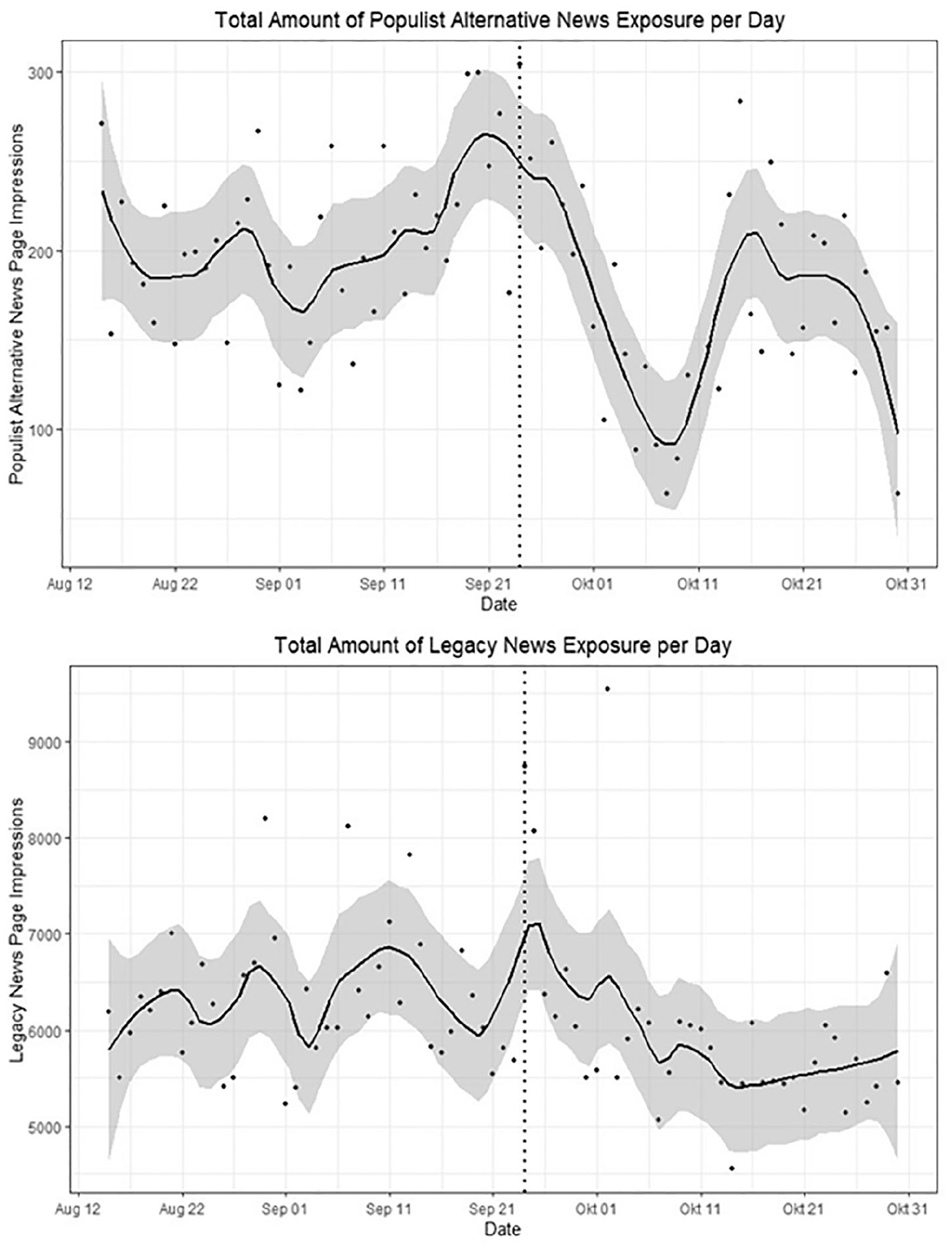
News exposure during the 2017 German Bundestag campaign.
In addition, we asked whether the amount of populist alternative news use varies between first- and second-order elections (RQ1b). Since the 2019 data only cover a 1-month period before the European Parliamentary election date in Germany, we subset the 2017 data to a 1-month period immediately before the election date (24 August–25 September 2017) for this comparison. The data support the notion that populist alternative news sites receive more attention during a first-order election. In the 2017 data set (10.5%; 95% CI: LL = 8.8%; UL = 12.3%), the number of participants with at least one visit is significantly higher than in the 2019 data set (7.4%; 95% CI: LL = 7.1%; UL = 7.8%); B = 0.036; SE = 0.013; p = .006). Similarly, a Mood’s median rank test indicates significant differences between the medians of the two data sets (t(2470) = 2.76; p = .006). That is, it seems that the amount of populist alternative news page impressions among those who visited respective websites at all was higher in the first- than in the second-order election period, too.
We also asked for the relationship between populist alternative news use and voting for populist parties (RQ2). This was tested by considering respondents’ self-reported voting decision (assessed after the election) in regression models that also accounted for the influence of demographic factors and political interest. More precisely, we use dummy variables for voting for right-wing populist party AfD and left-wing Die Linke which is also being described as populist by some authors (see, for example, van Hauwaert and van Kessel, 2018). All other voting decisions serve as the contrast group. As described above, these analyses are based on hurdle models, which allow to differentiate between factors predicting whether populist alternative news exposure occurred at all (binomial model part) and whether exposure was more or less frequent (count model part). Model estimates are depicted in Figure 2. Full model results are reported in Tables 1 and 2 of the Online Appendix.
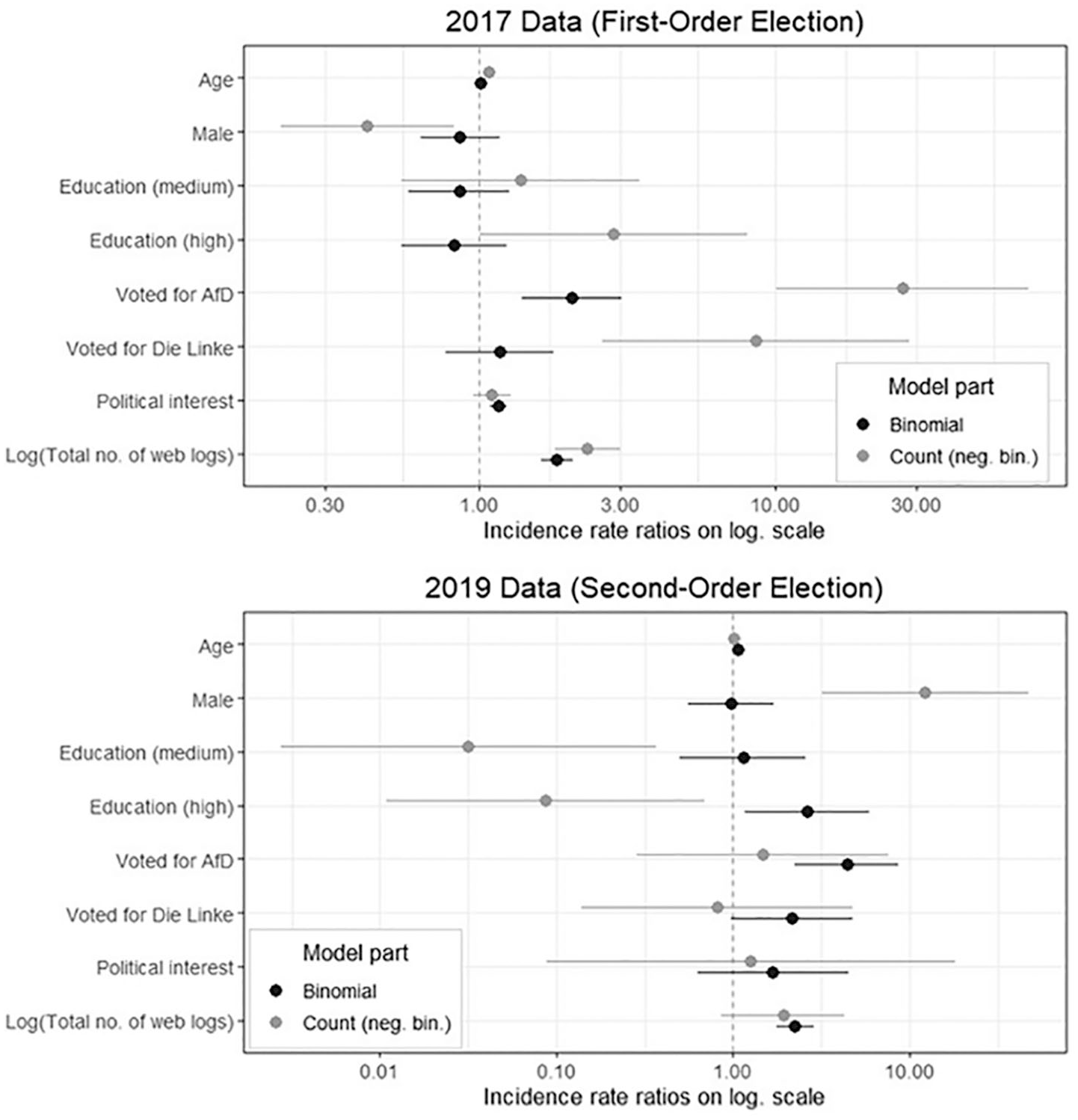
Results of hurdle models predicting populist alternative news use.
Results indicate that during the 2017 German federal election campaign, voters of right-wing populist AfD had a higher likelihood of being exposed to populist alternative news and also visited respective websites more frequently. Voting for Die Linke was only associated with exposure in the count model part. This indicates that Die Linke voters were not significantly more likely to visit populist alternative news websites than voters of other parties. But if they did, they used them more frequently than other voters. Remarkably, voting decisions are the strongest predictors of populist alternative news exposure in both parts of the model. During the 2019 European Parliamentary election campaign, the dose of populist alternative news exposure was unrelated to voting for the two allegedly populist parties. However, people who decided to vote for AfD had a higher probability of being exposed to populist alternative news content at all in the month prior to election day.
Next, we asked for the role of intermediaries in directing users toward populist alternative news websites (RQ3). Results for both election periods point in very similar directions (see Figure 3). Search engines and Facebook both played a massive role in referring German Internet users to populist alternative news websites during both election periods, together generating around 70% of all page impressions. Beyond that, also web mail services and direct referrals that occur within a website were important drivers of populist alternative news use in both data sets. Twitter and YouTube, however, had only marginal impact as intermediaries of populist alternative news use. Notably, the role of Facebook as a referrer is by far more pronounced for populist alternative news websites than for legacy news websites for which we also plotted the results in Figure 2.
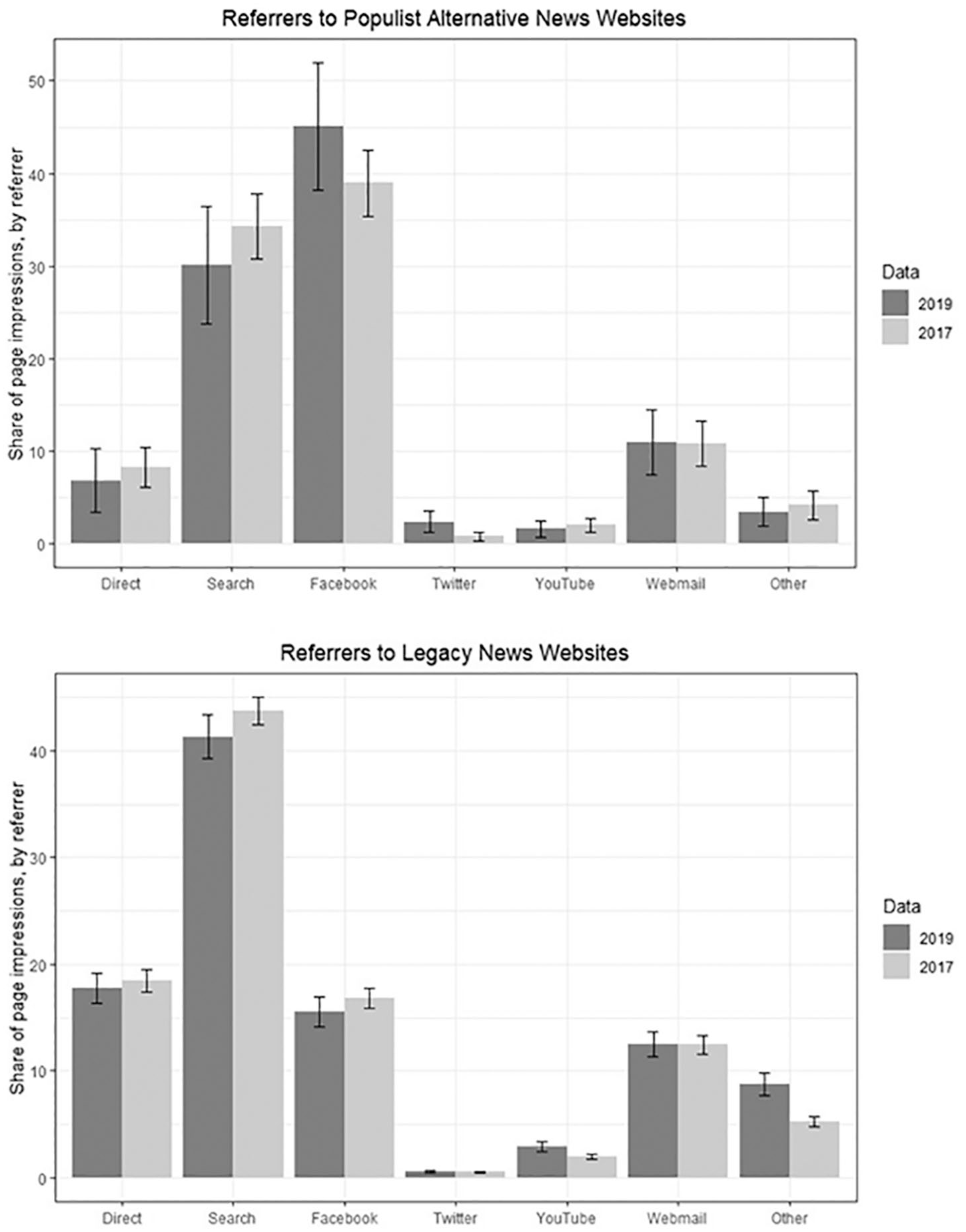
Referrers to news websites.
With regard to person-centered predictors of populist alternative news use (RQ4a and b), results from the hurdle models (Figure 2) reveal differences between the first- and second-order election periods. Higher age, for instance, significantly predicts populist alternative news use during the 2017 first-order election for both model parts while it only increased the probability of being exposed to populist alternative news at all, but not the frequency of exposure, during the 2019 second-order election. In addition, male gender reduces the incidence rate of being exposed to populist alternative news content at all in the 2017 data while it increased it in the 2019 data. Similarly, medium and high education levels reduce the likelihood of being exposed to populist alternative news at all in the 2019 data, whereas high education is a significant positive predictor in the binomial model part for the 2017 data. Political interest is unrelated to populist alternative news use in the 2019 data. In the 2017 data, it contributes to a higher dose of exposure.
Discussion
In this study, we investigated the role of populist alternative news use in first- and second-order election periods using digital trace data. Our intention was twofold: First, we wanted to determine the role populist alternative news use plays during different election periods. Second, we wanted to gather starting points for preventing potentially harmful effects for the functioning of liberal democracy. We considered an extensive collection of relevant outlets that goes well beyond previous studies (e.g. Müller and Schulz, 2021; Schulze, 2020; Stier et al., 2020). As a consequence, the amount of populist alternative news use appears somewhat higher than in previous research. The present analyses indicate that 16.5% of German Internet users visited a populist alternative news website at least once in a 4-month period around the date of the 2017 Federal Election in Germany.
In line with previous research (Müller and Schulz, 2021), our analyses also showed that a majority of users visited populist alternative news websites only very rarely during this period (with a median of three visits among those users who visited respective websites at all). Comparing these data with results from the 2019 European Parliamentary election campaign period reveals populist alternative news use is even lower in a less obtrusive second-order election. We also found that the mean share of populist alternative news exposure among all news exposure does not vary significantly between the two election periods. This suggests that populist alternative news exposure increased to a similar extent as total news exposure during first-order election periods. Taken together, these findings can be read as evidence for an existing, but somewhat marginal, role played by populist alternative news use during election periods.
Yet, the data clearly show that those voters who used populist alternative news sources during the two campaigns periods were more likely to vote for populist parties at the end of the campaign. A higher amount of populist alternative news use was related to voting for both, right-wing populist party AfD and left-wing Die Linke, in the 2017 first-order election, but not in the 2019 second-order election. In both elections, however, AfD voters were more likely to have visited at least one populist alternative news website at all. Taken together, these data suggest that while there seems to be a certain degree of affinity between left-wing voters and populist alternative news websites, their bonds with right-wing populist voters are much stronger. This is in line with extant research indicating a right-leaning slant of German-language populist alternative news outlets (Heft et al., 2020).
Since the two data sets at hand are lacking longitudinal measures of respondents’ party preferences, we cannot test whether populist alternative news readers actually changed their voting preferences in a populist direction after being exposed to respective news coverage during the campaign period. In any case, the results on voting sustain the notion that populist alternative news use can be seen as an example of partisan selective exposure (Dvir-Gvirsman et al., 2016; Stroud, 2010). It could even be discussed whether populist alternative news exposure, complementing the direct social media communications of right-wing populist political actors (Engesser et al., 2017) and user-generated content (Downing and Ahmed, 2019), facilitates the emergence of right-wing populist echo chambers (Nguyen, 2020). However, this is only likely to occur within core right-wing populist subgroups of the electorate which might not be large enough to be sufficiently captured with general population samples. Therefore, future research on the information environments of core right-wing populist partisans should use sampling strategies that allow to target this group specifically.
Beyond these core user groups, however, even occasional visits to populist alternative news websites (and not only higher doses of exposure) already coincided with a higher likelihood of voting for right-wing populist AfD in our two data sets. This is indicated by the fact that in the binomial part of both models voting for AfD was a significant predictor of exposure. This observation could be read as somewhat alarming. It leaves room for the assumption that not only a priori populist partisans with frequent exposure to populist alternative news, but also non-populist voters who are only unintentionally stumbling across populist alternative news content via news intermediaries might afterwards be more likely to vote for populists.
Against that light, it is crucial to see that Facebook and search engines, beyond all other intermediaries, play an outstanding role in creating attention to populist alternative news. Our data reveal that about 40% of German traffic on populist alternative news websites is generated by referrals from Facebook alone. Another third comes from search engines such as Google. If we consider that only a minor amount of news posts on Facebook and Google search hits leads users to follow links to outside news sources (Ju et al., 2014; Myllylahti, 2018), the actual amount of populist alternative news exposure that occurs within the Facebook and Google ecosystems might be even higher. The fact that Facebook referrals to legacy news are considerably less frequent in our data raises very sincere questions regarding the platform’s responsibility. Even more so since these patterns did not change between the 2017 and 2019 election periods. It seems that Facebook did not effectively refine their algorithms since 2017 in a way that would mitigate attention for questionable news sources. Therefore, counter-measures against the potentially harmful effect of populist alternative news use should focus on the role of platforms, and Facebook in particular.
At the person level, we found that men’s dose of populist alternative news exposure was lower than women’s in the 2017 first-order election data set. In the 2019 secondary election, the reverse case could be observed, confirming previous research (Guess et al., 2020; Müller and Schulz, 2021; Schulze, 2020; Stier et al., 2020). Similarly, higher counts of populist alternative news website visits occurred among the least educated in the second-order election period, but among the highly educated in the first-order election. The fact that the demographic profile of populist alternative news users is sharper during the less obtrusive second-order election period, indicates a difference in audience attention between these two election types. While core audiences with a specific demographic structure might be more drawn toward these outlets in general, their audience seems to grow more diverse during a highly salient first-order campaign. During such periods, political interest seems to play a crucial role for exposure. This means that particularly during first-order election campaigns, also non-populist voters who are, however, generally interested in politics are more likely to be exposed to populist alternative news. Since low doses of exposure are already related to populist voting, it seems important to develop counter-measures, not only at the platform level but also using communication campaigns that target vulnerable voter groups directly. Specifically during first-order campaigns, this should not be limited to male, low-educated populist partisans, but should focus on people with high education and high political interest in particular.
To overcome limitations of traditional survey data, we used a combination of web-tracking and survey data from an online-access panel for this research. Such combined data are so far only available from self-recruited opt-in online panels. Although quota sampling was used to achieve a data set that mimics the German adult population using the Internet on a set of predefined characteristics, and we weighted our data using additional socio-demographic information, we cannot rule out that unobserved confounders might have biased the analyses. This limitation is of less concern when it comes to the identification of determinants of populist alternative news exposure as estimates such as regression coefficients are assumed to be less affected by such biases then population totals or means (e.g. Groves, 2004, p. 86). However, it could still affect our findings on the prevalence of exposure. For instance, it is possible that individuals who are high in conspiracy thinking and populist attitudes are also more skeptical toward scientific research (Mede and Schäfer, 2020) and, thus, less willing to participate in a study like this. In that case, the amount of populist alternative news exposure could be underestimated by our analyses regardless of the data weighting procedures employed. Yet, previous research on populist alternative news use, irrespective of the country studied, is based on similar non-probability samples of volunteer respondents from online-access panels (e.g. Guess et al., 2020; Müller and Schulz, 2021), since combined tracking and survey data from real probability samples are not (yet) available.
In addition, future research should work with larger samples. Even though sample sizes of both data sets do seem sufficient for most purposes, results reveal that there are actually very few cases with a high amount of exposure to populist alternative news within our samples. This is reflected, for instance, in the large error bars of the count model parts of our hurdle models. Thus, all conclusions drawn from our data relating to factors contributing to or resulting from a higher relative amount of populist alternative news use have to be handled with care. Data sets such as the ones used in this study are suitable to document general patterns of populist alternative news use in the populace. Yet, to dig deeper into the origins and consequences of different levels of exposure, researchers should also consider exploring other sampling strategies which focus on specific populations with an increased likelihood of using populist alternative news media at all.
Beyond these shortcomings, our study has shown that populist alternative news media have become a relevant factor in election times that research on populist voting should not neglect. However, their role should also not be exaggerated. In Germany, populist alternative news websites are reaching about one-sixth of Internet users during a first-order election campaign—but most people within this group are only exposed to their content a handful of times. Direct exposure within social media environments which was not captured by our data might lead to additional exposure. Our study is the first to show that interest in populist alternative news websites is particularly strong during such politically obtrusive times and has direct implications for populist voting. During first-order election periods, populist alternative news reach a more diverse audience, particularly voters with higher education and political interest. Such incidental exposure raises questions about the role of tech platforms serving as intermediaries for populist alternative news use. Especially, Facebook seems to play a decisive role here by generating a lot of visits. Exploring how populist alternative news are embedded in the platform’s ecosystem in more detail seems to be a crucial next step in preventing malicious effects on the functioning of liberal democracy.
Supplemental Material
sj-pdf-1-nms-10.1177_14614448211032969 – Supplemental material for Populist alternative news use and its role for elections: Web-tracking and survey evidence from two campaign periods
Supplemental material, sj-pdf-1-nms-10.1177_14614448211032969 for Populist alternative news use and its role for elections: Web-tracking and survey evidence from two campaign periods by Philipp Müller and Ruben L Bach in New Media & Society
Footnotes
Acknowledgements
The authors would like to thank SINUS-Institut in Heidelberg, Germany, and respondi AG in Cologne, Germany, for providing access to the data and members of the joined FK2RG research seminar at the University of Mannheim/University of Munich for providing helpful comments on an earlier draft of this paper.
Funding
The author(s) disclosed receipt of the following financial support for the research, authorship, and/or publication of this article: Ruben Bach gratefully acknowledges financial support of this research project by the Eliteprogramme for Postdocs of the Baden-Württemberg Stiftung. Ruben Bach’s work was funded by the Deutsche Forschungsgemeinschaft (DFG, German Research Foundation)—Project-ID 139943784—SFB 884.

Supplemental material
Supplemental material for this article is available online.
Author biographies
References
Supplementary Material
Please find the following supplemental material available below.
For Open Access articles published under a Creative Commons License, all supplemental material carries the same license as the article it is associated with.
For non-Open Access articles published, all supplemental material carries a non-exclusive license, and permission requests for re-use of supplemental material or any part of supplemental material shall be sent directly to the copyright owner as specified in the copyright notice associated with the article.
