



Abstract
Existing literature on adaptation studies focuses primarily on analysing film adaptations from an intralingual and monomodal rather than an interlingual and multimodal perspective. To fill this gap, this study addresses the relatively under-researched issue of applying existing literary translation to the subtitles of film adaptations by the film subtitle producers. Concentrating on the Chinese subtitling of neologisms in the Harry Potter films (2001–2011) and by drawing on the Systemic Functional Linguistics (SFL)-informed multimodal framework, the aim is to investigate how subtitles and other multimodal resources interact to make meanings and their potential effects on the subtitled films when the film subtitle producers apply literary translation to subtitles of film adaptations. The results show that the application of literary translation to subtitled films by the film subtitlers may run the risk of downplaying some crucial elements of the original, such as the relationship between the fictional world and the audience. This study highlights the importance of considering more than just the literary elements when analysing film adaptations and points out broader possible areas, such as multimodality and audiovisual translation, which have only been partly recognized in adaptation studies.
Introduction
Three years after the first Harry Potter novel was published in the UK, the Chinese translation of the novel was published by the People’s Literature Publishing House in 2000. Over the following seven years, the other six books in the series were published in China as well. However, it was not just the novels that made Harry Potter a worldwide phenomenon; the films also brought the magic world of the novels to the big screen and further propelled its popularity. The Harry Potter film adaptations were released in China between 2002 to 2011 and became some of the highest grossing fantasy films in the Chinese film market. More than 20 years after the first book and film were released, Harry Potter continues to have a huge impact on the academic world today.
One of the most striking features of the series is JK Rowling’s diverse lexical creativity, which plays a huge role in its success (Brown and Patterson, 2010). The series draws upon a substantial number of newly-created words for the purpose of world- and character-building. By playing with languages such as Latin and ancient Greek, Rowling coined a number of new words to refer to the magical creatures, objects, places and incantations, which contribute to constructing a wizarding world very different from the world we live in. From the audience point of the view, the ability to learn, decode and remember these neologisms can be considered an important way to mark their in-group identity: as Gymnich and Scheunemann (2017: 16) suggest, Harry Potter fans have developed a ‘wizarding vocabulary’ to ‘put them in the position of insiders regarding the wizarding world’. In this light, it is essential to translate those neologisms in their process of crossing borders although it proves to be a challenging task.
Translating neologisms has always been considered a challenge due to their novelty and creativity. In the case of Harry Potter, since the translations of the novels usually predate the film adaptations for many languages, subtitlers may have to use the pre-existing translations of the neologisms rather than their own translations in order to keep consistency for the franchise. However, when applying the existing literary translation to the subtitles, a monomodal and static medium mainly based on written text is transferred into a multimodal and dynamic medium based on audiovisual text. When neologisms appear in translated novels, readers mainly rely on the co-text and context in order to decode the meaning while, in subtitled films, audiences may draw on various semiotic resources (e.g. visual and acoustic elements) to understand the meaning. Although keeping translations consistent in novels and films may cater to the satisfaction of the knowing audiences, some crucial elements from the original may not be reproduced in subtitled films due to the medium specificity of film text, especially for those unknowing audiences who are not familiar with the original work. In this sense, if subtitlers adopt the pre-existing literary translation in film adaptations, the target viewer’s reception of the films may not be the same as the target reader’s reception of the novels.
In this consideration, this study uses the examples of Chinese subtitling of neologisms in the Harry Potter films (2001–2011) to investigate the relatively under-researched issue of the applicability of existing literary translation to their film adaptations. I have developed a Systemic Functional Linguistics (SFL)-informed multimodal framework to account for the multimodal nature of film. The aim is to investigate how subtitles and other semiotic resources interact to make meanings as well as their potential effects on the subtitled films when film subtitlers adopt a literary translation in film adaptations. The goal is to show that the application of existing literary translation to subtitled films is much more complex, especially for Harry Potter which is such a worldwide phenomenon. This study aims to shift the emphasis onto films in the process of adaptation and how they function as audiovisual narratives that are different from their literary counterparts.
Previous Research In Adaptation Studies
Over the past few decades, research on adaptation studies has undergone rich development with a substantial number of studies on adaptations from novels into films (Aleksandrowicz, 2022; Cahir, 2006; Chan, 2012; Perdikaki, 2017; Stratyner and Keller, 2007). However, this existing literature seems to largely focus on analysing film adaptations from an intralingual and monomodal rather than interlingual and multimodal perspective, which offers little insight into how existing literary translation fits into subtitles of film adaptations.
Unlike translation studies, which concentrate on interlingual analysis, adaptation studies are largely concerned with intralingual issues, exploring adaptation shift from a literary and narrative perspective. As Aleksandrowicz (2022) suggests, this emphasis on investigating the transfer of narrative traits in adaptation studies is largely due to its origin in intralingual disciplines such as English literature and narrative studies. Among existing studies, the question of fidelity is central as research mostly lies in showing the level of faithfulness of the film to the novel by investigating the different types of adaptation shift from the original work to film adaptations (Perdikaki, 2017). However, this emphasis on fidelity has recently been much questioned by scholars due to its intralingual focus and literary supremacy, which will be discussed below.
First, these studies focus primarily on the transfer within the same language and thus give ‘little insight into the actual practice of translating adaptations’ (Aleksandrowicz, 2022: 475). As Stratyner and Keller (2007) indicate, given the increasing number of adapted films produced in Hollywood every year and their commercial success on an international level, as this tendency continues, the demand for the subtitling of these films is increasing. Therefore, it is urgent and necessary to study film adaptations from an interlingual perspective. Aleksandrowicz’s (2022) study offers a good example as he investigates how useful the existing literary translation is in the subtitling of film adaptations. Focusing on the subtitling of 16 film adaptations and by interviewing 15 translators, Aleksandrowicz argues that the usefulness of existing literary translation to subtitled films ranges from completely unnecessary to very useful, with a high dependence on the nature of the literary original and the adaptation. Although his study provides some insights into subtitling film adaptations, it tends to be restricted to the adaptations of classic literature, which can be quite different from the adaptation of contemporary literature such as Harry Potter that often has a huge fanbase and different linguistic styles. Additionally, his study is from an empirical perspective with no consideration of the distinct semiotic systems of film, which will be further explored in this study.
Second, as Legeyda (2013) indicates, fidelity-based approaches seem to emphasize literary supremacy over film adaptations. Although the comparison between the literary original and film adaptations is inevitable, over-emphasis on the literary original is problematic and insufficient since it overlooks the possibility of viewing film adaptations as a stand-alone audiovisual narrative, which has its unique cinematographic techniques and resources (Cho, 2005). The danger and limitation of fidelity-based studies is that they overestimate ‘the content at the expense of the form’ and ignore the distinct semiotic system that characterizes and constitutes the target medium (Legeyda, 2013: 4). This is especially true when it comes to audiovisual translation since subtitles do not work alone but often interact with other semiotic resources to make meanings. Those existing studies focusing primarily on monomodal aspects seem to compare the two mediums – written literature and audiovisual film – on a similar level, thus overlooking the polysemiotic nature of the target medium which differs from the source medium.
There seems to be a strong tendency in adaptation studies to acknowledge the medium specificity of literature but not film, and the language of film has largely gone unnoticed and been treated unequally to its literary counterpart (Elleström, 2017). According to Elleström, recognizing the differences between the two mediums, especially the constitutive elements of film, is crucial to the act of adaptation. Failing to do so may run the risk of ignoring relevant neighbouring disciplines, such as multimodality and audiovisual translation in this study, and lead to theoretical and methodological isolation. In response to this and in order to call for a full understanding of the semiotic characteristics of different mediums, Elleström suggests studying adaptations from an intermedial and multimodal research context, which is an approach that highlights medium dissimilarities and their constitutive elements for meaning-making. His emphasis on medium characteristics, especially the semiotic aspect of the medium (e.g. mise-en-scène and cinematography in film), contributes to shifting the monomodal focus of studying film adaptations, which is very pertinent and enlightening to my study which foregrounds the multimodal construction of neologisms in film.
In brief, existing work in adaptation studies rarely treats film adaptations from a multimodal perspective but focuses exclusively on the linguistic rather than other meaning-making resources in film. The multimodal nature of subtitled film adaptations has been rarely addressed due to the absence of an interdisciplinary methodology. In order to fill this gap, I have developed an SFL-informed multimodal framework to analyse how the existing literary translation fits into subtitled films, which will be presented after a discussion of neologisms.
Neologisms in Harry Potter
It is no secret that a large part of Harry Potter’s success is its innovative use of language. Originating in the Greek words neo (new) and logos (speech), the term neologism simply means newly-coined words. However, the term is often considered indefinable due to its subjectivity and arbitrary nature (Cabré, 1999). Cabré even calls neologism a ‘pseudo-concept’ because it is a term that is not based on objective newness, but on relative and subjective newness, that is, ‘a feeling of novelty’ (p. 205). Based on Cabré’s definition of neologism and for the purpose of investigating how a new word in film is translated in the Chinese subtitles, a lexical unit is considered a neologism in two main cases: first, if it first appears in the novel/film although it may later be included in dictionaries; second, if it has specific meanings in a specific context in the novel/film that are different from its everyday usage or its meaning is not evident from the dictionary definition.
In Harry Potter, there are many types of neologisms according to their subject matter, including places, magical objects, incantations and charms, magical creatures and plants, colleges, foods and others. Almost half of the neologisms in Harry Potter are incantations and charms drawing on Latinate terms. These neologisms increase the playfulness and entertainment of the story since part of the fun of the Harry Potter world is based on the audience’s ability to learn and decode these regular incantations in order to be included in this fictional world. For clarity, I classify the functions of neologisms into three groups – the representational, the interactive and the compositional functions. It is worth noting that the boundaries between these three functions are not distinct, as the functions are often interrelated, and one neologism may fulfil several functions simultaneously. One of the most common representational functions of neologisms is world-building. It is through these neologisms that audiences become familiar with the objects, places and phenomena in the fictional world, which further contributes to the construction of interactive functions, as discussed below.
The interactive functions of neologisms mainly concern the effects of the words on the relationship between the film and the audience, which plays a key role in Harry Potter. In addition to creating a sense of magic and to increasing entertainment, neologisms also serve as an effective device for securing the relationship between readers/audiences and the magical world of Harry Potter. As Göbel (2002) suggests, Rowling has successfully used many narrative techniques to make readers feel involved in the wizarding world and, amongst these techniques, neologisms play a crucial part. Due to the nature of the story in which magic is brought into the real world, part of the fun of Harry Potter lies in belonging to the in-group. The ability to know, learn and decode these neologisms is considered an important way for audiences to be initiated into this magical world and mark their in-group identity.
Since audiences often have problems learning and understanding these neologisms in the story, it is through the character of Harry that they find someone who is in the same situation. As Nel (2008) indicates, character-driven narration is the key to the story’s success. Rowling’s narration imagines an audience that is on Harry’s side, contributing to establishing emotional engagement between the characters and the audience. According to Mendlesohn (2008), Harry Potter is a typical example of portal-quest fantasy in which viewers join Harry as he leaves mundane life behind and takes them on a guided tour through a portal into the magical world. Entering the fantastic world requires viewers to learn from Harry’s point of view and relies on both the protagonist and the audience gaining experience. It is through the eyes of Harry that viewers, step by step, explore and develop knowledge of those neologisms in the magical world. This emotional link between Harry and the audience enhances the involvement and inclusion of viewers into the fictional world and thus contributes to establishing a closer relation between the story and the audience. However, as I will show in the data, by taking into account the polysemiotic nature of film, applying the literary translation of those neologisms into the subtitles of their film adaptations may downplay this sense of in-group identity.
Lastly, neologisms can also serve as an attention-seeking device since audiences may need more time and effort to process these new words (Munat, 2007). This foregrounding function of neologisms is also interrelated to the previously mentioned interactive functions of neologisms, given these words can induct audiences into the fictional world and therefore create a sense of being in an in-group through them.
The Multimodal Framework
This study analyses the Chinese subtitling of neologisms in the Harry Potter films (2001–2011) by developing an SFL-informed multimodal framework. The framework draws upon the three metafunctions from Kress and Van Leeuwen (2006)’s visual grammar as the theoretical foundation. The aim of the SFL-based multimodal analysis is to explore how different semiotic resources achieve the three metafunctions and to examine the meanings that arise when different semiotic resources interact and integrate in multimodal texts. Kress and Van Leeuwen (2006) employ the concept of three metafunctions from Halliday’s (1978) SFL, which examines the functions of language in social settings and considers language as a social semiotic system. The three metafunctions in SFL include the ideational (how the world is represented through language); the interpersonal (the interaction between the producer and the receiver of the text and the relationship between them); and the textual (how language is organized to create a cohesive text). Although metafunction originates from a theory centred on language, it is based on the assumption that metafunctions are a higher order of meaning rather than something specific to language (Kress and Van Leeuwen, 2006). Therefore, Kress and Van Leeuwen indicate that it is reasonable to assume that some descriptive tools from the theory may also be useful for analysing other modes and making use of other theoretical frameworks.
Kress and Van Leeuwen extend the three metafunctions of SFL to analyse visual images and rename the three metafunctions as the representational, the interactive and the compositional. The representational level mainly concerns the identification of the represented participants, the depiction of the activity and the circumstance, as well as the attributes of the participants. In my study, it addresses the depiction of the film characters, what and where the action is, when the neologism appears and what its connotative meanings are, if any.
The interactive level focuses on the relationship between the participants. According to Kress and Van Leeuwen, there are two main types of participants in every communication: ‘the represented participants within the text and the interactive participants actually engaged with the act of communication’ (p. 48). In this study, I mainly consider the relationship between the films and the audiences, which is examined through Kress and Van Leeuwen’s two concepts of point of view (PoV) and social distance. Van Leuven-Zwart’s (1989) descriptive model in analysing focalization in novel adaptations is also used to examine the concept of PoV in this study. According to Van Leuven-Zwart, focalization is understood as ‘the point of view from which the fictional world is presented’ (p. 172) and it can be realized either internally or externally. Taking Harry Potter as an example, internal focalization is achieved when the fictional world is presented to audiences through the PoV of the protagonist Harry. The relationship between audiences and the fantastic world is tied to Harry as he offers guidance for explanation and decoding to viewers. Given that PoV is character-bound, and Harry and the audience are provided with relatively the same amount of information, a higher degree of involvement is thus established between the fictional world and audiences. External focalization is realized when the fictional world is introduced to audiences through someone who does not belong to the fictional world. In this way, viewers are mostly not involved in the fictional world and may be presented as outsiders. In this light, the degree of involvement of the audience into the fictional world is not that high.
The concept of social distance at the interactive level is examined by combining Chen’s (2019) model in which the author reshapes the concept of social distance based on Kress and Van Leeuwen’s (2006) visual grammar to fit into the analysis of the relationship between the film and the viewer in subtitled films. According to Chen, social distance indicates the effects of intersemiotic relations on creating either far or close distance between the film and the viewer: the more processing time and efforts that the audience needs to understand the meaning of the film, the further it is likely to be away from the film. In the case of Harry Potter, if the meaning of the neologism is constructed in a relatively direct way, that is, it is expressed in both the subtitles and other semiotic resources, a close relationship is established between the film and the viewer; if the meaning of the neologism is conveyed in a relatively indirect way, namely, the subtitles do not repeat the non-verbal information, a further distance is set up between the film and the viewer.
Lastly, the compositional level mainly addresses the mechanism of intersemiosis – that is, the interaction and production of meanings across or between different semiotic resources (e.g. visual and acoustic elements) in multimodal texts (Kress and Van Leeuwen, 2006; O’Halloran, 2004). According to Royce (1998), intersemiosis is a complex process since the interaction between semiotic resources may result in multiplication rather than addition of meanings in multimodal texts. Different intersemiotic relations, such as a reinforced, complementary or contradictory relation, may arise between different semiotic resources in the process of intersemiosis (Royce, 1998). As O’Halloran (2008) indicates, an intersemiotic relationship as a result of intersemiosis is central in investigating how semiotic resources are organized to achieve a meaningful and coherent whole.
Overall, the SFL-informed multimodal framework developed in this study addresses the gap in existing research – which is often limited to monomodal and intralingual analysis – through a more holistic approach to the semiotic nature of film, and thus presents a fuller picture of audiovisual text for analysis (Lu and Lu, 2021). The multimodal framework in this study highlights the multimodal specificity of film adaptations, especially the intersemiotic aspect of subtitle translation demonstrated by the interplay between subtitles and other semiotic resources.
Methodology
Research data
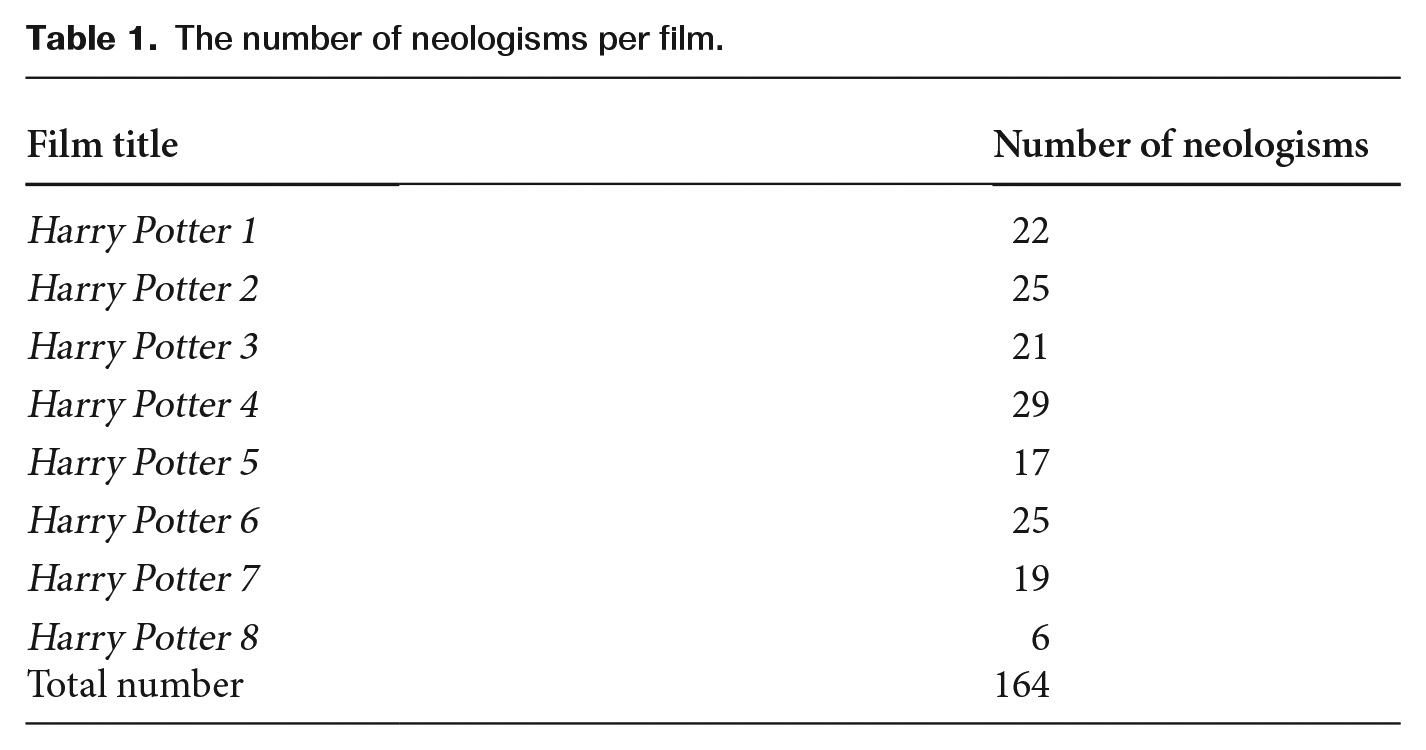
The Harry Potter films (2001–2011) were chosen for close analysis in this study due to their high popularity in China. I analysed the transcribed English film dialogue of the eight films in full to identify and quantify the original English neologisms. The English transcripts were downloaded from Internet Movie Screenplay Database (IMSDB), which has the largest collection of movie scripts available online. As the website indicates, the data in IMSDB often go through consistency checks to ensure they are as accurate and reliable as possible. Based on the criteria discussed in Section 3, I identified a total of 164 neologisms in the original work of Harry Potter films (2001–2011). Table 1 shows the number of neologisms identified per film. After identifying these neologisms in the original films, I then identified their corresponding Chinese translations manually by watching the DVD version of Harry Potter films (2001–2011) distributed by China Audio–Video Publishing House. In this study, the DVD subtitles are used for analysis for several reasons. First, this version is the only official DVD version that was authorized for distribution in China. Although there are also a few other versions of Chinese-subtitled Harry Potter films, they were mostly done by online amateur or unprofessional subtitlers, which may not reach as large a number of viewers as the official version did. Second, using DVDs is perhaps the only practical approach when dealing with a large corpus since DVDs are easily accessible.
The number of neologisms per film.
Methods of data analysis
Concentrating on the Chinese subtitling of neologisms in the Harry Potter films (2001–2011), this study aims to find out how subtitles and other semiotic resources interact to make meanings and their potential effects on the subtitled films when the film subtitlers apply literary translation into subtitles of film adaptations. To answer these questions, I first identified both the English neologisms and their corresponding Chinese subtitles, and subsequently conducted a comparative analysis between them to identify the translation techniques and the general patterns in terms of the Chinese subtitling of neologism. Then I conducted an SFL-informed multimodal analysis based on the multimodal transcription that I have created to identify the intersemiotic relations in constructing the meaning and exploring the impact of different translation techniques on the subtitled films.
The design of the multimodal transcription is based on the theoretical framework discussed in the previous section. As shown in Table 2, the transcription is beneficial for analysing subtitled films since it demonstrates the way the meaning is achieved through various semiotic resources, especially how subtitles work with other semiotic resources to construct the overall meaning.
The multimodal transcription used in this study.
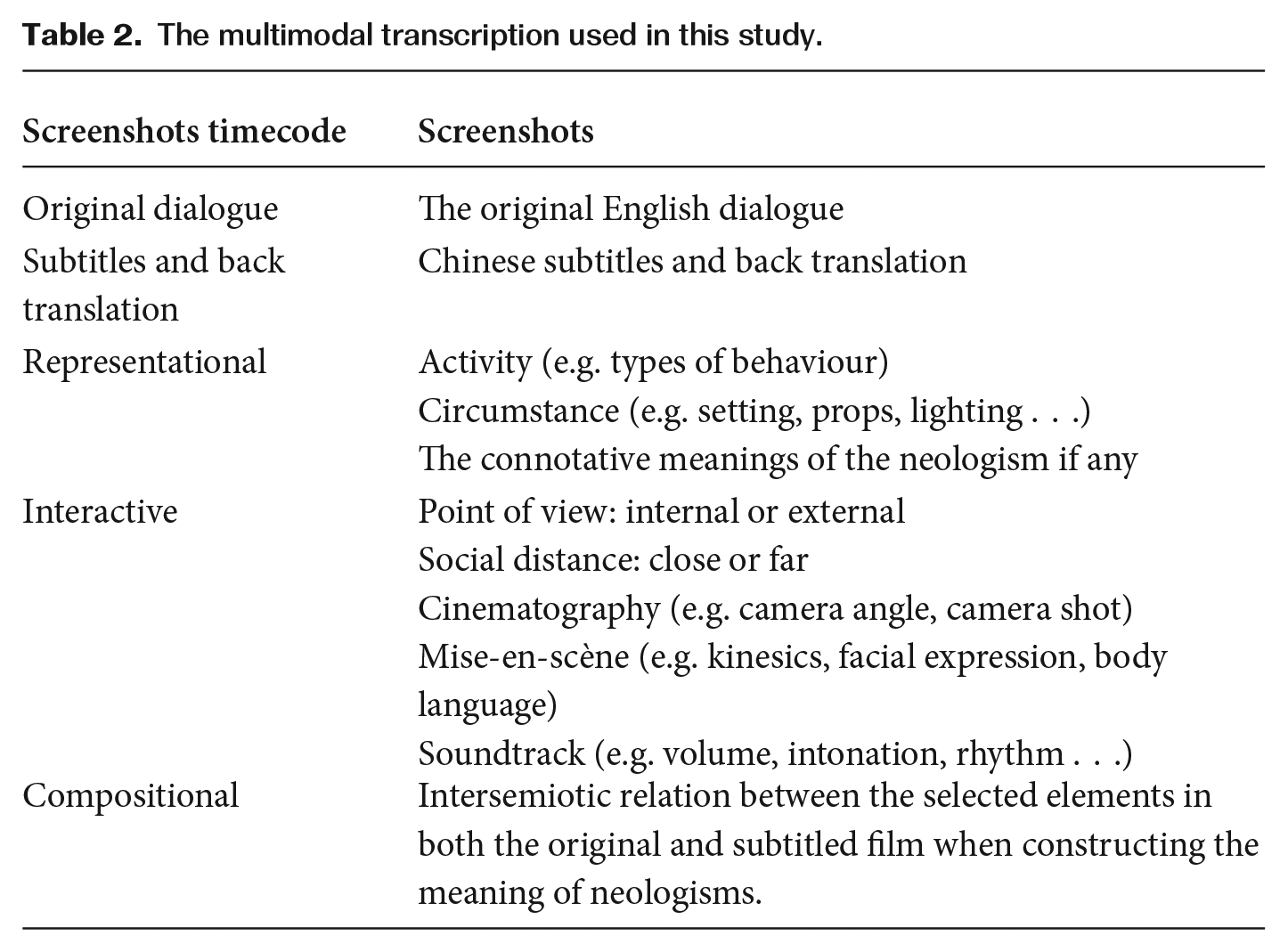
Since films are dynamic texts unfolding in time and space, in order to account for the dynamicity of film texts, I also used Van Leeuwen’s (1996) visual grammar of films as well as Bordwell and Thompson’s (2010) classifications of mise-en-scène and cinematography as checklists for the description of semiotic resources in the multimodal transcription. At the compositional level, since subtitling is an activity that involves the transfer of source–spoken text into target–written text, I consider one pair of intersemiotic relations here, namely, the intersemiotic relation between the original dialogue and other semiotic resources in the original film, and the intersemiotic relation between the subtitles and other semiotic resources in the subtitled film, to investigate in what ways the intersemiotic relation in the original film changes in the subtitled film and, if so, what are the effects of this change on the subtitled film.
In order to investigate to what extent the subtitles use the literary translation in the novels, I also compared the translations of neologisms in both the Chinese translated novels and the Chinese subtitled films. The Chinese versions of the Harry Potter novels were published by the People’s Literature Publishing House and are the only official Mandarin versions so far. Table 3 lists the publication date of the Chinese translated novels and the release date of the film adaptations.
Publication and release information of Harry Potter in China.
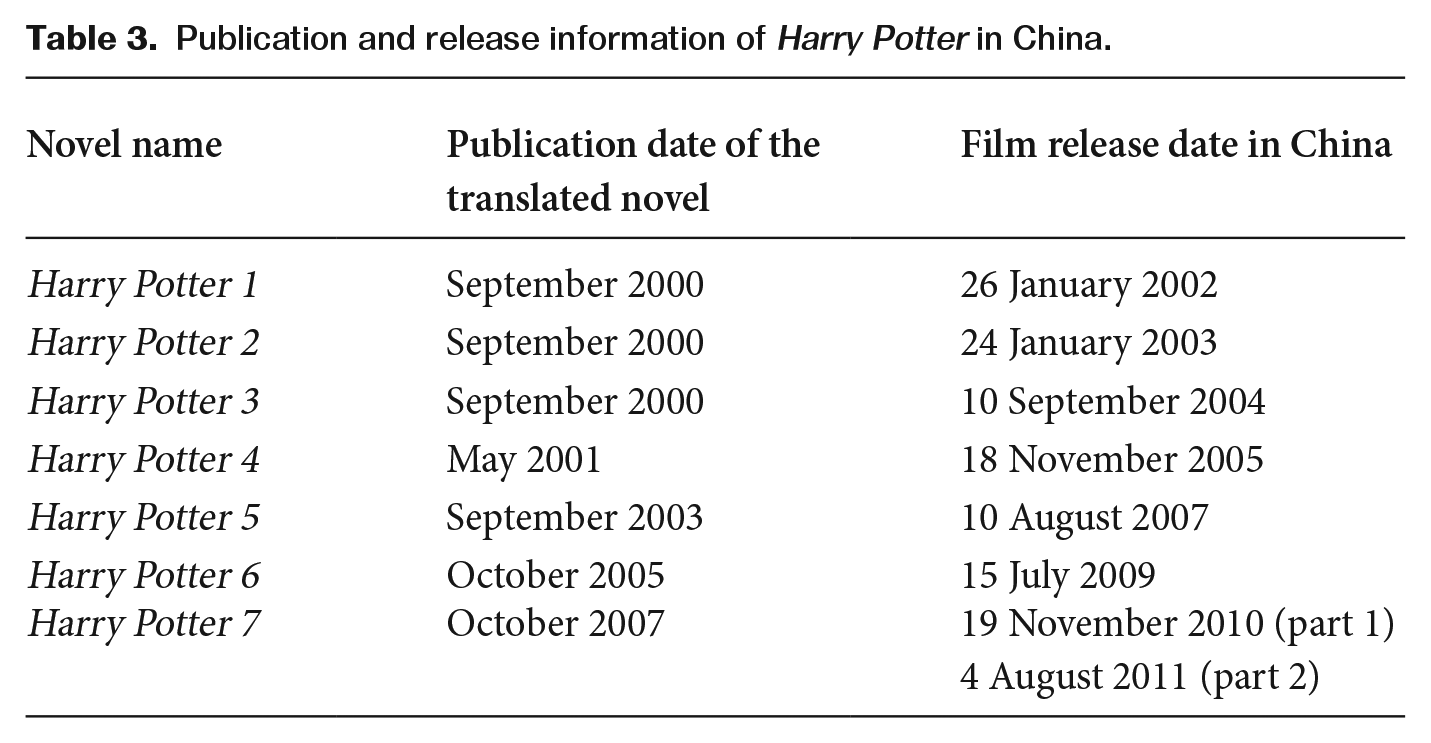
After manually comparing the translation of neologisms in the whole novels and the subtitled films, I found that the degree of consistency of the translation of neologisms in Harry Potter books and films is very high as there were only a few inconsistencies (e.g. sleeping draught) between the books and the films. Therefore, it can be inferred that the subtitles use the pre-existing literary translation in books, probably due to the franchise control.
Results and Findings
This section presents the results of this study from both a quantitative and qualitative perspective, in which the former illustrates that the examples discussed in the latter are not special cases but, instead, represent a general issue. There are many existing classifications of translation techniques for neologisms or culturally-specific references (Delabastita, 2004; Diaz-Cintas and Remael, 2021; Molina and Albir, 2002; Newmark, 1988). Based on these existing classifications and the specific examples in my data, I identified four types of translation techniques for translating neologisms in Harry Potter from English into Chinese: transliteration, literal translation, explicitation and creation. Transliteration is the process of transcribing the source language phonetically to the target language, whereby the pronunciation is retained but the meaning is not. Example 1 in Table 4 shows an instance of transliteration: the original neologism ‘Quidditch’ is translated into 魁地奇(Qui di qi), which has the same pronunciation as the original English word. Literal translation refers to a word-for-word translation in which the literal meaning of the source concept is retained in the translation. Example 2 shows an instance as the English neologism ‘Devil’s Snare’ is literally translated into 魔鬼网 (devil’s snare) in Chinese. Explicitation refers to a translation technique in which information that is not present in the source concept has been added in the translation, or the implicit meaning of the source concept has been made explicit and specified in the translation. Example 3 illustrates an instance of explicitation, in which the implicit meaning of the original neologism ‘Remembrall’ (a combination of two English words – remember and ball) has been made explicit in the Chinese translation 记忆球 (remember ball). As Diaz-Cintas and Remael (2021) suggest, explicitation is a technique that is used to make the translation more explicit and accessible to the target audience. The last translation technique – creation – means that a new word is invented in the target language. As can be seen from Example 4, the original neologism ‘Thestrals’ is translated into 夜骐 (night black horse), which is a new term in Chinese.
Examples of each translation technique.
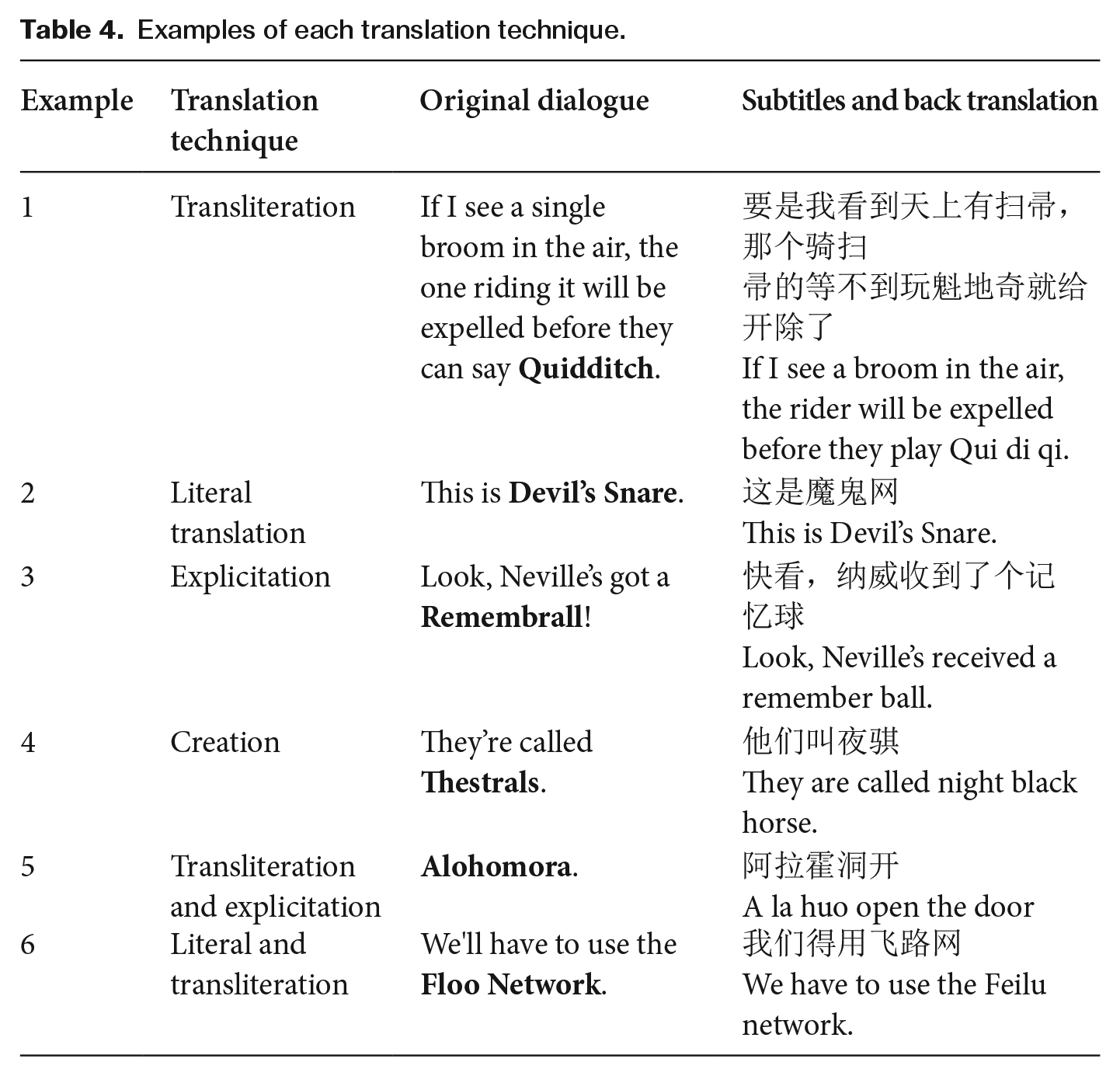
My data indicate that hybrid translation techniques are also very common, as translation is usually a combination of different techniques. Examples 5 and 6 in Table 4 present two instances of hybrid translation techniques. To avoid overlap and ensure clarity, each instance is only counted once; that is, each translation is counted as either a single translation technique or a hybrid translation technique. Otherwise, the number of translation techniques will not be consistent with the number of translations. Although the categorization of translation techniques may never be this simple, the categories discussed in this study aim to provide a good starting point for analysing the subtitling of neologisms and provide a general idea of how neologisms are translated from English into Chinese.
Table 5 shows the distribution of each translation technique per film in translating neologisms in the Harry Potter films (2001–2011). Based on this data, Figure 1 shows the percentage of each translation technique, in which a pattern in terms of the subtitling of neologism in Harry Potter can be identified.
The distribution of each translation technique per film.
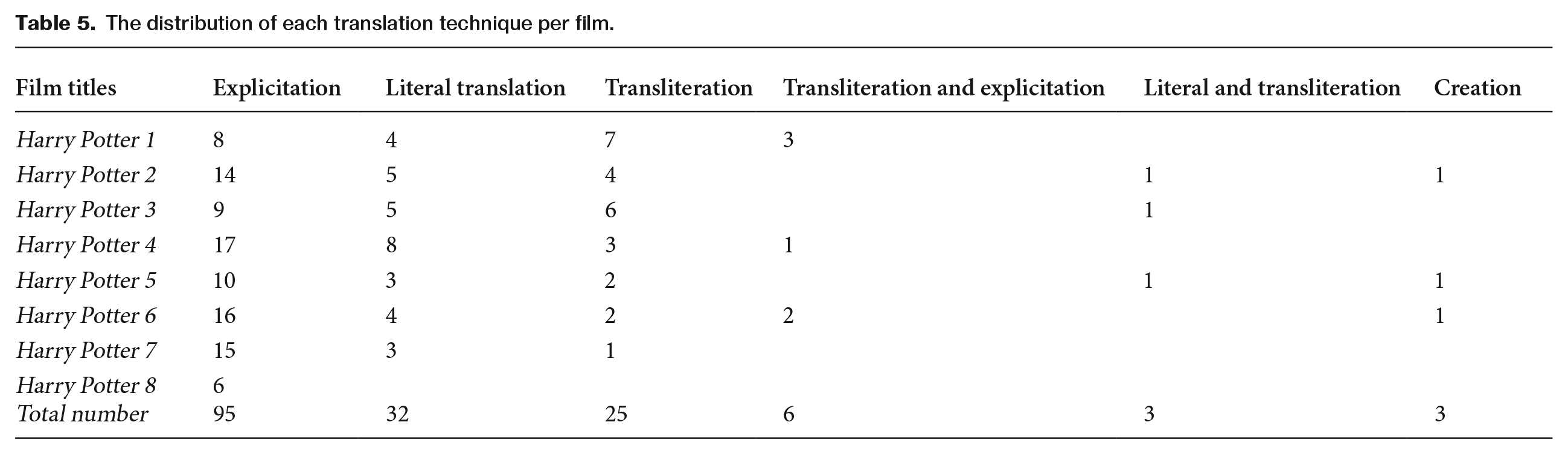
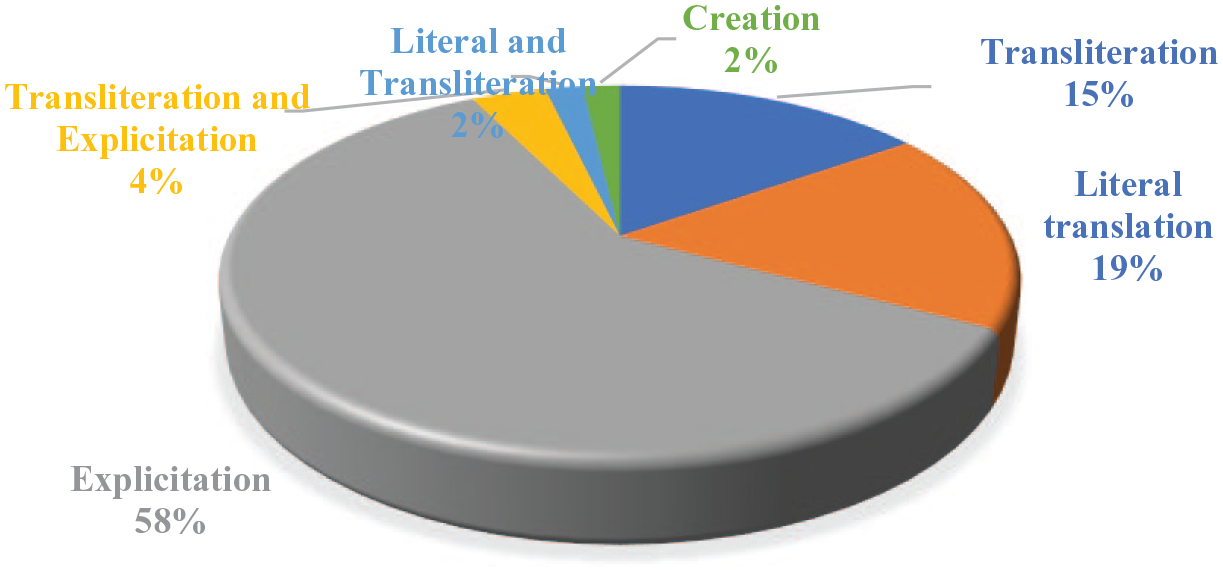
The distribution of each translation technique.
The quantitative analysis shows that nearly 60 percent of the original neologisms are specified in the Chinese translation under the employment of explicitation. Among them, nearly 80 percent are incantations and charms, as shown in Table 6. I concentrate here on discussing the effects of explicitation of incantations on subtitled films, given this is the most common translation technique and the most common type of neologisms in Harry Potter.
Examples of the explicitation of incantations and charms.
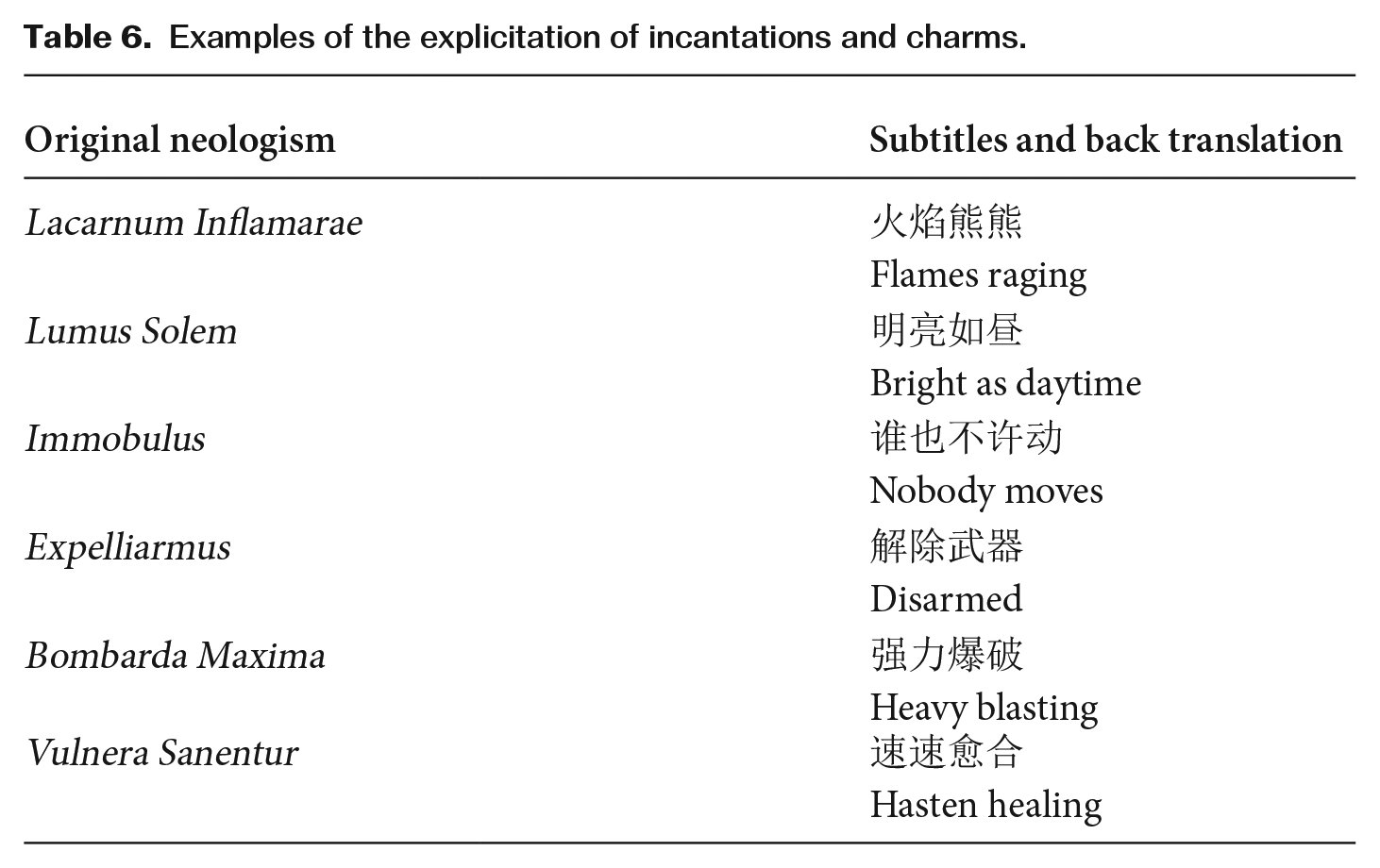
Table 6 shows that the Latinate incantations are mostly translated into four-letter Chinese words, resembling the structure of Chinese idioms which are very catchy to read. The translations retain some of the phonetic aspects of the original incantations. However, although the four-letter Chinese words may have the benefits of explicitly expressing the function of the incantations, reproducing the magical world familiar to the Chinese audiences and facilitating readability and acceptability, they may run the risk of reducing the fun of decoding these neologisms, which seems to be more evident in subtitled films than in translated books. In translated books, which are a medium based on written language, readers may still need to refer to the co-text and context to decode the meaning while, in subtitled films, the target audience can also access other meaning-making channels (e.g. visual and acoustic) that can facilitate their understanding, which is absent from books. This way of explicitation at the cost of losing the original fun is also argued by Zhou and Zhuo (2013: 121) as they indicate that, if too much information is added or made clear in Harry Potter, the translation may ‘read like an annotation of the original work’.
This effect of explicitation on subtitled films can be more clearly illustrated by adopting the multimodal framework. When the original neologism is specified in the Chinese subtitles, one pair of intersemiotic relations, namely, the intersemiotic relation between the original dialogue and other semiotic resources in the original film and the intersemiotic relation between the subtitles and other semiotic resources in the subtitled film, is different due to the change of the source–spoken text into the target–written text. Table 7 shows an example from Harry Potter 1 (2001).
Harry Potter 1 (Harry Potter and the Sorcerer’s Stone 2001).
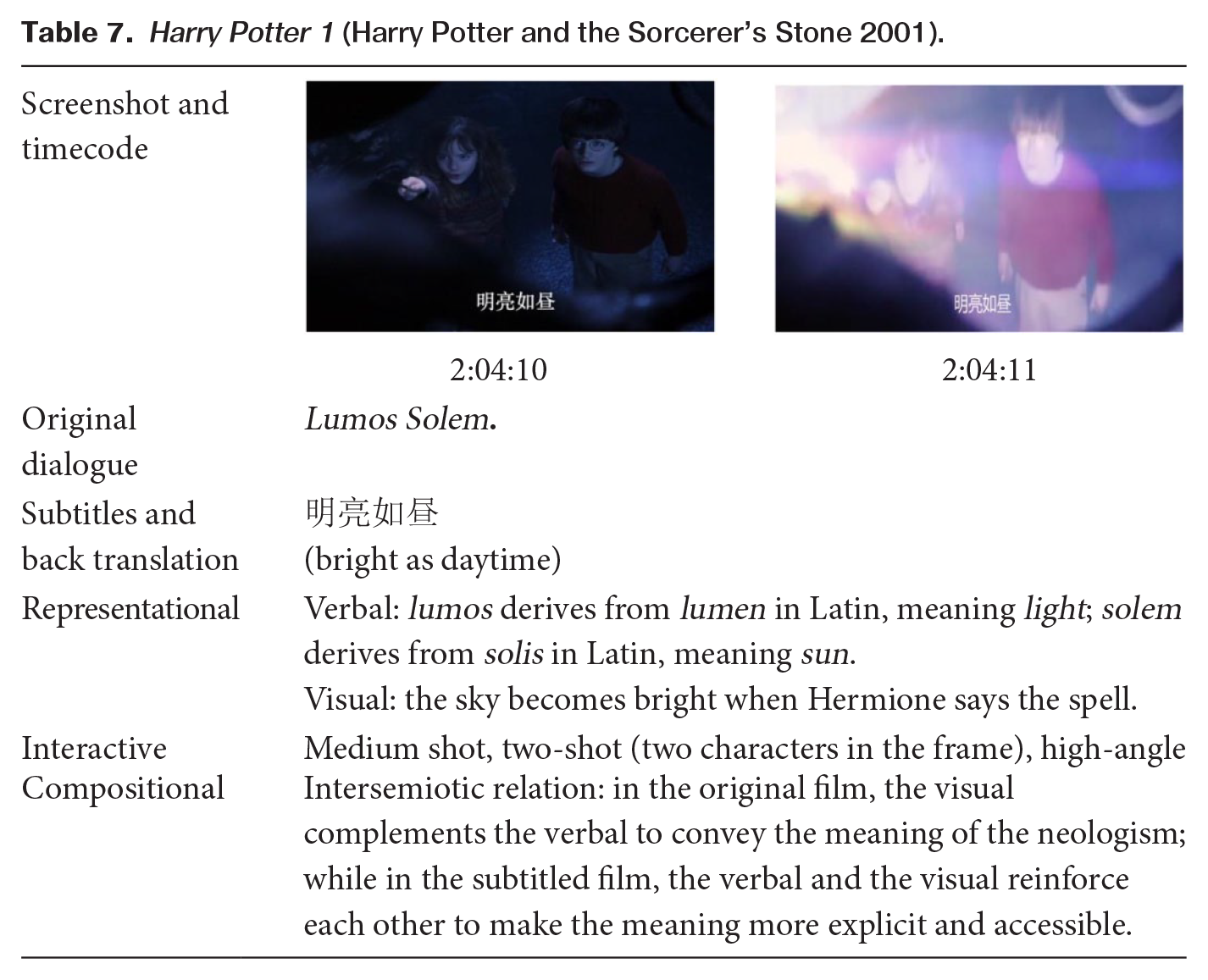
Since the implicit meaning of Lumos Solem is also expressed visually, that is, the target audience could see from the screen that the sky becomes bright when Hermione says the spell, the employment of explicitation in the Chinese translation may result in a higher level of information redundancy in the subtitled film. Following Baumgarten (2008), the term ‘information redundancy’ in this study means that the same information is expressed through the subtitles and other semiotic resources. In the original film, it is through the complementary relation between the visual image and the dialogue that the source audience decodes the implicit meaning of Lumos Solem while, in the subtitled film, the visual and the subtitle tend to convey the same information as they reinforce each other to make the text more accessible and explicit to the target audience.
Chen (2019) indicates that the reinforced relation between the image and the subtitles can reduce audiences’ processing time since they do not need to shift between the two semiotic channels to decode the meaning of the text. Therefore, the explicitation of the implicit meaning of the original neologism in the Chinese subtitles tends to bring the film and the viewer closer than in the original. However, in a deeper sense, this translation technique may downplay the inclusion of the target audience into the magical world of Harry Potter, which is a different type of closeness compared to just understanding the neologisms. As discussed in section 3, being able to decode those neologisms serves as an important role for audiences to mark their in-group identity. However, through the reinforcement between the subtitles and other semiotic resources which involves specifying the original unfamiliar neologisms into familiar words, the target audience tends to be given more information than the source audience, which might influence their relationship with the film. Despite the lack of audience reception study, it is possible to assume that the loss of decoding process precludes the target audience from sharing the same sense of inclusion into the fictional world as the source audience and distances them from the character of Harry. Unlike in the original film where the source audience can learn the Latin-related neologisms and be gradually initiated into the magical world along with Harry, in the subtitled film, the target audience does not have the same process as Harry and tends to be positioned as outsiders.
This loss of inclusion is more evident in subtitled films than in translated books when taking into account the concept of PoV. The novel is written in the third person PoV where Harry is the main focalizer. In this way, most incantations are introduced to readers as they accompany Harry on his way of learning and decoding, and observe the effects of these incantations through his eyes. The use of third-person pronouns (e.g. his and he) and verbs (e.g. heard, thought, learned and saw) are largely retained in the Chinese translated books. As a result, readers can experience directly what Harry does, sees and thinks and are thus led to discover the magical world and develop knowledge of incantations alongside him. However, due to medium specificities, it is hard to transfer this type of focalization in novels into a film narrative: as Vandaele (2018: 238) suggests, both books and films can produce narrativity but ‘each medium of narration does have special possibilities and constraints’. It is hard to show a focalization on one character onscreen due to the simultaneity and multimodality of film text. Unlike in novels where the verbal communication is mostly sequential and the thoughts and experiences of the character can be shown without a change in focalization, films can show several focalizers simultaneously by adopting certain mise-en-scène and cinematography. In this example, the medium-shot with two characters in the frame allows viewers to see each character and the surrounding setting, which suggests a limited degree of internal focalization of Harry. There are no close-up shots or PoV shots to show Harry’s inner thoughts or feelings in this scene. Thus, the use of focalization as a means of establishing a psychological link between Harry and the readers in the novel is even further diminished in subtitled films due to the adoption of explicitation in translation as well as the medium specificities of film.
Table 8 presents another example from Harry Potter 2 (2002), in which the feeling of in-group identity in the original tends to be lost due to the adoption of explicitation.
Harry Potter 2 (Harry Potter and the Chamber of Secrets 2002).
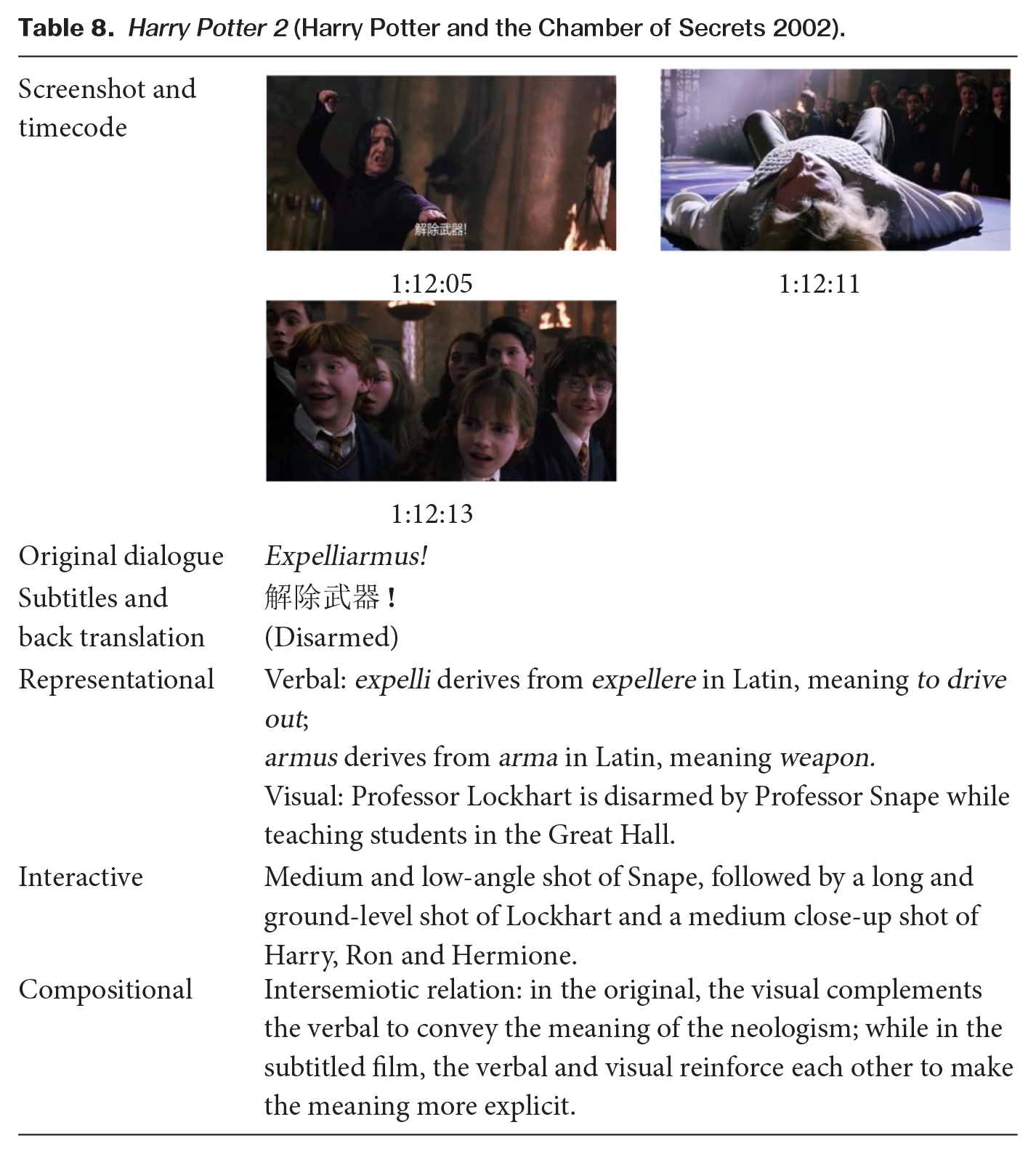
Table 8 shows that the implicit meaning of Expelliarmus in the original dialogue is specified as 解除武器 (disarmed) in the Chinese subtitle in which the same information can also be seen and heard from the subsequent visual image and the sound. Similar to the example in Table 6, it is likely that the reinforced intersemiotic relation between the subtitle and other semiotic resources reduces the fun of decoding as in the original. In addition, unlike in the books which are written from Harry’s focalization, in this scene, the effect of the incantation is shown to the audience through a long-shot zooming out to show a panoramic vision of the event, followed by a medium close-up shot with three characters in the frame rather than a PoV shot of Harry, which further downplays the sense of inclusion among the target audience.
This effect of explicitation is found not only in translating incantations, but also in translating magical creatures as shown in Table 9.
Harry Potter 3 (Harry Potter and the Prisoner of Azkaban 2004).
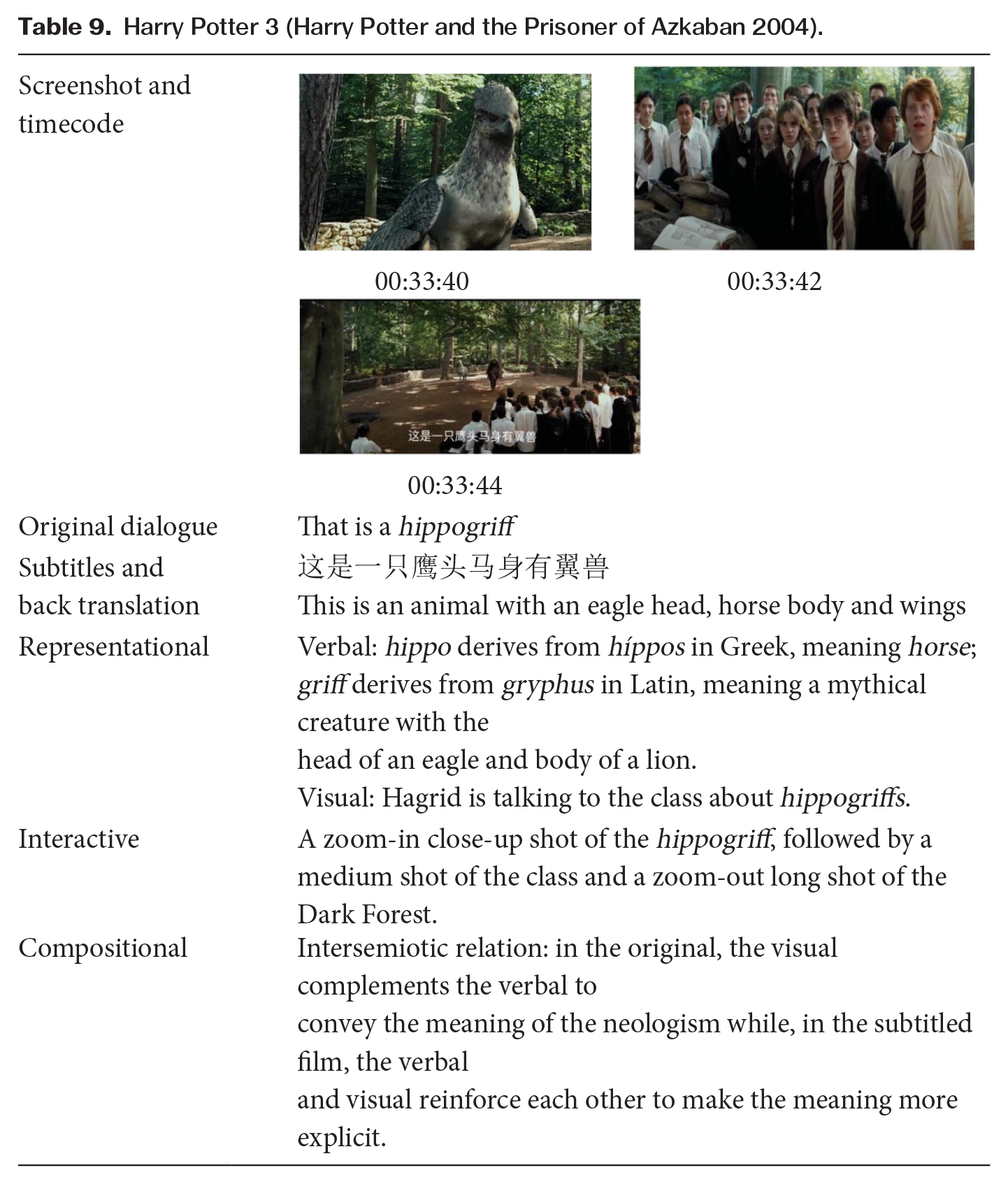
Table 9 shows that the process of decoding the neologism hippogriff achieved through the complementary relation between the dialogue and the visual is not reproduced in the subtitled film due to the explicitation of the original neologism. The medium shot of the whole class and the long shot of the forest further downplay the sense of in-group as the audience does not share the PoV of Harry.
Although only reception studies could give us more empirical evidence, it seems reasonable to assume that the explicitation of neologisms can therefore have several effects on subtitled films. Compared to the original films, the information in the subtitled films becomes more redundant, explicit and semiotically cohesive given the meanings are expressed through both the subtitles and other semiotic resources. A shift of intersemiotic relation from complementary to reinforced is identified in subtitling the neologisms. This compositional change can further influence the subtitled film representationally and interactively: the process of decoding is not reproduced and thus the inclusion of the audience into the wizarding world and the sense of in-group, which is the key to the appeal of Harry Potter, may not be retained in the Chinese subtitled film.
Discussion and Conclusion
The results of this study show that the application of literary translation to the subtitles of their film adaptations is very complex, especially for novels like Harry Potter which are such a worldwide phenomenon. Although adopting the terms used in earlier literary translation in subtitles saves time and retains consistency, the polysemiotic nature of film text means that the direct application comes at the price of some crucial elements of the original. This result differs from previous studies which often emphasize the importance of keeping consistency between literary originals and film adaptations, and which often evaluate adaptations according to their level of fidelity (Cahir, 2006; Perdikaki, 2017). Although only reception studies could give us more empirical evidence on the variance of audience uptake and subjectivity, it seems possible to assume that the reinforced intersemiotic relation between the subtitles and other semiotic resources in subtitled films as a result of explicitation may hinder the degree of involvement of the target audience into the fictional world, which is the key to the Harry Potter world.
As I have shown in the multimodal analysis, film is an audiovisual medium that has different semiotic resources for constructing meanings. Many aspects have to be taken into consideration when analysing the translated adaptations, especially the medium specificities of the target medium that have often been ignored in adaptation studies. My results are consistent with Legeyda (2013) as she suggests that film adaptations are characterized by semiotic systems and methods of decoding which are specific to film and which are largely different from their literary originals. This view is in line with Stratyner and Keller (2007: 2) as they argue that ‘film text is not another edition of the original, but a distinctive art form’ that has its own medium specificities. The adoption of certain translation techniques in books may not have the same effects when they are applied to films, since they differ in their presentation of narrative elements (e.g. focalization), which is crucial for triggering the sense of in-group in the Harry Potter world. This narrative difference between the two mediums found here is also highlighted by Vandaele (2018) who suggests that since a novel relates in words and a film portrays in pictures, the same translation may not have the same effects in the narrative. Due to the simultaneity and multimodality of film, the effect of certain translation techniques in film is much more complex than in a novel, which can further influence how the fictional world is interpreted and perceived by the audience. Therefore, when applying an existing translation of a written work as the basis of the subtitles for the film adaptations, one needs to balance the tone between both the effect of the original and the multimodal nature of the target text, rather than emphasizing the literary supremacy as often suggested in existing literature.
The multimodal approach that I have proposed and the issue that I have analysed in this study offer a new perspective for studying film adaptations. It shifts the focus of adaptation studies from a monomodal and intralingual to a multimodal and interlingual perspective, thus opening up new research paths. My arguments have highlighted the importance of considering more than the literary elements when analysing film adaptations and highlight broader possible areas, such as multimodality and audiovisual translation, that have only been partly recognized by scholars in adaptation studies. As this study shows, the multimodal perspective can also shift the linguistic focus of audiovisual translation research given that subtitles are only one part of the multimodal ensemble and it is through the intersemiotic relation between subtitles and other semiotic resources that the meanings are constructed in audiovisual text. This study also contributes to multimodal studies in general, especially in relation to intersemiosis. The different types of intersemiotic relations between subtitles and other semiotic resources can shed light on the specific ways in which semiotic resources interact to make meanings in film text. Future research such as reception studies could be carried out to provide empirical evidence of the audience’s interpretation and reception on the application of literary translation in the Chinese-subtitled Harry Potter films. This could further illustrate how the actual audience receives and perceives the explicitation of neologisms in subtitled films.
Footnotes
Acknowledgements
I would like to thank Dr Lyn Marven who inspired and guided me into this research, and the two anonymous reviewers who gave me valuable feedback to make this article possible.
Funding
The author received no financial support for the research, authorship and publication of this article, and there is no conflict of interest.
Biographical Note
SIWEN LU received a PhD in Translation Studies from the University of Liverpool and is currently a visiting post-doc researcher at the University of Bristol. Her research interests include audiovisual translation, subtitling, multimodality and digital media cultures. She has published several articles in peer-reviewed journals including Babel, New Media & Society and International Journal of Communication and Perspectives: Studies in Translation Theory and Practice.
Address: Department of Languages, Cultures and Film, University of Liverpool, Liverpool, United Kingdom. [email: