



Abstract
On Twitter and other established digital social networks, references to the Black Lives Matter movement almost doubled after George Floyd’s murder (see Giorgi et al., 2020, ‘Twitter corpus of the #blacklivesmatter movement and counter protests: 2013 to 2020’), alongside a similar rise in references to the counter-protest terms ‘All Lives Matter’ and ‘Blue Lives Matter’. Around the same time, the authors found online players of Splatoon 2 (Nintendo) expressing Black Lives Matter sentiments when using in-game design tools. These messages quickly disappeared in the game space to be replaced by longer-lived political content relating to LGBTQ+ activist sentiments and other non-political messaging. This visual essay provides documentation of memes captured by one of the authors between 6 and 14 March 2020 and discussion of their significance as data. The authors conclude that, despite being digital artefacts, Splatoon posts may be better understood using Cramer’s ‘What Is “Post-digital”’ (2014) reading with different characteristics from normal digital activism artefacts. The visual form attempts to underline the visual character of these post-digital artefacts, which contain no machine-readable textual content or metadata. Nevertheless, they represent a form of community discourse that is little examined and that the authors suggest should be documented and researched despite its awkward data structure.
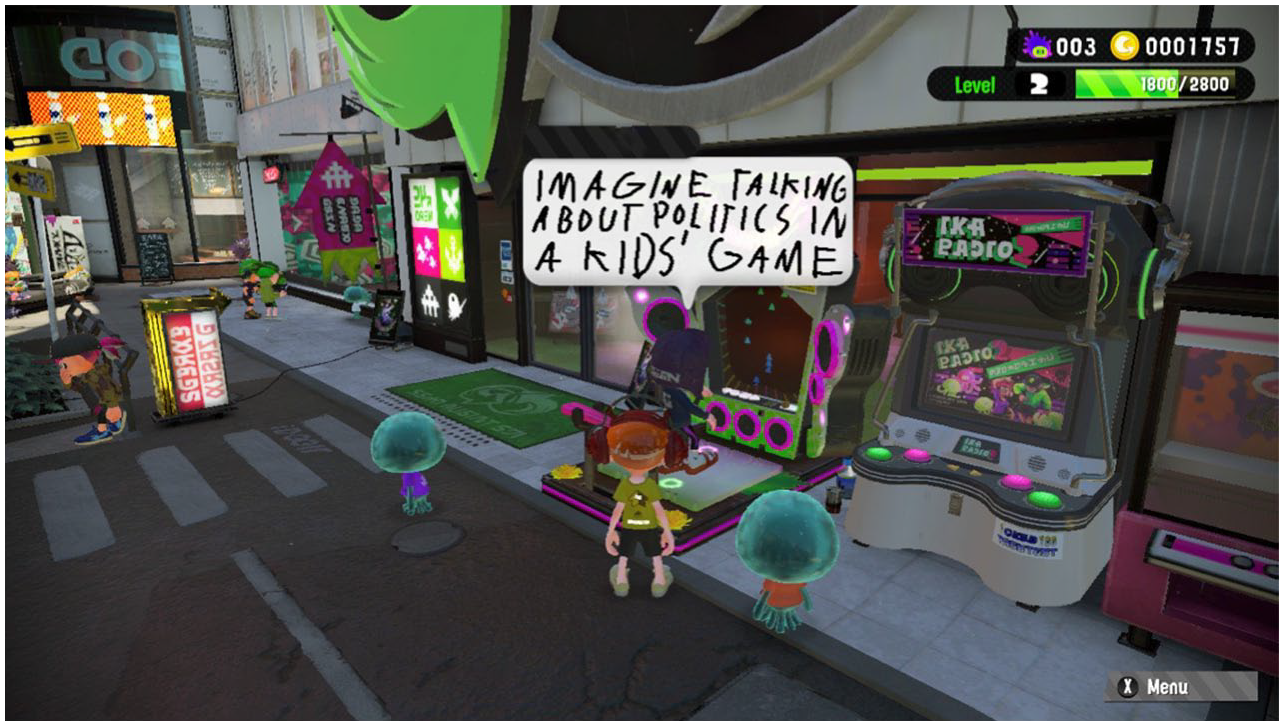
A player avatar (Bukcet Man) reflects on player politicization of kids’ games (see captures 19, 53).
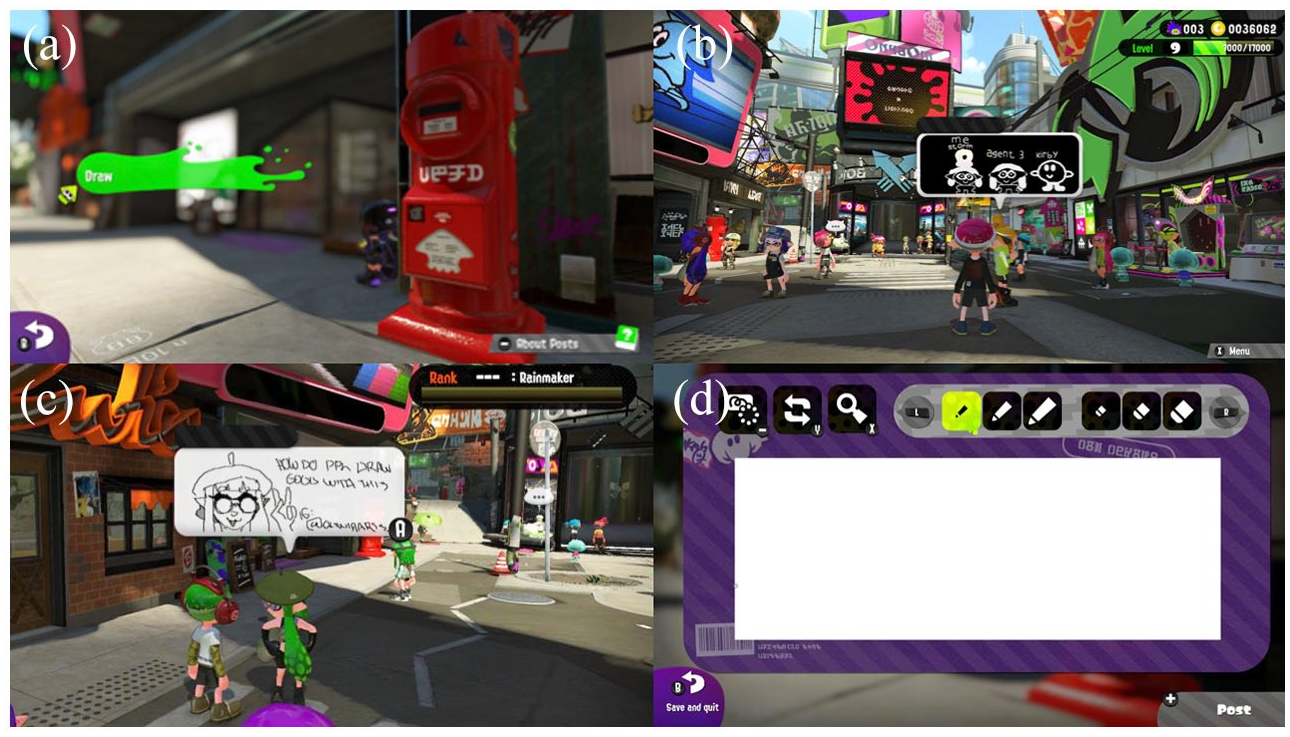
Clockwise from top left: (a) Inkopolis Square’s postbox, where players access the post editing tools; (b) Inkopolis Square, with a player’s (Storm) post visible; (c) an expression of a player’s (coolkid :) ) frustration with post editing tools; (d) the post editing tool – (left to right) undo, zoom, three pen widths, three eraser widths.
In April 2020, at the peak of the ‘Black Lives Matter’ (#BLM) campaigns, one author noticed the appearance of ‘hashtag politics’ in an unlikely place, the virtual lobby of a Nintendo video game. What began as a small project to document the ephemeral intrusions of multifaceted social movements into a closed digital space lead to the discovery that Nintendo’s implementation of digital discourse created both insurmountable challenges to analysing and capturing the data, yet a more honest and healthy discursive space. This article is aimed at documenting these challenges, comparing digital discursive models, and showcasing the fleeting artworks created by the anonymous and unknowable participants of Splatoon 2.
The #BLM Movement on Social Media Networks in 2020
On Twitter and other established digital social networks, references to the movement almost doubled after George Floyd’s murder, with a similar rise in references to the counter-protest terms ‘All Lives Matter’ and ‘Blue Lives Matter’ (Giorgi et al., 2020). The relatively accessible nature of structured data made available by the Twitter API (Application Programming Interface) and others surrounding #BLM has allowed researchers to discover meaningful trends in the data and to quantify its significance. For example, Matthew Haffner’s (2019) geographical study of #BLM terms found that there was positive engagement in Black and Asian populations in contrast to negative engagement with white users. Haffner’s research is made possible by the highly structured data provided by the Twitter API. Using geographical coordinates contained in the API’s JSON object for each tweet, Haffner could restrict the case study to a particular geographical area (municipalities within Louisiana and Texas) providing additional relevance to the data in terms of geography (US municipalities) and racial representation (municipalities with large Black and white populations).
Social media case studies such as Haffner’s document digital activism that leaves a data fingerprint, allowing it to be more precisely understood during and after activism has taken place in the pursuit of certain social goals (Mundt et al., 2018). Data sampling for these studies made extensive use of the Twitter API and Twitter’s web interface; Mundt’s study captured tweets that were later cross-referenced with profiles, available on the Twitter website, and filtered down to positive BLM messages only; Haffner’s API-based collection methods provided location data, language, hashtag extraction and full profiles from Twitter. However, the following visual case study documents evidence of #BLM activism on the Splatoon 2 online gaming platform, a digital space where these commonplace data extraction affordances do not exist (making typical data analysis impossible) and activism occurs in the context of a gaming service that has sought to design out contiguous or meaningful interaction with other players (see Figure 3a).
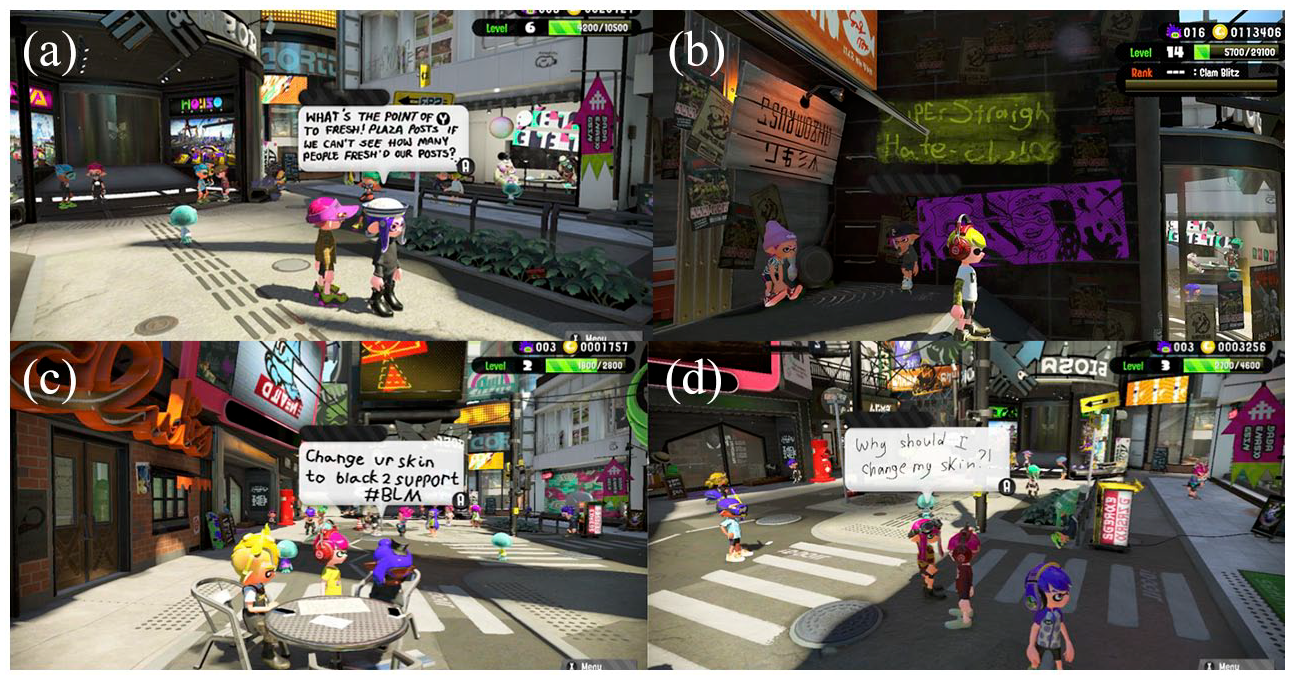
Clockwise from top left: (a) a player (OVERHEAVEN) questioning the utility of the limited interaction possibilities in Inkopolis Square; (b) ‘SuperStraight Hate-club’ post presented as background graffiti; (c) and (SomeTuber) (d) Point, counterpoint in posts (▽ Salt™).
As a result, we are left to consider a more ephemeral, less knowable and altogether more ugly dataset than exists either in the real world or on other social media networks.
The Rise and Fall of #BLM Messaging on Splatoon 2
We first noticed #BLM and Black Lives Matter-related posts appearing on the online mode of the Nintendo Switch computer game Splatoon 2 in early June 2020 and began documenting them immediately. Splatoon 2 is a Nintendo game made for their Switch console. Players take on the role of ‘octolings’ and ‘inklings’ who compete in a range of multiplayer battles, deviating from traditional first-person shooting games by rewarding based on how much of the play area is covered in each team’s ink rather than casualties caused. On starting the game, players are placed in ‘Inkopolis Square’, a pastiche of Tokyo with stores offering in-game upgrades and areas to access different play modes. The square is populated by avatars of other players who have played alongside the player. These other avatars are under the game’s control, randomly allocated roles in the environment of the square. These avatars are not interactive, other than to show the latest ‘post’ that the player has created when approached.
‘Posts’ are Nintendo’s mechanism by which a simple monochrome artwork (320 by 120 pixels in size) can be created using in-game freeform drawing tools, using either the joystick or touch screen (Figure 2d). There are no tools to render text or more complex imagery. In this way, Inkopolis Square provides a unique digital medium. It randomly presents 16 low-resolution images, one at a time, each written by hand on a touchscreen interface. Post images are regularly updated and pseudonymously authored by peers. Posts are only visible within the bounds of the game and other players are aware of this; they participate and react to viral communication and memes in this world (Figures 3c and d). The conversations are responsive to real-world events and themes though the real world never seems to report on it.
It was in these player posts that author David Mee started to notice and record #BLM-related messaging (see Figure 4) whilst also engaging as a player of Splatoon 2. All captures were performed using the researcher’s own equipment, Nintendo online profile and network infrastructure.
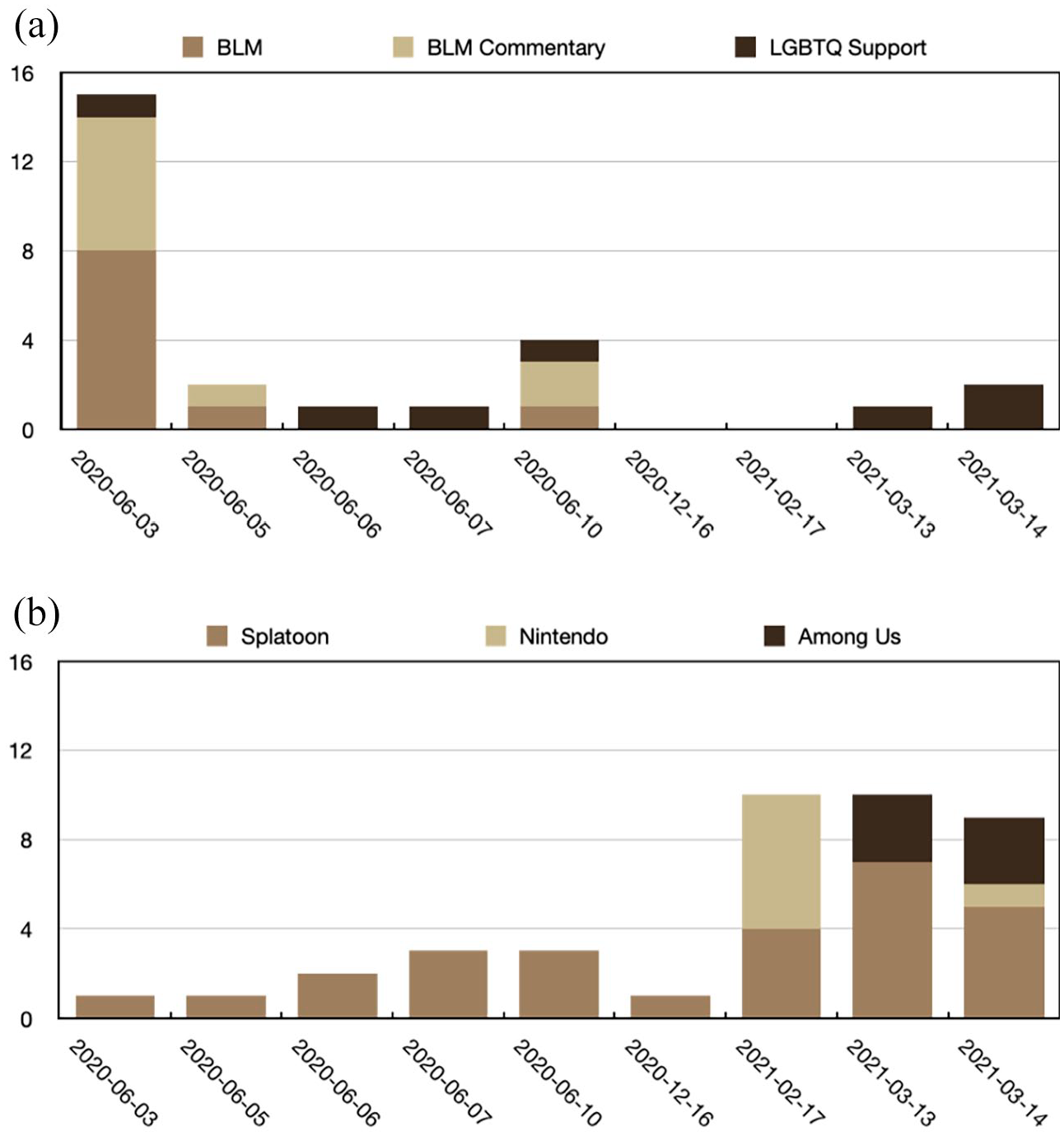
Top to bottom: (a) BLM and LGBTQ post frequency; (b) Splatoon, Nintendo and ‘Among Us’ post frequency.
Images were captured intermittently using the built-in ‘screenshot’ functionality of the Switch console, initially on a daily basis after the researcher started to notice #BLM-related imagery during peak mobilization of BLM protests in the week commencing 3 June 2020. Images were collated, uploaded to a public album on Flickr (Flickr, 2020) and cross-referenced to an online database with associated metadata (player name, capture date, text and thematic information) (Airtable, 2021) When the presence of the Black Lives Matter posts petered out from the game, the frequency of captures was reduced, only becoming active in the event of any resurgence or shifts in longer-term patterns in the data, with the final captures being months apart.
During this time a significant number of posts captured expressed support for other political positions. Support for Black Lives Matter, though at first widespread (including supportive pushback posts, such as captures 2 and 15) appeared only briefly in the data, whereas LGBTQi+ support continued at an apparently uniform rate (also included in this article is a sample of the far more frequent proportion that reference gaming culture, particularly other Nintendo properties and ‘Among Us’).
Whilst no posts were explicitly critical of #BLM as a movement, a few posts take issue with its discussion in the world of Splatoon 2 (captures 5, 6, 9, 15, 19, 43 and 53) (see Figure 5).
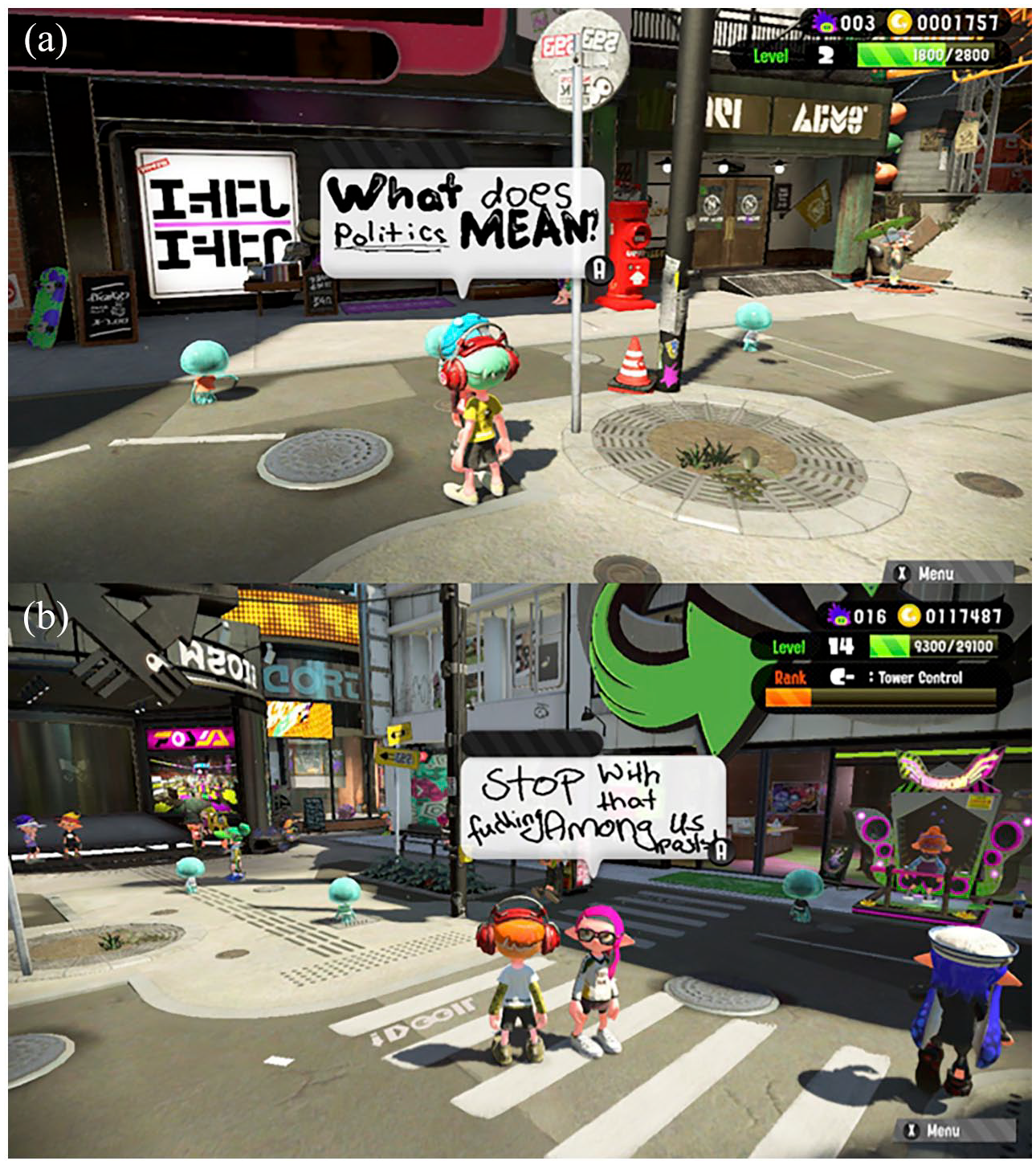
Top to bottom: (a) evidence of awareness of political discourse amongst Splatoon’s players (Maria Pupu); (b) a player (AlinaCst) grows tired of ‘Among Us’ posts.
These posts generally rest on two points of argumentation: that the game world is separate and unrelated to what happens in reality and that steps must be taken to shield ‘kids’ from political discourse. It is impossible to know anything of the authors, but they follow a common online model of using a protected minority (here, ‘kids’) as a means to problematize a particular political discourse (awareness of systemic repression of Black people). Most interestingly, posts critical of ‘political’ content do not emerge in response to other politicized causes, such as LGBTQi+ messages of support. However, it is difficult to draw conclusions from this sample.
One post (seen as background graffiti) mentions ‘SuperStraight Hate-club’ (Figure 3b). ‘SuperStraight’ was a TikTok video that argued for solidarity amongst those who ‘only dated cis-gendered women’ before moving into a (now banned) community on Reddit and 4chan’s /pol/ board channel (KnowYourMeme, 2021). Though no pro-SuperStraight posts were noted by the authors, there is no real way to know whether ‘SuperStraight’ had any other representation in Splatoon’s posts, or whether this post existed simply to raise awareness through an alternative media.
Similarly, the ‘MAGA’ (acronym for politician Donald Trump’s ‘Make America Great Again’ campaign slogan) post (capture 93) raises a number of questions about the use of posts and authorial intent in Splatoon. The post was spotted several months after Trump lost the 2020 presidential election. Despite being the most explicitly political post captured, there were no other ‘political’ posts spotted around this time, and no pushback against either the message or the use of ‘politics in a kids’ game’. It is not even possible to identify the poster as American. If this is a kids’ game, it is hard to determine the age of these kids, perhaps reflecting how players perceive others in the game rather than themselves.
Interpretation Challenges Presented by the Splatoon 2 Network
The difficulty of documenting user activity as a player and researcher in a way that was rigorous but still made sense in the context of gameplay is at the heart of what is ugly and therefore of interest to this journal. Despite the data being collected and distributed algorithmically, there are none of the traditional benefits associated with networked digital data. Even if it were programmatically scrapable, it presents a further challenge by having no computer-readable textual content, eliminating a means by which individual posts may be automatically classified or understood. Posts are encoded for human visual reading, not image classifiers.
There is some similarity in this model of highly locked-down, yet free, discursive spaces to dedicated communication tools (such as Telegram, Signal and WhatsApp); their end-to-end encryption models prevent any moderation of content, making them a valued outlet for misinformation, radicalization and criminal use.
Nintendo’s networking system uses a peer-to-peer, rather than typical client–server, architecture (OatmealDome, 2018) (see Figures 6a and b). It is not known how the selection of posts to show a player is made, nor whether this is part of the peer-to-peer (p2p) infrastructure or centrally archived and managed, though Nintendo states recently created images are prioritized amongst candidates (D’Anastasio, 2018).
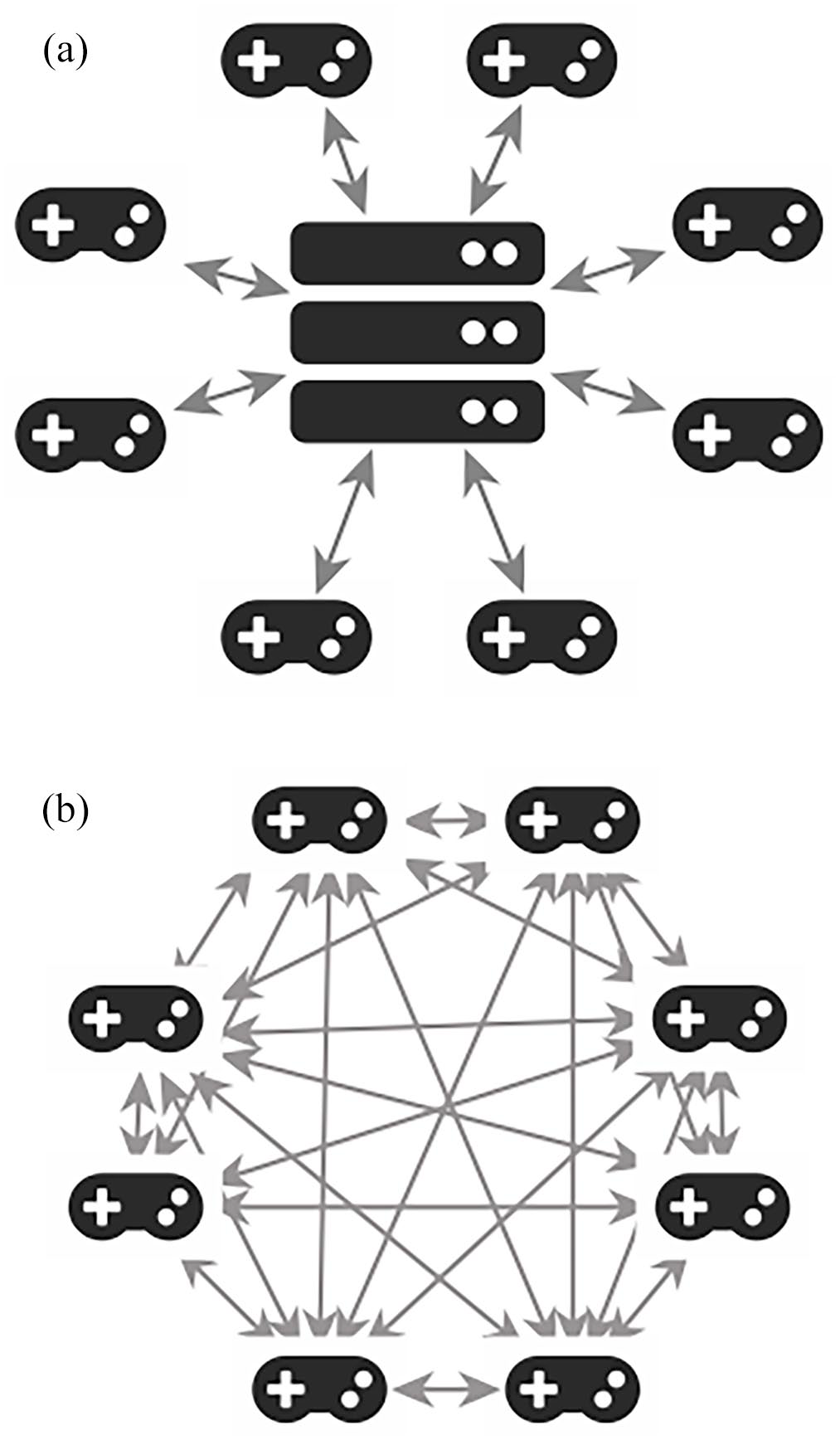
Top to bottom: (a) classic ‘single source of truth’ network diagram; (b) peer-to-peer networks (note the lack of a central management system).
Internet-based data collection, from web scraping to Twitter sampling, depends on having a central data authority against which queries can be run. The design of centralized systems is that any connected client running the same query under the same conditions should expect the same results; the data is uniform, centrally managed using an information architectural ‘single source of truth’ model, provided and managed by a central software data authority (Figure 6a). In contrast, peer-to-peer data systems are less consistent; every query is given access only to data from sources connected to each other at the same time (Figure 6b). Data can disappear at any time should a player disconnect, and running the same query on two different clients can provide completely inconsistent results. This is further compounded by the way each device (a Nintendo Switch) connecting to the network will have a unique history of players it has previously interacted with, from which it draws its selection of avatars for the cast of Inkopolis Square.
The network architecture intrinsically frustrates the more familiar model of resource access and identification represented by case studies of other social media platforms; there is no ‘internet archive’ for Splatoon posts, even though they are carried over the internet to unknowable numbers of other devices. Every client (or player) has a different subset of the overall data; there is no central client collecting, presenting or archiving data, nor is there a known interface by which this could be created, with no public API provided by Nintendo. Posts can only be requested by running copies of Splatoon, and can only be recorded according to the affordances of the system itself – hardware-facilitated screen captures, and a barely-used mechanism to send an owner’s own posts to Facebook and Twitter.
Further frustrating typical at-scale analytical approaches to data are that automated text extraction from posts would be largely ineffective. The editing environment for posts is rudimentary, certainly compared to the drawing tools supplied on most similarly-capable electronic devices (see Figure 2c). There are three pens of varying thickness, three similarly equipped erasers and an ‘undo’ feature. Notably absent is the ability to create text in any form. This presents a number of challenges for quantitative analysis. As any textual content would have been hand-written at a low resolution, computer-assisted text extraction is a near impossibility. Some text is a scrawl, using a mixture of joystick-controlled writing and touchscreen interaction, and the inability to create foreground and background cues creates further complexity for any automated extraction attempts. This creates a situation where automated tools cannot be used to censor or limit content, unlike Nintendo’s unicode-based text banning systems (OatmealDome, 2020) used to block sensitive typed terms that may be exposed to other players.
Even player names reveal little. Whilst many use non-Latin glyphs, they are used as graphic elements to typographically embellish profile names (unlike profile names on Twitter, there are none using a numeric suffix). Profile naming is done once, using on-screen keyboards with a selection of character sets. Once a profile is created, renaming requires the deletion of a profile, along with any achievements and game progression, making this an undesirable undertaking. This perhaps explains why political expression is reserved for easily replaceable posts, rather than in profile names. Because a player may rewrite their posts – or even their whole profile – the data becomes even more volatile. Without luck permitting the same profiles to be viewed longitudinally, there is no way to see changes to a player’s post, nor to see the impact it may have had on others.
Media created as posts are an end-node of the content distribution network. Though common memes and internet cultural references are significantly represented in posts, Splatoon is not where they originate. ‘Mainstream’ imageboards and online communities (such as Reddit and 4chan) are the sources, and are far more effective outlets for distribution and referencing. To migrate these references to Splatoon requires that they be manually recreated with limited tools. Over half the posts captured (55) are handwritten text, almost 10 times as many as are drawings (6).
Concluding Observations
Given the limitations of any analysis, how should we attempt to interpret activism-related messaging on Splatoon 2? Even other forms of Nintendo game-related political action have markedly different characteristics. When Alexandria Ocasio-Cortez asked followers on Twitter to invite her to their islands in Animal Crossing (Gordon, 2020) and the Biden campaign launched their own island (Kelly, 2020) they reached new audiences whilst complying with the frames of interaction defined by Nintendo’s systems – small groups using game-mediated chat. Splatoon’s political engagement model, in contrast, is a cacophony of loosely-related strands, delivered at a distance to random algorithmically-determined recipients, lacking the ability to interact with or know anything of the source of the message (Figure 3a). The Animal Crossing approaches are reminiscent of older politics, of stage-managed visits to small numbers of constituents; Splatoon instead presents a chaotic set of messages, each more memorable than the profile behind it, steeped in meme and imageboard culture whilst maintaining a broadly civil front. Posts created in Splatoon have little chance of escaping the medium. Players can screenshot posts of other players, as can be seen in this article, but they can only cross-post their own post to social media from inside the game. It cannot be ‘retweeted’ or posted into another medium easily. Posts are a dead-end for meme propagation; they are seen only by other players in the game, but their impact and reach cannot be determined by either their creators or other players.
Instead of considering these posts as digital activism, perhaps Florian Cramer’s (2014) term ‘post-digital’ best describes Splatoon messaging:
‘Post-digital’ describes digital information technology which no longer focuses on technical innovation or improvement, but instead rejects the kind of techno-positivist innovation narratives exemplified by media such as Wired magazine, Ray Kurzweil’s Google-sponsored ‘singularity’ movement, and of course Silicon Valley. Consequently, ‘post-digital’ eradicates the distinction between ‘old’ and ‘new’ media, in theory as well as in practice.
The post editor is a throwback to 8-bit era image editing, with none of the conveniences or tools common to contemporary image editors. It does not take advantage of the hardware to allow the use of colour or text rendering. At another level, the limited distribution mechanism of the peer-to-peer network itself changes the distribution from typical network broadcast system into something more akin to a scribbled and passed note within small social groups.
Splatoon’s limited post editing tools are similar to Cramer’s typewriter-using hipster example – seemingly limited, but a useful choice for the intended output. The hipster’s use of a typewriter is not a rejection of digital writing, but the tool by which he creates and sells unique typed artefacts. Splatoon’s post editor and distribution is not a ‘latest, best’ technological choice but one that services a fundamentally peer-to-peer network designed to encourage creative use whilst avoiding negative interactions. Posts’ limitations and imprecision make the user aware that there is little point in attempting anything complex, encouraging their adoption as something that can be used quickly, disposably and with little commitment, though remaining evidence of an authentic individual’s creation.
Although they are present in a game designed to be played online, they do not convey any of the typical affordances of networked media; they do not reflect any of the Silicon Valley models of technology associated with the internet, or participate in the distributed hypermedia of the web. They cannot be easily digitally copied, remixed or contribute to any analytical insights about reach, exposure or even their own history as digital artefacts. Even when posts are framed as parts of memes or conversations, they cannot be seen in context, demanding that the viewer be familiar with the cultural currency of the references themselves and to have serendipitously caught earlier parts of any conversation. Threaded discourse is impossible; responses are understood as either obscure insider conversations or as decontextualized and post-digital activism artefacts that make sense on their own terms. In this sense, Splatoon provides the tail-end of communication technology, where redistribution, analysis and measurement are fundamentally excluded by the the software stack, undermining the ability of researchers to gain a meaningful understanding of their impact –‘post-digital’ applies as much to Splatoon’s post distribution mechanism as its artefacts. They create a digital environment where observations must be made first-hand by researchers and questions of reach and demographics remain unknowable, sidestepping movements to make social media quantifiable and intelligible at scale: ‘a rejection of such dystopian techno-utopias as Ray Kurzweil’s and Google’s Singularity University, the Quantified Self movement, and sensor-controlled “Smart Cities”’ (Cramer, 2014). Whilst these technological decisions hamper digital researchers, they seem to foster positivity amongst the community of Splatoon 2 players. Notably absent in the data are the typical forms of abuse encountered on online discursive platforms, such as Twitter. Inkopolis Square feels like a school playground, with waves of in-jokes and original artwork shared amongst small groups of participants. Though fleeting, BLM’s invocation by players of the game was positive and sincere, taking effort for players to align themselves with. That these artworks were digital but ephemeral is perhaps the healthiest aspect of Nintendo’s implementation of a highly atypical online social space, which seems to be of benefit to participants far more than it presents challenges to researchers. The players seem able to discuss themes related to political and mature subjects in a creative way, without apparent censorship or the interpersonal attacks seen on other social platforms. Artwork on posts seems to be more reflective of the online culture of memes, hashtags and events than of offline reality though, amongst the hashtag politics, LGBTi+ posts seemed to garner less pushback than BLM posts. Despite the existence of a few contrary posts, there was no evidence of attempts to recruit or radicalize players, perhaps thanks to the limited nature of the posting canvas itself. Despite excluding visually impaired users, Splatoon’s use of primitive tools, anonymous identities and small groups shows a different way in which healthy and open digital communications can take place, casting researchers as visitors rather than API-empowered gods. Though this article responds to the idea that information is ugly, it is really the limitations of access and disempowerment of the researcher that are ugly, as the technical underpinnings that limit study make for a healthy and expressive networked space.
Footnotes
Appendix
Funding
The authors received no financial support for the research, authorship and publication of this article, and there are no conflicts of interest.

Biographical Notes
Address: SoDA, Manchester Metropolitan University, Manchester M15 6BR, UK. [email:
Address: SoDA, Manchester Metropolitan University, Manchester M15 6BR, UK. [email: