




Abstract
Encouraging designers to think about the precedents and consequences of their designs is integral to generating a design ethic that respects both our past and future generations (see Escobar, ‘Sustainability: Design for the pluriverse’, 2011, and Fry, Design Futuring, 2009). Situating designs as interventions in time also clearly acknowledges our growing responsibilities as designers in the age of the Anthropocene. The visualization of these relationships serves not only the designer engaged in the research, but those from other disciplines seeking to understand what historical or sociopolitical contexts may have informed a particular design innovation at a particular moment in time.
In this reflective practitioner piece, the author presents design timescapes, a novel visual thinking tool that not only challenges designers to visualize the relationships between design and societal shifts but encourages the development of visual argumentation for design proposals. This approach is also useful in introducing the concept of design futuring to students/designers unfamiliar with this emergent field. To illustrate the various manifestations of this tool, she shares examples of where she has applied design timescapes as part of her futuring practice, and as a pedagogical tool. She concludes by offering suggestions for how this tool, in combination with emerging design futuring practice, contributes to the expansion of the resources of visual communication, design practice, research, and education.
Keywords
Introduction
Though hope is about the future, grounds for hope lie in the records and recollections of the past. We can tell of a past that was nothing but defeats and cruelties and injustices, or of a past that was some lovely golden age now irretrievably lost, or we can tell a more complicated and accurate story, one that has room for the best and worst, for atrocities and liberations, for grief and jubilation. A memory commensurate to the complexity of the past and the whole cast of participants, a memory that includes our power, produces that forward-directed energy called hope. (Solnit, 2016: xvii)
Designers acknowledge that an understanding of history (and specifically design histories) is important to developing a practice that respects the past with an appreciation for potential futures. It is increasingly necessary that design research and pedagogy are temporally engaged, critical and infinitely curious. When revisiting her 2004 essay Hope in the Dark, feminist historian and activist Rebecca Solnit insisted that a lack of memory of our dynamic world reinforces the idea that the status quo is immutable, inevitable, and invulnerable: ‘In other words, when you don’t know how much things have changed, you don’t see that they are changing or that they can change’ (2016 p. xvii).
Not only is it possible to counter creative paralysis when faced with many of the horrifying informed projections regarding aspects of life that affect us all (biodiversity loss, increased population displacement, recessions, and global pandemics, to name a few), but it is also urgent work to learn how to be energized and activated by engagement with complex histories and pluriversal futures (Escobar, 2011). In this reflective essay, I aim to share how this can be achieved through a reading and visualization of time that highlights these changes and how they are connected to social, technological, environmental, economic, and political interventions.
The creative ideation process almost always includes a research phase in which designers look to precedents: similar design challenges, similar resources, or precedents with a more interdisciplinary scope. Getting designers to think about the precedents and consequences of their designs is integral to encouraging a design ethic that respects both past and future generations.
The practice of actively situating designs as context-responsive interventions in time also clearly acknowledges the growing responsibilities of designers in the age of the Anthropocene (Escobar, 2018; Schultz, 2018) to facilitate ‘a transition towards the establishment of a harmonious relation between all worldly subjects (human and nonhuman) through the redefinition of human ontology’ (Garzon, 2017: 75). The visualization of these relationships serves not only the designer engaged in the research, 1 but also those from other disciplines seeking to understand what historical or socio-political contexts may have informed a particular design innovation at a particular moment in time.
In my practice as designer, educator, and community organizer, I often draw on tools developed in strategic design and futures-oriented scholarship (Inayatullah, 2008). In this essay, I present design timescapes, a novel tool that not only challenges designers to visualize the relationships between design and societal shifts but encourages the development of visual argumentation for design proposals whilst introducing the concept of design futuring to those unfamiliar with this emergent field.
I will explain the steps involved and share examples of where I have applied this visual thinking tool as part of my practice, serving both as a mode of data synthesis and visual communication, and as urgent invitations to act in times of interwoven crises. The design timescapes presented here were visualized during a range of design workshops where expertise and informed projections – probable and plausible – anchored the more speculative offerings, the preferred and preposterous (Voros, 2019).
In this article, I also reflect on the use of design timescapes in design pedagogy, sharing what I have learned as the coordinator of two undergraduate design units across two universities in Sydney. In these units, students learned to apply design timescapes to connect design interventions to their social and political contexts, share insights, and visualize connections, with the more sophisticated visualizations also acting as effective visual arguments for possible next steps.
To fully grasp the approach, it will be necessary to share a basic working definition of several interdependent key terms and approaches: ‘futuring’ and ‘backcasting’ (both of which have traction in contemporary strategic design), and ‘pendulum futuring’. Through examples from my extensive experience as a workshop designer and facilitator, this essay will argue that design timescapes can be used to collectively map and interrogate the precedents and historical contexts of a complex issue or design intervention, and simultaneously help to map out potential futures. I conclude by offering suggestions for how the tool can be used more broadly in design practice, collaborative research and remote or online education.
Definitions
Futuring
Futuring is not predicting futures. It is a way of combining informed projections with imaginative critical design to invite designers, organizations, communities, and individuals to think differently about our current predicaments. This process can help those involved to step back from moments of panic and proactively design steps to change things for the better – not 20 years from now, but from today. Futuring is best known through the field of futures studies, futurology, or foresight thinking (Cornish, 2004; Fry, 2009; Hoyle, 2006; Inayatullah, 2008). It has been used in foresight analysis in the business world for decades (Inayatullah, 2008; Jefferson, 2012).
Backcasting
Originally called ‘backwards looking analysis’, backcasting was developed in the 1970s (Lovins, 1976) as an alternative planning methodology for electricity supply and demand (Anderson, 2001; Robinson, 1982) and has been used widely in futures studies ever since. Backcasting is the construction of a chain of traceable steps from a proposed future scenario back to the current day (Inayatullah, 2008: 18).
Pendulum futuring
When inviting people to think about futures beyond the next 3–5 years, I have found it helpful (and sometimes necessary) to give them a ‘run up’ – a relative time period that they can recognize and chart shifts within. This makes a futuring time frame of up to 50 years more tangible for participants. I call it ‘pendulum futuring’ because the designer is exploring the same amount of time forwards as backwards, creating a kind of non-linear swing to and from futures – looking to the histories of futures from the designer’s perspective.
For example, if from my present moment in 2020, I want to explore the next 30 years of possibilities for social housing in Sydney, I would visualize the significant events in this field over the previous 30 years. My timescape would start in 1990, with 2020 at the centre and 2050 at the end point. Pendulum futuring is often embedded in the construction of a design timescape.
Strategic Visualization of Potential Futures
A timescape is the extended timeline you choose to make visible during your design research or collaborative futuring process. The key difference between a timescape and a timeline is that a timeline only charts time that has already passed. A timescape makes the precedents and possible consequences of designs visible and uses the precedents and interrogation of contexts to help map out potential futures.
I first used the term timescape during a workshop in 2017 2 to describe the almost physical experience of standing in a field of potential futures with a 360-degree view of possibilities – like being in a landscape and being able to turn every which way and notice a variety of environments and pathways.
Unlike the futures cone depicted in Figure 1 (Voros, 2019), a timescape combines the exploration of future territories with a time that has passed. The designer chooses to start the timescape at a moment in time that is significant to the issues, themes, or design interventions being explored.
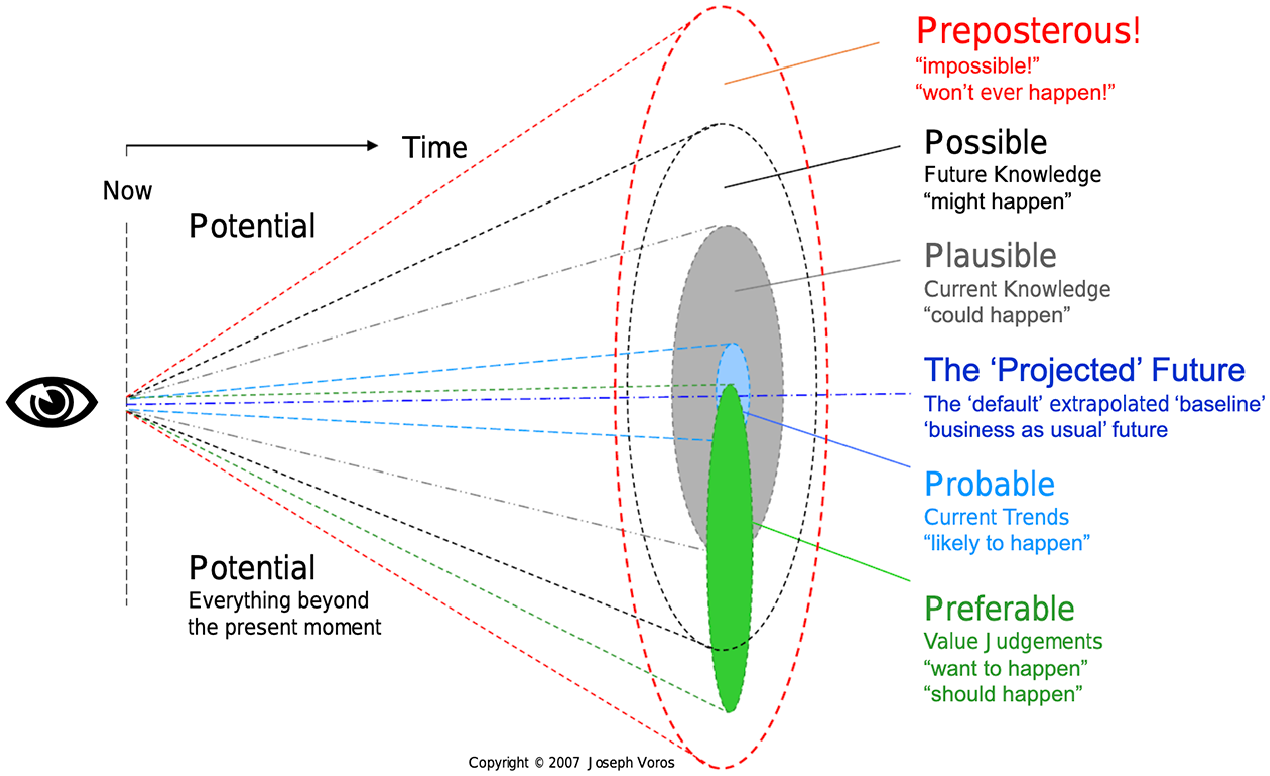
The Futures Cone Depicting Seven Types of Alternative Futures (Voros, 2019). © 2019 Springer International. Reprinted with permission.
Designs are influenced by the contexts within which they are created and also by the designs that have preceded them. Design timescapes provide an approach for visualizing the historical and contextual elements at play in an organized way. When done well, this allows designers to better understand how concepts, products and services have come into being and to trace what the consequences of their realization might be for broader society. These visualizations are selective, and inevitably speculative, acknowledging that the greater the distance the researcher has to the issue or design they are exploring (both temporally and culturally), the more speculative it will be.
Importantly, design timescapes are not just a visualization of historical events but a combination of known events (both design precedents and historical contexts) and unknown future possibilities (consequences). Designers are able to expand our timescapes to explore centuries before and after a design was created, or focus on a timespan of a few weeks or months. If the design intervention that forms the central point of the timescape has been in existence for a while, it can be insightful to identify some of the social, technological, economic, environmental, political, legal and ethical factors that led to the intervention. If the design in focus is yet to launch, then the second half of the timescape will be mostly speculative. The more informed the designers’ future projections, the richer the discussions around the potential next steps will be.
In Tomitsch et al. (2020: 62; also see Figures 2 and 3), I offer a practical guide as to how and why designers might integrate several methods relating to designing with and visualizing time (design timescapes, scenario-based futuring, backcasting, and local orbits): [Timescapes] can assist with: identifying the need for further research into precedents or consequences, making design choices that are informed by an understanding of a design’s history as well as its possible consequences, and arguing for the value and validity of a new design concept.
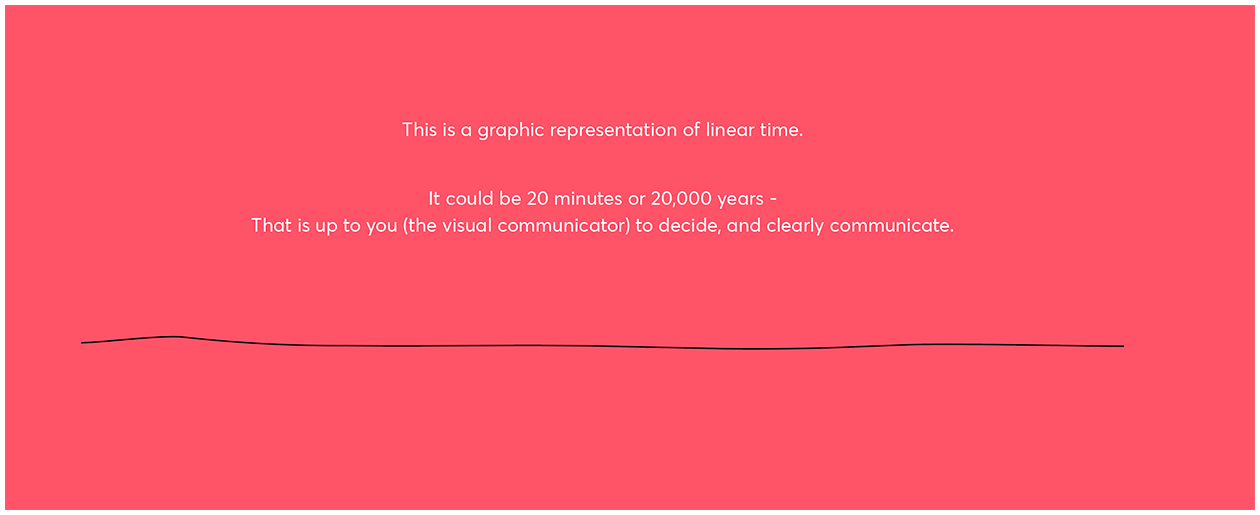
Lecture slide from the University of Sydney Visual Communication unit of study (Cooper, 2020).
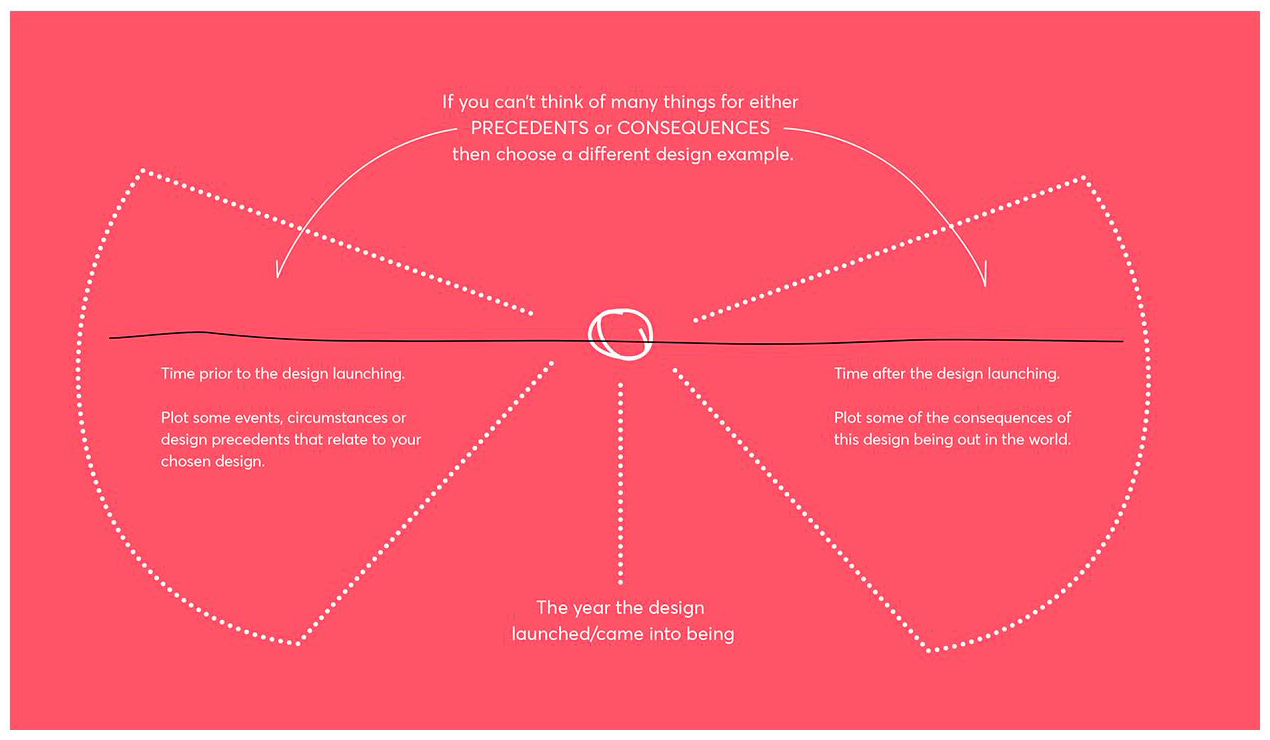
Lecture slide from the University of Sydney Visual Communication unit of study (Cooper, 2020).
Choosing a time span appropriate to the study is one of the first steps. Adopting the pendulum futuring approach described above is helpful, as it gives the designer equal room on both sides of the timescape to gain an understanding of expectations, assumptions, trends and pace of change. It can also be a great prompter for conversations (for example, sharing expectations of 2010 from the year 2000, or the year 2000 from the 1980s). 3
The centre point of the timescape is either occupied by the present moment or the launch date of the intervention that the designer is exploring. For example, when students were exploring the precedents and consequences of the grassroots environmental activism campaign #StopAdani, the central point was the launch in 2016 (see Figure 4).
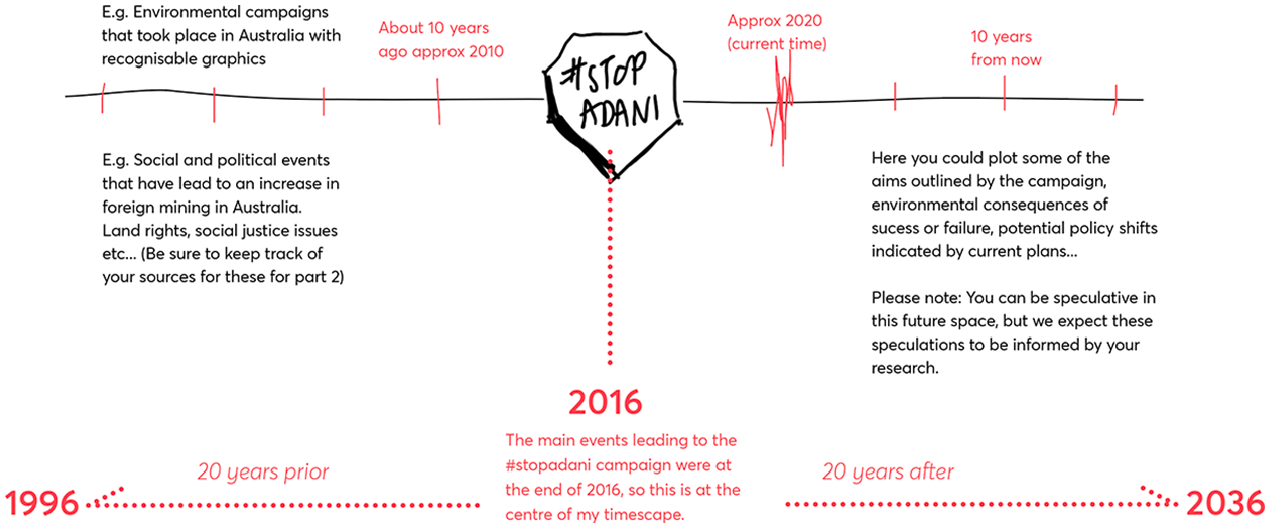
Lecture slide from the University of Sydney Visual Communication unit of study (Cooper, 2020).
Timescapes can be text-based or illustrated. To populate the ‘precedents’ side of the timescape, the designer can ask: Which earlier designs might have inspired this design? From what social context did this design emerge? What resources and technologies does this design draw on? (e.g. the rise of social media helped to facilitate the #StopAdani campaign, see Figure 5.)
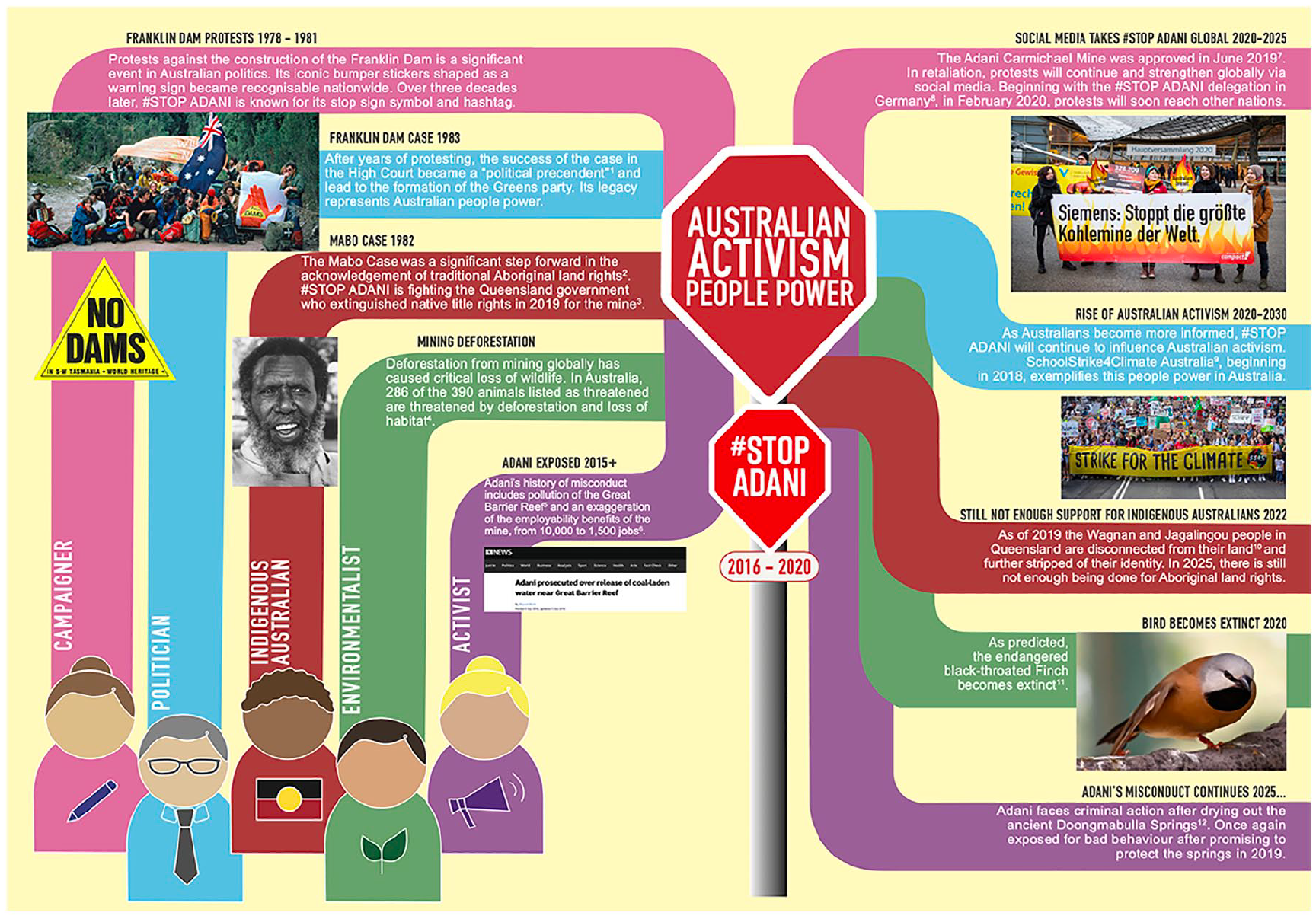
An example of how Visual Communication student MF chose to visualize her design timescape researching the #StopAdani campaign. MF chose to add complexity and depth to her poster by coding her findings to show key stakeholder roles in environmental campaigns over time.
When populating the ‘futures’ section of the timescape, the designer should first identify if the method is being used to explore the potential futures of a current design innovation – in which case, there are no known consequences of the design, and the timescape will be an extrapolation of current impacts to consider potential consequences that may yet happen. If the method is being used to visualize the precedents and consequences of a design that has been in existence for a while, there will be a combination of known and unknown consequences in the ‘futures’ side of the timescape. The potential ‘dates’ of these consequences are of course speculative but could align with known annual events or seasons (e.g. the #StopAdani campaign led to pro-mining campaigns and lobbying from the Adani Group, Minerals Council of Australia, and the Liberal–National Coalition.)
Once the timescape is completed, the designer can identify the insights this visualization process has revealed. These findings can be used to inform the next steps in a design process.
Design timescapes in practice and research
The visualization of temporal trends is not limited to design (for design). Other fields have explored the benefits of temporal and spatio-temporal visualization as both research, communication, and as the final creative work, for example in criminology (Brunsdon et al., 2007), health (Angus et al., 2012) and music (Hope and Vickery, 2011).
In design-futuring workshops, the visual communication of time plays several roles: cueing discussion, mapping conversation, and charting potential strategies. An incomplete or ‘lop-sided’ timescape will also draw attention to unseen histories and narratives. Designers should ask themselves: Is this a static period with regards to the issue/innovation I am exploring? Or do I need to seek out more information from other perspectives from this period?
Designing visual prompts for experimental and collaborative workshops is key to any kind of performative worldbuilding. In an attempt to proactively recognize, remember and acknowledge the changes of the past to ‘produce that forward-directed energy called hope’ (Solnit, 2016: xvii), I pre-populate the timescapes before each workshop. I plot a mix of recognizable, significant historical events (these could be global conflicts, elections, major policy changes), narratives of marginalized groups (more often than not challenging colonial narratives or the Western canon), and more personal experiences to cue an expanded sense of ‘fleshing out’ time. Remembering change helps us to future. Whether it be mapping women’s rights to vote over the last century, or mapping devices used to listen to music over the last 30 years – both serve to lubricate the kind of thinking required for rich futuring practice. Collaboratively visualizing these shifts helps a group to add greater granularity to their future scenarios.
Having shared some details regarding the process as a whole, I will now illustrate some ways in which the process helped to generate ideas about the various substantive issues it has been used to explore. I will share two key examples of where design timescapes were central to a collaborative futuring practice and resulting outcomes in professional practice, and two examples from student assignments. Permissions have been granted from the relevant people (design students whose work has been reproduced here, and workshop participants whose notes are de-identified, but are legible in the workshop photos).
Futuring migration at Frontyard Projects
In 2016, I co-founded a community-focused research space in my local area called Frontyard Projects. 4 Here, I designed and facilitated futuring workshops that explored the possible futures of the arts, nightlife, dating, education, and more (see Figure 6). The Futuring Migration workshop (2016) was designed in collaboration with local human rights lawyers and activists from the group Plan2050 in response to growing frustration with the Australian government’s cruel asylum seeker detention policy.
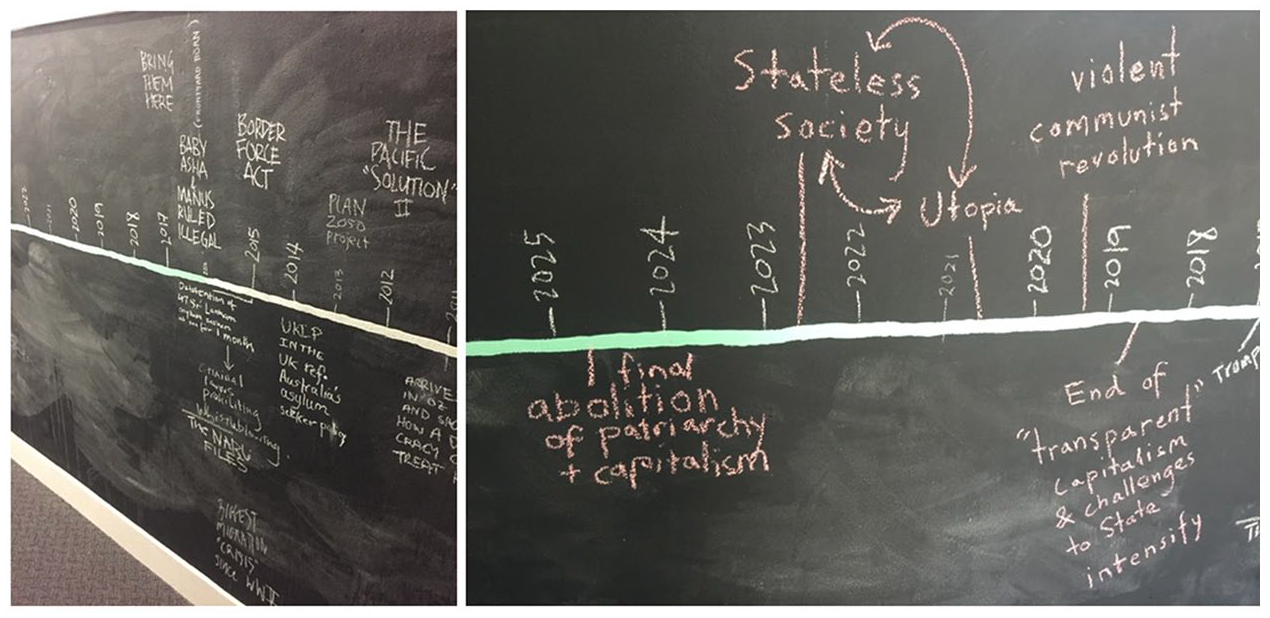
Two images from the chalkboard ‘Time Trumpet’ timescape for Futuring Migration workshops (2016) at Frontyard Projects, Sydney.
The group met for two nights of futuring workshops, the first focusing on the speculative artefacts generated by Plan 2050, and the second focusing on the personal stories and projections of workshop participants. The 40-year timescape painted in the hallway for this project began in 1996 and projected through until 2036, and was pre-populated with historic events and policy changes relating to asylum seekers in Australia. A rich discussion ensued when participants were invited to add their informed projections and speculations relating to plausible shifts in policy due to targeted advocacy to the design timescape. Visualizing the relationship between increasing climate-related catastrophes and environmental migration 5 highlighted the need for proactive approaches to combat xenophobia in Australia, resulting in the collaborative creation of a speculative service design solution comprising of a ‘Xenophobia Immunisation Kit’ and accompanying education campaign.
Futuring local government support for arts and culture
The following visual example emerged from two workshops designed to act as a community consultation process for local council to feed into their strategic plan Creating Our Inner West 2036. 6 Participants explored ways in which the council could support local artists and creative industries. The resulting contributions were informed by rich, lived experience of place. It was through the visualization of these interconnected experiences that meaningful links between needs, advocacy, and possible outcomes were constructed. Engaging creative community members from different cultural backgrounds and diverse age groups helped the local council to identify the potential benefits of mixed-use spaces where cultural competency, financial literacy, and language skill-sharing were identified as of great value to the arts community.
I have chosen to include Figure 7 as it shows how sketch-noting some of the contributions can enliven the timescape: helping participants to offer greater detail when sharing their visions of futures, and helping to animate the stories of the many ‘pasts’ being shared in the room.
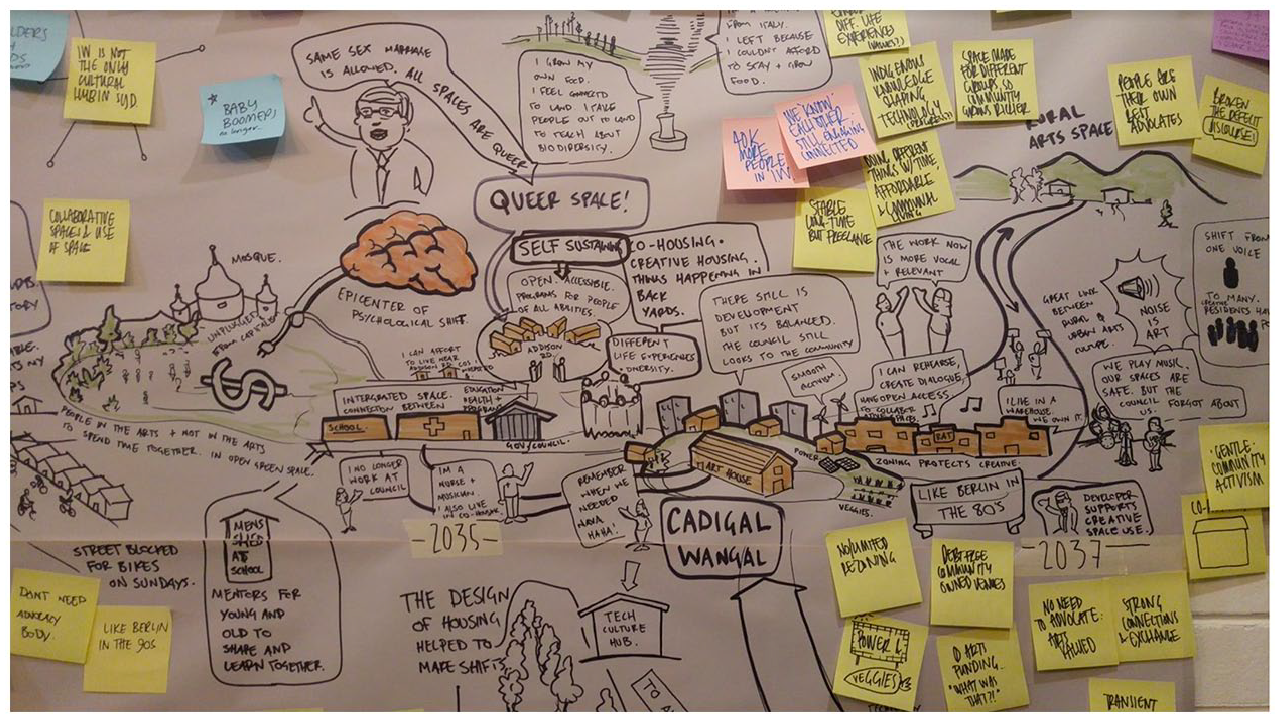
Excerpt of the 2017–2037 design timescape created for Inner West Council ‘Creating Our Inner West 2036’.
Design timescapes in undergraduate design student briefs
After seeing the benefits of using design timescapes in collaborative research, I embedded the approach as part of my redesign of the Interdisciplinary Design Studies Lab A (now called Design Futuring) at the University of Technology Sydney, and most recently as part of the Visual Communication units in the Design Lab at the University of Sydney.
One cohort of students used design timescapes in their design research process to explore local responses to the unfolding climate crisis on Gadigal lands over the next 15–50 years. The second cohort used the tool to develop an effective call-to-action campaign relating to their chosen design intervention.
The marked difference between the insights emerging from this process and asking students to write a text-based analysis of the historical context of a design were remarkable. It was through the visualizations that students identified historical parallels as well as patterns in human behavior, policy shifts, resource availability and geopolitical tensions that inform design practice. Creating with this tool helped them to not only research historical events and reflect on their role as designers in the Anthropocene, but also to engage in a futuring and backcasting process.
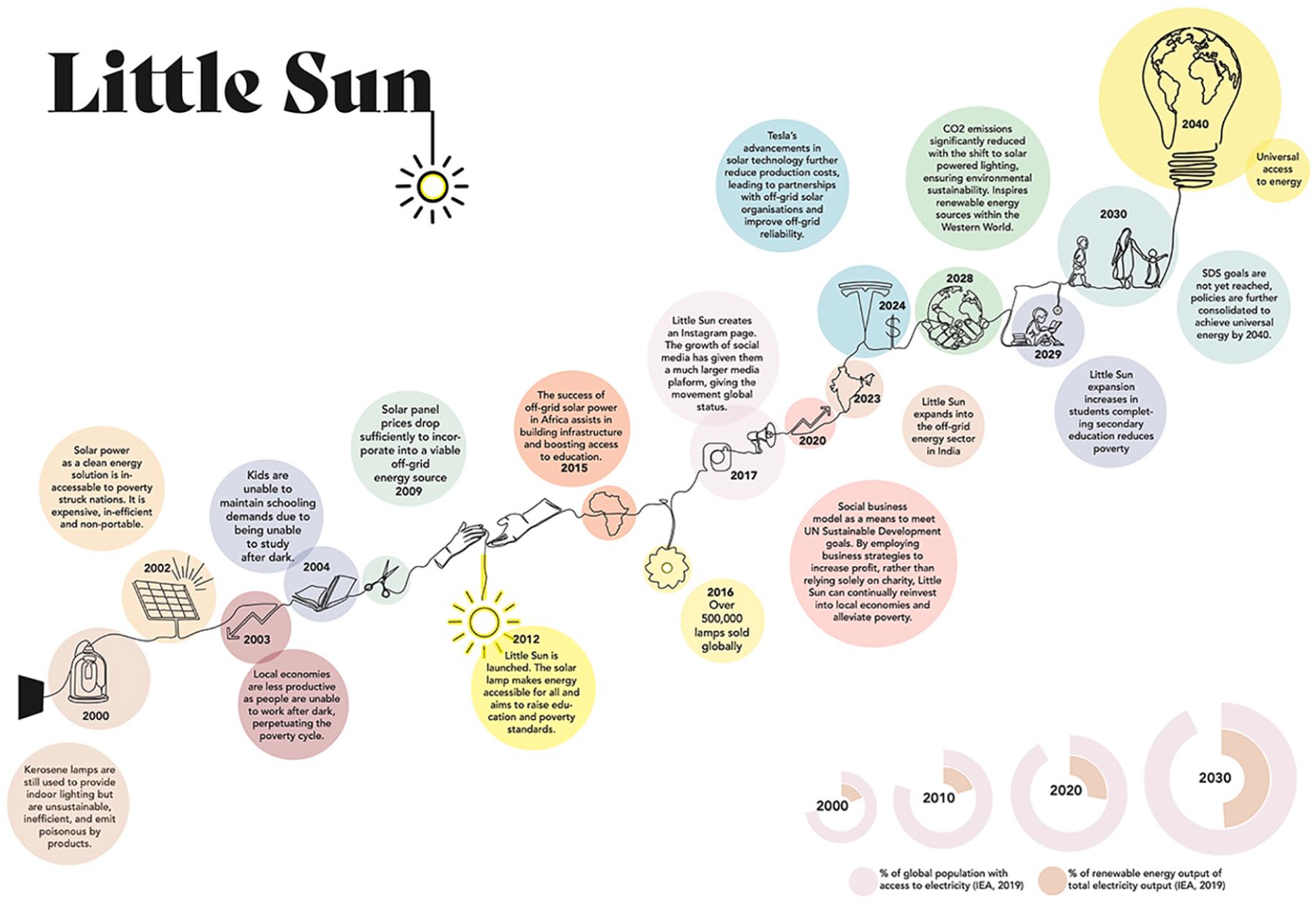
You can see from the following examples that students were able to imbue their design timescapes with an array of visual character. Figures 8–10 indicate the progression from simple text-based research on a timescape to graphic narrative, and Figure 11 is a more text-based approach. Common to all of them is a strong visual argument for the positive social consequences of the designs they were investigating.
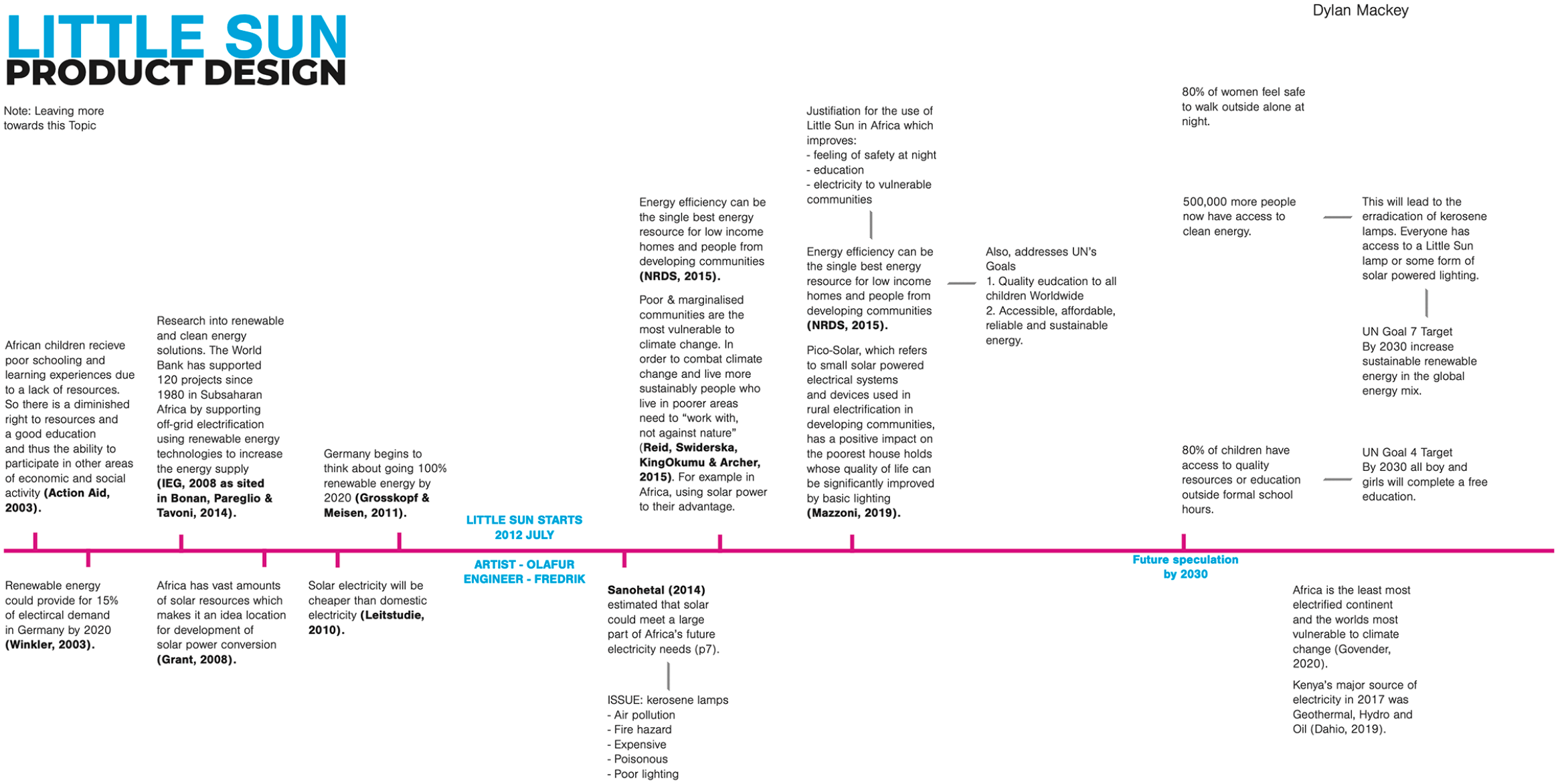
Dylan Mackey’s draft exploration of the precedents and consequences of the product design ‘Little Sun’.

Mackey’s completed design timescape in full.
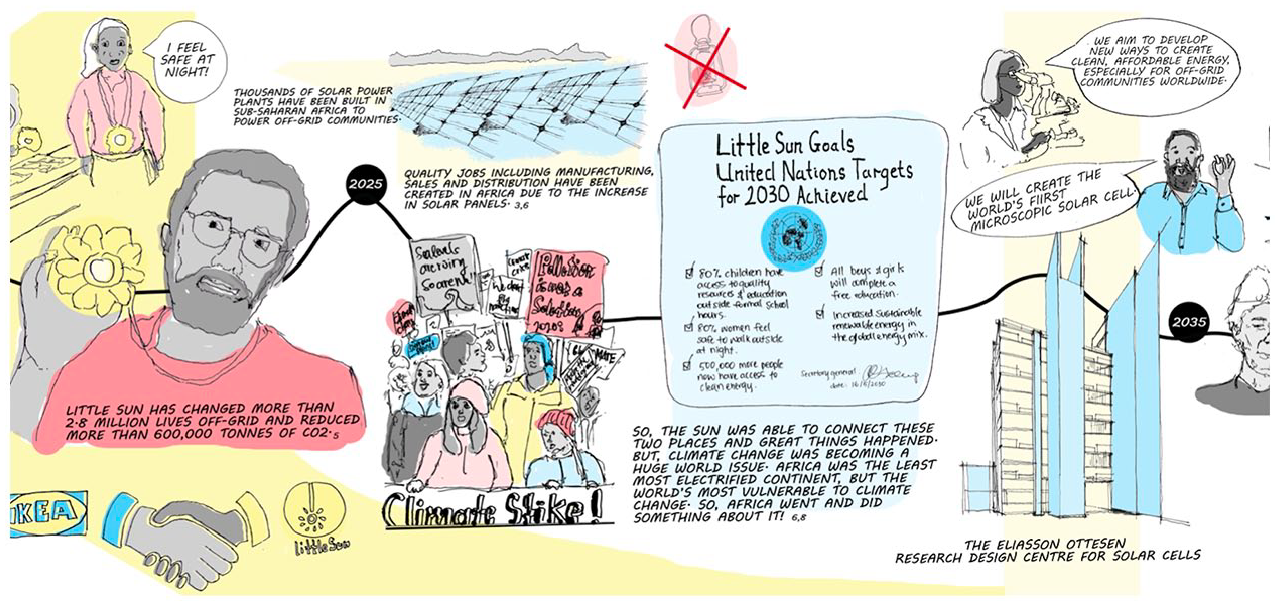
Detailed excerpt from Mackey’s Little Sun design timescape.
In contrast, Bridie Douglas chose a more text-based approach to visualizing their findings.
Discussion and Conclusion
Hope just means another world might be possible, not promised, not guaranteed. Hope calls for action; action is impossible without hope. . . . To hope is to give yourself to the future, and that commitment to the future makes the present inhabitable. (Solnit, 2016: 4)
Taking time to reflect on this tool as a design researcher and practitioner has given me the opportunity to identify the multifaceted benefits of visualizing time through design timescapes during a design process. It has proven to have at least three benefits: cueing rich discussion, mapping conversation, and charting potential strategies. Visual communicators could also use the tool to help to argue for a particular approach, design intervention, or call-to-action, through refined digital synthesis, coding of actions and insights, or by animating elements.
It can be difficult for facilitators to capture the details shared in a workshop, especially when pluriversal visions are navigated. Trying to address this when facilitating design workshops online during Covid-19 I have found the collaborative platform Miro to be an excellent platform to explore a method such as this, especially when participants are contributing their own digital sticky-notes. The downside of this is that it can be difficult to navigate and synthesize all of the contributions, compared with when the facilitators are the note-takers.
This essay has offered design timescapes, and design futuring more broadly, as a way to combat paralysis when faced with difficult future projections. Learning to identify damaging patterns of human behavior and understanding the context-responsive nature of many of the design innovations of the past are vital to effective futuring work, and to inspire future-friendly design practices.
This essay has also argued that design timescapes can be used to gain a greater understanding of what consequences may follow design innovations through visualizing these ideas with what has preceded and fed them. Effective visual communication is key to synthesizing complex issues, as well as exploring and communicating the steps towards more just and sustainable futures. Design timescapes is one such tool that can be used in design research and pedagogy to achieve this.
Footnotes
Funding
The author received no financial support for the research, authorship, and publication of this article, and there is no conflict of interest.

Notes
Biographical Note
CLARE M COOPER’s design research and pedagogy are informed by two decades of professional design practice, workshop facilitation, community design activism, and the performing arts. She has brought together thousands of people to work together on community initiatives, creative approaches to governance, collaborative composition, speculative design, and critical listening through co-founding several performing arts festivals, large-scale improvising orchestras, and experimental research spaces, including the NOW now Festival (2001), Splinter Orchestra (Sydney, 2000), Splitter Orchester (Berlin, 2009), Frontyard Projects (2016), Climate Strike Workshop (2019), and the Design Activism Workshop (2019).
Cooper has consulted on government projects, community grants and policy development with the City of Sydney, Inner West Council, Create NSW, and National Association for Visual Arts. As a harpist and guzheng player, her international performances and compositions have been featured on Australia’s ABC, Germany’s SWR and UK’s BBC and have been published by Mikroton (Russia), Splitrec (Australia), and High Zero (USA).
She is currently a Lecturer in Design Computing at The University of Sydney, where she teaches visual communication, design futuring, interaction design, and electronic arts.
For more information about her research projects, please visit Clare’s personal webpage: Gutstring Projects Folio.
Address: The University of Sydney, 148 City Road, Darlington, NSW 2008, Australia. [email: