



Abstract
This article interrogates the idea of ‘smartness’ as embraced by artistic and design representations of future domestic spaces. Through an analysis of works of individual artists, designers, and curators (Aideen Barry, Kuba Jekiel, Rowan Elselmy) as well as collectives (UCL, Liminal Space, Dark Matter Labs, Superflux, the Hub for Biotechnology in the Built Environment, SquintOpera), we explore how these creative interventions reconfigure the well-established techno-centric narratives around smart homes. Our interpretations are enriched by insights drawn from self-conducted interviews with creators, as well as those expressed in available feature texts and media commentaries. Engaging with theoretical frameworks originating in cultural studies, critical futures studies, and speculative design, our analysis demonstrates how the discussed projects recalibrate the neoliberal paradigm of smart living, offering unconventional and inspirational understandings of smartness. The article contends that ‘smartness’ cannot be seen as a fixed technological ideal; rather, it should be approached as a fluid, context-specific concept, calling for a more nuanced approach to the smartification process of modern society, across material, ideological, and axiological dimensions.
Keywords
Introduction: Concept and methodology
In recent years, the concept of ‘smartness’ has become central to discussions about the future of living, particularly in reference to smart homes and smart cities. The futuristic visions of life enhanced through progressive human integration with smart technologies, as depicted in popular culture and marketing visions, appear to be centred on maximizing convenience and productivity, displaying a fundamentally techno-capitalist orientation (e.g. Kember, 2016; Maalsen and Sadowski, 2019; Sadowski, 2020; Sadowski et al., 2021; Woods, 2018; Zuboff, 2019). The existing literature confirms that the development of smart technologies has mostly been driven by ‘industry’s techno-economic optimism’ (Pereira and Hargreaves, 2024) while grappling with application challenges (Gram-Hanssen and Darby, 2018; Wilson et al., 2015). However, is this really the only way our lives can be enhanced by intelligent domestic devices? This article stems from a conviction that by adhering to conventional narratives and reproducing them – both through our imagination and our actions in technologically mediated homes – the future of smart living may become severely restricted, as far as both personal choices and the strata of social values are concerned. Thus, it seems urgent to us, as cultural studies scholars, to critically engage with the concept of ‘smartness’, strategically pluralizing its meanings, in an attempt to design more livable, perhaps smarter, futures.
Although the scholarly discourse on smart home technologies has predominantly been shaped by research conducted within the applied sciences, recent years have witnessed a modest increase in academic reflections informed by conceptual and methodological frameworks of cultural and sociological studies. These interrogations include analyses of representations of smart homes across various media and cultural artefacts, including literature, video games, or film. However, much of this work focuses on historical depictions of smart technologies, without addressing most recent or niche portrayals of smart living (e.g. Heckman, 2008; Schaffer, 2020; Spigel, 2010). The few existing studies examining contemporary cultural representations offer critical, often feminism-inspired, interpretations, exposing capitalism-informed, albeit concealed, aspects of smart homes (e.g. Chambers, 2020; Hamarowski and Golańska, 2023). However, these investigations have yet to fully engage with how cultural depictions – both mainstream and alternative – (re)configure the concept of smartness, either reinforcing or challenging its conventional understandings. In addition, available analyses of current cultural production tackling the idea of smart living rarely consider the personal intentions of these projects’ creators, ignoring the observations and values these unconventional visions are driven by. This article aims to partly fill this dearth in research by examining selected up-to-date artistic and curatorial interventions that deal with smart living, with an aim to figure out the ideas of smartness they convey. Even though the cultural studies approach assumes that meanings and interpretations of cultural texts are created by readers immersed in their complex socio-cultural contexts, we believe that analysis of creators’ intentions remains relevant for our research, as it reveals motivations behind the particular intervention as well as signalling the problem the project is meant to respond to. Also, the focus on the creator’s viewpoint facilitates examination of the project’s critical potential. We engage in brief exercises in close (or attentive) reading (e.g. Berthoff, 1999; Bialostosky, 2006; Greenham, 2019; Ohrvik, 2024) of these projects, combining our interpretations with the insights offered by some of their authors. Such investigative strategy helps us address the main research question structuring our analysis, namely: What does the adjective smart in speculative thinking about smart homes stand for?
This article contributes to current debates on smart technologies and everyday practices associated with their growing presence in domestic spaces by pluralizing the concept of ‘smartness’, thus deconstructing its prevalent meanings infused with techno-capitalistic values (Kember, 2016; Zuboff, 2019). For this purpose, while examining selected interrogations of smart living, we reflect on how these speculative interventions are related to current thinking about the ‘smart’ future. With this objective in mind, the next section of this article starts by briefly outlining, based on secondary sources and analyses, the trajectories of understanding smartness in the emerging field of smart home research. Initially driven by cultural studies approach, and slightly dissatisfied with its limitations, our analysis is in section on future as an analytical category positioned within the broader context of critical futures studies and speculative design, highlighting the significance of exploring imaginative representations of the future as an essential mechanism for fostering social change. Building on this foundation, in section on futurescapes of smart living we turn to artistic and curatorial interventions and, in some cases, their accompanying narratives gathered through self-conducted interviews 1 with creators and analyses of secondary sources (mostly, feature texts and media commentaries).
The examples of smart homes of the future discussed in section 4 are drawn from an archive of approximately 300 cultural representations compiled in the course of a multi-year research project Smart(ening up the modern) home - Redesigning power dynamics through domestic space digitalization. This collection encompasses movies, TV series, video games, art exhibitions, literary works, and audio-visual advertisements produced roughly between the 1933 Chicago World’s Fair – whose ‘Homes of Tomorrow’ exhibition is widely regarded as inaugurating modern smart home imaginaries – and the present. The corpus was first assembled through review of (relatively scarce) literature focused on cultural representations of smart home technologies. It was subsequently expanded via targeted searches in online repositories and catalogues, references and mentions on social media platforms, documentation of design competitions (e.g. The Davidson Prize), as well as site visits and archival queries in institutions such as the Museum of the Home (London), the Design Museum (London), and Futurium (Berlin). Within this broader corpus, many representations either reproduced market-oriented understandings of smartness foregrounding high-tech, commercially available solutions or incorporated smart technologies only tangentially, as narrative background elements. Against this backdrop, we employed purposive sampling to identify a smaller subset of works that explicitly and imaginatively engage with questions of domestic futures. We contacted creators behind the selected projects and invited them to elaborate on the premises and intended interventions of their work. The resulting sample comprises projects that (1) articulate a central and well-developed vision of the future home rather than treating it as a peripheral motif, and (2) depart from market-ready solutions in ways that open up alternative social, ecological, political, and experiential configurations of domestic life. Based on this search, we identify themes that structure the speculative thinking about the future of smart living. Along with the cultural studies approach, we close-read relevant examples of artistic, design, or curatorial practices falling within each identified strand, exploring how these representations relate to the specific streams of thought in scholarly discussions. We are particularly interested in how these projects participate in either advancing or destabilizing their predominant assumptions, while creatively redirecting them toward new conceptual and material reservoirs of the imagined futures. Thus, in line with close reading strategy, we attempt to figure out how our interpretative findings are related to ‘broader philosophical, literary, and cultural questions’ (Bell et al., 2009: 6) permeating the smart home discourse. We summarize our findings in the discussion section of the article.
Our objective in this article is to situate smartness within the theoretical framework emerging at the crossroad of cultural studies, critical futures studies, and speculative design with an aim to recognize it as a fluid, context-dependent, and plural concept, thus avoiding its positioning as a static technological ideal. Engagement with selected artistic and curatorial practices serves this purpose.
Understanding smartness
Although the acronym SMART originally referred to Self-Monitoring, Analysis, and Reporting Technology in hardware failure prediction systems, its contemporary use in relation to smart homes typically denotes data-driven, responsive systems capable of monitoring, intervening in, and steering domestic life (Hildebrandt, 2020). Today, the notion of ‘smartness’ is widely debated in smart home research, with its definition remaining rather ambiguous and ever-changing. While cultural studies scholars have already critically approached the term ‘home’ in smart home discourse (e.g. Ellsworth-Krebs et al., 2015; Gram-Hanssen and Darby, 2018), the meaning of smartness is still insufficiently explored and needs to be charted.
Marikyan et al. (2019), building on the telecare systems classification proposed by Bowes et al. (2012), describe the progression of smart home technology through four stages, each reflecting a deeper integration of (artificial) intelligence and functionality. Initially, in their account, smart homes utilized basic information processing systems that responded to residents’ movements without engaging AI, but – as technology advanced – AI-driven devices emerged, marking the second stage of smartification of the domestic space. Such technologies enabled environmental sensing, health monitoring, and task automation. Subsequently, the third period introduced interoperability and data-sharing capabilities through voice control (such as Siri or Alexa) and connected networks, while the fourth phase of smart technology integration within the homescapes, (erroneously) projected for 2020, anticipated the use of embedded sensors for sophisticated forms of remote health management. This ‘developmental definition’ aligns with the most widely adopted technology-oriented understanding of smart homes, which emphasizes the integration of advanced technologies, such as sensors, actuators, and Internet of Things (IoT) devices, to automate and control various systems within the domestic space (Saad Al-Sumaiti et al., 2014; Zhang et al., 2018). The core of this approach is to boost the functionality, efficiency, and safety of living spaces, creating connected environments that can adapt to both immediate and anticipated needs (De Silva et al., 2012; Mekuria et al., 2021). In this prevalent perspective, smart homes are envisioned as intelligent systems that improve the quality of life through automation, connectivity, and proactive management of home environments, addressing a wide range of issues, including security (e.g. Ray and Bagwari, 2020), energy (e.g. El-Azab, 2021; Gram-Hanssen and Darby, 2018; Reinisch et al., 2011), and medical (e.g. Chan et al., 2008; Demiris et al., 2004; Rialle et al., 2002) concerns.
As recent research reveals, beyond technical disciplines, conceptions of ‘smartness’ are continually produced and normalized through everyday practices of marketing and consumption. The sector’s prevailing articulation of smartness aligns with techno-centric, solutionist visions that frame technology as the primary vehicle for (domestic) betterment. Chambers’ (2020, 2022) examination of smart home promotional texts – spanning professional institutional reports on IoT, consumer surveys, marketing materials, audio-visual adverts, and corporate website content – captures this pattern with particular clarity. She shows how these texts repeatedly advance narratives in which technological intervention appears as both inevitable and intrinsically beneficial. Smart devices are positioned as streamlined solutions to vaguely defined household challenges, accompanied by sweeping assurances. As Chambers notes, ‘smart discourses prescribe smart solutions to ill-defined problems. Within the drive to inhabit and colonize the home, the speculative and grandiose rhetoric of promotional texts promises inevitable progress, reduced housework, and enhanced lifestyles’ (2020: 314). While her critique foregrounds the lack of attention to gendered household dynamics and the actual diversity of households, it also exposes the persistence of a techno-ideal of smartness, as ‘industry continues to make ambiguous and unrealistic claims about efficiency, convenience, and energy reduction’ (Chambers, 2022: 672), frequently detached from ethnographic evidence of how technologies are actually taken up, or from more fundamental reimaginations of domestic practices, infrastructures, or care relations.
This techno-solutionist repertoire is also reproduced visually in architectural trade media, where images actively define and normalize particular meanings of smartness in the home. Based on visual content and semiotic analysis of 321 smart-home images drawn from six publicly accessible architectural outlets (2018–2020), Sadati Far and Leszczynski identify two dominant modes of representation: images in which smart technologies are visible (37%) and those in which they are concealed (63%) (2025: 11). They argue that these modes produce complementary semiotic myths of the smart home: one that frames it as a familiar space of belonging for both residents and smart objects, and another that constructs it as an aspirational site of intangible luxury enabled by the automation of everyday domestic labour. Together, these visual narratives work to secure trust in and desire for smart homes, thereby naturalizing them as desirable and inevitable domestic futures. Industry discourse also consolidates smartness around personalization. Dahlgren et al. (2021), analyzing technology-sector reports, show that smart home futures are framed as automated decision-making for a ‘market of one’, advancing a techno-hedonist ideal of convenience, control, and choice while downplaying negotiated household power relations.
At the level of products, Sovacool and Furszyfer Del Rio’s (2020) mixed-methods research – drawing on 31 expert interviews and 37 structured site visits across different retail environments – offers a complementary perspective by examining how smartness materializes in the marketplace. Their mapping of 267 commercially available smart home devices supplied by 113 companies initially gives the impression of a flourishing and heterogeneous consumer ecosystem. Devices ranged from simple, standalone tools to more automated and potentially AI-enhanced systems, such as robots and drones. This sheer proliferation of products suggests a sector that is dynamic and responsive to emerging techno-social possibilities. Yet, when viewed through the more conceptual lens of smartness, the market is far more uniform than this numerical diversity implies. Their findings reveal that nearly all devices operate within a narrow, highly standardized understanding of what counts as ‘smart’: networked connectivity, sensor-driven automation, remote control, and incremental optimization of domestic routines. Functionally and ideologically, they converge on the same premise that homes become ‘smarter’ by layering additional digital components and intensifying algorithmic management.
At the same time, recent analyses suggest that industry and marketing discourses are not entirely static and have begun to experiment with more inclusive representations of users and households: featuring more diverse bodies, family configurations, and domestic arrangements in their imagery (e.g. Chen et al., 2025). These more pluralized visual and narrative repertoires respond, at least in part, to earlier critiques of exclusion, signalling a growing awareness that smart homes are inhabited by differently positioned actors. However, even if the imagined occupants become more varied, these shifts in who is pictured as belonging to the smart home do not fundamentally unsettle the techno-ideal that has been sustained since 1980s visions, such as the ‘Xanadu: Computerized home of tomorrow’ by Roy Mason. As a result, the core repertoire of promises remains anchored in technological sophistication and networked infrastructures, leaving the underlying model of what it means for domestic life to be ‘smart’ unchanged.
In contrast to predominant technology-focused definitions, preoccupied with the actual functions that smart home devices may fulfil, scholarly conceptions originating in critical studies of smart technologies portray them as dynamic cultural entities that not only reflect, but also substantially shape, social identities, relationships, as well as present and envisioned living arrangements. Constituting material-semiotic settings, in this view, smartified spaces are seen as integral to a broader cultural shift toward digital modernism, within which the boundaries between human agency and technological autonomy increasingly blur, initiating new forms of post- and more-than-human relations (Heckman, 2008; Herwig, 2022). Thus, smart homes are no longer perceived merely as facilitators of convenience or efficiency; rather, they serve as arenas in which notions of identity, personhood, and lifestyle are negotiated, influencing the prospects of human-technology interactions. Positioned as ‘socio-technical assemblages’ (Maalsen, 2020) of materialities and social significations, these networks of relationalities shape, and are shaped by, social tendencies and cultural codes (cf. Wajcman, 2010: 149). Thus, in their role of ‘communication media’ (Spigel, 2010), smart homes narrate values-loaded visions of the future, while remaining inscribed with a specific set of expectations and desires, embodying either utopian promises or dystopian anxieties (Chambers, 2020). Far from being neutral spaces, they are embedded within the power structures that give rise to and organize them, serving as breeding grounds for the possible exclusion of certain identity categories (Benjamin, 2019; Rottinghaus, 2021). Their potentially exclusionary nature often becomes evident in the design and implementation of smart home technologies, which may unconsciously prioritize certain social groups while marginalizing others, thereby perpetuating, even deepening, existing inequalities.
In dialogue with the cultural studies-informed strand of defining the smart home as a multifaceted concept metaphorized as a ‘constellation’ (Heckman, 2008), ‘nexus’ (Strengers, 2020), or ‘assemblage’ (Maalsen, 2020), we propose to conceive of it as a laboratory in which ‘material-discursive’ (Barad, 2007) futures of technologically enhanced domesticity – imbued with distinct social patterns of behaviour, cultural values, as well as gendered living arrangements – are enacted. As such, the category of ‘smartness’ should be seen as historically contingent, its attribution being invariably determined against the technological advancement and axiological profile of a given community. Considering the conceptual ambiguity of the term, the understanding of smartness proposed in this article underscores its context-specific and inherently fluid nature, undermining the view that it can be defined solely by the material sophistication of technologized spaces. Such a framework lays the ground for further explorations of speculative interpretations of smartness, which seek to challenge the apparent inevitability of an already initiated process of smartification promoted by big tech corporations and their neoliberal ideologies. It also opens up novel possibilities for a more creative, sensitive, and socially engaged interrogation of smart home technologies and their futures.
Future as an analytical category: A theoretical background
The research conducted within the field of cultural studies has predominantly been concerned with understanding and challenging the power structures embedded in cultural practices, views, texts, and institutions. However, some scholars point out that this focus has typically remained anchored in the present or the immediate past, with only sporadic and rather superficial engagements with the future (e.g. Powers, 2020: 451; see also Alper, 2019; Urry, 2016; Grossberg, 2010). As Powers notes, ‘In cultural studies, it is common to make predictions and deliver warnings, but it is rare to … consider the purpose and implications of future speculation’ (2020: 452). As cultural studies scholars, we perceive this avoidance of speculative thinking within the discipline as a serious limitation, especially given this field’s commitment to the advancement of social change. Such an orientation positions cultural studies as preoccupied with formulating criticism rather than offering possible solutions to the identified problems. We believe that a more thorough engagement with speculative thinking within cultural studies could be beneficial, and our view stems from the conviction that the future is not an abstract concept or a distant horizon; it is a space within which the dynamics of power, culture, and technology could be reconfigured. In that sense, our argumentation aligns with Powers’ opinion that the discipline should orient itself toward the future, considering it a ‘zone to be occupied, fought over, theorized, envisioned, and possibly emancipated’ (2020: 456), or, as Urry contends, a crucial arena for the thorough contestation of complex power relations (2016: 11). Cultural studies, Powers argues, ‘could bring much-needed critical awareness to future imaginaries’ (2020: 453), offering necessary contexts and political motivations for dare futures work. Therefore, acknowledging the urgency to engage with the future, we are convinced that cultural studies – historically adept at forming theoretical alliances and concerned with refashioning the social structures toward a progressive change (cf. Grossberg, 2010) – needs to forge its strategic connections with future-oriented disciplines, ensuring itself a place of a central actor in the collective endeavour to imagine and design a better, or at least different, tomorrow.
Thus, the conceptual framework through which we approach our findings in this article combines insights offered by cultural studies (especially critical strands aligning with feminism, science and technology studies, and environmental humanities) with the ways of thinking typical for future-oriented fields, such as critical futures studies (CFS) and speculative design. We believe that such a conceptual crossroad is needed in the context of our research to truly account for the possible meanings of smartness in smart home discourse. It enables envisioning the diversity of meanings and scenarios that smartification of domesticity may entail while not losing sight of power dynamics and sensitive issues that structure our socio-cultural reality. Acknowledging inequalities and asymmetries (as cultural studies do) is not enough; it is urgent to undertake action to imagine and configure the reality which is to come according to the desired scenarios. Futures studies – an ‘action-oriented field’ (Fischer and Dannenberg, 2021), within which creation of visions of the future supports current actions – may provide a helpful perspective in this endeavour. As Fuller and Loogma underline, ‘Foresight is intended as a precursor to action and is concerned with generating knowledge about the anticipated consequences of different actions’ (2009: 73). Yet, while futures studies have historically been a prominent field, in both academic and commercial terms, the systematic inclusion of cultural dimensions in the scholarly analyses conducted within this area has only recently gained traction through CFS. Goode and Godhe observe that ‘in terms of shaping society’s capacity to imagine and deliberate on potential futures (and therefore to steer towards or away from specific scenarios), we are always and unavoidably dealing with matters of culture’ (2017: 4). Thus, unlike traditional futures studies, which often concentrate on forecasting trends, CFS seeks to critically engage with the cultural narratives that influence how societies understand the future. Grounded in principles of inclusivity, CFS are akin to the underlying beliefs of cultural studies, even though the field is less concerned with analyzing social power dynamics than envisioning tomorrow. Importantly, CFS commits to the democratization of future-oriented discussions, ensuring that diverse voices are taken into account in public deliberations. As Goode and Godhe underline, CFS declares its ‘antipathy towards a technocratic ethos that claims the future is best left to experts’ without, however, delegitimizing expert knowledge (2017: 112). For us, an enrichment with cultural studies insights may further sharpen the critical dimension of CFS, offering a more difference-sensistive, socially inclusive, and environment-attentive view of the future.
Even a bolder approach to thinking about possible tomorrows is offered by speculative design practice (e.g. Auger, 2013; Barendregt and Vaage, 2021; Dunne and Raby, 2013; Hunt, 2011; Malpass, 2013), in which design functions ‘as a form of critique and speculation within disciplinary, scientific, and societal frames’ with an aim to stir broader debate (Malpass, 2013: 333). Focused on future possible applications of science and technology, this practice intends to reflect on different implications of current technological advancements, developing scenarios of roles the technological products may play in new use contexts. As Dunne and Raby put it, ‘speculative design contests “official reality”; it is a form of dissent expressed through alternative design proposals. It aims to be inspirational, infectious, and catalytic, zooming out and stepping back to address values and ethics. It strives to overcome the invisible wall separating dreams and imagination from everyday life, blurring distinctions between the “real” real and the “unreal” real’ (2013: 160). Hence, speculative design does not only encourage deliberations about the technological future, but serves as a tool of delivering critique and rethinking the development of technology (Auger, 2013: 12). However, primarily concerned with the implication of technological advancement, speculative design is contested from the standpoints of intersectional feminism, race studies, and decolonial perspectives (e.g. Pennington, 2018; Tlostanova, 2017; Tonkinwise, 2014) as not contextualized enough as far as social differences and hierarchies are concerned. Thus, an informed cultural studies approach could mitigate some of the flaws of the speculative design practice, opening it up to a more critical thinking about the power dynamics implied in envisioned future scenarios. Enriched with such a perspective, speculative design can certainly offer tools to imaginatively engage with alternative futures for an advancement of not only technological, but also social change. In our view, the nexus of social justice-oriented cultural studies, action-oriented CFS, and provocation-triggering speculative design produces a prolific conceptual background for deliberating speculative visions of smart living, triggering re-categorization of knowledge and helping choices to be made about what actions could lead to desired futures.
One of the key concepts with which we engage in the following section of this article is that of ‘futurescapes’ (e.g. Adam and Groves, 2007), that is, the representations of potential futures, conveyed through a variety of cultural media. We use the concept in conjunction with the practice of ‘what-if’ scenarios frequently employed in speculative design, and described by Dunne and Raby as exercises that begin with a simple yet powerful question: ‘What if things were different?’ (2013). This question acts as a catalyst for imagining alternative realities that challenge the boundaries of what is considered possible within the current technological and socio-political climate. In line with the proposed conceptual framework, we also employ cultural studies perspectives to address power dynamics that the discussed futurescapes envision or within which they are situated. Unconstrained by the current state-of-the-art, by no means should these speculations be seen as predictions; rather, we approach them as provocations that encourage us to think beyond the limitations of the techno-social affordances of the present. Both futurescapes and ‘what-if’ scenarios leverage the power of speculative thinking to explore alternative futures and challenge the conventional narratives that constrain our understandings of what the future might hold. Cultural studies approach equip these insights with a more critical consideration of social power dynamics and its possible (re)structurings.
We believe that such a theoretical framing enables more attentive discussions about the smart home of the future, possibly reconfiguring the prevalent understanding of smartness away from the predominant neoliberal framework within which it is typically positioned. It seems that the domain of art is especially apt for such explorations, offering a ‘rich repository of imaginative futurescapes’ (Goode and Godhe, 2017: 111), as well as serving as a suitable canvas for speculative propositions. In Inayatullah’s words, the goal of such critical research is ‘to disturb present power relations through making problematic our categories and evoking other places, scenarios of the future … the new is possible’ (2007: 10). Thus, in the next section, in line with the CFS call for a ‘reconstructive turn’, or ‘seeking out versions of the future that may otherwise remain on the margins of public culture’ (Goode and Godhe, 2017: 7), we explore the somewhat latent discourse on smartness. As our investigations expose, based on analyses of artistic and curatorial practices, as well as the creators’ commentaries, not only do these artistic futurescapes of domestic living extend current material realizations of smart homes to their logical extremes, but they also challenge conventional understandings of smartness and their underlying social functions. Moreover, they propose imaginative solutions that may serve as an inspiration for developing inclusive and sensitive technological advancements that could contribute to creating a smarter tomorrow.
Futurescapes of smart living
Although technologically driven notions of ‘smartness’ dominate much of commercial and technical-scientific discourse about smartified domestic spaces, it would be inaccurate to assume that the entire academic community uniformly aligns with the established trajectories of smart technology development. In this section, while exploring the futurescapes of smart living as imagined in selected artistic, curatorial, and design-oriented visions, we identify points of convergence, albeit subtle, with the ongoing scholarly debates. So conceived, our approach avoids the fallacy of portraying scholarly discourse on smartness as monolithic, but it also underscores that, even though creative practices often take much bolder unconventional paths, they are not entirely disconnected from existing scholarly conversations in the field.
Conceptually located at the crossroad of cultural studies, CFS, and speculative design, our discussion is organized around four major reimaginings of future domesticity identified through a thorough and systematic review of recent artistic and curatorial practices tackling the concept of smart living. Each of them is defined by a key area of change that challenges the conventional understanding of ‘smartness’. We discuss: inclusive home, bio-home, self-sovereign home, and augmented home. Within the inclusive home category, smartness is redefined as fostering social equity and inclusivity; we approach this idea through two artistic projects: Aideen Barry’s Not to Be Known (2015) and Kuba Jekiel’s HYPERLIVING (2020). In bio-home, smartness relates to ecological sustainability; we discuss it by referencing the BioKnit prototype project (2022), created by the Hub for Biotechnology in the Built Environment, and the Superflux’s installation Mitigation of Shock (2017–2019). In self-sovereign home, smartness shifts toward autonomy and self-governance; we look at this futurescape via a brief analysis of the FreeHouse (2021/2024) project by Dark Matter Labs (DML). In augmented home, the idea of smartness focuses on enhancing human experiences through immersive AR/VR/MR technologies; we explore this concept by referring to the Tomorrow’s Home 2050 exhibition (2021–2022), developed by UCL’s Institute of Healthcare Engineering in collaboration with Liminal Space, and HomeForest (2021) app project, jointly conceived by architects Haptic, creative studio SquintOpera, sound designer Coda to Coda, bio-design specialist Yaoyao Meng, and poet LionHeart. We also engage with the insights offered by Rowan Elselmy, a co-founder of the 2023 metaverse architectural competition Design the Digital Extension of Your Home.
Certainly, the proposed categories are not entirely discrete, and some of the projects discussed here intersect with and are informed by several of these provisional strands of thinking. The same can be said about the intentions of the projects’ creators. These convergences attest to the obvious fluidity in smart home themes and ideas, as well as in the meaning of smartness. While the analytical categories proposed in our discussion aim to be as comprehensive as possible, we are aware that they do not exhaust all the possible futurescapes envisioned around smart living, due to, inter alia, the ongoing evolution and dynamic expansion of this field.
Inclusive home
As the recent cultural studies and sociological research demonstrates, smart home systems, while marketed as neutral tools designed to enhance convenience and efficiency, are deeply gendered as far as their design and envisioned functions are concerned (e.g. Chambers, 2022; Pink, 2022; Pink et al., 2022; Strengers et al., 2022). Typically based on male-centric assumptions, these technologies frequently fail to meet the diverse needs of actual users, even though, on the surface, they may appear as inclusive (Hamarowski and Golańska, 2023; Strengers and Kennedy, 2020). This bias raises critical questions regarding who the smart home is truly ‘smart’ for? Such interrogations expose the limitations of current design philosophies that prioritize efficiency over the complexity of social landscapes and inequalities embedded within domestic spaces. Responding to these problems, some artistic interventions reconceptualize the contentious space of the smart home as a (potentially) inclusive, or one that transcends mere functionality to actively foster equity, community, and social responsibility.
‘The war zone is in the home. It is in the domestic space that the violations are actually happening’, says Aideen Barry in the course of discussing the crucial battleground for feminist politics (personal interview, 2023). Her Not to Be Known, 2 a stop-motion movie, confronts the underlying gendered assumptions embedded in smart technologies, questioning whether the smartness-imbued spaces offer liberation from, or rather perpetuate, existing social hierarchies. Barry’s project reveals how smart devices, marketed as progressive tools for increasing convenience, reinforce traditional gender roles, turning the smartified domestic space into a site that reproduces the conventional division of work rather than liberating women from stereotypically assigned chores. In her project, Barry appears entangled in vacuum hoses, with her hair woven into the tools of domestic labour, symbolizing the relentless expectation that women maintain an idealized version of domesticity, even within a digitalized, ‘smart’ environment. Technology-enhanced domestic space, Barry suggests, overwhelms and objectifies women in invisible ways, advancing hidden social and technological agendas. Explains Barry, ‘there’s this insidious thing around technology … what is not known or not to be known … So these are like the kind of invisible contexts that I was thinking about when making something like this’ and ‘it’s bizarre how insidious the smart home kind of thing has become’ (personal interview, 2023). Clearly, her ironic vision resonates with feminist critiques of smart home technologies (e.g. Strengers and Kennedy, 2020), which argue that smart devices, performing the roles of ‘smart wives’, perpetuate stereotypical, gendered roles. Barry is also aware of the racialized construction of technology; as a symbol of modernity that nonetheless reflects entrenched global inequalities: ‘I occupy the space of privilege. You know, I’m a white Western woman who’s living off the advantages of technology … I am able to do this work because of the enormous advantages I’ve had about where the lottery of life birthed me, you know. But I’m also keenly aware of the inequality that’s created by living where I am’ (personal interview, 2023).
Yet, Not to Be Known also speculatively redresses such an idea of smartness; after all, the protagonist eventually liberates herself from the abusive space, ending the deeply discomforting situation of suppression. This relieving closure breaks open critical questions that she poses in the interview: ‘I wonder, is a smart home something more philosophical? … Can a smart home be feminist or intersectional? And it’s like a realization of emancipation of women or others in a way. And the home in a way has become this kind of battleground of these debates. So that is a very interesting premise of what the smart home can be’ (personal interview, 2023). Thus, not only does Barry challenge the notion of home as a neutral space, but she also offers a ‘what if’ scenario to prompt a rethinking of smart technologies as mechanisms that can dismantle ingrained social structures. Her work encourages us to view domestic smartness as a platform for resistance to established stereotypically shaped social expectations.
Similarly, against the grain of the predominant discourse on smart home technologies, Kuba Jekiel’s project HYPERLIVING (Figure 1) expands the notion of smartness, replacing its focus on an individualistic experience with emphasis on communal adaptability and social engagement. In Jekiel’s futurescape, the smart home responds not only to individual preferences but also to the evolving needs of communities, fostering a sense of belonging and collectivity: ‘What we forget about as a civilization, as a society, is that collective action constitutes our most impressive power … We close ourselves to each other, we function as singular beings … we are not interested in people around us … But in the context of an exponential growth of AI technologies, we cannot abandon neither our sociality nor our power to learn from each other, to be together, to support one another’ (personal interview, 2023). His speculative project proposes a smart building which constitutes a platform for social connection and mutual support, challenging the isolationist, consumer-driven model that typically defines smart technology. Conceived as a dynamic, adjustable, and intelligent structure of spaces, that intuitively gathers people around common interests and needs, it facilitates interaction, encouraging collectivity and togetherness. As Jekiel explains, ‘The proposed system minimizes the fixed ownership of space, offering access to a huge amount of various shared areas, available for living, working, playing, or learning, and connects people in activity-oriented circles’ (Jekiel, 2020: 5). By designing a building which consists of movable pods with different functionalities, the proposed space becomes an amalgam of ingredients, that – with a help of intelligent algorithms – can be easily reconfigured according to both the actual users’ preferences and more encompassing social needs: the proposed architectural system gives opportunities ‘to boost hyper-individualities, but also – to support sociality’ (Jekiel, personal interview, 2023). In a more general sense, in the creator’s words, ‘HYPERLIVING looks into how architecture can address the potentials and threats of the changing reality, offering an interactive and adaptable living environment that supports societies in staying resilient’ (Jekiel, 2020: 7). Kuba Jekiel, Hyperliving (2020). Image courtesy of the artist Kuba Jekiel. Copyright by Kuba Jekiel.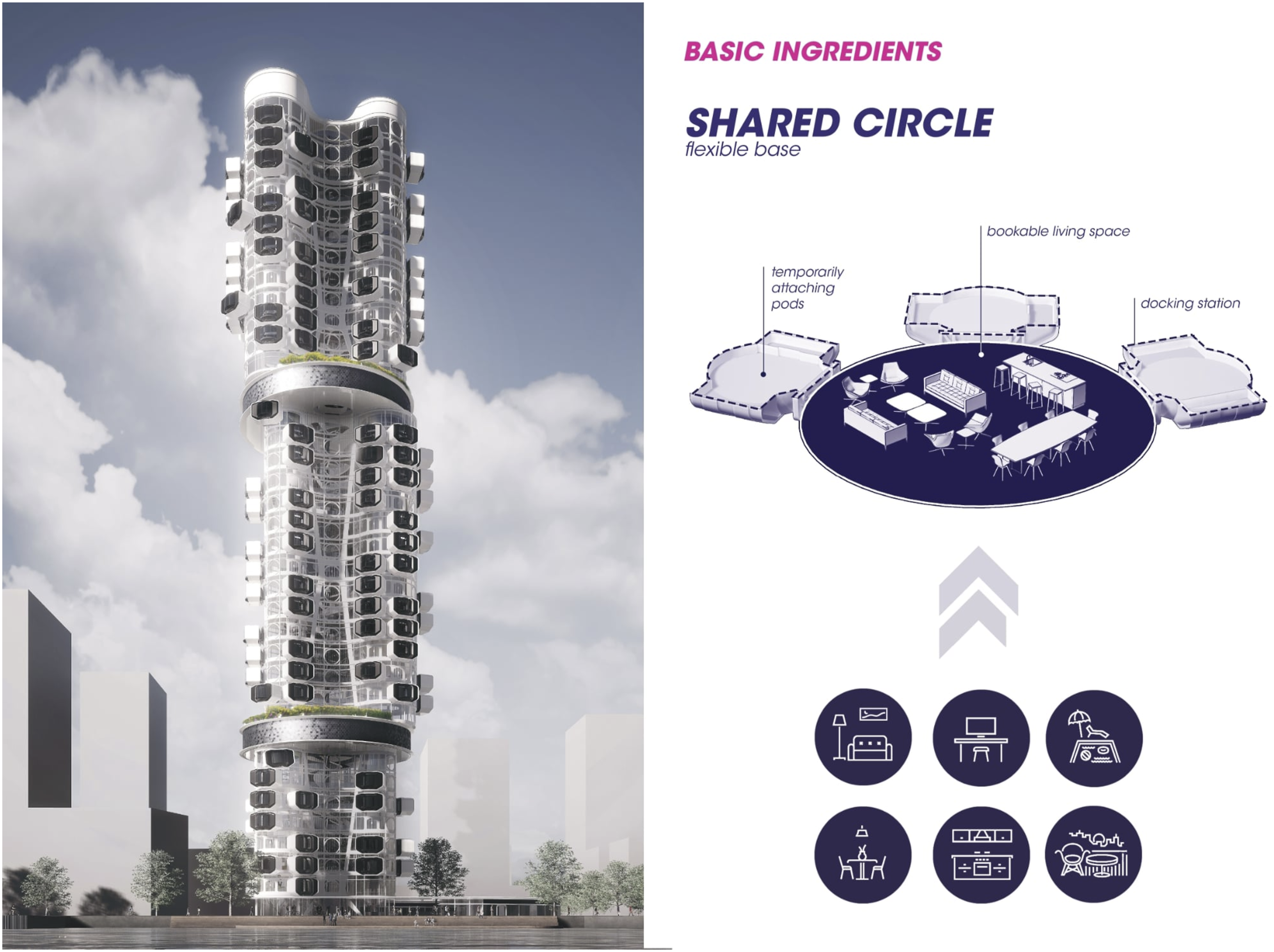
Jekiel’s focus on communal adaptability brings a powerful anti-neoliberal critique to the conversation on intelligent technologies, speculatively positioning smart homes as sites that can enhance social resilience rather than encouraging isolating productivity. This perspective challenges the often individualistic and efficiency-driven narratives percolating the smart home discourse, suggesting instead that smartified environments can be designed to evolve alongside their users to meet communal needs. HYPERLIVING promotes a model of smartness that prioritizes collective well-being and shared experiences over individual gain, aligning with what scholars in speculative and critical design describe as ‘design for social good’ (DiSalvo, 2012). This approach resonates with similar arguments in critical technology studies, which call for smart environments that embrace social values, such as inclusivity, adaptability, and social responsibility (Willis and Aurigi, 2019).
The two projects articulate a broader critique present within cultural studies and, especially, feminist science and technology studies (STS), questioning the assumed neutrality of technology and exposing the biases embedded in its design. The creators underscore the often-hidden social costs of smart home technologies, from the exploitative labour practices underpinning their production to their societal impact. Such an approach resonates with the strand of research on smart homes that addresses the needs of marginalized communities, considering how adaptable smart technologies can enhance social connections and a sense of belonging (Wu et al., 2022). Such an inclusive framework aligns with the principles of universal design, advocating for environments that support a broad spectrum of needs and promote resilience through social interdependence (Imrie and Hall, 2001). By envisioning smart homes as platforms for fostering shared purpose, these speculative propositions imagine a future in which smart technologies serve not only to satisfy functional needs but also support more equitable, justice-based, and socially attuned modes of living. Ultimately, Barry and Jekiel remind us that truly inclusive homes must go beyond efficiency to actively engage with the social realities of those who inhabit them, challenging us to redefine smartness in terms of a commitment to equity and collective well-being.
Bio-home
One of the central themes in debates around smart technologies is how IoT systems and data-driven solutions can be deployed to automate energy resource and waste management, aiding in the fulfilment of carbon-neutral targets (Constantinou et al., 2024; Elghaish et al., 2024; Zhu et al., 2022). Such ‘green technologies’ offer an appealing perspective, with a techno-solutionist narrative conveyed by producers. A concurrent discourse, tackling the limitations of techno-centric approaches to sustainability, suggests that over-reliance on advanced technology for smart homes can increase resource dependency, energy consumption, and waste due to the complexity and maintenance requirements of these systems (e.g. Ahmed et al., 2023; Pohl et al., 2021), especially when they disregard ‘Value Sensitive Design’ (Del Rio et al., 2021: 15). Other studies affirm that human-induced environmental changes call for a redefinition of smart homes to incorporate passive design strategies and vernacular architectural techniques that rely on local resources and natural elements to create environmentally responsive living spaces (e.g. Salman et al., 2016). Clearly, there is no consensus on how to design sustainable and resilient homes capable of addressing the challenges of climate change, nor on whether mainstream understandings of home smartification are well-suited for this purpose. While smartness typically evokes imaginaries of cutting-edge technologies forming conglomerates of interconnected networks, oftentimes conceived through the lens of informatics and electronics, the biotechnological dimension of smartness is rarely discussed in either academic or commercial settings.
The rather limited definition of smartness as something introduced into homes without fundamentally redefining how these spaces are constructed becomes evident to us upon encountering the BioKnit 3 project, developed by The Hub for Biotechnology in the Built Environment (HBBE) and showcased at the Design Museum in London as part of their Future Observatory display. Grounded in environmental humanities thinking, the project speculates about possibilities of constructing organic and environmentally neutral dwellings, whose intelligence rests on their inherent capability to naturally grow and biodegrade. As the HBBE designers underline, the vision behind their projects is ‘to develop biotechnologies to create a new generation of Living Buildings which are responsible and responsive to their natural environment; grown using living engineered materials to reduce inefficient industrial construction processes; metabolize their own waste, reducing pollution, generate energy and high-value products and modulate their microbiome to benefit human and ecological health and wellbeing’ (HBBE, n.d.a). BioKnit is a biohybrid structure composed of mycocrete – a paste made from sawdust, paper fibres, water, and fungal mycelium – grown within 3D-knitted fabric formwork. The different materials are combined in the experimental design process based on long-term testing and, as the HBBE informs, ‘have a dramatically lower environmental impact compared to conventional construction materials and provide the opportunity to radically rethink how we build’ (HBBE, n.d.b).
The potential applications for BioKnit are vast, particularly in non-load-bearing structures within buildings. By incorporating naturally occurring and eco-friendly materials into construction, BioKnit reduces the carbon footprint of building projects. It also introduces a brand new aesthetic and tactile experience to architectural spaces: a result of combining ‘hi-tech and lo-tech approach’ (HBBE, n.d.c) which merges biotechnology with advanced digital fabrication. As such, not only does the proposal break new ground in architecture, but it also speculates about the potential ways to reframe smartness through bio-design, where the union of organic materials and progressive construction methods results in structures that are much more environmentally sound. BioKnit represents a ‘smart’ micro-solution that can be employed to partly mitigate the disastrous anthropogenic impact on ecosystems. With predominantly ecologically neutral composition, it turns to truly sustainable design solutions. Employing humble organic materials, coupled with advanced sophistication of experimental design, the proposal constitutes a step both toward and away from the information and communication technology-imbued future, critically engaging with the question of how our building strategies impact the ecosystem of which humans are an intrinsic part.
While some speculative proposals offer ways to reduce environmental impact, others confront the most ominous visions of the ecological catastrophe. The aftermath of a failed attempt to break free from the cycle of exploitation and violence inflicted on our planetary system is imagined in Superflux’s installation Mitigation of Shock (Figure 2). Set in a fictional London apartment in the year 2050 (close enough to imagine the world inhabited by the children of today’s adults), the installation envisions a reality in which environmental degradation and resource scarcity have forced people to adopt radical modifications in their domestic environment. By immersing participants in a speculative space that feels both familiar and foreign, the installation invites a reckoning with the reality that the effects of climate change are already unfolding. As described by the creators, it was an ‘attempt to make the size and complexity of a hyperobject like climate change tangible, relatable, and specific’ (Superflux, 2017), a provocation to reflect on how individuals and societies might navigate the challenges of an environmental collapse and how it shapes their ideas of domesticity. Superflux, Mitigation of Shock (2017–2019). Fogponics Food System. Image courtesy of the design studio Superflux (supported by Suncorp & CCB). Copyright by Superflux.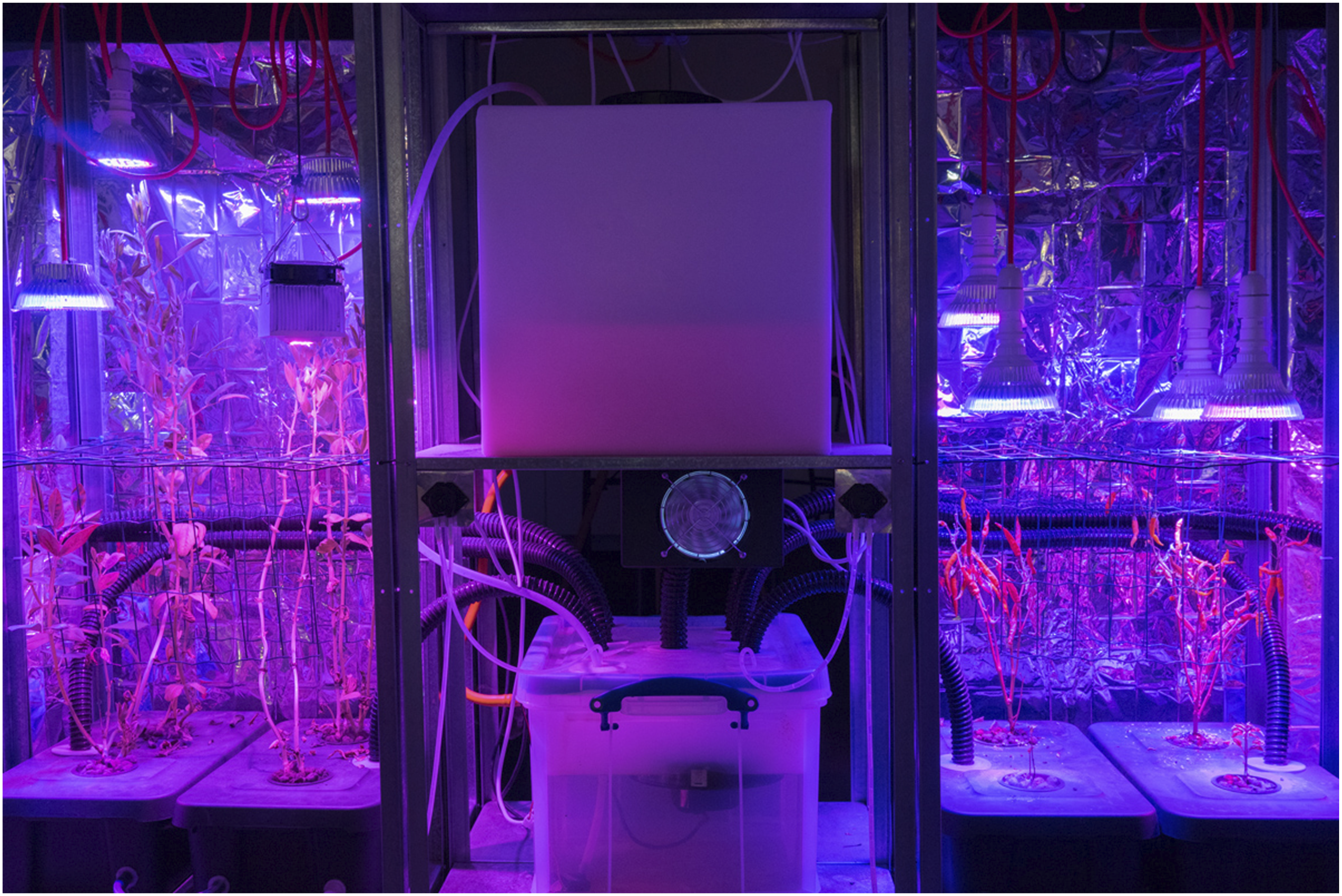
Pivotal to the installation is the ‘what if’ scenario of extreme food insecurity and possible adaptation to this challenge. The apartment space contains a variety of unconventional devices exploiting alternative food production methods that people have had to develop out of necessity. The installation features fogponics (a method of growing plants without soil, using nutrient-rich fog that stimulates growth and absorption of mineral substances by plants and fungi), alongside other innovative and DIY systems of cultivation of edibles within a constrained urban setting. Visitors are invited to engage with the fragility of contemporary food chains, recognizing how individuals might be compelled to experiment with new forms of urban agriculture and foraging to ensure their survival. Such an approach, as the creators of the project evince, generates a new understanding of design practices. As they explain, ‘Over the course of the project, we realized how important it was to explore our deeply entangled relationship with other species and non-human entities. To explore what it would mean to design not simply “tools” that do our bidding, but to design with a more-than-human approach; to design as co-inhabitants of the same complex, ecological system in which humans and non-human species co-exist’ (Superflux, 2017). Through their installation, Superflux reveals the superficiality and naivety of the promised utopia of smart living where smart hubs, now relegated to the peripheries of the space, serve as trinkets of a bygone era. Once necessities, they have become almost useless debris in the face of climate-induced disruptions, revealing how historically contingent the ‘smart’ component in ‘smart home’ is, and how quickly its meaning shifts to accommodate the unstable, ever-changing reality of a ‘risk society’ (Beck, 2009). As the Superflux artists elaborate, ‘within our world of design the focus on the “product or artefact” has always been the embodiment of an outcome. Here, instead we began to focus on the organism rather than the artefact’ (2017). Thus, the installation conveys a notion of ‘smartness’ that stands for entangled, more-than-human co-existence – or ‘interdependence’, as the designers suggests (Superflux, 2017) – which challenges the predominant idea of a domestic space whose connectedness relies on its integration within the network of IoT (otherwise remaining isolated from the external world), and moves toward conceiving of a smart home as a multi-species, living, organic assemblage.
The two discussed projects – very different from each other in their general orientation – shift the understanding of the notion of smartness in the domestic space toward a techno-organic, multidimensional, and lively co-existence of more-than-human (including digital and biological) entities, which work together to create a complex, albeit fragile, ecosystem, connected and responsive to both internal and external environment. Such understanding drifts away from the conventional discourse on smartification of domestic spaces, signalling an entirely different approach to what a technologically enhanced living may entail.
Self-sovereign home
Engaging critically with the evolving discourse surrounding smart homes of the future, some artists and designers speculate about new models of ownership, resource management, and environmental stewardship in their effort to redefine the taken-for-granted ideas of smartness. Inspired by spatial justice theories, and drawing on decolonial approaches, the FreeHouse project by DML challenges traditional notions of property and income extraction related to it. FreeHouse (exhibited at the Design Museum in London as part of Future Observatory Display and discussed – as FreeHouse Tkaronto – at the 2024 Evergreen Conference) introduces the radical idea of a self-owning house, functioning as a digital autonomous organization managed by civic trusts. As Indy Johar, the founder of DML, explains, in the context of the FreeHouse, ‘we’re looking at a new theory of actually how a house – as a semi-autonomous, self learning system for public good – can be constructed. So I think there’s an important moment where technology and new capabilities allow us to reimagine these assets in a more entangled way’ (Johar and Hearn, 2021). Thus, this reconceptualization of smartness extends beyond the integration of advanced technologies, proposing a holistic rethinking of how self-sovereign homes can contribute to both environmental sustainability and social equity.
DML – a multidisciplinary discovery, design, and development lab – engages in the exploration of ‘invisible systems’ that govern everyday life. Their objective is to rethink property as a foundational concept in our socio-economic systems. As discussed in their Medium article (DML, 2024a), the lab critically examines the deep structural issues embedded in traditional property paradigms and how they have historically led to dispossession, environmental degradation, and exclusion of vast numbers of people from access to essential resources. The lab argues that the traditional theory of property as a system of objectification, extraction, centralization, and control is no longer sufficient to address the complex challenges of today’s world. In response, the FreeHouse project proposes a speculative, experimental model for a new tenure system that combines stewardship, perpetual bond finance, and zero-carbon construction, while challenging the colonial and neoliberal idea of private property. The goal is to create homes that are not merely assets but self-managing entities that actively generate environmental and social value. This model envisions homes as digital autonomous organizations held by civic trusts, introducing a new form of social engagement. The FreeHouse Tkaronto (2024) (Figure 3), a proof-of-possibility project, is a speculative prototype house in the Toronto ravines area that serves as a demonstrator of this new reality, offering a template for public housing provision that is materially circular, affordable, and civically governed. Given Canada’s colonial legacies, not only does the FreeHouse Tkaronto challenge the Western idea of land appropriation and resource extraction, but it positions its approach to land as a critical dimension of Indigenous reconciliation, with an aim to partly undo the pernicious effects of colonialism. The idea, in the designers’ words, is to create ‘regenerative, truly affordable housing on degraded land along valuable ravine ecosystems for residents who will support land stewardship inspired by Indigenous land practices’, thus recognizing the value of native knowledges rooted in an embodied presence on the land (DML, 2024b). Apart from the social aspects, the project is also meant to ‘provide an opportunity to remediate the past ecologically damaging interventions of the site as part of its landscaping, such as reusing or removing grey infrastructure while restoring naturalized watercourses, and re-wilding the riparian landscape’ (DML, 2024b). Dark Matter Labs, FreeHouse Tkaronto (2024). Image courtesy of the Dark Matter Labs, Calvin Po, and Callum Nolan. Copyright by Dark Matter Labs.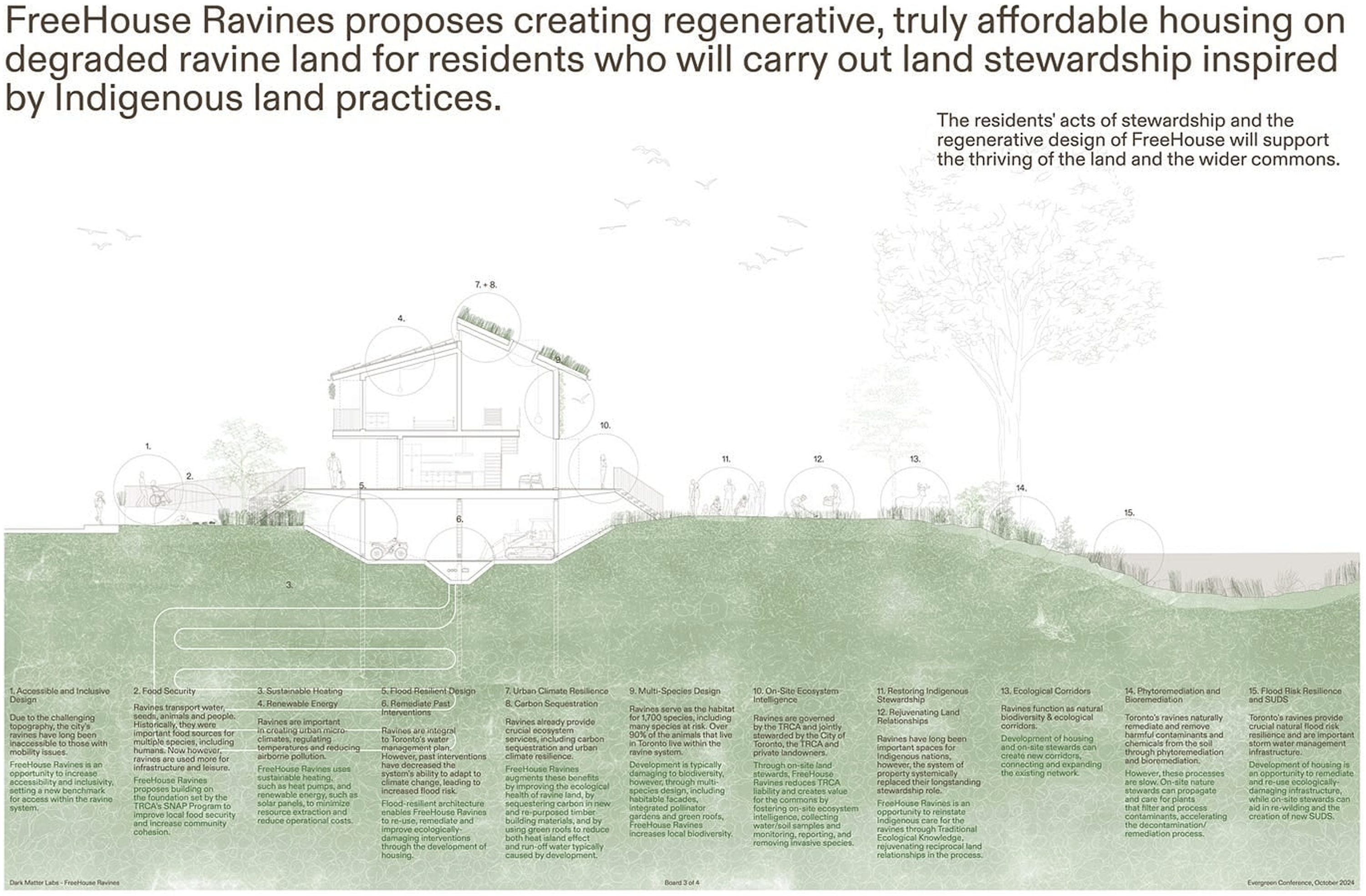
In its focus on more-than-human ownership, FreeHouse aligns with some strands of the post-anthropocentric discourse, thematizing the agency of non-human actors – such as local animals, plants, and rivers – in the governance and management of housing. Contrasting with the dystopian science fiction portrayals of AI systems, the thinking embodied in the DML’s project envisions a future in which smartness fosters ecological stewardship and communal well-being. This approach turns away from the idea of IoT, overexploited in the prevalent discourse on smart home technologies, in favour of Latour’s concept of the ‘parliament of things’, which proposes a radical rethinking of political and social order (1999). Latour argues for the inclusion of non-human entities in collective decision-making processes, challenging the traditional anthropocentric framework that positions humans as the sole agents of political life (Latour, 2005, 2017). As DML explains, the approach encapsulated in FreeHouse reflects a shift from traditional control-oriented mechanisms to systems that recognize the complexity and interdependence of all ecological participants (2024b). This perspective is reflected in the project’s commitment to integrating the voices and needs of non-human agents within the fabric of community governance, echoing Latour’s call for a more inclusive negotiation of the common world.
FreeHouse’s redefinition of smart home technologies invites a transformative reconsideration of the relationship between homes, their inhabitants, and the broader environment: a community of things and organisms. Smartness is reimagined as a sensitive and responsive embodiment of ecological and communal stewardship, a more-than-human entity owned by itself. Such an approach, as DML designers underline, ‘recontextualises the home not as a commodity, but a confluence of relationships: that with its inhabitants (comfort, design for minimal maintenance, the steward’s rights), and the wider ecosystem (energy use and generation, heating, urban drainage, biodiversity and use of resources)’ (DML, 2024b). This artistic vision proposes a future in which homes are not just passive structures, but active actors – participants in the creation of a just and sustainable society. Such a speculative reconfiguration encourages us to see homes of the future as vital components of the broader socio-environmental systems that nurture both life and community, expanding the concept of smartness to encompass both ethical and ecological responsibility.
Augmented home
Recent scholarly discourse has been progressively endorsing the integration of augmented and virtual reality (AR/VR) technologies with smart home systems, recognizing their transformative potential for domestic spaces. Researchers investigate how these immersive technologies can be leveraged to improve user interaction and accessibility, particularly for populations with cognitive and physical challenges, as well as exploring the possibilities they offer for improving general well-being. Mixed reality (MR) is believed to provide more intuitive, hands-free control mechanisms, making smart homes more user-friendly and adaptable to the needs of seniors and individuals with disabilities (e.g. Alabood and Maurer, 2022; Mahroo et al., 2023). Additionally, AR applications, such as those employing marker tracking, are developed to enable control of household appliances, further enhancing the accessibility and practicality of smart domestic spaces (Ullah et al., 2012). The more business-oriented research examines the use of VR environments for cost-effective testing and prototyping, enabling the refinement of smart home systems before their real-world deployment (Seo et al., 2016). While the academic community has been gradually embracing the idea of VR/MR-augmented smart homes, the existing efforts are primarily focused on incremental improvements or enhancement of available solutions, rather than proposing a comprehensive overhaul of current smart home paradigms. Moreover, these academic initiatives have yet to translate into substantial market shifts. Although companies like HoyoTech have recently begun advocating for the incorporation of VR/AR/MR to enrich the smart home experience – particularly with the advent of potentially transformative technologies like AppleVision – these cutting-edge ideas remain largely unrealized in everyday contexts.
A much bolder perspective on rethinking smart homes through AR/VR/MR technologies emerged during our interview with Rowan Elselmy, a co-founder of the 2023 metaverse architectural competition Design the Digital Extension of Your Home. For Elselmy, smartification of the domestic spaces is inherently about adaptability and the capacity to transcend physical limitations. As she explains, ‘The smartness is more about the ability of the objects to be shaped in different trends. … I’m sitting on a physical chair but I can see it in AR with it spreading its wings or whatever … the creative interpretation of the physical object in the different trends, this is what’s very interesting for me. … Having a digital extension’ (personal interview, 2023). From her standpoint, smartness must surpass the simple blending of digital tools, prioritizing the reimagination and reconstruction of the physical world within the boundless potential of augmented environments. Thus, instead of filling the home with smart devices in the form of futuristic décor or vintage-inspired smart gadgets, we should consider the digital realm as a true source of domestic innovation. In her words, ‘Having portals in your room that take you into the digital extension of your home like this kind of thing is what I’m interested in, honestly. Because I feel like the physical world limits my creativity’ (personal interview, 2023). Her vision of transcending material constraints reframes the potential of smart homes as spaces for new kinds of spatial engagement, pushing past the boundaries of the physical. This marks a departure from the conventional idea of the smart home, historically centred on optimizing the physical environments. Moreover, this reimagining of smart homes carries potentially transformative implications for the smart home appliances market. The concept of most objects being inherently adaptable through augmented reality substantially lowers the threshold for smart home creation, making it also far more customizable; it also facilitates the decentralization and diversification of the market, as individuals could design and distribute AR-based extensions via alternative channels, bypassing the need for traditional sales infrastructures.
In contrast, the status quo in the provision of services defines much of the vision for MR smart homes as presented in the Tomorrow’s Home 2050 4 exhibition, jointly developed by UCL’s Institute of Healthcare Engineering and Liminal Space, revealed through our review of curatorial documentation from the event held at London Museum of the Home (2021–2022). One notable space within this house-like structure is the ‘Room of Requirement’, which speculates about how inhabitants could immerse themselves in the metaverse, a highly convincing virtual environment where digital avatars engage in real-world activities, such as shopping, eating, socializing, and playing games. Achievements and acquisitions in the metaverse could be transferred into the physical world, effectively blurring the boundaries between virtual and actual experiences. Such integration has significant implications for social behaviour, identity formation, and the long-term effects of engaging with immersive technologies, particularly in terms of altering perceptions of reality and influencing interpersonal dynamics. Additionally, this level of immersiveness may serve the commercial interests of providers, rendering their products more desirable by creating an environment where spending is integrated and navigated in ways that maximize profit. The metaverse thus becomes not only a space for personal interaction but also a highly controlled marketplace, designed to encourage continuous consumer engagement. The exhibition also featured an AI-enabled, subscription-based service that allows users to create lifelike, interactive avatars of deceased family members or friends, offering a means to revisit memories and maintain emotional connections. For older individuals, such as those suffering from early-onset dementia, ‘Re:Viva’ could provide both a cognitive safety net and a therapeutic environment, where reminders and interactions with trusted avatars can support memory retention and daily functioning. For others, it may offer a form of emotional continuity, enabling reconnection with a lost loved one for guidance and encouragement. Certainly, this imagined smart home service raises complex ethical questions about the boundaries of memory, identity, and the authenticity of interactions with AI-generated representations of the deceased. While ‘Re:Viva’ may serve as a valuable tool for emotional healing and cognitive assistance, it also highlights broader concerns about reliance on AI for managing grief and human relationships, challenging traditional conceptions of mourning and remembrance in the digital age.
A slightly different approach to AR underpins the 2021 Davidson Prize-winning project HomeForest
5
(Figure 4). Conceived as a response to the pandemic crisis and the subsequent disruption of standard working conditions and the commonly understood work/life balance, the project endeavours to ‘create a digital ecosystem which infuses wellbeing into an individual’s routine’ (Greenleaf, 2021). The app, as its creators underline, ‘uses spatial computing – to generate flora and fauna that react in real-time to touch, movement, and mood’ (SquintOpera, 2021) with an aim to open new dimensions of experience. Drawing on the biophilia hypothesis (which highlights humanity’s deep-seated affinity for nature) and the Japanese practice of shinrin-yoku (forest-bathing), HomeForest seeks to recreate therapeutic value of nature immersion, without – however – truly engaging with nature. Squint/Opera, HomeForest (2021). Image courtesy of the Squint/Opera, a Journey studio. Copyright by Squint/Opera, a Journey studio.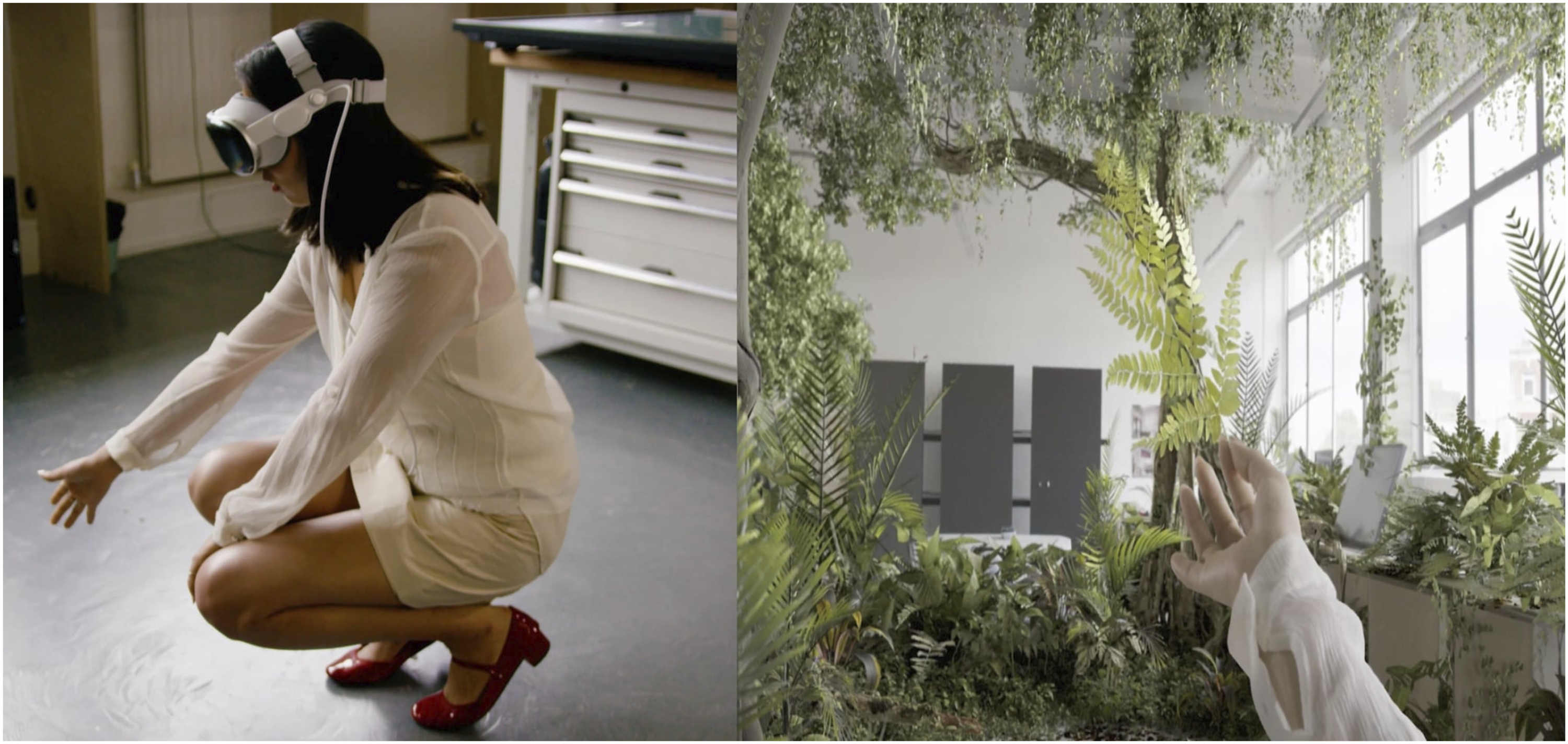
By creating a digital twin of the home, the project uses sensors and data to map the layout and monitor an individual’s movements and routines within a domestic or work space. The technology then synchronizes with IoT devices already present in the space, projecting calming visuals like forest canopies and playing nature sounds to enhance well-being. The system also incorporates a modular HomeKit, adding additional smart objects that further expand the capabilities of the home’s digital ecosystem, encouraging interaction and exploration of less-frequented spaces. Through continuous learning of user behaviours, HomeForest adapts and evolves to enhance the individual’s routine with personalized, wellness-driven prompts and experiences. Although it may seem like a convoluted way to reconnect with nature, especially through technology culturally perceived as its opposite, it offers a response to increasingly challenging urban conditions, particularly in areas where proximity to nature is a privilege of the few. As Eleanor Greenleaf – one of the project designers – explains, through HomeForest ‘the way we think about the home is challenged, by stimulating our imagination and awareness, changing our perception of the space we inhabit. HomeForest plays with all our senses, reconnects us to our environment or notifies of visiting wildlife, while soundscapes expand the sense of space and place’ (2021).
Experimenting with AR/MR technologies, some designers redirect the understanding of smartness as embodied in the home of the future toward the unlimited extensions that could be added to the domestic spaces. Such visions depart from the idea of a smart home as packed with devices meant at increasing efficient management of household chores, investing instead in imagining how it can be creatively augmented and customized. As Sarah Douglas, the Liminal Space director, underlines (in line with speculative design logic), the goal of such projects is ‘to provoke thinking, provoke reaction’ and such practice is ‘really about quite an educational approach and how you bring that kind of inquiry to the public’; the aim ‘is to use artistic creative design approaches to engage the public with challenging or complex social topics’ (personal interview, 2024). Engaging multisensory experiences and multidimensional relations, the potential applications of such extensions are virtually endless. They encourage embarkment on a creative journey to redefine the meaning of domesticity while raising ethical questions regarding both social relations as much as human interactions with the natural-cultural environment and its values.
Discussion
Throughout this article we have argued for the need to pluralize the techno-capitalist understanding of technologically enhanced domestic environments, where smart homes are typically framed in terms of frictionless convenience, individualized control, and continuous optimization. The case for pluralizing smartness, however, is not a celebration of multiplicity for its own sake. It is an analytic requirement for grasping the competing normative projects built into ‘smart’ domesticity. The futurescapes analyzed here show that ‘smartness’ is not a neutral descriptor of device capability. Rather, it is a value-bearing term that legitimizes particular futures of domestic life while foreclosing others. By staging ‘what if?’ scenarios, speculative works intervene upstream – where smartification’s common sense is formed. Thus, they can support anticipatory governance by helping to surface trade-offs, failure modes, and capture points before they congeal into infrastructures, markets, and living norms. The argument resonates with the reconstructive impulse in CFS – recovering futures that would otherwise remain marginal – and with the idea that unsettling present categories can widen the space for alternative trajectories.
Analytically, our framework organizes these interventions as four relocations of domestic ‘intelligence’: social justice and care relations (inclusive home), ecological sustainability and more-than-human entanglement (bio-home), governance and property regimes (self-sovereign home), and experiential reconfiguration through AR/VR/MR (augmented home). Considered as power-laden socio-technical regimes – not merely as visual or discursive framings – these futurescapes depict the smart home as a struggle over what the home is for. They pose questions about the distribution of labour, the environments that must be sustained, the actors who govern, and the ways mediated experience reshapes intimacy and attention. Each regime carries an affirmative promise alongside a characteristic vulnerability, and it is precisely this pairing that makes them politically instructive.
Inclusive home projects foreground that automation can reproduce gendered domestic orders instead of dissolving them. Not to Be Known reframes the smart home as a battleground: hidden gender agendas and unequal burdens persist, even under the banner of progress. The speculative ‘good’ is the insistence that smartness be accountable to care, equity, and lived domestic realities. HYPERLIVING extends this insight by imagining smartness as collective resilience – communal adaptability and shared infrastructures in place of private entitlement. At the same time, inclusivity is vulnerable to capture. ‘Care tech’ can tip into paternalism, intensifying control, surveillance, and responsibilisation as residents become managed subjects. And algorithmic organization of shared space may generate fresh exclusions – through gatekeeping, behavioural sorting, or unequal access to collective amenities – even when marketed as ‘community’.
In bio-home, smartness stands for environmental responsiveness: how homes metabolize resources and adapt with more-than-human worlds. BioKnit develops this sensibility through ‘living buildings’ and low-impact construction, framing intelligence as material life – growth, biodegradation, and situated adaptation. Mitigation of Shock pushes the point further: under climate disruption, yesterday’s smart hubs become obsolete debris, while intelligence takes the form of improvised cultivation and adaptive, more-than-human domestic ecologies. The promise here is a move away from ‘control’ and toward ecological attunement. The failure modes are familiar but newly articulated: ecological smartness can become a romanticized aesthetics of austerity that normalizes deprivation; it can offload systemic responsibility onto households through ‘DIY resilience’ as moral obligation; or it can harden into enclosure via proprietary bio-material supply chains and ‘green’ branding that leave extractive logics intact.
Self-sovereign home makes explicit that smartification is inseparable from political economy. FreeHouse imagines the home as a self-owning entity embedded in civic trusts, stewardship, and more-than-human governance – recontextualising housing away from commodity extraction and toward a confluence of relationships among inhabitants. Here, too, there are important points of fragility. Autonomy does not guarantee democratic governance. If decision rights are unclear, authority can consolidate in technocratic forms. Likewise, trusts are not immune to capture. Finally, stewardship rhetoric can be mobilized to justify expanded control over residents and land when mechanisms for accountability and contestation are under-specified.
Augmented home futurescapes foreground convergence by shifting domestic innovation from hardware to mediated layers. Elselmy’s account frames smartness as the capacity to ‘shape’ objects through digital extension, potentially decentralizing and diversifying domestic modification by lowering barriers to entry. Platform dependence, however, intensifies in parallel. The Tomorrow’s Home 2050 exhibition imagines immersive marketplaces and subscription services, including intimate AI-mediated offerings such as grief and memory avatars. Such systems may provide therapeutic scaffolding; they may also cultivate dependency and embed commercial capture directly into everyday affect.
Taken together, what these speculative cartographies offer is a sharper politics of choice – one that specifies where ‘good’ futures can be twisted into enclosure, surveillance, dependency, or renewed inequality. As an evaluative closure, the futurescapes do more than chart possible smart tomorrows; rather than accumulating into a coherent and exhaustive programme for smart living, they imply criteria for assessing domestic innovation beyond functionality. These include: care justice (who benefits, who labours, who is governed), ecological metabolism (what material and energy relations are installed), governance accountability (who decides and how decisions are contested), and media/platform dependency (what forms of attention and market capture are built into domestic life).
Conclusions
As our analyses throughout the article have shown, the value of approaching smart homes through a conceptual framework emerging at the crossroad of cultural studies, critical futures studies, and speculative design lies in its capacity to unsettle what otherwise passes as common sense. Such a strategy unveils alternative ways of thinking, typically relegated to the sideways of dominant commercial and scholarly discourse. When academic work follows the dominant industry storyline too closely, it can inadvertently stabilize it by taking its problem definitions and timelines as the default frame of reference – even when the intention is to subject them to scrutiny. Critical and speculative approaches intervene earlier, at the level of imaginaries: they make visible the interests, exclusions, and value hierarchies embedded in prevailing visions of domestic ‘smartness’, and they reopen questions that are often treated as already settled. This has implications well beyond scholarship. The futures that engineers, designers, and policymakers build toward are shaped by what is publicly regarded as desirable, and worth investing in; limiting those narratives narrows the space of innovation itself. Engaging, also academically, with artistic and speculative propositions therefore does not distract from ‘real’ developments, but helps prevent smartification from acquiring an aura of inevitability, while expanding the visual and discursive vocabulary through which ‘smartness’ is made thinkable. The question, then, is how such plural imaginaries might be translated into more plural modes of shaping technological futures, so that alternative visions do not remain confined to galleries or academic texts.
One potential way to pursue this translation is to expand ‘public participation in futuring’, which currently remains largely limited to experts and professionals (Barendregt et al., 2024). This expansion should include prospective users of smart technologies, particularly those from socio-economic and cultural backgrounds that tend to be overlooked, even in discussions about their potential involvement in ‘smart living’. Another step, we believe, is to critically engage with artistic recalibrations of the notion of smartness of the future. This seems important, as the artistic world excels in boldly redefining the taken-for-granted concepts and assumptions, exposing their limitations and flaws. It may also offer what Kirby calls – in reference to cinematic representations – ‘diegetic prototypes’, which have the capacity to ‘encourage audience support for the development of the technology on the screen’ (2010: 43). Thus, artistic visions of more sustainability- and inclusivity-oriented domestic smartness can serve as ‘performative artifacts’ (Suchman et al., 2002: 164), establishing in the social realm ‘the viability and possibilities of a nascent technology’ (Kirby, 2010: 45), as well as signalling its potential consequences. They also demonstrate that cultural representations are not merely reflective commentary on technological development; they are actively productive of alternative problem definitions, alternative scenarios, and alternative understandings of responsibility. It may be the time for academics and smart home creators to catch up with these imaginings, or they risk building a future designed only for a privileged few, perpetuating the extractive and exclusionary logic of techno-capitalism.
Footnotes

Ethical considerations
The study was conducted in accordance with ethical standards.
Consent to participate
Written informed consent was obtained from all participants, including consent to cite their names alongside excerpts from the interviews conducted with them.
Funding
The authors disclosed receipt of the following financial support for the research, authorship, and/or publication of this article: The article is a result of the project ‘SMARTUP: Smart(ening up the modern) home – Redesigning power dynamics through domestic space digitalisation’. This research was funded by the National Science Center in Poland (grant no. 2021/03/Y/HS6/00250) as part of the ERA-Net Cofund CHANSE programme (‘Collaboration of Humanities and Social Sciences in Europe’), supported by the European Union’s Horizon 2020 research and innovation programme (grant agreement no. 101004509).
Declaration of conflicting interests
The authors declared no potential conflicts of interest with respect to the research, authorship, and/or publication of this article.
Data Availability Statement
Participants consented to the use of interview excerpts in the publication; however, they did not consent to the full interviews being shared publicly. Therefore, the full supporting data are not available.
Other identifying information
No additional identifying information related to the authors, institutions, funders, or approval committees is included that could compromise anonymity.