




Abstract
Multimodality scholarship has hitherto mainly focused on the combination of static visuals and written language (see Bateman et al., Multimodality: Foundations, Research and Analysis -- A Problem-Oriented Introduction, 2017; Tseronis and Forceville, Multimodal Argumentation and Rhetoric in Media Genres, 2017; and Forceville, ‘Multimodality’, in press, for discussion and bibliographies). However, drawing on visuals, written language, spoken language, music and sound, film is a multimodal medium par excellence. In this article, the authors specifically focus on documentary film. Documentary can be considered to be the cinematic equivalent of audiovisual rhetorical discourse, aiming to persuade its envisaged audience of something. Obviously, it is crucial for the credibility of documentaries that they are seen as indexically rooted in reality. But, recently, documentary film has witnessed the flourishing of a subgenre that may seem to challenge this indexicality: the ‘animentary’ – a documentary that consists to a considerable extent of animated images. While the completely constructed nature of animation means that animentaries’ indexical relation between audiovisual representation and represented world is loosened, or even absent, animentaries also – and importantly – enable perspectives on reality that live-action documentary cannot. This article analyses how the visual, verbal, sonic and musical modes function rhetorically in four feature-length animentaries that share the theme of ‘war’: Waltz with Bashir (dir. Ari Folman, 2008), 25 April (dir. Leanne Pooley, 2015), Chris the Swiss (dir. Anja Kofmel, 2018) and Another Day of Life (dir. Raúl de la Fuente and Damian Nenow, 2019). The authors conclude that the written and spoken verbal modes play a crucial role in safeguarding animentaries’ referential relation to reality.
Keywords
1. Introduction
Documentary film theorist Bill Nichols considers the genre’s goal to be to convince the audience of a certain standpoint. For this reason, he claims, its functioning can be rooted in classic, specifically Aristotelian, rhetoric (Nichols, 2017), where rhetoric can be defined as ‘the energy inherent in emotion and thought, transmitted through a system of signs, including language, to others to influence their decisions or actions’ (Kennedy, 1991: 7). A central assumption in Aristotle’s approach is that rhetoric is called for only if there is no conclusive, undisputed evidence (or ‘inartistic proof’) for a standpoint. In such a case, the rhetor (here: the documentary maker) has to resort to ‘artistic proof’ (Nichols, 2017 following Aristotle; we in turn adopt this terminology). Artistic proof is rooted in one of the following three appeals: ethos, logos and pathos.
A new type of documentary is the animated documentary, or ‘animentary’, first systematically theorized by Annabelle Honess Roe (2013). But while live-action documentaries build on audiovisual recordings capturing traces of a profilmic reality, 1 animentaries are largely or completely constructed representations of that reality in the sense that they do not record profilmic events. In this article, we address the question of how animentaries’ weakened indexical link to reality affects their rhetorical function in terms of ethos, logos and pathos. Its structure is as follows. In section 2, we briefly discuss live-action documentary film’s rhetorical dimensions. This is followed by a characterization of how animentary’s reduced indexicality affects its persuasive powers (section 3). In section 4, we analyse four animentaries: Waltz with Bashir (dir. Ari Folman, 2008), 25 April (dir. Leanne Pooley, 2015), Chris the Swiss (dir. Anja Kofmel, 2018) and Another Day of Life (dir. Raúl de la Fuente and Damian Nenow, 2019) from the perspective of their rhetorical potential. Our choice – limited by the relative scarcity of feature-length animentaries anyway – was motivated by the fact that these films share the theme of war. Given the historical nature of these wars, issues of authenticity and the relation to an ‘objective’ reality are of greater importance than in, say, animentaries about personal trauma. This makes these films particularly suitable for our discussion. In section 5 we discuss the issue of the ethos of the animentaries’ makers, ending with some tentative conclusions (section 6).
2. Documentary Film As Rhetorical Genre
The pithiest and most quoted characterization of the documentary film genre is John Grierson’s (1933: 8) ‘the creative treatment of actuality’, ‘actuality’ here meaning ‘reality’. Grierson thus already captured documentary’s inherent tension between recording reality and a necessarily partial and subjective perspective on that recorded reality.
Nichols (2017: 10) offers the following definition: Documentary film speaks about situations and events involving real people (social actors) who present themselves to us as themselves within a framework. This frame conveys a plausible perspective on the lives, situations, and events portrayed. The distinct point of view of the filmmaker shapes this story into a way of understanding the historical world directly rather than through a fictional allegory. (emphasis in original)
Nichols acknowledges the same tension as Grierson. On the one hand, he points out that documentary portrays an ‘historical world’ and assumes that documentaries are ‘about reality . . . real people [and . . .] tell stories about what really happened’ (p. 23). These assumptions ‘rely heavily on the indexical 2 capacity of the photographic image and of sound recording to replicate what we take to be the distinctive visual or acoustic qualities of what they record’ (p. 23, emphasis in original). It is thanks to this indexical capacity that documentary is ascribed evidentiary value. However, ‘much of the power of documentary . . . lies in its ability to couple evidence and emotion’ (p. 66, emphasis in original). ‘[Indexical] images not only provide visible evidence, they also pack a punch, boosted by our belief in their authenticity. Documentaries harness this enormous emotional power to engage us all the more fully with the historical world’ (p. 66). This impact is what Nichols has called an ‘indexical whammy’ (p. 27). On the other hand, Nichols emphasizes that the documentary maker adopts a ‘distinct point of view’ and ‘shapes [the] story’ (p. 27).
This tension sums up the essence of rhetoric, ‘the form of speech used to persuade or convince others about an issue for which no clear-cut, unequivocal answer or solution exists’ (p. 44). A documentary can thus be considered a kind of audiovisual variety of rhetoric, trying to persuade its audience of the rightness or importance of a particular point of view on persons, objects, events, or other phenomena. The documentary film thereby constitutes a thoroughly multimodal discourse, drawing on moving images, spoken language, sound, music and (often) written language. It makes sense, therefore, that Nichols makes use of various aspects of Aristotelian rhetoric in his theorization of documentary, including the stages of a classic rhetor’s speech (pp. 58–68) and the categorization into types (pp. 77–80).
For present purposes, we are specifically interested in Nichols’ use of Aristotle’s three types of ‘artistic proof’: ethos, logos and pathos. Nichols describes them as follows:
Credible or ethical proof (ethos): generating an impression of good moral character or credibility for the filmmaker, witnesses, authorities, and others.
Compelling or emotional proof (pathos): appealing to the audience’s emotions to produce the desired disposition; putting the audience in the right mood or establishing a frame of mind favorable to a particular view, this ‘proof’ has its basis in emotion rather than logic.
Convincing or demonstrative proof (logos): using real or apparent reasoning; proving, or giving the impression of proving, the case. (p. 59)
The use of the word ‘proof’ may seem a bit misleading, as Kennedy (1991: 37, note 40) points out, since in Aristotelian rhetoric only logos is part of the speech proper, whereas ethos and pathos pertain to characteristics of the rhetor (by extension: documentary maker) and audience, respectively. ‘Ideally, only logos, argumentation directed to the central issue, might be used because ethos and pathos appear clearly . . . to be outside the case’ (Braet, 1992: 316, emphases in original). But, however this may be, all three are factors that bear on the persuasiveness of a documentary. Let us briefly elaborate on each of them.
Ethos
‘True credibility results when the audience attributes three qualities to the speaker . . . these virtues are good sense, virtue and goodwill’ (Braet, 1992: 311). In this article, following Nichols (2017), we will take ethos to apply to the social actors in a documentary who provide testimonies of some sort as well as to the animentary’s maker(s).
Logos
Logos is the proof that exists ‘in the speech itself, in so far as it proves or seems to prove’ something (Aristotle, cited in Braet, 1992: 309). Logos proves, or seems to prove, that and how something happened. In live-action documentary it is expected that there is, minimally, an audiovisual record of salient and relevant aspects of the profilmic reality – that is, that it ensures the indexical relation between what appeared before the camera and its filmic representation. But it is precisely this relation that is weakened or absent in animentaries.
Pathos
Pathos depends upon ‘putting the hearer into a certain frame of mind’ . . . through the speech . . . Its influence rests on the fact that the pathe (emotions) into which the judge is plunged, such as orge (anger) and eleos (pity), influence his [sic] judgment. (Braet, 1992: 314, quoting Aristotle, emphases in original)
Interestingly, perhaps even surprisingly, Aristotle considered the emotional impact of a speech on its audience an integral and bona fide part of the art of rhetoric – not as a manipulative trick to be avoided.
In the rest of this article, we will follow Nichols’s application of Aristotle’s three types of artistic proof.
3. Animated Documentary
According to Honess Roe (2013: 4), the animentary is characterized by the following features. It (i) has been recorded or created frame by frame; (ii) is about the world rather than a world wholly imagined by its creator; and (iii) has been presented as a documentary by its producers and/or received as a documentary by audiences, festivals or critics. (emphases in original)
Although an animentary is thus very much about the world, the fact that it dispenses with a visual record of a profilmic reality appears to clash with documentary’s treasured indexical relation to that world. However, Honess Roe considers animentary’s liberation of Nichols’s ‘indexical bind’ (Nichols, 1991: 149, quoted by Honess Roe, 2013: 22) to be actually animentary’s most important strength: ‘By releasing documentary from the strictures of a causal connection between filmic and profilmic, animation has the potential to bring things that are temporally, spatially and psychologically distant from the viewer into closer proximity’ (Honess Roe, 2013: 2). Thus, it can show things that were not, or could not have been, visually recorded, for instance because they occurred before film and photography had been invented, or because nobody happened to film or photograph them. But animentary can also deliberately distort or defamiliarize the visual track, for instance to help the audience empathize with a social actor’s unusual or deviant experience of events (e.g. due to trauma or other mental afflictions, hallucinations, or dreams), or for moral reasons (e.g. to protect the anonymity of a social actor).
Honess Roe claims that there are three key ways in which animentary can achieve effects that live-action documentary cannot achieve (so well): mimetic substitution, non-mimetic substitution and evocation. Whereas mimetic substitution and non-mimetic substitution make up for missing material (due to the paucity or absence of pertinent archival footage) in realistic and non-realistic ways, respectively, evocation works to represent concepts, emotions, or moods that are extremely difficult or impossible to represent in live-action. Through evocation, animation appeals emotionally (i.e. via pathos) to audiences. Such evocation may take many forms in animentary, including that of visual or multimodal tropes (e.g. Forceville, 2019; Forceville and Paling, 2021). Here, ‘the animation, through its potential multiplicity of styles, techniques and means of production, becomes a visual excess that we need to factor in when interpreting the nature, and meaning, of animated documentaries’ (Honess Roe, 2013: 27, emphasis added). But, while visual excess may enhance the rhetorical points made, for instance in the form of metaphors, it may also deteriorate into sensationalism, and thereby detract from the ‘sobriety’ (Nichols, 2017: 26) of documentary.
The fact that visual indexicality is absent 3 in animentaries, however, severely jeopardizes their relationship with the realities they purport to represent. Honess Roe (2013) underestimates the importance of this relationship: after all, the complete absence of signals that an animentary reliably refers to the real world would simply disqualify it from being considered a documentary at all. We contend that the burden of sustaining the link between representation and reality shifts to other modes, such as written language and the soundtrack (Forceville, 2015). Arguably, the soundtrack acquires an even greater importance in animentary than in live-action documentary, where its role is already substantial: ‘A greater reliance on speech tends to distinguish the documentary from the avant-garde, and the rootedness of much of this speech in the lives of social actors tends to distinguish it from fiction’ (Nichols, 2017: 19).
In short, we can say that, due to relaxing the indexical bind to ‘actuality’, animentary verges toward the ‘creative treatment’ pole in Grierson’s definition. The more creative a documentary, irrespective of whether it is of the animated or the live-action variety, the more it risks being considered as fiction. Undoubtedly, the borders between non-fiction and fiction are fuzzy ones, as Nichols’s (1991) title ‘blurred boundaries’ makes clear. Particularly in an era in which ‘fake news’ and ‘alternative facts’ have become dangerously popular terms, it is nonetheless extremely important not to conflate non-fiction and fiction (especially fiction film that is ‘based on a true story’): Art is not the antithesis of nonfiction; a nonfiction filmmaker may be as artistic as he or she chooses as long as the processes of aesthetic elaboration do not interfere with the genre’s commitment to the appropriate standards of research, exposition and argument. For example, a nonfiction filmmaker cannot invent new events or eliminate ones that actually occurred for the sake of securing an aesthetic effect where this falsifies history . . . A nonfiction filmmaker must be accountable to the facts and the prospect of heightened effects does not alter that accountability. This, of course, is a major difference between fiction and nonfiction. (Carroll, 1996: 232–233)
Whereas, on the one hand, as Honess Roe (2013) convincingly demonstrates, animentary enables presenting highly subjective perspectives on reality that live-action documentary cannot provide, on the other hand, its relaxation of the indexical bind risks obfuscating the difference between non-fiction and fiction, thereby putting documentary’s precious relationship with reality at risk. This issue is specifically important when the topic of an animentary is an historical one, as is the case in the four war documentaries we will analyse. The degree to which any source of information (whether maker or social actor) is seen as trustworthy moreover affects both the perception of evocative aspects and of the asserted referential ties between representation and reality. In our analyses we will therefore let ourselves be guided by the following questions:
(1) How do the visual, spoken language, written language, sonic and musical mode contribute to, or detract from, animentary’s asserted reference to, and arguments about, the reality it claims to portray – and thereby (fail to) exemplify logos, the most important of Aristotle’s three types of artistic proof?
(2) How/to what extent do the animentaries perform the functions that Honess Roe (2013) claims are the genre’s assets: the ability to perform mimetic and non-mimetic substitutions, and evocation via visual excess (pertaining to pathos), the latter two via visual and multimodal tropes and other mechanisms?
(3) How do considerations of the ethos of social actors in the animentaries, and of their makers, influence persuasiveness?
4. Case Studies
Waltz with Bashir [WwB] (dir. Ari Folman, 2008)
Description. The director was a soldier in the Israeli Defence Forces during the 1982 Lebanon War. Many years later, a friend and fellow veteran tells him about his terrible nightmares. Folman realizes he himself has hardly any memories of the war and visits former fellow soldiers to remedy this gap. The resulting film is an emotional and (auto)biographical account of Israeli soldiers’ experience of the 1982 war, consisting of interviews and (sometimes poetic) visualizations of events. The key traumatic event of the film is the Sabra and Shatila massacre of unarmed Shiite civilians, which Folman and his group actually facilitated by firing flares to aid the Christian Phalange militia perpetrators.
Visual indexicality
WwB consists almost entirely of animated images. Part of it was traditionally shot as a talking-head documentary in a sound studio and then transformed into animation. Even most of the war scenes were first re-enacted, the resulting footage serving as the basis for the animations, which were drawn from scratch (Cineuropa, 2009). Although highly realistic in design, the animation thus has no direct visual indexical bind to reality. This absence of visual indexicality is arguably vindicated by the fact that the filmmaker tries to recover his private memories from the war. This subjectivity also transpires in WwB’s often-used first person perspective and point-of-view shots.
The inadequacy of photographic media to capture the story Folman wants to tell is underscored when, several times, photographs are presented in animated form. At one point, Folman does not even recognize himself in a photo. The only moment offering visual indexicality is the final scene, which shows animated images of crying women walking through the streets of Beirut after the Sabra and Shatila massacre transforming into archival live-action footage, thereby jolting the audience by an ‘indexical whammy’ into fully acknowledging the reality of this harrowing event.
Visual excess
Many passages exploit animation’s opportunity to depict events that are not to be taken at face value (e.g. the opening of the film, showing a pack of aggressive dogs, see Figure 1) or represent subjective or imagined experiences (e.g. a veteran imagines peacefully floating in the sea clasping a giant naked woman, see Figure 2). These scenes help evoke atmosphere and enhance empathy with Folman and his fellow veterans’ experiences and memories, and thus strongly aim at creating pathos.
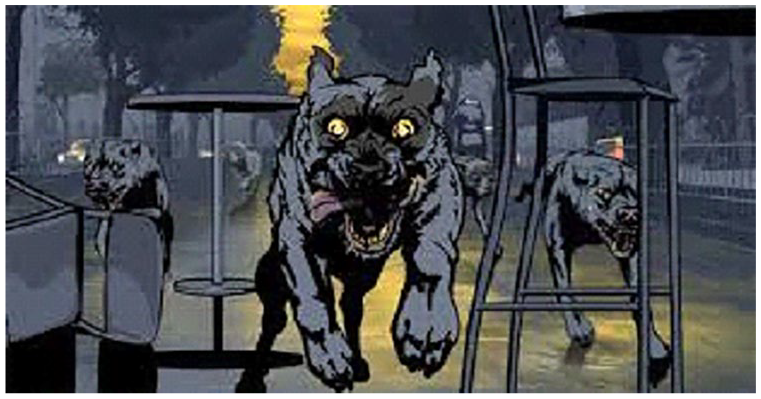
Opening shot of Waltz with Bashir (2008, dir. Ari Folman), showing a pack of aggressive dogs.
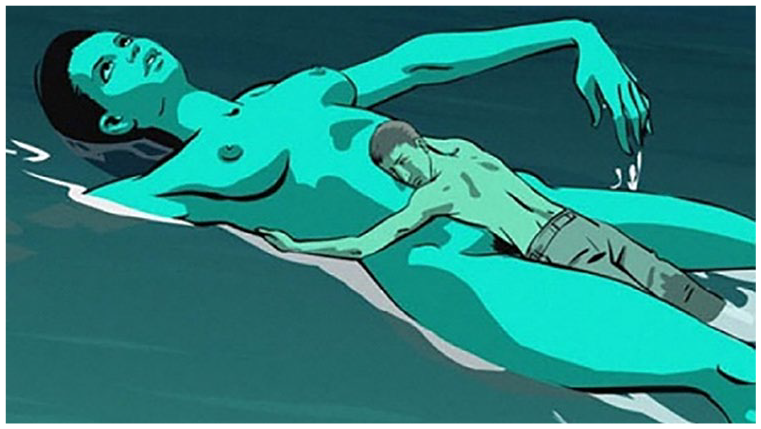
Poetic image of imagined peacefulness of an Israeli veteran. Screen grab from Waltz with Bashir (2008, dir. Ari Folman).
Bolstering referentiality via spoken language, written language and sound
The words spoken come from the interviewees and from Folman (in first-person voice-over) himself. That said, while the contents of the words can be traced back to their sources, they were in two cases not spoken by the social actors themselves, but dubbed by voice actors as these interviewees did not want their voices in the film (Kliger, 2009). The written-language mode is crucial in anchoring (Barthes, 1986[1964]: 28) the social actors’ visual appearance, by providing their names onscreen both in Hebrew and English: it is this verbal anchoring that roots them in the real world. The spoken and written language modes thus strongly contribute to the logos of WwB.
The musical mode
Only music that emanates from the depicted world itself (i.e. ‘intradiegetic’ music) can function indexically. All music in WwB is non-diegetic/score (i.e. ‘added’) music (even though some music is presented as intradiegetic – namely when social actors are seen dancing to or singing along with music supposedly produced in the story world). While the original soundtrack was composed by Max Richter, the film also contains several existing songs, resulting in a wide variation of music styles. Moving from electronic to pop and punk, the shifts in music reflect the emotional intensity and the changes in mood of the social actors throughout the film. For example, the theme audible during the running-dogs scene is minimalistically electronic and nervously up-tempo, and is repeated several times during the film. It sets the general atmosphere and is markedly different from the rest of the score. Interestingly, some of the battle scenes are accompanied by rock music, while in others classical music can be heard. In one scene, a soldier starts playing his rifle as if it were a guitar and the ensuing rock music strongly contrasts with the horrific events portrayed, creating a sense of surrealism. By drawing attention to itself in this way, the score music emphasizes war’s absurdity more than a more conventional choice of music would have done – and thereby contributes to logos rather than pathos.
25 April (dir. Leanne Pooley, 2015)
Description
25 April chronicles the involvement of Australian and New Zealand (ANZAC) troops in the Gallipoli Campaign in Turkey during the First World War. The events are recounted from the perspectives of five New Zealand soldiers and one Australian nurse. The story is narrated as if it were a traditional talking-head documentary that contains dramatized re-enactments and interviews supposedly recorded only a few years after the events at Gallipoli, simulating ‘talking head’ testimonies. As Honess Roe (2013: 75) points out, ‘to testify to something . . . is synonymous with bearing witness, giving evidence and asserting and affirming the truth.’ The animation style differs slightly between the interview scenes and the re-enactments of the actual battle in a way that is reminiscent of how re-enactments and talking-head scenes may differ in style in a live-action documentary.
Visual indexicality
Although both the interview and battle parts of the film are completely animated, for the interview sessions professional actors impersonating the soldiers and the nurse were first filmed and later animated using motion capture (see NZ On Screen). The motion capture and lip-synch used to portray them ensures that even the most subtle facial expressions, such as the trembling of lips, are visible, adding to pathos. The war scenes are animated so as to appear largely realistic; animation is here used mimetically. Only the final scene offers a direct visual indexical bind to reality: in a live-action setting, animated photographs of the social actors as they had appeared in the interviews slowly turn into real-life photographs of the six historical social actors, thereby revealing what they actually looked like and confirming that they truly existed. Similar to WwB, it is at this moment that an ‘indexical whammy’ really hits the audience. Again, including photographic material was apparently considered vital by the director to have at least some visual indexicality.
Visual excess
The use of non-mimetic animation in 25 April allows for depicting scenes with greater freedom, as when a huge Turkish flag enveloping an equally giant British flag represents the victory of the Turks (Figure 3), departing boats turn into birds flying away and represent the hopeless position of the ANZAC forces, and a dog running into a bright light symbolizes his death and the death of many soldiers. In several scenes, evocation works to foreground the soldiers’ horrific experiences and thus to appeal to the audience’s pathos. Interestingly, small tokens of visual excess occur even in the generally ‘realistic’ interview parts. At one point, an interviewee is shot in battle. As he appears in front of the ‘camera’ in the interview setting, blood oozes from the bullet wound and he slowly dissolves completely: here, animation clearly functions non-mimetically and evocatively. However, even in these latter functions, it remains relatively sober, avoiding overdramatic spectacle in the war scenes.
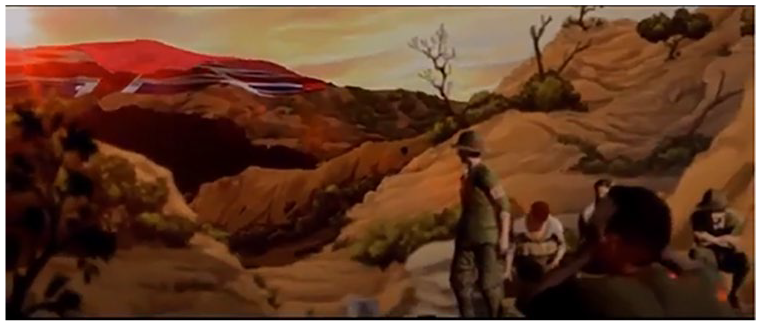
ANZAC soldiers seeing a Turkish flag covering the Union Jack (upper-left corner). Screen grab from 25 April (dir. Leanne Pooley, 2015).
Bolstering referentiality via spoken language, written language and sound
The animated nature of the film in combination with the use of voice actors means there is no direct audiovisual indexicality. Nevertheless, the verbal mode contributes to the film’s logos in other ways. The script only uses words that the protagonists wrote in their diaries, letters and memoirs, which were found and selected after a year of research (Croot, 2016). The film’s ethos is thus largely attributable to the authenticity of the social actors’ testimonies. In some scenes, the act of writing in a diary is shown on screen, with a voice-over reading the words out loud. Moreover, written texts intermittently provide historical facts about the Gallipoli campaign and the protagonists’ real names and professions (e.g. Figure 4), while some shots display important dates and maps of the region. In the opening scene, we read: ‘This is the story of six people who served at Gallipoli. It is based on their words as written in their diaries, letters and memoirs. The events in this film are true.’ Likewise, written information about what happened to the protagonists after the war accompanies their photographs in the final scene: ‘Edmund Bowler was shunned by the military establishment for his outspoken criticism of the Gallipoli campaign. He died in 1927 and is buried in a civilian grave.’ Again, logos is crucially dependent on language.
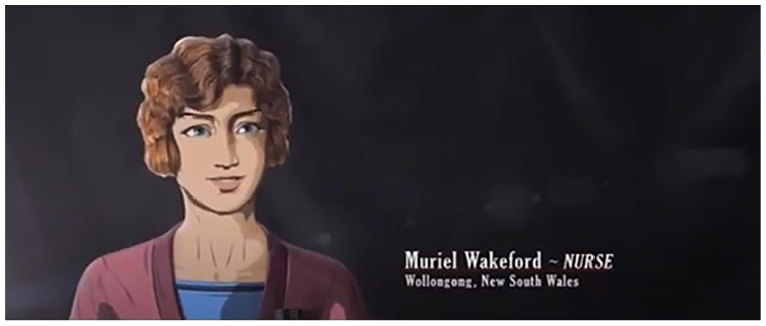
The Australian nurse Muriel Wakeford, narrating. Screen grab from 25 April (dir. Leanne Pooley, 2015).
The musical mode
The original score by David Long contains a wide range of themes, varying from slow and dark to more upbeat and exciting. As the mood shifts between scenes, so does the music. Somewhat bombastic during battle scenes, the soundtrack contributes to a sense of drama and steers the audience’s emotional responses.
Chris the Swiss [CtS] (dir. Anja Kofmel, 2018)
Description
CtS is a film by Swiss filmmaker Anja Kofmel. During the Croatian War of Independence in 1992, her cousin Chris Würtenberg, a war reporter, was mysteriously found dead in a Balkan field wearing the uniform of an international mercenary battalion. The film charts Kofmel’s search for the truth about her cousin’s involvement in the war. Relying on the notebooks he left behind, she follows Chris’s footsteps and interviews his family and the people he met as a reporter-turned-soldier. A substantial part of CtS portrays Chris’s experiences during the war through animation, shifting between Kofmel’s and Chris’s perspective, but the film also includes live-action and archival footage.
Visual indexicality
The three types of footage (animation, live-action interviews with social actors and archival footage) take up approximately equal amounts of screen-time. The film furthermore includes drawn sketches explaining the complex history of Yugoslavia; these have a different style from the animated images of Chris, simulating the often-present difference between re-enactments and archival footage in live-action documentaries. Thanks to the interviews and the archival footage, the film has a high degree of visual indexicality, enhancing logos. By contrast, the animation, although realistic in design, often deliberately seeks to escape the suggestion of any indexical bind. Even so, the viewer is reminded that CtS’s animated part was based on the filmmaker’s work: some live-action scenes show Kofmel drawing portraits of Chris, providing a degree of visual indexicality (Figure 5). Additional strategies are used to imbue the animated images with a sense of authenticity. Bold black and white lines, almost like brush strokes, characterize the animation’s style and contrast sharply with the colourful live-action and archival footage, arguably contributing to the idea of ‘sobriety’ (Nichols, 2017: 26) of documentary.
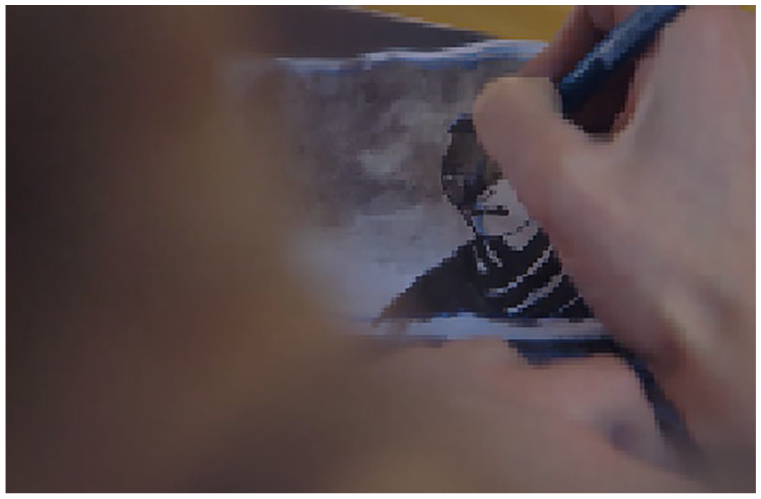
Anja Kofmel draws her cousin Chris Würtenberg. Screen grab from Chris the Swiss (dir. Anja Kofmel, 2018).
Another strategy that suggests sustained indexicality is the establishing of parity between the three types of imagery. This is achieved by graphic matches from the live-action footage to the animated images and vice versa. In one scene, Anja is travelling to Croatia by train while she is reading Chris’s notebook. In the next scene, Chris, in animated form, is shown in exactly the same position when he, too, travels to Croatia, writing in the very notebook Anja is reading. These transitions supposedly corroborate the validity of the animation. The same holds true for the representation of various social actors in the different kinds of images. The mercenary Alejandro, for instance, is shown in animation first, in archival footage second, and then when he is interviewed by Kofmel. Sometimes, the images are alternated in such a way that it appears as if Anja as animated girl is looking at the same archival images of Chris that the viewer is looking at, when Anja states: ‘When I grow up, I want to be just like you’ (Figures 6a and 6b).
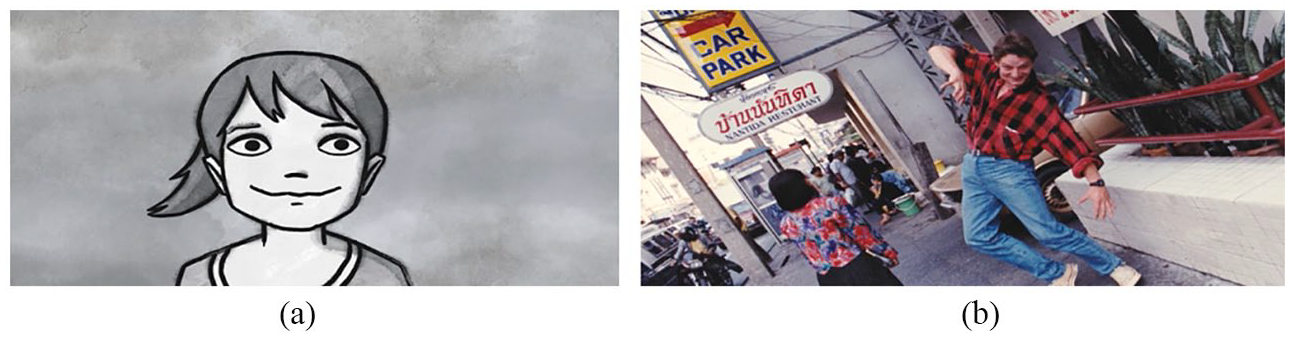
Anja as animated girl . . . Screen grab from Chris the Swiss (dir. Anja Kofmel, 2018).
Visual excess
Through evocative animation, CtS is able to represent the danger and violence of war non-literally. The opening scene visualizes the recurring nightmare Anja experiences after Chris’s death. Searching for her missing cousin, Anja imagines him wounded, being hunted down by a swarm of strange shadowy figures (e.g. Figure 7), ominously swallowing everything that crosses their path. Apart from these recurring figures, the animation sometimes evokes the state of mind of Chris, who struggles with his involvement in the conflict as a reporter and the impossibility of neutrality, visualizing an emotion or experience described verbally either literally or metaphorically (see Honess Roe, 2013: 106). Often, metamorphoses (Wells, 1998: 69–76) suggest meanings and emotions that live-action film could not convey.
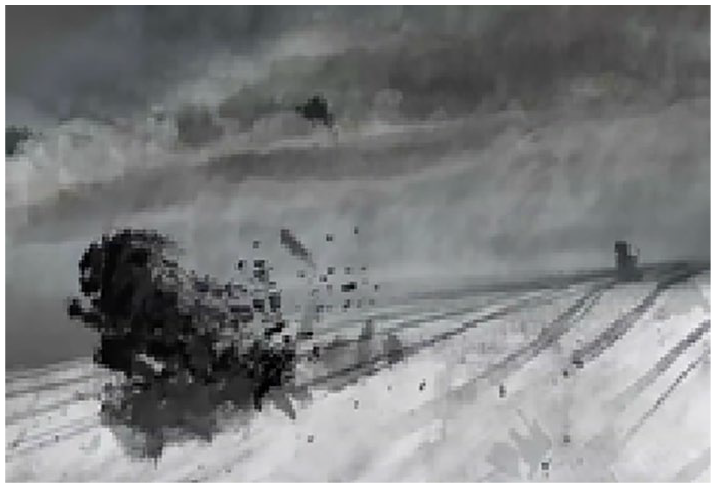
A ‘chaos’ army of shadows overwhelms everything in its path. Screen grab from Chris the Swiss (dir. Anja Kofmel, 2018).
Bolstering referentiality via spoken language, written language and sound
The interview and archival footage naturally have strong aural indexical binds to reality. The animated images are supported by two voice-overs, one for Chris and one for Anja – but both of them were recorded by voice-actors. This means that the animation is neither visually nor sonically indexical and that, in Anja’s case, a professional style of delivery was considered more important than authenticity. Nevertheless, since we see Anja in the film and it is clear that this is her film, we assume that the words spoken by the voice-overs can be trusted to be Chris’s and her own, respectively. The fact that both voice-overs recount events in first-person and occasionally in the present tense adds to the sense of authenticity and reliability. Furthermore, CtS emphasizes the verbal sources it was based on by mentioning Chris’s notebooks in the voice-over and repeatedly showing them in live-action, underscoring the validity of Chris’s voice-over by indicating where the spoken words come from. Additionally, captions inform the viewer when an article of Chris’s is read out loud and when his own voice can be heard. During these moments, the film again references its source by showing an audio tape as Chris begins to speak.
Besides giving historical and factual information, Anja’s voice-over explicitly reflects on the fact that only some details of Chris’s story are known and that, as filmmaker, she had to imagine the rest. This frankness makes the viewer more inclined to trust the animation.
The musical mode. Apart from a pop song during one of the first scenes of the film and a Croatian rap song during the closing credits, the score music is mainly instrumental and minimalist. Consisting of deep tones, it works as a mood setter, often bestowing a sense of impending danger and upheaval on visualized events. Quite a few scenes are not accompanied by any music at all.
Another Day of Life [ADoL] (dir. Raúl de la Fuente and Damian Nenow, 2019)
Description
ADoL recounts the experiences of the famous Polish war journalist Ryszard Kapuściński (1932–2007) during the 1975 Angolan War of Independence. The film is based on Kapuściński’s eponymous book (1976), which became well known across the world. Kapuściński acquired fame as one of the first journalists using subjective first-person narration (De Bruijn, 2019). ADoL adheres to the events in the book (Mączka, 2019), but also contains some fictional plot lines and characters that were inspired by those events (Platige Image ‘Another Day of Life Pressbook’).
Visual indexicality
ADoL combines four types of footage: (1) animated images; (2) archival footage; (3) live-action interviews (all in Portuguese, with subtitles) with social actors who are still alive; and (4) atmospheric live-action footage apparently shot in present-day Africa. Only (2) and (3) provide indexical evidence of historical events. The footage in (4), which moreover contains some clearly enacted scenes, does not contribute to logos. The animation, colourful and realistic in style, was created via motion capture film using professional actors (Puppetworks Animation Studio), while their speech was performed by yet other (voice) actors – and thus exemplifies no indexicality. Several social actors appearing in the animation also occur in the archival footage and in the live-action interviews (although in the interviews they are of course much older). Topics and locations in the animations are frequently visually matched with the archival and interview footage, and in some scenes there is such a quick alternation of different kinds of footage that they seem to be part of the same shot. Particularly noteworthy is that every time a new social actor first appears in the animated part of the story, the visuals are made to match almost perfectly with the live-action interview session that follows right after (Figures 8a and 8b), thereby smoothly linking the non-indexical animations with the indexical live-action footage. But this ‘naturalization’ (Barthes, 1986[1964]) remains nonetheless somewhat strained. For one thing, the animated social actors all speak English, sometimes with accents, whereas the live-action interviews with the older, historical social actors are all in Portuguese, suggesting they may not be very comfortable speaking English (or may not even have a command of the language at all). Perhaps in order to diminish this tension, during the closing credits, live-action photographs of the social actors appear in the animated frame (Figure 9).
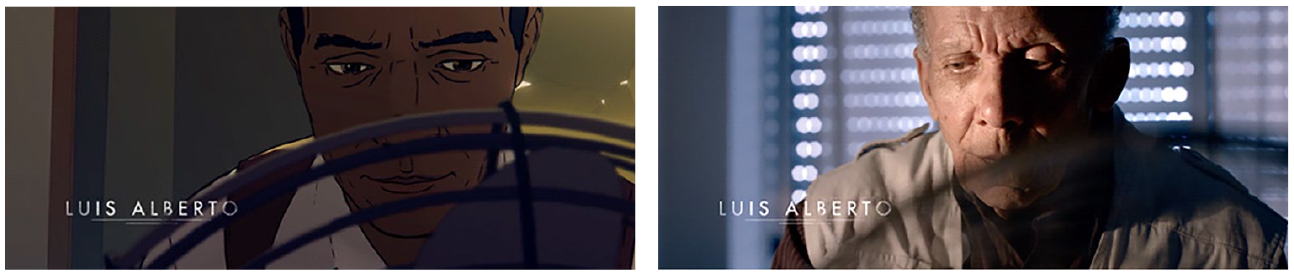
A social actor appearing in the animation . . . Screen grab from Another Day of Life (dir. Raúl de la Fuente and Damian Nenow, 2019).
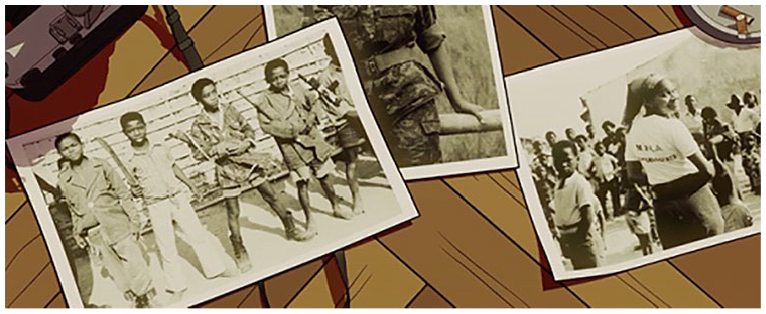
Archival material appears into the animated frame. Screen grab from Another Day of Life (dir. Raúl de la Fuente and Damian Nenow, 2019).
Visual excess
During most of ADoL, animation is used as mimetic substitution: it makes up for non-existent footage, showing Kapuściński’s perspective on events. It is he who tells the audience at the beginning: ‘My name is Ryszard Kapuściński.’ Additionally, animation is used evocatively to give the viewer an insight into the subjective experiences of Kapuściński and his qualms over his responsibilities as a reporter. By experimenting with colour, shape and deformation, the animations convey his troubled state of mind. Just as Kapuściński’s writings reflected his own subjectivity (Mączka, 2019), so does the film based on his book. Several times, for instance, the animation creatively depicts objects breaking apart, guns and bullets flying through the air in slow-motion and people floating around like clouds (Figure 10), presumably visualizing Kapuściński’s feelings of guilt, fear and loneliness. These fragments symbolize the theme of confusão, absolute disorientation, mentioned several times during the film to explain the chaotic situation in Angola. Here, animation’s evocative potential is used to its full capacity and turns out to be a particularly apt way of telling a story that is ultimately about the virtual impossibility of objectivity in a time of confusão. A point of concern, however, is that the repeated visualizations of confusão are rather melodramatic. Apart from not contributing to logos, their hyperbolic nature arguably also fails in terms of pathos.
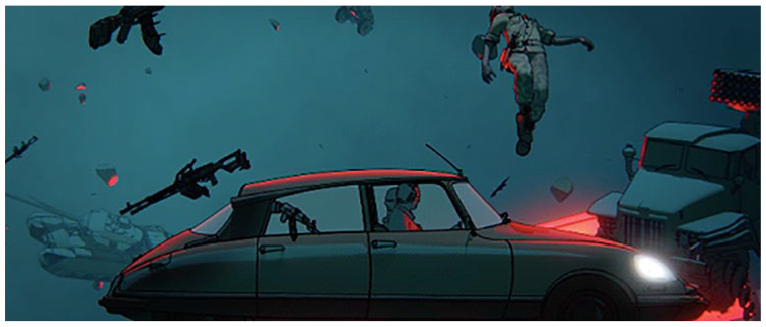
‘Visual excess’ evokes Kapuściński’s experience of ‘confusão’. Screen grab from Another Day of Life (dir. Raúl de la Fuente and Damian Nenow, 2019).
Bolstering referentiality via spoken language, written language and sound
In the animated parts, voice actors were used to represent the protagonists’ voices, so there is no aural indexicality, unlike in the archival footage and in the interviews. In this regard, it is worth observing that the interviewees’ voices sometimes sound slightly distorted whereas the animated characters’ voices appear vibrant and authentic. It is as if the imbalance between the live-action footage and the animated images needed to be compensated for by the sound track.
Written language, in the form of captions introducing social actors by name, links them to the archival and interview footage, furnishing further proof of their real-world existence. The opening sequence conveys information about the situation in Angola in 1975 through both written and spoken language as a voice-over repeats the words typed on a typewriter. At the end of the film, intertitles provide information about events after Kapuściński left Angola.
The musical mode
The original soundtrack by Mike Salas contains many deep-toned, somewhat bombastic songs that occasionally help to dramatize scenes. Other existing songs used in the film are rather up-tempo and jazzy. Besides setting the mood for scenes, the non-diegetic music also helps bridge the animation and the live-action and/or archival footage parts. Again, parity between the different types is thereby created.
5. The Ethos of The Animentaries’ Makers
Clearly, an animentary’s credibility resides in the ethos of its makers no less than in that of its social actors. The makers’ ethos builds partly on the personal and/or professional status they enjoy, or have developed thanks to their earlier work, but may also involve the reputation of the institutions that sponsor(ed) them. Such reputations, to be sure, are not, or only minimally, accessible during the film-viewing itself. However, they can be accessed via other sources and thereby influence an animentary’s ethos (albeit retrospectively). In this section, we briefly address the ethos of the makers.
The ethos of WwB overwhelmingly depends on the fact that the film is autobiographical. Folman’s visual and aural presence buttresses his credibility as the narrator of events that actually befell him and his friends during the Lebanon war, and specifically during the Sabra and Shatila massacre. The film does not set out to examine the circumstances of this notorious incident, which have been documented elsewhere, but to audiovisualize Folman trying to recover his traumatic memories of this period. Having been personally involved, the film’s emphasis on his personal perspective helps to build Folman’s ethos.
25 April’s director Leanne Pooley, writer and producer Matthew Metcalfe and Pooley’s long-time editor Tim Woodhouse have an impressive track record in documentary film making (IMDb). But the ethos of 25 April depends most of all on the scrupulous historical research the team behind director Pooley conducted to collect the written sources serving as the basis for the script of the six witnesses’ testimonies, whereas these witnesses’ families, thanked in the final credits, have presumably provided crucial help.
The ethos of the maker of CtS, Anja Kofmel, is supported by her studies of visual design in Lucerne and her specialization in animation. Her award-winning animated short Chrigi (2009) formed the basis for the animation parts of CtS, which were created by the Hungarian animation studio Nukleus Film (IMDb). Kofmel’s family connection to Chris, and the access she thereby had to testimonies of his father, mother and brother as well as to Chris’s notebooks, further strengthens her ethos.
The film-external ethos of ADoL depends both on the animentary’s makers and on Kapuściński. Raúl de la Fuente gained a reputation for documentary filmmaking, winning the award for ‘best short film – documentary’ at the 2014 Goya Awards for Minerta (2013) (IMDb; Kanaki Films ‘Team’). The other director, Damian Nenow, is a Polish filmmaker who specializes in computer graphics and often produces history-based films. He is mostly known for the animated short Paths of Hate (2010), which won 25 awards, and the animated documentary City of Ruins (2010) (IMDb; Platige Image ‘Damian Nenow’). But what about the ethos of Kapuściński? The opening credits mention ‘based on a true story’, although it is not clear whether this refers to the book, to the film, or to both. Several quotes from the book are used in the spoken soundtrack. The credibility of the animated parts thus depends largely on the trustworthiness of Kapuściński’s book. Two facts undermine this trustworthiness. In the first place, Kapuściński struggled to remain impartial in the Angolan conflict – but this at least is explicitly thematized in the film. More serious is that Kapuściński has frequently been criticized for embellishing his journalistic work, which he himself referred to as ‘literary reportage’ (quoted in Mackey, 2010). A biographer, Artur Domosławski, commented: Kapuściński was experimenting in journalism. He wasn’t aware he had crossed the line between journalism and literature. I still think his books are wonderful and precious. But ultimately, they belong to fiction. (quoted in Harding, 2010)
The animated parts of the film are thus likely to repeat the potentially biased view of events as well as any fictionalizations occurring in Kapuściński’s book (Mączka, 2019). For instance, was Kapuściński really seconds away from being beheaded by a hostile soldier when that soldier was shot dead by a soldier from a rival faction, or is this a fictional dramatization of ‘narrowly being saved’ (assuming that at least this did really happen)?
6. Concluding Remarks
War experiences are deeply disturbing. ‘If fantasy and disremembering play an important part in the recollection of trauma, it follows that a non-‘objective’ [type] of documentary that embraces expressivity and metaphor, such as animation, can help explore a traumatic past’ (Honess Roe, 2013: 161). Unsurprisingly, all four war films discussed make ample use of animation’s affordances to render the remembered past’s hallucinations and horrors. Via evocations they help visualize the subjective experiences and emotions of social actors. Our analyses thus corroborate Honess Roe’s claim that one of animentary’s strengths is that it can appeal to audiences’ pathos. The score music in the documentaries, too, is used mainly to amplify the emotions the films want to trigger in their viewers.
Logos is by far the most important of Aristotle’s three types of artistic proof and establishing incontestable links between whatever is shown and reality is an essential part of a documentary’s logos. Animation can by itself not be indexical via the visual mode (except, to a minimal extent, by representing historical social actors via motion capture, rotoscoping, or other techniques). But it can bolster its link to reality by combining it with other modes, notably spoken and written language. In the animentaries discussed in this article, this is done to varying degrees. Several techniques occur in all four of them. In the first place, each of them verbally names animated social actors, even though these may be impersonated by professionals when they first appear on screen. In the second place, live-action archival footage and/or photographs of the social actors confirm their existence in the real world.
In CtS, 25 April and ADoL, a substantial proportion of the films consists of, or is based on, archival and interview material; here, the link to reality is heavily dependent on language, both in its written and its oral mode. The verbal mode appears in one or more of the following ways: via lip-synch accounts spoken by the live-action social actors themselves; via spoken accounts delivered by these social actors’ animated impersonations; via a voice-over reading from written sources; and/or via written texts superimposed on the animated images. In each case, pains are taken to show that the words originate in attested historical sources, such as (note)books and interviews. That said, the artistic proof in ADoL is in several respects arguably less robust than in the other three documentaries. The poetic freedom Kapuściński took in his news reports taints his ethos as a journalist; the indexical relation between animation and reality, and thereby the logos, is weakened by the enactments by (voice) actors; and the pathos too easily builds on the sensationalist visualizations of confusão. ADoL, while powerfully and hauntingly presenting events during the Angola revolution of 1975 therefore needs to be treated with caution from a rhetorical/documentary perspective.
Summarizing, we fully agree with Honess Roe (2013) that animated (parts of) documentaries can fulfil roles that live-action documentaries cannot, or not so easily, fulfil. Well-considered mimetic and non-mimetic animation and evocation of social actors’ emotion contribute to a documentary’s rhetorical force. But – and here we have problems with her unreserved enthusiasm about animentary’s liberation from Nichols’ (1991) ‘indexical bind’ – these cannot occur at the expense of the precious relationship between animentaries and the reality they claim to represent and comment upon. We propose that for an animentary to be acceptable as a documentary logos must be supported by strong, demonstrable links to reality. Live-action archival material and validated sources in the verbal mode are indispensable for animentaries about historical events to be credible. To the extent that visual indexicality is weakened or absent in animentaries, it thus needs to be compensated for by historically validated information in the written and spoken verbal modes.
Footnotes
Acknowledgements
We are indebted to Hartmut Stöckl, Jana Pflaeging and three anonymous reviewers for their comments and suggestions on earlier drafts of this paper. Of course, we alone remain responsible for all interpretations and for any mistakes.
Funding
The authors received no financial support for the research, authorship and publication of this article, and there is no conflict of interest.

Notes
Biographical Notes
ANNIEK PLOMP obtained her Master’s Degree in Film Studies in January 2020 at the University of Amsterdam. Her MA Thesis on animated war documentaries and their claims to documentary veracity formed the basis for this article.
Address: Department of Media Studies, University of Amsterdam, The Netherlands. [email:
The key theme in the research of CHARLES FORCEVILLE (Media Studies, University of Amsterdam) is the question of how visuals convey meaning. Combining cognitivist and socio-biological theories with detailed textual analyses, he publishes on multimodality in various genres and media (documentary film, animation, advertising, comics, cartoons, pictograms). He published Pictorial Metaphor in Advertising (Routledge, 1996) and coedited Multimodal Metaphor (Mouton de Gruyter, 2009), Creativity and the Agile Mind (Mouton de Gruyter, 2013) and Multimodal Argumentation and Rhetoric in Media Genres (Benjamins, 2017). His monograph Visual and Multimodal Communication: Applying the Relevance Principle appeared in 2020 (Oxford University Press).
Address: Department of Media Studies, University of Amsterdam, Turfdraagsterpad 9, 1012 XT, Amsterdam, The Netherlands. [email: