




Abstract
This article examines how the use of emergent smart baby monitors re-mediates parent–baby touch, notions of connection, parental sensing and the interpretation of babies’ bodies, and contributes to the formation of subjectivities. Domestic baby monitors are a mid 20th-century phenomenon which normalizes parental anxieties. While baby monitoring is not new, the ‘next generation’ of wearable bio-sensing baby monitors offers a different relationship to the body via the physiological tracking of babies, and the sending of information or alerts to parents’ via connected mobile apps. These devices have been associated with creating unnecessary parental anxiety and the digital ‘replacement’ of parental touch, although little research exists on their use in the context of parent–infant interaction or touch. The authors present a qualitative case study of one such technology, Owlet, to explore how parents experienced, understood and negotiated the discourses of parent–infant touch that circulate around and through Owlet, with particular attention to the relationship between visual and tactile resources. The study focuses on both its multimodal design and take-up by parents through analysis of interviews with the Owlet designer, Owlet as a product, focus groups with parents and families’ home experiences of Owlet. Data is analysed through a tri-part lens, which first combines multimodal social semiotic and sensory ethnographic approaches, and then the analytical concept of governmentality. The findings are discussed in relation to four analytical themes: (1) creating a desire for digitally mediated touch; (2) spatiality of digitally mediated connection; (3) formulating the ‘right kind’ of touch; and (4) reconfiguring ‘knowing touch’. The authors discuss multimodal discourses pertinent to the shaping of parent–baby touch practices including: rationality and efficiency; individualism, autonomy and freedom; and self-improvement and empowerment. They conclude that the discourses that coalesce around Owlet contribute to the reconfiguration of parent–baby touch and the formation of neoliberal subjectivities.
Introduction
This article aims to contribute understanding on the potential of emergent smart baby monitor technologies to influence the formation of parent–baby subjectivities by re-mediating touch, notions of connection, parental sensing and the interpretation of babies’ bodies.
While baby monitoring is not new, the ‘next generation’ of wearable bio-sensing monitors offers a different relationship to the body via the physiological tracking of babies and the sending of information to parents via mobile apps. We use one such device – Owlet – as a research probe to study its affordances and use in the family home. Owlet digitally mediates touch through its direct physical contact with a baby’s skin, its influence on parental touch practices and the tactile landscape of family life. These devices have been associated with the digital ‘replacement’ of parental touch; however, little research exists on their use in relation to parent–infant touch interaction. We argue for the need to pay attention to how the design of touch and technologies outsource touch and its functions, especially in the context of parent–baby interactions.
The study takes a social semiotic orientation to technology which seeks to understand the meaning potentials of Owlet, and how these shape, and are shaped through, parents’ situated use of it. The study consists of two elements. First, we approach Owlet as a designed multimodal object with meaning potentials and affordances which are both material and social, with attention to how it is embedded within and marketed through dominant social–cultural narratives, memories and experiences of parent–infant touch. Second, we explore how parents take up Owlet, and understand and negotiate the discourses of parent–infant touch that circulate around and through Owlet, including the shifting place of touch or its removal from parent–infant interaction. This approach provides a holistic understanding of how technologies, bodies and environments intersect.
The study uses qualitative methods including: interviews with the Owlet design team; talk-aloud interaction with Owlet; focus groups with parents; and family home-experiences of Owlet using observation, video re-enactment and interviews. The analytical framework brings together a multimodal and sensory ethnographic approach to articulate our simultaneous concern with touch as a communicative mode and a sensorial experience (Jewitt, 2017). Multimodality provides a focus on the body and sensory ethnography offers empathetic methods (e.g. re-enactment), which together facilitate the exploration of touch through touch. This generates insight into participants’ felt/sensorial experiences and the affective aspects of touch that cannot be observed, and supports participants to convey touch-based experiences which words often fail to do. The article organizes study findings through four intersecting themes which are discussed through a governmentality perspective. This combines the terms government and rationality to extend the notion of governance to refer to the conduct of people, in which self-governance is a guiding force. This brought broader socio-technical and socio-political features of touch as it is digitally mediated to the fore, highlighting discourses pertinent to the shaping of parent–baby touch practices mobilized across the findings and their contribution to the reconfiguration of parent–baby touch and the formation of neoliberal subjectivities.
Background
Touch matters in all aspects of sociality, including parent–baby relationships and subjectivities. Touch is our first, perhaps most immediate, sense, gaining maturity in the womb before other sensory systems (Fulkerson, 2014). From a medical, developmental and psychological perspective, touch is crucial to the life and well-being of an infant (Field, 2002, 2014). Throughout life, touch is central to social encounters and meaningful interaction (Cekaite and Holm, 2017). Embodied sensory dimensions of parent–infant touch (e.g. soothing and co-sleeping) point to the ‘blurring of bodily boundaries and selfhood’ (Lupton, 2013: 40) involved in close physical proximity and touching or near-touching of bodies (Tahhan, 2008). Unsurprisingly, parent–infant touch is deeply bound up with moralities and politics, and notions of good and bad parenting (O’Malley Halley, 2009), culturally and historically shaped notions of good (e.g. calm, playful) and bad touch (e.g. abusive, anxious). Numerous organizations (e.g. government, health and educational) offer advice on what constitutes good touch, particularly in relation to sleeping, feeding and playing. The global market of baby products reflects and reinforces the tensions between, on the one hand, enabling parent–infant contact (e.g. baby slings) and, on the other, creating varying levels of distance (e.g. cots, baby monitors).
Increasingly, technology plays a significant role in parenthood in the form of online resources and apps (Balaam et al., 2013). Domestic baby monitors are a part of that mix, a mid 20th-century phenomenon that normalizes parental anxieties. The ‘next generation’ of wearable biosensing baby monitors (e.g. Owlet) offers a different relationship to the body via the physiological tracking of babies. These devices are related to touch in several ways. The Owlet sock involves direct touch skin contact with a baby’s foot and impacts on the physicality and comfort of baby. It enables the wireless transmission of physiological data to parents’ smart phones in ways that influence touch experiences that are interpreted as a form of remote digital touch in the context of the wider embodied diagnostic touch practices parents employ. This enables us to reflect on how baby biosensing monitors impact on the shape of tactile interaction (e.g. the manufacturers’ promise of reducing negative touch). The use of such technologies is also contingent on the tactile landscape of family life in the home, its social, sensory and material context, and parents’ wider multisensorial caring and bonding activities of which touch is a part. This study engages with the way in which digital objects, such as Owlet, can become central to people’s social relationships, and the diverse ways in which their introduction into the home can disrupt everyday domestic practices (McDonald, 2015:18). We explore parent–baby touch practices in the context of encounters between parents and babies, and the digitally-mediated experiences provided by Owlet, with attention to how these intersect to disrupt, reduce, ‘replace’, re-orientate or reconfigure touch. More generally, digital technologies are key to shaping the ‘cultural references and archetypes through which contemporary motherhood is produced and consumed’ (Orton-Johnson, 2017: 1).
Owlet enters this touchy terrain along with other ‘smart’ baby products (e.g. feeding spoons, smart diapers) (Greenfield, 2013). It tracks babies’ movement, breathing, sleep patterns and body positions, physiological changes, including heart rates, body temperature and oxygen levels. This information is sent to parents’ smart phones via a connected app which alerts them to dangerous readings or ‘nudges’ their behaviour. It is part of a wider ‘dataveillance’ trend (Lupton and Williamson, 2017) in which the infant body is an object of surveillance, measurement and monitoring, and ‘implicated in an expert network of normalization’ (Lupton, 2013: 46). Despite advances in ‘intimate surveillance’, very little is known on how biosensing monitors such as Owlet are actually used by parents, and their potential impact on parenting (Wang et al., 2017). Wang and colleagues noted Owlet’s potential significance for parent–infant touch but touch was not brought into focus. We extend that study through an ethnographic, sensory and multimodal lens on parent–baby touch and engagement with the concept of governmentality. Given the centrality of touch to parent–baby relationships and subjectivities (Field, 2002), it is vital to better understand how such devices influence or regulate parent–baby touch.
Research Design and Methodology
Our qualitative case study explored how Owlet, a smart baby monitor technology, shaped touch interaction in the context of parent–baby relationships and asked:
How do emergent smart baby monitors re-mediate parent–baby touch?
In what ways do they shape notions of connection, parental sensing and the interpretation of babies’ bodies?
How do these influence the formation of parent–baby subjectivities?
At the time of the study, no such technology was available in the UK, making a ‘naturalistic’ study impossible. We used Owlet as a research probe to understand the responses of its intended users in the ‘real-world’ setting of the family home. Owlet was chosen as it was the most advanced domestic device available (in the US, Australia and Canada) and scheduled to release in the UK (after our fieldwork). The study attends to Owlet as a designed object and its use by parents. This enables us to investigate the meaning potentials and affordances of Owlet as an object, the social–cultural narratives, memories and experiences of touch that its use is embedded within, and the ways that these both shaped parents’ experiences and how these were understood and negotiated.
Owlet
Owlet is a smart baby-monitor, a wearable device consisting of three elements: (1) a sensor-embedded fabric sock that wraps around a baby’s foot and connects to (2) a base station via blue-tooth (Figure 1) and (3) a mobile app (Figure 2). The sock detects the baby’s real-time heart rate and oxygen levels, represented by a heart shape and O2 symbol positioned on a range from low, to standard, to high readings (Figure 2) and alerts caregivers (via the base station or Owlet app) if readings fall outside a normal range.
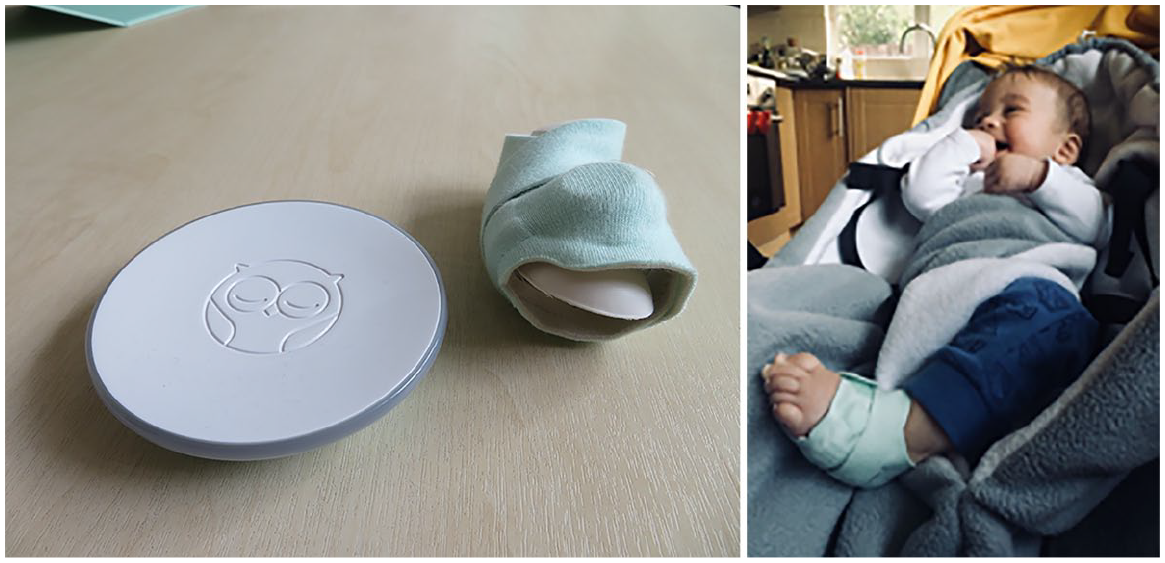
The Owlet sock and base station, and on a participant baby’s foot.
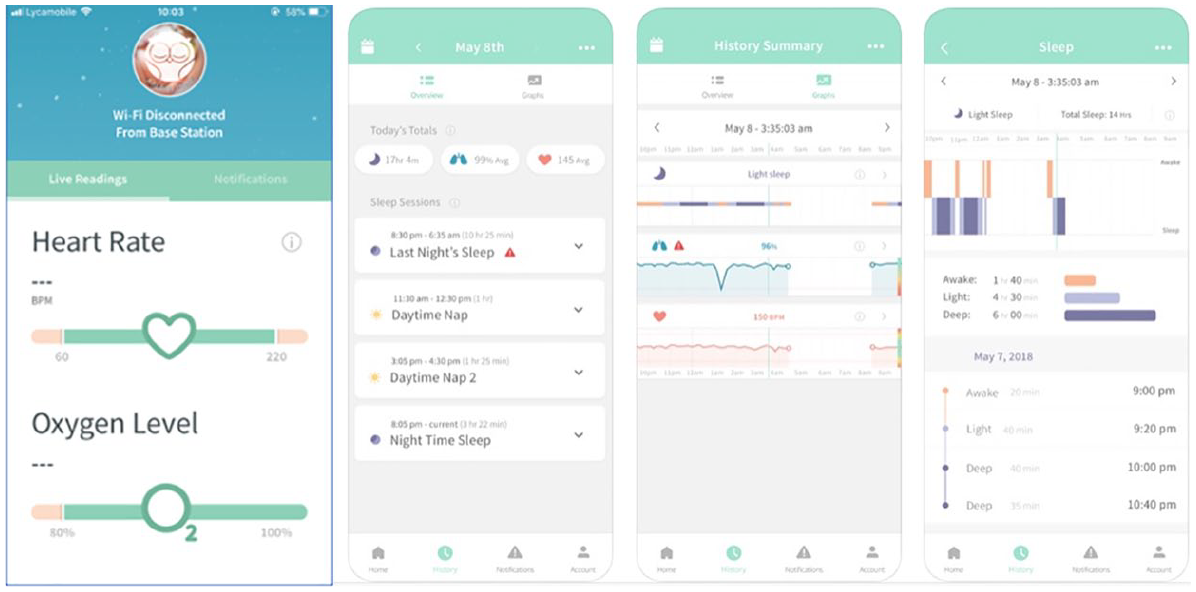
Owlet data interface.
The app includes Owlet Connected Care, which uses data-analytics to generate trend data on baby’s ‘sleep states’ categorized as awake, light and deep.
Recruitment and participants
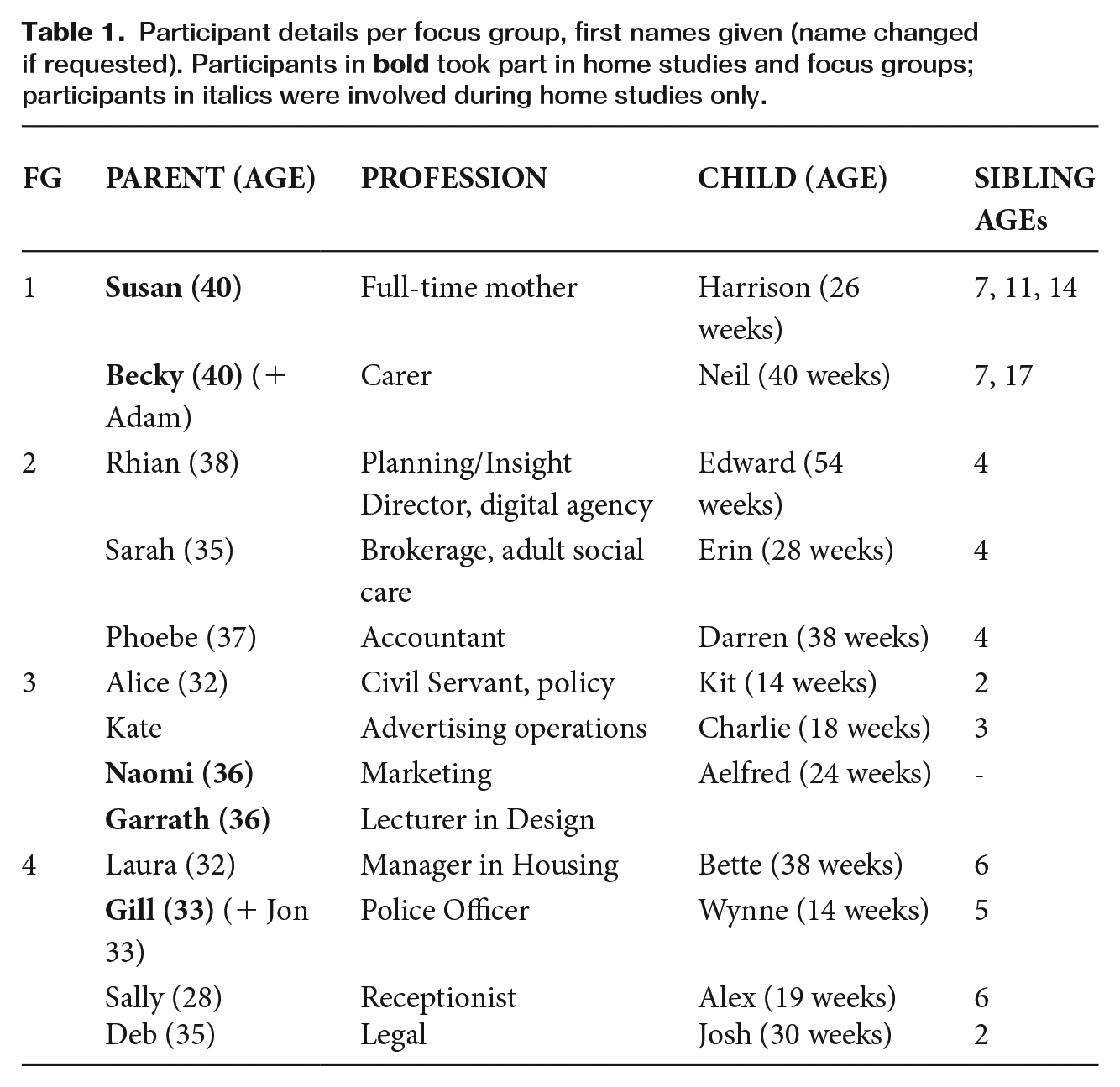
Parents were recruited through notices in local parenting networks (i.e. nurseries and toy/book shops) and social media. Fifteen adults participated: 12 women and 3 men, between 28 and 40 years of age, and their 12 babies, aged 14 to 54 weeks: a total of 27 participants. Four family households (7 parents and 4 babies) were recruited (self-selecting volunteers) from the focus groups for a follow-on home study (Table 1). Our interest in participants’ responses to and uses of Owlet was made clear, as was our lack of involvement in its design, and our neutrality in its success or failure.
Participant details per focus group, first names given (name changed if requested). Participants in
We interviewed four Owlet developers: the Vice President of the in-house designer team, the Product Design Manager, a company researcher, and a medical advisor from the Health Affairs team.
Data collection and materials
The case study used a range of qualitative methods:
A talk-aloud Owlet encounter organized around multimodal social semiotic concepts (van Leeuwen, 2005) (see analysis) was conducted by four of the project team with expertise in design, HCI, multimodality and sensory ethnography. A talk-aloud process was used to explore Owlet’s packaging and components – we felt and described their texture, materiality and colour; we set up Owlet and analysed the instructions. The one-hour session was video recorded. This informed a second post-fieldwork ‘hands-on-session’ with Owlet (90 minutes, analytical notes taken). The Owlet website with attention to the users’ Stories section was analysed. These encounters enabled ‘first-hand’ exploration of Owlet and an ‘empathetic route’ (see video re-enactments below) into parents’ experiences.
Four focus groups were facilitated with parents and their babies (see Table 1) using a topic guide and a range of activities with tactile objects and visual aids to prompt discussion, followed by a hands-on-exploratory session with Owlet. The topic guide included discussion of parents’ handling memories, learning to touch a new-born baby, their childhood memories of touch, sources of advice on touch, their thoughts on the significance of touch, notions of ‘good/bad’ touch, and experiences of baby monitors and self-tracking. Observation of ‘naturalistic’ parent–baby interactions (e.g. feeding, soothing) contributed to the discussion. Each focus group lasted 1.5 to 2 hours, and was video-recorded.
Research encounters were conducted with four families who used Owlet in their home for up to three weeks. A semi-structured interview was conducted with parent(s) at the beginning and end of the encounter. The initial interview built on focus group discussions to explore their observation, touching and use of technologies with their babies. The second probed participants’ experiences with Owlet, with an emphasis on touch. This included demonstration and discussion of learnt touch practices (e.g. swaddling, comforting), the routine of the home at bed-time, family and cultural attitudes and practices. Interviews lasted 45 to 80 minutes, were audio-recorded and touch-actions demonstrated by participants were photographed.
Video recorded re-enactments were used as part of the home research encounter to capture baby’s bedtime routine, a routine central to Owlet, and to explore moments of touching. Participants were asked to walk, show and talk the researcher through the bed-time routine (Figure 3). Video re-enactments capture mundane moments which can be difficult to recall/describe, to create an empathetic route into participants’ bodily-known practices (Pink and Leder Mackley, 2014). In addition to demonstrations of a range of touch practices, these sessions involved discussion across a wide range of topics including the sensory environment of the home, parental purchases (e.g. monitors) and arrangements of equipment, timings of bedtime and learning to touch and handle baby. Re-enactments lasted between 45 to 60 minutes.
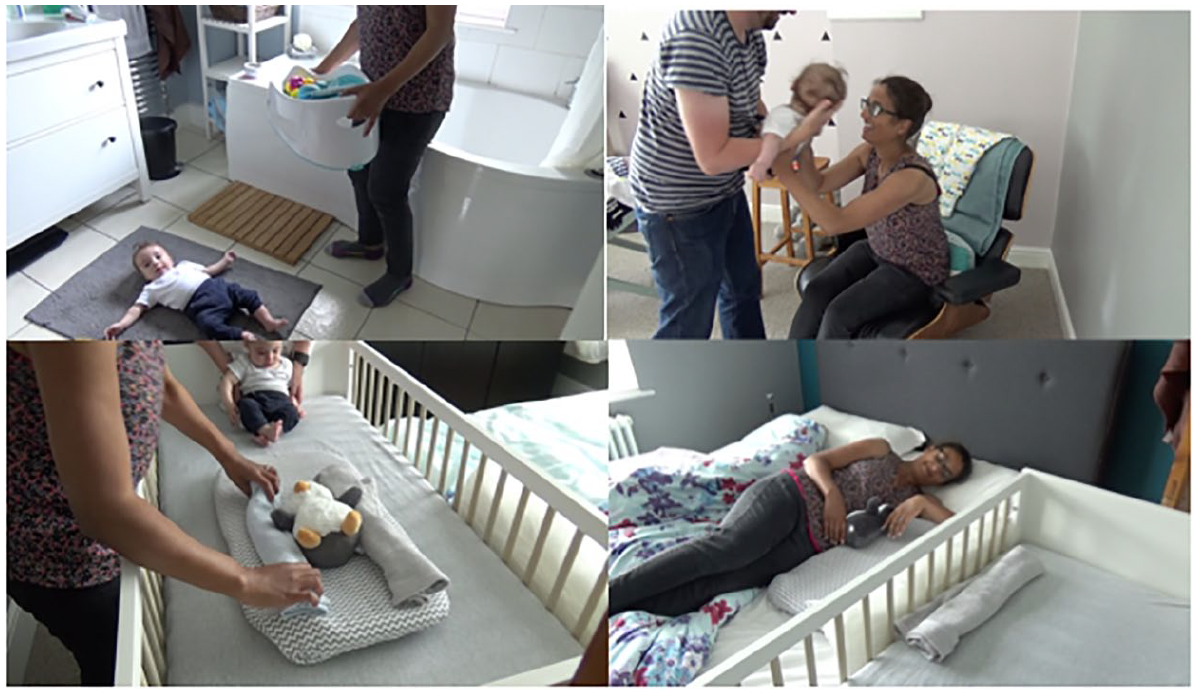
Examples of photographs taken in the research encounters and re-enactments.
In-depth interviews were conducted with the Owlet design team: the topics explored included the history and development of Owlet, the problem space of the design, design specifications, prototype versions, the product rationale, design considerations, user expectations regarding parent–baby touch, the status of the device and feedback on its usage. Three interviews lasting 30–90 minutes were audio-recorded via online video conference software.
Analytical framework and process
The framework that structured the analysis articulates a simultaneous concern with touch as a communicative mode, a sensorial experience, and its role in the formation of subjectivities. This acknowledges the contingent and fluid boundaries of ‘modes of touch’, the need to situate semiotic resources and modes within the bodily, material and sensory possibilities of touch (Jewitt, 2017). This approach reflects the increasing significance of the sensory aspects of touch as it is digitally mediated. It combines two inductive approaches: multimodal social semiotics (Kress, 2010; Jewitt et al., 2016) and sensory ethnography (Pink, 2015). These approaches differ in their emphasis on the semiotic and experiential, but share a qualitative attention to meaning beyond language, and place interaction at their centre (Jewitt and Leder Mackley, 2019).
We use multimodality to analyse the design of Owlet as a digital system and its histories (via interview with the Design team) and its packaging, a product-related attribute prominent in brand communication (Wagner, 2015). We employed multimodal concepts, including mode, semiotic resource (e.g. colour, textural features), materiality and compositional information values (Kress and Van Leeuwen, 2006). We situated the use of Owlet in the multimodal context of parenting and the family home, and the discourses (including those of its marketing) that it circulates within related to the broader landscape of parenting with which its design and use interacts (Van Leeuwen and Djonov, 2013).
While multimodality asks how meaning is made and communicated, sensory ethnography sets out to account for how meanings are experienced, the sensorial and often unspoken dimensions of everyday life (Pink, 2015). It is an experiential method which provides the researcher with a route (e.g. through re-enactments) to generate multisensorial traces of a collaborative research encounter towards an empathetic encounter with a participant’s sensory world (Pink and Leder Mackley, 2014). Methods are based on the notion that much of what is important about our feelings and activities is tacit, embodied and unspoken. This approach enabled us to explore touch through touch and to gain insight into participants’ felt/sensorial experiences, memories and imagination or speculation on touch.
This combined analytical lens is particularly useful in the analysis of touch at this emergent stage (Jewitt, 2017; Jewitt and Leder Mackley, 2018) and was used to explore the semiotic resources and affordances, and the experiential meaning potential of Owlet with particular attention to touch. While parental up-take of Owlet in the study was not entirely determined by its multimodal design nor was it unconstrained by it. The rich account gained from the analysis provided insights on the socially situated understandings of parent–baby touch embedded in and realized through Owlet, contributing to our understanding of parents’ differing responses and uses.
Four interconnected themes central to parent–baby touch as mediated by Owlet were evident across the analysis of the data set (as introduced in the next section). The themes were verified through their triangulation across the case study data (i.e. interviews, focus groups, video re-enactments, research encounters with Owlet and in the family homes) and critical data sharing sessions within the project team.
Threading through these analytical themes were issues of self-governance (e.g. rationality, efficiency and autonomy) which led us to explore them through the lens of governmentality, a perspective concerned with the ‘conduct of conduct’ (Foucault et al., 2000). Exploring the role of technologies, such as Owlet, in parent–infant interaction through this lens was particularly relevant given the intense governing of infanthood through the everyday structuring of the domestic lives of parents (Rose, 2005). We draw on three key concepts from governmentality. The rationalities of government refer to the key forms of knowledge and expertise that are fostered, produced and relied on for governing. Technics of government refer to how governing takes on a technological and pragmatic form through practical mechanisms, procedures, or instruments (Inda, 2005), used to influence, naturalize and operationalize the conduct, beliefs and ambitions of people. The subjects of government refers to the types of ‘identities that arise from and inform governmental activity’ (p. 10). In the discussion section, we apply these concepts to the study findings to illustrate how the digital can enter into the reconfiguration of parent–baby touch in the context of the formation of neoliberal subjectivities.
Four Touchy Themes
The findings are organized and discussed through four intersecting themes identified through the analysis.
Creating a desire for a digitally mediated touch
This section integrates findings from the multimodal analysis of Owlet and the focus groups to examine how the Owlet packaging contributes to creating consumer desire for a new kind of touchy connection. We discuss how colour and texture are used to convey information about Owlet (Esbjerg and Bech-Larsen, 2009; Djonov and van Leeuwen, 2011), its imagined users (Kress and Van Leeuwen, 2002), and to link touch to notions of efficacy and pleasure (Rose, 2005).
The Owlet colour palette is pastel minty green, grey and white. The mint-green box of thin yet sturdy cardboard is coated with smooth-to-touch matt paper with rounded corners associated with child-safe goods. A texture echoed in the soft blankets and clothing carried through to the imagery of babies in the instruction leaflets – their grey and white clothing and ‘ungendered’ bodies. Inside, the Owlet sock and base station are held in place by a transparent hard-plastic cover fitted over a white moulded board described by parents as ‘luxurious’, creating a ‘warm’ felt-scene, ‘Apple-esque’ with a clinical hint of ‘petri-dish’: a scientific or technological modality (Kress and Van Leeuwen, 2006). Parents found the colour palette suggested a ‘gender neutral’ device, ‘modern’, ‘contemporary’, ‘pleasing’, ‘cool’ and ‘clean’ (Figure 4) associated with subtle and tender emotive temperatures, innocence and calmness (Kress and Van Leeuwen, 2002).
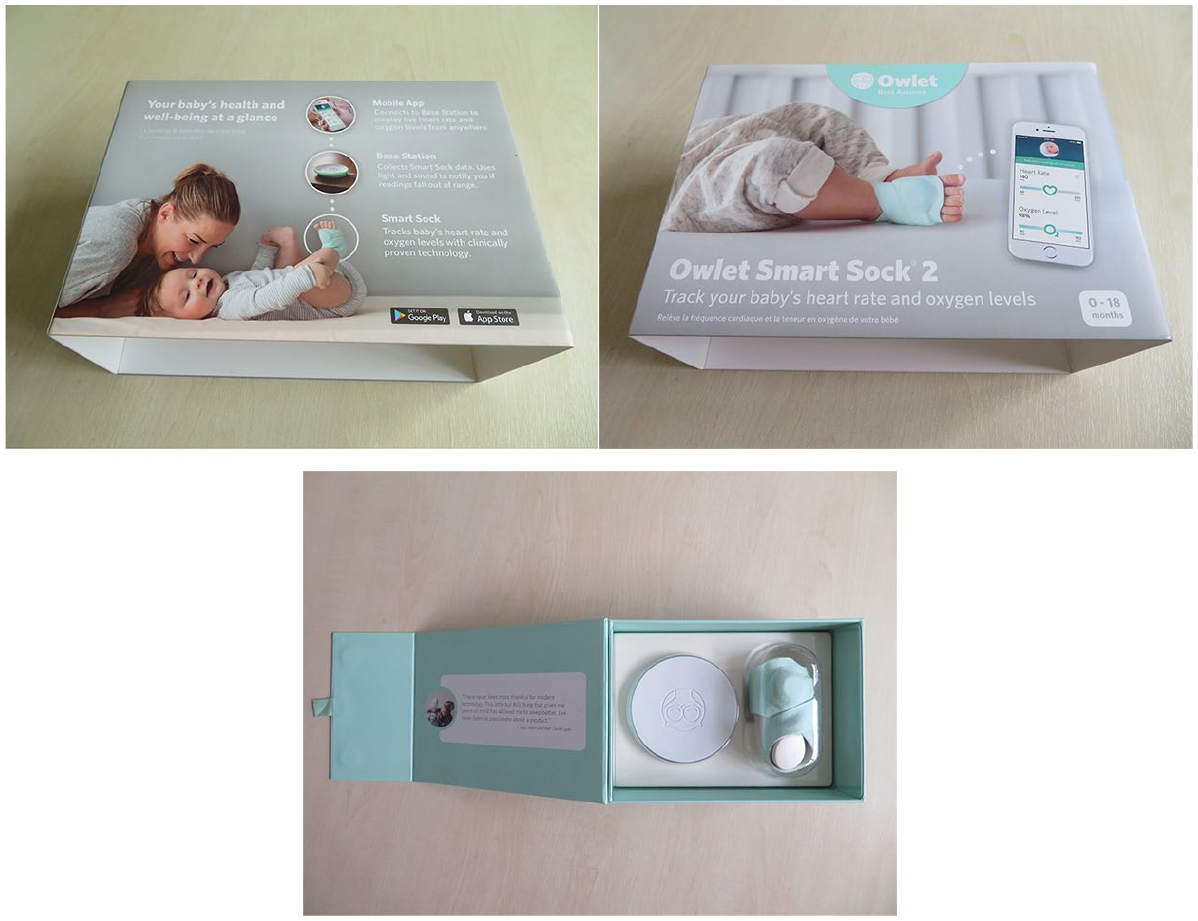
Owlet packaging: outer sleeve: front and back panels; boxed display of sock and base station.
The narrative imagery of the packaging (Figure 4) presented Owlet as a future-facing compassionate technology (Kress and Van Leeuwen, 2006). The front panel shows a sleeping baby dressed in a onesie wearing an Owlet sock on its foot, lying alone on a soft mattress. The sock is connected, by four ‘speech bubble’ dots symbolizing communication, to an image of a mobile phone screen displaying the Owlet app interface. Top-centre of the panel, looking over the baby, is the Owlet logo – a cartoon owl, and the tag-line ‘Rest Assured’. In Greek mythology, an owl is said to have sat on the blind side of Athena, the Goddess of Wisdom, to enable her to see the whole truth. We interpreted this visual message as one of autonomy, efficiency, safety and connection, echoed in the Owlet website images of alert, smiling babies lying alone in a cot or on the floor. The back panel depicts a woman, a baby and the Owlet device. The composition is divided into two-equal halves: ‘mother and baby’ on the left, Owlet on the right. The woman wears soft-relaxed yoga-style clothes (a trope for holistic self-improvement). She is in close-up, an intimate pose with the baby, smiling, looking down at, nearly but not quite touching baby. The baby is lying on a mattress, calm and smiling, holding its foot and leg, looking away from the woman. Their bodies close yet separate, calm and restrained, exude joyful autonomy. On the right of the panel, the three Owlet elements are depicted in circular frames: Owlet sock on the baby’s foot; a photo of the base station on a bedside-table; a photograph of a small and manicured ‘feminine’ hand holding a mobile phone displaying the Owlet app. The three images are arranged in a vertical line on the panel-centre, each connected by ‘speech bubble’ dots. The associated ‘technical’ descriptors for each element pictured are to the right. The placement of elements in a composition endows them with ‘information values’ attached to ‘zones’ of an image (Kress and Van Leeuwen, 2006: 183). The visual connection of the baby to the Owlet represents them as belonging together, which alludes to the digital connection from baby’s body via the Owlet sock to the Owlet app on the parent’s mobile phone. The ‘mother’s’ gaze on the left is given the value of the already ‘given’, familiar, known; while Owlet on the right is the ‘new’, not-yet-known, information at issue – the future.
The imagery of the Owlet instruction booklet in the box shows a sleeping baby wearing an Owlet sock, lying alone on a mattress; an alarm clock, books and the Owlet base station are on the nightstand, beside a bed made up with soft, white linen (Figure 4). These visual narratives promise a relaxed separated baby and parental bodies, bed-time reading, uninterrupted sleep (but not too long so as not to interrupt productivity!), awoken by an alarm rather than a baby. Parents in the focus groups laughingly contrasted the messy chaotic realities of parenting with the relaxed babies, yogi mother and clean, calm environments of Owlet imagery.
The packaging serves to frame digital monitoring as a ‘natural’ and ‘normal’ part of being a modern parent: ‘There’s technology to tell us everything else – why not what’s most important?’ (statement by Co-founder). It invites parents into a supportive interpersonal relationship (Wagner, 2015: 202), in which technology manages communication and empowers them through remote control, where Owlet, a nanny-like figure rather than a mother, looks over and touches baby, with the added visual promise of baby’s potential for independent self-soothing. The scene is set for a ‘clinically proven’ technology that manages risk, a benign governing technic that delivers information more efficiently and expertly than the maternal gaze or touch (Rose et al., 2006).
Spatiality of digitally mediated connection
In this section, we integrate findings from the interview with designers, analysis of Owlet and home encounters to argue that Owlet promises to extend the spatiality and modality of parent–baby connection.
Owlet design and marketing promote notions of freedom, individuality and autonomy (keystones of liberal subjectivity) via visualizations of otherwise invisible factors (heart rate and oxygen levels) rather than the audio-visual means of conventional monitors. The Owlet team spoke of its ability to generate: … a feeling of connection, I actually know my baby is alive, I know my baby is breathing, I know my baby is, is normal at this moment, it eases the stress when you’re away, when you are disconnected. (Owlet team interview)
They compared the contact of Owlet with a baby’s foot as a proxy for a parent’s hand on its chest, enabling the ‘busy’ parent to touch to check in with their infant remotely via their mobile. Owlet promotes an idealized parent–baby proximity which it actively manages through technological affordances, user instructions and narratives of ‘good’ touch, risk and ‘safe’ sleep. Owlet marketing materials show babies alone or separate from their parents and present separation as a technological requirement. The Owlet designers discussed parental bodies (and touch) as potentially ‘interfering’ with signal strength and reducing functionality. Owlet materials set out the ‘Perfect monitoring scenario . . . when your baby is alone, sleeping and in the dark’. The ABC of safe sleep is posted on the Stories section of the Owlet website, and the App guidance pages, for example: … now remember Owlet is not an excuse for unsafe sleep, the American Academy of Paediatrics says that the safest way for your child to sleep is Alone, on his [sic] Back and in his Crib.
Many of the Owlet website user stories concern parents feeling able to separate, for instance: ‘This means I can relax and check the app, rather than hover over my baby, and catch up on vital sleep’ (Story 9). This is visualized in marketing narratives of ‘successful’ work–life balance, and remotely connecting: ‘thinking’ about your baby ‘so you don’t have to’ and a promise of freedom through connection ‘anywhere’.
Participants in the home study considered separation and connection to another person that one loves and is responsible for as complex. They worried about potentially obsessive checking having the inverse effect of providing freedom, raising questions of parental identity, why would you not check when it is so easy to do so? They argued the expectation of separation may burden parents with more anxieties whereby they are always lightly touched by baby. Most parents in the study, commented on the distance that the technical affordances of Owlet enabled between parents and children: ‘It [Owlet] could make you put baby in their own room earlier’. (FG2 Rhian)
Discourses of parenting, safe sleep and technology competed in complex ways, however, with participants discussing touch, distance and connection as something they actively managed and reflected upon. Some recalled childhood touch memories, ‘My mum thinks you should leave them at the end of the garden – unless it’s raining or foggy’ (Becky), and moments of physical separation from their baby (e.g. hospital experiences).
Co-sleeping, a frequently raised and contentious topic, was part of their broader management of touch. Participants differed in their sleeping practices, they highlighted the inconsistencies and cultural particularity of safe sleeping advice, and how these are articulated through their family practices and histories. Some parents located co-sleeping in relation to creating a secure, independent and happy baby. Others situated it as a temporary problematic solution, or felt it is important for baby to ‘start enjoying his own space and feel safe’ without immediate parental presence or touch, invoking a discourse of baby ‘self-improvement’. This contested space suggested the potential of Owlet to bridge the process of lessening immediate presence or touch. Other parents linked co-sleeping to a desire to feel their baby was okay: Every now and again I might sort of touch her or poke her [laughs], check that she’s okay . . . she inevitably will end up in the bed at some point . . . she’s either feeding in the night or cuddling. (FG 2 Sarah)
These parents positioned the proximity of touching parental and baby bodies as safe and distant bodies as risky. Three home-study families saw touch as central to their ability to respond to and take cues from their babies’ touch needs. There were similarities in how touch was embedded in wider parental routines, material and technological contexts, and the sensory home environment. The households all signalled bedtime through space, touch, fabrics (e.g. sleeping bags) and sounds. Participants’ narratives revealed how touch can be both fleeting, incidental and actively negotiated throughout the night, as part of a wider managing of bodies and boundaries which aimed to extend the comforting touch of the body to overcome distance. Parent–baby touch was digitally remediated, negotiated and resisted through different ‘technics’ related to Owlet’s management of the space between parent and baby bodies, and points to how technology enters the formulation of parent and baby subjectivities. Participants’ comments highlight the sociality of spatial distance and time, and problematize Owlet’s technological promise to stretch connection beyond home to the mobile ‘anywhere’ and ‘always’.
The ‘right-kind-of-touch’
In this section, we draw on the focus groups and home encounters to explore how participants’ sense of ‘good’ and ‘bad’ parenting is deeply bound-up with the norms and moralities of touch circulated at the level of their family cultures and society, and how these related to Owlet.
Participating parents framed their touch practices and routines (e.g. bathing and swaddling) as socio-cultural, learnt from parents, grandparents and health professionals, and discussed them in relation to discourses of expertise, notably in relation to the authority of medical and parent organizations.
There was a dissonance between parental notions of the ‘right-kind-of’ touch and that of experts (e.g. medical) and family, for example, in relation to how much to hold a baby, ‘controlled crying’, or co-sleeping. Parents spoke of the stakes for parent–baby touch as high: some described ‘missing out on’ and feeling ‘deprived of touch’ in circumstances (e.g. premature birth) that had restricted touch with their baby; others expressed concern about the potentially detrimental effects of a lack of ‘skin-to-skin contact’, promoted by organizations (e.g. National Childcare Trust) as an ‘instinctive, beneficial’ practice. Participants’ experiences revealed the moral, gendered and generational evaluations of the ‘right-kind-of’ parent–baby touch, and its governance.
I wanted to hold her but I was told that I shouldn’t be holding her and I’d spoil her. It just didn’t feel right, but listened to what other people were saying. But with him, I just ignored them . . . He literally lived on me for five months. He’s quite happy to be put down [now]. [FG 4 Gill]
Owlet enters this contested touchy landscape with a conceptualization of the ‘right-kind-of’ parent–baby touch, which it aims to reproduce and maintain. The Owlet team used an ‘almost universal gesture’ as a design touch point ‘the parent placing their hand on baby’s chest to check they are alright and still breathing’. All participating parents mentioned this touch-gesture as a matter of sensing life and sending reassurance: The only other thing that I’m realizing that I do . . . probably I do it most nights, intuitively . . . Charlie sleeps . . . without moving . . . I will go and put my hand on his chest, even now, and I’ll just feel his [chest]. (Kate)
The Owlet team, commented that: It is not necessary for [parents] to go in and touch [their] child while they’re sleeping and potentially interrupt or disrupt their sleep.
They discussed the different ‘qualities’ of touch that Owlet enabled, namely ‘happy’ and ‘calm’ touch and its potential to remove ‘hovering’, ‘stressed’, ‘panicked’ or ‘anxious’ touch. This change in touch practices was seen to enable more ‘conducive’, ‘playful’ touch encounters beneficial to the emotional state of parents and, perhaps more importantly, the future emotional life and potential of their child.
Owlet materials visually stipulate correct and incorrect ways of holding and sleeping embedded in the ‘truth regime’ of medical and government regulations on safe-sleep. It situates the ‘right-kind-of’ parent–baby touch as a needed (rational) touch, shifting touch away from being a mutual experience between parent and baby to one for baby. This positions touch designed to reassure a parent, rather than benefit a baby, as a form of selfish touch.
Participants in the home study, however, viewed touching as a ‘special bond’ and crucial to the process of ‘becoming’ a parent: … it’s just a lovely, really lovely experience. You get the sense that he’s seeking comfort and finding it. (Rhian)
For some, Owlet was distinct from ‘human’ touch and redundant: Even with something like this [Owlet], I think I’d still do that [touch baby], because there’s nothing like going in, it’s about . . . me touching him. So actually, even though this [Owlet] would be saying that his heart was beating, I still think I would want [makes a touching gesture], I mean, before I go to bed I check on both my children . . . yeah, I do, I touch both. (Kate)
A concern that Owlet or technologies more generally could replace parental touch (something Owlet clearly states is not their aim) was raised by focus group participants. Some thought Owlet could translate an anxious tactile response into a visual one, and potentially amplify rather than remove anxious touch: It doesn’t necessarily make me think reassuring, it makes me think I’d be continually looking at that going – are her oxygen levels okay? Rather than – ‘oh, I can be at peace because the alarm’s not going off.’ (Sally)
Several parents voiced their concern that they could ‘get obsessed’ with the information in ways that could increase anxiety. More generally, they found the process of engaging with Owlet anxiety provoking (e.g. the struggle to fit the sock correctly on a wiggling baby). For Garrath and Naomi, Owlet prompted the ‘wrong’ kind of touch – ‘he just kept trying to kick it off’ ‘[We] removed it to calm him, otherwise he won’t sleep’, they associated Owlet with ‘stressful’ touch and interrupted sleep, which interfered with their tactile bonding.
Reconfiguring ‘knowing touch’
In this section, we draw primarily on the home encounters with parents to explore how Owlet shaped the use of touch to know.
The Owlet designers spoke of guiding parents through different ‘touch points’ to ensure their safe and accurate use of it, and to manage wider parental emotions and behaviour. This positions Owlet as a technic for reflection through which parents (and babies) could learn to be ‘more relaxed’, to separate and to make better decisions (e.g. to recognize when medical help is needed). In the home encounters with parents, however, they actively negotiated and resisted the entry of Owlet into their tactile knowing of themselves and baby. At one extreme, what should have been a ‘helping friend’ became ‘some Robocop technology’ that ‘augment[ed]’ a baby (Garrath/Naomi), at the other, Owlet became ‘Owlie . . . part of the family’, a ‘co-parenting’ device (Becky). This dynamic negotiation was related to parental use of Owlet as a tool for discovery in relation to their baby’s well-being and bodily agency, and self-discovery in the management of touch practices, emotions and the interrelations between parent–baby bodies. Parents spoke of needing to learn the right-kind-of- touch to connect Owlet for an accurate reading.
Parents in the home study commented on learning to interpret digital data as part of the parenting skills set required by Owlet: I mean, all of a sudden I have now got to be an expert in what the right oxygen level is . . . it’s like, just tell me if it’s right or not, don’t show it to me on a scale, for God’s sake, cos then I have to make the interpretation, and I don’t know what the hell it’s supposed to mean. (Garrath)
Parents varied in the ways that they used Owlet as a training tool, or a tool for self-improvement. Some discussed the need to know one’s own ‘emotional boundaries’ and ‘personality’ to self-manage its use. Becky’s use of Owlet changed the role of touch in her skill of ‘knowing’ her baby and reduced her anxiety. Initially, she continued to check on her baby when he was asleep on his own upstairs, later she would check the Owlet app first and then go upstairs, in the knowledge that he was ‘probably alright’. As her use of Owlet continued, she made a conscious decision not to touch him in the night: I can now go about half an hour, we got to about half an hour without me having to check on him now, which is amazing. [laughs] Because I could see his heart beat, and that he had enough oxygen. [Night-touch became] like an extra thing that I didn’t need to do. (Becky)
Owlet remediated the modal and sensorial features of parent–baby interaction in the home, changing the shape of knowing touch and its role in ‘skilled vision’ (Grasseni, 2004). As a parent in the home study (Gill) commented, ‘Hands aren’t really reliable.’ Others expressed concerns that Owlet may de-value parental expertise, ‘you don’t want tech to take the place of common sense.’ They reasserted the significance of their knowledge of baby: I sort of wound myself up quite a lot in the early stages trying to measure everything, and actually the happy contented sleeping baby was the measure that really made a difference. (Rhian)
We argue that Owlet represents a shift in the semiotic and sensory character of the task of parental knowing, shifting the ‘technic’ of understanding from feeling to interpreting visual data. Knowing baby via Owlet is re-presented as an internal invisible matter with the potential to remove or lessen the value or trust in parental felt and/or observed sensory knowledge of their baby’s body to assess critical aspects of well-being: feeling their pulse, clammy skin, changes in their body position and colouring. This shift is significant for the ways that technologies may come to shape touch as it has the potential to reshape the task of knowing from a naturalistic felt window onto baby’s body to an abstracted scientific–technical window into baby’s body and, in doing so, to significantly reimagine the role of parental touch in knowing baby.
Digital Touch Technologies and The Formation of Subjectivities
In this section, we discuss the study findings through the lens of governmentality (Foucault et al., 2000), specifically the concepts of rationalities, technics and subjects. We argue that the discourses that coalesce around Owlet reconfigure parent–baby touch and are mobilized in the formation of neoliberal subjectivities. The significance of the analysis is its empirical evidencing of how hegemonic values seep into technology to position the touchy bodies of babies and parents, and their pervasive stability even in emergent and unstable digital environments/markets, pointing to the tactile character of a neo-liberal conceptualization of parenting.
Rationalities
The practices promoted and embedded in Owlet are intertwined with specific rationalities, ‘truth regimes’, forms of expertise and authorities that are key to the formation of neoliberal subjectivities (Holloway and Pimlott-Wilson, 2016). As we have shown, Owlet advice and instructions refer to medical, government and health-care regulatory authority and expertise, with references to psychological and health research that link sleep to post-natal depression, maternal weight and anxiety. The Owlet website ‘Stories’ highlight parents’ lack of expertise by foregrounding how Owlet supports parents’ understanding of their babies. Owlet mobilizes expert knowledge to problematize parent–baby sleep and safety, formulating particular phenomena as problems, including parental ‘hovering’ – a ‘problem’ of separation, anxious touching and ‘unsafe’ sleep practices. It draws governing authorities, e.g. the American Academy of Paediatrics, into the conceptualization of problem and solution, resonating with governmentality’s continual classification of experience as problematic (Inda, 2005). This problem space creates a need for the digitally mediated touch of Owlet, where digital monitoring is benign, delivering information that is more advanced than the parental gaze or touch that is best for baby. Ultimately, digital touch is positioned as rational in contrast to human touch driven by the ‘irrationality’ of parental (maternal) emotion. In short, digital touch is ‘sold’ as effective, efficient, precise and data-driven. The emotional economy and labour of parenting is thus shaped via Owlet to produce a rational neoliberal subjectivity.
Technics
Owlet, we argue, is a technological means to direct parent–baby attitudes and conduct. Owlet advertising imagery is a technic, creating a disciplinary space, which works to construct and normalize imaginations of ‘good’ parent–baby touch and bodies, and ‘successful’ parents through neoliberal rationality and the display of parenthood as a regulatory space linked to consumer culture (Orgad and Meng, 2017). The study findings suggest the design potential of Owlet to: reconfigure the spatiality of parent–baby relations – although this was resisted by some; encourage, standardize and normalize touch practices; and promote (market) new senses of remote ‘touch’ and connection. Owlet reproduces a particular notion of the ‘right-kind-of’ parent–baby touch, an efficient and necessary touch, ‘calm’ and reassuring, ‘happy’, ‘conducive’, ‘playful’ and only ever for baby (not parent). This conceptualization of touch resonates with, indeed empirically validates, a neoliberal version of ‘successful mothering’ (Orton-Johnson, 2017). Owlet creates a touch environment in which parents are digitally prompted with data to ‘manage’ their mental well-being to help secure the future emotional life and potential of their child. As the ways that parents took up and used Owlet has shown, however, its re-formulation of touch enters a contested landscape, in which the constant interplay between the materiality and sociality of the body, the environment and technology proved central to the different ways that parents (and babies) used and resisted Owlet – ways that shaped their touch interaction.
We have shown that the tactics and technics embedded in the design of Owlet (and its use instructions) concern the re-training of parent–baby touch routines and practices. Discourses of self-improvement, skills-development and empowerment, all key features of neoliberalism, infuse Owlet’s marketing and the experiences of parents. Participating parents’ experiences evidenced their constant desire (or demand) to become ‘better parents’, and/or for their babies to become ‘better babies’ (e.g. to regulate themselves, to sleep longer). Often, they expressed ‘future facing’ concerns and actions including the imagination or preparation of their child for future independence. For some parents, Owlet became a means for reflection, which was embraced by parents as a tool for self-improvement, mobilizing the technology to re-train their (and their baby’s) touch in the context of sleep. Other parents negotiated their use of Owlet in unexpected ways (e.g. as a diagnostic tool to monitor baby’s heart rate in relation to known or feared health conditions). However, some parents resisted Owlet, seeing it as a technological ‘intruder’ disrupting their family routine.
Central to Owlet’s digital re-training is how it reconfigured the notion of ‘knowing touch’ through the way it remediated the modal and sensorial features of parent–baby interaction within the environment of the family home. The provision of an abstracted scientific–technical window into baby’s body impacted on some parental practices of ‘knowing touch’ by positioning manual and bodily knowing as inadequate. The Owlet app translated bodily data into visual data and, in doing so, it expanded the skills set of parental knowing to include reading and interpreting digital data. We suggest that, over time, the changes to parent–baby touch realized through the use of Owlet may reshape parental touch practices and tactile acuity. Given the centrality of touch to how we know ourselves, others and the world, how future touch technologies may shape the epistemologies of touch and subjectivities is a significant question.
Subjects
Central to Owlet as a technic of governmentality are the types of parent and baby touch practice that its design and use problematized and promoted. These types of touch foster and maintain particular parental (and baby) identities; in this instance, Owlet fosters touch that is rational and autonomous. Through these governmental practices, Owlet seeks to shape and cultivate particular types of individual and collective identity. This serves to emphasize how technologies are intimately involved in making modern subjects. Using Owlet has the potential to reformulate the parental sense of self and the distinction between parent and baby body as a technological affordance. The marketing and use of Owlet sets out to attach parents to particular touch practices, which in turn mould parental conduct, certain capacities and qualities. We suggest these touch practices connect with parental identities with a notion of the ‘good’ parent, particularly the entrepreneurial, free, autonomous and self-regulating ‘good’ mother demanded by Neoliberalism (Orgad and Meng, 2017). In this context, Owlet served to naturalize and internalize surveillance within some of the participants in the home study, reflecting the self-monitored and self-disciplined subject produced through neoliberalism tied to consumer culture. Through our description of the different ways that parents negotiated their use of Owlet, we have made visible and felt the ways in which they adapted or resisted the processes that this technology subjected them to, to cultivate a sense of ‘their own’ selves and identities (Inda, 2005).
Conclusion
This article has made a theoretical, methodological and empirical contribution to understanding the potential significance of ‘next generation’ smart baby monitors for parent–infant touch interaction and subjectivities. It has proposed a new framework for researching touch drawing on multimodal, multisensorial and governmentality perspectives. The analytical layering this provides has contributed to understanding of the intimate connections between technologies, bodies and environments, and how the blurred boundaries between them can be generative and significant for researching touch.
Using this framework, we have illustrated how Owlet entered the technoscape of parenting, and some of the potential influences of technological, socio-cultural and material affordances on the sociality of parent–baby touch. We have highlighted the multimodal discourses of rationality, autonomy, freedom and self-improvement evoked for the study participants through the design and use of Owlet, and pointed to the various authorities, knowledges and techniques mobilized through Owlet. With attention to how parents in the study took up (negotiated and resisted) Owlet, we have pointed to Owlet as a governing technic which influenced parents’ conduct, including formulations of notions of the ‘right-kind’ (and amount) of parent–baby touch, the spatiality of digitally mediated connection and ‘knowing touch’, and its potential to contribute to the professionalization of parenting. We have suggested the potential of the neoliberal discourses that coalesce around Owlet to shape parent–baby touch habits and routines, and subjectivities. This study prompts us to ask how the multimodal and sensorial representational shifts facilitated by Owlet might play out for the future of digital touch technologies, parental touch practices and acuity.
Footnotes
Funding
This work was supported by the European Research Council (ERC) under the European Union’s Horizon 2020 research and innovation programme (grant agreement No. 681489). There is no conflict of interest.

Biographical Notes
CAREY JEWITT is Professor of Learning and Technology at UCL Knowledge Lab, University College London. Her research interests include multimodal research theory and methods, and methodological innovation, and bringing this perspective to technology-mediated interaction, most recently digitally-mediated touch. She has led numerous research projects in these areas and is currently Director of IN-TOUCH (funded by an ERC Consolidator Award). She also previously led the large NCRM-funded project MODE ‘Multimodal Methods for Researching Digital Data and Environments’ (MODE.ioe.ac.uk). Carey is a Founding Editor of the journal Visual Communication (Sage), and has published extensively in her fields. Her recent books include Introducing Multimodality (Routledge, 2016) and The Routledge Handbook of Multimodal Analysis (2014).
Address: UCL Knowledge Lab, Department of Culture, Communication and Media, Institute of Education, University College London, 23–29 Emerald St, London WC1N 3QS, UK. [email:
SARA PRICE is Professor of Digital Learning at UCL Knowledge Lab, University College London. Her research interests focus on the design, development and evaluation of emerging digital technologies for learning, teaching and training with attention to embodiment, how sensory and bodily interaction can be mediated through digital technology, and the role of this in supporting new ways of thinking and meaning making. She is Co-I on IN-TOUCH, UCL PI on the ‘Move2Learn’ project (Wellcome Trust, ESRC, NSF) and has co-led several other research projects, most recently ‘WeDraw’ (EU H2020). Sara’s recent publications include Digital Bodies: Creativity and Technology in the Arts and Humanities, with Sue Broadhurst (Palgrave Macmillan, 2017) and the Sage Handbook of Researching Digital Technology (2013) with Carey Jewitt and Barry Brown.
Address: as Carey Jewitt. [email:
KERSTIN LEDER MACKLEY is a Senior Research Fellow on IN-TOUCH at the UCL Knowledge Lab, University College London. Her research interests are in sensory and visual ethnographic research approaches as applied to the study of everyday experiences and activities, emerging technologies and design futures. She has been a Research Fellow on a number of significant projects, including ‘LEEDR: Low Effort Energy Demand Reduction’ (Loughborough University) and ‘TOTeM: Tales of Things and Electronic Memory’ (Brunel University). Kerstin’s recent publications include Making Homes: Ethnography and Design (Bloomsbury Academic, 2017) with Sarah Pink, Roxana Moroşanu, Val Mitchell and Travy Bhamra, and she has published in a range of journals, notably in Qualitative Research, Media, Culture & Society, and Visual Studies.
Address: as Carey Jewitt. [email: