




Abstract
Drawing upon visual ethnographic research carried out in two Spanish cities between 2015 and 2018, this visual essay explores the ability of street art to speak about violence against women. Posters, wall writings and stencils represent both visual communication and political expression that can give an insight into this gender-based phenomenon. Street art pieces are linked to broader social contexts. The photographs and discourse analysis of the street art presented in this essay pay attention to the specific contexts of Spanish society and investigate the social spaces in which street art pieces are embedded. The author offers a critical perspective on assumptions regarding the gendered construction of public space and reflections on street-level visual resistance about violence against women in Madrid and Valencia.
Keywords
Reading Walls as Canvases for Resistance
The global economic crisis and ensuing austerity measures have had a severe impact on women all around the world (Brah et al., 2015; Evans, 2016). Nor has the Spanish economic crisis that has lasted over 10 years been favourable to Spanish women. Money and resources have been cut from prevention work regarding gender violence and women’s health care, and a number of legal initiatives to improve women’s rights have been withdrawn (Grenzner, 2014; Sahuquillo, 2013). Women around the world have resisted the implications of austerity in a variety of creative and artistic ways (see, e.g., Rovetto, 2015; Ryan, 2017). Spanish women have reacted by demonstrating on the streets to protest against the government cuts, demanding an improvement to women’s political and social conditions, gender equality and prevention of physical and mental violence against women. One avenue for this work – in addition to rallies, marches and strikes – is street art, 1 which has become an important tool for confronting violence against women.
In Spain, street art has a long history as a communication tool in times of societal changes. Different street art forms from posters to murals have been employed to express ideas, make claims and project opinions. Walls were utilized during periods of political turbulence such as Franco’s dictatorship (1939–1975) and the transition to democracy (1975–1982). Therefore, it is not surprising that Spanish women also have a long tradition of taking their message into public space through street art, and there are recorded examples of wall writings from the beginning of the 1930s (Tolonen, 2017).
The debate about street art has shifted from mere aesthetic views to approaches that interpret this cultural expression as a social and political protest, and as a tool for communication (Youkhana, 2014). Judith Butler (2004: xx-xxi) has argued that a hegemonic comprehension of politics is feasible partly through restraining what will and will not be admissible as part of the public sphere itself, and that ‘the regulation of the sphere by appearance is one way to establish what will count as reality, and what will not’. I reformulate Butler’s declaration that visibility and appearance serve to declare the meaning of stories manifested about violence against women. This visual essay explores street art from a grassroots perspective and as a tool that offers socio-political expression for questions that often remain invisible in the mass media. The street art pieces presented are seen as media for communication and the way in which artists and activists utilize street art as an instrument to respond to gender violence issues in public space.
Violence against women continues to be a seemingly permanent feature of our society and studies repeatedly highlight that many women will be subject to violence at some point in their lives (Evans, 2016). This includes mental, physical and sexual forms of violence, and its impact ranges from immediate to long-term multiple physical, sexual and mental consequences for women and girls, including death (UN Women, 2019a). This study explores some of the concerns about such violence that appear on walls in Spain, focusing on violence in the public sphere. A discourse analysis seeks to demonstrate the variety of ways that street art resists violence against women: how street art frames issues, translates discontent into statements and produces rival discourses to the dominant one.
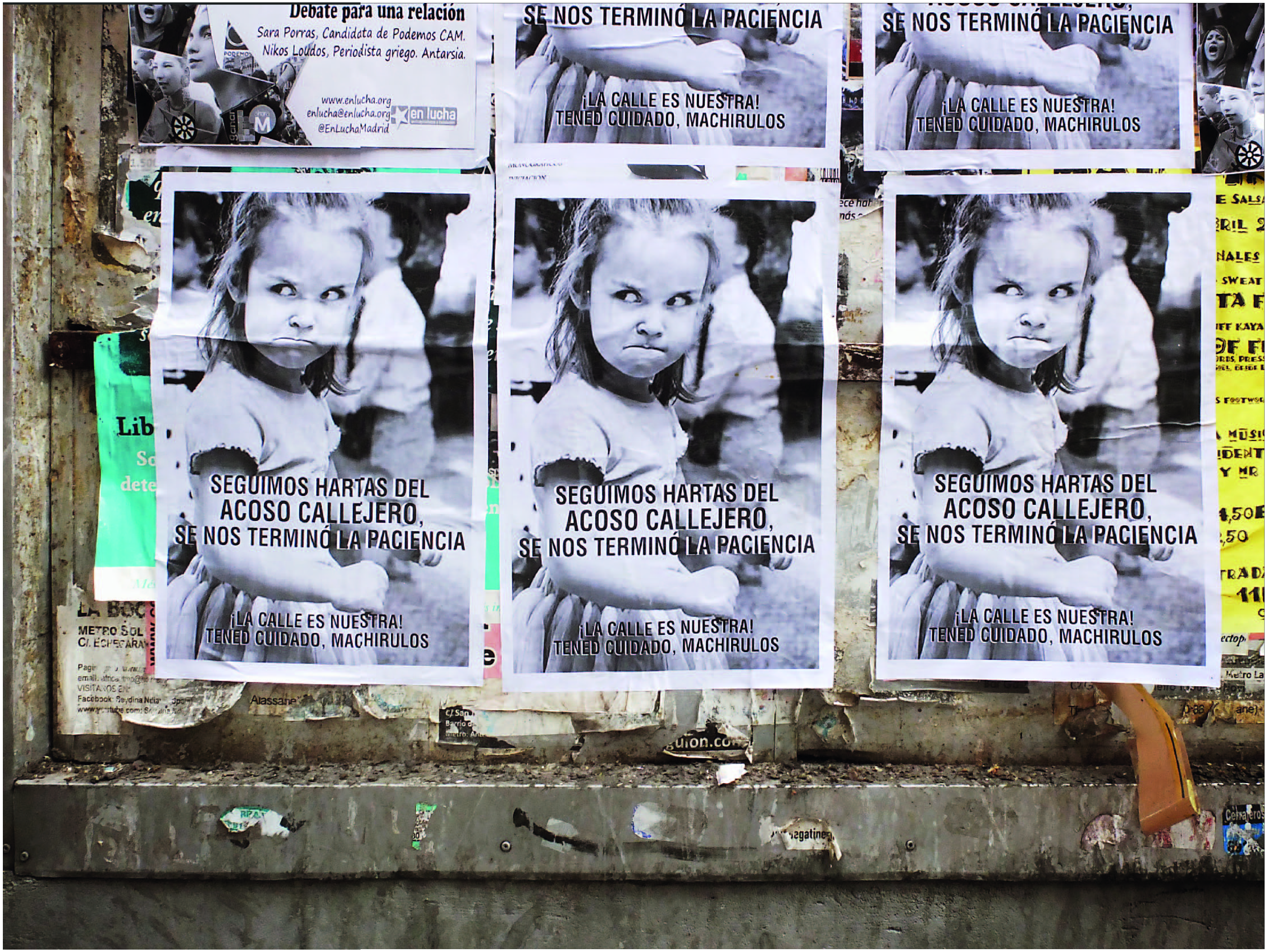
The posters shown in Figure 1 and the stencil shown in Figure 2 narrate counter-hegemonic stories. In these images, both discourses (visual and textual) fall into an ambivalence between safety-intimidation. The series of posters shown in Figure 1 illustrate a little girl with ferocious eyes, her lips and fists tightly closed, giving the impression that she is totally fed up with street harassment. This discourse frames women as active by taking over the physical space through direct action – they are claiming street space back from men by attaching these posters and demonstrating that ‘the street is ours’. Words such as ‘we’ and ‘our’ exclude men. The photograph of the young girl with the text ‘Our patience has ended’ highlights women’s exposure to macho men’s street harassment throughout history and emphasizes the attitude of the younger generation.
Series of posters: ‘SEGUIMOS HARTAS DEL ACOSO CALLEJERO, SE NOS TERMINÓ LA PACIENCIA. ¡LA CALLE ES NUESTRA! TENED CUIDADO, MACHIRULOS’ (‘WE ARE TIRED OF STREET HARASSMENT, OUR PATIENCE HAS ENDED. THE STREET IS OURS! WATCH OUT, MACHO MEN’).
© Photograph: Jonna Tolonen.
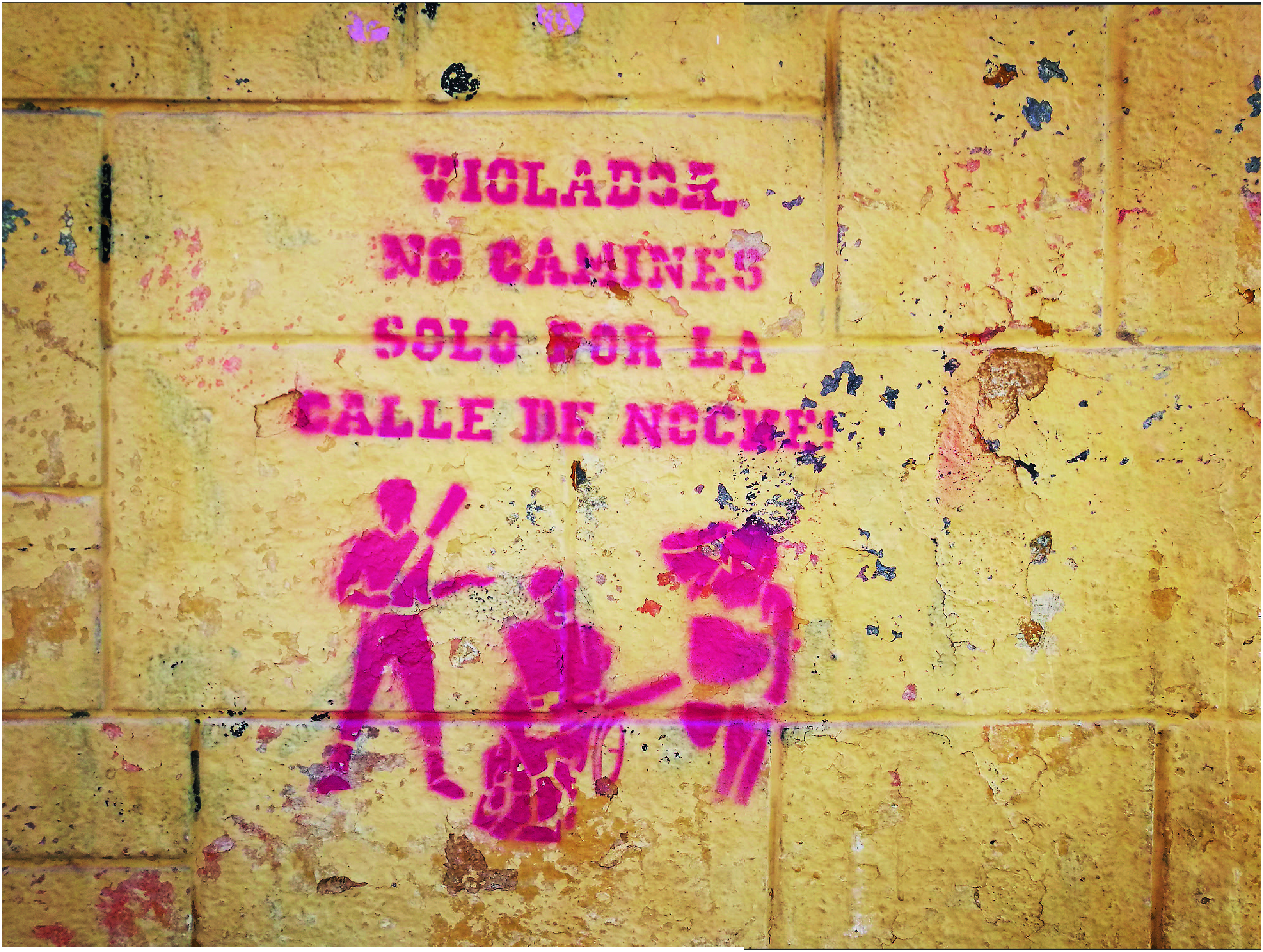
Stencil: ‘VIOLADOR, NO CAMINES SOLO POR LA CALLE DE LA NOCHE!’ (‘RAPIST, DO NOT WALK IN THE STREET ALONE AT NIGHT!’).
© Photograph: Jonna Tolonen.
Women have been, and often still are, framed homogeneously as a weak and inactive group, and seen as particularly vulnerable when walking the streets alone (Frazier and Falmagne, 2014; Hoppstadius, 2019). The street is the most common location of violence against women in Spain (INE, 2018). The term ‘street harassment’ includes actions such as verbal comments, staring, whistling, stalking, honking and groping, while some definitions also include sexual assault and rape (Logan, 2015; Vera-Gray, 2016). In Spain, 71 percent of females experience street harassment for the first time while they are still minors, between the ages of 11 and 17 (Salas Oraá, 2018).
The street intervention seen in Figure 2 ‘VIOLADOR, NO CAMINES SOLO POR LA CALLE DE NOCHE!’ (‘RAPIST, DO NOT WALK IN THE STREET ALONE AT NIGHT!’) illustrates three, supposedly female, figures painted in pink. Each figure holds a baseball bat in her hand and the figure in the middle is sitting in a wheelchair. The figure on the right is wearing a bikini. Here, women are framed as a much more versatile group than in Figure 1. Women with all kinds of physical features, on the one hand, are suffering from gender-based violence but, on the other, are welcomed to join the fight against street harassment. From an intersectional perspective, the discourse highlights that violence against women is not a uniform phenomenon because disabled women are more likely to suffer from it. The discourse reifies the dichotomy of female victims and male perpetrators (see, e.g., Frazier and Falmagne, 2014). Nonetheless, solidarity is clearly framed by visualizing three women together defending the security of the streets with a baseball bat that is generally seen as an urban weapon for men. This approach also shifts the customary protective role from men to women.
‘Rape in Spain is Cheap’
Most of the gender violence that women experience is invisible to others; it often occurs in dark alleys or behind closed doors. Spanish artist Sara Batuecas’ poster series illustrates women being physically harassed (see Figures 3 and 4). At the same time as feminist groups of varying ideological factions have increasingly started to look more diverse, they have also made themselves more visible, not only in online forums but also in the streets providing spaces for dialogue and engagement (Evans, 2016; Tolonen, 2016). Batuecas’ works and her narration of the process of creating the posters can be interpreted as an engagement with resistance – a group of women posed, photographed, printed, paid for and placed posters around the streets with the intention of communicating with the public (Batuecas, 2019). Creating street art together is an activity that binds individuals to a group and its beliefs (Phillips, 1999; Tolonen, 2016, 2021).
#SITOCASUNANOSTOCASA TODAS (IFYOUTOUCHONEOFUSYOUTOUCHUSALL).
© Photograph: Jonna Tolonen.
Close-up of one of Sara Batuecas’ poster series.
© Photograph: Jonna Tolonen.
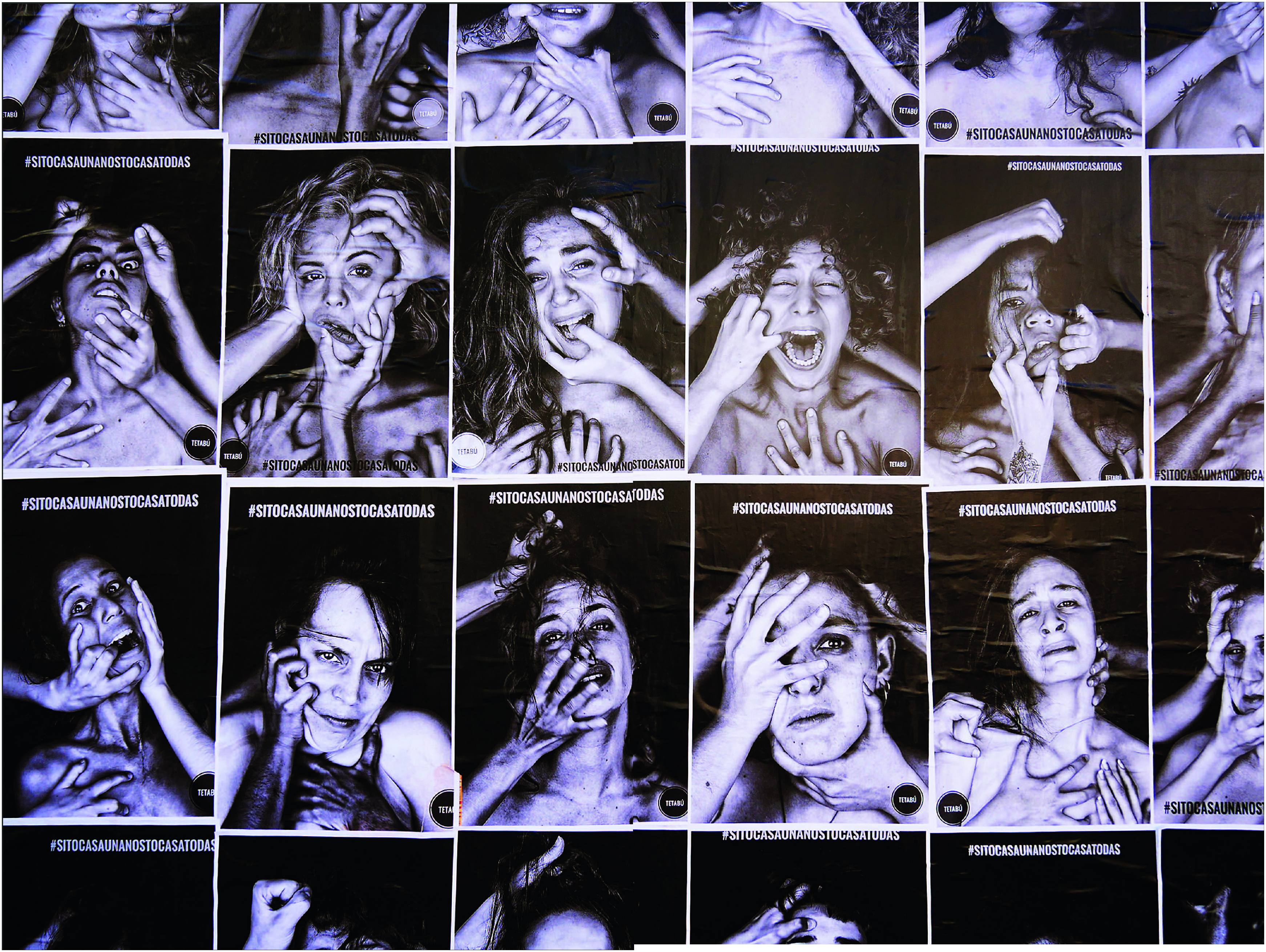
Batuecas wanted to talk about violence against women at the place where it most often occurs, and her intention was to influence society through street art (Batuecas, 2019). Phillips (1999) describes this kind of group action as an ‘open ideological community’ that believes that change in society is possible. When asked about her motives for creating this particular poster series, Batuecas reflects: I began this project because I needed to create something to get rid of the rage and impotence I felt when I saw all the cases of macho violence that occur daily in our country. Above all, the rage that broke out when the sentence of ‘La Manada’ was declared [in April 2018]. I felt that the Spanish justice system had left women unprotected and it gave me the feeling that rape in Spain is cheap. (Batuecas, 2019, emphasis added)
With ‘La Manada’, Batuecas refers to one of the most well-known cases of gang rape in Spain. In July 2016, an 18-year-old woman was sexually assaulted by five men during festivities in Pamplona. The court verdict sent the violators to prison for ‘continuous sexual abuse’ not for ‘rape’. 2 The five men talked about their group as the ‘manada’, a term commonly used to refer to a pack of wolves. La Manada became a symbol for Spanish feminist associations regarding the ‘machismo’ that women suffer from (Ceberio Belaza, 2018). The sentence of La Manada set off a wide-scale national outcry about women’s rights, with mass protest rallies using slogans like ‘No es abuso, es violación’ (‘It’s not abuse, it’s rape’) and ‘Yo te creo’ (‘I believe you’). Posters presenting the La Manada men with the statement ‘VIOLADORES’ (‘RAPISTS’) were spread across Spanish cities (see Figure 5). The poster illustrates the men in their official police mug shots. Here – with their real names and faces – the La Manada men are condemned in public by the public. The message of the poster is clear; these men are rapists, not ‘just’ sexual abusers.
Poster of the five men of La Manada with the text ‘VIOLADORES’ (‘RAPISTS’).
© Photograph: Jonna Tolonen.
Both the La Manada movement and the global #MeToo movement emerged in spring 2018. As part of an ongoing global resistance to violence against women, women have not only continued with existing campaigns, but also the number of new activists and groups has risen. They have helped uncover thousands of cases of women who have experienced violence, and the issue is now discussed more openly and more widely. For instance, currently in Spain, women seem to report sexual harassment and rape more regularly, since reports of sexual attacks with penetration increased by 22.7 percent during 2018 (Ministerio del Interior, 2019). In addition, in November 2019, French women started big rallies across the country to condemn violence against women (see, e.g., The Guardian, 2019).
‘We Want to Stay Alive!’
In the neighbourhood of Lavapiés in Madrid, where Batuecas’ poster series were spread, many women’s rights activists and feminist groups operate. Therefore, in that neighbourhood, finding street art with a more controversial tone than that presented in Figures 1–5 is not surprising. Figure 6 shows a stencil, painted red, depicting a woman with a machete raised above her head. The text ‘MACHETE AL MACHOTE’ (‘MACHETE TO MACHO’) is belligerent and intentionally provocative to get the attention of as many passers-by as possible (see Figure 6).
Stencil: ‘MACHETE AL MACHOTE’ (‘MACHETE TO MACHO’).
© Photograph: Jonna Tolonen.
The most common interpretation of this piece is that it aims to encourage women to hit machomen with a machete. However, the artists who created this work have stated that the purpose of the stencil is neither to promote violence against men nor to increase any kind of unnecessary violence, but to encourage women to use self-defence (Gaceta, 2016). This view is based on the feminist self-defence initiative from the 1970s, launched to make women aware of and develop their own mental and physical self-defence skills, and to initiate discussion on violence against women. The core message is not ‘an intent to kill any person, but the machismo and patriarchy that prevail in our society and people’ (Feminómenas, 2018). The discourse does frame woman as aggressive, but in a different way from the females presented in Figure 2, where the three women are relaxed and laid-back. Depending on the reading of passers-by, this could result in viewing the woman in Figure 6 either as ‘acting like a man’ or recognizing a diversity within gender theorization that extends beyond a binary approach (Naegler and Salman, 2016).
The street art pieces presented here are examples of how women use this type of art to exploit public space by drawing attention to violence against women. They demonstrate how Spanish women are taking over public space for themselves without permission, to allow their voice to be heard on issues they consider essential. Their main criticism concerns the prevailing patriarchal ideology, and their aim is to make visible and expose the consequences of patriarchal power structures.
Batuecas’ poster series was based on staged photographs of anonymous women who had volunteered for the project (see Figures 3 to 4). Another street campaign, organized by Asamblea Feminista Panteras (AF.P) (Feminist Assembly of Panthers), stressed the same issue, but with identified victims. This campaign involved spreading dozens of names of the victims of femicide around the city of Madrid. Every piece of writing on the wall included the name, age, city and date of death of women killed by their current or former partners or spouses (see Figure 7). The slogan of the campaign, ‘Vivas nos queremos’ (‘We want to stay alive!’), refers to historical struggles associated with disappeared people during the Argentinian dictatorship and feminist organizations’ fight against trafficking (Rovetto, 2015). As a consequence, the campaign exceeds the mere visual register to become a political slogan and a memorial space. These wall writings were encountered in the streets almost as grave stones, as some people stopped, paid their respects or started a conversation with another passer-by, as Tolonen (2018) reflects: As I was photographing the wall with Virginia’s name on it, I saw several ladies stopping in front of it. One of them saw me and was worried if she was blocking my picture and commented: ‘Pobre chica. Que vergüenza, ¿no?’ (‘Poor girl. What a shame, isn’t it?’).
28-01-17 Virginia. F. 33 años. Orense. #Vivas nos queremos! AF.P. (Asamblea Feminista Panteras) (Virginia. F. 33 years old. City of Orense. #We want to stay alive! AF.P [Feminist Assembly of Panthers]).
© Photograph: Jonna Tolonen.
In 2017, globally 84 women were killed every day due to violence against women, according to the United Nations (UN Women, 2019b). In response to these atrocities, activists and feminist groups will undoubtedly continue exploiting public space with street art pieces that draw attention to violence against women. Street art can raise awareness of female suffering and ill-treatment. In addition, the pieces convey ideas about what equality and women’s rights should be in today’s society. As a vital means of communication for women in Spain, street art seems to have bloomed again; it is breaking stereotypes of women in society and allowing mass communication outside the mainstream media.
Footnotes
Acknowledgements
All Spanish–English translations by the author.
Funding
The author(s) disclosed receipt of the following financial support for the research, authorship, and/or publication of this article: The author would like to thank the Emil Aaltonen Foundation for the travel grants that made her fieldtrips to Spain possible.
