




Abstract
Visual media representations of protests are a part of politics in general. A protest is about creating a mediated political event with its own performative bodily and emotional aspects, and cultural memory, each of which affects a sense of citizenship. This article discusses how protest photographs serve as resources for political struggle by examining the visual media stream during the 2017 anti-governmental protests in Venezuela. The data consist of (social) media content and prominent photographs. The selected photographs are then discussed using five functions of iconic photographs proposed in Hariman and Lucaites’ (2007) book, No Caption Needed: Iconic Photographs, Public Culture, and Liberal Democracy, with the argument being that the context of the pictures should also be carefully considered when analysing specific photographs because it provides essential information about them. Since the pictures represented daily life and likewise had a special ‘truth effect’ and transmitted affect, they supported the opposition’s and anti-governmental protesters’ discourse on the government as a faceless enemy. This also gave room to the protesters to construct through performativity an emotional juxtaposition to the faceless power and, in this way, emphasize their humanitarian struggle. In particular, the article contributes to how visual representations function in terms of performing citizenship and the role of media photography within the context of an authoritarian government.
Introduction
The image of 23-year-old Wuilly Arteaga, wearing a jacket displaying the Venezuelan flag and with a violin positioned on his shoulder was commonly shown in traditional media and, even more so, in social media during the anti-governmental protests in Venezuela in spring 2017. Arteaga played classical tunes in the streets of Caracas while masked and uniformed members of the National Guard shot rubber bullets and threw canisters of teargas at him and other protesters. Eventually, the National Guard destroyed his violin and he was thrown into prison, where he was beaten by the authorities (Arteaga, 2018). 1
While Arteaga is arguably one of the best-known citizens who gave a face to the protests of 2017, he was certainly not the only one, as will be discussed in this article. As Castells (2007: 239) points out, ‘the simplest message is the human face . . . it is the symbolic embodiment of a message of trust around a person, around the character of the person.’ Therefore, it is important to focus on more than just speech or written text when studying a protest movement and its political meaning-making in a polarized situation because meaning-making is also performed and closely connected to affective ties in time and space (Palonen, 2018). Despite a growing body of research focusing on the production and mediation of protest images, there is a need to study, through visual and social movement research, how visual representations of protests manage to gain the attention of the broader public and how the protesters’ ‘struggle to be seen’ (Guidry, 2003) moulds the creation of images (Rovisco and Veneti, 2017).
Arteaga was just one of hundreds of thousands of protesters, but he came to symbolize civic action in a highly polarized situation in Venezuela. Here, I focus not so much on the legal aspects of citizenship, but on citizenship as a political identity that is formed as, for example, an emotional construct that enforces emotional identification with other civic actors (Hariman and Lucaites, 2007). Moreover, photographs expose and model social behaviour, including the behaviours that constitute citizenship (p. 17) and, in that way, they also reconstitute the social (Stocchetti and Sumiala-Seppänen, 2007). Based on this function, I argue that in the current hybrid media environment, filled with different kinds of visual representations, it is not only important to focus on specific images but also to analyse them as part of the context from which they arise. By focusing on the visual media stream of conflicts, it is possible to detect certain underlying cultural and political aspects of a society, and thus to also understand the conflict better.
A growing number of studies in social movement research and media studies are focusing on the relationship between visuality, media environments and repertoires of protest (e.g. Spellman-Poots et al., 2014; Visual Communication Special Issue 16(3), 2017). Protests and iconic images have been studied especially in the context of social media and memes (e.g. Boudana et al., 2017; Olesen, 2018), with respect to how bodies are revealed and used (e.g. Lin, 2018; Mann, 2019; Ruiz, 2017), and also as part of the process of image-making as an interaction between the protesters, photographers and audiences (e.g. Faulkner, 2013; Rovisco, 2017). The case of the Venezuelan protests in 2017 highlights each of these themes, and thus the article contributes in particular to how visual representations function in terms of performing citizenship and the role of media photography as a part of political struggle within the context of an authoritarian government in a hybrid media environment.
Based on the varied function of images in protests, I am interested in what performative elements construct citizenship in the photographs of protesters and how these elements contribute to a process of meaning-making as a part of political struggle.
The article is structured so that I first present background information on the polarization of Venezuelan politics and the media. Then I discuss what the visual representations reveal about the disintegrating cultural and political scene, focusing on five different functions of iconic photographs in a society, as outlined by Hariman and Lucaites (2007), even though the selected photographs are not treated as icons per se. Then the methodology and data are introduced. They consist of (a) a study of (social) media content during the protests, and (b) a close analysis of four prominent photographs. Interviews with 24 Venezuelan societal actors are also used as background material to help contextualize the photographs. Thus, the article approaches the visuality of conflicts not in the traditional way as propaganda, censorship or news frames, but as a part of the social, which constructs meanings in a dialogic relation between different actors and forms by bringing into play new empirical insights needed in the field (Blaagaard et al., 2017: 1112–1113).
In the next two sections, the results show that since the analysed representations of the protesters represented daily life and likewise had a special ‘truth effect’ and transmitted affect, the images supported the opposition’s and anti-governmental protesters’ discourse on the government as a faceless enemy. This also gave room to the protesters, through their bodily and facial expressions, to construct an emotional juxtaposition to the faceless power and, in this way, emphasize their humanitarian struggle.
The Venezuelan Political Situation and The Anti-Governmental Protests of 2017
When the aim is to understand the perceptions created through photographs of active citizens engaging in civic membership, it is essential to understand the cultural, historical and political context in which the pictures were taken and circulated. Venezuela is a highly polarized society that, during the anti-governmental protests of 2017, was led by the increasingly authoritarian president Nicolás Maduro (2013–present) (García-Guardilla and Mallen, 2019). As Bisbal (2009: 16) points out, what really occurred during the era of Chavismo (1999–present) is that politics penetrated all sectors of society. This politicization and polarization of society created an antagonistic situation where attempts to deal with the ‘other’, which in the case of Chavismo was the political opposition and its supporters, justified the exclusion of the nation’s citizens and acts of violence against them (McCoy et al., 2018).
As a case study on the representations of civic membership and their function, I focus on the anti-governmental demonstrations in spring 2017 in Venezuela. A series of protests directed against President Nicolás Maduro’s government occurred between April and July of that year. The events began in late March when the government-backed Tribunal Supreme Court dissolved the opposition-led National Assembly and hundreds of thousands of protesters took to the streets almost daily for four months. The protests were the largest since the unrest of 2014, which had resulted in injuries, arrests and more than 40 deaths due to severe repression by armed forces and paramilitary groups (www.el-nacional.com). However, it should be remembered that there is a longstanding tradition of engaging in peaceful civic action against the government, especially by the Venezuelan student movement.
As in 2014, many were killed as a means of repression in the protests of 2017: according to some estimates, 163 persons died (Observatorio venezolano de conflictividad social, 2017). Already, before the constitutional crisis that began with the Supreme Court’s decision in March to dissolve the Assembly, there was tension between the opposition and the government. After the Court’s decision, however, dissatisfaction increased and the protests grew significantly larger. They continued despite the fact that the Supreme Court had already reversed its decision on 1 April. The protests continued until July, when Maduro held Constitutional Assembly elections, where supposedly only government-minded candidates participated. Thus, the end result was that the Constitutional Assembly assumed more power than the National Assembly and the protest movement dissolved.
In addition to the crowds in the streets, an essential part of the protests played out in an online environment. Certain images in particular stood out as social media content. In addition to the pictures chosen here for closer visual analysis, numerous additional pictures on social media showed the streets full of protesters and teargas smoke. These images served the function of showing the power wielded by a large crowd wishing to overthrow the government.
It is important to note that both sides of the conflict, the government and the opposition supporters, tended to post social media content for their own group, which echoed the currently polarized traditional media field. This should be remembered also in the case of Arteaga and the videos and pictures of him that began to circulate in the media, but for different purposes among different groups. This is due to a prolonged conflict that had already lasted for two decades, and over the years people had either deleted friends on the opposing side from their social media spaces or formed a mutual agreement that they would not comment on each other’s posts (Salojärvi, 2017). That is why the purpose of the pictures circulating in social media at the national level is not to raise debate between the opposing parties in the conflict, but to construct unity among like-minded individuals (see Salojärvi, 2016).
Societal Functions of Iconic Photographs
According to Dartnell (2007), images have a function in understanding the language of identities, groups, religions and nationalisms. They help us to deconstruct political themes into symbols, icons, emblems, allegories and moralities, and in this way visual representations help us to ‘see’ and ‘read’ the interaction of politics (p. 144). Following this idea, the study departs from the five functions of iconic photographs in society, as highlighted by Hariman and Lucaites (2007), by discussing how the most prominent pictures of the protests can be understood as resources for political struggle.
Among media scholars, there is no consensus on how an iconic photograph can actually be defined (e.g. Andén-Papadopoulos, 2008; Griffin, 1999). Here, even though the focus is not on the selected pictures as iconic, but instead to use the five functions as a theoretical frame for potentially iconic images, I emphasize that iconic photographs are widely recognized, remembered and affective, and serve as representations of historical events (Hariman and Lucaites, 2007: 27). Images evoke instant emotional reactions and effectively grab our attention (Ewbank et al., 2009: 127). With iconic photographs, this is highlighted by their highly emotional effect (Hariman and Lucaites, 2007). Iconic photographs have an impact because of ‘the high drama and emotional pull of symbolic moments of death, sacrifice, and patriotism’ (Griffin, 1999: 129).
Iconic photographs may be used to study political action and how it can be constituted and controlled through visual media. Iconic photographs (or here, potentially iconic ones) may have five different functions: they may reproduce ideology, communicate social knowledge, shape collective memory, model citizenship and provide figural resources for communicative action (Hariman and Lucaites, 2007). Ideology for Hariman and Lucaites is ‘a set of beliefs that presents a social order as if it were a natural order’ (p. 9). Thus, this conception can be compared to Gramsci’s notion of hegemony (see, e.g., Sassoon, 1980). Hegemony in a Gramscian sense includes different aspects of a society, such as economics, culture and politics. Hence, according to Gramsci, different societal actors and institutions, including media and journalistic photographs, have a role in creating hegemony. Yet, even as they create hegemony, they are also able to voice counter-hegemonies. The mainstream recognition, widespread circulation and emotional impact that constitute an iconic photograph are part of the formula for reproducing a given society’s social order. Yet, the counter-hegemonic side of images should not be forgotten either, since images may contain both dominant and resistant responses to social authority (Hariman and Lucaites, 2007: 9–10.) The ideas of hegemony and resistance to it are especially important in a polarized situation, which may be defined as a bi-polar type of hegemony, in which it is of central importance ‘to demarcate frontiers between “us” and “them” and to stake out communities perceived as moral orders . . . [where] two groups create each other through demarcation of the frontier between them’ (Palonen, 2009: 321).
Second, iconic photographs communicate social knowledge; the more they are used, the more they also have a role in collective memory work since they will mark, frame and otherwise set the tone for future understandings of public life (Hariman and Lucaites, 2007: 11).
Third, iconic photographs shape collective memory by shaping our understanding of specific events and periods. Through iconic photographs, viewers may personalize historical events and political decisions. This personal understanding of an event or topic is ‘embedded, normative, and capable of determining subsequent action’ (p. 11). This alone is a major reason for studying specific conflicts through photographs because it helps us to understand the layered significance of how collective memory is formed, which may be thought of as a part of the hegemonic power struggle. Thus, memory work is political (Zelizer, 1995: 228).
Fourth, icons offer a model of performing citizenship since the images show citizens together with other citizens in common circumstances, they show the state and other institutions, and they valorize some actions over others (Hariman and Lucaites, 2007: 11–12); in short, they show a form of citizenship that can then be reproduced by different actors (see Faulkner, 2013).
Finally, iconic photographs also provide figural resources for communicative action, i.e. they can be used due to their widespread recognition by the public as ‘a relatively democratic resource for persuasion on specific issues’ (Hariman and Lucaites, 2007: 12). Thus, they can be used in memes and for different types of political purposes. A still image can bypass the in-built rationality of language, and thus it may directly influence a viewer’s moral senses (Olesen, 2013: 9). This then may create ‘moral shocks’ among viewing audiences, which turns the audiences into producers in the form of social activism (Glück, 2018: 113). This may be seen in the way the images have been re-posted (in different contexts) and made into memes. This also builds on their iconic status (Boudana et al., 2017).
Methodology and Data
The methodology used for this study involves two sets of data because a strict visual analysis did not reveal the meaning-making processes and thus the approach needed to emphasize a process of reflexivity as well (Blaagaard et al., 2017). The first part consists of online media content. During the protests of spring 2017, I observed social media content (including Facebook, Twitter and WhatsApp as well as news and YouTube links of the conflict that were circulated via social media) and several digital news sites (e.g. runrun.es, El Universal, La Patilla) on a daily basis from early April until the end of July. This was done in order to obtain a broad and general overview of the events in Venezuela and to identify general visual trends and prominent images for closer analysis.
From the digital content observed, I chose four different visual media events based on their commentary and the frequency with which they circulated on online media sites. Based on the criteria, seven to nine cases stood out; I chose the most prominent of these cases, ones that specifically represented civic action against the armed forces. Later, this selection was confirmed by traditional media since these particular events were also focused on by the international mainstream media as providing the most important pictures of the protests (e.g. Agence France-Presse [AFP], 2017) or when international news media interviewed the individuals in the photographs (e.g. El Nuevo Herald, New York Times, The Times). Yet, it should be noted that not one but several pictures were taken of each media event and only time will tell which, if any, of the series of photographs will become iconic. Moreover, choosing another representative photograph for each of the four events would not have changed the results since all the photographs form part of the overall data and the results are reflective of all the images.
I chose one picture from each of the four media events to analyse more closely, using the visual rhetorical interpretation method because it aims to ‘reveal particular rhetorical strategies instead of enumerating and describing what the picture shows’ (Kędra and Sommier, 2018: 44). The method is based on four visual methods: visual rhetoric (Foss, 2005; Wright, 2011), denotations and connotations (Barthes, 1977, 1983), compositional interpretation (Rose, 2012) and intertextuality (Allen, 2000; Kristeva, 1980). The method consists of six different layers (see Appendix 1). The first layer consists of a basic denotative interpretation, followed by photographic techniques. The next layers address connotative interpretations, which are categorized as visual rhetorical figures (layer 3), with the most common being metaphors (Banks, 2001: 17–18) and metonymies (Barthes, 1977), and symbols and intertextuality (layer 4), which have to do with the connections made between (some elements of) the photographs and other cultural artefacts. The fifth layer deals with emotional engagement, while the final layer crystallizes the argument made as a conclusion to the interpretative process.
The four photographs chosen for step two of the analysis were as follows: (1) a photograph of Hans Wuerich, a man who stripped himself naked and confronted the National Guard with only a Bible in his hand (Figure 1); (2) an image of Maria José Castro, an elderly woman who turned her back on an armoured National Guard vehicle that was pushing her forward (Figure 2); (3) a photograph of Caterina Ciarcelluti, a fitness enthusiast who threw rocks at the National Guard (Figure 3); and (4) Wuilly Arteaga, a violinist who played his violin in the middle of the protests on several occasions and who, in the selected photograph, was playing a violin while armed forces were marching behind him (Figure 4).
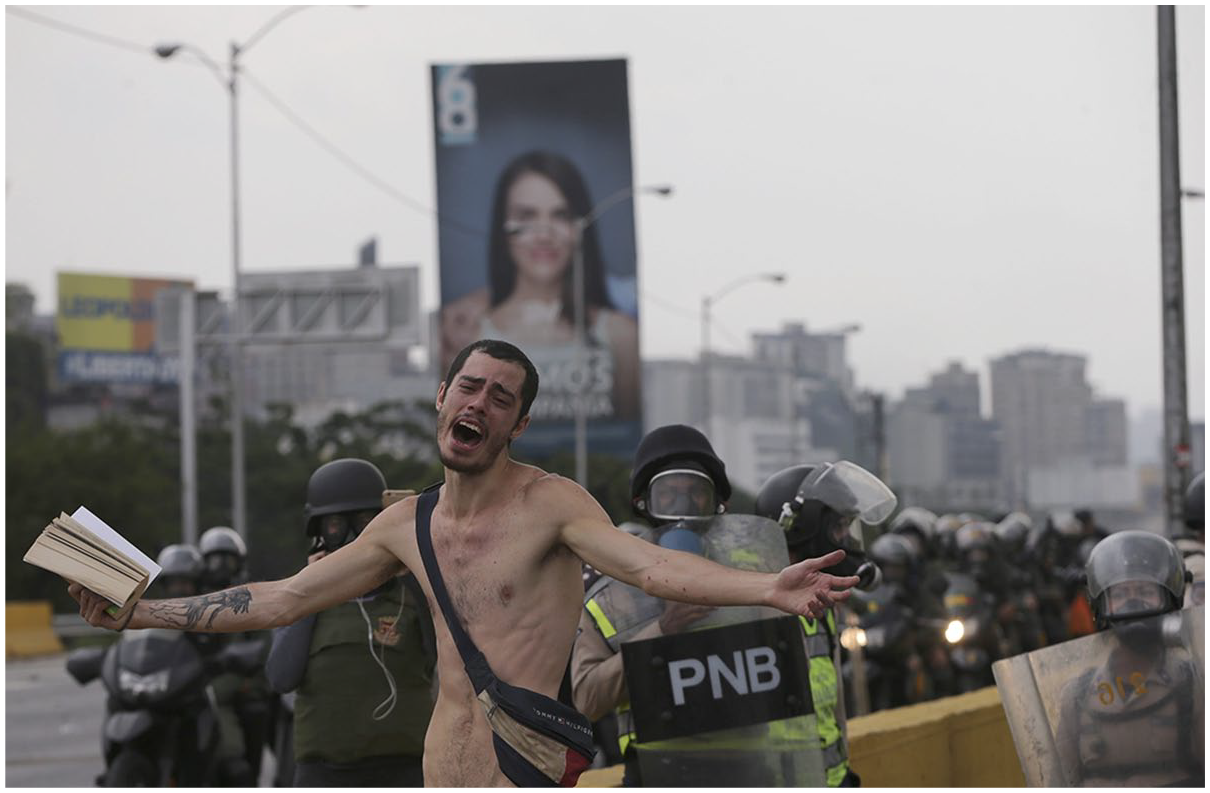
An anti-government protester holds a Bible under the watch of riot police during a march in Caracas, Venezuela, Thursday, 20 April 2017. © Photograph: Fernando Llano/Associated Press. Reproduced with permission.
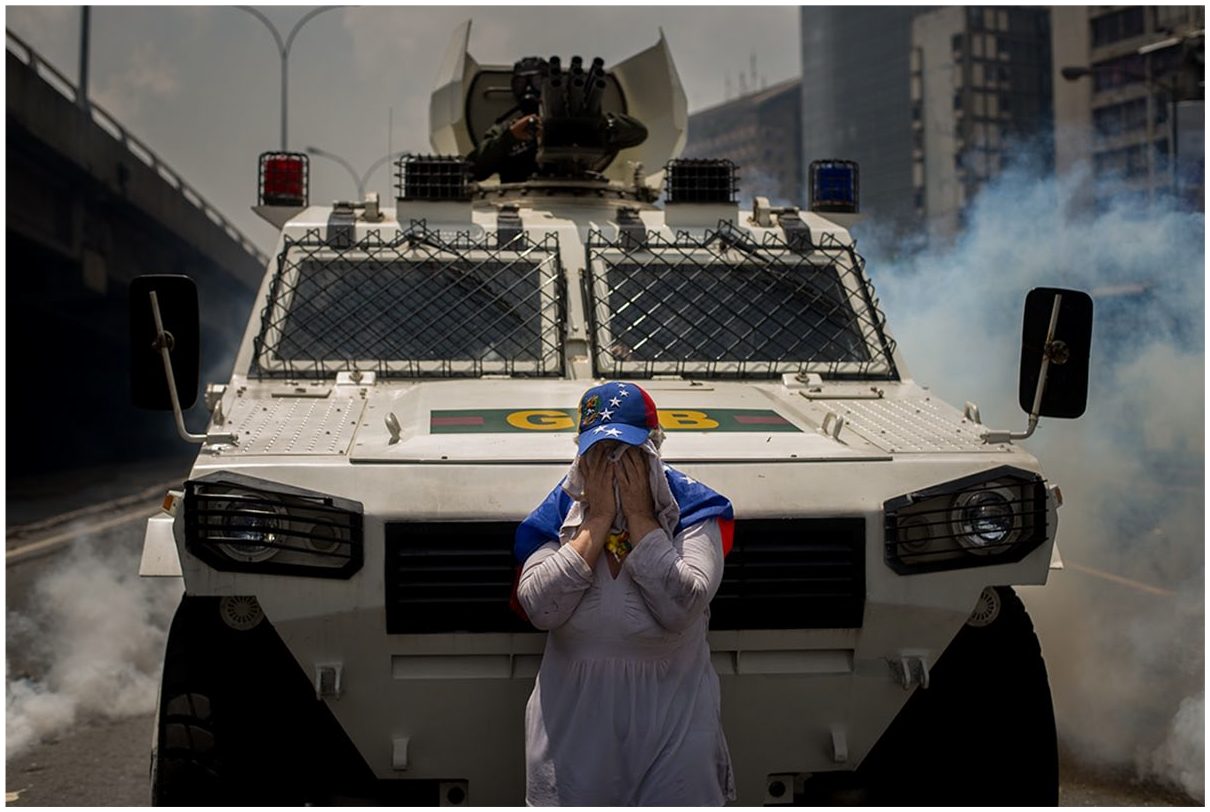
Maria José Castro turning her back on an armoured National Guard vehicle. © Photograph: Manuel Quintero. Reproduced with permission.
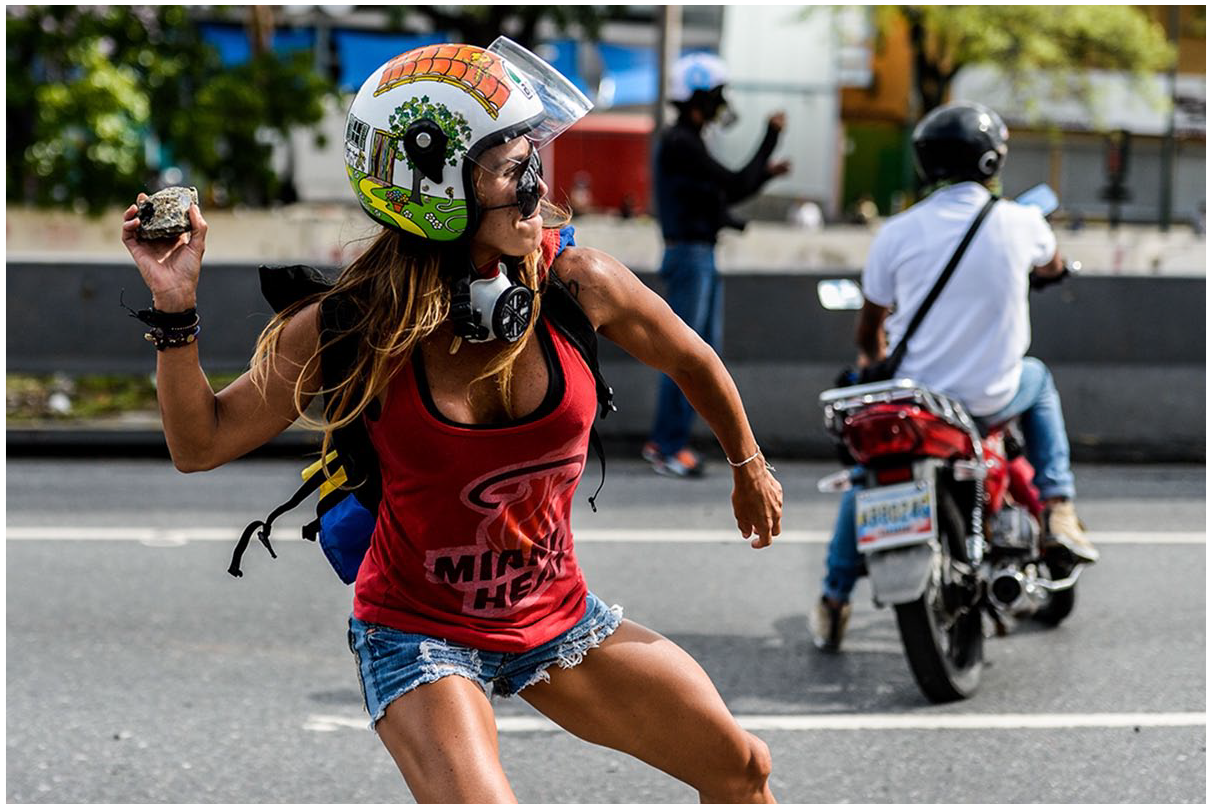
Caterina Ciarcelluti, a fitness enthusiast, throwing rocks at the National Guard. © Photograph: Federico Parra/AFP/Getty Images. Reproduced with permission.
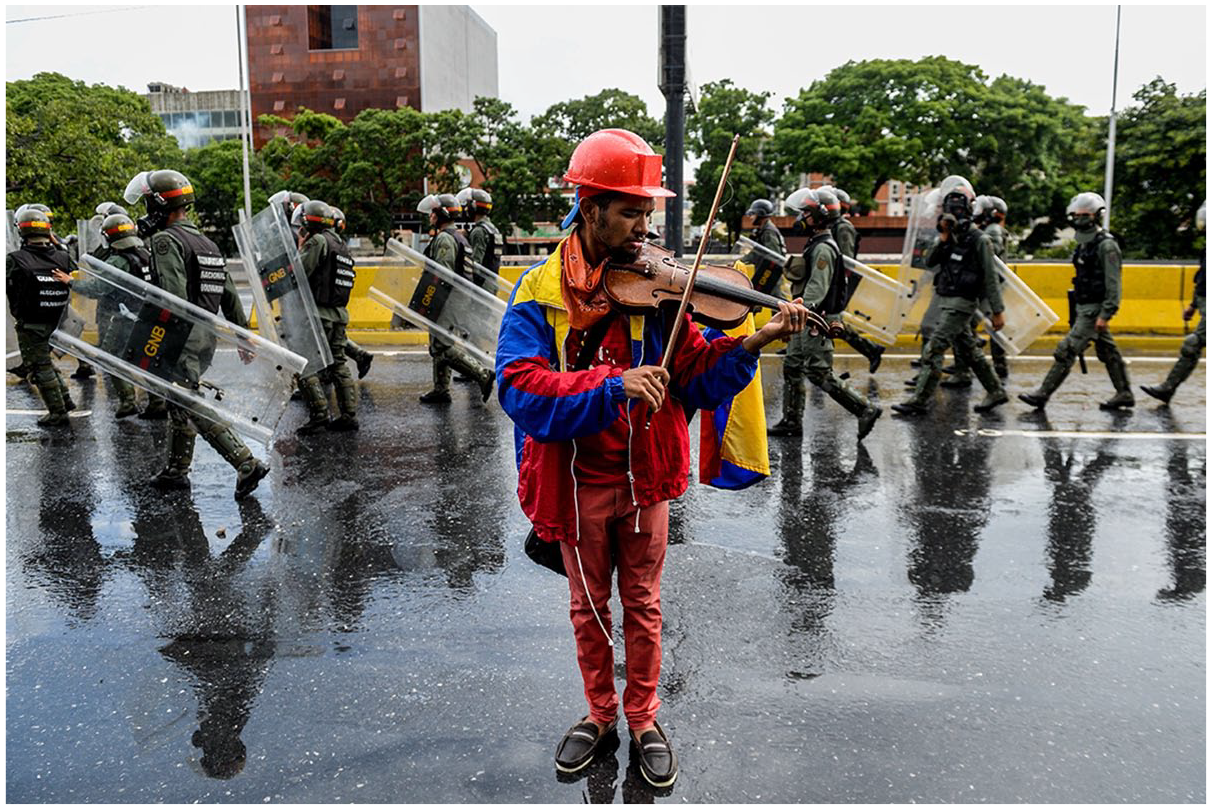
Wuilly Arteaga playing his violin while armed forces march behind him. © Photograph: Federico Parra/AFP/Getty Images. Reproduced with permission.
Many of the elements in the analysis described above are subjective, i.e. they provide intertextual connotations; they also describe the emotions and feelings derived from the viewer’s background, knowledge, experience and culture (Kędra and Sommier, 2018: 46). This is both an advantage and disadvantage of the method. It is an advantage because the interpretation is connected to the viewer’s individual relation to the story presented in the images (p. 45), thereby making it possible to use all the tacit knowledge viewers have at their disposal instead of only describing the artefacts presented in the image. The disadvantage is that the interpretation may vary between different viewers. To avoid this problem, the approach of using online environments was put in broader context via 22 semi-structured, themed interviews with anti-governmental Venezuelan societal actors, who form part of the primary audience for the protest images (see Salojärvi, 2017), and two interviews with photographers documenting the protests conducted via email. The face-to-face interviews were conducted in Greater Miami, Florida, between December 2017 and June 2018, and their purpose was to give insights into the cultural and political understanding of the demonstrations and the overall conflict. Some of the interviewees lived in Venezuela during the time of the protests, while others lived in Florida. Some also knew the protesters in the photographs personally. On average, the interview lasted for about an hour, but they ranged from 30 minutes to two hours. The interviewees were selected based on their status within the Venezuelan community in Miami; hence, they represent the most prominent journalists, media professionals and other societal actors, such as Supreme Court judges in exile, political leaders and civil society actors. They can therefore be considered societal and/or opinion leaders within their community and may contribute to the process of iconization of the images.
Five Functions in Constructing Citizenship
In spring 2017, the Venezuelan opposition called the people into the streets, but by the end of the year the opposition had lost support due to its fragmentation. When observing the social media content, it seemed that, while the opposition leaders called for the protests, the protesters, namely the citizens, articulated the movement from their own perspective and made themselves active political and societal actors, i.e. the citizens made the movement their own, so to speak, by publishing their own selfies and commenting on and re-posting different links (see Panizza, 2017). This observation was confirmed during the interviews. For example, journalist Doricer Alvarado noted: ‘The people did not go into the streets because the opposition told them to . . . The politicians did not know how to capitalize on these crowds that were angry and defending what was important for them’ (12 December 2017).
Basic denotative-level interpretation showed that the analysed photographs do not show a large crowd and thus the focus is on the individuals portrayed in them. This may imply a process of ‘individualization’, which refers to the concentration of media attention on identifiable individuals and which is accelerated by social media (Mann, 2019), even to the point that such individuals – especially Arteaga – were turned into public figures. Moreover, this individualization may also reflect a conscious choice and strategy: Wuerich revealed in an interview with The New York Times (Díaz, 2017) that he wanted the media’s attention because the situation in the country was so unbearable. This individualization should not, however, be belittled since the mass of pictures showing large crowds of demonstrators was not able to arouse and transmit feelings to the same degree as these specific pictures that focused on facial expressions, body language and confrontation. In this sense, the analysed photographs had a specific function in the protest movement, which was later augmented by the international media when it also became interested in the specific events and the people behind them.
When analysing the photographs using the five functions proposed by Hariman and Lucaites (2007), one central theme that emerges from the pictures has to do with emotionally engaging with representations of masculinity and femininity, which are interwoven with challenging and reproducing ideology. On the one hand, the pictures of Wuerich, Ciarcelluti and Arteaga gave rise to disputes on social media. A naked man is an easy target for ridicule in a macho culture. The picture of a muscular woman was belittled, e.g. in memes and social media conversations, by saying that she does not represent a ‘real’ Venezuelan woman. Arteaga was targeted especially for his sexual orientation. This may have been done to diminish his significance in a macho culture by suggesting that he is somehow less of a man (compared to the norm of a strong, heterosexual alpha male). In this sense, these three pictures presented Venezuelans in roles that represent cultural counter-hegemonic views, and that is why both the opposition and government supporters disputed among themselves the significance of the actions taken by Wuerich, Ciarcelluti and Arteaga.
On the other hand, the photographs evoked sympathy and viewers could easily identify with them, but for different reasons. The nude Wuerich came to symbolize what Venezuelans were experiencing precisely because he revealed his vulnerability and courage, which challenged typical notions of Latino male masculinity. Castro’s advanced age would seemingly have put her in a physically vulnerable position, but at the same time her age made her a highly respected person in Venezuelan culture. That is what makes the photo iconic: she should not have been there in the front line confronting the armed forces, something that is usually only done by younger protesters.
The photo of Ciarcelluti is different. She shows anger, takes action and evinces strength, all of which are not typically connected to the female body, despite the fact that she is also represented as an object of the gaze in the sense that she shows so much skin, which may increase the picture’s sex appeal. Moreover, she is visibly a physically strong woman, which also does not fit any of the stereotypes of a Venezuelan woman. Yet, she meets some of the beauty standards of a Venezuelan woman, as one interviewee (photographer David Alejandro Maris Mejías) noted: ‘Female beauty came to be part of the idiosyncrasy of the country . . . so this beautiful woman in a culture that values physical beauty, that she was there in the protests, that makes it an excellent photograph’ (16 January 2018). Hence, the picture may be empowering for Venezuelan women, who have typically been strong characters in Venezuelan culture despite perceptions of it being a predominantly macho male culture.
As a second function of modelling citizenship, the pictures manifest ordinary life, which is one way to communicate social knowledge and augment an understanding of Venezuelan society since the photographs are backed up by all the other pictures of the protests. That is why context matters. All the images taken during the protests contribute to building a ‘truth effect’ in the selected photographs, which is also why icons, in general, work powerfully as symbols (Hariman and Lucaites, 2007: 33, 97). Moreover, they tell the audience about the ‘reality’ of a conflict situation where the public sphere is otherwise filled with rumours. The truth effect of these pictures consists of at least three different aspects. First, these images do not stand alone: the context of a broader media stream creates the background for interpreting such images. The photographs became part of the visual news stream, which highlighted the different kinds of people involved in the protests and contained typical visual rhetorical figures and symbols, such as smoke from teargas. Moreover, the backgrounds in the analysed photographs are similar to those in other pictures in the visual news stream and can be identified as streets in Caracas. Second, the unselfconscious actions of those in the pictures helped create the truth effect. The people photographed did not look at the camera, which lends the photos an objective feel. Finally, the selfless actions make the photos more credible; other news images and texts showed that there was a real danger of getting shot by rubber bullets or blinded by teargas, similar to what had happened to those photographed and others during the protests. Moreover, especially in the case of Arteaga, the truth effect was augmented by the fact that he was followed for several days during the protests by several news media outlets. These three aspects make the analysed images more truthful and authentic, and they may therefore shape collective memories of the events as the third function of iconic pictures.
The images may have had a more significant impact internationally since they transmitted the emotions of the protesters and brought attention to them through emotional engagement, as demonstrated by the fifth layer of analysis, thereby playing an important part in the formation of international awareness of events in Venezuela. Thus, in respect to the fourth function, the studied representations of the protests also participated in modelling citizenship through this strong emotional engagement. The emotions shown in or generated by the photos, according to the analysis, include for example frustration, anger, pride and sadness, but also determination, sacrifice and hope, all of which are emotions many Venezuelans may identify with. Many of these emotions also came up in the interviews: ‘At that time, we were all thinking that now it will happen, and this government will stop the killing’ (journalist Tamoa Calzadilla, 15 December 2017). Perhaps that is why the pictures became so important: they came to symbolize the emotions and repression experienced by Venezuelans in general.
Regarding the fifth and final function, the photographs provided figural resources for communicative action through the intertextuality analysed in layer four by being circulated on social media in the form of memes on both sides of the conflict, both among supporters of the government and the opposition. The memes showed, for example, the suffering face of Wuerich as representative of the emotions felt by many Venezuelans. One significant type of meme compared the pictures with other iconic photographs, namely the photo of Wuerich with the famous photo from the Vietnam War of a naked girl running down the road after a napalm attack in 1972 taken by Nick Ut, and the photo of Castro with the famous photo of a man standing in front of a tank in Tiananmen Square in China in 1989 taken by Jeff Widener.
Discussion
This article has focused on the performative elements that construct citizenship through protests and the different functions of prominent protest photographs in a protest movement. Conflict images ‘propagate, manipulate, confuse, mobilize, glorify, degrade, illustrate, document, and provide different truths for different contexts and different audiences’ (Blaagaard et al., 2017: 1117). Since the quantity of images generated by different actors in conflicts today has been growing so large, it has become even more crucial to focus on the pictures that emerge from the visual media stream and ask what causes them to stand out from others and what meanings they transmit. Therefore, I also argue here that the context in which pictures are taken should be considered even more carefully when analysing specific images because this might also reveal something essential about them.
Some aspects that obviously contribute to the prominence of specific images are a matter of algorithmic control, but also the gatekeeping role played by professional journalists, broadcasters, editors, political actors and even sometimes militaries is also important (Blaagaard et al., 2017: 1117). This was certainly the case during the conflict of 2017 in Venezuela since the specific pictures analysed were all taken by professional photographers and circulated in hybrid media. Moreover, it has been found that social media logic highlights images that are spectacular and depict violence (Poell and Van Dijck, 2015).
The analysed photographs alone did not necessarily have an impact on how citizenship was performed during the protests, but together with other images taken during the protests they represented a model of active and participatory citizenship. They highlighted the ordinariness of citizens participating in the protests precisely because they represented daily life. The photographs represented the power of civil society. They created an image that showed how a significant part of the population did not support the government, which may have increasingly encouraged people to participate in the protests. In addition, the analysed pictures represented individuals as brave and willing to take risks in the face of repressive security forces. Yet, in the streets, the cameras also decreased the risk to the protesters, since at least on some occasions the protesters took more risks when there were media around them, while at the same time the security forces were less aggressive (e.g. photographer Manuel Quintero, 12 December 2017) because both groups knew the media would report what was happening (see Faulkner, 2013).
The studied images represented varied ways of performing citizenship because all showed an atypical citizen or protester. Hence, they also represent a variation on how to perform gender and age, and therefore challenge typical conflict pictures in which women and children make ideal victims (Chouliaraki and Stolic, 2017; Mortensen, 2017) and men are shown as hyper-masculine warriors (Kraidy, 2017). The Venezuelan opposition argued that their supporters were a varied group who tolerated all kinds of people as long as they supported the idea of democratic governance (Salojärvi, 2016, 2018). Thus, the images underlined the discourse of the opposition that anyone and everyone could be a supporter of the opposition. Moreover, they challenged the government’s discourse, which tended to reduce the role of women to motherhood and caretakers (López Caldera, 2018) by showing women actively taking a stance together with other citizens and even risking their physical wellbeing.
The photos symbolically show particular individuals as ‘small’ but persevering human beings confronting a faceless government. The connotations of innocence (Wuerich compared with the Vietnamese children) and courage in the face of a powerful enemy (Ciarcelluti compared to David vs Goliath, and Castro compared to the man defying the tank) reinforced the image that the government was powerful, faceless and authoritarian.
Being camouflaged or unrecognizable served the purposes of the state actors, who in addition to being physically protected (Ruiz, 2017), also want to maintain their position of power through a homogeneous whole that represents soldiers as abstract figures as well as individuals as a means of protection against ethical critiques (Mann, 2019). Protesters’ masks may be perceived to represent collectively those who have been excluded from the process of democracy (Ruiz, 2013), but when it is the armed forces acting in the context of a repressive government, the masked faceless soldiers become a force of menace. This is because they do not have revelatory elements as their masks draw attention to the act of concealment (Ruiz, 2017).
Yet, this study argues that the facelessness of the soldiers also served the purposes of the resistance movement since, through the daily use of mobile phones and social media, faces have become ‘a new battleground’ (Mann, 2019); thus, revealing or hiding one’s face is a form of political action. Since the human face is a new site of politics in conflict situations driven by the use of social media and since the protesters themselves may use their bodies as well as the emotional, visual and spatial aspects of them (Butler, 2011; Lin, 2018), the facelessness of the soldiers allows more room for the protesters to ‘reveal’ their own faces, i.e. to show emotion through their bodily and facial expressions – expressions that are perceived as more authentic because elements of the truth effect contribute to the representation of ‘reality’ and help construct an emotional juxtaposition to the faceless power of authority, thereby emphasizing their humanitarian struggle. Thus, photographs and social media play an important part in this process.
The photographs supported the discourse of authoritarian power created by the Venezuelan opposition by showing the government as an enemy standing against ordinary Venezuelans, which is part of articulating a bi-polar society. This fact was highlighted by faceless soldiers confronting recognizable individuals. The opposition at the time lacked strong symbols that would have served the function of uniting the people since it did not have a clear front figure for the movement. This is why the opposition needed pictures like these to symbolize affect. Moreover, digital pictures have a crucial role in making a conflict visible or invisible (Blaagaard et al., 2017).
Conclusion
Photographs of protests function as visual materials, references and exemplars for other people’s actions during demonstrations (Faulkner, 2013). Thus, it should be remembered that images are not only representations of a pre-existing reality but they also guide people in interpreting and acting within the world (Belting, 2011: 144). Images of protests result in an interaction between the protesters, armed forces and photographers but the interactive process continues long after the event since they are ‘read’ and ‘re-read’, and become elements of new protests (Faulkner, 2013). Social media plays an essential part in this reproduction process since it offers an arena not just to media professionals, but also to anyone who wishes to participate in this type of (re-)production of cultural memory and iconic action. Moreover, in the age of hybrid media, meanings of these kinds of potentially iconic photographs are contested in social media. That is why the formation of a hegemonic position is more difficult to attain now than during the era when fewer voices had direct access to the public sphere. This process also interferes with authoritative state actors’ control of the internet and trolling strategies (see obserlatinf.org).
In this way, the importance of pictures is especially significant for ‘resource-poor protesters’ (Lin, 2018) who are being repressed by the government. Using their own bodies, protesters may perform a spectacle for purposes of self-expression and gain media coverage for their causes by performing dramatic instances of civic action (Bob, 2005; Krastev, 2014) that have different types of societal impact, especially in terms of reproducing ideology by challenging prevailing cultural hegemony, communicating social knowledge by manifesting ordinary life and modelling citizenship through emotional engagement, as noted using the five functions of Hariman and Lucaites (2007).
In the end, it does not matter if the protesters had planned to perform such a role or if they merely acted on impulse. In the case of Arteaga, who was presented in the media, he was the subject of debate on social media and ultimately had to seek asylum in the US (Beltran and Sesin, 2018), where he became a public figure and therefore a constant reminder of the repression implemented by the ‘faceless’ government of Venezuela. As one interviewee (journalist Gabriela Perozo) summarized it: ‘Social media either condemned those protesters or it flattered them, but in the end the (protesters’) message remained’ (5 December 2017).
Footnotes
Appendix
Six layers of visual rhetorical interpretation (slightly modified from Kędra and Sommier, 2018).
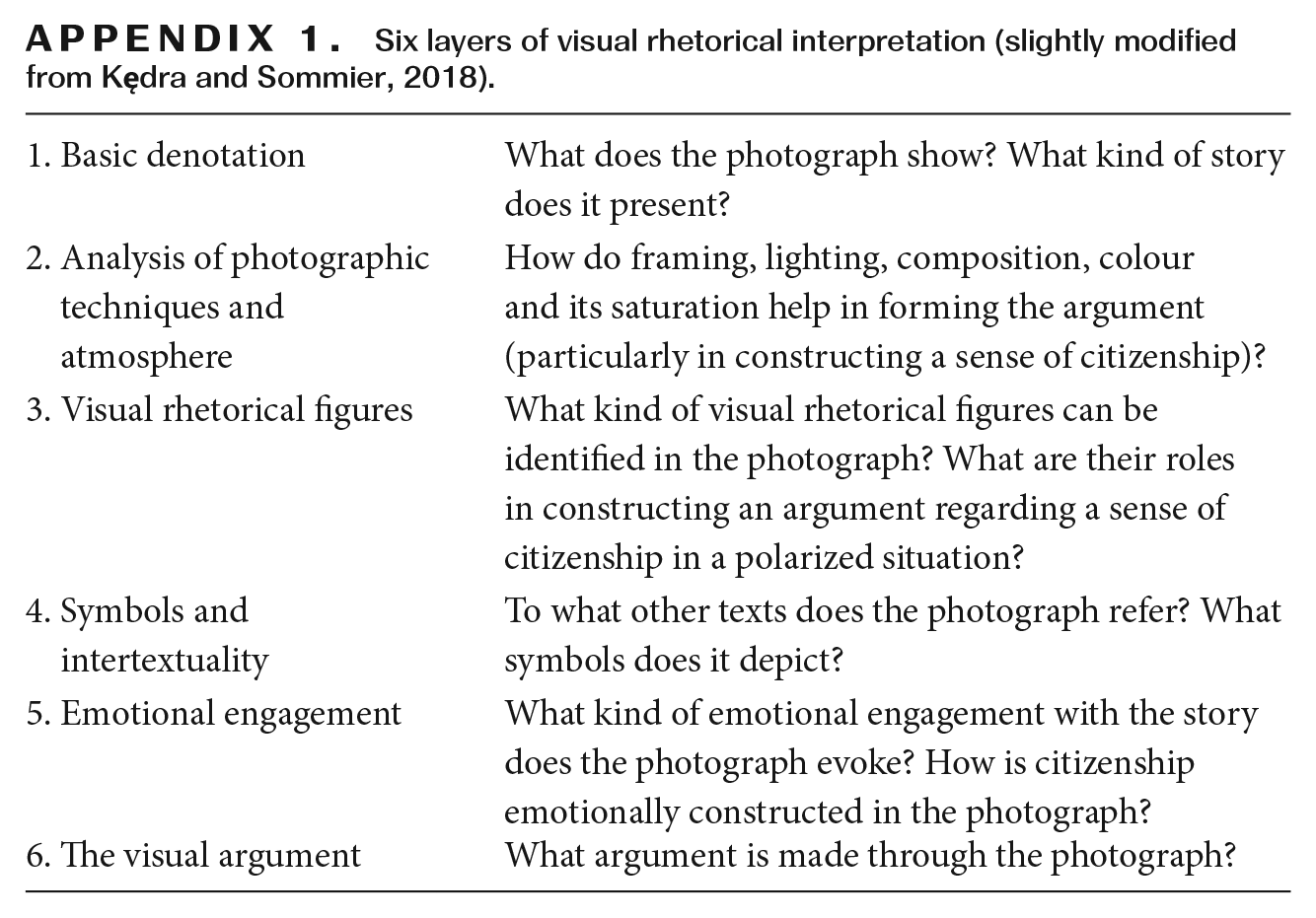
| 1. Basic denotation | What does the photograph show? What kind of story does it present? |
| 2. Analysis of photographic techniques and atmosphere | How do framing, lighting, composition, colour and its saturation help in forming the argument (particularly in constructing a sense of citizenship)? |
| 3. Visual rhetorical figures | What kind of visual rhetorical figures can be identified in the photograph? What are their roles in constructing an argument regarding a sense of citizenship in a polarized situation? |
| 4. Symbols and intertextuality | To what other texts does the photograph refer? What symbols does it depict? |
| 5. Emotional engagement | What kind of emotional engagement with the story does the photograph evoke? How is citizenship emotionally constructed in the photograph? |
| 6. The visual argument | What argument is made through the photograph? |
Declaration of Conflicting Interests
No potential conflict of interest was reported by the author.
Funding
This work was supported by the Finnish Cultural Foundation and the Academy of Finland consortium project ‘Mainstreaming Populism’.

Notes
Biographical Notes
VIRPI SALOJÄRVI is a postdoctoral researcher at the Department of Social Research in the University of Helsinki. She is currently working in the Academy of Finland funded projects called Mainstreaming Populism (2017–2021) and Whirl of Knowledge (2019–2022). Her research interests include populism, media and democracy, power, freedom of expression and diaspora studies. Salojärvi’s doctoral dissertation focused on the role of media in the political conflict of President Chávez’s Venezuela.
Address: Media and Communication Studies, University of Helsinki, PO Box 54, 00014 University of Helsinki, Finland. [email: