




Abstract
In today’s hybrid media landscape, scholars have questioned the “protest paradigm” as the leading interpretation of news coverage of protest action. While the press tends to cover protests in rather antagonistic terms, it is simultaneously highly celebratory of the digital, rehearsing long standing techno-utopian and techno-deterministic discourses. This study zooms in on the Iranian #WomanLifeFreedom movement, investigating how the political power of digital technologies is articulated in Time and Wired magazine. The findings highlight an overarching discourse of technology as a double-edged sword intersecting with discourses of tactical creativity, horizontalism, and digital “witnessing”; as well as two marginal but interlinked discourses: technology as last resort and human right. Findings show that while the protest paradigm persists in the contemporary coverage of the #WomanLifeFreedom movement, legitimizing and delegitimizing frames coexist to produce a more nuanced view of the movement, highlighting activist goals and grievances alongside elements of conflict and spectacle. Considering the transnational dimension of the protests, and the U.S. – Iran political context, the paper concludes that both the geography of protest and the integration of digital technologies in activism shape the coverage of contemporary movements.
Introduction
This paper aims to shed light on the discursive dynamics underlying the media representation of activists and protests. Mass media play an important role in citizen political participation as producers and circulators of imaginaries, vocabularies, and ideas from which the public draws when making sense of the political world (Gamson, 1992). Thus, news media coverage of cases such as the #WomanLifeFreedom movement, remain a significant site for meaning-making, where “digital activism becomes endowed with promises and warnings for the future of democracy” (Balan and Dumitrica, 2022). Press coverage is an important mechanism through which protests are brought to the attention of political actors and the broader public. However, news media tends to cover protests in unfavorable or delegitimizing terms, often focusing on the “spectacular” features, such as the number of protesters (Dumitrica and Bakardjieva, 2018) or celebrity involvement (Harlow and Brown, 2023); and favoring official sources to activist accounts, which serve to reinforce official narratives and antagonize protesters (Smith et al., 2001). Conversely, media enthusiasm for digital technologies has been documented in the coverage of numerous social and political movements, such as the Arab Spring (Russell, 2011) and Black Lives Matter (Mourão and Brown, 2022). Discourses of technological determinism / utopianism persist in press coverage of digital activism, positioning social media as prerequisites for the success of activist movements and highlighting the affordances of the digital for citizen engagement (Balan and Dumitrica, 2022).
Based on an in-depth discourse analysis of 48 articles published in Wired and Time magazine, this paper investigates the research question: how is the political power of digital technologies discursively constructed in the #WomanLifeFreedom movement in Iran? While the integration of “the digital” in protest movements has been of scholarly interest for over two decades, a large corpus of knowledge focuses primarily on western and democratic contexts, while the analysis of non-western or authoritarian spaces is underrepresented.
This paper examines the discursive construction of the #WomanLifeFreedom movement in two leading news magazines, Wired and Time, whose focus on technology and public affairs respectively allows the investigation of both the “digital” and “activist” dimensions in the Iranian #WomanLifeFreedom protests. These outlets share a neoliberal, techno-capitalist orientation and have established themselves as leading news sources worldwide. While the two magazines are U.S. based, they both claim a global readership and transnational scope (as evidenced, among others, by their international editions), thus warranting attention as important producers of public discourse beyond the U.S. media context. This paper follows up on research by Balan and Dumitrica (2022), which investigated the discursive construction of the phenomenon of digital activism in Wired and Time magazine. This paper zooms in on a specific case of digital activism – the #WomanLifeFreedom movement, aiming to unravel the discursive mechanisms shaping citizen imaginaries of digital activism, while also comparing with the broader discourses of digital activism formerly identified in these two news media outlets.
Theoretical framework
The protest paradigm (and its discontents)
The protest paradigm is a persisting lens through which the relationship between political press and activism is examined in scholarly literature. Inspired by Chan and Lee’s (1984) insights that news media tends to cover civil protests in antagonistic or unfavorable manner, the protest paradigm is credited to McLeod and Hertog (1992, 1999) who consolidated the idea that journalists employ “frames, sources, and public opinion to marginalize protests that challenge dominant power structures” (Harlow and Brown, 2023: 335). Four main frames are typically highlighted in relation to the protest paradigm, namely riot (highlighting the violent and disruptive aspects of protests, depicting protesters as potentially dangerous to society by emphasizing acts such as looting or damage to property), confrontation (emphasizing clashes between protesters and police, or protesters and government, or protesters and anti-protesters), spectacle (with a focus on drama, sensationalism, celebrity involvement, size/numbers, and appearance of protests), and debate (which depicts protesters as legitimate, and highlights their goals and grievances; Harlow and Brown, 2023). The first three “delegitimizing” frames are more frequently employed by mainstream media, and tend to draw more on official sources, while the last frame is more seldomly encountered, and gives protesters a voice by favoring them as sources (Harlow and Brown, 2023). However, not all protest groups receive the same kind of media coverage: war protests, characterized by more radical goals and extreme tactics, tend to be treated more critically than social protests (Boyle et al., 2004). Moreover, the location and place of origin of a protest matters (Boyle et al., 2012). For example, research by McCluskey et al. (2009) indicates that in communities with low levels of pluralism, protests against the government tend to garner more negative coverage. Wittebols (1996) also highlights how protests against governments that are adversarial to the U.S. are treated more favorably by U.S. media than those against friendly governments.
The protest paradigm poses a complex challenge to social movements, as media coverage can be a valuable political resource that allows movements to communicate with the public, mobilize actors, garner support, win legitimacy, and broaden the scope of their actions (Brown and Harlow, 2019; Della Porta and Diani, 2006). In order to win the attention of media outlets, protesters may engage in spectacle, conflict, and drama which are well-known to attract journalistic eyes. However, the flip side of this strategy is that usually mainstream media respond critically, “demonis[ing] potesters, characterizing them as menaces to society, marginalizing their voices, and under or inadequately reporting their grievances, demands, and agenda of the movement” (Brown and Harlow, 2019: 510). Thus, the protest paradigm can also be understood as a mechanism of social control (McLeod and Hertog, 1999), where radical voices of protesters come into tension with the journalistic logic that aligns with system propaganda and reinforces the status quo (Kilgo and Harlow, 2019). Moreover, the protest paradigm highlights how the same tactics that garner the attention of the media and the public may simultaneously pose a danger to social movements due to media narratives that undermine, trivialize, or delegitimize protests (Boykoff, 2006).
The predominancy of the protest paradigm in academic literature has encountered more critical scrutiny in recent years, with scholars pointing out several notable limitations. First, the majority of examples supporting the protest paradigm come from the U.S. context and assume that news organizations are ideologically aligned with the government or system (Harlow and Brown, 2023), which is not always the case. For example, in some fragmented and competitive media contexts, certain news coverage may legitimize or express support toward protest movements and causes, insofar they align with the outlets’ ideology and public stance (Lee, 2014; Milne, 2005). Another caveat is that news media coverage of protest movements is not uniform, but rather fluctuates at different points during citizen mobilization. Gottlieb (2015) shows how media attention and dominant frames vary at different stages of the “protest news framing cycle,” gaining increased attention in the “alarmed discovery” stage, followed by an emphasis on conflict as the tensions between activists and officials peak, and decreasing as the protest concludes or becomes latent.
Moreover, the protest paradigm is normative in perceiving violence as a “deviation” from contemporary life and framing it as necessarily delegitimizing, when in fact it can be seen as both a major feature in everyday life (Cammaerts, 2012) and a tool that can be strategically employed in protest tactics (Della Porta and Diani, 2006). Scholars have also pointed to the need of addressing media effects beyond the binaries of legitimization/delegitimization, and looking instead at a broader “spectrum of legitimacy” that allows for a variety of perspectives (Brown, 2021: 160).
Lastly, a wide variety of activist groups coexist today, mobilizing around diverse issues and causes, which makes for a more complex (and less predictable) media coverage of these protest actions (Cottle, 2008). Likewise, changes in the production and consumption of news in today’s hybrid media system (Chadwick, 2017) led to legacy media largely losing their centrality as the only avenue for protest groups to communicate with the wider public. Evidence from the Egyptian Revolution shows that mainstream news sources such as The New York Times aligned more with the protest paradigm than online alternative media outlets (Harlow and Johnson, 2011). Moreover, alternative online news is highlighted as crucial for mobilization and dissemination of protest information, especially in authoritarian contexts, where mainstream media channels are closely aligned with government narrative (Gainous et al., 2015).
Techno-utopianism in news media
The integration of digital technologies in protest movements has implications for both the ways in which it is covered in the media, as well as for the (success of the) movement itself. While the protest paradigm suggests that media coverage of protest tends to delegitimize these civic actions, the press has been traditionally enthusiastic about digital technologies, framing these in overwhelmingly positive terms, as illustrated by the persistence of tropes such as technological determinism, technological sublime, or technological mysticism in media discourse (cf. Balan and Dumitrica, 2022).
Such optimistic framings of the social impact of digital technologies are paralleled in the coverage of numerous activist movements, such as the Arab Spring and Occupy Wall Street (Dumitrica and Bakardjieva, 2018). Media metaphors such as “Twitter Revolution” placed digital technologies at the heart of citizen mobilization, “transforming these technologies into signifiers of citizen power – that is, the power of citizens to take part in the governance of their lives” (Dumitrica and Bakardjieva, 2018: 817). Balan and Dumitrica (2022) identify five persisting narratives through which digital technologies gain political significance, namely: as a last resort; as a witness; as a double-edged sword; as sites of creativity; and as enablers of horizontalism. Overall, these narratives reinforce techno-utopian and techno-deterministic perspectives on activism, with overwhelmingly positive articulations of digital technologies as quintessential, democratizing tools that are necessary for the success of social movements and “positioning digital technologies as the holy grail of citizen empowerment” (Balan and Dumitrica, 2022: 14).
These positive media articulations of the digital technologies contrast with the delegitimizing representations of protest postulated by the protest paradigm. Yet there seems that the integration of digital technologies in citizen activism has a “special” effect on the media coverage of protest. First, the contemporary “hybrid media system” (Chadwick, 2017) where traditional news media intersect with digital news sources and online political spaces is significantly different than the media context of the 80s, when the protest paradigm first emerged while broadcast still reigned supreme. Today, social media has become an important site of news consumption enabling activists, journalists, bloggers and other engaged citizens to voice alternative accounts that are not necessarily in line with traditional media institutions (DeLuca et al., 2012). Moreover, audiences can be critical of media sources and use social media platforms to resist mainstream discourses and put forth alternative articulations, as illustrated by Jiang et al.’s (2022) investigation of the Black Lives Matter movement on TikTok. To date, little is known about specific ways in which the integration of the digital in protest movements shape their coverage in the press, although a few recent studies include findings that point toward the potential challenging of the protest paradigm as traditionally understood (e.g. Jiang et al., 2022; Literat et al., 2023). By zooming in on the coverage of the #WomanLifeFreedom movement in Wired and Time, this paper aims to shed light on these dynamics by considering the protest paradigm not only as a discursive device framing protest events, but rather as a larger dynamic that leads to these devices – including the news outlets’ ideological orientation, journalistic concerns, type and location of protest, and reliance on official sources. This case also allows the investigation of how news coverage elsewhere (U.S.) shapes discourse production with regards to the movement (Iran) and how these discourses circulate beyond the contextual borders of the #WomanLifeFreedom movement (worldwide).
Methodology
Building on prior research by Balan and Dumitrica (2022), this study zooms in on the discursive construction of digital activism in the #WomanLifeFreedom movement. Based on a corpus of 48 news articles published in Wired and Time magazine between September 2022 (which marked the start of the #WomanLifeFreedom protests) and March 2023 (when large-scale protests – as well as media attention to them – decrease in intensity, following the death sentencing and execution of several protesters), this paper investigates the research question: how is the political power of digital technologies discursively constructed in the #WomanLifeFreedom movement in Iran? While the integration of “the digital” in protest movements has been of scholarly interest for over two decades, a large corpus of knowledge focuses primarily on western and democratic contexts, leaving the analysis of non-western spaces still underrepresented. Notable exceptions are the studies investigating the Arab Spring of the early 2010s, which provided valuable insights into the role and impact of social media (e.g. Howard et al., 2011), however the discursive dimension of the interplay between digital technologies and protest movements is seldomly addressed.
The focus on Wired and Time is relevant for several reasons. Positioned at the intersection of democracy, neoliberalism, and capitalism, Time maintains a focus on current events and is widely regarded as a “flagship” of U.S. magazines (Grainge, 2002: 206). Since the early days of digitization, Wired’s importance has been noted as a pivotal space for the construction of “the dominant technological imaginary of Silicon Valley” (Ferrari, 2020), becoming virtually synonymous with the “culture of contemporary technocapitalism” (Fisher, 2008: 181). Thus, both outlets are seen here as central producers of techno-utopian, techno-capitalist, and neoliberal discourses that position technology at the core of democratic processes. Moreover, both are world-renowned magazines, claiming a wide readership in the U.S and beyond (as illustrated by their international editions, e.g., timeasiasubs.com; wired.it). The distinct focus on technology in Wired and current affairs in Time allows for synchronal investigation of both “digital” and ‘activist” dimensions respectively in the #WomanLifeFreedom movement.
The sample was collected by performing a keyword search for the terms “Iran + protest” and “Iran + activism” on wired.com and time.com, collecting all the articles that referred to the #WomanLifeFreedom protests. To gain an in-depth understanding of the sample, a three-step approach to discourse analysis was developed, starting with an inductive, close reading of the media stories at sentence level and data-driven coding looking at specific descriptors, topics, metaphors, actors, actions, tactics, values, and symbols, which yielded a total of 164 codes. A second reading at paragraph level zooms out to identify the wider media discourse and the context in which it emerges, followed by a refinement of codes into 19 broader categories. Third, scanning the overall text in the context of the broader sample provided an understanding of how the media narratives intersect with one another. Data analysis was performed with the assistance of Atlas.ti software. The analysis identified four persisting and intersecting discourses, as well as two marginal ones, detailed in the next section (Figure 1).
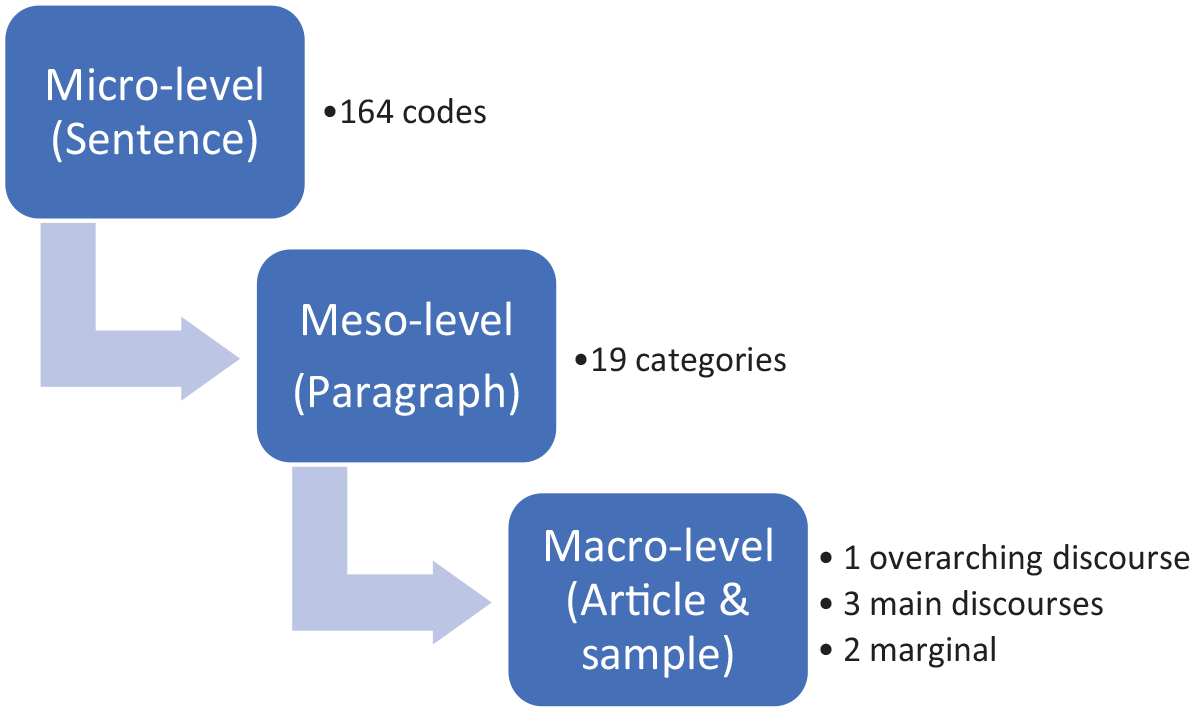
Three step discourse analysis approach.
Results
The (overarching) double-edged sword of technology
The findings highlight that press coverage of the #WomanLifeFreedom movement in Iran centers around one major discourse (29%), namely technology as a double-edged sword, whereby the opportunities afforded by digital technologies to activism are balanced with the risks they pose to both individual activists and broader social movements (Balan and Dumitrica, 2022). Within this discourse, we can see how the digital affords the same means of action to both activists and their opponents. In the #WomanLifeFreedom movement, social media platforms are strategically used by both activists and the Iranian state.
On the one hand, social media provides activists with an avenue to document and make visible the protest events, especially instances of police brutality or abuses of force that are not broadcast in mainstream media and often denied by the authorities. Considering Iran’s highly regulated context of media production where content is subject to scrutinous censorship (Rahimi, 2016), social media plays a crucial role in speaking truth to power and rendering otherwise obscured events visible to a global community. Moreover, digital platforms are used to raise awareness and inspire others to join the protests, to share original activist content, and to show solidarity and support for the movement. As Poell and Van Dijck (2015: 529–530) explain, this “acceleration of activist communication” may empower activists by speeding up the exchange of information and allowing real-time interaction, however this event-oriented social media logic also poses a challenge by shifting attention away from the activist issue and toward the spectacle of protest. Least often, social media are also used for identifying victims killed in the protests (as often there are no official records are kept), as well as to ask for donations, petition signatures, and contact elected officials (Figure 2).
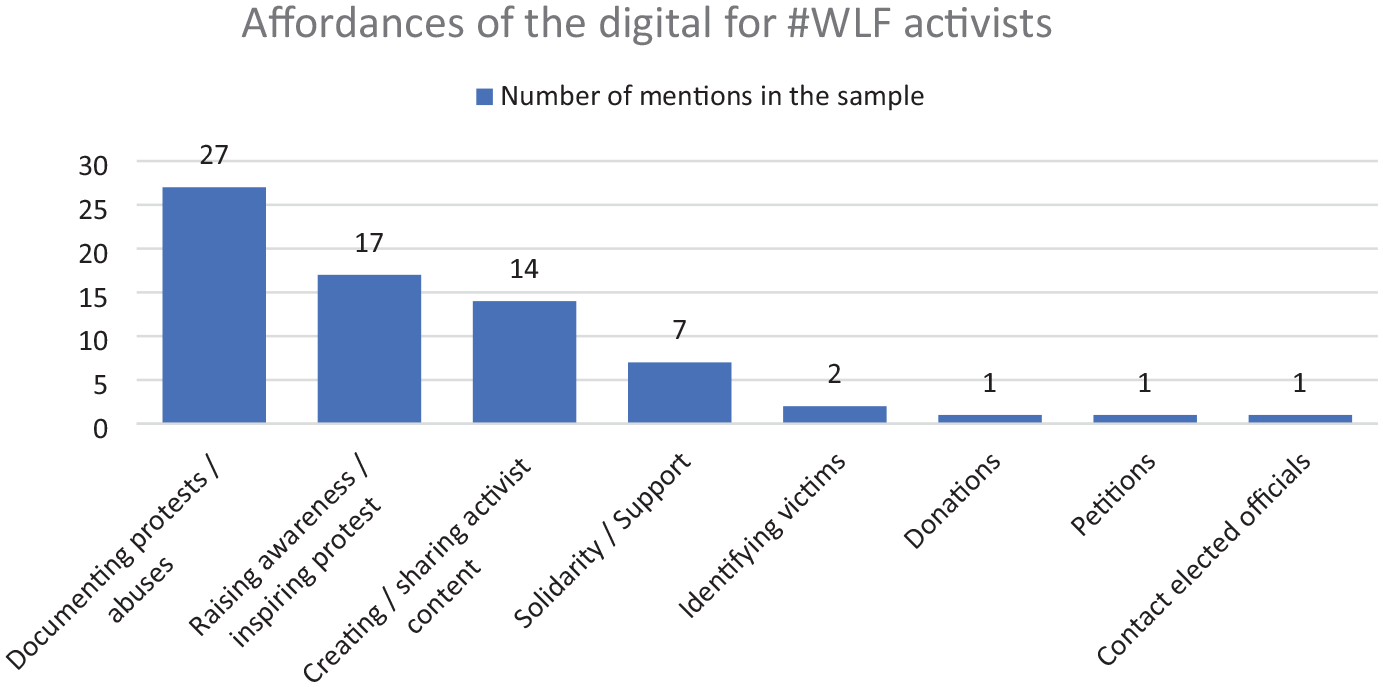
Affordances of digital technologies for the #WomanLifeFreedom activists.
On the other hand, the same activist content shared on social media enables the Iranian government to identify/target activists and facilitates both government and corporate surveillance. Moreover, digital platforms can be strategically employed for propaganda, and purposeful mis- and disinformation. By using fake accounts, bots, or flooding activist accounts with junk followers the Iranian authorities are able to deploy such digital affordances against activists, to delegitimize their actions and hinder collective action. Less often, they may report or take down activist posts. Where these tactics fail, the authorities also resort to social media restrictions (e.g. suspending accounts, cutting access to platforms), internet censorship, and even internet blackouts to control the protests. The increased use of algorithms as propaganda and algorithms as repression point to the need for more digital literacy in the activist environment, to be able to identify and avoid authoritarian strategies as well as develop alternative ways of “bending the algorithm” in the pursuit of social justice (Treré, 2018: 373; Figure 3).
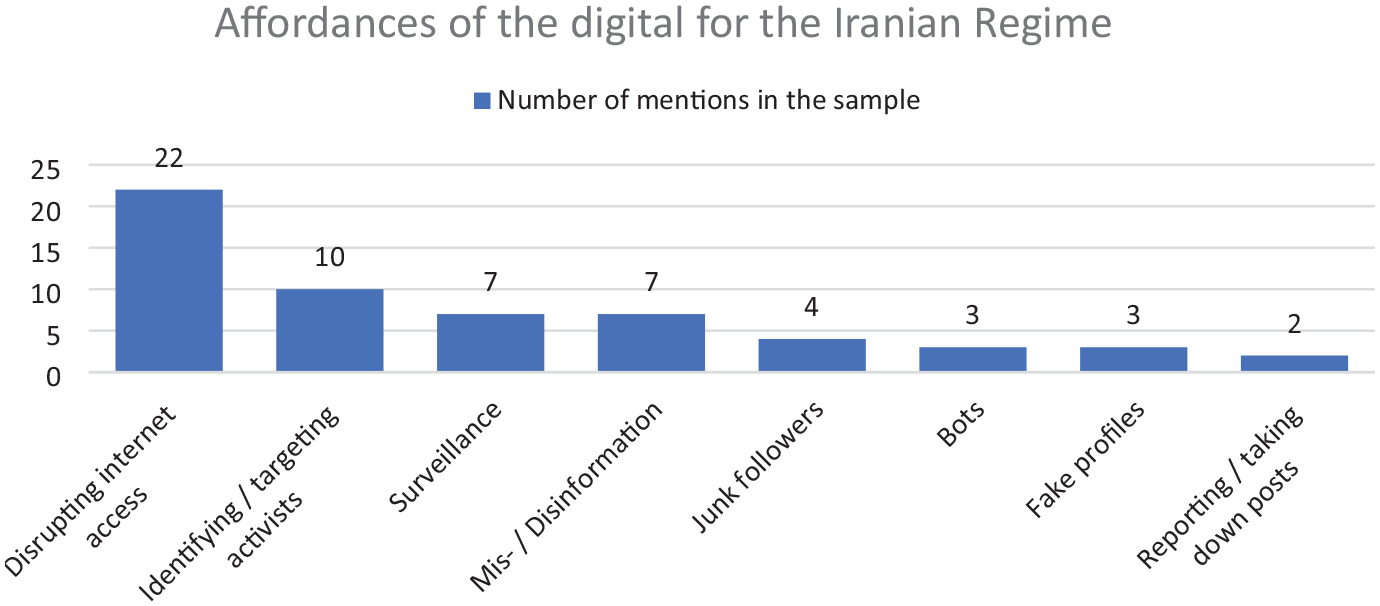
Affordances of digital technologies for the Iranian Regime.
In line with Balan and Dumitrica (2022), the overall discourse of technology as a double-edged sword presents a negative framing where the risks outweigh the benefits. In parallel, access to the internet is constructed as vital for the survival of the movement, and thus internet blackouts and disruptions are effective digital weapons deployed against activists: “[. . .] they are targeting these platforms that are the lifeline for information and communication that’s keeping the protests alive,” (Burgess, 2022). This articulation shows how the “confrontation” frame translates to the digital space, where tensions between protesters and authorities are expressed through the use of digital technologies and played out online. Yet the implications of this digital conflict can be just as dangerous (and sometimes just as lethal) as face-to-face interactions with the police. In sum, the double-edged sword of technology discourse is at the core of the sample, both as a “persisting narrative” in itself (illustrated above), and as an overarching discourse that intersects with two other relevant narratives highlighted by our sample, to which we will turn next.
Tactical creativity in the #WomanLifeFreedom movement
The second persisting discourse in the sample (28%) highlights the tactical creativity involved in digital activism practices, and the novel ways in which individuals draw on existing cultural resources, combining and remixing them, and generating “affective impact through the innovative process of this recombination” (Balan and Dumitrica, 2022; Burgess, 2006: 206). In the #WomanLifeFreedom protests, the main purpose of activist tactical creativity is linked to circumventing internet restrictions, for example by using VPNs, setting up Starlink satellites that have been smuggled into Iran in the hopes of preserving internet access through in case of blackouts (Vick, 2022a), or establishing connections to Tor network, a task that is “difficult [and] extremely dangerous if the regime detects the activity” (Hay Newman, 2022). This also illustrates how the discourse of creativity intersects with the double-edged sword of technology: when activists are faced with challenges in the digital world (e.g. internet blackouts), digital technologies afford several clever and creative avenues for circumventing restrictions – yet these are difficult and risky strategies that might come at a very high cost.
A second aspect of tactical creativity relates to the creation of new apps, features, or software that aid in activist tactics, such as anti-surveillance technological resources that help activists avoid identification and tracking, and applications that map unsafe or dangerous areas – tailoring creativity to the specific needs of the movement. Other apps, such as Signal and WhatsApp have increased functionalities to allow Iranians to access these services while using proxies. Similarly, Iranian authorities have focused on developing or acquiring innovative face-recognition software, collecting biometric data from citizens, and implementing AI-driven surveillance technologies. Overall, the development of new technological resources seems to be part of “a game of cat and mouse” (Green, 2022), an apt metaphor that occurs twice in the sample and sheds light on the creative tensions between activists and their opponents.
Third, tactical creativity is expressed in the creation of activist content, which includes videos of protest events, informative content about the movement, edited promo videos, and others. Social media play a crucial role circulating activist content and amplifying it beyond national borders. However, the Iranian authorities are also effective content creators, taking advantage of digital affordances. For example, a recent strategy involved the development of state-backed videogames that reinforce traditional religious values and mythologize Iranian leaders, while presenting the #WomanLifeFreedom protesters as dangerous extremists (Ghorbanpour, 2023). As Dal and Nisbet (2022) argue, the former dreams of technologies of “liberation” seem to have become a “reinforcing spiral of control, innovation, resistance, and counter-innovation between authoritarian governments and those that seek to bypass censorship and digital repression.”
Lastly, there seems to be a gendered dimension discursively linked to the tactical creativity of activism. With women at the center of the #WomanLifeFreedom movement, it is not surprising that feminist resources and strategies would take front stage. However, the sample tends to focus on – and collate – “innovative and nonviolent” methods of protest (such as removing scarves or cutting off hair) which are difficult to fight “with brute force” (Serhan, 2022). This illustrates how news coverage of the #WomanLifeFreedom movement discursively links the protests to femininity, emphasizing nonviolence, inclusion, social relations – while framing the Iranian Regime in terms of “masculine” associations with power and dominance, such as “brute force,” “stronghold,” or “crackdown” (Serhan, 2022). All in all, this discourse is rather celebratory of the potential of digital technologies for activism. Even if the process involves risks or challenges for activists, the negative framings implied by the protest paradigm seem to be countered by more positive articulations of the intersection between technology and creativity as enabling novel ways for citizens to engage with democratic politics.
The facilitators of horizontalism
A third discourse (16.5%) is linked to the horizontal structure of activist movements, where digital media are celebrated as an alternative to top-down structures, enabling a decentralized network that facilitates grassroots political engagement (Balan and Dumitrica, 2022). In our sample, this is most visibly illustrated by the vocabularies used to describe protest participants: the most common descriptors are related to youth (“young Iranians,” “children”), femininity (“Iranian women,” “schoolgirls”), and horizontalism (“countless Iranians”; “folk on the ground”; “all the people”; “everyone”). The horizontal structure enabled by social media allows for transnational political engagement, making space for activists and supporters from all around the world to engage with and bring a contribution to the movement. This may appear to create an inclusive arena, where multiple diverse individual voices can be both expressed and amplified in the political sphere (Dumitrica, 2020). However, the advantages of this horizontal structure are balanced with a practical challenge posed by the lack of mediators (i.e. civil society). This aspect complicates the process of negotiation with those in power, even when the authorities seem to (likely insincerely) extend a pathway for dialog. Aside from mistrusting such promises of dialog based on past experiences, the activists often have no practical recourse to engage in such dialog chiefly due to the loose organizational structure of the movement (Vick, 2022b). In line with the protest paradigm, this discourse is closely aligned with the “spectacle” frame, mostly focusing on the numbers and size of protests, afforded by digital means. At the same time, it highlights the challenges posed to horizontal and decentralized movements in terms of negotiation or conflict resolution.
Digitally witnessing the #WomanLifeFreedom movement
The last major discourse (15.5%) identified in the analysis relates to digital technologies as a witness to the lives of the distant Other, acting as a “window” (Balan and Dumitrica, 2022) through which the global community can see the realities happening on the ground in Iran from the perspective of the citizens (rather than curated mainstream media content). Gregory (2015) found that the ability to access events happening elsewhere through citizen documentation (in particular, livestreaming) can create “distant witnesses” by stimulating empathy and leading to a feeling of community, which may in turn increase awareness and inspire action. Likewise, digital technologies can act as an (amplifier of) activist “voice” (Balan and Dumitrica, 2022), as this article urges readers: “we must amplify the voices of this revolution, use our platforms to shine a light on the government’s atrocities. We will not let the world turn a blind eye to what is happening in Iran.” (Aslan, 2022).
This quote illustrates the digital’s potential to both render activists visible (“shine a light,” “not turn a blind eye”) and heard (“amplify voices”). In doing so, activist grievances become part of the global discourse, transcending the highly regulated national context, and becoming difficult to ignore or cover up. Activist grievances receive significant coverage in the sample analyzed, with 38% of the texts addressing what activists are aiming to accomplish within the #WomanLifeFreedom movement. Unsurprisingly, women’s rights are at the heart of activist demands, immediately followed by grievances about the authoritarian political regime and the lack of personal and political freedom (see Figure 4).
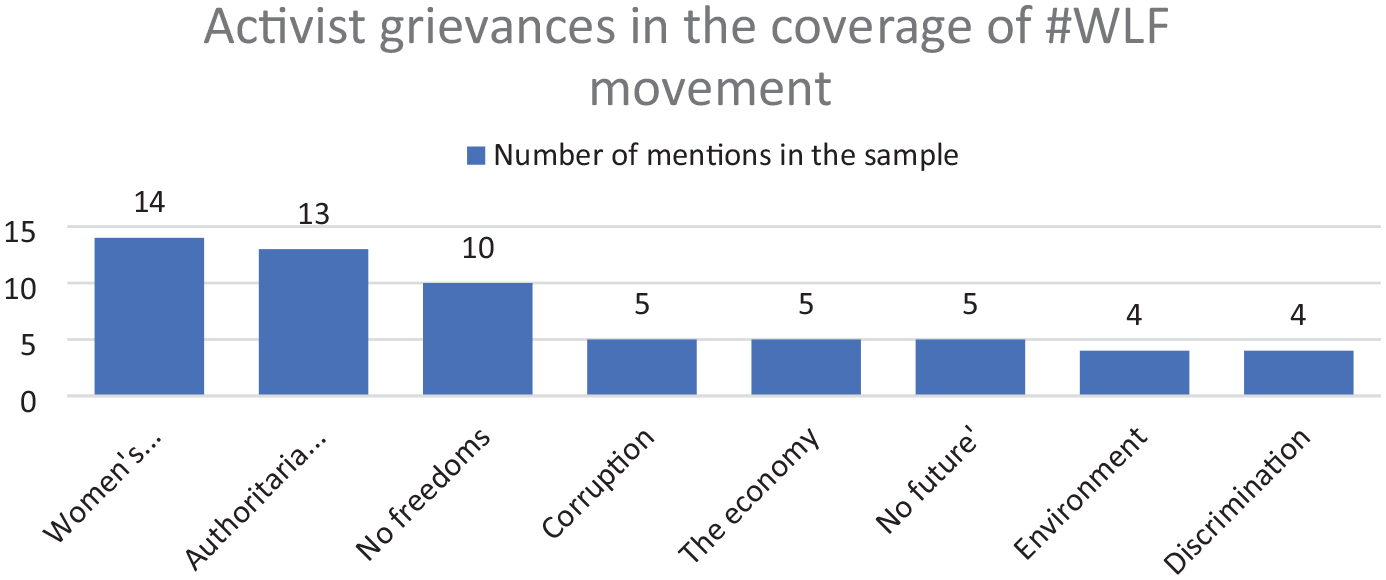
Activist grievances in the coverage of #WomanLifeFreedom movement.
In addition, celebrities are highlighted in 17% of the sampled articles, and seem to play an important role in “witnessing” the protest events, sharing content, raising awareness, and expressing solidarity and support. Thrall and Stecula (2017) point out that celebrity involvement may reach and activate a wider public than politicians, and that stars may also act as intermediaries between the public and distant tragedies due to their emotional and personal approach to human rights issues. However, the authenticity of their involvement may be called into question, as well as the extent of its impact (Thrall and Stecula, 2017). The presence of celebrities illustrates the co-presence of legitimizing and delegitimizing frames in the coverage of the #WomanLifeFreedom movement in the two news media outlets analyzed, where activist grievances intersect with more “spectacular” elements, such as the huge size and scope of the protests and the celebrities associated with the movement.
Marginal discourses: Technology as a last resort and technology as a right
Both magazines also rehearse a discourse of technology as a last resort (7%), as well as one of technology as a fundamental human right (3%) – however such discursive articulations remain rather marginal across our samples.
The first one refers to digital technologies providing a last and only avenue for citizen engagement when all other options have failed (Balan and Dumitrica, 2022). Echoing the discourse of technological mysticism, technology is framed in almost spiritual terms, as a “savior” of the people from the unjust realities of everyday life. This is most visible in Wired’s prominent metaphor of the “digital lifeline,” whereby digital technologies are seen as crucial, enabling individuals “to communicate and access life-saving information during critical events and crises” (Burgess, 2023). This discourse highlights the value of the digital for dealing with urgent, immediate issues, as technology affords people with the ability to instantly communicate local concerns to a global audience, and garner immediate reactions to matters that might otherwise be obscured. Notably, this metaphor is present in 60% of the Wired sample, but it is entirely absent from the Time sample. This parallels the original observations of Balan and Dumitrica (2022), placing technologies of last resort at the discursive center of Wired’s coverage of digital activism, a magazine that is most notable for its focus on technology and the digital, yet having a weak presence in Time, where the coverage is chiefly focused on current affairs.
A second marginal discourse views technology as a fundamental human right. This articulation of the internet as more than just a communication technology, where “to be excluded from this information technology is, effectively, to be excluded from information, full stop” (Best, 2004) is a long-standing and ongoing scholarly discussion. While the right to the internet does come with challenges (Tully, 2014), it has been recently acknowledged at (inter)governmental level, as evidenced by the adoption of the resolution on “The Promotion, Protection and Enjoyment of Human Rights on the Internet” by the United Nations in 2016. One article positions cutting off access to internet as a “vital” tactic of opponents when compared to disrupting access to other basic human necessities: “[. . .] we typically don’t see governments shutting down electricity or water or gas. They target the internet because they see shutting down the flow of information as a vital thing to do” (Hay Newman, 2023). These two marginal discourses are often linked to highlight that the digital becomes the only remaining recourse for Iranians when internal negotiation with authorities is off the table, suggesting that denying access to the digital under such circumstances is seen as a breach of human rights – which in the #WomanLifeFreedom context refers not only to the rights of women, or rights to personal freedoms, but also to the right to information – equated here with access to internet (Figure 5).
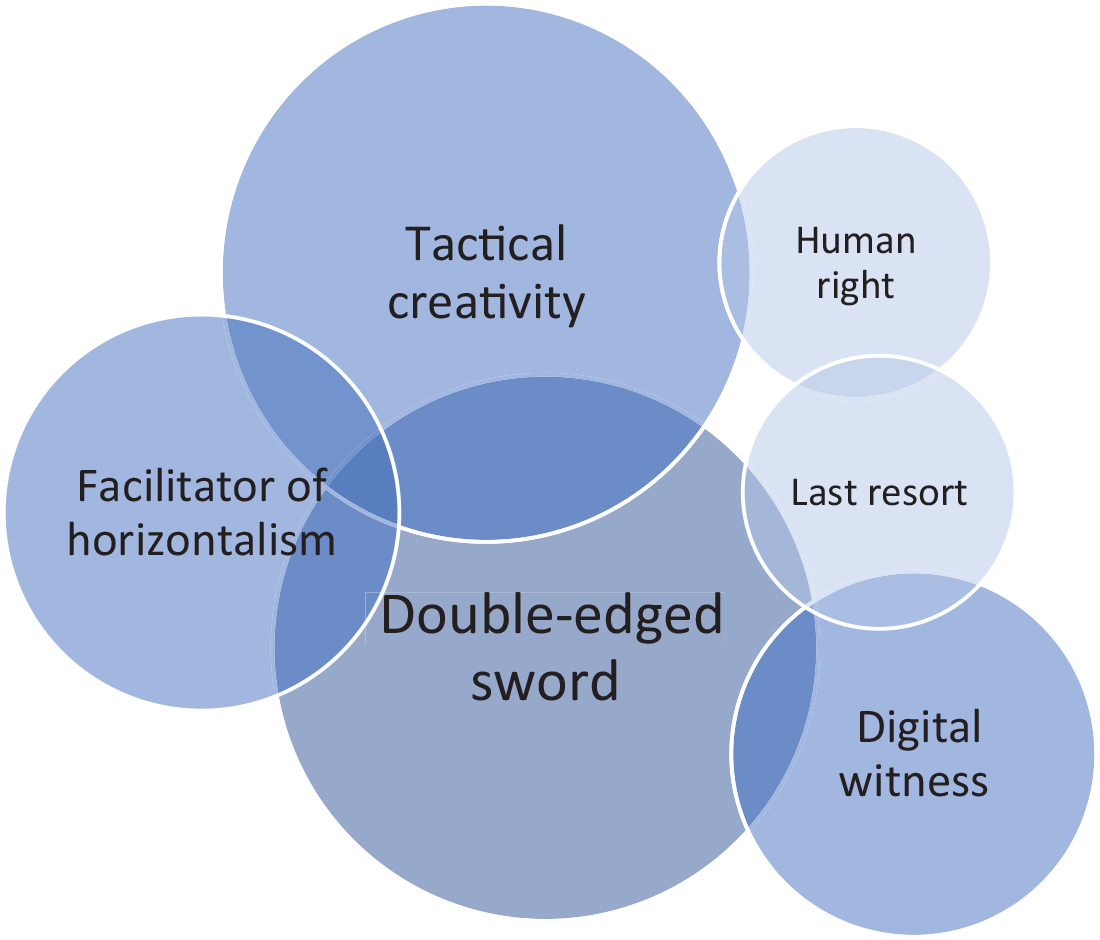
Visual summary of the discursive construction of digital technologies in the coverage of the #WomanLifeFreedom protests in Time and Wired magazine.
Discussion
The findings show that most central to the coverage of the #WomanLifeFreedom protests is an overarching discourse of technology as a double-edged sword, where the advantages of the digital are balanced with its potential risks and dangers. This articulation is tightly interlinked with a discourse of tactical creativity, where digital technologies afford activists with creative means to circumvent internet restrictions and avoid surveillance, create new software to aid in activism, and generate creative content. However, the same digital means are available to the Iranian authorities, a duality leading to a never-ending “game of cat and mouse.” These two discourses also intersect with the articulation of technology as a facilitator of horizontalism, where the keyboards (or touchscreens) at our fingertips enable every person to become an activist. While the democratization of access to civic participation via digital tools is an undeniable affordance, it also presents a challenge for dialog and negotiation in conditions where there are no official leaders and no representation from civil society. In line with the protest paradigm, the above-mentioned discourses align the closest with a “conflict” frame, where the clashes between protesters and authorities are translated to the online space. The risks posed by such digital confrontations to activists range from mild (e.g. reporting an activist post calling for mobilization on social media) to lethal (e.g. using face-recognition software to identify activists with the goal of execution). Moreover, these risks can be ideological (e.g. misinformation) or pragmatic in nature (e.g. arrests). Importantly, the conflict between protesters and Iranian authorities does not equate with a negative media framing. On the contrary, considering the geopolitical relations between the “democratic” U.S. and “authoritarian” Iran, the conflict frame is in fact celebratory of the power of Iranian citizens as active agents, holding abusive governments accountable.
Another significant discourse identified is that of technology as a digital witness to the lives of the “distant Other,” making local grievances visible and audible on a global scale. Most interestingly, a “debate” frame becomes highly relevant in this articulation, outlining both the core aims of the movement (with an emphasis on women’s rights and anti-authoritarianism) and more local, context-specific issues that are included under the broader #WomanLifeFreedom umbrella, such as economic or environmental concerns. This discourse also puts forward celebrities – actors, athletes, musicians, politicians – as important witnesses (and allies, amplifiers) of the movement, confirming the persistence of the “spectacle” frame noted in the protest paradigm. The spectacle of civic action is also highlighted in the context of horizontalism, with its emphasis on the size and numbers of protesters (e.g. “countless Iranians”). In addition, two marginal but intersecting discourses are identified – one of technology as a last resort in circumstances where traditional civic action means proved ineffective, and a discourse of technology as a human right, where access to the digital is constructed to be as important as access to water (and other survival necessities).
Overall, the analysis suggests that the protest paradigm persists in the media coverage of the #WomanLifeFreedom movement, with a primary emphasis on the “conflict” frame and the digital tensions between activists and authorities, which may also spill over in the offline domain and carry serious implications for the movement and individual activists. Moreover, the “spectacle” frame is significant, illustrated by both an emphasis on size and scope, and a spotlight on celebrity involvement. However, the conversation becomes more nuanced when we consider the absence of the “riot” frame: notably, none of the articles sampled included demonizing or highly negative representations of activists. When there are discussions of more “violent” actions undertaken by activists, these are usually presented in a positive manner, emphasizing perseverance and empowerment, as seen in the symbolic action of cutting off hair, or collective strength (“they stood against the police [. . .] shout[ing]”). The sample also reveals the presence of a strong “debate” frame, representing the movement as having legitimate goals and grievances clustered around the central issue of women’s rights, but expanding into more specific economic, political, and social issues. Thus, while the delegitimizing frames suggested by the protest paradigm persists in the coverage of the #WomanLifeFreedom movement, they co-exist with several legitimizing mechanisms that give credence to the Iranian protesters and showcase their civic actions in a positive light.
One possible interpretation of this intersection of both legitimizing and delegitimizing frames could come from examining the Iran – U.S. relations. As Semati et al. (2021) puts it, “[American] discourses about Iran are grounded in certain persistent and predictable, even if contradictory, views and perceptions” – ones that simultaneously emphasize religious fundamentalism, the adherence to strict and repressive “Islamic” rules, and backward or conservative views, while also acknowledging Iran’s notable developments in terms of technology, science, arts, and culture (Semati et al., 2021). Considering the recent tensions between the U.S. government and the Iranian authorities, as evidenced by the re-imposition of sanctions on Iran during the Trump administration (Marcus, 2018), the assassination of the Iranian general Qasem Soleimani in an airstrike carried out by the U.S. (Marcus, 2020), as well as the uncertainties surrounding the Iran Nuclear Deal (Motamedi, 2023), it is unsurprising that the press in the U.S. leans into the narratives of the Iranian pro-democracy activists, rather of those of the authoritarian government. The analysis suggests that this adversity between the two governments, as well as the social nature of the protests factor into the coverage of the #WomanLifeFreedom movement in a more positive light.
Another interpretation could have to do with the integration of digital technologies in activist practices. When the protest paradigm emerged in the mid-80s, legacy media and journalistic institutions had significantly more control over the information available to citizens, often being the only source of information particularly when it came to representations of far-away contexts. Digital technologies (and social media in particular) have democratized access to information and made it accessible for citizens, journalists, activists, celebrities, and other stakeholders to upload content that represents their realities and perspectives, stepping out of the constrains of journalistic norms. While not unproblematic (e.g. online misinformation), this increased access to public discourse arenas has weakened the grip of traditional media institutions on the content audiences engage with, allowing for a variety of voices – some aligned with the status quo, others opposing it – to coexist, expanding discursive possibilities from the bottom up, which then arguably feed back into traditional media narratives and thus into public discourse. With these considerations in mind, the “spectrum of legitimacy” suggested by Brown (2021) appears to be a more fitting interpretation of how press coverage of protest operates.
Conclusion
This paper set out to investigate how the political power of digital technologies is discursively constructed in the coverage of the #WomanLifeFreedom movement in Wired and Time magazine. The study finds that at the discursive center of the movement, technology is framed as a double-edged sword, providing both opportunities and challenges for the Iranian digital activism context. The creativity brought on by technological affordances, the democratization of access to politics through technology, and the technological potential to bring local (and far-away) issues into the public view of a global community are also highlighted. The present study supports the findings of Balan and Dumitrica (2022), adding a marginal discourse of technology as a human right. The conceptualization of digital rights as human rights is relatively new and still a matter of unsettled debate, as competing perspectives and framings can be used by various actors to fit their different goals (Karppinen, 2017). Further research could shed more light on these various articulations to better understand the implications they carry in practice and their potential to be translated into policy.
The study found evidence for the persistence of the protest paradigm, especially in terms of the conflict and spectacle of protest. Yet these rather negative framings are balanced with more nuanced, legitimizing frames that highlight the grievances of protesters and celebrate their creativity and horizontalism. Echoing Wittebols (1996) and considering the ideological tensions between the U.S. and Iranian governments, it is not surprising that the media discourse championing democratic values and western ideals of social justice are more favorably aligned with the protesters, on both the anti-authoritarian and the women’s rights issues. Chan-Malik (2011) notes how similar framings were present in the U.S coverage of both 1979 and 2009 revolutions in Iran, but underlining that those framings have been “deeply shaped by American discourses of gender, class, and sexuality,” bringing forth the risk of misinterpretation and appropriation. Thus, the coverage of protests, especially “far away” ones, need to be addressed trough a critical lens that accounts for how media intersects with other dimensions of political power, and how persisting discourses shape interpretations of social justice on a global level. Moreover, further research could delve further into the historical and geopolitical context in which the #WomanLifeFreedom protests unfold, to provide a clearer understanding of the systemic issues at play and context-specific barriers that stand in the way of change. Lastly, while this paper notes the gendered dimension in the coverage of the #WomanLifeFreedom protests, a deeper understanding of the intersection of feminism/femininities, digital technologies, and protest in media coverage would be a fruitful avenue for further investigation.
