




Abstract
Conceptual Metaphor Theory (CMT) claims that human beings can only understand abstract, complex phenomena by metaphorizing them in terms of concrete, more basic phenomena – and do so systematically. Unsurprisingly, therefore, expressing a state of ‘depression’ often draws on metaphors. Such metaphors, however, are not necessarily verbal in nature. In this article, the authors analyse the metaphors used to communicate
Keywords
1. Introduction
Conceptual Metaphor Theory (CMT) starts with the assumption that ‘the essence of metaphor is understanding and experiencing one kind of thing in terms of another’ (Lakoff and Johnson, 1980: 5). Thus, metaphor need not be verbal in nature: ‘metaphor is primarily a matter of thought and action, and only derivatively a matter of language’ (p. 153). Another key claim in CMT is that human beings systematically conceptualize and understand abstract, complex phenomena in terms of more basic, concrete phenomena (see Johnson, 1987). ‘Concrete’ here means perceptible via sense organs and/or experience-able via bodily interactions with the environment. The ‘thing’ to be understood (the ‘target’) is thus made comprehensible by being compared to a ‘thing’ that is seen, heard, touched, smelled, tasted and/or experienced by physical actions (the ‘source’). The ubiquity of such expressions led Lakoff and Johnson (1999: 248) to postulate a ‘super’-metaphor:
Taking seriously CMT’s claim that human beings systematically conceptualize abstract, complex targets in terms of concrete, physical sources means that metaphorical patterns should also pervade visual and multimodal discourse (for overviews, see Forceville, 2016a, 2016b). One medium that invites research into structural non-verbal metaphor is animation film (e.g. Forceville, 2013, 2017; Forceville and Jeulink, 2011).
Investigating conceptual metaphors in non-verbal media is essential for the tenability of CMT’s claim that we fundamentally think in and live by metaphors rather than just use them verbally. Only by analysing non-verbal expressions of conceptual metaphors can we be sure that metaphorizing is primarily a conceptual, not a verbal process. But examining conceptual metaphors in non-verbal discourses is important for another reason: meaning is profoundly affected by the medium in which it is conveyed, since ‘the medium is the message’ (McLuhan, 1964: 24, et passim). For our purposes, this entails that the conscious or subconscious creation, and the ensuing interpretation, of a conceptual metaphor in animation film will be the result of medium-specific affordances and constraints that are (possibly systematically) different from those in modalities such as written or spoken language, or static visuals. These differences come to the fore even more strongly if the animation films are wordless, since any conceptual metaphors in them must then be triggered by the visual mode – often supported by sound and music. Moreover, since animation does not need to respect physical laws, it has opportunities to (audio)visualize metaphors that are not so readily available to other media (see Honess Roe, 2013: 25, et passim).
In this article, we therefore examine nine short animated films from a CMT perspective to chart the way depression is presented in these films. Depression is a complex affliction, defined here as ‘an illness characterized by persistent sadness and a loss of interest in activities that you normally enjoy, accompanied by an inability to carry out daily activities for at least two weeks’ (World Health Organization, 2016–2017). Depression affects more than 300 million people worldwide (World Health Organization, 2017). Nevertheless, as multiple Mental Health Awareness initiatives attest (for instance, those launched by the American National Alliance on Mental Illness [NAMI] – see https://en.wikipedia.org/wiki/National_Alliance_on_Mental_Illness), it remains a misunderstood and underestimated condition that is still a taboo in Western culture. Understanding how audio-visual media express depression metaphorically is thus useful as it will facilitate communicating about this topic. Indeed, within the field of psychotherapy, metaphors have been recognized as a tool in the communication between patient and therapist (see, for example, the ‘metaphor therapy’ developed by Kopp, 1995). This article provides insight into the types of metaphors patients may employ to explain their experience of depression.
Prior work has revealed a limited number of recurring conceptual metaphors in verbal discourse about depression. Tercedor Sánchez and Láinez Ramos-Bossini (forthcoming), using a corpus of more than 289 million words, find the most frequently occurring metaphors to be (1)
Fahlenbrach (2017) started the project of investigating conceptual metaphors of depression in films. In 10 short animation films she identifies two recurring metaphors:
2. Corpus, Questions and Approach
In order to find suitable animations for our analyses, we used ‘animation’ and ‘depression’ as search terms on YouTube. Our criteria for including a film from the large number of suggestions were the following:
(1) The film could be understood as being about ‘depression’ – which transpired from its title, comments by the person uploading the film (often the maker), and/or observations in comments sections;
(2) The film had to be (virtually) wordless, so that any metaphor construed was not dependent on language;
(3) The film was short (at most: 10’), enabling the analysis of complete films in some detail.
In the nine resulting case studies, we formulate the metaphors in the standard CMT form A IS B, as in the depression metaphor studies cited above. It should not be forgotten, however, that this is only a convenient ‘shorthand’ for signalling a conceptual metaphor, which necessarily fails to capture many pertinent nuances occurring in unique contexts. In light of this, some preliminary points must be made. First, the
In the next section, we analyse each film, indicating the metaphor(s) identified in them and the features of the source domains that can be mapped onto the target domain. In section 5, we reflect on the patterns in this corpus with regard to the source domains and the use of animation.
3. Case Studies
The Wound (TW)
The Wound tells the life-story of a lonely woman and alternates between the old woman’s present and past selves. As a child, she was bullied and at one point, feeling frustrated, she drew a black monster, which came alive and stayed with her throughout her life.
The relation between the monster and the woman is characterized by a tension between care and oppression. As a child, she initially hugs the monster (Figure 1a) and smuggles it to school in her schoolbag. As she grows up, the monster is always there to console her when she comes home in desolation. In the present, the now big monster is very demanding: it prods her, bangs its fist on the table, eats the sandwich from her plate and drags her into her apartment.
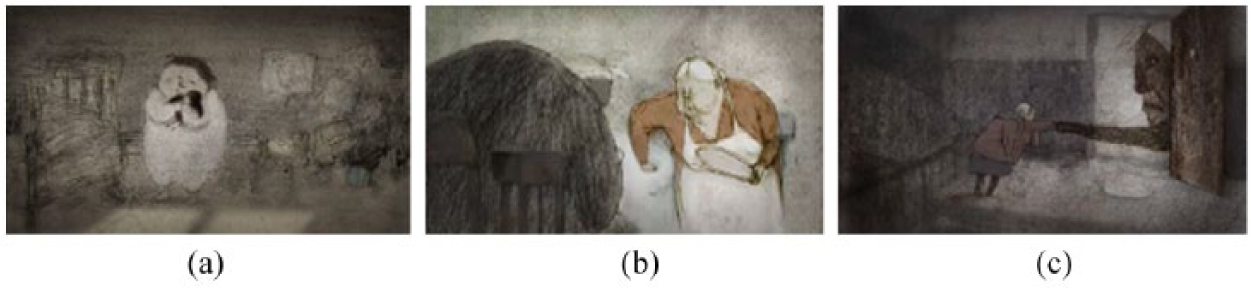
from The Wound. © Anna Budanova, 2013. Available at: https://vimeo.com/63658207 (accessed 7 July 2018).
As the monster was born when she felt lonely, seems most present at her most desperate moments and persistently forms an obstacle to her desires and needs, we identify it as a source domain for depression:
Fallin’ Floyd (FF)
The film starts with Floyd joyfully playing the trumpet outdoors. He buys an engagement ring for his love interest, but finds her with another man. Frustrated, he throws his trumpet in the river, at which point a small black creature appears next to him. At first it imploringly reaches for his hand, but then it tugs Floyd into his home. From then on, Floyd never manages to get rid of it. As the creature, born in a moment of despair, forms a continuous, persistent and unwelcome presence that hinders Floyd in his daily activities, we identify the metaphor
The monster’s behaviour allows for various mappings onto the depression domain. It puts Floyd at risk (Figure 2a) and hinders him in his new job, thus suggesting the obstructive and destructive character of depression. Floyd continually attempts to free himself from the monster, but it relentlessly pursues him. Floyd gets fired and ends up in bars where other customers (searching oblivion in alcohol, drugs and sex) are accompanied by similar monsters. The more he drinks, the bigger the monster becomes (significantly, when at the end of the film Floyd recovers from his affliction, it dwindles in size). Thus, as in TW, the changes in the monster’s proportion reflect the fluctuating severity of the depression.
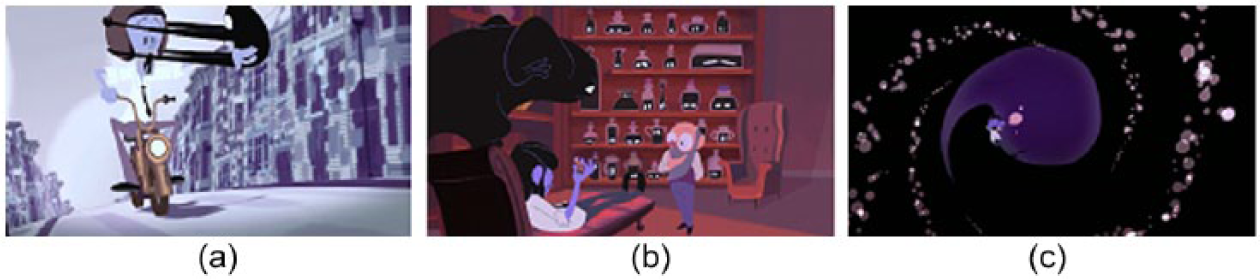
from Fallin’ Floyd. © Albert ‘t Hooft and Paco Vink, 2012. Available at: https://vimeo.com/87766904 (accessed 7 July 2018).
Eventually Floyd visits a psychiatrist (Figure 2b). In this scene, a second metaphor comes into play. When the psychiatrist throws Floyd’s engagement ring out of the window, Floyd frantically chases it into the river, where his dark companion merges with the water, engulfing Floyd completely (Figure 2c). While his movement of falling invokes the metaphor
Floyd passively sinks to the bottom – perhaps hinting at a suicide attempt – until he finds his trumpet there. Resurfacing, he begins to play again and with the music the dark night lights up: in the course of the film the
Tzadik
An unhappy-looking boy sits in a small boat, in a dark sea. A big dark monster with a fluid contour is sitting next to him, softly purring and hugging the boy (Figure 3a). While the boy is asleep, a mysterious bright light escapes from his body and settles on a dying tree on a close-by island. The tree magically erects itself and begins to flourish again, assuming the light’s brightness. The boy wades towards the tree, but when the monster wakes up, it angrily pursues him and after a struggle manages to bar his access to the island.

from Tzadik. © Oriel Berkovits, 2013. Available at: https://www.youtube.com/watch?v=gW1x51zezqE (accessed 7 July 2018).
We propose that this film, too, invokes the metaphor
Eventually, the boy succeeds in reaching the island, where the tree suddenly bathes in a beam of light and the boy flies up this beam, invoking the metaphor
Black Cloud (BC)
In this animation without music, a young man is walking along with his hands in his pockets when a black cloud appears that begins to rain only on him. The actions subsequently undertaken to solve this problem – putting up an umbrella sporting the word ‘Prozac’, visiting a psychiatrist beating on it (Figure 4a) and heavy drinking – cue the metaphor

from Black Cloud. © Ross Hendrick, 2014. Available at: https://www.youtube.com/watch?v=f1R0qLh61Yw (accessed 7 July 2018).
Unlike in the previous three case studies, the source domain in this film is not a monster. But it is also black and shares characteristics with the monsters in TW, FF and Tzadik. The cloud forms an unwelcome presence that continuously follows the protagonist around and seems inescapable, despite various attempts to get rid of it. Only at the very end, after the man recovers from being struck by lightning formed by the joining of his cloud with a similar cloud of a woman (Figure 4b), does the cloud turn white, shrink and disappear (Figure 4c). Instead of the rain that has been audible all along, we now hear birds chirping.
Mental Health Awareness (MHA)
A red-haired woman in red shoes walks along a street, a friend locking arms with her. Then the friend turns into a shadow and the woman, now with a smiling mask (Figure 5a), falls through the pavement (Figure 5b). She is now without the mask, crying. The red blood on her knee connects her physical pain with emotional pain. Falling into an underground space emphasizes that the dark space is a
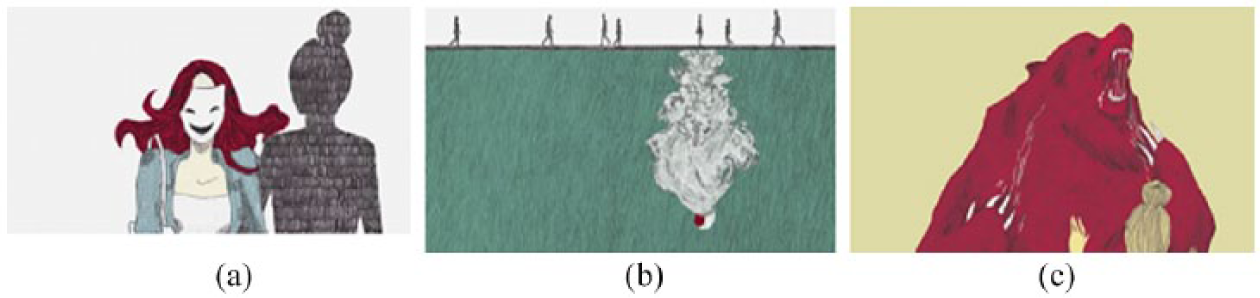
from Mental Health Awareness. © Eileen Kai Hing Kwan, 2012. Available at: https://www.youtube.com/watch?v=dGulSPPOZv0 (accessed 7 July 2018).
In the next scene, she is running through a dark wood. We then see, from above, a throbbing amorphous mass with the same red colour as the woman’s hair, shoes and knee-wound, lying on the ground, hemmed in between poles. The underground space, the wood and the enclosed figure all support the metaphor
Rising up, the red mass turns into an aggressive-looking bear that roars and scratches itself with sharp claws, suggesting, as Fahlenbrach (2017) notes, self-mutilation. In this way, the metaphor
Acceptance – Living with Depression
A paper-cut-out animation, Acceptance is accompanied by the Kate Bush song ‘Running Up That Hill’, performed by the band Placebo.
A woman extracts herself from the ground. A heart is seen (and heard) throbbing. In its cut-out contour, black blobs become visible and a hand pushes the semi-detached heart back into the paper again, covering the blackness underneath. The woman begins to walk through the landscape, which is transformed into a dark wood. A close-up of the heart reveals it to be almost completely filling with blackness (the song lyrics here are ‘there’s a thunder in our hearts’). Moreover, it begins to grow black sprouts. This time, the woman fails to keep the blackness inside the heart (Figure 6a); it falls to the ground where it grows into a tree that towers over her and runs after her (Figure 6b). The tree’s branches seem like tentacles about to grab her and thus embody aggression and danger. We can thus once again identify
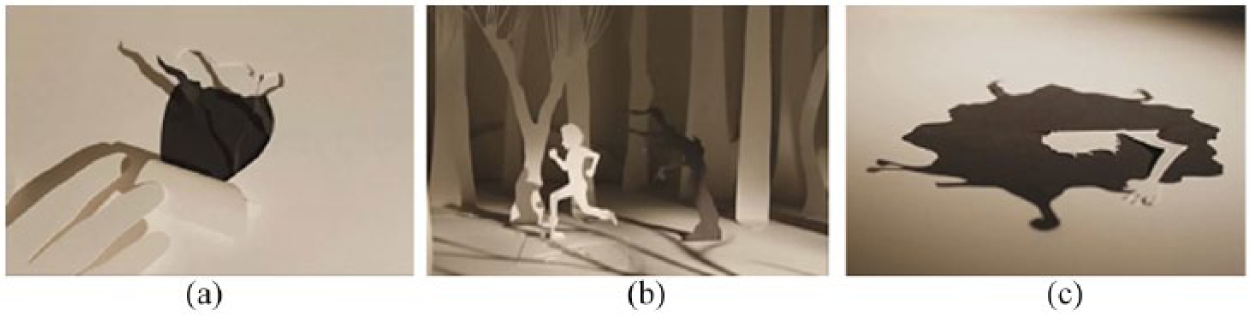
from Acceptance – Living with Depression. © Helen Macklin, 2011. Available at: https://www.youtube.com/watch?v=hYM8LhnFi0E (accessed 7 July 2018).
Next, the tree transforms into a well that swallows the woman. She spirals down the well, manifesting
Eventually a light begins to glow in the dark well and the woman manages to extract herself from it (Figure 6c). Her climbing out of the dark well suggests that
Sad
Accompanied by lines from the Johnny Cash song ‘Hurt’ (in the version of Nine Inch Nails), a blue-coloured boy gets out of bed in the morning and descends the stairs to the breakfast table. He has an attached dark blue shadow which thwarts him (e.g. Figure 7a); at school, the shadow rises up behind him and seems to strangle him (Figure 7b), triggering
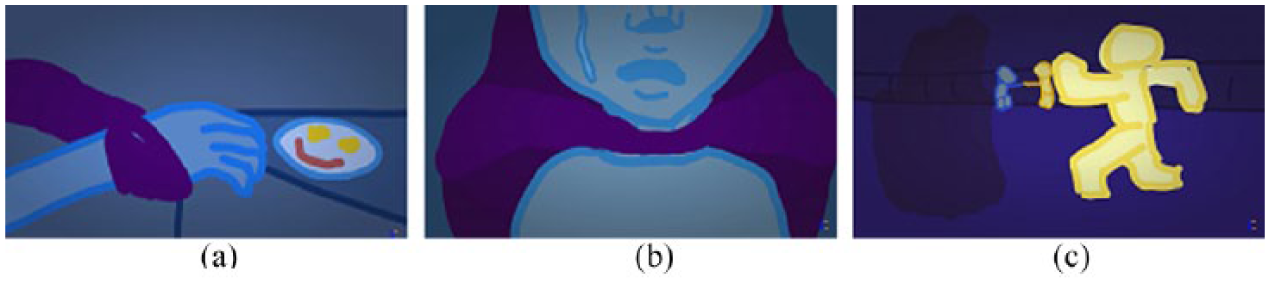
from Sad. © Andy Cepollina, 2017. Available at: https://www.youtube.com/watch?v=OiUXhHtSaok (accessed 7 July 2018).
In the final scene, the boy, looking over a bridge, watches cars pass by underneath (contemplating suicide?). He sits down dejectedly. A bright-yellow figure (his ‘positive self’?) comes to shake his hand, and then engages the boy’s shadow in a boxing fight, while he and his ‘positive self’ still shake hands in the background (Figure 7c). The contrast between the dark shadow, representing the depression, and the light ‘positive self’ triggers the metaphor
Depression
In this stop-motion film, a black heart made of clay lies surrounded by branches that are drawn on paper, all pointing toward it (Figure 8a). We hear rather solemn, choral music with no lyrics. From the branches, black snakes (?) or ropes (?) wriggle towards the heart and wrap themselves around it (Figure 8b). The notion of confinement is thus again crucial, as the heart is literally tied up, or suffocated. If we take the heart as the conventional metonym for the person, we could formulate the metaphor as
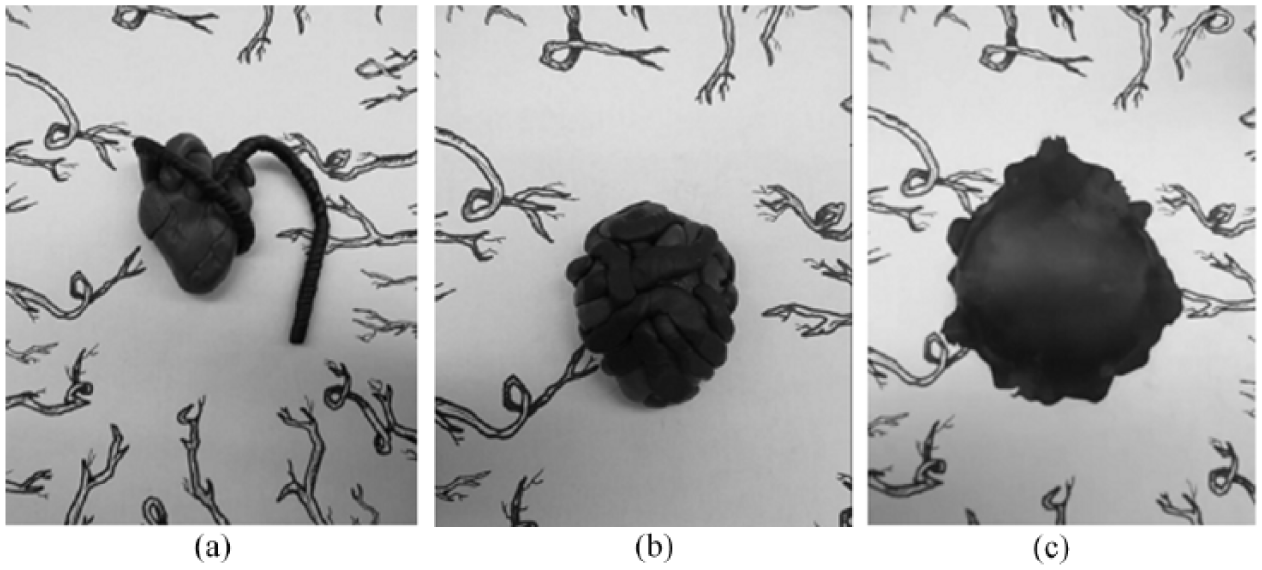
from Depression. © Alison Krenzer, 2014. Available at: https://www.youtube.com/watch?v=B_VU4quHJTM (accessed 7 July 2018).
Eventually, the snakes/ropes blend with each other and in the end merge with the heart, ‘absorbing’ it, so that it is no longer distinguishable as such, having been transformed into a formless blob (Figure 8c). This visual transformation, enabled by the materiality of clay, suggests that the attacks of the black creatures have completely deprived the heart of its identity. The fact that the creatures are ambiguous between snakes and ropes is functional: ropes trigger the feature ‘used to tie up’ and ‘strangle’, whereas snakes culturally evoke ‘surreptitiousness’ and ‘poisonousness’.
Depression Animation (DA)
A blue clay figure scrambles out of some sort of enclosure (Figure 9a). He finds himself in a wood, where he is pursued by a sharp-toothed, growling black monster (Figure 9b). Wherever he runs to escape, he encounters it again. The accompanying music signals rising tension. Suddenly, he sees a white door, but it does not lead him out of the wood (Figure 9c).
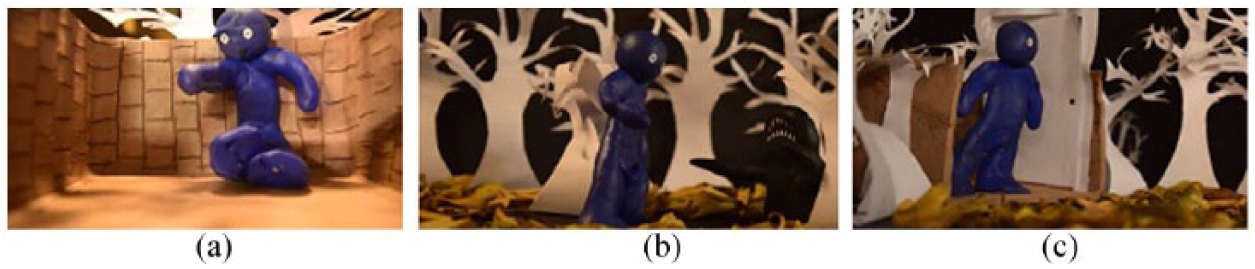
from Depression Animation. © Gemma Johnston, 2016. Available at: https://www.youtube.com/watch?v=oksYru2euPI (accessed 7 July 2018).
We identify two metaphors in this film:
4. Discussion
In this paragraph, we examine the patterns in the metaphors identified in the films in more detail and along the way refer to the metaphors signalled by Charteris-Black (2012), Fahlenbrach (2017) and Tercedor Sánchez and Láinez Romos-Bossini (forthcoming).
We propose that, to show what the various metaphors have in common, we can formulate all of them in terms of the following two metaphors:
In the films she analyses, Fahlenbrach (2017) also identifies
Apart from the source domains
We now take our two central metaphors as a starting point for reconsidering the animation films, noting how their specific narrative contexts/scenarios, as well as the affordances of their being animated, make the metaphors interact with other pertinent features.
5.1 Being depressed is being in a dark confining space
Most of the films analysed exploit the
Any temporary or definitive solution to end the depression that the films may offer has to be compatible with the dark confining space scenario: escape the confinement and/or find light. The latter ties in with the
5.2 Being depressed is being confronted by a dark monster
The source domain
Another affordance of a living creature is its ability to act of its own accord. A recurring feature of the monsters is their pursuit of the protagonists, as in Acceptance, FF, Sad, DA, Tzadik, TW and even in BC. Despite the different shapes and characteristics of the source domains, they hound the fleeing or resisting protagonists, demanding excessive attention and, in doing so, constitute obstacles to their well-being. The monsters in Tzadik, MHA, FF, TW, Acceptance and DA moreover all display aggressive behaviour, undertaking potentially harmful actions against the depressed persons, such as urging them to self-mutilate (MHA), preventing them from eating (TW, Sad), barring them from access to good things (Tzadik), dragging them towards undesired places (TW, FF), or chasing them (Acceptance, DA).
This aggressive and destructive behaviour is at odds with another recurring mapping. In several films, the monster not only presents a danger and a burden but, paradoxically, is also a companion that nurses, strokes, or protects the depressed person, or at least invites or (forcefully) wants him or her to be physically close to it (Tzadik, TW, FF, Acceptance, Sad), exemplifying the metaphor
But the monster is mainly conceived of as an opponent interfering with the patient’s desired activities. Any resolutions (temporary or permanent) to the depressed state – if offered at all – naturally must be commensurate with the personification scenario: the monster shrinks, is calmed down, tamed, disappears, or is fought (see also Tercedor Sánchez and Láinez Ramos-Bossini, forthcoming).
5.3 The relation between depression as dark monster and as dark confining space
As noted above, several of the films draw on both the central
Often both versions of the depression metaphor co-occur in the same film (FF, MHA, Acceptance, DA) – and in some cases we even see a seamless metamorphosis of one into the other: when Floyd and his monster jump into the river, the monster and the river actually merge; and the fluid drop-emanating contour of the monster in Tzadik makes it ontologically similar to the sea-of-depression. Lakoff (1993: 16) indeed also acknowledges the possibility of the presence of both types of metaphor in one phrase. The animation medium, however, appears to afford this in a way that is different from verbal expressions. Whereas, in language, the object–location pair may be expressed in a single sentence, the two types necessarily occur sequentially. The audio-visual medium, by contrast, allows for simultaneously expressing the object–location dual. This is perhaps most clearly exemplified in Depression, where both
5.4 Animated depression : medium-specific dimensions
Some of animation’s affordances are particularly pertinent to the depression metaphors we identified. One intriguing dimension of the personification of depression enhanced by the animation medium is that in several films there is the strong suggestion that the monster is an ‘alter ego’ of the depressed person. In TW, it physically resembles the old woman, and their movements in the rocking chairs are rhythmically synchronized; in Sad, the dark-blue monster is the light-blue depressed person’s shadow; the heart and the ropes/snakes in Depression are both black; and in MHA the use of the colour red for the bear and the woman suggests that, if only momentarily, the woman is her depression. In Tzadik, the brightness emanating from the sleeping boy’s body hints that the light he later pursues symbolizes a positivity that inheres in himself – a theme that is also evoked in the ‘positive self’ off-spin in Sad.
Since animation need not respect the laws of gravity (or any other physical laws, for that matter) and is often hyperbolic, spectators have no problem accepting that Floyd walks on walls and that the boy in Tzadik flies through the air, creating multiple possibilities for the visual expression of
More generally, animation (and live-action film) is excellent at ‘compressing time’ (Fauconnier and Turner, 2002: ch. 6). Stages in the lives of the depressed persons that in reality may take weeks, months, or even years, are effortlessly and quasi-naturally conflated into mere minutes or seconds, as most clearly exemplified by the use of split screens in Sad. The affordances of the material used in an animation can be made productive too, as we have seen in Depression, where the use of clay allows for the merging of the snakes with the heart into a formless blob, interpretable as a loss of identity.
Other resources in animation (and film in general) that can be mined for meaningful effects are the sonic and musical modes (see Van Leeuwen, 1999). Calm versus agitated themes or sounds and harmonious versus disharmonious ones are often used to reflect the mood of a film’s hero(ine) at a given moment. Several of the films have the depression-monster growling. Briefly after Floyd meets his monster, it is not just its gesturing but also its helpless sounds that indicate that it wants attention, while the significant appearance of the brightness in Tzadik is reinforced by a new musical theme. The relief that the white door appears to offer the blue creature in Animation Depression is underlined by a short rhythmic beat, signalling a potential narrative development. In MHA, the abrupt change in the soundscape underscores the suddenness of the onset of the depression, whereas the continuing of the melody at the end implies the depression’s latent presence. In this way, the medium of non-verbal animation films discussed here affords meaning-making mechanisms not available to monomodal verbal metaphors. While the metaphor may be predominantly expressed in the visual mode, the sonic and musical modes support it and encourage additional or richer meanings.
5. Concluding Remarks
We claim to have demonstrated that wordless animation film can express depression metaphorically just as well as verbal discourse can. More specifically, although other authors (Charteris-Black, 2012; Fahlenbrach, 2017; Tercedor Sánchez and Láinez Ramos-Bossini, forthcoming) sometimes use different verbal formulations for the various metaphors and sometimes cluster them differently, this does not change the crucial fact that our animation films draw on the same underlying conceptual metaphors – thereby further substantiating CMT’s claims that human beings think metaphorically.
In our nine films, two conceptual metaphors recur that we have labelled
Furthermore, the medium of (wordless) animation creates meaning not just visually, but also sonically and musically. These modes, and their interaction, further expand the opportunities to understand
Conversely, a CMT perspective helps uncover patterns in how depressed persons experience their affliction. Therapists practising metaphor therapy could use the animations discussed in this article as catalysts to encourage clients to talk about their problems by asking them to comment on the animations. On the one hand, the ‘dual’ theory should help the therapist attest to whether the client has a preference for
Clearly, using CMT as a tool for analysing animation films will both enrich metaphor theory and help reveal patterns in animation’s medium-specific resources to create narrative and argumentative meaning.
Footnotes
Acknowledgements
We are indebted to two anonymous reviewers for thoughtful and insightful observations on earlier drafts of this article. We have moreover benefited from comments on its presentation at the ‘Warsaw Multimodality Workshop and Masterclass’ (University of Warsaw, 7–9 June 2018). We also thank Elisabetta Adami for her editorial comments.
Funding
This research received no specific grant from any funding agency in the public, commercial, or not-for-profit sectors and there is no conflict of interest.

Biographical Notes
The key theme in the research of CHARLES FORCEVILLE (Associate Professor, Media Studies, University of Amsterdam) is the question of how visuals convey meaning. Committed to cognitivist, socio-biological and relevance-theoretic approaches, he publishes on multimodality in various genres and media (documentary film, animation, advertising, comics and cartoons). In 1996, he published Pictorial Metaphor in Advertising (Routledge). He co-edited Multimodal Metaphor (Mouton de Gruyter, 2009), Creativity and the Agile Mind (Mouton de Gruyter, 2013) and Multimodal Argumentation and Rhetoric in Media Genres (Benjamins, 2017). A monograph with the working title ‘Analyzing Visual and Multimodal Mass-Communication: A Pragmatic Model’ is in preparation for Oxford University Press.
Address: Department of Media Studies, University of Amsterdam, Turfdraagsterpad 9, 1012 XT Amsterdam, The Netherlands. [ email:
SISSY PALING is currently a lecturer in the Media Studies department of the University of Amsterdam. Her research interests concentrate mainly on the field of film studies, animation, documentary theory and interactive documentary.
Address: as Charles Forceville. [ email: