




Abstract
Introduction:
The present meta-analysis aimed to investigate whether there is an association between SERPINE1 rs1799768 polymorphism and sepsis risk and mortality.
Materials and methods:
Published reports were searched in PubMed, PubMed Central, Gene, PubChem and Google Scholar. Odds ratios (ORs) and corresponding 95% confidence intervals (CIs) were assessed in a random-effects model.
Results:
The results of the overall meta-analysis indicated that an increased sepsis risk was evidently associated with SERPINE1 rs1799768 polymorphism (OR = 1.30; 95% CI 1.08–1.56; p = 0.006). When studies were stratified by ethnicity, no significant association was observed between SERPINE1 rs1799768 polymorphism and sepsis risk in the Asian group. As for the Caucasian population, overall OR was 1.24 (95% CI 1.02–1.51; p = 0.03). The results of the overall meta-analysis indicated that an increased sepsis mortality risk was evidently associated with SERPINE1 rs1799768 polymorphism (OR = 1.73; 95% CI 1.31–2.28; p < 0.0001). When studies were stratified by ethnicity, significant association was observed between SERPINE1 rs1799768 polymorphism and sepsis risk mortality in the Asian group and the Caucasian population.
Conclusions:
In conclusion, the meta-analysis suggests that there are significant associations between SERPINE1 rs1799768 polymorphism and risk of sepsis and sepsis mortality.
Keywords
Introduction
Sepsis is a life-threatening condition that arises when the body’s response to an infection injures its own tissues and organs. 1 Despite advances in antibiotic therapy and modern life support, the fatality rate of patients with sepsis has remained as high as 30%–60% worldwide. 2 Early identification of patients at high risk of dying from sepsis may help initiate rapid and appropriate therapeutic interventions and may have a great impact on sepsis-related morbidity and mortality.
Serpin peptidase inhibitor, clade E (nexin, plasminogen activator inhibitor type 1), member 1 (SERPINE1) is a single-chain, glycosylated protein composed of three β-sheets (A, B, C) and nine α-helical domains (A–I) with a strained reactive center loop (RCL) positioned in the carboxy terminus. SERPINE1 is a major inhibitor of urokinase (uPA) and tissue-type (tPA) plasminogen activators. By limiting the conversion of plasminogen to plasmin, SERPINE1 attenuates fibrinolysis, promotes extracellular matrix (ECM) accumulation and contributes to both physiologic and pathophysiologic stromal remodeling. 3 Sepsis increases bacterial content in all fluids and organs and increases SERPINE1 messenger RNA and enzymatic activity in the lung and liver. 4 A single measurement of SERPINE1 activity could identify patients with ongoing severe coagulopathy early in the course of sepsis. 5
During the past decade, various studies have been carried out to examine whether there is an association between SERPINE1 rs1799768 polymorphism and sepsis risk and mortality, but the results from these studies were controversial.6 –21 In the present study, we performed a meta-analysis that covers 16 studies to clarify whether there is an association between SERPINE1 rs1799768 polymorphism and sepsis.
Methods
Publication search
Published reports were searched in the National Center for Biotechnology Information (NCBI) Global Cross-database, including PubMed, PubMed Central, Gene, PubChem and Google Scholar, with the following key words: “SERPINE1,” “PAI-1,” “plasminogen activator inhibitor-1” and “sepsis.” Publication language was not restricted in this search. Reference lists of articles retained for review were examined manually to further identify potentially relevant reports.
Inclusion and exclusion criteria
Abstracts of all retrieved studies were reviewed. Studies that met the following criteria were included: (1) addressing the association between SERPINE1 rs1799768 polymorphism and sepsis risk and mortality; (2) having a case-control or cohort design; and (3) providing sufficient data for calculating odds ratios (ORs) and 95% confidence intervals (CI). Studies were excluded if any of the following facts existed: (1) books and other literature that were not case-control or cohort studies; (2) studies whose primary goal is not the investigation of the association between SERPINE1 rs1799768 polymorphism and sepsis risk and mortality; or (3) articles without control group information or without the retrievable original data. When analyzing sepsis risk, the control group comprised health participants. When analyzing sepsis mortality, the control group comprised the patients who died from sepsis. When the studies that were covered in different articles overlapped, only the ones showing the most extensive results were included in this study.
Data extraction
Two investigators independently extracted the data from each eligible paper. Disagreements were resolved by discussion and a consensus was reached on all items between the two investigators. The following data were collected from each study: first author, year of publication, study design and ethnicity of the participants, and genetic numbers of cases and controls.
Statistical analysis
Statistical analysis was conducted using STATA 12.0 (Stata Corp LP, College Station, TX, USA). A p value < 0.05 was considered as statistically significant. In addition to the overall database, two ethnic subgroups were created that covered all studies with Caucasians and Asians. ORs were calculated with 95% CIs in the recessive model. The heterogeneity between studies was tested using the I2 index (I2 < 25%, no heterogeneity; I2 = 25%–50%, moderate heterogeneity; I2 > 50%, large or extreme heterogeneity). Forest plots were generated to summarize the results. Publication bias was evaluated with Begg’s funnel plots based on the analysis results and database size. Moreover, Egger’s test was also completed for each dataset for a better analysis on the publication bias.
Results
Study characteristics
A total of 320 papers were retrieved after the first search, and 304 of them were excluded from the analysis. As a result, 16 studies that met the inclusion criteria were included in the final meta-analysis. The data collection flowchart is shown in Figure 1. The characteristics of all studies are included in Table 1.

Flowchart of study identification.
Characteristics of the included studies.

NA: not available.
Quantitative data synthesis
The results of the overall meta-analysis indicated that an increased sepsis risk was evidently associated with SERPINE1 rs1799768 polymorphism (OR = 1.30; 95% CI 1.08–1.56; p = 0.006; Figure 2). When studies were stratified by ethnicity, no significant association was observed between SERPINE1 rs1799768 polymorphism and sepsis risk in the Asian group (OR = 1.64; 95% CI 0.87–3.09; p = 0.13). As for the Caucasian population, overall OR was 1.24 (95% CI 1.02–1.51; p = 0.03). Results are shown in Table 2. No significant publication bias was found (Figure 3).

Meta-analysis of the association between SERPINE1 rs1799768 polymorphism and sepsis risk.
Risk of sepsis.

OR: odds ratio; CI: confidence interval.

Funnel plot of the association between SERPINE1 rs1799768 polymorphism and sepsis risk.
The results of the overall meta-analysis indicated that an increased sepsis mortality risk was evidently associated with SERPINE1 rs1799768 polymorphism (OR = 1.73; 95% CI 1.31–2.28; p < 0.0001; Figure 4). When studies were stratified by ethnicity, a significant association was observed between SERPINE1 rs1799768 polymorphism and sepsis risk mortality in the Asian group (OR = 2.89; 95% CI 1.37–6.12; p = 0.006) and the Caucasian population (OR = 1.61; 95% CI 1.37–2.15; p = 0.001). Results are shown in Table 3. No significant publication bias was found (Figure 5).

Meta-analysis of the association between SERPINE1 rs1799768 polymorphism and sepsis mortality.
Risk of mortality.

OR: odds ratio; CI: confidence interval.
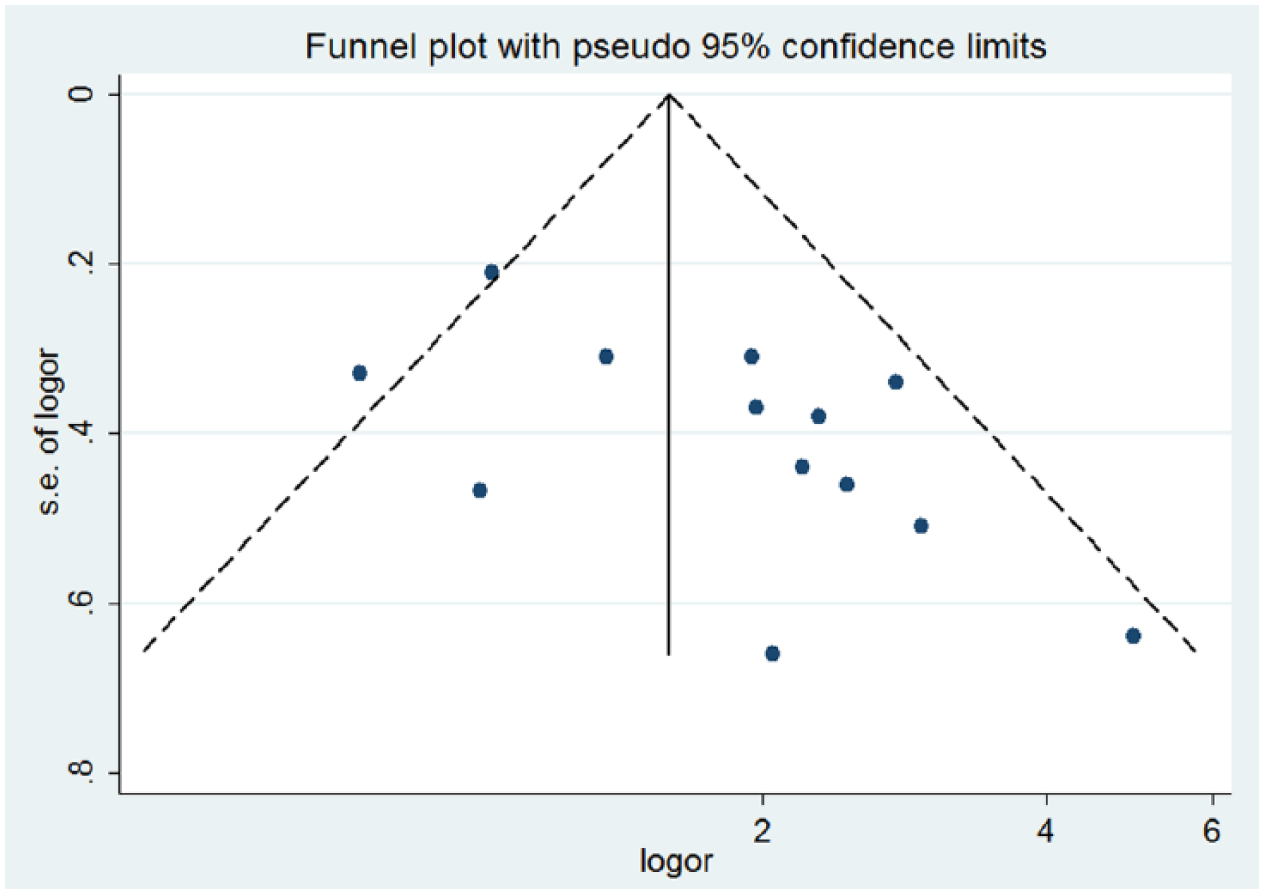
Funnel plot of the association between SERPINE1 rs1799768 polymorphism and sepsis mortality.
Discussion
Elevated SERPINE1 levels are, in fact, a significant causative factor in the pathophysiology of septic coagulopathy, particularly in the context of increased tissue transforming growth factor beta 1 (TGF-β1) levels. 22 SERPINE1 rs1799768 polymorphism is a major genetic determinant of plasma SERPINE1 levels. 23 Recently, many studies have investigated the association between SERPINE1 rs1799768 polymorphism and the risk of sepsis, but the results were not consistent. Thus this meta-analysis aimed for better insight regarding the association between this single-nucleotide polymorphism (SNP) and sepsis risk. After a comprehensive search and careful selection, 16 studies were critically reviewed and included in our analysis. The result of this meta-analysis shows that there is a significant association between SERPINE1 rs1799768 polymorphism and increased risk of sepsis and sepsis mortality.
When studies were stratified by ethnicity, no significant association was observed between SERPINE1 rs1799768 polymorphism and sepsis risk in the Asian group. Only two studies included Asians. Thus small sample size and limited number of studies for this ethnic subgroup in this meta-analysis could be the major factors that contribute to the discrepancies between overall and subgroup analysis. A note of caution should be sounded when interpreting our findings, especially in subgroup analyses in light of the limited sample sizes involved. This is well exemplified in the comparison of the small and large studies, where significance was attained only in the small studies. It has been suggested that to achieve satisfactory power, at least 1000 subgroups are required and often more, depending on the prevalence of the examined polymorphism. 24 We therefore must regard our findings as preliminary, which should be viewed as hypothesis-generating and a call for validation in future large and well-design studies.
There were several possible limitations of this meta-analysis. First, this meta-analysis is based on the summaries of case-control and cohort studies, which rarely establish causal relationship, and it is encouraging to incorporate the concept of Mendelian randomization into observational association studies. 25 Second, only one polymorphism in the SERPINE1 gene was evaluated in this study, which might not be sufficient to address the complex genetic architecture of sepsis. Third, only published articles written in the English language were retrieved for inclusion and some unpublished small and/or negative articles might be missing, leading to the potential existence of publication bias. Fourth, it is essential to examine gene-environment and gene-gene interactions at the level both of individual studies and meta-analysis. To achieve this goal, one usually needs to perform a meta-analysis of individual participant data, which is not always practical for the majority of published meta-analyses.
In conclusion, the result of our meta-analysis suggests that there are significant associations between SERPINE1 rs1799768 polymorphism and the risk of sepsis and sepsis mortality.
Footnotes
Declaration of Conflicting Interests
The author(s) declared no potential conflicts of interest with respect to the research, authorship, and/or publication of this article.
Funding
The author(s) received no financial support for the research, authorship, and/or publication of this article.