




Abstract
Objective
The angiotensinogen (AGT) gene has been considered to be implicated in the development of cancer. However, the results have been inconsistent. In this study, we performed a meta-analysis to clarify the association of AGT M235T variant with cancer risk.
Methods
Published literature from PubMed and Embase were retrieved. Pooled odds ratio (OR) with 95% confidence interval (CI) was calculated using a fixed- or random-effects model.
Results
A total of seven articles including eight studies (3639 cancer cases and 6684 controls) for AGT M235T variant were included. The present meta-analysis showed that AGT M235T variant was marginally associated with cancer risk under dominant model (OR=1.12, 95% CI=1.02–1.24). However, the positive association was not stable after sensitivity analysis. Further subgroup analysis by cancer type did not suggest any association of AGT M235T variant with various cancers (all p>0.05).
Conclusion
The present meta-analysis demonstrated that AGT M235T variant was not associated with risk of all cancer or various cancers. Further well-designed studies with large sample size should be conducted to confirm or refute the non-significant association.
Introduction
Cancer is the main public health issue worldwide. Recently, cancer has been thought to be associated with the interaction of a variety of environmental lifestyle factors and host genetic factors.
The renin–angiotensin system (RAS) is a hormonal signaling mechanism widely known as a blood pressure regulation system. The RAS consists of angiotensinogen (AGT), angiotensin I, angiotensin II, renin, angiotensin I-converting enzyme (ACE) and chymase. AGT is one of the most significant elements of the RAS. AGT and RAS are involved in vascular tone, cardiovascular remodeling, and salt and water homeostasis. 1 Recent studies have implicated AGT with inflammation as well as in vitro inhibition of human endothelial cell proliferation, cell migration and angiogenesis. 2
There are many polymorphisms in the AGT gene located on chromosome 1q42–q43. In exon 2, a non-synonymous substitution of T by C in codon 235 of the AGT gene, leads to a change from methionine to threonine. Initially, AGT M235T variant was found to be associated with increased risk of hypertension.3,4 Recently, AGT M235T variant has been found to play an important role in the etiology and progression of cancer. However, the results have been inconsistent.5–11 Hence, in this study, we performed a meta-analysis to clarify the association of AGT M235T variant with cancer risk.
Materials and methods
Literature and search strategy
Literature databases including PubMed and Embase data were searched. The search strategy to identify all possible studies involved the use of the following key words: (angiotensinogen or AGT) and (variant or variation or polymorphism or genotype) and (cancer or tumor or carcinoma). All related studies published in the English language were included. The reference lists of retrieved articles were manually searched. If more than one article were published using the same data, only the study with largest sample size was included. The literature search was updated on April 17, 2013.
Inclusion criteria and data extraction
The studies included in the meta-analysis must meet all the following inclusion criteria: (1) evaluating the association between AGT M235T variant and cancer risk; (2) using case-control or cohort design; and (3) providing sufficient data for calculation of odds ratio (OR) with 95% confidence interval (CI). The following information was extracted from each study: (1) name of the first author; (2) year of publication; (3) country; (4) ethnicity; (5) sample size; (6) genotype distribution in cases and controls; and OR with 95% CI under dominant model. The two authors independently assessed the articles for compliance with the inclusion/exclusion criteria, resolved disagreements and reached a consistent decision.
Statistical analysis
The association between AGT M235T variant and cancer risk was estimated by calculating pooled OR and 95% CI under a dominant model since most studies provided an estimate under this model. The significance of pooled OR was determined by Z test (p<0.05 was considered statistically significant). Q test was performed to evaluate to the between-study heterogeneity. A random- (DerSimonian-Laird method 12 ) or fixed- (Mantel–Haenszel method 13 ) effects model was used to calculate pooled OR in the presence (p<=0.10) or absence (p>0.10) of heterogeneity, respectively. Subgroup analysis by ethnicity was performed to examine the source of heterogeneity. To evaluate the stability of the results, we performed sensitivity analysis by removing one study at a time. Publication bias was assessed by Begg’s test 14 and Egger’s test 15 (p<0.05 was considered statistically significant). Data analysis was performed using STATA version 11 (StataCorp LP, College Station, Texas, USA).
Results
Characteristics of the studies
The literature search identified a total of 123 potentially relevant papers. Of these, 114 papers were excluded because of obvious irrelevance by reading the titles and abstracts. In addition, one paper was excluded because it was a meta-analysis. 16 Then, eight papers met the primary inclusion criteria. However, one paper was excluded because it examined the association of tag SNP of AGT with cancer risk. 17 In addition, two studies were included in the article by Huhn et al. 7 and they were considered as a separate study in the following data analysis. At last, seven articles including eight studies (3639 cancer cases and 6684 controls) for AGT M235T variant were included in the final meta-analysis.5–11 A flow chart describing the study exclusion/inclusion criteria is presented as Figure 1. The characteristics of the included studies are listed in Table 1.
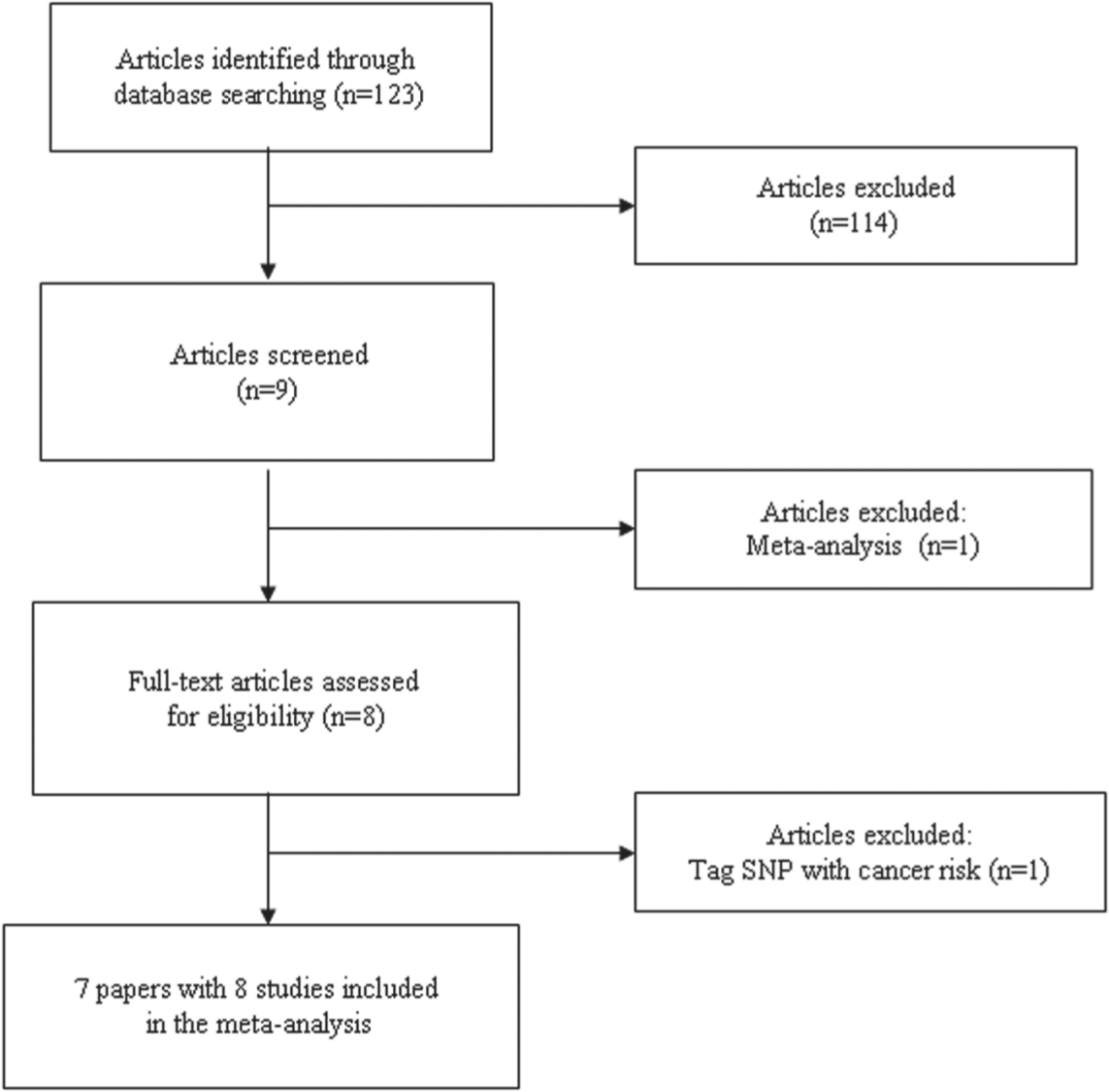
Flow chart describing the study exclusion/inclusion.
Characteristics of the studies included in the meta-analysis between M235T polymorphism in the AGT gene and cancer risk.

Under recessive model
NA, not available
Meta-analysis results
The present meta-analysis showed that AGT M235T variant was marginally associated with cancer risk under a dominant model (OR=1.12, 95% CI=1.02–1.24, Figure 2), with no evidence of between-study heterogeneity (I2=40.3%, p=0.110). Further subgroup analysis by cancer type did not suggest any association of AGT M235T variant with various cancers (breast cancer: OR=1.05, 95% CI=0.54–2.05; colorectal cancer: OR=1.10, 95% CI=0.93–1.30; gastric cancer: OR=1.27, 95% CI=0.74–2.16; oral cancer: OR=0.84, 95% CI=0.42–1.68).

Meta-analysis of association between M235T polymorphism in the AGT gene and cancer risk under a dominant model (MM+TM vs TT).
Sensitivity analysis and publication bias
We performed sensitivity analysis by excluding one study at a time and the result was not robust, with ORs and 95% CIs ranging from 1.08 (0.97–1.21) to 1.21 (1.05–1.39). No publication bias was detected for association of the AGT M235T variant with cancer risk (p=0.711 for Begg’s test and p=0.750 for Egger’s test).
Discussion
To our knowledge, this is the first meta-analysis examining the association between AGT M235T variant and cancer risk. The present meta-analysis suggested that AGT M235T variant was marginally associated with cancer risk. However, the significant association disappeared after sensitivity analysis. Further subgroup analysis indicated that AGT M235T variant was not associated with risk of various cancers.
Recent studies have demonstrated the local over-expression of several components of the RAS in various cancer cells and tissues (e.g. lung, pancreas, breast, prostate, skin and cervix carcinoma), suggesting that local over-expression of the RAS is associated with carcinogenesis. 18 I/D variant in ACE has been suggested to be not associated with all cancer or various cancers risk by two meta-analyses,16,19 which is consistent with our finding that AGT M235T variant was not associated with risk of all cancer or various cancers. However, since we only provided pooled estimate under a dominant model, we could not rule out that AGT M235T variant is associated with risk of cancer under other genetic models (e.g. co-dominant or recessive model). In addition, a recent study with relatively large sample size (777 incident cases and 1035 controls) conducted by Andreotti et al. 17 demonstrated that two tag SNPs, which are located in the promoter, were strongly associated with renal cell carcinoma (rs1326889 [OR=1.35, 95% CI=1.15–1.58] and rs2493137 [OR=1.31, 95% CI=1.12–1.54]) after multiple testing correction. Thus, we also could not rule out the possibility that other variants of AGT, which are not in high linkage disequilibrium with M235T, are associated with risk of cancer.
To date, eight studies have investigated the association of AGT M235T variant with cancer risk. However, the results have also been inconsistent. The disparate findings for various cancers could be partly explained by the gene–gene/environment interactions. It is well accepted that environmental factors (e.g. use of hormone replacement therapy and family history of cancer) could influence the association between AGT M235T variant and carcinogenesis.5,11 In addition, difference in linkage disequilibrium between populations might also explain the conflicting associations. Also, the sample sizes of cases and controls are different in each study and the statistical power is low for most included studies, which would further explain the inconsistent results.
In summary, AGT M235T variant was not associated with risk of all cancer or various cancers. However, given the limited data, it is not possible to draw an exact conclusion on the risk of cancer associated with AGT M235T variant, which warrants further investigation.
Footnotes
Conflict of interest
None declared.
Funding
This work is supported by Zhejiang Natural Science Foundation (Y2100248), Foundation of Department of Science and Technology of Zhejiang Province (2009C33155), Zhejiang Gong Yi Xing Technology Application Project (2011C33045,2012C33025), Zhejiang Medicine, Health, and Science (2009A218, 2010KYB127), Taizhou Science and Technology Bureau (102KY15) and Zhejiang province Chinese medicine study foundation (2011ZA113, 2012ZA130).