




Abstract
Introduction:
The purpose of this study was to examine whether the insertion (I) or deletion (D) of angiotensin-converting enzyme (ACE) polymorphism confers susceptibility to sarcoidosis.
Methods:
A meta-analysis on the associations between the ACE I/D polymorphism and sarcoidosis was conducted.
Results:
Seventeen comparison studies consisting of 1556 cases and 2381 controls were available for the meta-analysis. Meta-analysis revealed a significant association between the D allele and sarcoidosis (OR 1.206, 95% CI 1.049–1.386, p = 0.009). An ethnicity-specific meta-analysis of the DD+ID genotype showed an association with sarcoidosis in East Asians (OR 1.342, 95% CI 1.041–1.729, p = 0.023). An association was found between the DD genotype of the ACE I/D polymorphism and sarcoidosis (OR 1.251, 95% CI 1.070–1.463, p = 0.005). Furthermore, stratification by ethnicity indicated an association between the DD genotype and sarcoidosis in Europeans (OR = 1.215, 95% CI = 1.010–1.462, p = 0.039).
Conclusions:
Our meta-analysis demonstrates that the ACE I/D polymorphism is associated with susceptibility to sarcoidosis in European and East Asian populations.
Introduction
Sarcoidosis is a chronic systemic granulomatous disease characterized by accumulation of activated T lymphocytes and mononuclear phagocytes, which form non-caseating epitheloid granuloma in the affected organs. 1 Although the etiology of sarcoidosis is not fully understood, it has been suggested that antigens act persistently to induce an exaggerated immune response in genetically predisposed individuals. 2
Angiotensin-converting enzyme (ACE) converts angiotensin I into angiotensin II and inactivates bradykinin via the kallikrein-kininogen system.3,4 Angiotensin II, as a potent vasoconstrictor, is the main effector molecule of the renin-angiotensin-system (RAS). The RAS contributes to electrolyte homeostasis and to the regulation of blood pressure in vivo. 3 Dysregulation of this system can contribute to the development of essential hypertension. Furthermore, angiotensin II is a potent pro-inflammatory modulator that augments the immune response.4–7 Elevated serum ACE levels have been observed in patients with active sarcoidosis. 8 Since serum ACE levels may reflect the mass of granuloma in the body and are a consequence of the activation of the monocyte-macrophage-epitheloid cell system, they are considered to be an activity marker of the disease. 9 Thus, ACE is thought to play a key role in the pathogenesis of sarcoidosis.
The ACE gene, located on chromosome 17q23, contains an insertion (I)/deletion (D) polymorphism within intron 16 that may contain or lack a 250 to 287 bp repeat sequence. 10 The DD genotype is associated with an approximately two-fold higher tissue11,12 and plasma concentration of ACE than the II genotype. 10 Thus, the D allele could play a role in the pathogenesis of sarcoidosis.
The ACE I/D polymorphism has been studied in the context of sarcoidosis. However, published results on the genetic associations of the ACE I/D polymorphism are controversial and inconclusive.13–27 This may be because of small sample sizes, low statistical power, and/or clinical heterogeneity. In order to overcome the limitations of individual studies, resolve inconsistencies, and reduce the likelihood that random errors are responsible for false-positive or false-negative associations, we employed a meta-analysis to further characterize the association and to investigate whether the ACE I/D polymorphism contributes to susceptibility to sarcoidosis.
Materials and methods
Identification of eligible studies and data extraction
A search of the literature for studies that examined the association between the ACE I/D polymorphism and sarcoidosis was conducted. We utilized the MEDLINE and EMBASE citation indices to identify articles published until December 2012 in which the ACE I/D polymorphism was identified in sarcoidosis patients and controls. In addition, all references mentioned in the identified articles were reviewed to identify studies not indexed by MEDLINE and EMBASE. The following keywords and subject terms were used in the search: “angiotensin-converting enzyme,” “ACE,” and “sarcoidosis.” Studies were included in the analysis if: (1) they were case-control studies, (2) contained original data, and (3) included sufficient data to calculate odds ratios (ORs). No language restriction was applied. We excluded the following: (1) studies including overlapping data; (2) studies in which the number of null and wild genotypes or alleles could not be ascertained; (3) studies in which family members were studied because their analysis was based on linkage considerations; and (4) studies in which the genotype distribution in controls was not consistent with the Hardy-Weinberg equilibrium (HWE), because deviation from the HWE among controls suggests the possibility of bias during control selection or genotyping errors. The following information was extracted from each identified study: author, year of publication, ethnicity of the study population, demographics, numbers of cases and controls, the frequencies of the genotypes and alleles of the ACE I/D polymorphism, and type of sarcoidosis.
Evaluation of publication bias and study quality
The chi square test was used to determine if the observed genotype frequencies in controls conformed to Hardy-Weinberg (H-W) expectations. Funnel plots are often used to detect publication bias, but they require a range of studies of varying sizes and subjective judgments; therefore, we evaluated publication bias using Egger’s linear regression test. 28 Egger’s linear regression test measures funnel plot asymmetry on a natural logarithmic scale of ORs.
Evaluation of statistical associations
We performed meta-analyses using (1) allelic contrast (D vs. I); (2) recessive (DD vs. ID + II); (3) dominant (DD + ID vs. II); and (4) codominant (DD vs. ID vs. II) models. Point estimates of risks, ORs, and 95% confidence intervals (CIs) were calculated for each study. In addition, within- and between-study variations and heterogeneities were assessed using Cochran’s Q-statistic. Cochran’s Q-statistic test assesses the null hypothesis that all studies evaluated the same effect. The effect of heterogeneity was quantified using I2 with a range between 0% and 100%, representing the proportion of between-study variability attributable to heterogeneity rather than to chance. 29 I2 values of 25%, 50%, and 75% were nominally assigned as low, moderate, and high estimates. The fixed-effects model assumes that a genetic factor has a similar effect on disease susceptibility across all studies investigated and that observed variations among studies are caused by chance alone. 30 The random-effects model assumes that different studies show substantial diversity and assesses both within-study sampling error and between-study variance. 31 When study groups are homogeneous, the two models are similar. If the study groups lack homogeneity, the random-effects model usually provides wider CIs than the fixed-effects model. The random-effects model is most appropriate in the presence of significant between-study heterogeneity. 31 Statistical manipulations were undertaken using the Comprehensive Meta-Analysis computer program (Biosta, Englewood, NJ, USA). The power of each study was computed as the probability of detecting an association between the ACE polymorphism and sarcoidosis using a significance level of 0.05 and assuming an OR of 1.5 (small effect size). Power analysis was performed using the statistical program G*Power (http://www.psycho.uni-duesseldorf.de/aap/projects/gpower).
Results
Studies included in the meta-analysis
Fifty-two studies were identified by electronic and manual searches, 18 of which were selected for full-text review based on title and abstract details.13–27,32,33,41 One study was excluded because it contained a polymorphism different from the ACE I/D polymorphism. 33 Thus, a total of 17 studies met our inclusion criteria.13–27,32,41 Two eligible studies contained data on two different sarcoidosis groups,19,22 and these were treated independently. Thus, a total of 19 separate comparisons met our inclusion criteria. However, two of the 19 separate comparisons were excluded because they had a genotype distribution in controls that was not in HWE.22,32 Thus, a total of 17 separate comparisons from 16 studies met our inclusion criteria. These studies consisted of 12 European, three East Asian, one West Asian, and one Turkish studies, and included 1556 cases and 2381 controls in total. Selected details of the individual studies are summarized in Table 1 and Figure 1. The statistical powers of these 17 studies ranged from 18.0% to 66.2%. None of the studies had a statistical power exceeding 80%.
Details of the individual studies included in the meta-analysis.

Ref: reference; UK: United Kingdom; USA: United States of America; OR: odds ratio; CI: confidence interval; HWE: Hardy-Weinberg equilibrium.
Power calculations assume α = 0.05, OR = 1.5.
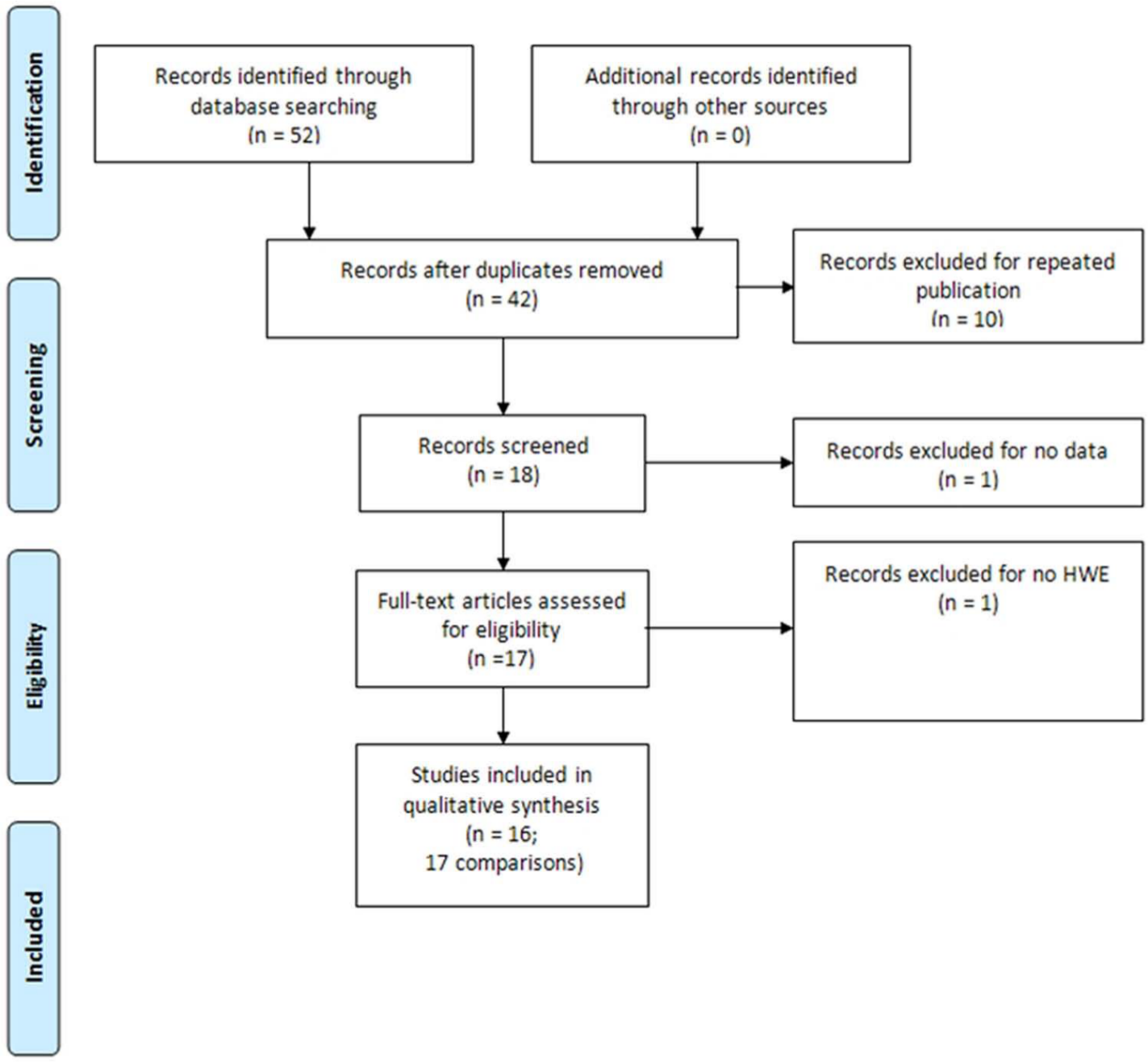
Study flowchart.
Frequencies of the D allele of the ACE I/D polymorphism in different ethnic groups
The mean frequency of the D allele of the ACE I/D polymorphism was 46.2% among all normal controls, and East Asians had a lower D allele prevalence than the other ethnic groups (34.6%). Among normal controls, the frequencies of the D allele in East Asian, Indian, European, and Turkish populations were 34.6, 40.1, 52.1, and 54.3%, respectively (Table 2).
Prevalences of the D allele of the ACE I/D polymorphism.

Meta-analysis of the association between the ACE I/D polymorphism and sarcoidosis
A meta-analysis of all sarcoidosis patients and of each ethnic group was performed. A summary of the meta-analysis findings of the relationship between the ACE I/D polymorphism and sarcoidosis is provided in Table 3. The meta-analysis revealed a significant association between the D allele and sarcoidosis (OR 1.206, 95% CI 1.049–1.386, p = 0.009) (Table 3, Figure 2). Stratification by ethnicity indicated no association between the D allele of the ACE I/D polymorphism and sarcoidosis in Europeans (OR 1.103, 95% CI 0.979–1.243, p = 0.107), or in East Asians (OR 1.156, 95% CI 0.965–1.384, p = 0.116) (Table 3). Analysis using homozygote contrast showed the same D allele pattern in Europeans and Asians (Table 3). However, an ethnicity-specific meta-analysis of the DD+ID genotype showed an association with sarcoidosis in East Asians (OR 1.342, 95% CI 1.041–1.729, p = 0.023), but not in Europeans (OR 1.036, 95% CI 0.845–1.270, p = 0.734) (Table 3, Figure 3). An association was found between the DD genotype of the ACE I/D polymorphism and sarcoidosis (OR 1.251, 95% CI 1.070−1.463, p = 0.005) (Table 3). Furthermore, stratification by ethnicity indicated an association between the DD genotype and sarcoidosis in Europeans (OR 1.215, 95% CI 1.010–1.462, p = 0.039), but not in East Asians (OR 0.970, 95% CI 0.677–1.389, p = 0.867) (Table 3, Figure 4). Associations were observed in Europeans under the DD vs. ID model (OR 1.227, 95% CI 1.007–1.493, p = 0.042) and in East Asians under the ID vs. II model (OR 1.403, 95% CI 1.074–1.834, p = 0.013) (Table 3).
Meta-analysis of the association between the ACE I/D polymorphism and sarcoidosis.

ACE I/D: angiotensin-converting enzyme insertion and deletion; OR: odds ratio; CI: confidence interval; F: fixed-effects model; R: random-effects model.

ORs and 95% CIs of individual studies and pooled data for the association between the D allele of the ACE I/D polymorphism and sarcoidosis over all groups.
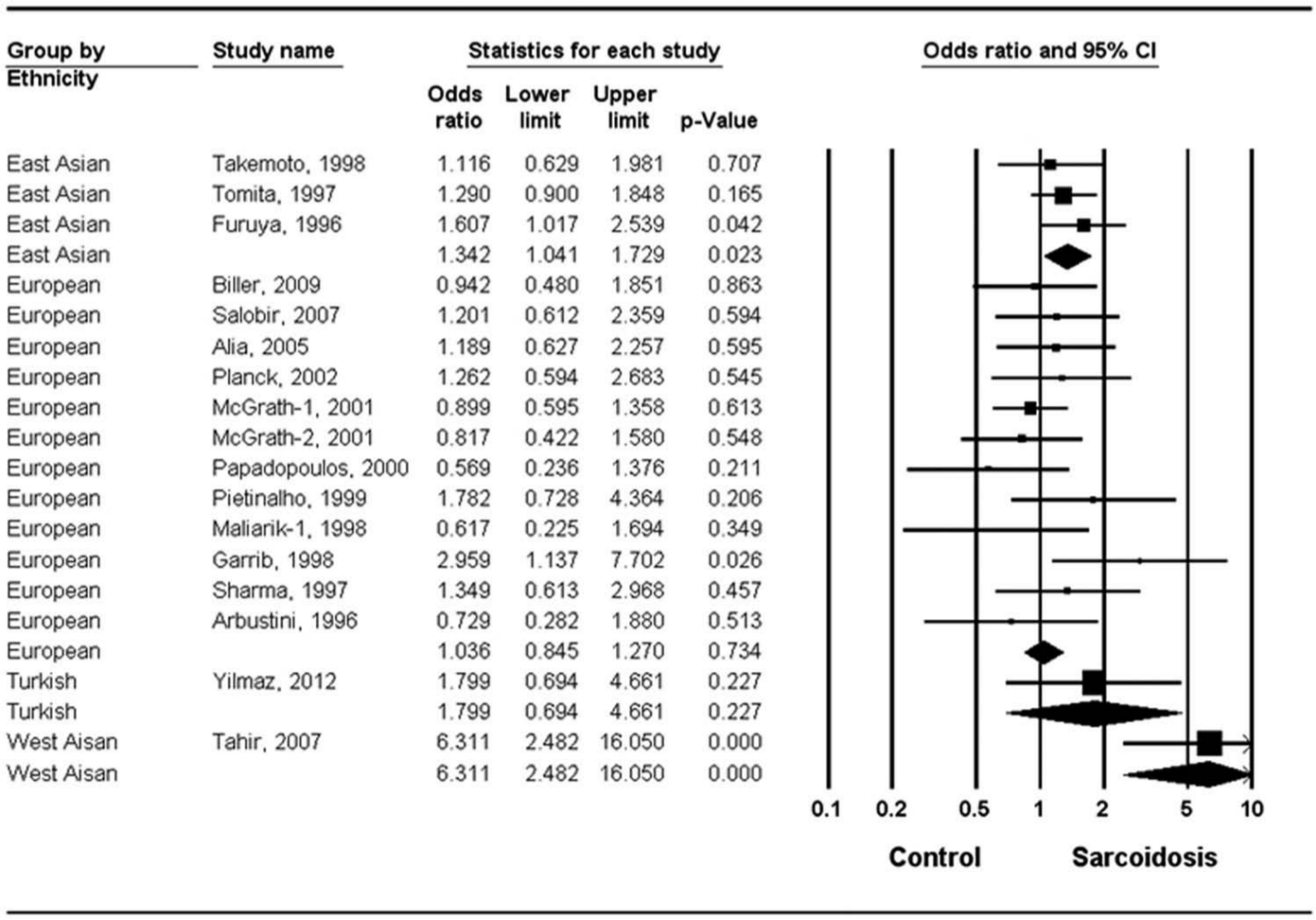
ORs and 95% CIs of individual studies and pooled data for the association between the DD+ID genotype of the ACE I/D polymorphism and sarcoidosis in each ethnic group.

ORs and 95% CIs of individual studies and pooled data for the association between the DD genotype of the ACE I/D polymorphism and sarcoidosis in each ethnic group.
Heterogeneity and publication bias
Between-study heterogeneity was identified in the meta-analyses of the D allele and the DD+ID genotype over all groups (Table 3). However, the heterogeneity was resolved by an ethnicity-specific meta-analysis (Table 3). Publication bias causes a disproportionate number of positive studies, and poses a problem for meta-analyses. Evidence of publication bias was not found in a meta-analyses of the ACE I/D polymorphism in all AA (Egger’s regression test p values > 0.1).
Discussion
ACE is expressed in a wide range of tissues, including the kidneys, heart, lungs, vascular endothelium, skin, joints, and testes.11,12 ACE plays an important role in RAS, angiotensin II conversion, directly increases vascular smooth muscle cell contraction, and affects smooth muscle proliferation, monocyte adhesion, platelet adhesion, and aggregation.3,4 The ACE I/D polymorphism accounts for 47% of the variation in ACE plasma activity, 10 therefore the source of the majority of the variation still remains to be discovered. Measuring plasmatic ACE activity provides a good indicator of activity of sarcoidosis and treatment success, but the genetic component (I/D polymorphism) studied here does not account for the majority of that variation, therefore a linear association cannot and must not be assumed. This polymorphism has been studied in connection with several diseases, including Alzheimer’s disease, 34 myocardial infarction, 35 cerebral infarction, 36 hypertension, 37 and vasculitis. 38 These studies reported associations between susceptibilities to these diseases and the DD genotype and D allele.34–38 Considering the high serum ACE levels observed in sarcoidosis and the role of ACE as a biochemical marker of sarcoidosis, ACE may be a candidate gene for sarcoidosis. 9
In this meta-analysis, we combined evidence on the associations between the ACE I/D polymorphism and susceptibility to sarcoidosis. Meta-analysis of the DD+ID genotype (dominant model) and ID vs. II genotype (codominant model) revealed a significant association with sarcoidosis in East Asians. Furthermore, meta-analysis stratified by ethnicity indicated an association between the DD genotype (recessive model) and DD vs. ID genotype (codominant model) of the ACE I/D polymorphism and sarcoidosis in Europeans. The difference in genetic models for an association of the ACE I/D polymorphism and sarcoidosis between Europeans and East Asians may be explained partly by the ethnic difference of the D allele frequency. European populations demonstrated a higher frequency of the D allele, while East Asians showed a lower frequency of the D allele, which is in agreement with the already known population specificities of sarcoidosis,16,24,25 which has a higher prevalence in Europeans than East Asians. Despite the differences in the D allele among ethnic groups, the meta-analysis showed an association between the ACE I/D polymorphism and susceptibility to sarcoidosis in Europeans as well as East Asians.
Sarcoidosis involves complex interactions between genes and external agents. An antigen-driven process may result in an exaggerated Th1-type immunological response in genetically susceptible people in sarcoidosis. 2 Epithelioid cells in granulomas are the main source of ACE. The serum ACE level is increased in active sarcoidosis, and is a marker for monitoring sarcoidosis activity. 8 ACE is expressed in T cells and activates macrophages and augments CD4+ T-cell infiltration. Angiotensin II, which is produced by conversion from angiotensin I by ACE, modifies the inflammatory response. Moreover, in view of the fact that the ACE I/D polymorphism accounts for approximately one-half of the variance in ACE plasma levels, 10 it is likely that the ACE I/D polymorphism plays a role in susceptibility to sarcoidosis.
The results of this meta-analysis differ from those of a previous meta-analysis on the relationship between the ACE I/D polymorphism and sarcoidosis risk performed by Medica et al. 39 The present study included four more studies,13–16 encompassing 347 more sarcoidosis patients and 345 more controls, than the Medica et al. study, and only studies consistent with HWE were included. In addition, an ethnicity-specific meta-analysis was conducted for Europeans and East Asians. This meta-analysis revealed an association between the ACE I/D polymorphism and sarcoidosis risk in European and East Asian populations, in contrast with the results of the previous study.
The ACE I/D polymorphism may influence the antihypertensive response of ACE inhibitors (ACEI). The ACEI has been known to be associated with better response for hypertension in the DD genotype compared with the II genotype. 40 Our meta-analysis confirmed the association between the ACE I/D polymorphism and sarcoidosis. Thus there is a possibility that the ACEI use is associated with better clinical improvement of sarcoidosis in patients carrying the DD genotype in comparison with the II genotype. Further evaluation is needed to clarify the relation between the ACE I/D polymorphism and response to ACEI therapy in patients with sarcoidosis.
The present study has some limitations that should be considered. First, heterogeneity and confounding factors may have distorted the analysis. Second, other ACE polymorphisms capable of affecting ACE activity could also be associated with sarcoidosis. However, the limited amount of data available prevented further meta-analysis. Third, there are varying levels of disease severity, and the activity level of sarcoidosis was unclear. Further research is required to examine whether an association exists between the ACE I/D polymorphism and the activity or clinical features of the disease. Fourth, we included data from European, East Asian, Indian, and Turkish patients in our meta-analysis, but our ethnicity-associated results are applicable only to European and East Asian ethnic groups.
In conclusion, this meta-analysis of the ACE I/D polymorphism, which was based on a total sample of 1556 patients and 2381 controls, demonstrated that the ACE I/D polymorphism is associated with susceptibility to sarcoidosis in Europeans and East Asians. Accordingly, our findings support the notion that the ACE I/D polymorphism plays a role in the pathogenesis of sarcoidosis. Larger-scale studies in populations with different ethnicities are needed to explore the relationships between the polymorphisms of the ACE gene and the pathogenesis of sarcoidosis.
Footnotes
Conflict of interest
None declared.
Funding
This research received no specific grant from any funding agency in the public, commercial, or not-for-profit sectors.