




Abstract
Renin-angiotensin and kallikrein-kinin systems are interconnected, regulating blood pressure homeostasis. We have demonstrated the interactions among polymorphisms of the angiotensinogen (AGT) and endothelial nitric oxide synthase (NOS3) genes and conventional risk factors affecting the hypertension occurrence. Individuals were recruited (n=192) and classified into hypertensive (HG; n=140) and normotensive (NG; n=52) groups. The genotypic distribution of the Met235Thr (AGT) and Glu298Asp (NOS3) polymorphisms demonstrated that both are independent risk factors of hypertension (p=0.02 and p=0.008, respectively). The concomitant presence of these polymorphisms in the HG group was significantly different (p=0.001) from the NG. Both gene polymorphisms presented an additive effect for the unfavourable alleles T and A, respectively, and 95% of the double mutant homozygotes were classified into the HG. Specific interactions among certain conventional factors and the presence of at least one unfavourable allele presented significant odds towards hypertension. Blood pressure homeostasis was affected by genetic polymorphisms conditioned by the T and A alleles of the AGT and NOS3 genes, respectively, which acted independently. However, their interaction with smoking, sedentariness, age and total cholesterol may have increased the predisposition to hypertension, which may explain most of the hypertension cases.
Introduction
Hypertension and coronary artery diseases (CAD) are associated with endothelial dysfunction and vascular remodelling. The endothelium is a complex and dynamic tissue that responds to environmental stimuli and activates vasoactive substances, including vasoconstrictor agents, such as angiotensin II (AngII), and vasodilators, such as nitric oxide (NO).1,2 Endothelial cells generate both AngII and NO, which interact with each other, and the vascular smooth muscle cells (VSMC) are their main targets. These two molecules appear to have antagonistic effects not only on vascular tone, but also on vascular remodelling and renal function. 3
Increased plasmatic levels of angiotensin I (AngI) may induce the alternative pathway of the AngI metabolism, which is associated with the neutral endopeptidase (NEP 24.11). This enzyme has a complex role in the generation and metabolism of vasoactive peptides. It acts by inactivating peptides, such as the bradykinin, AngII 4 and the atrial natriuretic hormone, 5 producing the Ang-(1-7) peptide from AngI. 4 Furthermore, it has been demonstrated that Ang-(1-7) increases vasodilatation by inducing bradykinin production 6 that strongly stimulates B2 receptors, favouring the endothelial nitric oxide synthase (eNOS, also known as nitric oxide synthase 3, NOS3) increase, and producing higher NO levels, causing consequently hypotension. 7 This mechanism indicates that the kallikrein-kinin and renin-angiotensin systems may be interconnected.
This was especially suggested by DNA polymorphisms found in the human angiotensinogen gene (AGT) and the endothelial NOS3 genes, strictly associated with plasmatic levels of their coded proteins. For instance, the T allele of Met235Thr polymorphism of the AGT has been associated with systemic arterial hypertension (SAH).8 –13
Another genetic variant that could become a potential candidate marker for hypertension development is the NOS3 Glu298Asp.14 –17 Studies demonstrated that the A allele of the NOS3 gene is more susceptible to proteolytic cleavage in endothelial cells and vascular tissues, which might result in reduced levels of functional eNOS and may explain the possible mechanism that interferes in the enzyme function.18 –21
The homeostasis between AngII and NO is essential for the maintenance and regulation of blood pressure by counterbalancing vasoconstriction and vasodilatation, events that may be affected by the AGT and NOS3 genes. We hypothesize that disequilibrium of allelic and genotypic frequencies in these two genes may favour hypertension occurrence through the presence of unfavourable alleles causing an imbalance of the pathways, which could be aggravated by the interaction with conventional risk factors, such as cholesterol and triglycerides levels, body mass, smoking history, sedentariness and familial history of CAD. Therefore, the aim of this investigation was to study the presence of AGT and NOS3 polymorphisms and their interaction with conventional risk factors in hypertension predisposition.
Materials and methods
Study group and inclusion criteria
Consecutive patients of both sexes (n = 192) admitted in the Clinical Hospital of the Federal University of Uberlândia and in the Triângulo Mineiro Heart Institute were investigated for genetic polymorphisms of the AGT and NOS3 genes. The criteria for inclusion were: age>18 years, Caucasian race and absence of degenerative, systemic and chronic diseases, myocardial revascularisation surgery, coronary angioplasty and previous myocardial infarction.
Patients were divided into two groups: Group I consisted of 140 hypertensive patients; Group II, the control group, consisted of 52 normotensive individuals. Hypertensive patients were diagnosed after presenting a constant systolic arterial pressure higher than 140 mmHg and a diastolic arterial pressure higher than 90 mmHg. Reference values of conventional risk factors such as high levels of total cholesterol, low-density lipoprotein (LDL) and triglycerides, low levels of high-density lipoprotein (HDL) and obesity were adopted according to the III Brazilian Consensus of Dyslipidaemias and Prevention of Atherosclerosis: 22 total cholesterol>200 mg/dl 1 , LDL cholesterol>159 mg/dl 1 , HDL cholesterol<40 mg/dl 1 , triglycerides>200 mg/dl 1 and body mass index (BMI)>25 kg/m2. The criteria for inclusion of individuals in the control group were: no hypertension history, absence of infectious diseases, no diabetes mellitus, but CAD was not excluded. Besides the regular clinical and laboratorial parameters, data were also collected for the two groups, including smoking history, sedentariness and familial history of CAD.
All of the procedures, risks and potential benefits were properly explained to all of the patients before they provided formal informed consent. This study was submitted to the Research Ethics Committee of the Federal University of Uberlândia, and approved under the number 219/07.
Determination of genetic polymorphisms
Peripheral blood was collected from all individuals, and genomic DNA extractions were performed, as described elsewhere, 23 from an aliquot of 500 µL of total blood.
Genotyping of the Met235Thr polymorphism of human AGT gene was performed by the polymerase chain reaction-restriction fragment length polymorphism (PCR-RFLP) technique using the pair of primers: 5’-GGA-AGGAACA-AGA-ACT-GCA-CCT-3’ (sense) and 5’-C-CCC-AGG-TCA-CAC-CTG-TCG-TGG-CAG-3’ (antisense), designed through the Primer Software. Amplicons were restricted by using the endonuclease Psy I (Tth111-1) (MBI Fermentas, Amherst, NY, USA) for three hours at 37ºC. Genotyping was performed in a 3% agarose gel electrophoresis. The 332-bp amplicon was digested and separated into two fragments of 308 bp and 24 bp when the T allele was observed at the position 704.
For the Glu298Asp polymorphism, a pair of primers described elsewhere 24 was used. The 457-bp amplicon was digested by the endonuclease BanII (Qbiogene, Solon, OH, USA) for four hours at 37ºC and the restricted fragments were detected in a 3% agarose gel electrophoresis. The transition G→T is characterised by the loss of the enzyme BanII restriction site, which generates two fragments of 320 bp and 137 bp in the presence of the G allele at the position 894 of the NOS3 gene.
Statistical analysis
Statistics was performed by the Statistica software version 6.0 (StatSoft, Inc, 1984–2001, Tulsa, OK, USA), using an α error less than 5% (p<0.05) for significance. The clinical continuous variables, genotypic and allelic frequencies were analysed by χ2 test to verify differences between the control and patient groups. The odds ratios (ORs) of individual and combined genotypes of both AGT and NOS3 gene polymorphisms were calculated for hypertension development. Multiple regression analysis with binomial distribution was adopted to verify the joint association of genotypes and conventional risk factors represented by OR and significant p values, considering unfavourable vs favourable alleles. A logistic regression analysis was also performed to calculate the dominance and additive effects of both critical polymorphisms AGT (Met235Thr) and NOS3 (Glu298Asp), considering the genesis of SAH. An additional analysis for the age limit was carried out stratifying patients and controls into two subgroups when age was greater or equal to 50 years, due to the average occurrence of coronary events. Pearson’s correlation was also used to verify association between risk factors and polymorphisms.
Results
Patients’ characteristics
The two studied groups are fully characterised in Table 1 according to the many parameters evaluated. As evidenced, the total cholesterol levels were significantly higher in the hypertensive group (p<0.001) when compared to the control group. The same result was observed for the presence of smoking and sedentariness characteristics, which were significantly higher in the hypertensive group (p<0.001). However, the risk factors of familial history of CAD and BMI were similar between the two groups (p>0.05).
Clinical parameters for hypertensive and normotensive patients.

CAD: coronary artery disease; ns: not significant; BMI: body mass index; LDL: low-density lipoprotein; HDL: high-density lipoprotein.
Genetics analysis
The genotypic frequencies of the Met235Thr polymorphism show that among 140 hypertensive patients, 54.3% were MT and 11.4% were TT, presenting a significant difference in comparison to the control group (χ2 =5.12; p=0.02). In the same way, the genotypic frequencies of the Glu298Asp polymorphism show that 64.3% were GA and 13.6% were AA in hypertensive patients, in contrast to the control group (χ2=6.95; p=0.008) (Figure 1A). The frequency distribution of favourable and unfavourable genotypes in the hypertensive group, considering the simultaneous presence of both polymorphisms, showed an extremely significant difference in relation to the control group (χ2=13.1; p=0.001) (Figure 1B).

Frequency distribution of individual (A) and combined (B) genotypes and alleles of the Met235Thr and Glu-298-Asp polymorphisms in hypertensive and normotensive groups.
The ORs for the AGT polymorphisms (Met235Thr) indicate that the TT genotype or the T allele, dominant condition (TT + MT) may favour the hypertension occurrence with an OR of 2.2. The additive effect of the unfavourable T allele was highly significant (OR=1.8; p=0.02). The same analysis of the odds for hypertension development was performed for the NOS3 polymorphism (Glu298Asp), and the results indicated that the AA genotype or the presence of the A allele may predispose to hypertension with odds of 3.2 and 6.7, respectively, and the additive effect also was significant for the A allele (OR=2.1; p=0.01) (Figure 2).
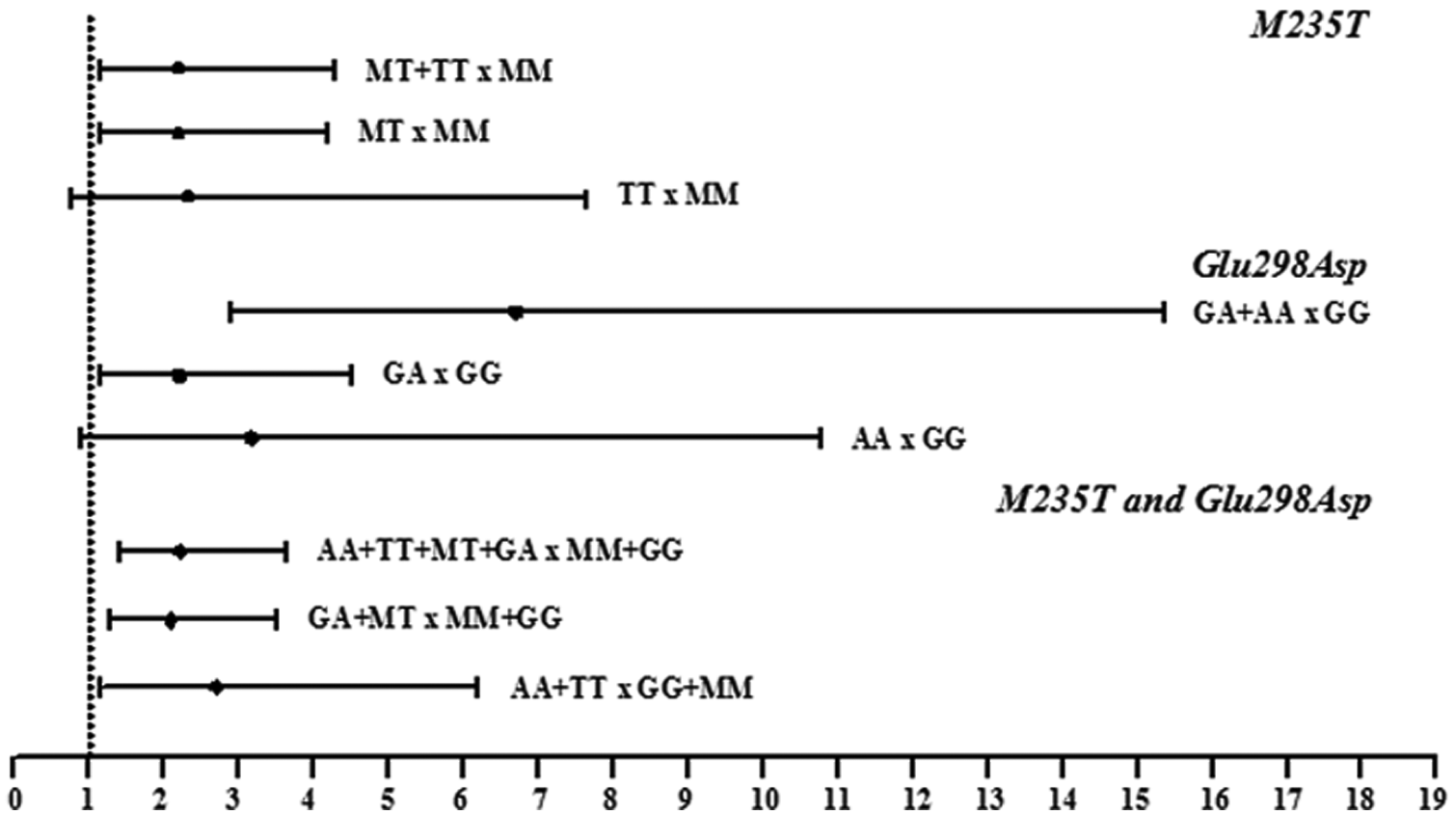
The risk of hypertension development associated with the angiotensinogen (AGT) Met235Thr and endothelial nitric oxide synthase (NOS3) Glu298Asp polymorphisms. Comparisons among genotypes, isolated and combined, for each gene are represented in the graphic. The points are calculated odds ratio (OR) ± confidence interval (CI) (95%) for 140 patients and 52 controls.
The multiple regression analysis with binomial distribution was used to verify the independence between the variables, and demonstrated that both polymorphisms were significant for the genesis of hypertension (p=0.01). Since those two genes are in different metabolic pathways, they may be considered as independent risk factors, and the ORs were calculated for the combination of the unfavourable alleles favouring the hypertension occurrence. The odds were calculated according to the combination of genotypes as follow: AA+TT vs GG+MM, OR=2.7 (1.1–6.3), GA+MT vs MM+GG, OR=2.1 (1.3–3.5) and AA+TT+MT+GA vs MM+GG, OR=2.2 (1.4–3.6) (Figure 2).
The logistic regression analysis was used to calculate the odds of the unfavourable genotypes of AGT (MT+TT) and NOS3 (AG+AA) polymorphisms in comparison to the favourable ones (MM; GG, respectively), either independently (Table 2) or in combination (Table 3). The major combination with the highest odds associated with hypertension was the smoking habit and the presence of at least one unfavourable allele for each gene (OR=102). The analysis for individual gene polymorphisms revealed that the effect of the NOS3 polymorphism was highly significant (p=0.01), and the AGT polymorphism was close to significant (p=0.06). When the conventional factors were evaluated, only smoking and HDL levels were significantly associated with both polymorphisms (Table 4).
Odds ratio for the occurrence of hypertension considering individually the alleles A and T of each polymorphism and the presence of the conventional risk factors.

p<0.05; LDL: low-density lipoprotein; HDL: high-density lipoprotein.
Odds ratio for the occurrence of hypertension considering the simultaneous presence of both alleles (T and A) and the presence of conventional risk factors.

p<0.05; LDL: low-density lipoprotein; HDL: high-density lipoprotein.
Multiple regression analysis of conventional risk factors associated with Met235Thr and Glu298Asp polymorphism effect on hypertensive patients.

p<0.05; LDL: low-density lipoprotein; HDL: high-density lipoprotein.
Using the logistic regression analysis, it was observed that the heterozygote and the homozygote for the T allele of the human Met235Thr presented 58% and 78% higher chances of developing hypertension, respectively. Similar data were seen for the Glu298Asp polymorphism, which revealed that the GA and GG genotypes presented 61% and 80% higher chances of developing hypertension. In addition, the combined polymorphisms, the double homozygote individual (TT+AA), presented a 95% increased chance of hypertension occurrence (data not shown).
The Pearson’s correlation analysis detected significant associations with an expected variable and hypertension, such as the smoking habit and hypertension (r=0.23, p<0.05). However, none of the environmental factors and laboratorial parameters was associated with polymorphisms, suggesting their independence as risk factors (data not shown).
Discussion
Essential hypertension is an important public health challenge in both economically developing and developed countries. 25 Clinically, this pathology is a highly prevalent cardiovascular risk factor and its development is associated with relevant conventional clinical parameters such as familial history, age, sedentariness, obesity, dyslipidaemia, hyperglycaemia and smoking. 26 Even in the presence of strong environmental components, the identification of disease susceptibility genes linked to hypertension may provide new insights on the prediction, progression and severity of the disease. 27 However, the effect of gene polymorphisms on hypertension has been controversial, and most of the literature have focused on the relationship between specific gene polymorphisms involved in the vascular homeostasis, including genes involved in the renin-angiotensin and kallikrein-kinin systems. In this study, we have emphasised the importance of the Met235Thr and Glu298Asp and their association with conventional risk factors predisposing to the hypertension pathogenesis because of the highly significant data from the literature involving these two polymorphisms, but most of them emphasise a one-gene effect only, with rare reports focusing on their interactions. None investigate their possible interconnection with conventional risk factors.
In this study, the conventional risk factors were highly prevalent in the hypertensive group, especially smoking habit, sedentariness, high levels of triglycerides, total and LDL cholesterol and low levels of HDL cholesterol. Previous reports28,29 have also demonstrated that hypertensive patients usually present multiple risk factors, similar to our results. In our study, only familial history of CAD and BMI were not associated with SAH. Moreover, SAH and cardiovascular diseases are not restricted to men only, and considering the hypertensive and control groups, gender frequencies were equally distributed (data not shown).
DNA polymorphisms usually have a high frequency in the population, and differences in these frequencies between affected and control groups may indicate a possible association with susceptibility to the development of the disease. Our data indicate significant frequency variations in the normotensive and hypertensive groups in the AGT and NOS3 gene polymorphisms. The presence of the allele T in the Met235Thr polymorphism (AGT) and the allele A in the Glu298Asp (NOS3) presented increased genotypic frequencies of the MT/TT and GA/AA, respectively, in the hypertensive group, whereas MM and GG genotypes were more frequent in the normotensive group. Our data agree with some studies30–32 that showed TT genotype of AGT Met235Thr was associated with essential hypertension in Caucasians. This is also supported by other studies that have shown a relationship between this genotype and blood pressure in an ethnically mixed Brazilian urban population.33,34 In relation to the Glu298Asp polymorphism, others have reported similar results, in which the A allele may determine the susceptibility to hypertension.35–38 These findings suggested a protective effect of the M and G alleles of the AGT and NOS3 genes, respectively, against the development of hypertension, whereas the T and A alleles increase the susceptibility to hypertension, respectively.
We have observed an additive effect for the T allele of the Met235Thr polymorphism, which resulted in odds 3.6-fold higher for a TT individual to develop hypertension. This result is in accordance with others reports 33 that suggested an association with genetic susceptibility of the MT and TT genotypes and with an increased risk of hypertension occurrence. Furthermore, in this study, Glu298Asp polymorphism also presented an additive effect of the A allele, in which the homozygote presented odds 4.2 times greater towards disease development, also corroborating another study. 39
The lack of correlation among conventional factors and both gene polymorphisms indicated that they all act as independent factors in the development of hypertension. For this reason, we have calculated the ORs for the combination of some conventional risk factors such as smoking, hypercholesterolaemia, sedentariness and age (>50 years) with the unfavourable alleles for AGT and NOS3 polymorphisms, individually and combined, to demonstrate their possible interaction affecting the predisposition to hypertension.
We have demonstrated a significant interaction of the T allele of the AGT gene with smoking, high level of total cholesterol and elderly persons with respect to hypertension. This is also corroborated by another study, where the TT genotype of the Met235Thr polymorphism was previously associated with an increased risk of coronary heart disease and myocardial infarction only in smokers. 40 Currently, it has also been demonstrated that the T allele of Met235Thr polymorphism increases the risk of CAD associated with the presence of hypercholesterolaemia 41 and reduced life span.34,42 Nevertheless, it has also been indicated that the unfavourable allele of the Met235Thr polymorphism had an interaction with clinical parameters, such as BMI and gender, which contributed to increased blood pressure. 34
Similarly to the AGT gene, it was also found for the NOS3 polymorphisms that the A allele had an interaction with sedentary lifestyle, and also presented a significant combination with smoking towards the development of hypertension. These data coincided with other studies that demonstrated that the GA/AA genotypes of the Glu298Asp polymorphism may increase the risk of hypertension when associated with high total cholesterol level,43–45 while the AA genotype may increase the risk of premature CAD. 46 Moreover, the combination of sedentariness and the A allele may also explain part of the increased blood pressure in hypertensive patients. These findings are in agreement with the literature, as evidenced by regular exercises that improve endothelial NO bioactivity, leading to vasodilatation and cardioprotective benefits, 47 which could be useful for AA individuals who present lower eNOS mRNA levels and enzyme bioactivity. 48 Finally, smoking seems to be the most relevant factor which, combined with the GA/AA genotype, may increase the susceptibility to SAH about 25 times, supporting the hypothesis that subgroups of the population based on genetic profiles may be at higher risk of determined diseases, as cardiovascular and cancer, when exposed to tobacco smoke. 49
In brief, we have observed a synergistic interaction between two gene polymorphisms from two different but interconnected pathways that modulate the blood pressure homeostasis and specific conventional risk factors, which may increase the predisposition of individuals to hypertension. The most important evidence was demonstrated by the simultaneous presence of both unfavourable alleles (T and A) with the smoking habit, which presented odds of 102-fold higher towards the development of hypertension. Impairment of eNOS-mediated nitric oxide biosynthesis contributes to endothelial dysfunction and promotes the development of atherosclerosis. However, numerous clinical studies evaluating potential associations between NOS3 polymorphisms and cardiovascular disease risk have been controversial. 10 Few of these studies have specifically evaluated the contribution of cigarette smoking, even though smoking may modify the influence of these polymorphisms on endothelial function. 50
Other hypertension risk factors, such as sedentariness, total cholesterol, triglycerides and age have also been described and may significantly increase the chance of occurrence. 43 Furthermore, previous epidaemiological data suggested that genetic factors are more likely to affect young rather than old people. 48 However, our results have demonstrated that elderly people with unfavorable alleles had increased odds almost 10-fold higher towards hypertension occurrence than individuals younger than 50 years of age.
Multiple logistic regression analysis of conventional risk factors associated with Met235Thr and Glu298Asp polymorphisms presented a major effect on hypertensive patients, especially for the variables of smoking habit and low levels of HDL cholesterol, suggested as the most important factors for SAH in this Brazilian Caucasian population. This is the first demonstration of the confounding and interacting effects of genotypes and conventional factors predisposing to hypertension, demonstrating that our results strengthen the hypothesis that genotypic combinations (haplotypes) are more important than single gene polymorphisms alone.
It is likely that there is an important interaction between these two gene polymorphisms, indicating that kallikrein-kinin and renin-angiotensin systems may be interconnected in regulating blood pressure homeostasis, and that the endothelial function verified in hypertensive patients is dependent on the combination of genetic and environmental factors. However, due to their independent segregation, variable frequencies in different populations, different ethnic backgrounds and confounding environment factors, their contribution to the physiological and pathological processes in SAH are expected to vary. The risk estimates in this study may allow cardiologists to apply them in the evaluation of their future patients, helping their patients to modify their lifestyles, and definitively improving strategies to prevent predicted hypertension.
Footnotes
Conflict of interest
None declared.
Funding
This work was supported by CNPq (National Agency for Scientific and Technological Development) Grant #308458/2009-5, CAPES (Brazilian Federal Agency for the Support and Evaluation of Graduate Education) Rede Nanobiotec/Brasil Project# 8/2009 and BioGenetics Molecular Technologies (Agreement UFU/BioGenetics 2002–2010).