




Abstract
Objective
We conducted meta-analysis of relevant case-control trials to determine the association between endothelial nitric oxide synthase (eNOS) intron 4a/b gene polymorphisms and hypertension susceptibility.
Methods
We searched the PubMed, Cochrane, and Embase databases using relevant keywords and reviewed pertinent literature sources. All articles published up to July 2019 were considered for inclusion. Based on the qualified studies, we performed a meta-analysis of the associations between eNOS intron 4a/b polymorphisms and the risk of hypertension.
Results
Fourteen studies were included in this meta-analysis, including 3344 cases and 3377 controls. The eNOS intron 4a/b locus was significantly associated with increased susceptibility to hypertension (including essential hypertension) in the overall population, according to dominant, allelic, homozygote, heterozygote, and regressive models, in the mixed population according to the regressive model, and in Caucasians according to the dominant, allelic, heterozygote, and regressive models. The eNOS intron 4a/b locus was also significantly associated with increased susceptibility to essential hypertension in the mixed population according to the heterozygote model.
Conclusion
eNOS intron 4a/b gene polymorphisms increase susceptibility to hypertension, including essential hypertension.
Keywords
Introduction
Hypertension is defined as a clinical syndrome involving increased systolic or diastolic blood pressure. However, in 2005, the American Society of Hypertension Writing Group proposed a new definition of hypertension as a progressive cardiovascular syndrome with many possible causes, leading to changes in the structure and function of the heart and blood vessels. Hypertension is caused by environmental factors and multiple genetic factors, and can be divided into essential hypertension (EH, accounting for more than 95% of cases) and secondary hypertension (accounting for 1%–5% of cases). In line with progress in molecular biology, the study of susceptibility genes related to blood pressure regulation has become a focus of research efforts aimed at exploring the pathogenesis of hypertension.1–4
The renin–angiotensin system (RAS) affects vascular tension, cardiovascular remodeling, and ionic balance, and is closely related to the physiological regulation of blood pressure. The RAS system elevates blood pressure and is involved in the development and maintenance of hypertension. In addition to humoral regulation dominated by the RAS, autoregulation of cardiovascular activities is also important in regulating blood pressure. This autoregulatory mechanism comprises a regulatory system in the target organ, composed of myocardial or vascular smooth muscle cells, endothelial cells, and other factors in the internal and external environments. Endothelial nitric oxide (NO) is the main endogenous vasorelaxing factor responsible for maintaining normal blood pressure and blood flow in this regulatory system, and catalyzes the production of NO synthase (NOS) genes. Endothelial NOS (eNOS) is also an important gene in the study of hypertension.5–9
The aim of this study was to perform a meta-analysis of the available literature to obtain updated evidence for the association between eNOS intron 4a/b gene polymorphisms and susceptibility to hypertension, including EH.
Materials and methods
Search strategy
We searched the Cochrane, PubMed, and Embase databases to identify studies pertaining to the associations between eNOS intron 4a/b polymorphisms and risk of hypertension, published up to July 2019. We also reviewed the references of all identified articles to detect additional studies. The search terms were: gene polymorphisms, gene, polymorphism, variant, genotype, endothelial nitric oxide synthase intron 4a/b, eNOS intron 4a/b, endothelial nitric oxide synthase, eNOS, hypertension, essential hypertension, and EH, used in combination with “AND” or “OR”. This literature review was performed independently by two investigators, with any disputes resolved by a third investigator as needed.
This meta-analysis was carried out in accordance with PRISMA guidelines. Following the Participants, Interventions, Comparisons, Outcomes and Study design (PICOS) principle, the key search terms included (P) patients with hypertension or EH; (I) detection of eNOS intron 4a/b gene polymorphisms; (C/O) comparison of gene polymorphisms of eNOS intron 4a/b between hypertension and control groups; and (S) case-control trial or cohort study.
Study selection criteria
Included studies met the following criteria: (1) case–control or cohort studies; (2) case subjects were patients with hypertension or EH; (3) control subjects were healthy people; (4) research topic eNOS intron 4a/b; and 4) article in English or Chinese language.
Studies were excluded if they met the following criteria: (1) repeat articles or results; (2) clear data errors; (3) case reports, case–control studies, theoretical research, conference reports, systematic reviews, meta-analyses, and other forms of research or comment not designed in a randomized controlled manner; (4) irrelevant outcomes or other gene loci; and (5) no control group.
Two investigators independently determined if the studies met the inclusion criteria, and disputes were resolved by a third investigator as needed.
Data extraction and quality assessment
Basic information and information on primary study outcomes were extracted for each included study. Basic information relevant to this meta-analysis included author names, year of publication, country, disease type, and sample size. Primary clinical outcomes included frequencies of eNOS intron 4a/b genotypes in case and control groups. Data extraction was performed independently by two investigators, with disputes resolved by a third investigator as needed.
Statistical analysis
All analyses were carried out using Stata v12.0 (StataCorp LP, College Station, TX, USA). Heterogeneity among the study results was assessed by χ2 and I2 tests, and appropriate analysis models (fixed-effect or random-effect) were determined; a χ2 P ≤ 0.05 and an I2 > 50% indicated high heterogeneity and a random-effects model was used in this case, while a χ2 P > 0.05 and an I2 ≤ 50% indicated acceptable heterogeneity and a fixed-effects model was used. Egger’s and Begg’s tests were used to detect publication bias. If the Hardy–Weinberg equilibrium (HWE) genetic balance test was not reported in the original text or was not performed in the control group, we carried out manual detection using Stata v12.0 and extracted the corresponding results (P value). The meta-analysis was carried out using five commonly used gene models: allelic model (a vs b); homozygote model (aa vs bb); heterozygote model (ab vs bb); dominant model (aa + ab vs bb); and regressive model (aa vs ab + bb). Odds ratios (ORs) and 95% confidence intervals (CIs) were used to analyze all the indexes. We also performed subgroup analyses according to overall,10–23 mixed,12,16,19,21 Caucasian,10,14,18,22 Black, 18 Asian,15,20,23 and HWE.
Results
Overview of included studies
We reviewed 735 articles identified by our initial keyword search, of which 643 were excluded following title/abstract review. The remaining 92 articles were subject to a complete full-text assessment, and 78 further articles were excluded for failing to meet the study inclusion criteria. The reasons for exclusion were: no clinical outcomes (n = 34), repeated articles (n = 11), without control group (n = 17), and no qualified patients (n = 16). We ultimately identified 14 case–control studies10–23 that met the inclusion criteria for this meta-analysis, including 3344 cases and 3377 control patients. The study selection process is outlined in Figure 1. The basic information for each study, including author names, year of publication, country, disease types, and sample size are summarized in Table 1.
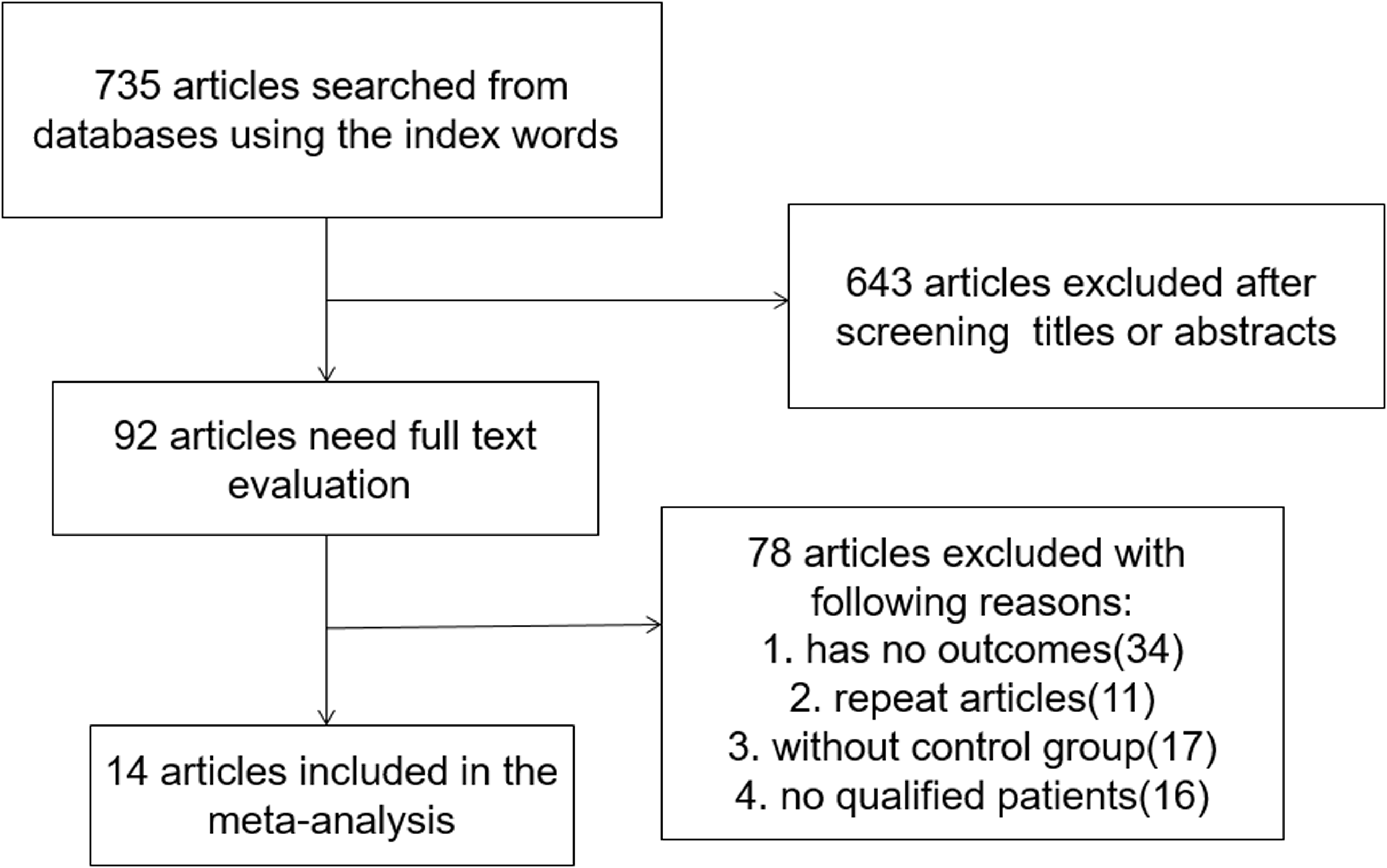
Literature search and selection strategy.
Basic characteristics of included studies.

Meta-analysis of eNOS intron 4a/b polymorphisms and hypertension (including EH) susceptibility
All the included studies reported on the association between eNOS intron 4a/b polymorphisms and hypertension susceptibility. The results of the meta-analysis are shown in Table 2 and Figure 2. The eNOS intron 4a/b a locus was significantly associated with increased susceptibility to hypertension (including EH) in the overall population according to all the tested models, in the mixed population according to the regressive model, and in Caucasians according to the dominant, allelic, heterozygote, and regressive models. The association was also significant in both HWE and no-HWE studies according to all the models.
Meta-analysis of endothelial nitric oxide synthase intron 4a/b polymorphisms and susceptibility to hypertension, including essential hypertension.

*P value for heterogeneity (χ2); #P value of pooled statistic.
OR, odds ratio; CI, confidence interval; HWE, Hardy–Weinberg equilibrium.

Forest plots for dominant model of endothelial nitric oxide synthase (eNOS) intron 4a/b polymorphisms associated with hypertension and essential hypertension (EH). Forest plots for dominant model of eNOS intron 4a/b polymorphisms associated with hypertension and EH according to (a) subgroup and (b) Hardy–Weinberg equilibrium.OR, odds ratio; CI, confidence interval, HWE, Hardy–Weinberg equilibrium.
The results of Begg’s and Egger’s tests suggested no significant publication bias among the study results (Figure 3).

Funnel plot analysis of all included studies.OR, odds ratio; s.e., standard error.
Meta-analysis of eNOS intron 4a/b polymorphisms and EH susceptibility
Seven studies including 2120 cases and 2147 controls reported on the association between eNOS intron 4a/b polymorphisms and EH susceptibility. The results of the meta-analysis in relation to EH are shown in Table 3 and Figure 4. The eNOS intron 4a/b a locus was significantly associated with increased susceptibility to EH in the mixed population according to the heterozygote model, and in the no-HWE studies according to all models. However, there was no significant association between eNOS intron 4a/b a locus and EH susceptibility in the overall population according to any of the models.
Meta-analysis of endothelial nitric oxide synthase intron 4a/b polymorphisms and susceptibility to essential hypertension.

*P value for heterogeneity (χ2); #P value of pooled statistic.
OR, odds ratio; CI, confidence interval; HWE, Hardy–Weinberg equilibrium.

Forest plots for dominant model of endothelial nitric oxide synthase (eNOS) intron 4a/b polymorphisms associated with essential hypertension (EH). Forest plots for dominant model of eNOS intron 4a/b polymorphisms associated with EH according to (a) subgroup and (b) Hardy–Weinberg equilibrium
The results of Begg’s and Egger’s tests indicated no significant publication bias among the study results (Figure 5).
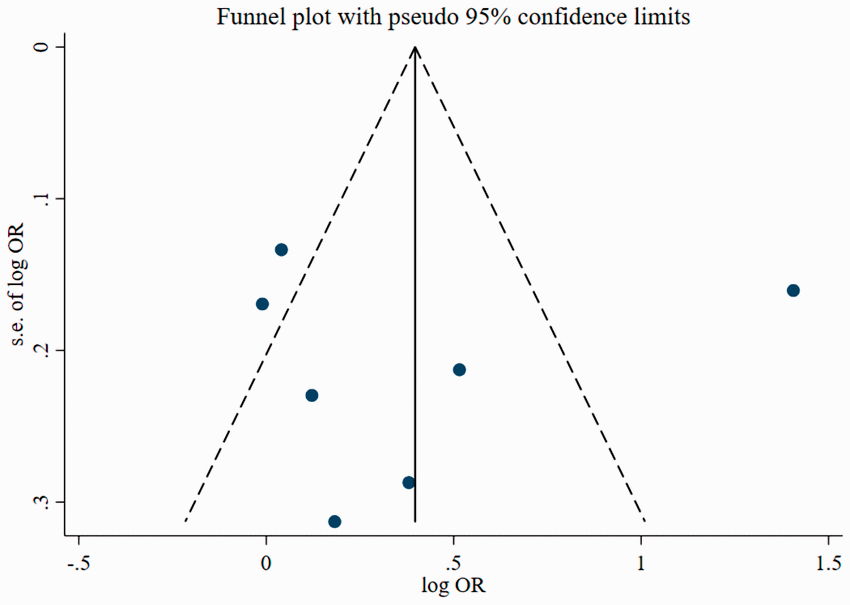
Funnel plot analysis of included studies for essential hypertension.
Discussion
NO is a fat-soluble gaseous free radical with a short half-life, simple structure, and active properties. It has a molecular weight of 30 kD and can diffuse through the cell membrane. NO has a wide range of biological actions in the human body, including reducing vascular permeability, resisting platelet aggregation and leukocyte adhesion, relaxing blood vessels, promoting angiogenesis, and regulating nerve function. NO is produced by a variety of tissue cells in the human body, such as cardiomyocytes, vascular endothelial cells, and neurons. Endogenous NO is mainly present in vascular endothelial cells and macrophages and is produced by L-arginine, catalyzed by NOS. There are three types of NOS in the human body: eNOS, present in vascular endothelial cells; neuronal NOS expressed in normal states and mainly distributed in human neurons; and inducible NOS, which is inductively expressed in the body after injury and is distributed in human lymphocytes and other immune cells. eNOS is mainly present in platelets, vascular endothelial cells, and renal tubular epithelial cells. During NO synthesis, glutamate binds to and activates the N-methyl-D-aspartic receptor on the cell membrane, leading to Ca2+ influx and activation of calcium-dependent eNOS and NOS, which use arginine as a substrate and oxygen to produce NO and citrate. In vascular endothelial cells, NO can relax vascular smooth muscle, inhibit endothelial cell proliferation, relax blood vessels, and regulate blood pressure.
The eNOS gene is located in the p35–p36 region on the seventh pair of chromosomes, with a total length of about 21 kb. It contains 26 exons and 25 introns, and its encoded mRNA can be translated into 1203 amino acids. In normal physiological states, the continuous production of endogenous NO in the human body is mainly regulated by eNOS. Polymorphisms of the eNOS gene thus affect the concentration of NO in the body by altering the functions of eNOS. The studies of eNOS gene polymorphisms related to EH in the current meta-analysis mainly included the G894T mutation on exon 7 24 , the variable number of tandem repeats (VNTR) in the fourth intron, and the T786C mutation located in the eNOS promoter region. 25 The eNOS gene has an approximately 27-bp VNTR on the 4th intron, which can be divided into two alleles according to the number of repeats: the a allele is repeated four times and the b allele is repeated five times.
Uwabo et al 25 studied the relationship between the eNOS 27-bpVNTR polymorphism and EH in a population north of Tokyo, and showed that the frequency of the a allele was significantly higher in the EH group compared with the control group, whereas logistic regression analysis suggested that the a allele might be a genetic marker of EH in Japanese patients. The current study showed that the eNOS intron 4a/b a locus was significantly associated with increased susceptibility to hypertension in the overall population and in Caucasians according to the dominant and heterozygote models, in the Black population according to the heterozygote model, and in the mixed population according to the allelic model. The eNOS intron 4a/b a locus was also significantly associated with an increased risk of EH in the overall population according to the dominant and heterozygote models, in the mixed population according to the heterozygote and allelic models, and in Asians according to the heterozygote model.
No previous meta-analyses have reported on the associations between eNOS intron 4a/b gene polymorphisms and susceptibility to hypertension and EH. Fan et al. 26 reported that the rs2241766 polymorphism was associated with a significant increase in hypertension risk while the rs1501299 polymorphism might play a protective role against hypertension in Caucasians. Jiao et al. 27 found that the serotonin transporter (5-HTT) L/S polymorphism and endothelin 1 (END1) rs5370 polymorphism were correlated with significantly increased risks of pulmonary arterial hypertension (PAH), whereas the 5-HTT L allele increased susceptibility to idiopathic PAH and PAH in chronic obstructive pulmonary disease. Wang et al. 28 concluded that there were no significant relationships between the atrial natriuretic peptide (ANP) T2238C and G1837A gene polymorphisms and the risk of EH, but conversely, the ANP T1766C gene polymorphism may be associated with the risk of EH, while the 1766C allele might protect against EH.
In the current meta-analysis, the eNOS intron 4a/b a locus was significantly associated with an increased risk of hypertension (including EH) in the overall population according to all the tested models, in the mixed population according to the regressive model, and in Caucasians according to the dominant allelic, heterozygote, and regressive models, respectively. However, the eNOS intron 4a/b a locus was only significantly associated with increased EH susceptibility in the mixed population according to the heterozygote model.
The results of studies on the relationships between EH, gestational hypertension, and eNOS gene polymorphisms are not consistent, and show ethnic and regional differences. Moreover, most studies have focused on a single gene locus, while few studies focused on the simultaneous actions of multiple gene loci.27,28 However, continuous development and progress in molecular biology technology means that different animal models can be designed for further study of EH-related genes, and large-sample multi-gene loci studies can be carried out in different regions and ethnic groups to obtain more reliable results, in line with the need to clarify the pathogenesis and provide more effective treatments for hypertension. Although we tested for heterogeneity among the included studies in this meta-analysis using χ2 and I2 tests, the number of studies was limited, and more studies with larger samples in different ethnic groups and different geographic regions are needed.
The current study had certain limitations: (1) only English and Chinese articles were included; (2) individual studies had different exclusion/inclusion criteria; (3) the severities of hypertension, EH, and GH differed among the studies; (4) the number of studies was limited, especially in relation to GH; and (5) pooled data were analyzed because individual patient data were not available, thus precluding more in-depth analyses.In conclusion, the current meta-analysis determined that eNOS intron 4a/b gene polymorphisms may affect the susceptibility to hypertension, including EH.
Supplemental Material
sj-pdf-1-imr-10.1177_0300060520979230 - Supplemental material for Association of endothelial nitric oxide synthase intron 4a/b gene polymorphisms and hypertension: a systematic review and meta-analysis
Supplemental material, sj-pdf-1-imr-10.1177_0300060520979230 for Association of endothelial nitric oxide synthase intron 4a/b gene polymorphisms and hypertension: a systematic review and meta-analysis by Xiru Xu, Woruo Ye, Hanqing Chen, Ming Liu, Weimin Jiang and Zhuyuan Fang in Journal of International Medical Research
Footnotes
Declaration of conflicting interest
The authors declare that there is no conflict of interest.
Funding
The author(s) disclosed receipt of the following financial support for the research, authorship, and/or publication of this article: This work was supported by the Jiangsu Province’s Outstanding Traditonal Chinese Medical Academic Leader Program (SLJ0201); and A Project Funded by the Priority Academic Program Development of Jiangsu Higher Education Institutions ([2018]87).

References
Supplementary Material
Please find the following supplemental material available below.
For Open Access articles published under a Creative Commons License, all supplemental material carries the same license as the article it is associated with.
For non-Open Access articles published, all supplemental material carries a non-exclusive license, and permission requests for re-use of supplemental material or any part of supplemental material shall be sent directly to the copyright owner as specified in the copyright notice associated with the article.
