



Abstract
Emotions are recognized as essential factors in learning activities, and self-regulation is considered an essential element in learning. Both emotions and self-regulation are theorized to contribute to critical thinking, which is a multidimensional concept comprising a set of skills and dispositions. However, empirical research on the interrelations between these concepts is scarce. In the present study, the participants were 2,404 undergraduate students from 18 Finnish higher education institutions. Students’ achievement emotions and self-regulation were measured with a self-report survey, and critical thinking with a performance task. The data were analyzed using structural equation modeling. The findings highlight that especially activating emotions are significant in a low-stakes test situation. Excitement, a pleasant activating emotion plays a crucial role in such a context. However, self-regulation did not show a strong association with test performance and did not add to the effect of emotions on test performance.
Introduction
Critical thinking has been theorized to be interlinked with affective and attitudinal dispositions (Bensley et al., 2016; Elen & Verburgh, 2023; Facione, 1990; Hyytinen et al., 2024). In a similar vein, control-value theory suggests that achievement emotions are associated with student performance, such as performance on critical thinking tests, and self-regulation (Pekrun & Perry, 2014). Likewise, theories on the self-regulation of learning indicate that affective factors are included in its influence on performance (Zimmerman & Schunk, 2011). However, empirical research on the associations between these concepts has been scarce. Instead, the concepts of critical thinking, self-regulation, and achievement emotions are often studied as distinct phenomena, and there is surprisingly little dialogue between these traditions (cf. Bensley et al., 2016; Hyytinen et al., 2021, 2024; Rear, 2019). Admittedly, these interlinked concepts create a complex ensemble. Adding to the complexity are the reciprocal links that are theorized between them. In other words, emotions or self-regulation not only influence performance, but performance also creates emotions and shapes self-regulation. However, a thorough understanding of student performance requires a holistic approach, combining these concepts in research designs. In the present study, we aim to gain insights into the interplay between the complex phenomena of emotions and self-regulation of learning during students’ performance in a critical thinking test.
Achievement Emotions During Test Performance
Emotions have been recognized as essential factors in learning activities. Often called achievement emotions, they are affects that occur during a range of learning activities, such as studying or test-taking, or in situations that focus on the outcomes of those activities (Pekrun & Perry, 2014). Such emotions include not only affects but also expressive, physiological, cognitive, and motivational aspects (Frenzel & Stephens, 2013). Consequently, the activation of achievement emotions is based on contextual factors and students’ appraisal of the situation – namely, their perceived control over the required activities and the value they place on those activities (Pekrun, 2006; Pekrun & Perry, 2014).
Traditionally, emotions have been differentiated by their valence. While the concepts of positive and negative are often used for valence, pleasant, and unpleasant are more accurate terms (see, e.g. Harmon-Jones & Harmon-Jones, 2016; Pekrun & Perry, 2014; Watson & Tellegen, 1985). More recently, other dimensions of emotions have been considered, such as the degree of activation and focus (see taxonomies in Feldman Barrett & Russell, 1998; Pekrun & Perry, 2014). The degree of activation of emotions refers to the physiological effects (e.g. arousal) of emotions, namely, whether they are activating or deactivating (Pekrun & Perry, 2014; Watson & Tellegen, 1985). Thus, for example, excitement can be characterized as an activating and pleasant emotion, while stress and frustration are activating and unpleasant emotions. Calmness, on the other hand, is a deactivating and pleasant emotion. Additionally, focus refers to the phase of the learning process that activates the emotion, namely, whether the emotions spring from the activity (prospective) or the outcome (retrospective; Camacho-Morles et al., 2021; Pekrun & Perry, 2014). Consequently, emotions that spring from the experience of test-taking, for example, are activity emotions, while emotions that spring from the outcome of a test, for example, are outcome emotions. Other contextual factors influence emotions as well (Pekrun & Perry, 2014), such as the status of the required performance – in the present study, a low-stakes assessment (see also Bensley et al., 2016).
The dimensions of achievement emotions make a difference in how they are linked to student performance (e.g. Pekrun et al., 2002). Research has found that activating pleasant emotions are beneficial for performance, and deactivating unpleasant emotions are detrimental (Camacho-Morles et al., 2021; Pekrun et al., 2002). However, findings are more contradictory when it comes to deactivating pleasant emotions and activating unpleasant emotions. For instance, a recent meta-analysis showed contradictory findings regarding activating unpleasant emotions, with frustration having no effect while some other similar emotions did have a quite strong effect (Camacho-Morles et al., 2021). The link between emotions and performance is not one-directional; earlier performance also has an influence on emotions (e.g. Pekrun & Perry, 2014). Additionally, emotions can be self-regulated (Efklides et al., 2017; Zimmerman & Schunk, 2011), making the three aspects tightly intertwined (see Figure 1).

The interconnected and multi-directional relationship between performance, emotions, and self-regulation (based on, e.g. Pekrun, 2006).
While student emotions are assumed to be associated with student performance, the origins of these emotions cannot be dismissed. According to control-value theory, one of the important aspects behind achievement emotions is the value given to the performance. The test characteristics are a factor in this process (see Wass et al., 2020), and the test status is one of these characteristics. Some students likely do not value low-stakes test performance, while for others, an intrinsic interest in the task heightens its value. The perceived task value is linked not only to emotions, but also to the choices students make (Eccles & Wigfield, 2002). It follows that students’ test-taking motivation to complete low-stakes assessment tasks is often lower in comparison with high-stakes tasks, because low-stakes assessment tasks have no personal consequences for the students (Silm et al., 2019; Wass et al., 2020; Wolgast et al., 2020). Furthermore, students may see a low-stakes situation as one that they do not have control over. In contrast, an environment that encourages students’ active contribution and autonomy can foster activating emotions and in turn have positive effects on outcomes (e.g. Jones & Bursens, 2015).
Self-Regulation of Learning and Its Link With Achievement Emotions
Self-regulation of learning refers to the intentional management of one’s learning, including planning and monitoring both behaviors and emotions (Beckman et al., 2021; Zimmerman, 2002). Strong and comprehensive self-regulation skills are essential for student learning and development in university studies. Earlier research has identified task analysis and goal-setting, strategy use and monitoring, and reflection (Puustinen & Pulkkinen, 2001) as key phases or elements of self-regulated learning, which operate simultaneously in authentic learning situations (Saariaho et al., 2018). These key elements of self-regulation are especially important in active skillful learning which requires student’s effort, as well as in managing and directing learning intentionally. Self-regulation of learning, including cognitive, behavioral, motivational, and emotional aspects and processes (Efklides et al., 2017; Pintrich, 2004), has been identified as an essential precondition for active and intentional learning (Zimmerman & Schunk, 2011). It has also been found to be linked with strong self-efficacy (Bandura, 1997) and higher academic performance (Mega et al., 2014).
As stated above, the link between emotions, self-regulation of learning and academic performance is reciprocal (Lazarus, 1991; Pekrun & Linnenbrink-Garcia, 2012). Thus, while emotions can be regulated, they also play an essential role in active and intentional self-regulation of learning (Pekrun et al., 2002). For instance, pleasant activating emotions may facilitate self-regulated learning, and engagement in the task furthers it (Pekrun & Linnenbrink-Garcia, 2012). While earlier research has suggested that self-regulation of learning mediates the effects of emotions on performance (Efklides et al., 2017; Pekrun et al., 2002), empirical evidence of the interplay between self-regulation of learning and emotions is scarce (Pekrun & Stephens, 2010) and mixed in nature. For instance, it is not clear whether the ability to regulate emotions is positively or negatively linked with performance (Wolters, 2003). It appears that pleasant activating emotions often co-occur with self-regulatory activities such as planning and monitoring (Saariaho et al., 2018), but it is unclear whether there is a causal link between them.
Critical Thinking Performance and Its Link With Self-Regulation of Learning and Achievement Emotions
Critical thinking is a complex and multidimensional phenomenon (Elen & Verburgh, 2023) that involves active engagement with the topic matter. It also entails a deep approach to learning, where the students seek to understand different points of views and make connections rather than just memorizing facts (Hyytinen et al., 2018). The term “critical thinking” is commonly understood as self-regulative thinking that involves a set of skills and the dispositions to use these skills (Elen & Verburgh, 2023; Halpern, 2014; Hyytinen et al., 2024). Previous research has identified several skills that are needed to be able to think critically: elaborating the problem or situation; evaluating the trustworthiness of information associated with a situation; identifying biases; applying that information to solve a problem and to reach a well-reasoned conclusion; and communicating it effectively to others (Hyytinen & Toom, 2019; Shavelson et al., 2018). Students with critical thinking can understand the links between various assumptions and ideas, and they are flexible in considering different perspectives. They can also determine the relevance of information, find explanations, and provide justifications for their conclusions (Facione, 1990; Shavelson et al., 2019).
Theories on critical thinking present links with both self-regulation and emotions. Critical thinking is said to be intertwined with affective and attitudinal dispositions (Arum & Roksa, 2011; Bensley et al., 2016; Elen & Verburgh, 2023; Hyytinen et al., 2024; Liu et al., 2016). It has been suggested that emotions play an important role as a moderating factor in critical thinking (Loon & Bell, 2018). Additionally, the concept of critical thinking is often associated with the concepts of reflection and self-regulation (Bensley et al., 2016; Halpern, 2014; Hyytinen et al., 2024), and self-regulation is considered to play a crucial role in facilitating the complex process of critical thinking (Bensley et al., 2016; Lau, 2015). However, it is noteworthy that while evidence points to achievement emotions and self-regulation predicting critical thinking performance, experiences of prior performance shape emotions and self-regulation as well (Pekrun & Perry, 2014; Zimmerman, 2002). The theoretical links between self-regulation and achievement emotions appear even more complex, as it has been suggested that the links between these phenomena are multidirectional (Pekrun & Perry, 2014; Zimmerman, 2002). In other words, emotions influence self-regulation and vice versa. This complexity poses a challenge for any research design striving to explore the nature of these relationships. Moreover, these phenomena do not exist in a vacuum but are, in turn, influenced by the context and environment (e.g. Pekrun & Perry, 2014), such as a low-stakes test situation or active learning environment.
Although the relationship between critical thinking, self-regulation, and emotions is often theorized, only a few earlier studies have explored the associations between these three concepts, providing empirical evidence (Bensley et al., 2016; Hyytinen et al., 2024; Rivas et al., 2022). In addition, it is rare for all three concepts to be included in one study. In general, pleasant emotions such as enthusiasm and enjoyment have been found to be related to self-regulation and critical thinking, while negative emotions tend to hinder the use of these strategies (Acosta-Gonzaga & Ramirez-Arellano, 2021; Chevrier et al., 2019). Studies indicate that self-regulation has a positive link with critical thinking performance (Hyytinen et al., 2024; Rivas et al., 2022), and overall competence when students’ active engagement is required (P. Virtanen et al., 2017). It has also been found that test-taking effort and time are mediating variables in this association (Hyytinen et al., 2024). In a similar vein, high emotion regulation has been linked with strong critical thinking (Namaziandost et al., 2023). Findings on the association between emotions and critical thinking are more mixed. It is not surprising, in light of research on emotions and performance, that studies have found that neutral and positive emotions, such as curiosity, predict critical thinking, while negative emotions, such as boredom, are negatively related to critical thinking (Chevrier et al., 2019). However, in a recent study, confusion and anxiety were found to be positively associated – and frustration negatively associated – with critical thinking among higher education students (Muis et al., 2021).
In sum, previous research demonstrates the critical role of emotions in explaining critical thinking and self-regulation among higher education students (Acosta-Gonzaga & Ramirez-Arellano, 2021; Chevrier et al., 2019; Loon & Bell, 2018; Muis et al., 2021). However, more research is needed to fully understand the complex and reciprocal relationships between these concepts.
Aims
The aim of this study was to explore the interplay between achievement emotions and self-regulation of learning in a performance test situation, and their link with test performance. The association was explored in a low-stakes test measuring students’ critical thinking.
Based on previous research, our hypotheses were as follows (see also Figure 2):

Measurement model of the associations between achievement emotions, self-regulatory monitoring and planning, and critical thinking test performance.
Materials and Methods
Participants and Data Collection
The data were gathered as part of a project funded by the Ministry of Education and Culture in 2019 (Ursin & Hyytinen, 2022). The participants were undergraduate students (n = 2,402) from 18 (of 35) Finnish higher education institutions. The response rate was 25%. The data consisted of 49% male, 48% female, and 2% individuals who did not wish to state their gender. The data were not fully representative of the gender distribution in Finnish higher education (Vipunen, 2022) as female students were underrepresented. The median age of the participating students was 23 years. Participation to the study was voluntary, and informed consents were obtained from the participants. The ethical principles of research with human participants in the human sciences in Finland were adhered to in the project (TENK, 2019), and according to those principles, no approval by an ethical board was required.
Measures
After students completed a performance test assessing critical thinking (see below), they were asked to fill out a background questionnaire, including several self-report scales.
The participants were asked to reflect on four emotions experienced during the performance, using a five-point scale (from totally disagree to totally agree). The emotions included “stress,” “frustration,” “excitement,” and “calmness.” The first two were activating unpleasant emotions; the third, an activating pleasant emotion; and the fourth, a deactivating pleasant emotion. Thus, three of the four possible dimensions of emotions were present.
The participants were also asked to reflect on their self-regulation of learning. An adapted version of the Self-Regulation of Learning Self-Report Scale (SRL-SRS; Toering et al., 2012) was used, comprising nine items rated on a five-point scale (from totally disagree to totally agree). The items formed two scales measuring dimensions of self-regulation, namely planning and monitoring. A confirmatory factor analysis was conducted for the scales; they were an acceptable fit (RMSEA = 0.07; CFI = 0.96; TLI = 0.94; SRMR = 0.05).
Students’ critical thinking was measured using a low-stakes performance task (henceforth PT) from the CLA+ International (Collegiate Learning Assessment; Van Damme & Zahner, 2022; Zahner & Ciolfi, 2018). The open-ended PTs of critical thinking tend to simulate activating real-life critical thinking processes, which allow assessment of multiple perspectives associated with the situation, interpreting information, and reaching and justifying decisions by using the available evidence (Hyytinen & Toom, 2019; Shavelson et al., 2019). The PT was translated and adapted to the Finnish context following the International Test Commission’s (2018) guidelines, including double translation, reconciliation, review, and cognitive labs (Ursin et al., 2022). Students had 60 min to complete the PT, which measures three constructs of critical thinking: analysis and problem solving, writing effectiveness, and writing mechanics. Analysis and problem-solving (APS) refers to students’ ability to utilize, analyze, and evaluate the information provided in the task and to reach a conclusion. Writing effectiveness (WE) refers to the ability to elaborate and provide written arguments that are well-constructed and logical, while writing mechanics (WM) refers to the ability to produce a well-structured text. Each of these three constructs was scored on a six-point scale by two trained scorers. The correlation between the two scorers’ scores was acceptable (APS r = .71, WE r = .71, WM r = .70). If the difference between the scorers’ scores was more than two points, a third scorer resolved the discrepancy. The internal structure of the PT has been tested and reported in a previously published study (Kleemola et al., 2022).
Analysis Methods
Structural equation modeling was used to analyze the data. The goodness of fit of the tested model was assessed using fit indices according to Hu and Bentler’s (1999) cutoff criteria: RMSEA <0.06, CFI ≈0.95, TLI ≈0.95, and SRMR<0.08. Mplus version 8.4 was used (Muthén & Muthén, 2017).
Results
We tested the model presented in Figure 2 above. The model fit was good (RMSEA = 0.04; CFI = 0.96; TLI = 0.95; SRMR = 0.04). The model explained 15% of the variation in critical thinking test performance, 13% of the variation in monitoring, and 25% of the variation in planning. The resulting model is presented in Figure 3.
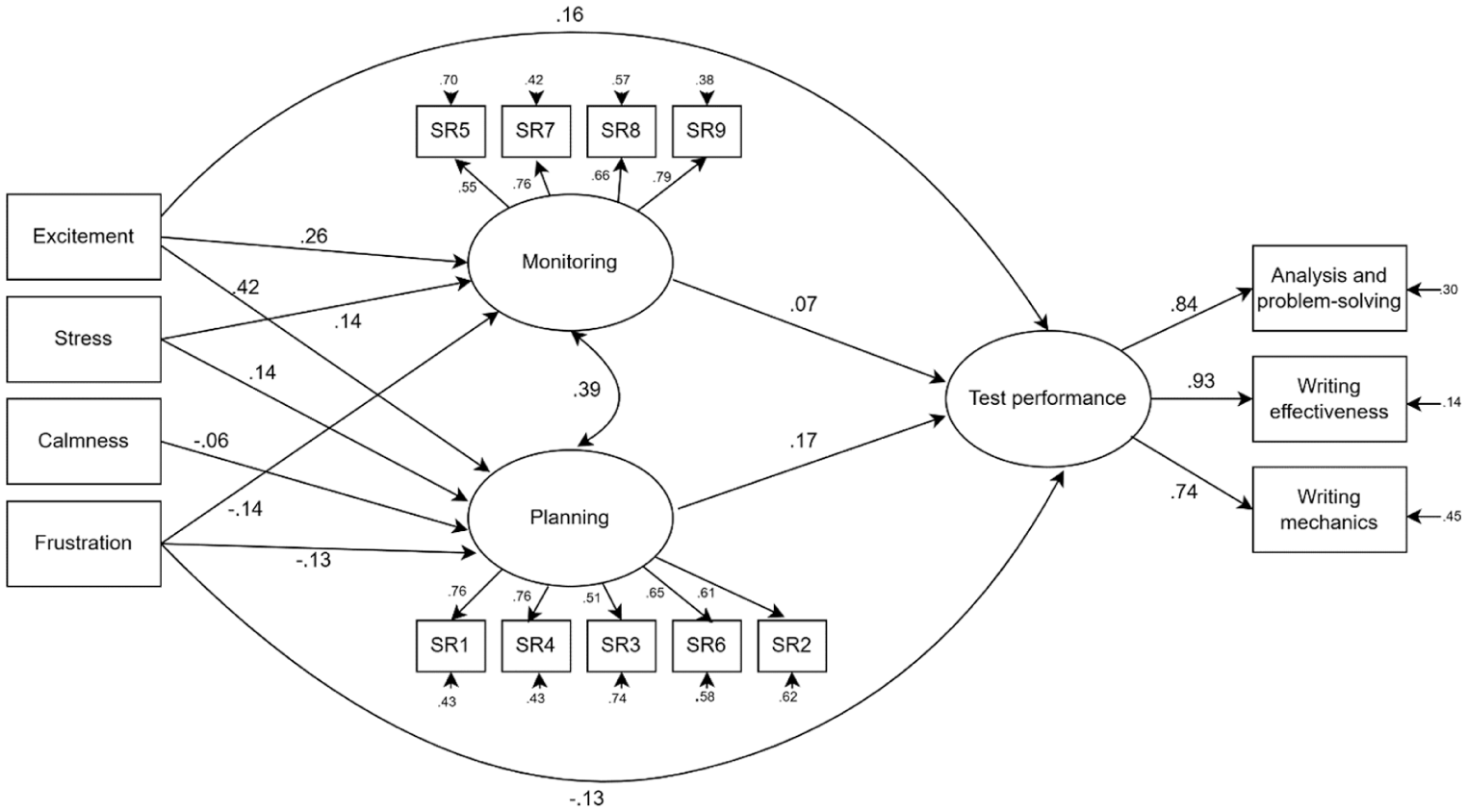
Significant standardized coefficients.
Achievement Emotions and Self-Regulatory Monitoring and Planning
Our first hypothesis proposed that achievement emotions would be associated with self-regulatory monitoring and planning. Our model (Figure 3) shows that there is a relatively strong positive association between excitement about the test situation and both monitoring (β = .26, p < .001) and planning (β = .42, p < .001), indicating that the more excited the student was, the more they monitored and planned their work. There is also a small positive association between stress regarding the test situation and monitoring (β = .14, p < .001) and planning (β = .14, p < .001), indicating that the more stressed the student was, the more they monitored and planned their work. In contrast, a small negative association was detected between frustration concerning the test situation and monitoring (β = −.14, p < .001) and planning (β = −.13, p < .001), indicating that the more frustrated the student was, the less they monitored and planned their work. Calmness in the test situation, however, had only a nominal positive association with planning (β = .06, p = .024) and no significant association with monitoring. In conclusion, our findings partly confirm our first hypothesis: excitement, stress, and frustration are associated with self-regulatory monitoring and planning; calmness does not.
Achievement Emotions and Critical Thinking Test Performance
Our second hypothesis predicted that achievement emotions would be associated with critical thinking test performance. We examined both direct and indirect effects of these emotions. Excitement about the test situation had the strongest total effect on critical thinking test performance (β = .25, p < .001). The direct effect (β = .16, p < .001) was increased by nominal indirect effects through monitoring (β = .02, p = .016) and planning (β = .07, p < .001). Thus, the more excited the student felt, the better their performance was in the test. In contrast, frustration with the test situation had a small negative total effect on critical thinking test performance (β = −.16, p < .001). The effect consisted almost entirely of a direct effect (β = −.13, p < .001), with only nominal indirect effects from monitoring (β = −.01, p = .024) and planning (β = −.02, p < .001). Thus, the more frustrated the student felt, the weaker their performance in the test. Stress had only a nominal total effect on critical thinking performance (β = .08, p = .003). The direct effect was not significant, and indirect effects through monitoring (β = .01, p = .028) and planning (β = .02, p < .001) were almost nonexistent. No significant association was found between calmness in the test situation and test performance. In conclusion, our hypothesis was partially confirmed and partially refuted. Excitement, as a pleasant activating emotion, was positively associated and frustration negatively associated with critical thinking test performance with only nominal indirect effects via self-regulation. However, no association was found in unpleasant activating emotion stress or the de-activating emotion of calmness.
Self-Regulatory Monitoring and Planning and Critical Thinking Test Performance
Our third hypothesis suggested that self-regulatory monitoring and planning would be associated with critical thinking test performance. Our model (Figure 3) shows that there is only a nominal association between test performance and monitoring (β = .07, p = .013) and a small association between test performance and planning (β = .17, p < .001). Thus, although the findings provide some support for our hypothesis, it is not very strong.
Discussion
Findings in Relation to Previous Research
The present study aimed to explore higher education students’ achievement emotions and self-regulation in a performance test situation, and their association with critical thinking test performance. The findings provide valuable insights into how achievement emotions and self-regulation in a test situation interact with each other, and how they are associated with low-stakes critical thinking test performance.
First, we explored the association between achievement emotions and self-regulation of learning, assuming that they are associated with each other (
Second, we investigated achievement emotions in relation with critical thinking test performance, assuming that they are associated with each other (
Third, we explored the association between self-regulation of learning and critical thinking test performance, assuming that they are associated with each other (
Our findings show the complexity of the phenomena at hand. Such complexity comes as no surprise, as it has been suggested both by theory (e.g. Pekrun & Perry, 2014) and by conclusions drawn in other studies (e.g. Chevrier et al., 2019; Muis et al., 2021). However, the complexity and the multidirectional nature of associations make the topic methodologically challenging. Consequently, no research design is able to capture all aspects, and the reciprocal nature of associations and the cross-sectional study design may have obscured some of the associations we expected to find. Future studies should focus on finding methods to reliably investigate such reciprocal associations. For instance, longitudinal study designs could reveal more about the complex associations.
Only 25% of the invited students participated in the study, and the reasons behind decisions on participation are not known. Thus, the findings may be biased in two ways. First, it is possible that the students with weaker critical thinking skills decided to opt-out of the assessment, thus distorting the critical thinking test performance findings. Second, the voluntary decision to participate may have influenced students’ emotional states.
Methodological Reflections
While our study used performance-based assessment to measure critical thinking, emotions, and self-regulation were measured using self-report surveys. This is a limitation of our findings, as it is possible that students had difficulties reflecting on their emotions in the survey administered after completing the actual test. Future research should use more advanced methods, such as stress-level measurements with smart rings during test performance, which would provide more reliable information about arousal levels compared with self-reports.
The critical thinking test used in the study was considered by some students to be relatively easy and they did not need to put much effort into completing it. It is possible that this explains the low or non-existent associations between our self-regulation measures and test performance. It has been shown that students’ regulation of learning and the effort they put in are linked to task difficulty (Efklides et al., 2017). The more demanding the task, the more complex thinking processes are activated and the more regulation of learning is required (see, e.g. Hyytinen et al., 2021). At the same time, the task should not be too difficult, as overly challenging tasks can decrease students’ motivation and effort (Efklides et al., 2017) and activate negative emotions that can be harmful for learning (see Wass et al., 2020). Consequently, future research should consider that the difficulty of the test may influence findings and focus on creating a test that corresponds to students’ skills.
Practical Implications
Finally, our study has practical implications for how teachers can support their students’ learning and understanding. While our focus was on critical thinking test performance, our findings give insights to broader situations of teaching and learning in higher education contexts. Many skills and knowledge in higher education are similar in complexity to critical thinking, requiring active engagement and deep approach in order to learn (see, e.g. Hailikari et al., 2022; Tuononen et al., 2020; A. Virtanen & Tynjälä, 2019). Teachers should be aware of the complex interplay between emotions and self-regulation, and their influence on student performance and deep learning. Our findings give insights in the development of active learning pedagogies even though our study was not conducted in a classroom environment, and its findings do not translate directly to pedagogical practices. In order to provide more practical suggestions, future research should create pedagogical interventions and study their effectiveness.
First, teachers should put effort into fostering positive emotional states. Our findings are in line with suggestions that active engagement with learning requires a supportive environment. Excitement as a pleasant activating emotion turned out to be important to student performance in the low-stakes situation that our critical thinking test was. Although our study focused on a test situation, many everyday classroom activities can also be considered similarly low-stakes events. In these situations, teachers should emphasize a positive classroom environment conducive to active learning. This could be achieved, for example, through allowing emotions to be explicit, and discussing them with students. We also assume that openness with emotions and fostering positive emotional states in the classroom interaction may be critically important for student learning from the viewpoint of emotional contagion (Hatfield et al., 1994), that has received a lot of attention recently among the researchers on learning (e.g. Lu et al., 2025). Consequently, teachers should be aware of all dimensions of emotional states, not just valence, but also whether they are activating or deactivating.
Second, our findings give support to constructive pedagogies. The emotional state that proved most beneficial in our study (excitement) aligns with the scaffolding approach, whereby teachers encourage students to progress beyond their current knowledge without overwhelming them with anxiety-inducing challenges (e.g. Doo et al., 2020). A supportive, safe environment, good relationships with teachers and peers, and constructive classroom interaction are optimal for active skillful learning. Building a relationship with students requires effort from the teacher, being available, and being ready to regulate and modify teaching to support students’ learning processes.
Finally, our findings highlight the interconnections of emotions and self-regulation of learning. Thus, self-regulated active engagement can be encouraged through supporting students’ emotional awareness and emotional regulation (see, e.g. Pekrun et al., 2002; Saariaho et al., 2018). Suitable activities are, for example, simulations of real-world situations that relate to the field of study and reflective assignments, such as learning diaries (see also Russell et al., 2022). Relatedly, students are likely to benefit from explicit discussions about study-related emotions and their contributions to learning.
Footnotes

Ethical Considerations
The ethical principles of research with human participants in the human sciences in Finland were adhered to in the project, and according to those principles, no approval by an ethical board was required.
Consent to Participate
Participation was voluntary, and written informed consent was obtained.
Funding
The authors disclosed receipt of the following financial support for the research, authorship, and/or publication of this article: This research was funded by the Finnish Ministry of Education and Culture. The study was carried out through the funding of a project entitled KAPPAS! – Korkeakouluopiskelijoiden oppimistulosten arviointi Suomessa (Assessment of Undergraduate Students’ Learning Outcomes).
Declaration of Conflicting Interests
The authors declared no potential conflicts of interest with respect to the research, authorship, and/or publication of this article.