




Abstract
As a causal attribution, attributing academic success to giftedness might influence students’ academic achievement. According to previous studies, students’ self-regulated learning and negative learning emotions may mediate the association between achievement attribution and academic achievement. Therefore, the present study employed structural equation modeling to examine the association between attributing academic success to giftedness and academic achievement among elementary and secondary students, and included students’ negative learning emotions and self-regulated learning as mediators. The 2018 data from China Family Panel Studies were included in the present study for analysis. Results showed that the full mediation models had satisfactory model fits. After controlling the effects of the covariates, attributing academic success to giftedness had a positive indirect association with their academic achievement, through the mediation of self-regulated learning and negative learning emotions. Based on these findings, possible explanations and suggestions for practices and future research are discussed.
Keywords
Introduction
Causal attribution has been found in previous research to have important influences on students’ academic performance and psychological well-being (Liu et al., 2009). Causal attribution refers to the process of individuals explaining the causes of various events they encounter in their daily life, such as academic failure or success (Weiner, 1974). Attributing outcomes to different factors (e.g., ability, effort, and luck) may result in individuals’ different emotional arousal and thereafter affect their later achievement (Weiner, 2006). For example, attributing successes to stable and internal factors such as ability may enhance individuals’ positive expectations and therefore contribute to a later success (Gordeeva et al., 2019; Weiner, 2006). On the contrary, attributing successes to unstable factors such as luck may stimulate passive behavioral manners and result in both psychological and learning problems (for a meta-analytic overview, see Gordeeva et al., 2019). One of the important factors involved in the process of attribution is giftedness, which refers to a natural ability that is remarkably higher than the average (Johnsen, 2011). Giftedness can be considered as a factor for attribution, and students may evaluate how important giftedness is in achieving high academic performance (Tirri & Nokelainen, 2011). However, only a few studies have investigated how attributing academic success to giftedness (AAS_G; regarding giftedness as the main cause of achieving a high academic level) might affect students’ psychological and academic development. The present study therefore focused on elementary and secondary school students, and investigated how AAS_G affected their academic achievement. Furthermore, we examined the mediating effects of students’ negative learning emotions (NLE) and self-regulated learning (SRL) in this process.
Attribution theory
The influence of attributing academic success to giftedness can be explained by the attribution theory of motivation (Weiner, 1974, 2006). According to this theory, individuals attribute their successes and failures to certain factors such as ability, effort, and luck, which affects their cognitions, emotions, and behaviors in later processes and in turn leads to different developmental and academic outcomes (Weiner, 2006). Depending on the events being attributed, previous research makes the distinction between causal attribution of negative events and causal attribution of positive events (Gordeeva et al., 2019; Weiner, 2006). In addition, possible factors for attribution can be categorized, based on three dimensions: stability (i.e., whether the causes change over time or not), internal versus external locus of control (i.e., whether causes are within oneself or not), and controllability (i.e., whether one can control the causes or not; Weiner, 2006). For instance, effort is classified as an unstable, internal, and controllable factor, and ability is characterized as a stable, internal, and uncontrollable factor (Weiner, 2006). According to this theory, attributing positive events to stable and internal factors (e.g., ability), and attributing negative events to unstable and external factors (e.g., luck) are self-enhancing and motivating for individuals (Nauta et al., 1999). More specifically, attributing success to stable and internal factors would inspire individuals to internalize positive outcomes into their self-concepts, and expect the success to repeatedly occur in the near future, which would increase their motivation and thereafter boost their academic achievement (Nauta et al., 1999; Weiner, 2006).
Giftedness refers to a natural ability that individuals are born with, and it may be developed into talents or various capabilities with intrapersonal and environmental catalysts such as parenting and education (Johnsen, 2011). Considering the features of giftedness, it may be considered as an internal, stable, and uncontrollable factor (Weiner, 2006). Therefore, attributing academic success to giftedness is likely to help students integrating success into their self-concept and enhance their motivation and engagement in self-regulated learning. Similarly, this causal attribution would inspire students to expect repeating success in the near future, and therefore reduce their NLE such as anxiety. The enhanced SRL and reduced NLE would further improve students’ academic achievement.
Achievement attribution and academic achievement
In line with the theoretical assumption, previous studies found associations between students’ achievement attribution and academic achievement. However, previous studies mainly focused on attribution of academic failures, and found inconsistent results (Gordeeva et al., 2019; Perry et al., 2008). Some studies found that students who attributed a poor academic performance to internal and stable factors, would experience a decrease in academic achievement (Perry et al., 2008). However, other studies found that attributing failures to stable factors had a positive association (Gibb et al., 2002) or did not have a significant association with academic achievement (Bridges, 2001; Houston, 2016).
Compared with studies about attribution of academic failure, only a few previous studies focused on attribution of academic success (Gordeeva et al., 2019). However, attribution of positive events was found to be a better and more stable predictor of students’ academic achievement than attribution of negative events (Gordeeva et al., 2019). A few studies focusing on attribution of success found that students who tended to attribute positive events to internal and stable factors had higher levels of academic achievement (Houston, 2016; for a meta-analysis, see Gordeeva et al., 2019). These studies, however, focused more on individuals’ general tendency to attribute positive events to internal and stable factors, instead of investigating a specific factor to explain academic success, such as attributing high test scores to ability (McClure, Meyer, Garisch et al., 2011). A few studies investigated specific attribution of academic outcomes but found different results. For example, McClure et al. (2011) found that students who attributed academic success to internal factors such as ability attained higher academic achievement. However, Liu et al. (2009) suggested that attributing academic success to ability did not have a significant effect on students’ growth in academic achievement. Nevertheless, it is important to investigate specific factors for attribution, as attributing to different factors might have different influences on academic achievement (Liu et al., 2009). As far as we know, no published studies have examined the influence of attribution to giftedness on academic achievement. Although giftedness is considered as an internal and stable factor as well as ability, it also has its unique characteristics as being natural and fixed (Gagné, 2004; Johnsen, 2011). Whereas ability is considered to be capacities being developed over a period of time, giftedness is regarded as genetic and natural (Gagné, 2004), and therefore may be a more stable factor than ability. Thus, it would be interesting to investigate how AAS_G would affect students’ academic achievement.
Achievement attribution, negative learning emotions, and self-regulated learning
As far as we know, not much previous literature has discussed how AAS_G affected students’ negative learning emotions (i.e. negative emotional fluctuations occurring in the learning process, such as anxiety, disappointment, and shame; Pekrun & Linnenbrink-Garcia, 2014). However, previous studies have explored the influence of achievement attribution on students' various emotions. For example, Hu et al. (2015) found in their meta-analysis that attributing negative events to internal and stable factors was positively associated with the level of depression. In addition, a few studies found that attributing positive events to internal and stable factors would reduce students' negative emotions and improve their positive emotions. For example, students who attributed positive events to internal factors were found to have lower levels of anxiety (Yang et al., 2017; Zhang & Guo, 1995). Previous studies also found that attributing academic success to internal factors would arouse positive emotions such as confidence, excitement, and relaxing (Hu & Xu, 2002). However, the abovementioned studies did not explore the influence of a specific factor for attribution either.
Likewise, previous studies have also explored the influence of attribution on students' self-regulated learning (i.e., the cognitive, affective, and behavioral process of students’ spontaneous and conscious participation in learning activities to reach a desired level of achievement; Sitzmann & Ely, 2011; Zimmerman, 1994). Students who engaged in self-regulated learning would be motivated to exert control over a wide range of behaviors such as concentrating in classes (Sitzmann & Ely, 2011), and this process may be affected by their attribution of academic success. For example, Shirdel et al. (2018) found that attributing positive events to internal factors would enhance students’ motivation for learning, and further promote their SRL. Specifically, when students attributed successes to internal factors, they would predict the result to repeatedly occur in the near future, and therefore show higher levels of engagement and motivation in the learning process (Sun & Xie, 1993). This result was also confirmed in the intervention study of Liu (2014), where underachievers received training about their attribution process. It was found that strengthening the process of attributing success to stable factors improved underachievers’ motivation, and as a result, they showed higher levels of engagement in the learning process (Liu, 2014). In a study about Massive Open Online Course (MOOC) users, attributing success to internal factors was also found to be positively associated with motivation (Xu & Liu, 2017). In addition, one study examined specific factors for attribution (e.g., ability, effort), finding that students who attributed academic success to ability were more likely to be motivated and to exhibit a ‘doing my best’ orientation, and were less likely to exhibit a ‘doing just enough’ orientation (McClure et al., 2011). To summarize, attributing success to internal and stable factors may evoke individuals’ expectations for future success, and therefore strengthen their learning motivation and promote their SRL (Gordeeva et al., 2019; Han et al., 2019).
Negative learning emotions, self-regulated learning, and academic achievement
A large number of studies have explored the relationship between students' NLE (e.g., test anxiety) and academic achievement, and most studies found negative associations (Gilman & Huebner, 2006; Lei & Cui, 2016; Liu et al., 2017; Pekrun, 2006; Steinmayr et al., 2014). For example, a recent large-scale longitudinal study conducted by Pekrun et al. (2017) investigated a series of NLE (e.g., anger, anxiety, shame, boredom, and disappointment) of German elementary and secondary school students, and found that NLE had significantly negative associations with their academic achievements. Likewise, previous studies extensively investigated the relationship between students' self-regulated learning and their academic achievements, and most studies found positive associations. For example, Kitsantas et al. (2017) found in a longitudinal study that students’ SRL had positive effects on their academic achievements in various subjects. The meta-analysis of Dent and Koenka (2016) also confirmed that elementary and secondary school students with higher levels of SRL had a better academic performance. To summarize, previous studies have found evidence that students’ NLE had a negative association with academic achievement, whereas their SRL had a positive association with their academic achievement.
Reviewing previous literature, it can be found that, in line with the attribution theory (Weiner, 2006), students’ causal attribution may have important associations with their learning outcomes, and this process may be mediated by their SRL and NLE. In support of this idea, Chen and Li (2012) found that the association between students’ achievement attribution to ability and their academic achievement was fully mediated by their negative learning emotions. In a longitudinal study, Throndsen (2011) also found that students with higher academic achievement at year three tended to attribute success to ability and had higher levels of SRL learning at year two. Given that little attention is paid to how students’ causal attribution of positive events, especially specific factors for attribution such as giftedness, can affect their academic achievement, more research seems to be needed. Further studying students’ causal attribution to specific factors may also help to develop related interventions to help students improving their psychological well-being and learning outcomes.
The present study
The present study therefore aimed to examine how attributing academic success to giftedness affected students’ academic achievement, and included students’ negative learning emotions and self-regulated learning as mediators. Hypotheses were developed based on the attribution theory (Weiner, 2006) and findings emerging from previous studies: (1) a higher level of AAS_G was associated with a higher level of SRL (McClure et al., 2011; Shirdel et al., 2018), and thereafter a better academic achievement (Dent & Koenka, 2016); (2) a higher level of AAS_G was associated with a lower level of NLE (Yang et.al, 2017), and thereafter a better academic achievement (Pekrun et al., 2017).
Methods
Participants and procedure
The present study employed the 2018 data from the China Family Panel Studies (CFPS). The CFPS is a large-scale longitudinal social investigation started in 2010 by the Institute of Social Science Survey of Peking University. CFPS collects data annually about the economic and non-economic wellbeing of the Chinese population, and the investigation covers a wide range of topics such as individuals’ education outcomes and psychological development. The complete sample of CFPS included individuals from 25 provinces/cities/autonomous districts in China. The present study selected students who were attending elementary and secondary schools at the time of the data collection (N = 2632) from the 2018 CFPS dataset. In this student sample, there were 1400 boys (53.2%; girls = 46.8%), with an average age of 12.65 years old (SD = 1.94; range = 9–17). In addition, 1550 of the students were living in rural areas (58.9%; urban = 41.1%), and 1473 students were attending elementary school (56%; secondary school = 44%).
Measures
Attributing Academic Success to Giftedness
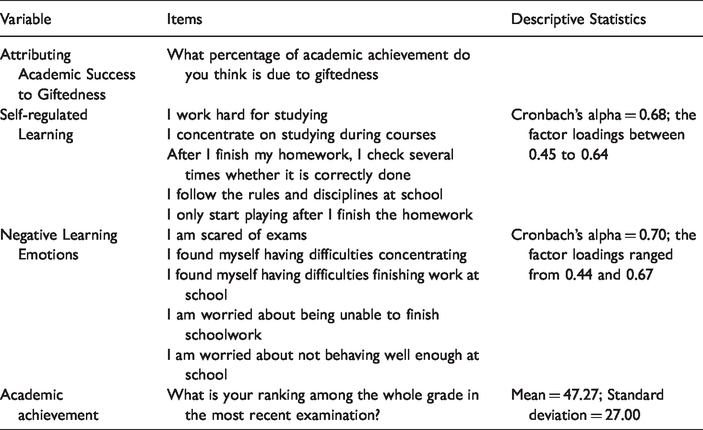
All measures were administered in Mandarin. The extent that a student attributed academic success to giftedness was measured with a single question, ‘What percentage of academic success do you think is due to giftedness?’ Students were asked to report the percentage from zero to 100. A higher score on this question indicated that the student had a higher level of AAS_G. To ease the interpretation of the results, the raw scores (Mean = 47.27, SD = 27.00) were standardized into Z-scores. For detailed information about the constructs (applied for other constructs mentioned below as well), please refer to Table 3 in Appendix 1.
Self-regulated learning
Students’ self-regulated learning was measured with five items describing the process of students exerting control over cognitive and behavioral activities at school to reach desired academic achievement, and their spontaneous engagement in the learning process, for example, I only start playing after I finish the homework. Students reported to what extent did each statement apply to themselves on a 5-point scale, from 1 (totally disagree) to 5 (totally agree). A higher score on this scale indicated a higher level of self-regulated learning. The scale has been widely used in previous studies about self-regulated learning (e.g., Zhang, 2017). In the present study, the subscale showed satisfactory reliability (Cronbach’s alpha = 0.68) and good measurement validity (in a confirmatory factor analysis, the model showed good fit, RMSEA = 0.03, CFI = 0.95, SRMR = 0.05, TLI = 0.93; the factor loadings ranged from 0.45 to 0.64).
Negative learning emotions
Students’ negative learning emotions was measured with five items from the Adolescents’ Learning Emotion Scale describing students’ anxiety, worries, and incompetent feelings in the learning process, for example, I am worried about not behaving well enough at school (Dong & Yu, 2007). Similar to the items measuring self-regulated learning, students reported how these statements applied to them on a 5-point scale. A higher score on this scale reflected more NLE in the students. The reliability and validity of the original scale have been supported in previous research (Dong & Yu, 2007; Wang et al., 2017). These items also showed satisfactory reliability in the present study (Cronbach’s alpha = 0.70). The measurement validity of the items was also supported (the model of confirmatory factor analysis had a good fit, RMSEA = 0.07, CFI = 0.95, TLI =0.90; the factor loadings were between 0.44 and 0.67).
Academic achievement
Students reported their rankings in the whole grade in the most recent examination. Students were asked to indicate which category matched with their rankings, that is, 1. The top 10% (i.e., the 90th percentile), 2. 11–25% (i.e., the 75th–89th percentiles), 3. 26%–50% (i.e., the 50th–74th percentiles), 4. 51%–75% (i.e., the 25th–49th percentiles), and 5. the lowest 24% (i.e., the 24th percentile). Their scores on this question were recoded so that a higher score indicated a better academic achievement.
Covariates
As students’ individual characteristics such as gender, age, place of residence (rural or urban) were shown in previous studies to affect their academic achievement (Pekrun et al., 2017), these variables were included in the data analysis as covariates. Students reported their own gender, age (measured in years), and place of residence in the beginning of the questionnaire.
Analysis
Mplus version 7.0 (Muthén & Muthén, 1998–2012) was used in the present study for data analysis. Structural equation modeling was employed to test the model fit of a full mediation model. In order to increase the statistical power and avoid mediator confounding in estimating direct and indirect effects (VanderWeele & Vansteelandt, 2014), a separate model was fitted for each mediator respectively. As students’ academic achievement was an ordinal variable, the Weighted Least Squares Mean and Variance-Adjusted (WLSMV) was used for model estimation, which produces a more accurate and less biased estimation of coefficients for models including ordinal variables (Li, 2016). Missing data (less than 7.8% of the data were missing for most of the main variables) were treated with Full Information Maximum-Likelihood Estimation in Mplus. Although 32.7% of students’ Academic Achievement were missing, we did not found significant group differences in the mean scores of AAS_G (p =.273), SRL (p =.679), and NLE (p =.476) between the complete sample and the sample with missing values on Academic Achievement. Indirect effects were examined with Model Indirect in Mplus. Satisfactory model fit was suggested by RMSEA <.08, CFI >.90 and TIL > .90 (Hu & Bentler, 1998). Standardized coefficients were reported to indicate how large the potential effects were.
Results
Descriptive statistics
The descriptive statistics and correlations between observed variables are presented in Table 1. The numbers of students fell in each academic achievement category were 359 (lowest 24%), 417(51−75%), 534 (26−50%), 324(11%–25%) and 137 (top 10%). The results showed that students’ AAS_G had a positive association with SRL (r = .12, p <.001) and a negative association with NLE (r = −.10, p = .008), but did not have a significant association with their academic achievement (r = .03, p = .294). Students’ SRL had a positive association with their Academic Achievement (r = .18, p <.01) and their NLE had a negative association with Academic Achievement (r = −.23, p <.01). According to the suggestion of Shrout and Bolger (2002), a full mediation model can be tested as long as the independent variable had a significant association with the mediator, which in turn had a significant association with the dependent variable. Therefore, we examined a full mediation model of SRL and NLE.
The descriptive statistics and correlations between observed variables.
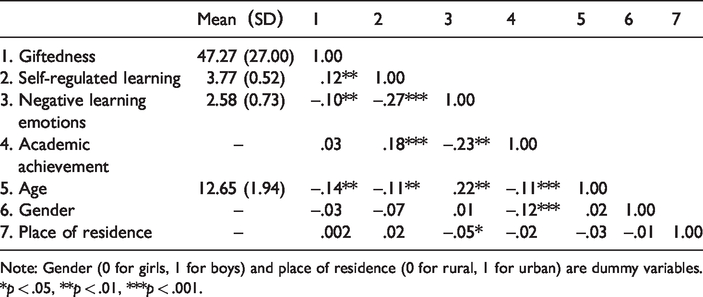
Note: Gender (0 for girls, 1 for boys) and place of residence (0 for rural, 1 for urban) are dummy variables.
*p < .05, **p < .01, ***p < .001.
The mediation of self-regulated learning
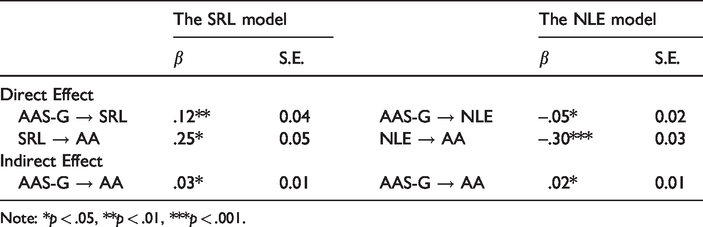
The regression coefficients of the full mediation model of students’ SRL are presented in Table 2. A visualization of the model is provided in Figure 1. The model is considered as acceptable,
Standardized regression coefficients of students’ attributing academic success to giftedness (AAS_G) in predicting academic achievement (AA) through self-regulated learning (SRL) and negative learning emotions (NLE).
Note: *p < .05, **p < .01, ***p < .001.
A description of the study constructs and measuring items.
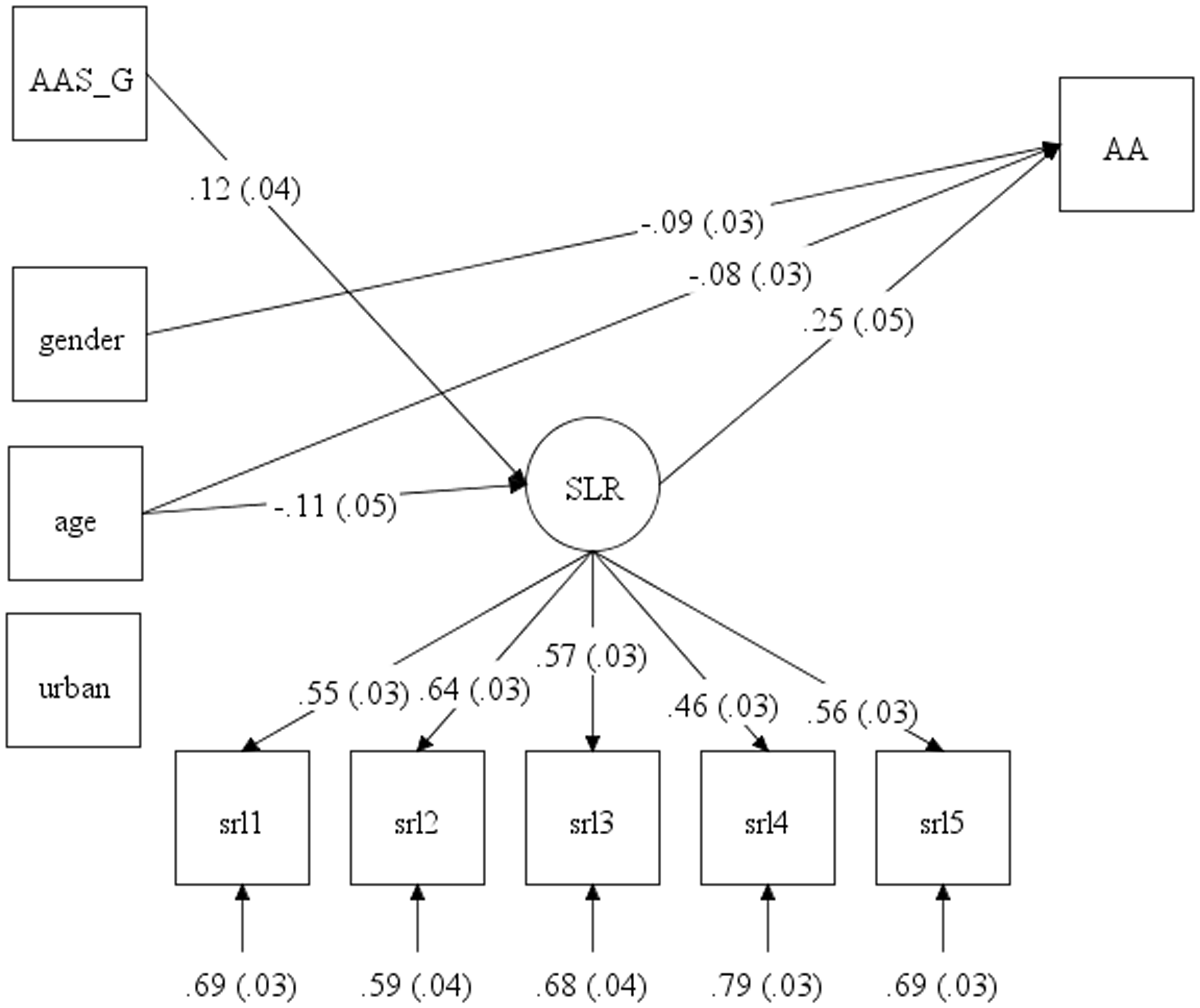
A Visualization of the Full Mediation Model of Students’ Attributing Academic Success to Giftedness (AAS-G) predicting Academic Achievement (AA) through Self-Regulated Learning (SRL).
The mediation of negative learning emotions
The regression coefficients of the full mediation model of students’ NLE are also presented in Table 2. In Figure 2, a visualization of this model is provided. This mediation model had a satisfactory model fit,
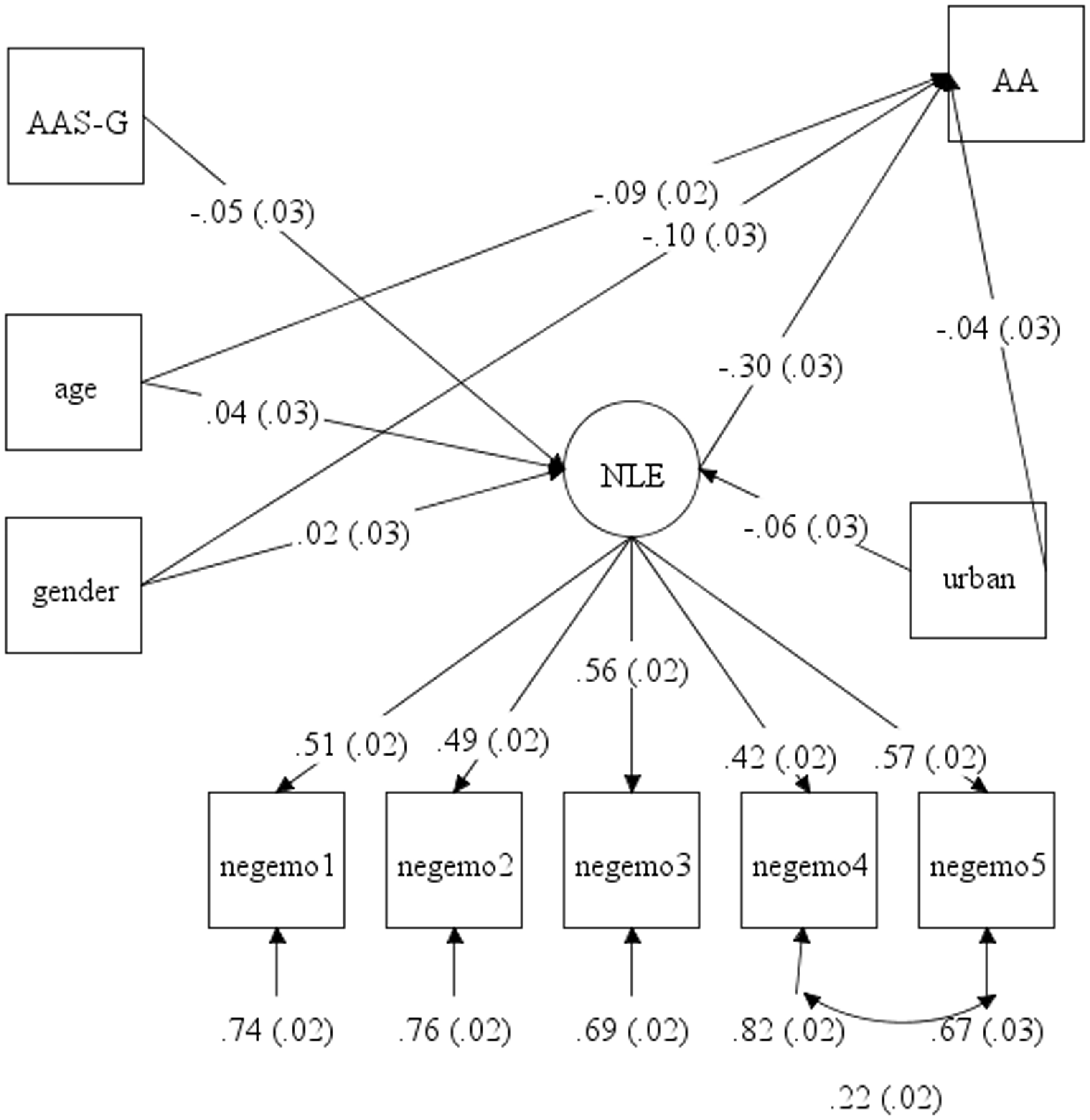
A Visualization of the Full Mediation Model of Students’ Attributing Academic Success to Giftedness (AAS-G) predicting Academic Achievement (AA) through Negative Learning Emotions (NLE).
Discussion
The present study investigated the association between attributing academic success to giftedness and students’ academic achievement, with students’ negative learning emotions and self-regulated learning being included as mediators. In line with our hypotheses (Dent & Koenka, 2016; Pekrun et al., 2017; Shirdel et al., 2018), students with higher levels of AAS_G had higher levels of SRL and lower levels of NLE, and an increased SRL and a decreased NLE led to a better academic achievement. Our findings provided support for the Attribution Theory (Weiner, 2006) that causal attribution would affect students’ emotions and behaviors and thereafter affect their academic achievement. As giftedness is regarded as an internal, stable, and uncontrollable factor for attribution, attributing success to giftedness would enhance individuals’ expectations for future success and increase their learning motivations, leading to improvement in academic achievement (Perry et al., 2008). However, although significant, the indirect effect of AAS_G on academic achievement seems to be small, while the binary association between AAS_G and academic achievement was even not significant. One of the plausible reasons for the weak association is that the students were asked about the importance of giftedness for academic achievement in general, instead of their own successful experience. This may weaken the association between AAS_G and students’ individual academic achievement. Another possible reason is that due to the presence of potential moderators (e.g., whether students view themselves as gifted or not), the overall association between AAS_G and academic achievement might be suppressed or canceled out. For instance, the influence of AAS_G might be different for students who regarded themselves as gifted and not gifted. For students deeming themselves as not gifted, higher levels of AAS_G might harm their motivations to learn, and probably have a negative effect on their academic achievement. On the contrary, for students perceiving themselves as highly-gifted, higher levels of AAS_G may further boost their motivations for future learning, and help them achieving better academic outcomes. However, without further study, we were not sure about the role of students’ perceptions of their own levels of giftedness in the studied associations.
Likewise, the association between AAS_G and NLE was small as well, and this may also be due to the presence of potential moderators, such as students’ self-esteem. For example, the positive association between adolescents’ negative attributions (e.g., attributing negative events to internal and stable factor) and depression was stronger for adolescents with low levels of self-esteem compared with adolescents with high self-esteem (Southall & Roberts, 2002). Future studies may therefore consider including interesting moderators such as students’ view of their own levels of giftedness, and students’ self-esteem, to further investigate the studied associations.
It is also interesting to note that recent research pointed out that what matters for later outcomes is not a factor per se, but rather how individuals view the factor based on the attribution dimensions (e.g., whether it is stable and internal) (Graham, 2020). For example, Dweck’s (2007) mindset theory proposed that individuals may have a fixed mindset (i.e., believing intelligence is innate and fixed) and a growth mindset (i.e., believing intelligence can grow and be developed) about intelligence. Therefore, although the present study attempts to argue that giftedness is internal, stable, and uncontrollable, students can view giftedness as unstable for instance (Graham, 2020). For students with different perceptions of giftedness (e.g., stable or unstable), the influence of AAS_G on their academic achievement might be different as well. Unfortunately, we did not have information about students’ perception of giftedness in the present study, and cannot further explore this question. We therefore encourage future research to include questions about how students perceive giftedness, and investigate whether this would affect the influence of AAS_G on their academic performance. As attribution retraining research may provide important implications for school practice, we encourage more research to look into this topic, so that suggestions may be provided in the future to develop intervention and help students to adjust their causal attribution and achieve higher academic achievement.
This study is one of the first few studies exploring the influences of AAS_G on students’ academic achievement. By approaching the open-access dataset of CFPS, a large and representative sample was included in the present study, which increased the generalizability of our findings to a larger student population. However, some limitations should be taken into account as well. Firstly, this study employed cross-sectional data, which prevented us from concluding causal relationships between study variables. Including longitudinal data was at this moment not feasible, as the measurement of the independent variable was only recently included in the 2018 CFPS dataset. However, future studies may include longitudinal data (e.g., when CFPS data are updated) or an experimental design (e.g., with vignette) to further investigate how AAS_G affects students’ SRL, NLE, and academic achievement. Secondly, although we have included potential covariates, we did not explore the influence of other interesting variables, such as students’ self-esteem in this process. Future research may further include these related variables and explore possible moderating effects. Thirdly, students’ academic achievement was measured by their self-reports of ranking in the grade and there may be some reporter biases. In addition, students provided self-reports for all the measured variables, which may result in shared source bias. Although a test of Harman's single factor variance (< 50%; Podsakoff et al., 2012) did not show significant shared source bias between variables in the present study, future research is still encouraged to include more objective measures of academic achievement, such as standardized test scores. Fourth, students’ perception of giftedness (AAS_G) was measured with a single item and future research may therefore include more sophisticated measures to capture a more comprehensive view of the construct.
Conclusion
This study found that students who attributed academic success to giftedness had higher levels of self-regulated learning, and lower levels of negative learning emotions, and the increased self-regulated learning and decreased negative learning emotions were associated with higher levels of academic achievement. Future research is encouraged to employ longitudinal data to further examine the mediating role of students’ SRL and NLE in the association between AAS_G and academic achievement. We suggest more research look into this topic and include important moderators, so that practical suggestions can be given to school practitioners, and interventions can be developed to help students.
Footnotes
Acknowledgements
This work was supported by the CSC scholarship offered by the China Scholarship Council in collaboration with the University of Amsterdam.
Declaration of conflicting interests
The author(s) declared no potential conflicts of interest with respect to the research, authorship, and/or publication of this article.
Funding
The author(s) disclosed receipt of the following financial support for the research, authorship and/or publication of this article: This article was supported by the CSC & UvA scholarship.
