



Abstract
Social media has a strong influence on the everyday lives of college students. A particular question of advanced research interest is whether social media also play a role when attending class. This exploratory study was aimed at designing a theoretical model that embraces such concepts. First, we identified that identity development, learning support, and parallel use are general concepts that are relevant when attending class. Next, using a survey with 230 students, we examined whether these general concepts could be empirically validated with factor and correlation analyses. We then applied a literature review to identify and subordinate more specific concepts to these general concepts. The resulting model of social media use when attending class includes active and passive elements related to designing and registering personal information, giving and getting support for learning, as well as posting and browsing during parallel use. We offer three conclusions: (1) identity development is based on impression management, social comparison, and self-concept clarifying, (2) learning support consists of collaborative learning, supporting intrinsic motivation, and promoting self-efficacy, and (3) parallel use during learning is based on entertainment, escapism, and relaxation. Finally, we discuss limitations, especially missing model tests, future research activities, and practical implications of our conceptual model.
Keywords
Highlights
The study covered recent research on the educational social media use of college students. It focused on social media usage patterns during learning that are related to identity development, learning support, and parallel use. The findings were integrated into a new theoretical model that can guide future research and instructional design in the field of learning and teaching in higher education.
There is no doubt that “social media” such as Facebook, Youtube, or Whatsapp have a strong impact on higher education settings and the everyday lives of college students (e.g. Zachos et al., 2018). Social media are “web-based and mobile services that allow individuals, communities, and organizations to collaborate, connect, interact, and build community by enabling them to create, co-create, modify, share, and engage with content” (Nau et al., 2022, p. 15). Numerous studies have found conclusive evidence that college students’ social media use may be more or less intensively related to academic learning and performance (e.g. Malak et al., 2022). Many of studies have examined how often (how many times a day) and how long (how many hours per day) social media is used by college students, either on-site or at home, as well as during the context of their teaching and learning activities (e.g. Wright et al., 2022).
Here, it is often difficult to distinguish whether research relates to a social media use which takes place before, during, or after class in college settings. For example, Vorderer et al. (2016) found that college students are more or less “permanently online”. Baldwin-White and Gower (2023) found that about 70% of college students use social media every day and more than 75% more than 1 h daily. Having such a situation, it is not astonishing that social media users have difficulties in accurately estimating their social media time and use (e.g. Verbeij et al., 2021). Obviously, social media use has become an integral part of the daily life of college students what makes precise temporal delimitations difficult. With this situation in mind, it makes sense to focus on students’ social media use when they are attending class. Attending class means that students are actively studying throughout a regular semester what includes time periods before, during, and after class. More precisely, it includes time spent at courses, independent study time (for preparing and reviewing courses and exams), but also time on personal social media use in and -outside college teaching and learning settings (Brooks, 2015; Liborius et al., 2019). Personal social media use outside college is essential as it reduces time for studying and influences study habits and academic performance (e.g. Leyrer-Jackson & Wilson, 2018). For our study, we used such a broad time focus as it allows to cover many relevant influences on learning processes. It also makes it possible to consider research results spanning multiple periods of time when studying.
In addition to problems in research on time patterns of social media use, however, it is evident that the effects of user behavior in college settings are particularly dependent on the goal of social media use (Barrot, 2021). Studies on college students’ goals for using social media show an extremely wide range of options. For example, Ciampa et al. (2016) found nine goals of social media use by college students: communicating with friends, entertainment, communicating with family, community event information, communicating with classmates, college event information, classwork information, professional connections, and communicating with professors. Bal and Bicen (2017) found ten different goals: messaging (texting), following friends, catching up the news, taking photo or record video sharing, being aware of the trends, listening to music, following the applications, making new friends, making checking in, and downloading new application. Kircaburun et al. (2020) identified seven goal areas in college students: maintaining existing relationships, meeting new people and socializing, expressing or presenting a popular self, passing time, entertainment, realizing informational and educational use, and use as a task management tool. If you have a situation in which college students use social media for extremely different purposes, then it is difficult to conclusively classify research results. In addition, it is notable here that most of the goals found are anchored in everyday practice and have little connection to theoretical concepts.
The research situation is complicated by other disruptive usage patterns of social media: First, there is a multiple goal situation for the same social media networks. There are many different social media networks (e.g. Facebook, Youtube, WhatsApp, Instagram, WeChat, TikTok, Pinterest, Twitter, and LinkedIn) which can be used for many different goals at the same time. For example, Abdurahman et al. (2019) found that the uses of many social media networks were related to academic performance and non-academic engagement which makes it difficult to precisely control learning processes and products. Second, there is also a problematic social media use which is related to Internet or media addiction. Here the primary goal of social media use is to satisfy an addiction. Social media addiction related goals concern, for example, mood modification, withdrawal from others, or conflict management what relates sometimes to pathological behavior patterns which in turn makes learning more difficult (Shahnawaz & Rehman, 2020). If you have a situation in which social media can be used for different purposes at the same time or in which learning processes are disrupted by pathological usage patterns, then it is difficult to control research activities effectively, to systematize research findings coherently, and to develop future research step by step.
Overall, we have a situation in which research on the social media use of college students suffers from different temporal focuses, very different usage goals, and disruptive influences. It is therefore not surprising, that the knowledge base in this field is highly diverse and fragmented. When you have such a research situation, then there is a high probability that findings and related concepts overlap, are not related to each other, or are missing. Having such a situation and in general, we decided to develop a theoretical model on social media use of college students that should (a) provide a common basis for dealing with widely scattered research findings and (b) expand perspectives that are less differentiated in research. In social media research, there is a strong focus on communication and relationship formation and maintenance with others (e.g. C. C. Yang et al., 2021). However, this focus is not always uncontroversial in college settings. Guy (2008) showed that there are serious risks to using social media consciously and purposefully for relationship building in college classroom settings like distraction, cyberbullying, lack of trust, or problems in curriculum integration. In addition, Greenhow and Galvin (2020) showed that relationship building with social media could represent an informal backchannel in college courses, but that it had to be implemented with great effort in a meaningful and rule-based manner. We therefore largely ignored a relationship-building focus of social media, also because this has already been significantly taken into account elsewhere (e.g. Fox et al., 2013; Orben & Dunbar, 2017; Schnauber-Stockmann et al., 2021; Sherrell & Lambie, 2018; C. C. Yang et al., 2021). However, three other essential concepts seem to be poorly addressed and undervalued in existing approaches on goals for social media use of college students: identity development, learning support, and parallel use during learning.
First, we focus on identity development in relation to social media use (e.g. Hsieh et al, 2019). Bozkurt and Tu (2016, p. 163) formulated that “digital identity formation is not a new concept; however, its effects with ever changing technological opportunities especially with networked technologies need further exploration”. Identity is about how a person is defined by themself and others. Its development is based on interactions with and feedback from family and friends as well as people they meet in different contexts (J. L. Johnson et al., 2022). From a theoretical perspective, Slater (2015) postulated that a social-cognitive mechanism supports an iterative process of exposure to media content and identity development, and includes identity-relevant attitudes that trigger an identity-consistent choice of social media content, which is also associated with social identity accessibility and identity-relevant attitudes. In this area, we have research, for example, on the professional identity construction in social media covering professional stereotypes and reconstruction of multiple professional selves, merging public and private identities, or belonging to a group and trusting social media (Kasperiuniene & Zydziunaite, 2019). Identity development represents a key goal of contemporary higher education students and it is currently speculated that it is related to social media goals and activities (Tomlinson & Jackson, 2021). There is some qualitative evidence in the field of higher education research that identity development (or formation) is related to informal learning which could also take place in social media (Greenhow & Robelia, 2009). Others see the influence of a peer culture where social media use is an important development tool (Renn, 2020), or emphasize the role of individual self-disclosure (Luo & Hancock, 2020). When we look for an identity development model for college students, then we find, for example, one on civic identity development in which social media can be related to key influences like peer groups (M. R. Johnson, 2017). Taking these findings into account, it is highly probable that social media is significantly related to the identity development of college students. However, this field of research appears to be fragmented and without systematized evidence, which suggests the expansion of a theoretical perspective in order to further develop research.
Second, we focus on learning support. Learning support concerns the extent to which social media is integrated into students’ academic activities in a way that improves learning processes and outcomes (Chang et al., 2019). Meşe and Aydin (2019) found that among college students, sharing educational content and research activities on social media networks is relevant for learning support. For example, Zaidi et al. (2018) found that Youtube can support learning as it, for example, makes learning interesting, supports understanding, motivates to learn outside of class, captures attention, allows to accomplish study tasks, exposes students to what happened in the outside world, improves the quality of assessments, or enables students to control their own learning. Bower (2019) identified several fundamental theoretical assumptions concerning social media use, arguing that it performs a mediating role to achieve learning goals, influences different forms of cognitive representations, and affects how meaning is processed, interpreted, created, and interrelated. Burns et al. (2020) found that college students used Youtube mainly as adjunctive to lectures/labs, as a way with different approaches, when they miss class and need to learn a procedure, or for preparation for a procedure that students never had done. Others like Lee et al. (2021) found unprofessional behaviors in Youtube videos of college students like absenteeism or lateness for assigned activities, poor initiative and motivation, insulting, poor verbal/nonverbal communication, missing awareness of limitations, blaming external factors rather than own inadequacy, or lacking insight in own behavior. Such examples of research suggest that social media can be used to promote learning. Here too, the evidence appears to be fragmented, suggesting a deeper and more systematizing theoretical focus.
Third, we focus on parallel use of social media during learning. A parallel use of social media during learning means that time spent on social media is time lost on learning activities and that social media causes distraction or task-switching which results in decreased academic learning and performance (Amez & Baert, 2020). From a theoretical perspective, the effects of parallel social media use can be explained by Mayer and Moreno’s (2003) cognitive theory of multimedia learning. According to this approach, switching from social media to learning content requires a change of attention and additional cognitive capacities that increase task-irrelevant cognitive load. As working memory is limited, an increase in cognitive load can reduce the cognitive resources assigned to encoding, storing, or retrieving learning-relevant information (Demirbilek & Talan, 2018). For example, Karpinski et al. (2013) found that the negative relationship between social media use and efficiency and productivity in an academic setting was moderated by multitasking which means using social media in the background while studying. Lau (2017) showed that social media multitasking significantly negatively predicted academic performance. May and Elder (2018) did a comprehensive analysis on social media multitasking and academic performance. They found effects of multitasking during in-class activities and while students are studying, in diverse instructional contexts and for varied academic tasks as well as related to overall achievements, test performance/recall, comprehension, note-taking, self-regulation, or efficiency. Others like Beuckels et al. (2021) reported evidence on distractor effects resulting in poor learning and related on the assumption of cognitive depletion. They also stressed that there are also more affective mechanisms of multitasking such as enjoyment or time perception: “Therefore, future research should aim to transcend the great overreliance on the cognitive mediators, as this one-sided approach might withhold us to get a complete picture of the media multitasking story” (p. 14). Also, in this area of research on social media use by college students, there is still room for improvement. This in turn suggests an expanded theoretical perspective that specifically addresses the question of why college students use social media in parallel with learning and whether there are affective reasons for this.
Purpose and methods of the present study
Given this background, the main goal of our study was to develop a theoretical model on the social media use of college students when attending class. First, such a model should bring together and create a connection between different lines of research. This should make isolated research more accessible and the research field better structured overall. Such a theoretical model opens up the possibility of relating different evidence to one another, what realizes scientific progress, because it lays a new basis for further and more in-depth research activities. Second, such a theoretical model should focus on widely overlooked but important concepts on identity development, learning support, and parallel use. At the moment, there are some models on social media and learning or education, but these models do not focus in detail on identity development, learning support, and parallel use. Here, for example, Flynn et al. (2015) identified six highly general theories which were related to social media use: Connectivism, social development theory, communities of practice, cognitive apprenticeship, discovery learning, self-determination theory, or cognitive load theory. Also, Otchie and Pedaste (2020) found a variety of again highly general but different approaches on using social media in learning contexts: Collaboration, communication, interaction, entertainment, teaching, learning, resource sharing, and socialization. Al-Rahmi and Zeki (2017) had a more nuanced perspective and focused in their model on usefulness, enjoyment, ease of use and collaborative learning, but neglected identity development or parallel use.
The goal of our study is not to test a theory, but to develop one. Our methods do not have a hypothesis-testing character, but are exploratory in nature. We used two methods for theory development. The first approach was a quantitative one whereby a survey and statistical methods were used to explore general theoretical constructs. In particular, we attempt to empirically identify general concepts using survey data and exploratory statistical methods. We used an exploratory factor analysis to find indications of validity of our general concepts (Tavakol & Wetzel, 2020). The second approach was based on a literature review of existing models and key research results with the goal of identifying specific concepts and subordinating them into the general concepts of the theoretical model. We used an exploratory narrative review of literature for developing a nuanced theoretical perspective on the general concepts (e.g. Giles, 2002). Overall, we combined two methods in an exploratory-sequential design: The quantitative methods were used to find general concepts, and then the literature review was used to identify more specific concepts (Edmonds & Kennedy, 2013).
For our first approach, we implemented a three-step procedure. For the first step, we conducted a survey among college students about their use of social media when attending class. For the second step, we applied statistical methods (reliability tests, factor analysis, correlation analyses) to identify general concepts in the survey data and to get some first indicators of construct validity. We used exploratory factor analysis; we did not use confirmatory factor analysis as our goal was to explore concepts for a potential new theory, not to test an already existing theoretical framework (Schumacker & Lomax, 2010). We aimed to explore social media use concepts related to identity development, learning support, and parallel use during learning. For the third step, we related these three concepts of social media use to academic performance, study satisfaction, and fear of missing out in order to obtain initial indicators of criterion validity. In the context of this research, academic performance is defined “as students’ ability to carry out academic tasks, and it measures their achievement across different academic subjects using objective measures such as final course grades and grading point average” (Maqableh et al., 2021, p. 4005). Study satisfaction was defined as “a positive assessment that an individual makes when comparing their ambitions with what they had actually achieved“ (Carranza Esteban et al., 2022, p. 2). Fear of missing out was defined as the “desire to stay continually connected with what others are doing” (Przybylski et al., 2013, p. 1841). We selected academic performance, study satisfaction, and fear of missing out, because they are considered important concepts in the higher education context in two theoretical models: Alamri et al.’s (2020) social media, satisfaction, and academic performance model as well as Roberts and David’s (2020) fear of missing out, social media intensity, social connection, and psychological well-being model.
For our second approach, we used a literature review with the goal to narrow general concepts down and identify more specific characteristics (Stebbins, 2001). These characteristics represent subordinate concepts to the general concepts. Again, we performed a multi-step procedure. First, to identify the specific concepts, we conducted an exploratory review of existing models and key research results of social media use, specifically focusing on educationally relevant aspects. For theory-building purposes, our review was exploratory and did not have a theory- or effectiveness-testing nature. We searched the literature (using Google Scholar) with combinations of terms like “identity”, “learning”, “parallel use” (or “multi-tasking”), together with “social media” and “models” or “theories”. We attempted to identify specific theoretical concepts that are related to identity development, learning support, and parallel use within the context of social media. On the one hand, these concepts had to be exclusive, such that they were only related to one of our three general concepts. On the other hand, these specific concepts had to be as exhaustive as possible, covering many specific characteristics for each of the general concepts. Second, we followed an iterative process of theory development in which we generated ideas, specified conceptual definitions, and described relationships between the identified general and specific concepts (Jaccard & Jacoby, 2020). Third, we used “tactics for generating meaning” (Miles & Huberman, 1994) to subordinate the specific concepts into our general concepts. Such methods concern clustering, making contrasts and comparisons, factoring, partitioning variables, and subsuming particulars into general concepts, as well as creating conceptual coherence. Here, we first collected different concepts and related definitions. We then first assigned these specific concepts to the general concepts, where each specific concept was used only once. We then tried to eliminate the concepts that appeared twice or multiple times as well as had significant overlaps with each other. Our orientation was also to be economical in terms of the number of integrated concepts. Our goal was to have a maximum of three to five specific concepts for each of the general concepts. Fourth, to support our theory-building processes, we used Hallikainen’s (2015) multi-perspective model on the continued use of social media. In this model, different values for using social media are distinguished: functional (related to perceived utility), social (associating with social groups), emotional (arousing feelings), epistemic (satisfying a desire for knowledge), and conditional (a specific situation). This model helped us to focus on different and distant concepts, and find structural relationships and similarities between the concepts. Here, our goal was not to provide a comprehensive literature review or to consistently apply a qualitative method of theory development. We stopped our development process when we thought we had found a model that could extend existing models and provide a good basis for further research. Our goal was to selectively use research results in order to be able to design a theoretically coherent model that represents a kind of significant interim result of a longer theory development and research process. This model, like all other theoretical models, concerns a section of social media reality in higher education contexts.
Exploring the general concepts of social media use when attending class
Our first approach was based on an online survey, exploratory factor analysis, and correlational analyses.
Procedure and participants
We collected the data using an online survey through LimeSurvey, which was activated for three weeks in the summer of 2021. This survey also included other subject areas that were not the focus of this study. The second author of this paper, who was studying for a college Master’s degree at the time, distributed the links to the survey among her colleagues, acquaintances, and friends via social media channels (Facebook, Instagram, and WhatsApp). This resulted in a convenience sample of 230 college students who all gave their informed consent to participate in the study. The study was carried out in compliance with the ethical research criteria of the university in which the master’s theses were submitted. The age range of participants was from 18 to 41 years (M = 24.0, SD = 3.3), and the gender distribution was 66.1% female, 33.9% male. At the time of the study, 50.4% of the participants were studying for a Bachelor’s degree, 47.9% for a Master’s degree, and 1.7% for a doctorate. Seventy-three percent of participants lived in Austria, 25.7% lived in Germany, and 1.3% lived in other countries. Our goal was not to have a representative sample or to examine effects of variables on a causal basis. We also did not test group differences and our goal was not to develop and evaluate a measurement instrument. Our goal, however, was to explore general concepts or constructions in student data on a theory-exploring but not theory-testing basis. It was important for us to get a valid factor solution related to the general concepts in mind. An essential criterion that can handle different good or bad data conditions and related criteria is the sample size. We considered the number of factors, number of variables per factor, level of communality, and the agreement between sample and population solutions. Having three factors, four variables per factor, a wide level of communality, and a goal of good agreement in mind (see our study results), we would need, according to Mundfrom et al. (2005, p. 164) a minimum sample size of n = 130. Our sample size of n = 230 seems to deliver a sufficient basis for getting a valid factor solution in our analyses.
Measures
First of all, our study was not about the development or testing of measurement instruments. We had designed a larger survey and asked ourselves after the survey was carried out whether the three general concepts could subsequently be identified in an exploratory manner in this survey. In general, we did not take a deductive research approach, but an abductive one in which we tried to find potentially relevant theoretical concepts by focusing on procedures related to an “informed exploratory study” (Janiszewski & van Osselaer, 2022). Such studies have the potential to discover new or undervalued theoretical concepts, or to allow to consider large sets of relationships. In particular, we conducted a secondary data analysis in order to explore certain general concepts. We had some hypothetical concepts about identity development, learning support, and parallel use during learning in social media use. We also had a data-set on social media use of college students from the master thesis of the second author of this study (Schlick, 2022). In this data-set we had about 100 items related to demographic variables, variables on frequency of social media use, motives for social media use, attitudes toward social media, well-being, as well as academic performance and satisfaction. In selecting and building our measures, we followed Andersen et al. (2011): 1. We selected a data set about social media usage, which should also contain extractable information relevant to our general concepts. 2. We searched for items in the data-set that were likely to measure the relevant general concepts (four items for each general concept). 3. We also included variables that could be related to the selected general concepts (academic performance, study satisfaction, fear of missing out). 4. We chose an exploratory statistical method (exploratory factor analysis).
All the measures described below were implemented in the German language. Items from existing questionnaires were translated from English into German. The linguistic quality and comprehensibility of the items were checked in an online pre-test with three college students around two weeks before the questionnaire went live. There were no significant objections.
Goal areas of social media use when attending class
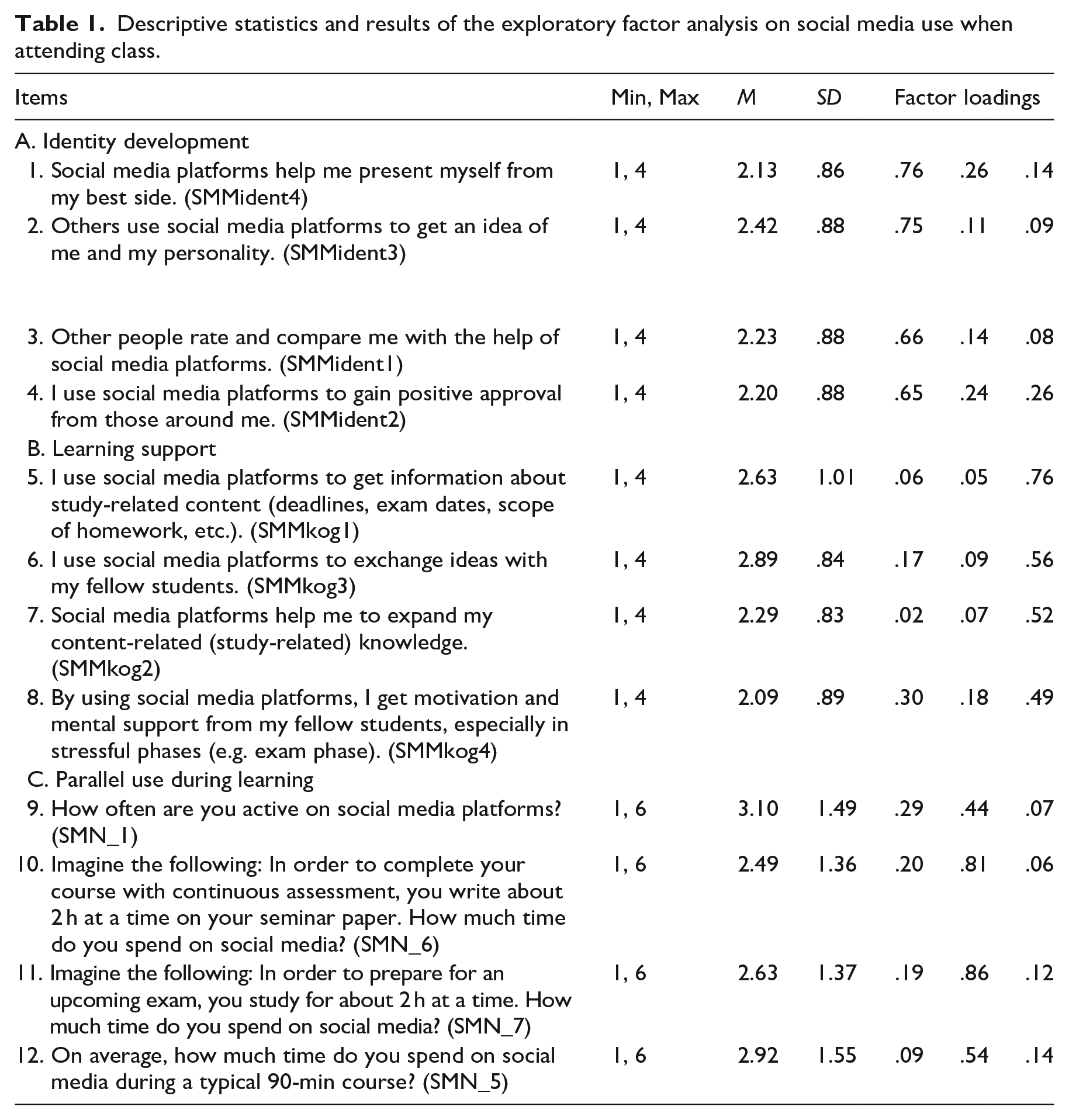
To measure goal areas of social media use when attending class, we identified and used a 12-item scale, four items each for identity development, learning support, and parallel use (see all items in Table 1). Some item formulations were obtained by discussing the social media use of college Master’s thesis students. Other item formulations were orientated toward and adapted from scales on the Social Networking Usage Questionnaire (Gupta & Bashir, 2018) and the Social Networking Sites Usage and Need Scale (Ali et al., 2020). For measuring identity development and learning support, we used a 4-point Likert scale (1 = I totally disagree, 2 = I tend to disagree, 3 = I tend to agree, and 4 = I totally agree; Cronbach’s alpha (CA) for identity development: .79, for learning support: .66). To assess parallel use during learning, we used four 6-point scale items: item 9 with scale: 1 = 0–5 times per day, 2 = 6–10 times per day, 3 = 11–15 times per day, 4 = 16–20 times per day, 5 = 21–25 times per day, and 6 = more than 25 times per day); items 10 to 12 with scale: 1 = less than 5 min, 2 = 5–10 min, 3 = 10–15 min, 4 = 15–20 min, 5 = 20–25 min, and 6 = more than 25 min (CA = .74). According to Taber (2018, p. 1278), the CA of our scales were “fairly high” for identity development, “high” for parallel use, and “adequate” for learning support. This means that our exploration attempts on general goal areas of social media use were carried out with acceptable accuracy.
Descriptive statistics and results of the exploratory factor analysis on social media use when attending class.
Academic performance
We used four questions to build an index on academic performance: (1) “Please estimate your current grade point average for all the courses you have completed so far in your studies.” (5-point answer scale of 1.0–1.5, 1.6–2.5, 2.6–3.5, 3.6–4.0, and higher than 4.0; low values represented good grades and higher performance); (2) “How do you personally assess your general performance during your studies?”; (3) “How do you personally assess your performance in the last semester of your studies?”; and (4) How do you personally assess your performance in the last three courses you attended?” The last three questions used a 5-point Likert scale ranging from “very good” to “very bad”. The CA was .87, which indicated good reliability.
Study satisfaction
Study satisfaction was measured using a 9-item questionnaire from Westermann et al. (2018) e.g. “I really enjoy what I’m studying”; CA = .81). The questionnaire used a 4-point Likert scale (from “doesn’t apply” to “fully applies”).
Fear of missing out
Fear of missing out was measured with 10 items from the Fear of Missing Out Scale (FoMOs; Przybylski et al., 2013). Items such as “When I have a good time it is important for me to share the details online (e.g. updating status)” were answered on a 5-point Likert scale (ranging from “not at all true of me” to “extremely true of me”; CA = .76).
Statistical analyses
We used SPSS 28 for the descriptive, correlational, and factorial analyses of our data. After reliability analyses, we created all variables by summing up the individual item scores and dividing them by the number of items. The exploratory factor analysis used principal axis factoring as the extraction method and Promax as the rotation method, following Goretzko et al. (2021). We also calculated zero-order Pearson correlations.
Statistical analyses findings on social media use when attending class
The descriptive statistics and results of the exploratory factor analysis are shown in Table 1. The means and standard deviations indicate low to medium scores for each item showing that identity development, learning support, and parallel use during learning were present and detectable in the sample of college students but not at a high level.
The factor analysis yielded three separate factors (with an Eigenvalue >1), which explained 57.67% of the variance for identity development (26.47%), learning support (15.36%), and parallel use during learning (15.84%). According to Carpenter (2018), we complied with most of the methodological recommendations (the recommendation value is given in brackets) which are relevant when conducting exploratory factor analysis: factorability of the data, Kaiser-Meyer-Olkin: 0.73 (>0.60); Bartlett’s test of sphericity: p < .001 (p < .05); minimum factor loading: 0.44 (0.30–0.40); commonalities: 0.23–0.73 (0.40–0.70). We found independent and distinguishable factors. There are high factor loadings on one factor each and at the same time low factor loadings on the other factors. Looking at the factor loadings, the items on identity development appear to be the most valid. There are also good loadings regarding learning support, only item 8 on motivational and mental support differs slightly. When considering parallel use during learning, no classic ratings scales were used; rather, frequency assessment had to be made, which, however, did not lead to poor validity. Here, only item 9, which asked about the overall social media use, does not seem to be entirely optimal. In summary, we were able to identify the three factors in our data at an acceptable level: We therefore assume that identity development, learning support, and parallel use during learning represent valid goal areas for students when using social media.
The zero-order correlations between all the variables are depicted in Table 2. Calculating the correlations was not intended to test specific hypotheses or to confirm adjusted and causal relationships between the variables. The correlations should provide further exploratory evidence of the validity of our variables with regard to everyday student life. The correlations obtained vary and show different statistical and practical significance, which also depends on the sample as well as sample size. First, we found significant positive, but small correlations for social media use between identity development, learning support, and parallel use during learning. Such small correlations indicate, on the one hand, that different types of social media use are related to one another; but on the other hand, low correlations show that the different types of social media use are unique and to some degree independent of each other. Second, we found a high correlation between identity development and fear of missing out, which indicates that this type of social media use is related to more social and personality-related learning issues. Third, we found no significant relationships between social media use for learning support and academic performance as well as learning support and study satisfaction. These correlations may indicate that learning support through social media is not a highly effective goal area. Fourth, there were significant correlations between parallel social media use during learning and academic performance, study satisfaction, and fear of missing out; specifically, more parallel social media use for learning corresponded with lower academic performance, lower study satisfaction, and greater fear of missing out. These correlations may indicate that the parallel social media use during learning has a significant impact in college students’ academic lives. Finally, we found significant correlations between academic performance, study satisfaction, and fear of missing out; lower academic performance corresponded with lower study satisfaction and greater fear of missing out. We also found that higher study satisfaction was associated with less fear of missing out. These correlations indicate that our chosen variables are related to each other, but also represent their own facets of college student life. In summary, these correlations indicate that the focused goal areas of social media use are relevant in college students’ academic lives. The results showed that identity development, learning support, and parallel use during learning correlate with variables that are relevant in everyday student life such as academic performance, study satisfaction, and fear of missing out.
Correlations for social media use when attending class (231 >n > 228).
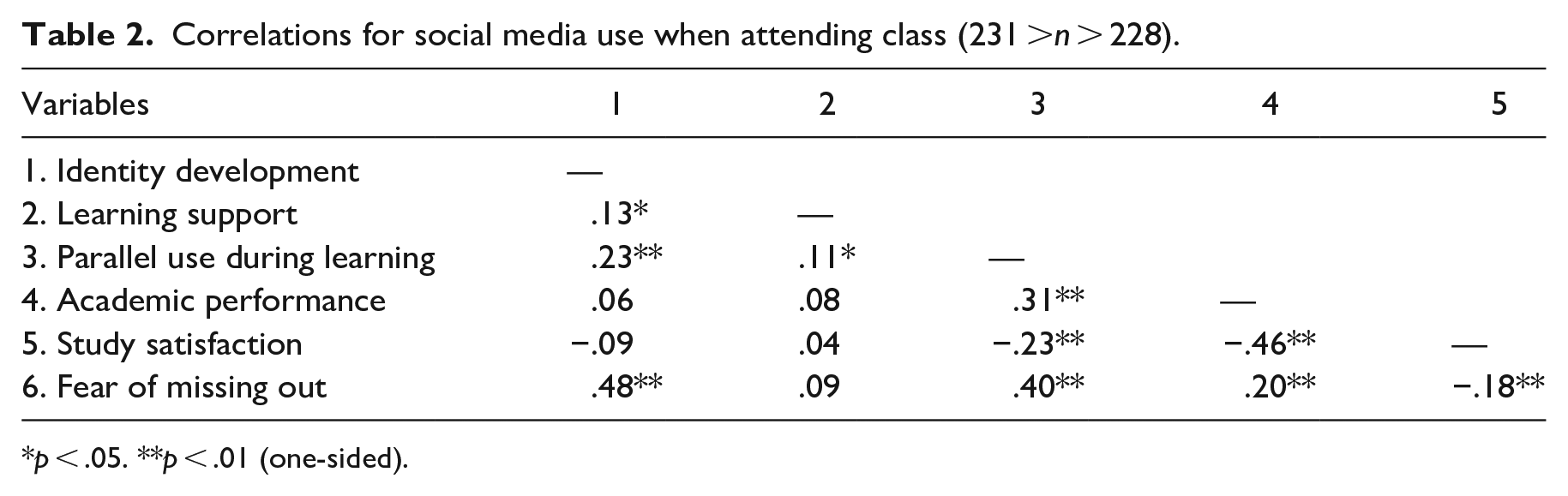
p < .05. **p < .01 (one-sided).
Using this quantitative analysis, we were able to confirm that there are general concepts in the social media use of college students when attending class. We distinguished the three originally assumed concepts (identity development, learning support, and parallel use during learning) as independent concepts, which are relevant for future research activities. We also found that these concepts correlate with important variables in the college context, which provided further evidence of their validity. However, the empirical analysis did not test a theory or the measurement instruments; instead, it was a tool and a first step toward developing a theory of social media use for college students when attending class. These identified general concepts were then used for the development and specification of a more sophisticated theoretical model.
Finding and integrating specific concepts of social media use when attending class
Our second approach consisted of using the identified general concepts from the quantitative stage as starting points for the development of a more specified theoretical model. The general concepts represented broad goal areas into which more specific sub-goals were included. The specific concepts were derived from an exploratory literature review that focused on key research findings. The resulting model on social media use is depicted in Table 3. As mentioned above, our second approach was based on a review of existing research, an iterative process of theory development, tactics for generating meaning, and a multi-perspective model for supporting our theory-building process.
A model of social media use of college students when attending class.
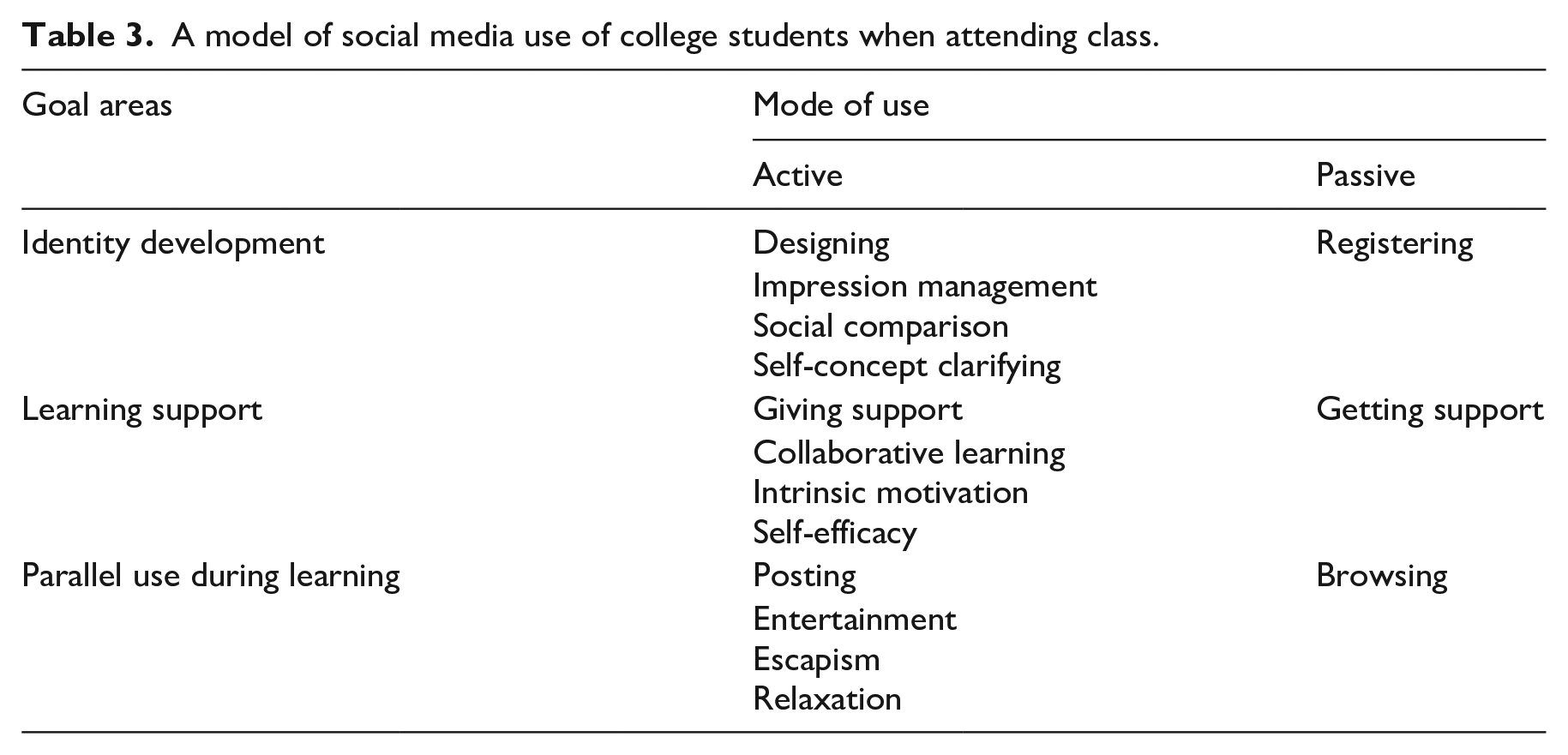
A model of social media use when attending class
In our model, shown in Table 3, we assumed that three concepts represent goal areas for the social media use of college students when attending class: identity development, learning support, and parallel use during learning. In expanding our quantitative findings, we first learned that all goal areas can be more actively or more passively influenced through personal activities in social media. It is not entirely undisputed what active and passive use of social media is, because any use fundamentally represents active action. An active and passive use is related to engagement which can be conceptualized as active participation or passive content consumption (Khan, 2017). Active means “that social media content is produced or shared” (C. C. Yang et al., 2021, p. 632) and is connected to a clear focus of attention and purposeful action. Passive means “that the content is being consumed” (C. C. Yang et al., 2021, p. 632) and the user is acting without a clear focus of attention or is the receiving addressee of the actions of others. An active use is often based on direct exchange with others which includes one-on-one exchanges and broadcasting. A passive use refers to monitoring the online life without deeper engagement (Verduyn et al., 2020). To measure active and passive social media use, we have, for example, the “Social Media Activity Questionnaire (SMAQ) from Ozimek et al. (2023). There is also research examining differences between active and passive social media use in relation to well-being (e.g. Valkenburg, van Driel, & Beyens, 2022), or memory functioning (Sharifian et al., 2022).
We further assumed that active and passive social media use differs depending on the goal areas. Concerning identity development, we distinguish between designing (active) and registering (passive). Designing is about the planned production of something, registering means noticing something. The design of identity represents a cognitive and social construction process (Kasperiuniene & Zydziunaite, 2019). Registering means the more or less conscious perception of information that was found on social media. It is based on undirected viewing with no specific goal in mind, on an informal search as a limited and unstructured effort, on passive monitoring (alertness for things of interest and recognizing potentially relevant sources) as well as an incidental acquisition of information (obtaining information by chance; Choo et al., 1999; Savolainen, 2016). Concerning learning support, we distinguish between giving support (actively assisting others in solving learning problems) and getting support (receiving help from others on learning problems). In general, giving and getting support can be related to collaborative learning activities with knowledge sharing behavior and learning-focused interactivity from other students (or instructors; Ansari & Khan, 2020). In particular, social media can be used for a number of learning relevant purposes like, for example, managing group work, generating ideas, asking questions, receiving feedback, doing presentations, or conducting assessment (e.g. Greenhow & Lewin, 2019). In respect to the parallel use during learning, we identified posting which is actively putting information on social media for dissemination. The type of posts depends on the subject area and also on the type of social media. For example, posts generate or concern views, likes, comments, other participant-initiated posts and related responses (e.g. Hales et al., 2014). There are emotional posts (to evoke emotions), functional posts (to highlight attributes of products and services), educational posts (to educate and inform others), and others (Tafesse & Wien, 2017). Recent research showed that students are using social media and posting significantly while studying or during lessons, mainly for non-academic purposes (e.g. Ataş & Çelik, 2019; Winskel et al., 2019). In addition to active posting, there is also browsing: It is seen as a rather passive mode (C. C. Yang et al., 2021, p. 632) and as “semi-directed searching in an area of potential interest” (Ellis, 1989, p. 178). Browsing refers to viewing or scrolling posts/stories of others on social media (Valkenburg, Beyens, et al., 2022; Weinstein, 2017).
We further assumed that identity development via social media consists of impression management, social comparison, and self-concept clarifying. Past research indicates that impression management is linked to identity-building processes in online settings (Chester & Bretherton, 2007). Research also suggests that social comparison in social media is related to identity facets (C. C. Yang et al., 2018), and that there is a relationship between self-concept clarity, identity, and social media (Q. Yang et al., 2022). Impression management is a controlling and organizing activity that covers “peoples’ attempts to manage impressions others form of them” and “all actions aimed at controlling their impressions of themselves” (Ortbach & Recker, 2014, p. 2–3). For example, social media allows to have a strong control over self-presentations: Related asynchronous communication assists to reflect on how to communicate with others, physical distance reduce concerns about negative judgements, and the possibility of eliminating distracting cues helps in presenting the self in an optimal way (see the hyperpersonal model of online impression management and related evidence: Scott & Fullwood, 2020; Walther, 2007). Social comparison concerns the “process of comparing oneself with others as a way to understand and evaluate oneself” (C. C. Yang et al., 2018, p. 92). In social media, individuals get information (on, e.g., attractiveness, fitness, or vitality) from others, make comparisons, and influence their self-evaluation based on different areas in different directions: parallel (comparing with people on similar levels), downward (comparing with people who are inferior), and upward (comparing with people who are superior; Kong et al., 2021). Self-concept clarifying is about getting information in order to achieve a state of mind in which “the contents of an individual’s self-concept (e.g. perceived personal attributes) are clearly and confidently defined, internally consistent, and temporally stable” (Campbell et al., 1996, p. 141). In social media, self-concept-clarifying is about self-affirmation and essential as there are different challenges for an individual’s self-concept like an ideal self, a consistent self, multiple selves, identity experimentation and self-exploration, or self-concept fragmentation (Fullwood et al., 2016; Petre, 2021).
We also assumed that social media-related learning support is about affecting collaborative learning, intrinsic motivation, and self-efficacy. Collaborative learning is related to social media use (e.g. Al-Rahmi et al., 2018) and is evident when linked partners perceive positive interdependence, have considerable interaction, share responsibility, apply social skills, and provide group self-evaluation (D. W. Johnson et al., 1990). Social-media based collaborative learning has, for example, positive benefits in increasing interactive learning activities, active learning, exchanging ideas, positive attitudes toward learning, or achieving academic goals (Liu et al., 2022). Research indicates that intrinsic motivation is affected by social media use in the context of academic performance and related learning processes (Malik et al., 2020). Intrinsic motivation is “generally applied to an activity seen as its own end, whereas extrinsic motivation applies to an activity that is distinct from its end” (Kruglanski et al., 2018, p. 166). In social media, intrinsic motivation is based, for example, on curiosity, perceived enjoyment, and explorability (i.e. motives of exploratory search; Allam et al., 2019). Self-efficacy is defined as “people’s judgement of their capabilities to organize and execute courses of action required to attain designated types of performances” (Bandura, 1986, p. 391). It is related to social media use and has a learning-related academic (academic self-efficacy) and social media component (digital media self-efficacy; Pumptow & Brahm, 2021). In social media, knowledge sharing self-efficacy represents also a self-assessment on the ability to share knowledge with others (Ngoc Hoi, 2021).
Finally, we assumed that parallel social media use during learning is related to entertainment, escapism, and relaxation. Entertainment in social media affects college students’ academic learning (Feng et al., 2019) and can be defined as “any activity designed to delight and, to a smaller degree, enlighten through the exhibition of the fortunes or misfortunes of others, but also through the display of special skills by others and/or self” (Zillmann & Bryant, 1994, p. 438). Social media has an entertainment value which “refers to the pleasure people experience when communicating with others” (Abbas Naqvi, 2020, p. 5) and social media entertainment has been found to be related to learning and performance (Dzogbenuku et al., 2022). Escapism is defined as “a behavior employed to distract oneself from real life problems” (Young et al., 2017, p. 24) and is an essential experience in social media use (Kircaburun & Griffiths, 2019). In social media, escapism can lead to disengagement during learning, especially when learning is boring (Bergdahl et al., 2020). Relaxation is an activity to “become or cause someone to become calm and comfortable, and not worried or nervous, or to become or cause a muscle or the body to become less tight” (Cambridge Dictionary, n.d.); it is an important concept in parallel social media use (Kononova & Yuan, 2017). In social media, relaxation provides relief from stress resulting from learning or everyday problems (Whiting & Williams, 2013). Social media use for relaxation represents a kind of coping attempt to emotionally escape stress via media choices and to reduce negative affective states associated with stressors (Bae, 2023).
Discussion
The purpose of our study was to explore the social media use of college students when attending class. We combined two theory-building approaches (inspired by Eastwood et al., 2014; Kelle, 2015): Based on a student survey and related statistical analyses, we were able to identify three general concepts that represent goal areas for social media use: identity development, learning support, and parallel use during learning. Based on these general concepts, we undertook a literature review to identify specific concepts in order to substantiate the general concepts. In the resulting model, we differentiated between active and passive social media experiences such as designing and registering, giving and getting support as well as posting and browsing. We postulated that identity development is related to impression management, social comparison, and self-concept clarifying. Furthermore, we assumed in our model that learning support is based on collaborative learning as well as promoting intrinsic motivation and self-efficacy. Finally, we hypothesized that the parallel use of social media during learning is for the purposes of entertainment, escapism, and relaxation.
Our resulting model also took into account previous research on social media use when attending class and shows some similarities to related theoretical approaches. Our model has some similarities with a conceptual model of social networking in higher education developed by Jucevičienė and Valinevičienė (2010), especially regarding student support, cooperative learning, and knowledge construction. Our model also corresponds with Sobaih et al.’s (2016) model and related concepts such as peer learning, course engagement, knowledge discussion, and learning communities. It also has some overlap with Saini and Abraham’s (2019) model of educational use of social media in pre-service teacher education and concepts such as community identity, motivational influence, social relation purposes, collaboration, and resource/material sharing. It has some similarities with a framework for educational adoption of mobile social media from Xue and Churchill (2019), especially concerning activities (i.e. learning) and support (i.e. collaboration). It corresponds with the concept of distraction in a conceptual model on the social media use in classroom from Van Den Beemt et al. (2020). There are also some overlaps with the multidimensional model of social media use from C. C. Yang et al. (2021) on active and passive use, browsing, entertainment, escapism, or social comparison. In summary, some elements of our model can also be found in similar or overlapping concepts form other theoretical approaches on the social media use in classroom settings. However, our model differs significantly from existing models. It refers to situations in which college students attend classes. In addition to learning support, which can also be found in other models, our model also focuses on identity development and parallel use during learning, which cannot be found in other models. In addition, our model combines cognitive, motivational, and emotional concepts like, for example, collaborative learning, intrinsic motivation as well as relaxation. It considers an active and a passive mode of social media use. Overall, our model represents a structured attempt to design a theoretical model that can serve as a broad basis for further research on social media use in higher education.
Strengths, limitations, and future perspectives
Our major goal was to develop a model of social media use of college students when attending class. From a methodological point of view, our study represented a targeted exploration of goal areas for social media use in higher education settings (e.g. Rieger & Klimmt, 2019). From a theoretical point of view, our model represents a dimensional model that combines different characteristics of social media use and is descriptive in nature. It does not represent an explanatory model that links social media use to other variables of college experiences.
Our model is based on a comprehensive review of empirical research on the social media use of college students, but has not yet been empirically tested in its specific form. We have some evidence for the general concepts, but delivered no empirical tests for the specific concepts. In a next step and for empirical tests, measuring instruments would have to be developed and validated. Here, several instruments are available that could support the development of measures for all of our concepts. These instruments must be adapted to the social media and college context and could be a first basis for an empirical test of our model. Such scales concern impression management (Bolino & Turnley, 1999), social comparison (Allan & Gilbert, 1995), self-concept clarifying (Campbell et al., 1996), collaborative learning (Shimizu et al., 2020), intrinsic motivation (Goldman et al., 2017), self-efficacy (Zimmerman & Kulikowich, 2016), entertainment (Brock & Livingston, 2004), escapism (Stenseng et al., 2021), and relaxation (Lundervold & Dunlap, 2006). Correlational studies could then be used to examine our general and specific goal areas of social media use and their relationships to other important variables in higher education settings (e.g. academic performance and study satisfaction). Finally, long-term studies as well as experimental and quasi-experimental studies could be carried out. Such studies could vary elements of our model in order to be able to test more causal effects in higher education learning and teaching. As long as such and similar empirical tests have not been carried out, our model can be viewed as a justified collection of hypotheses or as a theory in an early stage of development.
Another limitation concerns our theory development process. We used a survey to detect general phenomena and a review of literature to elaborate on the quantitative findings. In our model, there is some empirical evidence for the general concepts, but not for the specific concepts (in the context of the whole model). The specific concepts and the assignments to the general concepts are more or less explorative and require further empirical tests. We have processed a large amount of literature to ensure that this process is scientifically sound. However, this process can be viewed as being influenced to a greater or lesser extent by multiple subjective choices and the research could be criticized for the arbitrariness of the assumptions made. However, to remain as objective as possible, we took the current state of research into account in all phases of theory development. We also used two different approaches with a multi-step procedure during the first approach together with a review of existing theoretical models and key findings as well as an iterative process of theory development in the second approach. Overall, our approach to theory development was to subordinate specific concepts into a more general framework and we realized some kind of an exploratory development of a theoretical typology (Pearce et al., 2003). A final statement about the quality of our model can only be made when it is tested empirically.
Another limitation is that we did not distinguish between how the different types of social media had specific capabilities for supporting academic use and learning. For example, some social media platforms, such as Facebook or LinkedIn, might be used primarily for identity development, while others, such as Youtube or Whatsapp, might realize multimedia-based learning and multiple ways of providing learning support. In future research activities, the primary functions of different types of social media in higher education settings need to be reflected in our model. For example, one important research perspective might be that social media use when attending class is more closely coupled with informal learning activities that could take place on Youtube (e.g. Decius et al., 2022; Kassens-Noor, 2012). Another possibility of future research could be to connect our model with an advanced model on relationship building with social media on Whatsapp. Here, for example, Deng et al. (2022) presented a social capital approach to social media use on bridging (about loose connections to provide information to one another) and bonding (about support in emotionally close relationships).
Implications for practice
Our theoretical model provides a conceptual basis for taking a reflective approach to social media use in college when attending class. It represents a model that provides a starting point for further exploration and empirical testing. A significant practical use only seems to make sense after such empirical tests. In colleges and universities, the use of social media during teaching and learning is part of everyday life. However, many higher education institutions do not distribute empirically tested recommendations or guidelines on how to deal with social media for academic purposes (Hennessy et al., 2019). For example, many tutors ask whether students should use social media during lessons or not, or consider how they could integrate social media into their lessons to provide innovative teaching and support learning. Our model and related research can serve as a scientific basis for supporting such activities and related discussions as well as decisions from a theory-based perspective. In the long term, our model is intended to help establish guidelines for an educationally sound use of social media in higher education settings.
Footnotes
Author contributions
The first author supervised the study and wrote the manuscript. The second author designed and carried out the study within her master thesis and revised the manuscript.
Declaration of conflicting interests
The author(s) declared no potential conflicts of interest with respect to the research, authorship, and/or publication of this article.
Funding
The author(s) received no financial support for the research, authorship, and/or publication of this article.
Informed consent
The participants were informed and acknowledged that participation was voluntary, anonymous, and confidential and that the data would be used exclusively for scientific and non-commercial purposes.
