



Abstract
This qualitative study explores networked collaborative learning in the context of an online undergraduate education course, analyzing the talk, thinking, and media that students jointly produced during a discussion hosted via video conference. Our work speaks to recent interest in online instruction, particularly in post-secondary institutions, as well as the challenge of making online courses engaging, critical, and inclusive educational spaces. Working from a sociocultural frame on learning and development, we demonstrate how synchronous engagement online with multiple digital technologies facilitated students’ knowledge construction and analysis of assignment content. Additionally, we illustrate how the students and the technologies influenced each other, co-functioning reciprocally as elements within a broader “actor-network”. Human and non-human “actants” worked together, affording small but noteworthy shifts in students’ perspectives and thinking. We offer a definition of networked collaborative learning, positing that it is constituted by the dynamic convergence of actants working toward multiple and competing goals, and we discuss its potential for teaching and learning in online spaces.
Online learning is an increasingly common phenomenon across college campuses, taking myriad forms: massive open online courses (MOOCs), blended courses, or discussion-based online classes. One goal of online learning initiatives is to increase access to college-level courses, particularly through MOOCs (Lewin, 2013; Scott, 2013). Another goal is to improve the nature and quality of learning by enabling students to engage in the co-construction of knowledge and the production of multimodal artifacts (Dohn, 2009; Ornellas and Muñoz Carril, 2014). Although claims about the revolutionary impact of the digital age on education are overstated (Kirp, 2013; Thille et al., 2015), a hopeful vision has guided the authors to draw on research in the learning sciences to design and build new digital tools (referred to as “SuiteC” 1 ) for online creation, collaboration, and curation, and to offer online courses for both university populations and the wider public, thereby expanding access to information, tools, and participation.
This paper describes our recent efforts to reimagine online instruction, moving away from the conception of online courses as fostering a passive and autonomous absorption of information toward an understanding that privileges creativity, collaboration, and criticality. The ability to collaborate is often described as a quintessential 21st century skill, its value ever increasing with the proliferation of digital tools and the participatory cultures that they have spawned. In the study that follows we explore university students’ joint, synchronous use of the SuiteC digital tools to think, explore, develop, and represent their ideas multimodally. Our analysis and findings lead us to offer a revised definition of collaboration that foregrounds the networked and reciprocal influence of a range of human and non-human participants including students, instructors, technology, and pedagogy.
To understand this particular networked collaboration we turn to Soviet scholar Mikhail Bakhtin (1986), whose work has influenced sociocultural approaches to learning and development. We also draw on Latour’s (2005) Actor Network Theory (ANT) to make sense of collaborative learning in the context of a rich, technologically mediated learning environment. Specifically, we were keen to explore the possibilities and outcomes of multiple “actants”—human and non-human elements—converging as agents in such a space. That is, how did the online space, class assignment, digital tools, students and instructors interact to lay seeds for what Bakhtin (1986) would term “ideological becoming”? In closely examining the students' dialogue and analysis of gendered advertisements with and through the use of digital technologies, we seek to elucidate what constitutes “collaborative learning” in an online space, and to show what online collaboration makes possible for learning.
Literature review
Current conceptualizations of collaborative learning
Interest in the practice of collaborative learning (CL) is vast, diverse, and growing, as is scholarship that explores the phenomenon (see Chen et al., 2018, for a recent comprehensive review). In fact, the belief that collaboration is beneficial, a necessary part and parcel of work, personal life, and citizenship, especially in a digital age, is in the air. Even before the current fascination with digitally mediated contexts for collaboration, there have been decades of research, much of it springing from a Vygotskian tradition, on the social nature of learning, including the benefits to be derived from learners working together (see Stahl et al., 2006 discussion of the early literatures on “cooperative” learning).
It is safe to say, however, that interest in this topic has experienced a super bloom of late, driven largely by the ease with which we can create, curate, and communicate online, along with the networked spaces that afford the coming together and sharing of information, opinions, and artifacts by people whose interests and affiliations converge and also conflict—what Jenkins (2006) has termed “participatory culture.” It is possible now, even easy in many cases, to participate in online cultures—to develop within them, to learn from them, to shape them. This is the reason that variants of the term “collaborative learning” or “collaboration” occur so frequently in discussions of digital media, and also, we might add, at times unreflectively and interchangeably. The affordances of collaboration are now often taken as a given rather than delineated, explored, or questioned.
For example, the U.S. Department of Education’s 2010 technology plan lists a now familiar set of competencies and expertise required for the 21st century: “critical thinking, complex problem solving, collaboration, and multimedia communication” (p. iv, italics added), while the Common Core Standards for English Language Arts (Common Core State Standards Initiative, 2017) recommend that teachers “use technology, including the Internet, to produce and publish writing and present the relationships between information and ideas efficiently as well as to interact and collaborate with others” (CCSS.ELA-Literacy.W.8.6, italics added). In addition to lists of the competencies considered crucial and cutting-edge for school-based learning, a number of fields show active interest in studying the nature and impact of collaboration in online environments. Some of this work flies under the banner of “computer-supported collaborative learning” and concerns itself broadly, from a learning sciences perspective, with how people learn together with the aid of various computer technologies (Armstrong, 2010; Chen et al., 2018; Stahl et al., 2006). Other work focuses on the nature of collaboration across groups identified by differences in patterns of work in negotiation, research, conception, and production (Oliveira et al., 2011). In this literature, collaborative learning or collaboration in the context of formal education is generally characterized as: (1) two or more individuals (often students and teachers) working together, (2) most often synchronously, (3) in order to construct shared meaning or acquire new knowledge that (4) leads towards accomplishing a shared goal (for e.g., Dillenbourg, 1999; Garrison et al., 1999; Laal and Laal, 2012; Roschelle and Teasley, 1995; Zhang and Carr-Chellman, 2001). Some scholars describe the process as synchronous and shared so as to contrast it from cooperation in which “partners split the work” and delegate tasks to eventually produce a final output (Dillenbourg, 1999: 8). Other literature uses collaboration as an umbrella term to encompass both processes (e.g., Hammond, 2016). 2
Conceptualizations of online collaboration
While collaboration occurs both on- and off-line, a subset of literature focuses specifically on collaboration in online contexts. For the most part, this literature focuses on existing, commercially available platforms and applications (Karasavvidis, 2010; Oliveira et al., 2011; Steeples, 1995; Yamagata-Lynch, 2014). With the adoption of “learning management systems” on college campuses, and the range of instructional tools provided through them, researchers have attempted to study and sometimes to compare in-person, online, and blended classes (Means et al., 2013; Shea and Bidjerano, 2017; Yamagata-Lynch, 2014). This work has been motivated in part by skepticism about the extent to which online courses allow or encourage interaction that matches the quality of in-person discussions and conversations (Halverson et al., 2014; Schulte, 2011). There has been keen interest as well in figuring out how to assess, and it is argued, thereby encourage collaboration in online courses (Swan et al., 2013). The vast majority of these studies rely on self-reports for data—that is, surveys that reveal perceptions of how well or poorly online activities are experienced—while direct observations of collaborative learning are rare. Some work focusing on aesthetics and multimodality examines contexts outside of higher education, namely personal blogging (Domingo et al., 2014) and multimodal production in the work setting (van Leeuwen, 2018).
Across the literature on collaborative learning in online contexts, what remains under-explored and perhaps taken for granted is the role that tools, principally digital technologies, play in mediating learning in online spaces. Chen et al. (2018) rightly point out that “technology-mediated learning environment or tools [referring to learning platforms, systems, or tools] and strategies have been developed to support learners’ engagement in productive interactions and in carrying out collaborative tasks” (p. 801). However, it is also important to recognize that “placing learners together does not guarantee productive CL” (Dillenbourg, 1999; Kreijns et al., 2003; as cited in Chen et al., 2018: 801). Conversely, we should not over-determine the role of tools in technologically mediated environments. Thus, rather than focus selectively on participants or the tools they use, we aim to expand current conceptualizations of collaborative learning by paying close attention to the host of meaning-making practices and digital technologies that facilitate collaborative learning. As we explain further in the section below, we explore how digital technologies, along with students and instructors, play a mediating role in the process of collaborative learning. We therefore aim, as Latour would say, to open the “black-box” surrounding collaborative learning and delve deeper into understanding its nature—what it is, how it occurs, and why it matters—in the context of online courses.
Theoretical framework
Learning through ideological becoming
Mikhail Bakhtin (1986) examined the specific ways that people build meaning through language, articulating the necessary struggle to make others’ words one’s own, rather than merely to parrot or unconsciously absorb another’s discourse. Like all symbol use, he saw this struggle as situated in particular historical moments, genres, registers, and purposes. Bakhtin (1986) emphasized dialogism and response, arguing that people shape their communications at the point of “utterance,” influenced by preceding speakers or writers and imagined audiences. Meaning-making, then, occurs as a series of linguistic or semiotic exchanges, with each turn anticipating another, forming links in a much longer chain of communication (see also Freedman and Ball, 2004). Through this dialogic process—the back and forth of communicative turns, large and small—speakers negotiate “internally persuasive discourses” (Bakhtin, 1991), gradually making the words of others their own.
Bakhtin’s theorizations provide helpful points of departure for studies of collaboration, online spaces, and digital tools. First, Bakhtin characterizes turns at talk or other kinds of meaning-making in such a way as to emphasize their dialogic, latched, and iterative nature, suggesting a big return for fine-grained analyses of conversations within collaborative work. We do not see such analyses in most of the literature on collaborative learning (CL), where the focus is primarily what participants talk about, rather than how meaning is constructed in the course of the exchanges. When collaborative conversations also focus on joint and simultaneous activity with digital tools, one can expect further complexity and richness to be revealed through examinations of speech turns layered with tool use. Second, Bakhtin's focus on power and identity demands analytic attention to the ideological challenges that often accompany learning. For Bakhtin, being socialized into a new community, with its distinctive belief systems, values, and ways of using language, is no passive act, but one that requires an active response and a conscious effort to orchestrate new and foreign ways of thinking and being with familiar ones. He employs the terms “internally persuasive discourse” and “ideological becoming” to articulate this struggle of making a discourse community’s words one’s own, thereby shifting one's own perspectives. While much literature on collaboration and online learning speaks broadly to “learning outcomes,” the micro-shifts that facilitate these possibilities often go undiscussed.
Networked collaboration
With Bakhtin’s theorization of language and learning in mind, we turn to scholarship that expands social interactions and collaborative learning to consider the role of the technical in the social. Actor-Network Theory (ANT) allows us to explore how collaborative learning entails heterogenous actants—both technologies and participants—coming together through the consumption and production of media artifacts (Latour, 1994). Bruno Latour (1994) proposes a new way to envision social relations, one that focuses on the associations between heterogeneous elements that comprise a network (Cressman, 2009). As a defining feature of ANT, a network is the relation and interaction of various actants to one another. Latour (1994) explains that “the notion of network is of use whenever action is to be redistributed” (p. 2). In other words, a network helps to explain how action takes place, situating an individual actor in an ecology of other actors that make possible the action produced. This introduces significant considerations for educational contexts such as how learning outcomes are derived. Learning outcomes, from an ANT perspective, are not the result of any single actor—for example, students, teacher or pedagogy—but are produced from the relation of actors—including, as ANT would advise us, non-human agents.
Latour (1994) contests the presumed passivity of non-human agents and tools within a network, arguing that agency is distributed among human and non-human actors. To signal their agentive properties, he labels humans and non-humans within a network “actants.” More specifically, Latour defines an actant as “something that acts or to which activity is granted by another … an actant can literally be anything provided it is granted to be the source of action” (Latour, 1996: 373). An important distinction about the distribution of agency across actants can be made with respect to intentionality. Kumar and Rangaswamy explain Latour’s stance that “objects may not be empowered with intentionality or have the desire to modify a particular outcome, but they have the agency to modify a state of affairs through their availability and use” (2013: 1991–1992). In other words, humans and non-humans have an equal claim to agency, but their agentive capacities to influence the network may vary.
Situating our study within an ANT framework allows us to explore how multiple actants, ranging from digital tools to the students themselves, influence one another to make possible “turns” in thinking—turns that we believe align with the dialogic back and forth that Bakhtin (1986) describes. Thus, the combined insights of Latour and Bakhtin offer a way to probe how meaning is constructed in the course of complex, technologically mediated exchanges. In considering them alongside each other, we explore what constitutes networked collaborative learning in an online classroom and the roles that different actants play in mediating this process.
Methods
Context
The setting for our study was an undergraduate online course in education that was offered at a large public university in California, but was also open to students at other campuses and the wider public. Titled “The Art of Making Meaning,” this course included weekly online activities, video lectures, and a synchronous discussion held online using Zoom video conferencing software. Led by the professor or graduate teaching assistants, discussion sessions typically included overviews of the week’s readings followed by small group work in Zoom “breakout rooms.” Teachers joined the breakout rooms briefly to answer questions, but the intent was to create a space for student-led discussions. During breakout rooms students typically discussed guiding questions and created a media artifact using a “Whiteboard” tool. 3 This tool, one of several that our team designed and that are now used across university departments, is a real-time, multimodal, infinite canvas. Students are introduced to each of the SuiteC tools, including the Whiteboard, at the beginning of the semester. Their exploration of these tools is scaffolded through tutorials and guided instructions during their weekly activities. At the time of our study, students were familiar with how to use the Whiteboard tool since they had had several opportunities each week to use this tool in their work. During the discussion they noted aloud the challenges of the tool and the ways they had overcome those challenges (Figure 1).
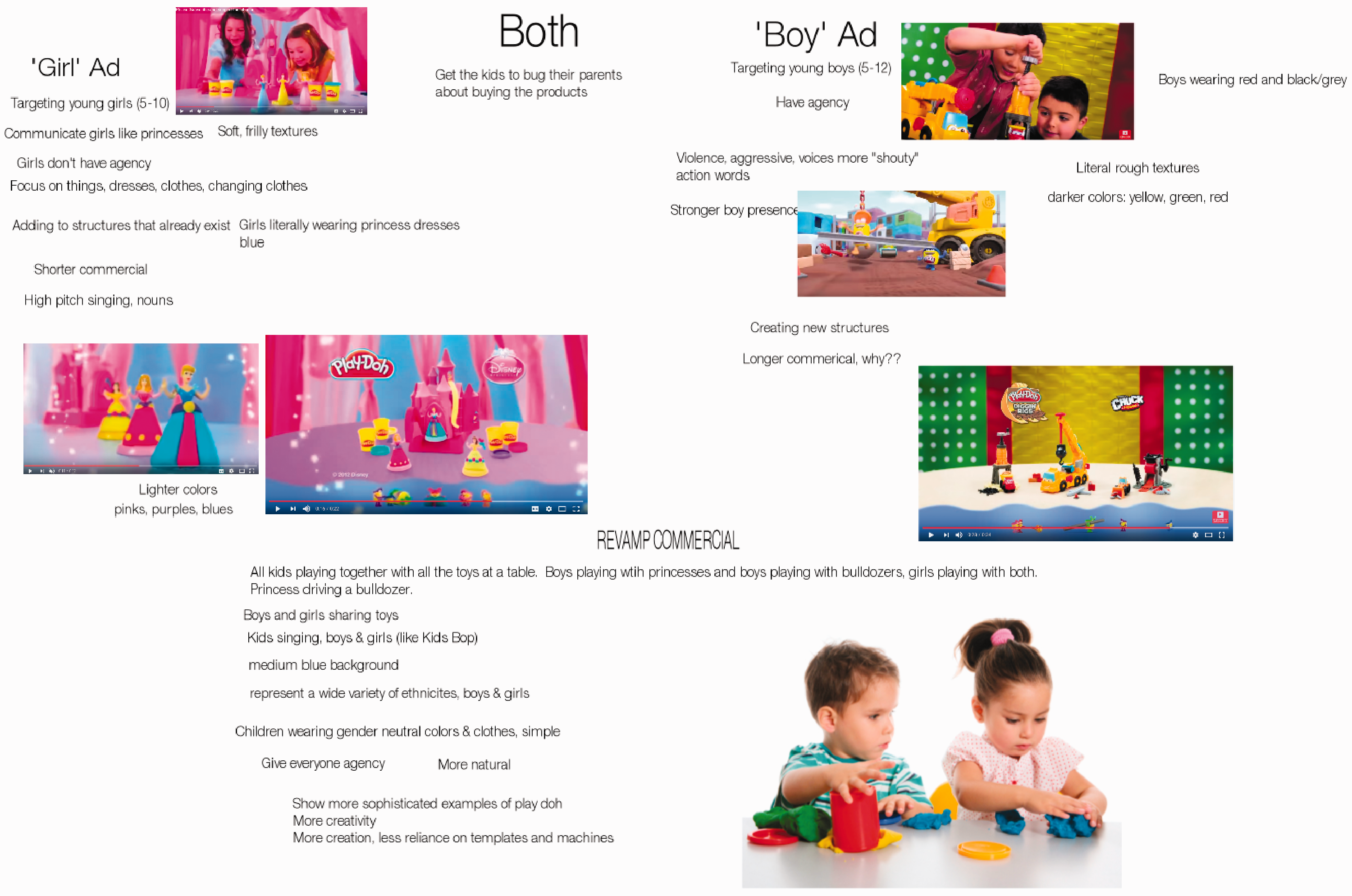
Students’ original Whiteboard from their discussion group.
The instance of collaborative learning that we analyze took place mid-way through the semester and focused on students’ discussion and deconstruction of two video advertisements 4 (“ads”) for Play-Doh—a modeling compound used by children to shape and sculpt objects. In each of the two ads, a pair of young boys or young girls was seen playing with Play-Doh and various apparatuses for manipulating it. The lyrics of the jingles in each ad were gendered in terms of the message they conveyed to the audience as well as in the ads’ use of color, gestures, and visuals.
While the first half of the assignment asked students to analyze and contrast the two video ads, the second half invited students to expand beyond binary notions of gender by reimagining a single ad to be either more “inclusive” or “subversive” of traditional gender representations. To generate and record their analyses, students were asked to create a digital Whiteboard. After the weekly online section meeting, students had the opportunity to revise their Whiteboards to add any elements they were not able to contribute during the synchronous discussion section.
Participants
Participants were undergraduate students at a public university in California and one high school senior from an adjacent state. They represented a range of majors and varied in their previous experiences both in courses about education and online courses. All students were enrolled in an online undergraduate course that focused on understanding notions of literacy from a sociocultural perspective through theoretical exploration and a fieldwork practicum. We collected data on 10 discussion groups and a total of 31 students; in this paper we focus our analysis on one group of three students.
Data
Our data consist of one synchronous collaborative learning event. To conceptualize this “learning event” we draw on Shirley Brice Heath’s concept of “literacy event” as the activity that encircles a text: “any occasion in which a piece of writing is integral to the nature of participants’ interactions and their interpretive processes” (1982: 93). However, we utilize Actor-Network Theory to extend Heath’s focus on talk and text, situating these as just two “actants” among many in an online network structured through pedagogical design. Thus, we employ the term “learning event” through the lens of ANT, referring specifically to the learning made possible by a network of multiple actants converging synchronously in an online space.
In our data the learning event is constituted by three students’ collaborative work in one online discussion section during the seventh week of a 14-week semester, and a follow up interview with the focal students. Discussions during breakout rooms were audio and video recorded using Zoom’s recording feature. We collected both the original Whiteboards students created during the online session, and the revised Whiteboards that were assigned later. Back-end data generated from the course site were used to identify processes of students’ work on the revised Whiteboard. Last, we conducted a focus group interview with students about the collaborative experience of creating a Whiteboard. This interview took place two weeks after the students’ online session and lasted one hour.
To select a subset of the Whiteboards for analysis, we explored students’ Whiteboards across groups. We were particularly interested in how students used the Whiteboard tool over the duration of the learning event and which groups used the Whiteboard in multiple ways to construct and represent knowledge (e.g., aesthetic, brainstorming device, analytical). This tool use was evidenced by the resulting Whiteboard artifacts, and also corroborated through the logged events of backend data generated on the course site.
We narrowed to five groups who more substantively used the Whiteboard in their conversations and transcribed the audio/video recordings of the breakout sessions. We then generated preliminary codes for the analysis of these transcriptions focusing on the content of student discussion, including “multimodal analysis” and “gender analysis.” We also compared group Whiteboards across two drafts: the in-class Whiteboard and the revised Whiteboard. In choosing a focal group we ultimately selected the group that made the most substantial revisions to their Whiteboard after class had ended. Although we analyzed and noted similar patterns of collaboration in the other groups, we felt that honing in on a single group would allow us to capture with detail the complexity and affordances of networked collaboration.
Using inductive coding we conducted a second cycle of analysis and generated a set of codes that allowed us to explore our research questions (Miles et al., 2014). These codes extended beyond the content of student discussion and focused on the learning process: “collaboration,” “awareness of own learning,” “multimodality,” and “criticality.” We mapped these codes onto a visual matrix identifying specific events that occurred around the dialogue we had coded, as well as corresponding video and back-end data. This allowed us to understand both what students were saying and what they were doing during their conversation. We also listed parallels between the two rounds of discussion (i.e., the first in-section discussion and the second follow-up interview). Our data were triangulated through observations, interviews, back-end data, and multiple rounds of coding by four researchers in order to reach consensus (Miles et al., 2014).
Questions
Amidst increasing interest in “computer supported collaborative learning,” we asked in this study: What does collaborative learning look like in the context of an online course? What does collaborative learning make possible for students?
Findings
The analysis that follows illustrates a synchronous collaborative learning event among students in an online course as they analyzed and created digital media artifacts. First, we identify the key actants involved in the collaboration, highlighting the dynamic interactions among the students, instructor, media artifacts, and digital tools. Next, we turn to what the networked collaboration made possible for learning, honing in on the micro shifts in student thinking around gender: considering new perspectives, questioning previously held assumptions, interrogating concepts, and making connections to real-world experiences. We found that as human and non-human actants converged, the students extended their thinking beyond dominant discourses of gender that characterize gender in terms of the two distinct and contrasting categories of “boy” and “girl.”
Networked collaborative learning
Figure 2 is a visualization of the actor-network that made possible the collaborative learning we observed and analyzed. Light blue circles represent actants, while the white and gray circles are actor-networks. Gray actor-networks are those that are peripheral to this network, but we chose to include them as we either consider them in our analysis (e.g., YouTube, Play-Doh marketing campaign) or they are otherwise important for understanding the larger ecology (i.e., UC Online, Research Project, Other Zoom Breakout Rooms). The white actor-networks (ED 140, SuiteC, Zoom video-conference) help to situate actants within their broader ecologies. This visualization reveals that collaborative learning was made possible by three actor-networks comprised of multiple actants that converge within and across these networks.
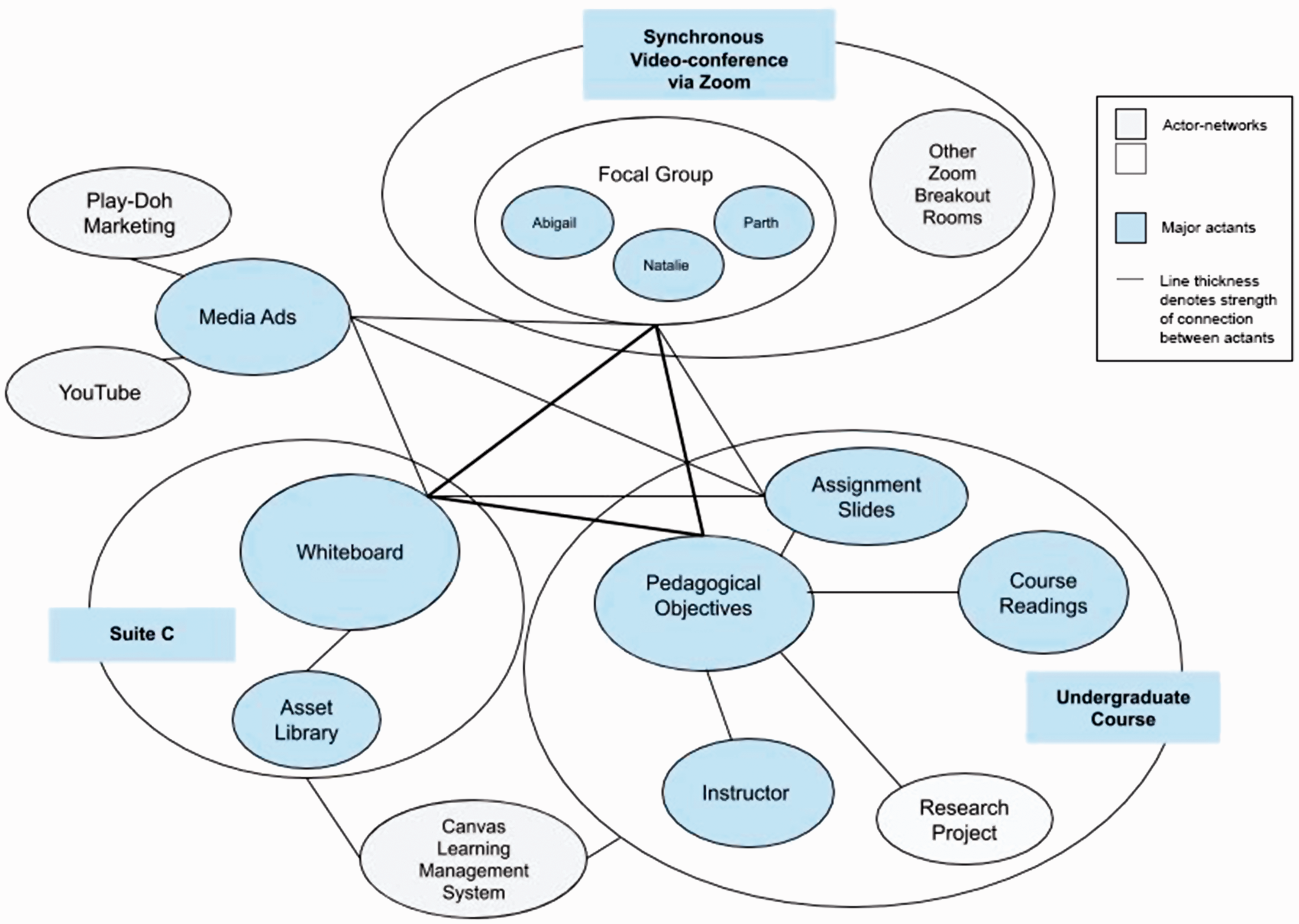
A map of major actants involved in the synchronous collaborative learning event.
As represented by the white circles in Figure 2, actants converged within and between three broader actor-networks. In the Undergraduate Course actor-network, which represents the class ecology, we can see that several actants and a peripheral actor-network combined to produce the pedagogical objectives. The pedagogical objectives were a key actant that interfaced with several other important actants. In the SuiteC actor-network, Whiteboards and the Asset Library are highlighted, as they are the two tools that the assignment task directs students toward. The Whiteboard is the primary tool students use to collaboratively compose and think while the Asset Library acts as a space where students eventually upload and share their Whiteboards with their classmates. The “synchronous video conference via Zoom” is the mediator that brings students together in this moment. Both the Zoom application and the designated classroom time converge to make an actor-network. Three students form the study’s focal group, and simultaneous to this collaboration there are several other collaborations between students occurring (hence, the actor-network of “Other Zoom Break-out Rooms” 5 ).
Figure 2 also visualizes the connections between actants and the three actor-networks through lines and line thickness. The connections between Whiteboard, pedagogical objectives, and focal group are represented by thicker lines, as they heavily mediated each other, and were extremely important for the shifts in thinking we observed in each student. The Whiteboard enabled students to talk, think, and pull apart the media ads; the pedagogical objectives suggested how the students and Whiteboard (along with other actants) were to interact, and the students actualized all of these suggestions and relations. Consistent with our earlier reference to Kumar and Rangaswamy (2013), students created, drove, and acted upon these relations through their intentionality and dialogic exchanges, though these decisions and their conversation were influenced by the actants and actor-networks depicted here.
Drawing on ANT, we demonstrate what collaborative learning in an online space looks like in terms of the roles multiple actants play and the outcomes of the learning event. As mentioned previously, ANT envisions both human and non-human actants as nodes within a network that support the maintenance of the network, or otherwise lead to its degradation. In the following section, we identify the key actants that made online collaborative learning possible, and we pay attention to how actants “enroll” (Callon, 1984; Law, 2009) each other into the network of this particular online collaboration. We emphasize how the pedagogical design is integral to forming this network.
Zoom, the video conferencing software used in the course, was a mediating actant around which instructors and students interacted in small and large group formats. If participants’ internet connection remained consistent, Zoom easily faded into the background as a stable actant that maintained and facilitated the network. The students in this study worked in a “breakout room” on Zoom where they saw and heard only each other and used the instructor’s PowerPoint slides to guide their work in the absence of the instructor. The slides themselves were a key actant holding together this particular online collaboration. They enrolled the pedagogical objectives and teacher’s guidance, which facilitated the students’ engagement with other actants—primarily the ads and Whiteboard, though also course texts—around particular learning objectives.
While the slides directed students toward particular learning objectives, the students, media, and the Whiteboard came together in unique and unpredictable ways. Each of these actants were a part of other actor-networks, which could have detracted from the pedagogical objectives structuring this collaborative learning event. For example, the ads had their own agenda of marketing gendered toys, while YouTube, which hosts the ads, could have drawn students into other videos and down other paths. In Table 1, we see an example of how these actants—the slides, the ads, and the Whiteboard tool—along with the students’ intentions, each played a part in constructing collaboration and influencing each other’s actions within the network.
Excerpt of transcript from learning event (ad deconstruction).
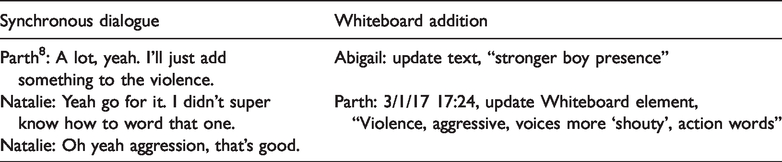
In this instance, the students simultaneously discussed their ideas about the ads and made additions to the Whiteboard. Having identified that one ad was targeted to girls and the other to boys, the students had created two distinct sides to analyze the “‘boy’ ad” and the “‘girl’ ad” on their Whiteboard, where they wrote key words that represented their comparisons of the ads’ modes and messages while they simultaneously captured and uploaded screenshots. As shown in Table 1 the students searched for words to characterize a key difference in the boy-identified ad: As Abigail finished updating text from a different observation (that the boys have a stronger presence than the girls in their respective ads), Parth wrote “violence, aggressive, voices more ‘shouty’ action words.” Natalie noticed his addition and agreed, lauding his choice of wording.
Students, through the agency and directive afforded to them by the instructor’s slides, thus pulled apart the ads in the form of images and short phrases and embedded them in the Whiteboard. The Whiteboard served not only as a thought pad, but as an active player in the conversation, representing back to students their emerging ideas and analysis. The Whiteboard and instructor slides acted on the ads to dislodge them from their originating context—a Play-Doh marketing campaign shared on YouTube—and enroll them into the classroom actor network.
In terms of this particular small group collaboration, we see that the actants interact in complex and reciprocal ways that further ideas, dialogue, and design consistent with the pedagogical objectives of the course. In other words, the students, the media, and technology work on each other, sustaining the actor-network and acting as participants in the online collaboration. We begin to see here a picture of online (classroom-based) collaborative learning emerge. Collaboration is a networked achievement brought about by humans and non-human actants (in this case technology). In an online learning space, technology plays an important role to make possible and maintain classroom-based collaborations.
We believe the reciprocal relations of technology and humans apply to all collaborations, although technology comes to the fore in an online environment, calling forth actants and maintaining strong ties among them to support the collaboration. As we will show in the following section, the convergences of students, instructor, media, technology, and other actants lead to shifts in student thought that represent small but significant moments of learning within an online classroom context.
Individual and collective shifts
Any networked collaboration is a “choose your own adventure” of infinite possibility. Any external change to the living, breathing ecology—substituting a tool, adding or removing a group member, changing the content or guiding questions—inevitably results in a shift in “output” of student thinking and production. Similarly, internal changes—the dialogical contribution of a group member, the addition to or revision of something on the Whiteboard—inform and transform the interaction, and thus, potentially, student learning. Any mark that is made changes what follows, and as some potentials fold, others emerge.
In this section we hone in on a specific set of conditions within the online learning network described above. Across the learning event, we observed how the four key actants in the network—the Whiteboard, the ads, the course slides, and the participants themselves—interacted to facilitate small, gradual shifts in each student’s reflection on gendered representation in the media and gender socialization, more broadly. Through a technologically mediated, dialogic process—the back and forth of communicative turns, large and small—students began to grapple with the perspectives of others in real time. We see these shifts as micro-steps toward “ideological becoming” (Bakhtin, 1986), manifested as small seismic rumblings and emergent reconsiderations of self, other, and society. As one particular instance of collaborative learning, this interaction is of course specific and unique, and yet it speaks to the broader potential for shifts in thinking, learning, and production within online course ecologies.
The start of the group activity saw students captured by the jarring contrast of traditional displays of gender in two Play-Doh modeling clay advertisements: the “boy ad” featured boys as aggressive, agentive, building, destroying; the “girl ad” featured girls as pretty, frivolous, accessorizing. As the group progressed from deconstruction to the creative imagining of alternative ads, they grappled with the problematics of gendered stereotyping 6 coming up against their projected concerns of parents who they imagined may not approve of “non-traditional” depictions of gender. And finally, as they moved on from making the Whiteboard to engaging in more freeform dialogue, we noticed their thinking shift toward broader analyses of gender as a social construct and socializing force.
We focus in particular on the part of the activity that asked students to take a creative leap and think through how they would design their own ads. The call to not only deconstruct, but create something new, challenged the group to think through how “inclusive” or “subversive” gender representations may actually look. Positioned as producers, the students were called to not only respond to existing, tangible content, but to consider more abstract notions of gender and socialization. As demonstrated below, this culminating moment revealed collective and individual micro shifts in perspective, thinking, and participation that suggest what online collaboration can afford for learning. While this seemed to be a collective move, we also recognized that shifts in the networked interaction inspired the three students—Parth, Natalie, and Abigail—to take individual paths in negotiating both their participation and their contingent theorizations of gender.
Parth
Parth’s participation was characterized by a sustained exploration of what Bakhtin calls “internally persuasive discourse” (Bakhtin, 1991)—that is, the tension-filled consideration of multiple points of view toward shifting understandings. This was not an isolated pursuit, but one facilitated by the network, including the contributions of his partners. On the one hand, Parth shared with Abigail anticipated concerns of “so many angry parents” reacting to an ad they might understand as subversive. He also considered Natalie’s suggestion of “everyone playing with everything,” but used it as a springboard to further interrogate the more abstracted notion of “gender neutrality”: Or maybe … I mean ok so if we're trying to get away from the gender bias, then toys that aren't speci … I mean, the problem is that if you don't know if this would sell or not but like, gender neutral toys … so things that like don't necessarily … Ah I don't know, I'm not sure because then like I was going to say that you could do gender neutral toys but I don't think there's any such things as gender neutral toys, it's just there are toys that have associations with them like … [interruption occurs] every toy is technically gender-neutral outside of society.
Natalie
Natalie, who played the self-appointed, unofficial timekeeper for much of the learning event, deepened her engagement and expanded her thinking as the dialogue progressed. While she was undoubtedly engaged in the ad deconstruction, spontaneously commenting, “I really like this, I think this is fun,” her goal initially seemed to be to appease the assignment requirements: “We have like twenty minutes,” and five minutes later, “Alright, fifteen more minutes. I don’t know what else we need to do.” As the group struggled to reimagine a new ad, she responded to her partners’ attempts at interrogating subversion by repeatedly insisting that “the best would be for everyone to just play with everything”: that is, one ad with boys and girls playing with all kinds of toys. In the context of her concern for timekeeping, we read these contributions as hurried attempts to move the group on to the next part of the assignment.
We saw a shift in Natalie’s engagement when the group seemingly finished adding their ideas to their Whiteboard and moved into a more open-ended discussion, inspired by the assignment slides, but no longer structured by themes. Natalie reflected on her experiences walking through gendered aisles at a Target department store, noting that, “It's really hard to just have a toy that is just a toy.” Abigail took this up, adding, “I didn't really think about it but giving kids these toys really helps to set in place these gender roles that accompanies them with the rest of their lives.” Abigail gave her own example of the way Barbies had instilled in her a certain ideal. This exchange sparked Natalie to further articulate the process of gender socialization: Like we're giving girls like baby dolls they're like rocking and like caring for. And then we're giving boys like nerf guns, but they're going out and like … And then we're like, Why are boys more violent? … Why are girls so much more nurturing? It must be inborn!
Abigail
Like Parth, Abigail was persistently concerned with the ads being “effective” in the eyes of marketers and “mad parents.” However, as the group wrapped up the more concrete task of re-envisioning an ad and recording their ideas on the Whiteboard, she opened herself to discussing gender more abstractly and more critically. As discussed earlier, Natalie’s sharing of observations from her lived experience brought Abigail to reflect that, in our society, a toy is not just a toy, but a form of gender socialization. In this extended dialogue with Natalie, Abigail concluded: “I think I understand the idea of this Play-Doh. I think it's a metaphor for the kids themselves, and the way that they’re being shaped.”
Abigail’s insights seemed to develop in real time through the dialogue with her classmates. As the students filled up the Whiteboard space and moved into a more free-form dialogue, her incipient concern with the “effectiveness” of the ad seemed to fade. Her interest, like that of her group mates, shifted away from the advertisements themselves and drew on personal experience to understand the very processes of gender socialization.
Discussion
In our examination of a collaborative learning event, we observed the unpredictable ways non-human and human actants formed a network and how this networked collaboration produced micro-shifts in the students’ participation and their thinking about the concept of gender. As the students worked to multimodally deconstruct the ads’ messages and then construct a new ad, they came to revisit their assumptions about gender, reflect on their own gendered experiences, and understand gender as socially constructed. As we have demonstrated, these micro-shifts were facilitated by a network of dynamic actants: an ecosystem that was both intentionally designed and that took on a life of its own.
Redefining collaborative learning
In response to our first research question—“What does collaborative learning look like in the context of an online course?”—our analysis of the online learning network as a dynamic ecology inspires a revision of existing conceptualizations of collaborative learning. In our literature review we identified the most prevalent, operational definition of collaborative learning as (1) two or more individuals (often students and teachers) working together, (2) most often synchronously, in order to (3) construct shared meaning or acquire new knowledge (4) that leads towards a shared goal (e.g., Dillenbourg, 1999; Garrison et al., 1999; Laal and Laal, 2012; Roschelle and Teasley, 1995; Zhang and Carr-Chellman, 2001). Our analysis addresses and expands each of these elements, moving toward a conceptualization of collaborative learning as a network of human and non-human actants.
First, we suggest that rather than understanding collaborative learning as a synchronous interaction between multiple individuals, we can helpfully conceptualize it as a network of relationships between human and non-human actants, converging both synchronously via voice-based means and asynchronously via text-based exchanges (e.g., Karasavvidis, 2010; Oliveira et al., 2011; Steeples, 1995; Yamagata-Lynch, 2014). Thus, we see collaborative learning as constituted by networks, while emphasizing the affordances of synchronicity in this particular learning instance. 7
Further, and in response to our second question—“What does collaborative learning make possible for students?”—we believe that the emphasis on the construction of shared meanings toward shared goals can be helpfully complicated through its characterization as a tension-filled process of ongoing shifts. Rather than afford the construction of shared meaning toward a shared goal, collaborative learning facilitates the negotiation of goals that are potentially multiple and competing. While an overarching goal is assigned via the course learning task, actants, and especially people, may each have their own affordances and goals, respectively (e.g., to convince someone of what they believe, to propagate a certain ideology, etc.). As actants contribute their individual desires and affordances, they inevitably introduce and influence other actants to take on new ways of thinking and being. A networked view of collaborative learning highlights both the coming together of actants, and the resulting disruptions or shifts that actants experience as they interact. In terms of learning and education, we see this most powerfully represented in how students’ participation and thinking around the course content changed in small, but important ways, sowing seeds toward what Bakhtin called ideological becoming.
We thus offer the following definition of collaborative learning (CL): (1) the convergence of human and non-human actants, (2) within a synchronous or asynchronous network, (3) facilitating and facilitated by shifts in knowledge and thinking, (4) in service of multiple and competing goals.
Pedagogical implications
While we believe our definition of CL is applicable in both online and offline contexts, our work speaks especially to pedagogical considerations for online collaborative learning. Pedagogical design is integral to maintaining a network that supports collaborative learning. Given that networked technology can easily serve as a distraction, the onus is on the educator or instructional designer to actively recruit technology in productive ways, leveraging its affordances for the pedagogical project at hand. In an online classroom, “remix”—the ability to easily manipulate and combine media to create original work or artifacts—is an affordance of digital tools that has great learning potential (Knobel and Lankshear, 2008; Scott, 2018; Scott et al., 2018). Digital tools, like SuiteC and in particular the Whiteboard in this context, encourage students to actively engage with remix. In the collaborative learning event that is the focus of this paper, students appropriated key words and phrases and uploaded screenshots from the advertisements. Remix was important for the shifts we saw as it enabled students to pull apart the ads and re-present and see them in a new light. It challenged the power of the ads to speak authoritatively about gender and helped to provide a space for students to come to their own understandings about gender.
As noted in our review of literature on online learning, synchronicity is not needed to sustain all online collaborations (Halverson et al., 2014; Schulte, 2011). However, in our study, video-conferencing played a key role in facilitating rich student dialogue and iterative design. We advocate for students to have the opportunity to meet face-to-face in virtual spaces to share perceptions, thoughts, and emotions, and to design/create together in real time. We also recognize that while students sharing a virtual time-space may spontaneously generate their own dialogue, thoughtful assignments comprised of guiding questions and creative tasks catalyze and scaffold this conversation. Conversely, follow-up “unstructured” time offers students agency to take their dialogue in directions that feel most fruitful to them, opening up the space to generate authentic new insights.
While the pedagogical design of the learning event discussed above scaffolded students’ interactions with other actants, it was not deterministic, nor did it predict all of the learning outcomes we observed. For example, the students’ most explicitly stated insights or shifts came after they stopped their multimodal analysis and ad creation; that is, when they filled the Whiteboard space. While the scaffolded dialogue helped them build their analysis up to this point, the unstructured time in the learning event afforded them space to organically explore the questions and connections that most interested them. Further, students’ positive affect while working with each other was both an unpredicted outcome of this collaboration and an actant that facilitated the network. This observation aligns with Latour’s explanation of the network and its actants: actants do not act on and with each other nor produce pre-determined effects, but rather they are always embedded within a network of relations that facilitate unpredictable processes and outcomes. Educators and instructional designers must work with intention to “assemble” assignments and tools in ways that enable collaborative learning and sustain student engagement, while also understanding that the network will inevitably work in unpredictable ways and produce its own effects.
The insights gleaned from this study are not exclusive to online learning contexts. Rather, they suggest that online education, when conceptualized and designed via actor networks, may be as rich as in-person, student-centered pedagogy. The key is to neither dismiss nor over-emphasize the role of any actant—be it the instructor, students, or digital tools—but to interrogate the dynamic ways these come together. Conceptualized through Actor-Network Theory, effective online pedagogy functions as a kind of teeter-totter: an ongoing balance of intentionality through pedagogical best practices and openness and wonder at the possibilities that emerge.
Conclusion
In this study we demonstrate how networked collaborative learning facilitates small but significant shifts in students’ thinking within the context of an online undergraduate course. While we do not know the trajectories these students’ thinking about media, gender and socialization have taken beyond the brief time that they all converged, we nevertheless recognize the micro shifts in perspective-taking and thinking that occurred during the encounter as a glimmer of ideological growth and change. Honing in on this level reveals the richness of insight and potential for expansive thinking made possible by a thoughtfully designed online learning network. As they moved between critically analyzing media to producing their own artifacts, the students periodically reflected and commented on the process itself. In a few seemingly joyful moments for those who design learning experiences, the students spontaneously echoed our feelings about this promise of intentional online education. This sentiment is perhaps best evidenced in the words of Parth: “Interesting. I'd never thought to take the time to do this [kind of analysis of everyday media consumption], but like once you take the time to do this, it's actually pretty crazy … All the things you can find.”
Footnotes
Declaration of Conflicting Interests
The author(s) declared no potential conflicts of interest with respect to the research, authorship, and/or publication of this article.
Funding
The author(s) received no financial support for the research, authorship, and/or publication of this article.