



Abstract
This paper examines how armed conflict impacts the recalibration of Aleppo’s historic urban and cultural fabric, using the Al-Jdeideh quarter as a case study. This article critically reflects on the ongoing (post-)conflict, top-down (post-)reconstruction activities in Aleppo’s historic core, drawing on ethnographic research of visual mapping and semi-structured interviews with current Aleppo dwellers in the city and former dwellers displaced across Europe. Our findings highlight that the current reconstruction activities lack locals’ values and needs, and amplify the altered socio-economic dynamics between the (former) communities’ absence and presence. Therefore, these activities are resulting in a skewed representation of what once was a major hub of culture, commerce, heritage, and everyday life. As such, the paper argues that the current reconstruction attempts lack a comprehensive and context-specific approach, and need to explore more inclusive pathways of human-centered and sustainable recovery.
Introduction
On December 19th, 2022, amidst the ongoing energy crisis that plunged the streets into cold, bitter darkness, Al-Hatab Square in Aleppo’s old city was illuminated by the shimmering lights of a first-of-its-kind Christmas market. The “post-war” festive decorations and jolly music pierced through Al-Jdeideh quarter ruins, where the square is located, attracting passers-by who arrived curious and seeking warmth. For three weeks, the event invigorated the quarter with a “generous” electricity supply accommodating stands, music performances, and activities to “warm the hearts of Aleppians.” This “unconventional” event was preceded in the same square by another: the “Once Upon a Time … Aleppo” open-air exhibition, by Fine Art students from Damascus University in October 2022 (Figure 1). The “unconventional” nature of these events becomes apparent against the backdrop of overlapping and chronic crises that the country has been witnessing since 2011. As the Syrian conflict reached Aleppo, armed clashes marked the beginning of the “Battle for Aleppo” in July 2012, ending in December 2016, with the Syrian state regaining control over the city. Many neighborhoods, including the historic core, became battlefields and stages where unprecedented hostilities and human rights violations took place (see Amnesty International, 2015). Whether intentional or collateral, the armed clashes and subsequent instabilities came with violence exercised through the destruction of the built environment and homes, displacing and fracturing generationally maintained socio-cultural networks and economic activities interlaced with the urban fabric. Cultural events at Al-Hatab Square in Al-Jdeideh. Left: The Christmas Village at Al-Jdeideh, Aleppo, December 2022. Image source: North Press Agency (2022). Right: “Once Upon a Time … Aleppo” art exhibition at Al-Jdeideh, Aleppo, October 2022. Image source: https://www.instagram.com/once.upon.a.time.22/, accessed April 2023, account deleted thereafter.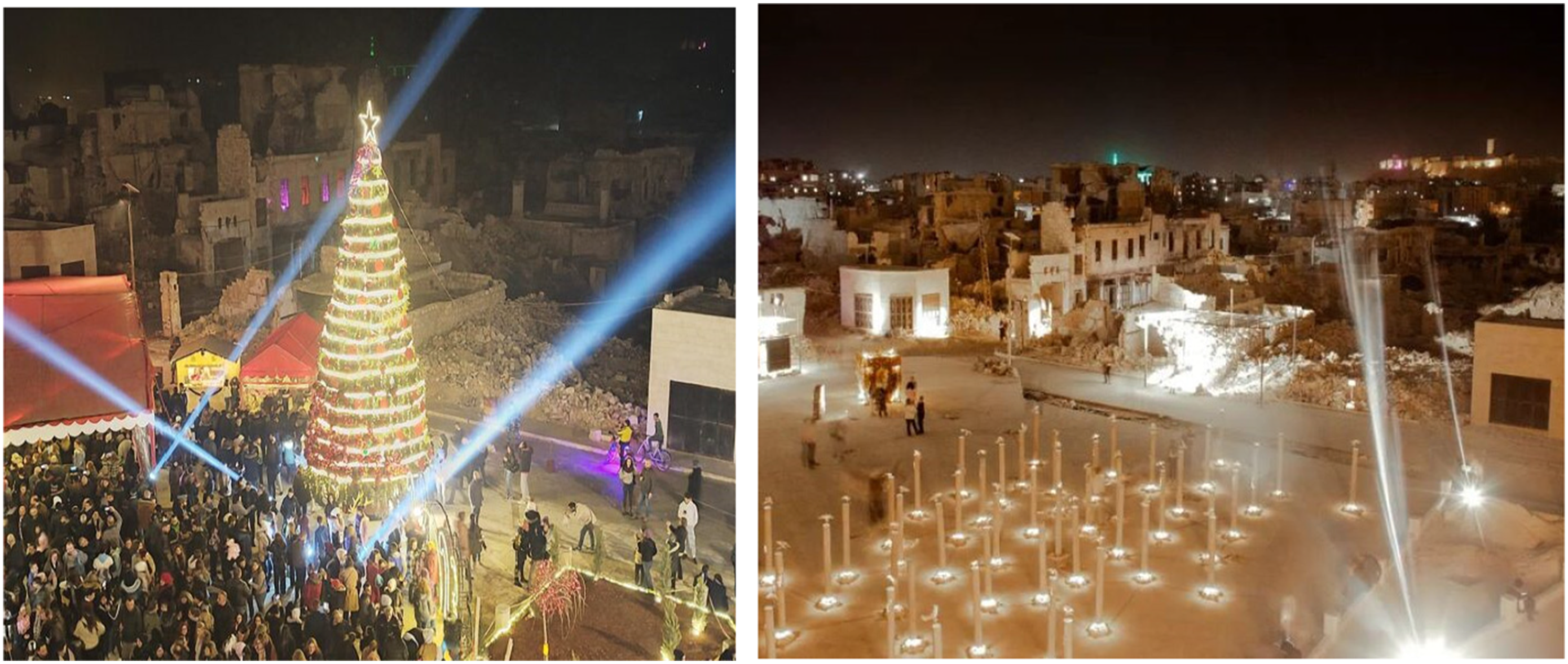
Understandably, urban heritage sites are affected by armed conflict and reshaped during post-conflict activities, tensions, and intentions (Sørensen and Viejo-Rose, 2015). After the armed clashes ended, various international responses emphasized the urgency to protect and document the “authenticity” of Aleppo’s built heritage (Pütt, 2018). However, political agendas and economic sieges conditioned the reconstruction efforts; only sparse projects were supported by the Syrian government. The national social media streams, affiliated with the Syrian state, celebrated such efforts and festive events by broadcasting “co-created” narratives of survival, national pride, and the “honourable loyal Syrians” who did not abandon their country. Therefore, generously supporting events in Aleppo, with replicas in cities that the state control, became a public display of power and representation of the nation’s unity and victory.
Nonetheless, as the festive lights brushed over the nearby rubble, they evoked the war’s violence, pre-war memories, and everyday realities of a war-crippled city. The unfamiliarity of these events hardly matches the vibrant pre-war businesses or today’s paralyzed spaces, reflecting highly politicized and imposed healing processes, lacking sensitivity to socio-cultural and economic dynamics that maintain “authenticity” (Munawar and Symonds, 2022). With a patchwork of uncoordinated and sparsely funded initiatives, the reconstruction efforts are still focused on technical exercises of physical restoration of structures of the past (Khalaf, 2020). Contradictions evoked by these patchworks and pop-up activities reflect the complexity of (post-)war realities and the intricacy of healing processes displayed in public spaces. Such activities stirred up interpretations and discussions as different actors engage with and deliberate on cultural heritage, leading to intense contention over heritage representation and significance during and after wartime. The case of Al-Jdeideh quarter in Aleppo is yet another example of how various (post-)conflict dynamics and reinterpretations of cultural heritage (re)fabricate war-torn, fragmented structures and meanings. Questions of “whose and which heritage?” and “what to continue and what needs to change?” overarch the (post-)conflict reconstruction and recovery processes in Aleppo. These questions carry contradictory images, involving those who claim ownership of the past (Munawar and Symonds, 2022) and those who have the (future) rights to it.
This paper focuses on the Al-Jdeideh quarter and highlights the ways in which unplanned and uncoordinated attempts at (post-)conflict reconstruction processes exacerbate the underrepresented values and needs of the locals. Through (visual) ethnographic fieldwork and semi-structured interviews, this paper addresses the following questions: What are the current post-conflict dynamics taking place in the Al-Jdeideh quarter? How do former and current Aleppo inhabitants perceive these reconstruction works and “recovery actions” in the quarter? The paper develops a biographical-narratives approach to create an assemblage of stories that are spatially embedded, generationally transmitted, and iterating between past images and future visions. It seeks to map out and give voice to the unheard stories, memories, and perceptions of Aleppo dwellers inside and outside of Syria. Ultimately, these methods, together with a literature review and secondary data analysis, provide critical insights into how and by whom Al-Jdeideh’s (post-)war biography is composed.
Is Aleppo in post-conflict recovery?
As mentioned earlier, the “Battle of Aleppo” took place from 2012 to 2016, with the Syrian state and its allies ranged against the opposition forces labeled as “traitors” and enemies of the state. The city, recognized as a UNESCO World Heritage Site since 1986, was divided into two parts: eastern parts, including the historic core, controlled by armed opposition forces, and western parts controlled by the Syrian army. After several years of military impasse, the Assad-led Army and its allies launched a large-scale offensive campaign, effectively becoming an airtight siege from mid-July 2016 (Scherling, 2021). Aleppo’s historic core became the battlefield, as each side aimed to gain control of this symbolic territory; it suffered significant destruction, marked by the tragic collapse of the famous minaret of the Great Umayyad Mosque, dating back to the eighth century. Unsurprisingly, social media exploded with reactions to this loss and blame was exchanged between opposing parties, leading to vague narratives obscuring “the truth” (Munawar and Symonds, 2022). The spatial and cultural destruction of heritage persisted until late 2016, when a resolution was reached between the Syrian government and the armed opposition groups to evacuate the latter’s fighters and their families from the city. This agreement was the result of what was considered the Aleppo offensive, “Operation Dawn of Victory,” and for others “the siege of Aleppo.” This offensive involved intense military operations of what scholars term “urbicide”: the deliberate destruction of the city (see Abujidi, 2014). On December 22nd, 2016, the offensive ended with the Syrian state taking control over the city, followed by public celebrations of the claimed victory against terrorism (Sputnik International, 2016). “Aleppo’s Liberation Day” has become an annually commemorated event that marks the retrieval of Aleppo by the state and its international supporters (SANA, 2022), thus reaffirming their legitimacy claims. From 2017 onwards, the city’s supposed stabilization, as endorsed by the Syrian government, has hardly matched its fragile state on the ground: a fragmented, generationally articulated urban, social, and cultural fabric (Affaki, 2021), a crippled economy, and vulnerability to cascading crises.
The aftermath of the “liberation of Aleppo” left the city in ruins: the death toll reached 31,000 and hundreds of thousands were forcibly displaced within and beyond the city’s borders, while others suffer dire living situations. The historic core was left in ruins: around 30% totally destroyed and 60% severely damaged (UNESCO, 2017). Evidently, the reconstruction and instrumentalization of cultural heritage have been essential to provide emotional, cultural, and economic healing for societies traumatized by conflict (Giblin, 2014; Munawar and Symonds, 2022). In response to Aleppo’s fragile state on an international scale, UNESCO organized its first international meeting in Beirut in 2017, involving Syrian stakeholders such as the Directorate General of Antiquities and Museums (DGAM), to discuss recovery actions for Aleppo’s heritage sites. In the same year, the World Heritage Committee meeting in Krakow recommended the adoption of a Historic Urban Landscape approach (HUL) for Aleppo (Alsalloum, 2019). Despite the prioritization of Aleppo’s reconstruction at a national level, the city did not receive any significant financial assistance (UrbAN-S, 2019) to facilitate a comprehensive reconstruction process. Due to the ongoing sanctions, limited or no follow-up plans and detailed recovery strategies have been implemented within Aleppo’s historic core by UNESCO (Mahfouz, 2021), with limited involvement and cooperation with other parties with access on the ground. Such involvement includes the Aga Khan Trust for Culture (AKTC) reconstruction works that took place in the Medina Souqs (UrbAN-S, 2019) and some private local architecture companies (i.e. Raha). Other restoration projects received charitable funds from the Syrian government (supporters) with what appears to be a religious bias. Examples include the restoration of the Great Umayyad Mosque minaret through generous donations from the Muslim-majority republic of Chechnya (Ray, 2019; Sputnik International, 2017) and Mar Elias Maronite Cathedral restoration funded by Church in Need (ACN) (Pontifex, 2020), while the rest were scantily and arbitrarily funded by local private donors. Due to a severe lack of funds, equipment, and skilled labor displacement, only a few of Syria’s heritage rehabilitation projects have made progress. However, these projects are currently limited to technical exercises focused on physically restoring the structures of the past (Khalaf, 2020).
Scholarly critics have raised concerns about the arbitrary selection and prioritization of renowned heritage sites for reconstruction, questioning their valuable impact on the necessary recovery within the city. For example, while the monumental and historic significance of the Great Umayyad Mosque reaffirms its symbolism for Aleppo’s rooted dwellers who practice their Friday prayers (Affaki, 2021), its restoration paints a false image of cultural persistence and rising stability for national and international viewers. Such piecemeal ventures in (post-)conflict reconstruction arguably undermine the socio-political and socio-economic developmental challenges required for restoring mutually inclusive relationships and rebuilding (Munawar and Symonds, 2022) and trust between local communities and national institutions (Barakat, 2021). Aleppo’s post-war reconstruction strategies must fundamentally follow an integrated approach that combines developmentalism with societal transformation and reconciliation (Affaki, 2021; Munawar and Symonds, 2022).
Although the city celebrates its seventh “liberation” anniversary in 2023, it is very problematic to describe the current situation as a “post-conflict” landscape. Aleppo is trapped in regional dynamics of chronic crises, political instability, and socio-economic degradation. The violence experienced undoubtedly disrupted urban spatial arrangements, leading to significant spatial discontinuities. While societies, heritage, and urban space remain inherently conflictual (Pullan and Baillie, 2013; Smith and Waterton, 2009), the term “post-conflict” becomes controversial when applied to Syrian and other post-conflict geographies.
Social challenges in (post-)conflict reconstruction projects of cultural heritage
The destruction of cultural heritage has long been a concern, but its social dimension remains underdeveloped in international policies and practices (Barakat, 2021), especially in the constantly changing political dynamics of the so-called Global South. After conflicts, the focus of national and international efforts to rebuild cultural heritage primarily lies in the careful preservation and restoration of those significant expressions of collective identity, deeply rooted in the essence of religious and historical monuments. While recognizing the undeniable importance of religion as a vital element of culture, and its profound significance to individuals in various war-torn societies (Barakat, 2021), the specific emphasis on reconstructing symbolic physical elements poses numerous challenges when it comes to promoting processes of recovery and reconciliation in post-conflict regions.
Indeed, emphasizing people’s attachments to meaning, memories, and narratives has been gaining more attention in relation to the value of heritage sites. The Québec Declaration (ICOMOS, 2008), an international heritage conservation charter, for instance, recognizes narratives and memories, alongside “traditional knowledge, rituals, values, etc.,” as part of the spiritual elements that give meaning and attune the “spirit of the place” of heritage sites (Wells, 2021). Furthermore, the nomination process of UNESCO’s 1 Historic Urban Landscape approach (HUL) advocates an inclusive orientation that embraces the diverse social values that people attach to urban areas. This approach was adopted by UNESCO to ensure the integration of cultural heritage policies and management concerns in the wider goals of sustainable urban development. However, embracing the operationalization of HUL continues to pose a challenge, as field access is lacking contextualized values in relation to local heritage discourses, which continue to be politicized and reframed according to the different interests of local actors (Ginzarly et al., 2019). Wells (2021) emphasizes UNESCO’s urgent need for further improvements in terms of researching and assessing the social dimension in its practices, which was previously discussed in the work of Isakhan and Meskell (2019). They highlighted the common misconception of “successful” projects in relation to sustainable peace, reflecting on past efforts of UNESCO’s (post-)conflict heritage reconstruction projects in Bosnia, Afghanistan, and Mali. In particular, Isakhan and Meskell (2019) outlined the problems of prioritizing expert opinions over local perspectives when deciding which heritage sites to reconstruct, the prioritization of monumental restoration at the expense of humanitarian needs (Meskell, 2018), and the use of heritage as a symbol of peace when societies were still grappling with ongoing crises and conflicts (Isakhan and Meskell, 2019). Former and recent projects in war-torn and socially ruptured cities, such as Mostar and Mosul, which aim to restore unity and peace, faced various challenges in balancing human-centered and top-down recovery approaches, and disregarding humanitarian needs and political agendas on the ground. 2 Consequently, such negligence endangers both local communities and heritage sites, exposing them to potential risks of instability, violence, and iconoclasm (Isakhan and Meskell, 2019). These projects become staged efforts lacking genuine local involvement and addressing needs, thus reducing the complex processes of “reconciliation” in fragmented societies to mere theatrics of lifeless, shell restorations. As a result, the reconstruction of cultural heritage in (post-)conflict regions must unequivocally prioritize the affected communities to ensure an authentic recovery pathway towards hope, healing, and reconciliation (Barakat, 2021; Munawar and Symonds, 2022). Therefore, the endeavor to place people at the core of post-conflict reconstruction necessitates profound contemplation on the very understanding of heritage in a specific context.
Developing a conceptual and methodological approach: spatial embodiment of (hi)stories and cultural processes
To adequately address the aforementioned questions of “whose heritage?” “which heritage?” and “what needs to continue and what needs to change?” this paper proposes to read and examine built heritage as embodiments of historical and cultural processes, through the following conceptual and methodological approach.
Heritage sites as canvases of narratives and biographies
In her book Uses of Heritage, Smith (2006) established a reframing of heritage and provided an eye-opening exploration of the subjective nature of heritage beyond its mere physicality, where the privileging of material sites and their “monumentality” narrows the complex and divergent ways in which culture is continually contested and renegotiated in multiple forms and experiences (De Cesari and Dimova, 2019; Shahab and Isakhan, 2018). Likewise, for Gantois (2019), heritage places are open avenues to unravel the multiplicity of perceptions, experiences, memories, and meanings attributed to heritage by its local communities, residents, users, and visitors. She asserts that examining these sites should be “by exploring [their] emotional and experiential realities,” hence shifting “from exclusively focusing on the heritage structure as an object to viewing heritage as a relationship” (Gantois, 2020: 183). Recently, Jelic and Staničić (2022: 480) called for embracing interdisciplinarity, reframing heritage “as a reflection of the past and future, simultaneously tangible and intangible, an object and an experience.”
In (post-)war turbulence, heritage transforms into a collage of individual narratives and collective experiences from diverse histories flowing along currents of time, with unwritten tales awaiting their chance to be woven and shared. Translating such experiences from “knowing into telling” is a “narration” skill for reconstructing reality (White, 1980: 6) which, if collectively practiced, transforms into practices of remembering together and fosters collective engagement. The power of reconstructions of reality, as Jackson (2013: 15) emphasizes, lies in their “existential imperatives” and underlines that telling one’s story allows marginalized locals to take center stage and become more than passive players during life disturbances. Jackson (2013) further stresses that the narrative and storytelling power is in defragmenting ruptured memories’ places and empowering individuals to own their traumatized experiences. Storytelling, a term Hannah Arendt (1977) uses to describe critical understanding from experience, holds power to transform the private into public meaning. Human existence is thus inherently intertwined with the spatial realm, where images and narratives play a crucial role in shaping it as a meaningful place (De Jong et al., 2021). Telling the story, as Gantois (2020) advocates, becomes an immersive spatial practice that transcends traditional historical interpretations of heritage sites and brings forth new knowledge derived from everyday practices and experiences. As such, various forms of narratives, including those on social media and virtual platforms, hold great potential to defragment stories about places’ histories beyond politics and enable societies’ active and emotional engagement with their urban heritage (Van der Hoeven, 2019).
In parallel, a biographical approach, as explored by Sørensen and Viejo-Rose (2015), sheds light on the complex processes that manifest and influence the (re)shifting values and images of heritage sites. It is a way to tune in to the lived stories of these sites’ inhabitants and a way to tell the story of that place. This lens aids in (re)identifying the fluctuating meanings of cultural heritage in post-war societies and contested geographies (Sørensen and Viejo-Rose, 2015). In the same line, Zibar (2023), in her research on forced displacement urbanisms, developed the territorial biography approach to sketch the overlapping and embedded spatialities of suffering, memories, belonging, and shifting geographies of what and where are past and future homes. Walter (2014: 12) demonstrates this point as follows: … to see a building as narrative is to acknowledge that [… it] is itself an active partner in our self-composition. Seeing a building as an ongoing and developing narrative is to acknowledge the relevance of the community’s story to date—the building’s biography—but also invites us to wonder where the “story” might go next.
Therefore, framing the heritage site as a narrative and encapsulating the site’s biography is essential to illuminate a deeper understanding of people’s existential imperatives. By mapping these biographies and their spatiality, it is possible to consecutively discuss the course of post-conflict reconstruction processes and visions, analyse their effects, and trace how they redefine and change the meaning of spaces and places (Sørensen and Viejo-Rose, 2015). Heritage is, after all, a living record of existential subjectivity and generational continuities, as well as embedded perceptions. Narratives and storytelling, therefore, offer researchers a valuable means to collect qualitative data, enabling a deeper understanding of the storytellers’ personal and cultural perspectives (Djabarouti, 2021; Goodman, 2011).
In the (post-)conflict, war-traumatized, and politically charged context of Syrian cities, a narrative and storytelling approach becomes an essential tool to ensure inclusivity in restructuring the meanings and values of the “lost” heritage (Mahfouz, 2021) of all the affected communities and individuals. Voicing narratives and mapping biographies in the post-conflict recovery and heritage reconstruction processes not only amplifies concealed knowledge but also helps, if collectively practiced, to steer inclusive practices of filling in the missing pieces that gave the places their meaning and reasserting their spirit’s continuity. Thus, this paper calls for a narrative turn to navigate a dialogue on the post-conflict reconstruction processes, to emphasize the importance of understanding cultural heritage as a multi-layered canvas for recalibrating past cultural meanings and local narratives within both contemporary and future reconstruction strategies.
Remembering together: Living, researching, and visiting the site
First and foremost, contextualizing this research by elaborating on the authors’ positionality is of high importance. The authors of this paper, all of whom have Syrian citizenship and have experienced displacement, began researching this case in April 2021 during an online seminar (BTU-AUB, 2021-22). Despite their shared background, the authors’ relationship to the case study differs. One of the authors (LZ) grew up in an adjacent quarter of Al-Jdeideh until the conflict reached Aleppo in September 2012. The other authors (DS, SA) had no previous pre-war knowledge of the site and conducted fieldwork and visual ethnographic research on periodic visits between April 2021 and September 2022. Twelve semi-structured interviews were conducted between March 2022 and February 2023. 3 The interviews were mostly done through voice calls, while three were conducted on-site and in-person. During site visits, the authors documented the everyday social context using photographic and video recordings to understand the post-conflict transformations of Al-Jdeideh quarter. Finally, the data collection was supplemented with collective mapping during a workshop organized by the collaboration of Brandenburg University of Technology in Cottbus and the American University of Beirut in November 2021 (BTU-AUB, 2021-2022). In this workshop, the authors surveyed eight architecture students from Aleppo and mapped their memories of Al-Jdeideh quarter.
Over 2 years, the authors shared their memories of the quarter and its history, working together to reconstruct its image. The authors developed a narrative and biographical approach to their case study by intersecting three conceptual and methodological frameworks to map out the web of meanings from their collected data. First, the authors reconstructed the historical events and the interviews based on the narrative and storytelling literature and schemes mentioned earlier. Second, using Sørensen and Viejo-Rose’s (2015) biographies of place and Zibar’s (2023) territorial biography, these analytical frameworks allowed them to map the changing meanings of presence in the place and hence the right to reconstruct it. Third, borrowing from Gantois’s interactive walking methodology (2020, 2022), the authors engaged in serendipitous walking during the fieldwork. Guided interactive walk-talks and informal hangouts contributed to obtaining a general understanding of the case study and gathering up-to-date reactions regarding the ongoing reconstruction processes.
Combining personal narratives, interviews, and interactive walking with both biographical and narrative approaches allowed for full immersion and engagement with the spatial and emotional dimensions of the site. Putting the images together served to interpret the space as a multi-layered canvas of past experiences, everyday life, and future aspirations.
Zooming in: Al-Jdeideh between the past and the future
The establishment of Al-Jdeideh quarter as an urban expansion beyond Aleppo’s fortified perimeter dates back to the Mamluk period following Mongol conquests (1260-1400 AD) (GTZ, 1999). The quarter accommodated Christians’ displacement flows followed by European merchants’ arrival, which facilitated intermediary cooperation with Al-Jdeideh’s residents (Burns, 2016). From the mid-17th century onwards, these communities enjoyed a religiously and culturally pluralist society under Ottoman rule, with each community exercising a degree of local autonomy (Hourani, 1979), that attracted later various Christian migration flows. Within this period, the quarter witnessed spatial and architectural growth and characterization (e.g. Waqf Ibshir Pasha Complex 4 in 1653), meeting the socio-cultural and economic needs of multiple communities (David and Chauffert-Yvart, 1982) Such socio-economic coherence flourished, with two major extensions to accommodate new Christian families. However, by 1850, anti-Christian riots developed with Tanzimat reforms, which unveiled Muslim-Christian tensions steered by economic gaps between “privileged” Christians benefiting from international trade and “marginalized” Muslim workers in the eastern suburbs (Burns, 2016). Despite the tensions, Al-Jdeideh’s cultural identity consolidated of multi-ethnic communities coexisting in a shared urban landscape by the end of the Ottoman period (Burns, 2016).
With the fall of the Ottoman Empire and the start of WWI, waves of exiles and refugees intensified due to the Armenian and Assyrian genocides (Al-Ghazzi, 1922, 1925). The Near East Relief group, among others, established support infrastructures for the vulnerable newcomers in Aleppo, including refugee camps, relief schools, orphanages, and medical units, with various programs and funds. Al-Jdeideh underwent significant demographic changes as many wealthy families moved to the adjacent and modern quarter of Aziziye. Refugee camps, schools, and other support infrastructures gradually transformed “from temporary emergency relief to constructive community service” (Rodogno, 2014: 47), becoming permanent structures of the city. Schools in Al-Jdeideh, such as Haygazian primary school (1919) and the Kilikian Armenian orphanage 5 and vocational school (1921), are interesting examples of this process. Over the years, waves of refugees have brought many highly skilled populations, contributing to the flourishing production of high-quality services and goods, attracting diverse buyers from everywhere. As a result, Al-Jdeideh and its surrounding quarters have been bustling with economic activities, attracting apprentices and small business investments that have added to the character of the handmade goods business quarter. These newcomers constituted 25% of Aleppo’s population by 1925 under the French mandate (Hovannisian, 1997). Consequently, this quarter has become a home for a mix of ethnicities and religions, providing opportunities to start a meaningful and prosperous life. This has reshaped Al-Jdeideh’s social appearance and has become intertwined with its spatial characteristics until the Syrian war.
From 1947 until the 1990s, two significant changes had a profound impact on the region. The first occurred in 1947 with the establishment of Israel as a state on Palestinian land, followed by the forced migration of the Jewish population from Syria. Violent and hostile incidents affected the social cohesion in Aleppo’s historic core from 1850 on, which singled out one of the communities within the city’s complex fabric. The second change encompassed the short-lived Syrian-Egyptian union, known as the Arab United Republic (UAR), from 1958 to 1961 and the subsequent Baathist coup in 1963. During these years, the nationalization of industries and land reforms exerted pressures that led to a decline in the economic incentives that formed the backbone of the country’s economy, such as agriculture, transport, and banking (Burns, 2016). This decline crippled entrepreneurial activities and compelled numerous businessmen from Damascus and Aleppo to relocate to neighboring countries, destroying the working environment that had existed prior to nationalization (Moubayed, 2021). Following political disturbances in the 1970s, heritage rehabilitation attempts of the old city were halted (Fansa and Diab, 2020).
After UNESCO recognized Aleppo as a World Heritage Site in 1986, the Directorate of the Old City, the GTZ, and several partner institutions established a long-term heritage-driven rehabilitation plan for Aleppo’s historic core (GTZ, 1999). From the 1990s onwards, Al-Jdeideh witnessed revitalization and tourism-led improvements that resulted in the prosperity of its markets (souqs), the rehabilitation of its urban space (e.g., Al-Hatab Square), and the adaptive reuse of historic courtyard houses (Neglia, 2021) into hotels, restaurants, and tourism support infrastructure. By the 2000s, Aleppo’s old city had well-developed rehabilitation guidelines and initiatives for revitalization, management, and conservation. Consequently, Al-Jdeideh flourished to become a melting pot of various tourist, cultural, and socio-economic attractions.
This flourishing was short-lived, ending with instabilities in 2011, which drove independent businessmen to migrate, with entire factories dismantled and shipped off to Turkey. Those who stayed behind faced extreme difficulties given sanctions and shortages of electricity, liquidity, and manpower (Moubayed, 2021). Al-Jedideh quarter, being one of the front lines for armed clashes, experienced active violence with a combination of underground bombings, mortar shelling, aerial attacks, and ground fighting (David, 2018). The Waqf Ibshir Pasha complex was turned into a labyrinth, as its walls were punctured, and shops turned into hideouts for armed fighters. Islamic extremist groups targeted Al-Hatab Square and the Evangelical Church through underground bombings, nearly obliterating them. Other parts of the area, including markets, churches, and significant cultural houses like Bayt Ghazala and Bayt Ajiqbash, were severely damaged by ground street battles and aerial shelling, predominantly from the Syrian state and its allies (David, 2018; Sim, 2016). Once the battles ceased, Al-Jdeideh lay in a mosaic of ruins and rubble with its inhabitants displaced and evacuated. With about 60% of the quarter impacted, Al-Jdeideh is in dire need of a reconstruction strategy to rebuild its built environment and revive its spirit (Figure 2). Damage assessment plan for the historic core shows Al-Jdeideh as one of the most severely damaged quarters, after the Citadel’s perimeter and the Medina Souqs. Left: Map of damage assessment in Aleppo’s Old City, 2017, based on Affaki (2021). Right: Zooming in on Al-Jdeideh damage before any renovation or reconstruction work; created by Saeed Asaeed, 2022, based on Haddad et al. (2019); Affaki (2021); Google Earth.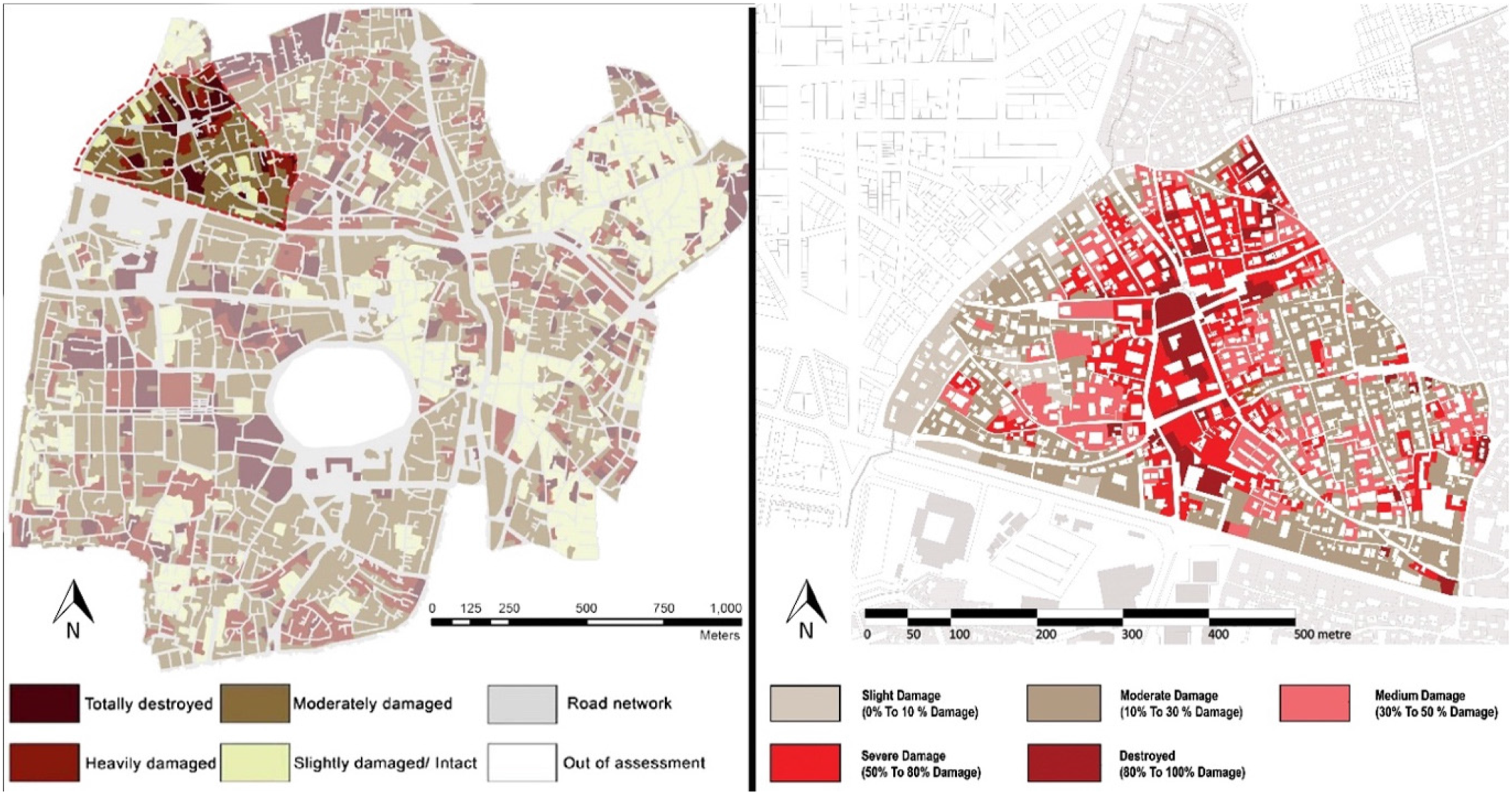
Navigating the destroyed memory lanes
The district of Al-Jdeideh is demarcated by Al-Khandak Street to the south and Al-Telal Street to the west, while its northern and eastern boundaries merge with adjacent historical quarters (Figure 3). Both streets serve as prominent entry points to Al-Jdeideh, given their distinct commerce and workmanship. Following the 2016 ceasefire, Al-Telal Street underwent a prompt revival of intensive commercial occupation by locals and newcomers. Despite the temporal ruptures and fractures of everyday life during wartime, many practices emerged to provide a diverse range of products at affordable prices and cater to informal activities for those seeking a livelihood. These activities contributed to its rapid re-emergence as an abundant commercial center, where street vendors (Bastat)
7
refurnished the pavements, rekindling Telal Street’s famous ambiance. Map of Al-Jdeideh’s post-conflict condition displaying the renovated buildings and walking tour described. Created by Saeed Asaeed, 2023.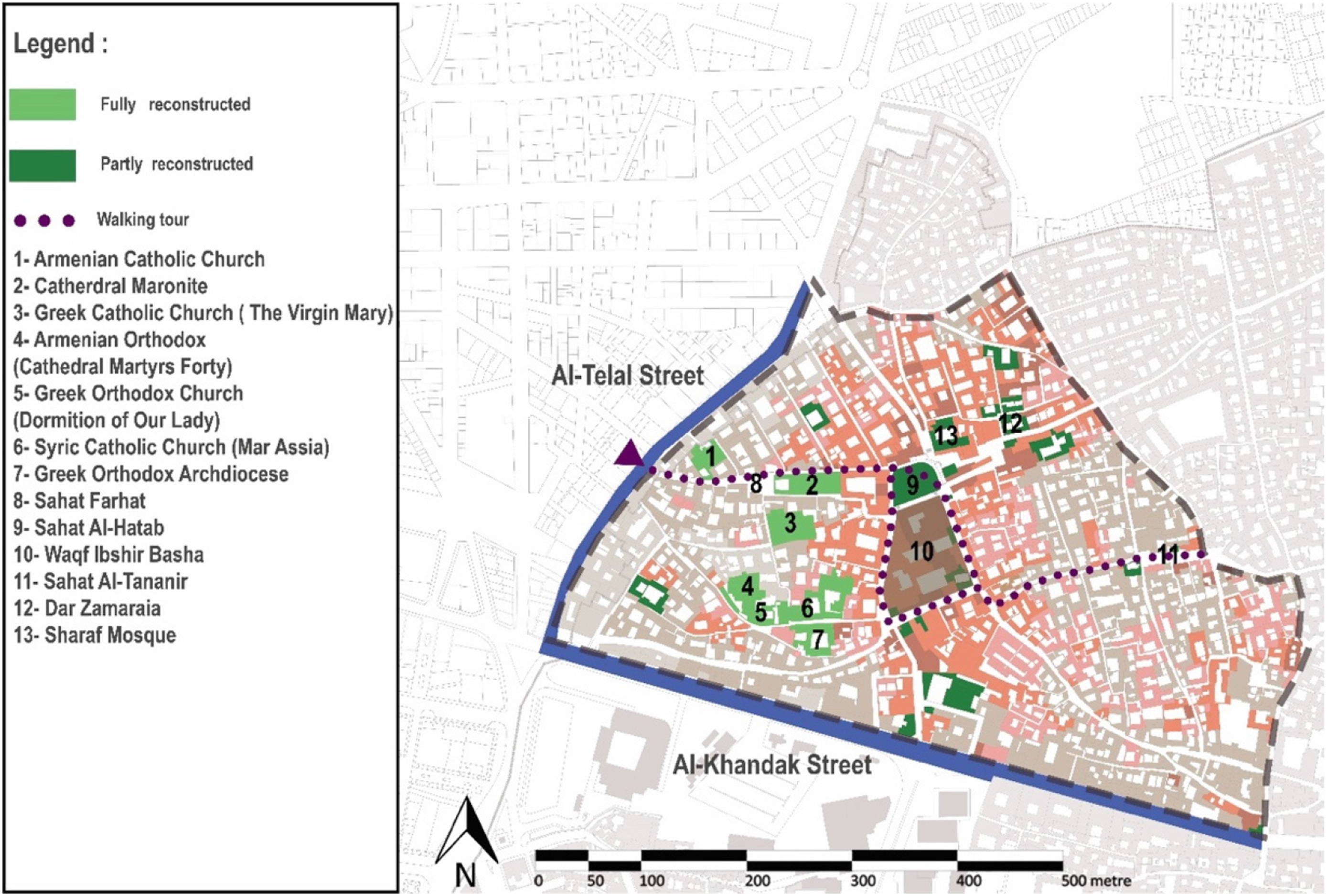
Within a 50m span, Al-Telal’s noisy vibrancy dissipates into an atmosphere of tranquility, stillness, and worship, as one walks through a narrow entrance leading to Farhat Square (no. 8). The square’s triangular shape accommodates three cathedrals: the Mar Elias Maronite Cathedral, the Virgin Mary Roman Catholic Cathedral to the right, and the Armenian Catholic Cathedral (accessed through a gated alley on the left) (Figure 4). Constructed around the early 19th century, each church houses precious heritage dating back to earlier times (Hadjar, 2010). From 2012 onwards, these cathedrals were periodically forced to close, due to instabilities and severe damage, signaling a spiritual discontinuity.
From early 2017, caretakers of these cathedrals sought ways to rebuild and revive them. The 40 Martyrs Armenian Orthodox Cathedral, for instance, acquired governmental support, while the Mar Elias Maronite Cathedral obtained funding from abroad. Others, such as Our Lady Church Greek Orthodox Church, were reconstructed by their local community with financial support from local private donors (Samowar, 2020). The caretakers of the churches endured struggles to reconstruct former familiarities for gathering, commemorating, and serving as points for navigation and support. These activities represented hope for many and a way to regain a sense of control in turbulent times. Left: The Maronite Cathedral in Farhat Square in Al-Jdeideh (September 2022). Right: Farhat Square, view from the top of the Maronite Cathedral (April 2022). Source: Diana Salahieh.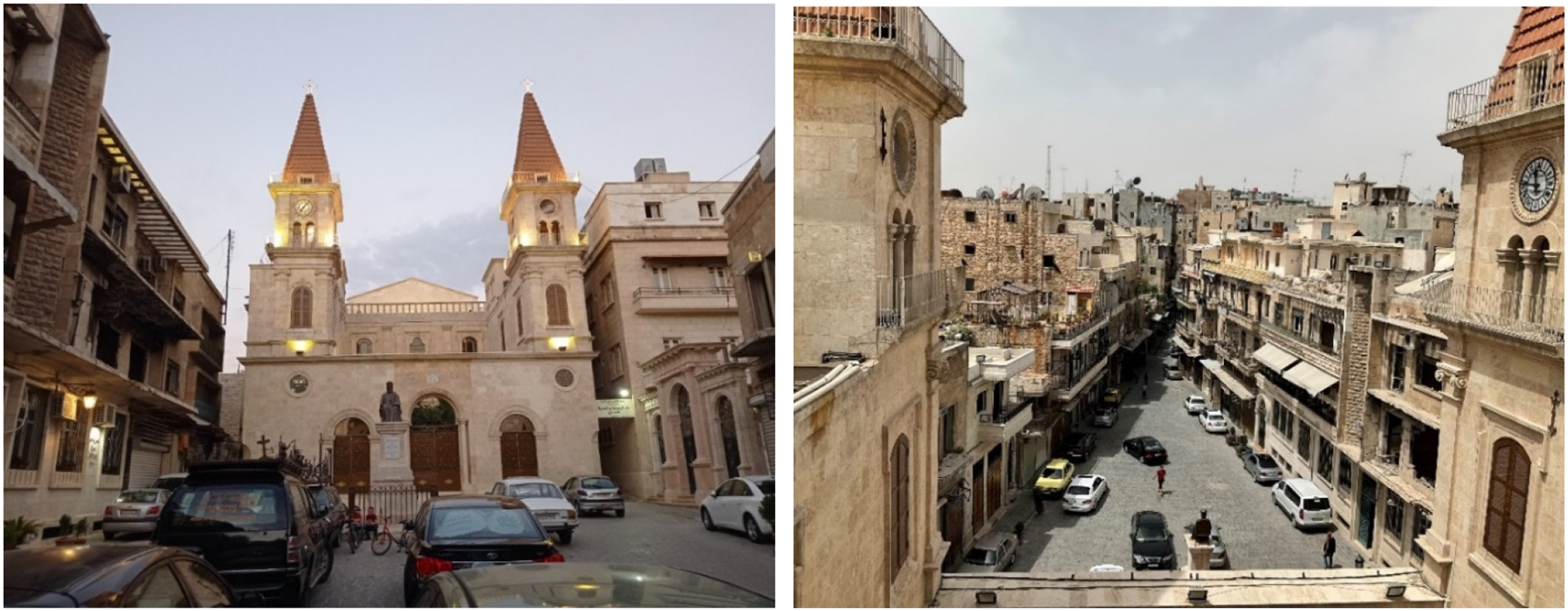
Arriving at Al-Hatab Square
Unlike Al-Jdeideh’s reconstructed cathedrals, the rest of the quarter shocks the eye as it lies in ruins.
6
Walking away from the robustly refurbished cathedral structures that conceal war scars, destruction layers the narrow alleys leading us to Al-Hatab Square. A sense of discrepancy arises, feeding into the contradiction as one faces the newly polished light-colored floors, resulting from reconstruction supported by the government since 2018. These colors provide a sharp contrast to the war-torn structures, such as Waqf Ibshir Pasha, with voids acting as a new vista towards the citadel (Figure 5). Al-Jdeideh’s Al-Hatab Square and nearby shops, March 2022. Sources: Saeed Asaeed and Diana Salahieh.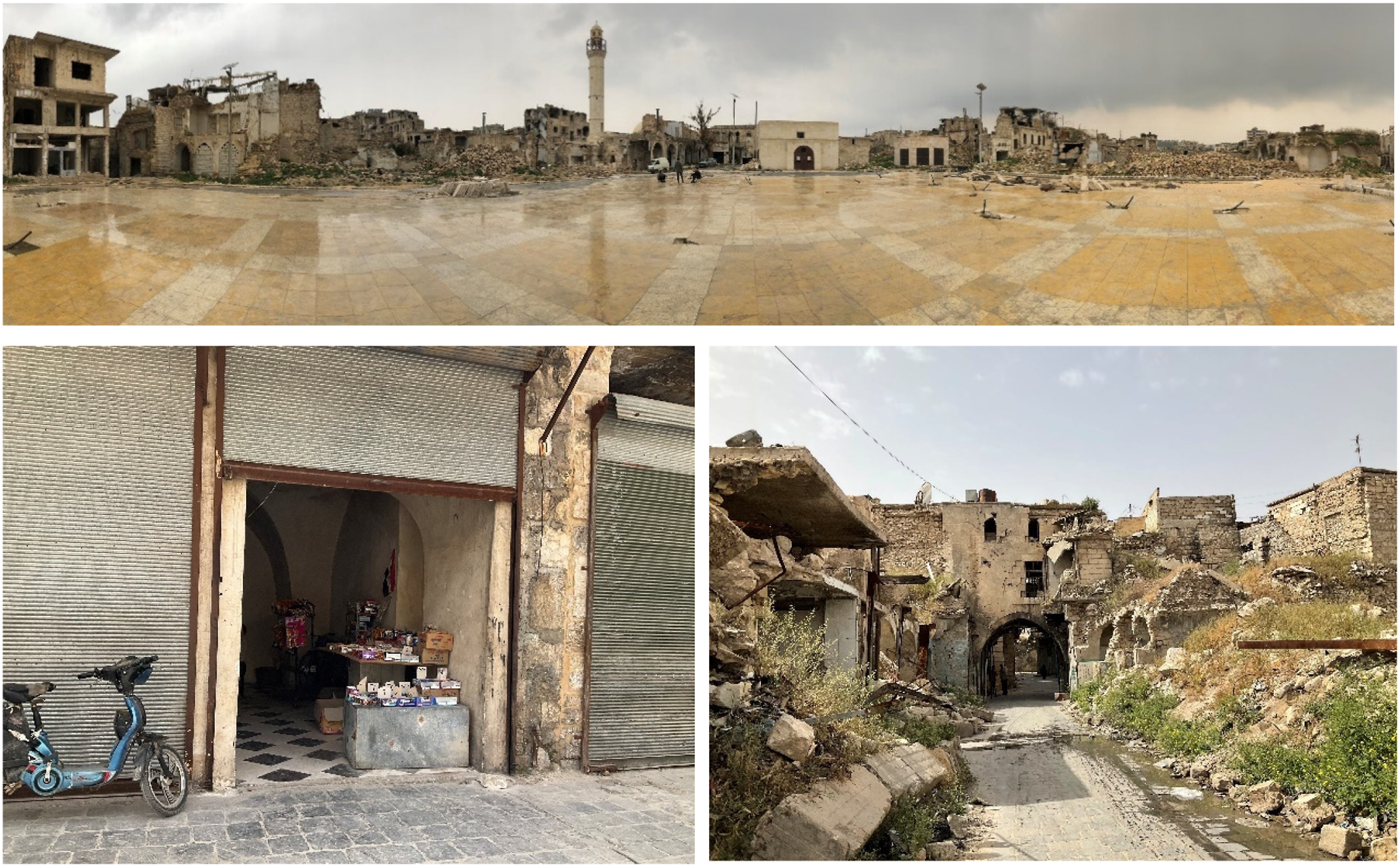
The hammering, drilling, and machinery noise signal ongoing reconstruction work in the vicinity. The most significant work is being done on Al-Sharaf Mosque, one of the oldest mosques outside the old city walls from the 12th century (Hadjar, 2010), funded by an anonymous sponsor. Similarly, the privately owned Dar Zamaraya, a courtyard house complex and a recognized landmark that houses a restaurant, hotel, and guestrooms, is one of the few ongoing reconstruction projects on the ground.
Nonetheless, amidst the ruins, glimpses of everydayness emerge. The aroma of grilled meat fills the air, accompanied by the bustling sounds of a market. This infusion of sensory experiences rejuvenates the once war-halted businesses, eagerly awaiting reconstruction. Locals have filled the voids within the Waqf’s war-torn structures, transforming them into makeshift stalls to sell fish and meat. Every makeshift installation tells a story of resilience and strain filled with hope amongst the debris and desolation. These practices serve as poignant reminders of the Waqfs’ (endowment) systems, which serve as legal instruments governing the ownership and purpose of buildings entrusted to the state. 8 Throughout history, the utilization of endowment buildings has played a pivotal role in sustaining socio-economic activities and preserving the historic fabric of Aleppo (Burns, 2016: 215, 285). Therefore, despite their dilapidated state, these pop-up businesses attract passersby, symbolizing the enduring spirit of entrepreneurship and inviting exploration of the future possibilities recalled from the past.
As the walk through Al-Jdeideh’s alleys continues, an endless reel of (post-) conflict struggles unfolds: the urban fabric is heavily fractured, regardless of the current (post-) conflict reconstruction’s piecemeal interventions. Between war-manufactured voids and pop-up activities, a canvas for nostalgia and catalysts for imagination dominate, evoking visions of what once was and how these spatial voids can be reclaimed or reimagined to serve future needs.
(Post-)conflict narratives of Al-Jdeideh
Instrumentalizations of Al-Hatab Square
Since the reconstruction works started, the role of Al-Jdeideh’s Al-Hatab Square has been encapsulated in pop-up and festive activities. Different actors, including young artists, religious figures, and local entrepreneurs, have exhibited their views on the square’s newly mended floors and deranged surroundings after the war.
The “Once Upon a Time … Aleppo” open-air art exhibition is an example of such activities, in which Al-Hatab Square became the stage for an open-air exhibition in October 2022. Fine art students from Damascus University collaborated through artistic expressions of “smashed dreams, fear, loss, pain, hope, and a new vision seeking fulfillment.” Guided by the theme of white doves, each student crafted installations, employing 16,000 dove manikins conveying their individual interpretations and reflections. Their work contributed to redirecting national and international attention, where the square’s state voiced public fears and imagination. Hammoud Radwan described his concept “Fading Continuously” as follows: What is most fading now is our presence as Syrians inside this country. In this work, there are pictures of several people I used to have their presence in my life in moral and material ways, but it vanished with time until I was left alone. The war constituted a state of escape for everyone, including the doves!
Like Al-Jdeideh’s crippled places, the artwork encapsulated intricate struggles the Syrian youth experienced: uncertainties for their future directions inside or outside the borders. In a quarter unknown to many, juxtaposing contemporary artistic interventions with the war-torn architectural ruins, their artwork provoked questions about the appropriateness of such collisions and presence.
Two months later, on December 19th, a Western-style Christmas market popped up in same square, with a Facebook page promoting the event as a dedication to the martyrs. The organizers announced bringing “the joy of Christmas to Aleppo,” featuring photos and videos of craftsmen building the market. According to George Bakhash, Aleppo Governorate Council member and an organizer, the event brought together Christian and Muslim groups in reclaiming the square and transforming it into a powerful testament to the city’s resilience and a symbol of unity. Similar to the art exhibition, the market included a stage for musical performances, adding to its “cultural richness.” Warsha, a local production company responsible for constructing the market, builds on the utilization of culture to improve the economic and social conditions of the city. Warsha’s founder, Antoine Makdis, explained that the locals selling their products in the kiosks were able to benefit from rent-free stalls and low prices, thus enabling them to sustain their businesses while keeping the prices affordable for locals: Warsha believes in the importance of rebuilding Syria after the war with Syrian financing, not foreign. The importance of that lies in preserving the long-term sovereignty and independence of Syria. Despite the economic difficulties the country faces today, we are still capable of rebuilding it ourselves, but we need to work together to do so. (Interview, 2022)
The Christmas market has sparked considerable perplexity due to its conflicting intentions, actions, and “foreign” actors in light of (post-)conflict circumstances. Several Christian residents were reluctant to visit the market, citing unfamiliarity and discomfort with the event’s audience. Others asserted that such activities fail to foster healing or uplift the collective psychological well-being, as they resemble an illusory portrayal of recovery. Similar to Sørensen and Viejo-Rose’s (2015) work, Al-Hatab Square also illustrates how places can take on new meanings layered upon older ones, particularly during post-conflict stages where significant sites are exploited for their mnemonic value. For both events, one cannot deny the political instrumentalizations behind them, streaming messages about the state’s public image of drawing healing paths to stability and recovery. In the early stages of such presumed recovery, these events echo questions of: what can be reclaimed and reconstructed, and by whom?
“Because it is a replica”: reconstruction between continuity, change, and honesty
For the interview respondents, the reconstruction works in Al-Jdeideh present a sense of ambiguity and dishonesty. Rolling back to “what it was” is, evidently, out of the question, yet the current reconstruction works embrace the rebuilding process and the glorification of the past: Because it is a replica … you cannot build the thing exactly as it was. If you have a vase and it was broken you try to repair it as much as possible but it is broken … you cannot bring it back to its original state and the same goes for the churches … they were reconstructed mostly as they were before … huge efforts was made to make this happen … and it is a very good thing but even still I always feel that there is something different. (Interview, 2022)
This predicament between maintaining continuity, adopting change, or rebuilding with honesty presents challenges that are spatially present and condition how everydayness is lived. In line with the excerpts from this interview, Khalaf (2020: 2) similarly emphasizes that in post-conflict reconstruction, honesty entails implementing (alternative) interventions that allow people to understand the layered history of a place and acknowledge new additions: … because the synergy between continuity and change is inextricably bound up with the progression of people and cities. On one hand, reconstruction can re-establish the “thread of continuity” with a pre-conflict time “that people search for when the rhythm of everyday life has been shattered.” On the other, it can change people’s conditions to improve everyday life.
Such perspectives bring back “authenticity” to the core of the reconstruction processes: does authenticity necessitate erasing all war traces and creating a narrative of “nothing has happened”? Or does it entail recognizing the changes as an integral part of the “authentic” reality of evident post-war transformation? The extent to which honesty can be upheld and the locals’ desires regarding the reconstruction of their places are subjects of debate. What appears as popularly accepted reconstruction processes lacks explanation as to why, for whom, or how such reconstructions can integrate former and current dwellers in present and future frameworks (Fadel, 2021). While a few structures and spaces are managed to support shop owners and residents, they still struggle to rebuild and commence recovery. What they share is their inability to afford reconstruction: It’s been four years and I have been asking for support from the municipality to fix this arch on top of my shop. It might collapse any day now. And I’m still waiting. (Interview, 2022)
Such a lack of financial support or compensation from the government means that these small restoration projects have to be self-financed. Therefore, it is no surprise that shopkeepers would reopen their half-demolished shops to sell humble commodities, aspiring to modest profits. Risking their own safety, the ambition is to regain a semblance of normalcy and control over their lives. Despite the desire to return and self-finance minimum repairs, government regulations and bureaucratic procedures pose significant obstacles. Respondents highlighted that “the government makes it hard for us as owners to rebuild what was destroyed or at least renovate or make the minimum interventions.” The excessive requirements and paperwork that seem impeding in the current circumstances create additional burdens for the affected: Officially you can do nothing without taking official approval but what we see on the ground is illegal restoration dominant there and it does not match with the sense of the old Aleppo … (Interview, 2022)
The essayist Solnit (2010) recognizes such imposed complications that hinder self-organized relief and rebuilding efforts in post-crises. With the lack of a reconstruction strategy that builds on societal interventions, the image of a spatial patchwork to “get by” dominates how lived heritage contexts are partially reconstructed from below.
Identifying associated places and community figures as cultural anchors
Gantois (2022: 65) wrote: “A heritage site is not only important within the spatial fabric as a relic for its historical understanding or experience. Rather, heritage is considered to be organically integrated into the everyday life of local communities, while also having a use value: it is lived-in.” Indeed, Aleppo’s historic fabric has always been “alive.” Therefore, two forms of data collection were employed to trace and map recollections and imaginations of everyday life with former and current dwellers: a mapping workshop and interviews.
An initial mapping for Al-Jdeideh’s memories and images took place in Germany in 2021.
9
During this mapping activity, the displaced respondents’ recollections of the quarter had significant patterns of landmarks and remembrance of repetitive social practices (Figure 6). They still carry a “bond with the historical and material layering” and “immaterial attachments” that have been part of their lived experiences. Examples include meeting friends in Al-Hatab Square and visiting the seven cathedrals during the (Easter) Great Friday. Respondents also emphasized specific smells, activities, familiar shops, and food corners. Recollection of Al-Jdeideh memories, collage mapping during the workshop at B-TU, Cottbus. Created by Essam Jrko, November 2021.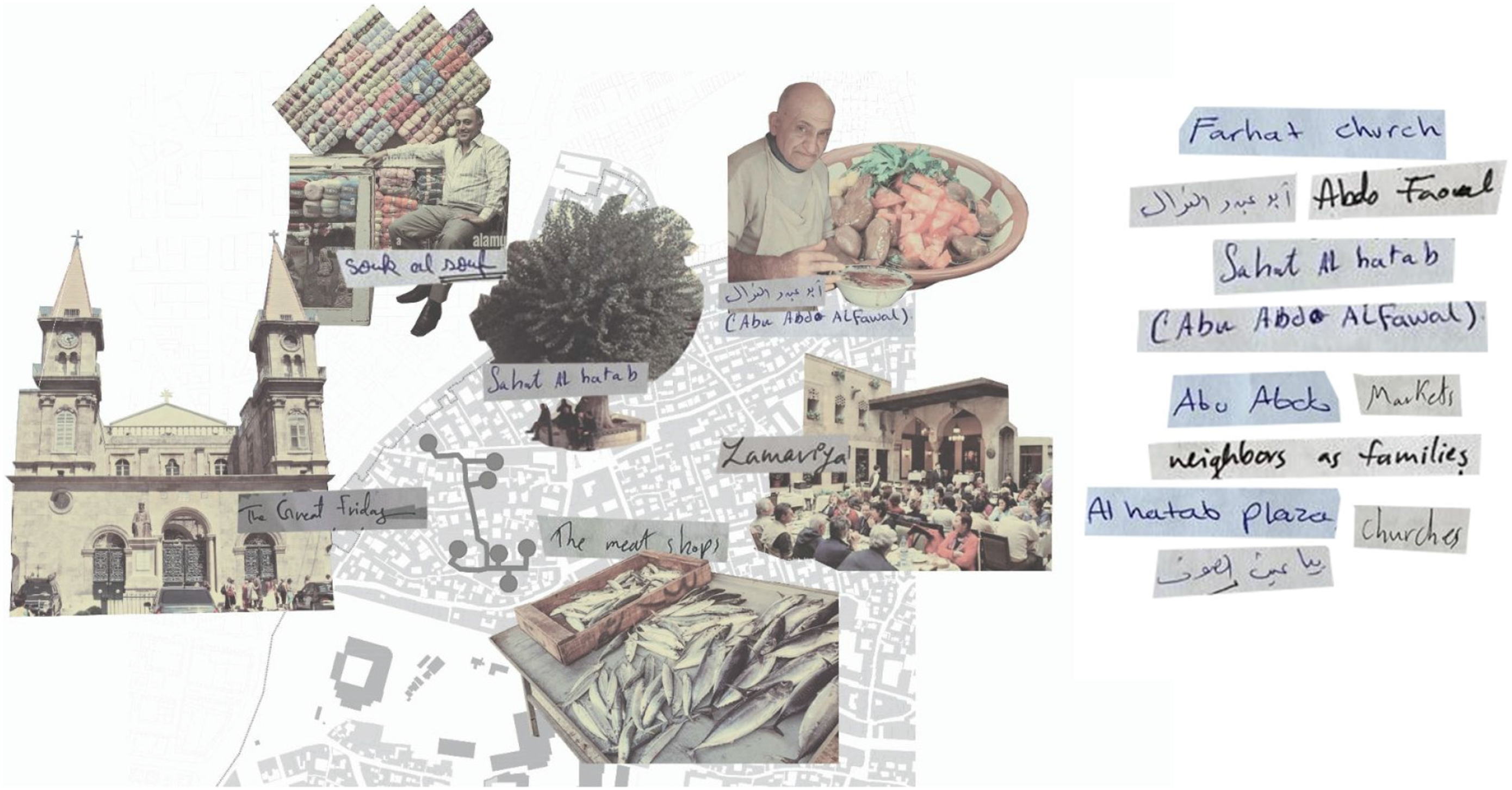
Aligned with the workshop results, interviews highlighted how Al-Hatab Square represented memories of unforgettable social events, a meeting point between friends for late-night eating, and a unique collection of businesses and tourist attractions. In particular, the square hosted a famous little corner shop that prepared hot beans, Abou Abdo, which held a nationwide reputation for its tasty meals, generosity, and hospitality. One of our respondents highlights such attachments as follows: I cannot forget Abou Abdo’s shop there which for all people here they consider him the history of Aleppo … he’s a symbol for the city and he was born and lived in Al-Jdeideh … he used to make a very special dish of fol … its reputation reached America.
Despite forced displacements and war, these spatially fixed figures have become mnemonic anchors known on a city scale, being the go-to places for many. Interviews with former and current dwellers supported a further understanding of the immaterial attachments and unveiled agreed-upon social values embedded within Al-Jdeideh’s urban fabric. Common themes overlapped, as narratives accentuated that the collective ingredients and memories are spatially embedded: from the corners of the streets to the courtyard housing typologies, where generational kinship networks formed the social urban fabric of its inhabitants. While the war ruptured these networks, leaving behind a lingering sense of estrangement, Al-Jdeideh still retains their presence. Evidently, Al-Jdeideh’s landmarks go beyond being historical relics; they are infused with communal attachments to well-known local figures who have been an integral part of the quarter’s identity, passed down through generations and widely recognized.
Absence, presence, and “these newcomers”
Respondents recall a sense of peaceful coexistence between religious communities, embedded in a historically layered socio-spatial composition. According to Bryant (2016), this “peaceful coexistence” contends and emerges with an idealized glow surrounding nostalgic depictions, especially after conflict. Such coexistence is remembered and maintained through daily interactions and exchanges. … before, we were one big family, there is no difference between Muslim and Christian; now this concept is neglected because of the war but my relationship with the priest, here, is perfect; he considers me as one of them. I visit him regularly and we drink tea together. (Interview, 2022)
In her work, Bryant (2016) highlights that “the multi-religious, multi-ethnic” post-Ottoman cities were “organized around the management and appreciation of difference.” Within Al-Jdeideh, while religious coexistence might be exhibited via tolerance, boundaries still pertain. ”In the actual practice of this coexistence, the ‘minorities’ [in Aleppo] express that they often feel less than equal to the ‘majority’” (Rabo, 2012: 144). Indeed, the complexity of religious coexistence still carries distinctions displayed in difference, 10 and might involve “antagonistic tolerance.” Therefore, Duru’s “coexistence toleration” in Turkey can be applied here, where conviviality seems to reflect “living together” as the sharing of common spatial and socio-economic resources, encompassing a dynamic marked by both “cohesion and tension” (Duru, 2016: 158).
Aleppo’s historic core’s paralysis shows the impact of the conflict and crises. Respondents, familiar with the quarter prior to the war, highlight concern for disruption of their lost values and socially recognized image. They consistently emphasized the common losses and perceived threats to the pre-war harmonious social fabric in their quarter, stating, “The morals are gone and the religious values too. The war has exhausted us” (Interview, 2022). The demographic changes in the aftermath of the war, linked to forced displacements, have obscured the accepted social norms between the pre-war residents and the post-war newcomers. Unlike previous displacements, the arrival of “newcomers” and their new activities competing for scarce resources are threating the conviviality once lived; this is seen as a threat to the idealized image of the past: … but now the strangers. There are so many people coming here and they are not from Aleppo. They pretend that they are from here and they made our reputation bad. (Interview, 2022)
Furthermore, one of the respondents asserted that newcomers lack awareness of Al-Jdeideh’s historical significance and sacredness. 11 Similar perceptions steer boundary-making and foster “us versus them” dynamics, which are attached to the devaluation of the “respectable image.” Such unwelcomed social infills indicate a high potential for stigmatization leading to social exclusions and ghettoization.
The current situation portrays a diffuse presence lacking social networks and recognition of rooted families that constituted familiarity within Al-Jdeideh. These families, referred to in the interviews as the “original Aleppians,” belong to specific socio-economic profiles and age categories. These “Aleppians” “know,” without guidance, how to protect and maintain self-presentation in public spaces by reading and interpreting social codes which are spatially embedded. Through routinized fleeting encounters and durable engagements (Blokland, 2017), the spaces are a canvas for co-produced public familiarities for those who “know” shop owners, “original families,” and long-term (pre-war) residents. I was happy when I saw one wool shop there recently re-open. I have known him [the shop owner] for a long time. We usually bought from him, and I was happy that he came back. (Interview, 2022)
The involvement of old prominent families, therefore, might be essential for healing the ruptured social fabric. The biography of this specific place highlights that belonging thresholds have fixed socio-economic boundaries tied to historical and geographical presence in specific time-space frames, only identified outside of the period of intense clashes. Therefore, Al-Jdeideh is claimed through the reassertion of generational presence and familiarities, evident for the respondents. … before when people were getting married in Aleppo, we saw their children and there was continuity but now the second generation travels and the third one we only see through the internet and that is very painful. It is very hard … for our children to come back. (Interview, 2022)
While the respondents kept highlighting social and temporal fractures and ruptures, resistance to uncontrollable and unwanted socio-spatial changes becomes a “return” paradox. “Return,” thus, linked to reconstruction, is unquestionably socio-spatial processes of long and maintained social networks intertwined with war-affected markers.
Reflections and conclusions
This paper examined the (post-)conflict transformations in Aleppo’s historic core, with a specific focus on the case of Al-Jdeideh. Using spatial biographies and narrative approaches, the paper contextually traced relational changes in Al-Jdeideh between the past and present and unveiled ruptures and fractures inflicted upon the socio-spatial fabric area. This tracing demonstrated how (post-)conflict dynamics are significantly altering and reshaping spatial and cultural functions and meanings matched with (former) communities’ absence and presence. Due to the intensity of clashes and insecurities, temporal ruptures of irregular tempos disrupt the sense of continuity in a specific locality and lead to evictions, displacements, and relocations of figures and activities. The heavily damaged built heritage, accompanied by displacements, created social ruptures and crippled the everydayness of formerly vivid convivial spaces, the first of their kind and scale since the 14th century in Aleppo, resulting in discontinuities observed in the disentanglement of the generationally knitted social networks embodied within Al-Jdeideh’s stones and mortars.
Tracing the biography of Al-Jdeideh with locals amplified the emotional quality and significance of the intangible heritage. Respondents illuminated their need for a sense of continuity despite discontinuity. This tracing allowed for an understanding of Al-Jdeideh as an urban stage, where the recalibration of post-conflict cultural and social meanings and contradictions materialize. On this stage, the solidified symbolic “cultural” image of coexistence and conviviality is (re)manifesting in forms of selective past resurrections, such as architectural renovation, artistic creativity, and festive events. However, these events-based resurrections are imbued with unfamiliarity, which fractures the generationally maintained image of the vivid everydayness of “business as usual” once known and practiced.
Nowadays, as different visions and aspirations strive to reconstruct Al-Jdeideh’s cultural heritage, questions of authenticity and legitimacy and the “right to” and “right in” a place arise. While the desire to restore what was lost is understandable, the reconstruction efforts and recovery actions remain ambiguous and in a state of uncertainty. Despite the well-developed pre-war rehabilitation guidelines, these fail to address socio-economic challenges on the ground, while current, scarce urban assessments lack depth. Narratives about Al-Jdeideh highlighted how memories and values intertwine with space, manifesting spatial significance, and a straightforward architectural reconstruction of “what it was” within socially knitted heritage fabric cannot guarantee social healing and cultural recovery. The data showcased dwellers’ struggles, hopes, and challenges in the process of reconstruction and recovering from the devastating armed conflict and unfolding chronic crises.
Our findings emphasize the significance of architectural compatibility and a nuanced understanding of heritage, moving beyond an idealized notion of authenticity as the sole guiding principle. Hence, it is critical to account for the current and pre-war social dynamics at the center of the reconstruction processes (Azzouz, 2020). In the case of Al-Jdeideh, the Historic Urban Landscape approach (HUL) seems promising to order to integrate local narratives of heritage values to bridge war ruptures. Similar to Walter (2014: 12), we assert that “An understanding of narrative engages us and awakens us to the need, the responsibility even, to take that ‘story’ forward; in writing the next chapter, we must understand how the plot has developed thus far, and how to drive that plot onwards.” In the context of Al-Jdeideh’s rich cultural heritage, employing such a narrative and biographical approach has proven to be essential to accentuate the locals’ generational associations with its socio-spatial fabric, cultural-historical markers, perceptions, and meanings for its former and current dwellers and users. Such recognition is fundamental for opening a dialogue between policymakers and communities, allowing for inclusive pathways of human-centered recovery. These pathways can create the framework where reconstruction strategies and recovery roadmaps can be interwoven. With temporary exemptions and facilitations, local communities can harness their creativity (Barakat, 2021). As such, the heritage fabric acts as a multi-layered canvas where cultural meanings and local narratives can inspire contemporary and future reconstruction strategies. This canvas has the potential to provide the basis to weave human-centered recovery and reconstruction processes.
To contribute to discussions on human-centered reconstruction and rehabilitation in Syria, we call for thorough investigations of heritage sites as “an assemblage of material and immaterial, intellectual, emotional, and moral values” (Viejo-Rose and Sørensen, 2015: 293) and trace the socio-collective values and significance through a narrative and meaning reconstruction approach. Heritage reconstruction must go beyond the mere restoration of historic monuments; it should foster dialogue and engagement among all stakeholders, including local communities and displaced individuals (Munawar and Symonds, 2022: 1030), prioritizing local communities and involving them in post-crisis recovery processes (Barakat, 2021). When the stories and experiences of locals are heard, it becomes possible to elevate the restoration, and in this case, reconstruction, processes of heritage sites as tools for local empowerment and recovery (Gantois, 2020).
Footnotes
Acknowledgements
As part of the two-year joint project by BTU-AUB in 2021–22, we extend our appreciation for the organizers' support and educational guidance provided by Dr. Sepideh Zarrin Ghalam, Prof. Christoph Wessling, and Prof. Dr Robert Salib, and the collaborative contribution of other colleagues in the early development of this work. We are grateful to the expert who generously shared their extensive knowledge on Aleppo. Finally, we sincerely thank all the Syrians we interviewed who entrusted us with their personal stories and struggles.
Declaration of conflicting interests
The author(s) declared no potential conflicts of interest with respect to the research, authorship, and/or publication of this article.
Funding
The author(s) received no financial support for the research, authorship, and/or publication of this article.
