




Abstract
This article investigates the origin, circulation and consumption of a new commodity – the “battle pass” – in the complex ludic economies of contemporary digital games. The article dives deep into the history and political economy of battle royale shooters and the game Apex Legends (2019), a free-to-play example of the genre monetized in part by a battle pass. Inspired and in dialogue with Nieborg and Poell’s (2018) theory of platformization, this article asks questions related to how digital games like this operationalize their status as ‘contingent commodities’. The article then engages in an ‘app walk-through’ (Light et al., 2018) of Apex Legends, analysing its vision, operating model and governance. The focus here is on revealing the ‘mediator characteristics’ that structure in-game commodities like avatar skins, loot boxes and the battle pass. There is then a discussion and theorization of these monetization strategies and the industry-wide tendencies for consumerism they signal. A key takeaway is that digital consumption in games is at once both easy to ‘see’ but also highly abstracted, making it very difficult to pull apart what people are actually consuming when they engage with the monetization layer of contemporary digital games.
Keywords
Park attendant: “and would you like to buy some Itchy and Scratchy Money?”
Homer: “What’s that?”
Park attendant: “Well it’s money that’s made just for the park. It works just like regular money but it’s uh… fun.”
Bart: “Do it, Dad.”
Homer: “Well OK, if it’s fun. Let’s see, uh, I’ll take eleven-hundred dollars’ worth.”
Of all the games to enter the public’s consciousness in 2018, it was Epic’s Fortnite (2017) that did it best. Write-ups in the popular press like The New Yorker (Paumgarten, 2018) focus on its sudden, profound cultural weight as a common activity of teenage children spending their evenings and weekends playing a difficult, inscrutable game of survival that was bleeding into all aspects of their social life. Conspicuously absent from much of the popular or academic discussion, however, was any serious attention paid to the core business model of games like Fortnite: in-game item sales and the ‘battle pass’ or ‘event pass’, despite the fact that these games were quickly becoming known for having some of the highest revenues in all of digital gaming. Battle passes were first introduced by Valve Corporation in 2013 for the popular massive online battle arena (MOBA) Dota2 (2013) as the ‘compendium’, an opt-in paid progression system that would partially raise money for Dota2’s yearly international tournament. Since then a variety of games have introduced battle or event passes in different forms, making them a regular part of the consumer cycle of digital games. Battle passes are now firmly locked into the seasonal business timetable of ‘free-to-play’ (F2P) games, signalling to casual and dedicated players alike when games will be updated with content and events.
Battle passes were created at a time of relatively fast-evolving monetization strategies for digital games. One model, prominent with mobile F2P games but which has also had success with full price console and PC games, centres heavily on purchasing what Nieborg (2015) calls ‘product commodities’ which grant the ability to access additional content or the ability to continue playing the game. This model has been combined with ‘loot boxes’ in a variety of game genres, digital objects that, when purchased, are opened and give players opportunities to access digital items through a mechanism similar to a slot machine. What is unique about the battle pass as a monetization strategy is that instead of replacing the above monetization strategies, they augment and reify them. Battle passes, which tend to cost around $10 USD (Goslin, 2019), provide players with the opportunity to unlock in-game content by completing in-game challenges over the course of a defined season, usually lasting three to four months. The rewards that are given out to players by a battle pass in these games are legion: new avatar skins, weapon skins, materials to customize one’s player profile, ‘experience boosts’ that allow one to level up faster, loot boxes, etc. Key is that the battle pass gives players an alternate pathway to access content that is usually gated directly by purchasing it. Battle passes, then, offer a model of commodified play that sits at the intersection of the pay-to-win dynamics of popular mobile games (Harvey, 2018; Nieborg, 2015), the ‘gamblification’ of play (commonly associated with loot boxes in games like League of Legends (2009) or Overwatch (2016). Games with battle or event passes like Fortnite, PlayerUnknown’s Battlegrounds (2017), Dota2 and Counter-Strike: Global Offensive (2012), were ranked in the top ten by digital revenue in the PC and console sectors of the digital games industry. The success of these games demonstrates the popularity of the F2P business model that has defined the mobile games industry, extending it onto legacy platforms.
This study addresses the complex ‘ludic economies’ (Giddings and Harvey, 2018) of the battle pass and other in-game monetization schemes that have come to define MOBA games and battle royale shooters. To accomplish this, I use the game Apex Legends (2019) as an example. Apex Legends is a F2P battle royale shooter that heavily utilizes in-game purchases and a battle pass as its monetization strategy. Following Nieborg and Poell’s (2018) cutting-edge work on the platformization of cultural production and their theories of contingent and connective commodities (Nieborg, 2015), this study starts to tease apart the specific ways in which battle royale games like Apex Legends operationalize their contingency: how do they govern these ‘purchases’ and transactions? How do they materially create an infrastructure that, as often as possible, is encouraging players to spend money to access digital objects. To do this, the study first dives further into the politics of platformized commodities in F2P games, looking at the political economy and context of loot boxes and battle passes. Second, it contextualizes the most popular F2P games on the console and PC: battle royale games like Fortnite and Apex Legends. The study then engages in a short ‘app walk-through’ (Light et al., 2018) of Apex Legends, starting with an analysis of its vision, operating model and governance. It then engages in a technical walk-through of the game, focussing on the ‘mediator characteristics’ and its various in-game product commodities such as avatar skins, loot boxes and battle passes. Finally, the study ends with a discussion of the generalizable tendencies associated with the battle pass as monetization strategy.
Ludic economies and the politics of platformized commodities
Digital commodities in digital games are neither new nor free from controversy (Dibbel, 2003; Joseph, 2018; Kücklich, 2005). From cosmetic avatar skins and clothes, weapon skins and loot boxes to battle passes, they are both objects that have themselves become the subject of consumer scorn (see, for example the controversies surrounding Electronic Arts’ Star Wars Battlefront (2017)) but also, contradictorily, the driver of an immense cycles of consumer spending, forming the core business model of the most profitable and popular games. Games with loot boxes, digital currencies, battle or event passes make up the majority of the top ten in terms of game revenue, especially if one considers mobile games, which make up the vast majority of global revenues (SuperData Research, 2020). Games with battle passes specifically, like Fortnite, PlayerUnknown’s Battlegrounds (2017), Dota2, and Counter-Strike: Global Offensive, were ranked in the top ten by digital revenue in every major market segment of the digital games industry in 2018. So, despite consumer scepticism or scorn, it is obvious that people are consuming digital commodities, so it is worth examining them closer.
In the introduction to their guest-edited ludic economies special issue in Games & Culture, Giddings and Harvey (2018) make the case that ‘the study of digital games – should be applied as a primary heuristic in understanding the cultural economy of neoliberal late capitalism and vice versa’ (p. 649). This study’s approach is very much in dialogue with this call, stressing that digital games are a kind of ‘canary in the coal mine of capital’ that tell us about future trends in capitalist production, distribution and, most importantly for this study, consumption. Studying what a battle pass is, how it works and how it is consumed can tell us a lot about the current state of platformized, contingent commodities but also their future (Nieborg and Poell, 2018). Digital commodities also give us windows into the deep contradictions of consumer society, where people every day confront in small ways the contradiction between use values and exchange values but in a context amplified by the affordances of digital technology.
Numerous scholars in game and media studies have given attention to ludic economies and digital commodities in different forms. Early research focused on game modifications as objects that were products of ‘immaterial labour’ and ‘playbour’ (Kücklich, 2005). Game mods at this time were often not discrete commodities, but, as it was theorized by Küchlich, the labour performed to create them added very real exchange value to the games themselves by extending the life of the game commodity by spurring community engagement and buy-in. Mods eventually were monetized as platform holders and game developers realized that the value created by mod makers could be regulated with established, platform-based e-commerce tools (Joseph, 2018).
Nieborg and Poell’s (2018) theory of contingent commodities puts forward one of the most well-developed theories of these kind of commodities today, as part of what they call is the process of the ‘platformization of cultural production’. They describe this process as the ‘penetration of economic, governmental and infrastructural extensions of digital platforms into the web and app ecosystems’. This extension means a deepening of cultural commodities as ‘contingent’ in that platforms ensure that they are ‘malleable, modular in design and informed by datafied user feedback, open to constant revision and recirculation’ (p. 2). This study demonstrates how this leads to an increase in the contradiction between use and exchange values as use values of the commodity – if it is even sold to a consumer as a discrete object instead of just bundled as a ‘service’ – are shaped entirely by the needs of the platform and the real owner of the content, which are in the last instance shaped by the needs of capital, always at odds with their use. Contingent commodities such as loot boxes, battle passes and virtual cosmetics put the sustainability of cultural production in serious jeopardy, especially their ‘autonomy and economic sustainability’ (p. 3) as platforms increasingly rely on user-generated content and the global labour arbitrage of moving content moderation jobs to countries with low wages to ensure low production costs. This is because they are still just capitalist enterprises – ‘platform capitalists’ as Srnicek (2016) describes them – but with the added ability to enforce anticompetitive gatekeeping alongside market enclosure.
Contingent commodities come in many forms, but so far, some of the best focused analysis of them has been of mobile and freemium games. Nieborg (2015), for example theorized commodification in app and mobile games like Candy Crush (2012) as a multilayered, forming what he calls a ‘connective’ commodity, which is broken into three distinct commodities that are sold to different buyers. The first was the ‘product’ commodity, which was the traditional in-app purchase of in-game expansion content or digital currencies. Product commodities entailed a traditional consumer relationship, even if the commodity being bought is considerably more nebulous. The second element of the connective commodity was the ‘prosumer’ commodity, which is functionally what Kücklich (2005) theorized as ‘playbour’, the overall value created by the networked play of users. The prosumer, by virtue of their play, co-creates the social elements of the game, something that is used to justify the other forms of monetization, such as advertising, or selling user data to analytics companies. Finally, there is the ‘player’ commodity, which is monetized both internally and externally to the app by advertising agencies using the tools Facebook, and other platforms provide them with to monetize individual users that will have cash amounts attached to them as ‘cost per acquisition’ (Luton, 2013). The player commodities are then sold between app developers.
Loot boxes and battle passes similarly have much in common with the ‘invest/express’ genre of mobile F2P games. Harvey’s (2018) analysis of the gendered ludic economy in Kim Kardashian: Hollywood (2014) illustrates the contradictory experience of playing these games, which rely on a careful mixture of in-game player customization (the ‘express’ part of the game) and the management of time and the attentional economy which is deeply intertwined with financial capital (the ‘invest’ part of the game). Invest/express games, like most heavily monetized F2P games, allow the player to play most of the game’s content for free, but use in-game mechanics like time-gated events and regeneration bars to encourage players to spend small amounts of money to keep playing. Harvey’s argument is that invest/express games operationalize the commodification of gender to create new markets. This article’s study of battle royale games and battle passes shows how many of the same dynamics of invest/express in terms of avatar customization and status seeking (which is always gendered) play out in other genres of digital games.
A battle royale of battle royales
This article uses the game Apex Legends (2019), developed by Respawn Entertainment (a subsidiary of the larger games publisher and developer Electronic Arts), as a prime example of the current trends in monetization and game design towards battle passes and loot boxes. For one, Apex Legends is a ‘battle royale’ shooter, a genre popularized by the game PlayerUnknown’s Battleground (PUBG) (2017), which itself was originally a game modification of ARMA II (2009) called DayZ: Battle Royale. Inspired somewhat by Koushun Takami’s book Battle Royale (2014), where a junior high school class of teenagers are forced to kill each other to the last person in a vicious blood sport, a battle royale shooter usually involves a set number of players parachuting onto an island, collecting weapons and fighting each other to the death. The last team or individual left standing is the victor. These games vary in gameplay, art style and price point, but their immediate popularity was striking, and they quickly became some of the most profitable games on every platform. While PUBG made the first big splash in the genre on PC, the breakout hit was Epic Games’ Fortnite battle royale mode, which was an add-on to the original game’s online co-operative ‘save the world’ mode. Fortnite’s battle royale mode, created in the span of two months when Epic realized they could replicate the main gameplay of PUBG, was able to gain a considerable amount of market advantage largely because it was on major console platforms like the PlayStation 4 before PUBG and other competitors (Davenport, 2018). Also, unlike PUBG – a game with a premium price tag in addition to in-game microtransactions and digital commodities – Fortnite’s battle royale mode was F2P from the start, and later monetized entirely through microtransactions for in-game avatars, dances and gliders with an in-game currency system called ‘V-Bucks’ (Epic Games, 2017). Fortnite has continued to enjoy a massive amount of success, earning revenues totalling 1.8 billion USD for 2019, while PUBG has lagged behind in absolute revenue numbers (SuperData Research, 2020).
Alongside the success of both of these games, numerous other competitors in the battle royale genre have come into the marketplace. One is Apex Legends, which I give specific attention to for two reasons. The first is that, unlike Fortnite, Apex Legends also has loot boxes built into their business model alongside cosmetic items, avatar skins, weapon skins and battle passes. This is particularly relevant because Electronic Arts is well known for aggressively using loot boxes to monetize their games. Electronic Arts’ treatment of the in-game economy, loot boxes and progression system in Star Wars: Battlefront 2 (2017) was subjected to a largely negative fan and player reaction due to perceived ‘pay to win’ dynamics in the economy. This fan reaction caused EA to pull microtransactions for a short time to adjust them. EA CFO Black Jorgensen justified this decision (while emphasizing just how contingent these commodities are to constant revision and modulation) by saying that ‘we listen to the community very closely and we will always be changing the games to make those games better and make the community more excited about playing those games’ (Gamespot, 2017). EA, possibly reflecting on the inherently tricky rhetorical positioning of loot boxes and other monetization strategies, took a very different approach to in-game commodities and the battle pass system with Apex Legends. The game launched with three in-game currencies, two characters that would require in-app purchases to unlock immediately and no other items that went beyond basic cosmetic changes. The game was, as a result, well received by the major enthusiast press outlets, earning a relatively high 88 out of 100 score, compared with Battlefront 2’s more modest 76 out of 100 (Metacritic, 2019a, 2019b). The economy in Apex Legends is considerably less opaque about what it offers consumers, making it an excellent example for a walk-through that shows how players are encouraged to spend money and engage in a consumptive loop with these in-game commodities and services.
Apex Legends: A walk-through
To map the basic contours of the monetization strategies in Apex Legends, this study is informed heavily by Light et al.’s (2018) ‘app walk-through method’, which was created to address the unique challenges and affordances of apps for smartphones, tablets and computers. Informed by Latour (1999) actor–network theory and approaches in dialogue with semiotics and cultural studies (specifically Hall’s (1997) circuit of culture and Williams (1974) study of television), the walk-through engages ‘directly with an app’s interface to examine its technological mechanisms and embedded cultural references to understand how it guides users and shapers their experiences’ (p. 882). It involves ‘the step-by-step observation and documentation of an app’s screens, features and flows of activity’ (p. 882). While the method as described by Light et al. (2018) is tailored towards smart phone apps, I find that following the contours of the method for a downloadable game like Apex Legends on a console like the PlayStation 4 or the PC is a natural fit. This is largely because that while software becoming ‘apps’ is, as Nieborg and Poell (2018) argue, a process of platformization, console games have long been ‘platform native’ and similar in design and function to contemporary apps (p. 10).
The walk-through method features two areas of analysis: the ‘environment of expected use’ and the ‘technical walk-through’, both of which when combined give a holistic picture of the software being studied that does not reduce it entirely to either. The environment of expected use situates the software ‘beyond users, content and technology’ (p. 889) in socio-economic and cultural contexts. This is done by focussing on materials that are often provided by the creators of apps, such as marketing materials, public statements in the press or terms of service (TOS) agreements. The environment of expected use has three major areas of interest for the researcher: vision (purpose, target user base and scenarios of use), operating model (business model and revenue sources) and governance (how user activity is managed and regulated). Because this study is focused on the battle pass and the loot box commodification strategies, the walk-through gives more attention to this side of Apex Legends rather than the gameplay side.
Vision
Apex Legends is a big budget, high fidelity, multiplayer and squad-based first-person shooter (FPS) set in the ‘Titanfall’ universe, an IP owned by EA and associated with two prior games developed by Respawn: the science fiction FPS’ Titanfall (2014) and Titanfall 2 (2016). The gameplay itself is structured by the conventions of the battle royale mode: 60 people, making up 20 squads, drop onto a small island (several kilometres wide). Each player takes on the role of one ‘Legend’ which in the lore of the game is functionally a star in the titular televised blood sport put on by a mysterious group known as the ‘Syndicate’. When the players have landed, they then have to scavenge in buildings and other structures for weapons, weapon modifications and protective equipment. These items come in varying levels of power, thus incentivizing players to continuously scavenge for more and better gear, which will increase their ability to survive combat encounters with other teams. At the same time, the players are forced into a closer and closer space with each other as an electric field – forming a circle – gets smaller and smaller. Players that stay outside of the play area for too long will die, ensuring that players who want to rank high will move to the centre of the circle and engage in combat with other squads.
A key feature of these kinds of games is that the competitive nature of them frames the way they are monetized and the kinds of commodities that become the basis of the game’s revenue stream. It is not uncommon for developers to spend quite a lot of time in their community communications reassuring players that in-game content will not be ‘pay-to-win’. The razor’s edge on which success or failure in a game like Apex Legends walks is a selling point for battle royales. It is designed into the randomness of item drops and the skill of gameplay to make it enjoyable to many players of different skill levels without compromising the desired determining element of gameplay skill. The ability of some players to buy a gameplay advantage over others that would overturn this careful mix of randomness and skill – especially those who didn’t spend extra money – is a constant issue of discussion and worry for those in these kinds of player communities. Games that created opaque in-game economies with items that did impart in-game advantage, such as Star Wars: Battlefront 2, did end up having serious public relations problems because players argued that the game became ‘pay-to-win’ (Gamespot, 2017).
Because of this, I argue that this codes the ideal player of Apex Legends as someone who, if not intentionally, implicitly believes in what Huizinga (1944) described as a ‘magic circle’, a game space that exists outside of the normal constraints of everyday life, free from the pressures of economics or inequality. This ludic experience is defined by the equality of those who enter into it and not defined by their external circumstances (i.e. wealth should be able to buy one’s ability to win the game). At the same time, the vision of the ideal player is someone who is also ok with items that impart no in-game utility or advantage not being equally distributed among players. Thus, the ideal player cares about ludic conceptions of a level playing field but not one free from status symbols. I also would argue that the ideal player also sees cosmetics as secondary to the real ‘meritocratic’ competition that unfolds in the game, a highly gendered assumption (Paul, 2018). Shooters, especially in public or the increasingly professional e-sports community, have historically have been framed as pastimes entirely for boys and men (despite the long-standing and active presence of women in these spaces) in both marketing materials and in fan culture (Taylor et al., 2009). Paradoxically, this gendered assumption contradicts the reality that the feminine coded act of shopping and dressing up in different avatar skins is the main economic driver of some of the most masculine-coded and profitable digital games in the world (Harvey, 2018).
Operating model
Apex Legends is a game that follows many of the monetization choices of the F2P or ‘freemium’ game design. At the same time, as battle royale style game developed by a subsidiary of Electronic Arts like Respawn Entertainment, it exists discursively and contextually within the dominant view of FPS games as ‘hardcore’ experiences for dedicated fans of the genre. This is because FPS games are a keystone of the ‘AAA’ game design space that has long defined the console and PC games industry (Kerr, 2017; Nieborg, 2011). This also sets it apart somewhat from Fortnite battle royale, which is likewise F2P but is not an FPS and does not have the same aesthetic and competitive fidelity to other games in the genre. This makes the operating model of Apex Legends unique in this commodity space as the other major releases by the big AAA game studios still come with a ‘premium’ price tag that usually comes in higher than $60 USD such as Call of Duty: Black Ops 4 (2018), Overwatch, Star Wars: Battlefront 2 or PUBG. In this way, a classic, well-established genre of game is clearly being shaped by wider, industry-wide trends in game design. Four out of 5 dollars in global revenues in 2019 coming from games using F2P, (SuperData Research, 2020), demanding new industry taxonomies to categorize this market segment (Kerr, 2017).
Apex Legends is monetized primarily by using ‘in-app-purchases’ or in-game purchases (Nieborg, 2015), which historically is the most lucrative of the commodities in mobile games (Figures 1 and 2). These purchases are almost always mediated by a variety of in-game currency systems that have different values attached to them and which are then transferrable with different forms of in-game content. In the case of Apex Legends, the base currency is known as ‘Apex Coins’. Because the version of Apex Legends I played was on the PlayStation 4, these coins had to be purchased through the PlayStation Store, of which a percentage, usually 30%, will be taken as a service fee by Sony. Apex Coins are then transferrable for other in-game content, such as the battle pass an Apex Pack (Apex Legends’ version of the loot box) or one of the many rotating exclusive items for sale in the store, such as the above pictured Bangalore Premium Skin ‘The Enforcer’. Here we see how ‘real’ currencies are transformed (twice!) into a company scrip not dissimilar to the ‘fun’ Itchy and Scratchy Money that Homer misguidedly bought too much of. The Apex Legends store. Here Apex Coin purchases ‘unlock’ the use of other currencies for additional purchases. The play tab, prominently featuring the player’s chosen avatar and skin.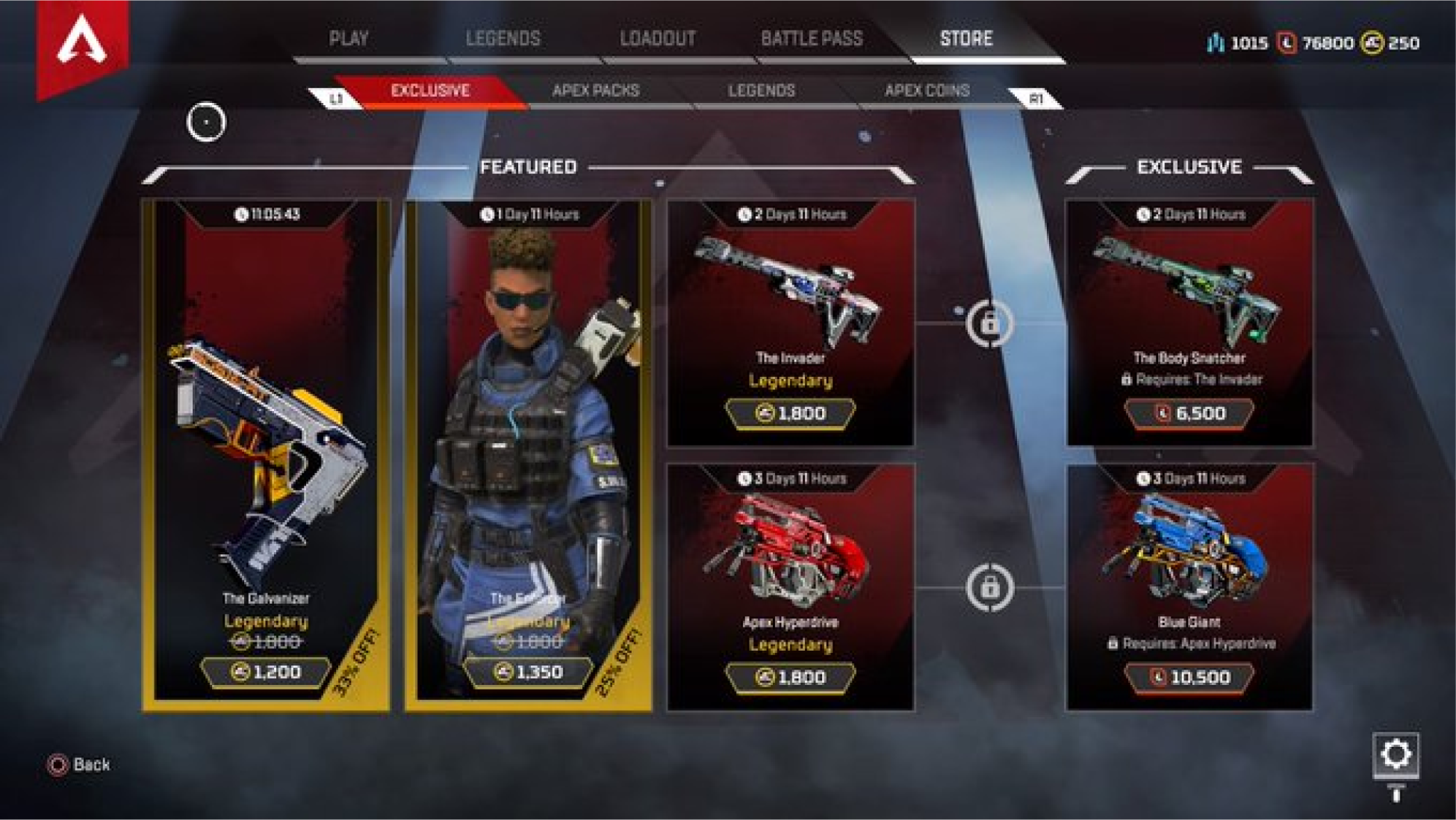
Governance
Apex Legends is formally governed by two TOS agreements: the Electronic Arts User Agreement (2019) and the PlayStation Terms of Service and User Agreement (Sony, 2019). Both of them provide the boundaries of use, and what the rights and responsibilities that players have. Each TOS devotes a significant amount of attention to the specifics of in-game purchases, and the rights that users have to this content. Upon a review of both TOS, it becomes clear that users are discursively framed as having almost no rights when it comes to the games themselves or the virtual items they purchase. Violations of these TOS are usually the grounds upon which users will have their access to the game revoked as in the case of cheating or engaging in abusive behaviour towards other players. But even if players do not violate the TOS agreements, the items they have purchased are still contingent in that access to them can be changed at any time. Players do not own this content. Instead players merely licence them. This formal user non-ownership is the defining feature of the governance of Apex Legends.
The EA TOS (2019) governs commodification in Apex Legends in three subsections. At the very beginning of the TOS, EA defines their products and games as ‘EA services’ which encompasses the game software (be they on a physical disc or downloaded) and ‘related updates, upgrades and features as well as online and mobile services, features, content and websites offered by EA and/or live events hosted by or in connection with EA’. In other words, every single product sold or delivered by EA is a ‘service’. In the Content and Entitlements section, the TOS describes how all EA services have ‘content’ and ‘entitlements’, the latter being a subsection of the former. Everything in a digital game is content, but only certain items are entitlements, which ‘are rights that EA licences to you to access or use the online or offline elements of EA services’. These include ‘access to digital or unlockable content additional or enhanced functionality (including multiplayer services); subscriptions; virtual assets; unlock keys or codes, serial codes or online authentication; in-game achievements and virtual points, coins or currencies’. The currencies themselves are also framed as entitlements.
The TOS also stipulates how games that are played on a PlayStation 4 console have ‘supplemental terms’. Platform governance here is interlocking and complimentary because the PlayStation TSOS (2019) similarly refers back to ‘third-party’ services, such as those offered by EA. This TOS also reflects many of the features of the EA TOS: the money in the digital ‘wallet’ used by PlayStation, for example has no value outside of the wallet. It also states similarly that users do not ‘own’ what they have bought in the PlayStation Store. For example ‘use of the terms “own”, “ownership”, “purchase”, “sale”, “sold”, “sell”, “rent” or “buy” on or in connection with Playstation Network services does not mean or imply any transfer of ownership of any content, data or software or any intellectual property rights from Sony Interactive Entertainment, its affiliates or its licensors to any user or third party’. The TOS also states ‘virtual items are licenced, not sold’. These items can be modified or revoked at any time, and that ‘you are not entitled to any refund, benefit or other compensation for the loss of any virtual items’.
What is clear from both TOS is that users have, at least according to EA and Sony, no formal right to whatever they have bought in a digital game. The non-ownership of ‘entitlements’ flows down from the non-ownership of all content. From a consumer perspective, there are very few ways to even imagine any lasting meaningful relationship with the digital items they have spent money on. This analysis of the TOS also puts into relief how digital games companies frame digital commodities as subsets of existing bundles of content, all of which is delivered as a ‘service’ more akin to visiting an amusement park, than a commodity with use value that one owns. Players are formally framed as visitors of content, fully alienated from that which they spend their wages on, merely able to view it through a thin layer of liquid crystal.
The technical walk-through
The technical walk-through of Light et al. (2018) method focuses on assuming the users’ position. This is done by collecting screenshots, videos and field notes and giving special attention to what they describe as ‘mediator characteristics’, elements of the app that mediate external technical and cultural influences on the app itself. These mediators might be how the user interface is arranged, the content of the functions and features available or textual and symbolic content. This walk-through of Apex Legends focuses on identifying and describing how these mediator characteristics ‘seek to configure relations among actors’ (p. 891) to orient users towards the use of virtual currencies to buy in game items. As such, this study’s central focus is on the key mediators: digital items such as the Apex Pack, Legend skins and the battle pass. Because the monetization layer exists, functionally, outside of the realm of gameplay, I also do not discuss the affordances of the battle royale.
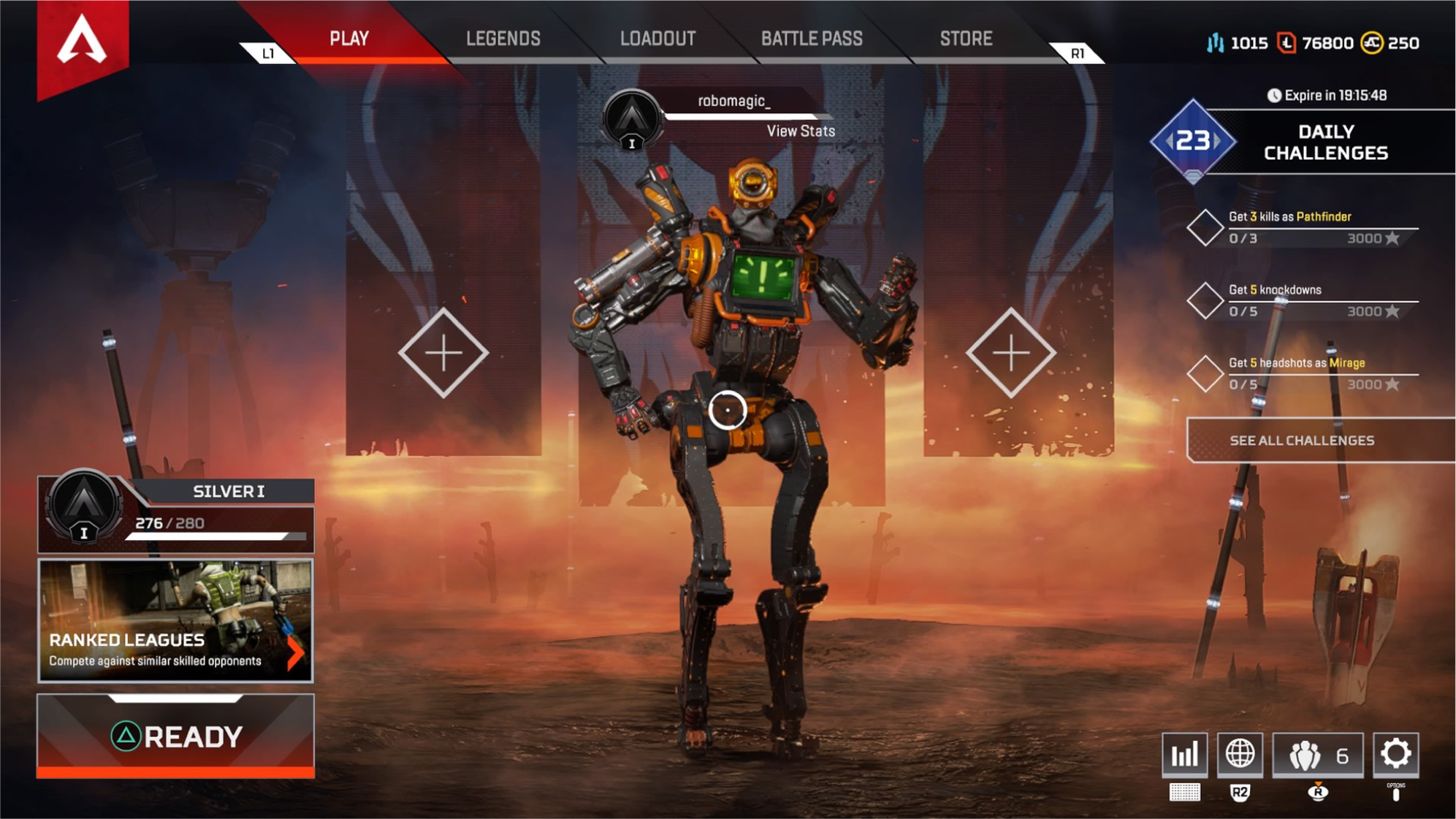
Apex Legends breaks its user interface into five tabs: play, legends, loadout, battle pass and store. These flow from left to right, walking the user through the functionalities that Apex Legends affords its users when they are not in the middle of a game match. The play tab contains the most densely packed information and, importantly, is where players can choose to enter a game and play. From here, they can be matched with up to 59 other players and 19 other squads. Usually this takes less than 30 s, and soon their avatar will be dropping out of a ship onto the map to fight with other players. From this point on the game’s affordances change drastically, but the cultural signifiers of the entitlements that players have accessed up until the game began are on full display.
The rest of the play tab haphazardly contains the majority of relevant information about the player’s Apex Legends profile, their current avatar skin, their digital currencies and the challenges available to them to level up in the battle pass. The play tab is both a highly utilitarian screen and a highly effective one because the player’s chosen avatar, as well as the avatars of the other players in the same squad, is also displayed here. In this way, the most conspicuous entitlement in the game is showcased to the player as well as their squad mates, marking it as a key mediator characteristic. A site where capital, power and affective meaning flow, what Ryn et al. (2018: 2) describe as a ‘site of social accumulation and curation of gaming capital’.
The following two tabs – legends and loadout – flow directly from the play tab, all of which are presented as a series of options screens related to decorating the player’s avatar and weapons, but which are actually disguised stores for digital commodities that feed into, and from, the battle pass, Apex Coins and Apex Packs. For example on the Legends tab, users are shown what skins they have already ‘unlocked’ for the various characters. At the same time, they are also shown what skins they have not unlocked. If the user clicks on the locked items, they are given the opportunity to spend ‘crafting metals’, one of the three currencies in the game used for unlocking items. This currency is unique because users cannot spend real money to get it. Instead, it is unlocked by opening Apex Packs, giving players an alternative route to accessing items they want to unlock. Apex Packs, in turn, are intimately tied to the in-game progression systems associated of earning experience points as well as by completing in-game challenges for the battle pass. While technically the digital currency that users can buy with real money (Apex Coins) are not paid for on these tabs (that is reserved for the store tab), it is clear that these are not merely option screens for players to tune their play style or make meaningful choices around the game. They are primarily shops. The currencies the player has are always present on every loadout and store tab in the top-right hand corner of the screen. One is always, in some way, engaging in consumer activity here.
The next two tabs – battle pass and store – ground Apex Legends’ monetization model into two distinct parts. The battle pass’ unique structure bears some elaboration. First, the battle pass comes in two forms: free and paid. The free pass is given to every player, and will give out rewards, but vastly fewer. Contra this, the paid version promises players the ability to unlock over 100 items. On first glance, the battle pass offers a relatively simple and familiar structure for a seasoned game player: a progression ladder (usually 1–110) that is tied to experience points and challenges. The battle pass tab shows the levels associated with climbing this ladder, as well as the rewards at each level. Completing challenges accessed through the play tab, for instance, will sometimes reward a player with a battle pass level, unlocking the associated entitlement on the battle pass ladder. Just playing the game will also earn experience points, which as they accrue will also unlock battle pass levels. Through a mixture of both, an average player could, with time, climb the ladder at around 1–3 levels a day.
The battle pass offers players the opportunity to earn items to unlock. But the battle pass also offers the player a consumer choice: they can spend Apex Coins to unlock battle pass levels immediately. For example a player could spend 150 Apex Coins to jump up one level, or as I discovered, 11,550 Apex Coins to jump 77 levels. To purchase enough coins, a player would have to spend more than $130 CAD. While the architecture that affords this act of consumption is likely not used that often, this is expected and indeed central to the business model of F2P. It signals how that even a monetization layer that nominally retains a traditional advancement structure based on meritocratic play allows for impulsive spending akin to the mobile F2P model. This is because the monetization layers of F2P games rely on economies of scale and small groups of players making up the vast majority of purchases (Nieborg, 2015).
As the final tab in the game, the store tab completes the consumer experience. As a tab, it is itself broken into a number of sub-tabs: exclusive items, Apex Packs, Legends and Apex Coins. On these tabs, players can spend Apex Coins that they have already gained access to or they can go to the final tab where the coins themselves are sold. This is the tab on which player currency is transformed into the ‘entitlement’ that is an Apex Coin. The quantities in which these coins can be purchased vary from 1000 for $13.49 CAD to 11,500 for $133.49 CAD. From here, Apex Coins translate into the rest of the in-game purchases available to players: additional Legends for players to unlock, exclusive items like avatar and weapon skins or the Apex Pack.
The Apex Coins tab is where real currency ends its circulation in the broader capitalist marketplace and begins its circulation in the ‘service’ F2P economy internal to the game. The circulatory function of the battle pass and Apex Coins is key as they are constantly redirecting players back to the loadout tabs. For example when the player levels up the battle pass, they usually will unlock one item and when they open an Apex Pack (either by purchasing one or getting one from the battle pass), they will unlock three items. This creates a small dot next to the relevant loadout tab that the item can be found in. This dot will remain until the player has cycled through their loadout tabs to view the item. This means that players at any number of points between rounds of play are likely to tab through the different screens and view the items they have just unlocked and reflect on the items that they still have yet to access. The circulation of the player through these tabs ensures that players are regularly given the opportunity to at least consider spending their various currencies, which when depleted would, ideally for EA, have them buying more Apex Coins.
Analysis
The experience of playing Apex Legends – when not actually playing the game – is that players are circulated through a constant series of screens that mediate player relationships with in-game rewards, currencies and metrics that then re-interact with those rewards and currencies. There are a handful of major takeaways from this: If you are not playing Apex Legends, you are constantly encouraged to reflect about what you are ‘entitled’ to. The experience of Apex Legends’ customization layer takes up no less than eight dedicated tabs, each tab having a number of sub-screens where players are managing their inventory of weapon skins, Legend skins, Apex Coins, tokens, banner poses, kill quips, intro quips, crafting metals, banner stat trackers, banner frames, banner poses and Legend finishers. The sheer number of items and information spread is high reflecting the gendered, class-based dynamics at the heart of mobile F2P games that frames consumption as a site of agency. If you are not playing Apex Legends, you are shopping in Apex Legends. There are opportunities to shop on nearly every screen. It is also important to remind the reader of the framing of consumption here as service-based. On nearly every screen users are encouraged to reflect on what they have (the ‘entitlements’ they are entitled to) and what they do not. The player is then presented at many times the opportunity to use one of the three currencies to unlock an item. If the item is not available in the store (and many of the legendary items are not, instead they are offered on a time-limited basis in the store tab), they can then get it by using the rare crafting metals, buying an Apex Pack, buying individual battle pass levels or by levelling up in the battle pass by playing the game. Finally, failing all else, they can buy Apex Coins to keep their shopping spree going. The battle pass encourages players to stay engaged with the monetization layer of the game. If a player is not shopping, they can at least be mobilized to be rewarded with Apex Packs and cosmetic items that keep them interacting with the many loadout tabs, looking at the cost of items and regularly browsing the battle pass tab to keep playing to unlock more.
Conclusion
These takeaways show how battle passes, loot boxes and other forms of monetization interlock in the F2P model of battle royale games. This walk-through sheds light on how the F2P monetization model has come to new genres of consumer goods and has been adapted to new conditions. This ‘battle pass capitalism’ then is a ‘local’ variation on the platformization of cultural production. Services, not commodities in their classic sense, are on the rise as a cutting-edge site of digital accumulation and as such the shape of what mass culture is becoming. Battle pass capitalism shows in a sense how games are now shops. This mirrors the other side of the dialectic, where digital shops and platforms have already adopted the logic of games and play. For example various sales on the Steam digital distribution platform were constructed as games and encouraged players to compete to ‘unlock’ price cuts on games players wanted to buy (Joseph, 2017). The dominance of the F2P model and in the case of the runaway success of the battle pass described here also suggests that large, narrative games not premised on the service model are going to increasingly be considered an unacceptable risk for the digital games industry to produce. It is not that they will disappear, but that they will be given less priority and resources with time in part because they are not as contingent and less likely to become a series of disguised shops. The reason I referenced Itchy and Scratchy Money at the start of this article is because I believe that in a sense what we are seeing here is the obfuscation of consumption writ large: where consumerism is relegated to immense digital theme parks that pass money through a series of shunts that transform currency into company scrip, further abstracting the commodity fetish relation Marx (1867/1990). So elegantly described the fundamental relationship remains the same, but the conditions under which it is carried out are harder to see clearly.
At the same time, the service model of the battle pass also has serious impact on the labour conditions of game workers. Workers on the development team of Fortnite, for example reported exhausting 100-h work weeks due to the massive success of the game and the drive to constantly be developing content for the next season and battle pass (Campbell, 2019). In this way, we can see how the F2P battle royale game is a mediator showing how culture, consumers and workers are locked in a ‘fun’ cycle defined by a digital circuit of accumulation and capital.
Footnotes
Acknowledgements

Declaration of Conflicting Interests
The author(s) declared no potential conflicts of interest with respect to the research, authorship and/or publication of this article.
Funding
The author(s) received no financial support for the research, authorship and/or publication of this article.