




Abstract
The rise of platforms as the premier model of videogame distribution has led to a number of changes in the business models of producers and distributors. Consumers are constantly hailed by games platforms through freemium business models that offer cosmetic items contained in loot boxes or recurring subscriptions. Thus far, game studies and consumer studies have been unable to account for the totality of how these new and dynamic platforms circumvent legal barriers and attract potential consumers. This paper argues that a hybrid research model combining platform studies, socio-cultural critique of gamblification, and political economy is required in order to theorize and explicate how these platforms operate. The platformized and gamblified model for game distribution seeks to regulate and configure networks of association between consumers and producers with the ultimate aim of eliciting participation on platforms.
Introduction: Valve hiding in plain sight
Slot machines and loot boxes: closely related reward mechanisms that have colloquially become synonymous with exploitation and addiction of consumers. The anxiety surrounding the contemporary proliferation of slot machines and loot boxes, especially in their digital incarnation, is not unique to the Euro–American context (Steinberg, 2019), but its specific configuration is uniquely confronted by Valve Corporation’s platform ecosystem. Valve Corporation (hereafter Valve) has featured in recent discussion of loot boxes in particular. For example, the burgeoning journalistic coverage of this issue (e.g. Frank, 2016; Kelly, 2019) has tended to focus on a symptomatic question, namely, whether loot boxes are a predatory game design element, and where they fall on the spectrum between gambling and non-gambling games. Although important for raising awareness of the gamblification of games, the journalistic approach has largely failed to address the wider question of how loot boxes are built into consumption paradigms that Schüll, 2012: 115 has described with reference to slot machines and that have as a key objective the maximization of consumers’ “time on device” (TOD). The fact that these consumption paradigms are the result of agile development by software companies has further exacerbated conventional analysis as these operators are not immediately recognizable as tried and true gambling operators nor is their model that of legally recognized and regulated gambling. Valve, the subject of our analysis in this article, presents a challenge both to journalists and scholars because of its ability to withhold or mask information about its black-boxed algorithmic operations (Bucher, 2018) reifying the maxim that “those inside the company […] can produce a different type of research than those outside” (boyd & Crawford, 2012: 674-675).
Steam, Valve’s video game distribution platform, eludes political economic analyses conducted through the shifting analytic lenses of market share (from economists and journalists) or legal status (from government legislators) employed over the past decade. This is because the platform exhibits strong dynamism in its operating model, eschewing traditional retail distribution in favor of agile digital distribution. Indeed, Steam’s various configurations, since it first appeared in 2003, have allowed Valve to repeatedly blur the boundary between video gaming and gambling. Unfortunately, considering the limitations of analysis by those on the “outside” and especially given Valve’s propensity to mask its operations from critics and legislators, the systematic nature of this boundary blurring has been only poorly apprehended. To shine a light on some of the work that Valve has done to hybridize video gaming with gambling, we conceptualize Steam as a platformized and gamblified space of consumption and production. To make this case, we take the example of the massively popular battle arena game, DOTA 2 (Valve Corporation, 2013). It is important for our argument that analysts understand this game not as a stand-alone commodity but as inclusive of the Steam platform and its network associations. Our general approach has been to work from the perspective of consumers who navigate game and afferent platforms, earn skins and trade or gamble them away, embodying what Ritzer and Jurgenson refer to as prosumers under the Web 2.0 model (2010: 10). Consider the example of so-called “skin gambling” as an illustration of this point. When we first looked at a third-party skin-gambling website for exchanging DOTA 2 skins, our initial reaction was to ask what exactly is happening? The simplest answer was that consumers were gambling cosmetic items from within the game on third-party websites in order to convert their in-game items into cash. We discovered, however, that the actual process is in effect much more complex, requiring consumers to connect their Steam accounts through third-party login infrastructure and to open a virtual pipeline that traverses numerous digital passage-points normally enclosing in-game goods from real world economic considerations. Consumers have been playing DOTA 2 since 2013, earning skins or purchasing them through gambling affordances like “loot boxes,” which resemble roulette-like mini-games that award goods of varying rarity and monetary value (Johnson, 2016; Macey and Hamari, 2019; Perks, 2017). This implies both that consumers are heavily invested in the game’s economic microcosm but also that when they gamble their goods away, they are aware of the relative value of their commodities as objects of their own prosumption (Ritzer and Jurgenson, 2010). As Ritzer and Jurgenson explain, the concept of “prosumption involves both production and consumption,” which occur as symbiotic parts of a larger practice and take on new forms in a digital context (14). Our analysis proceeds as follows: after a brief scene-setting discussion of theory and method used, we discuss DOTA 2, its seasonal pass, and Steam’s operations. We then address third-party complementors that are granted access and take a broad look at the entirety of this consumption space and how it hails users through its multiple layers.
Theory and method
We begin by building our analytic apparatus by combining political economic approaches (Arsenault, 2011; Flew, 2012), platform studies (Nieborg and Poell, 2018; Srnicek, 2017; van Dijck et al., 2018), and sociocultural critique (Reith, 2019; Schüll, 2012). Our argument is that platforms like Steam are a different space of consumption than what has traditionally been analyzed in terms of gambling or gaming and that they are constantly evolving to encapsulate consumers’ activities in order to extract the maximum amount of value in the form of participation on platform (POP), a distinct variation of TOD. We then detail the platform ecosystem in which Steam is embedded. We end with an explanation of how network associations between consumers are encapsulated by the platform and theorize the broader applications of this analysis.
Political economies of media
Drawing from political economies of media, Amelia Arsenault’s work suggests how to analyze situations characterized by limited access to information and strong concentration of power/ownership. Arsenault opted to move away from considering the power of stakeholders along the traditional lines of market share and market power (2012). The theoretical approach proposed is to stop considering corporations exclusively as distributors and viewers only as consumers and to consider each as nodes aligned along an abstract network of consumption/distribution and power associations (102; Latour, 2005). The utility of this framework is that critics are freed from having to empirically gauge the absolute value of Valve, Steam, or games that are distributed on the platform, while refocusing their full attention to the network associations that connect consumers, producers, and distributors.
If Arsenault’s framework allows for the agile theorization of network associations, then Terry Flew’s Structure-Conduct-Performance (SCP) model allows us to theorize a processual network. Flew explains that the SCP model functions as a schematic that displays organization, behavior, and efficiency as a unified circuit intended for manipulation (91). Configured like an electrical board, the SCP model is a tool meant for use by controlling interest, in our case platform holders, in order to tweak and refine the overall performance of the system in question and all units that constitute said system. As it concerns DOTA 2, the Battle Pass is rolled out yearly, with changes to activities and rewards implying such manipulation (DOTA 2 Gamepedia, 2019). Furthermore, Valve oversees the operation of a robust market platform and distribution platform that are constantly bringing consumers into contact with content or with each other. Flew discusses that the limitation of the SCP framework is its incapability to account for causal direction when looking at a media market where multiple entities interact and manipulate the system (91). When considering Valve’s control over their platform ecosystem, we turn to Adam Ruch’s critique of Blizzard Entertainment back in Ruch, 2009. Ruch discussed that Blizzard had the capacity for “perfect regulation,” understood as exerting control over a service it owns entirely through code or contract (Ruch, 2009). Valve exerts comparable regulatory control over its platform and by extension its consumer base. Year after year, it refines and optimizes the platform ecosystem in order to extract value and to increase player retention. Valve controls the configuration and the conduct of the structure in order to increase performance. Bringing Arsenault and Flew together with Ruch’s insight, critics can understand that Valve actually configures the network associations that consumers are engaged with and by extension seeks to configure consumers themselves .
Platform studies
In conversation with political economies of media, emerging research on platforms also gives us indispensable insight. Nick Srnicek’s Platform Capitalism makes the case that platforms have emerged as part of a broader crisis in contemporary capitalism. According to Srnicek, “with a long decline in manufacturing profitability, capitalism has turned to data as one way to maintain economic growth and vitality” (2017: 5). Under these conditions, platforms emerged as a business model “capable of extracting and controlling immense amounts of data, and with this shift, we have seen the rise of large monopolistic firms” (Srnicek, 2017: 5). At their most general level, platforms are “intermediaries that bring together different users: customers, advertisers, service providers, producers, suppliers, and even physical objects” (Srnicek, 2017: 25). Platforms gain their advantage over more traditional business models by positioning themselves between users and their activities, giving them privileged access to user data. Platforms leverage the network effects they create to snuff out competition: as users join, more users are forced to join because of a lack of alternative options, thus increasing the dominance of the platform. This “generates a cycle whereby more users beget more users, which leads to platforms having a natural tendency toward monopoly” (Srnicek, 2017: 25). While Srnicek’s theorization of platforms is useful for helping us to think about Valve, Steam, and DOTA 2, our case also presents some important empirical differences from the platforms they discussed.
Accordingly, we also need to turn to Van Dijck, Poell, and De Waal’s The Platform Society. They make the key point that we need to be thinking about “platform ecosystems,” rather than platforms in isolation. A platform ecosystem “is an assemblage of networked platforms, governed by a particular set of mechanisms […] that shapes everyday practice” (Van Dijck et al., 2018: 4). Commodification—as an example of one such governing mechanism—has all the traditional effects of commodification but, in a platform ecosystem, also has the secondary effect of concentrating power in the most central platforms within the platform ecosystem (2018: 34). As our analysis will demonstrate, digital commodities that originate from within Steam, Valve’s digital gaming platform, circulate on secondary websites. These secondary sites are linked directly to Steam through the application programming interface (API). APIs are a standard strategy for regulating third-party access to platforms (2018: 35). APIs grant only partial access to third parties as a form of control, allowing or disallowing specific uses of platform data, infrastructure, or most importantly here, digital commodities in the form of tradeable and marketable goods (2018: 35). What APIs allow and disallow is largely up to the platform holder and not the third-party operators, with greater levels of access being granted to third parties through “formal partnerships […] or by gaining access to paid data services, which have become a core part of platform business models” (2018: 35).
Crucially, this reveals that the way commodities circulate as gambled and wagered items on third-party platforms is not a challenge to Valve’s business model, but a sanctioned use of Steam’s data as part of a larger commodification mechanism that directs consumers to use their goods in ways (gambling, wagering, and trading for real money) that are not possible on the Steam platform for legal or cultural reasons. The diffuse platform ecosystem serves as a shroud for platforms that adopt a “hybrid status,” which allows them to “bypass regulation […] to which most sectors are subjected, either by law or by custom, thus creating a legal and social gray area to negotiate their position with regulators and legacy competitors” (2018: 21). Van Dijck and colleagues highlight the relationship between consumers within the platform ecosystem who are urged toward particular modes of consumption through legally gray third-party sites and the role that third-party sites play to entrench the platform’s power over consumers. The platform ecosystem created by this arrangement makes for a nebulous space that promotes new forms of consumption, which may be flexible enough to elude regulatory control.
In addition to the concepts of platform and platform ecosystem, we turn to Nieborg and Poell for a conceptualization of “platformization” or how to analyze these phenomena over time (2018). As they explain, from the vantage point of software studies and political economy, analyses generally account for the structure of a platform at one moment and might produce a history of the platform that led to the current configuration. Their warning is that scholars must consider platforms as the product of ongoing processes. Thus, “platformization” refers to the “penetration of economic, governmental, and infrastructural extensions of digital platforms into the web and app ecosystem, fundamentally affecting the operations of the cultural industries” (Nieborg and Poell, 2018: 4276, emphasis in original). Platforms and platform ecosystems do not spring fully formed. They are the result of arduous processes which are always ongoing and self-refining. Nieborg and Poell reiterate that more traditional economic models mistakenly apprehend platforms as static objects, which has led to shortsightedness insofar as platforms are highly dynamic and adaptive (2018: 4277). Platformization, when considered in relation to gamblification of games, is a stronger framework to account for the constant and dynamic repositioning of platforms to elicit and encapsulate consumer engagement. From our perspective, platformization can be understood as the structural process that Flew was steering toward. It is a driver of SCP. The question then is: platformization for what purpose?
Sociocultural studies of addiction
Schüll’s Addiction by Design suggests a key purpose for this sort of design control: time-on-device (2012). The design philosophy behind a casino slot machine and a platform like the one we are discussing here is functionally identical: keeping consumers on the line. Where gambling scholarship has used time-on-device as the main descriptor for this network association, we have opted to refer to it as participation-on-platform. Our reasoning is that the platform stretches beyond any one device, encompassing DOTA 2, the Steam marketplace, and several afferent platforms in an ever-expanding and increasingly decentralized ecosystem. Second, we have chosen to substitute time with participation because time is not always an accurate descriptor for the intensity or the outcome of platform usage. A purchase or wager is not necessarily predicated on time, and the specific form of participation is more important for data collection and the accumulation of consumer information (Srnicek, 2017; Zanescu et al., 2020). These facts afford powerful platform actors the capacity to amplify feedback loops that Reith has diagnosed as underpinning contemporary developments in “addictive consumption” (2019).
Methods
A final point concerning methodology is that we started studying DOTA 2 and its larger ecosystem in May 2017. Our methodology has been described in detail elsewhere (Zanescu et al., 2020) but for the purposes of this article can be summarized as follows. Beginning with the purchase of a subscription to the game, Andrei and Marc proceeded to labor through the same game mechanics that commercial users navigate. Formal design elements were cataloged and captured via screenshots. Ethnographic notes pertaining to play, item gambling, as well as to the major eSports events related to DOTA 2 were recorded by Andrei, Marc, and Martin. An estimated 500 h of play analysis was undertaken by Andrei and Marc, followed by 200 h devoted to The International 2017 and 2018 by Andrei, Marc, and Martin. We estimate the ethnographic process at a total of 700 h, aligning with the virtual ethnography norms set forward by Boellstorff et al. (2013). Relying on earlier methods for considering games and software as textual systems that users navigate via play (Aarseth, 1997; Bogost, 2006, 2007; Frasca, 2003), we position our ethnographic play data as a textual reading of game software as the proto-platform par excellence (Nieborg & Poell, 2018). We argue that a company like Valve tightly regulates the space of consumption not just through its games but through the broader platform ecosystem that it dominates.
Platforms of all shapes and sizes but all in concert
In order to discuss Steam’s business model and DOTA 2 as a specific case, its digital infrastructure should be laid bare so that the network is understood as a unified construct rather than a smattering of individual platforms. This network has five specific nodes that are fundamental to our analysis: Steam itself, DOTA 2, The Battle Pass, the Steam Marketplace, and third-party gambling websites/platforms (which we designate as a fifth position but can be expanded to however many platforms can be cataloged). Viewed through the conceptual apparatus of platforms, the platform ecosystem, and platformization, the five nodes mentioned above operate as a diffuse network. For analytic purposes, we have located the game at the center of this network though it is possible to imagine a range of different analytic approaches that might start from third-party sites or place the Steam Marketplace at the center. DOTA 2, a game developed and published by Valve, is the first node along this discursive network. In the game, “two teams of five players each attempt to traverse a somewhat symmetrical map with the goal of destroying their opponents’ “ancient,” which is a large structure that sits outside each team’s spawn point” (Lajeunesse, 2018).
The game is free to play, and winning or losing games grants nothing to consumers at this point. Players engage with each other in individual matches and then proceed on their way, with the option of maintaining contact through the Steam platform’s social network options. At a surface level, DOTA 2 is a platform that brings together 10 consumers in the activity of play and socializing, yet it does not strictly conform to Srnicek’s definitions. It is both a cloud-based platform and it is a product platform but is not recognizable as service in its stand-alone form since it does not require a subscription or buy-in, and it does not advertise anything properly (Srnicek: 49). However, DOTA 2 does not exist outside of the Steam platform, which shapes its operations.
Every year since 2013, roughly from Q2 to Q3, Valve releases The Battle Pass, the second node in the overarching platform. The Battle Pass offers a bevy of activities and rewards for consumers to buy into as the DOTA 2 International eSports championship season ramps up and the main event finally takes place (Zanescu et al., 2020). The pass is priced at US$9.99 for the base product or US$36.99 for an upgraded version (2018). This pass appears as an interface overlay inside DOTA 2 and is “leveled up” by winning matches, wagering on said matches, or completing several other activities. The premium purchase garners 75 Battle Pass levels. At specific levels, consumers are rewarded with cosmetic items. Levels may also be purchased for real money (5 levels for US$2.49). All revenue is routed to Valve, but according to Valve, 25% of all sales goes toward The International’s prize pool. 1 Numbers have shown a meteoric rise in revenue as the prize pool has grown from 2.8 M US$ in 2013, to 10.9 M US$ in 2014 (a 380% rise to be exact), and most recently to 30.0 M US$ (Liquipedia, 2019). The Battle Pass is another variety of platform, bringing purchasers into contact with Valve as a retailer and as an eSports organizer. It is a product platform that leverages advertising platform characteristics (in that it indirectly advertises The International championship as well), especially collecting consumption data but not for traditional advertising purposes.
Additionally, many of the rewards earned through the Battle Pass may be sold on the Steam Marketplace, the third node in this meta-platform. 2 The Marketplace is, as the name suggests, a digital market platform where consumers can take the unrestricted rewards earned through the Battle Pass and sell them. There is absolutely no regulation or barrier on how players engage in selling and buying on the platform, approximating a free market as closely as possible. Prices range anywhere from a few pennies to thousands of US dollars, with no limit to the amount of times an item may be resold. For each sale, Valve takes a 15% cut, which is levied from the buyer. The Marketplace most closely resembles lean platforms, not in the sense that it is assetless, but in the sense that assets are virtual and replicable at no cost and it collapses physical space between sellers and buyers, while offloading the retail activity onto self-interested consumers, as opposed to employees (Srnicek: 49). The overall platform mediates between individual consumers but also in a more abstract sense between consumers and Valve as money changes hands at high velocity and transnationally with Valve acting as tax collection agency or cryptocurrency company, generating value from the circulation of its ostentisibly immaterial capital.
Furthermore, the game, the pass, and the marketplace are all appendages of the larger Steam platform. When taken in the context of the overall operation of Steam, each of the other platforms exists as a subset and fulfills the general function of circulating capital on Steam itself. Consumers convert their local currency into Steam US dollars in order to buy in-game goods or to buy items sold by other players or even games outright. This has been a hurdle in theorizing gamblification because money, strictly speaking, does not exit the platform. Consumers are free to circulate this virtual currency among each other or to purchase all kinds of goods available, but they cannot cash out. On the face of it, a division between the physical world and the digital platform is maintained and Valve evades classification as a gambling operator because if we were to pay attention only to Valve and Steam and ignore the larger platform ecosystem, it would appear as though no consumer ever makes money as a result of their transactions on Steam. However, the Gambling Supervision Commission for the Isle of Man (among other European legislative bodies) has provided a legal framework under which it is possible to consider new forms of gambling as “anything which has a value in money’s worth,” including “convertible virtual currencies […] such as bitcoins which can be bought and sold” as well as “nonconvertible virtual currencies [including] virtual goods such as digital “skins” for avatars and weapons in video games […] as well as in-house game currencies” (Guidance for online gambling amendments regulations 2016, 2017: 6). Valve has elected to cease distributing loot boxes in areas with updated legislation, such as the Isle of Man, rather than comply with any restriction to their operations. In this sense, real money does exit the system and therefore it is clear that the phenomenon of gamblified prosumption has moved beyond the traditional defined limits of gambling.
The fifth, and most elusive, node mentioned earlier is the third-party item gambling website. All items on the Steam platform exist in a digital inventory that can be accessed by third-party applications insofar as they have been granted access to the overall platform API, which is regulated by Valve itself. As Nieborg & Poell mention, API access is a strong indicator of platform collaboration (2018) and therefore these companies exist in a bizarre gray space. Although unregulated gambling is illegal in Quebec, where we write, these websites get around that by accessing consumers’ inventories and allowing individuals to wager DOTA 2 items as opposed to money, yet the winnings are real money. These platforms would conform to what Srnicek refers to as lean platforms, that is, platforms without physical locations or infrastructure and which run through the participation of unprotected consumers/adopters. Their operation is widely heterogenous and flares up almost as fast as the websites themselves may be shut down.
These third-party sites do not operate uniformly in their complementor relationship with Valve. Yet, the complex historical interplay of eSports betting, skin gambling, and the subsequent output toward cryptocurrency or real money has been discussed by Greer et al. in detail (Greer et al., 2019). In April 2018, Marc surveyed 10 skin trading and wagering sites that feature DOTA 2. Eight of the sites surveyed use the Steam API. Six of these eight sites require a user’s Steam ID and password in order to log in, while the other two sites connected by API offer alternative modes to sign in such as Facebook, Google, or e-mail accounts. The remaining sites use their own log in criteria. Most of the sites use the Steam API and access a user’s Steam inventory in order to operate.
Marc first identified what the commodity inputs and outputs were of each site. Each of the sites allowed skins to be deposited and withdrawn, while four of the sites had real money and hybrid inputs and outputs. Loot.bet, for example, allowed users to turn their DOTA 2 skins into a US dollar value for use on the site. After that amount had been wagered successfully on a real eSports match outcome, the earnings from what were first an in-game item could be withdrawn from the site as cash. Unlike the Steam platform proper, the third-party sites can be an opportunity for consumers to cash out of the Steam ecosystem although not all sites offered a way to cash out and not all cash-out mechanisms were uniform from site to site.
Dota2Lounge.com, for example, offered a hybrid system between trading, cashing out, and wagering (Figure 1). Users here post trade requests by linking to certain items or real money and highlighting items that they have to trade or are looking to acquire. In-game items can be traded for items, but many sellers offer real money trades for valuable or bulk sets of items. Real money trades are not conducted through the site itself but are rather facilitated by the trade interface. Dota2Lounge Homepage—Trade offers juxtaposed with betting options (2019).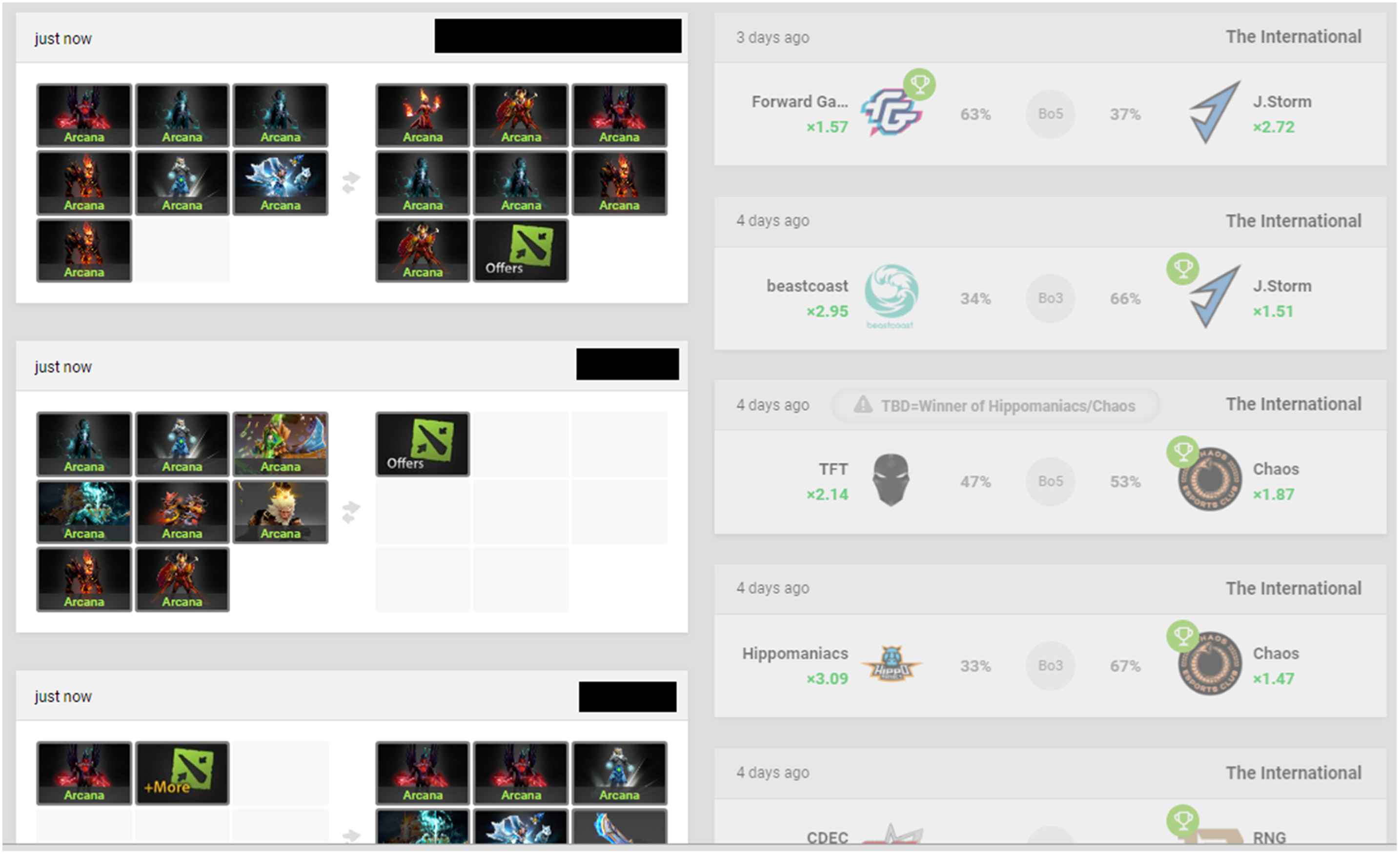
Real money trades are set up by the users through PayPal, bank transfers, or through cryptocurrency services. Importantly, next to the trade interface, there is a wagering interface where users can bet what the website refers to as “virtual currency” in the form of skins on upcoming DOTA 2 eSports matches (DOTA2Lounge, 2019). In order to bet, players wager any number of their virtual items. Items are lost on an incorrect bet, but the items are returned along with new items as winnings on a correct bet.
Other sites like skingame.co only allow the wagering of skins and have no real money cash-out mechanism built in. However, this and other sites allow players to wager their skins on games of chance within the site. Here, the wagers and returns are skins and loot boxes containing yet more skins which can be used on the steam market, wagered on eSports matches, further wagered on these games of chance, or cashed out through a real money trade.
One final site worth highlighting is (Skins.cash, 2019) (Figure 2). This site is purely a cash-out mechanism that uses the steam API. The trade process is quick and simple. As the site advertises, there are four steps to turning the items into real money: Sign in using your Steam account. Enter your trade URL. Choose the skins you want to sell. The DOTA 2 item prices will be formed automatically by our service. Choose the most suitable payment method, and you are good to go. Available payment methods are PayPal, QIWI, MasterCard, Visa, Webmoney, etc. (depending on your country) (2019). Skins.Cash Webpage—Steam logo prominently displayed (Skins.cash, 2019).
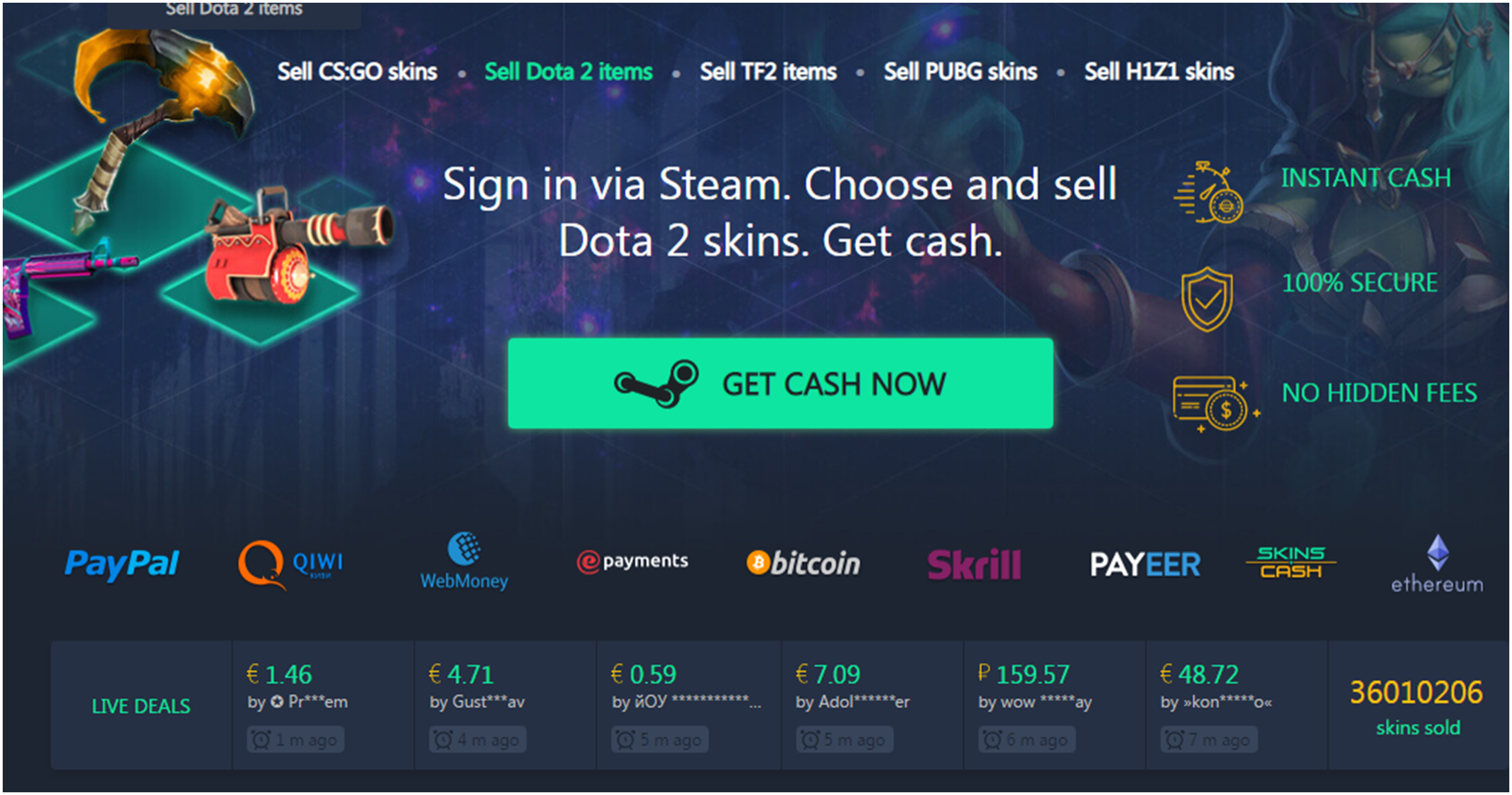
The site functionally works as a quick automated cash-out mechanism. While some of the website reviews note that this service is costly because the algorithm sets the value of the items and these are often lower than the market rate, it is still an available cash-out option.
Crucially, it is far from the only cash-out option as well. In addition to cash-out options built into platforms networking with Steam through the API, there are also web forums such as the DOTA2Trade subreddit where users are able to work out more profitable deals among themselves with less platform interference. There are two takeaways from this survey. First, contrary to notions of Valve’s gamblified DOTA 2 practices being firmly bounded within cosmetic items and the “steam bucks” economy, they are actually transferable into real money. Second, both cash-out and third-party trading mechanisms are closely paired with wagering games and eSports betting such that the line is blurred between wagering virtual currency and real money and between consuming gamblified game mechanics as leisure practice and traditional gambling.
The consumer in this web of systems embodies the entrepreneurial spirit of the prosumer (Planells, 2017) by seeking maximum value for their in-game commodities while deliberately being redirected toward the different sites within the platform ecosystem. Users are simultaneously being exposed through DOTA 2, Steam, and third-party sites to the risk of loss in the way the items can be earned through chance, have fluctuating market values, and lost in wagers. These sites promote core platform engagement by directing users to play the game proper because that is the site where these commodities are generated and to check on the market to make sure they are making equitable trades, or getting maximum value for their wagers. Third-party engagement increases POP because it ultimately redirects consumers back to the core platform as the source of their commodities’ value and as the primary site of commodity acquisition.
Hereafter, we discuss these platforms as one platform ecosystem since in reality, they operate in unison. For all intents and purposes, DOTA 2 only reaches operational fullness when the Battle Pass is active and acts as connective tissue between the game and the market. The Battle Pass performs the yearly advent of “creative destruction” (Schumpeter, 1943/1996: 84) that political economist Amelia Arsenault discusses as each year it adds new activities and buries unfruitful ones, perpetually reinventing itself for the delight of consumers (2011: 102). For instance, the shift from the 2017 to the 2018 model retired a Plinko-like minigame where players could win a few Battle Pass levels and replaced it with a more involved tipping activity allowing players to effectively busk for levels and indirectly for rewards (DOTA 2 Gamepedia, 2017a, 2018). Arsenault’s network political economy approach is useful here because it focuses on the processes of the platform and how consumers are affected, rather than market ownership (2011: 102). When taken together, the overarching platform that appears can be read through the flow of money, but also as an involved “social architecture” of these nodes (2011: 103). Furthermore, Valve’s economic power is not understood here through mergers and acquisitions or conglomeration but rather through the yearly refinement of its platform, its position at the center of a legally gray platform ecosystem, and what that entails for consumers.
Configuring consumers
One hiccup is that the entire system hinges on a key factor: consumer engagement. Engagement and retention are desired outcomes and therefore we should ask, what does player engagement garner for Valve? The answer is, of course, revenue, but the form of revenue is crucial. As mentioned earlier, Valve makes no direct revenue from DOTA 2 which operates on a purely freemium or F2P (free-to-play) model (Alha et al., 2014; Hamari, 2015; Nieborg, 2015). They do make a great deal from the Battle Pass, but that does not fully account for all revenue. Goods earned by players and sold to players net them a 15% margin. Those goods however do not exist without player engagement. To be precise, when players earn levels through the Battle Pass, they earn treasures, colloquially referred to as “loot boxes” (Perks, 2017). When players open these treasures, they are granted one random reward inside. The more consumers engage with the pass, the more loot boxes they can earn, the higher the chance they will receive valuable items for resale or personal use. This is referred to as “escalating drop chances” in which players’ chances to earn rare rewards grow with each additional treasure they earn (DOTA 2 Gamepedia, 2017b). Therefore, better player retention and engagement indirectly translates to more items entering the marketplace, and more consumers participating strengthens the economy of the marketplace. Consumer activity is play, and here play is value generation. It also happens that the activity constantly shifts between different types of play (e.g., 5-on-5 battles, minigames), different types of wagers (e.g., on whether or not your team will win or lose a match, on which pro team will win or lose their match), and different types of transactions (e.g., on the Steam Marketplace, on third-party sites), making the extent of gamblification difficult to apprehend.
This brings up the issue of the consumers’ status as it regards the platform ecosystem: Are they consumers or workers? Above, gamblified play is reconfigured as a value-generating activity by the company. In Srnicek’s words, “the activities of users and institutions, if they are recorded and transformed into data, become a raw material that can be refined and used in a variety of ways by platforms” (2017: 56). Here, play is productive on two distinct levels. The first is generating revenue outright by producing digital goods, but the second, and more subtle productive mode, is generating data about engagement. As mentioned above, changes between the 2017 and 2018 Battle Passes, for instance, show the removal of conspicuous gambling games and the addition of tipping, implying that previous data projected stronger earnings from the shift away from outright gambling and into a pseudo-work/gambling hybrid. Srnicek’s point that “work becomes inseparable from nonwork and precise categories become blunt banalities” stands as consumers’ participation-on-platform generates value in a number of ways (2017: 54). The players’ game is reconfigured as profit-generating activity in the eyes of Valve. Consumers then are not extraneous to the SCP model; their behavior is in fact one of its core considerations (Flew, 90). Nevertheless, it remains difficult to simply reduce consumers to a standing-reserve resource under the umbrella of the SCP model, if for no other reason than their agency.
If Valve’s prerogative enacts a constant and ongoing process of platformization, driven in turn by an ongoing optimization, that is merely one end of the developer/consumer chain. The other end is driven by nebulous and diverse motivations, given that consumers never act as a unified theorizable group (Brock, 2017). Schüll discusses the attempt to enframe free and voluntary play as “ludocapitalism […] [where] they have sought to attune their industry’s machinery of production to consumer predilections” (Schüll, 2012: 53). In a strange turn of events, industrialists have been forced to acknowledge consumer agency when trying to encapsulate them within the industrialist SCP model or under the Web 2.0 prosumption model of Ritzer and Jurgenson. This has led to different explanations of consumer behavior. Schüll discusses gambling design, which is relevant here because of the loot box model and the gambling minigames, yet it always reduces player motivation to a search for “the zone experience,” a pathologized and addiction-laden drive for satisfaction and escapism (Schüll, 2012: 54).
The design of reward models is an ongoing and fraught debate in the games industry (Perks, 2017). Most notably, it has been drawing a great deal of journalistic attention as a predatory practice. Game scholar Matthew Perks has written about the design of loot boxes as a moment where game developers are shifting toward a “monetization model [that] is inherently exploitative and potentially harmful to its consumers” (2017). Here, the discussion of gambling systems is flipped. We are not discussing a situation where pathological play leads consumers predisposed to addiction toward such products but one where these products are iteratively designed in order to elicit such behaviors. Debates around whether or not loot boxes are consistently frustrated and diffused by legal definitions of gambling, which require monetary output, and goods gained from loot boxes and sold on the Steam Marketplace do not technically constitute proper revenue.
When consumers own goods on the Steam Marketplace, there are two possible outputs for them. One is outright selling the goods on the Marketplace. This is legally allowed and will, as mentioned earlier, net the seller whatever the item is listed for, with an additional 15% added onto the sale price and given directly to Valve. As an example of these sales, last year’s Battle Pass granted players the opportunity to win several, particularly lucrative items, among which the Jade Baby Roshan item sold immediately for a little under 400 CAD. That price shot up to nearly 1900 CAD and fluctuated wildly before settling around 1700 CAD (at the moment we are writing). Each individual sale provides a 15% premium for the producer. The case might be a single such item circulating many times, or many items circulating once, or not at all. Yet, this single item has benefitted Valve to the tune of thousands of US dollars. Other items might sell for a small sum, but they circulate more easily and with greater frequency. Sellers keep their earnings in the form of Steam store credit, which is then spent either in the Marketplace in turn or for games published on Steam proper. This represents the compliant legal earnings model that the Marketplace openly encourages.
There is nonetheless a second model of earnings available to players, that of unregulated gambling, since items may be illicitly wagered on websites like LootMarket.com, Dota2Lounge.com, or Loot.bet. In this mode, players wager items, for their Marketplace value and according to betting odds, on specific eSports matches and when they win, they can cash out in real money. This mode is, strictly speaking, illegal in jurisdictions (e.g., Canadian provinces) where it contravenes criminal code prohibitions of unregulated gambling. Yet, it is allowed to operate by Valve, and it operates by having access to Valve’s API. As mentioned earlier and noted by Nieborg and Poell, “infrastructural access to APIs and Software Development Kits is among the primary ways in which platforms control complementors” (2018: 4281). These often-illegal gambling platforms are not parasites leeching off Valve, they are in fact cherished complementors. These complementors are granted limited access which corrals them into the SCP pipeline, integrating their respective strategies with those of the producer. Claims that these secondary platforms are undesirables by Valve (Johnson, 2016) are therefore shallow disavowals since they have been given the keys to the kingdom. The targeted shutdown of specific websites but not others effectively refocuses outrage around unregulated gambling on these platforms, while diverting critique away from the larger exploitative apparatus run by Valve. This is also an instance where conglomeration does not appear in its traditional sense and therefore cannot be apprehended, except as a network of association in Arsenault’s sense (2011: 117). For all intents and purposes, Valve’s stranglehold on the platform ecosystem reaches from production all the way to consumption while dancing around issues of legality at the transnational level. Furthermore, given that cashing out through third-party gambling platforms still occurs through the API, consumers’ money is restricted to circulating through Valve’s platform. It is no longer of an issue of whether or not this is gamblified consumption because the currency is virtual but whether individuals can escape this virtual casino altogether.
Conclusion: Where does Valve end?
Our aim has been twofold. First, to provide an example of how a consumer studies and game studies analyses can be conducted when a platform holder is black boxed. Second, to consider a gamblified platform ecosystem as an ongoing process of platformization that attunes network associations between consumers and platform holders. Simply put, Valve operates a gargantuan platform ecosystem arranged around a few popular media commodities, built on the drive for ever-increasing efficiency and control. This in turn results in participation-on-platform producing eventual profit, either from prosumer activity or data collection. The platform confounds traditional political economic analysis because it dances on the periphery of traditional industrial arrangements, and so scholars need to reconsider how to analyze platform infrastructure in the first place. Arsenault provides an understanding of a media industry not as distinct bodies but rather as interconnected nodes in a network with regulable behaviors and associations. Flew, Nieborg, and Poell further add to this toolkit by theorizing platformization, an ongoing process of becoming platforms, distinctly from static and immutable industrial arrangements. The SCP model also bolsters this analysis by allowing critics to conceptualize an end goal for platforms that is different from concentration: Optimizing control over a system that is already an effective monopoly. Last, Ritzer and Jurgenson’s category of prosumer should remind critics that consumers are never merely passive in these systems.
Valve’s platform ecosystem, composed of DOTA 2, the Battle Pass which provides more rewards, the Marketplace allowing players to sell their goods, Steam’s overarching systems, and the tangential and often disavowed third-party gambling operators, is one regulable system. The company makes little upfront with the game but a great deal from the Battle Pass; 25% of all Battle Pass sales constitute the prize pool of The International each year, and so, extrapolating from the 2018 prize pool of $25,532,177, we estimate that Battle Pass earnings for Valve were 102,128,708 US$. An innumerable amount is made from the 15% cut that Valve makes from all sales of items gained from the Battle Pass and this for every Battle Pass or Compendium since 2013 as items never actually exit the market. Consumers cannot legally exit the market without abandoning their goods altogether. Valve here relinquishes the reigns to players, who seek to fulfill their own goals and to protect their assets. Whether it is a desire to show off a skin as a status symbol or to enjoy an aesthetically curated character for one’s own pleasure, players are the ones who drive the sales and purchases of items. Their prosumption is rendered profitable, regardless of their intent.
Platform design is also oriented with the goal of optimizing the pipeline’s operation, here understood as value-generating player retention. These prerogatives manifest as the design of gamblified systems, which has led to harmful and predatory business practices. It is beyond our scope to discuss whether game addiction takes place because of the platform affordances, but ethically, it must be acknowledged as a potential outcome of the systemic arrangement of platformization, or as Schüll calls it, Addiction by Design (Schüll, 2012). We strongly encourage further research into the evident convergence of ludocapitalism, gamblified platformization, and prosumption.
Although the relation between video game consumers and producers has been discussed in consumer studies, the conversation has remained centered on business models and the rise of prosumption-investment (Planells, 2017). This masks the immense speed at which Valve and other platform holders have developed their models. On the other hand, perspectives about prosumption and fetishism of goods have rightly focused on the discussion about what goods come out of investment and why consumers are willing to pay as much as they do for digital abstract goods (Roberts and Cremin, 2017). Yet, it is our opinion that consumer studies pertaining to the video game industry need to integrate platform studies frameworks as well as political economic theoretical models that can contend with these agile corporations that evade more traditional forms of polling and analysis. What is needed are new models like the one we have used to interrogate the increasingly nebulous rapport between consumers and platform holders. Valve’s effective monopoly, and that of other platform holders in similar arrangements, must be analyzed in order to fully comprehend how their business is conducted, how it uses consumers to generate income, and how under their model, all consumption and play is repurposed as a value-generating activity (Whitson and French, 2021), a platformized and gamblified campaign to increase profits at all costs.
Footnotes
Declaration of Conflicting Interests
The author(s) declared no potential conflicts of interest with respect to the research, authorship, and/or publication of this article.
Funding
The author(s) disclosed receipt of the following financial support for the research, authorship, and/or publication of this article: Andrei Zanescu would like to acknowledge financial support for this research from a Fonds de recherche du Québec—Société et culture (FRQ-SC) Doctoral Grant (2020-B2Z-277963). Martin French would like to acknowledge financial support for this research from a Social Sciences and Humanities Research Council (SSHRC) Insight Development Grant (430-2016-00996) and a Fonds de recherche du Québec—Société et culture (FRQ-SC) Action-Concertée Grant (2017-BJ-202106).