



Abstract
The article explores the sociomaterial organization of preschool children’s digital literacy activities, focusing on how participant positions are enacted and distributed. The data material consists of 70 hours of video-recorded observations in early childhood education and care in Norway. Drawing on Ethnomethodology/conversation analysis (EMCA) and Science and Technology Studies (STS), we approach digital literacy practices through the following analytical concepts: participation framework, positioning, script and mutual enactment. The analysis of a twenty-minute sequence shows how tablet activities are dynamic and shifting, where the participant framework, positions and scripts are mutually enacted. Through our analysis we show how the creation of activity frames with a joint focus of attention is important for establishing and sustaining digital literacy as a collaborative activity. It is suggested that applications with weaker scripts might also be important. Here, we show how the “owner” uses a range of interactional resources to establish and sustain control and mutual involvement in literacy activity. This also involves how the technology is enacted in multiple ways.
Keywords
Introduction
Over the last 10-15 years studies of digital literacy have tended to focus on how children use technology in the wide sense to participate in society (e.g. Kafai and Burke, 2017). According to the idea that literacy refers to participating in society, it has been argued that the “nature of literacy has become deictic” (Leu et al., 2017: 1), pointing out that it is relationally produced, context-bound and contingent. Viewing literacy as relational also points out that what is considered to be competent action changes as technologies, discourses and social practices develop. Along these lines, the concept of dynamic literacy has been introduced to encompass various dimensions of literacy so that “hybrid and fast-changing ways in which meanings circulate in digital culture” can be described and analysed (Potter and McDougall, 2017: 37).
In this text, digital literacy refers to a number of literacy activities across a wide range of digital media (Scott and Marsh, 2018) and social constellations. The notion includes operational, cultural and critical skills, as well as the competencies needed to be part of societies and communities (Marsh, 2020). However, to better understand digital literacy, researchers have explored how these activities may be seen as heterogeneous networks in which not only the human but also the nonhuman matters, and where the social and the material are intertwined (e.g. Burnett and Merchant, 2020; Lundtofte et al., 2019). Cues from apps, tablets and surrounding children and adults all play a part in how digital literacy activities unfold. This means that we need to focus on the organization of participation in these activities, considering how talk, body and tools are enacted when displaying social norms and relevant actions (Aarsand and Bowden, 2020). Being a literate person thus involves being able to both read and produce relevant action in line with what is expected from the position one occupies. Seeing digital literacy as participating in a digital world (e.g. Kafai and Burke, 2017) directs attention to how peers (Danby et al., 2018), siblings (Houen et al., 2021), adults (Aarsand and Assarsson, 2009) and educational institutions (Bowden and Aarsand, 2020) play important roles in the production of digital literacy practices.
In the upcoming analysis, we explore three excerpts from one twenty-minute video observation sequence of one child’s “turn” at having the tablet in an early childhood education and care (ECEC) setting. Drawing on a relational understanding of literacy practices, we direct our focus onto the sociomaterial organization of children’s tablet activities in situ, asking the question: How are participant positions enacted and distributed in digital literacy activities?
Early childhood and digital technologies
Tablets and young children have become a field of interest for researchers within early childhood education and care (e.g. Flewitt et al., 2015; Kjällander and Moinian, 2014; Lundtofte et al., 2019). This interest seems to be rooted in the fact that touch screens have made it easier for children to use the technology and that many children in the Western world both have access to and use tablets on a regular basis.
Research on digital tools in ECEC tends to explore how digital tools are, and can be, implemented specifically for pedagogical purposes (Henward, 2018), asserting that information and communication technologies shape learning, meaning-making and play (Lafton, 2015). Researchers have focused on how to help education practitioners explore the potential of tablets in early literacy learning (Flewitt et al., 2015: 290). It has been argued that the nature of play in contemporary society has changed in terms of the resources available and the ways in which these are used in play (Marsh et al., 2016). However, researchers have also argued that digital play does not significantly differ from traditional play. Focusing on social interaction during digital play, Lawrence (2018) found that “the social interactions exhibited during peer play with iPads were varied, there were many of them, and they were not different in kind from those observed among preschoolers engaged in traditional play” (2018: 224). Marsh et al. show how play nowadays draws on “digital as well as non-digital properties of things and in doing so moves fluidly across boundaries of space and time” (2016: 250). Wohlwend (2015) uses the term collaborative literary practices to argue that what might seem chaotic and messy to outsiders observing young children’s play with an iPad is actually collaborative literacy play, as touch screens allow several fingers to act simultaneously. It has been argued that there is a tendency to focus either on play or on learning when studying children and technologies (Lundtofte et al., 2019). However, some research does not deal primarily with learning or play. In a study of children in an ECEC setting playing computer games, Ljung-Djärf (2008) identified three positions, namely, owner, participant and spectator, and explored the dynamics involved in the way children position themselves, concluding that the computer “forces the children into different positions and ways of acting” (p.71). Even though Ljung-Djärf states that these positions are both static and dynamic, she argues that the computer moves children into these positions. Arnott (2013), on the other hand, focuses on the social contextual factors that shape interaction between children using technology. Similar to Ljung-Djärf (2008), Arnott discusses technology as a static present “thing”, although this differs regarding whether the nonhuman or the children determine the outcome of the interaction with technology.
In line with literacy being seen as fundamentally deictic, a sociomaterial and relational ontological approach can help us to open the field as we explore the assemblages of tablet and children, allowing us to see how both human and nonhuman take part in the accomplishment of literacy activities.
Mutual enactment, participation framework and script
To explore how digital literacies are performed we turn to Science and Technology Studies (STS) and Ethnomethodology/Conversational Analysis (henceforth EMCA) for theoretical and analytical tools. Taking a sociomaterial perspective, we aim to widen our understanding of the social organization of tablet activities by including tablets and their applications as participants in our analysis. From a sociomaterial perspective, non-humans are actors that are inextricably entangled in relations with humans and the mutual enactment of both. Seeing how the social and the material are intertwined allows us to “look beyond the dualism of the social and the material without demoting the value of either” (Johri, 2011: 211). A sociomaterial perspective perceives non-humans as actors, where cues from apps, tablets and surrounding children and adults all play a part in how literacy practice unfolds. Thus, we suggest using a flat ontology to perceive how the actors are mutually constitutive. By incorporating both the social and the material, without favouring one over the other, we can expand our understanding of digital technology and advance the field (Johri, 2011; Kucirkova, 2021). The consequences of taking such a stance are that humans and non-humans are seen in relation to each other (Law and Mol, 2008) and digital literacy activities are seen as multiple, shifting and unknowable in advance. To explore tablet activities in an ECEC setting, we look at children and digital technology in a “symmetric fashion” (Latour, 2005) or what has been called a heuristic flattening (e.g. Star, 2007). It is important to keep in mind, however, that heuristic flattening “… is a way of breaking down reified boundaries that prevent us from seeing the ways in which humans and machines are intermingled” (Star, 2007: 93). In the present text, heuristic flattening refers to the relationships between tablets, applications and humans and how they gain meaning (Hutchby, 2001). In other words, we assume that non-humans also have implications when it comes to how activities and practices are organized and accomplished. A heuristic flattening requires a relational stance where actors are seen as linked with other actors and act in relation to each other. Actors both shape and are shaped in assemblages, or encounters with other actors, whether human or non-human. From this point of departure, we can explore the deictic nature of literacy as we approach digital literacy practices as situated and mutually enacted in the meeting between human and non-human actors (Law and Mol, 2008; Mol and Mesman, 1996; Woolgar, 2012).
To explore the sociomaterial organization of tablet activities we will use the concepts of participation framework (Goffman, 1981;Goodwin and Goodwin, 2004) and script (Akrich, 1992). Participation framework is mainly used to study how humans interact in material environments and how they build actions in concert with each other in situ (e.g. Aarsand and Bowden, 2020; Goodwin and Goodwin, 2004). The concept explores three aspects: the establishment of the activity, the distribution of participant positions, and the situatedness of sociomaterial activities. The first aspect, the establishment of the activity, refers to how the participants agree upon which activity is taking place at a given moment. Framing a situation means establishing a joint definition of it (Goffman, 1974). This agreement is established and negotiated through the use of various interactive resources, such as intonation, gaze and placement to signal to each other how to understand the situation. This, in turn, has consequences for how the participants interpret and act on each other’s actions, for instance, questions are understood and treated differently in education depending on whether they occur during a test or during an introduction to a new topic. Moreover, framing an activity relates to expectations of what is going to happen and how the activity is to be performed, while it also provides guidelines for understanding each other’s actions (Tannen and Wallat, 1999 [1987]). To understand what the participants are doing we need to identify how they orient themselves towards the activity at hand. The second aspect is the distribution of participant positions. Goffman (1981) argues that the participants are placed in and enter different positions in different activity frames. Participating in an activity involves taking stances and positioning oneself in relation to other participants, both people and objects (e.g. DuBois, 2007). However, one cannot merely claim a position, this position also needs to be ratified by the other participants, thus, the positions are realized in assemblages in which the actors’ positions are mutually enacted.
To analyse the participants’ positioning, attention is directed towards their stance-taking (DuBois, 2007; Jaffe, 2009). Stance-taking is a social act that consists of: i) an evaluation of the object, for instance a particular application on the tablet. Taking a stance is always directed towards someone or something. Then there is: ii) positioning oneself and others in relation to the object, for instance taking the position an expert, and iii) alignment with a second person, in which this person may, to varying degrees, agree or disagree. Thus, stance-taking has consequences with respect to how the participants orient to and interact with each other and has a focus on what is said, how it is said, and how it is related to social norms and values in the community. This indicates that the position taken involves rights and expectations concerning what, how and where to act (Goffman, 1981). For instance, being placed in the position of a newcomer in a game allows the participant to not know how to progress and ask questions. The third aspect of the participation framework is the situatedness of sociomaterial activities. To understand sociomaterial interaction, we pay close attention to how various interactional resources, such as gestures, gazes and intonations, in addition to physical placement and objects, are made relevant in situ to establish a joint course of action. Social interaction takes place within social, cultural and material frames, which underlines the necessity of understanding action and activities as situated, “you cannot describe a gesture fully without reference to the extra-bodily environment in which it occurs” (Goffman, 1964: 134). For instance, the meaning of pointing is connected to the social and material situation at hand (Goodwin, 2003), it is mutually enacted in the way that both the pointing and the material environment acquire a particular meaning in relation to each other (cf. Goodwin, 2003; Law and Mol, 2008). Drawing on both STS and EMCA, tablets and applications are here given the status of participants.
The concept script has been used to study how non-human actors have an impact on sociomaterial activities (Akrich, 1992). The concept treats artefacts, in this case both tablets and applications, as scripted implicitly with a notion of how they are to be used. As Akrich states: “like a film script, technical objects define a framework of action together with the actors and the space in which they are supposed to act” (Akrich, 1992: 208). The script directs the user’s attention to particular aspects of the artefact and guides the user in how to use it (Säljö, 2005). There is a difference in how strong a script can be said to be: “a strong script suggests a certain kind of use, a weaker script suggests a larger degree of flexibility” (Aune, 2002: 390). The notion of script draws attention to the artefacts involved in practices and indicates that these, in the present case a tablet and various applications, offer certain possible actions to the users. However, the users’ actions are not predetermined, as the functions of artefacts are mutually produced in sociomaterial activities.
In sum, participation framework and script are used as analytical concepts to study how artefacts and children are mutually enacted in the organization of digital literacy activities in ECEC.
Methodological and analytical approach
This article draws on data from a larger research project “Digital Tools in Early Education and Care” where the purpose has been to investigate children’s digital literacy practices. The data consist of video recordings from three ECEC institutions where we spent one to two weeks in each. Thirty-five children, four to six years of age, and ten ECEC teachers participated in the study. We used two cameras for video observations, one that followed the children and their use of digital artefacts, such as tablets, smartphones and smartboards, and one that followed the ECEC teachers and their interaction with the children and digital technologies. In line with the EMCA approach, the observer avoided taking an active role in ongoing activities to achieve what has been called “naturally occurring interaction” (e.g. Hutchby and Wooffitt, 2008). However, when the children or adults asked questions we would answer them. All in all, we have approximately 70 hours of video-recorded material. Written informed consent was obtained from the ECEC teachers and from the children’s parents for the purposes of research participation and publication of data. Children that told us, or in other ways signalled that they did not want to be recorded, were respected and have not been included in the data. The project has been approved by the Norwegian Centre for Research Data with respect to research ethics. Pseudonyms have been used for all participants.
To determine how participant positions were enacted and distributed as digital literacy activities unfolded, we have selected three extracts. They have been chosen according to the following criteria: (1) a recurring activity, (2) several applications at work to capture how various scripts function in digital literacy activities and (3) more than one child present to capture the social interaction around the tablet. The extracts in the present paper come from a time span of twenty minutes with the same children, a tablet and different applications, which makes them particularly suited for displaying the hybrid, dynamic and shifting character of digital literacy activities. The extracts have been transcribed according to conventions developed within conversation analysis (see Appendix 1). As the participants are Norwegian speakers, the extracts have been translated into English.
In line with STS and EMCA, we direct our analytical attention to how the participants handle the situation by looking at what happens in interaction rather than assuming what the participants do and what they think (Bateman and Church, 2017; Hutchby and Wooffitt, 2008). Thus, our attention is placed on concrete actions that are accomplished and are observable, both by the participants and observers, to see and understand the situation as they do (Schegloff, 1996). This means that the participants’ use of verbal, non-verbal, visual and semiotic resources is found to be important if they are treated as relevant by the participants (e.g. Goodwin, 2003). In the upcoming analysis, we investigate the enactment of participation by exploring how the participants orient themselves towards others, humans and non-humans, how they display stances towards the participants, applications or other actants (DuBois, 2007), and how this takes place in the enactment of digital literacy activities.
Sociomaterial organization of tablet activities
Digital literacy activities are assemblages consisting of human and non-human actors. Drawing on the idea that these assemblages are dynamic and fast-changing, we examine the consequences these changes have for the accomplishment of digital literacy activities in ECEC settings, focusing on the sociomaterial organization of digital literacy activities through the analytical concept participant positioning.
In the present ECEC setting, the children could use tablets after lunch. To do so, they had to sign up on a waiting-list that functioned as a queue. The registration procedure for tablet use was well known to the children; the teacher asked them who wanted to use the tablet and they were put on the list by raising their hands. When their turn came, they officially had ten minutes at their disposal, which was controlled by the teacher. During the assigned minutes the child was free to use the tablet. This was the institutional procedure for the child to apply to use the tablet. An array of applications, selected by the ECEC teacher, was available on the tablet, and there was room for the children and parents to suggest other games. Tablet use was not guided by the adults, however, adults were there to help if the children were struggling with an application (Sørenssen et al., 2019). This practice was treated by the adults as a solo endeavour; however, usually there were other children sitting around the child who was playing, waiting their turn or simply cheering, commenting or suggesting which apps to use, as well as co-playing.
Inspired by Ljung-Djärf (2008), we differentiate between the positions of “the owner”, who is in control of the tablet, “the (co-) participant”, who is involved in the digital activity, and “the spectator”, who can be described as an interested audience not involved in the activity. Being positioned as the owner generates certain rights relating to use of the tablet and the positioning of co-participants (cf. Goffman, 1981). The three extracts presented here highlight how the same actors, both human and non-human, are enacted differently, and how the assemblages are hybrid and dynamic in the production of participant positions. First, we will look at how various material and interactive resources are put into practice in the enactment of “ownership”. Second, we will show how multiple activities can be produced within the same assemblage, and the third extract shows how social norms and an open script may produce a moral order guiding the distribution of participant positions.
Enacting ownership
Being positioned as the owner by the ECEC teacher and the institutional procedure does not guarantee this position. To remain the owner, one has to continually mark this position in the interaction with the other participants. However, as the children use the tablet together with their peers, we found that ownership was also marked in a way to keep the other children interested enough to stay put.
In the first excerpt, we meet three girls, Pia, Eva and Thea, who are seated on an L-shaped bench. Pia is in the middle with a tablet on her knee, letting the other two see the screen and be close enough to potentially touch it.
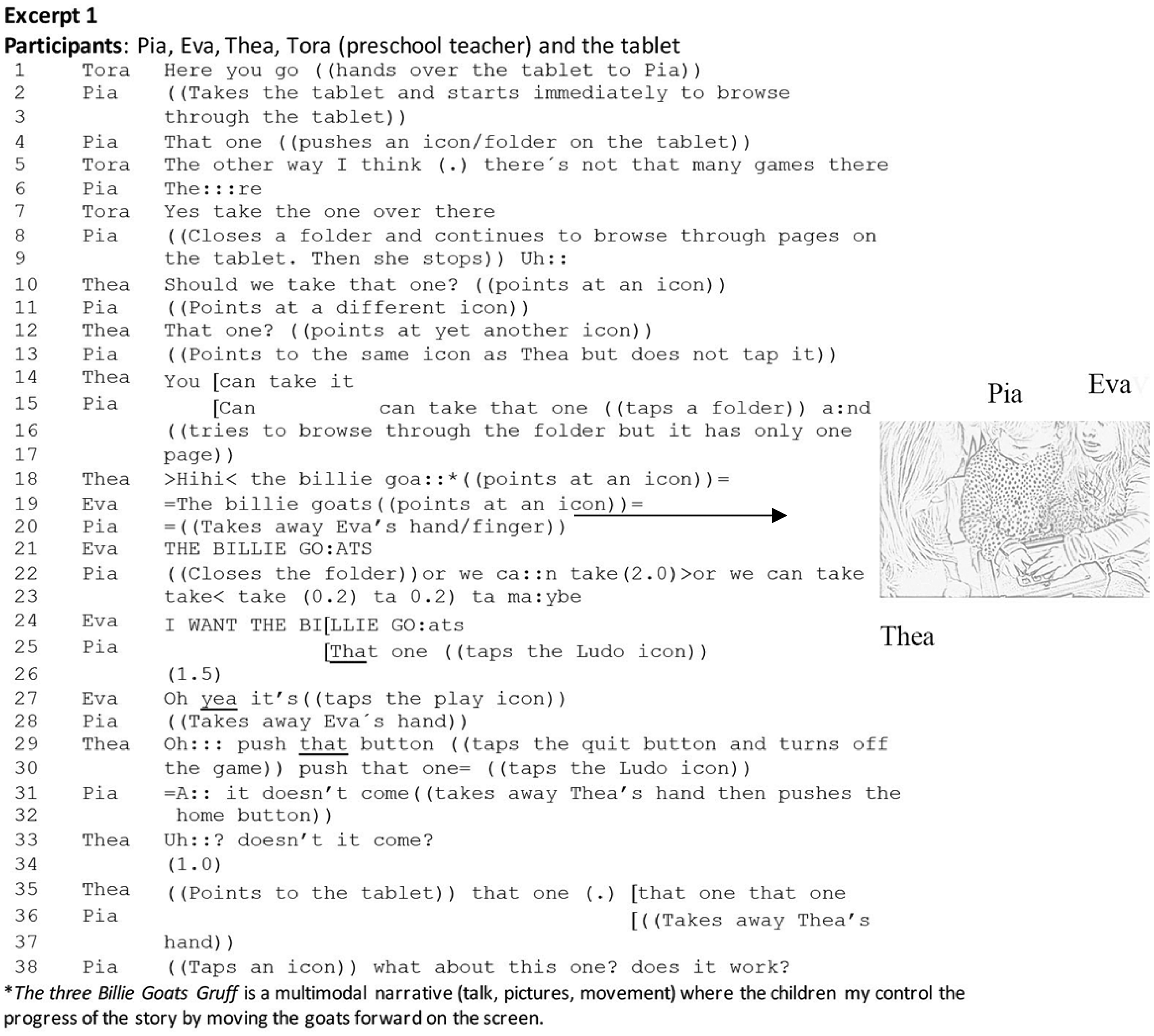
When Tora hands over the tablet to Pia (line 1) and tells her where to find the games she also positions her as the owner and categorizes the upcoming activities as playing games (lines 2-7). As the owner, Pia has the right to decide how to use the tablet until an adult tells her otherwise. Pia enters this position, both by holding the tablet with both hands, which can be seen as an embodied statement, and by browsing through the applications without protest.
Pia opens a folder consisting of several icons (line 9) and Thea immediately points to an icon and asks, “Should we take that one?” (line 10). Using “we”, Thea marks that finding a game is seen as a joint activity where she positions herself as a co-participant. Pia does not say anything but points at various icons, thereby displaying disagreement with Thea’s suggestion. Thea does not protest, instead she suggests another icon (line 12). However, Pia chooses to open a folder instead (line 15). Here we see that Thea changes strategy, “you can take it” (line 14). Changing from “we” to “you”, displaying that she acknowledges Pia as the owner and the one who may decide what game to play. Pia has not told anyone what she is looking for but demonstrates who “owns” the tablet while Thea takes the position of co-participant. As a co-participant, Thea suggests which icon to tap, but she does not claim the right to decide. Rather, Thea participates by pointing and asking if particular icons could be possible choices. Moreover, the distribution of positions is displayed through embodied and verbal actions.
Pia opens a folder and several icons appear on the screen (line 15). As a material actor, the tablet does not define a rigid use and therefore it can be understood as having a weak script, offering a high degree of flexibility. While Pia looks at the applications, Thea smiles and laughingly says “the Billie go:::*” while pointing at the icon (line 18). This could clearly be heard as a suggestion for which application to choose, where Eva aligns with Thea and immediately says “The Billie goats” as she reaches out to the icon with her index finger (line 19). Pia immediately takes Eva’s hand gently away (line 20), an embodied stance where she marks who owns and decides what happens on the tablet. Eva tries another strategy, as she raises her voice and shouts “THE BILLIE GO:ATS” (line 21). Like Thea, Eva inhabits the position of co-participant, which here means that she can suggest what games to play, but she is not the one who gets to decide. However, she tries to influence the choice by trying to tap the icon and raising her voice. Pia does not have to take this into account, as there are no objections when Pia brushes Eva’s hand away.
Eva once more suggests in a loud voice “THE BILLIE GO:ATS”, while Pia continues to search for an alternative, “or we can take (2.0) >or we can take take<” (lines 22-23). The search for an alternative game can be seen as taking a stance against Eva’s suggestions while at the same time it indicates the obligation the owner has to choose a game. During this sequence, Pia holds the tablet openly on her lap signifying that she is open for engagement from her peers and uses the term “we”, which marks the search for a game with joint activity, positioning the girls as co-participants, with herself still being in control. Eva does not accept that Pia refuses to follow her suggestions and says “I WANT THE BILLIE GO:ats” (line 24). The recycling of her wish is slightly changed, and she now displays a clear personal stance, “I WANT”. Pia does not act on Eva’s stance and overlapping her talk when she chooses to open Ludo. When Eva sees the application that has been chosen, she lowers her voice, “GO:ats” (line 24) before displaying that she acknowledges the game and reaches out to tap the play button on the screen (line 27). Once again, Pia marks her position as the owner of the tablet by carefully taking away Eva’s hand. When the Ludo application has been opened, the script offers two possible actions, start or quit. Now, Thea taps the quit button, which brings them back to the desktop and several icons appear on the screen (line 29), she immediately repairs this action by tapping the Ludo icon and this takes them back to the game (line 30). Pia does not manage to stop Thea’s activity on the tablet, but lifts her hand away from the screen before she says that “it doesn’t come” and taps the home button and closes the game, an option offered by the tablet that is only available to the owner. Once more, Thea moves her hand towards the icons on the screen while she says “that one (.) that one that one” (line 35), but this time Pia takes her hand and lifts it away from the tablet before she taps the icon. Once again, it can be seen how Pia marks her position as the one who controls the tablet by mainly using her body.
The sociomaterial organization of the tablet activity involves the distribution and enactment of different positions that involve certain rights, as well as obligations. The tablet has many applications the child can choose, and therefore does not define a rigid use. The tablet can hence be understood as having a weak script, offering a high degree of flexibility. Pia marks her right to decide and control the tablet activity with her body by gently removing the co-participant’s hands and fingers. However, it could be argued that the weak script contributes to stronger social control and governing of the literacy activity. In short, the tablet is enacted as a holder of possibilities even though these are not equally distributed. As the owner, Pia uses both linguistic and embodied resources to mark who is in charge of the tablet. Through talking out loud, holding the tablet with both hands, moving away fingers and keeping it on her knee, Pia is able to decide who gets access to the screen while also controlling the home button. Moreover, Pia does not need to negotiate or assert her position as the owner verbally; rather, Thea and Eva confirm her position and right to decide what to do. The well-known frame for the situation, the waiting-list procedure, contributes to the mutual enactment of the owner position.
Enacting multiple activities
Using tablets in ECEC is a sociomaterial literacy practice in which the participants negotiate access and thereby possibilities and obligations to act. When a child is formally positioned as the owner by the ECEC teachers and participating children, the conditions to act radically change. In the first example, we saw how the owner both made the tablet visibly accessible to the others and simultaneously restricted their possibilities to act by using embodied strategies. The enactment of the tablet was closely related to a weak script with many opportunities which in fact strengthen the position of the owner.
In our data, when the children chose a particular application, like a game, we saw that the tablet in itself had a weak script. However, applications have scripts with varying degrees of strength. In the next example we direct our attention to what happened to the organization of the activity when the children used “The Three Billie Goats Gruff” application, but did not follow the script. As a player, you can place your finger on the goats and move them forward along a path. At particular places, the goats stop, and one can hear the narrator tell the well-known story. Moving the goats forward is the only way to complete the story. The player can tap various icons, such as birds, cones and mushrooms, which make sounds and movements, but have no impact on the story. The script of this application is strong as it is narratively driven and there is only one way of moving the story forward on the tablet. We explore how the tablet activities unfold as three boys enter the activity.
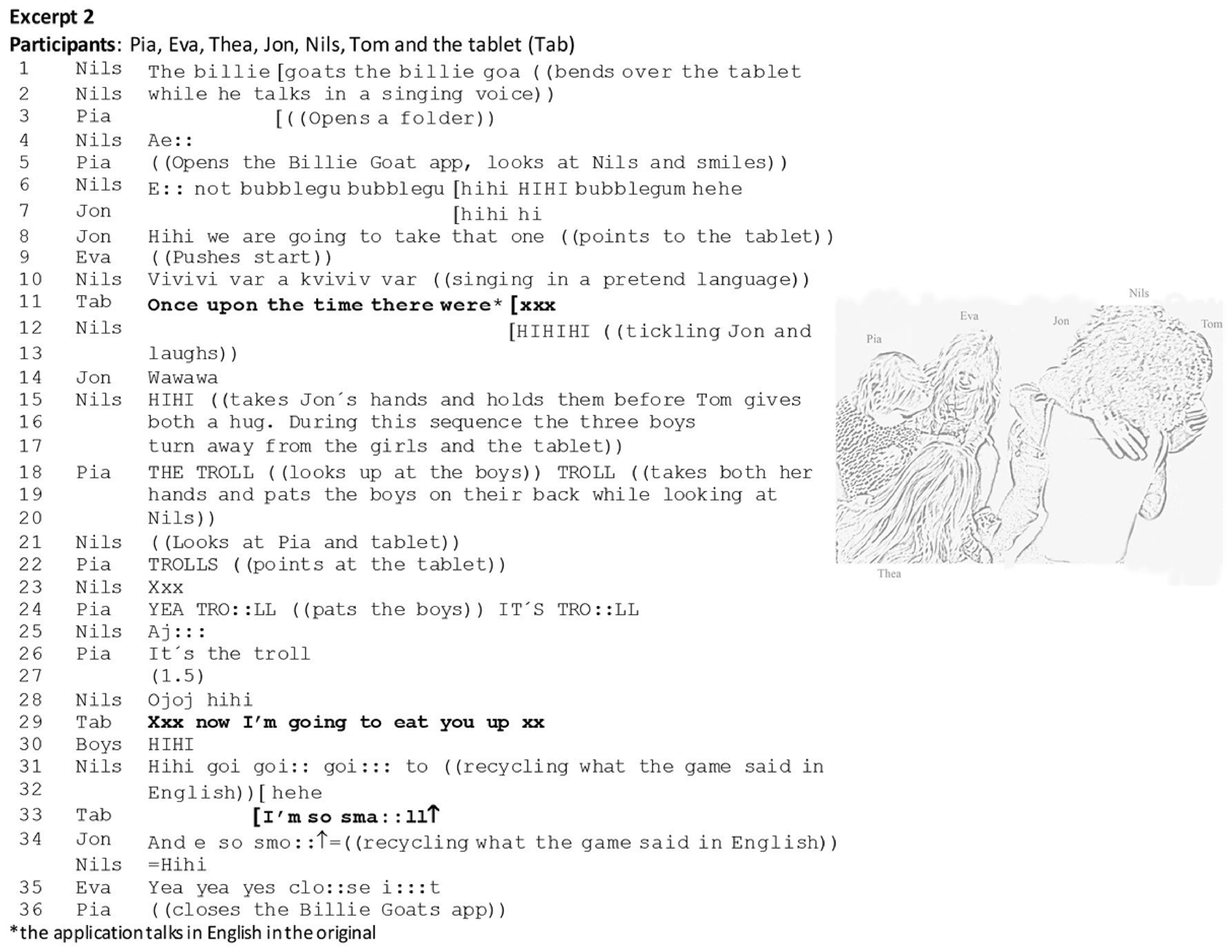
This excerpt starts with Nils talking in a singing voice “The Billie Goats the Billie Goa” (line 1) which is followed by Pia who opens the folder where the Billie Goats app is located and taps the icon as she looks at Nils and smiles. Her choice, gaze and smile can be seen as an attempt to align herself with Nils. However, Nils does not respond to Pia but directs his attention towards Jon and starts playing with words, where Jon aligns with joint laughter (lines 6-7). The boys create an activity frame in which Pia and the other girls are positioned as spectators; however, the girls also position themselves as spectators of the boys’ non-digital play. Thus, it could be argued that a competitive activity frame is being enacted, where the tablet activity seems to be enacted as second to the non-digital play that the boys engage in. When the application opens, Jon displays that he knows what to do next by pointing at the start button and saying what to do (line 8). Eva taps it and the application starts; however, the boys are preoccupied with tickling each other and laughing, not focusing on Pia and the tablet (lines 10-17). In an attempt to draw the boys from the non-digital activity back to the tablet activity, Pia shouts “THE TROLL” while looking at the boys (line 18). In our data, the appearance of the troll was usually considered the peak of the narrative. When neither of the boys reacts to her invitation, she lets go of the tablet with her hands, balancing it on her lap, while she uses both hands to pat the boys’ backs as she looks at them. Nils looks at the tablet and at Pia, who once more shouts “TROLLS” as she points to the tablet, indicating where the relevant action takes place (lines 21-22). Neither of the boys reacts and Pia once more pats them on their backs as she shouts “YEA TRO::LL” (line 24).
When Pia shouts that the troll has appeared, it may be seen as an invitation to become a co-participant and to access an attractive activity on the tablet. However, the boys ignore her invitation and at the same time reframe the Billie Goats Gruff activity. During this sequence, the application runs and the narrator can be heard telling the story about the “The Billie Goats Gruff”. The boys do not seem to pay attention to what is happening on the tablet, but when the narrator says “xxx I’m going to eat you up” (line 29), they look at each other and laugh. Nils in a pretend English recycles what was originally said. The narrator continues the story (line 34), where Jon, like Nils, picks up on the narrator’s previous utterance and recycles both the words and the intonation (lines 35). The boys engage with the application through playing with the English language and the dialogue in “The Billie Goats Gruff”. It could be argued that the narrator in the application tells a story that the boys turn into language play that has relevance for them in terms of being something they find funny. Lafton (2015) found that merely the sound coming from a computer in an ECEC setting is an actor that gets others to act.
The distribution of positions is an important part of the sociomaterial organization of tablet activities. Pia is still the owner, holding the tablet in both her hands and being the one who controls which application to open. Nils takes the position of a co-participant when he suggests what game to play and Pia accepts his suggestion. However, when Pia starts the application, she directs her attention to the two boys who are in front of her while they laugh and recycle parts of the story being told. Even though Pia tries to get their attention by highlighting a critical moment in the story, she does not succeed in establishing a joint focus of attention. Being the owner of the tablet does not guarantee co-participation in the activities taking place. Rather, the boys reframe the activity by turning the tablet game into a language game. Through their embodied and linguistic stances, they positioned the girls as spectators. Despite the fact that the Billie Goats Gruff application has a rather strong script, it is here demonstrated how the script is used when the story is “lifted out” of the tablet. This shows that using a tablet is not merely about using a tool, as what happens in sociomaterial assemblages is unpredictable and essentially indeterminate (Law and Mol, 2008).
Enacting moral order
The position one inhabits in tablet activities has consequences for which actions are accepted and how these are assumed to be accomplished. We have seen how enactments of digital tablet activities are related to the script for the tablet and applications, in addition to the children. In the next example, we direct our attention to what the organization of a literacy activity looks like when the participants have a joint focus of attention and the application has a weak script.
The “Albert Åberg” application is what can be called a game without measurable goals, which means that users are flexible with regard to how to play it (Juul, 2010). As a user, you can go into different rooms in Albert’s apartment and take part in various activities in no particular order, as opposed to the narratively driven “The Billie Goats Gruff”. In the living room you can vacuum dust bunnies, and in the kitchen you can make stew. The next excerpt is from the kitchen where the user is presented with a cutting board and six ingredients to choose from, which are to be cut and then mixed into the stew. This is done by tapping on an ingredient and then swiping it in order to cut it. When the stew is finished the user serves it in a bowl, moving the stew from the saucepan to the dish. The script is both strong, as it does not allow the player to act in other ways, and weak, as it does not run on time or have built-in “rights” and “wrongs” regarding what, or how many, ingredients one needs to finish the stew.
The next episode takes place 16 minutes after Pia has entered the position of the owner. Jon, Nils, Tom and Eva surround the tablet, while Thea has left the scene. In the minutes leading up to Excerpt 3 Pia goes into the kitchen and has made stew by choosing ingredients while the rest of the children have been watching her. When the stew is finished, she goes back to the kitchen and the cutting board.
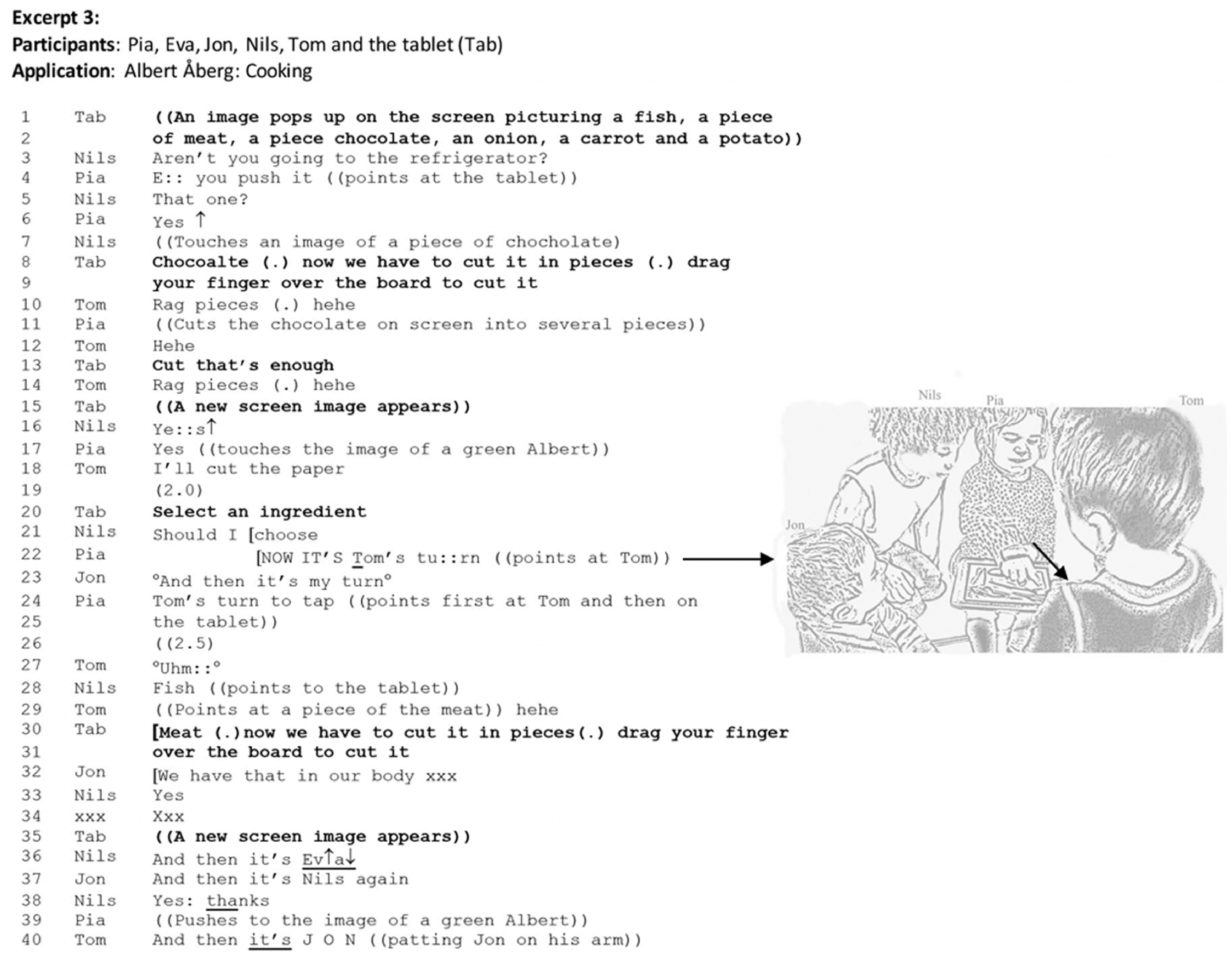
An image of a cutting board covered with six different ingredients appears. Pia immediately turns to Nils while she points at the tablet and tells him to choose one of them (lines 4-6). Nils suggests the chocolate, which is approved by Pia. After Nils has tapped the chocolate icon, the tablet tells the participants what they have chosen and explains what to do next (lines 8 and 9). Pia follows these instructions and cuts the chocolate into pieces, then she chooses to add one more ingredient (line 17). When the application has told them to choose again, Nils asks if he is allowed to choose another ingredient (line 21), but this time Pia raises her voice while pointing at Tom and says it is his “turn” to choose next (line 22). The overlap as well as using the concept of “turn” indicates that getting to choose and touch the screen is not a random act, nor is it restricted to one particular person. Taking turns and queueing is a recurring practice in ECEC and it could be argued that this practice is made relevant here. This can be seen by the fact that Jon immediately calls for the next turn (line 23) and that Pia repeats that it is Tom´s turn to tap as she points at him and then at the tablet (line 24). Tom gets to choose the ingredient while his co-participants make suggestions and comment on his choice. When Tom has chosen, and cut the vegetable, a question appears on the screen where they have the opportunity to either finalize the cooking or choose more ingredients. Nils reacts to this and says “and now it’s
During this sequence, the tablet is visually and audibly accessible to all the participants. It can also be seen how a moral order is established through using a well-known turn-taking practice where the co-participants have to queue and are allowed to touch the screen one by one. The enactment of a turn-taking structure not only turns the digital literacy activity into an embodied performance, but also generates expectations of how to participate. Pia has taken control of the activity and the other children surrounding the tablet are all enacted as co-participants. It is of importance that the Albert Åberg application is player-driven in the sense that time does not matter; therefore, the script makes it possible to distribute the physical tablet from hand to hand without disturbing the activity on the screen while the user also makes decisions. Wohlwend (2015) suggests that by engaging in an open-ended app, such as Albert Åberg, collaborative play can be facilitated that promotes “shared decision-making and negotiation among players” (p. 160). In short, the assemblage of a rather weak and open script, the turn-taking principle and the participants enact a moral order that guides the organization of the digital literacy activity.
Digital literacy as dynamic, flexible and multiple
In the analysis we have approached digital literacy as comprising cultural practices and explored this through the lens of participant positions, or more precisely, we have looked at how participant positions were enacted and the consequences this had for the performance of the digital literacy activities. According to Ljung-Djärf (2008), participant positions are dynamic, and potentially multiple, as they are continuously defined and transformed in relation to each other. By focusing on participation and positioning we have shown how the enactment of digital literacy practices within an assemblage consisting of the same human and non-human actors, only differing in the applications, was dynamic, flexible and multiple. Thus, the owner, co-participant and spectator positions were all negotiated and distributed in an assemblage, and what part the tablet, the application, or the different children played in a given assemblage was not predetermined but could be subject to change, as has been shown, over the course of a twenty-minute turn.
Our analysis points out that when positioned as the owner, Pia could decide what and when to use particular applications, as well as who and when someone was allowed to touch the screen. However, inhabiting the position of owner does not guarantee being in control or being able to establish a joint focus of attention. In the second excerpt we saw that when there was no longer a joint focus of attention, the activity frame(s) and the distribution of positions changed. The boys directed their attention to how the story was told, and not merely to the screen. During this process, who had their hands on the tablet was irrelevant as the girls were both positioned, and positioned themselves, as spectators of a non-digital activity, even though the narrator’s voice from the application was recycled.
As Fenwick, Edwards, and Sawchuk (2015: 2) argue, a sociomaterial perspective offers resources for systematically considering both the patterns and unpredictability that make digital literacy activities possible. Taking a sociomaterial perspective entails that we consider digital technologies, in this case tablets and applications, as relational actors within literacy activities. The tablet’s materiality makes it mobile; it is possible to place it on one’s lap, or hand it over to someone else, and has consequences for how it may or may not be used in joint activities. In the extracts, the tablet was located on the owner’s lap, it was visible and could be touched by the co-participants at the same time, rendering it possible to control the co-participants’ actions on the screen (Excerpts 1 and 3). In addition to the materiality, tablet activities involve applications and we see in our data how different applications embedded with different scripts had consequences for the enactment of the assemblage. “The Billie Goats Gruff” application consists of a story where the participants follow three goats on their adventure over a bridge, it is unidirectional and there are few chances to “leave the path”, thus the script of the application is strong. However, we have seen how the story was enacted in a way whereby the screen and the animations did not matter, rather the narrator’s voice became an important part of the assemblage. The “Albert” application (Excerpt 3), on the other hand, has an open-ended and weaker script where the users can wander into different rooms and engage in different activities, such as making dinner or vacuuming. The script did not entail a focus on goals, nor the time used, in effect facilitating various uses, such as the collaborative aspect which generated different positions and rules to sustain the digital literacy activity. However, it is interesting how a moral order relating to turn-taking and acting on the screen was established and works as a resource with regard to the distribution of participant positions.
Sørenssen and Franck (2021) argue that employing a sociomaterial perspective can aid scholars and practitioners in exploring and expanding their understanding of how “the child” is enacted in different assemblages. We want to add to this and suggest that such a perspective can also aid in expanding the understanding of what digital literacy practices can be when enacted in different assemblages in an ECEC setting. In the ECEC settings where our fieldwork was carried out, the institutional procedure was that one child had ownership over the tablet in a given time slot. What we see in our material is that this was rarely the case, the child positioned as the owner was for the most part surrounded by other children. In light of our data, applications with weaker scripts and the tablet’s touch screen especially allow for several fingers to act simultaneously, leading us to agree with Wohlwend (2015) and her term “collaborative literary practices”; what might seem as chaotic and messy to outsiders observing young children’s play with tablets is actually collaborative literacy play (see also Danby et al., 2018). An implication for practitioners might be to expand the institutional procedure regarding tablet use in ECEC. Instead of seeing tablet use as a solo endeavour, it could be fruitful to see it as a group activity where the human and non-human contribute to the enactment of digital literacy activities.
As one of the slogans within STS is that “it could have been otherwise” (Woolgar and Lezaun, 2013), this study has its limitations as it does not exhaustively look at what digital literacy activities have become once and for all in ECEC, as other studies might find other usages and other sociomaterial organizations of tablet use. However, we have explored the enactment of positioning within one twenty-minute turn which we found to be characteristic of our data in the ECEC settings where we carried out our fieldwork. For future studies it would be interesting to see how positions might be negotiated while especially focusing on the consequences different types of scripts and social organization of the activities might have. Thus, we see a need for more empirical research focusing on the enactment of digital literacy activities in ECEC settings.
