




Abstract
This paper examines the role of visual representations in shaping public perceptions and policies regarding Venezuelan and transcontinental migration in Colombia, with a focus on two key border areas: Norte de Santander (the Colombia-Venezuela border) and the so-called “Darién Gap” (the Colombia-Panama border). By analyzing images and narratives published by El Espectador between 2019 and 2024, the research examines how bodies and places are visually represented to shape public perception, policy responses, and migration governance. The analysis reveals two dominant themes in the media’s portrayal of migration: (1) The production of migrant bodies – Migrants are frequently depicted as massified, vulnerable, and dehumanized subjects. Venezuelan women, in particular, are portrayed through a dual lens: as victims of sexual violence and as reproductive subjects, reinforcing narratives of crisis. The bodies of migrants in the Darién are often visually merged with the landscape, emphasizing suffering, exhaustion, and precarity. (2) The production of spaces – The border regions are framed as zones of disorder and danger. The trochas (irregular crossings) in Norte de Santander are depicted as lawless, reinforcing associations with crime, smuggling, and state absence. Meanwhile, the Darién Gap is visualized as a treacherous jungle where nature itself becomes an obstacle, justifying increased border control and humanitarian interventions. By applying multimodal discourse analysis, the study demonstrates how visual representations produce emotions— such as fear, pity, or urgency—that influence both public opinion and policy decisions. For this reason, we propose the concept of “visual economy of migration” to understand how visual representations shape the shared meaning of the migrant crisis in Colombia, while entangling readers’ fears and concerns with broader issues.
Introduction
Over the past 8 years, Colombia has shifted from being a country of emigration to becoming the destination for more than two million Venezuelans fleeing their country (Rossiasco and De Narváez, 2023). At the same time, it has become a key transit point, as the so-called Darién Gap has turned into a route toward the Global North for various nationalities. These transformations invite us to examine how migration to and through Colombia has been represented in the national media.
In this paper, we explore how visual representations — including photographs, infographics, and data — operate as technologies that produce intense affects and reproduce hegemonic narratives of migration as a “crisis,” focusing on the Colombia-Venezuela and Colombia-Panamá borders. We analyze two specific cases with different temporalities: (a) the portrayal of Venezuelans as masses moving through dangerous territories, alongside the construction of the Venezuelan woman as a vulnerable and reproductive subject; and (b) the framing of the Darién as “the most dangerous migratory route,” which has become a scenario for humanitarian intervention and, more recently, a perceived national security threat for regional governments since 2021 (Garcés-Amaya et al., 2025; Álvarez and Cielo, 2023).
Our analysis builds on the theoretical framework of Visual Governance (Massari, 2026), which highlights images as active instruments that shape public emotions, policy responses, and the symbolic ordering of migration. By introducing the concept of a “visual economy of migration,” we extend this framework to show how visual regimes function not only as representational devices but also as governing technologies that actively construct migration as a “crisis.” Through this lens, images circulate and reinforce meanings that legitimize intervention and violence, framing migration as an exceptional threat requiring urgent control. The power of images thus sustains a symbolic order underlying contemporary migration regimes. Romano and Varela (2023) describe this as a “necropolitical fantasy” of the humanitarian industry, which seeks to ensure safe and orderly movement through disciplinary dispositifs. By conceptualizing the “visual economy of migration,” we reveal how images do not merely depict migration but participate in governing it, reinforcing crisis narratives and justifying interventionist policies.
While previous analyses on contexts such as the US-Mexico border (Aquino, 2011; De Genova, 2013; De León, 2015), Lampedusa (Cuttitta, 2015; Dines et al., 2024), and Ceuta and Melilla (Fernández, 2020) have examined the production of migration as crisis, and works by Stefoni et al. (2018), Domenech (2020), and Varela and Gabrielli (2021) have stressed the importance of South-South mobilities, we find that the shifts in Colombia’s role — from sender to receiver and transit country — remain underexplored.
To address this gap, we conduct a multimodal discourse analysis of photographs and narratives published by El Espectador about the Colombia-Venezuela and Colombia-Panama borders between 2019 and 2024. We focus on how the notion of a “migrant crisis” relies on the construction of specific bodies crossing territorial borders and occupying spaces marked as dangerous and beyond the state’s organizing power. In what follows, we present our conceptual framework and elaborate our understanding of the “visual economy of migration,” followed by our methodology, corpus construction, and analysis. We conclude by discussing the broader implications of our findings.
An approach to the visual economy of migration
This analysis draws on Poole’s (1997) concept of a “visual economy” to examine how images shape representations of the Andes in colonial and postcolonial contexts, highlighting their role in constructing difference. We extend this concept to migration, exploring how visual production and circulation create symbolic orders that shape identities, social boundaries, and power relations (Massari, 2021, 2026).
We approach the concept of production in at least two dimensions. First, from a political economy perspective, it refers to value as a social relation; contemporary neoliberal societies are driven by spectacle, where interpersonal relations are increasingly mediated or replaced by images and representations (Poole, 1997). Second, we seek to understand the role of media as sites of power-knowledge in visual production, emphasizing the rigorous control over meanings and the codification of public language (Kress and van Leeuwen, 2006: 29).
We propose the concept of “visual economy of migration” as a hinge to connect the exercise of symbolic power and ground it as an expression of migration governance. Governance shapes language, discourses, representations, and emotions, establishing a framework of meaning to manage migration. In doing so, it reproduces symbolic violence (Bourdieu, 1970). In this sense, images do not merely illustrate migration but actively shape semiotic landscapes and engage viewers/readers in constructing migrant subjectivities (Kress and Van Leeuwen, 2006).
Additionally, the visual economy of migration not only frames migrants as humanitarian subjects or security threats but also participates in racialization processes and the production of otherness that sustain xenophobic sentiments. This dynamic reflects broader global patterns in which visuals reinforce colonial hierarchies and legitimize exclusion (Andersson, 2014; Massari, 2021). By focusing on the Colombian and Panamanian contexts, we aim to localize and complicate this framework, highlighting South-South dynamics often overshadowed by North-centric analyses.
In this regard, the literature on migration governance focuses on the production of political rationalities for managing migration (Cvajner et al., 2018) invites us to consider the actors, practices, discourses, and power relations that govern mobility and shape subjectivities (De Genova, 2019; Hess, 2012). Among these actors, we include mass media, which has played a prominent role in shaping how audiences define and perceive migration. Media is particularly relevant for this study because, as Massari (2026: 7) reminds us: “communication networks and media play a central role in the exercise of power in the digital age by shaping public opinion and social movements.”
One of the issues that has gained significant attention in recent literature, and which we examine in relation to migration governance, is the production of a “crisis”—specifically, the discourses that naturalize migration as a crisis and perpetuate forms of panic (Cantat et al., 2023). In this context, critical studies on the coverage of refugees’ and migrants’ arrival on European shores in 2015 highlighted how the media played a key role in constructing the so-called “refugee/migration crisis.” These media narratives intertwined concepts of “invasion,” “threat,” “suffering,” and emotions such as fear, anger, and pity, framing migration as a security emergency (Chouliaraki and Stupart, 2025; Georgiou and Zaborowski, 2017; Kosho, 2016). Migration was portrayed as “a sudden, shocking, and unmanageable event that places ‘us’ in Europe under pressure” (Chouliaraki and Georgiou, 2020). As a result, the role of the media extended beyond fostering anti-immigrant sentiments; it prompted restrictive shifts in national and regional migration policies (Kosho, 2016).
From this approach, we are interested in engaging with De Genova’s (2013) proposal of the “border spectacle” to highlight the operation of power that relies on selective visibility. De Genova argues that it is not a specific practice but a production of a scene of crisis, which portrays the nation-state as vulnerable to the incoming movement of people while concealing an obscene necessity. For him, the obscene is the necessary recruitment of undocumented workers for the labour market under conditions of illegality and deportability. In this spectacle, securitization policies deployed by the state produce bodies as disposable: they are captured to be killed, expelled, or included in the productive sphere by subjugation. However, De Genova’s analysis is situated on the Mediterranean and US-Mexico border, transit spaces for South-North migrations. What does the border spectacle look like in spaces of South-South migration? What is concealed as the obscene when policies do not seek to prevent entrance but rather to facilitate movement and protect people on the move? These questions, left unanswered, will be addressed in our analysis.
Methodology
We draw on the multimodal method of discourse analysis (Kress and van Leeuwen, 2006; Kress, 2003), which allows us to discern the roles, social relations, and characteristics attributed to what is represented. Additionally, it enables us to trace the narrative representations and interactive meanings embedded in visual configurations within a broader semiotic landscape (Kress and van Leeuwen, 2006). This framework facilitates connections with the circulating narratives regarding the “migrant crisis” and its linkages to a broader migration governance agenda.
Moreover, we draw on Sarah Pink’s (2007, 2012) contributions to visual methodologies, which emphasize the sensory and affective dimensions of images and the importance of situating visual data within lived, embodied experiences. Pink’s approach underscores that images are not passive reflections of reality but active constituents of social life and meaning-making processes. This perspective allows us to understand the visual representations of migration as performative acts that mobilize emotions and shape political and social responses.
Our corpus comprised news reports from the national newspaper El Espectador. We selected El Espectador because it is the oldest newspaper in Colombia, with a broad national circulation and a reputation as an independent media outlet. Its publications include photojournalism, chronicles, and news reports that were part of our research interests. We conducted an initial search using the keywords “Darién”, “Necoclí”, “Frontera Norte de Santander”, “Cúcuta”, and “Crisis Migratoria con Venezuela”. After filtering the documents, we obtained: (1) 102 news articles related to Darien between January 2020 and October 2024. In this case, the dataset includes 118 pictures and 2 photoreports. (2) 79 news articles mentioned Cúcuta and the metropolitan area between January 2019 and 2022. A total of 111 pictures and 6 videos were included in the reports.
We identified two emerging themes: the production of bodies and the production of spaces, both serving as signifiers of the “migrant crisis”. According to Kress and Van Leeuwen (2006), and Nikielska-Sekula and Desille (2021), visual resources often depict relationships between people, places, and things. These elements, referred to by the authors as “participants,” are central to the visual representation of meaning. For people, depiction often conveys roles and relationships. For example, gaze, posture, or framing can suggest power dynamics, emotional states, or interactions between the depicted individuals and the viewer. Locations or settings provide essential context and meaning, grounding the image in a recognisable environment and establishing the relationship between people and their surroundings.
We implemented a three-stage analytical process to explore the visual semiotic mode and analyse how images build meaning, enabling more complex communication. First, we developed a matrix to systematize the news and describe the content of the photos and narratives. In this inductive exercise, we focused on what appears in the images and how they are presented.
Categorizations. Source: own elaboration based on Kress, G., & Van Leeuwen, T. (2006). Reading Images: The Grammar of Visual Design (2nd ed.). Routledge.
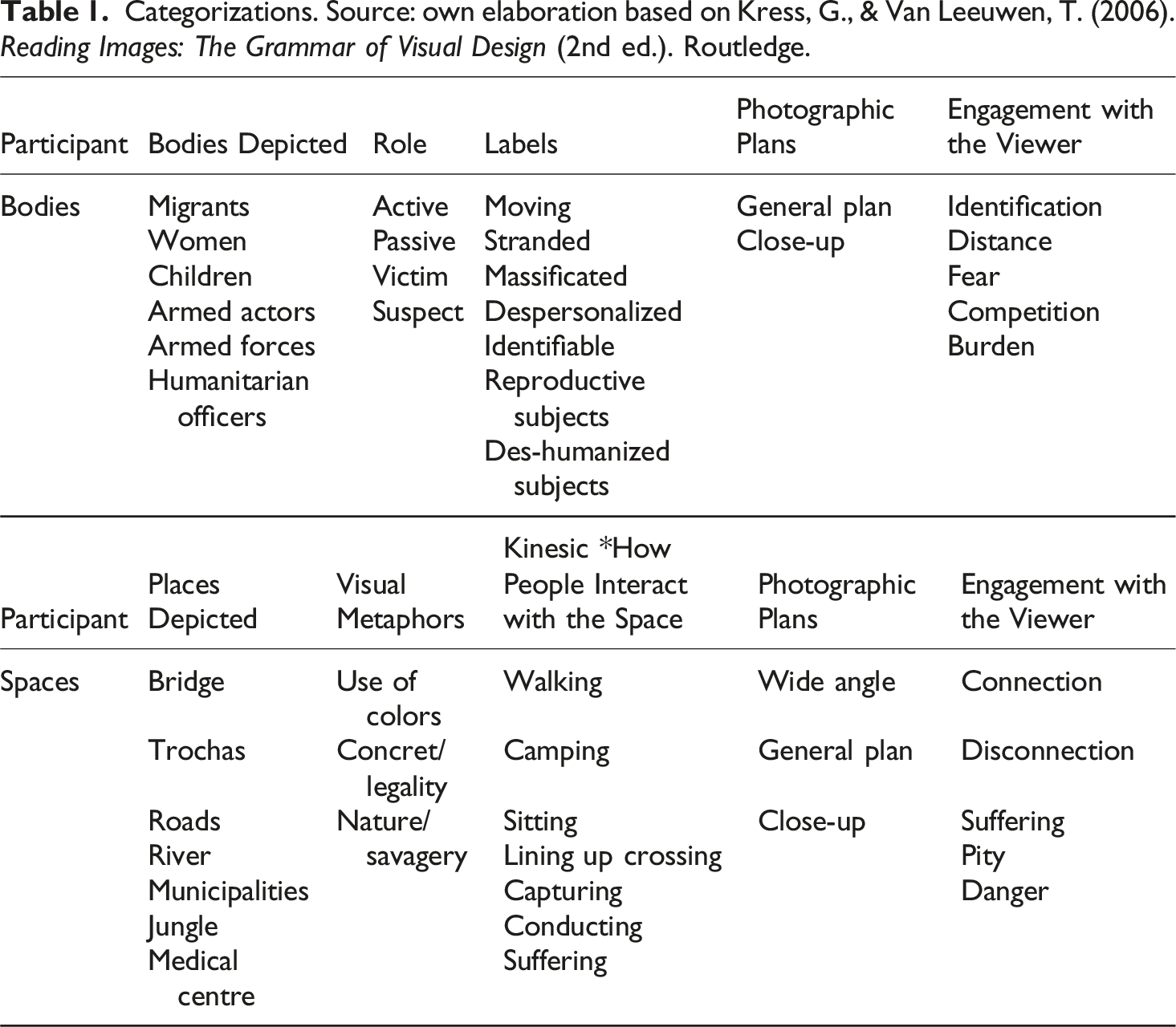
In the final stage, we examined the intersemiotic relationships between images, headlines, textual narratives, data visualizations, and captions to assess how visual representations complement or contrast with other semiotic modes. This intertextual approach allowed us to explore how meaning is co-constructed across different modes, shaping both affective responses and policy rationalities (Kress and van Leeuwen, 2006; O’Halloran, 2004). Additionally, we analyzed changes over time, identifying shifts in representations and discourse to understand how the media has shaped the narrative of migration as a crisis.
Context of two “crises”
Cúcuta, the Bridges and the Colombia-Venezuelan Border
On August 15 2015, Maduro closed the Venezuelan side of the Simon Bolívar International Bridge that connects Villa del Rosario, part of the Cúcuta metropolitan area, with San Antonio del Táchira in Venezuela (Figure 1). This decision was taken for an indefinite time and without previous warning to the Colombian government after a shooting between Venezuelan soldiers and Colombian paramilitaries who attacked from the Colombian side (El Espectador, 2015a). On August 24, Colombians who lived in La Invasion, an informal settlement in San Antonio del Táchira, were deported or forcibly expelled to Colombia following the Operación Liberación del Pueblo, which began on August 20 under a state of emergency (El Espectador, 2015b). Venezuelan security forces carried out this operation in a place known because most of the people who lived there were Colombians who migrated undocumented during the 2000 decade, escaping the armed conflict and the persecution of armed forces, including the state security forces (Flórez Suárez, 2015; La Opinión, 2015). Norte de Santander border. Source: Interagency group on mixed migration flows (2024). Available at: https://www.r4v.info/es/document/gifmm-colombia-mapa-presencial-y-operacional-de-norte-de-santander-ene-may-2024.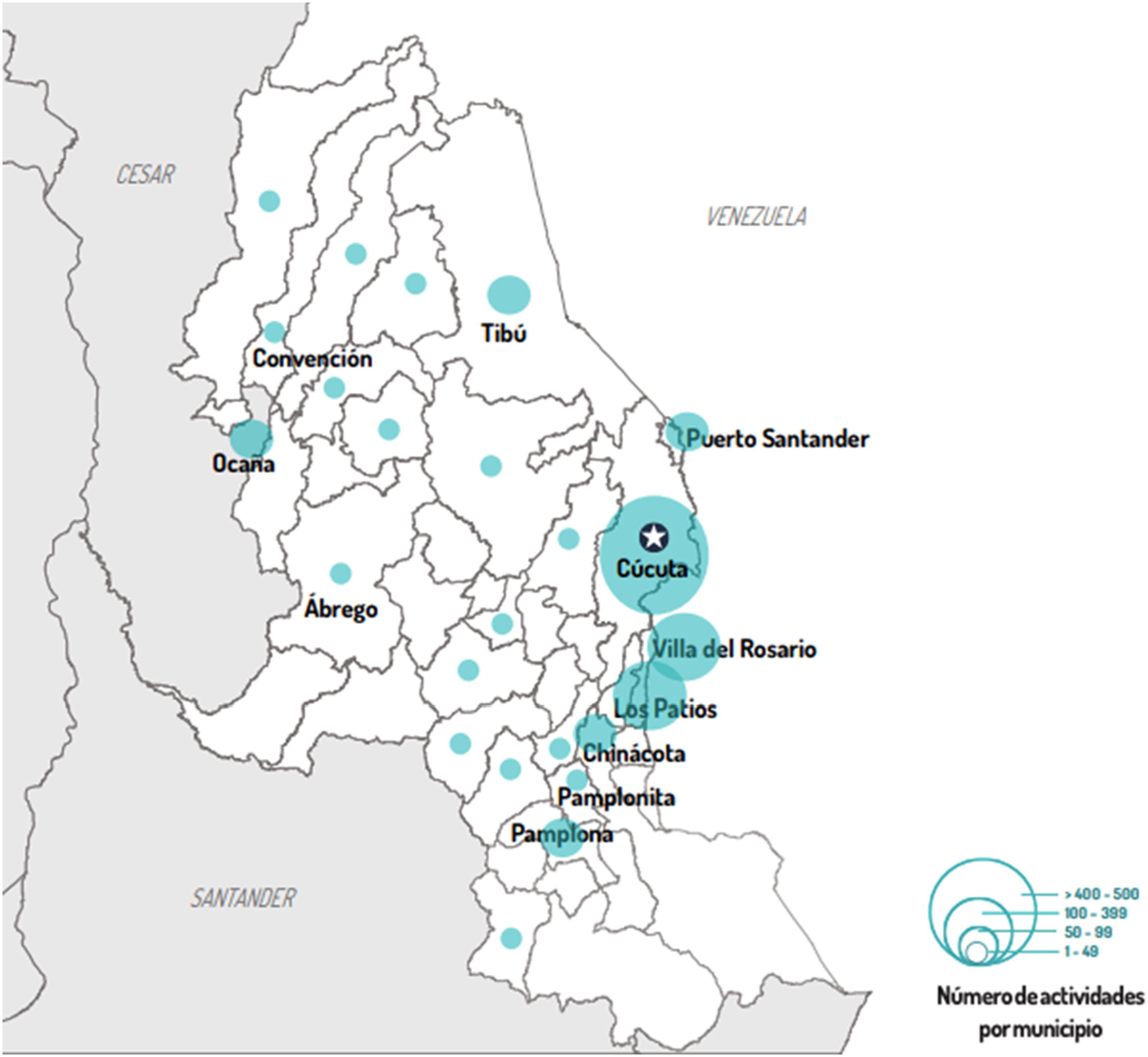
In 1 month, 19.952 people forcibly returned to Colombia, crossing the Táchira River (Comisión Interamericana de Derechos Humanos, 2015). On this date, a new vocabulary began to be used in media by the national government and in day-to-day conversations to describe what was unfolding at the border: “crisis”. Border crisis, migrant crisis or humanitarian crisis became interchangeable terms. Millions of Venezuelans and Colombian returnees crossed to Colombia in the following years, mainly entering Cúcuta via the trochas (R4V, 2021). According to the Inter-agency Coordination Platform for Refugees and Migrants from Venezuela 1 (R4V, 2024), since 2018, more than seven million people have fled Venezuela due to the economic and political situation, with an estimated 84% relocating to Latin America and the Caribbean. By May 2024, almost three million have relocated to Colombia, as registered by the website (R4V, 2024). Cúcuta and the metropolitan area played a vital role in this flow as it is the main entrance point for Venezuelans into Colombia. The border city became a host space for those who moved there attempting to reach other parts of the country, the American continent or Europe. This area became of great importance for the policy-makers in Bogotá and international agencies (many of them part of the United Nations) working to protect migrants’ human rights, with a special emphasis on women’s rights in response to different international declarations. 2
Darién, the jungle and the externalized border
The Darién has been constructed as a peripheral backdrop in the national narrative. Historical references to the area are limited, often portraying it as an impenetrable jungle. The term “gap” refers to the only break in the Pan-American Highway (Figure 2). Over time, it became the backdrop for a prolonged history of armed conflict and territorial dispossession, evolving into a strategic zone for armed groups, drug trafficking, agribusiness, and logging economies (CNMH, 2020). “Darién gap”. Source: International crisis group (2023) Available at: https://www.crisisgroup.org/es/latin-america-caribbean/andes/colombia-central-america/102-bottleneck-americas-crime-and-migration.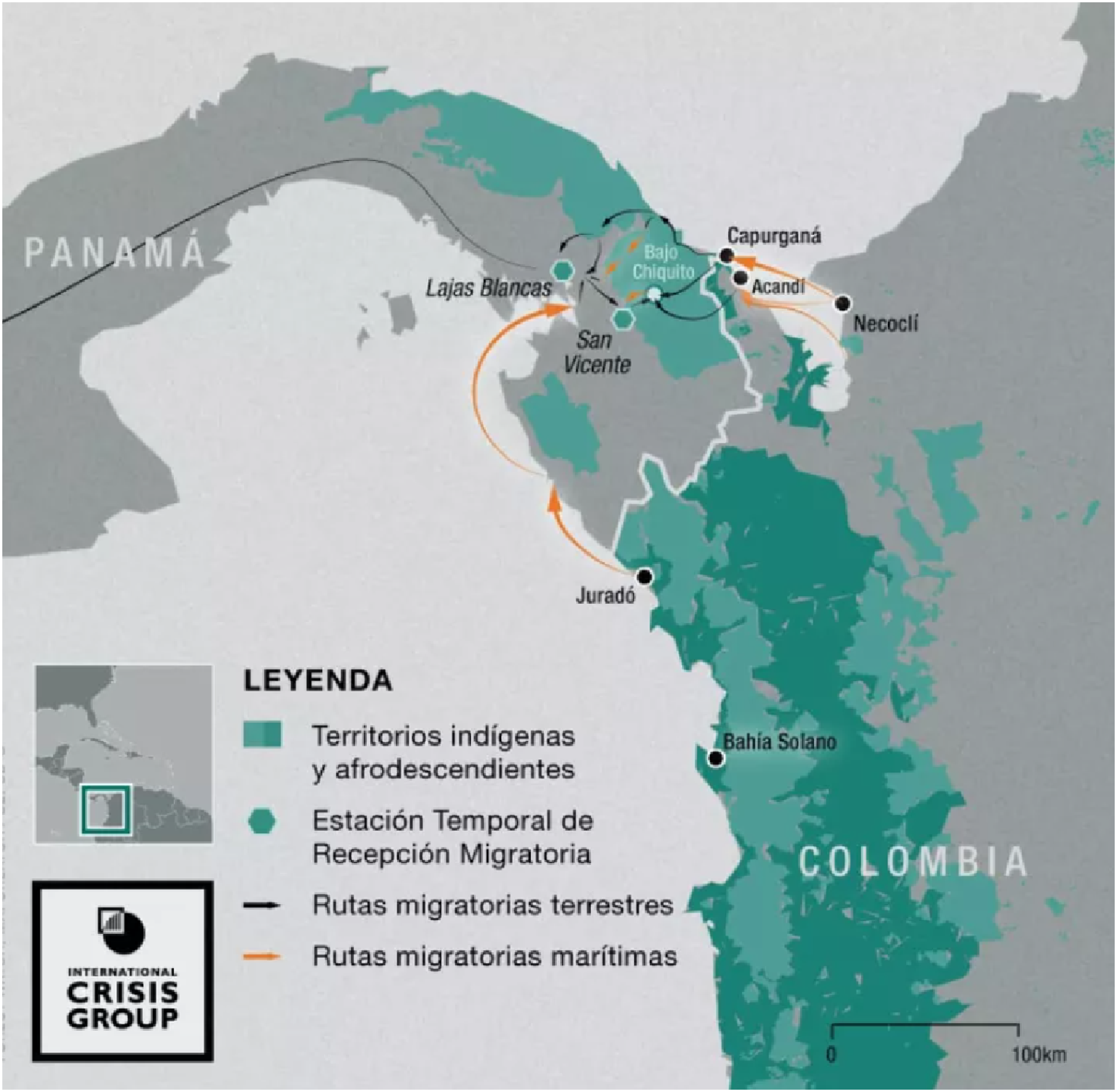
The recent public and political interest emerged when it was first mentioned in the media around 2017. This was prompted by a report from Interpol, revealing that “there are at least 25 illegal groups involved in migrant trafficking.” (El Espectador, 2017). This report coincided with an alert issued by the Panamanian National Border Service (SENAFRONT) in 2015–2016, noting an unusual increase in entries through the jungle and highlighting the transcontinental origins of the crossers. From then on, news headlines emphasised the danger in the migration routes and began using language denoting massification.
After borders were reopened with the lifting of COVID-19 restrictions in 2021, the media, governments, and humanitarian sector framed it as a “humanitarian crisis.” Pictures circulated by the press were decisive in shaping the idea of the Darién: From an unknown and remote territory to a place of suffering that witnessed an unusual presence of humanitarian agencies. Their actions focused on concrete health interventions, including medical check-ups, treatment for dehydration and digestive infections, and the provision of medication to prevent HIV infections and unwanted pregnancies resulting from reported sexual violence (El Espectador, 2022). Crossings increased exponentially between June and October 2022 (El Espectador, 2022b), highlighting significant changes in migration patterns. Venezuelans became the most represented nationality, replacing Haitians and Cubans. This shift led to discussions of the familiarisation of migration (Valera and Gabrielli, 2021), as the protagonism of the lone male migrant was replaced by an increase in the number of families. Reports of the Ombudsperson’s Office (2023) estimated that 20% of the migrants were minors and warned about a rise in the number of unaccompanied minors moving across the Darién. During this period, the beaches of Necoclí became a place known for the permanent presence of migrants who could not cross the Gulf of Urabá by boat: “There are around 3500 migrants on the beaches with tents” (El Espectador, 2023e).
From that point onward, the narrative surrounding the crossing openly criminalized it. The government of Panamá framed it as a threat to national security and hemispheric concern with the involvement of other actors (such as the government of the United States and the European Union) (Garcés-Amaya et al., 2025). The presence of SENAFRONT was reinforced, and significant investments from the United States (US) were made for training, weaponry, and biometric technology (El Espectador, 2024). More recently, the Panama and the US governments signed an agreement to facilitate repatriation flights and return migrants to Colombia (El Espectador, 2024b).
The production of bodies
The visual material simultaneously portrays migrant bodies as vulnerable and challenging. In this section, we focus on the representations and narratives that shape particular bodies and subjects, exploring how these contribute to constructing the idea of a “crisis.” We explore how the process of meaning-making develops, linking Venezuelan migration to large-scale movement and presenting it as a public issue. Within this context, migrant women are increasingly portrayed as key figures in the unfolding “crisis.”
Colombia-Venezuela border: Moving conglomerations
In February 2019, the news about Colombia reopening official border crossings in Norte de Santander was accompanied by the picture featured in Image 1. This image was featured eight more times in the news between 2019 and 2021 regarding the arrival of Venezuelans and Colombian returnees. It proved to be malleable: it featured in reports about government measures over bridge crossings, such as operating schedules and the permitted motives for entering Colombia (El Espectador, 2019, 2020a). It permanently appeared in the news during July and August 2020 when, due to COVID-19 and containment policies, many Venezuelans decided to return to their country (El Espectador, 2020b, 2020c, 2020d, 2020f, 2020g). The reports emphasized that the conditions imposed by the Venezuelan president, Nicolás Maduro, such as delimiting specific days and hours for the reception of Venezuelan nationals, were producing agglomerations and a high risk of COVID-19 dispersal in the bordering cities. The Colombian government’s measures to contain the virus and the work in cooperation with international humanitarian agencies
3
were featured in those news entries. Picture taken by Cristian Garavito for El Espectador, 2019. Available at: https://www.elespectador.com/mundo/america/reabren-paso-en-la-frontera-con-venezuela-con-algunas-restricciones-article-842157/.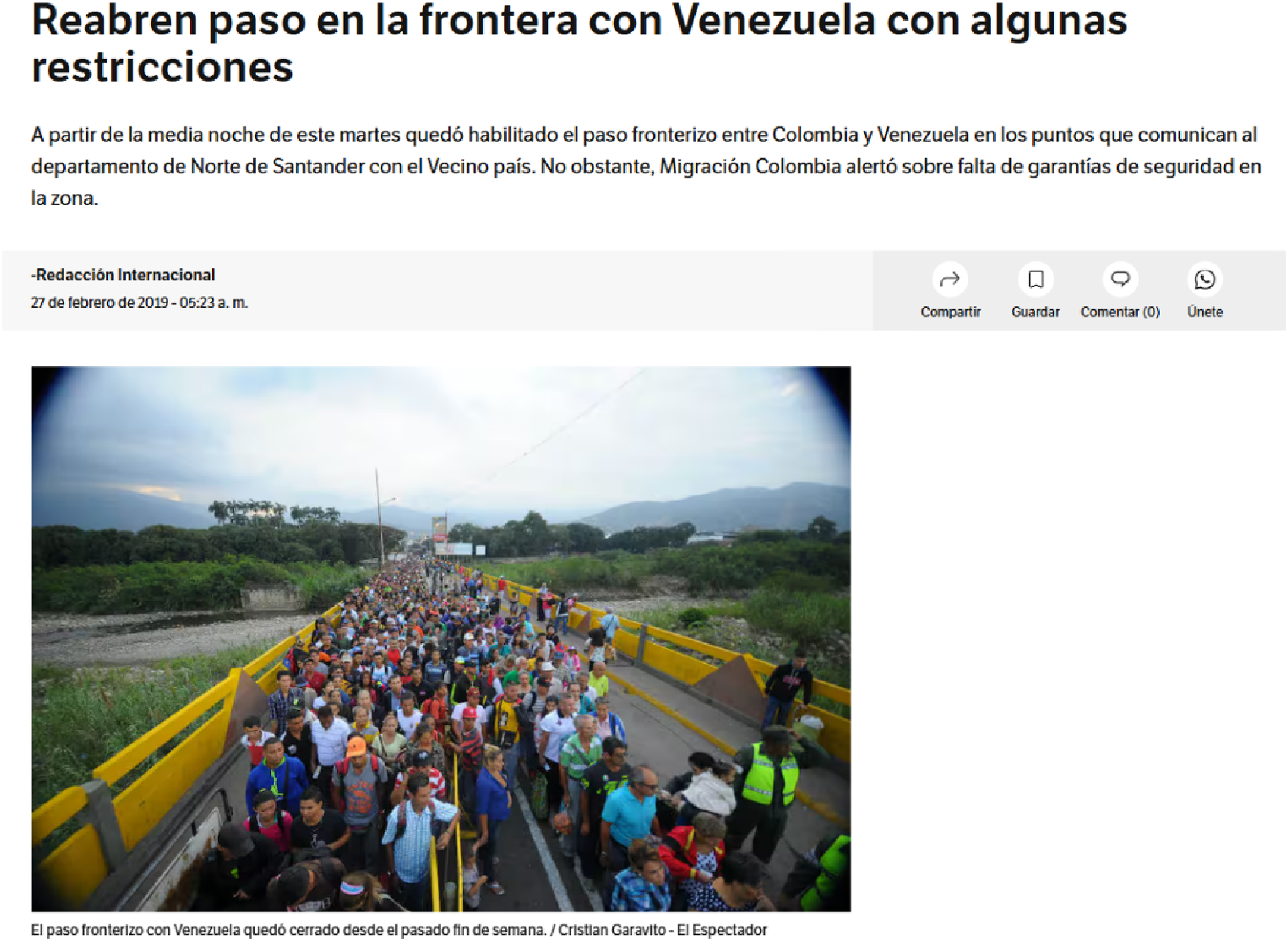
The realities experienced by Venezuelans were not expressed in those entries. They were present as a picture that conveys an agglomeration of bodies crossing the Simón Bolívar International Bridge. The complexity of life on the move from and back to Venezuela was transformed into numbers and percentages in the reports featuring Image 1. Datafication, defined as “the conversion of qualitative aspects of life into quantified data” (Ruckenstein and Schull, 2017: 261), emerged in the form of metrics, such as the number of daily crossings of the international bridges, the total number of Venezuelans living in Cúcuta, of buses with Venezuelans crossing the bridges, of Venezuelans assisted in the CAST, registered COVID-19 positive, and blocked in La Parada, among others (Charles, 2022).
Pictures of moving or stranded bodies, presumably Venezuelans and undocumented, are paired with quantitative data. Numbers and percentages become equal protagonists shown in the headlines, the lead paragraph, or the caption of the pictures. Deborah Poole writes: “We do not simply ‘see’ what is there before us. Rather, the specific ways in which we see (and represent) the world determine how we act upon the world and, in doing so, create what that world is.” (1997: 7). She argues that seeing is a material act insofar as it is worldmaking. How is the public of the leading newspaper in Colombia learning to see the border crossings and the border crossers? What role do these pictures and percentages play in defining their relation to this migration movement? One layer of analysis can point out that there is an uncontained border and movement across it: homogeneously impoverished and undocumented Venezuelans are arriving through the trochas. They are portrayed in large groups, looking down, at their children or belongings. There are always belongings in the pictures: suitcases, pots, backpacks or bags are being carried. This can elicit a suspicion of uncontrolled movement, one done to stay, or at least a sense of vulnerability, backed by the data as evidence.
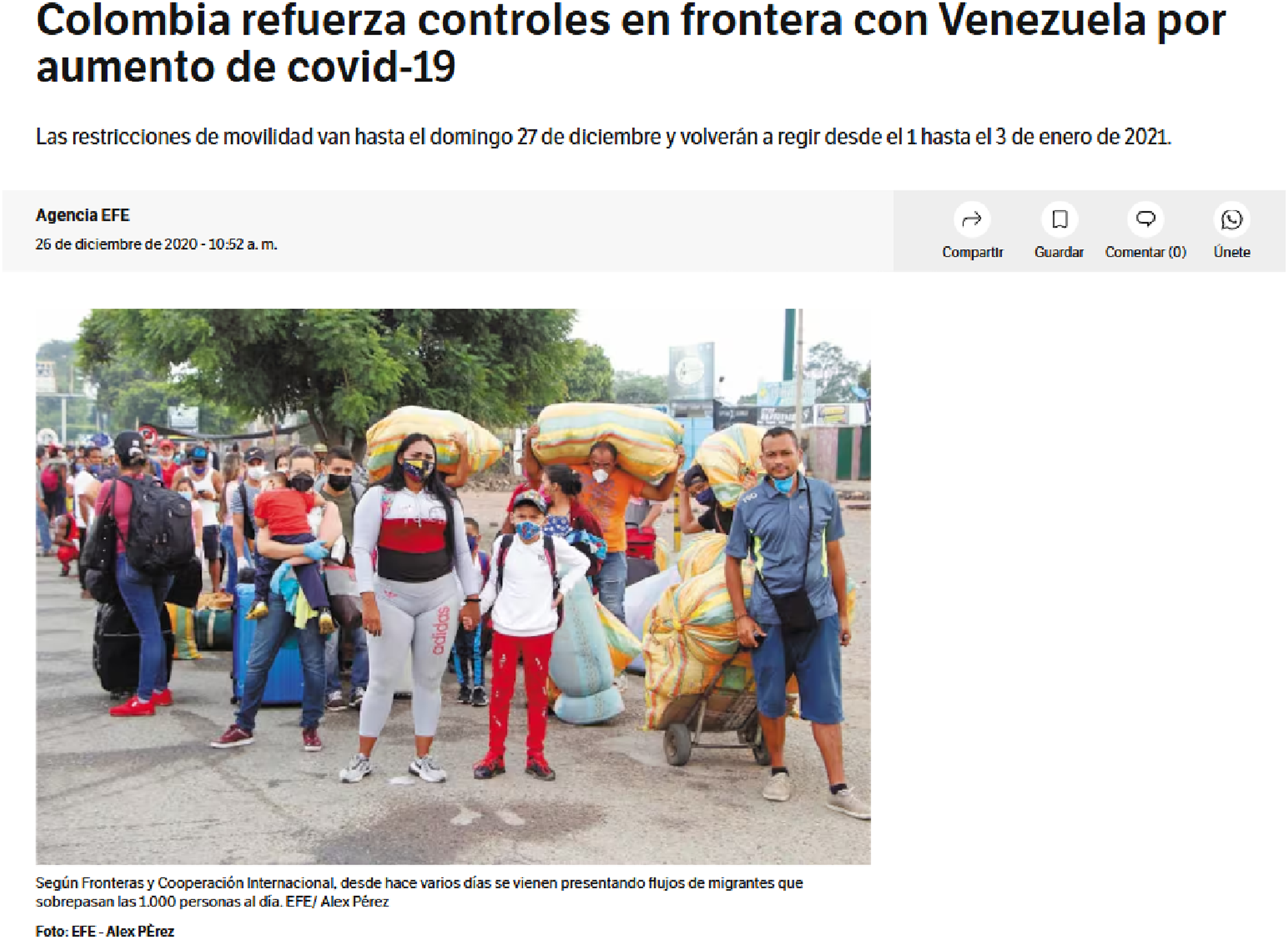
Of the 79 news articles, 55 featured pictures of people, presumably Venezuelan migrants, crossing or stranded on the international bridges, crossing the Táchira River to the Colombian side, and walking on Colombian roads. In these pictures, Venezuelans appeared in groups, moving somewhere and carrying their belongings in suitcases, backpacks, trollies or bags like in Image 2. The international bridges were the main site featured in the pictures; out of 55, 30 articles included pictures taken there. Image 1 represents this trend not only because it was published 9 times for different entries within 2 years, but also because of the relations it creates: people from Venezuela are introduced as an agglomeration that intends to cross the Simón Bolívar International Bridge. They carry backpacks, hold bags and children. They are entering the Colombian side, which is known to the viewer from the angle the picture is taken and because of the presence of Colombian police officers organizing the movement with fences and security tape. A migration rate and the total number of inhabitants in La Parada, Villa del Rosario, a neighbor next to the Simón Bolívar international bridge, feature in the caption. Available at: https://www.elespectador.com/colombia/cartagena/la-parada-el-punto-cero-del-exodo-venezolano-article-887432/.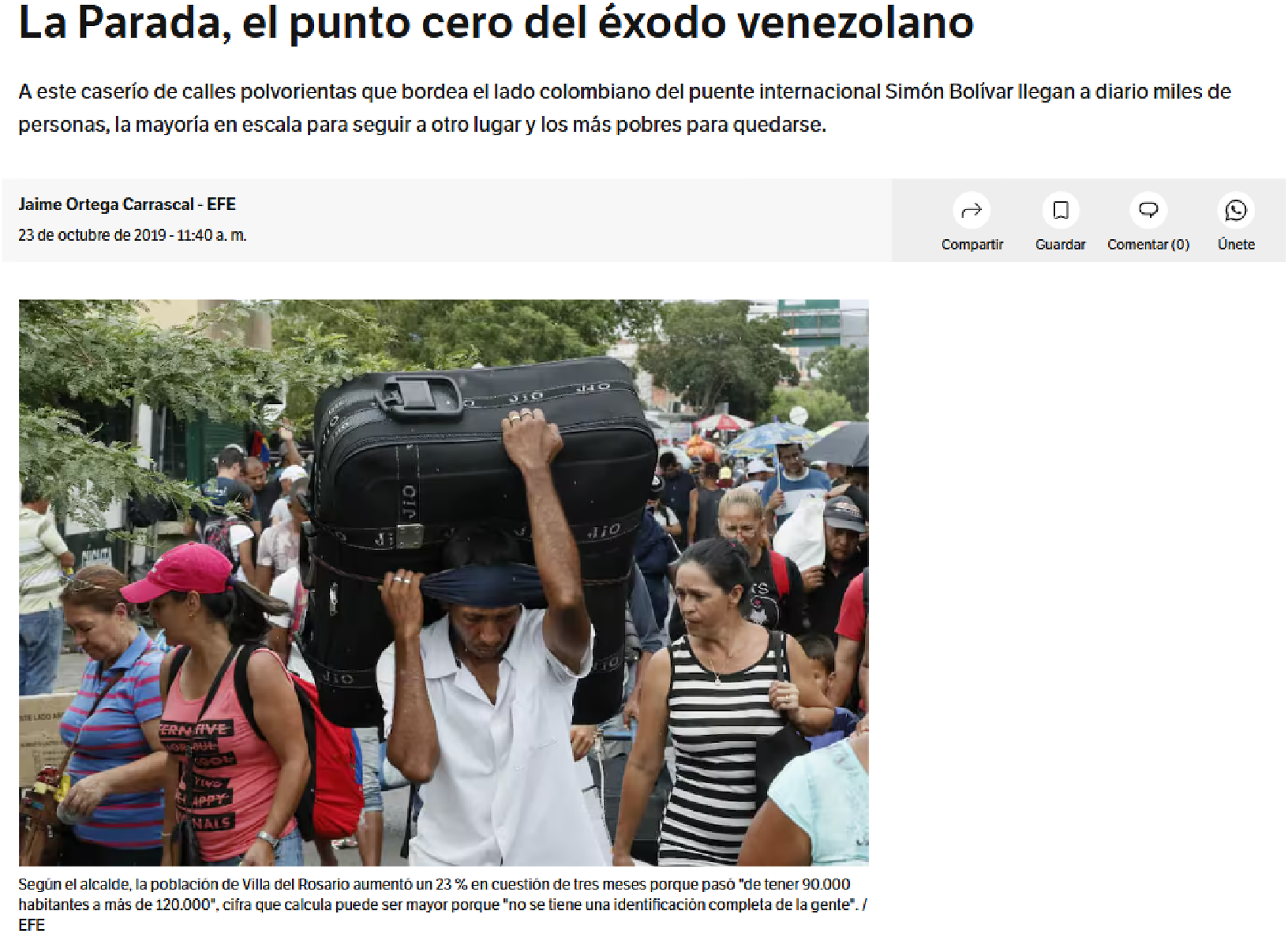
By repeating these patterns, the viewer learns to assume that the moving conglomerations or stagnant agglomerations are Venezuelan migrants: people assumed to be foreign to the Colombian nation and have suddenly crossed the territorial borders to reside elsewhere from their homeland. The ragged clothes, the children, the suitcases, the bare feet on the road, and the improvised tents on the sidewalks become tangible signs of a crisis. The embodiment of the Colombian state was introduced with police officials, city mayors, the Colombian president, and civil servants. Police officials were portrayed assisting the people on the move. The Colombian president, the Cúcuta and Villa del Rosario mayors, the Norte de Santander governor, and the civil servants were portrayed in close-up pictures commanding orders in official or press meetings. Such visual organization generates a sense that the Colombian state was working relentlessly to assist Venezuelan migrants. Humanitarian assistance, a term present in many of the reports as one of the main responses to the “crisis”, gave further meaning to the images: The Colombian state is a protector and sought to exert control over the movement.
Migrant women: Vulnerable and reproductive subjects
On December 19 2019, the newspaper published an article titled “Venezolanos en Colombia: una crisis ignorada por la comunidad internacional”. 4 This is the first time the news coverage mentions the risks of sexual violence and “forced prostitution” 5 (El Espectador, 2019b, para. 3), although it does not specify who is at risk. Simultaneously, this is the first entry that refers to the necessity of sexual and reproductive policies to assist migrant women (presumably cisgender and heterosexual) in matters such as abortion, contraception and reproduction. In the report’s photograph, two men talk face-to-face; a pile of luggage, bags, a woman and a child are between them. The woman turns her back to the camera; she is leaning to the floor as if to pick or search something in the piles for the child next to her, whose back is also turned. In total, 11 news articles spoke of the risks of sexual violence during migration, often mentioned in the same sentence with terms such as human trafficking, sexual exploitation and prostitution. In most of them, migrant women were explicitly mentioned as subjects at risk, while criminal organisations and armed groups were the main perpetrators.
The pictures in those news articles included women often holding or tending children. Their womanhood is expressly mentioned in the lead paragraph, the main body or the image caption under terms such as “women at risk”, “vulnerable women”, and “women and children”. Also, through data about the number of Venezuelan women in Colombia, Venezuelan women victims of sexual violence or assisted by humanitarian organisations. The notion of “crisis” becomes embodied in specific spaces. The viewer learns that a crisis is taking place through the vulnerability of Venezuelan women in the trochas and the Colombian highways. They learn that they are vulnerable because of the exposition to specific forms of violence and because, as the articles emphasise, they are undocumented. This term no longer refers to their administrative status but to a position of ignorance, precarity, and potential victimhood, as described by an officer of Women’s Link Worldwide: “They are poor, malnourished, uneducated women with many children. Unjustified and disproportionate barriers are imposed on them when they ask for help” 6 (El Espectador, 2020a, para. 15). “Womenandchildren”, as suggested by Enloe (2023) in the analysis of how Western media narrated and justified the Gulf War, is a patriarchal trope that conflates women and children as an undistinguished mass. Under this exercise of power, the author argues that womenandchildren are produced as helpless victims of violence without the agency to act in diverse ways during times of war. In effect, international humanitarian agencies and, gradually, national feminist organisations became knowledge sources to understand the embodied meanings of the unfolding crisis.
Less than a month later, on 14 January 2020, the article “El doloroso parto de las venezolanas en Colombia”
7
(Cruz Cañón, 2020) was published. The article highlights the growing concern over the reproductive capacity of Venezuelan women. Pregnancies, birth rates, and pregnant women were referenced in nine entries, five of which are from 2020. This entry is notable as it includes the most photographs among the articles during the time of the border closure—six in total, beginning with a young pregnant woman at the centre of the image. She stands straight, holding her belly and gazing directly at the camera. Following are images of pregnant women carrying and holding children assumed to be theirs, as in Image 3, pregnant women celebrating a baby shower, and a woman with her back turned to the camera. The viewer understands that the Venezuelan women mentioned in the reports are cisgender, are presumed to be heterosexual, and that their reproductive capacity poses a challenge to Colombian healthcare services and international humanitarian agencies at the border. Increasing birth rates, a higher number of beds used by Venezuelan women in labor compared to beds used by Colombian women for the same purpose, lack of knowledge about abortion rights in Colombia, and lack of money to buy contraception are repeated in the news. Even in entries that do not mention pregnancies or birth rates, Venezuelan women are mostly portrayed next to children at the centre of the image. They are not alone, people or houses are behind or next to them, as shown in Image 4. The image is part of the report “El doloroso parto de las venezolanas en Colombia” (Cruz Cañón, 2020). Behind the woman and children in the picture, a Sisbén office, the Colombian Household Vulnerability Identification System for Social Assistance, is visible. The caption includes data on pregnant Venezuelan women assisted by the Ministry of Health during the last 2 years. It emphasizes that “many” did not want to fall pregnant but couldn’t find contraception in Venezuela. Available at: https://www.elespectador.com/colombia/mas-regiones/el-doloroso-parto-de-las-venezolanas-en-colombia-article-899757/. Two news articles shared this picture between October and December 2020. The caption in one entry (El Espectador, 2020h) provides the daily number of Venezuelans crossing the border and remarks on the assistance provided by international aid agencies. Available at: https://www.elespectador.com/colombia/mas-regiones/colombia-refuerza-controles-en-frontera-con-venezuela-por-aumento-de-covid-19-article/.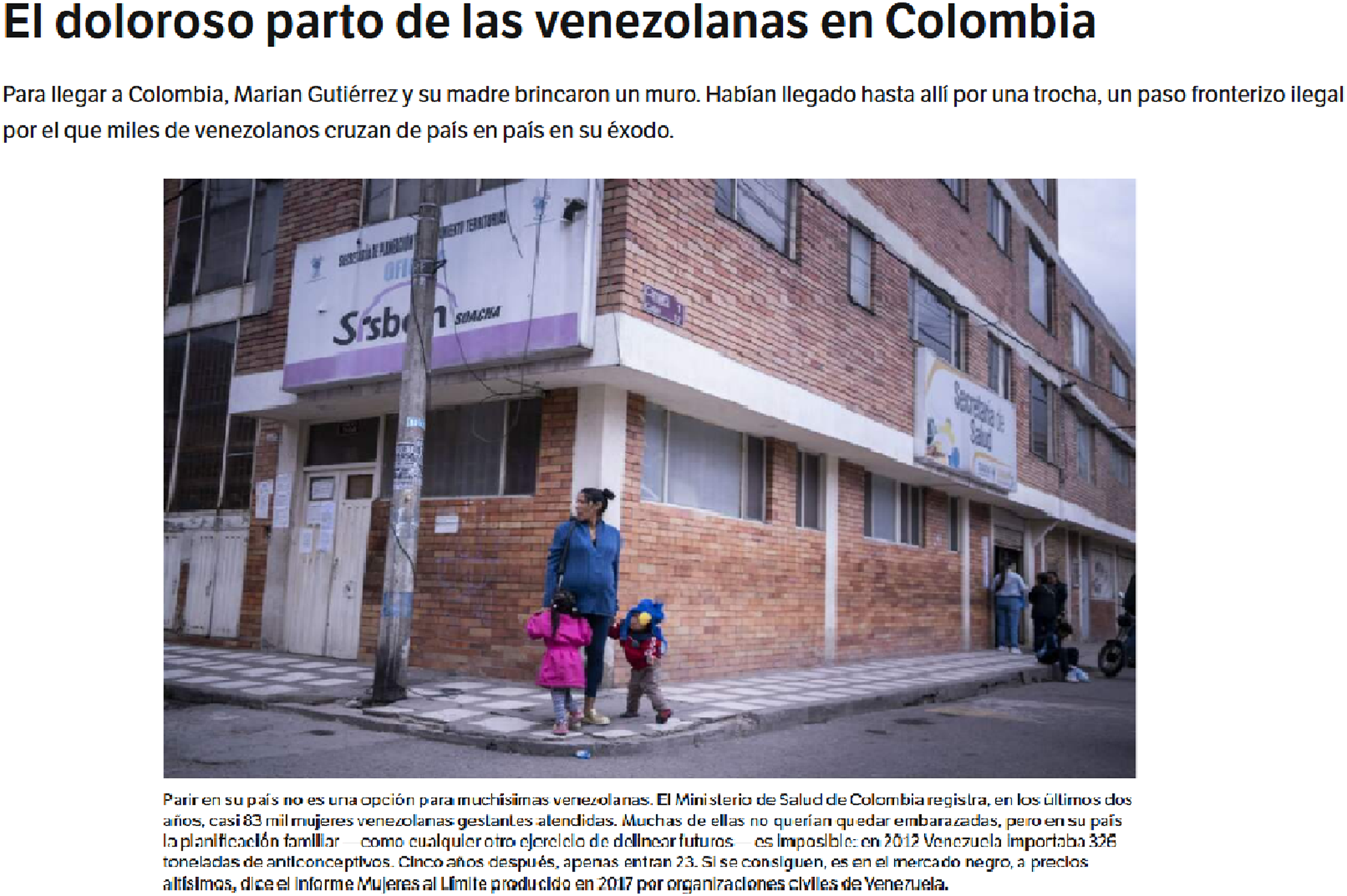
As reminded by Poole, the effect images have cannot be contained: “Once unleashed in society, an image can acquire myriad interpretations or meanings according to the different codes and referents brought to it by its diverse viewers” (1997: 18). What do the data and pictures do? What responses are elicited in viewers by pairing images of pregnant women or women holding children with stories of rape in the trochas or on Colombian roads? Are sexual violence and unwanted pregnancies mobilized as strategies to hold Venezuelan women responsible for the consequences of their movement? Such visual and narrative practices produce Venezuelan women in several ways: they are depicted as cisgender, their reproductive capacity is framed as problematic for the host society, and they are portrayed as unable to assess danger. Meanwhile, feminist organizations and international humanitarian agencies become positioned as experts on this subject. The two main photographic formats—homogeneous masses and individual women holding children against a collective backdrop—elicit complex affective responses. Beyond descriptive representation, the use of close-ups and wide-angle shots in these images illustrates dynamics of spatiality and proximity that shape affective engagement. Close-ups of pregnant women or children create intimacy and compassion but simultaneously evoke suspicion by emphasizing logics of risks (Charles, 2022) associated to their presence on this side of the border. Wide-angle shots of migrant groups crossing bridges or jungles evoke detachment and anonymity, reinforcing perceptions of massification and threat. These framing strategies are not neutral; they contribute to a grammar of crisis and moral panic that legitimizes control and intervention (Kress and van Leeuwen, 2006; Pink, 2007).
The production of spaces
In the inductive analysis, we explored how spaces are represented and imbued with meaning linking the “crisis” whether it its framed as an unrestrained humanitarian issue, or as a matter of national security (Domenech and Dias, 2020). Below, we present two manifestations of how this process unfolds: first, the portrayal of the Darién as an inhospitable jungle responsible for the suffering of those who dare to cross it; and second, the depiction of the Darién and the “trochas” in Norte de Santander which over time have come to symbolize spaces associated with criminality and the need for control. These visual compositions prompt us to consider how the visual economy of migration actively produces places (Santos, 2021). Only specific settings are ascribed border significance and discursively constructed as “paradigmatic places” requiring control, serving as stages for the spectacle of the “crisis” (Andersson, 2014; De Genova, 2013).
El Darién and the exemplary power of nature
Among the 102 news articles in El Espectador consulted using the keyword ‘Darién,’ 80 highlighted the “natural” aspects of the border in their archival photographs. The images portrayed dense jungle landscapes that appear difficult to access, thick vegetation, and moderate-flow rivers that can be crossed on foot but have often proved fatal during the rainy season. Notably, the photographs employ wide-angle and general plan shots, creating a sense of detachment for the viewer, where the territory is rendered unfamiliar (Kress and Van Leeuwen, 2006). This framing portrays the Darién as an impenetrable and overwhelming force of nature, distant from any centre of state authority. The images and layout also highlight the massiveness and recurring presence of certain bodies. In 89 photographs, visual cues suggest the subjects are presumably migrants in transit, identifiable by their boots, backpacks, camping gear, sun hats, and the way they walk in vertical lines. Additionally, the photographs reveal a notable shift beginning in 2020, with women and minors becoming more visible.
However, this contrasts abruptly with the so-called “crisis in Necoclí,” widely broadcast in June 2021. Beyond the images of an “overflowing” beach (El Espectador, 2021), photographs published in the following months begin to include, for the first time, depictions of bodies and institutional symbols. In 10 of these images, institutional elements are evident but exclusively tied to urban municipalities such as Necoclí, Acandí, and Turbo, far from the edges of the jungle. In six photos, individuals presumed to be public officials (e.g., ministers, mayors) are shown walking collectively but organized in horizontal lines, conveying a sense of order and authority. Other images depict high-level regional and transcontinental meetings, featuring representatives of the Colombian and Panamanian governments, the then-mayor of New York (El Espectador, 2023d), and European Union delegates announcing investments in reception centres (El Espectador, 2022c). This visibility ended up in the implementation of the “controlled transit” proposal, which established a daily quota for crossings. However, this measure lasted barely a month (El Espectador, 2021). Throughout the 2019–2022 period, headlines and news coverage returned to emphasizing the state’s inability to maintain an effective presence in the region, accompanied once again by photographs focusing on boats and jungle crossings.
This sudden contrast in frequency and in the bodies that intermittently or permanently occupy the spaces (jungle and urban) allows us to identify a first subtext that emerges from the predominant presence of nature in these images is the scant mention of state responsibilities, at a time when migration was presented as a “humanitarian crisis”. In contrast, it is primarily the jungle that is held responsible for the high mortality rates (El Espectador, 2023c), for the inherent cruelty and wild force that endanger the lives of those who dare to cross, with migrants portrayed as individuals following their whims and left to their own fate. Studies on Lampedusa (Cuttitta, 2015; Dines et al., 2024), Ceuta and Melilla (Andersson, 2014; Fernández, 2020), where the sea is framed as a ‘natural danger,’ and those referring to the Mexico–United States border (De León, 2015; Magaña, 2011), have already demonstrated this phenomenon, where the desert and the Rio Grande serve the same symbolic function, transferring their savagery to “the border.”
In the case of El Darién, we observed that the photographs often blended bodies in with the very nature of their surroundings. The use of visual metaphors, such as wide-angle and general plan shots where a row of bodies appears barely distinguishable on the horizon (see Image 5), is frequent. In some instances, individuals become indistinguishable from the stones, merging seamlessly with the landscape and the horizon. In others, the predominant use of brown tones—rather than green, which is typically associated with nature—creates a visual assimilation with the mud on their boots and their worn clothing, erasing their identities as they enter the jungle. This deliberate use of colours, contrasts, and visual elements extends the representation of the jungle to encompass those traversing it. Symbolically, this produces dual meanings: one of profound suffering and another of dehumanization.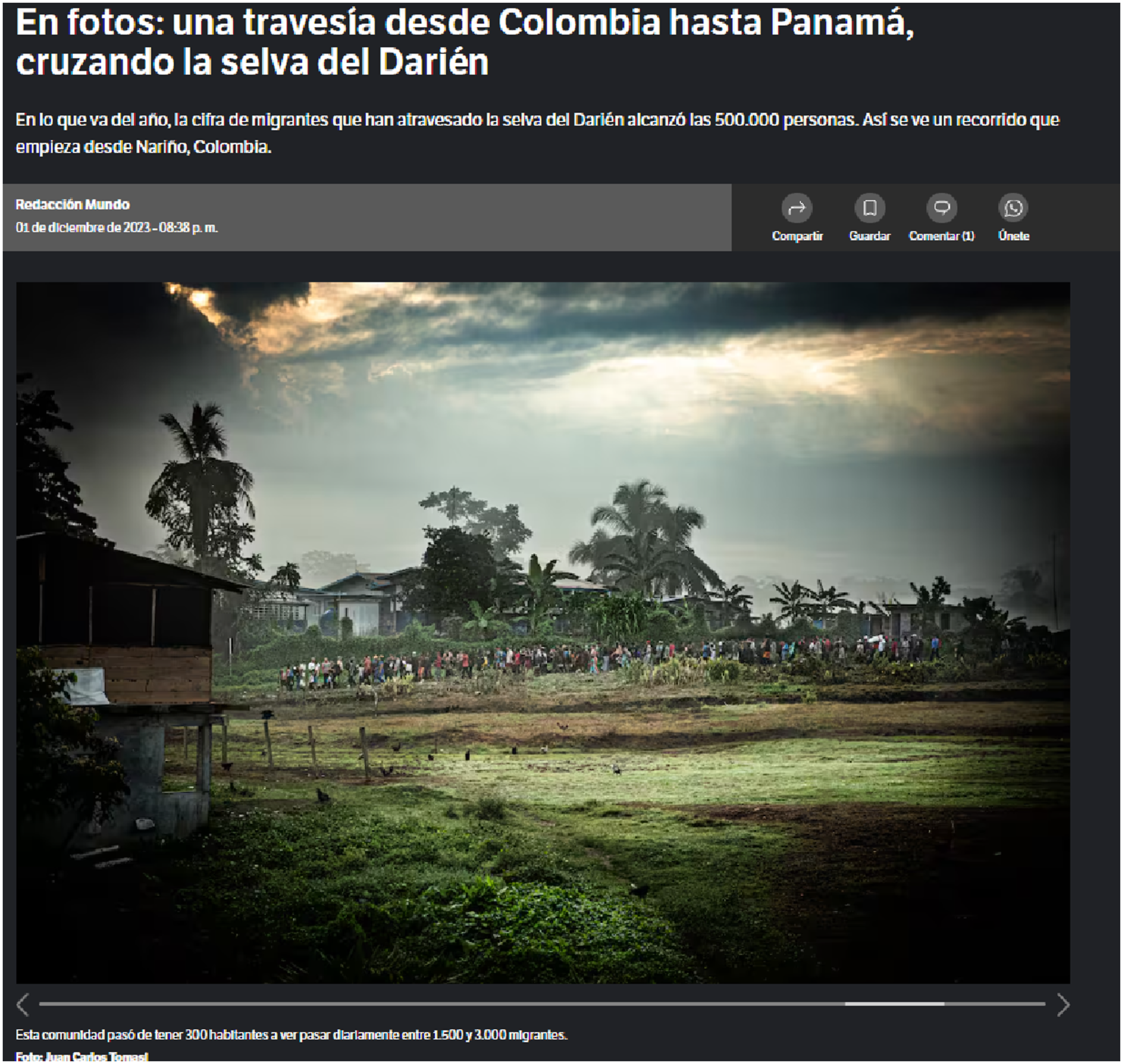
This visual meaning is not without purpose, as it serves as a warning to future migrants. As De León (2015) similarly argues in the context of border security strategies in the Sonoran Desert, “the idea that dead bodies should act as a form of deterrence to future migrants [is a] fundamental component (...). These policies expose noncitizens to a state-crafted geopolitical terrain designed to deter their movement through suffering and death” (p. 28). In this vein, the power of the visual economy acts as a stark cautionary tale for those seeking to improve their living conditions or escape violent contexts by moving “irregularly” toward the Global North.
Migrants are rendered faceless and politically irrelevant, reduced to a state of bare life (Agamben, 1998). Within this framework, visual representations emphasize the proximity of migrants to nature. As a result, a secondary subtext emerges: the peril of the jungle is symbolically equated with the threat posed by “irregular” migrants. These individuals are portrayed as “wild,” “elusive,” and “outlaws,” who are forced to remain hidden in the shadows and, therefore, subject to control through the extraordinary mechanisms of migration governance. As Andersson observes, migrants are “alternately a hounded, pitied prey and a ghostlike, prohibited presence” (2024: 130).
These visual strategies resonate with the broader framework of visual governance by shaping how viewers imagine and emotionally relate to these spaces and bodies (Pink, 2007, 2012).
The “trochas” at the Colombia-Venezuelan border and the jungle of Darien as a niche for criminality
In our analysis of the visual representations produced by El Espectador regarding Norte de Santander and El Darién, we identified a common theme: specific spaces serve as signifiers of criminality, although these representations emerge at different times—since 2020 for Norte de Santander and since 2022 for El Darién.
The construction of bridges symbolizes the “legality” of transit and the implementation of migration policy at the border. In the images, these spaces are depicted as modern structures with muted colors, in stark contrast to the almost absent depictions of the trochas. These informal crossings first appear in visual representations and news narratives in January 2020, gaining prominence throughout 2020 and 2021 (Image 6). The “trochas”—artisanal crossings created to navigate the river (considered a natural border between Colombia and Venezuela)—have historically signified binational family communication and informal trade. However, with the establishment of Colombian migration authorities, they have come to symbolize irregular crossings (López, 2023).
This contrast between the official nature of the bridge and the irregularity of the trochas transforms the latter into spaces of uncontrolled movement and danger. In this context, the images and headlines depict certain bodies in transit as symbols of threat, with the natural, wild landscape merging with the bodies that navigate it. In this regard, some headlines, for example, present: “The Painful Labor of Venezuelan Women in Colombia”, which raised concerns about Venezuelan cisgender women’s reproduction in Colombia. Sex workers, pregnant and undocumented women were featured in that article, which can elicit questions such as: what else aren’t the trochas able to contain? This image (El Espectador, 2020i) alludes to the trochas: spaces of uncontained and disordered movement resulting from the closure of the international bridges. (https://www.elespectador.com/colombia/mas-regiones/cierran-trochas-en-la-frontera-entre-colombia-y-venezuela-en-cucuta-article/).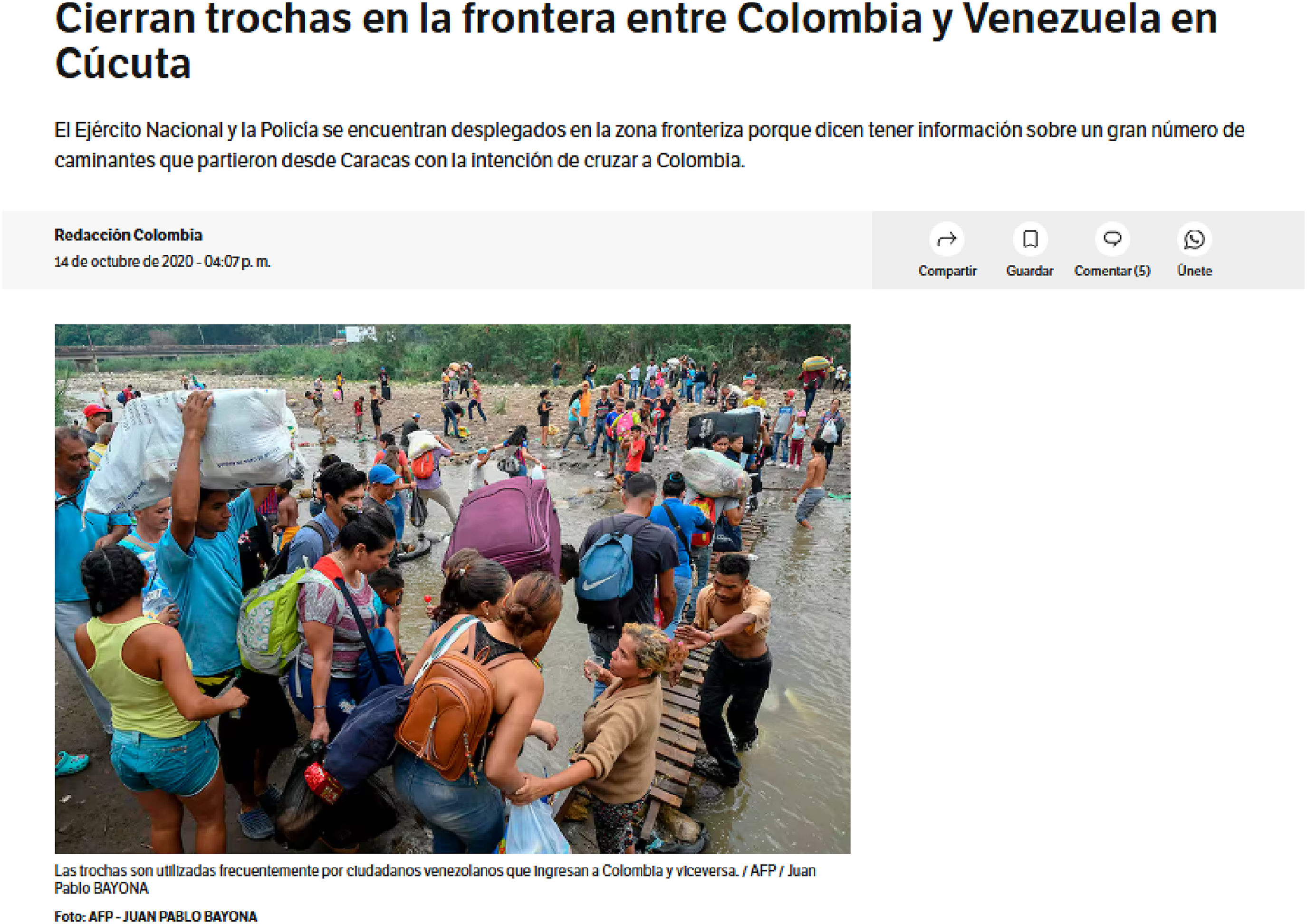
The “trochas” symbolize spaces devoid of state presence in the news: they represent the uncontrolled movement of people that defies the closure of international bridges by both the Venezuelan and Colombian governments. These crossings highlight a sense of disorganized entry that challenges the Colombian state’s power to contain, and the humanitarian agencies' abilities to categorize those on the move. Additionally, the trochas embody the risk posed by non-state armed groups who control these spaces and the bodies that pass through them. Undoubtedly, the photos avoid depicting any body or object with institutional references, and the most significant kinesic representation is movement itself. The contrast between the concrete of the bridge and the “natural” and artisanal quality of the trochas underscores a sense of malleability and vulnerability, which becomes an increasing public concern. This visual opposition projects a sense of threat advancing toward “this side” of the border.
The metaphor of malleability and nature is symbolically linked to the danger that “everything passes through there.” As a result, headlines and news coverage increasingly focus on the violent actions occurring in these spaces, with particular emphasis on sexual violence and abduction for sexual exploitation, as well as the names of armed groups and criminal organizations controlling these interstitial areas. The state and humanitarian representatives also express concern about the malleability of these spaces. Colombian security forces may be able to identify and close one trocha, but others quickly emerge in its place. Indeed, the news often highlights the lack of official information regarding the total number of these crossing points and the challenges this data gap presents to the Colombian state. This concern underlines how the trochas are imagined as permeable spaces and transit routes that not only facilitate the crossing of people and goods but also display the limitations of territorial sovereignty of the states involved.
Within this same frame of meaning, where the trochas have been linked to criminality, municipalities and neighborhoods along the border are increasingly being stigmatized. In this case, La Parada is portrayed in photos as an overcrowded area, posing both a security and health risk to the rest of the country. In Cúcuta, the city center and the Erasmo Meoz Hospital have been highlighted in relation to the high number of Venezuelan individuals engaged in informal economies to support themselves or seeking state-provided healthcare services. The hospital, in particular, has become a focal point for discussions surrounding an increasing number of undocumented migrants in need of medical care and the state’s efforts to control the spread of COVID-19.
Secondly, in the visual representation of the Darién in the press, at least two contextual meanings can be identified. On one hand, nature is portrayed as a wild, uninhabited space, devoid of public awareness—stripped of its history and the communities that have long inhabited these territories. On the other hand, by temporarily housing those who cross it (the migrant bodies), the Darién is depicted through a decontextualized narrative, where it exists solely as a symbol of the threat posed by recent migratory movements toward the Global North. The untamed nature that defines this border simultaneously reinforces the perceived need for its control.
In 2021, news in El Espectador began to feature photographs depicting armed actors and scenes of drug confiscations involving security forces. This shift is tied to growing concerns about the presence and territorial control of the Clan del Golfo in this region of the country, as well as the publication of reports linking this armed group to extortion, the regulation of routes, and their role as intermediaries between locals and migrants (El Espectador, 2023). Photographs of abandoned or burned buses, overcrowded boats, and captures of individuals with apparent ties to transport companies—evidenced by their uniforms—help to bring to life the narratives, reinforced by the headlines, surrounding smuggling operations.
However, this same scene casts suspicion on anyone who might be a smuggler, including private transportation companies, local residents, and indigenous communities (El Espectador, 2023b). This shift illustrates how the visual economy of migration reshapes social relationships and serves to criminalise ancestral practices of mobility and acts of solidarity and regular exchanges that take part in the informal economies (Álvarez and Cielo, 2023). The unprecedented increase in the number of images and narratives framed in ‘criminality’ and ‘chaos’ ultimately justifies an extraordinary presence—not only of national sovereignty but also of the externalization of borders where North-South colonial relations take place (Bensaãd, 2006; Csernatoni, 2018; Cuttitta, 2018). The Darién is not understood merely as the legal-political border between Panama and Colombia; rather, it is seen as a complex scenario intertwining transnational routes to the Global North and, therefore, as the site where ‘irregular’ global mobility must be contained.
In the news dated from June 2024, following the change of government in Panama , photos now evidence the “heroic” state presence; technology, planes, and deployments of armed forces groups and immigration officials appear in the scene. The mass of bodies crossing the jungle has now been replaced by individuals escorted to planes, guarded by the Panamanian armed forces, to ensure their repatriation with support from the United States or monitored during their transit and arrival. (See Image 7).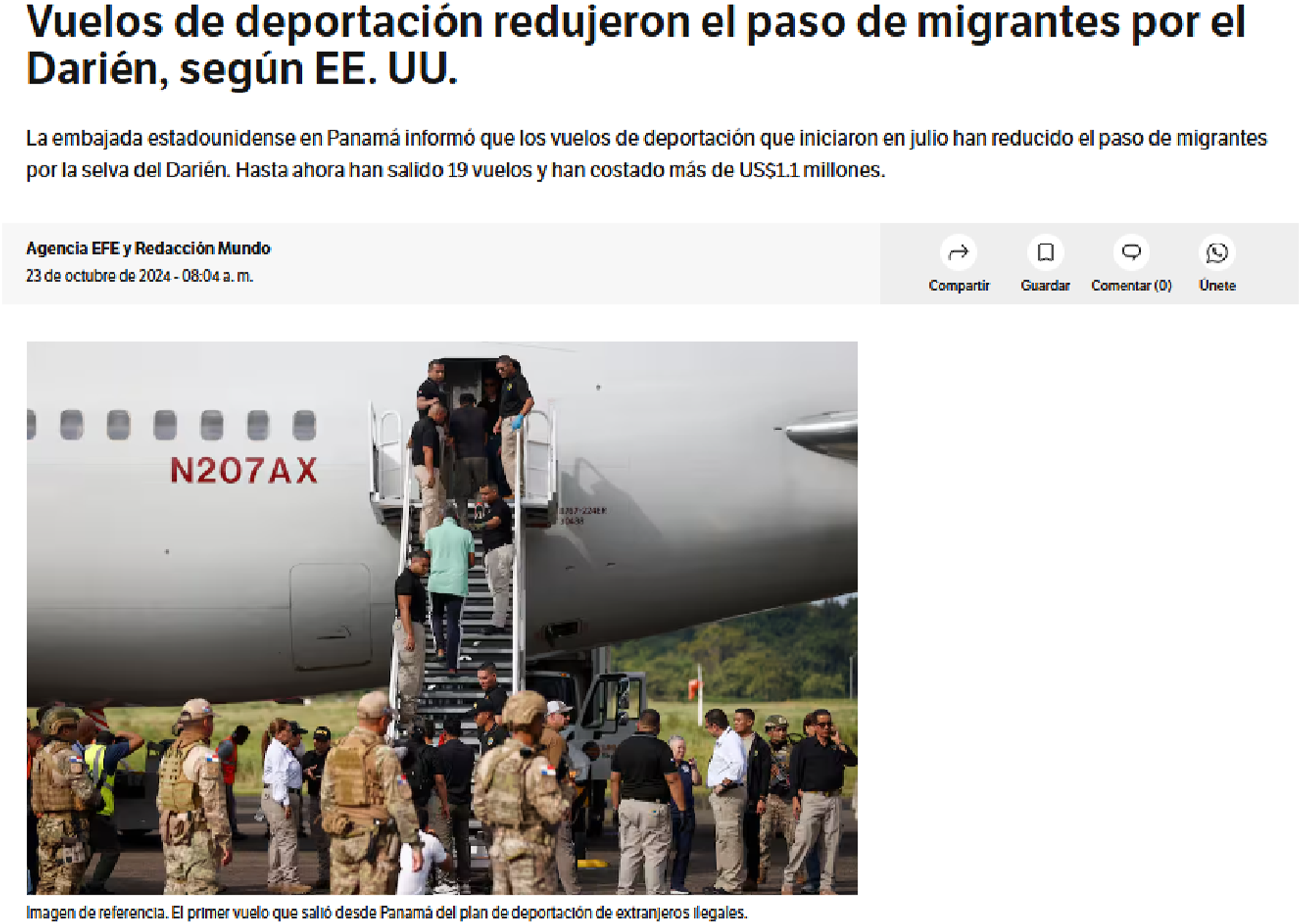
Conclusions
This article examined the visual representations presented in the press regarding the arrival and transit of Venezuelan and transcontinental migrants in Colombia during two periods framed as “migration crises”: the Colombia-Venezuela border (2019–2022) and the Darién region (from 2021 onward).
In analyzing the compositional meaning, we argue that the over-representation of border spaces acts as a signifier of the “migration crisis”. A closer examination of the distinctive features of the photographs and photo reports accompanying El Espectador’s news coverage reveals the prominence of certain locations: the Simón Bolívar International Bridge and the trochas in Norte de Santander that connect Colombia and Venezuela, as well as medical centres and iconic sites in the municipalities where events took place. In the Darién region, the semiotic landscape is shaped by the jungle, rivers, and other natural elements. These geographical settings are imbued with crisis meanings of crisis, associated with mass movement, disorder, and lack of documentation or criminality. In the case of the Darién, predominant images depict it as an empty, wild territory fraught with inherent dangers. This perspective often blurs the line between migrants and the natural environment in visual representations, extending the connotations of wildness and risk to the people traversing the jungle. Notably, both depictions of savagery and criminality, linked to emotions of fear and suffering, ultimately serve to justify the control of mobility.
Moreover, we identified that in the visual compositions, the bodies—primarily those of individuals presumed to be undocumented or in-transit migrants—become visual carriers of discourses surrounding massiveness, suffering, danger, urgency, threat and excess. Migrants are often portrayed as elusive, chaotic masses, depicted through images of crowds, endless lines, and overcrowded spaces where individual identities are obscured. These bodies are depicted as subject-objects, ultimately fostering a connection with the observer on the basis of moral panic, particularly during the COVID-19 pandemic. Over time, the narrative evolved to frame migrants as impoverished, undocumented individuals with intentions to settle, positioning them as potential threats.
Furthermore, we identified ambivalent gendered portrayals: migrant women become visible—or even hyper-visible—when the focus shifts to the sexual violence they endure, or, paradoxically, when their pregnancies are framed as problematic. This visual framing contributes to the construction of a sexual and gendered order that delineates who is considered acceptable within the national fabric.
These visual strategies are not isolated aesthetic choices but are embedded within governance assemblages involving state institutions, humanitarian agencies, and transnational actors. The representation of migrant women and children as hyper-vulnerable aligns with policy frameworks designed to justify humanitarian interventions and securitisation measures, thus operating across both macro (state and transnational governance) and meso (NGO and media) levels.
By explicitly engaging with the Visual Governance theoretical framework (Massari, 2026), our analysis underscores the centrality of images in governing migration, extending beyond textual and policy dimensions. Images operate as affective technologies that sustain the symbolic production of crisis and legitimize security and humanitarian interventions. This study contributes to ongoing debates on visual governance and migration control in the Global South, offering insights relevant to the broader conversations presented in this special issue.
Similar to contributions by Massari (2026) and other authors in this special issue, our work interrogates how visual regimes not only represent but actively participate in the governance of mobility, generating symbolic orders that justify humanitarian and security interventions. Ultimately, the production and circulation of these images function as disciplinary mechanisms that shape societal perceptions of migration and contribute to the affective and moral economies that produce the “crisis”.
Footnotes

Funding
The authors received no financial support for the research, authorship, and/or publication of this article.
Declaration of conflicting interests
The authors declared no potential conflicts of interest with respect to the research, authorship, and/or publication of this article.
Data Availability Statement
Data sharing not applicable to this article as no datasets were generated or analyzed during the current study.