



Abstract
This paper introduces the concept of “visual governance,” a framework for understanding how governance is enacted through visual representations such as photos, videos, and maps. It highlights the growing influence of visuals in migration governance, particularly in the digital era, where platforms like social media amplify their reach and impact. Visuals have evolved from mere tools to central agents that communicate, legitimize, or contest power structures, policies, and practices. Given the pivotal role of images in today’s communicative sphere and the transformative effects of digital technologies and social media on the governance landscape, this paper proposes a framework to theorize the role of images in migration governance. This framework incorporates all layers of governance—not only policies, practices, and regulations but also representations, recognizing their integral role in shaping governance dynamics. The proposed approach is grounded in the understanding that the relationship between the visual communication sphere and governance is inherently iterative, with visuals and governance influencing one another in a dynamic interplay. Moreover, the framework includes all relevant actors involved in migration governance, spanning macro-level institutions, meso-level organizations, and micro-level individuals. By acknowledging the diverse range of actors and their varying capacities, it reflects the shifting power dynamics facilitated by digital platforms, where even individuals can significantly shape visual narratives. This conceptual model provides a comprehensive lens to analyze how images influence public perceptions, policymaking, and governance practices, advancing our understanding of migration governance in the digital age.
Introduction
In recent years, visual elements have gained unprecedented influence in communication, reshaping how information is conveyed and perceived on a global scale. Visuals often outpace text in their ability to convey urgency, emotion, and complex narratives, marking a significant departure from traditional, text-centered communication. Since the spread of television and the circulation of images capturing distant events, scholars have long recognized and questioned the unique power of visual media to influence public perception and political outcomes on a global scale (Strobel 1996; Bleiker 2001; P. Robinson 1999). Images have the ability to make distant issues feel immediate and personal, attempting to bridge the physical and cultural divides by evoking strong emotional responses. This capacity for immediacy and emotional impact has fuelled debates about the role of visuals in shaping world politics, as images broadcast across borders have the potential to influence not only public sentiment but also policy decisions and diplomatic actions (Besco and Tolley 2018; Lemay 2019; Scott et al. 2022). As visual media have continued to evolve—from television to online platforms and social media—their influence has only deepened, positioning images as central agents in the transmission of information, mobilization of opinion, and governance of transnational phenomena.
Advancements in digital technology have catapulted us into a radically transformed media landscape where images hold unprecedented power. The widespread accessibility of smartphones has democratized the ability to capture and instantly share images and videos, allowing ordinary individuals to become active participants in global communication. Visuals are now more immediate, impactful, and accessible than ever, and social media platforms like YouTube and Facebook have amplified this transformation. The events of the Arab Uprisings, for example, were broadcast worldwide through videos and posts shared by participants and witnesses on these platforms, often in real time. Platforms like Facebook, Instragram, YouTube, TikTok and Twitter (now X) allowed participants not only to document events as they unfolded but also to communicate with one another across borders, fostering a sense of solidarity and shared purpose that transcended national boundaries. In this digital era, and its communication sphere - the space in which information, ideas, and messages are exchanged and circulated within society - images have become crucial tools for advocacy, narrative control, and information (and misinformation) dissemination, transforming how society perceives and reacts to global events and adding a new dimension to the interplay between visual culture and governance.
When viewed within the context of migration, this shift toward visual dominance carries profound implications. Platforms flooded with images and videos related to migration can shape perceptions of migrant journeys, conditions, and challenges, often impacting policy responses and public opinions. In migration governance, visual content has become essential for monitoring, documenting, and framing migrant experiences, with its immediacy and emotional resonance influencing narratives that reach wide audiences. This study situates itself within this visual framework, where images are no longer secondary but have become central tools in the governance of migration, highlighting a transformation in how migration is seen, shared, and understood globally.
While it is clear that images play a role, the ways in which different actors (e.g., government institutions, international organizations, NGOs and CBOs, social media influencers, criminal groups), with different level of authority in migration governance use images strategically to reinforce/reproduce/challenge/navigate migration policies and practices remain under-theorized. Even more,he academic debate has so far missed the systematic integration of visual representations into the analysis of migration governance. There is a need to move beyond isolated studies of visuality and develop comprehensive frameworks that consider how images shape and are shaped by governance dynamics, especially in light of contemporary communication landscape. This integration is crucial for a more nuanced understanding of migration governance, which acknowledges the complex interplay between visual narratives, policy-making, and practices on the ground.
To understand the role of images in governing transnational phenomena within this drastically new communication context, a fresh theoretical framework is essential. This paper introduces a new conceptual model for examining what can be termed visual governance, a process whereby governance is enacted through visual representations—such as images, videos, maps, and other visual media—to communicate, regulate, legitimize, or challenge prevailing power structures, policies, and practices. Using the lens of migration governance, this article introduces a theoretical framework that brings images into analytical focus. Firstly, the framework enables us to incorporate the realm of discourses and representations into the dimensions of governance previously explored in migration governance literature (i.e., policies and practices). Secondly, it enables the inclusion of all relevant actors in the analysis, not just traditional ones, but also those whose participation has been facilitated by the new digital communicative sphere. This includes stakeholders at both the macro level (state-based institutions such as national government and transnational entities as the European Union) and meso level (international organizations and non-governmental organizations) but also those situated at the micro level such as individuals (e.g., influencers and individuals with large following base or whose content starts to circulate wildly). Finally, the proposed theoretical framework is based on the understanding that the role of images in migration governance should be examined through an iterative approach, considering the interplay between the visual communication sphere and the governance realm and how those two dimensions influence each other.
The paper begins by introducing the concept of “visual governance,” situating it within the broader debates on migration governance and highlighting the growing influence of visuals in a digital era. It then reviews existing literature on the role of images in international politics, identifying gaps and under-theorized areas. The paper progresses by proposing a comprehensive theoretical framework that integrates policies, practices, and representations, emphasizing the iterative interplay between visual communication and governance. It further explores how actors at macro, meso, and micro levels utilize visuals to shape, legitimize, and contest migration governance. The discussion concludes by reflecting on the dual role of visuals as both inputs and outputs of governance, providing a nuanced understanding of their transformative impact in shaping public discourse and policymaking.
The Role of Visuals in International Politics: Progress, Gaps, and the Need for a Comprehensive Model of Visual Governance
International Relations studies have since long time been intrigued by the idea that images could play some role in international politics. In 1996, Strobel advanced the idea that the visual representation of conflict and suffering happening in distant countries did “help foreing policy officials explain the need for U.S. intervention” (Strobel 1996, 35). He argued that by focusing the attention to one crisis (the famine in Somalia in 1992) over another one (the conflict unfolding in Southern Sudan), the CNN played a key role in “dictating” US foreign agenda. Later on Robinson (P. Robinson 1999) redefined the impact on the CNN effect showing that although it was unclear whether or not the news media had triggered military intervention, media influence on government policy was possible only when policy was still uncertain and media coverage clearly framed a situation advocating for a specific course of action.
Although scholars are still discussing the dynammics of the interaction of images in world politics, little doubt remains on the fact that visual representation do play a role in international arena. Bleiker’s seminal article on the aesthetic turn (Bleiker 2001) showed how exploration of representative practices could broaden our comprehension of International Politics. Since then, International Relations studies have increasingly extended their attention to the visual world to investigate international politics (Hansen 2015; Hansen et al. 2021). Furthermore, with the increased prominence that the topic of migration has acquired over the last two decades, a growing body of scholarship has started focusing on the study of how specific visual representations of displacement contributed to shaping the public understanding of migration dynamics (Chouliaraki et al., 2017; Franko 2021; Massari 2021; Musarò 2016).
More recently, some scholars argued for a direct link between the dissemination of specific images and their political impact, illustrating how visuals can drive significant policy shifts and public responses. For example, while the dramatic photo of Alan Kurdi did not lead to a fundamental shift in broader discourses and representations of refugees (Bozdag and Smets 2017; Slovic et al., 2017) and had limited influence on migration policies overall (Burns 2015; The Independent 2015, 2016), it has nonetheless been suggested that it significantly shaped political discourse and decision-making in specific contexts. During the 2015 Canadian election, public reaction to the image drove the Liberal Party, under Justin Trudeau, to commit to accepting 25,000 Syrian refugees by the end of the year if elected (Besco and Tolley, 2018). Similarly, the image influenced Germany’s “politics of openness” from 2015 to 2016, prompting leaders to embrace policies of refugee acceptance in response to humanitarian concerns (Lemay, 2019).
While the importance to pay attention to (also) images to study world politics has been widely acknowledged, traditional methodological approaches for the study of international politics are yet quite limited when it comes to analysing how meaning is produced (Åhäll 2009). Poststructuralist discourse theory offers an approach able to make sense of “inclusive and negotiated ways of engaging a multiplicity of public, semi-public and private stakeholders in the collective definition of public value” (Howarth and Griggs 2015, 293) through a critical gaze over the reproduction or reshaping of practices of governance; or narrative and interpretive theory that have put at the centre of the attention the role of meaning and culture in governance (Turnbull 2016). However, these methods completely overlook the visual dimension. Other strands of more recent literature do, on the contrary, present a great variety of methods of analysis to approach migration studies (Nikielska-Sekula and Desille 2021) but have mostly focused on the use of images as research tools and, to a lesser extent,on images as data to analyse.
Despite these important contributions, the role of images in the broader context of governance dynamics, especially in the realm of migration governance, remains largely under-theorized. What remains underexplored in the literature is a conceptual model that traces the evolving relationship between visual artifacts and the governance of transnational phenomena, particularly in light of advances in digital technology and their key role in international politics. The increasing accessibility of digital devices and platforms has enabled images to circulate widely within today’s communication sphere, shaping public discourse and influencing governance in a different way than before. Yet, how these visual discourses intersect with other dimensions of governance, such as policy-making and on-the-ground practices, remains unclear.
Moreover, existing theoretical frameworks often fail to consider the full scope of actors involved in visual governance—overlooking not only who these actors are but also the specific roles they play and the necessity of distinguishing between actors operating at various levels, from state agencies to grassroots movements and non-traditional influencers. Additionally, a critical gap persists in understanding the bidirectional influence between visuals and governance: are images simply shaping governance strategies, or are governance structures and policies actively guiding the production and dissemination of visuals? This paper addresses these questions by proposing a comprehensive model of visual governance, one that reflects the interplay of visual content, policies, practicesand actors as they evolve across different levels of governance.
The visuality of migration
Important scholarly work has focused on the representation of people on the move. In a seminal article on the topic, Malkki (1996) has pointed out how photographic accounts of displacement, were consistently portraying refugees as a ‘sea of humanity’ contributing to the dehistoricization and depoliticization of their experience and thereby constructing a ‘universal humanitarian subject’. More recently, Bleiker et al. (2013) showed how images of medium or large groups of people have prevailed in the visual depiction on people on the move, while pictures of individuals with distinguishing traits have remained relatively absent. This dehumanizing visual framing, Bleiker et al. argued, reinforced an image of refugees associated with threat and security concerns (for more on this point, see also Caballero-Vélez’s article in this Special Issue).
Even when representations focus on individuals with personal histories, the humanitarian narrative often depicts them as embodying a shared universal identity of “refugeness” (Nyers 1999). According to Nyers, indeed, it is no coincidence that the cover photo a publication titled “What is it like to be a refugee?” portrays a shirt hanging outside a shelter with no human bodies or faces visible. This object represents the universal situation of the humanitarian subject and evokes feelings of loss and emptiness. This “invisibility” of the individual persists even when single people are portrayed to represent the experience or the loss of rights of an entire category. As Rajaram observed, refugees continue to be denied the possibility to produce political narratives, while the account of their experience remains a prerogative of Western relief agencies, through which ‘refugee lives become a site where Western ways of knowing are reproduced’ (Rajaram 2002, 247). This is particularly interesting because the ways refugees are represented – and thus come to be known to the general public – are crucial in creating the ‘conditions of possibility” for either welcoming (hospitality) or rejecting them (Bleiker et al. 2014, 192).
Since the so-called 2015 migration crisis, a renewed interest has focused on the visuality dimension in migration and international relation studies. For example, studies on the visual politics of the Mediterranean space highlighted the complex relationship between humanitarianism and border policing in Europe, questioning the traditional view that these domains are inherently incompatible and highlighting the convergence of humanitarian efforts and border enforcement (Musarò 2016, see also Lynes’ contribution in this Special Issue). Looking at the broader visual landscape of those years, Hansen et al., 2021 found that discourses of humanitarianism and border control were both in place and the ambiguity present in the EU’s discourse was also present in the wider visual environment. Attention has also been devoted to invisibility. Pictures influence our perceptions and thoughts by showing selective aspects of reality, making it crucial to recognize what is omitted as well as what is included as what remains unseen in pictures is excluded from public discourse and debate. For instance, aside from the widely circulated image of Aylan Kurdi, there has been little attention to the many migrants who have perished along migration routes (Lynes et al., 2020) and migration agencies rarely depict the dangers and fatalities migrants face, omitting visuals of mortality and the perils of the journey (Massari 2024).
Even at the policy level, institutions have started devoting increasing attention to the role of images. Many institutions directly involved in migration management have developed communication strategies and toolkits that include details on the use of images (Massari 2024). Although, as we have just seen, the visual dimension of migration has been largely explored from different perspectives, it has very seldom been put in systematic connection with the governance dimension. The next section will propose a theoretical framework to integrate images into the study of migration governance.
While the literature has provided substantial insights into the representation of refugees and the visual dimensions of migration, there are significant areas that remain underexplored, particularly regarding how these visual representations influence and intersect with migration governance dynamics. Firstly, there is a notable gap in understanding the nature of the relationship between visual representations and the formulation and implementation of migration policies. Although studies have highlighted how images shape public perceptions and narratives around migration, there is less clarity on the circumstances and dynamics by which images come to reproduce or challenge other governance actions such as policies or practices. Secondly, the existing research has not sufficiently addressed the role of images in the power dynamics between different actors involved in migration governance. Finally, clarity is needed regarding the dimension(s) of migration governance in which visual representation play a role. Are images only relevant for their role to influence our understanding of international mobility and the debate surrounding it? Or should we also consider images as one of the instruments of governance, similar to legal norms and physical structures that delineate borders among states? Perhaps it is both. Understanding the dual role of images—as influential elements shaping public perception and as active instruments in the governance process—is crucial for a comprehensive analysis of migration governance.
Governance and migration governance
My understanding of migration governance is informed by Rosenau’s definition of governance as a system of rule with transnational implications (Rosenau 1995) and by Barnett and Duvall’s concept of productive power, which highlights the role of power in shaping global governance through social relations. According to Barnett and Duvall, productive power operates by influencing beliefs, identities, and social capacities, not through direct force or coercion, but by defining norms and relationships that guide what actors—whether individuals, groups, or states—consider possible, desirable, or even thinkable (Barnett and Duvall 2004).
The added value of this approach lies in its capacity to enable a study that not only examines how a specific actor regulates the world, but also at how the actors constitutes it. Leaving aside the role played by interest in migration governance, which is probably the most self-evident aspect, let’s focus for a moment on the roles of power and ideas. This is particularly important considering our inclusive understanding of who the actors of migration governance are. This includes a variety of subjects, from governments, to private companies (Infantino, 2024), from international organizations (Geddes 2018), to NGOs (Massari 2021), and even criminal groups (Achilli 2024) at various governance levels (e.g., bilateral, regional, transnational and multi-lateral). Against this backdrop, it becomes clear how the notion of productive power and the potentiality of expression of productive power by the different actors of migration governance are crucial to study the dynamics of how international mobility is imagined and governed.
This is particularly relevant if we consider the visual dimension, as productive power concerns ‘discourse, the social processes and the systems of knowledge through which meaning is produced, fixed, lived, experienced, and transformed’ (Barnett and Duvall 2004, 20). Discourses are here intended in Foucauldian terms as sites of social relations of power that produce social identities and capacities. Barnett and Duval conceptualization is particularly relevant as it allows for the analysis of the discursive production – including contested ones - of subjects and the determination of meanings in transnational governance. Particularly, it allows us to investigate how the ‘other’ is defined and how the fixing of meaning is connected with determined practices and policies (Barnett and Duvall 2004).
Similarly, Betts (2011) suggested to take also into account the various configurations of ideas in migration governance, alongside interest and power. The governance of migration is not solely determined by material factors such as state interests and power dynamics but is also profoundly influenced by the ideational context within which policies are formulated and implemented. The importance of ideas is also stressed by Geddes who highlights how ideas inform the actions of various the actors involved in the management of migration (Geddes 2022, 311). Ideas are important in the governance of migration not only because they affect how migration governance actors conceive it, but also, because these ideas constitute the basis by which this mobility is managed (Geddes 2021) insofar governance systems shape migration through their foundational ideas, classifications, and organizational processes. Migration governance is not merely a reaction to migration patterns but actively shapes the movement of people by imposing categories (e.g., asylum-seekers, economic migrants) and frameworks that define who can move and under what conditions. These ideas influence decisions on inclusion and exclusion, guiding how states and organizations regulate migration. The effects of ideas are therefore not only very powerful but also very practical. Based on all the above and also partly responding to Triandafyllidou’s call for de-centering and pluralizing our understanding of migration governance (Triandafyllidou 2022), this article proposes expanding the analysis of ideas into migration governance to include the visual dimension, as the focus has predominantly been on the textual and language aspects.
The ontology of visual governance
For the definition of this new theoretical framework it is probably useful starting with the definitions of some key concepts and the outline of relevant stakeholders. In this paper, the communication sphere refers to the space where information, ideas, and messages circulate and are exchanged within society. It includes all channels, platforms, and media—such as traditional media, social media, public forums, and interpersonal networks—that facilitate communication. Building on Habermas’s concept of the public sphere (1989), the concept also takes into account how communication networks and media play a central role in the exercise of power in the digital age by shaping public opinion and social movemnets (Castells 2010). This digital expansion has enabled rapid, multi-channel information flow, creating new spaces for visual, audio, and interactive content.
In this context, visuals are crucial and their ability to be produced, circulate and be remediated challenges us to rethink the framework of the digital public sphere in order to account for their role. Visuals are different from text as they inherently possess the ability to circulate in an easier way. Although of course interpretation of images will always remain historically, geographically and culturally situated, images possess an inherent feature of immediacy (Hansen 2011), able to trascend linguistic barriers and have a strong potential to elicit sentiments as direct reaction to their exposure. Moreover, one of the most widely acknowledged advantages of the digital public sphere, as opposed to the traditional one – made of “newspapers and magazines, radio and television” (Habermas et al. 1974, 49) – is its openness to a variety of actors. Indeed, a distinguishing feature of today digital public sphere is being opened to different stakeholders as contents can be easily posted online without the need of intermediaries or gatekeepers such as journalists in a traditional media environment (Schäfer 2015). A key implication of this system is its openness to bottom-up engagement, allowing actors and influencers at the individual level to participate directly in public debate. This digital public sphere challenges us to rethink governance frameworks, advancing theoretical approaches that account for the traditional actors situated at the macro and meso level as well as the new, micro-level actors—individuals and small groups who have been mostly marginalized, or altogether excluded, by the public debate. — who now contribute actively to public discourse and influence governance dynamics.
At the macro level, state institutions (and state-based institutions such as EU agencies), that have been one of the most prominent actors of the traditional public sphere, remain one of the key actors of today digital communicative sphere (Colombo 2018; Krzyżanowski 2018a, 2018b). While in 2013, the 77.7% of governments of the 193 UN member countries had a presence on Twitter (now X) (Burson-Marsteller’s 2013), this figure rose to 98% in 2020 (Burson Cohn and Wolfe 2020). Not only state-level agencies, but also heads of state, EU representatives, political leaders have their social media accounts and they actively and timely comment on global issues and global events followed by millions of followers (for more on this point see also Gintova’s contribution in this Special Issue).
At the meso level, International Organisations (IOs) and non-governmental organisation (NGOs) began creating social media accounts in the mid-2000s to interact with the public and governments. On one hand, social media enabled these organisations to engage with millions of supporters (or potential supporters) globally: “the explosion of digital communications platforms has been a game-changing opportunity” (quotation of a Digital Engagement Director in Burson Cohn and Wolfe 2020). On the other hand, the digital public sphere enabled IOs and NGOs to use social media to directly target key decision makers as part of their advocacy activities. The European Media Director of Human Rights Watch, clearly illustrated this new sphere of opportunity outlining the crucial role of social media in three key component of the organisation’s mandate: “investigate, expose, change” (Stroehlein 2017).
At the micro level, the last two decades have seen the increased participation of individuals, who were previously considered merely the audience of traditional media. For example, while commentators have rightly noted that the uprising in Middle East and North Africa in the early 2010s were primarily people’s movements (Khamis et al. 2012), it is notable that the Egyptian Revolution and the Syrian uprising in 2011 have been associated with Facebook (Time 2011) and You Tube respectively (CNN 2012). The power of people using social media to engage with politics is further confirmed by its nemesis: the surveillance or interruption of internet services that states have occasionally implemented during critical moments to control or disrupt public debate altogether (Duncombe 2018). Since the Arab Uprisings, social media and its visual dimension have played a transformative role in amplifying citizen-led movements and shaping global public discourse. The ability to instantly capture and share images and videos has empowered individuals to document events firsthand, a practice central to the rise of citizen journalism. Movements like Black Lives Matter and #MeToo have harnessed the visual potential of social media to bring attention to systemic injustices and mobilize support on an unprecedented scale. Visuals of police violence shared widely on platforms like Twitter, Instagram, and Facebook galvanized global support for Black Lives Matter, drawing attention to issues of racial injustice and prompting widespread calls for police reform (Moa Eriksson and Åkerlund, 2023; Kumanyika 2016). Similarly, the #MeToo movement used personal narratives, often accompanied by images and videos, to shed light on the pervasive nature of sexual harassment and assault, sparking conversations and policy changes worldwide (O’Halloran and Cook 2024). These movements underscore how social media’s visual dimension allows for a powerful, grassroots-driven approach to advocacy, enabling individuals to bypass traditional media gatekeepers and directly engage with global audiences. Visual content, from live-streamed protests to viral hashtags, has become central to people’s movements, strengthening collective action and amplifying marginalized voices in ways that were previously difficult to achieve. The role of image creators in shaping these transformative visual narratives is further elaborated in Anna Fin’s article, which examines the meanings photographers assign to migration and migrant photography within the broader context of visual governance (see Fin’s contribution in this Special Issue).
Of course, while some of the new actors—such as individuals and small groups—now have the potential to contribute to public discourse, their actual influence can be limited by factors like visibility, audience reach, and platform algorithms. Not everyone engaging on social media has substantial reach or influence; many users have minimal followers, and their contributions could often go unnoticed or lack engagement (Shah 2024). However, including these actors at the micro level is particularly important in light of the visual potential of today’s digital public sphere. While it’s true that many users have minimal visibility and limited follower counts, the nature of visual content allows even low-visibility posts to resonate more widely. Images and videos have an inherent immediacy and emotional appeal, often capturing attention quickly and spreading through shares, likes, and reposts, sometimes reaching audiences beyond the original creator’s network. This makes visual content from smaller actors more likely to gain traction than text-based content alone, allowing them to contribute to the public discourse even without a large follower base.
Furthermore, visuals are easily repurposed, recontextualized, and shared across multiple platforms, enabling smaller actors to insert themselves into larger conversations. A striking image or compelling video can be picked up by more influential users or even news outlets, amplifying the original message and giving these micro-level actors a broader platform than they might achieve through textual posts. In this way, the visual nature of the digital public sphere further enables a bottom-up dynamic where smaller actors, through visual contributions, can indirectly shape public opinion and discourse. Moreover, visuals offer alternative narratives and perspectives that can challenge dominant viewpoints, especially when they come from marginalized voices or communities less typically represented in the communication sphere. By including these actors in theoretical frameworks, we capture a fuller, more nuanced view of the digital public sphere, recognizing how visuals enable a diverse array of participants to contribute to meaning making within governance-related discussions.
Connecting the dots: Visual migration governance
To systematically incorporate the changes introduced by advanced digital technology into the contemporary digital communication sphere and their implications for migration governance, this paper presents a step-by-step reasoning process culminating in a proposed theoretical framework. To do this we need first to understand where the visual dimension fits into existing theoretical models, outline the relationship between images and governance, and how different actors participate into it. Starting from the first point – the role of images – when one thinks about the governance of migration, traditional dimensions of governance include first of all the norms, rules, and legal frameworks governing international mobility. From Roseneau’s general definition of governance as a “system of rules” to more specific definitions of migration governance (see for example Betts 2011; Geddes 2022), policies designed to manage this phenomenon have been central to the concept of governance. More recently, it has become evident that also practices—understood as repeated actions or behaviours employed by the various actors involved in migration governance—play a key role in the management of international mobility (C. Robinson 2018; Geddes et al., 2019; Panebianco 2019). Building on this and inspired by the studies that have shown how representations are critically important for their performative role in framing migration issues linguistically and ideologically (Boswell et al. 2011; De and Tseng, 2017; Sommer 2023), I would like to add to these two traditional dimensions that of representations, intended as the way ideas, people, or events are depicted, symbolized, or communicated, through all representational forms of expression (textual, visual but also auditive or sensory, etc). We can therefore define migration governance as the constellation of policies, practices and representations that interactively – the three dimensions influence and respond to each other dynamically, creating a mutually dependent and ongoing exchange - contribute to the management of international mobility.
I use the concept of representation instead of discourse because it allows for a more focused examination of the distinct dimensions that contribute to the shaping of discourse. Specifically, the concept of representation highlights the various ways—and the different forms through which—reality is depicted and communicated. In contrast, discourse refers to a broader system of meaning that encompasses not only representations but also the underlying frameworks of policies and practices that collectively shape how we understand and engage with the world.
Given the contextual changes of the digital communication sphere and the relevance that images have assumed within it, a second important point is about the nature of the relationship between visual representations in particular and migration governance, which is dual and iterative. It is dual because visual representations work both as influential elements creating meaning and shaping public perception and as tools in the governance process. It is iterative because visual representations serve both as inputs into the governance system and as outputs that function as governance tools. As inputs, visual representations constitute key elements that create meaning within the governance system. Images, videos, and maps depicting migration events, conditions, and experiences influence public perception and discourse. These visual inputs contribute to the shaping of narratives and opinions about migration, which in turn affect the formulation of governance strategies. Dramatically iconic photographs of overcrowded boats in the middle of the sea, the body of Alain Kurdi, people shivering in thermal blankets on the southern shores of Europe enter the governance system as key elements that inform and influence strategies, policies, and public engagement. As outputs, visual representations are strategically employed by governance actors to enact, communicate, and legitimize their agendas. Famous FRONTEX maps with huge red arrows pointing toward Europe, IOM SAFE mobile application, which points out the risks of human trafficking by means of interactive games, NGOs showing dire conditions of people on the move to raise funds are some examples of how visual representations can be used as governance tools. These tools, in turn, of coursefeed back into the public discourse, perpetuating the cycle. These two interconnected processes of meaning creation could mislead us toward a sort of cognitive immobility, stuck into the chicken or the egg dilemma. Should images be approached as governance tools, intended as part of the instruments that policy makers can utilize to steer actors toward specific policy outcomes? Or, on the contrary, should images be considered for their ability to contribute to discourses on migration issues which shape governance policies? The difficulty of answering these questions lays in its false premises. The question of what comes first between images and governance is misleading as the two are interconnected in a strictly hermeneutical process in which the latter shapes the former while it is also shaped by it. (Figures 1 and 2). Graph showing iterative process between the three dimensions of Migration Governance. Graph showing iterative relations between the Representation dimension and Migration Governance.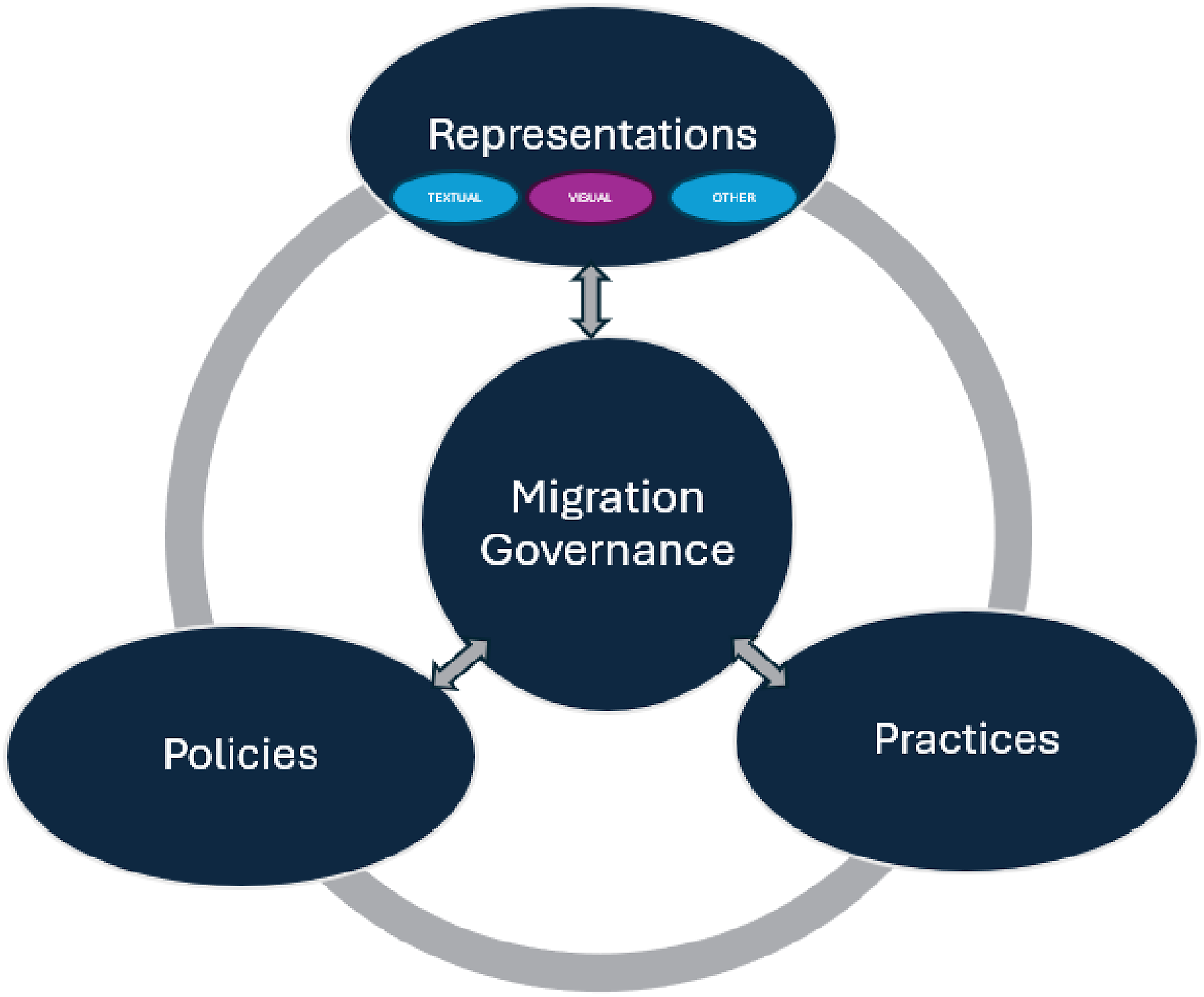
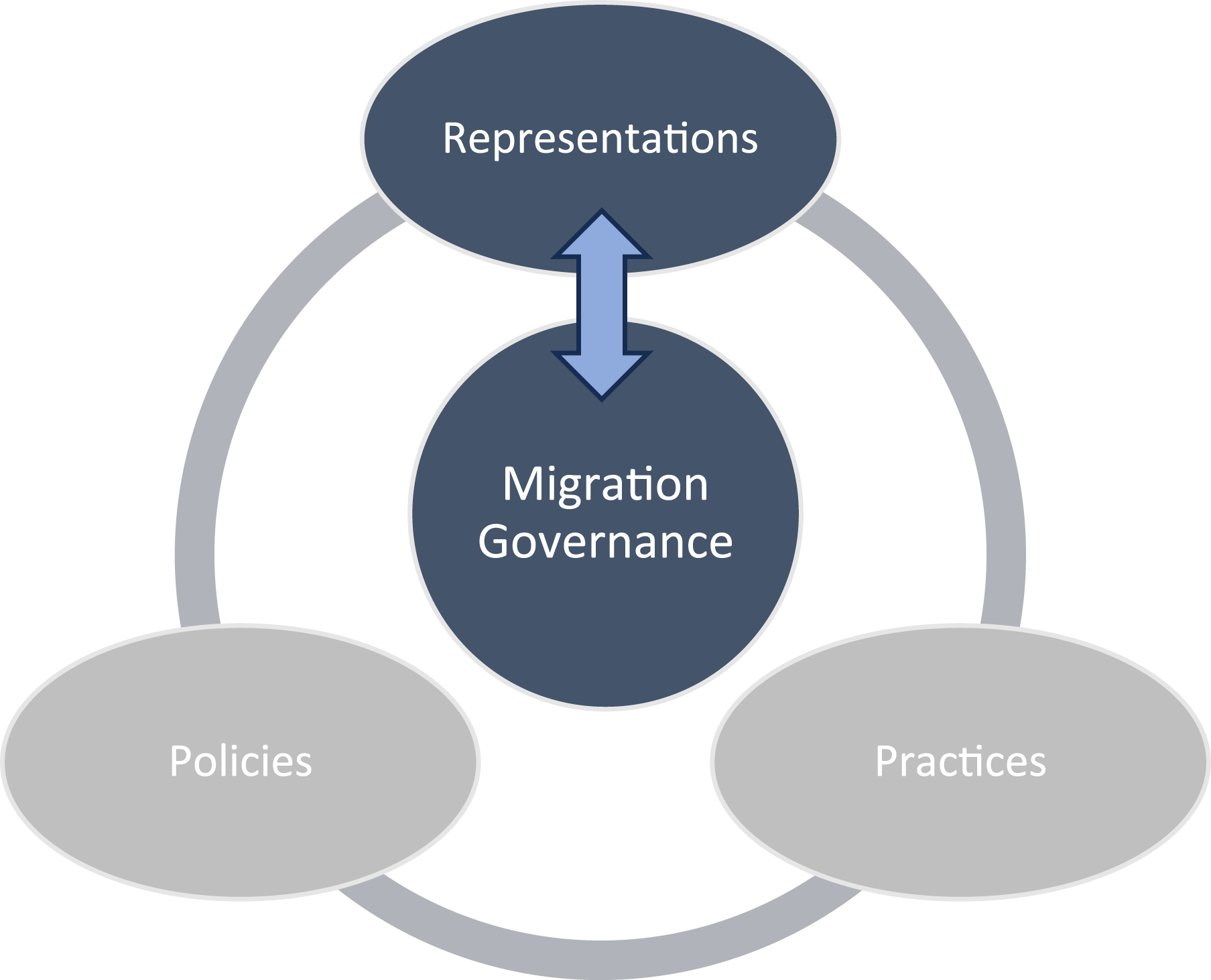
Finally, it is important to include in the framework the images produced by the different actors that, with different capacities, participate to it. Different actors operating at different levels of governance use visual media to try to convey their policies, justify their actions, and influence/mobilize public opinion. As we have seen above, in addition to the role of state actors and state-based transnational actors (e.g., EU) situated at the macro level and the role played by international government and non-government organisation at the meso level, the literature on the digital public sphere points out how also actors situated at the micro level do play a role in the way certain issues are approached. Indeed, images produced by the actors at all levels (macro, meso and micro) thanks to their instant and wide circulation contribute to the iteration between the representation and migration governance.
All different actors contribute, although with different degrees of power, to the creation of representations. Surely, images can both contribute to legitimize or reinforce regulations, as well as to contest and challenge existing power structures and migration regimes. We could go as far as hypotize that actors situated at the macro level produce accounts that are/become hegemonic, while actors located at the meso level are more likely to reproduce or challenge them and those at the micro (individual) level contest them. However, although quite interesting to test, this is probably out of the scope of this specific paper. In this new theoretical framework, visual migration governance can therefore be defined as enactment of governance through visual representations—such as images, videos, maps, and other visual media—created by the different migration governance actors to communicate, regulate, legitimize, or contest prevailing power structures, policies, and practices related to migration.
Conclusion
Visuals have become increasingly influential in the public communication sphere. Advances in digital technology and the proliferation of platforms like Instagram, TikTok, and YouTube have amplified this trend, enabling ordinary individuals and institutions alike to produce, share, and amplify images and videos that contribute to the processes that shape public sentiment and influence policy. This shift is particularly evident in the context of migration, where visual content has also become central to documenting, framing, and influencing perceptions on migration.
This transformation has seen digital and social media platforms being increasingly utilized not only by heads of state, institutions, and politicians but also by international organizations and NGOs working on migration. Individuals have also started to actively utilize these platforms. Alongside the posts of politicians conveing their views on global mobility, we became more and more used to see relief organisations’ campaigns to support people on the move, solidarity movements disseminating information from the different migration routes hotspots, artist dysplaying their artworks on the subject, first-hand accounts of the journey, as well as public’s comments to the various posts and information disseminated. This new communication landscape enabled a broader range of voices and perspectives to be heard, especially highlighting the relevance of individuals, influencers or small groups of people in global debates over a range of interantional and transational issues, and significantly impacting the discourse around migration. Indeed, as the communication realm has become more open and inclusive, so should our explorative gaze. By looking at the different ways in which different actors contribute to shaping representations of migration which in turns influences and are influenced by migration governance decisions, we will be able to shed light on complex interrelation between visuality and migration governance.
If we exclude images from our analysis of migration governance, we risk overlooking a critical dimension that shapes how migration is perceived, framed, and governed. Visual representations are not merely supplementary to governance; they actively contribute to meaning-making, public discourse, and policy formulation. Ignoring the role of images would lead to an incomplete understanding of the iterative processes that connect governance structures with public perceptions and narratives. Without considering images, the influence of visual inputs—such as those depicting migrant journeys, border conditions, and humanitarian crises—on shaping public opinion, policy priorities, and governance strategies would remain unexamined. Furthermore, by neglecting images, we fail to account for the strategic ways actors at different levels use visual content to navigate, reinforce, or challenge governance systems.
Despite significant existing research, this article identifies a continuing gap in comprehensively understanding the intersection of visual representations and governance dynamics. It advocates for a comprehensive approach that fully incorporates the influential power of images in shaping policymaking and public perceptions. By proposing an expanded framework that integrates the visual dimension into migration governance, the study seeks to offer a nuanced understanding of how visuals contribute to meaning-making, policy shaping, and public engagement in an era of digital communication dominance. To do so, the article introduces the concept of “visual governance” a process whereby governance is enacted through visual representations to communicate, regulate, legitimize, or challenge prevailing power structures, policies, and practices. By integrating the visual dimension alongside the traditional focus on policies and practices, the framework highlights the iterative and interconnected relationship between these elements within governance systems. Visuals are conceptualized as both inputs—shaping public perceptions and narratives—and outputs, strategically employed by governance actors to communicate, legitimize, and regulate policies and actions. This dual role positions visuals at the heart of governance processes, emphasizing their capacity to influence and be influenced within a dynamic, hermeneutical cycle. This new framework also allows to acknowledge the multi-actor nature of visual governance, incorporating a diverse array of stakeholders operating at macro, meso, and micro levels. State institutions and transnational entities at the macro level, international organizations and NGOs at the meso level, and individuals and grassroots movements at the micro level all contribute to the production and circulation of visual content.
While this paper foregrounds the visual dimension of migration governance, it is important to recognize that visual representations often operate in conjunction with other communicative modes. Scholars working within the field of multimodality—particularly in critical discourse studies, linguistics, and media analysis—have explored how meaning is co-produced across textual, visual, aural, and spatial resources (Jewitt 2009; Kress and Van Leeuwen 1996). These approaches emphasize that images do not function in isolation but are embedded within broader multimodal ensembles—such as news stories, campaigns, social media posts, or policy documents—where each mode interacts to shape the communicative impact. Engaging with these insights enriches our understanding of how images contribute to meaning-making processes in governance by drawing attention to the hybrid nature of contemporary communicative practices.
This framework, while focused on the visual as an analytical entry point, does not negate the interdependence of visual forms with other modes of representation. Rather, it seeks to isolate and theorize the role of images in migration governance because of their increasing autonomy, reach, and affective power in digital communication contexts. Nonetheless, integrating insights from multimodal analysis allows for a more robust conceptualization of representations as one of the three dimensions of governance (alongside policies and practices). It opens avenues to explore how visuals interact with language, sound, and digital affordances to produce governance effects. Future applications of the visual governance framework could benefit from cross-pollination with multimodal methodologies, especially when examining complex artifacts like NGO video campaigns, interactive border surveillance interfaces, or algorithmically curated social media feeds.
By capturing the complexity of migration governance through this lens, the framework advances a more nuanced understanding of how visuals operate across multiple levels of governance. It challenges the notion of a linear relationship between visuals and governance, instead presenting a dynamic, iterative process where visuals simultaneously inform and are shaped by governance structures. This approach offers a valuable tool for analyzing the role of visual representations in contemporary governance, particularly in the context of migration, and lays the groundwork for further exploration of this under-theorized dimension into the governance of other transnational phenomena.
Footnotes

Funding
The author(s) disclosed receipt of the following financial support for the research, authorship, and/or publication of this article: This project has received funding from the European Union’s Horizon 2020 research and innovation programme under the Marie Skłodowska-Curie grant agreement No. 101024772.
Declaration of conflicting interests
The author(s) declared no potential conflicts of interest with respect to the research, authorship, and/or publication of this article.
Data Availability Statement
Data sharing not applicable to this article as no datasets were generated or analyzed during the current study.