



Abstract
This article examines how racial and linguistic identities are constructed on the Australian reality TV show Border Security. Based on an analysis of 108 episodes of the show involving 253 border force officers and 128 passengers, we explore how the hegemonic Australian identity of the White native speaker of English is constructed on the show. Officers are represented as a relatively uniform group of heroes devoted to protecting Australia’s national security. Simultaneously, most of them look white and sound like native speakers of Australian English. In contrast to the officers, passengers, as their antagonists, do not have a predominant racial or linguistic profile. They are represented as highly diverse. What unites them is not any racial or linguistic profile but that they represent a security risk. Threat thus comes to be mapped onto diversity. The show’s schema of heroes and antagonists invites the audience to identify with the heroes. By identifying with the White-English heroes, the audience also comes to take on their power of judgment over its diverse linguistic and racial Others. The analysis shows how the White-English identity bundle is constructed as the authoritative and legitimate position of the judging knower. The article’s main contribution is to show how the raciolinguistic construct of the White-English complex is made hegemonic in a diverse society officially committed to multiculturalism.
Keywords
How do highly diverse societies come to be imagined as homogeneous?
National identity today is embedded in a perplexing paradox: high levels of ethnic, cultural, racial, and linguistic diversity—sometimes labeled “super-diversity”—coexist with the dogged staying power of discourses that imagine the nation as homogeneous and centered on a core identity. Australia provides an example of this paradox: more than half of the Australian population are overseas-born or have at least one overseas-born parent, and around a quarter of the population speak a language other than English at home (Author, 2021a). Yet, this high level of de facto diversity co-exists with the persistent ideology of Australia as a White and Anglophone nation (Hage, 1998).
The imagery of Australia as a White nation is grounded in a settler-colonial history, which rendered non-British people, societies, languages, and civilizations invisible. Three key elements of this erasure can be identified. First, there is the legal concept of “terra nullius” (“no man’s land”), which posits that Australia was uninhabited prior to colonization and places Indigenous people outside the human and social realm. The terra nullius justification for the British right to rule was only overturned in law by the Australian High Court in 1992 and, arguably, continues to persist in debates over Indigenous sovereignty (Buchan and Heath, 2006).
Second, Australia was founded as a penal colony and the identities of the convicts as forced migrants have been systematically “white-washed.” This is most apparent regarding Irish Catholic convicts, who were transported to Australia as rebels against the Crown. While the British–Irish conflict is central to early colonial history, this conflict has since been erased by re-imagining the initial settlers—and the foundational identity of modern Australia—as a harmonious “Anglo-Celtic” group (Hodge and O’Carroll, 2006). The white-washing of the initial settler population can also be seen from the fact that Black convicts—who accounted for 1–2% of transportees—have been completely expunged from accounts of Australia’s convict heritage (Pybus, 2006).
A third plank in the creation of Australia as an Anglophone White nation is the Immigration Restriction Act of 1901, which was designed to limit non-British immigration and is also known as the “White Australia” policy (Jupp, 2007). Immigration restrictions were progressively relaxed throughout the 20th century. The first step toward abandoning restrictions on non-British immigration was the admission of large numbers of continental European migrants after the Second World War. De facto, origin-based restrictions were abandoned entirely in the 1960s followed by de jure elimination of the policy in the 1970s. Despite the espousal of multicultural policies since then—and concomitant high levels of immigration from a great variety of origin countries, particularly in Asia—Anglo privilege continues to be evident in many aspects of Australian society (Forrest and Dunn, 2006).
In sum, Australia as a White and English-speaking nation has deep roots. However, the staying power of the ideology many decades after its abandonment in law constitutes an ongoing paradox, particularly as non-British Australians and their descendants now constitute a large and ever-increasing segment of Australian society. Even if some migrant groups—such as the Irish mentioned earlier or post-1945 European arrivals—have been absorbed into the hegemonic identity, the question remains how the idea of Australia as a White and English-speaking nation is maintained in the face of great ethnic, cultural, racial, and linguistic diversity.
One answer to this conundrum that has recently been proposed on the pages of this journal relates to Australia’s neoliberal economy (Seet and Zhao, 2021). Immigration, international education, and tourism are key pillars of the Australian economy, even if the 2020 border closures in response to the COVID-19 pandemic may have put them on hold temporarily. This internationalization program rests on the continued attraction of new temporary and permanent migrants, international students, and tourists. The economic desire to attract ever more diverse people to Australia perversely engenders a symbolic need to maintain “a White face” for marketing purposes, as Seet and Zhao (2021) argue. Indeed, the “White face” of Australia—imagining White and English-speaking Australians as core members of the nation and everyone else as peripheral—is widely underwritten by Australians with hegemonic and non-hegemonic identities alike, as we have repeatedly documented in our research (Piller and Takahashi, 2013; Smith-Khan, 2019b; Torsh, 2020).
In this article, we extend the economic perspective provided by Seet and Zhao (2021), to include a security and entertainment dimension in Australia’s White-English paradox. We do so by examining the contradiction between a high level of de facto diversity and imagined homogeneity in the popular reality TV show Border Security: Australia’s Front Line. Specifically, our article has three aims. First, we intend to demonstrate that the show systematically invests English and Whiteness with authority, credibility, and morality. Second, we will show that language and race are closely mapped onto each other to enregister English as White language and people who embody Whiteness as speakers of English. Third, we argue that the show teaches audiences the sensibilities of White-English subjecthood—a perceiving subject that passes judgment on the authority, credibility, and morality of the White-English–speaking Self and its Others.
In the following, we first outline our conceptual framework by describing the literatures on the discursive construction of raciolinguistic identities that undergird our research. Next, we provide an overview of the TV show that constitutes the empirical basis for our research. We then introduce our corpus and interpretive framework before analyzing the racial and linguistic positions of the show’s three protagonists: hero immigration officers, who keep Australia safe; their antagonists, who constitute a potential threat to Australia; and the omniscient narrator, who interprets the story for the audience. We close with implications for sociolinguistic research and multicultural policy.
The discursive construction of raciolinguistic identities
This paper pursues three intertwined research questions: first, how does the combination of English and Whiteness come to be constructed as the default identity and other identities as problematic? Second, how are race and language co-naturalized? Third, how is the combination of English and Whiteness inculcated as the position of the perceiving subject? Our approach to these research questions is guided by three bodies of knowledge, related to the discursive construction of identities in the media, the intersection of language and race, and the constitution of the perceiving subject within securitization. In the following, we will briefly describe each of these.
The discursive construction of identities in the media
The discursive construction of identity has received intense interest in a variety of disciplines at least since the 1980s. The basic assumption is that identities are not given, static, nor inherent to the person. Instead, they are imagined, fluid, and always under negotiation (Anderson, 1991; Le Page and Tabouret-Keller, 1985; Wodak et al., 2009). However, this does not mean that identities are a random free-for-all—nor that all identity options are equal. On the contrary, identity negotiations are constrained by conventionalized identity options and these options are hierarchically ordered. In other words, identity options and the conditions under which they are negotiated are highly unequal (Smith-Khan, 2019a).
An important context where identity options are showcased and become available as models is the media. The media constitute a major source of unequal representations and the valorization of some identities over others. Two findings are particularly pertinent here. First, a large body of work has explored the forms and functions of persistent nationalist, racist, and xenophobic representations in right-wing political discourses in liberal democracies (e.g., Majavu, 2020; Randa, 2017; Sun, 2021). Second, the underrepresentation of minoritized identities in mainstream media has also been noted repeatedly. For example, a recent Australian report into media diversity found that only 6% of newsreaders and no senior managers of the national free-to-air networks are of Indigenous or non-European backgrounds (Author, 2020). The same is true of fictional genres, where Anglo characters continue to predominate despite decades of Australian multiculturalism (Harvey, 2020).
Within the flourishing body of research into the construction of national identities in the media, two gaps can be identified, which our research is designed to contribute to filling. First, we have a good understanding of racially polarizing representations in political discourse. However, less attention has been paid to the ways in which polarized identities are achieved in media discourses that are not ostensibly political and, in fact, committed to a multicultural policy framework. Second, we know that under- or non-representation are key facets of exclusion, but little attention has been paid to reality TV shows such as Border Security, which do feature many diverse characters.
The co-naturalization of language and race
The literatures discussed above focus predominantly on conventionally labeled identities, as they relate to race, ethnicity, nationality, religion, or culture. All these categories are discursively constructed, which means that none of them has an objective reality but comes about in a discursive process (Hill, 1999, 2008). “Race,” for instance, is not a biological or objective category but one that emerges in a process of racialization, where people are socialized into noticing skin color as a meaningful identity signal (in contrast to, say, earlobe shape). Because “race” is not biological but discursive, non-phenotypical identity markers may also be subject to the process of racialization. The emergence of the Muslim hijab as a racial marker provides an example (Al-Saji, 2010).
As in the case of skin color and the hijab, racial markers are embodied and perceived visually. Aural aspects of identity construction have received less attention despite the salient role of language in the performance and perception of identity. “Language most shows a man. Speak, that I may see thee!” as the Renaissance playwright Ben Jonson put it (Schelling, 1892). The intersection of visual and aural identity making has recently come to the fore under the label “raciolinguistics” (for details, see the papers collected in Alim et al., 2020). The key idea behind the co-naturalization of language and race is neatly summed up in phrases such as “Looking like a language, sounding like a race” (Rosa, 2019) or “Hearing faces, seeing accents” (Piller, 2017).
In raciolinguistic identity making, “linguistic and racial forms are jointly constructed as sets and rendered mutually recognizable as named languages/varieties and racial categories” (Rosa and Flores, 2017: 631). In other words, language becomes a proxy for race. This opens the door for racist discrimination even in liberal democracies that have outlawed racism or by people ostensibly committed to anti-racism (or, at least, non-racism). The proxy role of language in racist discrimination has been shown in education (Li et al., 2021; Rosa, 2019), employment (Lippi-Green, 2012; Piller, 2016a), before the law (Eades, 2012; Smith-Khan, 2019c), and in other gate-keeping encounters such as finding housing (Baugh, 2005; Du Bois, 2019). The inverse of the raciolinguistic discrimination described by these researchers is the constitution of the White-English complex as normative raciolinguistic identity.
In sum, a burgeoning body of research is devoted to the co-naturalization of language and race. The focus of this research has been squarely on oppressed identities—how the linguistic and racial Other is constructed and how these constructions may serve to maintain racist structures and enable racist discrimination. Less attention has been paid within this framework to hegemonic linguistic and racial identities. Our research constitutes a step toward correcting this omission by focusing on the construction of the White-English raciolinguistic complex.
Securitization and the constitution of perceiving subjects
The fundamental problem that animates our research—how the paradox between a highly diverse population and a White-English national imagery is sustained—is not only a question of seeing, but also a question of authority, credibility, and morality. Whose perceptions predominate and who gets to pass judgment? Which identities “make sense” and seem credible and who determines what constitutes credibility? Who is accorded the presumption of innocence and good character and who comes under suspicion?
These questions have gained additional weight in the 21st century as some identities have been closely linked to security threats, in what has been termed the “migration–terrorism nexus” (Galantino, 2020). There is an extensive body of research into racial profiling by security apparatuses, in Australia and elsewhere (e.g., O’Brien, 2021; Voigt et al., 2017). This body of knowledge has recently been extended to include raciolinguistic perspectives to demonstrate how language and race intersect to create bundles of identities that are perceived as suspicious and threatening (Bassel et al., 2020; Khan, 2020a, 2020b; Smith-Khan, 2017).
What is largely absent from this work on the construction of threatening, suspicious, or untrustworthy raciolinguistic identities is a focus on how the perceiving and judging subject comes to be constructed. Political scientists have argued that securitization theory is inherently racist as it accords the right to judge what constitutes risk, safety, or security to the White subject (Howell and Richter-Montpetit, 2019). However, work on epistemic racism in the context of securitization mostly lacks a linguistic dimension (but see Khan, 2020b). How do linguistic profiles intersect with racial profiles to shape the position of the legitimate knowledge producer? More specifically, how is the right to judge vested in the position of the White native speaker? We have previously shown how procedural guidance, platform resources, and professional networks work to create privileged knowers (Piller, 2016b, 2019; Smith-Khan, 2021). Here, we extend this work to show how the White-English identity bundle is constructed as the authoritative and legitimate position of the judging knower.
Border Security: Australia’s Front Line
We will now provide an overview to the background of the empirical basis of our work, the reality TV show Border Security: Australia’s Front Line (henceforth, Border Security).
Border Security is a popular Australian reality TV series that is billed as “a fascinating insight into the daily workings of the thousands of officers who dedicate their lives to protecting Australia’s border” by Channel 7, the commercial TV network that produces the show (Author, 2021c). The 7 Network is Australia’s largest media conglomerate (Author, 2021i). Politically, the network has become increasingly conservative throughout the 21st century and has been in a broadcasting alliance with Rupert Murdoch’s Foxtel since 2008 (Author, 2021f; Gillies, 2020).
Each episode of Border Security consists of three or four mini-stories, following immigration, customs, and quarantine officers as they deal with a national security threat. Most of these stories are shot at one of Australia’s international airports and involve three different types of security problems: visa compliance (e.g., is a person entering on a tourist visa really a tourist or someone who is seeking to work illegally?), quarantine matters (e.g., is a passenger bringing prohibited items into the country that might constitute a biosecurity hazard?), and customs issues (e.g., is a traveler attempting to smuggle contraband?). Each plotline basically involves a suspicion, an investigation of the suspicion, and a resolution. In most cases, interrogation of the suspect constitutes a key element of the investigation.
The format is incredibly popular, both in Australia and internationally, with related shows such as Alerta Aeropuerto (various Latin American countries), Border Patrol (New Zealand), Border Security: Canada’s Frontline (Canada), Homeland Security (USA), and UK Border Force (UK). In Australia, Border Security first aired in 2004 and is now running in its 18th season. For most of this time, the show has been “cemented in the TV ratings top 10” (Cartwright, 2014) with more than 1.6 million viewers per week (Author, 2018a)—in a nation of 23 million. Border Security fell out of the top-ranking TV shows in 2019 but that does not detract from the fact that it has dominated Australian reality TV for most of the 21st century so far (Author, 2021h). Its popularity is also evident from the fact that Channel 7 continues to show multiple repeats on its main and subsidiary channels. During the week of writing in May 2021, for example, eight different Border Security episodes were screened on free-to-air television (Author, 2021g). Additionally, episodes are available on various paywalled and open streaming channels and video-sharing platforms.
Commercially successful as it is, Border Security is more than entertainment. The show is the product of a private–public partnership between Channel 7 and the Australian state. The show is underwritten by the Department of Home Affairs, the federal ministry that “brings together Australia’s federal law enforcement, national and transport security, criminal justice, emergency management, multicultural affairs, settlement services and immigration, and border-related functions, working together to keep Australia safe” (Author, 2021e). Prior to the establishment of the Department of Home Affairs in 2017, the show was overseen by the predecessor immigration department (henceforth, “the Department”). The Department allows filming in restricted areas and has final say over what is published, including the right to veto content (Hughes, 2010).
The result of this private–public partnership is a form of “securitainment” (Andrejevic, 2011). Securitainment can be understood as a soft-power approach where a public relations message about national security is delivered in the form of entertainment. Indeed, the show is said to have improved the public image of the Department and the officers who work for it to such a degree that frontline careers have become more popular, and the morale of existing staff has improved (Elder, 2006). The success of improving the image of the Department within Australia has been such that it is now also used as an external soft-power tool, with the Australian Government funding exports of the show to nations across the Pacific in a bid to curb Chinese cultural influence there (Graue and Handley, 2020).
The key message of the show—that the Department and its officers are keeping Australia safe—simultaneously raises public awareness of security risks. Overall, the show instills a sense of danger and risk, and relief that the Department and its officers are averting those risks. At the same time, it must be noted that the risks shown are relatively minor and mostly involve relatively petty matters such as visa overstaying, import of prohibited foods, or small-scale smuggling. More substantial security risks, including any political and intelligence matters, are explicitly excluded from being filmed and shown. As a result, Border Security leads to a “de-differentiation of categories of potential threat” (Andrejevic, 2011: 165) and matters such as those just mentioned come to be seen as undifferentiated risks to national security.
Border Security has to date been the subject of several studies in criminology, law, and media and cultural studies. These have focused on how the show inculcates a neoliberal governmentality in its audiences in that it encourages both self-policing and schadenfreude when wrongdoers get caught in the act (Hughes, 2010; Price and Nethery, 2012). At least one study has noted that the show implicitly constructs national security as a racial problem (Walsh, 2015). This researcher found that non-Australians, visible minorities, people from non–English-speaking backgrounds, and those from poor countries are overrepresented among the show’s villains. We contribute to this body of research by adding a linguistic dimension to the racial perspective. In the following, we will describe our methods of data collection and analysis.
Methods
Throughout 2019, we opportunistically collected 39 episodes of Border Security that were available on Informit EduTV, a streaming database that makes TV shows available for teaching and learning purposes, and on video-sharing platforms Dailymotion and YouTube. A total of 17 of the episodes we had access to are from the period 2004–2009, another 17 are from 2011 to 2018, and the season of five collected episodes could not be identified. It is important to note that there may be a significant time delay, for legal reasons, between the screening date of a show and its filming (Boon-Kuo, 2015).
These 39 episodes include 108 separate plotlines, which constitute our units of analysis. Most of these occur at Sydney’s international airport (71), followed by Melbourne (19), Brisbane (14), Perth (3), and the Gold Coast (1). The matters under investigation include smuggling of drugs and other prohibited goods (45), possession of incorrect or fraudulent visas (34), and bringing prohibited foods or plant materials into the country (29).
The plotlines include 10 hours of spoken interactions, which we transcribed. These interactions usually form part of the investigation and involve one or more officers communicating with one or more passengers about the matter under investigation. These interactions are real (not re-enactments) but obviously heavily edited. The average length of an interaction on the show is 5 minutes. Interactions are complemented by voiceover commentary (which we also transcribed), to-camera commentary by officers, and explanatory writing on screen. Additionally, we collected the summary for each show as it is published in TV guides.
The 108 interactions in our corpus involve a total of 253 officers and 128 passengers. There are also a small number of other characters such as interpreters, local contacts of passengers, and medical officers. In the analysis, here we disregard those and focus on the identities of the officers and passengers. Additionally, we take the voiceover commentary into account.
As we are interested here in the construction of raciolinguistic identities, we undertook three types of analysis. First, we identified all explicit identity references to characters that were verbalized in our corpus. We coded identity references in six different categories, namely, demeanor (e.g., “a
Second, we identified the variety of English or other language used by each interactant as falling into one of the following four categories: “Australian English,” “center English other than Australian” (i.e., British, Irish, New Zealand, North American, and South African), “other English,” and “language other than English.” The distinction between center and peripheral varieties of English is common in English linguistics. Speakers with center English accents are widely understood as native speakers and those with peripheral accents as non-native speakers. While we do not subscribe to these language ideologies, we acknowledge their importance as social constructs. Torsh did most of the coding and about a quarter of cases were moderated by Piller and Smith-Khan, including all that had been flagged as “unsure” in the first round of coding.
Third, we identified the embodied racial identities of interactants, or to be precise, whether they seemed to look white to us or not. We did so fully aware of the dangers of such a project and acknowledge that our perceptions have fundamentally shaped our analysis (see also, Lo, 2021). However, based on previous research (Walsh, 2015), we hypothesized that racial positionings are central to the show’s logic without being made explicit. To test that hypothesis, we needed a way to identify embodied racial positioning. After much discussion and numerous moderation sessions, we opted for a binary scheme of “white-looking” and “other” that suffices for our purposes, as we will explain below. We only classified a character as “white-looking” if we all agreed and if no other evidence was present that pointed to more complex positionings. 1
We will now proceed to show how the identity references, language varieties, and embodied racial identities of characters map onto each other and to what effect.
Officers
The producer of Border Security describes the officers at the heart of the show as “real stars […] forever on the lookout for drug runners, terrorists, illegal immigrants” (Koch 2006). As noted above, one of the show’s functions is to improve the public image of Australia’s national security apparatus and its frontline officers under the guise of entertainment. Therefore, it is not surprising that officers constitute the largest group of characters on the show. Although, in real life, passengers far outnumber officers at any airport, including in the restricted areas, this is different on the show. In our corpus, officers (253) outnumber passengers (128) by a ratio of one to two.
Officers not only dominate numerically but also by being presented as a highly homogeneous group. This homogenization happens in three ways. First, of all the identity references we examined, only name and occupation are ever stated for officers, and the occupation term is obviously always the same, “officer.” Oftentimes, these identity references are not even individuated, as in the following examples:
Where they are individuated, the most frequent reference pattern is title plus given name, as in these excerpts:
While
The reason why officers are never referred to in terms of other identity categories is obvious. Their occupation coincides with their role, and their demeanor, gender, and nationality are irrelevant to the story. Furthermore, their nationality is known information because only Australian citizens are eligible for employment with the Department. The same can be said for language status, in that they obviously need to be able to speak English to be employed. What is newsworthy is when officers have skills in a language other than English and those skills are useful in the investigation. There is only one single example of such a language-related reference to an officer in our corpus:
A
While the reasons for the absence of identity references other than role and name are pragmatically obvious, the effect is to construct a strikingly uniform cast of officer characters.
The uniformity in identity descriptors is further reinforced visually. Officers present a homogeneous group image first and foremost because they wear uniform. The current uniform consists of a blue short-sleeved shirt and pants with the phrase “Australian Border Force” stitched in prominent golden thread and capital letters above the left breast pocket. The shoulder strap has a rank slide with the officer’s rank indicated by the number of golden lines. Both upper arm sleeves have a sewn-on stitched epaulette displaying the Australian coat-of-arms. The Australian coat-of-arms is a shield displaying the symbols of the six Australian states—the Cross of Saint George for New South Wales, the Southern Cross for Victoria, the Maltese Cross for Queensland, a native piping shrike bird for South Australia, a black swan for Western Australia, and a red walking lion for Tasmania. The shield is held up by a kangaroo and an emu and the word “Australia” is written underneath. This coat-of-arms is framed by a laurel wreath into which the words “Australian Border Force” are stitched. The emblem is topped off by the British Imperial State Crown, which is itself headed by another cross. The uniform also includes the officer’s removable metal name tag above the breast pocket. Additionally, officers wear lanyards with a swipe card and a photo ID around their necks. The lanyards have “Australian Border Force” printed on them as running text (see Figure 1). Screenshot from Border Security showing officers in uniform.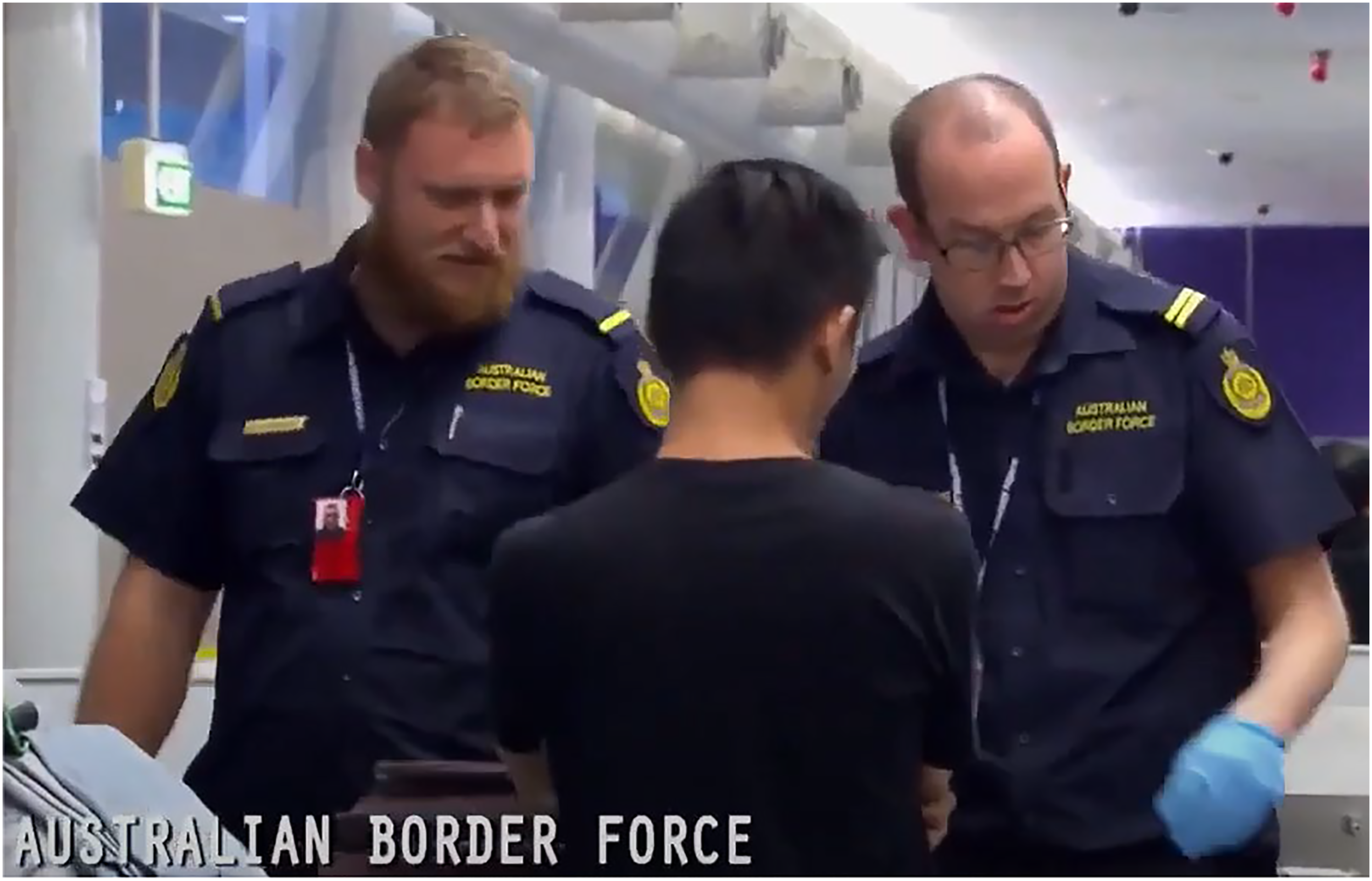
Although the color and style of uniforms have been redesigned a few times over the years the show has been running and at times have varied across the different agencies (customs, immigration, and quarantine), the overall effect is clear. Officers are homogenized into their group role as representatives of the Australian state and its security apparatus.
Officers’ position in the White-English complex.
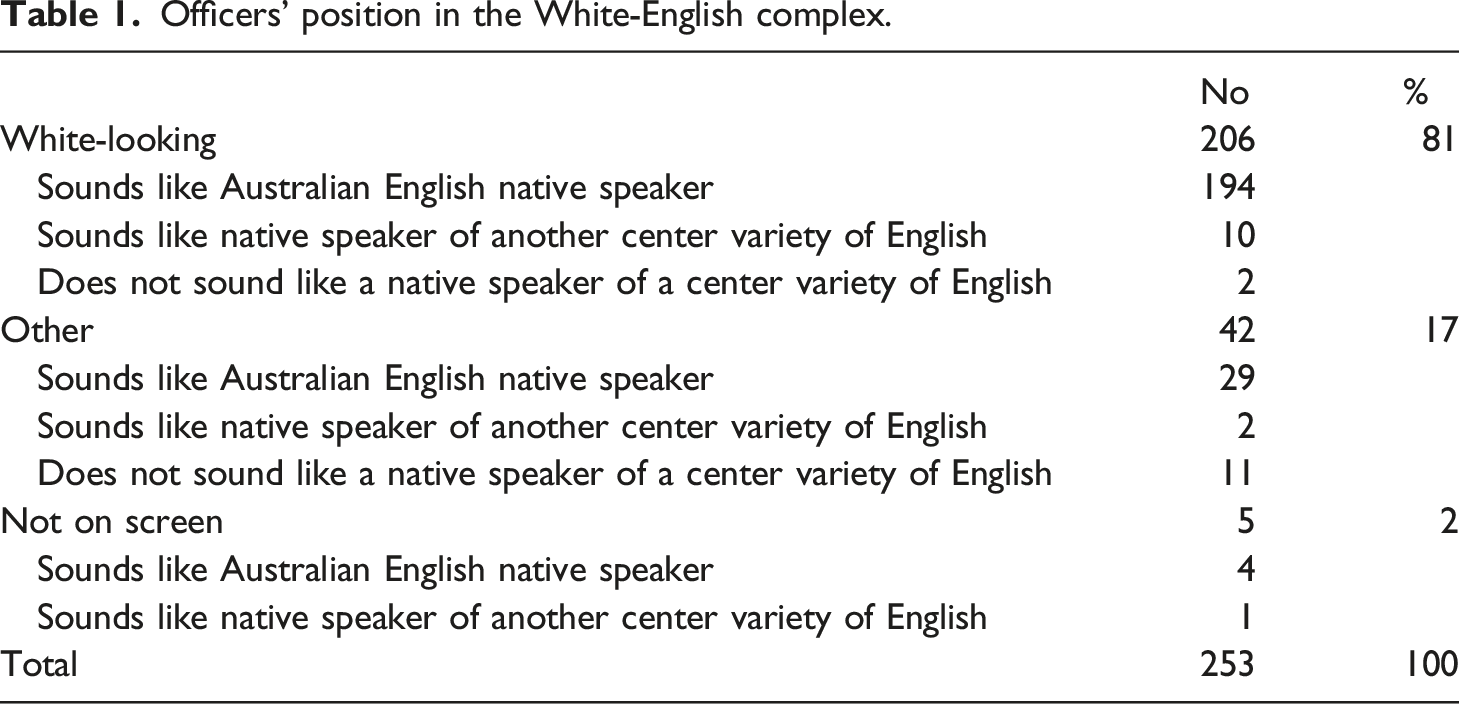
In addition to the high level of homogeneity with which officers on Border Security are represented, the impression of their relative uniformity also emerges against the high level of diversity of the group they are contrasted with, as we will now explain.
Passengers
While officers appear as relatively uniform, the opposite is true of their antagonists. As we pointed out above, the narrative schema always follows the arc of suspicion, investigation, resolution. Resolution means that the suspicion is either proven or not. In about two thirds of cases (77/108), the suspicion is confirmed. The resulting penalty includes having to pay a fine (24), being deported (23), being taken into custody (13), receiving a written warning (7), or having goods seized (4). In six cases in the corpus, the penalty is not explicitly stated. In 31/108 interactions, the passenger is either found to be innocent or is let off without a penalty. Overall, a cloud of suspicion hangs over civilians throughout the show and the officers’ suspicions are shown to be warranted because they have a high likelihood of being confirmed.
The format of the show entails that officers have a clear identity (see above) while their antagonists do not. Many of the identity references applied to antagonists are highly general terms such as “man,” “woman,” and group references such as “family,” “father and son,” or “husband and wife.” Additionally, identity terms that reference mobility are frequent, such as “backpacker,” “passenger,” “traveler,” “tourist,” and “working holiday maker.” Terms for antagonists also explicitly indicate them as wrongdoers, as in “drug smuggler,” “non-declarant,” or “illegal worker.” The adjective “illegal” is more likely to be applied to things and activities than to people, though (e.g., “carrying an illegal weapon,” “hiding something illegal,” “working illegally”).
This generic cast of suspect characters comes from all over the world, and nationality references are applied liberally and permeate almost every single interaction. The most frequently identified nationalities by far are “American” (42) and “Chinese” (40), as in these examples:
An
We’ve got a
The next frequent nationality reference is to “Canadian” (18) but our main finding is that many nationalities only occur once or twice, 2 creating the impression that the main commonality of antagonists is precisely their diversity, as in these examples:
A
A
A
The implication of this great diversity among antagonists is that diversity per se is suspicious. Another way to make diversity suspicious is by singling out cases of citizens or residents of Australia or other countries of the Global North who are not White, as in the following examples:
The French passport belonging to
A
Some herbal products found in the bag of a
Passengers’ position in the White-English complex.
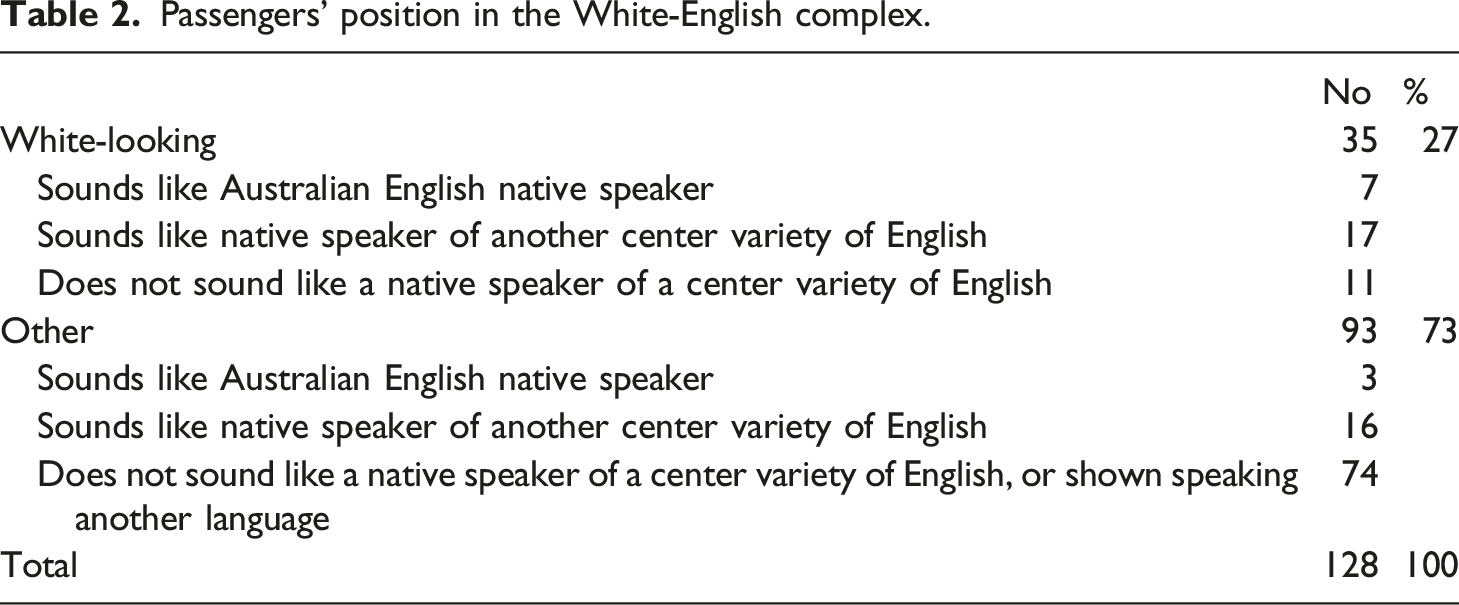
The diversity of antagonists in terms of their appearance is made even more salient by the contrast with uniform-wearing officers. Not only do antagonists obviously not wear uniform but many of them look quite disheveled and unkempt. This is not surprising after having been en route to Australia for more than 24 hours, as is usually the case from Africa, the Americas, and Europe.
Additionally, minority sexual or religious identities seem overrepresented among antagonists. That the show may indeed target passengers with high sensational value was revealed in 2014, when the African-American transgender woman and sex work activist Monica Jones alleged that producers and officers had collaborated to pressure her to appear on the show (Safi, 2014).
In sum, the identities of antagonists have little in common with each other besides what they are not. Ex negativo, they are positioned outside the White-English complex.
The omniscient narrator
In addition to officers and their antagonists, the show includes a voiceover narrator, who is present in each episode. The narrator is never seen but only heard. The voice actor behind the narrator has not changed since 2004. The voice belongs to Grant Bowler. Grant Bowler is known to be a middle-aged white Australian man who speaks in a Standard Australian English accent. Grant Bowler was already well-known before he became the narrator on Border Security for his role as a police officer in the popular fictional police drama Blue Heelers. In addition to being known for his portrayal of the police officer character that launched his career (Author, 2021b), the actor is highly committed to the show’s national security message, as he explained in an interview: I think the show is reassuring to people in a very frightening time. […] I think it is nice for an audience to be able to turn on the television and see that they are protected. We live in an age of terrorism; we live in frightening times. It’s kind of become a global village, and along with that you tend to get all the village idiots wandering around freely at will. (quoted in Koch, 2006)
While the show itself is entirely free of offensive references to passengers such as “village idiots” in this interview, the dichotomy between “good” officers and “bad” antagonists is fundamental to the show’s logic. The narrator serves to make this logic explicit, over and over again. Officers are the good guys, the protectors of Australia’s national security, those who keep the audience safe. The threat emanates from the officers’ antagonists, a cast of highly diverse individuals who have three things in common: first, they are suspicious, second, they do not look white, and third, they do not sound like native speakers of (Australian) English.
The role of the narrator is to explicate what is going on to the audience, to provide insight into the officers’ reasoning, to move the narrative along by summing up vital information that is not shown, and, crucially, to provide judgment. This uniformly involves voicing suspicions, insinuating threat, or warning of danger. Statements about dangers to national security and how they are averted, are often generalized, as in the following examples:
Immigration officers are trained to identify passengers displaying suspicious or unusual behavior. Often there is a lot of confusion about a passenger’s true intentions. [italicized words are spoken emphatically]
Customs and border protection officers know that threats to Australia’s border can come at any port. That’s why they maintain a strong presence at all international terminals.
Customs and border protection detector dogs are part of the frontline, safeguarding our borders against any illegal activity.
In addition to such general statements about national security, the narrator also voices suspicions of specific threats, as in these examples:
A passenger returning from Vietnam has failed to declare an exotic medicinal tea that’s infested with what officers suspect is a dangerous pest.
One other small but suspicious detail has been noted by supervising officer Mark.
Officer Matthew discovers a final piece of evidence, which confirms his suspicions and could land this passenger in a lot of trouble.
All these general and specific statements about suspicion, danger, threats and their opposites, safety and security, are delivered by the disembodied voice of the narrator. Although unseen, the identity of the actor voicing the narrator is known to be that of a middle-aged male white native speaker of Australian English. The effect on the audience is similar to the way in which the Christian God is not believed to have an embodied identity yet is widely imagined as an old white man (Blum and Harvey, 2012). Indeed, the narrator functions as a kind of Freudian super-ego, who becomes the internalized voice of the audience. This super-ego socializes the audience into seeing two groups of people: white-looking English-speaking hero officers, and other-looking and other-sounding diverse villains.
Conclusion: the White-English complex
The key findings of this research can be summarized as follows. First, by showing the cast of hero characters as predominantly white-looking and English-speaking, Border Security constructs a White-English identity complex as the default identity of representatives of the Australian nation. Other racial and linguistic identities come to be seen as problematic simply because they are antagonists of the heroes. In contrast to the officers, these antagonists do not have a predominant raciolinguistic identity. They are characterized by who they not, rather than by who they are.
Second, race and language are co-naturalized in the White-English complex as one constituting the other. Where diversity is admitted into the hero identity—and we must not forget that Australia has officially embraced multiculturalism, both as national policy and as fact of the ethnic diversity of its population, for a number of decades, as we noted in the introduction—language is a greater marker of Otherness than embodied identity in our corpus (see also, Tankosić and Dovchin, 2021). After all, 42/253 (17%) of officers do not look white but only 13/253 (5%) speak with a non-native accent.
Third, the show’s schema of heroes and antagonists invites the audience to identify with the heroes. As we have amply demonstrated, these heroes’ identities sit at the center of the White-English raciolinguistic complex. Their antagonists’ identities, by contrast, are outside that complex and are highly diverse. By identifying with the heroes, the audience also comes to take on their power of judgment over the diverse Other. This power of judgment is further reinforced by the disembodied voice of the omniscient narrator who speaks from an imagined position at the center of the White-English raciolinguistic complex.
Our findings have implications for sociolinguistic research and multicultural policies. Sociolinguistic research into linguistic inequality has long focused on linguistic minorities and their disadvantages. As we have demonstrated here, a focus on linguistic privilege is equally important, if not more so. To understand how race and language intersect to produce disadvantage, we need to be more clear-eyed about the other side of the coin and examine how racial and linguistic privilege is produced and maintained.
The same is true of multicultural policies. In Australia, multicultural policies are usually perceived as being for the people who are not White and English-speaking, as is demonstrated by policy terminology about “culturally and linguistically diverse (CALD)” or “non-English-speaking background (NESB)” Australians. Both these terms reproduce precisely the dichotomy that the story schema of Border Security hinges on. These terms may be neutral in policy discourse and the show’s negative value judgment may be absent. Nonetheless, by setting up this precise dichotomy between Anglos and the rest, or insiders and outsiders to the White-English complex, the terminology of Australian multicultural policy enables the continued construction of Australian identity as the exclusive birthright of White and English-speaking Australians. Border Security then exploits this construction to offer security within the borders of English and Whiteness.
Footnotes
Acknowledgments
We gratefully acknowledge research assistance provided by Dr Gegentuul Baioud and feedback on previous versions of this manuscript provided by Dr Alexandra Grey, Dr Loy Lising, and three anonymous peer reviewers.
Declaration of conflicting interests
The author(s) declared no potential conflicts of interest with respect to the research, authorship, and/or publication of this article.
Funding
The author(s) disclosed receipt of the following financial support for the research, authorship, and/or publication of this article: This work was supported by Humboldt Foundation.
