




Abstract
The burkini ban introduced by several French coastal cities in August 2016 caused a great stir in France and abroad. Discussions were mostly articulated around the topics of secularism, religion, and national identity and values. This study examines foreign perspectives on the burkini ban in France to gain insights into the construction of cultural realities. Informed by Cultural Studies and Critical intercultural communication, this study approaches the construction of cultural realities by investigating the articulation of similarities and differences. A thematic analysis of newspaper articles (N = 167) from the United States, Canada, the United Kingdom, and the Republic of Ireland was conducted to identify the categories evoked to construct similarities and differences. Findings indicated subtle shifts between old and refined commonalities. Throughout the data, France was cast away and represented as “the deviant other” while Muslims and Islam were associated with representations of “us.” However, underlying tensions indicated ambivalence in the redefinition of symbolic differences and similarities. Specifically, the figure of the Western Muslim and the construction of the burkini as “appropriate difference” suggested the persistence of hierarchical relations between “us” and “them.” Cultural realities therefore appeared to be both liquid and solid. In addition, findings underlined the dialogic construction of cultural realities as differences and similarities were constructed at different levels (national and transnational) that became meaningful through their interactions.
Keywords
Introduction
Overview of the main events related to the burkini ban in France.
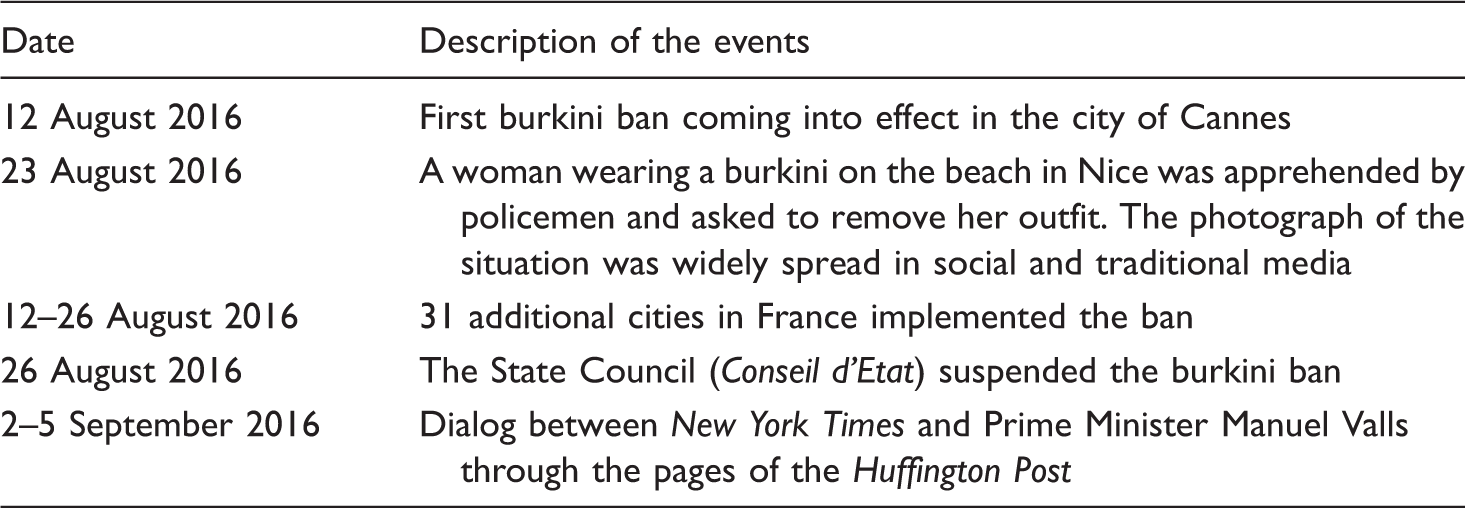
This study focuses on the burkini ban because of its resonance across countries and in the media, as well as the topics brought up in relation to it. Discourses about the burkini ban touched upon a variety of notions ranging from culture, religion, secularism, Islam, the West, and collective identities. Exploring the articulation of these issues to construct impressions of sameness and difference can therefore offer relevant insights into the construction of cultural realities. This study draws on previous research from cultural studies and critical intercultural communication about media representations and postracial expressions of racism in the media. Focusing on newspaper discourse about the burkini ban, this article poses the following questions:
What differences and similarities were mentioned in the articles collected?
Around which notions were similarities and differences constructed? With/against whom were similarities and differences constructed?
The data (N = 167) were collected from eight newspapers from four countries (United States, Canada, Republic of Ireland, and United Kingdom) and analyzed using thematic analysis. By choosing newspapers from abroad, this study sets out to explore how the notions of similarity and difference were utilized in the data when talking about the burkini ban implemented in France. Findings indicate subtle articulations of existing and new oppositions between us and them. Renegotiations of existing categories draw attention to (i) the different levels (national and transnational) coming into play, (ii) the solid and fluid aspects involved in constructing cultural realities, and (iii) overall dialogic process.
Theoretical background
Constructing cultural realities
Polemics about the burkini ban touched upon issues ranging from national identities and values, to culture and religion. This event therefore stands as a relevant case to examine processes associated with the construction of cultural realities. Exploring cultural realities builds on postmodern assumptions about the notion of culture being a fluid, discursive, and interactional resource that “exists only insofar as it is performed” (Baumann, 1996: 11). From that perspective, culture is associated with the construction of symbolic similarities and differences used at individual and institutional levels to include as well as exclude (Dervin and Risager, 2015; Piller, 2011; Sommier, 2016). This study focuses on newspaper discourses given the explicit role of the press to construct imagined communities. As Anderson (1991) argued, media contribute to convey a sense of similarity among individuals through the common practices and knowledge they share. This sense of commonality comes hand in hand with the construction of differences and barriers with others (De Cillia et al., 1999). Exploring newspaper discourse supposes that symbolic similarities and differences are constructed at the national level. Nevertheless, representations of national imagined communities can be diverse and latent. De Cillia et al. (1999: 169) point out that “The term ‘Austrian nation’ often does not occur explicitly in [their] data.” National identity and representation are typically constructed in more implicit and complex ways. The authors, for instance, point out the complementary use of references to both national culture (Kulturnation) and national institutions (Staatsnation) (De Cillia et al., 1999). Holliday (2016) also emphasizes the interplay between individual and institutional discourses in constructing cultural realities. Studies looking at the construction of cultural realities have revealed complex interplays between existing static representations and their appropriations by individuals and across discourses. These research paths expose the limits of “methodological nationalism” (Holliday, 2010: 166) and highlight the importance of inductively uncovering the various meanings attached to cultural realities (Sommier, 2016). For this reason, this study focuses on the articulation of differences and similarities as a way of identifying what (and how) cultural realities are constructed in the newspaper articles selected for analysis.
Secularism in France
Some of the mayors who passed municipal orders argued that wearing the burkini on public beaches was a violation of the principle of secularism. This argument was criticized for misinterpreting the law that forbids (mostly civil servants) from displaying religious affiliations in public services but not in public places (Veille, 2016). However inaccurate the claim was, it draws attention to the salience of secularism in the public and political debate in France. The system of separation of State and Church in France (laïcité) is intertwined with numerous societal, cultural, and political issues, which makes it a complex and often polemical topic. Several studies have pointed out the pitfalls of this system and drawn attention to the unequal representations it can sustain. Researchers have cast light on the bias of secularism in France toward Catholicism and the concomitant pressures it puts on Islam and Muslims (Adrian, 2009; Bhandar, 2009; Doyle, 2011). Critiques have also discussed the embeddedness of French secularism in republicanism which emphasizes uniformity as a means to achieve equality regardless of origins, religions, or beliefs (Brubaker, 1992). This framework typically stands in opposition to multiculturalism and the recognition of official minorities (Baubérot, 2007). It is based on this framework that any statistics related to religious or ethnic belonging are forbidden in France (Cervulle, 2013). The emphasis placed on uniformity has, however, been criticized for creating unattainable integration goals and deepening inequalities (Hancock, 2008; Raveaud, 2008).
Jugé and Perez (2006) argue that uniformity, like universality, often mirrors the status quo and lifestyle of the majority, which hints at a larger problematic associated with color-blind ideology. Previous studies have pointed out the paradoxical fear of communitarianism in France that blames minorities for identifying as communities while dominant discourses tend to construct them as such (Geisser and Zemouri 2007; Sommier, 2017). This is particularly problematic for religious minorities who stand out in contrast to the invisible secular majority (Sommier, 2017). The prominent (yet false) representation of secularism as inherently and originally French (Baubérot, 2007; Baubérot and Milot, 2011) also contributes to tying laïcité and French identity together. The articulation of differences in France through the lenses of religion and secular practices echoes racial oppositions inherited from the colonial period. The opposition between Muslims and French is indeed reminiscent of that between Caucasian French, and Arabs, Maghrebi, or North Africans (Deltombe and Rigouste, 2006; Fellag, 2014).
These differences have been further emphasized by the political use of secularism in France, as illustrated by the burkini case. As an important national symbol, secularism has been woven into political agendas to defend specific perceptions of the nation and its identity. The National Front has very vocally associated secularism with national identity and traditions, and with opposition to Islam (Laoukili, 2005). The use of secularism in discourse to construct enemies dates further back and indicates shifts in society. Baubérot (2007) explains how oppositions went from antagonisms between secularism and Catholicism to hostilities between secularism and Islam. The latter opposition has been crystallized in the opposition toward the veil which has defined much of the polemics associated with secularism in France since the end of the 1980s.
Representations of Islam in the media and expressions of racisms
Discourses circulating in France about religion, and the status of Muslims in particular, are embedded in larger representations about Islam. Events in the past 20 years have been associated with negative discursive dynamics whereby Islam and terrorism are often conflated (Vanparys et al., 2013). Previous studies have drawn attention to the role played by media discourse in conveying biased and monolithic representations of Muslims (Saeed, 2007). Numerous studies have focused on representations of Islam and Muslims in European media. Their findings emphasized ways in which Muslims tend to be constructed as different by emphasizing Islam as foreign, dangerous, and overall at odds with European imagined communities (see, e.g. Miera and Sara Pala, 2009; Moore et al., 2008; Poole, 2002; Richardson, 2010).
These representations are relevant to consider in light of the shifts that have characterized expressions of racism. Scholars have pointed out the renewal of racist discourses that moved from racial and biological claims to ethnic and cultural arguments (Lentin, 2004; Mason, 2000). Within these discourses, the construction of sameness is not articulated around explicit mention of racial similarities. Instead, the emphasis is placed on the cohesiveness of the imagined community and ideas of cultural similarities (Gilroy, 1992; Hall et al., 1992). This shift is further supported by discourses entrenched in Orientalism (Said, 1978) and that deploy ideas about a Clash of civilizations (Huntington, 1996) between the West and the Rest (Hall, 1992). Such discourses underline the symmetry between racism intertwined with colonialism and concepts of biological race, and current forms of cultural racism relying on cultural incompatibility between white majorities and Muslims. Construction of differences through the lens of national identity, representations of Muslims as others, and a sense of threat associated with the conflation of Islam and terrorism have laid the grounds for predatory identities. Appadurai (2006: 52) explains that the discursive logics associated with the emergence of predatory identities: “are based on claims about, and on behalf of, a threatened majority. In fact, in many instances, they are claims about cultural majorities that seek to be exclusively or exhaustively linked with the identity of the nation.”
Appadurai’s discussion of predatory identities underlines the relevance of investigating which concepts are brought up to construct differences and similarities. Polemics surrounding the burkini ban echoed tensions about representations of Muslims and relations between us and them. Exploring media discourses about this event therefore offers opportunities to explore lines along which difference and similarity are constructed, which draws attention to wider processes of constructing cultural realities.
Data and methods
Data
Newspapers used for data collection.
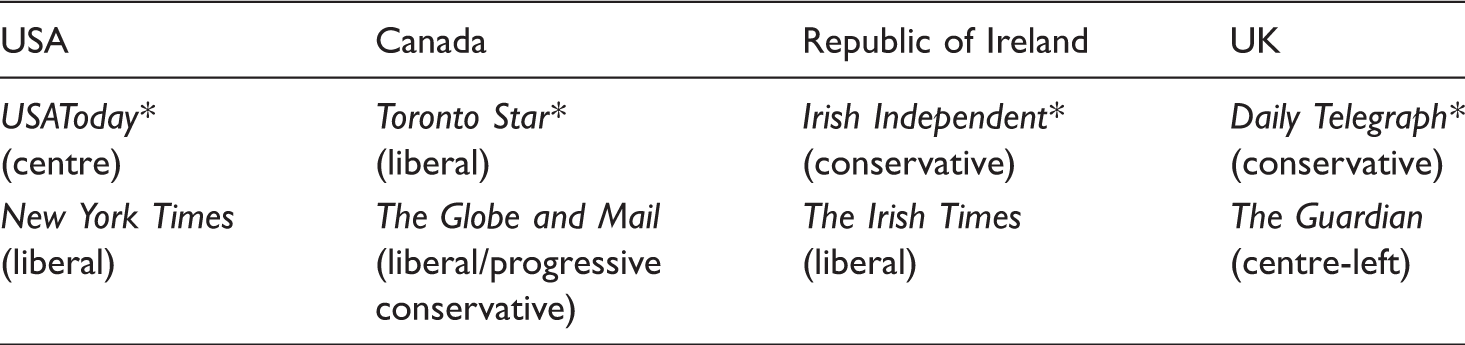
Titles marked with an asterisk have the highest circulation rates.
Number of articles collected per newspaper and country.
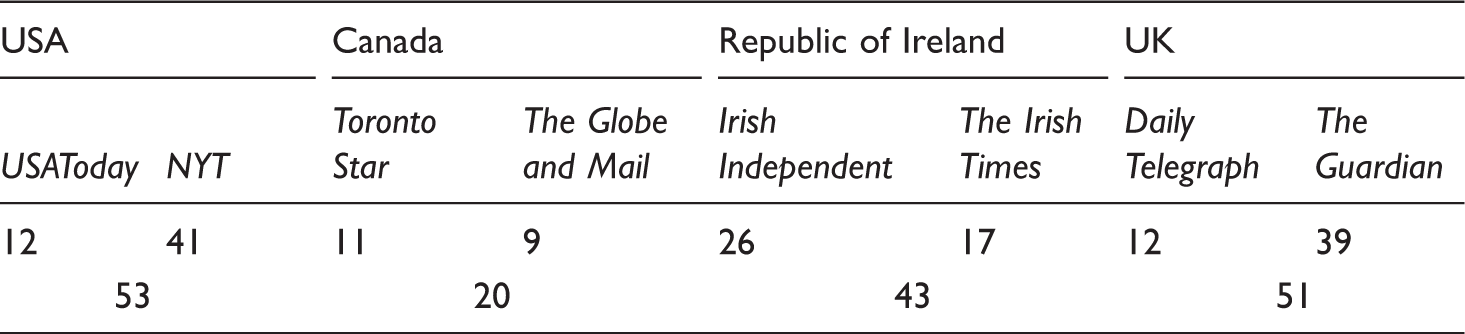
Analysis
Data were analyzed using thematic analysis in order to explore in depth which elements were used to construct similarities and differences. A three-step coding approach was used that included open, axial, and selective coding stages (Boeije, 2010). This approach ensured a systematic and iterative reading of the data, which is a critical aspect for internal validity (Silverman, 2011). The different steps of the analysis enable a progression from linear coding focused on overt meanings to an integrated reading of the data that uncovers implicit meanings and connotations. The very first step consisted of reading the whole data set and taking notes about the issues perceived as relevant in the articles. Following this preliminary stage, codes were systematically assigned by reading all of the articles collected and constantly navigating between data and codes to evaluate and negotiate repetitions and overlaps. During the axial coding phase, all codes and associated fragments from the data were organized into a common file in order to identify and gather similar elements. The following thematic groupings were created at this stage:
Singling out France (laïcité and religions in France, history of the country, stereotypes and jokes, political life and debates); Islam and Muslims (discriminations in France, immigration and integration, Muslim voices, talking on behalf of Muslims, Muslim women, Muslim practices); Entities, groups, communities (national representations, Europe, feminists, oppressed versus elites worldwide, people outside of France, Western values); Terrorism (past events, fueling new attacks).
In the last phase, codes, thematic groupings, fragments from the data, and all notes made during the analysis were read through again. This process enabled comparing and contrasting the emerging analysis with the raw data to ensure that decisions made throughout the process were coherent (Boeije, 2010). Two main themes were identified as underlying and connecting the thematic groupings developed in the preceding phase. Namely, the construction of France as the deviant case and the idea of “appropriate difference” were identified as significant themes through which differences and similarities were articulated in the data.
Findings
The coverage of the burkini ban in France offered insights into the (re)negotiations of meanings and oppositions. Specifically, what it means to be French, Muslim, and to belong to the West were actively discussed in the data. Overall, findings suggest that France was cast away and represented as “them” while the idea that Muslims belong with “us” was reinforced. However, underlying tensions indicate ambivalence regarding the redefinition of symbolic differences and similarities. The construction of the burkini as an “appropriate difference” and the preservation of similarities with France indicate a complex interplay between persistence of established representations and emergence of new groupings. The two main themes along which differences and similarities were constructed in the data (i.e. the construction of France as the deviant case and the idea of “appropriate difference”) will be presented in detail after discussing differences and similarities among the newspapers used for data analysis.
Similarities and differences among newspapers
The vast majority of the articles criticized the burkini ban and discourses among newspapers were fairly homogeneous. A few discrepancies were, however, identified between the four newspapers of records (more liberal) and the four newspapers with the highest circulation rates (more conservative with the exception of the Toronto Star). Throughout the data, only four articles out of 167 supported the ban. All four articles were published in the more conservative outlets (i.e. Mortimer, 2016, USAToday; Pearson, 2016, Daily Telegraph; Woods, 2016a, Daily Telegraph; Woods, 2016b, Irish Independent) therefore echoing their traditional editorial line. The same newspapers also published pieces aligned with discourses circulating in the rest of the data and criticizing the ban. However, articles published in the more conservative newspapers tended to give more importance to criticizing France than to including Muslims. On the other hand, the newspapers of records (i.e. The New York Times, The Guardian, The Irish Times, The Globe and Mail) integrated both strategies of excluding France and including Muslims. The more multifaceted discursive strategies used in the newspapers of record could result from their liberal political leaning, editorial tradition, as well as the fact that they published more articles overall (106 out of 167). Discrepancies between the newspapers could suggest that the burkini ban was widely criticized (and so was France for implementing it), but that the validating of the burkini and welcoming of Muslims was limited to a (more liberal) fringe of the media.
Constructing France as the deviant case
Throughout the data, the criticisms were targeted at the ban but also at France for implementing it. In numerous occasions, the burkini ban was presented as a typical French incident. Many articles pinpointed elements of the French society that would illustrate how and why the burkini ban was happening in France. This process of essentializing the burkini ban as an instance of Frenchness was supported by (i) the representation of laïcité as a French exception intertwined with (ii) references to the past and French history, as well as (iii) the use of French clichés.
Many articles criticized French secularism by presenting it as an institutionalized form of discrimination, as in the following extract: It may seem a minor point [the misunderstood difference between public space and public services] but it is crucial in attempting to understand
The problems presented in the data were typically associated with the idea of French exception. The idea of France facing a unique situation was conveyed through different arguments, from terrorism, immigration, and religious practices, to jokes and stereotypes. The following extract illustrates the depiction of France as an exception regarding the status of religion: “Religious clothing is particularly sensitive in France, where an unusually large part of the population has no religious affiliation, and where the first provision in the constitution says France is a ‘secular Republic’.” (Irish Independent, 26 August 2016).
Several other articles used more humorous tone to construct the burkini ban as an instance of Frenchness by building on an existing repertoire of popular jokes and stereotypes. The following quote illustrates the use of clichés about the assumed status of sensuality and sexuality in France: The French beach, after all, is sacred ground, where the female form is religiously flaunted and fawned upon. It’s no coincidence that the world first discovered Brigitte Bardot sprawled out on le sable in a movie called And God Created Woman. So perhaps nothing constitutes more of an affront to the French way of life than the sight of a burkini on the Riviera. (Yakabuski, 22 August 2016, The Globe and Mail)
In contrast with humorous comments mentioned previously, sharp criticisms were voiced in the data. Words used to criticize the burkini ban were often very strong: “what complete bunk” (The Globe and Mail, 24 August 2016); “ridiculous bans” (USAToday, 28 August 2016); “The images are preposterous as well as ugly” (The Guardian, 24 August 2016b), as several argued that “France has dug itself into a hole it needs to climb out of quickly” (Nougayrède, 26 August 2016, The Guardian). Articles also drew attention to the responsibility of France in fueling terrorist attacks because of the burkini ban. Unequivocal condemnations of France created a sharp division between “us,” those passing the judgment, and France, the defendant. This separation was further validated through the theme of French decline that emphasized the values betrayed by France and that used to define it (when it belonged with “us”). The burkini ban was thus presented in the data as “a sad sign of liberalism going backwards in France” (Ebner, 27 August 2016, Irish Independent). France was urged to “recommit itself to combating prejudice against Muslims” by reconnecting with the values that shaped it: “Paris was not built on backwardness or barbarism or misogyny. Its luminous appeal to all humanity stems from the Enlightenment” (Cohen, 18 August 2016, The New York Times). The theme of French decline enabled pointing out what no longer corresponds to France while underlining what still characterizes “us.”
The theme of French decline was also conveyed through the parallel made between France today and conservatives from the past, for instance those who first opposed the bikini. In addition, France was associated with current conservative figures that are typically presented as “our” enemies today. Comparisons with Saudi Arabia, Iran, Islamic extremists, Taliban and “extremist religionist men” (Mallick, 29 August 2016, Toronto Star) in general emphasized representations of France as deviant. By posing the following question: “How is France, with its national commitment to secularism, any different from Saudi Arabia, with its national religion of Islam?” (USAToday, 28 August 2016), these articles essentially posed the question of whether France still belongs with “us.”
The burkini as “appropriate difference”
There seemed to be an inclination across data to refer to an imagined community beyond the national scope. Similarities were indeed suggested across borders as the burkini ban was assumed to have caused “shock and anger worldwide” (The New York Times, 26 August 2016). Similarities were suggested among deterritorialized communities with an emphasis on the people (versus the elites embodied mostly by politicians and to a lesser extent by the media), minorities around the world, and women’s right in particular: What is it about women’s swimwear and more generally women’s attire that over and over in history has attracted controversy and impelled societies to legislate or regulate women’s choices? Historians, sociologists and anthropologists have argued about it for decades, but the seemingly simplistic statement that women’s bodies are a battleground has some truth to it. Formally or informally, men (primarily) have been making rules about women’s attire for a very long time. (Rubin, The New York Times, 27 August 2016b) It’s not just clothes and fashion that the religious are adapting to meet the needs they have as western Muslims. You can watch non-swearing stand-up comedians joke about ‘flying while Muslim’, as you eat turkey bacon on your pizza and drink non-alcoholic beer. (Woodlock, The Guardian, 25 August 2016) Just after 8am, the sun was already beating down on Nice’s Carras beach and Dalila, a French pensioner, was treading water in the sear in her pink and purple floral burkini. ‘I spend a long time in the water every morning, to ease the pain from the arthritis in my hands and feet,’ she said. ‘A dip in the sea soothes the aches and makes all the difference to my health.’ But since last week, Dalila has been trying to arrive at the beach much earlier—6am, if she can—before the municipal police begin their patrols. (Chrisafis, 26 August 2016, The Guardian)
Positive representations of the burkini and of Western Muslims in the data countered images of France discriminating against Muslims and being a closed society. Positively representing the burkini as an acceptable and accepted difference also enabled construction of positive representations of Western societies as inclusive and tolerant. Positive representations of the burkini and of Western societies were therefore mutually constructive and underpinned by discourses of integration. Furthermore, explicit criticisms toward France’s assimilation policy in relation to the burkini ban suggested opposite positive assumptions about “our” integration policies and their outcomes. The following extract illustrates the construction of the burkini as a positive example of Western Muslims working to fit in: “These, along the burkini, are examples of how Muslims are evolving and adapting to living Western lives. Stretching extra material around your arms, legs and head is not the provocative symbol of foreign subjugation” (Woodlock, 25 August 2016, The Guardian).
Overall, positive representations of the burkini downplayed its religious meaning and constructed it as a solution for Muslims to engage in normal activities. Thus, positive representations of the burkini can be interpreted as a form of reverse stereotype that positively constructs the burkini and Muslims associated with that practice. Even though positive depictions offer alternative representations of Muslims and Islam, they do so in a limited manner by producing instances of “appropriate difference” (Hall, 1997: 273). That is, the burkini was unanimously supported throughout the data because it was depicted as having no strong ideological nor religious added connotations—also in the words of those who wear it. As the following quote suggests, the burkini is (and should be) acceptable because it does not disrupt the existing ways of life: “The burkini is not a political project, but will become one if it is banned.… Burkini-clad women aren’t enslaved or political projects—they’re just women who are retaining their modesty while having fun by the pool or at the beach” (Khan, 24 August 2016, The Globe and Mail).
The burkini is presented as a reflection of Western Muslims conforming to existing routines and structures. Thus, the burkini symbolizes the maintenance of a hierarchical order and a unidirectional adaptation path through which our ways of life remain the dominant model for Muslims to negotiate. The burkini stands as a successful negotiation because it does not question that status quo order and suggests an effort from the minority. The notion of “acceptable difference” therefore hints at the interplay between the burkini being framed as a difference but tacitly constructed as similar to our practices. In addition, the acceptance of that “appropriate difference” enables to reinforce positive representations of “our” societies as accepting and welcoming.
Constructing cultural realities
Similarities and differences were constructed in the data at national and transnational levels. Nuances between these levels and ways in which they become meaningful offer insights into the dialogical construction of cultural realities. In some instances, as in the following extract, explicit references to national culture corresponded to the imagined audience of which newspapers are traditionally constructive: I would like to see face veils outlawed in Britain for the simple reason that this is, and always has been, a culture in which we have an expectation and a right to look one another in the eye during public life. (Woods, 25 August 2016a, Daily Telegraph) It may not feel that way, but we are safer than we have ever been as we go about our daily lives, and appalling though every act of terrorism is - and, indeed, every violent crime - the odds of any of us experiencing either is very low. But we feel scared. And we feel powerless. So we blame the EU, refugees, the burkini. And we look back to what now seems a safer, happier time, when all we had to worry about was hemlines. (Garratt, 24 August 2016, The Guardian) Yet the proposals now being floated in Germany around restricting the burqa make it clear that France is not the only European country grappling with whether some Islamic coverings amount to a barrier to the full participation of women in Western society. (Smale, 19 August 2016, The New York Times) The controversy has even lapped at these shores, with a Quebec opposition party, and some of the province’s political commentators, demanding a ban. The Coalition Avenir Québec soon reversed course, perhaps recognizing the absurdity of its position. To their credit, Premier Philippe Couillard and Prime Minister Justin Trudeau offered the correct response: We have real problems to worry about, and an alleged excess of clothing while swimming is not one of them. (Globe Editorial, 24 August 2016, The Globe and Mail) This summer the burkini has been banned in Corsica, Cannes and Villeneuve-Loubet. My sister-in-law returned from a family holiday in Alicante in Spain and related how local residents tried to prevent her swimming in the pool, even going to the trouble of organising a public meeting because her costume was “too covering”. Police had to intervene, proving that even on holiday there is no respite from the hysteria. Our very own Ukip has now also called for a ban on the veil. (Yaqoob, 16 August 2016, The Guardian)
Processes involved in the construction of cultural realities therefore revealed both fluidity and solidity. The findings indicated the tensions associated with the exclusion of France from the traditional realm of commonalities and with the complementary redefinitions of “us.” Discourses about the burkini ban reversed traditional discourses of exclusion–inclusion by casting France away and welcoming Muslims in. This aspect underlines the liquid aspect of cultural realities that are constantly negotiated, asserted, and can be fiercely challenged or dislocated in discourses. What was striking from the findings was the strength and unanimous condemnation of France across countries and newspaper genres, which also hints at the construction of positive self-images of tolerance. Similarities with France may have enhanced the inclination to sharply condemn it and the ban. All of the countries included in the data collection have passed measures to limit the visibility of Islam in public places. Moreover, the image of France as somewhat representative of the challenges faced by the West was present in the data. Thus, constructing France as the deviant other may have been a way of creating distance not only with France but also with one’s own issues and past. The quasi-unanimous rejection of France could thus reflect the inclination of putting forward representations of “us” as tolerant and inclusive societies—in contrast with past measures adopted against the visibility of Islam and criticisms of anti-Muslim racism (Byng, 2010; Carr and Haynes, 2015).
Despite apparent fluidity, processes of negotiating cultural realities were, however, limited. Even though France was discarded, the cultural reality from which it was excluded was not deeply challenged. That is, Muslims and their practices were included on the basis of their similarities and compliance with an existing cultural and societal order. Specifically, Western Muslims were incorporated into “our” cultural reality, and so was the burkini, through representations that focused on similarities between Islam and the West. In addition, France was excluded based on the transgression of values such as freedom, tolerance, and equality that were associated with the West and, in particular, with the countries from which the data were collected. Thus, even though symbolic barriers were rearticulated, they were on the basis of the same underlying cultural reality and the hierarchy it entails. In addition, the representation and inclusion of Western Muslims seemed to be limited to the more liberal newspapers (i.e. The New York Times, The Guardian, The Irish Times, The Globe and Mail), while other outlets prioritized criticizing France. This study therefore draws attention to the limitations of challenging and redefining cultural realities in depth as discourses may hint at superficial changes and prioritize a rhetoric of exclusion (i.e. of France) over inclusion (i.e. of Muslims).
Conclusion
This study used the case of the burkini ban in France in August 2016 to explore processes associated with the construction of cultural realities. Specifically, this article explored the construction of similarities and differences in foreign (i.e. from the United States, Canada, United Kingdom, Republic of Ireland) newspaper articles discussing the burkini ban passed in some French cities.
Findings indicate that similarities and differences were constructed across national and transnational levels using various strategies. Essentializing and stereotyping France was used to construct the burkini ban as a typical French event, which enabled dismissing the ban and to exclude France from the realm of the West. On the other hand, Muslims and Islam were associated with “us” through the figure of the Western Muslim and the construction of the burkini as “appropriate difference.” Muslims and the burkini tended to be represented through concrete and relatable individual experiences that downplayed religious aspects while highlighting similarities between “us” and “them.” Similarities and differences were therefore reorganized in the data. France, a longtime ally, became the deviant other while Muslims and Islam were normalized and presented in a similar light to “us.” Differences (with France) and similarities (with Muslims and Islam) were constructive of who “we” are by indicated what behaviors and values are perceived as normal and valuable. These new mappings of “us” and “them” suggested both liquid and solid aspects of cultural realities. On the one hand, existing commonalities were altered. The different levels at which similarities and differences were constructed hinted at the dialogical construction of cultural realities whereby entities become meaningful in relation to one another and through their repositioning. However, the cultural reality from which France was excluded was not changed and Western Muslims were welcomed because they did not challenge the existing order.
This study analyzed the case of the burkini ban in depth, thus limiting the findings only to this event. Nevertheless, results offer insights into the construction of cultural realities and articulations of similarities and differences that are worth exploring further in the light of current geopolitical tumultuous events. This study also contributed to discussions about the notion of difference, which is central to a wide range of (popular, academic, political) discourses that tend to associate it with difficulties and conflicts. Findings from this study indicate tensions and fluidity associated with the construction of difference as deviant and/or appropriate. This calls for further research to understand how difference can sometimes be constructed as acceptable and for what purposes.
Footnotes
Declaration of conflicting interests
The author(s) declared no potential conflicts of interest with respect to the research, authorship, and/or publication of this article.
Funding
The author(s) received no financial support for the research, authorship, and/or publication of this article.