




Abstract
This study employs intersectionality theory as an analytical framework to explore the multiple intersecting factors influencing accent adjustments among Korean-Chinese professionals in South Korea. Data were collected through a questionnaire survey of 46 Korean-Chinese foreign residents of South Korea, along with semi-structured interviews with 13 participants. This paper focuses on reporting the results that emerged from an iterative analysis of qualitative data, incorporating initial and axial coding based on intersectionality theory, which led to the identification of two main themes. The findings indicate that Korean-Chinese professionals adjust their accents to more closely align with standard South Korean pronunciation, using this linguistic strategy to counter stereotypes about the Korean-Chinese community and challenge the raciolinguistic essentialism prevalent in South Korean society. The study further reveals a sociolinguistic hierarchy that prioritizes nationality over ethnic identity, categorizing Korean-Chinese professionals as “Chinese nationals with Korean characteristics” rather than fully “Korean.” When nationality of a country perceived as less developed (China) intersects with ethnic identity—compounded by easily identifiable non-standard Korean accents—the Korean-Chinese accent serves as a marker of individuals who are devalued, reinforcing perceptions of their “essential inferiority” within social cognition. Thus, the accent adjustments made by Korean-Chinese professionals are not merely personal choices but rather a flexible linguistic strategy shaped by a social hierarchy in which ethnicity, nationality, and language intersect. These findings contribute to research in both ethnic studies and applied linguistics by explicitly applying an intersectionality framework to the study of accent discrimination.
Introduction
Accent serves as a key marker of group affiliations (Fuertes et al., 2012), allowing interlocutors to infer characteristics such as race, class, nationality, or educational background (Giles and Billings, 2004; Nelson et al., 2016). In the context of language attitude research and from the perspective of non-linguistically trained individuals, accents are generally categorized as either “standard” or non-standard. Standard accents conform to codified norms that dictate the “correct” usage of language in both spoken and written forms, while non-standard accents deviate from these norms (Dragojevic, 2018). Non-standard accents can be further categorized into two types. The first, non-native accents, emerge when language learners retain phonetic features influenced by their mother tongues, such as intonation and pronunciation (Moyer, 2013). The second, regional accents, arise among native speakers of the same language due to geographic separation (e.g., British English vs Australian English) (Cook, 1999). While research has extensively examined non-native accents—primarily to assist language learners in acquiring standard pronunciation—significantly less scholarly attention has addressed how regional accents function as systemic markers of social inequality and discrimination. This oversight neglects the marginalization experienced by regional accent speakers and the role these accents play in constructing social class identities. Particularly in non-English contexts, it remains methodologically challenging to disentangle the intersecting sociolinguistic factors that enable regional accents to operate as potent class signifiers.
In South Korea, speakers with non-standard regional accents are often subjected to bias and stereotyping, making them a significant case for study. This is largely due to the country’s complex history, which includes prolonged external domination, colonial rule, and the division of the modern state, which have caused nationalism and standard language ideology to become deeply rooted. For nearly 10 centuries, the Korean Peninsula was a vassal of China, particularly during the Yuan, Ming, and Qing dynasties. In modern times, Korea faced Japanese annexation and its accompanying language assimilation policies. Following World War II, American and Soviet occupation led to the Korean War, further shaping South Korean culture’s strong emphasis on national unity and kinship. This historical backdrop has fostered an ideology of “us” versus “them.”
In recent decades, South Korea, like many other industrialized countries, has experienced increasing international migration due to globalization. The government officially defined the country as a “multicultural society” in 2006. However, South Korean society continues to uphold a standard language ideology that emphasizes linguistic homogeneity in standard Korean within the public sphere. At the same time, a raciolinguistic ideology that problematizes racial and linguistic diversity persists (May, 2024; Park & May, 2025; Seo, 2024). This ideology not only shapes public attitudes toward ethnic minorities (Kim-Bossard and Badenhorst, 2023) but also influences the specific ways that co-ethnic groups, such as North Korean refugees, are perceived and treated in South Korea (Park, 2024; Park & May, 2025). In this context, regionally distinctive non-standard Korean accents often trigger co-ethnic discrimination—a phenomenon that deserves greater research attention. Experiences of such discrimination highlight a contradiction in South Korean society, which places a strong emphasis on national unity and kinship while simultaneously marginalizing certain co-ethnic groups.
This paper focuses on the largest diasporic Korean group in South Korea—the Korean-Chinese community. The Korean-Chinese people, also known as Joseonjok, are one of China’s 55 ethnic minority groups. As holders of Chinese nationality, they are diasporic Koreans whose ancestors migrated from the Korean Peninsula to northeastern China between the mid-19th and early 20th centuries. They share the Korean language and cultural practices with their counterparts living on the Korean Peninsula (Cui and Gao, 2024). However, their accent and dialect are markedly different from contemporary standard Korean. The Korean-Chinese accent is associated with the Ryukchin dialect, while the standard Korean accent falls under the Gyeonggi (Seoul) dialect. Prosodically, the Ryukchin dialect predominantly employs a low tone at sentence-final positions, even in interrogative sentences, where other accents use rising tones. In other words, the mood of a sentence in this dialect is expressed through morphological markings such as grammatical particles. In contrast, the Gyeonggi (Seoul) dialect relies on prosodic factors to convey sentence mood, where a falling tone typically indicates commands, stubbornness, or sternness (Shin et al., 2012). The prosodic differences between these two dialects may lead speakers of standard Korean to perceive the Korean-Chinese accent as sounding impolite or rough.
The current study focuses specifically on Korean-Chinese professionals living and working in South Korea. These professionals can be categorized as upper-middle class based on their educational attainment and career profiles; however, their social class remains contested in Korea due to the persistence of co-ethnic discrimination. Drawing on intersectionality theory (Block and Corona, 2016; Crenshaw, 1989), this study explores why these individuals modify their accents in response to social marginalization stemming from their intersecting identities.
This study explores their experiences through the following research question: What accent-related challenges do the Korean-fluent Korean-Chinese professionals face in South Korea?
In the following sections, we begin with a brief review of the literature on raciolinguistics and accent-related discrimination in South Korea. We then draw on intersectionality, as defined by Crenshaw (1989), to develop a theoretical framework for this inquiry. Next, we outline our mixed-method approach, which includes data collection through a web-based survey and semi-structured interviews, followed by thematic coding analysis. Finally, we present our findings, which highlight the multiple intersecting factors influencing the accent adjustments made by Korean-Chinese professionals in South Korea.
Literature review
The raciolinguistics perspective
The term “raciolinguistics” was first introduced by Nelson Flores and Jonathon Rosa in 2015, and refers to both a “perspective” and an “ideology.” Raciolinguistic ideology is defined as “the embedded ideological construction and value of standardized language practices,” which often labels “certain racialized bodies with linguistic deficiency” rather than objectively assessing language practices (Flores and Rosa, 2015: 151). This concept provides a critical theoretical lens for examining idealized monolingualism, standardized national language norms, and the intersections of language, race, ethnicity, and power across diverse contexts (Alim, 2016).
To date, most raciolinguistic research has focused on Anglophone contexts and the “white gaze” (Flores and Rosa, 2015). For example, becoming Black in America—as a form of both acclimation and survival—requires individuals to learn [African American] history and absorb the culture, and even acquire the accent (Morgan, 2009). The speaking style of Black individuals is often perceived as needing correction by a white listeners (Alim, 2016). The racialization of Asian Americans, meanwhile, is reflected not only in overtly racist vocabulary but also in subtle discursive patterns, such as the categorization of individuals as “newcomers” versus “old-timers.” These forms of covert racialization position certain individuals as illegitimate, marginalized community members while centering whites as the norm (Lo, 2016). Similarly, educators often reinforce white linguistic norms under the guise of career readiness, thereby delegitimizing the linguistic practices of racialized speakers (Emerick and LeMaster, 2024). Studies of these phenomena highlight racialization as a process of socialization in and through language.
Most raciolinguistic research has been conducted against the historical backdrop of nation-states, colonial governments, and racial hierarchies between whites and non-whites or between colonizers and the colonized (Rosa and Flores, 2017). The primary focus has been on analyzing raciolinguistic tensions among phenotypically distinct groups. In this study, we extend raciolinguistic concepts to examine the co-ethnic racism experienced by Korean-Chinese people as a diasporic community in South Korea, and in particular, the relationship between that racism and their accents. This form of discrimination persists despite the absence of visible physical differences, underscoring the role of language in maintaining social hierarchies (Tsuda, 2022: 598; see also May, 2023).
Accent discrimination in South Korea
In recent years, stereotypes and discrimination associated with non-standard accents in South Korea have received increasing attention from various sources, including social and news media outlets, activists advocating for linguistic diversity and inclusion, and academics conducting research on language and identity. For instance, a search on YouTube using keywords such as “North Korean refugee” and “Korean language education” reveals key terms such as “accent,” “disregard,” “marginalization,” and “impact” (Lee and Park, 2020). For North Korean refugees seeking to integrate into South Korean society, there is growing awareness that their accents and other identity markers may lead to being stereotyped as pitiable, unskilled, or poorly educated (Hough, 2022; Park & May, 2025). In this context, many North Korean refugees internalize the negative societal perceptions of their accents prevalent in South Korean society, believing that standard Korean represents a more authoritative language variant. To avoid revealing their identities through their accents, some choose silence (Park, 2024; Park & May, 2025), while others attempt to modify their accents (Park Salon and Dufva, 2018). As a diasporic Korean group, Korean-Chinese individuals born in China also experience discrimination due to their non-standard Korean accents.
Following the establishment of diplomatic relations between China and South Korea in 1992, layoffs resulting from China’s state-owned enterprise reforms led many unemployed Korean-Chinese people to seek job opportunities in South Korea. This period coincided with the South Korean government’s relaxation of visa policies for foreign-born Koreans, enabling these Korean-Chinese individuals to enter South Korea in pursuit of their “Korean dream” more easily due to their linguistic advantage as native Korean speakers than non-Korean speakers. According to the statistics released by the South Korean Ministry of Justice (https://www.moj.go.kr/moj/2412/subview.do), by the end of 2024, South Korea had 2,042,017 long-term foreign residents, of whom 668,126, or 33%, were Korean-Chinese residents of Chinese nationality. In other words, one in every three foreign nationals in South Korea is Korean-Chinese. Despite their significant presence, the majority of Korean-Chinese people in South Korea work in low-wage, labor-intensive, and insecure jobs, which are colloquially termed “3D” (“dirty, dangerous, and difficult”), including roles in construction, domestic work, cleaning, and food service.
Due to their prevalence in these occupations in South Korean society, entrenched stereotypes surrounding Korean-Chinese individuals have emerged, often manifesting as discrimination, suspicion, and even fear—a phenomenon commonly referred to as “Korean-Chinese phobia” (Han & Shin, 2019; Kim, 2018). This attitude is reflected in South Korean media, which frequently adopts a “paternalistic” attitude toward foreign workers with limited Korean proficiency, but displays clear discrimination against Korean-Chinese individuals who speak Korean fluently but with a different accent (Sul and Kim, 2024). Despite the diverse identities among Korean-Chinese individuals in South Korea—including laborers, transnational marriage migrants, international students, and highly skilled professionals—mainstream media (including news, film, and variety shows) consistently portrays them through stereotypes: “lower-class individuals or criminals with rough accents, living in dirty and chaotic environments, and lacking upbringing” (Cho and Kim, 2020: 10).
The linguistic stigmatization Korean-Chinese people face in South Korea impacts social identity formation. As established in the preceding analysis, this linguistic stigmatization impacts social identity formation by marking Korean-Chinese speakers as out-group members, perpetuating embodied racialization (Roth-Gordon, 2017: 29) through vocal cues, and generating intersectional disadvantage that transcends simple additive models. Building directly on this empirical foundation, the present study argues for the importance of exploring the relationships between the multiple factors contributing to the racialization of Korean-Chinese accents through an intersectional lens.
Intersectionality as a theoretical framework
As a theoretical framework (Figure 1), intersectionality posits that characteristics such as nationality, race, ethnicity, gender, socioeconomic status, and sexual orientation interact within social hierarchies, shaping multi-faceted identities (Bowleg, 2012; May, 2023). Originally introduced by Black feminist scholar Crenshaw (1989) to examine the specificities of gendered and racialized subordination in American society, the concept of intersectionality has since been expanded to analyze the multiple oppressions experienced by individuals occupying multiple marginalized social positions. For example, it has been used to explore the health and well-being challenges faced by women of color (Lewis, 2023) and the struggles of LGBTQIA+ youth within minority communities (Ream, 2024). Rather than merely stacking identity categories, the intersectional approach recognizes that these categories are not pre-existing, nor are the relationships between them predetermined. Instead, these inter-categorical relationships should be viewed as an open empirical question, offering an “open-ended framework for making meaning of the social world” (Collins, 2019: 28). Intersectionality theory (based on prior research, created by the authors).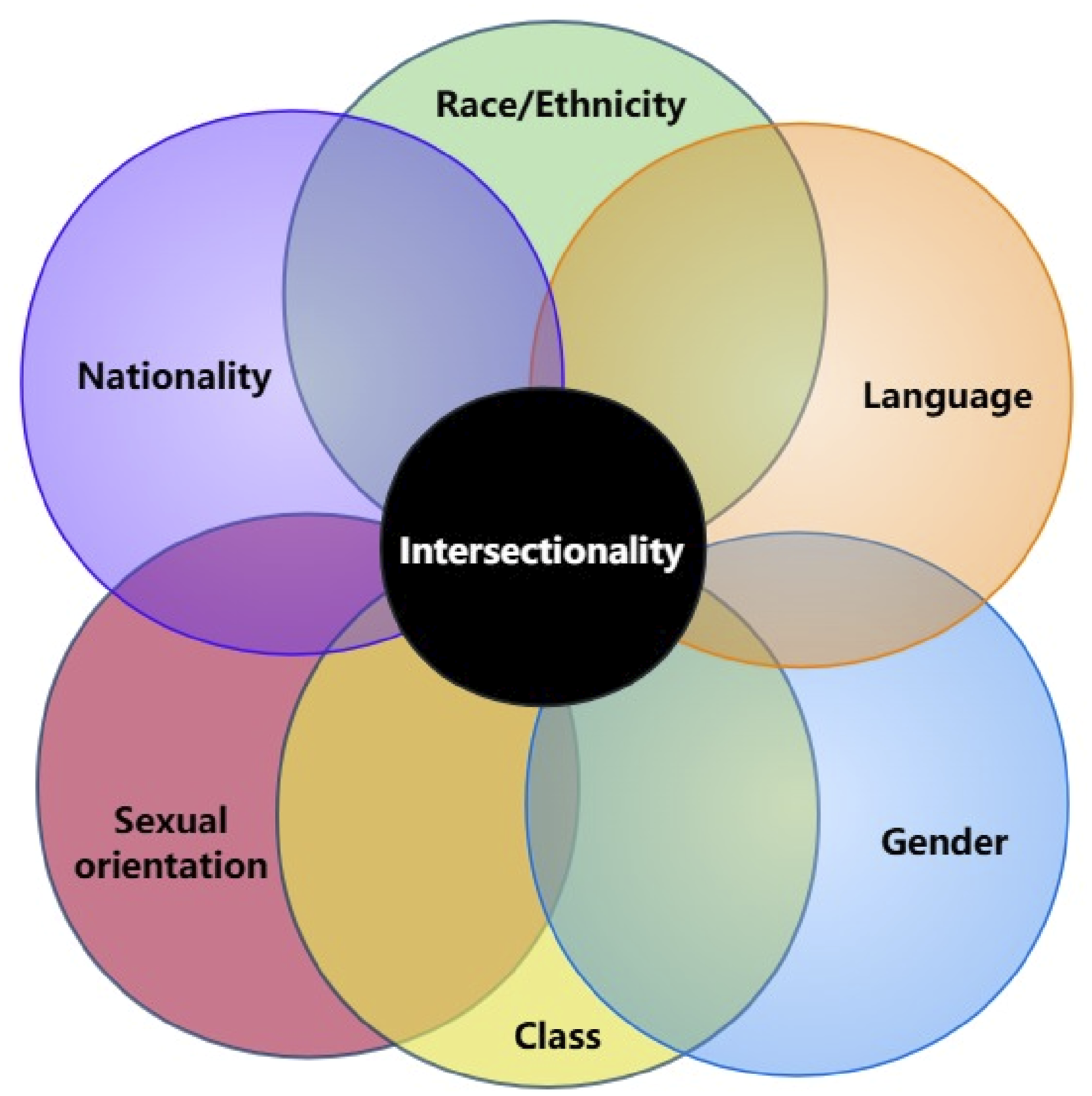
Block and Corona (2016) note that while a great deal of research has explored the relationship between language practices and multiple identities, examining how these elements intertwine, few studies explicitly incorporate the concept of intersectionality. By adopting an intersectional framework, researchers can better understand how power dynamics shape individuals’ experiences in complex, context-dependent ways. Rather than treating social factors as separate variables, an intersectional approach allows scholars to analyze how these categories interact to produce unique forms of privilege and marginalization. This approach is particularly useful for examining linguistic discrimination, as it reveals how language use is not only shaped by social hierarchies but also reinforces them.
In a global context, defining intersectionality as a singular concept is challenging, as the meanings of social factors such as power, oppression, and social exclusion vary significantly depending on historical contexts and socio-cultural backgrounds (Falcón, 2012). In the South Korean context, studies using intersectionality as a theoretical framework often draw on the perspectives of Black women, particularly Black American teachers who are native English speakers. These studies suggest that, despite holding the qualifications to teach as native English speakers and benefiting from certain privileges associated with their nationality, these teachers often find their pedagogical expertise and experiences overlooked or marginalized due to their race (Park & May, 2025; Seo, 2024; Seo and Kubota, 2023).
However, research on the discrimination faced by specific diasporic Korean groups—particularly in relation to their accents—and the interwoven social factors that shape these experiences remains relatively scarce. In this regard, this study does not merely aim to expand the application of the concept of intersectionality; rather, it seeks to illuminate an underexplored space in which ethnicity, nationality, and language intersect.
The study
This study employed a mixed-method approach, following an explanatory sequential design (Creswell and Creswell, 2018). In the first phase, the first author conducted a survey to gain a broad understanding of the accent-based discrimination experienced by Korean-Chinese professionals in South Korea. In the second phase, the first author conducted qualitative semi-structured interviews with selected survey respondents over 3 months to explore their perceptions of the causes of accent-based discrimination and the coping strategies they employ. In this paper, the analysis of qualitative data is prioritized to achieve a nuanced, situated understanding of the diverse circumstances experienced by different individuals.
Participants and data collection
In stark contrast to the prevalent negative stereotypes they face in South Korea, Korean-Chinese people are better integrated into China’s multi-ethnic society, benefiting from high literacy rates and bilingualism that position them as a “model” ethnic group (Zhang and Li, 2015). To investigate how this “model ethnic group” encounters discriminatory perceptions and behaviors in their ancestral homeland, we focus on individuals within this group with a comparatively high level of socioeconomic privilege—upper-middle-class Korean-Chinese professionals living and working in South Korea. Examining whether and to what extent these middle-class professionals are subjected to stereotyping provides insight into the complex interplay of ethnicity, nationality, and language.
This study was conducted in Seoul, South Korea. The first author, a Korean-Chinese scholar specializing in sociolinguistics, is a member of both the South Korean academic community and the Korean-Chinese community in South Korea. In the first phase, we employed purposive snowball sampling to recruit 46 Korean-Chinese professionals. The recruitment criteria included being born in the Korean-Chinese settlement areas of northeastern China; being fluently bilingual in Chinese and Korean; having previously been enrolled in a graduate program (master’s or doctoral) in South Korea; and having been employed in South Korea for an extended period at least 5 years. Based on factors such as income level, residence, occupation, and educational background, all participants were classified as upper-middle-class Korean-Chinese. We invited them to participate in an online survey to gather information on their accent-related experiences, including experiences of discrimination and intentional accent modifications.
Profiles of the Korean-Chinese interview participants.
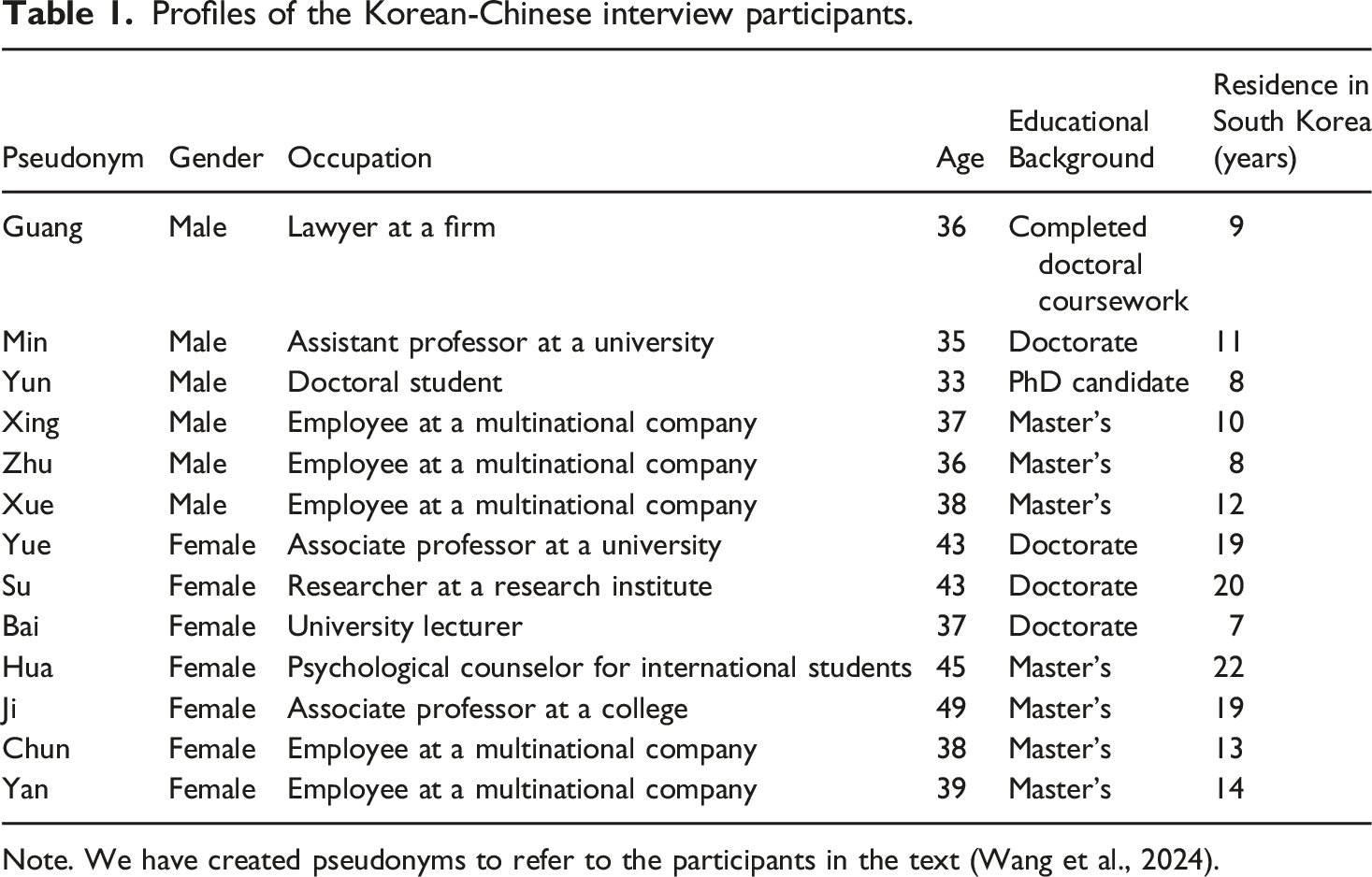
Note. We have created pseudonyms to refer to the participants in the text (Wang et al., 2024).
Throughout the study, the researchers continuously reflected on their roles, particularly benefiting from the insights provided by their emic perspective on the Korean-Chinese community in South Korea. The first author conducted the interviews, fostering an environment in which participants felt comfortable sharing their thoughts candidly by disclosing her own experience as a Korean-Chinese scholar. The experiences she shared included awkward moments, and challenges encountered over the past decade while navigating the South Korean academic community and various social settings, in which her accent often played a role. This self-disclosure helped establish trust, encouraging participants to share their own stories more openly.
Although self-disclosure facilitated rapport-building and enhanced participant openness, we recognize its potential priming effects (Shapir et al., 2023), particularly in implicitly centering discussions around shared experiences of accent-related marginalization. For this reason, we proactively mitigated this influence by employing neutral prompt formulation in the interview guide and continuously examining researcher positionality during interpretation. In alignment with a constructivist paradigm, the authors did not aim to eliminate the influence of self-disclosure, but rather sought to critically reflect on it as an integral part of the co-constructed narrative process.
The interviews focused on the participants’ experiences of accent-related marginalization and discrimination in South Korea, their relationships with mainstream Korean society, and the reasons behind any adjustments they made to their accents in social ssituations, educational settings, and the workplace. Beyond serving as a data collection tool, the interviews also functioned as a social practice of knowledge co-construction (Talmy, 2010). Through this process, both researchers and participants reflected on discrimination against non-standard accents in South Korean society, exploring the intricate relationships among language, identity, nationality, and ethnicity that underpin these dynamics.
Data analysis
Coding themes based on intersectionality theory.
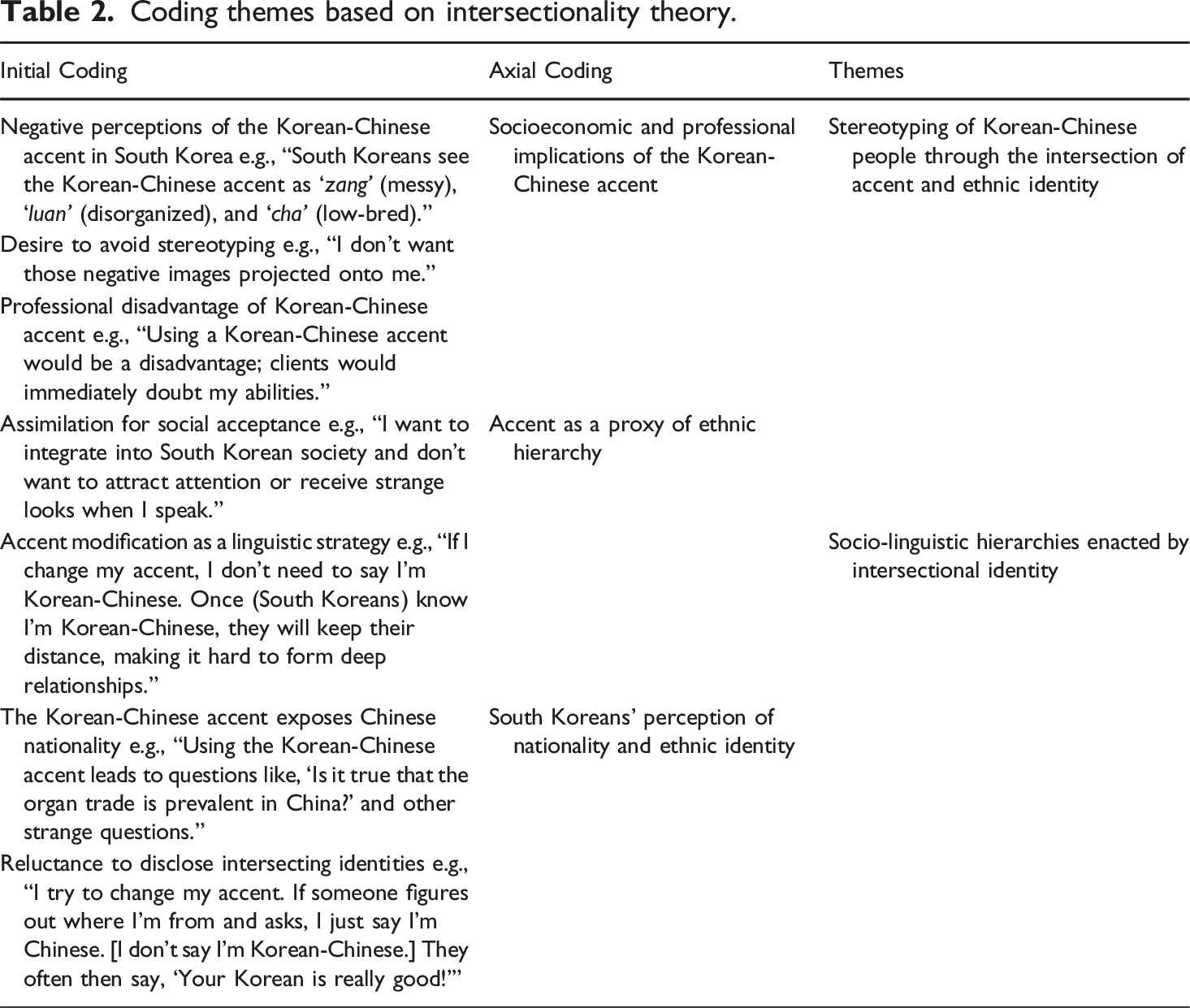
Subsequently, axial coding was conducted with reference to intersectionality theory to examine the interactions between the initial codes, resulting in three subcategories: socioeconomic and professional implications of accent; accent as a proxy of ethnic hierarchy; and South Korean society’s perception of nationality and ethnic identity. Finally, after a thorough discussion, the two authors synthesized these subcategories into two overarching themes: stereotyping of Korean-Chinese people through the intersection of accent and ethnic identity, and socio-linguistic hierarchies enacted by intersectional identity.
Findings
Despite their established academic and professional accomplishments, all survey respondents (N = 46) reported consciously modifying their accents in public and/or professional settings by adopting a standard Korean accent (i.e., a “Seoul accent”). When presented with the survey items.
“Have you ever consciously changed your accent in a social or professional context?” and “If yes, what motivated you to do so?”, the majority of participants cited direct experience of stereotyping (e.g., being perceived as less competent), communication breakdowns due to misunderstanding or negative perceptions of their Korean-Chinese accent, or workplace or social pressure to conform to standard linguistic norms. This finding suggests that even individual Korean-Chinese professionals with relatively high socioeconomic status are not immune to accent discrimination in South Korea. The following sections present the findings under two themes: the stereotyping of Korean-Chinese people through the intersection of accent and ethnic identity, and sociolinguistic hierarchies enacted by intersectional identity.
The “messy, disorganized, and lowbred” Korean-Chinese: Stereotyping of Korean-Chinese people through the intersection of accent and ethnic identity
The participants in this study noted that South Korean media has long presented stereotyped depictions of the Korean-Chinese community, leading them to believe that avoiding negative stereotypes in South Korea is difficult without changing their accents. Most Koreans haven’t had much real interaction with [Korean-Chinese people]. Their perceptions are heavily shaped by media portrayals. In news reports and blockbuster movies, Korean-Chinese characters are always portrayed as vicious murderers or telecom fraud gang members. The moment they hear a Korean-Chinese accent, they [Koreans] just want to stay far away. (Yun)
Despite the fact that the crime rate among Korean-Chinese residents is not significantly higher than the national average (Yoon et al., 2022), news reports often frame Korean-Chinese people within negative narratives, associating them with “malicious murder, eating dog meat, and illegal residency.” In films and TV dramas, Korean-Chinese characters are frequently portrayed as killers, psychopaths, organ traffickers, and child kidnappers, while comedy shows depict them as “awkwardly dressed, profit-driven, and unscrupulous” (Cho and Kim, 2020: 10). These representations create a binary opposition between Korean-Chinese and South Koreans, reinforcing contrasting stereotypes such as “poor versus rich,” “dirty versus clean,” and “weak versus strong” (Song, 2017). This persistent media framing deepens the social divide between the two groups and reinforces existing prejudices against Korean-Chinese people, as reflected in Su’s account below: South Koreans see the Korean-Chinese accent as “zang” (messy), “luan” (disorganized), and “cha” (low-bred), even associating it with fraudsters and gangsters. I can’t change how Korean society views Korean-Chinese people on my own, and I don’t want those negative images projected onto me. Being mindful of my accent is indeed a hassle, but it really saves me from a lot of unnecessary trouble and misunderstandings. (Su)
Korean-Chinese residents of South Korea are acutely aware that South Koreans’ attitudes toward the Korean-Chinese accent extend beyond language; they reflect perceptions of the speaker. Given its distinct phonetic, intonational, and prosodic features, the Korean-Chinese accent is easily recognizable, marking the speaker’s Korean-Chinese identity and exposing them to pervasive stereotypes and stigmatizing narratives. Su highlights the negative media representations that link the Korean-Chinese accent with undesirable traits—being “zang” (messy), “luan” (disorganized), and “cha” (low-bred). These negative images often translate into personal biases and create setbacks for individuals in social and professional settings. Consequently, modifying their accents becomes a strategy for these Korean-Chinese professionals to navigate stereotypes, minimizing misunderstandings and avoiding unnecessary trouble. When in Rome, do as the Romans do. I want to integrate into South Korean society and don’t want to attract attention or receive strange looks when I speak. (Chun)
Like Chun, many Korean-Chinese professionals find that despite their fluency in the Korean language, they struggle to be fully accepted as either ethnically or linguistically Korean. Their accent often becomes a target of prejudice and disdain, hindering their social integration. As a result, many choose to modify their accents to align more closely with the standard Korean accent, adhering to the principle of “when in Rome, do as the Romans do.” This is supported by the survey results, which indicate that 83% of respondents adopt a standard Korean accent in public places—such as workplaces, shopping malls, restaurants, and cafes—rather than their native accents, even when communicating with fellow Korean-Chinese professionals. Additionally, 13.6% reported using the standard Korean accent even at home or in private settings. I have higher educational qualifications than most of my colleagues and work in Chinese business, which makes me reasonably irreplaceable. Even so, I can’t imagine communicating with clients using a Korean-Chinese accent, because that would be a disadvantage; clients would immediately doubt my abilities. (Guang)
Guang, who has completed coursework for a doctoral degree in law from a prestigious South Korean university and works as a lawyer at a renowned firm, highlights how a Korean-Chinese accent can undermine perceptions of one’s academic background and professional competence, making it difficult to gain the recognition they deserve. Even for someone with high expertise and an indispensable role, using a Korean-Chinese accent may lead clients to question their abilities, resulting in a lack of professional respect. This underscores how raciolinguistic essentialism operates in South Korean society—an individual’s accent can cause them to be viewed through the lens of group stereotypes rather than their personal qualifications. To counteract this implicit racializing logic, these Korean-Chinese professionals often adopt a standard Korean accent to ensure that their professional image is not undermined by their accent.
Sociolinguistic hierarchies enacted by intersectional identity
The findings of this study reveal that Korean-Chinese professionals frequently experience othering in interactions with South Koreans. Crucially, participants interpret this treatment as reflecting their categorization as members of an ethnic minority from China—a nation framed within South Korean discourse as “developing”—rather than as part of the Korean diaspora. This intersectional perception of nationality and ethnicity further reinforces the discriminatory treatment of the Korean-Chinese community. Similar patterns have been reported in previous studies, showing that South Koreans tend to exhibit higher levels of rejection and discrimination toward immigrants from developing countries—particularly people of color—while displaying more favorable attitudes toward white individuals from developed nations (Kim and Kim, 2019). When I first joined the company, a colleague said, “Wow, you speak so elegantly [without a Korean-Chinese accent]; I can’t tell at all that you’re Korean-Chinese.” They even asked if my dad was a CPC [Communist Party of China] secretary. At that moment, I didn’t know how to respond—should I be happy or angry? (Yue)
Yue, who was able to successfully adopt a standard Korean accent in professional spaces, found that her South Korean colleagues expressed surprise and assumed she must come from an elite background in China (e.g., suggesting her father was a CPC secretary), implying that she was an “atypical” Chinese person. This reaction reveals how South Koreans use accents as a marker of nationality and social class—those with a Korean-Chinese accent are often categorized as “ordinary Chinese,” while those who have adjusted their accents are considered “exceptions.” In other words, South Koreans instinctively associate the Korean-Chinese accent with “Chinese” heritage and use it as a signifier of nationality. Because China is perceived as a developing country, the Korean-Chinese accent is regarded as “unrefined,” reinforcing the prevailing sociolinguistic hierarchy in South Korea, where nationality often takes precedence over ethnic identity.
Since nationality is seen as a difficult boundary to cross, accent serves as a crucial proxy for distinguishing South Koreans from the Korean-Chinese community, contributing to the latter’s racialization within their own ethnic group. In this ethno-national hierarchy, modifying one’s accent not only helps Korean-Chinese professionals improve their social standing but also grants them a degree of “exceptionality,” even when they are still recognized as Korean-Chinese. When meeting Korean-Chinese friends in public places, we generally have an unspoken understanding to use the Seoul accent [standard Korean] or just speak Mandarin. We would rather be perceived by Koreans as Chinese than risk being associated with a Korean-Chinese accent. (Min)
Min notes that the Korean-Chinese professionals in South Korea are acutely aware that speaking fluent Korean with a Korean-Chinese accent in public can place them in an awkward, ambiguous, and intersectional identity—neither fully “Chinese” nor authentically “Korean,” but instead “Chinese nationals with Korean characteristics.” This positioning can lead to unequal treatment in social interactions. Consequently, when socializing in public, even those accustomed to using a Korean-Chinese accent strategically switch to standard Korean or Mandarin to avoid the marginalization tied to their intersectional identities. The ethno-national stratification in South Korea intensifies the socio-linguistic hierarchy, making the Korean-Chinese accent a site of co-ethnic racism. Korean-Chinese professionals, when interacting with friends in public, tend to either opt for standard Korean to integrate into mainstream society or speak Mandarin to be perceived as Chinese. This strategic language choice reflects the intersectional identity conflict that these Korean-Chinese professionals experience in South Korea, as they struggle to fully belong to either the “host” (Korean) or the “guest” (Chinese) group.
Discussion
This study applies the theory of intersectionality to examine the deliberate accent adjustment of middle-class Korean-Chinese residents of South Korea. Emerging findings from the analysis indicate that despite sharing a common ethnic heritage with South Koreans, attaining strong educational qualifications, being fluently bilingual in Korean and Mandarin, and holding stable, well-paid jobs in Korea, these individuals actively modify their accents to align more closely with standard Korean (i.e., the Seoul accent) in workplaces, public settings, and even family environments. This linguistic adjustment is not just a personal preference; rather, it represents a strategic choice aimed at reducing the stigma associated with the Korean-Chinese accent in South Korean society, mitigating the social marginalization imposed by their intersecting identities as both “Chinese” and “Korean-Chinese.”
In South Korea, the Korean-Chinese accent is often imbued with negative connotations, linked to low socioeconomic status, criminal behavior, and a lack of cultural capital. This linguistic essentialism positions accent as a key marker of identity, reinforcing discrimination against Korean-Chinese individuals and perpetuating the social hierarchy that privileges South Koreans. These findings align with previous research (Chang and Kang, 2020; Ha and Jang, 2016; Park & May, 2025) showing that even North Korean refugees, despite their shared ethnicity with South Koreans, are often perceived as culturally inferior due to their distinct accents. This perception further intensifies co-ethnic racism, making the Korean-Chinese accent a significant tool for distinguishing “us” from “the others” and legitimizing the marginalization of this group.
Despite South Korea’s deep-rooted cultural prioritization of national unity, the question of who is recognized as Korean remains contested, with many people still excluded by the socially accepted answers. Mainstream society tends to view native South Koreans as the sole representatives of national identity, overlooking diasporic Koreans, particularly those from developing countries. Tsuda’s (2022) research on Nikkeijin (Japanese emigrants and their descendants) demonstrates this phenomenon in another national context, showing that Japanese Americans and Brazilians who “return” to their ancestral homeland of Japan are stratified by nationality into an unequal class hierarchy, where native Japanese occupy the highest social position, and Japanese Americans hold relatively higher status than Japanese Brazilians, who are relegated to the bottom tier—frequently facing cultural discrimination and relegation to unskilled labor. Han (2016) describes this phenomenon as “nouveau-riche nationalism.” The Korean-Chinese professionals in this study occupy a liminal space at the intersection of their nationality (Chinese) and diasporic ethnic identity (Korean-Chinese). The tendency of South Korean society to prioritize nationality over ethnic identity leads to racist structures of inequality based on nationality, which can be as severe and insurmountable as those faced by phenotypically distinct groups that are racialized as inferior based on visible characteristics. Furthermore, when combined with the easily identifiable non-standard Korean accents of Korean-Chinese individuals, this ideology turns those accents into markers for devaluation, further solidifying and amplifying Korean-Chinese people’s ambiguous and precarious identities within South Korean society.
This study contributes to the existing literature by addressing a critical research gap. Most raciolinguistic studies have focused on language-based discrimination in the historical context of nation-states, colonial governance, and racial hierarchies between whites and non-whites (May, 2023; Rosa and Flores, 2017); in contrast, there is a notable lack of research exploring how accent-based discrimination operates against groups that share an ethnic background with the privileged community in their local context yet still face racialized exclusion. By investigating the experiences of Korean-Chinese professionals, this study extends the scope of raciolinguistic scholarship to cases where phenotypical differences are absent, yet accent remains a key marker of exclusion and discrimination.
Furthermore, this study seeks to illuminate an understudied space shaped by the intersection of ethnicity, nationality, and language. By highlighting the fact that these Korean-Chinese professionals deliberately modify their accents to navigate South Korea’s ethno-national stratification, this study provides empirical evidence that accent is not just a linguistic feature but a significant socio-political tool. In this context, accent adjustment can be seen as a flexible linguistic strategy, the use of which is shaped by deeply embedded social hierarchies of ethnicity, nationality, and language. This challenges the commonplace assumption in public and policy discourse that racial discrimination operates primarily through visible phenotypic differences. Our findings demonstrate that accent functions as a potent mechanism for reinforcing social boundaries—even among co-ethnic populations—extending a well-documented tradition of linguistic boundary-marking. From the Biblical Shibboleth test to contemporary analyses of Northern Irish English, history shows that linguistic features routinely signal group membership without visual cues. The Korean-Chinese case contributes new insights by revealing how hierarchies of national origin can reactivate these dynamics within putatively homogeneous ethnic groups. Expanding the analytical lens of raciolinguistics in this way allows for a more nuanced understanding of how linguistic discrimination operates in ethnically similar yet socially stratified communities.
Conclusion
This study examines the racialization of groups with shared Korean heritage, revealing that accent adjustment among Korean-Chinese professionals in South Korea is not merely an individual adaptation strategy but rather a reflection of the complex interactions between language, nation, and ethnicity in South Korea. Since Korean-Chinese people and South Koreans are not differentiated by appearance, adopting a standard South Korean accent can help counteract co-ethnic racism and promote social acceptance and upward mobility. However, since adults often struggle to fully mask the phonetic and intonational features of their native accents, Korean-Chinese professionals’ ability to completely assimilate remains limited. As a result, the effectiveness and sustainability of adaptation strategies among Korean-Chinese professionals are limited, leaving them subject to structural discrimination and their social status in a precarious position.
Although racial and linguistic diversity in South Korea is steadily increasing, significant progress has yet to be made in addressing the deep-rooted linguistic discrimination faced by diasporic Koreans, and specifically Korean-Chinese people. This issue requires ongoing attention and active efforts to resolve.
Our findings contribute to raciolinguistics research while also integrating intersectionality theory to offer deeper analysis and more nuanced interpretations. We hope this perspective provides a framework for further valuable insights into the language strategies employed by other ethnic minority groups in similar contexts, and supports the continued grown of academic understanding of the various social factors shaping the experiences of ethnic minority groups. In turn, this knowledge can help highlight the transformative nature of ethnic minorities' processes of social adaptation.
Footnotes

Funding
This research was supported by the 2024 Korean Studies Grant Program of the Academy of Korean Studies (AKS-2024-R-007).
Declaration of conflicting interests
The authors declared no potential conflicts of interest with respect to the research, authorship, and/or publication of this article.
Data Availability Statement
The datasets generated during and/or analyzed during the current study are not publicly available due to the fact that research participants have not consented to data release but are available from the corresponding author on reasonable request.