



Abstract
Social scientists have shown limited interest in documents in their research on institutions, particularly the criminal justice system, which is surprising considering the omnipresence of documents in legal institutions. This article outlines an approach to conducting document analysis, with a particular focus on legal documents. It builds on existing methods but offers unique analytical strategies for researching authoritative texts. The purpose of this article is to inspire and facilitate more research with legal documents. Based on my research on sexual violence, I propose a step-by-step methodological approach to documents in general and a set of analytical strategies to interpret legal documents in particular. The aim is to sketch out a framework that encourages the researcher to reflect on various aspects of documents and to illustrate how to conduct document analysis.
Introduction
Researchers in criminology, victimology, socio-legal studies, and other social sciences have long shown interest in the workings of the criminal justice system. This is particularly evident in research on sexual violence. Here, the focus has been on the high attrition rates created by the many cases of sexual violence dropped by the police and the low number of cases that end in conviction. Much of the research on the criminal justice system is based on surveys, statistics, interviews, observations in court, and mock trials (Daly and Bouhours, 2010; Finch and Munro, 2005; Lea et al., 2003; Smith and Skinner, 2017; Temkin, 2000; Temkin et al., 2016), and there is little research on legal documents, even though the criminal justice system is built upon such documents.
Latour (2010) illustrated how documents were an essential part of legal institutions with his study of the French Council (administrative law), but the omnipresence of documents is also evident in other legal institutions, including criminal courts, that rely on the principle of orality. The law itself consists of documents that regulate social life and legal proceedings. A legal case typically includes a range of documents, including a case file and reports written by different experts. A legal decision or ruling is usually written down in a document and subsequently cited in other documents. The cited cases constitute case law, which in turn becomes the law. Many of these documents are readily available to researchers, and they all tell us something about the law, the legal profession, other experts, legal practice, legal processes, and the legal handling of social problems. For this reason, legal documents should attract more interest from social scientists than is currently the case.
The purpose of this article is to inspire and facilitate more research with documents, especially legal documents. Through examples from my own research on sexual violence, I show how document analysis can be performed. The aim is to sketch out a framework that encourages researchers to reflect on various aspects of documents and illustrates how to conduct their analysis. It builds on existing methodological approaches but proposes analytical tools based on a combination of documentary theory and theoretical concepts that can be used to deconstruct power relations. Although most of the examples I use are based on my research on legal documents on sexual violence, the framework is also relevant to other documents and beyond this topic.
In the remaining sections of this article, I first discuss the contribution of the document analysis I propose before discussing what a document is. I then sketch out some important interrelated steps in conducting a document analysis. Subsequently, I present a set of analytical strategies for interpreting legal documents that may be used to problematize authoritative texts and legal powers, before extracting a set of analytical questions for institutional documents in general. Finally, I discuss some limitations of document research.
Contribution to existing literature on document analysis
Social scientists have increasingly shown interest in researching documents (Lewis and Atkinson, 2025), considering documents to be social products that should be recognized sociologically, as they permeate society and are integral to people's daily lives. More than 30 years ago, Smith (1990: 212) encouraged social scientists to turn to documents to study “the ruling relations” (e.g. the social organization of power) because our societies “are pervasively organized by textually mediated forms of ruling.” She suggested that investigating “how texts mediate, regulate and authorize people's activities expand[s] the scope of ethnographic method beyond the limits of observation” (Smith, 2001: 160). She developed institutional ethnography, an approach inspired by Marxist theory and standpoint feminism, to make visible and raise consciousness of the objectification of people (particularly women) and their everyday lives in mainstream sociology. The ethnographic approach to documents has recently been strengthened by Trundle and Phillips (2025), who proposed a method for ethnographic document analysis that offers a guide to dwelling with documents based on ethnographic principles, including people-centeredness, reflexivity, interpretation, context, and recursive dwelling. They build on Prior's (2008, 2003) early work on documents, which emphasized the functions of documents, not only their content. Grant (2018) offered a more practical guide that covers the whole research process and includes both public documents, such as media texts and official documents, and private documents, such as letters and diaries.
The document analysis I present here builds on and complements existing methodological approaches. First, it acknowledges the utility of document analysis in the study of institutions, professions, and experts (Lewis and Atkinson, 2025) by zooming in on legal institutions and their professions and experts. Rather than developing a general framework that is useful for both public and private documents (e.g. Grant, 2018), it explores the specificities of public documents in depth. While private documents can advance our understanding of people's experiences, perceptions, reflections, and opinions, public documents give insight into policy, professional practice, decision-making processes, organizational routines, values, and culture.
Second, this paper considers theory necessary when working with documents. To help analysts interpret and make sense of documents, it shows how theoretical concepts can be used as analytical tools. This analytical (rather than practical) guide is not grounded in one theoretical or methodological tradition (e.g. Smith, 1990; Trundle and Phillips, 2025) but borrows from different traditions. Third, it shares with Smith (1990) the idea that institutional documents are authoritative but differs in its conceptualization of power relations. Smith considered power relations to be organized hierarchically, localized in the “ruling relations”—that is, bureaucracy, administration, management, professional organization, and the media. Instead of focusing on power as institutionally given, the guide presented here focuses on different techniques or forms of power. It takes as a starting point techniques of power that are exercised by some people on others in more subtle and indirect ways, shaping people's actions and possibilities (Foucault, 2000).
What is a document?
Defining a document is not a straightforward task, as Buckland's (1997) discussion shows. The most obvious answer to the question of what a document is could be that it is a text and, more specifically, a printed text. However, most documents are now electronic, and while they are not texts on paper, they are still material in other forms. This suggests that document analysis needs to deal with some form of materiality, although people may disagree on the kind of materiality involved. Documents could be printed or electronic texts, illustrations, photographs, artifacts in museums, or animals in zoos (Buckland, 1997). They need not include text, only an object that signifies information. Accordingly, one important meaning of documents is that they are sources of information or objects that signify information.
The word document consists of “doceo,” which means to show, demonstrate, instruct, or make a play (drama), and “mentum,” which signifies means and result (Lund, 2004). In other words, a “document” is associated with evidence and matters of proof. According to Suzanne Briet, one of the earliest documentalists, “[a] document is evidence in support of a fact” (Briet 1951: 7, cited in Buckland, 1997: 3). She explained that it is “any physical or symbolic sign, preserved or recorded, intended to represent, reconstruct, or to demonstrate a physical or conceptual phenomenon” (Buckland, 1997: 3). In other words, a document is not only a text or a source of information but also evidence. According to Skare (2022: 13), “documentation” became a key word in both administration and science during the nineteenth century, as both scientists and bureaucrats had to provide empirical proof of the basis for their arguments. Evidence, proof, and facts are part of a common vocabulary shared by law and science in which documents contribute to visually presenting objects, processes, relationships, and theoretical constructs (Lynch, 1985; Lynch, 2013) to substantiate an argument or demonstrate a claim. This conceptualization of documents is important when studying documents in science or law.
To summarize, a document has at least two important meanings—materialized information and evidence. For the purpose of this article, documents refer to printed or electronic texts that may include drawings, sketches, photographs, models, or similar objects.
A step-by-step methodological approach to documents
Documents are associated with the emergence of the European state bureaucracy, in which documents were written text “stating and proving transactions, agreements and decisions” and contributed to creating a public bureaucracy independent of local customs (Skare, 2022: 13). Documents are powerful resources for constructing, negotiating, and regulating social spaces and actors (Brown and Duguid, 1996; Smith, 2001). Experts, professionals, and bureaucrats translate people's conditions, actions, and incidents into records that can be filed, stored, manipulated, and assessed (Lewis and Atkinson, 2025: 4). These records are in turn used to assess people's continued actions on particular occasions (Smith, 1990). This means that there is a mutual relationship between social actors and documents, in which documents both produce and are produced by social actors (Lewis and Atkinson, 2025). Documents constitute an inextricable part of any bureaucracy and the criminal justice system and offer valuable knowledge of these institutions (Weber, 1971).
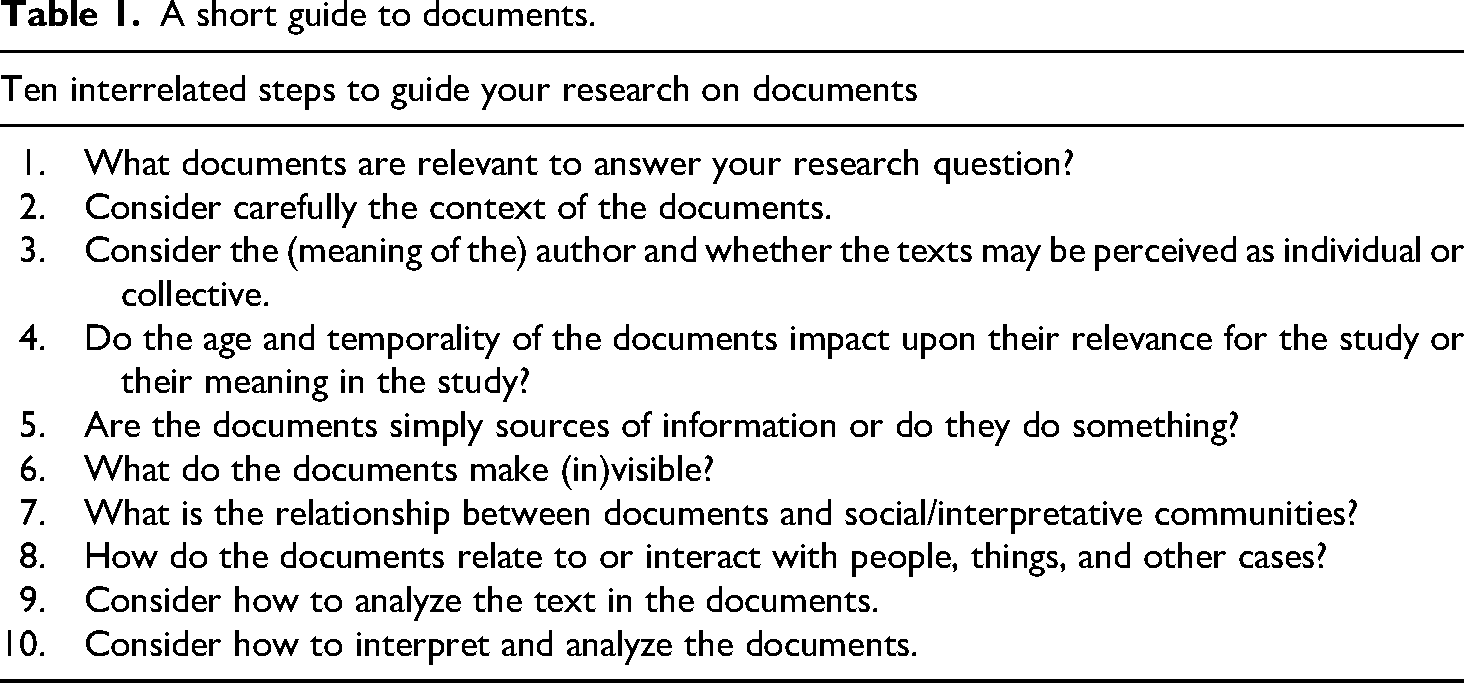
When conducting a document analysis, it is useful to reflect on various aspects of documents and how they are understood differently from various vantage points. The following interrelated steps provide a guide for how to do this. These steps do not constitute a fixed chronology, even though they are presented as such. Rather, they are points to consider throughout the research process.
Documents have different ages and temporalities, and taking this into account constitutes
When a document documents something, it makes something visible (Asdal and Reinertsen, 2022). Accordingly,
Focusing on absences does not entail simply viewing the documents as windows into an institution, in which the aim is to analyze practices that are hidden from view or underlying causes of the events that take place in the documents (Valverde, 2003). The underlying causes are not more true or real than what is spelled out in the documents. Rather, it means that the study should focus on documents as sites where actions take place rather than as a medium of recorded acts (Asdal and Reinertsen, 2020). For instance, if I want to study how the courts make legal decisions in rape cases, I analyze written verdicts because in Norway, they include an explanation or justification of the courts’ ruling. According to Kolflaath (2005), there is a clear distinction between how judges argue a case in a verdict and how the judges actually reason and discuss the facts when making a decision, but unlike Kolflaath, I consider the verdict to be adequate data for learning about legal decision-making practices. It is in the verdict that the judges have to argue their case and formulate a conclusion that satisfies legal requirements, is rooted in evidence, and can be considered legitimate, so it will not be overturned by higher courts due to technicalities. Whether the written verdict actually represents what the judges discussed during their oral deliberations or whether it represents how the judges actually reasoned when making their decision in the case are irrelevant. How they reasoned or discussed the case is not more real than the written document, and the document is not only a means of looking into practices that took place outside the document. Documents are important practices in their own right. They materialize a decision (or a case) and effectuate it. A decision relies on its documents to have effects in the future, for example, in terms of imprisonment or acquittal. This means that institutionalized processes proceed through their documents. For this reason, they are essential in institutionalized practices and decision-making processes (Justesen, 2005).
Acknowledging that documents are important social practices in their own right constitutes
In many bureaucratic decisions, language is typically standardized, passive, conservative, and affirmative. When the language is passive, the author does not participate directly. The lack of a participating author and the standardization of the text communicates that the information presented represents facts (Mik-Meyer, 2005). The longer the distance between the text and its author, the more impartial and objective it appears. This is because the distance signals an apparent separation of the author's interests and the product (Potter, 1996). Affirmative texts do not reveal how they arrived at their conclusions. Instead, they silence their decision-making practices, and in this way, the decision-making practices are “black-boxed”—hidden from view (Latour, 1987). The less standardized the texts are, the more active the language is, and the more argumentative it is, the more transparent institutional processes become.
The ten interrelated steps can be summarized in the ten questions and prompts presented in Table 1.
A short guide to documents.
How to interpret legal documents
Legal documents are part of one of the most powerful institutions in our society, an institution that is highly professionalized. This means that legal documents must be interpreted in the context of their institutional and professional capacity. This does not mean that they only matter jurisprudentially but that socio-legal analysis must be sensitive to their origin. Legal systems vary considerably between countries, which means that every study must take into account the specificities of the system studied. They consist of a range of documents to analyze, including statutes, trial transcripts, case files, legislative preparatory works, and decisions made by tribunals, committees, and courts (lower courts, appellate courts, and the Supreme Court). Although most of these documents may be considered collective, they do not necessarily reflect the institution's decision, opinion, or perspective. For example, a legal decision represents the court, but a court transcript does not, although it has been shaped by the legal system.
A legal trial is a highly controlled and ritualized process in which the judge and procedural rules dictate what to do and when to do it (Duncanson and Henderson, 2014; Valverde, 2015). Even speech or conversation is highly regulated. In daily conversations, turn-taking is characterized by turn-by-turn allocation, whereas in legal conversations, it is pre-allocated (Atkinson and Drew, 1979; Duncanson and Henderson, 2014). Pre-allocation entails special rules regarding when and how different actors may speak. These regulations suggest that every testimony transcribed is co-produced by the narrator, the legal actor conducting the cross-examination (prosecutor, defense lawyer, judge), the rules governing the proceedings, and the process of giving evidence.
A court transcript is, in other words, a legal representation, and not a personal account of an incident, someone's behavior, or their experiences. Additionally, a transcript usually includes multiple voices. If, for instance, a defense lawyer says or implies that the victim in a case is not credible, then this represents their view on the victim, not the court's view. These are a few examples of how the legal system manipulates time and space to control legal processes and the documentation of these processes. Accordingly, power is a key concept when analyzing authoritative documents. In the following section, I highlight four analytical strategies for legal documents that may be used to problematize authoritative texts and legal powers.
Facts versus knowledge
In everyday life, the law and the legal system tend to be associated with facts or the truth. Verdicts might be perceived and treated as factual accounts of what occurred in a case. The verdict itself might be rooted in forensic evidence, or what is often called “scientific facts.” Legal language is even factual. The omnipresence of facts in the legal system perhaps makes it tempting to focus on facts as such by considering whether a legal conviction requires forensic facts or by treating the outcomes of criminal cases as the truth of what happened. These facts and truths can instead be viewed as constructions created in an interactive process between the court, the people, and the things involved in a case (Niemi-Kiesiläinen et al., 2016). Applying this perspective entails an analytical focus on how the legal system constructs facts, truths, and authoritative statements. This can be done by studying how the law uses scientific facts and knowledge when assessing evidence and making decisions (Valverde, 2003). This then tells us about how the law produces legal knowledge, and about legal meaning-making processes (Niemi-Kiesiläinen et al., 2016; Valverde, 2003).
Considering that the law's authority rests partially on its ability to establish legal facts, understanding how facts are created makes it possible to question some of the law's authority. In legal decisions, it is often stated that “the court finds…,” which implies that it is not producing any facts but simply discovering them, often with the help of science. Instead of accepting this portrayal, it is possible to consider how law and science co-constitute facts. According to Valverde (2003), legal facts and judgments only make sense and are functional within a network that connects them to statutes, courts, scientific experts, forensic reports, institutions, etc. Facts are therefore built by relying on different kinds of knowledge. Legal professionals might rely upon expert testimonies and forensic reports when building, arguing, or proving a case, or justifying a decision. Although law tends to rely on science, it takes precautions to ensure that scientific experts do not usurp the role of the judges (Latour, 2010; Ward, 2009). The relationship between law and science has been described as filled with tensions and disputes, many of which are related to different methods and purposes, disagreements on definitions, and different perceptions of allocation of responsibility (Jasanoff, 1995; Kruse, 2016; Nelken, 2009; Rees, 2010). Studying these tensions and disputes will allow the analyst to problematize the authority of institutions, experts, and professions.
Studying how the criminal justice system produces facts entails a focus on mechanisms that make claims unquestionable. According to Potter (1996), facts imply truth, and real occurrences and can be contrasted with descriptions that refer to accounts or reports. They might seem significantly different, but as Potter showed, we use descriptions to build facts. Studying how the law produces facts requires an investigation of how it uses descriptions based on witness reports, forensic scientific reports, and legal accounts of current law. The legal system relies on different knowledge and also produces (legal) knowledge when attempting to make sense of a social or legal problem. Scientific facts have gained epistemic authority in society, including in courts, because they are associated with mathematical certainty, the highest level of certainty attainable in the realm of probability (Shapiro, 2014). When the legal system builds facts, it sometimes uses the authority of law and sometimes the authority of science to claim that something is a fact. However, it is also common to rely on common sense, a type of knowledge that is persuasive because of how it appeals to something intuitive and, therefore, obvious (Cochran, 2013; Laugerud, 2020a).
Common sense is a form of knowledge that refers to both common knowledge and good sense (Cochran, 2013). It is grounded in everyday life in terms of being connected to a community (“common”), based in experience, and readily understood by non-experts. Common sense appears to be self-evident and difficult to challenge. Cochran (2013) showed how the courts explicitly invoke common sense when making arguments. By doing this, they refer to readily available knowledge claims and justify them by implying commonality and consensus. In America, common sense is, in fact, the most cited authority for an argument (Allen, 2000).
A different way of studying the authority of common sense is to investigate how non-expert knowledge is used in the courts’ reasoning. This can be done by using the approach developed by Carol Bacchi, called “What's the Problem Represented to Be?”, which offers a way of thinking differently about what is commonly taken-for-granted (Bacchi, 2012; Bacchi and Goodwin, 2016). The key term in this analytical approach is “problematization,” which refers to how the text produces “problems” rather than being a solution to a problem. As emphasized by Lewis and Atkinson (2025), documents tend to constitute precisely what they describe, including problems. The Bacchi approach consists of a set of questions for critically scrutinizing what is taken-for-granted or problematized in the text.
For example, I have used Bacchi's approach to analyze some peculiar formulations in rape verdicts (Laugerud, 2020a). They appeared to be value judgments formulated in conservative and formal language. These value judgments typically presented a person or something as unthinkable, normal, abnormal, incredible, odd, or peculiar. For instance, rather than writing that the accused lied, they stated that his story was “constructed” or that his claim “beggared belief” or was “contrary to expectations.” Formulations like these indicated what the courts considered normal, good, right, and desired. This implies that common sense reasoning is normative and circles around what might be considered normal. Normalization, the process of making something appear normal and something else abnormal, is one way factual accounts are made (Potter, 1996). These accounts are further naturalized due to common sense reasoning being both intuitive and self-evident. Naturalization implies that something is unchangeable and unquestionable. This overview shows how the criminal justice system relies on various forms of knowledge when making factual accounts in its decision-making practices. Focusing on how facts are constructed, rather than the facts as such, makes it possible to question taken-for-granted assumptions about the legal system and the ways in which the law regulates social life.
Outcome versus dynamics
Research on the legal system, particularly on sexual violence, tends to focus on the outcomes of various legal processes, such as attrition rates, sentencing levels, and legal reforms. Research on attrition rates has problematized the high number of cases that are dropped by the police or end in acquittals and has examined the possible reasons behind this. The conviction rate might be considered an “attractor” (Carline et al., 2020) because of its focus on the quantification of legal case outcomes. According to Merry (2016), quantification is seductive because it offers concrete, numerical information that allows for easy comparison and ranking across jurisdictions and types of cases. “With the casual positivism of much science, it is the results, not the processes, that count” (Star and Bowker, 2007: 274). Considering how numbers convey objectivity and scientific authority, and how rape research tends to face credibility challenges, it may not be surprising that research on sexual violence has been dominated by quantification (Levine, 2021; Merry, 2016).
To understand why the attrition rate is high or how the criminal justice system produces unsatisfactory outcomes in legal cases, there is a need to focus on the processes and dynamics of law. We need more knowledge of how things happen in law and how these outcomes are created. An example of a focus on the dynamics of legal proceedings, rather than the outcome, is to study how the courts reason when making decisions. In a study of incapacitated rapes, I investigated how commonsensical ideas about sleep were invoked in verdicts (see Laugerud, 2023). Here, incapacity refers to unconsciousness (sleep), heavy intoxication, or other reasons for not being able to resist an act. These commonsensical ideas do not necessarily shape the outcomes of the cases, although this does occur, but they typically represent the views of some of the judges, such as in the minority vote in a dissenting decision.
In my analysis, I noticed that the courts questioned complainants’ claims of being asleep during the incident in question. Some of the arguments in the verdict included assumptions regarding the ways in which people sleep, or at least should sleep, based on mundane knowledge of sleep. These assumptions were sometimes implicit in the judges’ reasoning, or the judges posed explicit questions concerning whether the complainant was in fact sleeping during the incident. For example, if the incident occurred shortly after the complainant fell asleep, some judges sometimes questioned how it was possible to fall into a deep sleep in such a short time without waking up immediately when the sexual advances began. If the incident took place somewhere other than in the complainant's home, in someone else's home, it was stated that people usually sleep more lightly at a stranger's house, with an assumption that the complainant would wake up quickly if anyone touched them. Similarly, if the accused lay on top of the complainant, they could remark that it was surprising that the complainant did not wake up due to the heavy load.
These kinds of comments and questions are built upon commonsensical assumptions of how, where, and when people sleep. The ways in which these are formulated in the verdict—for instance, that it is surprising they did not wake up or that something is common/usual—indicate a norm. They imply that the complainants should have woken up because that is what people usually do. This means that legal reasoning is partly commonsensical (Laugerud, 2020a), and that in the context of sleep, sleep norms might become relevant and explain how the panel of judges in a criminal case reason when making decisions (Laugerud, 2023). Analyzing how courts reason in verdicts can improve our understanding of why many rape cases do not end in convictions.
Criminal acts versus identities
Legal documents, as previously mentioned, may be considered prescriptive texts. They concern normative issues, that is, what is considered normal and how people should behave. As briefly outlined above, common sense reasoning evokes ideas about the normal and the abnormal, and I have previously argued that this reasoning is concerned with examining whether people conform to the norm (e.g. judges’ ideas about normality) (Laugerud, 2020a). As illustrated above in relation to sleep norms, legal documents direct their attention as much toward the people involved in a crime as toward the act of crime. In other words, legal documents not only inquire into criminal acts but also into criminal and victim identities. This is done through an examination of who the accused and accuser are. By considering their motivations, intentions, confessions, (re)actions, mental health, or (in)sanity, legal documents construct identities. Here, experts, especially psychologists and psychiatrists and their medical reports, contribute to labeling people as dangerous, monstrous, or innocent.
In Laugerud (2021), I compared three high-profile rape cases in Norway. In all three cases, the defendant was accused of sexually assaulting 10 women. Almost all the complainants in all three cases had waited a long time before reporting their experiences to the police, and hardly any of them had been subjected to forensic medical examination. For this reason, there was little forensic evidence in the cases. Accordingly, credibility appraisals became important, meaning that the assessment of the credibility of the accuser and the accused and their testimonies was the key element during the trials and in the verdicts. In my study, I compared how the court constructed the defendants.
In the first case, the court characterized the defendant, who was a basketball coach, as a popular person because most people in his club liked him or admired him, and because most of the victims had had a crush on him. The complainants all testified to how he suddenly changed personality before the assaults and how he conducted the rapes in a violent or aggressive manner. Most of them also distanced themselves from him after the assault. By emphasizing these two contrasting sides of the defendant, as well as detailing his mode of action during the assaults, the court constructed him as a Janus-faced person—one face being likable and charming and the other face being aggressive and violent. Through the trial and the written verdict, the court revealed his true face—the face of an aggressive serial rapist.
In the second case, forensic psychiatrists concluded that the defendant had psychopathic traits and antisocial personality disorder. The court placed much emphasis on these personality traits and argued that they fit well with how the complainants described him. Moreover, the court focused on his sudden change in personality. The complainants described how he abruptly changed from being a charming person to an aggressive person without any warning when he assaulted them. In this case, the court paid particular attention to how some of the complainants characterized his eyes as black and his expression as blank. He was compared to an animal when they described how he attacked them, being brutish and acting on his instincts. By combining psychiatric labels with animalistic characteristics, the court constructed him as a pathologized and monstrous serial rapist.
In the last case, the court emphasized the defendant's attractive position in the subculture he was part of. He was characterized as the person to know if one wanted access to events, jobs, or freelance contracts. The court focused on his personality change when he drank and took drugs. According to the complainants and witnesses, he frequently hosted parties where he offered free drinks and drugs. When he became drunk/high, he would usually transform into a clingy and “itchy-fingered” person. They further characterized the assaults as “sleep rapes,” in which he would start having sex with victims in a careful manner while they were asleep after the parties. Most of the complainants were friends with him before the assaults and did not distance themselves from him after the incidents but continued their friendship and sometimes sexual relations with him. By emphasizing his position, reputation, and relationship with the complainants, the court constructed him as a person with great but subtle power who abused the victims’ trust in him.
By combining different sources of information (witness testimonies, expert knowledge, and common sense), and by emphasizing some and downplaying other aspects of the defendants’ behaviors and characteristics, the court constructed three distinct types of perpetrators. By doing this, they labeled the perpetrators and placed them into categories that shaped how others perceived and treated them. When these labels appear in an authoritative document, they function as facts or truths that give the defendants inflexible identities (Niemi-Kiesiläinen et al., 2016). Some labels are more stigmatizing, destructive, and challenging to escape than others. Focusing on how the court constructs identities makes it possible to nuance perceptions of perpetrators, victims, and crimes.
Theory versus practice
The law is an interpretative discipline, and its application is not necessarily straightforward. Law in theory (or in books) and law in practice mutually shape each other because current law depends on previous legal practice (case law). How legal provisions are applied depends on preparatory work and case law. In preparatory work, the legislator expresses their intentions with the provision, while case law shows how courts have interpreted the provision in practice. Legal verdicts constitute case law, which refers to how previous legal decisions make the law because they function as a norm for how to interpret the law and how to handle similar cases in the future. In this regard, there is a hierarchy of verdicts in which the Supreme Court has the strongest influence on future decisions and the district court has the weakest. If a provision needs clarification, the Supreme Court must take on a case to consider its application. This makes law flexible and open in the sense that it is constantly (re)shaped by interpretative practices. This characteristic of law has prompted imaginations of law as a pathway, a metaphor that implies both patterned and new practices (creating a new path) (Davies, 2017). This metaphor focuses on the connection between abstract law (law in theory) and everyday law (law in practice).
One way to analyze legal documents is to investigate the relationship between law in theory and law in practice. This is useful because, as pointed out by Lewis and Atkinson (2025: 5), “[i]nstitutional documentary prescriptions in and of themselves cannot determine actual behaviour: they always, in principle, require local negotiation and interpretation.” This relationship can be studied by investigating the creation (or implementation) of new law, which concerns the relationship between law and politics. This relationship is controversial because of the separation of powers between the legislative, executive, and judicial branches of government established in the Constitution. The separation of powers is intended to protect citizens from abuse of power by separating the power between state institutions, which in turn act as counterweights to each other. Still, in Norway and other countries, the Supreme Court is supposed to make law in the sense of clarifying, interpreting, and correcting legislation in certain instances and even to set aside legislation in conflict with the Constitution (Schei, 2011). The controversial issue is how far the Supreme Court may go in creating new law. The law is supposed to secure stability and continuity by being predictable, but at the same time, it must be able to respond adequately and fairly in new situations by being flexible and dynamic.
In politicized cases, the Supreme Court may take a more or less conservative or progressive approach. For example, in Norway, when a legislator wanted to increase the sentencing levels in rape cases, the Supreme Court increased the level minimally with a reference to case law. This conservative approach led the legislator to introduce a minimum sentence and a normal sentence that could only be bypassed by extraordinary circumstances (Ot.prp. nr. 22, 2008). In this way, the Supreme Court acted conservatively. An example of the opposite is how the Supreme Court recently changed sentencing in drug cases. The government has attempted to reform drug policy by decriminalizing substance abuse among addicts (NOU, 2019: 26). The government has not yet succeeded in implementing the reform, but the Supreme Court has implemented new sentencing practices in line with the intention of the proposed reform (Efjestad, 2023). Here, the Supreme Court acted progressively, reforming the law without new legislation. By studying the relationship between law in theory and law in action, it is possible to say something about the relationship between law and politics, institutional practices, and how the law actually handles social problems.
Analytical questions for documents
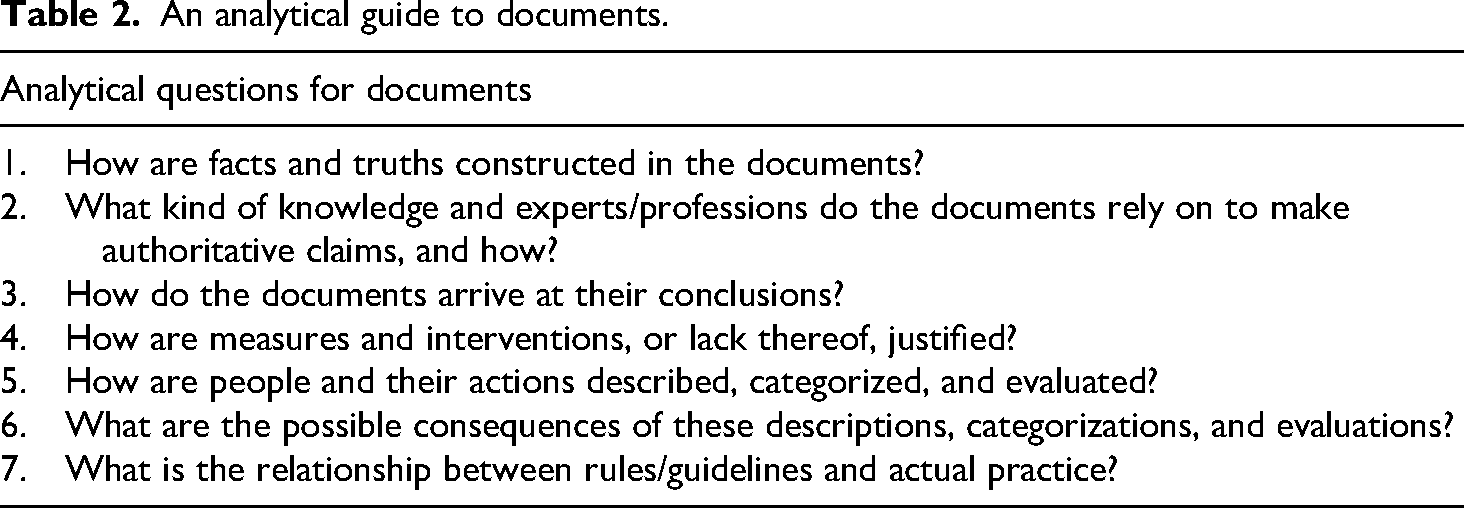
The four analytical strategies described above may be summed up in a set of analytical questions applicable to institutional documents beyond the criminal justice system. Combining these with the initial ten steps will allow the researcher to analyze authoritative texts in a range of different institutions. See Table 2.
An analytical guide to documents.
Limitations and ethics in researching legal documents
In this article, I have focused on the value of researching legal documents. However, legal documents also have some important shortcomings. First, legal documents may be considered “thin data.” The texts are often short, perhaps standardized, and sometimes written in inaccessible language. For this reason, it can be difficult to know what to do with them and how to analyze them, and their value might be limited accordingly. One way to make use of documents that appear to be of restricted value is to compare or supplement them with other documents or data that potentially offer more information or context for similar processes.
Legal documents are also limited in the sense that they are shaped by the institution that made them. This means that the information available in the documents, the ways in which the documents are presented and formulated, and whose perspective they represent are all framed by the criminal justice system. Accordingly, even when analyzing transcripts of personal testimonies, it is important to keep in mind that these are not an accurate description of witnesses’ experiences, but rather a testimony framed by and adapted to the criminal trial. A range of institutional documents represent people's lives and their experiences, feelings, and thoughts on various aspects of their lives. This information can be used for research. However, it is important to be aware of the limitations of using this data. It is different from a personal account because it is framed by the institution in the sense that it is selected, filtered, and formulated by the system. It is not complete and might also be much more limited than other sources of information on the same issues. Still, it can be valuable in understanding how the institution perceives and manages certain social problems, to explore a phenomenon we have little knowledge of, or to use as a starting point for a theoretical or conceptual discussion (e.g. Laugerud and Skilbrei, 2023; Sandberg and Ugelvik, 2016).
First and foremost, legal documents tell us something about the legal system and the legal profession. This means that researchers who want to study legal documents need to familiarize themselves with the legal system to understand their origins and contextualize them to make sense of them. This does not mean that only legal scholars can study them, but researchers must have a basic understanding of the law. When I started investigating legal verdicts, I also read about the court on the court's websites, went to court to observe court trials, and read relevant legal provisions, policy documents, and socio-legal literature on the legal processing of rape. These sources of information facilitated my understanding of legal language, legal issues, and legal documents.
Finally, legal documents contain highly sensitive information, so it is important to consider the possible harms that might arise from researching these documents. In Norway, researchers are required to notify the data protection service Sikt and to comply with legal regulations and ethical guidelines when researching legal documents such as verdicts. These documents usually include personal data that directly and indirectly identify the people involved in the case (e.g. the accused, victim, witnesses, and professional actors). These risks need to be balanced against the benefits of researching these documents. I believe that research on legal documents contributes to improving knowledge of legal processes and practices. This knowledge is vital for people's trust in legal institutions and their sense of justice, as it contributes to knowledge about the state's use of force and transparency in key processes that regulate the state's relationship with its citizens. In relation to politicized fields such as the legal processing of rape, it is particularly important to have knowledge of the law to inform public debates and policy interventions. Accordingly, research on legal documents has great utility for society. Still, people involved, especially non-professionals, have a right to privacy, and care needs to be taken to ensure that their lives and suffering are not exposed in a way that potentially causes more harm.
To protect people's privacy, researchers need to anonymize their data when publishing their work. One important consideration in this process is whether the case name/number should be published. The case name/number identifies the case but not necessarily the people involved in it or other case information. If potential harm is considered low, case identification secures transparency in the research process because other researchers can then access the same documents. Transparency can strengthen the credibility of research if it does not threaten people's privacy. Additionally, in the context of commitment to open science, avoiding case identifiers might be more challenging.
Another aspect to consider is how to represent descriptions of violence (Houge, 2022). In verdicts, violence is often depicted in detail in cold and technical language. Researchers must determine how much detail is necessary to make an analytical point and how to represent those details. Too many details might distract readers and make them uncomfortable, while excluding all details might downplay the seriousness of the incident. To balance these considerations, it is useful to think through the objectives of analysis, including whether it is necessary to quote the detailed descriptions of violence to make an analytical point or argument, or if it is sufficient to rewrite it differently or exclude some of it. In the context of conflict-related sexual violence, Houge (2022) discussed the dilemma of re-presenting the atrocities of sexualized war violence. She noted how detailed descriptions risk sensationalizing the acts, othering both the victims and the perpetrators and alienating the reader, whereas more neutral accounts risk downplaying the gravity of the offenses and trivializing the violence.
Conclusion
Researchers interested in institutions, particularly the criminal justice system, have plenty of opportunities to study how the law and other institutions represent and manage people, actions, and social problems through various documents. Documents tend to be readily available, and they document institutional practices and processes. Through examples from my own research, I have outlined a framework to both inspire and facilitate more analysis of (legal) documents. This approach builds on existing methodologies but offers unique analytical strategies for researching authoritative texts.
Footnotes

Funding
The author received no financial support for the research, authorship, and/or publication of this article.
Declaration of conflicting interests
The author declared no potential conflicts of interest with respect to the research, authorship, and/or publication of this article.