




Abstract
The goal of this article is to introduce activity systems as a methodological tool in narrative inquiry to gain a holistic understanding of socially shared experiences from an examination of documents. The research question was how can qualitative researchers use activity systems as a tool for engaging in narrative inquiry of socially shared experiences to uncover new meanings by constructing a story? In this article, we share a sample analysis of our experience relying on documents and media as a form of narrative to begin to understand the socially shared human activity associated with net neutrality and its potential impact on U.S. residents. We end this article with reflections of lessons learned from our activity systems guided story construction process.
Keywords
What is already known?
In qualitative research, narratives bring shape and form to ideas that allow us to engage in ongoing dialogue about the idea as part of our reality. Narratives can help navigate tensions in human activity. While identifying tensions in narratives, activity systems analysis can help understand the complexities involved in human activity including tensions.
What this paper adds?
This article introduces activity systems a tool for qualitative researchers to engage in narrative inquiry and constructing a story about new meanings. It also introduces documents as a valuable source of data in narrative inquiry.
Narrative Inquiry with Activity Systems: A Story About Net Neutrality
The goal of this article is to introduce activity systems as a methodological tool in narrative inquiry to gain a holistic understanding of socially shared experiences from documents. We engage in this discussion by referring to a sample data set from a study we conducted through document analysis about net neutrality and its implications to distance education. In this article, we asked the primary research question how can qualitative researchers use activity systems as a tool for engaging in narrative inquiry of socially shared experiences to uncover new meanings by constructing a story?
We begin our discussions by introducing our understanding of narrative inquiry and its intent to find what Bruner (1991) proposed as a breach in a socially shared plight. In our sample study, the breach or tensions, as described by Engeström (1987), we encountered took on a critical role in organizing the relevant human activities we identified. We introduce our reliance on activity systems as an analytical tool to assist in finding multiple units of activities, each with its own tensions and outcomes. We discuss how the activities we found first took an important role in our sense making of net neutrality and then in our continual efforts to transform our new understandings into words through storytelling. We end this article with our reflections of lessons learned including a discussion of how approaching narrative inquiry from an activity theoretical perspective helped our shared analysis and story construction experiences and the challenges and merits of document analysis as a data source in narrative inquiry.
Narrative Inquiry Through Document Analysis
In the sample study, we approached this narrative inquiry relying on the analysis of documents about net neutrality with an interest in making sense of symbolic materials represented in the documents while understanding both the personal and social meanings represented in them (Schreier, 2012). We approached the study from a constructivist qualitative paradigm (Lincoln & Guba, 1985, 2013; Lincoln, Lynham, & Guba, 2011) and believe that, as researchers, we participate in inquiry to make sense of the world. We do this through semiotic interactions in natural settings, which give us opportunities to experience vicariously participants’ daily symbolic interactions (Blumer, 1986; Denzin, 2007). As researchers, we took the role of active agents by engaging in purposeful sense making while constructing new understandings about a phenomenon (Charmaz, 2014; Lincoln & Guba, 2013). Methodologically, we questioned the seemingly logical stance that mainstream social scientists hold (Richardson, 2000), and we did not assume that following systematic, mechanical processes is the only approach for exploring truths (Toomela, 2010).
We believe that in narrative inquiry, data should not be limited to the study of interviews and observations, but rather include documents that can take a role in making sense of how the world is understood to be real (Krippendorff, 2013). In the case of net neutrality, many key players such as government officials and corporate CEOs were not accessible for interview and observations. However, the phenomenon itself exists as a reality and is accessible through public documents. Therefore, these documents can serve as valuable data for researchers to engage in narrative inquiry and construct meaning about the phenomenon.
Documents are often overlooked as data in narrative inquiry (Flick, 2007), but they can be a rich source. Human beings regularly make meaning from written texts (Hodder, 2000). Therefore, documents can be a reference for activities in which people engage (Daiute, 2008) that “enact values, policies, and diverse ideological perspectives” (Daiute, 2014, p. 54). Daiute (2014) stated that through documents …diverse actors may or may not be addressing one another directly as in face-to-face interactions, values of a society or group…are virtually speaking to one another as in social network environments. (p. 73)
Bruner (1986) introduced narrative inquiry as an alternative and complementary method to the scientific method for understanding human experiences. He conceptualized narrative inquiry as a way for publicly engaging in interpretations and negotiations of public meanings (Bruner, 1990). Narratives bring shape and form to ideas that allow us to engage in ongoing dialogue about the idea as part of our reality (Bruner, 2002). It can include details of human “imagination, vignettes of daily life, news reports of events of public interest, histories, gossip, and other oral and written accounts in past, present, and future time” (Daiute, 2014, p. 2). People engage in narrative exchanges to construct realities of the world through symbolic interactions with their cultural settings (Bruner, 1991). Polkinghorne (1988) described, “Narrative [as] the fundamental scheme for linking individual human actions and events into interrelated aspects of an understandable composite” (p. 13).
Constructing a Meaningful Story From Narratives
Stories bring structure and order to real-world experiences (Bruner, 1990). Stories are translations of messy real-world observations organized into communicative units. We are naturally drawn to stories because it helps make ideas easier to understand (LeFever, 2013). Stories help people understand complex ideas because they are often “about problems, dilemmas, contradictions and imbalances” (González-Monteagudo, 2011, p. 298) that help navigate tensions. Life becomes livable through stories because they organize complex realities (Lewis, 2011) by giving “meaning, unity, and purpose to major events and memories” (Bhatia, 2011, p. 347).
In this instance, storytelling is a special kind of design activity, separate from fact telling (LeFever, 2013). It is a way for people to engage in a problem-solving activity to find solutions to challenges in life (Moen, 2008). Unlike fact telling, storytelling is “somehow not innocent…even has a wicked or immoral penumbra” (Bruner, 2002, p. 5). Therefore, storytelling is a design activity that often involves a wicked problem (Rittel & Webber, 1973). As a design activity, the intention of storytelling is to share new meanings the storyteller found in the world. Daiute (2014) explains that storytelling/narrating is: …an activity people use to mediate—manage—interactions that matter to them. Narrators recount experiences and tell stories to solve problems, to make friends, to pursue opportunities, to live good lives. This sense-making function of narrating involves using narrative as tool to figure out what is going on in the environment, how one fits, and how situations might be better. For these reasons, narrating is a process that occurs within a complex network of social structural, interpersonal, and environmental relations. (pp. 33–34)
As designed artifacts, stories represent the author’s ideas and act as a tool for the author to gain a greater understanding of the phenomenon and communicate to the reader new ways of looking at the world. Stories are in-the-moment commodities that represent the essence of a phenomenon in a convenient format, but the stories are not the phenomenon itself (Inckle, 2010; Lukács, 1972). As stories become objects that hold the essence of the author’s ideas, they transform abstract ideas to more tangible concrete forms (Sfard, 1994). Therefore, stories can help authors share their new understandings about a phenomenon as a tangible object (Keats, 2009).
Narrative Inquiry and Storytelling From a Cultural Historical Activity Theory (CHAT) Perspective
CHAT originated from the works of Russian scholars such as Lev Vygotsky and Alexei N. Leontiev during the Soviet era. Involving a transformative ontology, CHAT conceptualizes the organism and the environment as an inseparable whole (Stetsenko, 2008). The unit of analysis in CHAT research is the human activity. Vygotsky considered that psychological research ought to connect human action, mind, and sociohistorical setting as part of an inseparable whole (Valsiner, 2001; Wertsch, 2000). Examining human activity as a holistic unit can help narrative researchers “avoid the pitfalls of individualistic and societal reductionism” (Moen, 2008, p. 59).
CHAT scholars avoid breaking real-world observed and experienced phenomenon into a series of mutually exclusive variables waiting to be controlled (Rogoff & Angelillo, 2002). Instead, they investigate how individuals and groups of individuals engage in a dialogic inquiry with artifacts, prior knowledge, peers, and their cultural setting while simultaneously influencing and transforming one another (Wells, 1999). Therefore, CHAT scholars are often interested in how people develop and learn through activities in which they take part in everyday settings (Lave, 1988; Rogoff & Lave, 1984).
A seminal CHAT theorist, Engeström (1987), introduced the activity systems model (Figure 1) first in Finland and then to the North American community with the publication of Cole and Engeström (1993) and Engeström (1993). In this framework, human activity is conceptualized as an object-oriented activity in a series of actions shared among individuals and their social environment (Yamagata-Lynch, 2010). Activity systems can help researchers understand complex human activity by systematically analyzing the whole activity without breaking the wholeness (Arievitch, 2008).

Activity systems analysis model.
The components in the activity systems model include the subject, tool, object, rules, community, division of labor, outcomes, and tensions. Subjects are people or organizations participating in an activity, and tools are resources that participants use to obtain the object or the goal. Rules can be policies, procedures, and beliefs that participants are compelled to follow while engaging in an activity. The community is the group in which participants identify they belong while participating in an activity, and the division of labor is the shared responsibilities among community members involved in the activity. The outcome is the consequences that participants encounter at the end of the activity. Any component of an activity can bring about tension in the participants’ effort to attain the object. In human activity, tensions can become an obstacle for attaining the object or the reason why the participants choose to modify an activity to attain the object (Yamagata-Lynch, 2003; Engeström, 1993).
Among scholars who engage in narrative inquiry, Daiute (2008) studied United Nations international policy documents related to children’s rights from a CHAT perspective. She studied the nations’ human activities related to children’s rights as introduced through narratives in international sociopolitical documents. In her work, Daiute relied on activity systems to identify the nations’ key players, those who influenced children’s rights and the various activities in which they engaged. Furthermore, an activity systems analysis of these two issues led to the creation and enforcement of policies about children’s rights. Subsequently, this approach allowed her to identify conceptual and power issues that gave rise to tensions between children’s rights, nations’ rights, and the limitations nations experience in their ability to protect children’s rights.
Analysis and Story Construction Process Sample
Getting Engaged in the Narrative Inquiry
Our research process involved (a) collecting data, (b) engaging in analysis, (c) identifying units of activity, and (d) designing the story. The entire process of data collection and analysis in which the first three authors participated took 14 weeks, after which we engaged in continued efforts writing this article with other research team members. The 14-week research activity entailed several subactivities that were shared among the first three authors of this article and are listed in Table 1.
14-Week Research Process.

Table 1 portrays our research as a clean sequential process, but in real life it was messy and iterative. Our study began with the second author leading the data collection. There were other projects in which the team was engaged, and it made the most sense to assign one person to help us gain momentum collecting data for the new project. The second author was tasked with searching for documents related to net neutrality including academic peer-reviewed journal articles, news media publications, blogs, infographics, and government documents.
The second author found 48 documents published on the web and 10 peer-reviewed articles about net neutrality in Week 1. We situated the documents in context to determine what story they collectively had to tell based on history and issues they were about (Charmaz, 2014). This initial data analysis required us to understand the historical sequence of events and to identify the key players and stakeholders and their differing perspectives on net neutrality. We reviewed the documents with the goal of finding insights on the values, policies, and ideological perspectives held by various stakeholders (Daiute, 2014). Building on Week 1’s work, in Week 2, the second author found additional documents authored by specific stakeholders and individuals including the U.S. government, public interest groups, professional organizations, broadband companies, court documents, and news media documents. This resulted in 20 additional documents in our data set.
We relied on Evernote (https://evernote.com/) to log, share, and write memos about the data. During weekly research meetings, the first three authors reviewed materials collected during the previous week and selected documents the team should analyze. At this point, we read each document lightly to gain an understanding of the perspectives expressed and then engaged in open discussions about what made sense and what did not make sense which we recorded in our team reflective memos. We focused on searching rich data that were “detailed, focused, and full” (Charmaz, 2014, p. 23). We were also looking for potential breaches or troubles in the narratives (Bruner, 1991; Daiute, 2011) which we intentionally recorded in our reflections. All notes generated on Evernote were shared to new members of our research team, as they began participating in this project.
Finding Rich Data in Documents
We found that rich data are only rich if we can make sense of the meanings that they represent. When we met for our research team meetings, we often shared questions about the technical and legal language that initially made little sense such as “common carrier” and “information service providers (ISPs).” There were times that we had to rely on legal dictionaries to help us understand what we were reading. We quickly learned that being able to read and make sense of documents as narratives about net neutrality meant that we could not be shy about asking questions to one another about what did not make sense. When we encountered words and ideas that initially did not make sense, we took note of them in our shared memo in Evernote to remind ourselves to look for meanings in future documents.
Initial Observations of the Data
In our initial observations during Week 1–3, we found that narratives about net neutrality in public documents were often about individual versus political led values. These conversations often led to policies that limited or expanded U.S. residents’ access to the Internet services that significantly influenced their daily lives. Many voices spoke from decidedly different positions about net neutrality and actively participated in the narrative exchanges. Our second observation was that the multivoiced chatter about net neutrality made it complex, disjointed, and difficult to follow. We decided that we had to become vigilant in our understanding of each perspective and put extra care in checking how our biases affected our understanding of each perspective.
At this point, we realized that the three authors involved in the data analysis were originally from non-U.S. nations that did not practice capitalism in the same way as the United States. This realization made us aware that we had to pay attention to how our biases about government entities and their relationship to private communication media industries from our countries of origin were affecting the way we saw meaning in the U.S. net neutrality data. We started to have conversations calibrating how we understood net neutrality in the United States, and what were the issues we saw in the data because it was situated in the United States.
While becoming more aware of our personal biases, we began to see meaning in the data and engaged in our analysis as a problem-solving activity to figure out what was going on (Daiute, 2014). In our analysis, we focused on finding tensions that held together the shared human activities (Bruner, 1991; Daiute, 2011; Lewis, 2011). Our goal was to be able to present a story to our reader from multiple perspectives to help them find meaning by identifying the so what and who cares about net neutrality (Bhatia, 2011; Clandinin, 2006).
Coding the Data
By Week 4, the first three authors began the coding process, which lasted to Week 8. Initially, we engaged in individual coding, shared those codes during meetings, and identified group codes that were mutually exclusive with agreed upon definitions. This led to a set of team codes and definitions for those codes that captured the essence of the main concepts that surfaced from the narrative (Saldaña, 2016). With each data analysis iteration, more details and more potential stories emerged, as we collectively engaged with the documents (Charmaz, 2014) and discussed our individual and team findings during reflective meetings. We also gained further insights on values, policies, and ideological perspectives held by various integral stakeholders (Daiute, 2014) in the historical development of the net neutrality narrative.
Activity Systems Analysis
By Week 9, the team agreed that we had engaged in sufficient coding to inform us of the thematic units in the data and tell a story about net neutrality. Therefore, the first three authors began drafting activity systems models to represent units of activity, tensions, and outcomes that we found critical in telling the net neutrality story from a holistic perspective. We used poster paper during our meetings and drew drafts of multiple activity units, often with scribbles that led to drawing new activity systems and our reflective insights somewhere on the poster paper. We took photos of each draft systems and added them to the Evernote team electronic notebook (see Figure 2 for example).

Sample activity systems analysis draft.
The series of activity systems analyses led to our discovery of distinct activities, spanning multiple decades during which unique outcomes became interwoven with one another as shown in Table 2. We found that the systematic analysis of human activities while drafting and redrafting activity systems allowed us to identify key activities and helped us make sense of the disjointed dialogues in the narrative. It also helped us identify who the protagonist was going to be in our story about net neutrality. Initially, as we drafted the activity systems representing human activities, the subject/protagonist continually shifted from one key player to another.
Activities and Tensions Found in the Net Neutrality Narrative Analysis.
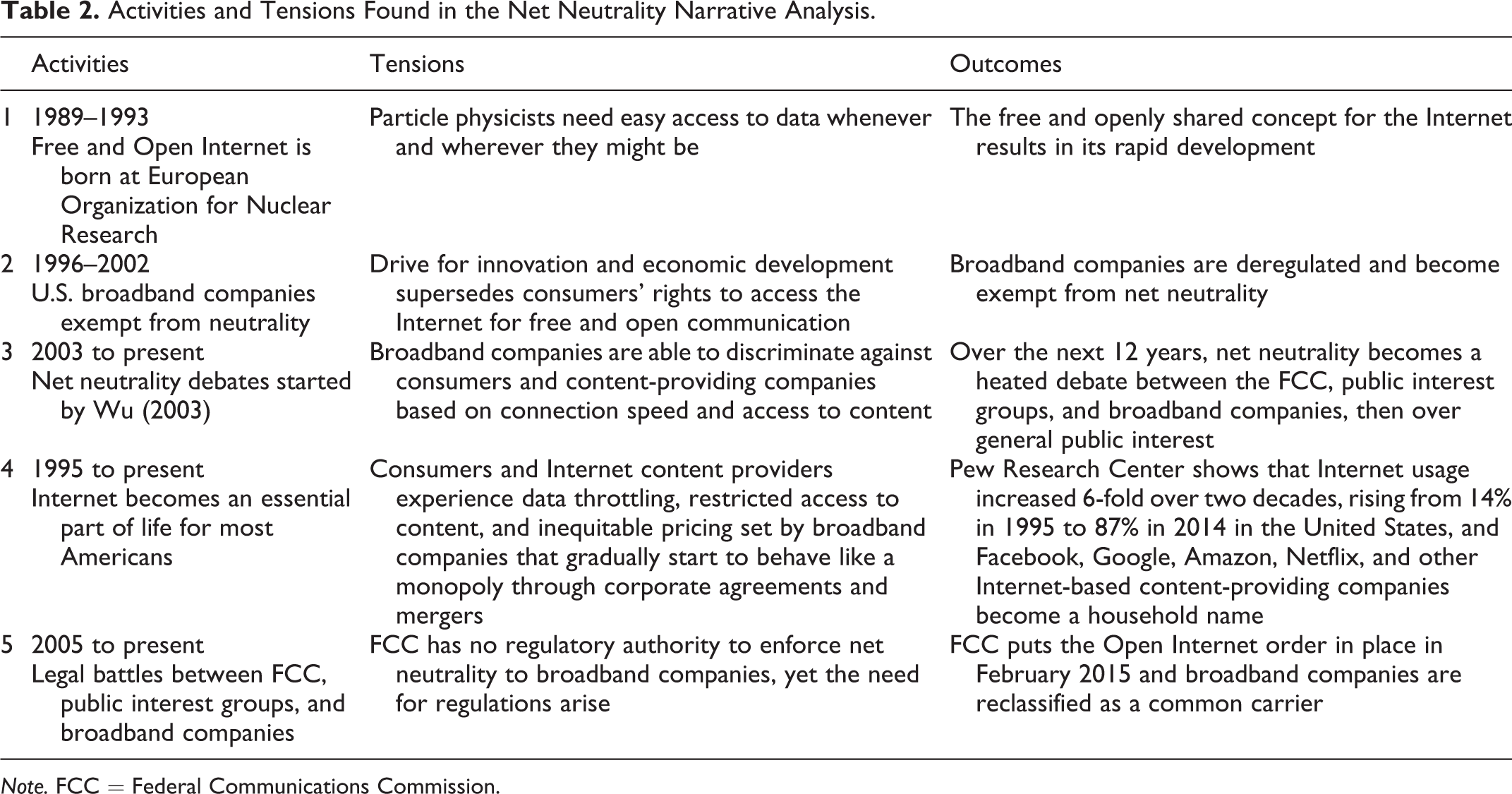
Note. FCC = Federal Communications Commission.
As we gained a better understanding of the symbolic meanings in the narrative, we identified the Federal Communications Commission (FCC) as the protagonist of our net neutrality story. The FCC as protagonist enabled us to address the complexities involved in net neutrality from a holistic perspective and construct a story that flowed from one activity to another. It was the only perspective from which we could identify in the documents we reviewed entire activity units with information on all components of an activity system. The final activity system that guided our efforts retelling the net neutrality story in the United States is presented in Figure 3.

Activity systems analysis results of shared net neutrality narrative: Previously presented at the 2016 Annual Meeting of American Educational Research Association, Washington, DC.
Constructing a Story From Narrative Inquiry
In the process of identifying an activity system that best represents net neutrality as a socially shared phenomenon, we had to remind ourselves that in narrative inquiry stories are often “about problems, dilemmas, contradictions and imbalances” (González-Monteagudo, 2011, p. 298). We tried to organize our story around tensions we found rather than the historical units of activities we presented in Table 2. This meant that we had to review Table 2 and all of our reflective memos to understand the recent history about net neutrality in the United States.
While beginning to write the story presented as Appendix A, we realized that we would not be able to tell a cohesive story with “organic unity” (Parrish, 2006, p. 75) if we tried to weave into the story every detail of our findings. We had to decide which details from Table 2 would be part of our story. While it is ideal to present a detailed account of a story, we realized that too much detail can get in the way of our reader gaining a holistic understanding of the story. Hence, instead of addressing every chronological detail in our story about net neutrality, we decided to identify only what we were willing to commit to introducing to our readers as our newfound understanding of a complex, socially shared phenomenon (Pelias, 2011; Richardson, 2000).
We relied on our activity systems analysis in Figure 3 and focused on telling a story based on that analysis. This meant that we included historical details that would help the reader understand the components and tensions that we identified in the activity systems analysis. We believed that this allowed our story to maintain explanatory power (Connelly & Clandinin, 1990) while highlighting connections among individual activities and events in an understandable manner (Polkinghorne, 1988).
Lessons Learned
As we identified at the beginning of this article, we engaged in our narrative inquiry study with the intent to find socially shared tensions related to net neutrality in the United States and relied specifically on activity systems analysis to identify those tensions. Once we began the data collection, coding, and analysis, we encountered tensions in the research process. We had to carefully address these tensions to prevent them from becoming distractions that could create obstacles in our efforts to understand the phenomenon we were studying. From this experience, we specifically learned lessons about (a) challenges in the narrative inquiry of documents, (b) narrative inquiry with activity systems, and (c) narrative story construction as a design process. In the following sections, we will share the lessons we learned from each of the above topics.
Challenges in the Narrative Inquiry of Documents
While relying on public documents to engage in our narrative inquiry, we learned that within net neutrality, many key players, especially net neutrality opponents, contributed their narrative to the public while purposefully building a hostile and confusing argument. These key players deliberately distorted the narrative to reconstruct the shared experience in a false manner (Striano, 2012). As researchers, we had to spend a significant amount of time making sense of these narrators’ intent for sharing their ideas and not be misled by the ways that they presented their arguments.
While we unpacked the various biases about net neutrality that key players shared in documents, we also had to address our biases about relations between government entities and communication media companies. We engaged in research team conversations to determine whether what we came to understand from the data was truly in the data. We constructed Table 2 to document our research team’s consensus of our understanding of the tensions in the net neutrality narrative. While constructing Table 2, we relied on our data, reflective memos in Evernote as an audit trail, and interrogated one another until we found a collective meaning about net neutrality.
Narrative Inquiry With Activity Systems
We learned that engaging in narrative inquiry while relying on activity systems analysis allowed us to engage in a collective analysis of the data that brought focus to our shared efforts. Our methods gave us a way to share our moment-to-moment understanding of net neutrality as a cultural, psychological phenomenon and discover its possible implications. This gave us time and space to work through the disjointed narrative constructed by multiple key players with diverse interests. There were times that we were unable to come to an agreement about which key player was advocating for which specific position. However, working through each activity, we identified and made sense of the information in the data as a whole by understanding how each activity took part in the whole story. Thus, we collectively reached a better understanding of net neutrality as a phenomenon in the United States.
This process allowed each team member to experience the qualitative inquiry process as a semiotic process (Schreier, 2012). We individually experienced the symbolic interactions in the narrative (Blumer, 1986; Denzin, 2007). Initially, during data analysis, each research team member independently pursued his or her curiosities and doubts about net neutrality. While we drafted the activity system, we shared oral ministories of what we understood about each activity and reached a collective understanding. Each ministory brought new questions that peaked our curiosity and fueled our motivation to continue the analysis. These ministories, as tangible objects, served a critical role in our efforts to engage in the story construction process with a unified voice for the reader (Keats, 2009).
Narrative Story Construction as a Design Process
Once the research team agreed on how to represent our collective understanding about net neutrality, as shown in Figure 3, we started drafting the story. This story is included as Appendix A. We approached our narrative story construction process as a complex design problem-solving activity with net neutrality at the center of a shared wicked problem (Rittel & Webber, 1973). We decided to engage in narrative inquiry solely through document analysis, which allowed us to tell a story from a third person perspective, and inevitably evaluate the shared narrative from an outsider perspective (Norrick, 2013).
We realized that when presenting a story from a third person perspective, it could be difficult to design a story that does not become merely fact telling (LeFever, 2013). To avoid fact telling, we decided to identify a key player who would serve as the protagonist of our story. This helped us tell our story organized around the historical activities related to net neutrality and the protagonist. We chose the FCC as our protagonist because the most recent impetus for net neutrality to become an interest among U.S. citizens and media outlets at the time of our data analysis was the FCC vote on the Open Internet Order in February 2015.
While it is unclear to us as authors who would ultimately be the readers of our work, we assumed for storytelling purposes that readers would likely be at least vaguely familiar with the February FCC vote. Therefore, we chose to start the story from the time when the vote took place and weave in other historically relevant information to make the vote more meaningful to the reader. We made this decision with the assumption that the beginning of our story would be relevant to a wider audience, making it more likely they would invest their time reading the entire story.
Conclusions
The process involved in writing this article became a story construction process on its own that was separate from our meaning-making process of the net neutrality narrative. Instead, it became a story about our methodological decisions and actions. The act of writing this article made our team engage in intense reflection of our decisions and actions guided by activity systems analysis that resulted in us putting significant effort in finding words to express our experiences in a narrative format. If we did not engage in this team process for writing this article, the outcomes of what we did in our study would not have changed, but writing this article made us much more aware of the deliberate decisions we made. This helped us gain a new sense of accountability in our methodological decisions and actions. In future studies, the process of writing this article will make our team be more purposeful in our methodological decisions and actions.
Footnotes
Appendix A
Authors’ Note
All authors took part in the sample study as part of an ongoing research team effort led by one faculty with several doctoral student members. The first, second, and third authors were involved in the entire research process for this work. The fourth author contributed to the article’s conceptualization and writing. The fifth and sixth authors were newer team members after the data collection and analysis and contributed significant feedback helping the team design and write our findings as a story.
Declaration of Conflicting Interests
The author(s) declared no potential conflicts of interest with respect to the research, authorship, and/or publication of this article.
Funding
The author(s) received no financial support for the research, authorship, and/or publication of this article.