




Abstract
In this article, we propose a method for ethnographic document analysis (EDA) and outline the key sensibilities and processes involved. Despite the ubiquity of document data within ethnographic research, there remains few practical, methodological and epistemologically grounded guides for ethnographic approaches to documents. EDA offers a guide for ensuring ethnographic principles underpin the entire research process, from question design to writing up. Moreover, EDA breaks down the process of document analysis and offers eight specific areas of focus for comprehensively analysing documents. These ensure researcher reflexivity and attention to the multiple and contradictory meanings within documents, as well as their implicit narratives, aesthetics, voice, tone and mood, silences, genealogies of language, and social lives. Given the importance of documents in most research fieldsites, EDA can be a powerful and adaptive method in the qualitative toolkit.
Documents are ever-present artifacts of social life. They record remarkable moments, such as births, deaths, marriages, criminal convictions or acquittals, and citizenship or deportation. Equally, documents accompany banal, everyday moments. A multitude of quotidian documents circulate, pile up, and get thrown out or deleted, be they emails, utility bills, or fines for parking and speeding. Just as documents permeate social life, collecting and analysing documents are ubiquitous practices within ethnographic research. Today, a research fieldsite that does not involve documents is an exceedingly rare one. And yet there is surprisingly scant methods guidance for ethnographically approaching and analysing documents.
In this article we propose a method for ethnographic document analysis (EDA) and outline its key sensibilities and approaches. This guide takes account of the entire research process, offering flexibility when designing ethnographic studies of documents, allowing for diverse research questions, a wide array of different document types, and different ethnographers’ analytic styles. At the same time, EDA breaks down the analytic process into eight areas of attention: complexity; narratives; thickly descriptive notes; silence and absence; aesthetics; tone and mood; genealogies of language; and the social life of documents. We offer concrete and practical tools and examples for developing an ethnographic sensibility when approaching the analysis of documents.
Ethnographies of documents and ethnographic approaches to documents
Ethnographers have shown that documents are a ubiquitous feature of everyday life and ‘paradigmatic artifacts of modern knowledge practices’ (Lowenkron and Ferreira, 2014: 78). Documents are central to practices of work, the economy, politics, public and community institutions, creative life, and government (Grant, 2018; Mariner, 2019). Documents also provide the means by which modern systems of accountability, governance, and liability are made or challenged (Shore and Wright, 2015; Strathern, 2000) and shape how responsibility and agency is distributed and shared (Hull, 2003 and 2012b; Lowenkron and Ferreira, 2014). Documents can vividly witness human experience (e.g. Coutin and Fortin, 2023), or equally they can turn human lives into datasets and datapoints, rendering certain lives or human relations visible and others invisible (Mariner, 2019). From state files, medical records, organisational strategies and reports, to archives, diaries, legal documents, protest manifestos, policy submissions, and bureaucratic application forms, documents reflect pervasive practices deserving of ethnographic attention.
A significant focus of ethnographic studies of documents reveals the materiality of power and the state. Documents ‘are not simply instruments of bureaucratic organisations, but are constitutive of bureaucratic rules, ideologies, knowledge, practices, subjectivities, objects, outcomes, and even the organisations themselves’ (Hull, 2012a: 251, see also Derrida, 1995; Reeves, 2013; Smart, 2006). Documents are the means through which institutions and systems of power articulate and claim legitimacy through documentary enactments of ‘transparency, accountability, audit, participation, guarantee’ (Mathur, 2016: 2). Documents act as ‘mediators’ (Allard and Walker, 2016) or ‘coordinators of action’ (Jacobsson, 2022: 22) that have the power to interpolate or inscribe people within the apparatus of the state or within institutions (e.g. Coffey, 2009) and conversely, to extend the reach of institutions into personal worlds (e.g. Chelcea, 2016).
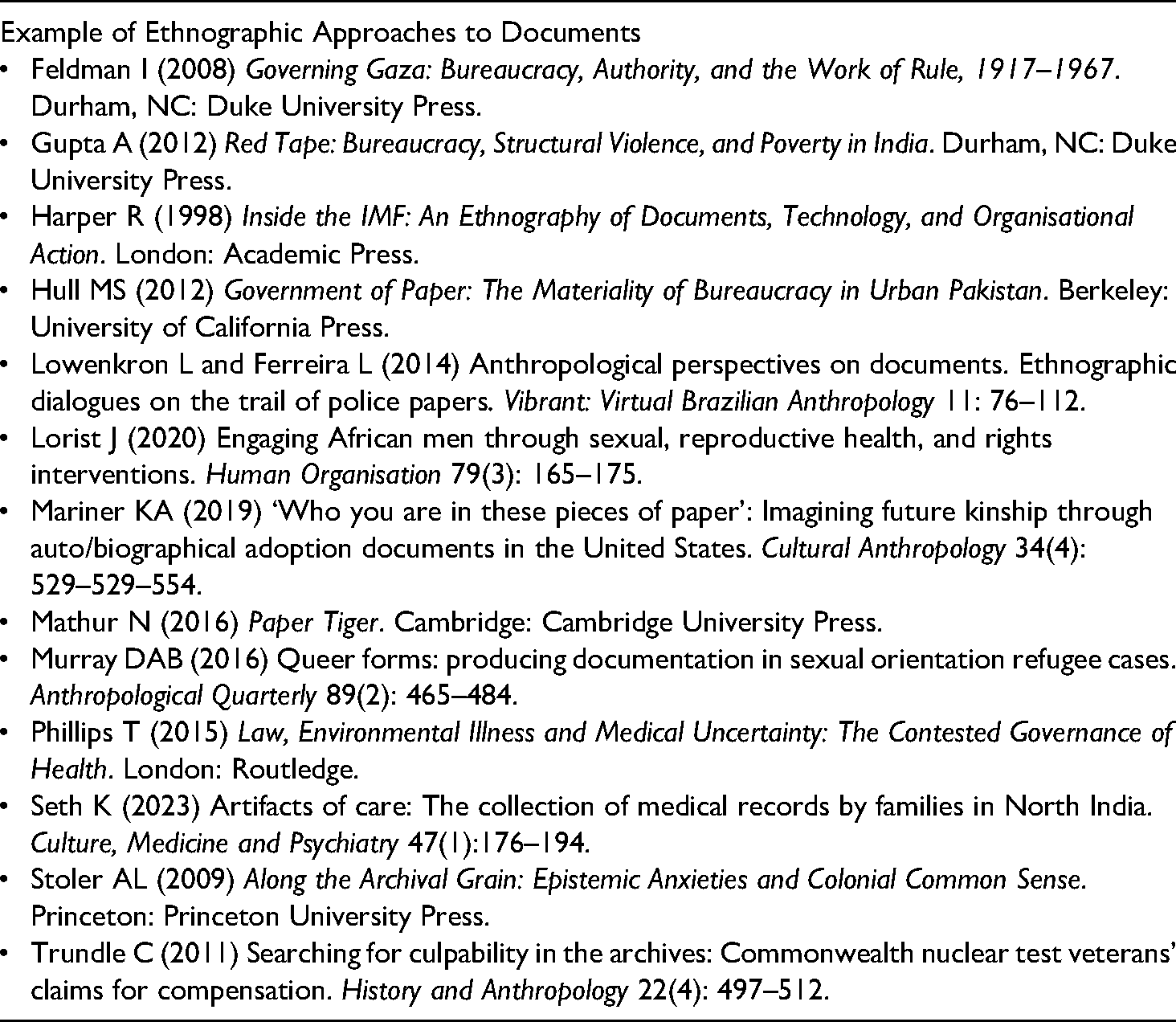
This literature offers compelling examples of the empirical and analytical depth that can be achieved through an ethnographic attention to documents (see suggested readings at the end of the article). It reveals that documents should be treated as a rich and complex site of social life and as valid ethnographic objects in their own right, rather than as simply providing contextual information or triangulation to participant-focused research (Hull, 2012a). Yet the methodological approach to documents within such ethnographic works is rarely explicated, nor made methodologically accessible to newcomers or interdisciplinary audiences. This article attends to this need.
The contributions of EDA
While there is relatively little methods instruction about ethnographic approaches to documents, there are some notable earlier iterations that we build upon. Scholars have proposed ethnographic discourse analysis (Macgilchrist and Van Hout, 2011), ethnographic content analysis (Altheide, 1987; Altheide et al., 2008), ethnographic textual analysis (Harris, 2006) and an ethnographic approach to documents (Jacobsson, 2022). EDA shares some similarities with the principles and practices of these methods, but also extends and compliments these frameworks in distinct ways.
First, we are proposing EDA as an approach that is specifically tailored to documents, as opposed to textual sources or content and discourse more broadly. This seeks to recognise the powerful genre of documents and documentation within contemporary society. In EDA, documents are far more than their content. Textual and discourse analysis often prioritise semantic meanings in order to reveal how power circulates through language (Bernard and Ryan, 1998). By contrast, EDA attends equally to the material dimensions of documents, and their dynamic social circulation (see also Hull, 2012a; Jacobsson, 2022). Whether in a stand-alone documentary study, or in combination with other methods, this approach treats the agentive qualities and social lives of documents as crucial to understanding them.
A second contribution of EDA is that, while focusing on the analysis stage, it outlines ethnographic design choices at different points of the entire research process that ensure congruence, making clear the important flow-through effects of ethnographic principles. This recognises that ethnography is a methodological disposition that informs all parts of a research project. While EDA is at its core a method for analysing documents, we also show that analysing in an ethnographic way involves first asking ethnographic research questions and collecting documents using ethnographic principles. And the analytic practices of EDA are designed to ensure an ethnographically rich and persuasive report, article or book.
EDA makes a third contribution by breaking down the analytic process into multiple areas of attention. While not prescribing a step-by-step, rigid process for analysis, we outline eight key considerations when analysing document to ensure that the nuances, complexities, and multiplicity of meanings and social effects of documents are explored.
This approach is one developed over time and through practice; it reflects our own ethnographic experiments and engagement with documents. Equally, in developing this EDA approach we have also drawn on the insights of a range of ethnographers who work with documents. To spotlight these influences, we reference a range of scholarship throughout. EDA thus reflects a synthesis, distillation and elaboration of approaches, rendering visible the often implicit, tacit workings of ethnography for an interdisciplinary audience.
What are documents?
We are reticent to define documents. Hull (2012a) argues against it, and there is a sound ethnographic rationale for refusing to do so. In researching inductively – in other words, starting with and building upon our participants’ social categories and explanations – we should define documents as they do. And our participants’ definitions of what does and does not count as a document may vary greatly. Pre-conceived definitions risk blunting our attention to what a document is and what it does within a social world. According to Prior (2003: 19), ‘we have to move away from a consideration of them as stable, static and predefined artefacts … the status of things as “documents” depends precisely on the ways in which such objects are integrated into fields of action, and documents can only be defined in terms of such fields’.
If we wish to create some definitional boundaries for identifying documents, then Prior does offer some useful parameters. Prior notes that, while documents can be multimodal, ‘the written word serves as the master code’ (2003: 19). In our own approach to documents, we see as central to documents the ways in which they store and perform evidence, ideas, and information, and how, at their core, they act as a record. Our own working definition of documents also hinges on a thing's ability to be transformed and transferred into material, paper form; in other words, could you print it? Such a definition thus includes paper-based documents, as well as a wide array of digital records, such as websites, emails, text messages, social media posts, photographs, maps, or art prints.
This thinly sketched definition comes with a caveat: pay far greater attention to what words and forms of boundary work participants use, or documents use, to delineate and define documents, than the safety-net of any scholarly definition.
The epistemic assumptions of ethnography: guiding principles for EDA
Ethnography as a methodology is diversely defined (Hammersley, 2006, Higginbottom et al., 2013). Our approach to ethnography is as a methodology underpinned by a set of five core epistemological sensibilities: People-centred, reflexive, interpretive, contextual and entailing recursive dwelling. Outlined below, these principles flow through and shape all stages of the research process and represent a research sensibility and epistemic understanding of knowledge, as much as they do a how-to approach to conducting research.
First, ethnography is people centred. It involves gaining deep familiarity with people's social worlds on their own terms and in their own words, that is, according to the meanings they ascribe to them (Campbell and Lassiter, 2014). Secondly, ethnography is also continually reflexive. The researcher asks, and continues to ask across the research process, how does my social positionality, as well as my preconceptions – social, cultural and theoretical – shape my engagement with a phenomenon and how I am interpreting and understanding it? (Altheide, 1987; O’Reilly, 2012). Thirdly, ethnography is interpretive and involves the researcher assigning and ascribing meaning to data in ways that can never be neutral or detached (Campbell and Lassiter, 2014). Fourthly, ethnography is contextual, in that it seeks to understand and describe human experiences and practices within the wider social, cultural, political and economic systems that shape them (Brewer, 2000; Trundle et al., 2024).
Finally, ethnography entails a recursive dwelling with participants, stories of their lives, and the data (or materials as ethnographers commonly call data) we generate. In this sense, ethnography is a method of slow scholarship, even when done within limited timeframe. By dwelling, we mean a recursive process of carefully attending to and attuning with participants, ethnographic objects of research, and research materials. In the context of documents, ‘attending to’ indexes the patience required to return to the documents on multiple occasions, as understandings of their context, circulation, and possible meanings grow. ‘Attuning’ refers to an attitude of openness to understanding the documents on their own terms, rather than according to predetermined research priorities, as well as an attention to the whole document, its subtle details of form, content, silences, and uses (Trundle et al., 2024).
How to dwell with documents, or a non-prescriptive how-to guide to EDA
While we discuss an ethnographic approach to documents across the ‘stages’ of research below, it is important to note that any linear understanding of the research process moving from design to collection, analysis, and finally to writing does not work for EDA. Rather, in EDA there is continual movement back and forth between refining the research question, collecting documents, spending time with documents to analyse them, and writing about them.
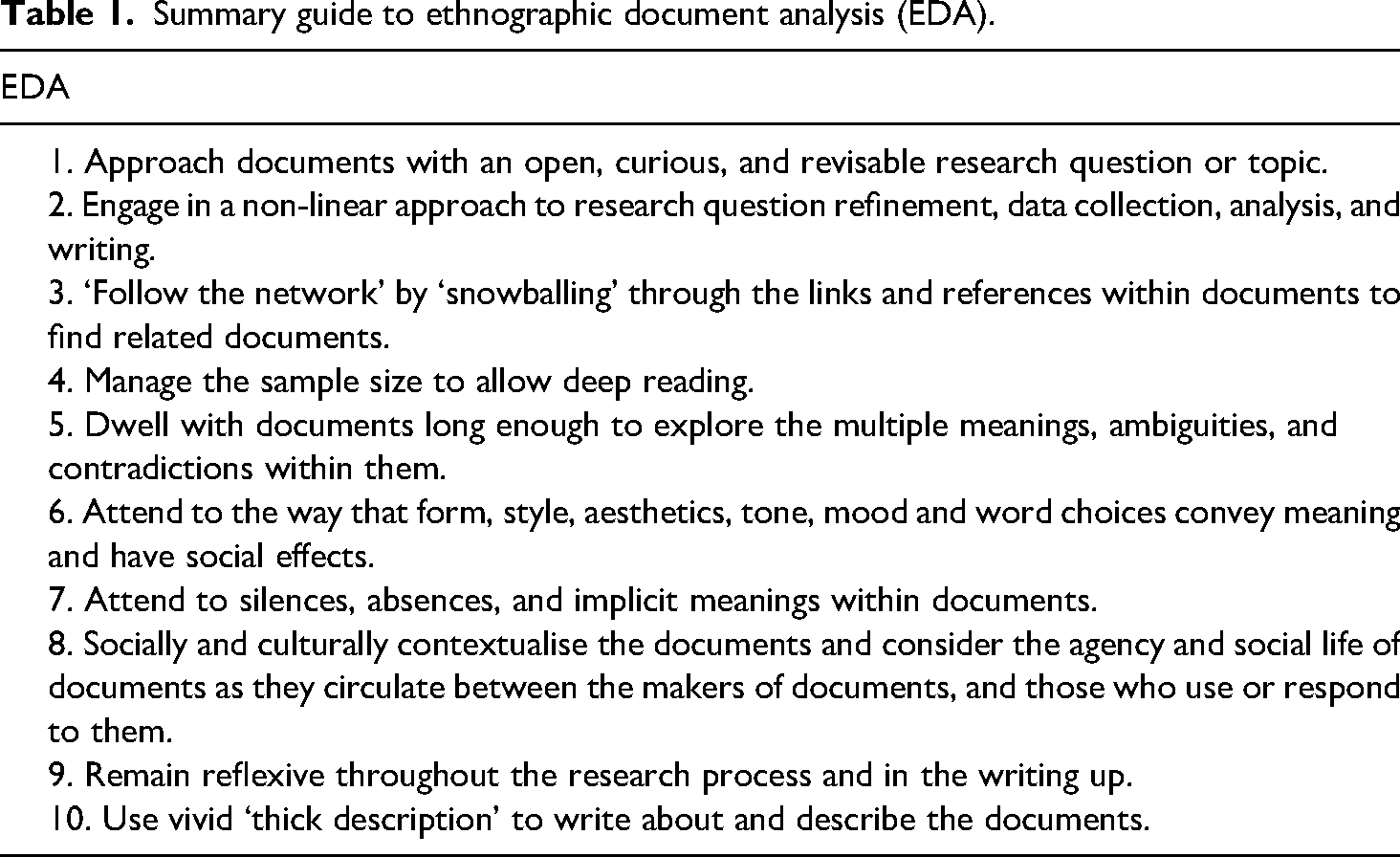
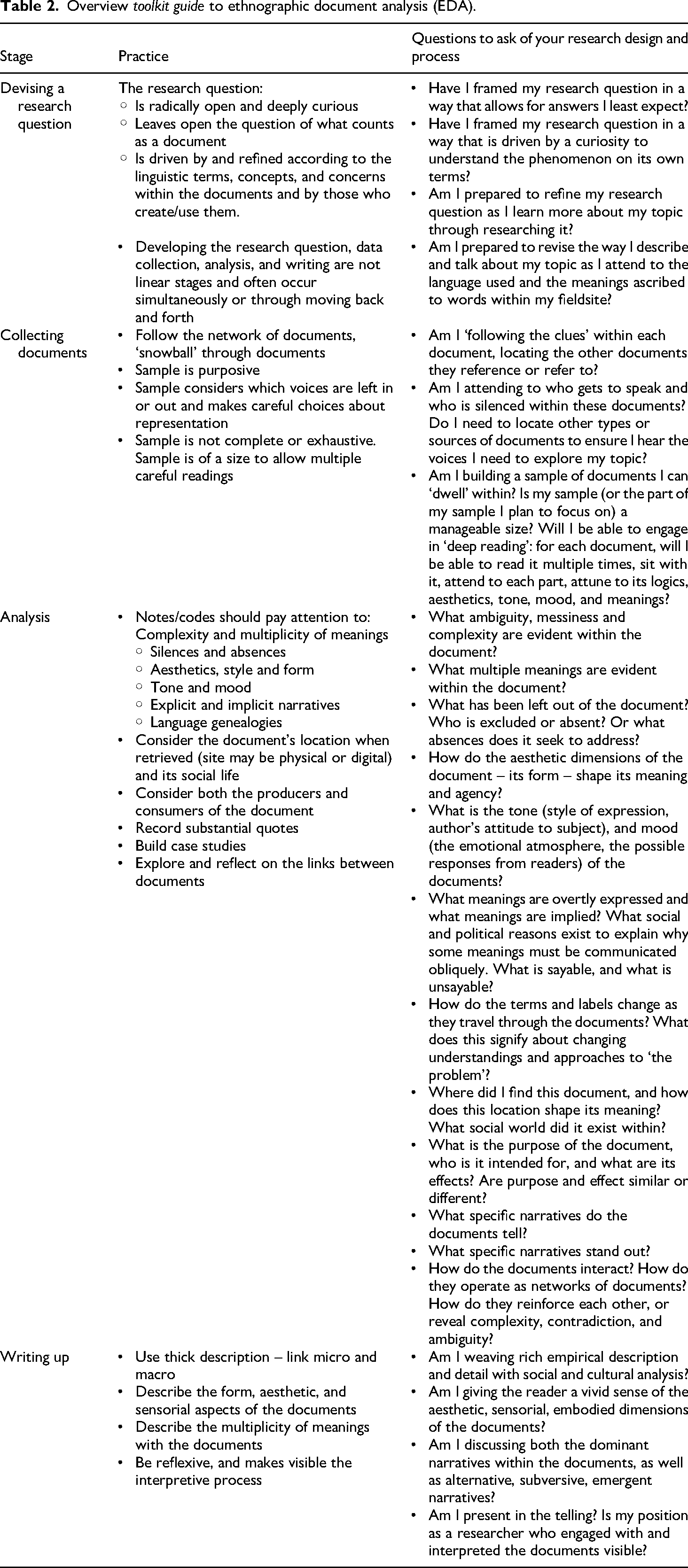
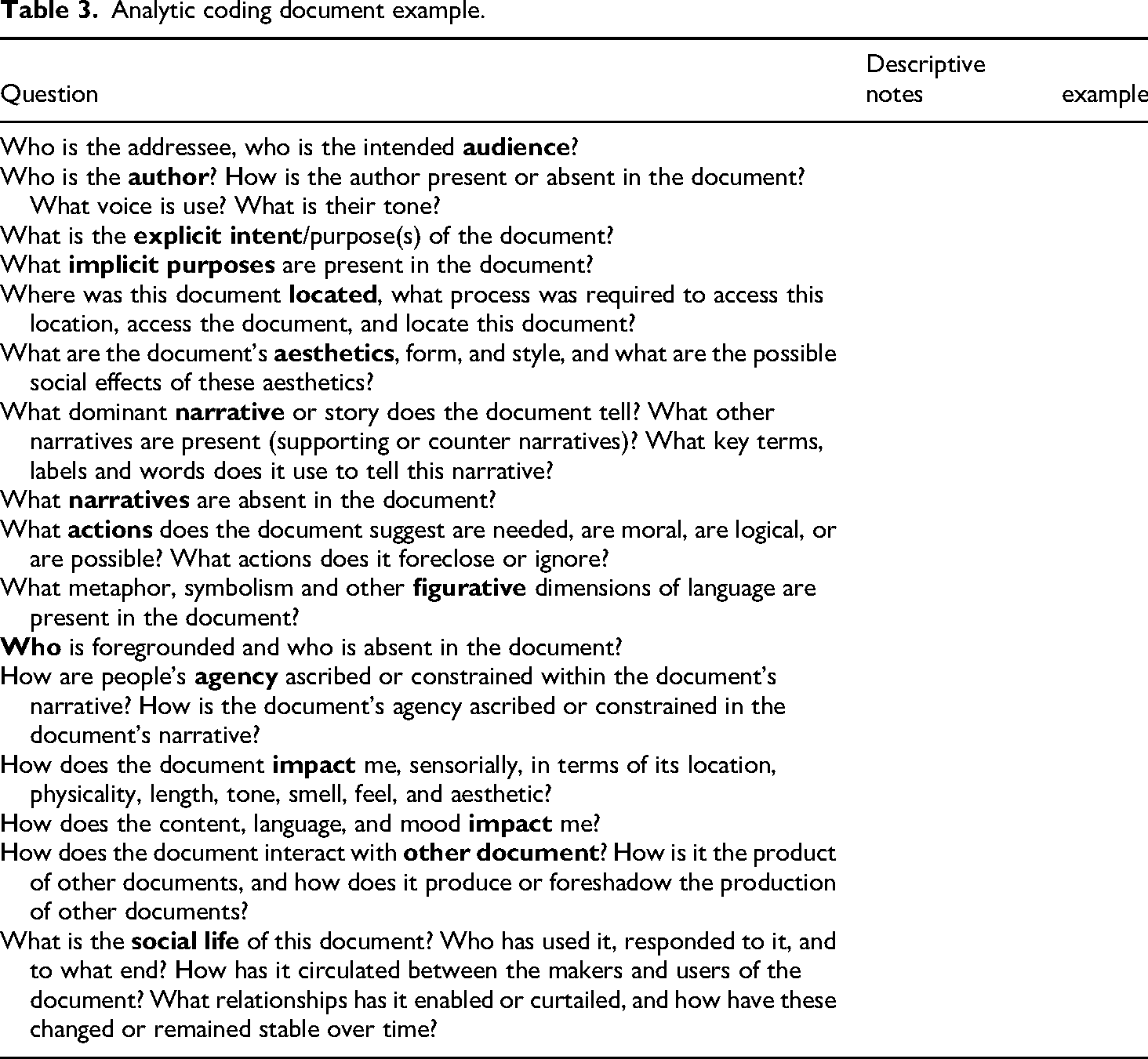
For ongoing reference, we have distilled the core principles and approaches into two resources. Table 1 offers a succinct summary of the method into ten key principles. Tables 2 and 3 offers an overview toolkit which frames EDA practices as a set of reflective questions to ask throughout the research process and during coding, respectively.
Summary guide to ethnographic document analysis (EDA).
Overview toolkit guide to ethnographic document analysis (EDA).
Analytic coding document example.
Designing an ethnographic research question for document sources
An EDA approach to designing research questions and topics is, at its most fundamental, radically open and deeply curious (Altheide, 1987; Jacobsson, 2022). Openness means designing a research question in such a way that ensures it will not shine its light in the direction of a specific answer, even subtly. An ethnographic question needs to allow any possible answer, including the answers a researcher least expects or least wishes to hear.
Such a question puts our participants (in this case, documents and those who produce or use them) in the definitional driving seat. Imagine a study of the document correspondence and interaction between a hospital and a patient group, for example: How effectively does Central Hospital meet the outpatient care needs of renal patients as measured by patient satisfaction and clinical outcomes? From an ethnographic perspective, such a question is problematic for two reasons. First, it has already determined that ‘care needs’ are reducible to patient satisfaction, clinical outcomes, and the established measurements used to track them. And secondly, the site where this occurs (outpatient care) is predetermined and delineated.
We are better to begin with a broader topic, exploring the ways Central Hospital and renal patients interact through documents and refine the question over time. We need a question that allows us to first ask of our documentary sources and participants how they variously understand and enact care and wellbeing, and where this occurs from their perspective. Moreover, we need to leave room for observing other forms of interaction beyond ‘care’ that each group may value for wellbeing (such as, for example responsibility, autonomy, or the ideals of the rights-bearing citizen).
A research topic framed this way can uncover the multiple congruences and incongruences in each group's ideals and enactments of care, from their own perspective. It is curious because it seeks, in good faith and at a deep level, to understand individuals’ and institutions’ own perspectives of care, rather than to affirm or test the researchers’ perspectives of care, or to measure against institutionally sanctioned definitions of care. And it lets participants and documents define the contours of the fieldsite, which may lead in and out of the hospital site. Such an approach treats participants and documents as agents in the wider social world and takes seriously their place within social life because it allows them to ‘speak’ on their own terms, and according to their own priorities.
A research question appropriate for EDA is also one interested in understanding documents through the perspectives of the social, cultural, political, economic, historical and institutional worlds that produced them and which they also help to produce. Such questions are thus implicitly curious about ‘the web of activities that surround’ documents (Prior, 2003: 16). An exploration of the ways Central Hospital and renal patients interact through documents thus enables the ethnographer to study not only the content of the documents themselves, but the ways documents shape and constrain social life, and how people interact with, understand and respond to documents.
An ethnographic research topic or question thus avoids fully predetermining what and who are the subjects of the study, and is revisable. As the above hypothetical study progresses we may discover, beyond patients, that family members, friends and community advocates are vital to mediating, filling in, and engaging with documents, and we would revise the research question to reflect this.
It is often misunderstood that broad initial research questions can only lead to broad answers, but this is not the case. The data generated through open ethnographic questions can be used to answer highly specific questions around, for example, how to improve a service. But they are able to do so in ways unconstrained by the status quo or established practices and thinking.
Dwelling in language and flows: searching for and collecting documents
An EDA approach towards document searches and the collection of documentary materials is iterative rather than pre-designed. It thus rarely imposes a rigid, predetermined criteria for document inclusion. Its hallmark is flexibility. The contours and boundaries of a sample are ‘snowballed’ due to the flow of and boundaries around documents in the fieldsite. Such an approach follows the network of documents, that is, it follows the links, mentions, and references within one document to locate other related documents. It attends to how documents are grouped together or separated out. This pays attention to how documents spawn documents. How, for example, an application form becomes a file, and a file generates a letter. Or how a government policy generates an organisational strategy which generates an implementation plan, and later an evaluation. In other words, documents help to constitute social networks and social action across time and space.
In developing search strategies for documentary sources, search terms are developed iteratively. This allows knowledge about the documents to build and increase the specificity and efficacy of search terms as the research progresses. Correspondingly, search terms are increasingly based on the everyday language and terms used within the documents and to classify the documents. Thus in the above hypothetical study, we move beyond obvious care terms (e.g. ‘care plan’) as we become familiar with the specific terms our participants use to assert good care, or the sites where they see good care occurring (e.g. ‘discharge’, ‘spouse’, ‘disability support payments’).
Documentary sample sizes are rarely huge, or if they are, then a subset of documents becomes the core focus. This allows the iterative re-reading or dwelling with each document. The scale of the ethnographic material collected is thus driven by a desire for interpretive depth and the limits of time and resources at the ethnographer's disposal. Scholars utilising EDA thus rarely seek to offer appraisal of a complete body of documents. In today's informational age, where documentary records are vast and continually proliferating, the goal of completeness is often impossible. Samples are thus purposive (Altheide, 1987). Rigour is demonstrated through a deep and contextualised reading of a chosen selection of documents that best allow the researcher to explore their evolving research topic or question.
In circumscribing a viable sample of documents to study, the researchers’ choices should also be informed by questions of voice, representation, and power. Just as documents include and exclude particular perspectives, the researcher's choices in which documents to include and focus upon reflects acts of representational power. Whose voices are we giving light to? Whose are we not? (Vaeau and Trundle, 2020) As Aimee Grant (2018: 125) shows, potential document sources are produced by both insiders to organisations and institutions, but also by outsiders who engage with, implore, critique and speak back to those in power. An EDA approach thus is highly reflexive about the choices made for the sample, its rationale, and its consequences (Rampton et al., 2004).
‘Deep hanging out’ with documents: an analytic strategy
Those utilising EDA are engaging in an interpretive analytic act aimed at generating complex and nuanced meanings. EDA thus rarely seeks to count the frequency of utterances to generate statistical results, as is common with some versions of content analysis. And rather than commencing the analysis phase once data collection is complete, analysis occurs alongside collection and is iterative. As a consequence of these features, predetermined codes or codebook are rarely used (Altheide, 1987).
At every stage, the process of dwelling with the documents acts, in the words of Clifford Geertz (1998), as a kind of ‘deep hanging out’, in which an intimate familiarity with the documents – their language, style, aesthetics, narratives and content – is slowly built. This requires repeated readings and re-readings of the document, ‘a long initial “soak” in the material, followed by an extremely close reading’ (Harris, 2006: 85–6). This shares some parallels with the ethnographic ideal of the immersive nature of participant-observation fieldwork.
Note taking and coding processes in EDA are inherently reflexive (Altheide, 1987). That is, analytic notes do not neatly separate out reflections about the research process – how data and analysis are produced – from the data and analysis produced. Analysis is understood to be generated by a researcher unavoidably shaped by their social positionality and disciplinary lens, and thus generated through an interpretive process, rather than a process by which data is simply ‘found’ or from which a researcher's positionality can be ‘bracketed’.
The coding and note taking approach of EDA is highly flexible and often designed to suit the individual researcher and the types of documents analysed. We are thus not prescribing a particular protocol of coding or note taking. We have, however, developed a template for coding that we have found particularly useful for graduate students and colleagues when first familiarising themselves with EDA (see Table 3). We do, however, recommend that over time scholars iterate and develop their own coding method based on their own research questions, the specifics of the documents they are analysing, and their own analytic thinking style. Regardless of the coding method used, there are eight specific areas of attention for coding and notetaking important to EDA, outlined in turn below.
Complexity
The notetaking/coding process in EDA is one that accepts, expects, and makes visible the contradictions and ambiguity that appear in the documents. Such ambiguity appears both within individual documents and across collections of them. This helps to ensure attention to complexity – the rich, messy and unfinished nature of social life that inevitably leave traces within documents. This is particularly important when analysing institutional documents. As Fassin and colleagues point out (2015), state institutions are never coherent monoliths, and to portray them as such vastly simplifies the contradictory and competing pressures, ideals, motivations, morals, and pragmatics that drive agents of the state. Given that documents have multiple meanings, any singular interpretation will be inadequate. This means approaching documents as artifacts that often contain both dominant and countervailing narratives at the same time.
An example of such documentary complexity is in Phillips’ work on the governance of nutrition-related diseases in Fiji, a country grappling with high rates of diabetes (Phillips, 2020). Glossy Ministry of Health annual reports reveal contrasting worldviews in quests to tackle this challenge. Within these documents, dominant health promotion narratives express the need for individual responsibility and lifestyle ‘choices'; development discourses calculate the burden of diabetes on the national economy; and bible passages remind readers that their bodies belong to God. These documents are also given different weight by local actors; Ministry of Health members become frustrated with those in the Ministry of Trade and Finance for ignoring their reports’ recommendations and prioritising business interests over public health (Thow et al., 2021).
Narratives
Documents contain narratives. Narratives refer to stories that attempt to make sense of the world, assign it meaning and value, plot events and their meanings across an unfolding arc of time, and turn the flux of experience into domains within which people can effectively act (Kleinman, 2020; Mattingly and Garro, 2000). Documents often contain their own small narratives while also contributing to larger narratives built across collections of documents and as part of larger social, political and historical processes. Documents, in this sense, are not taken to offer neutral records or reflect reality, but to engage actively in contestations over truth and meaning. When engaging in EDA we thus ask, what story does this document attempt to tell about the nature of reality, what systems of meaning does it offer (or deny) the subjects or readers of these documents, how does the past become intelligible through these narratives, and what future is the document attempting to construct or signpost?
A vivid example of this is the medical record as conceptualised by Berg and Bowker (1997). They demonstrate how the medical record is the ‘central niche’ in the network of clinical activities that transforms the lived body into the patient body, that is, into an object upon which medicine can work: ‘it is where many of the nurses’ and physicians’ tasks begin, end, and are coordinated, where inscriptions accumulate’ (1997: 514). The cultural logic of the medical record understands a body as a series of detached parts: blood separated from vessels, an abdomen separated from a chest, one organ separated from another. Biomedical narratives of Illness or healing emerge within such records through a tracking of the body and its ‘symptoms’ across time.
Thickly descriptive notes
The notetaking/coding practices of EDA need to allow the ‘thick description’ so essential to the later stage of ethnographic writing. Thickly descriptive writing entails telling stories about our research subjects – be they people or the documents they produce – in vivid and evocatively rendered detail and with sufficient contextual and local nuance (Bönisch-Brednich and Trundle, 2016). Thick description tends to foreground subjects ‘who are singular, contradictory, and relationally embedded’ (Trundle and Phillips, 2023: 116108). To achieve this, coding practices cannot only be geared towards a summative approach. They do not seek to simply find the most salient themes and strip out the messiness evident in the documents or the unique features of singular documents.
Thick description is also used in ethnographic writing to build key stories that follow characters across multiple moments in time and space and to explicate the wider social and cultural significance of such stories (Trundle and Phillips, 2024). To allow this, coding in EDA must spotlight, chronical, and draw out significant longer quotations and passages, and make connections within and across documents that build extended narratives and case studies, and which, in the process, details relevant features of the documents’ socio-cultural contexts.
Uploading documents into software programmes or sorting them into coding documents often reduces them to their written and linguistic components. Yet a key phase of EDA also involves spending considerable time with the documents in their original form and totality, considering the text and words alongside the aesthetics and materialities of the documents, and how such components interact. To this end, many ethnographers spend substantial coding time highlighting, underlining and adding notes in the margins of the document themselves, or copies of them. This is a key part of ‘dwelling with’ the documents, rather than with stripping out and isolating textual components.
Silence and absence
In EDA the silences and absences in a document are just as interesting and important as the expressed content. Our codes/notes thus ask of every document, whose voices are not present in the document, or whose socially silenced voices does the document attempt to presence? What has been rendered invisible through the aesthetic form and use of language of this document, or what silences does the aesthetic form and language attempt to counter? What do the priorities of this document exclude and include? (e.g. Barrera, 2018; Foucault, 1982) Thus as Ann Stoler ethnographic work on archives shows, documentary practices created ‘the conditions of possibility that shaped what warranted repetition … what stories could or could not be told and what could not be said’ (2009: 34).
Attending to the silences created or countered in documents necessitates reading both along and ‘against the grain’ of documents (Stoler, 2009). This means seeking out the meanings that documents promote and foster, as well as the meanings eschewed or implicitly rejected. The ethnographer usually identifies excluded or silenced narratives as they progress in analysing the full range of diverse documents within their sample. As some documents offer diverse pictures, voices and narratives, the silences in other documents becomes contrastively evident. In other documents, fleeting mentions of excluded subjects highlights their absence.
For example, during fieldwork with British nuclear test veterans, Catherine sat with a participant named James (a pseudonym), to examine historical military planning documents from state archives. Pouring over the documents and discussing them for hours with Catherine, James pointed out that the documents contained almost no mention of the safety of the Indigenous peoples living on neighbouring islands to the nuclear testing site. He showed Catherine one brief mention, a document from the 1950s marked top secret and titled, ‘Safety Precautions Planned for Operation Grapple’. This document noted that ‘safe levels of radiation “recommended by the International Commission on Radiological Protection (ICRP) would be necessarily exceeded.” Despite this the [document] reasoned that, “only very slight health hazard to people would arise and that only to primitive peoples”’ (2020). Catherine describes the document in James’ hands. Through all the photocopying of photocopies … the word ‘primitive’ has faded, almost indecipherably, from the page. But James has underlined it, twice, in green ink, and traced back in the vanished letters p and v. His finger is, however, pressed below the word ‘only.’ He taps it (Trundle, 2020).
Such documents demonstrate the almost complete erasure of Indigenous peoples and their wellbeing from the official planning and safety procedures of the British nuclear testing programme in the Pacific, as well as attempts by contemporary document users to counter such erasures.
Aesthetics
An EDA approach understands that a document's meaning lies not only in its content – information, numbers, graphs, words – but in how the document communicates and has social effects through its form and style (Riles, 2001 and 2006; Lester-Roushanzamir and Raman, 1999; Reed, 2006; Stoler, 2002). Coding and note-taking within EDA thus pay careful attention to what is conveyed through a document's aesthetics, for example ‘the importance of patterns, iteration and repetition’ (Trundle and Kaplonski, 2011: 411). Feldman (2008: 16) for example notes that the aesthetic of repetition within files is a core feature in how bureaucracy asserts political legitimacy. ‘Every personal file needs to look alike; every government form needs to fit the mould’. Aesthetics involves the use of font, layout, colour, bullet pointing, brevity or elaboration, spacing and sizing of items, as well as shifts between text and image. It also involves attending to how the style and rules of form convey meaning, be it in the format of a formal letter, meeting minutes, a legal ruling, or an architectural plan.
In her study of British and Egyptian rule in Gaza in the first half of the twentieth century, Feldman (2008) shows how the format and style of different bureaucratic documents powerfully constrained and shaped content in ways that solidified British and Egyptian colonial rule. For example, the style of a police report allowed almost any information to be included, no matter how apparently extraneous. This reflected an expansive security logic in which police records might provide as-yet unanticipated and vital information about ‘security threats’ in the future. By contrast the form of other documents severely limited or regulated what information could be entered. Letters between bureaucrats commenting on policy had style conventions based on politeness and reticence that obscured critique and open, direct debate. This reflected an awareness of the public accessibility of such documents, and such a style served to bolster the apparent unity of government officials’ approaches to policy.
Tone and mood
EDA attends to the tone and mood of documents. Tone refers to (1) the document's style of expression, and (2) the author's apparent attitude to the subject of the document. It is important to note that many official documents are written in an impersonal, authorless, ‘rational’ voice. As a ubiquitous and dominant voice, this tone can appear universal and go unnoticed. However, such a voice is neither an inevitable nor ‘natural’ way for documents to speak. Rather, authorless tones of neutrality are often used within documents to express legitimacy and truth, and to assert power (Trundle and Phillips, 2024). And depending on the topical focus of a document, such a voice may convey different apparent attitudes by the authors; arrogance, apathy, kindness, or threat can all be conveyed with such a tone depending on content and context. EDA also considers the mood of a document, or its emotional atmosphere. What emotions and reactions does it incite in the researcher, or might it incite in its intended audience? How is this part of its agency and social life?
Genealogies of language
EDA traces genealogies of language within and across documents. EDA encourage careful attention to the use of language, and how it shifts across documents and across time (cf. Macgilchrist and Van Hout, 2011). How does terminology emerge, solidify, or change over time, or as documents work their way through networks, up and down hierarchical structures, or in or out of institutions? (Altheide et al., 2008). A genealogical approach to documents thus borrows from Foucault's archaeological method to historically situate and trace the emergence of new classes of objects, identities, and concepts in order to understand how power and knowledge coalesce (1982). Such an approach is useful for seeing how narratives are contested, and how silences and exclusions emerge within documents. An example of a genealogical coding method is offered in Table 4. Taking a hypothetical case of a resident group concerned about pollution in their water, Table 4 reveals how the terminology shifts over time across documents, away from an emplaced sense of harm and local knowledge, towards a technical, scientific and legal understanding of ‘claims’.
Document genealogy map.
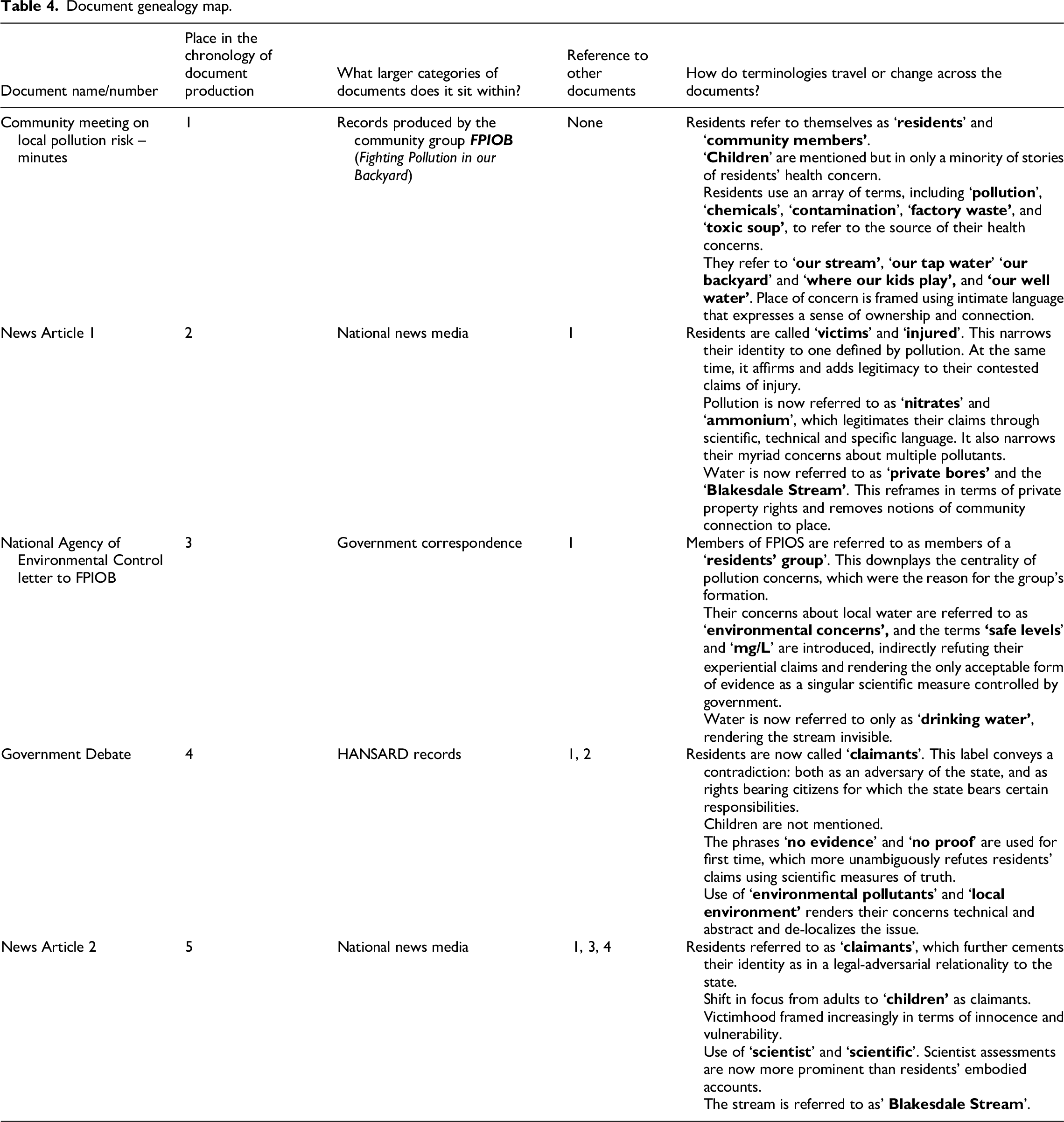
A careful and critical attention to genealogies of language allows a researcher to identify the social, cultural, and political logics and ideals that exist ‘beneath’ a document's surface, that is, the often unstated or obliquely stated meanings and narratives that underpin the obvious and explicitly elaborated meanings expressed in the document. When using EDA, we ask, what is being said, expressed or conveyed without being explicitly said? (Smith, 2005; Smith and Turner, 2014).
Social life of documents
EDA seeks to understand, as far as is possible, the social life of documents. EDA considers a document's location when retrieved, a site that may be physical or digital. How does a document's ‘home’ shape its meaning, agency, use, accessibility and movement? Moreover, how have the documents we study moved? For example, Harper (1998) described documents’ ‘careers’ within the IMF to reveal how institutional ideas and actions unfold and are transmitted or transformed through these documents.
Tracing the social life of documents entails exploring how documents mediate, make and break social relations between producers, the authors of and authorities behind documents, and recipients, those addressed or discussed in documents, and those who use and respond to documents. We can see how the producers and recipients of documents engage when we are able to ‘follow the flow’ of documents and discover how a document elicits other documentary responses.
Conceiving of the social life of documents also entails taking account of those who are less visibly or directly in relation to documents. Documents can remain unreachable for those searching for them, such as those documents classified, withheld, redacted or destroyed. Correspondingly, documents sometimes fail to reach those they address, such as those without a fixed address or secure housing. Thus, EDA takes the failure, erasure, or destruction of documents just as seriously as their presence when tracing their social life.
Over time documents may be put to uses unanticipated by their creators. Phillips (2015) discovered unintended uses of documents when researching a cluster of workers seeking compensation from their employer for alleged chemical injuries stemming from emissions at a mine site. One of the claimants, Jim, who had a low-level management role, trawled through boxes of company documents in order to prove that his employer knew of the toxicity, and could have foreseeably prevented the workers’ exposure. Jim knew of the existence of a company-commissioned report assessing the suitability of the current site for the mine. However, his employer refused to provide the document to the workers’ legal team, claiming it had long since been misplaced or destroyed. It was only when Jim looked more closely at his desk that he saw that the report was, serendipitously, amongst a pile of books propping up his computer. The report revealed that the site had been deemed unfit for the mine because particular weather conditions would carry toxic fumes to workers and neighbouring residents. The original document was then photocopied and given to lawyers, judges, investigative journalists and, eventually, Phillips when she began researching the matter, to prove the employer's negligence. The report was endowed with different kinds of status over time, ranging from something that was secret and withheld, to a mundane, pragmatic boost for a desktop computer, to a central piece of evidence in a legal case.
An analysis of the social lives of documents must also extend beyond the material life of documents to their ongoing legacy, and the ways in which they live on in the social imaginary. Exploring the genealogy of the ‘science’ of racialised difference in Australia, Emma Kowal (2024) prompts us to consider how historical artifacts and documentary records have afterlives, as do the people who have collected, analysed, translated and curated them over time. This invites ethnographers to reflect on how the social lives of documents can linger beyond their material form, and can continue to have a haunting presence.
Writing up to let others dwell in the documents
The hallmark of ethnographic writing is ‘thick description’, commonly misunderstood simply as very detailed empirical description. By contrast, Geertz (2008) describes thick description as a richly descriptive interpretive mode for understating social worlds. Geertz was attempting to grapple with ethnography's attention to wider cultural themes through the ‘microscopic’, that is, ‘exceedingly extended acquaintances with extremely small matters’ (316). Geertz argues that an interpretive approach not only describes a thing or practice in detail, but deciphers its cultural and public ‘import’ (315). Thus ‘social actions are comments on more than themselves … small facts speak to large issues’ (319).
In the same way that we ethnographically write about human participants, the writing-up stage of EDA describes documents in lively detail. This involves rich and contextualised quotes from the documents, and detailed description of them that render them sensorially present to the reader. Ethnographers wish to give the reader a feeling of dwelling with these documents.
Such thick descriptions convey a document's content, form, and aesthetic, as well as its social life. And in the tradition of Geertz's thick description, these details are woven through with analysis to reveal their larger social significance. Thick description does not stand alone outside of analysis and theorisation, and ethnographic writing tends not to separate findings from discussion.
Where possible we describe the varied effects that documents have on those who created or engage with them. Murphy's (2011) ethnographic study of Australian state records for Stolen Generation Aboriginal children offers one example. She traces how those forcibly removed from their families into state care as children decades later engaged with archives to make sense of their pasts. In archives they discovered letters from the parents begging for their return. Murphy traces the strong emotions, traumas, and connection to family and culture participants experienced when engaging with such documents.
We also use our embodied experiences of research to convey our sensorial experience of documents. This involves the materiality, smell and feel of documents, the embodied effects of them on us as we engage with them in archives, in offices, or digitally. It involves the effects that their emotive or detached language have on us, and the impacts we experience in terms of how they occupy our time or require our attention.
The reflective essay by ethnographer Lori Allan offers a poignant example of writing about such embodied effects. She describes her time spent with documents from the historical International Investigative Commission for Palestine, and the freedom she experienced to feel her emotions when reacting to non-living participants through documents. From their first memo to the metropole or letter to the missus, some of them struck me as arrogant, sexist, racist, petty, and ambitious, and equal parts long-winded in their boring views of “the Orient,” and tight-lipped when it came to what I thought I wanted to know from them. I have developed a genuine dislike for a couple of what I have come to refer to as “my guys,” my brood of Western commissioners who have traipsed through Palestine over the decades. And I could let those feelings bloom. I could frown and fume (silently and in my head in the library) at their biased attitudes, at their self-congratulatory pride, at their unselfconscious sense of self-importance (2017, Para 4)
Such reflexivity helps to unpack our own positionality and relationality to our research topics and reveals the ongoing agency of the documents upon those who read them.
Following the logic of attending to complexity within EDA, we write about documents in ways that reveal the multilayered and even contested meanings within documents (Trundle, 2011). Murphy's (2011) ethnographic description of Australian state records regarding Stolen Generation Aboriginal children offers heartbreaking textual examples of parents’ letters to state agencies pleading for their children to be returned to them. Alongside this she describes how such letters were met with cold and disparaging assessments by state bureaucrats, evident in comments inscribed in the margins of such documents, such as ‘no reply necessary’.
In ethnographically writing about documents, we offer what contextual information we can about their use and circulation. Such an approach is evident in an introductory passage Trundle offers in a piece of ethnographic writing to contextualise the documents she and one of her participants discussed together during fieldwork: ‘I am grabbing mugs as James fans documents across his kitchen table. But the papers are already watermarked by beverage stains, their corners dog-eared and well-thumbed. Setting them out, James knows each at a glance – by the shape and pattern of the text, the slant of a historical signature, the placement of a grainy diagram’ (Trundle, 2020).
Conclusion
Documents are ubiquitous artifacts of social life, and an equally pervasive component of ethnographic data and materials. EDA offers a flexible and holistic approach to engaging with documents that unpacks key areas of analytic focus and makes visible documents within their social context. By tracing an ethnographic approach to documents through all stages of the research process, EDA ensures coherence between ethnographic project design, fieldwork, analysis, and ethnographic writing.
EDA encourages a robust dwelling with documents that draws out the multiplicity of their meanings and a careful attention to form, aesthetics, silences, tone, mood, and implicit narratives. It moreover emplaces documents within their social contexts and traces their social lives and agencies over time. By offering ethnographers core reflexive and critical questions that allow them to attend to and attune with documents – either as a supplement to a broader ethnographic project or as a sole focus itself – EDA represents a powerful tool within the wider suite of qualitative approaches to documents.
Footnotes
Acknowledgments
The authors would like to thank all of our varied colleagues and research interlocutors who over many years have encouraged us to develop our ethnographic document practices, broadened our understandings, and prioritised reflexive, collaborative modes of scholarship.
Author contributions
Both authors worked on all elements of the article, from conceptualisation to writing and revising.
Declaration of conflicting interests
The authors declared no potential conflicts of interest with respect to the research, authorship, and/or publication of this article.
Funding
The authors received no financial support for the research, authorship, and/or publication of this article.
Data availability statement
There is no data available for this research.

Author biographies
Catherine Trundle is a medical anthropologist and senior lecturer in Public Health at La Trobe University. Her research focuses on heat stress and climate change, contested illness, ethnographic research methods, and the ethics of wellbeing. Orcid ID:0000-0003-0908-9606
Tarryn Phillips is a medical anthropologist and associate professor in Crime, Justice and Legal Studies at La Trobe University. Her research interests lie in contested illnesses, health and nutritional inequalities in the Pacific, and ethnographic research methods. Orcid ID: 0000-0003-4027-8667