



Abstract
This article responds to calls for a relational praxis and rigor in qualitative research, seeking alternative ways of knowledge co-construction that serve the needs of marginalized and racialized communities, thus subverting research-as-usual designs. I describe the collaborative development of a research methodology within a partnership involving members of the Callemar township's educational community in the Colombian Caribbean region. Conducted over 18 months, this research aimed to co-design decolonizing language curricula with rural teachers and their educational community. Data for this article stems from the first 5 months of the partnership, utilizing a variety of data collection methods, including field notes, audio and video recordings from both online and in-person meetings, and participant-generated media such as videos, audio recordings, and photos during community walks. The primary focus of this phase was analyzing participants’ interactions and historias that shed light on the values that informed the ways of knowing and being in the community. Guided by decolonial, participatory, and community-based methodologies, the central inquiry of this research was: How does a rural community's lived relationality frame the co-construction of a research methodology within a partnership with schoolteachers and an allied researcher? This question was addressed by demonstrating how community dialogue initiated a co-theorizing process that facilitated joint knowledge-making, leading to a deeper understanding of the community's local literacies. These findings contribute to ongoing decolonizing research efforts that aim to center relationality and to challenge the coloniality embedded in traditional knowledge-making practices. This article models a decolonial approach, emphasizing the importance of community collaboration in research. By centering the voices of those directly impacted by educational practices, this research offers valuable insights for future initiatives, promoting a forward-thinking, applied practice in collaboration with communities.
Relationality is a key principle in indigenous 1 cultural and knowledge-making practices (Cajete, 2000, 2021). It recognizes the essence of relations—between humans and more-than-humans (MTH) in the lands and waters—for knowing and being in the world (Kimmerer, 2013). Decolonial scholars have called for centering relationality in qualitative research, 2 especially by honoring indigenous ways of knowing (i.e., epistemologies) and being (i.e., ontologies), which have historically been neglected by western understandings of science and research (Battiste, 2013; Patel, 2016; Smith et al., 2019). Although non-decolonial scholars have also advocated for a relational practice in qualitative research (e.g., Emirbayer, 1997), this study is grounded in a decolonial relational praxis that ‘decentres the focus from the aims of the researcher to the agenda of the people’ (Muwanga-Zake, 2009: 148).
This study centers participatory action research (PAR) (Fals Borda, 1979) and community-based design research (CBDR) (Bang et al., 2016), methodologies that position research as a multilateral endeavor. Both approaches value communities’ perspectives, concerns, and experiences, deeming participants as co-researchers, co-designers, and co-producers of knowledge (Bang and Vossoughi, 2016). Distinctively, PAR and CBDR center indigenous and peasant epistemologies and ontologies, challenging the dominance of western knowledge systems. For instance, Sentipensar (feeling-thinking)—a radical epistemology and ontology that rejects the body–mind separation—is a central tenet of PAR (Botero Gómez, 2019; Fals Borda, 1996). Sentipensar is a term Fals Borda (2002) borrowed from the practices of peasants—mixed-race individuals with indigenous ancestry—in the Colombian Caribbean region. Sentipensar emphasized trusting both the mind and our body-senses to learn from and sustain life in the ecologies we inhabit. Fals Borda's participatory research exemplifies a relational methodological praxis that subverts colonial knowledge-making by positioning participants as experts whose ‘popular’ knowledges inform the research (Negrete, 2008). Fals Borda's work inspired and informed grassroots movements and popular education initiatives, particularly in struggles for land rights and against racial violence affecting indigenous, peasant, and afro communities in Colombia (Escobar, 2020).
Similarly, CBDR studies with indigenous communities in North America have intentionally centered indigenous ways of knowing, honoring participant's ways of seeing, relating and knowing the world (Bang and Medin, 2010; Meléndez et al., 2018). This approach is both epistemological and ontological, affirming relational ways of being that recognize humans as deeply interconnected with the land, water, and MTH beings. CBDR also challenges the notion of value-neutrality of research by centering axiology. Bang et al. (2016) define axiology as ‘the theories, practices, and structures of values, ethics, and aesthetics—that is what is good, right, true, and beautiful that shape current and possible meaning, meaning-making, positioning, and relations in cultural ecologies’ (28). This intentional focus on community's ‘constellations of practice, relationships, values, goals and worldviews’ (Bang et al., 2016: 30) has marked axiological innovations in learning research. Some examples include considering human–MTH relationships in science education (Bang et al., 2015; Marin and Bang, 2018), centering land and waters in indigenous language revitalization programs ((Engman and Hermes, 2021; Henne-Ochoa et al., 2020; Hermes et al., 2012) and co-developing STEM (Science, Technology, Engineering and Mathematics) education programs with indigenous families and educators (Lees and Bang, 2023; Tzou et al., 2019). In urban, minoritized communities, CBDR has also informed equitable school–family partnerships that amplify family agency in educational decision-making (Barajas-López and Ishimaru, 2020; Ishimaru, 2020; Ishimaru et al., 2018, 2019). Such research partnerships attend to racial equity and the ways marginalized communities learn, relate and exist in the world (Chin et al., 2023; Ishimaru, 2020).
PAR and CBDR exemplify relational research praxes that prioritize ethical relationship-building and community accountability in social science and educational research. However, as decolonial scholars warn, relational praxis should take different ways, depending on the communities we work with. For instance, Halle-Erby (2024), introduces openings as a methodological technique to ensure relational praxis during the design, data generation, and analysis of a study on land ideologies. Similarly, Blockett et al. (2022) propose co-experience to disrupt the focus to observe culture and to transcend power asymmetries in research interactions. The Gesturing for Decolonial Futures collective calls for relational rigor as a methodological praxis that prioritizes ethical relations over the achievement of predetermined research outcomes (Stein et al., 2022: 143). Similarly, Museus and Wang (2022) suggest solidarity-driven research designs to refuse the neoliberal logics of individualism.
These decolonial calls have resonated within me, especially the recognition of research as a relational activity that cannot be done in isolation but must be done in collaboration with communities of human and MTH beings (Patel, 2016; Tachine and Nicolazzo, 2022). I mostly concur with Halle-Erby's (2024) definition of relational praxis as both an ontological stance and as a political project. Ontologically, it illuminates alternative ways to knowledge co-construction that challenge the modern/colonial project (Machado de Oliveira, 2021). Politically, it resists ‘business as usual’ research designs (Escobar, 2018), instead uses research to serve the needs of marginalized and racialized communities.
I draw on these decolonial calls to do research in relation, honoring the knowledges and voices of those often unheard (Battiste, 2013; Patel, 2016). In this project, I collaborate with members of Callemar (pseudonym), a rural community in the Colombian Caribbean region: Teachers who endure harsh conditions to get to their schools and are often excluded from educational decision-making processes (Cruz Arcila, 2018; Cruz-Arcila, 2020). Students—rural youth who are courageous and wise enough to care for their land but whose literacies are not often recognized in the educational system (Becerra-Posada and Mannard, 2024). Students’ parents, relatives, and neighbors—keepers and passers of local knowledges and literacies—who have historically faced marginalization and violent dispossession.
Rather than adopting a stance of granting opportunities for these communities to speak, I align with decolonial feminists like Spivak (2003), who assert that marginalized groups are already articulating their experiences. In this regard, one of my primary roles has been that of an oídora (listener), listening to community's voices, their historias, 3 their reflections, and their ideas. I take inspiration from previous oídores (listeners), Orlando Fals Borda (2002) and Silvia Rivera Cusicanqui (2008), who have centered listening as a methodological relational praxis to disrupt power asymmetries, acknowledging the essential role of peasants, black, and indigenous peoples in the co-construction of knowledge.
In this article, I describe the collaborative development of a research methodology within a partnership involving members of the Callemar township's educational community (parents and guardians of students at El Carmen Secondary School) in the Colombian Caribbean region. Drawing on field notes, audio and video recordings from both online and in-person meetings, as well as participant-generated video-and-audio recordings and photos during walks, I engaged with seven community members and three teachers over the first 5 months of the 18-month partnership. The project ultimately aimed to co-design decolonizing language curricula with rural teachers and their educational community.
The focus of analysis for this part of the project was on participant's interactions and historias, which illuminated the interconnectedness of the community's values (i.e., axiology), ways of knowing (i.e., epistemology) and ways of being (i.e., ontology). Guided by decolonial, participatory and community-based methodologies (Bang et al., 2010, 2016; Fals Borda, 2002; Rivera Cusicanqui, 2015), I endeavored to inquire: How does a rural community's lived relationality frame the co-construction of a research methodology within a partnership with schoolteachers and an allied researcher? I try to answer this question by describing the process of listening to community members and sharing how centering their experiences, sense-making, and daily practices enabled us to collaboratively make, reflect and learn from our methodological choices. This cotheorizing process enabled joint knowledge-making and illuminated our understanding of the community's land-based literacies and their potential for attuning educational curricula. Relationality traversed our co-designed methodology, as we identified values and preferred ways of knowing that reflected the community's interdependence and deep-rootedness in their territory.
This piece contributes to decolonizing research that aims to subvert the coloniality embedded in knowledge-making endeavors (Mignolo, 2007, 2012). Through the methodological outcomes presented below, this article models, describes, and critically analyzes a decolonial approach that enables future-oriented applied practice in relation with communities.
Developing a collaborative research methodology
This article describes the initial phases of a larger research project that aimed to engage rural teachers and their educational community in the process of curricular co-design. This collaboration was held in Spanish, the mother tongue of all the participants, including myself. Collaborating with participants with whom I share a mother tongue and the dialect of our home province of Córdoba was an opportunity to build transparent communication and relationships of trust.
I approached this project as an ally to rural communities. I have been an English Language educator for 16 years, serving students from rural communities in secondary and higher education. For 10 years, I lived and raised my child in a small rural community. These experiences enabled me to question the (in)adequacy of standardized education in honoring the lives, cultures and linguistic repertoires of rural children and youth. The observed mismatch between the rich linguistic and cultural practices of rural community members and the deficit views that predominate in schools motivated to pursue research on literacy that supports more equitable language teaching and learning.
At the moment of doing this project, I was affiliated as a faculty member at Universidad de Córdoba, my hometown's public university, and as a doctoral student at McGill university in Canada. Aware of the power imbalance these positions could create, I cautiously approached entry into the community. From the outset, I prioritized relationship-building, ensuring that consent was not a one-time event, but an ongoing, dialogic process embedded in our evolving collaborations, as further detailed in the Ethical considerations section.
The project started in 2022 with conversations with secondary school teachers in a rural community of Córdoba, Colombia. I was welcomed into this community by Enith, a long-term friend and colleague with whom I have shared deep worries about the suitability of educational practices and policies for rural learners since we started teaching in rural schools in 2015. This concern had previously led us to codevelop teaching materials to address the lack of appropriate, contextualized, culturally sustaining classroom resources. Despite the changes and movements in our professional careers, we have continued to nurture discussions and conversations on educational equity.
Enith welcomed me into her school community, where I met the school principal, teachers, and students. During my visits in the summer 2022, I engaged in conversation about saberes locales [local literacies] and meaningful educational experiences with the Social Science, Technology and Spanish language teachers. In the fall of 2022, I continued these conversations with Fernando and Enith, who agreed to collaborate in a project that sustained our shared educational interests and their efforts to design of curricula and teaching materials. By November 2022, the three of us agreed on developing a collaborative team with community members to ensure our curricular developments were attuned with the local knowledges and literacies of their educational community.
This article describes the process of building this collaboration between December 2022 and May 2023, with seven local participants—parents and guardians—from Callemar, a township that is home to the educational community of El Carmen School. Rather than imposing a predetermined research agenda, we engaged in co-constructing the research process in response to the community's interests and ways of knowing. Neither Fernando, Enith nor I envisioned the shape this project would take, where community knowledge would flourish and lead us into continuous reflection and learning. We navigated uncertainty during this period, recognizing that we did not want to do research as usual, telling the community what and how to research. Instead, we wanted to collaboratively design a research methodology that was truly participatory and reflective of the community's lived realities.
Ethical considerations
My Canadian institution encouraged to do an exploratory phase prior to seeking research ethics approval. However, recognizing my ethical responsibility to the community, I sought formal approval from my Colombian host institution, which was granted on November 30, 2022. Following this, I obtained consent from community leaders and the school principal to invite community members to an initial meeting, where I shared the common research interests I had identified with my teacher colleagues serving the community.
Both written and verbal consent were obtained from the school principal and community members interested in participating in the partnership. All participants provided written consent for the use of their names and images in research dissemination. Participation in all activities was voluntary, and each activity began only after confirming consent. Before each community walk and dialogue session, participants were asked if they were comfortable being recorded and were reminded that they could withdraw at any time without explanation.
Research co-designers
Community members are research co-designers on this collaborative project. Their contributions were essential to developing a methodology that nurtured trust, reflexivity and idea generation among community neighbors, teachers, parents and guardians. The following descriptions come from each of the participant's self-descriptive messages in our WhatsApp group and during some of our walks and dialogue sessions. With their permission, I have garnered and translated from Spanish their contributions for inclusion in this section of the methodology.
Fernando is the Spanish Language teacher at El Carmen secondary school. He is a husband and father of two. He started teaching 20 years ago and describes himself as in love with his profession. He likes to share new and meaningful learning experiences with his students. He is convinced that education needs to be contextualized and should not be isolated from students’ realities.
Enith is the English language teacher at the El Carmen rural school. She describes herself as a wife and mother of three children, in love with God, kind, friendly, responsible, hardworking and humble. She is also a good teamplayer, as she tries to see the good in other people. She loves teaching English and is always motivated to teach her students an additional language.
Jairo is the Technology teacher at El Carmen school. He has been a technology teacher for 18 years; he joined El Carmen in 2017. He is a very committed and responsible teacher, interested in local technologies. He describes himself as a person on continuous learning, who likes to share with the people who surround him. He's empathetic and spiritual, but not religious. He's convinced that education is a tool to favor conviviality and improve ourselves daily.
Yeinis is a local of Callemar, born and raised in the village; she is in her mid-forties, married and a mother of two sons. She has strong ties to El Carmen school as alumnus, mother of two alumni, and currently as guardian of a El Carmen student. She describes herself as a community leader, charismatic and determined, bighearted and a believer of God. She holds major roles organizing community efforts to address drinking water needs in the dry season and maintaining the roads during the rainy season. She holds great expertise in plant gardening and traditional gastronomy, her celele—a traditional dish made of local fresh cheese and vegetables—is very popular in Callemar.
Yamile was born and lived her childhood in Callemar. When she was 9 years old, she and her parents left for another village in the north-east of the Caribbean region. She returned to Callemar when she was 15 years old. She attended and graduated from high school. She is married and a mother of two children (5 years old and 2 years old) who attend El Carmen primary section in Callemar. She has great expertise in the creeks and their fish.
Ana is a local of Callemar, and she is in her mid-forties. She is a wife and mother of five children, three of them attend El Carmen school. She also cares for her granddaughter (5 years old). Her family is recognized as knowledge-holders of plant-weaving practices and traditional cooking. She is an expert plant gardener and farmer. She is also an expert baker of traditional corn and yucca bread, her enyucados are famous in the community.
Daniel is the son of settlers in Callemar. His life has spanned between periods of time in Callemar and Monteria, the closest major town in the province. Daniel holds expertise in various fields such as plant weaving, crop farming, and gravedigging.
Germán is a settler in Callemar, after marrying a Callemar local 30 years ago. He has spent all his adult life in Callemar, where he raised his children. He owns a small store in the center of the village and considers himself an adoptive son of Callemar. He helps maintain the primary school section that his granddaughters attend.
Miguel is a Callemar local. He is in his 70s, and his grandchildren attend El Carmen's primary section. He is the spiritual leader of a Christian evangelical congregation in Callemar. He is an expert on native tree harvesting and carpentry.
Didier is the son of Callemar settlers who came from Antioquia in the 1940s. He has lived all his life in Callemar, where he is married and has two children (12 and 3 years old). For 5 years, he led the Junta de Acción Comunal, a civic organization that works together to solve community needs. He is an expert in local agriculture; he grows rice, corn, plantain, yuca, and yam in a parcel in the nearby hills.
Participatory collaborative analysis
This collaboration has been guided by a continuous process of analysis between the community members and me, thus blurring the limits between data co-generation and data analysis (Halle-Erby, 2024). Informed by decolonial perspectives that summon to include often-excluded voices in knowledge-making endeavors (Fals Borda, 2015; Freire, 2018; hooks, 1994), this analysis draws on the analytical toolkits of community co-researchers, members of a rural community whose analytical skills allow them to thrive in their ecology (Fals Borda, 2002), and my own, as an allied researcher.
Community co-researchers brought invaluable analytical skills to this process, particularly their analytical depth to recount present and past events in ways that revealed historical continuities, to extrapolate patterns and meanings embedded in their lived experiences, and to evaluate information and make decisions like collaborating in this project, proposing knowledge-sharing activities, and walking routes.
Their analyses were grounded in an ecological and relational understanding of their community, which complemented my own methodological toolkit. My approach, in contrast, drew from multimodal discourse and interaction analysis (Goodwin, 2000, 2013), an openness to iterative reflection, and a persistent uncertainty that led me to continually seek validation from co-researchers, even during the writing stages (Bernal, 1998).
A defining feature of this decolonial approach has been the challenge to linear timelines, which are central to western research traditions. This article took considerable time to write, as I came to realize the research process itself was non-linear and deeply entangled, shaped by ongoing conversations and iterative analysis with community neighbors, students, and teachers. In this process, I have been willing to be vulnerable with the community, for instance, sharing my initial recollection of their historias, welcoming their comments, their critiques and suggestions.
The analytical process unfolded through both collective and individual stages. Collectively, we engaged in on-site, face-to-face analysis sessions, as well as virtual discussions through Zoom and WhatsApp. One of the first stages of analysis involved making sense of the act of walking together. As we walked, community co-researchers reflected on the meanings embedded in their movements, memories, and observations. I took detailed field notes during these sessions and later revisited them for further reflection.
Despite the fear of sharing my individual and messy analytical process, co-researchers and I viewed and analyzed portions of video-and-audio recordings that I had previously organized. We watched recordings of the walks and listened to snippets of conversation that contained historias. Then we engaged in discussions that helped refine our shared understandings. This collaborative data analysis (Booker and Goldman, 2016) led to a process of co-theorizing that I describe in the following sections.
Individually, I engaged in extensive data review and organization, which included: - Reviewing and annotating my field notes - Perusing my reading notebooks from the last two years - Watching and transcribing portions of approximately four hours of video and six hours of audio recordings - Organizing and reflecting on co-generated data (e.g., transcripts, drawings, screenshots from video recordings) to identify connections across data source.
Through these processes, I developed analytical categories that captured broader themes emerging from our co-generated data. However, these categorizations were not static; I repeatedly returned to community members for feedback, incorporating their insights into the evolving framework.
After several attempts, trying to represent the relations across data and our analytical stages, I decided to use visual vignettes (Gugganig and Douglas-Jones, 2021) to reflect their interrelatedness. I hope the visual vignettes represent my ongoing movement between languages, Spanish, the language I shared with the community members, and English, the language through which I am sharing our analytical process within academia. The visual vignette also gives me space to move between text and image, hoping to provide a glance at how our analytical and reflexive process was embedded through our bodies, seeing, touching, smelling, walking and talking next to each other during fieldwork.
The community's axio-epistemologies guide the research design
In this article, axio-epistemology refers to the set of values that guide people's sense-making. In this section, I elucidate how the community's axio-epistemology—rooted in interdependence and relationality—has informed the co-construction of a community-based methodology. This process was deeply shaped by the community's lived experiences and values, which emerged as central to the research design.
I first met community members through a reunion comunitaria [community meeting] organized by Fernando and Enith. They invited community neighbors to meet for a maximum of 2 hours in a classroom of the primary school in Callemar. I joined the meeting via Zoom, which Enith and Fernando connected to on one of the school laptops. This initial encounter marked the beginning of a collaborative relationship that would profoundly shape the research process.
As mentioned in the analysis section, I have followed a messy, circular process of revisiting my notes, collectively generated video-and-audio data and reflections as we refined our understanding of the data. This iterative analysis has revealed the importance of these first meetings in setting expectations and laying the foundations for this collaboration. As I registered in my reflection journals, I was jolted by participants’ recounts that resonated with my theoretical understandings of sentipensar, as this post-meeting journal entry shares: My heart was filled with joy today, feeling people's pride for their pueblo, sharing about their solidarity: ‘sentimos lo que pasa en los caseríos’ … ‘nosotros no solo somos Callemar, estamos regados’ that was powerful. El saltaarroyo—'si este animalito camina sobre el agua, nosotros debemos aprender a nadar’. Estoy sentipensando, aren’t I? As I write these verses my heart and my mind are connected. My smile was there on a screen, but they could feel my emotion and excitement as much as I could feel theirs, their pride. (Reflection—29 November 2023)
Rereading this note in retrospect, I realize that identifying this sentipensar practice in this community's lived experience—specially in their relating with neighbors and the land—was key in forming a deep connection with them. It also nurtured my role as oidora (listener), attuning me to the axio-epistemology embedded in their historias.
As stated in my note, during our first meeting, community members shared historical recounts of their community that illuminated core values of their axio-epistemology. Interdependence emerged as a central value, expressed through Callemar members’ pride in being a united community. They described their ability to sense events in neighboring villages (‘we feel what happens in the villages’), and identified as members of not a single caserío (village) but as part of the entire township (‘we’re scattered’). Their words spoke of a type of unity in their township that transcended geographical distance, as they affirmed feeling connected to events that occurred in the most distant villages like Morrocoy, Pintura or San Miguel. Furthermore, they also expressed their interdependence extended to the land, shaping daily practices like swimming (‘if this animal walks over water, we need to learn how to swim’).
Reiteratively, the community expressed this interdependence and relationality that drove acts of solidarity, allowing them to respond in times of need. Didier explained that they can sense and mobilize around these events due to their capacity to orally communicate among neighbors across the villages, so the word spreads easily and action is taken quickly with the help of the community. Shared examples of this solidarity in action included helping neighbors cross the flooded creeks or rallying together during unfortunate events. For instance, when one attendee's house burned down, the community's timely response helped his family stay safe and put a roof over their heads in record time.
I listened to these historias and they continued to speak to me, revealing the lived relationality and interdependence that nurtured life in this community. During our following meetings, I observed this relationality manifest through tangible actions: community members actively informed and invited other neighbors to join our following meetings, embraced the recollection of historias as a collective endeavor, and moved our dialogues from the school classroom into the homes of the older neighbors. These actions underscored the interdependence that defines their social fabric.
I also sensed the community's relationality with their land-creeks, hills and forest. Neighbors emphasized the importance of visiting the territory, proposing going to the places ‘where things had originated’ or ‘where events had occurred and needed to be clearly told’. They also emphasized visiting the creek, noting that ‘the most important thing for these regions, at the community level, is water’. I understood the community's desire to ground our work in the physical spaces that hold their history and sustain their lives. Visiting the land was their way to acknowledge the community's interdependence with the creeks and their deep connection to the territory that shapes their identity and existence.
The community's expressed desire to work together—acknowledging the potential contributions of their neighbors and the land—marked a turning point for me. Their strong interest in collective work and walking the land deeply shaped our research approach, leading me to adapt my initial plans of using social cartography (Oslender, 2017) and oral history workshops (Cusicanqui, 2008) to build collaboration and learn about their saberes locales (local literacies). The interdependence and the relationality expressed in their desires became founding principles of our collaboration, thus guiding our decisions to walk together to learn the historias of the township, and then to reflect on the saberes locales that could be valued at school (Figure 1).
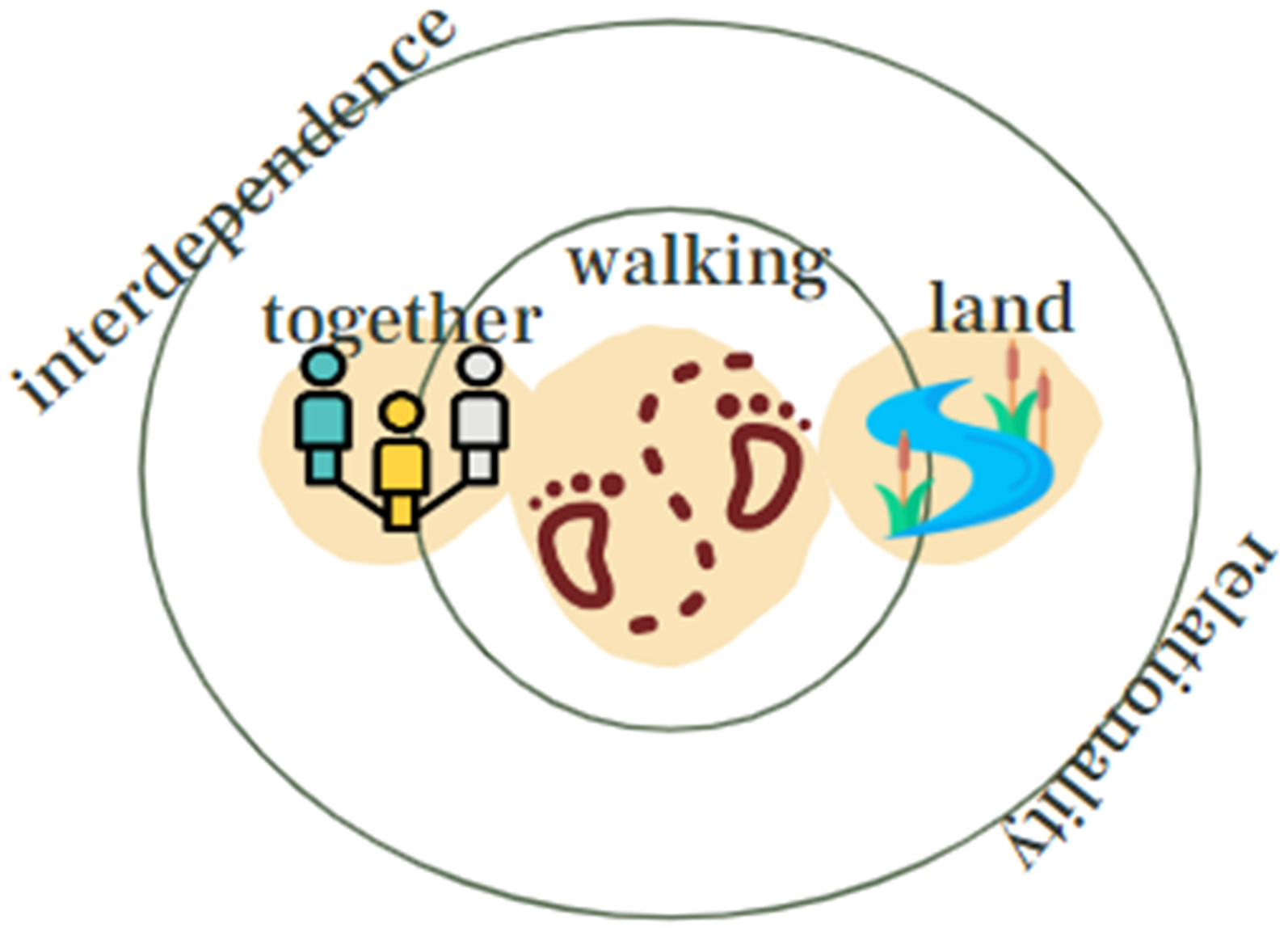
Community's axio-epistemology guides the research co-design.
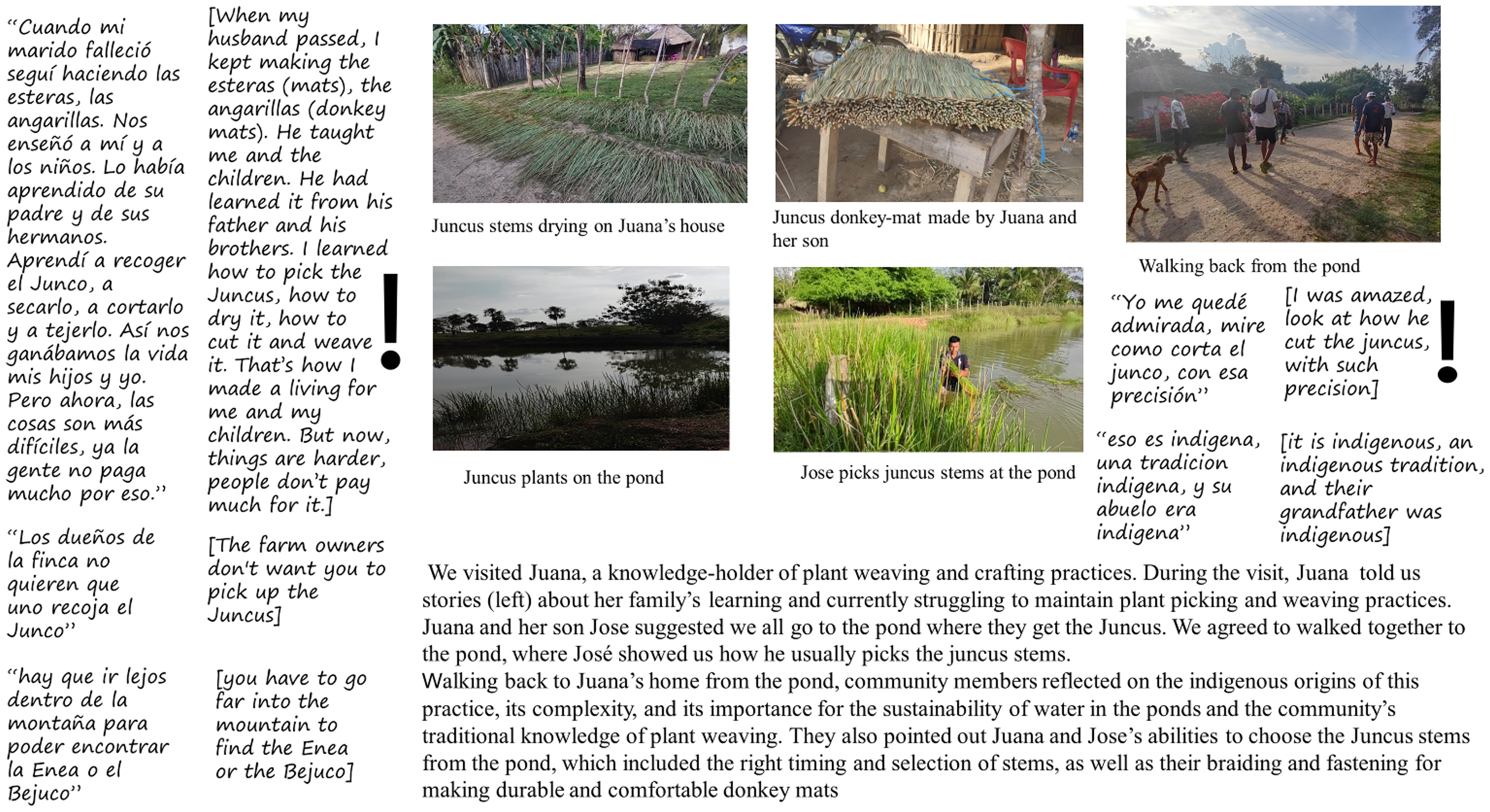
Visual vignette. Walking with the Juncus weavers.
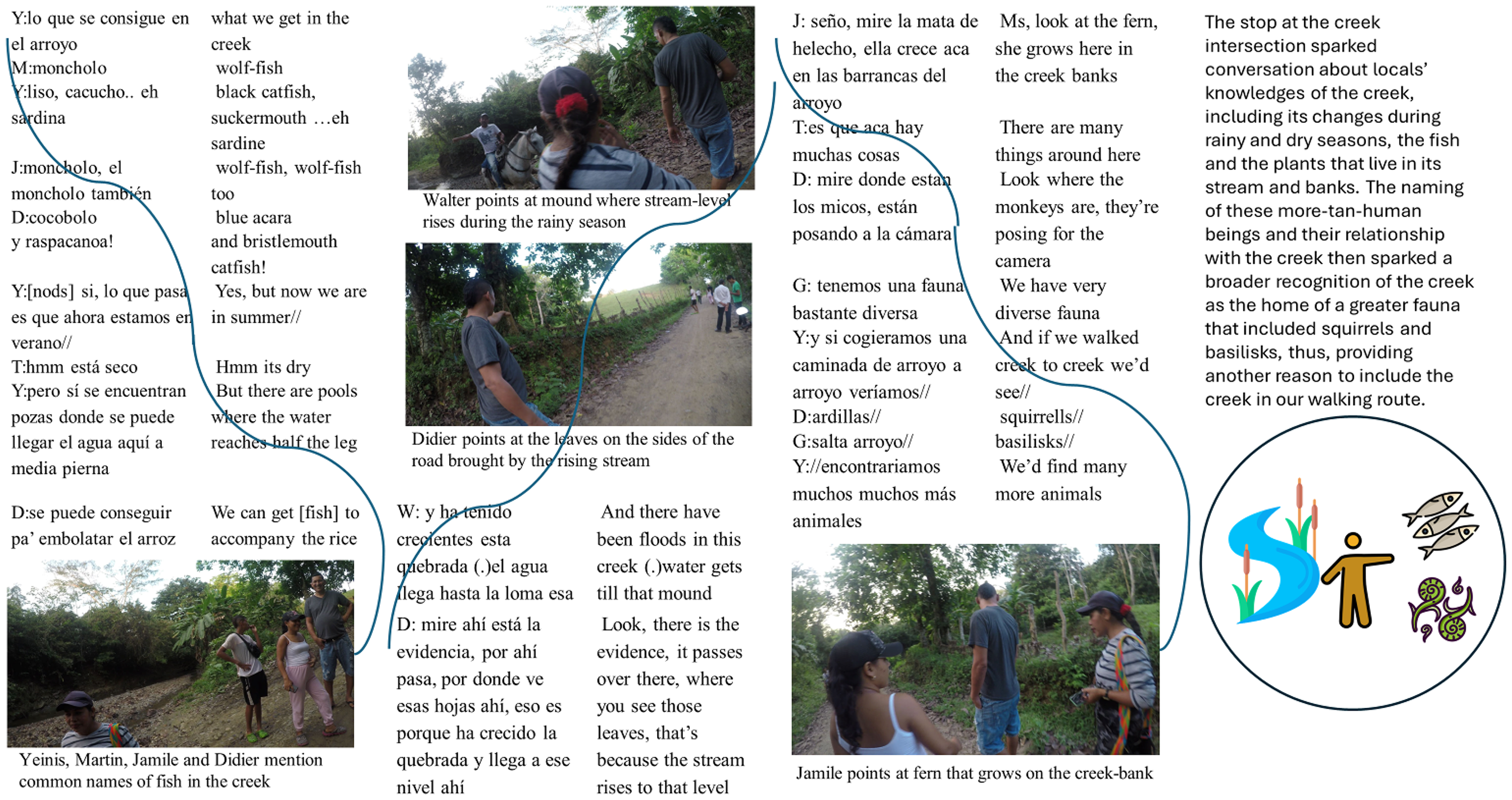
Visual vignette. Walking with the creek.
Figure 1 features an outer circle with the words interdependence and relationality, illustrating how the community's axio-epistemology guided our methodological decisions. At this stage, they were primarily involved in walking with community neighbors (i.e., walking together) and walking the land. Through this methodology, we expected to collaboratively engage in knowledge-making that would lead to learning about the historias (i.e., history and stories) of the Callemar township, and identifying the saberes (literacies) that could—or should—be perpetuated in the community through the school curricula.
The community's sentipensar informs multisensory walks
Our emerging community-based methodology was actively guided by community members with different types of leadership. For instance, Ana, Yamile and Yeinis suggested optimal times for our meetings and walks, which occurred in the afternoons after they had completed their matinal activities. They also proposed specific locations for our walks, serving as initial stepping stones in developing our walking routes. These contributions underscored the collaborative nature of our process, ensuring that the methodology reflected the community's rhythms and priorities.
During the walks, community members demonstrated their relational practices, engaging in on-the-moment reflections about the local knowledges and decisions about future walking routes. This practice resonated deeply with the concept of sentipensar, as community members inmersed in the walks using all their senses—observing, smelling, touching while conversing, analyzing, drawing insights and making decisions. To illustrate this process, I present visual vignettes (Figures 2 and 3) from two of our walks, including on-the-spot reflections that later influenced our co-theorizing and co-design efforts.
The first visual vignette (Figure 2) captures our first walk, which marked a significant step toward starting to recognize land-based literacies. In this case, the indigenous practice of making crafts from plants, through weaving their leaves, stems or fibers.
The vignette represents my analysis of our walk to Juana's home and then to the pond. The assembly of historias told by Jose and Juana and their demonstration of picking and fastening Juncus stems highlighted traditional knowledge and skills involved. This sparked locals’ acknowledgement of Juncus picking and weaving as an intergenerationally transmitted indigenous practice. This walk also helped seeing the interdependence and relationality between humans and plants. For instance, Juana and Josés knowledge and skills in weaving Juncus sustained the community's practice of using mats for riding donkeys, illustrating how human–plant relationships are woven into daily life.
Furthermore, our embodied experience—seeing, smelling, touching the juncus stems—likely facilitated our recognition of specific signs, like stems’ color, texture, shape and stiffness, all of which are required in picking, weaving and fastening the stems into mats. These sensory recognitions would later become instrumental in co-theorizing the nature–culture relationships that underpin the community's saberes locales, including land-based literacies.
The second visual vignette (Figure 3) illustrates our walk through the creek intersection and my growing understanding of the relationships and interdependence between the community and the creek. It includes transcriptions of the interactions that occurred as we passed the creek intersection. I have also added curvy lines—mirroring the creek's course—that connect the conversation transcript with still pics from our interactions. During this walk, locals shared their knowledge of fish common names, their feeding on fish, the changes in the stream, the plants that grow in the humid creek banks, and the other animals inhabiting the creek and its surroundings. In sum, their discourse and moves during this portion of the walk spoke of their relationality and interdependence with the creek, its plants and fish. I tried to represent this interconnectedness through the circular form and pictures at the bottom-right of the vignette.
Both visual vignettes highlight how sentipensar was key during the walks. We experienced the walks through our senses—seeing, listening, stepping, breathing, smelling—which directed our talking and walking together. In the first vignette, our multisensory experience at Juana's home shed light on the interdependence between humans, the pond and its plants, as well as the cultural practice of weaving juncus mats. In the second vignette, a similar multisensory engagement sparked stories of human and non-human life sustained by the creek. These examples underscore the community's sentipensar, which not only guided our walks but also sparked reflexive dialogue around the value of local literacies, such as plant weaving, plant picking, and relating with the creek through the MTH beings that inhabit it.
Such feeling-thinking interactions were common during our walks, and realizing their embodied nature inspired me to name them multisensory walks. These walks were stepping stones for the continuous reflexibility that was evinced in the dialogue sessions, another emerging method in our collaboratively designed methodology. By engaging our senses and embracing the community's feeling-thinking practices, we created a space for deep reflection and co-theorizing, further enriching our understanding of the community's literacies and their interconnected relationships with the land.
Co-theorizing through community dialogue
After having done three multisensory walks in Callemar and its whereabouts, we reunited at the primary school located in the plaza. The group included Enith and Fernando (the language teachers), Miguel, Germán, Ana, Yeinis, Yamile (community members), and myself as an allied researcher. I have included a third visual vignette (Figure 4) to illustrate how our cotheorizing deepened during the dialogue sessions. The vignette features transcriptions of community members’ historias alongside images of the crafts and plants they discussed.
As we reflected on the multisensory walks, locals told stories of their community. For instance, recalling our visit to Juana prompted Miguel and Germán to recount historias about the weaving practices that used to prevail in the township (left-hand side transcripts and pictures). These historias sparked responses from Yeinis and Yamile (right-hand side transcripts and pictures) who countered the idea of cultural loss. Instead, they emphasized the enduring relations between plants and knowledge-holders as pivotal to keeping cultural practices alive. At the bottom, I included a figure representing the cotheorized nature–culture relationship that emerged from this dialogue. This concept became a powerful tenet informing future actions in the project, such as intergenerational knowledge-sharing workshops at school.
Methodologically, the community dialogues highlighted the value of multisensory walks as a catalyst for further reflection. Yeinis, Yamile and Ana's experience walking to the pond to observe the Juncus, listening to Juana and Josés historias about learning to weave, and discussing their current struggles to pick plant stems and leaves facilitated a perspective that contrasted with Miguel and Germán's initial narrative. These reflections revealed that plant-weaving practices were neither lost nor confined to the past. Instead, they underscored the presence of active knowledge-holders in the community, whose relations with plants were to be sustained through their care and preservation.
At this point, our methodology had evolved significantly. It started with walking the land together, to centering sentipensar during the walks, and ultimately led to the deepened reflexibility and co-theorizing in our dialogue sessions (Figure 4). This iterative process not only deepened our understanding of the community's saberes locales and land-based literacies but also reinforced the importance of collaborative, embodied, and reflective approaches in community-based research.
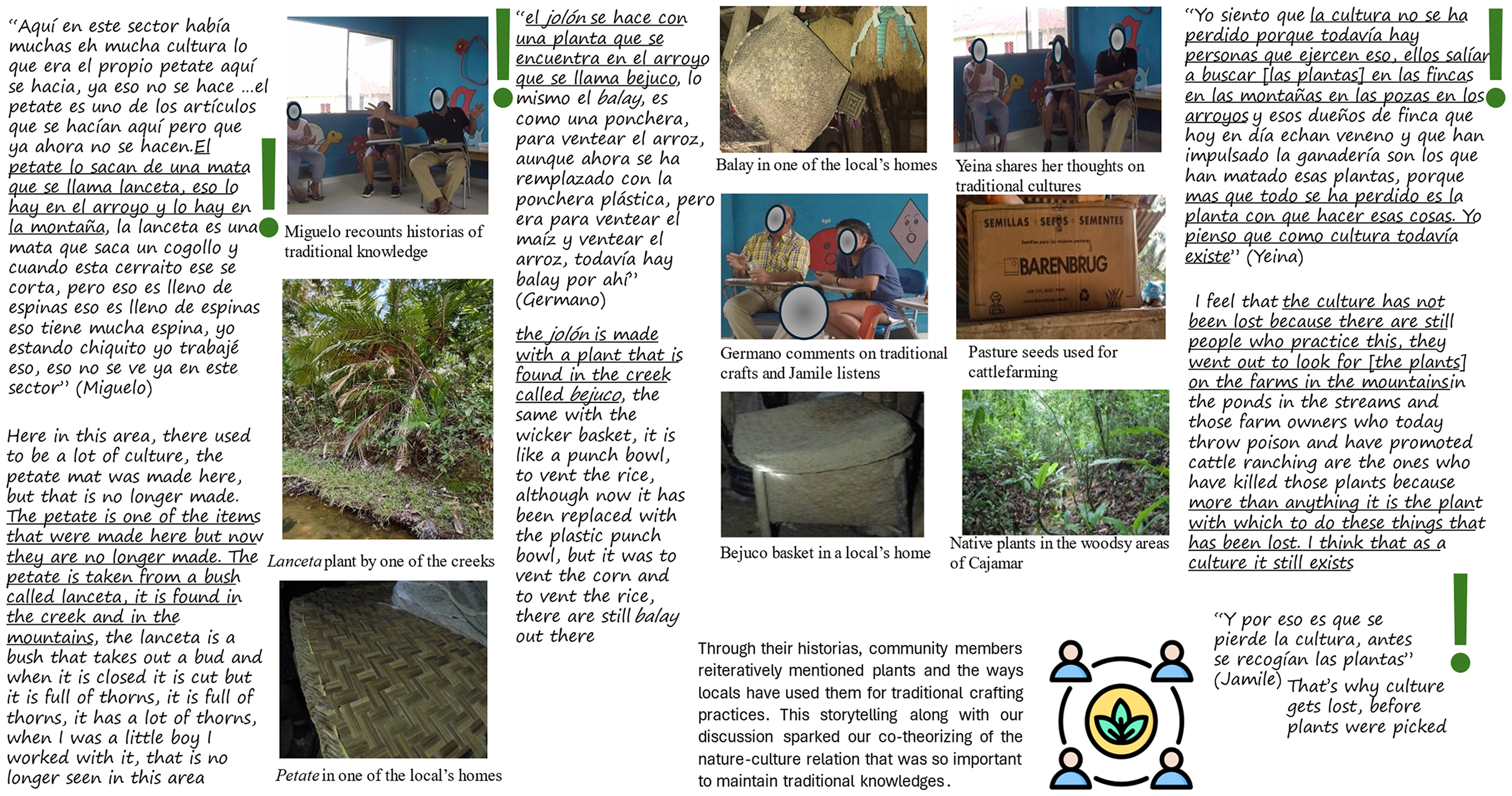
Visual vignette. Community dialogue.
As shown in Figure 5, our community-based methodology centered participants’ relationality and interdependence with land through our multisensory walks, the historias shared during the walks, and the community dialogue sessions that fueled our co-theorizing.
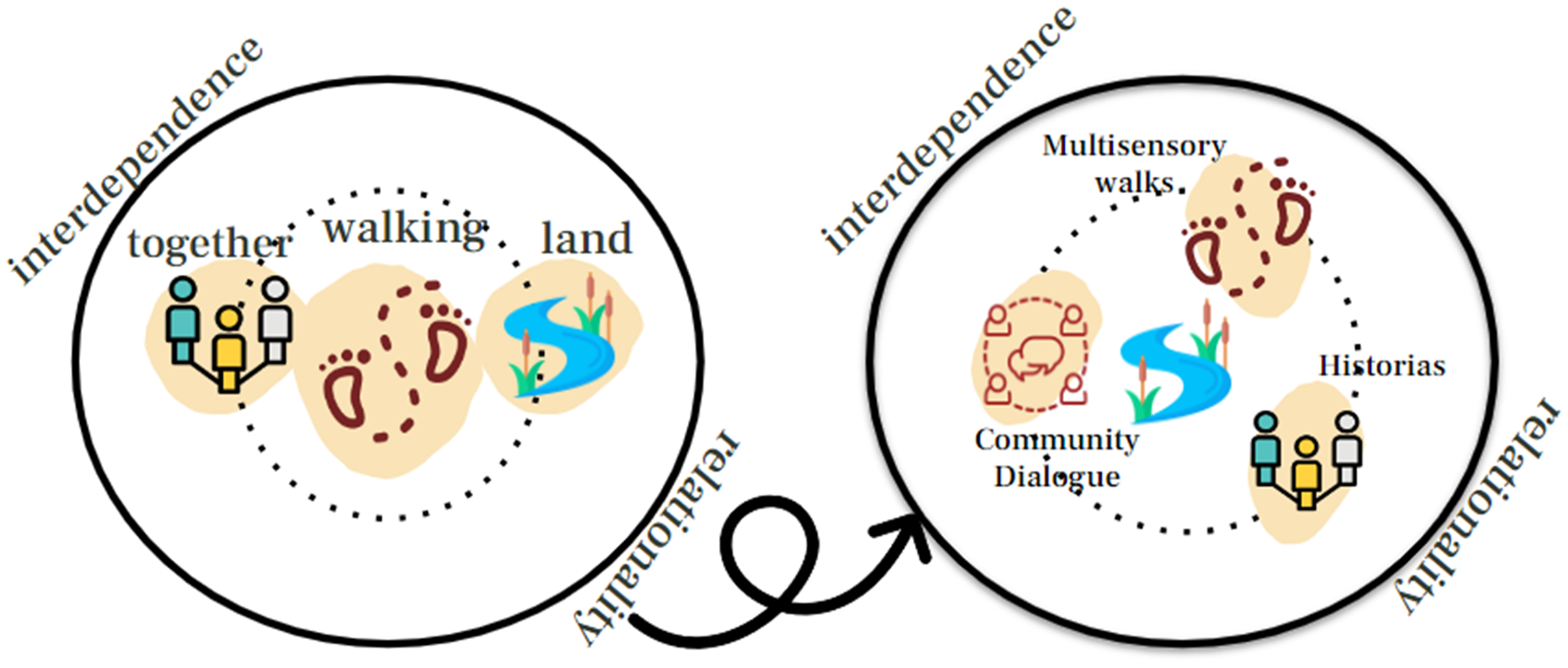
Making sense of our steps.
In the following months, the close relationship between native plants and the community weaving and cultural practices became a dominant theme in our correspondence. This was facilitated through a WhatsApp group created by Yeinis and named ‘Reviviendo Historias’ (reviving (hi)stories), as well as through Zoom and WhatsApp calls with Fernando and Enith. These interactions allowed us to sustain and deepen our reflections even when we were not physically together.
In sum, these examples on the co-theorizing of nature–culture relations—illustrated by the ways community culture is deeply tied to members’ relationships with plants—show how community members actively participated in knowledge-making endeavors throughout the multisensory walks, in-person dialogue sessions, and remote correspondence.
Expanding collaboration: from co-theorizing to curricular co-design
Our joint co-theorizing enabled Fernando and Enith—who also took on the role of oídores (listeners) during the dialogue sessions—to brainstorm possibilities for integrating saberes locales in their classrooms. This sparked a shared commitment to continue learning along the community. At this point, we recognized that the multisensory walks, shared historias, and community dialogue had been important steps in learning and making knowledge together, honoring the community's axio-epistemology of relationality and interdependence. We learned with the land, with each other, and from the already existing relations between land and humans, such as weaving plants or fishing in the creek. Together—community members, teachers and myself—we agreed to continue moving our methodology forward, now involving students more actively.
Our plan to enact our co-designed methodology thus included three multisensory walks and three dialogue sessions, during which historias would continue to be shared and collected. Between July and December 2023, our collective data generation and analysis continued to nurture our co-theorizing of land-based literacies, which in turn informed curricular co-design with Enith, Fernando, and Jairo, another schoolteacher who became an active participant in our walks and dialogues.
Although describing the results of our curricula co-design project is outside the scope of this article, I deem worthwhile highlighting the ongoing participation of community members. For instance, the enactment of our community-based methodology has engaged students and parents from the educational community, who have contributed their knowledge by guiding walks and sharing community's historias. The community members’ active and agentic participation—expressing their desires to perpetuate traditional practices like plant weaving, to honor their lived relationality that fosters community care and solidarity, and to value their saberes locales—has nurtured a curricular co-design process that centers the community's land-based literacies in the language and technology curricula for ninth and tenth grades at El Carmen, Callemar's secondary school.
Figure 6 includes examples of the ongoing collaboration between teachers, students, parents and myself as an allied researcher, with hopes of further honoring the community's land-based literacies in the school curricula. With participants’ consent, and stemming from their initiative, we have disseminated the recollected historias from the multisensory walks and the community dialogues with the broader community through school meetings and a digital collection shared via WhatsApp. These historias also sparked the co-design of a mural that illustrates saberes locales, and ways of knowing and being in the community. After discussing potential avenues with community members, we partnered with a Colombian muralist and illustrator. Together, we shared with this artist selected photographs taken during the walks—including those voluntarily contributed by community members from their phones. We curated a list of elements to include in the mural, and collaboratively decided on the color palette, format, suggestions, and final design.
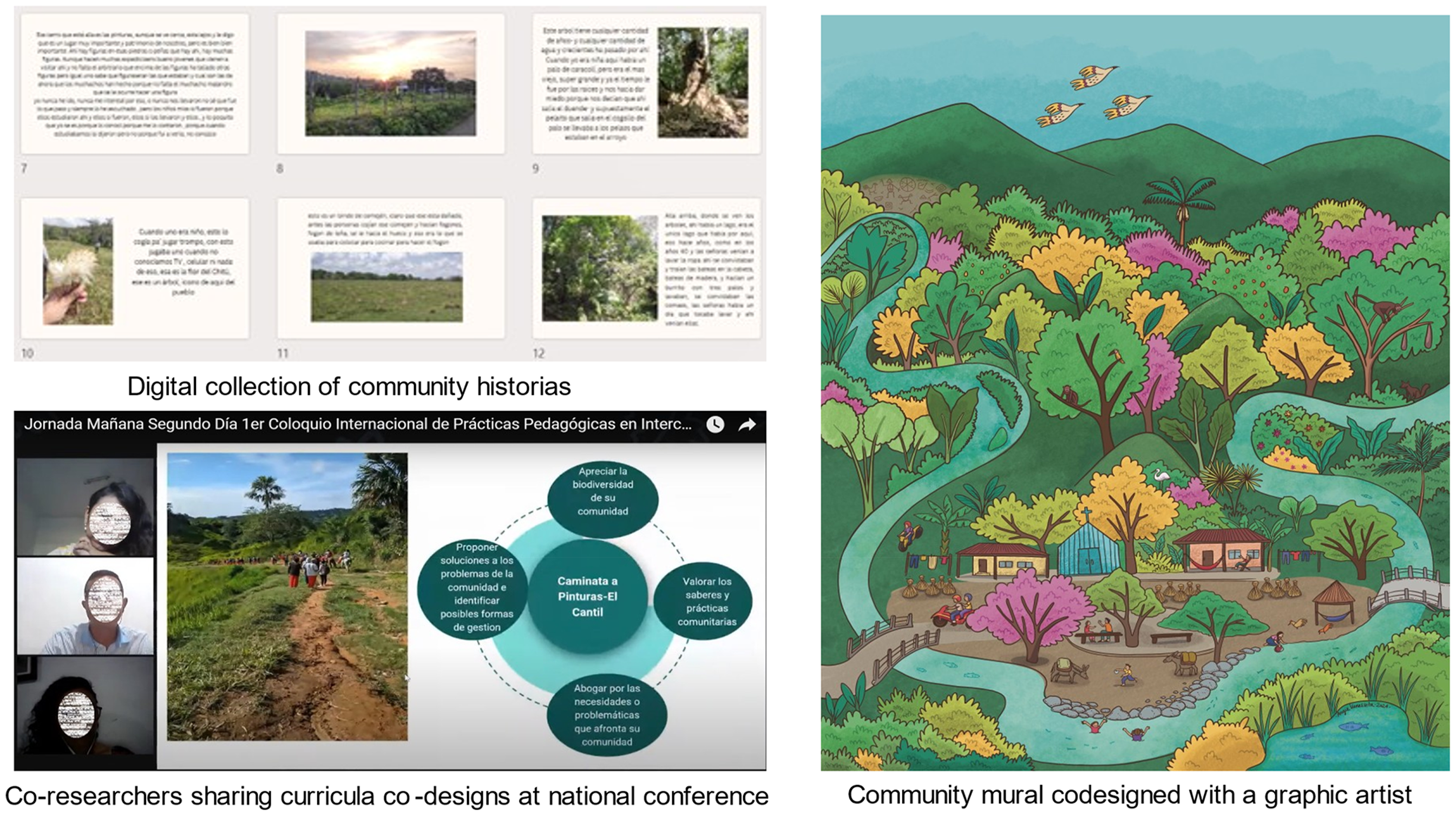
Collage depicting outcomes from the research partnership. Note: Top left: picture of digital collection shared through WhatsApp. Bottom left: screen capture of teachers presenting their curricula co-design at a national conference. Right: picture of approved illustration for community mural.
Enith, Fernando, and Jairo have led dissemination efforts, presenting their work to colleagues at their school and at national conferences. They continue to co-design land-based curricula and teaching materials across secondary grades, expanding the project scope to seventh and eighth grades, at El Carmen school.
Learning relationality: lessons from our partnership
Historias of relation along community co-designers
In this article, I illustrated the collaborative development of a research methodology with members of Callemar, a rural community in the Colombian Caribbean region. Community members actively guided the research co-design, proposing walks, historias and dialogue as central methods for data generation. Through this community guidance, we were able to co-create a methodology that was truly reflective of their lived realities. However, this approach also required us, especially me as an allied researcher, to navigate uncertainty and let go of preconceived notions about how research should be conducted. This approach echoes decolonial frameworks that prioritize non-hierarchical researcher–community collaborations (e.g., Bang et al., 2010; Ishimaru et al., 2022).
Data was co-generated with my research partners through multisensory walks and community dialogues where historias were shared. Videorecording ensured data was captured participatorily, while data reduction and analysis unfolded through iterative phases of participatory and independent analysis sessions. By centering these methods, this study contributes to decolonial methodologies that challenge logocentrism and favor the sensory experience of participants (Rivera Cusicanqui, 2010). As the Aymara scholar argues, ‘To walk, to know, to create [are] the verbs of a method in movement’ [my translation] (Rivera Cusicanqui, 2015: 8). Our research journey illuminated our joint process of walking, storying, and coming to know with the land.
Through this ongoing engagement with the data, I have learned that the historias, walks, questions, ideas, dreams, and desires are, as Ehret (2015) argues, ‘of course, more than “data”…’ (8). The co-generated data are part of the lived histories of individuals whose paths happened to coincide with mine in this time and space, holding similar visions for the future. My intention is to honor these stories not as mere data points but as life experiences that have generated learning and transformations at both individual and community levels. This is evident in our community-based methodology design and enactment.
I argued that the community's axio-epistemology—rooted in relationality and interdependence—became a guiding principle of our methodological co-design. For instance, the decision to walk together stemmed from community members’ ethic of mutual care. While our initial meetings took place in a school classroom, this setting felt unfamiliar and restrictive for sharing historias. Community leaders like Yeinis, Miguel and Didier expressed their desire of engaging as many neighbors as possible and hearing their contributions. They suggested walking would allow for a more familiar way to engage in knowledge co-construction. By listening to their desires and sense of care, I was able to follow their lead and learn alongside them. As we walked, I felt their comfort and ease as they laughed, joked, showed meaningful sites, and shared historias together.
Relationality and interdependence with the land were evident during the walks. Participants’ sentipensar or feeling-thinking practices guided our research process, shaping how we walked, talked and engaged with each other and the land. For instance, listening to Juana's and Jose's historias about learning to weave juncus—and then seeing them pick the stems at the pond—prompted Didier and Alfred, sons of settlers without indigenous ancestry, to express their respect for the plant-weaving tradition and recognize its indigenous origins. Similarly, while crossing the creek intersection, community members shared historias of floods, fish, squirrels, and monkeys, emphasizing the creek as a place of sustenance for their community, and as a must-visit spot in our walking plans. These participant' responses highlight how walking not only sparked reflexivity but also deepened participants’ connections to their community's spaces and culture. Furthermore, these on-the-move responses underscore the potential of walking as an embodied, land-based method to foster ethical and participatory research (Springgay and Truman, 2018; Taylor, 2020; Taylor and Pacini-Ketchabaw, 2017).
Drawing on Archibald's storywork (2008), Meixi and Elliot-Groves argue that storying with the land ‘illuminates our relationships to knowing, grows and guides our ethical sensibilities in our own lives in intergenerational and interspatial ways’ (in Marin et al., 2020: 2203). Both the recognition of plant-weaving traditions as indigenous and the creek as community-sustaining reflect reciprocal meaning-making and ethical learning that storying with the land often embeds (Marin et al., 2020). Historias emerged as a response to MTHs during the walks, and to other historias during community dialogue. For instance, Didier, Alfred, Yeinis and Yamile responded to Juncus picking and weaving with historias that valued land-based knowledges and skills to sustain human and MTH life in the community. During dialogue sessions, Fernando and Enith engaged responsibly as story listeners, which enabled them to later highlight students’ and parents’ land-based literacies. This ongoing engagement with historias created storytelling and storylistening loops, reflecting the creativity and reciprocity of storywork.
Furthermore, the storywork in our community dialogue fostered reflexivity that made space for participants to identify community issues such as the harmful effects of pesticides used by cattle farmers on native plants, and to devise ways to mobilize teachers and students around plant care. This process enabled us to imagine change together, thus challenging the often-extractive nature of reflexibility in qualitative research (Fals Borda, 1979; Museus and Wang, 2022). Community members’ historias and ideas also speak of their agency in identifying needs and devising solutions, as has been previously underscored in community-based and decolonizing research with indigenous, latinx, and rural communities in North and South America (Barajas-López and Ishimaru, 2020; Booker and Goldman, 2016; Escobar, 2018).
Historias also fostered reflexive dialogue that enabled co-theorizing land–human and nature–culture relations. For instance, Miguel told childhood historias of his own plant-weaving experiences, which he confronted with historias of the present that warned of the human threats to plant-weaving practices. Yeinis and Yamile responded with counter-stories that emphasized the role of relations with Juncus and Bejuco plants to maintain plant-weaving practices in the community. Their co-theorizing reflected an understanding of the intricate complexity between plant conservation for maintaining cultural practices like venting rice with Balays or putting children to sleep in Enea mats. These historias highlighted the nature–culture relations on which traditional practices depend. This co-theorizing is in tandem with indigenous and decolonizing frameworks that challenge the separation between humans and land (Cajete, 2000; Medin and Bang, 2014; Mignolo, 2009).
The role of trust in our partnership
Our emerging methodology is, in itself, a historia—a story unwinding as we built trust with each other. At times, I felt uneasy during the walks, such as when José entered the pond to pick juncus. I worried for his safety and felt a sense of responsibility. However, José and Juana reassured me, explaining that they frequented the pond and were deeply familiar with the juncus picking practice. Over time, as I let go of paternalistic feelings and community members shared historias outspokenly, we grew more trusting and comfortable. Together, we wove our methodology: walking, telling historias, and dialoguing in relation to the land.
As underscored in community-based studies (Aldemir et al., 2023; Lezotte et al., 2022; Vakil et al., 2016), mutual trust is essential in partnerships with communities. The conception and nurturing of this project have depended on acts of invitation and trust: Enith's invitation to visit her school. Callemar neighbors’ willingness to meet with Fernando, Enith and myself to discuss the possibility of a collaboration, and their subsequent invitation for me to stay and walk with them. Honoring these acts of trust has allowed us to maintain our bonds—as friends, partners, and collaborators—and to imagine possibilities for sustaining the community's historias and land-based literacies for the present and future.
Our methodological historia continues to unfold guided by the footprints and voices of the community as we walk together, telling and listening to historias. As mentioned earlier, the first iteration of our community-based methodology mobilized El Carmen students and parents, who led the walks just as their relatives had done when we started this collaboration. Our co-experience walking has informed our co-design of a land-based curricula, which is progressively implemented and evaluated. This process has created new loops of walk, dialogue, and co-design, resembling the iterative, reflective cycles of community-based research (Vakil et al., 2016), and strengthening our relationships as friends, colleagues, and co-designers (Bananuka et al., 2023).
Concluding thoughts
These findings highlight the potential of decolonizing frameworks to foster collaborative, non-hierarchical research with non-dominant, rural communities. By co-designing a research methodology guided by the community's axio-epistemology, we were able to co-construct knowledge in ways that honor community members’ ways of knowing and being. In this way, this study challenges the western, objectivist paradigms that often obscure the cultural nature of knowledge construction (Bang et al., 2016; Fals Borda, 1979).
The findings underscore the active roles of community members, whose historias and ideas were listened to and honored, thus informing the research process. Community historias, along with their forest landscape, are changing. These changes are framing community members’ desires to transform formal schooling in ways that perpetuate their ways of knowing and living (Corntassel and Hardbarger, 2019). They have realized that caring for their plant-crafting traditions requires caring for the lands and waters in this community. Thus, shedding light on the nature–culture intricacy that permeates their land-based literacies.
This study adds to previous research on school–community partnerships (Gordon et al., 2024; Teixeira et al., 2021), demonstrating that teachers and community co-construction is not only possible but also transformative and sustainable. However, such participatory knowledge co-construction requires leveling power dynamics and practicing respectful listening (Meixi et al., 2022). In line with humanizing research endeavors (Rahm, 2019; San Pedro and Kinloch, 2017), listening to the community members became a cornerstone of this partnership, enabling us to design a path for knowledge co-construction attuned to the community's ways of living and sharing knowledge (Fals Borda, 1979). Through listening to each other, my teacher colleagues and I have developed curricular co-designs that honor the community's land-based literacies and address their desires and concerns for the future.
As an allied researcher in education, languages and literacies, I am hopeful that the curricular co-designs emerging from this collaboration will reframe educational purposes, pushing against the homogenization of rural students into Eurocentric, colonial ideals of what it means to be an ‘ideal’ or ‘civilized’ member of society. I aspire for these findings to contribute to literacy, language, and educational scholarship (e.g., Bonilla et al., 2024; Fúnez-Flores and Phillion, 2019; Granados-Beltrán, 2022; Pahl et al., 2020) that advocates for ethical, equity-oriented research with communities often excluded from knowledge-making and decision-making endeavors.
Finally, I hope this work weaves into further research that strives to honor the pluriverse (Escobar, 2020)—the myriad ways of knowing and being, that exist and sustain all forms of life in rural communities like Callemar. By centering relationality, interdependence, and land-based literacies, we can continue to challenge colonial paradigms and create spaces where diverse epistemologies and ontologies thrive.
Footnotes
Acknowledgements
I am deeply thankful to the community of Callemar in San Carlos Cordoba, as well as my colleagues Enith Lambraño, Fernando Aleán and Jairo Simanca for welcoming me and nurturing me within their educational community. Deeply thankful to the IE El Carmen school’s principal, Luz Mila Perez, whose trust and support have permitted this ongoing collaboration with the community.

Funding
The author disclosed receipt of the following financial support for the research, authorship, and/or publication of this article: This study was funded by COLFUTURO and Universidad de Córdoba in Colombia, and the Fonds de Recherche du Québec Social Sciences Doctoral Scholarship # 319894 (https://doi.org/10.69777/319894).
Declaration of conflicting interests
The author declared no potential conflicts of interest with respect to the research, authorship, and/or publication of this article.