




Abstract
Unintentional injuries are a leading cause of preventable harm among adolescents. Adolescents also experience an increased risk of farm injury, and in Australia, injury-related farm fatalities among adolescents have remained largely unchanged over the past two decades. A third of all incidents involve farm visitors, indicating the need for population-level safety information. This project uses qualitative data to inform a co-design process with adolescents, and their teachers, to develop a game-based farm injury prevention online educational resource. This protocol describes the multi-phase co-design project. Focus group discussions regarding farm injury prevention will be held with students (Year 7 & 8; ∼12–14 years of age) and teachers at high schools with an agricultural focus across two Australian states. Inductive thematic analysis of discussion transcripts, and analysis of farm injury data, will inform the development of the modules and content of the game. User experience testing of the prototype will form the final phase of the project. This process is supported by a Stakeholder Advisory Group, which includes representatives of youth farming organisations, agricultural educators, and national child safety organisations. This group will assist in interpretation and dissemination of findings and promoting the resultant educational resource in schools. Ethical approval has been granted by the University of New South Wales Human Research Ethics Committee. Results will be disseminated through peer-reviewed publications, mass media releases, academic conferences, and the agricultural education sector in Australia via the stakeholder advisory group. This study will provide useful insights into co-designing injury prevention resources for adolescents using gamification and result in a co-designed farm injury prevention educational resource for schools and the general community via mobile and web-based applications.
Background
Injuries are a leading, yet neglected, cause of preventable harm among adolescents (Li et al., 2018). Globally, more than 369,000 adolescents aged 10–24 years died from transport and unintentional injuries in 2019, with 31.1 million disability adjusted life years (DALYs) attributed to injury among adolescents in the same year (Peden et al., 2022a). Transport, drowning, and falls were the most common causes of injury-related harm among adolescents.
Agricultural injury, including those that occur on farms, span a range of injury mechanisms, including transport, drowning, falls, electrocution, burns, poisoning, and injuries due to animal contact (Amey & Christey, 2019; Gammon et al., 2019; Jawa et al., 2013; Little et al., 2003; Pym et al., 2013). In Australia, an average of 82 deaths each year among people of all ages are due to non-intentional farm injury (Lower & Herde, 2012). A further 21,999 farm injuries-related hospitalisations occurred nationally between 2010/11 and 2014/15 (Harrison & Henley, 2018).
Addressing farm injury risk for adolescents is vitally important (Peden et al., 2022b) as children and adolescents on farms are a vulnerable group experiencing preventable premature death, morbidity, and disability (Adams et al., 2021). In Australia, fatal farm incidents among children <15 years in Australia have remained largely unchanged between 2001 and 2019, indicating a lack of progress (Peachey et al., 2020). Additionally, in Australia, a third of all child farm-related fatalities were farm visitors (Peachey et al., 2020), highlighting that, beyond the provision of farm safety information to those living and working on farms, community-wide approaches, such as education through the school system, may be beneficial.
Although adolescence is a risky period for farm injury, it is also an optimal age to intervene with education and behaviour change strategies to reduce such risk (Frank et al., 2004; Nilsson, 2016). Health and development during adolescence predict almost all aspects of physical and psychological health across the life-course (Patton et al., 2016). Strategies to reduce the risk of farm injury in adolescence will result in safer behaviours throughout adulthood, while also seeing these safer choices handed down to the next generation (Patton et al., 2016, 2018).
To optimise effectiveness, we have chosen to adopt a participatory research approach, working alongside adolescents using a co-design process. Co-design has been shown to be effective in the development of a diversity of interventions for adolescents (Björling & Rose, 2019; Clark et al., 2022; Dietrich et al., 2017; Koon et al., 2023). This extends to the involvement of teachers in curriculum development (Hundal et al., 2014).
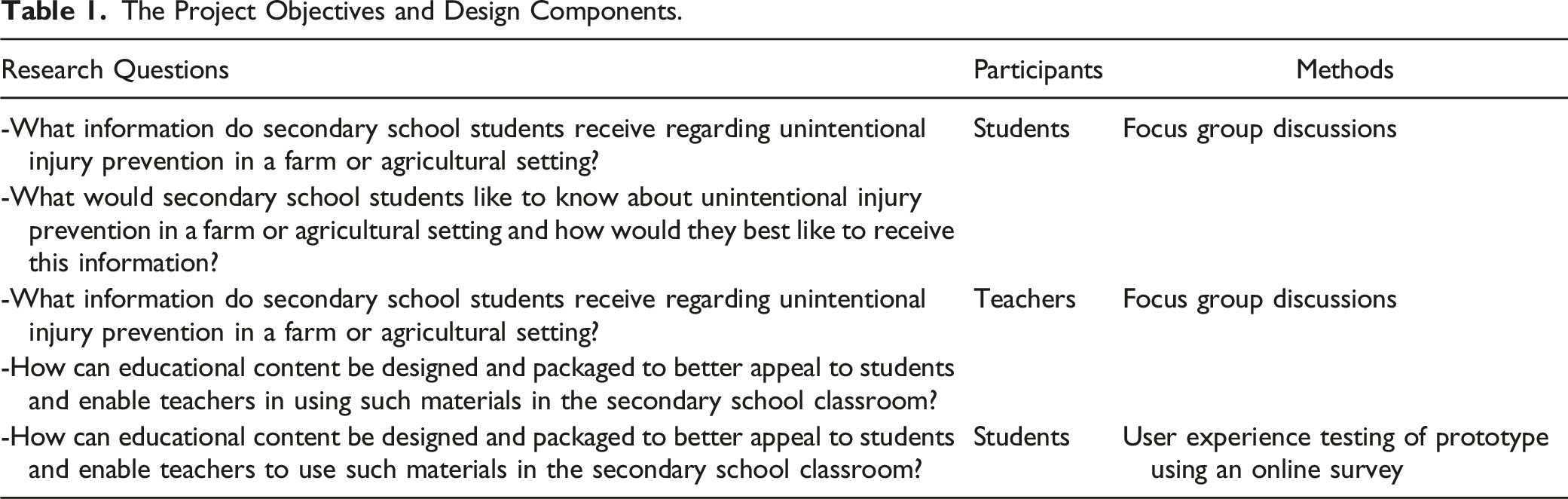
Funded by the Australian Government Department of Agriculture, Water & the Environment through the National Farm Safety Education Fund Program, the project detailed in this protocol strives to improve understanding and uptake of farm safety behaviours and practices among the next generation of farmers, specifically secondary school-aged adolescents. Through innovative co-design and gamification strategies, also shown to be particularly effective as an educational tool for adolescents (9), this project aims to explore the current provision, and preferred style and content, of future unintentional injury prevention information in a farm or agricultural setting for secondary school-aged students. As a secondary aim, we seek to understand mechanisms for the delivery of such information in a school setting from teachers, and barriers and enablers to its current provision as part of school-based education. The research questions that this study seeks to address are: 1. What information do secondary school students receive regarding unintentional injury prevention in a farm or agricultural setting? 2. What would secondary school students like to know about unintentional injury prevention in a farm or agricultural setting and how would they best like to receive this information? 3. How can educational content be designed and packaged to better appeal to students and enable teachers to use such materials in the secondary school classroom?
Methods
The Project Objectives and Design Components.
Study Setting
Data for this study will be collected from three to four high schools with a strong agricultural focus across two Australian states that represent variations in climate and agricultural commodity groups. The proposed locations are: Yanco in the Riverina area of New South Wales (NSW), Orange in the central west of NSW, Armidale in northern NSW and Charters Towers in northern Queensland (QLD). Figure 1 depicts the proposed study locations. Map of study sites.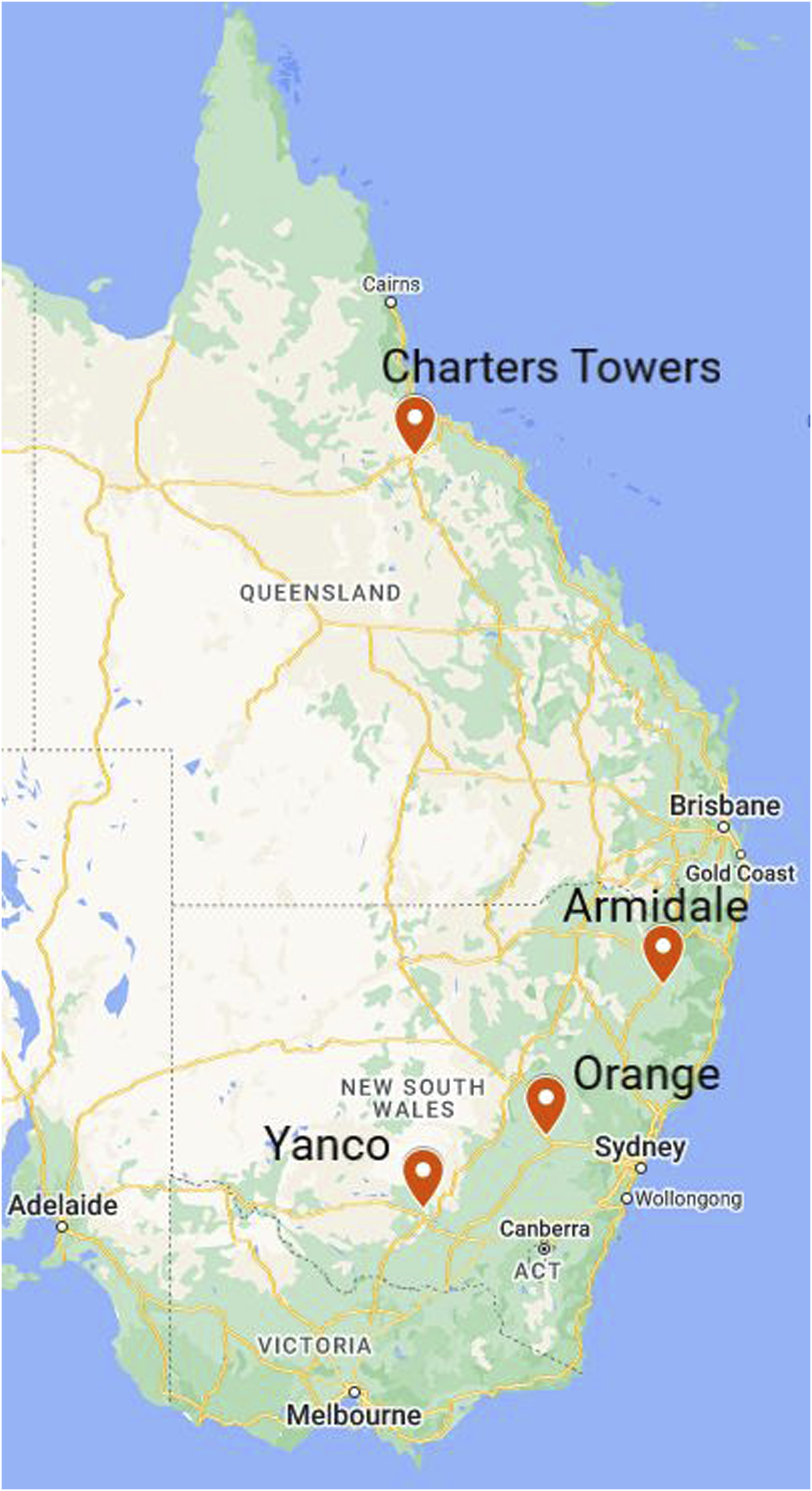
Focus Group Discussions With Students and Teachers
Focus group will be conducted with Years 7 and 8 students to determine current farm injury prevention knowledge and education received, as well as content and delivery of future farm safety information via gamification. We will also conduct focus group discussions with Years 7 and 8 teachers at the same high schools with an agricultural focus to identify barriers and facilitators to using such educational tools in the classroom to increase maximum uptake and usage of the educational resource in the school system.
The focus group discussion themes have been developed based on the needs of the project group, which covers expertise related to adolescent injury prevention, farm safety, educational design, and game-based education design. Each focus group will take approximately 45 minutes (the length of one class) to complete.
User Experience Testing
For the user experience testing, data will be collected via an anonymous online survey tool at the same schools. The survey questionnaire will be developed around the prototype of the game and based on our hypothesized framework of educational gamification. The survey is estimated to take no longer than 20 minutes to complete (less than the length of one class).
Data Collection Tools
Data collection tools comprise a discussion guide for student focus groups, a discussion guide for teacher focus groups, a game prototype, and an online survey for user experience testing.
Student Focus Group Discussion Guide
The student focus group discussion guide consists of a range of questions aimed at prompting discussion across five categories (Supplementary Material 1). The first category, ‘opening questions’, includes demographic questions and questions about living, working, and visiting farms. The second section of the guide, ‘Farm safety and injury prevention in general’, asks about awareness of injury risks on farms, and previous farm injuries to themselves, family, friends, or other important influences. The third section, ‘School-based farm safety education’ includes questions on the contents of the current farm safety education at the participants’ school, and which important topics should be covered with respect to farm safety and injury prevention. Section four ‘Gamified farm injury prevention’ includes questions about students’ receptiveness towards a farm injury prevention game, what they’d like it to include, what functionality they would like it to have and opinions regarding certificates and leader boards. The final section of the discussion guide ‘closing questions’ is a final chance for students to provide advice on the development of the game and any final thoughts.
Teacher Focus Group Discussion Guide
The teacher focus group discussion guide consists of a range of questions across the same five topics detailed above but prior to closing questions, includes a sixth topic ‘Use in the classroom’ (Supplementary Material 2). This section asks how the game could be used in the classroom, the value of linking the modules to vocational education and training (VET) packages and the national curriculum, as well as lesson plans.
User Experience Testing Survey
User experience testing will comprise students testing a prototype of the game, in a staging environment, on both web and mobile platforms. Alongside this testing of the prototype, an online survey will be completed by the students. The online survey begins with demographic information, including age, gender and school year and school name. The survey then features screenshots of a selection of the game’s modules and tasks and asks students to rate each screenshot on a scale of 1–10 (1 being extremely poor and 10 being excellent) with respect to content, design/layout and educational value. There is also an open text field where students can write in any comments or suggestions they may have for each of the screenshots being assessed.
To assess their level of interest in, and relevance of, each of the games’ five proposed modules, students will use the same scale 1–10 (1 being not relevant/of interest to 10 being highly relevant/of interest). Students are also asked to rate 1–10 (1 being extremely poor, 10 being excellent) the following features: leader board, certificates, and teaching activities to extend the game-based learning into the classroom. Finally, they are asked, via an open text box, if they have any further comments they would like to make about any aspect of the game.
Sample Size
The total sample size for the project is estimated to be a minimum of 129 participants. Specifically, this sample size is comprised of the following samples from each of the participant groups: 1. Focus Group Participant Group 1–Years 7 students: 3 × groups of 10 mixed gender participants 2. Focus Group Participant Group 2–Year 8 students: 3 × groups of 10 mixed gender participants 3. Focus Group Participant Group 3–Teachers: 3 × groups of 3 teachers 4. User Experience Testing Participant Group 4–Year 7 students: 30 mixed gender participants and Year 8 students: 30 mixed gender participants.
This sample size is sufficient to meet the research aims and answer the research questions because: (1) six focus groups with 10 participants (students) and 3 focus groups with 3 participants (teachers) will allow for sufficient exploration of the research topics (Dawson et al., 1993); and (2) similar research co-designing interventions for adolescents have utilised samples ranging from as few as 26 participants (Champion et al., 2020; Pernencar et al., 2018). We anticipate minimal loss between receipt of consent to participate and conduct of focus groups as these will be coordinated with schools and occur during the school day. Similarly, a sample of 60 students of mixed gender across both Years 7 and 8 and all three schools will provide ample user experience testing data to further refine the game.
Inclusion and Exclusion Criteria
Inclusion Criteria for Participation in the Study by Participant Group and Study Phase.

Recruitment of Participants
The research team will not identify/recruit participants for this project. The research team will engage with relevant agricultural schools independent of the research team to ask about their interest in participating in the research. If schools are willing (indicated via school Principal approval, prior to commencing recruitment, the research team will ensure the relevant approvals have been sought in addition to the University of New South Wales Human Research Ethics approval (i.e., SERAP approval for NSW Government Schools and QERI for QLD government schools). Once this has occurred, schools will be provided with the recruitment information and PISCFs to identify relevant classes and send both documents home with students to parents/caregivers to obtain consent for their child to take part in the focus group discussions and/or user experience testing. Support to assist with recruitment will be assumed by the organisation’s agreement to participate in the research and disseminate recruitment materials. Returned PISCFs will be collated by the designated school contact to ensure only those who consent participate in the focus group sessions and/or user experience testing.
For teachers, once the school has indicated a willingness to participate, the designated school contact will be asked to circulate the teacher recruitment information and PISCF to Years 7 and 8 students. For the teacher component of the project, the recruitment materials will instruct potential participants to contact the research team directly to register their interest in participating, and as such, the designated contact will not know whether a person agrees to participate or not.
Participants will not incur any expenses for their participation. Focus group discussions are intended to occur during the school day around the usual activities of teachers or during class time for students.
Reminders
With respect to school participation, two follow up reminders, sent via email at 2-week intervals after the first contact, will be issued to the school to seek their initial consent to participate. In the absence of a response from potential participants to the initial contact by the school, a reminder/follow-up may be conducted by the school, should initial recruitment numbers not be satisfactory or selective sampling needs to be conducted.
Consent
Prior to all data collection activities, the researcher(s), and schools will go through the consent process. There are three consent procedures described below, one for the schools, one for the teachers and one for the students (for both focus groups and user experience testing). In addition to the procedures described below, all relevant PISCFs have been attached to this application.
School Research Participation
An informal consent process will be used to determine willingness to participate in the research. Based on the knowledge and contacts within the research team, appropriate high schools with an agricultural focus in New South Wales and Queensland will be identified and contact will be made via email. Written agreement for the school to participate will be sought via the school principal or other leadership/management as relevant and saved on file. Recruitment information attached to this application details the content that will be provided. During this consent process a point of contact will be identified to facilitate appropriate Year level class groups and teachers for participation.
Student Focus Group/User Experience Testing Participation
Written consent will be obtained from parents/guardians of focus group/user experience testing participants. These participants will be Year 7 & 8 students at high schools with an agricultural focus in New South Wales and Queensland. Students will be chosen by the school to participate based on their year groups. Before the focus group/user experience testing, parents/guardians of the students who will be potentially involved will be contacted via the school’s existing communication methods (either student-parent/guardian portal, email, or hard copy paper), and sent the “Focus Group Parent/Guardian Participant Information Statement and Consent Form” or the “Online Survey Participant/Guardian Information Statement and Consent Form”. Both PISCFs will include relevant Working with Children Check Numbers. Parent/guardians of potential participants will be advised to contact the researcher(s) or relevant school contact if they have any questions, and once they are comfortable providing consent for their student to participate, will be asked to provide consent (either via a paper form or the school’s portal system) to the school, who will then communicate that students’ consent to participate to the researcher(s) prior to focus group. As schools will be conducting recruitment on our behalf, we will work with the schools to selectively sample based on age and gender if needed, to ensure groups are mixed.
Teacher Focus Group Participation
Written consent will be obtained from teachers prior to conducting the focus group. Teachers will be chosen by the school to participate. Before the focus group, teachers who will be potentially involved will be contacted via the school’s existing communication methods (likely email, or hard copy paper), and sent the “Focus Group Teacher Participant Information Statement and Consent Form”. The Focus Group Teacher PISCF will include relevant Working with Children Check Numbers. Teachers will be advised to contact the researcher(s) or relevant school contact if they have any questions, and once they are comfortable providing consent to participate, will be asked to provide consent (either via returning the completed form via email direct to the researchers or a paper form to the point of contact). As schools will be conducting recruitment on our behalf, we will work with the schools to selectively sample based on gender and years of teaching experience if needed, to ensure groups are mixed.
Risks to Participants
Although unlikely, respondents may experience discomfort if they recall events, previous farm behaviours or experiences of injury in a farm setting that they found distressing during the focus groups. To minimise the risk of participant discomfort, the researchers will adopt the following processes: 1. Parents/students will be informed of the nature of the questions to be explored during focus groups and are advised that they should not participate if they have had a traumatic experience with farm safety or injury or find discussing these topics distressing. 2. Those students who have experienced a traumatic farm injury and/or students/parents feel that discussing their experiences with farm injuries will upset them will be excluded from the study. 3. Participants can choose not to respond to any questions potentially causing discomfort. 4. Researchers will either move to a new question on the discussion guide or cease the focus group should they witness any student becoming distressed.
The benefits of this research far outweigh these potential risks of discomfort because there is an extremely low risk of any discomfort and the knowledge generated through the study will benefit the community through improved farm injury prevention interventions in a neglected age group that has increased risk of mortality and morbidity due to injuries on farms and in agricultural settings. There are no foreseeable harms associated with the user experience testing.
Privacy and Confidentiality
Focus Groups
The data will be collected as focus group audio recordings. Focus group discussions will use first names only, and this information will be captured during audio recording. During the transcription process, first names will be replaced with Participant #1 and Participant #2. In a case where two students have the same first name, the first letter of their last name will be used in discussions (e.g., “Kim S” and “Kim T”). The audio recordings will be transcribed by a member of the research team. The de-identified data will be retained for a minimum of 5 years after the publication of the research findings.
User Experience Testing Survey
The data will be collected as anonymous survey responses. The survey questionnaire will ask age, gender, school year and school name of students and data will be analysed and reported in aggregate. The de-identified data will be retained for a minimum of 5 years after publication of the research findings.
Data Analysis Plan
Focus group audio recordings will be transcribed and dual independently analysed by two members of the research team using NVivo. The analysis will follow both descriptive procedures to explore emerging themes and sub-themes and more analytical processes to develop theories on motivators, facilitators, and barriers to farm safety education (Braun & Clarke, 2006; Kitzinger, 1994, 1995). Separate analysis will be conducted for transcriptions of student focus groups and teacher focus groups.
Quantitative analysis will be conducted on the survey responses for the user experience component. Aggregate scores for each element (design, content, educational value) for each task will be calculated. Open text questions will use be thematically analysed independently by two team members using NVivo, with any conflicts resolved via consensus.
Rigour
Qualitative rigour will be maintained by researchers involved in conduct of focus groups independently coding data to enhance credibility (Côté & Turgeon, 2005; Nowell et al., 2017), writing and reviewing of field notes and the maintenance of reflexive journals to identify the development of inductive codes and evolution of ideas (Cutcliffe & McKenna, 1999; Nowell et al., 2017). Thematic findings will inform game development and be further tested for relevance with the end-users via the user experience testing.
Game Development
Gamified safety training in agriculture has attracted some attention given the sector’s high hazardousness and the increasing ubiquity of today’s online learning trends. This project is driven by the fact that little work has been done in the farm safety space for young students.
An online game development company has been engaged to develop and build the game. Based on the assessment of fatal and non-fatal injury data (Adams et al., 2021; Harrison & Henley, 2018; Lower & Herde, 2012; Peachey et al., 2020), the game is likely to comprise five modules: vehicles, workshop, water, paddock, and silo. Each module will include mini-games which identify risk factors, consequences and risk reduction measures adolescents can take in a farm environment to reduce injury risk for themselves and others. After each component of the research, findings will be taken back to the developer to ensure integration with the game development. Ultimately, user experience testing will further refine the game and identify any bugs which can be corrected prior to launching the game.
Alongside the game, the developer will build a parent/teacher portal which will provide further information about the issue of farm injury prevention and talking points parents can use around the home. From an educational perspective, teachers can access lesson plans to extend game-based learning into the classroom. Feedback from teachers throughout the focus group sessions will further optimise the utility of this aspect of the game.
Gamified learning experience will be achieved with the use of leader boards, experience points and scenario-specific mini games to encourage repeat engagement and badges upon completion. Players will also be able to print a certificate with their competencies once they have completed a level which may be an asset in seeking future employment. Gamification has been widely accepted as an effective alternative learning method to hands-on demonstrations though it is also criticized for its absence of sensory aspects such as haptics (Vigoroso et al., 2021). Nevertheless, we believe that game-based approach to learning can significantly support young students in farm safety education considering its flexibility, availability, and cost-effectiveness.
Stakeholder Advisory Group
Alongside the research and game development, a stakeholder advisory group has been established. This group comprises youth advocates, and representatives of mental health organisations, youth farming organisations, agricultural educators and national farm safety, child safety and water safety organisations. This group will assist in the interpretation and dissemination of findings and promotion of the resultant educational resource into schools. The group has a shared terms of reference and will meet at several points throughout the project to advise on the interpretation of findings, game development and promotion of the finished product to ensure its update and use.
Ethics Approval and Issues of Consent
Ethics approval was granted by the University of New South Wales Human Research Ethics Committee (approval number: HC220791). Approvals will be sought from ethics committees governing research with schools, State Education Research Applications Process (SERAP) in NSW and Queensland Education Research Inventory (QERI) in QLD, before data collection commences. As detailed above, informed consent is sought from parents/caregivers of students due to their young age, prior to participation. Informed consent will be provided by teachers covering their own participation in the project. Members of the research team conducting focus groups and user experience testing in person will hold the required NSW Working with Children Checks and QLD Blue Card approvals.
Patient and Public Involvement
As this research comprises a co-design methodology, public involvement is ensured through data collection with students and teachers (both as end users). Findings will be shared with the students and teachers involved, as well as promotion of the resultant educational resource, so students and teachers will be able to see the educational resource they have helped shape.
Dissemination & Outcomes
Results will be disseminated through peer-reviewed publications, mass media releases, academic and agricultural industry conferences and to the agricultural education sector in Australia via the project advisory group. The study will provide useful insights into co-designing injury prevention resources for adolescents using gamification and result in a co-design farm injury prevention educational resource for schools and the general community useable via mobile and web-based applications. Participant confidentiality will be maintained by not including any individually identifiable information.
Participating schools will be provided with a summary report of the findings via email at the conclusion of the project. Each school’s leadership will have discretion to share results with students and or families as well as teachers.
Final Remarks
Preventing farm injury and promoting safer behaviours on farms are vitally important to reduce injury-related harm among adolescents. To enhance effectiveness this project utilises a co-design methodology with both students and teachers. The outcomes of this study will result in the development of a web-based gamified farm injury prevention educational tool and complementary resources for teachers. This research is significant because, to the best of our knowledge, it will be the first time school-based farm injury prevention educational material has been co-designed with adolescents and their teachers.
Supplemental Material
Supplemental Material - Co-Designing a Farm Safety Gamified Educational Resource With Secondary School Students and Their Teachers: Qualitative Study Protocol
Supplementary Material for Co-Designing a Farm Safety Gamified Educational Tool With Secondary School Students and Their Teachers: Qualitative Study Protocol by Amy E. Peden, Dennis Alonzo, Faye McMillan, Tich Phuoc Tran, Catherine Hawke, Rebecca Ivers, and Richard C. Franklin in International Journal of Qualitative Methods.
Footnotes
Acknowledgments
The authors would like to acknowledge the Department of Agriculture, Water and the Environment via the National Farm Safety Education Fund Program for funding and prospectively thank the schools, teachers and students for their participation, as well as the project guidance from the Project Advisory Group.
Declaration of Conflicting Interests
The author(s) declared no potential conflicts of interest with respect to the research, authorship, and/or publication of this article.
Funding
The author(s) disclosed receipt of the following financial support for the research, authorship, and/or publication of this article: This work is supported by the Australian Government Department of Agriculture, Water & the Environment via the National Farm Safety Education Fund Program (grant number RG212914).
Disclosure
The funder has no role in the study design, collection, management, analysis and interpretation of the data, writing of the manuscripts or the decision to submit manuscripts for publication.

Supplemental Material
Supplemental material for this article is available online.
References
Supplementary Material
Please find the following supplemental material available below.
For Open Access articles published under a Creative Commons License, all supplemental material carries the same license as the article it is associated with.
For non-Open Access articles published, all supplemental material carries a non-exclusive license, and permission requests for re-use of supplemental material or any part of supplemental material shall be sent directly to the copyright owner as specified in the copyright notice associated with the article.
