



Abstract
Our bodily experience is a recognised conduit to understanding our social world and those who dwell within it. Concurrently, embodied research emerged as a legitimate and thought-provoking methodological approach that goes further to access depth in understanding than more distanced approaches. Yet such methods imply a closeness with the participants and context that raises some philosophical and ethical dilemmas. This paper aims to engage with these debates using examples from the author's experiences conducting embodied research in various global locales in the broad field of sport and physical culture. A conceptual model is built and employed in these discussions, and in doing so, the concept of ‘holistic description’ is developed to highlight the potential of embodied methodologies to engender further trust between the researcher, the reader and participants. It is hoped these developments will embolden researchers thinking about embodied research with further confidence and knowledge to pursue such involved and empathetic routes to knowing while staying true to the fundamental principles of qualitative enquiry.
Keywords
Introduction
The social sciences have manifested a sociology of the body that has been devised and developed to recognise the role of the body and its senses in our understanding of social life. Also known as the ‘somatic turn’ (Sparkes and Smith, 2012: 168), this emerged from a rejection of the mind/body dualism of Descartes in favour of the mind and body as wholly intertwined – the body as the physical mind. For Spatz (2015: 1), this understanding means that we must open ourselves to embodied research methods or the ‘epistemology of practice’ and reap the rewards in doing so.
Given the corporeal nature of our existence and participation in socio-cultural life, it is perhaps a surprise that little attention was given to research by, through and of the body initially (Sparkes, 2003, 2009), quite possibly due to resistance from positivist or ‘scientific’ based enquiry that has put up procedural resistance to the interpretive dimensions of qualitative research more broadly (Denzin et al., 2006). Yet this is no longer the case, with several studies now employing ‘embodied research methodologies’ (Sparkes and Smith, 2012). These have included, for example, studies into women's sporting embodiment (Allen-Collinson, 2009, 2011), the practice of free running/parkour (Aggerholm and Larsen, 2017; Clegg and Butryn, 2012), music festival attendance (Duffy et al., 2011), mixed martial arts (Green, 2011; Spencer, 2013), street art (Fransberg et al., 2023), E-sports (Taylor, 2012), childbirth (Chadwick, 2017) and dance performance (Dyck and Archetti, 2003) among others.
While diverse in nature and scope, embodied researchers face similar philosophical complexities due to their increased level of involvement with the research context and those that populate it. How and when does one become an ‘insider’? Should the researcher's position be participation-based, observational or both? When does one ‘return’ to objective sociological scrutiny? Is such a return either possible or desired? These are questions faced by qualitative researchers through time (see Becker, 1967), yet the contention here is that these questions are perhaps more pronounced given the centredness of the researcher in embodied research practice. However, they should not be deterred; the body is central to our world and our understanding of it, and we need it!
This turn to the body has coincided with scholarly calls for a ‘descriptive re(turn) in the humanities’ (Vitellone et al., 2020: 314). Love (2010, 2016) saw the problem of description as a neglected one, and we agree – in a fraught world, the practice of description in social sciences is our best chance of getting a handle on it (see Marcus et al., 2016). Moreover, there is a worthwhile proliferation of studies employing ‘thick description’ (Geertz, 1973) in qualitative research, to plunge beneath the surface and access further meaning and nuance in our social lives. However, given the advancements and associated lessons to be learned from embodied research, there is an opportunity to add a sensual holism to our thick descriptions; to delve further into the depths and bring our/their contexts and experiences into even sharper focus. This is a central aim of this paper.
As Mann (1986) wrote, ‘society is much messier than our theories of it’. Indeed, an aspect of our contemporary world is that its digitisation often presents us with an augmented reality that can be energised by detachment from the real world and each other. Embodied research presents an opportunity to redress this distance, allowing researchers to employ their bodies to make sense of and to bring us closer to our realities. Yet in doing so, they encounter their own web of complexities. This paper is an attempt to untangle some of these debates – around insider/outsider status, the participant/observer position, and the fraught journey between objectivity and intersubjectivity.
Despite the growing number of studies that employ embodied methodologies across the social sciences more broadly (see Jensen and Moran, 2013), Chadwick (2017: 55) has argued that: ‘for the last 30 years, there is little work which has reflected on the methodological aspects of the “turn to bodies”’ or the influence of phenomenology on this methodological turn. She offers important methodological and analytical tools to assist researchers in the embodied experience; however, philosophically other challenges remain somewhat under-discussed. By way of remedy, in this paper we offer up some caveats of author A's embodied research endeavours that took place (with varying degrees of success) in Fijian rugby and soccer teams (Sugden, 2021a), an urban (UK) mixed martial arts gym (Sugden, 2022), foodbanks (Sugden and Faulkner, 2023) along with sport for development and peace work in Israel/Palestine, (Schulenkorf et al., 2016). 1 A novel conceptual model (Figure 1) will also be employed to map these experiences to some of the key debates around embodied research.
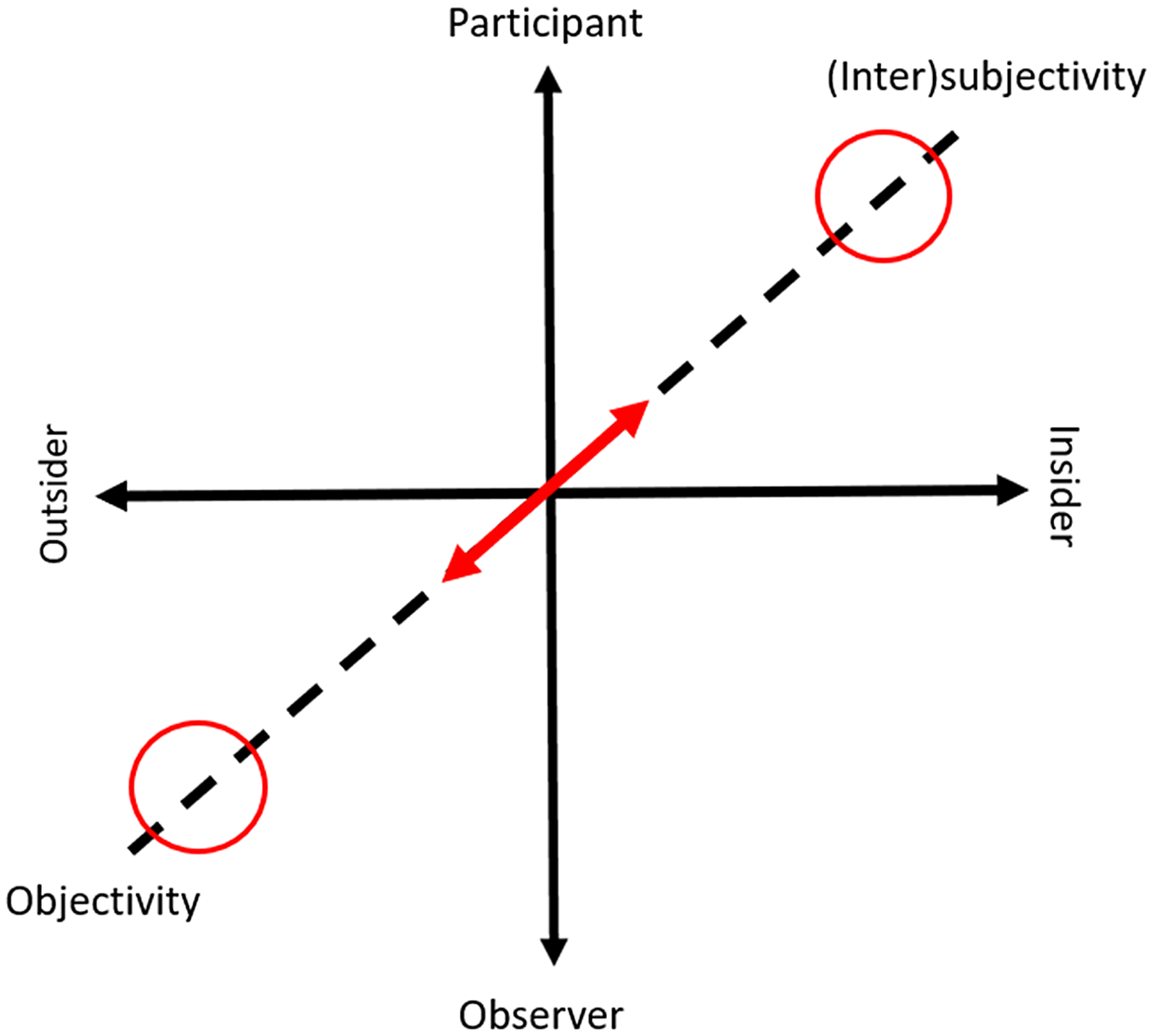
Embodied complexities. This figure takes the form of a Cartesian plane. The x-axis has the concepts of ‘outsider’ and ‘insider’ at opposite ends to depict the distance between these concepts in qualitative research and how researchers can travel between them. The y-axis has the concepts of ‘participant’ and ‘observer’ at opposite ends to, simply, depict the difference between these two concepts in the same manor. Overlaying and intersecting the graph is a dotted line that depicts the class clear journey researchers make between ‘intersubjectivity’ and ‘objectivity’.
The concept of ‘holistic description’ will be highlighted as both a goal and a challenge for embodied researchers. This concept emphasises the potential of embodied methodologies in both colouring the researcher's interpretations and adding depth of experience to qualitative prose that brings the reader into the embodied context. In doing so we engage with the concept of ‘trust’ and how the reader, participants and researcher(s) are all engaged in its orbit. Employing the senses in embodied research writing is certainly not a new idea. Indeed, it is a key feature of this work (see Sparkes, 2009; Spencer, 2013). This paper is an attempt to centralise our discussion of some of the important quandaries implicit in embodied research, to improve our awareness of and to find ways through them. This comes at a time when seeking empathy with another's experience is, we feel, more important than ever.
While there has been much worthy scholarship on and employing ‘thick description’ (see Denzin, 2001; Younas et al., 2023) which foregrounds our entry into the ‘aesthetic manifestations of meaning’ (Freeman, 2014: 832), holistic description is presented here as an option to include the lessons from embodied research to help us navigate these complex interpretive processes.
What holistic description offers is conceptual unity that encompasses the opportunities in writing of and through the body that allows readers access to participants lived experiences, their ‘corpo-reality’, and which allows researcher interpretations to become diffuse and shared (Allen-Collinson and Lededaki, 2015: 467). In doing this work, we hope researchers employing embodied methodologies or other immersive/participatory methods and theoretical frames can recognise some of their own ontological quandaries and better navigate them. To begin, we discuss the case for embodied research and why intersubjective understanding is viewed as a goal in such endeavours.
Employing the body
Some of the complexities surrounding embodied methods emerge from a somewhat latent attempt to stay true to fundamental tenets of value-free scientific enquiry. These emanate from the ‘methodological fundamentalism’ of the positivist tradition that has championed randomised experiments held at a distance as objective routes to ‘truth’ (see Denzin et al., 2006; Richardson and St Pierre, 2005). The intention is to show that although employing the body in contextual immersion can raise key questions concerning rigour, sincerity and credibility in qualitative research, these questions should act as inevitable routes to heightened awareness rather than barriers, adding to an established approach of using writing as a method of inquiry (Richardson and St Pierre, 2005). After all, ‘people's knowledge of themselves, others, and the world they inhabit is inextricably linked to, and shaped by their senses’ (Sparkes, 2009: 23–24), so why not use them?
The human body is central in not just our physical, but historical, social and cultural life in that we can sense, manipulate and dress them in ways which express our reality along with our feelings and interpretations of it. According to Jensen and Moran (2013: 4), the term ‘embodiment’ captures an ‘idea that human conscious subjects are intrinsically connected to the world in complex and irreducible ways’. For Merleau-Ponty (1945/1962: 165), the body is ‘where we see the world and where we reside’. To recognise embodiment in the phenomenological tradition is to consider the way we connect to the world during our conscious lives, materially, culturally, socially, politically. We constantly adjust our body in relation to the world – when it rains, we put on a coat; when it is bright we may shade our eyes – the world's imprint on our bodies is continuous and evolving. Therefore, in seeking to understand another's experience of the world, particularly when one is not of the same cultural / ethnic / racial / age / professional group the body can be a vital tool in accessing more contextual nuance. I experienced this while preparing for fieldwork in the Pacific Islands wherein I was hoping to gain access, through participation in rugby and soccer, to the shared meanings locals attached to the sports (See Sugden, 2021a). This diary note is instructive: The more I prepare the more I realise that I will need to find a team and play, ideally both footy [soccer] and rugby if possible. Being able to play alongside them [local Fijians] will be key the more I think about it…I’m fortunate really though I will need to take the gym more seriously in the next few weeks (Diary 03/05/2014)
Here I reflect that employing my body is ‘key’ to understand the context better and in achieving a degree of insider status with local people. I am ‘fortunate’ in that (at the time) I had passable skill in both pursuits but straight-away expressed anxiety through the self-perception of my body as ill-prepared to enter the field. Although I was not fully aware of the dilemmas to be discussed in the upcoming sections, I had an inherent sense of the importance that the body would hold in bridging the gap in understanding and in building trust. This is not a unique thought by any means. Indeed, a society's influence on the body has engendered many studies that reveal how context is reflected in our corporeality and vice versa. A dive into the world of tattooing, for example, shows how the body is repurposed as a tool of ‘consumers ontological entrapment’ while being modified as ‘their ultimate place of origin and destination’ – a transcendence of the body's place in the world (Roux and Belk, 2019: 485). The body is simultaneously an imprint of social context, a producer of that context and a window into our perception of this interplay. That said, it is still our own experience; how can we still seek to understand another's experiences and definitions of the world around them?
In pursuit of intersubjectivity
Intersubjectivity is a core concept in social research, well known by many as a goal for researchers seeking a shared understanding – beliefs, awareness, feelings – of social contexts (see Gillespie and Cornish, 2010). In Husserl's phenomenology, intersubjectivity plays a key role in the development of how we understand the social world, yet it is also notoriously difficult to define. Schutz (1970: 52) suggests that Husserl's own definition is somewhat incomplete and that it was not until the posthumous release of the second volume of Ideen that a more detailed definition was made available. At its most basic, intersubjectivity bridges the gap between personal and universal views of cognition, or, as Husserl writes, ‘[T]ranscendental intersubjectivity is thus the one in which the real world is constituted as objective, as existing for “everyone”’ (Husserl, 1938, cf. Schutz, 1970: 54). Intersubjectivity explores the role of the body, empathy, tools, communication and both the natural and cultural world – in essence the entirety of the human experience (Duranti, 2010). It requires a level of participation in the material world, even if a human presence is not perceptible and does not depend on language as the only form of communication.
Husserl (1913/1989) argued that the body allows for intersubjectivity (61) – built upon by Schutz (1967: 27) who claimed that ‘we first observe the bodily behaviour and then place it within a larger context of meaning’. Our bodies communicate; when we experience pain our bodies tell us, as with pleasure, joy, heartbreak, and the limitless spectrum of sensual and carnal experiences. In this respect, the body is critical to the work that we do as researchers. We develop an understanding of others’ experiences through bodily expressions (Schutz, 1970: 53). The simple fact of our embodiment can, therefore, be a valid place to begin the development of how we understand ourselves as socio-cultural beings. This heralds the term's connection to the work of Heidegger (1962) who taught embodiment as the study of ‘being-in-the-world’ (In-der-Welt-sein). This is a notion of situated meaning; wherein human consciousness is inseparable from the historical context from which it arose.
These perspectives were continued by Sartre and Merleau-Ponty, heirs to Husserlian thought, who spoke of ‘the flesh’ (la chair) as experiencing reality concurrently within the material, symbolic and cultural world (Merleau-Ponty, 1964/1969; Sartre, 1940/1972). The ‘physical’ body is subject to natural and biological sciences, in both health and decay, rules of gravity, the elements experienced through the senses by which one navigates the world. Moreover, one also experiences other living creatures, both human and non-human, through encounters with their living bodies; their facial expressions, tones of voice, gestures, moving forms and feel. The multi-sensual nature of the body as a sponge for the experiential culture of movement are precisely what makes it such a useful tool for understanding (verstehen), or put another way, achieving a state of ‘situationally structured’ intersubjective experiences (Merleau-Ponty, 1964/1969. See also Moran, 2010).
As qualitative researchers, we understand beating a path to intersubjectivity is important in our endeavours. Yet, to achieve intersubjective understanding of and through the body requires us to acknowledge the interconnectedness of the body and mind as ‘fundamentally intertwined’ (Allen-Collinson, 2011: 49), inseparable and harmonious in the pursuit of understanding. In this, the bodily experience is inherently subjective, which forms part of the allure as: ‘Subjectivity is necessarily embodied and contradictory, constituting both an infolding of socio-cultural discourses, material contexts and ideologies and an out folding of bodily energies and rhythms’ (Chadwick, 2017: 59).
Time is important – it takes time to learn embodied routines, habits, knowledges etc…and in doing so it makes it hard to ‘come back’. How then does one even attempt to ‘bracket’ this subjectivity when, for example, looking to locate power relations within an experience as related to wider contextual forces, particularly when performing field work and building trust with our participants? The answer lies in awareness and a knowledge of the potential in harnessing the body to build an honest holistic description of the embodied experience as researchers embedded in practice.
Holistic description
For phenomenologists engaged in the hermeneutic traditions of interpretation, there is an inevitability of knowing that comes from the experience of ‘being-in-the-world’; to be in the world is to harness its techniques, its rhythms (Allen-Collinson, 2011; Heidegger, 1962). Yet a key aim of embodied research is to embolden ‘active readership’ (Sparkes, 2003), to bring others with you into this bodily experience and to show how the practice, scene or culture is experienced by the researcher and those who populate the scape. In this regard, it is not just about how embodied research is carried out in the field but how it is reflected upon and reconstructed afterwards.
Geertz (1973) held that ethnography is not defined by its techniques but rather the ‘thick’ description or the meaningful construction of a given context. Indeed, his initial conception of ‘thick’ over the proliferation of ‘thinness’ in qualitative research is punctuated with embodied examples from the practice of ‘winking’ to (somewhat bizarrely) going on ‘sheep raids’ (ibid: 323). For Denzin, thick description (2001: 100) ‘presents detail, context, emotion and the webs of social relationships that join persons to one another’. It means encapsulating all the many colours of the data available, along with the methods of representing them in a meaningful picture. This is the recognition of intertwined conceptual structures ‘at once strange, irregular and inexplicit’ which one ‘must contrive to somehow first grasp and then to render’ (Geertz, 1973: 10). As suggested, this is not easy, perhaps because ‘what thick description entails and how it should be carried out is often missing or [paradoxically] insufficiently described’ (Younas et al., 2023: 1).
Although Geertz’ work pioneered these kinds of connections to embodied practice in qualitative research, we contend that it can be taken further. While it is not our goal to provide another updated guide to the practice of thick description (see Younas et al., 2023), we do hope to lend a hand by first highlighting understandings of it. There is a more recent body of literature that provides thoughtful and committed considerations of the research environment (Denzin, 2001; Ponterotto, 2006; Stake, 2010) wherein the researcher takes responsibility to carefully and accurately describe and interpret social realities (Ponterotto, 2006), including the thoughts and emotions of participants and their ‘interactions within a particular context’ (Younas et al., 2023: 2). It is worth noting here that the role of the body, perception and the senses is absent from many of these accounts as they are understandably preoccupied with reporting on the context which exists outside of it. As Geertz (1983: 58) wrote at a later point in his career: The Ethnographer does not, and, in my opinion, largely cannot perceive what his informants perceive. What he perceives, and that uncertainly enough, is what they perceive “with” or “by means of”, or “through”… or whatever the word should be (ellipses in the original).
Given this level of disconnect, perhaps what ethnographers study is less about experience but rather the structures in/through which experiences occur (Downey, 2002), which of course includes the body itself. However, since its inception, the glut of scholarship employing the body in such a hermeneutical task has grown alongside our understanding of these techniques. While this approach may come with its own set of dilemmas, it can assist us in understanding the complex web which surrounds us and the methods of doing so.
Embodied research emboldens the researcher to employ the senses in their interpretations but also in their writing in pursuit of what we term as ‘holistic description’ – a challenge for embodied researchers to add to their ‘thick’ renditions. Holistic description takes inspiration from Merleau-Ponty's contention that exploring the actions of the body from the perspective of both the self and the other plays a key role in our perception of the holistic nature of the ‘body-subject’ and our states of the mind (Merleau-Ponty, 1945/1962). As our relationships with bodily activities are different from our relationship with material objects, a methodological approach to analysing the work of our bodies in the world should reflect this holistic nature of the ‘body-subject’.
Holistic description derives from the philosophy of Holism, which ‘views humans as unified wholes composed of many dimensions that function interdependently’ (Moulines, 1986). It is inextricably linked to the study of the body and its connection to the wholeness of life through, initially, a rejection of authoritarian views of healthcare and a turn towards nursing that focused on the integration of body, mind and spirit as the ground for healing (Kim and Kollak, 2006).
In qualitative research, holistic description employs the body and the senses to capture and interpret the fullness of experience as a medium for meaning and understanding, for both researcher and reader. It is a window into the context and the lives of the researchers who co-construct it, not just analytically but phenomenologically. Writing in such a way is by no means new or indeed confined to a specific field as building ‘holistic understanding’ is prevalent in geography (Parr, 1998: 31), across ‘anthropologies of the body’ (Lock, 1993: 148) along with sociology (Coffey, 1999) and physical cultural studies more broadly (Giardina and Donnelly, 2017) to name but a few.
Holistic description is an attempt to cohesively label an approach to writing that extracts the full potential of embodied experience and that of the social world as experienced by others, building upon Merleau-Ponty's own emphasis on the primacy of perception (1945/1962). Drawing from this same tradition, Simonsen (2012: 16) asserts: The body concerned is not just an object in the world as studied by science, neither is it a mere assemblage or juxtaposition of its parts: it is a phenomenal, lived body, a dynamic unity that changes through interacting with an environment to which it responds and that it actively structures. This body is always contingent and in process.
To this end, holistic description sees the body's boundary as permeable to the meanings and messages surrounding it along with the feelings and senses that charge through it. This multiplicity of meaning is what gives holistic description its shape and value, one that builds upon Merleau-Ponty's (1969) concept of ‘interrogation’. It is an attempt to bring the reader into the scene so that the researcher's monopoly of interpretation can be disrupted and shared; in this our lives and troubles are better connected to others, warts and all. In doing so, certain dilemmas associated with embodied and qualitative research more broadly might be circumvented.
Indeed, there is a difficulty in interpreting the embodied experience and then describing it to the reader – making an abstract theorisation into something material and meaningful. While more classical phenomenological accounts favour attempts at this dualism, Allen-Collinson argues: [t]here can be no fixed, hard and impenetrable boundary between description and interpretation; indeed, any such dichotomy would be antithetical to the very openness and non-dualistic thinking of phenomenology itself (2011: 51).
The bodily experience is intrinsically wrapped up in one's perception and description of the context that surrounds us. It is important to note that this experience is not always a matter of intentional action, such as when a researcher immerses themselves into a context – joins a musical group, teaches a class or attends a gym regularly. It is also a product of habits, routines, and practices, intended or otherwise. It is through such patterns that we can derive meaning and learn important lessons about the nature of our social world. Yet to do so, one must plunge oneself ‘inside’ these cultures to become fluent in them, to legitimately form a holistic description, a journey that can be fraught. After introducing our conceptual tool, this journey begins in earnest, using research diary entries that cover a diverse series of embodied research projects completed by Author A. These diary entries will act as a proof of concept, opening the window into context to allow readers to develop an intersubjective understanding of the researcher's experiences and (in)ability to grapple with the complexities of embodied research.
Embodied complexities
The conceptual map below is intended to highlight some of the key debates and dilemmas that embodied methodologists must contend with and be aware of. It displays the insider/outsider and participant/observer continuums along which one must travel regularly, via various means to be discussed, as researchers flit between social and cognitive worlds/positionalities. Intersecting these axes are relative goals of intersubjective understanding and careful attempts at objectivity in interpretation. While we contend that knowledge of these complexities is crucial to research through and of the body, they are not the only ones one must be aware of. Figure 1 emerged from research experience, two decades of teaching immersive qualitative methods, alongside discussions with colleagues working in this space (including Author B). It is intended as a research/teaching aid and a guide to the discussions below.
Like all human endeavours, embodied research is socially constructed, but also intuitively constructed. A graph such as this then serves less as a how-to guide and more of an awareness guide about what researchers might be faced with in embodied research and what they might aim for during such an undertaking.
While objectivity is depicted in a less desirable quadrant here and in the discussion, that is not intended to deride its usefulness. If embodied (intersubjective) understanding is the goal, then the research is likely taking place in a context wherein a researcher has deemed a closeness with the context/participants as vital to the research question. The accuracy of the interpretation is then dependent on the researcher's ability to engage in an embodied reflexivity that can engender a rigorous and holistic description from inside and outside the scene.
The shifting insider/outsider dichotomy
Beginning with the horizontal line that denotes the insider/outsider dichotomy. The crossing of the intangible and obscure divide between the researcher and the researched has long been debated across the academy, particularly in circles of qualitative enquiry (see Dwyer and Buckle, 2009; Gair, 2012; Merton, 1972; Obasi, 2014). This is unsurprising given the centredness of the researcher and their positionality across the menu of qualitative methods. In this, the qualitative researcher's position is generally one of paradox as they must work to become in tune with the rhythms of the context under study yet maintain a paralleled awareness of how one's biases might impact interpretations of it (Maykut and Morehouse, 1994). Essentially, the validity claims are based on the researcher's impact on the context and whether their role undermines the natural occurrence. Put another way, would the interactions/behaviours/performances occur in the same fashion were the researcher not there? Known elsewhere as the ‘ethnographic I’ (Ellis, 2004). The ethnographic ‘I’ is visible as an actor and an agent, acting and reacting visibly to the implications and the consequences of enquiry (Ellis, 2004: 71). This discussion holds particular importance given the nature of embodied research, wherein the researcher's place within, and influence on, the context is undeniable – to a degree. The goal is not to influence the context unduly; this is trumped by the need to be influenced by it.
Sensual knowledge can be a road to deeper meaning and a level of understanding, of certain embodied practices that are inaccessible via simple observation (Sparkes, 2009). Through participatory experiences, one may use the many interpretive sensual functions of the body to better understand the scene beyond that which is possible through a more detached scientific method. Key questions then revolve around if/when/how the researcher is either an ‘insider’ or an ‘outsider’ and how best to make the most of these positionalities.
For Fayard and Van Maanen (2015: 11), the insider/outsider boundaries are ‘unavoidably blurred and indistinct’, which is partly why they appear at opposed ends of a continuum in Figure 1. For embodied researchers seeking intersubjectivity, the goal must surely be to experience a degree of insider status and knowledge to make interpretations of them. The latter can be done in situ, in the pages of the research diary, or later as part of a more distanced analytical process that makes use of self-conscious introspection as one attempts to be both honest in one's reflections along with, importantly, the experiential impact on them. However, is it merely up to the researcher to declare themselves as either inside or outside the bodily experience? For Brun-Cottan (2013) labelling a researcher as such can be dependent on who is doing the labelling; this is further compounded when there are multiple insider/outsider scales at play. In our experience, insider-ness is always shifting, always context-dependent and can never be taken for granted (Sheps, 2023).
Within this debate is the role of identity, particularly when research participants / populations are not of the same community, gender, age group etc. Back in Fiji I gained insider status as a team player through regular participation in rugby and soccer teams through my ability to keep up with the standard in the practices (just about). In both instances, I was eventually offered to compete with the teams and given team jerseys. As a white British man, my status as an outsider ethnically/culturally was clear; only through the embodied practice of sport participation was I able to claim a degree of insider knowledge.
Though Reyes (2020) argues logically that full insider status is not possible as no two people can share an identical experience of the world, in Fiji I would slide up and down the scale from moment to moment. I still worked hard to combat what I believed to be an identity hindrance by spending time becoming embodied in the team cultures – eating, training, socialising and even living with them throughout (see Sugden, 2021a). However, later in the discussion of our shared field sites in the Pacific Islands, a Tongan researcher and I reflected on our differing status, me as a clear outsider and him as a relative insider. I divulged the privilege of being allowed to participate in ‘Kava circles’ and talanoa
2
with locals, who were, for me, surprisingly open to sharing their lives, hopes and dreams in a somewhat divided Fiji. He reminded me of the positives of this positionality. It would have been hard for someone like me to get that information, I am too similar to them so they would never have trusted me the same way (Sugden, 2017).
This story depicts the nuanced effect that outsider status can have on gaining insider knowledge and understanding and vice versa, as an ‘outsider’ with no local/regional capital, they seemed to feel more open. This is also about ‘trust’ – in the researcher to be allowed in and to accurately/truthfully report on the scene, but also in the reader to believe in and trust the interpretation. A further point is that while ‘insider’ status might be viewed as desirable for understanding, it might not always be advantageous in uncovering truth(s) in fulfilment of research goals, something Author B experienced first-hand while attempting to collect data in a religiously charged conflict zone (see Sheps, 2023). Yet whatever the parameters of the research or the identity factors at play, travelling across the insider/outsider dichotomy feels essential to access depth and understanding while allowing a step back to report with degrees of accuracy and reliability. Nimble movement between these positions is then desirable as long as the researcher remains aware of their positionality and the impact this may or may not be having on both the data and one's interpretations. This involves what Wacquant (2009: 119) described as the need to ‘go native but come back a sociologist’. 3
Embodied research means that the body can be used to better understand, experience and get access to both the lifeworld's and trust of participants (Habermas, 1984, 1992). Time is of note here however – Wacquant (2004) spent three and a half years ensconced in the daily routines of the boxing gym, a length of time, one may argue, that allows the natural behaviours of the research subjects/participants to occur regardless of the researcher in their midst. I have conducted my own participant-embodied ethnography in an urban mixed martial arts gym in England's Northwest (see Sugden, 2021b, 2022) over 5 years (and counting), following similar methodological principles. I found that while those who populated the mats and cages of the gym were initially unperturbed by my positionality – as a researcher into their lives and routines – the length of time spent training near and with them undoubtedly permitted ‘insider’ access to deeper meanings and candour that may not have occurred in more ephemeral studies. That said, the time spent undergoing a participant ethnography, for example, is not necessarily a measure of success when satisfying the aims/research questions can be a better benchmark (see Sugden et al., 2019) Either way, it is the role of participation to access certain knowledge(s) that is less debatable in the world of embodied research.
Being an (embodied) participant observer
Participant observation is simply defined as ‘when the researcher is playing a participant role in the scene studied’ (Atkinson and Hammersley, 1998: 248). Yet more debate surrounds the degree to which a researcher is part of a said scene, particularly since the turn towards reflexivity in qualitative research in the early 1990s (see Bourdieu and Wacquant, 1992). There is variance in the corporeal impact on human behaviour; a researcher observing a group of students discussing the meaning of a poem may have substantial impact on the scene and, indeed, the co-construction of it. On the other hand, a single member of the crowd at a gig, or a participant observer of soccer fan behaviour (see Pearson 2012), may have a minimal bearing on the nature of observed behaviours.
There are various typologies developed to determine the degree to which a researcher is a participant observer that ask (broadly): How well is the researcher known to participants? Where is the researcher located in relation to the activity/scene? How much is known about the research by the participants? Or: If the researcher orientates themselves as a participant or becomes a participant by default? (Atkinson and Hammersley, 1998; Musante and DeWalt, 2011; Spradley, 2016). Auto-ethnographers of course go further by upending the idea of merely observing, as the method depends on the visibility of the self within ‘the constructions of meaning and values in the worlds they investigate’ (Adams et al., 2016: 71–72). If the researcher's voice is present and visible in published texts, then the researcher's embodied experience must surely form part of the narrative as a conduit for said voice. But this is easy to say.
The dynamics of the observer/participant roles in immersive research create challenges that are ‘especially acute’ in embodied research (Thanem and Knights, 2019: 57). Here the researcher positions themselves at the heart of the activity to gain a bodily experience of it. Through learning the techniques to navigate the scene, embodied researchers get an in-depth sense of the cultural scape so that they might more accurately interpret its meaning.
Phenomenological research, for example, seeks the explication of a context through the language of embodied experience; this then motivates researchers to access participants’ ways of ‘knowing, being, doing and becoming’ by immersing themselves ‘physically and mindfully into the field’ (Field-Springer, 2020: 197). Yet the researcher needs to maintain a consistent dialogue with their own positionality as an insider and an outsider to maintain a closeness with both the researched and the rigour of scientific analysis, respectively. A scramble to and from objectivity – an endeavour joined in futility and necessity. They also face challenges in remaining cognisant of their movement between roles as participants and observers – experiential awareness of and with the scene and how others may perceive them while they switch between roles and worlds.
The challenges are numerous but the rewards great. In embodied research, there is a connection between the participant and the insider in that by participating one is also ‘inside’ the context. This relation is highlighted in Figure 1, where working inside the research context, as a full participant is seen as a route to embodied knowledge and/or ‘intersubjectivity’. Yet they appear on different axis due to the unique complexities along the participant/observer continuum, which is a dynamic state, a positionality in flux with its surroundings.
By way of example, I was working for a sport for development and peace organisation in Israel/Palestine that, put simply, employed joint soccer practice between (broadly speaking) Jewish and Arab children to engender humanisation and coexistence. I was there as a coach and facilitator of the projects, but also as a researcher conducting participant fieldwork into the potential of sport in conflict resolution (see Schukenkorf et al., 2016). My multiple roles, along with my white/British identity meant that I needed to pay attention to my positionality. As a coach/facilitator, I was a participant in the program and the overall peacebuilding endeavour, using my body as a neutral, third space within the shared space of sport. Yet as part of this role I was an active observer, letting the game do the work enabling guided discovery. Taking a further step back I was also a researcher, viewing a well-organised/intentioned albeit ephemeral sport for peace project in one of the world's most troubled regions. I wrote at the time: ‘There are so many layers to my participation I don’t know where to start!?’ (fieldnotes Jerusalem, 2011). I should have started with the research, according to which I was very much a participant. I could also have taken time to reflect and openly acknowledge these participatory layers, and adjunct quandaries, rather than producing extensive field notes that were riddled with confusion such as this: We started [the project] early because it was hot, the kids were being difficult and I think overall it was a bit of a mess, I don’t think there will be enough time here for the game [soccer] to do the work we need it to do in giving these kids a good experience of each other (fieldnotes Jerusalem, 2011).
This entry is one devoid of vivid sensual richness that could amount to holistic description that could bring the reader into the context. This was recorded on the first day of this project, one of the first of its kind in Jerusalem – using sport for peacebuilding purposes. It was a momentous and fraught day, children from different communities refused to acknowledge or even sit near each other, let alone play together, there were many physical fights. It was extremely hot, and I remember being stressed, anxious and confronted with what I was seeing. These were all emotions and feelings that would have been useful in building an honest picture of what I was engaged in – a well-intentioned yet somewhat naive attempt at peacebuilding through sport. My status as a (neutral) outsider was also important but again something that did not fully occur to me until much later. Indeed, some of these reflections made it into the final work after the fact, but this is a prime example of an embodied experience that was deeply meaningful but, through narrow description, rendered meaningless. Here time was a healer, only years later were these mistakes fully realised, but perhaps too late for some of the power of experience to be reclaimed.
A further, more recent, example shows how distance from the participation itself can be managed for the benefit of the research. Back in Fiji, this involved flitting between the subjective and highly sensual experience of soccer/rugby practice with locals to attempts at honest, sociologically detached reflection. I occupied roles as a team-mate, training partner and friend during the day and then at night, when alone, attempting self-conscious introspection centred on these experiences and recorded in the pages of my research diary. I quickly realised that when embodied in the context, in the field in the Pacific it was both the best and the worst time to attempt objective social scientific scrutiny of my own experience. Best because I was able to set myself sets of seemingly impossible, but useful thought experiments – ‘How might I experience training if I were a member of a different ethnic group?’, ‘How might I experience it if I were a woman? Of better or different ability etc.…’ I was then able to draw upon fresh experience, and evidence to pack the diary full of colour based on feelings, sounds, cues, gestures, snatches of conversations and other sensual experiences. Where this is hampered is that subjectivity undoubtedly impacted these reflections due to their freshness.
However, what I was able to do is revisit the reflection in the pages of the research diary once again back in the confines of a bland, de-contextualized university desk space in Sydney, Australia and ask these questions anew. My gaze zoomed out and my reflections were influenced less by the freshness of experience and more so by the need to do justice to the (broad) research questions and agency of the groups under study. This is not ‘objective work’ per se, but rather an example of how the subjective is in flux as embodied researchers seek to gain an insight into the intersubjective lifeworld's of our participants and their cultures. A full, honest and sensorily detailed diary can boost the acuity of ‘systematic reflection’ in qualitative research – long held as crucial given the new perspectives and knowledge(s) one might have been subjected to since (Mills, 1959). In this regard, a more traditional objective ontological approach to the research context is, we argue, undesirable as ‘the retreat into a value-free objectivist science model is less a reasoned value position and rather more of a “true believers” methodological fundamentalism’ (Denzin et al., 2006: 771). A state of self-awareness can trump any faux sense of total value-free enquiry.
Know thyself
In phenomenological thought, there is a legacy of debate around ‘bracketing’ or shelving our preconceived notions/bias in pursuit of ‘objective enquiry’. The phenomenological debates that concern subjectivity and objectivity are ever-present in embodied research, dating back to the origins of the perspective itself (Heidegger, 1962; Husserl, 1982). For Heidegger (1962), we are interwoven in our contexts through his concept of Dasein. Merleau-Ponty (1969) too rejects notions of bracketing – an almost meditative space that removes points of reference and entire focus on meaning. Yet for Allen-Collinson (2011: 57) attempts at ‘bracketing’ are a determined effort to set aside ready-made assumptions and interpretations attempted via ‘an open, enquiring, questioning attitude of mind and being reflexive and self-critical’. It is important work despite the debates around its feasibility. While I set out an approach to objectivity above that focuses on leveraging time and distance, other approaches also encourage interpretive engagement with both insiders, akin to member checking (Thomas, 2017) and non-insider perspectives, along with the reading and analysis of other (similar) embodied spaces (see Allen-Collinson, 2011). This process draws from Husserl's idea of trading places: The things posited by others are also mine: in empathy I participate in the other's positing. E.g., I identify the thing I have over and against me in the mode of appearance (with the thing posited by the other in the mode of appearance). To this belongs the possibility of substitution by means of trading places… But never can the other, at exactly the same time as me (in the original content of lived experience attributed to him) have the exact same appearance as I have. My appearances belong to me, his to him [sic] (Husserl, 1989: 177).
So yes, it might be unrealistic to feel we can access an identical subjective experience as someone else, but embodied research can get us closer. It is an intense exercise in empathy, self-awareness, and in containing one's ego, along with a good knowledge of the demands of rigorous qualitative method (see Tracy, 2010). However, just because a researcher embodies a practice, it does not mean they can accurately and confidently report on others’ experiences and meanings of it (see Merchant, 2011). It might be worthwhile for us to consider embodiment or full status as a participant, as something that must be toiled for, crafted and earned.
As discussed, ‘thick description’ is focused on doing justice to the context and those that inhibit it, layering our interpretations with meaning, perspective and understanding. However, in consciously attending to the bodily experience and senses as affected by context, further dimensions can be accessed and brought into relief. This attention can also help with status questions, the answers of which can be found within the pages of a visceral research diary. This is all exemplified below where one can see by the three statements below recorded around 2 years apart during a 4-year-long embodied ethnography into an urban mixed martial arts gym (see Sugden, 2021b, 2022):
The first is a (thick) description, employing the senses, of entering the gym: It's the smell that hits first [on entering], sweat thinly veiled by incense burning at the reception area where a makeshift café hosts parents, friends and fighters awaiting the start or end of the sessions. Then the sound, music booming, from The Stone Roses to techno, shouts of encouragement punctuated by the thwack of pads absorbing impacts of jabs and kicks from the Thai [boxing] lot. Then the sight…20–50 men, women and children at work…sparring in the cage at the centre of the gym, rolling [jiu-jitsu sparring] on the mats around it…the [dead lift] bar being dropped in the weights area. This messy ecosystem, mixed by design, will take a lot of time and hard graft [work] to understand. (Diary 2 months)
Then an embodied reflection to add to the above recorded around the same time: I’m always anxious driving down [to the gym] I don’t know what I’m doing… then I get my arse handed to me [beaten] then I just drive home sore and pissed off, this [the research] was a f***ing stupid idea (Diary 2 months).
This contrasts with a more embodied understanding of the context: I now feel a real connection between maintaining a calm mind and maintaining and actually using my body through commitment to MMA, it's so far removed from being chained to a computer at a desk all day… I don’t know how I coped before (Diary 30 months).
The senses are evident in these extracts. In social research, there is often no substitute for being there and in embodied research, participation allows us to enter new plains of understanding. Above the transition from the uncomfortable to the comfort in the context is clear though the road was long, hard and gradual. Such a journey engenders honesty in how the environment was experienced by the researcher alongside the participants, doing justice to their practice and adding authenticity and honesty to forge a holistic description. Elsewhere in research into foodbanks, ‘being there’ was/is paramount to seeing how they worked, witnessing the attitudes and inter-relationships of the volunteers and the looks from desperation to unblighted optimism on the faces of the patrons. Yet it was only when volunteering myself – in fetching and carrying sacks of potatoes or restocking baskets of tinned goods – that you cross invisible boundaries that lend themselves to reciprocal trust, respect – the sort of empathy that is necessary for accessing intersubjectivity (see Sugden and Faulkner, 2023). With this, however, comes emotion: volunteering at foodbanks for 18 months made objectivity difficult as I grew angry about the impact of poor governance on people's lives in the UK. These emotions found their way into the pages of my research diary as I sought to make sense of the embodied experience: Arriving at 08.30 am and it's freezing… −4 [degrees centigrade] there is already a que, and we don’t start until 10 am the people in the que are regulars, they know each other and put a brave face on with jokes and laughter but there's no hiding why they are there. None are homeless only some without work yet they are forced here anyway due to the cost of living in the 6th largest economy in the world, I’ll never forget this… never forget this anger I’m feeling (Diary 2023).
I would later try to view these entries objectively and discuss these emotions with other volunteers as a way to understand if these feelings were shared. Often in our quest for unreachable shores of objectivity in qualitative research, there is a pressure to hold back our emotions and feelings about the scene under study. In holistic description, we council doing the opposite by letting it all out on the pages to be reflected upon as a truthful and full rendition of the scene as it was perceived, lived and felt in the moment.
Building trust through embodied reflection
There are opportunities here in employing the bodily/carnal/somatic experience; the sensory devices many of us are blessed with along with the participatory nature of many socio-cultural spaces. It means we can create a ‘thick’ description of course, but one that is also multidimensional, and multisensory. Like painting a picture of (a) reality on a canvas, the body and its senses allow us to use multiple colours and brush strokes to bring the image to life in a way that is more holistic than if one had only one colour and/or brush to use while drawing from memory at home. This process does not necessarily have to occur weeks or months after the fact; one does not need to be far removed from context. Take the MMA research wherein I was very much an insider due to my identity – like that of other gym members – and participatory status that took years to attune. The following vignette is instructive: I had to stop towards the end [of the session], I have a bad cut down my arm and it's bleeding all through my rash guard [top]. There was blood… quite a lot of blood on the floor, so I had to go and wash in the toilet; one of the other lads was like, ‘You all right, kid?’ He had a big grin on his face and a swollen eye…I grinned back, I just wanted to get back out there (Diary 20 months).
At the time I was elated, caught in the current of the practice and probably the accompanying rush of endorphins/adrenalin; however, just hours later I was able to engage in embodied reflection: Later at home I washed the blood and sweat off and watched it stream down the plug hole, looking at my elbow the cut looks bad and there's a piece of something floating around in there [the joint] it hurts like f**k. For all the mental benefits of [training], the physical cost can be huge…I felt shattered (Diary 20 months).
This reflection impacted the findings wherein the mental health benefits of such training were discussed yet further embodied reflection allowed for a more holistic impression of the environment, its costs and how they are realised by the body, quietly away from other gym members (see Sugden, 2021b). The admission of feeling ‘shattered’ gives a window into the aftermath of the practice, a world away from the bonhomie of the previous entry and a reminder of the struggles of the researcher and, logically, the researched.
In this respect, harnessing an army of senses to build the impression engenders both greater accuracy and, above all, honesty in reflection. Feelings, emotions and experiences are not ‘bracketed’ per se but held up in the cold light of sociological enquiry, evidence with which all may critique the social world and the researcher's positionality within. Herein, embodied reflexivity should encompass the ‘abductive’ and ‘iterative’ to-and-fro of qualitative enquiry as the data is related to the research question(s) / problems in pursuit of reconciliation (Thanem and Knights, 2019). For Allen-Collison (2009: 293), this means ‘creating rich descriptions that produce a feeling of understanding in the reader’ (emphasis in original). There are opportunities here to try and transport the reader into the experiential world with us so that they can become soaked in it. By allowing the reader into the feelings and senses surrounding the construction, this may engender more trust in that nothing is held back.
In opening one's mind and body to research contexts and then reporting on this integration and then reporting on this as accurately and candidly as possible through the practice of holistic description, the ‘discourse transactions that are always operating in any written communication’ are humanised (Stahl and King, 2020: 26). The extensive and worthwhile scholarship on trust in qualitative research focuses primarily on that which is built between participants and researchers; yet by and large the reader – the person consuming ad influenced by the narrative – is largely absent from these discussions. Whereas there is an (understandable) preoccupation with decentring the researcher from the findings, in holistic description the impact of the research on its author is laid bare. The triangular relationship between the reader, writer and context becomes less bounded, more visceral and, perhaps, more trustworthy.
The peoples and groups with which you share and experience the context can learn to trust you to report on their lives as the scene becomes imprinted on your body, sometimes literally (see Roux and Belk, 2019). On the other hand, the reader may also begin to trust the lived, or felt, experience of the researcher. As the ink on the pages intermingles with their blood, sweat and tears, they might see, or at least recognise, a part of themselves in the narrative and in doing so the bridge between them and the context can be meaningfully crossed. All that's left then is for the writer to trust themselves to reflexively and openly portray their account, messy as it might be. This process also brings the added benefit of potentially removing the perception that academic knowledge is intentionally rendered impersonal and that academics need not act as either the gatekeepers or arbiters of a ‘truth’.
Returning to our foundational concept of ‘thick description’ then, the intention is that ‘readers would be treated to texts so rich in details that the event or the object of description is palpable’ (Geertz, 1973). The ‘hands-on’ nature of embodied research means that it is possible to unmoor ourselves from the exclusivity of speech in qualitative research and permeate our ‘thick description’ with a sensual holism.
Conclusion – possibilities
Social research endeavours are inextricably linked to the web of context which surrounds them. The time of writing is burdened with climate emergency, economic woe in the shadow of COVID-19, significant regional military conflicts, the normalisation of post-truth politics and polarisation in global political discourse. Yet, embodied research is deeply empathetic work that emboldens us to try and see through the eyes of those with whom we share the research context. We can feel and experience our way to understanding so that we might help those at a distance form a closer understanding of the plight, power, agency and identities of others. Yet bridging distances and doing so accurately, is not easy and can take time. In the modern neoliberal university, such prolonged methods can be at odds with workloads, publication targets, impact metrics and pressures to attract new funding – all conspire towards shorter, less sensory methodologies. There is a tension here as: ‘Detached and disembodied research fails to understand the ugly desires and actions that drive and feed these attacks on our freedom and welfare’ (Thanem and Knights, 2019: 135). More involved qualitative research should seek to connect personal problems to those of the wider contextual milieu (Mills, 1959). By employing our bodies in pursuit of shared understanding, we can also highlight the similarities in our struggles but also our feelings, thoughts, desires and ambitions.
Here we join calls for qualitative researchers to become unshackled from the orthodoxies that bind them by ‘writing from the heart’ in a way that is inherently moral, political and instructive (Denzin, 2017: 209). This sounds nice and noble, but such efforts do not come without baggage. What we have done above is set out some key dilemmas facing embodied researchers to boost understanding and awareness of them. We sought to draw from the arsenal of embodied research practice and discourse, combining it with the legacy of ‘thick description’ to proffer a new concept – ‘holistic description’ – to serve as both a challenge to qualitative researchers and a remedy for some of the dilemmas we face when we look to get close. Trust is therefore instrumental in these endeavours. We have argued that in producing even more open, honest and visceral accounts, we can build further trust with those invested in the research to co-create more empathetic, vulnerable and honest understandings of our shared world.
Engaging in embodied research is fraught with challenges but also immense possibilities in remedying our detachment from our surroundings and each other. This paper sought to make sense of these challenges and offer both a visual explanatory tool that maps them out, along with tips and advice on navigating them. In doing so, we can harness our arsenal of senses to build a more accurate, involved, empathetic ‘holistic description’ of the scene under study and those that inhibit it.
Footnotes

Funding
The authors disclosed receipt of the following financial support for the research, authorship, and/or publication of this article: This work was supported by the British Academy, (grant number SG2122\210677).
Declaration of conflicting interests
The authors declared no potential conflicts of interest with respect to the research, authorship, and/or publication of this article.