




Abstract
How much should ethnographers involve themselves with the people, places, and processes they study? One answer has become increasingly popular: invert the standard method of participant observation into observant participation. This article draws on an ethnography of ambulance work to consider the trade-offs between these approaches. My fieldwork included “ride-alongs” with labor and management at a private ambulance firm in California (participant observation) and short-term employment as a novice emergency medical technician at the same company (observant participation). Beyond a simplistic distinction in “empirical depth,” I identify three issues at stake between participant observation and observant participation: field positioning, analytic gaze, and data assembly. Where participant observation presents more opportunities for mobile positioning, outward gazing, and inscription, observant participation presents more opportunities for fixed positioning, inward gazing, and incarnation. In addition to justifying such contrasts, I consider the advantages of mixing these styles into a hybrid approach when feasible.
There is perhaps no genre of social analysis more divisive than ethnography. That at least appears to be the case when you consider some of the distinctions that split the method into its warring camps: positivism versus reflexivity, empiricism versus theoreticism, and deduction versus induction (Burawoy 2009; Strauss and Corbin 1997; Timmermans and Tavory 2012). There are also fierce debates over some of the more practical aspects of ethnography. These include disputes over objects of analysis, case selection, and the politics of representation. Thorny issues like these have pitted some of sociology’s most recognizable names in opposition to one another: Katz (2010) versus Sánchez-Jankowski (2008), Burawoy (2017) versus Desmond (2014), Rios (2015) versus Goffman (2014), and Wacquant (2002) versus Anderson (2000, 2002), Duneier (2000, 2002), and Newman (2000, 2002).
While such high-profile debates help reveal some of the key stakes in sociological ethnography, they often skirt a fundamental feature of the method: the awkward union of participation and observation. Barring rare and somewhat antiquated labels like “full participant” and “full observer,” there seems to be a consensus that essentially all ethnographers are simultaneously participants in and observers of the microcosms they study (Adler and Adler 1987; Gold 1958; Junker 1960). This is the case across a wide variety of overlapping subgenres, be it community ethnography (e.g., ethnographies of neighborhoods, subcultures, and informal networks), organizational ethnography (e.g., ethnographies of firms, schools, prisons, hospitals, and nonprofit organizations), or action-focused ethnography (e.g., ethnographies of work, consumption, protest, and sport). Whatever the empirical object or location of the researcher, the union of participation and observation seems to constitute a tension, if not a contradiction. Indeed, essentially all ethnographers exist as people who not only take from but also take part in the social universes they study. This tension in participation and observation is variable, and we can see this in the two polarized caricatures that distort the method: the ethnographer who has “gone native” and the ethnographer who mimics a “fly on the wall.”
Assuming that neither full participation nor pure observation are desirable, ethnographers are forced to confront a seemingly simple question. How much should they involve themselves with the people, places, and processes they study? One answer has become increasingly popular: invert the standard method of participant observation into “observant participation” (Mears 2012; Moeran 2009; Sufrin 2015; Wacquant 2005, 2015; Wilkinson 2017). This answer calls for a deeper involvement in the field and seeks to push the ethnographer a bit closer to the dream (or nightmare) of “going native.” Unlike the participant observer, who tends to invent a new and somewhat transient role as a hang around, the observant participator is more likely to occupy and enact a preexisting role in the field. There are also important differences in passivity and proximity. Compared to participant observers, observant participators embrace a more active role in the field as they seek to minimize the distance between themselves and their empirical object. 1
Observant participators have existed as fashion models (Mears 2011), casino card dealers (Sallaz 2009), rookie cops (Moskos 2009), wildlife firefighters (Desmond 2006), jailhouse doctors (Sufrin 2017), and more. We can even reasonably apply the label to many of the ethnographers emerging out of the Second Chicago School: Becker (1951) studied musicians while he played the piano, Davis (1959) examined cabdriving while he steered a taxi, and Roy (1959) ran a “natural experiment” on factory work by doubling as an ethnographer and a machinist. Indeed, this strategy is relatively common among what we might call “ethnographies of practice.” It is not surprising then that so many observant participators focus on work, a central practice in any society. That said, there are alternative examples, the most obvious ones being within studies of sport and hobby (Crossley 2004; Gong 2015; Hancock 2018; Wacquant 2004). Observant participators have also occupied other roles, like that of the hospital patient (Roth 1963) and the jail inmate (Walker 2016). Even some community ethnographers have adopted the label to signal their exceptionally strong preferences to learn through collective action, shared rituals, and more (Pfadenhauer 2005; Vargas 2006).
It is important to stress that what I and others call observant participation has different names. Sometimes this method is called “embodied ethnography” (Hancock 2018; Holmes 2013; Monaghan 2006) or “enactive ethnography” (Wacquant 2015). Observant participation might even be equated with what Gold (1958) calls “participant-as-observer” fieldwork. Whatever its synonyms and legacy might be, there remains an enduring ethnographic tradition that explicitly preferences the insights captured through active participation. 2
This article clarifies the trade-offs between participant observation and observant participation and considers the merits of combining these two styles of inquiry, when feasible, into a hybrid ethnography. The hybrid approach I detail works best when the primary empirical object under investigation is an accessible activity or role and when the sequential separation or intentional oscillation between participant observation and observant participation is practical. But, while the parameters of hybrid ethnography are narrow relative to the stand-alone methods it mixes, the methodological lessons learned through this approach have wide implications. Above all, this article elucidates and expands the descriptive vocabulary for ethnographic methods while offering fresh insights into what ethnographers should consider when designing and executing their research.
I start by engaging the literature that best helps us understand the differences between participant observation and observant participation. Although important, I argue this body of scholarship tends to reduce complex variations between these methods to an oversimplified, and often moralized, discussion of “empirical depth.” To help mature the conversation, I reflect on a two-stage ethnography of 911 ambulance work in a large and dense California county. The first stage entailed participant observation. I shadowed workers and managers at a private ambulance company. The second stage entailed observant participation. After spending a year shadowing people at the company, I began working at this firm as a paid emergency medical technician (EMT) and did so for nine months.
Reflecting on this study, I identify three issues at stake between participant observation and observant participation: field positioning, analytic gaze, and data assembly. I claim ethnographers’ decisions to lean toward one method over the other tend to influence where they stand, the directions they look, and the manner in which they extract local knowledge. I detail the relative benefits and drawbacks of each method, but I also argue that there is something to be gained by mixing them. What I call hybrid ethnography is promising for an obvious reason: It allows ethnographers to use the strengths of observant participation to counter the weaknesses of participant observation and vice versa. Still, I refrain from pushing a hybrid-or-bust argument. At the end of this article, I consider the limitations of hybrid ethnography and highlight some directions for future research and reflection.
Deepening Fieldwork
Observant participation should be understood as a partial but significant rejection of participant observation. It is often framed as a heterodoxic style of fieldwork that is capable of unlocking truths that are otherwise hidden from the orthodox ethnographer. By assuming a more “involved” role in the field, the observant participator is supposedly capable of excavating social facts buried deep beneath a surface. Those who advocate this general method tend to emphasize a deepening of fieldwork in two ways: an increased exposure to concealed activities and conversations and an increased sensitivity to processes of embodiment.
First, observant participation leads the ethnographer into social settings that are presumably more difficult to access as a participant observer. This alone might justify observant participation over participant observation if the field site is particularly secretive or closed off. Still, the access benefits of observant participation should not be limited to initial points of entry. Both participant observers and observant participators may be able to enter a given field site, but the latter might be better positioned to access some of the less public aspects of that site. Drawing on the writings of Goffman (1959), some scholars have argued that observant participators have more opportunities to move from “frontstage” to “backstage” (Moeran 2009; Wilkinson 2017). The intuition is that depth of fieldwork immersion is positively associated with seeing exclusive conduct and hearing candid speech.
There are multiple cases suggesting that observant participation works to deepen fieldwork in this way. For example, as a fledgling card dealer trying to better understand the game of “making tips,” Sallaz (2002, 2009) was quickly exposed to the casino’s backstage. Along with break-room chatter, “after-work gripe sessions,” and other interactions off the casino floor, he was taught an array of secret strategies for motivating player tipping (Sallaz 2002:410). Indeed, his survival as an inexperienced dealer required this kind of backstage access. Other observant participators also note how their particular style of enactive fieldwork exposed them to hidden practices and frank talk. For instance, Parreñas (2011:15, 16), in her study on migrant Filipina hostesses in Japan, initially failed to connect with her subjects when she met them as a customer. However, once Parreñas became a hostess herself, other hostesses were much more likely to speak to her about their work. Likewise, Walker (2016), in his study of racialization behind bars, gained special access to spaces and conversations inside a county jail system not because he was an ethnographer but because he was also an inmate.
Second, observant participation exposes the ethnographer to more unspoken truths that are sunk into the flesh of active participants. Drawing on the writings of Bourdieu (1990), some have called for an ethnography of and through the habitus, that being a durable and transposable set of dispositions that imperfectly structure, and are incompletely structured by, the social universe (Wacquant 2005, 2015; see also Desmond 2006; Gong 2015; Sallaz 2009). Again, the intuition is simple. Because observant participators are more integrated actors within the world they study, they are more likely to embody experiences that approximate similarly located actors. This supposedly allows them to tap into tacit knowledge that is otherwise difficult to detect through participant observation.
Typically, observant participators study embodiment through initiation. Wacquant (2004), for example, examined the pugilist habitus forged in a Chicago gym by undergoing a grueling boxing apprenticeship. Indeed, observant participation, which is a term typically credited with Wacquant’s boxing study, often underlies a process of “becoming.” In “Becoming a Firefighter,” as another example, Desmond (2006) worked as a wildland firefighter to better understand the dispositions that correspond to such a high-risk job. As he put it, “in order to comprehend the contours of the firefighting habitus as deeply as possible, I had to feel it growing inside of me” (p. 392). This does not mean observant participators assume they can just acquire the same exact experiences of those they study. Holmes (2013) worked and lived alongside migrant Mexican farmworkers in the United States to better understand their mental and physical suffering. He nevertheless remained sensitive to how his class, race, and citizenship positionings permanently separated his experiences from those of his fellow berry pickers (Holmes 2013:32, 33). The objective is not to somehow invade, adopt, or mimic others’ subjectivities. Instead, the point is to cautiously connect the ethnographer’s embodiment as an active participant to others in the field while simultaneously recognizing important dissimilarities in experience.
Observant participation, a simple label we can loosely impose on many scholars who do not use the term, might therefore be framed as a particularly deep form of ethnography. But does this mean the method is superior to participant observation? Some certainly suggest so. Sallaz (2015), in his more recent study of the call center labor process, emphasizes the superiority of what I am labeling observant participation. He blames the limitations of surveys, interviews, and “direct field observations” among call center research for why the labor process remains puzzling. In justifying his fieldwork as a call center employee, Sallaz (2015:9) writes, “At no point have researchers experienced (call center labor) directly, with their own voices, bodies, and moral sensibilities.” For him, this is less a justification for the plurality of methods than it is a strategy to bypass the weaknesses of less effective techniques. Likewise, Moeran (2009:140) argues that participant observers should transition to observant participation while they are in the field, “to shift from an essentially passive to a much more active role.” In the same breath, he insists this deepening of fieldwork will lead “to a far more nuanced analysis” (Moeran 2009:140; see also Wilkinson 2017:618, 619). The loudest voice for observant participation, however, comes from Wacquant (2005, 2015). He argues that ethnographers should “dive into the stream of action to the greatest possible depth, rather than watch it from the bank” (Wacquant 2015:5).
Still, not all observant participators are so sure that they engage in a stronger method of fieldwork. For example, Sufrin (2015:627), a physician-anthropologist, reflects on her study of jail-based medicine and writes, “I do not contend that observant participation is better, richer, or superior.” Rather than see one method as necessarily more intimate than the other, Sufrin (2015) pushes ethnographers to recognize the “messiness of roles” and to acknowledge the distinct obligations associated with participant observation and observant participation. Moreover, Mears (2012:22), an ethnographer who at least partially studied the fashion modeling market by becoming a model herself, refuses to place observant participation above participant observation. She makes the point that even if there are unique benefits to observant participation, it is not necessarily a method that is suitable for all field sites or research questions. Not only are some practices “too dangerous, too lethal, and too out of bounds of what we can tolerate,” Mears (2012:22) insists that sometimes “maintaining distance as a participant observer offers preferred analytic insights.” It is also worth noting that for all of the supposed virtues of observant participation, many who do this form of ethnography couple it with other methods, like in-depth interviewing and even more orthodox forms of fieldwork (Mears 2011; Parreñas 2011; Purser 2016; Sallaz 2009; Spencer 2009; Sufrin 2017; Wacquant 2004).
While much has been done to clarify and even question the potential merits of observant participation, there is still work to do. For one, much of the method’s supposed glory is built on conjecture and the imagined alternative of participant observation. I am unaware of any publication that explicitly mixes what I am calling observant participation with participant observation and details the relative strengths and weaknesses of both approaches. This article seeks to fill the gap. I hold that more is at stake than just the depth of fieldwork. Participant observation and observant participation set the possibilities for three essential aspects of ethnography: field positioning, analytic gaze, and data assembly.
To explain why this is so, I reflect on a single case study where I used both participant observation and observant participation. While I suggest there is a special advantage to mixing these two methods into a hybrid approach, I do not argue that this strategy is ideal for most ethnographic projects. Hybrid ethnography is often infeasible because either participant observation or observant participation is not practical. Sometimes only observant participation can be done if the practice is highly insulated or secretive and sometimes only participant observation can be done if the practice is dangerous or unethical. But, even though the hybrid approach is not applicable to all or even most fieldwork, I argue that there are general and important methodological lessons to be learned through mixing participant observation and observant participation.
A Hybrid Ethnography of the Ambulance
Roughly four decades ago, Roth (1983), a skilled participant observer and observant participator in his own right, reviewed two sociological studies of the ambulance: Mannon’s (1981) Emergency Encounters and Metz’s (1981) Running Hot. While both of these publications tackled similar cases and addressed similar themes, there was a critical difference. Emergency Encounters was based on participant observation, while Running Hot was based on observant participation. Mannon shadowed ambulance crews as a ride-along. In contrast, Metz became an EMT and examined the ambulance through that experience. For Roth (1983:83), both studies were generally convincing, but Running Hot better succeeded at “getting under the skin” of ambulance crews, seemingly because “Metz was one of the workers” while “Mannon was an outsider.” Metz was, according to Roth (1983:83), able to paint “the more intimate picture of the relationships among workers, as we might expect from one who is part of the group.” The spirit of Roth’s comparison emphasized relative differences in depth. Both Mannon and Metz produced deep studies of the ambulance, but Metz just seemed to go deeper.
Inspired by these earlier studies, I mixed Mannon and Metz’s strategies for studying the ambulance. Like both of these ethnographers, I adopted a work-centric approach to examine the day-to-day operations of urban paramedicine (Seim 2020).
Similar to Mannon, I rode along with ambulance crews who worked for a private 911 ambulance company. I did so for nearly a year. During this time, I learned a lot about how ambulance crews were disproportionately responding to people toward the bottom of the class and racial hierarchies and how their work involved more low than high severity interventions. In addition to documenting their interactions with patients, I noted how crews worked with and against the other frontline workers who tended to share their clientele (e.g., emergency department nurses and law enforcement officers). I also learned quite a bit about the relationships between ambulance crews and those who attempted to control and coordinate their labor (e.g., company management and county bureaucrats). It helped that I also shadowed ambulance field supervisors. I hung out with them as they engaged with crews on the streets and as they met with upper managers at the firm’s headquarters.
Then, I dropped out of the ride-along role and became an EMT for the same company. I started to look more like Metz than Mannon as I began to study the ambulance labor process as an employee.
This abrupt shift from participant observation to observant participation was an opportunistic one. Facing a sudden reduction in my household’s income, I confessed to Grant, one of the company’s field supervisors, that I was about to significantly if not totally cut my involvement as a ride-along observer. I needed to make money. Grant recommended that I instead become employed at the company as an EMT. He reasoned that this would be a good way to make some extra cash while also continuing my research. Grant said I would be like a “caddie” to the firm’s better-trained paramedics. Unlike paramedics, EMTs do not start intravenous lines, interpret electrocardiograms, intubate, or lead a majority of the firm’s medical interventions. Instead, much of their work involves driving the ambulance, collecting patient vital signs, and starting medical reports for their paramedic partners. I ran Grant’s idea by a number of workers and managers at the firm and the consensus was clear: I could learn so much more about paramedicine by actually working in an ambulance.
Of course, no one becomes an EMT overnight. You must be trained and certified. Luckily, I already was. Several months before I began my ride-along observations, I completed a six-week intensive EMT training program. I mainly did this to learn about a world that I wanted to study. Grant, knowing that I had already undergone the basic training for EMTs, reasoned I could get a job at the company if I completed a three-day “refresher training” at another EMT school and passed some prehire tests at the firm’s headquarters (e.g., a fitness and agility trial, a mannequin-based skills exam, and a 50-question multiple-choice test covering anatomy and physiology, prehospital emergency procedures, and other topics). As I underwent these preemployment rituals, it became obvious to me that my hiring at the firm was abnormal. Most of the people who interviewed and examined me already knew who I was and knew I was a social scientist interested in better understanding ambulance operations. Once I was hired, I completed two more weeks of classroom training and six weeks of field training at the company before I started working as an EMT without direct supervision.
In the end, I worked at the company for nine months. When adding in all the prehire training, I matched a year of participant observation with roughly a year of observant participation. As an observant participator, I aimed to extend, but also challenge, the lessons I learned as a participant observer. I maintained a work-centric analysis of the ambulance and continued to examine ambulance crews’ relations with patients, police, nurses, and managers. Though, as expected, actually working as an EMT afforded some deeper insights.
I witnessed more of the ambulance’s “backstage.” Among other things, I learned how new employees were trained and saw how they interacted with other parties that were mostly unfamiliar to me as a ride-along (e.g., shift schedulers and human resources personnel). More importantly, I developed stronger bonds with ambulance crews, and this resulted in more candid conversations about management, police, nurses, patients, and other workers. That was especially true as my partners and I conversed one-on-one in the privacy of our rigs. Compared to my time as a ride-along, ambulance workers seemed less likely to provide generic and cliché answers about ambulance work when I asked questions as a fellow employee who just so happened to also be writing about his experiences. Additionally, as an EMT, I received company emails, gained access to an online message board exclusive to workers, and started to connect with paramedics and EMTs more frequently over social media and text message. All of this helped me better understand some of the behind-the-scene processes that shape the public front of 911 ambulance encounters.
My transition from participant observer to observant participator also meant unlocking a deeper understanding of ambulance crews’ subjectivities. I more directly and intimately confronted issues of embodiment. For one thing, I had to learn to see and talk like an EMT. In addition to acquiring something like Foucault’s (1973) “medical gaze,” I adopted a shared classificatory scheme that helped my partners and I determine which patients’ sufferings were more “legitimate” (see also Becker 1993). My new job required that I understand and articulate these classifications, and this resulted in a more thorough understanding of workers’ preferences. I also had to learn how to act like an EMT. I learned how to best contain my gag reflex as a ride-along, but my EMT job required more than just a tough gut. My paramedic partners expected me to have quick, yet steady, hands for prepping equipment and they counted on me not getting “spun” (i.e., emotionally dazed by the urgency and horrors of high priority cases). In learning how to see, speak, and act like an EMT, I also began to better comprehend what it felt like to be an ambulance worker and that was a particularly valuable lesson. It was one thing to hear workers comment on how physically, mentally, and emotionally exhausting their shifts were and something else entirely to experience this exhaustion firsthand. Beyond gaining a new appreciation for ambulance work, I also acquired a new set of dispositions for handling its day-to-day dilemmas. For example, I learned how to use a soft voice and a gentle touch to calm some patients and a firm voice and tight grip to pacify others. We might say that I embodied the role of the EMT and analyzed how it adapted the “cognitive, conative and emotive” components of my habitus (Wacquant 2016:70).
In the end, I completed a hybrid ethnography of the ambulance that mixed participant observation with observant participation. I shadowed crews like Mannon in the first year and worked as an EMT like Metz in the second year. For some of the scholars I previously noted, my transition from ride-along to ambulance worker should have fundamentally improved my study (Moeran 2009; Sallaz 2015; Wacquant 2015; Wilkinson 2017). While I agree that observant participation can “deepen” fieldwork in some respects, I am not so convinced that depth automatically equals superiority. In this way, I agree with some of the more hesitant champions of observant participation (Mears 2012; Sufrin 2015).
As illustrated in Figure 1, there are some important differences between participant observation and observant participation. When considering the merits of these techniques, we should consider more than just a simplified distinction in empirical depth. I argue that participant observation preferences a mobile field positioning while observant participation preferences a fixed positioning. This has consequences for where ethnographers can best direct their gaze, be it outwardly onto others via participant observation or inwardly onto themselves via observant participation. In turn, these differences shape the assembly of data, with participant observation motivating strategies of inscription and observant participation embracing processes of incarnation. To be clear, I am not arguing that either method is limited to the features I associate with them. I do not want to exaggerate the differences between participant observation and observant participation. I aim to highlight the relative opportunities associated with each strategy, detail the unique benefits to mixing them into a single approach, and consider the broader methodological lessons learned through hybrid ethnography.
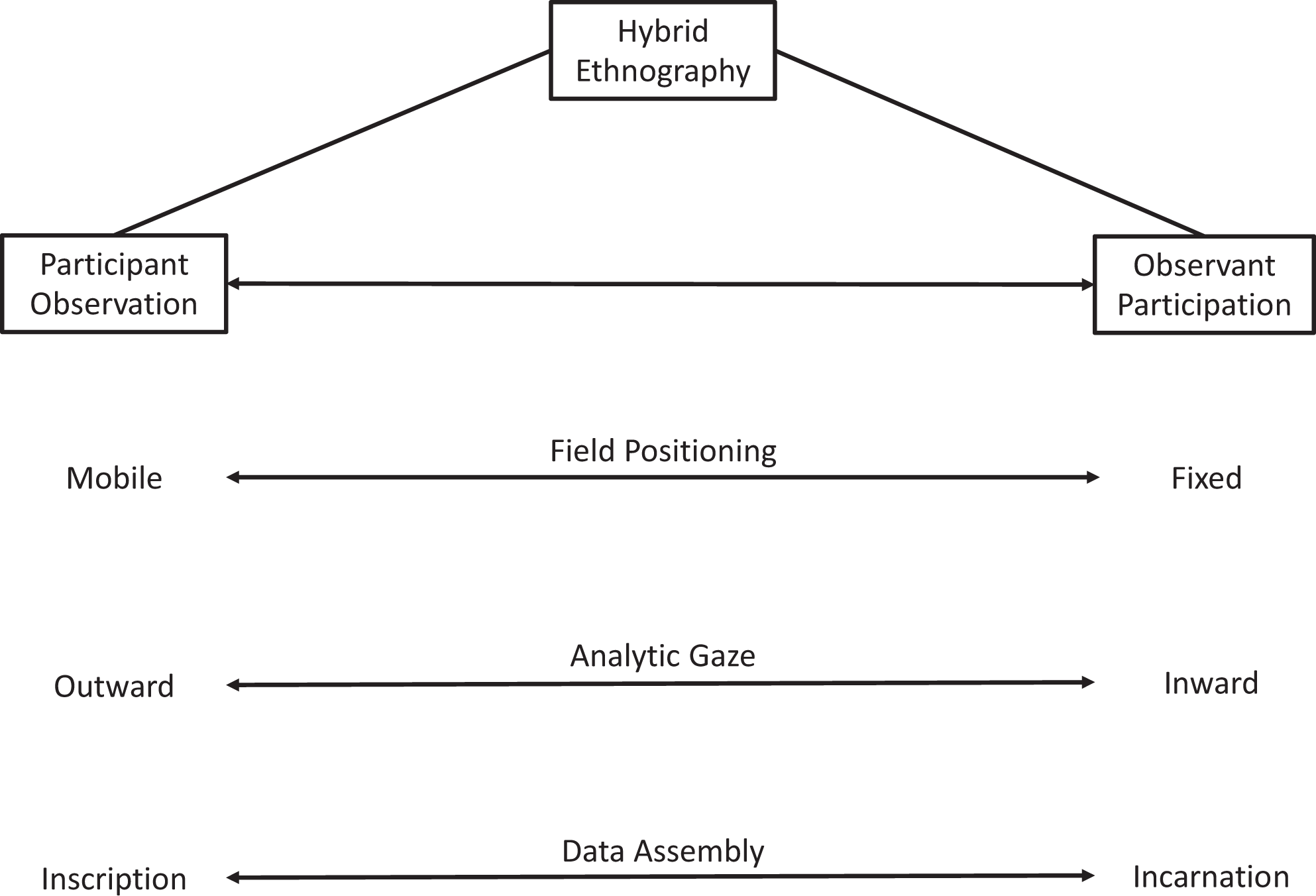
Participant observation, observant participation, and hybrid ethnography.
Field Positioning
One key variation between participant observation and observant participation concerns field positioning. The most obvious difference in positioning might be between relative “outsiders” (participant observation) and relative “insiders” (observant participation). However, a more important distinction might concern movability. Participant observation preferences a mobile position over a fixed one, whereas observant participation preferences a fixed position over a mobile one (see also Trouille and Tavory 2019).
Mobile versus Fixed
During my year of ride-along observations, I was able to move about the field. I could essentially shadow any ambulance crew I wanted. As such, I strategically split my time between day and night and weekend and weekday shifts. This was important since the ambulance workload varies according to day and time (e.g., more trauma and alcohol-involved 911 calls on nights and weekends). As a ride-along, I was also able to study management. I spent a significant amount of time shadowing field supervisors. I hung out with them as they monitored, encouraged, and disciplined workers. Most of our time together was spent in the privacy of their company-issued SUVs, where they often complained to me about a “lazy” ambulance fleet. Shadowing middle management also brought me in more frequent contact with upper management at the firm. That is because I accompanied supervisors to a number of daily management meetings. In short, movability proved to be a key benefit of my ride-along observations.
However, working as an EMT came with its own benefits in positioning. What I lost in breadth, I gained in depth. I implanted myself deeper into the world of paramedicine but from the more fixed position of EMT. As an employee, I was barred from the supervisor rig and the managerial meetings I found so insightful as a ride-along. However, I gained a more intimate knowledge of the ambulance and the people who work in it. I had to learn how to drive this vehicle and use its equipment, and I was forced to memorize a number of protocols concerning paramedical treatment and transport. In some ways, this shaped me into a more critical observer as I became increasingly sensitive to the mismatch between what ambulance crews do and what they “should” do. I also noticed that ambulance workers would speak more candidly with me when I was an EMT. Unsurprisingly, labor trusted me more when I was an employee. A few of my paramedic partners even explicitly noted that they became less concerned about me sharing their opinions with supervisors once I started working as an EMT. Such a concern, they reasoned, was higher when I was a ride-along who drifted between the spaces of labor and management. There were certainly some virtues to committing myself to the relatively fixed position of EMT and abandoning the more mobile position of ride-along.
A Hybrid Approach to Studying Crew–Management Relations
In transitioning from participant observation to observant participation, I learned there were distinct positioning benefits to both methods. I also realized there could be a special advantage in mixing a mobile position with a fixed one. My use of what I call hybrid ethnography proved especially useful for studying the vertical relations of production.
During my observations of managerial meetings, I started to develop a vision of the “lean fleet,” and this was connected with what I call the “poverty dilemma.” Per their contract with the county government, the company must respond in a timely manner to anybody who requests their aid. With demand for emergency services concentrated toward the bottom of the urban hierarchy, this means the firm must dedicate a majority of their resources to relatively poor clientele who generate little revenue (due to their high rates of uninsurance and the low reimbursement rates of Medicaid). Failure to comply with the contract can lead to hefty fines that seriously threaten the company’s profitability. The practical response for management, which I learned by observing their meetings, was to try to intensify the exploitation of labor by deploying a lean and flexible body of workers that maximized efficiency and minimized waste. I watched as upper managers carefully adjusted the size of the workforce by constantly editing the schedule of available shifts. Their goal was to deploy an ambulance fleet that was not so thin that it risked fines for tardy ambulances or so fat that crews would “wastefully” idle in their rigs waiting for 911 calls. They wanted to deploy a kind of goldilocks fleet that remained perpetually busy but still remained responsive to the county at large.
Lucky as I was to see upper management in action as a participant observer, I was perhaps luckier to examine multiple spaces to see how the lean fleet was realized and contested. I observed, from two positions, a struggle between management and labor. As already noted, I spent a significant amount of time shadowing field supervisors. I rode around with them as they patrolled the ambulance fleet. I watched as these supervisors, who were explicitly pressured by upper management to increase the efficiency of ambulance labor, sweat over the fluctuating number of ambulance crews available to respond to new calls. Fewer available ambulances meant a thinner fleet and thus an increased likelihood of tardy ambulance fines. In an effort to elevate the number of available units, supervisors focused much of their attention on the hospitals that crews transport their patients to. They wanted paramedics and EMTs to spend little time at these hospitals so they could respond to new calls. Put another way, supervisors wanted crews to lower their “drop times” because this reduced the overall likelihood of tardy ambulances. I accompanied supervisors as they monitored their laptops to see which crews were taking too long to complete their drops, and I stood by their side as they hounded workers in hospital ambulance bays to hurry up and finish their transport paperwork, cleanup their rigs, and return to 911 availability. Of course, I also shadowed ambulance crews. I watched as labor attempted to “milk” their drop times in an effort to carve in some informal break times into their 12-hour shifts (shifts, I should add, that never guaranteed an official pause for lunch). I accompanied them as they snuck off into hospital cafeterias to grab something to eat and watched as they intentionally postponed their transport paperwork, so they could use the restroom, check their phones, or chat with other crews outside the hospital. I also watched as they kept an eye out for management and noted how many were quick to return to 911 service whenever a supervisor SUV rolled into the ambulance bay.
My shift from participant observation to observant participation also proved insightful for a study of the so-called lean fleet. In abandoning the mobile position of ride-along in favor of the fixed position of EMT, I severed my opportunities to observe managerial meetings and shadow supervisors. As an employee, I was unsurprisingly barred from these spaces. However, I learned a lot about the lean fleet by actually working in it. Like other EMTs and paramedics at the company, I learned to both endure and resist the forces of lean production. I also learned to bend the rules of hospital transport to milk my drop time and I learned to keep an eye out for supervisors while in the ambulance bay. Indeed, some of the details regarding labor-management struggle did not become apparent until I participated as a worker. For example, only as an EMT did I learn exactly how crews in hospital ambulance bays trick supervisors into thinking they are unavailable for 911 service. My paramedic partners taught me to write the transport paperwork on our laptops and then wait 5–10 minutes before actually pressing the print button. That way, if management was monitoring our drop time online, they would see our paperwork status as “in progress” and assume we were still working on the previous case. In truth, we would really be taking an informal break knowing that dispatchers could not assign us a new 911 call until we printed our patient care report for hospital staff.
Indeed, it was one thing to observe struggle and another thing to participate in struggle. Any facade of neutrality was stripped as soon as my own mind and body were on the line. Like other workers, I needed to eat and use the restroom and I often longed for brief breaks at the hospital to catch my breath. When I was a ride-along, I could sneak off and use the hospital restroom or grab some food while the crew I shadowed cleaned the ambulance and completed their paperwork. However, as an EMT, I had to scrub gurneys and write patient care reports. I suddenly had more to lose during shorter drop times. I also had more of a reason to despise the supervisors. They pressured my partners and me to hurry up and return to 911 service. In the struggle between management and labor, I committed myself much more explicitly to the interests of workers. Among other things, this meant developing stronger bonds with EMTs and paramedics, and this in turn led to more candid conversations about crews’ frustrations with management. Fellow workers told me additional secrets on how to thwart organizational efficiency, and they dished new rumors that vilified supervisors and other higher-ups at the company.
An Initial Motivation for Hybrid Ethnography
Hybrid ethnography, here understood as the deliberate mixture of participant observation and observant participation, provided me an opportunity to leverage the relative strengths of both a mobile and a fixed positioning. As a ride-along, I was able to peer into distinct and oppositional spaces within the same organization. This helped me acquire a broad understanding of my case and see things that were otherwise difficult to detect from a single location. We should nevertheless be careful not to equate mobility with omnipresence. There are benefits to assuming a more fixed position in the field, and this became obvious to me once I started working as an EMT. I acquired a deeper understanding of one conflicting party: labor.
I am not arguing that mobile and fixed positionings yield mutually exclusive insights. Instead, I am arguing that both forms of positioning present distinct advantages for ethnographers, and I have attempted to demonstrate this through a brief summary of how I studied crew-management relations. The benefits of mixing mobile and fixed positionings provide an initial motivation for hybrid ethnography. Nevertheless, there are other reasons to embrace this particular approach and other examples of how it can work.
Analytic Gaze
Participant observation and observant participation preference different ways of seeing the world. Both allow the ethnographer to look outward onto others and inward onto the self. However, participant observation lends itself to outward gazing first and inward gazing second and observant participation lends itself to the reverse order.
Outward versus Inward
As a ride-along, I focused mostly on other people: workers, patients, cops, nurses, firefighters, bystanders, supervisors, upper managers, and so on. My mission was to make sense of their world. I did this from improvised sidelines. For example, while on 911 scenes, I often stood silently behind ambulance crews as they interacted with patients and others. Similarly, when in a moving ambulance with a patient on board, I usually sat on a seat above the head of the gurney and watched paramedics assess and treat their subjects. I was not mute or inactive. I asked questions and handed equipment. Still, my primary goal was to passively witness ambulance encounters. The same goes for my time with management. I sat on the periphery of operations meetings. And, even though I was frequently added to the meeting minutes, I rarely spoke. I certainly talked a lot to supervisors when I rode around with them in their SUVs. But, even so, my main objective was to understand their point of view. As a mobile participant observer, I primarily looked outward onto those I shadowed. I bent the ethnographic gaze back onto myself from time to time, but such an effort was always secondary to my observations of people and processes beyond my person.
Where I focused my analytic gaze as a ride-along can be contrasted with where I focused it as an EMT. I aimed to make sense of my world. This does not mean that observant participation is a totally egotistical research practice. I still looked at others and often did so like a participant observer. However, I was more explicitly focused on my personal, yet socially relevant, experiences in the field. This meant looking inwardly onto myself as I “became” an EMT. I coupled this process of becoming with personal scrutiny, paying careful attention to my shifts in preference and practice. The point was to tap into tacit knowledge that was otherwise difficult or impossible to detect from the sidelines. Among other things, I honed in on my exhaustion, my shaky hands, and my nausea as I learned to cope with the daily stresses of ambulance work. Such a focus was generally easy. When I made errors (and I made many), I could not help but notice my emotional reactions above anything else. For example, I feared I was going to be fired when I backed an ambulance into a pole and I wanted to scream in rage when I missed a highway exit while transporting a critical patient to the hospital. Even during more mundane moments, I remained heavily concerned with myself and my performance. I reasoned that adequate participation, which I unapologetically favored over accurate observation during my second year of fieldwork, necessitated such a concern. Observant participation simply provided a technique, or at least a label, to help me link my personal experiences to the forces that shaped them.
A Hybrid Approach to Studying Crew–Patient Relations
Again, there is reason to embrace hybrid ethnography. Participant observation tends to provide more opportunities for outward gazing while observant participation tends to provide more opportunities for inward gazing. I discovered that mixing an outward and an inward gaze was particularly useful for understanding ambulance crews’ relations with their clientele.
When shadowing ambulance crews, I became increasingly interested in how they viewed patients. As already noted, 911 calls tend to concentrate toward the bottom of the urban hierarchy. The paramedics and EMTs I observed did not, however, view their clientele as some undifferentiated mass. They spoke of different kinds of people. For example, while many of the workers I shadowed insisted they were “color blind” when I asked them about race, there were clues that patient skin color was relevant for crew–patient interactions. I often heard workers use not-so-coded terms like “homebody,” “ese,” and “white trash” to describe their patients in private, and overtime, I noted how crews seemed to look at darker-skinned patients more suspiciously (e.g., as “911 abusers”). In addition to skin color, ambulance crews saw a clientele divided by other salient features like gender, age, weight, and cleanliness.
While such visions of different kinds of people were significant, I came to understand another distinction in kinds of cases. While much of this was determined by crews’ formal classifications of clientele problems (e.g., gunshot wound, sepsis, flu-like symptoms, and generalized body pain), there was also a more informal classificatory system at play. Early into my ride-along observations, I noticed that paramedics and EMTs articulated a distinction in “legit calls” and “bullshit calls.” Legit calls indicated the so-called real emergencies that necessitate and justify the craft of paramedicine. These were the cases that had crews plugging gunshot wounds, compressing lifeless chests, and performing other relatively deep and technical interventions into the patient body. Bullshit calls, on the other hand, were the “nonemergencies” that involved little more than a transport of a stable patient to the emergency department. More poles on a continuum than mutually exclusive categories, these concepts structured a vocabulary of preference. In watching crews work and debriefing with them after almost every call I observed, it became obvious that most crews tended to prefer legit cases. For example, paramedics and EMTs generally, and I believe genuinely, preferred to work legit cases that involved black bodies than bullshit cases that involved white ones.
Understanding this vocabulary of preference helped me make sense of the varied interactions I witnessed between crews and their patients. While the association was imperfect, I noticed that moments of solidarity were more common during legit cases and moments of struggle were more common during bullshit cases. In Durkheimian terms, solidarity usually took an “organic” or interdependent form. Legit patients needed crews to live and crews needed legit patients to realize their craft. When they were conscious, legit patients often thanked their crews, and after legit cases, crews often expressed their excitement and joy in “truly” helping someone. Bullshit calls, on the other hand, often came with verbal struggle. Crews subtly and explicitly accused their patients with bullshit complaints of wasting their time, and these patients, in turn, often blamed ambulance crews of not caring about them, their problems, or their communities.
As an observant participator, I remained committed to understanding the complex relations between ambulance workers and their clientele. I still paid attention to what others were saying and doing, but I focused more on making sense of my own experiences in becoming an EMT. I turned the analytic gaze inward. I learned how to see and speak of patients as both different kinds of people and different kinds of cases. In addition to acquiring a medical framework for categorizing patients and their problems, I caught myself embracing pernicious stereotypes and informal classifications. For better or worse, I too made sense of patient problems on a legit-bullshit continuum and began to preference the so-called real emergencies. I was not immune to the “high” workers tended to get by working legit cases. I too used the language of legit and bullshit when speaking to my paramedic partners about the severity of people’s suffering, and I too got caught in relations of solidarity and struggle with clientele.
However, much more as an EMT than as a ride-along, I started to better understand the temperaments and frames that ambulance crews acquire to weather an infinite wave of 911 callers. Two sets of dispositions grew within me, one emphasizing a cold and apathetic style of interaction with clientele and another emphasizing a warm and sympathetic one. Put another way, I became a “dick,” but I also learned to “have heart.” On the one hand, I learned to speak bluntly with patients and trivialize their suffering. I frequently ditched soft speech and good bedside manner in favor of a firm voice and forbidding presentation of self. In opposition to my previous standards of decency, I yelled at some obnoxious patients and even threatened some of the more disobedient ones with limb restraints. On the other hand, I learned to express genuine care and concern for patients. I started to realize, as an EMT, how good it could feel to help mitigate human suffering from the back of an ambulance. When I was just riding along, I could not help but think that ambulance crews were formulating generic and inauthentic narratives of “wanting to help people.” But, as an EMT, I started to get it. There were emotional rewards to be gained from helping others.
I turned the gaze inward to make sense of these two opposing sets of dispositions, but this did not mean I got lost within myself. I talked to my colleagues about how to interact with patients and this frequently generated conversations about having the right “attitudes” and “mindsets” for the job. In fact, it was early during my field training as an EMT that a senior paramedic introduced me to the idea of “being a dick” to difficult patients. I also worked to contextualize my shifting dispositions. For example, I noticed that I usually had heart for more legit cases. And, when I was being a dick, it tended to be for calls closer to the bullshit end of the continuum. There were clear exceptions to this though, and my coworkers helped me understand why. Being a dick was usually associated with the grind of working so many bullshit cases, but many of us also linked it to the grim nature of legit work. The horrific sights of mutilated and malfunctioning bodies seemed to harden our sentiments. After encountering a number of legit cases, it became easy to see patients less as people and more as just assemblages of meat and bone. Similarly, having heart was usually tied with working legit calls and realizing the vocation of paramedicine, but we sometimes linked it to a rearticulation of the craft. This usually meant reconsidering bullshit cases as chances to do a kind of unsanctioned and underequipped social work. For example, my colleagues and I often appreciated the chance to connect unhoused and hungry people to emergency departments where temporary shelter and sandwiches could be found. Frustrations with the so-called nonemergencies were more typical, but there were certainly opportunities to have heart for those with bullshit complaints. This all complicated how I understood crew–patient interactions, but it did so for the best.
Another Motivation for Hybrid Ethnography
Most ethnographers, especially those working from the tradition of reflexive science, couple an external analysis with an internal one. The hybrid approach is unique in that it mixes the outward gazing strengths of participant observation with the inward gazing strengths of observant participation. As a ride-along, I focused most of my attention on others. This helped me identify general patterns as I studied speech and conduct across a number of actors. As an EMT, I more deliberately concentrated on my particular experiences. In making sense of how I became an EMT, I acquired a deeper understanding of what it is like to embody ambulance work.
Thus, hybrid ethnography is not simply motivated by its capacity to couple mobile and fixed positionings in the field. There is another motivation and it concerns the benefit of mixing an outward gaze with an inward one. The approach minimizes the participant observation risk of superficially accounting for the subjectivities of others. It also minimizes the observant participation risk of overgeneralizing personal experience. Still, there is more to consider than just field positioning and analytic gaze.
Data Assembly
Differences in positioning and gaze translate into differences in data assembly. Participant observers typically jot notes in the field and then elaborate on those jottings during a time and in a space a bit further from the “action” (e.g., in one’s private residence). Observant participators can do this too, but field jottings are rarer when the people and processes being studied need the ethnographer’s hands and mind for something else (like driving an ambulance). Pen and paper are usually set aside, and the researcher’s body becomes a fleshy tablet for collecting memories to later translate into text. While both styles of inquiry involve a kind of incarnation before inscription (i.e., experience before writing), participant observation favors inscription over incarnation and observant participation favors incarnation over inscription.
Inscription versus Incarnation
When I rode along with ambulance crews, I frequently jotted notes in a small notepad. I did most of my jotting from the back of the ambulance as I sat in the “captain’s seat” (individual seat above the head of the gurney). I not only did this between 911 calls while the EMT and paramedic were up front, but also during crew–patient interactions. For example, while the EMT drove during hospital transports and the paramedic sat in the back of the ambulance on the bench next to the gurney, I almost always sat in the captain’s seat and jotted notes as the paramedic interacted with his or her patient. While obviously not as detailed as what could be captured with audio or video recorders (both were forbidden by management), this simple technique allowed me to take fairly accurate notes on what was said and done. Because conversations and events unfolded quickly, I jotted shorthand notes to keep pace. Of course, my face was not constantly buried in my notes. I often slipped my notepad into my pocket to help crews in the back of the ambulance (e.g., grab and prep equipment), and I rarely jotted notes while outside of the rig on 911 scenes. However, every ride-along shift came with many opportunities to jot notes on events shortly after they occurred. In addition to the captain’s seat, I often jotted notes while sitting outside hospital ambulance bays as paramedics wrote their patient care reports and EMTs cleaned their rigs. I left most of my 12-hour ride-along shifts with a notepad full or nearly full of jottings. I then used these jottings to write detailed field notes on my computer from home.
Data assembly changed when I transitioned from ride-along to EMT. I still jotted notes, but I typically did so on my cell phone as my paramedic partners and I found brief moments to check our texts, emails, and social media. However, the more important difference in jotting concerns frequency. I could not pull out my cell phone, let alone a notepad, when I was driving an ambulance, pushing a gurney, collecting vital signs, filling out a patient care report, or doing some other job-related activity. As an EMT, I usually took notes in hospital ambulance bays during the short 10 or so minute breaks my partners and I carved out for ourselves between transports. Less often, I jotted notes while “on post” as my partners and I waited for new 911 calls. My EMT shifts ended with fewer shorthand notes to inspire my detailed writing, but I still typed descriptive narratives from home. Details unsurprisingly thinned as I became less confident in how events precisely unfolded and less sure of who said what exactly. I nevertheless acquired a deeper understanding of what ambulance work entails. I lived ambulance work as an EMT and, in a way, I incarnated the field under scrutiny. The field was made flesh through observant participation. I forged a virtue out of necessity by shifting away from writing outward-focused field notes and toward a more inward-focused field diary that sought to capture my sensuous activity. While I logged similar pieces of information (e.g., the emergencies I encountered and the neighborhoods I entered), my postshift writing focused much more on the conditions I could best capture as an observant participator: the dispositions of a rookie EMT.
A Hybrid Approach to Studying Crew–Cop and Crew–Nurse Relations
Participant observation and observant participation motivate similar but distinct modes of data assembly. In considering their differences, we might conclude that the former emphasizes inscription over incarnation and that the latter emphasizes incarnation over inscription. Participant observation lends itself to jottings that feed into field notes while observant participation aims to translate embodied experiences into a field diary. I hold that mixing both types of data sets into a single project yields another special advantage for hybrid ethnography. To help demonstrate this point, I turn to another set of social relations not yet considered in my summary of the ambulance study: the relations between crews and their police and nurse counterparts.
As a ride-along, I did not just concentrate on crew–management or crew–patient interactions. I also focused on the interactions between crews and other frontline workers. Even if temporarily, paramedics and EMTs share the subjects of their labor with a number of parties: firefighters who tend to stabilize 911 patients on scene, skilled nursing facility staff who frequently summon an ambulance to transport their residents to an emergency department, security guards who occasionally rely on crews to handle the sick and injured bodies that fall on their premises, and others. I paid special attention, however, to the work that paramedics and EMTs shared with police on the streets and nurses in the hospital. On the one hand, I watched how crews and cops did a kind of “cleanup” work as they labored together to clear the streets of gunshot victims, occupants of vehicle collisions, intoxicated subjects, sidewalk slumberers, people suffering public mental health crises, and other out of place bodies. On the other hand, I watched how crews and nurses did a kind of “fix-up” work as they labored together to offer quick corrections for a variety of health problems, provide temporary refuge from the streets, and give other short-term aid to their patients.
The crew–cop and crew–nurse interactions I observed were frequent but brief. I generally did not jot notes as they occurred, but rather soon after. I had plenty of opportunities to do so from the captain’s seat of the ambulance and in the hospital ambulance bays. Often, I would ask follow-up questions to ambulance crews about these specific interactions throughout the shift and jot their comments in my notepad. These notes proved immensely useful when writing more detailed field notes from home.
Overtime, I became interested in the conflicts between ambulance crews and their police and nurse counterparts. I noted three major forms of tension, which I call “jurisdictional struggle” (when a worker accuses another of encroaching on his or her duties), “finger pointing” (when a worker attempts to blame another for actual or potential errors), and “burden shuffling” (when a worker attempts to push an undesirable case or task onto another). The most common form of conflict I observed was by far the last one. For example, I frequently jotted the back-and-forth bickering I witnessed between crews and cops as they negotiated who should handle intoxicated, but otherwise medically stable, subjects. Likewise, I noted many instances in which nurses accused crews of “dumping” patients onto their specific hospitals. They often correctly assumed that crews were strategically transporting patients with so-called bullshit complaints to hospitals that would somehow benefit the paramedic and EMT (e.g., bring them into a less busy part of the company’s service area). The details of these interactions were often complicated. My ability to jot notes in the field proved valuable for assembling a data set that could capture the nuanced conflicts between ambulance crews and these other frontline workers.
Once I started working as an EMT, I came to understand and record crew–nurse and crew–cop interactions differently. As already noted, my ability to jot notes in the field was hindered. This in turn dampened my ability to write detailed narratives on how ambulance crews work with and against other frontline workers. Nevertheless, there was something to be gained by putting pen and paper down and getting my hands dirty. While the accuracy of my inscriptions may have suffered, I acquired a more intimate understanding of how and why ambulance crews struggle with police on the streets and nurses in hospitals. That was because I was thrown into these conflicts. I could not escape them. With my paramedic partners by my side, I engaged in jurisdictional struggle, finger pointing, and burden shuffling.
With regard to burden shuffling, nurses accused me of patient dumping and cops accused me of trying to avoid undesirable hospital transports. I learned how to engage in friendly debates with these workers in response to their often-correct accusations. My paramedic partners taught me how to cite county protocols to justify our actions. At the same time, I learned how to “bite my tongue” and save my expressed frustrations with cops and nurses for some behind-their-back “shit talking.” Perhaps most importantly, working as an EMT helped me better understand and appreciate what was at stake in these struggles (or at least what was at stake from the standpoint of ambulance crews). The exhaustion that comes with ambulance labor often escaped me as a ride-along. However, this exhaustion hit me every shift I worked as an EMT. I quickly started to realize why ambulance crews wanted to avoid vocationally unfulfilling tasks like transporting a drunk person to an emergency department. I too welcomed opportunities to take noncritical patients to hospitals in less busy territories of the county. This increased the likelihood that my partners and I would get longer “breaks” between 911 calls. There was often a clear reason to struggle over issues of burden shuffling: Losing these struggles usually led to more exhaustion. To be clear, we were not lazy. Or at least we did not think so. We embraced and pursued the hard work associated with the so-called legit calls, but we also frequently sought to avoid the more mundane tasks that filled our shifts. Struggling with cops and nurses over the distribution of bullshit cases provided one tactic for alleviating such a burden.
I wrote about my interactions with police and nurses from home. My field diary included reflections on why I engaged in arguments with these other workers and why I frequently decided to bite my tongue. Although I had far less jottings to guide me, I rarely struggled to narrate my conflicts and near conflicts with these other workers. I found diary entries cathartic, as I wrote about what I remember saying (and what I wished I would have said) to the nurses and cops who frustrated me at work. Unlike my field notes, my field diary focused much more heavily on my embodied experiences as a novice EMT. In addition to retrospectively writing about my thoughts and feelings, I focused on my shifting interests as someone cast into tense interactions with other frontline workers. In this regard, validity took on a new form. I became less concerned with accurately inscribing the events I witnessed and more interested in sufficiently capturing ambulance work incarnate.
A Final Motivation for Hybrid Ethnography
Mixing participant observation and observant participation means mixing different techniques of data assembly. One approach emphasizes inscription while the other emphasizes incarnation. The difference is subtle yet significant. Participant observation presents more opportunities for jottings which then inspire field notes focused on the speech and conduct of others. Observant participation is better suited for a corporal submission to the field, and this can prompt a field diary focused on the personal experiences of the ethnographer.
Again, hybrid ethnography comes with special advantages. It allows ethnographers to use field notes and field diaries to mutually reinforce one another. A data set produced through participant observation can help compensate for the relatively low generalizability and weak recall associated with observant participation data. At the same time, a data set produced through observant participation can help compensate for the relatively shallow insights associated with participant observation. Thus, along with offering particular strengths in positioning and analysis, hybrid ethnography can offer an edge in data assembly.
Discussion and Conclusion
Ethnography might best be described as a method of depth. Compared to survey researchers and interviewers, participant observers tend to pursue a deeper, albeit usually a narrower, inquiry into social life. Observant participators seek an even deeper inquiry as they go further “backstage” and dig into their own embodied experiences. This article helps clarify the increasingly popular distinction in participant observation and observant participation. In doing so, it shows that more is at stake than just the depth of fieldwork. Each approach brings different possibilities for field positioning, analytic gaze, and data assembly. Where participant observation presents more opportunities for mobile positioning, outward gazing, and inscription, observant participation presents more opportunities for fixed positioning, inward gazing, and incarnation. Each condition has notable strengths and weaknesses.
Mixing participant observation and observant participation can, under particular conditions, be advantageous. I have relied on an original “hybrid ethnography” of ambulance work to illustrate this point. As a ride-along, or a participant observer, I adopted a mobile position in the field (i.e., shadowed labor and management), embraced an outward gaze (i.e., concentrated on the speech and conduct of others), and emphasized a process of inscription (e.g., took jottings to inspire more detailed field notes). As an EMT, or an observant participator, I adopted a fixed position in the field (i.e., embedded in labor, under and against management), took on an inward gaze (i.e., concentrated on my personal experiences as a novice ambulance worker), and emphasized a process of incarnation (i.e., embodied the conditions of active participation to inspire entries in a field diary). This hybrid approach allowed me to uniquely study three social relations in the field: those between ambulance crews and their managers, those between ambulance crews and their patients, and those between ambulance crews and their nurse and police counterparts. Across each of these relations, I was able to leverage the strengths of observant participation against the weaknesses of participant observation and vice versa. This leveraging constitutes the simplest and most significant justification for hybrid ethnography.
I am certainly not the first ethnographer to mix participant observation and observant participation. As previously noted, a number of observant participators couple their method with other research strategies like participant observation (Mears 2012; Parreñas 2011; Purser 2016; Sallaz 2009; Spencer 2009; Wacquant 2004). For example, Purser (2016) does what we might consider to be a hybrid ethnography of eviction. As an observant participator, she worked for a day labor company and helped physically carry out tenant evictions on the West Side of Baltimore. As a participant observer, she sat in on rent court, briefly shadowed law enforcement, attended City Council meetings, and did other forms of less participatory fieldwork. Pursuer’s work is, in my view, another example of hybrid ethnography.
We should not, however, assume that hybrid ethnography is always possible or desirable. Again, the hybrid approach works best when the primary empirical object under investigation is an accessible practice or role and when the sequential separation or intentional oscillation between participant observation and observant participation is practical. Accessibility, in this sense, largely depends on the broader social positioning of the ethnographer and the opportunities for observant participation. I could not, for example, reasonably study medicine by working as a physician, but, given her professional history, Sufrin (2015) could and did. Becoming an EMT was a much more accessible path for me given my lack of health care work experience. And, of course, doing observant participation is only half of the picture for hybrid ethnography. Sometimes, this approach does not work because participant observation is not possible or practical. Indeed, certain groups may not welcome researchers who do not partake in their core activities. That, at least to some extent, was Parreñas’s (2011) experience in her study of Filipina hostesses in Japan and Moskos’s (2009) study of policing in Baltimore.
There are a number of other issues that complicate hybrid ethnography. I was able to customize the role of “ride-along” for participant observation and exploit the difficult, but still accessible, role of EMT for observant participation. Ethnographers interested in more informal settings may face a new set of challenges in combining participant observation with observant participation. There is also the issue of sequencing. In my study, participant observation preceded observant participation, but that need not always be the case. Indeed, a hybrid approach may involve observant participation before participant observation (e.g., Ho 2009) or even a back and forth mixture of these two styles (e.g., Hoang 2015). I hope future publications will address these concerns. I also hope more is done to consider how ethnographers’ general social locations might affect opportunities to mix mobile and fixed positionings, how their commitments to particular paradigms of analysis might influence efforts to couple outward and inward gazing, and how their different instruments of data collection might affect strategies to combine inscription and incarnation.
While hybrid ethnography cannot be applied to all ethnographic studies and there are certainly more issues to address when considering this strategy, I hold that the explicit mixture of participant observation and observant participation yields some general methodological insights. I assume most ethnographers are thinking about the core issues of field positioning, analytic gazing, and data assembly, even if they do not share my exact terminology. I also assume most can envision ways that they can shift between mobile and fixed positioning, inward and outward gazing, and inscription and incarnation. Continued reflections on hybrid ethnography can shed light on the trade-offs between these varying features of fieldwork.
This is probably so because all ethnographic projects have a bit of hybridity to them. They are essentially all made possible by that classic, but nevertheless awkward, union of participation and observation. Thus, beyond tacking on yet another adjective to ethnography, I hope this article helps advance our understandings of what is at stake when researchers decide not only to take from but also take part in the social cosmos they study.
Footnotes
Acknowledgments
Many people provided feedback on earlier versions of this article. I am especially grateful to Ashley Mears, Paul Lichterman, Ann Owens, Dan Schrage, Rhacel Salazar Parreñas, Leland Saito, Michael Messner, Tim Biblarz, Ching Kwan Lee, Dan Lainer-Vos, Brenna Seim, and Loïc Wacquant. Finally, I very much appreciate the comments I received from the editor and reviewers at Sociological Methods and Research.
Declaration of Conflicting Interests
The author(s) declared no potential conflicts of interest with respect to the research, authorship, and/or publication of this article.
Funding
The author(s) received no financial support for the research, authorship, and/or publication of this article.
