



Abstract
Following the lengthy period of isolation enforced by the COVID-19 pandemic, the imperative for qualitative researchers to re-engage in personal and participatory modes of inquiry has become increasingly important, especially within educational contexts. In this article, I argue that collaborative action ethnography could be a valuable way forward in post-pandemic research in which researchers seek to partner with teachers and pupils in their everyday school contexts. Using examples from the three case-study schools in my ongoing research into experiences of vulnerability in secondary music classrooms, I suggest that the flexibility of collaborative action ethnography has the potential to accommodate shifting degrees of participation from researchers, teachers and pupils. In particular, I highlight opportunities for incremental changes in classroom culture, development of pedagogical practice, and teachers’ professional learning made possible through collaborative action ethnography, and evaluate the extent to which such methodologies could help sustain meaningful personal and participatory research.
Keywords
Introducing collaborative action ethnography
Following the lengthy period of personal and professional isolation enforced by the COVID-19 pandemic, the imperative for qualitative researchers to re-engage in face-to-face, participatory modes of inquiry has become increasingly important. While some adaptations to research methodology during the pandemic – such as the use of digital ethnography (Buckband, 2023), online focus groups (Arya and Henn, 2021), and asynchronous messaging (Johnson, 2022) – helped ‘to hold flexibility, access and justice as core epistemic tenets’ (772), a lack of in-person communication with participants often proved detrimental to ethical and equitable research. Although online methods supported the participation of those who might otherwise remain invisible in research, such as the ill or housebound, they remained limited by inequities in digital accessibility (Nguyen, Hargittai, and Marler, 2021), issues around negotiating informed consent (Arya and Henn, 2021), and the blurring of public and private spaces caused by video-mediated contact (Buckband, 2023).
For many researchers, the restrictions imposed by the pandemic were a sober reminder of the importance of established qualitative research methods such as ethnography. Moving away from cultural immersion and participant observation meant not only that close relationships within communities were curtailed (Fine and Abramson, 2020), but also that valuable nuances of everyday, nonverbal interactions were lost (Arya and Henn, 2021). Furthermore, some of the most vulnerable populations, including children, disabled people and the elderly or disenfranchised, became increasingly difficult to involve in ongoing research (Fine and Abramson, 2020; Pelek, Bortun, and Østergaard-Nielsen, 2024). In particular, collaborative methods seeking to co-produce knowledge with such groups became ever more challenging, since digital approaches were often unable to foster shared ownership and responsibility between researchers and participants (Börner, Kraftl, and Giatti, 2024; Kim et al., 2023).
In fields such as education and healthcare research, therefore, the impetus for returning to personal, participatory methodologies in the wake of the pandemic was twofold. First, there was an urgent need to re-establish relationships with groups who were at risk of becoming increasingly marginalised. And second, there was an acknowledgement that such methodological change could provide ‘analytical leverage for understanding how [the] pandemic generate[d] group culture and interaction orders’ (Fine and Abramson, 2020: 6). However, gaining such insight would mean engaging these communities ‘in research that is contextually aware and a better “fit” for participation’ (Börner, Kraftl, and Giatti, 2024: 476) than many of the methods employed during the pandemic.
School-based research during the pandemic
My own experience as a doctoral researcher during the COVID-19 pandemic was, like that of many others, one of making endless Plan As, Bs and Cs (Cîrstea, Johnson, and Phiri, 2024). My research was situated within the field of secondary school music education in England, which over the past decade has become increasingly closely regulated by neoliberal and neoconservative legislation emphasising rigorous, ‘knowledge-rich’ curricula of canonic, propositional content (Bacchi, 2023; Young, 2023). But while policies such as the National Curriculum for Music (DfE, 2013) and National Plan for Music Education (DfE and DCMS, 2011, 2022) extol the beneficial effects of music-making upon learning, wellbeing and community (cf. Hallam and Himonides, 2022), my own previous experience as both a pupil and teacher was testament to experiences of music-making that caused exclusion, marginalisation and discrimination (cf. Bull, 2019; Cheng, 2020). I was acutely conscious of the ways in which music-making could construct both in-groups and out-groups, support both success and failure, and perpetuate both hopeful aspirations and harmful stereotypes. I therefore drew on Judith Butler's (1997) notion of ‘linguistic vulnerability’ to theorise how ‘musical vulnerability’ might contribute to both beneficial and detrimental musical encounters within the classroom. I defined musical vulnerability as our inherent and situational openness to being both positively and negatively affected by music's semantic properties – its delineation of self-identity, social identity and space – and somatic properties – its embodiment through aural receptivity, mimetic participation and affective transmission (MacGregor, 2022).
During my empirical research into musical vulnerability, I adopted a phenomenological, ethnographic lens to capture participants’ lived experiences in the music classroom (Maso, 2001), seeking to draw upon the inherent vulnerabilities of relationships and processes of research (Ellis, 2017; Minatti and Gass-Quintero, 2025; Page, 2017) to gain insight into the vulnerabilities at play within the relationships and processes of classroom music-making (Karlsen, 2019; Richerme, 2016; Wiggins, 2011). Unlike other school subjects, it could be argued that music-making has the potential to uncover multiple vulnerabilities, including those relating to the aural (and therefore public) construction of self, the mastery of complex skill, and the pursuit of sociocultural validation (Wiggins, 2011). Ideally, therefore, I wanted to be able to make regular visits to several schools to gain rich insight into teachers’ and pupils’ musical receptivities and susceptibilities, compare experiences across diverse settings, and evaluate emergent pedagogies.
In reality, however, I did most of my research from my desk, interviewing teachers (but not pupils, for ethical reasons) using video-conferencing software. As pandemic restrictions began to ease I was able to visit one school on a weekly basis for approximately six months. Though this offered rich analytical insight (MacGregor, 2025), it felt inadequate. It was simply not sufficient for becoming immersed in the school culture or eliciting pupils’ voices, let alone developing or assessing new pedagogies.
School-based research after the pandemic
After completing my doctorate, I therefore perceived a significant need for relational, collaborative, school-based research that would engage the range of teachers and pupils that I had previously been unable to reach. Although I had advocated the conceptual value of musical vulnerability across different localities (MacGregor, 2025), I did not want to assume that my prior research in one school, during a global pandemic, could or should speak into wider settings. Specifically, I wanted to be able to identify contrasting experiences of musical vulnerability across different classroom environments and to begin to support teachers and pupils in such experiences through introducing responsive, context-specific pedagogies – or ‘pedagogies of vulnerability’ (Brantmeier, 2013).
Pedagogies of vulnerability are characterised by teachers and pupils entering into reciprocal relationships as co-learners, valuing each other's lived experiences as sources of knowledge and caring for one another beyond a sense of obligation (McKenna and Brantmeier, 2020). While such approaches share similarities with critical, dialogic pedagogies (Spruce, 2012) and can be applied across subjects and stages within education, their emphasis upon processes of vulnerability has particular resonance in the music classroom. The ‘flat ontology’ (Bengtsson, 2019: 145) of co-learning supports the ethical construction of self- and social identities through the semantic properties of music-making, allowing co-learners to ‘care-with’ (Hendricks, 2023: 12) one another as they share diverse musical experiences. Foregrounding vulnerability also acknowledges the interdependencies made evident by the somatic power of music-making: the sonorous permeability of our bodies, the social impact of interpersonal synchrony, and the affective ramifications of emotional contagion (Bowman, 2014). Therefore, although fostering this mutual openness can bring about risk and discomfort (Christodoulidi, 2023), it has the potential to nurture receptive musical learning through reflexive, compassionate care and equitable, participatory musical practices (MacGregor, 2025).
Having secured the privileged position of a postdoctoral research fellowship funded by the Joanna Randall-MacIver Trust at the University of Oxford, I therefore set out to design a research methodology that would meet my two primary aims: first, to verify my previous investigations into musical vulnerability through comparison across different schools; and second, to support teachers in developing innovative, caring pedagogies of vulnerability. In doing so, I hoped to identify how musical vulnerability might be encountered and accommodated in contrasting classroom contexts, both within the English educational landscape and with potential future applications for international contexts. Methodologically, I wanted to move away from the distanced methods of the pandemic that objectified participants and reinforced the hierarchical, invulnerable separation between researcher and researched (Börner, Kraftl, and Giatti, 2024; Buckband, 2023). In what follows, I describe my subsequent decision to pursue a collaborative action ethnography and outline how it unfolded across three schools. I evaluate its benefits – especially in relation to its flexible, immersive and longitudinal nature – alongside its limitations for shared ownership and interaction with complex institutional ecologies.
Defining collaborative action ethnography
What is collaborative action ethnography?
To define collaborative action ethnography, it is helpful to consider its three constituent parts: ‘collaborative’, ‘action’ and ‘ethnography’. First, collaborative research can entail any approaches ‘that are explicitly collaborative in their design, development, and dissemination’ (Lassiter, 2021: 60). Such methods initially emerged during the late twentieth century to address the perceived disconnect between ‘expert’ researchers and ‘non-expert’ participants (Schubotz, 2020), especially in educational contexts. Within schools, aligning theory and practice was identified as particularly important for rectifying the asymmetrical power relationship often evident between researchers and teachers (Bruce, Flynn, and Peterson, 2011).
Collaborative methods overlap substantially with participatory methods; but while the former typically refer to partnerships between professionals (such as researchers and teachers), the latter are more commonly associated with the participation of under-represented groups (Bruce, Flynn, and Peterson, 2011; Schubotz, 2020). Participatory research – and notably participatory action research – is closely aligned with Freirean discourses of emancipation, and is likely to be initiated by marginalised groups working in co-research partnerships for the collective conscientisation of social inequity (Schubotz, 2020). Such approaches claim transformative potential to make visible local, relevant knowledge that may otherwise be overlooked by researchers (Burns, Howard, and Ospina, 2021) – but collaborative approaches, too, emphasise reflexive, multi-vocal practices, while including diverse participants who may or may not have been disenfranchised (Lassiter, 2021).
Second, action research can refer to any ‘method of systematically examining behavior in an effort to improve practice’ (Duesbery and Twyman, 2020: 3). Like collaborative research, action research aims to bridge theory and practice by designing, implementing and reviewing practical interventions in everyday contexts. It is characterised by an iterative process of planning, acting, observing and reflecting, with each repetition of the cycle informing the evolution of the next (McAteer, 2013: 29–30). Given its emphasis on the interconnection of theory and practice, action research ‘usually seeks to engage participants at some level in the process in order to solve a practical problem’ (Merriam and Tisdell, 2016: 49) – such as when a researcher visits a teacher in their classroom setting. However, the degree to which this partnership is democratic and collaborative can vary: sometimes a researcher-led, cooperative model can see less involvement of participants at certain stages of the process; while a participant-led, collaborative model is grounded in relationships of ‘humility, honesty and mutual respect’ (Peterson, Horton, and Restoule, 2016: 29) in which researchers and participants are equally involved in research questions, designs, actions and analyses (Bruce, Flynn, and Peterson, 2011).
Unlike collaborative and action research processes, ethnography has traditionally been conceived as a means of researcher-led construction of theory. Although it remains a contested term with blurred boundaries (Hammersley and Atkinson, 2007), it is usually used for studying actions and behaviours in culture-sharing groups. Researchers aim to immerse themselves in participants’ everyday lives, employing participant observation and informal conversation to generate rich depictions of sociocultural patterns (Creswell, 2008; Hammersley and Atkinson, 2007; Merriam and Tisdell, 2016). Within school contexts, educational ethnographers aim to set aside presuppositions ‘to make the familiar strange’ (Gordon, Holland, and Lahelma, 2001: 188) and to understand interpersonal microprocesses within broader institutional macrostructures.
Nevertheless, the role of collaboration within ethnography has been recognised as increasingly important for ethical and equitable research (Lassiter, 2021). Shifting from passive ‘participant’ observation towards active ‘participatory’ observation is one means by which researchers and participants can jointly engage in collecting and processing data, thereby ensuring that the research is applicable to participants’ sociocultural contexts (Schubotz, 2020: 125–126). Within anthropology, this ‘shifts control of the research process out of the hands of the anthropologist and into the collective sphere of the anthropologist working on an equal basis with community researchers’ (Rappaport, 2008: 6). Not only does this challenge hierarchical notions of participating subjects as subservient to researcher-driven agendas, but it also opens up new avenues for inquiry within the confrontations and discomforts of cross-cultural collaboration (Kallio, 2021; Lassiter, 2021).
Why use collaborative action ethnography?
In line with the growing prioritisation of methodologies that unite theory and practice, various hybrid forms of collaborative, action and ethnographic research have been developed in fields such as education, anthropology, business and organisation, communication technology and ethnomusicology. Three such forms are shown alongside definitions of collaborative, action and ethnographic research in Table 1. First, collaborative action research is described as an action research process guided by democratic joint production between researchers and participants. It has been used in research with indigenous communities (Peterson, Horton, and Restoule, 2016) and school teachers (Bruce, Flynn, and Peterson, 2011), offering ‘significantly deeper opportunities for all to learn’ (449) and building shared goals and identities. In some instances it shares similarities with participatory action research, but the latter is distinctive in being driven by a desire for change stemming from participants facing oppression or injustice (Eisenhart, 2019; Schubotz, 2020).
Defining collaborative action ethnography.
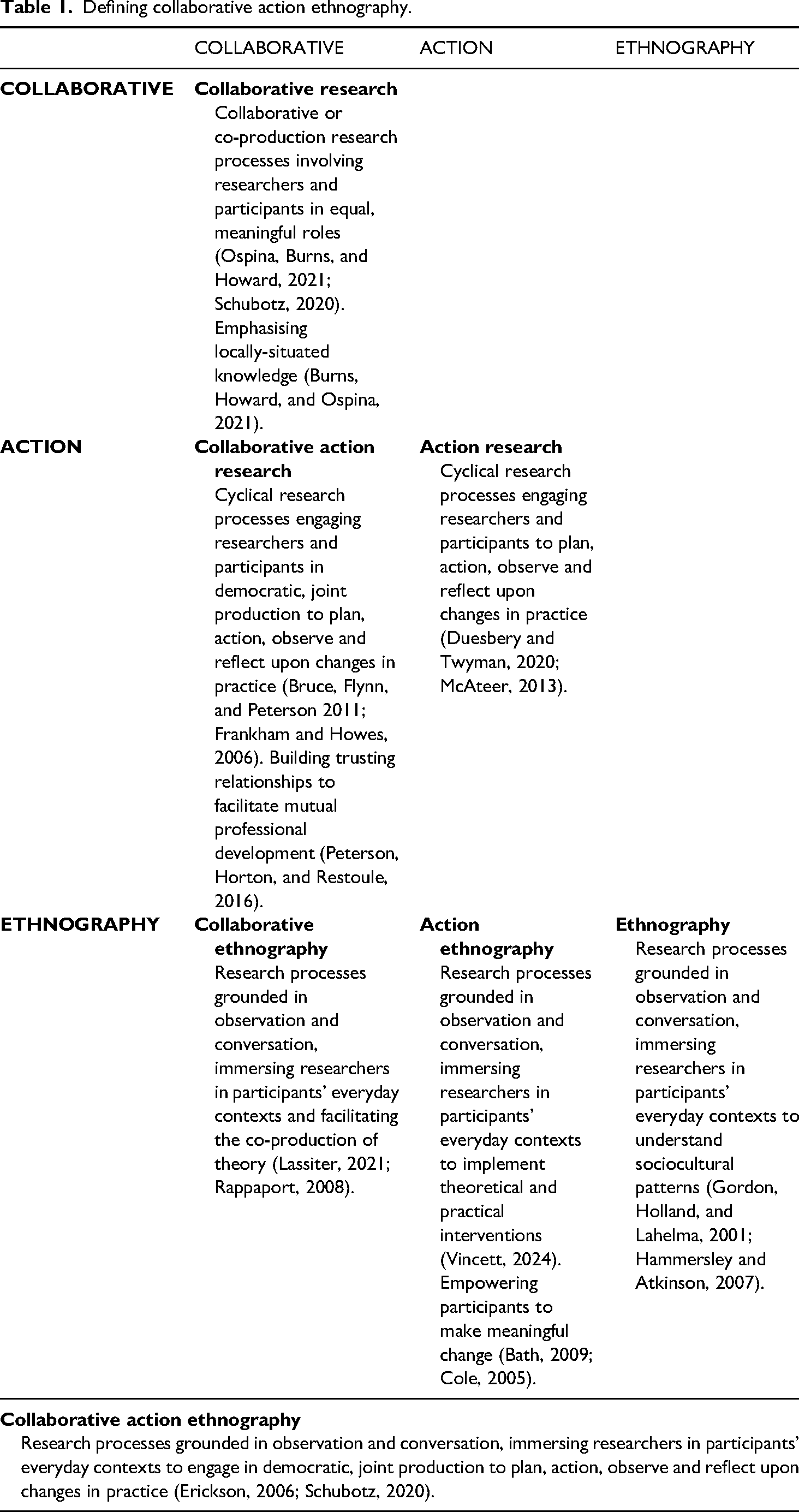
Collaborative ethnography – as outlined in the previous section – can in its broadest sense refer simply to the taken-for-granted collaboration between researchers and participants that is becoming the norm across ethnographic practices (Lassiter, 2021). More specifically, however, it refers to a model of ethnographic inquiry pioneered by Luke Lassiter (2005), which locates researchers and participants as co-producers of theory (Rappaport, 2008). In Lassiter's (2005) conceptualisation, collaborative ethnography engages researchers and participants as co-researchers in the initiation, development, analysis and presentation of research, ultimately resulting in co-created outputs such as the recently published account of a water crisis in West Virginia, with over 50 co-contributors (Campbell, Hoey, and Lassiter, 2020).
Action ethnography arguably has more complex origins than collaborative ethnography and has attracted comparatively little academic attention (cf. Cole, 2005; Lassiter, 2005). Joanne Vincett (2024) locates its beginnings in the social justice orientation of action anthropology and the ethnographic action research used in information and communication technology studies and underpinned by communicative ecology theory. Ethnographic action research has been adapted for education studies (Bath, 2009; Eisenhart, 2019), but has been critiqued for prioritising the action research cycle at the expense of cultural immersion and researcher reflexivity. Action ethnography, on the other hand, prioritises ethnographic methods of observation and conversation, while aiming to empower participants to make beneficial changes in their everyday lives (Cole, 2005; Schubotz, 2020). Vincett (2024) posits that such research should be characterised by immersion, intervention and impact: the researcher should take a participative (yet reflexive) role within the community; their engagement should act as an intervention to promote positive change; and their findings should advance both research theory and social practice.
However, while action ethnography is to some degree collaborative and driven by participants’ needs, ‘ultimately it is the researcher's responsibility to choose what actions to undertake in the field’ (Vincett, 2024: n.p.). In order, therefore, to offer participants equal agency in such an approach, it is necessary to adopt a collaborative perspective from methods such as collaborative action research and collaborative ethnography. Like approaches that have sought to combine participatory action research with ethnography (Eisenhart, 2019; Eisenhauer et al., 2016; Nichols and Ruglis, 2021), a resultant collaborative action ethnography – as defined in Table 1 – diminishes the potentially inequitable researcher–participant hierarchies of traditional ethnography. As in emancipative and indigenous methodologies, in which participants’ ecologically situated epistemologies and relationalities reconfigure the co-production of knowledge (Kallio, 2020; Prest and Goble, 2022), collaborative action ethnography aims to prioritise questions of genuine concern to participants (Erickson, 2006). Pursuing deep, sociocultural immersion (Schubotz, 2020: 120) and building reciprocal researcher–participant relationships (Erickson, 2006) has the potential to capture ‘the contradiction, irony, and nuance of the actual conduct of everyday life’ (241). Whether or not participants have previously been excluded from research (as is often the case in participatory action research and indigenous methodologies), collaborative action ethnography can directly address problems they identify as important through iterative cycles of action research (Table 1).
Collaborative action ethnography addresses many of the limitations faced by other models of collaborative, action and ethnographic research; but it too has potential shortcomings. Unlike participatory action research, which is primarily driven by participants (Eisenhart, 2019), and action ethnography, which remains under the control of the researcher (Vincett, 2024), collaborative action ethnography is situated on an uncomfortable middle ground. As in ethnographic research, the researcher plans, reviews and initiates the study, before it is gradually reshaped by participants’ concerns. With such malleability may come compromise, since collaborative, action or ethnographic principles may have to be stretched to facilitate participants’ active involvement; yet very rarely can such compromise completely overcome the latent power differential between the researcher's and participants’ implicit epistemologies and responsibilities (Eisenhart, 2019; Erickson, 2006; Kallio, 2021).
Nevertheless, while the discomfort of this shifting middle ground can be unsettling, it also allows for the flexibility and reflexivity that can accommodate unpredictable research relationships and environments. The capacity for collaborative action ethnography to account for diverse epistemes, to address multiple research questions, to take place over varied time periods, and to facilitate different degrees of commitment from participants makes it particularly suitable for classroom-based research, in which teachers’ priorities and availabilities change from week to week and year to year. For this reason – and for its potential to bring about relevant, sustainable, local change – I considered collaborative action ethnography to be appropriate for my research into pedagogies of vulnerability in the secondary music classroom.
Designing a collaborative action ethnography
Research design
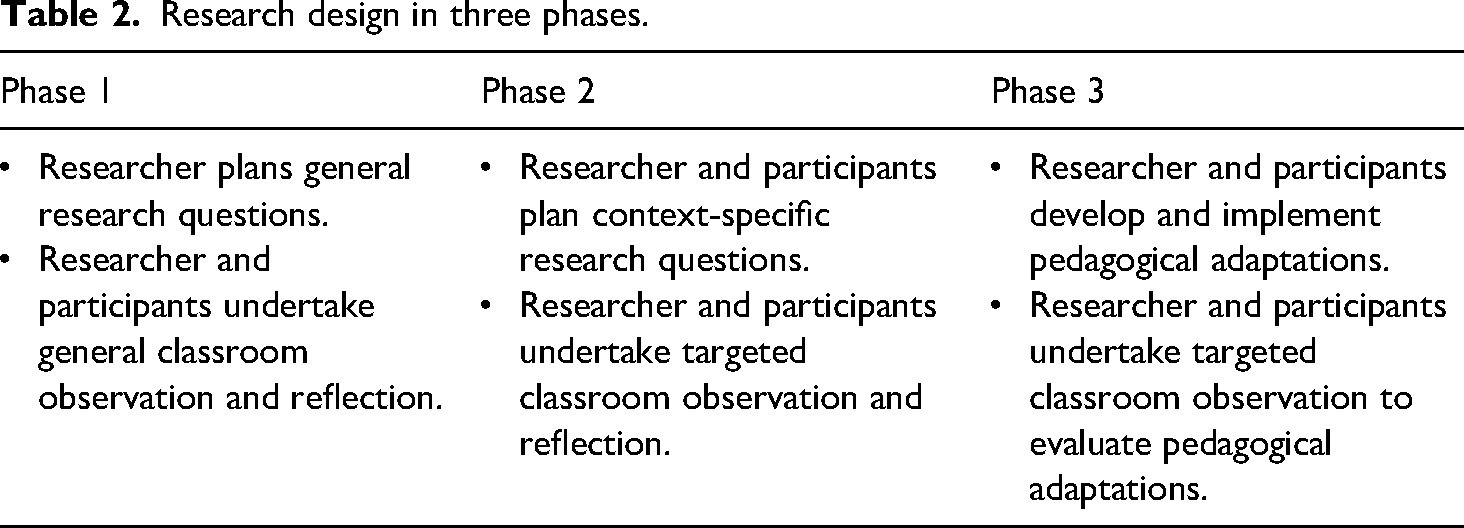
My collaborative action ethnography into musical vulnerability was designed as a collective case study (Creswell, 2008: 477) in three phases (see Table 2). As a case study, it comprised ‘an in-depth description and analysis of a bounded system’ (Merriam and Tisdell, 2016: 37), using multiple sites to offer insight into possible variation in conceptualising pedagogies of vulnerability (Creswell, 2008; Merriam and Tisdell, 2016). After designing the study and securing ethical approval, Phase 1 (January–March 2024) included recruiting participants, beginning ethnographic fieldwork, and comparing my own research agenda with those of my participants. To begin Phase 2 (April–December 2024), I worked alongside participants to plan context-specific research questions in response to our Phase 1 observations. We then continued our ethnography in line with these revised objectives. Phase 3 (January–July 2025) built on the Phase 2 findings to develop, implement and evaluate localised pedagogical adaptations in iterative action research cycles.
Research design in three phases.
To begin Phase 3, I independently reviewed the data collection from Phase 2. Given the large volume of data, I purposively sampled representative excerpts from each lesson observation and reflection to analyse with participants using a mind-mapping approach (Burgess-Allen and Owen-Smith, 2010). Akin to other rapid ethnographic assessment methods (Sangaramoorthy and Kroeger, 2020), this allowed us to determine emergent themes from a significant body of data within a one- to two-hour meeting. As illustrated in Figure 1, we identified and highlighted recurring patterns (Saldaña, 2025) and used mind-mapping to connect data and plan new classroom practices to introduce into lessons during action research cycles.
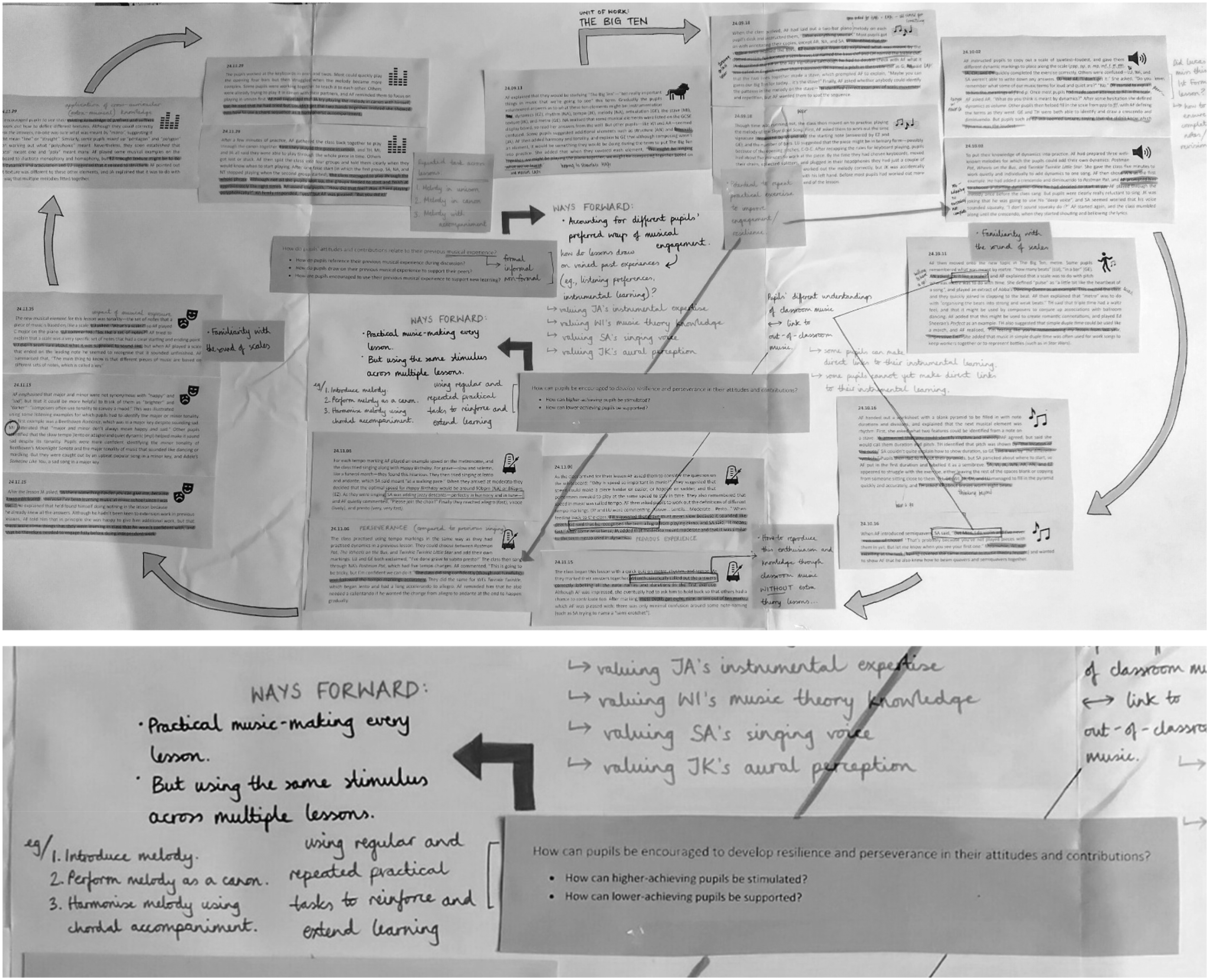
Mind-mapping of Phase 2 analysis (Kenslowe Park Manor).
In line with my previous research into musical vulnerability in the secondary school (MacGregor, 2022), I sought to recruit classroom music teachers, each with one of their Key Stage 3 classes (pupils aged between 11 and 14). I aimed to attend all the classroom music lessons of the selected classes throughout the study. To guide the initial lesson observations, I prepared several questions to reflect upon alongside teacher participants:
What is the subject of the lesson? Describe pupils’ positive responses (e.g., engagement, progress) during the lesson. How are these responses recognised? Describe pupils’ negative responses (e.g., disengagement, difficulty) during the lesson. How are these responses recognised? What aspects of the lesson went well and what would you change in future?
I intended to meet with each teacher (either in person or online) after a lesson observation and work through the reflection questions with them.
Research ethics
Before beginning my study, I had to secure ethical approval from the University of Oxford. In order not to delay Phase 1, I took the decision to follow the university's ‘Approved Procedure’ for the study of teaching in mainstream education (CUREC, 2019). This seemed to be an expedient option, since it enabled the use of opt-out, rather than opt-in, procedures for recruiting pupils and their parents. By framing my research as investigating teachers’ practices, I asserted that pupils ‘are research participants only because they are normal participants in the context’ (1) and committed that my research would not focus on individual pupils’ learning or behaviour. Instead, I focussed on teachers’ pedagogical development and did not require pupils’ participation in ‘anything that would not be within the range of usual educational practice for that site’ (1).
Through this procedure I circumnavigated common issues around gaining informed consent from pupils and parents, such as pupils’ individual competency and confidence to consent (Alderson and Morrow, 2011; Heath et al., 2007) and parental decisions that may (un)intentionally force children (not) to participate against their will (Bourke and Loveridge, 2014; Coyne, 2010). Instead, I sought informed consent from participating teachers and their headteachers, and provided pupils and parents or guardians with accessible information sheets and opt-out forms. On my first or second visit to each school, I gave pupils a brief verbal introduction to my research, answered their questions and gave them time to complete an opt-out form. Parents were sent the relevant documents via school mailing systems.
My study was successfully (and quickly) approved (R90676/RE001), but I was acutely aware of the potential limitations posed by the expedited endorsement. While collaborative research approaches aim to dismantle unequal power relationships between researchers and participants (Burns, Howard, and Ospina, 2021; Schubotz, 2020), following the Approved Procedure foreclosed the opportunity for my study to be led by pupils’ voices, other than by the perspectives they expressed within usual classroom practice (Burnard and Björk, 2010; Cain and Burnard, 2012). Furthermore, in its assumption that negotiating research with teachers is, by definition, lower risk than negotiating research with pupils, the Approved Procedure offered no specific guidance on managing ethical concerns that could arise within researcher–teacher partnerships. It did not, for example, explicitly address the costs to participating teachers of potentially intrusive interruptions to their everyday practices (Head, 2018), or account for underlying assumptions of expertise that could exacerbate asymmetrical researcher–teacher roles (Bergmark, 2019). As outlined in what follows, I therefore sought to take advantage of the flexibility inherent in the collaborative action ethnography method, allowing the locus of collaboration to shift over time according to the positionality of the researcher, teachers and pupils (Eisenhart, 2019; Erickson, 2006).
Research participants
I aimed to recruit three to four schools for my study, since ‘the more cases included in a study, and the greater the variation across cases, the more compelling an interpretation is likely to be’ (Merriam and Tisdell, 2016: 40). Recruiting any more than four, however, would make it difficult to schedule weekly visits. I recruited schools through existing contacts, employing purposive sampling to invite participants whose schools were likely to offer me access and whose contexts were illustrative of wider variation across schools in the area (Merriam and Tisdell, 2016). Although this sampling method inevitably introduced some bias into the recruitment process (e.g., my contacts were all white, heterosexual, cisgender women of a similar age and socioeconomic background to me), recruiting through existing networks can often be more fruitful than ‘cold-calling’ and result in greater participant receptivity and reliability (Jourdan, 2015: 108).
In total, I contacted music teachers at five schools; received responses from four; and gained informed consent from teachers and headteachers at three. To protect their anonymity, the names of all schools and participants have been pseudonymised, and geographical and statistical data have been approximated. In what follows, I describe each participating school, class and teacher in relation to my own ‘insider-outsider’ positionality (Berger, 2015). As a former pupil at an academically selective girls’ school, undergraduate and postgraduate music student, and teacher of music at two independent schools, I was highly familiar with certain music education contexts and shared some common ground with my research participants. However, my additional experience and privileged position as a postdoctoral researcher inevitably differentiated me as an academic ‘expert’. I therefore sought to exercise reflexivity when considering my ethical responsibilities and relationships to my participants (Bergmark, 2020), listening attentively to locate my own ‘ignorance of inequality’, disrupt entrenched values and assumptions, and understand epistemological differences (Kallio, 2021: 62).
Sycamore Close Academy
A state academy in the suburbs of a large city in southern England, Sycamore Close Academy was keen to promote opportunities for professional and pedagogical development. It was characterised by strict disciplinary standards and a ‘knowledge-rich’ curriculum, in line with neoconservative trends in English education policy prioritising a national inheritance of canonic cultural knowledge (cf. Biesta, 2020). It was rated by the Office for Standards in Education, Children's Services and Skills (Ofsted) as ‘good’, and had around 700 pupils on roll from diverse ethnic and socioeconomic backgrounds: approximately 15% had Special Educational Needs or Disabilities (SEND); 30% spoke English as an Additional Language (EAL); and 20% were entitled to Free School Meals (FSM). The school music department had two classroom music teachers, and pupils in Years 7 and 8 received three classroom music lessons per fortnight, learning keyboard and composition skills. Lessons in all subjects adhered to a set structure, starting with a revision exercise and followed by teacher-led direct instruction on the core content.
I was put in touch with the head of music at Sycamore Close, Mrs Pinehurst, through a parent of a pupil. Since I had no previous contact with the school I lacked ‘immediate points of identification’ and felt like a relative ‘outsider’ (Berger, 2015: 227). Although this offered me some degree of critical distance, I worried that Mrs Pinehurst might find my visits intrusive (Head, 2018) or misinterpret my expectations as a ‘belief that teachers are in need of support from researchers, who possess the necessary knowledge’ (Bergmark, 2020: 333). I therefore sought to learn about the pupils and practices at Sycamore Close through listening to and engaging with her expertise (Kallio, 2021), above and before pursuing my own research priorities. Mrs Pinehurst had between five and 10 years of teaching experience and was knowledgeable about Sycamore Close's ideologies, having taught there since it had opened. During 2023–24 Mrs Pinehurst and I worked with one Year 7 class of 30 pupils (17 boys, 13 girls) that teachers described to me as ‘challenging’ and ‘low attaining’. In line with the ethical approval granted to my research, when this class was passed to another teacher in 2024–25 I continued working with Mrs Pinehurst and a new Year 8 class of 30 pupils (17 boys, 13 girls). This class were also perceived by teachers to be ‘challenging’ and even to have some of the ‘worst’ attitudes to learning in the school.
Northgate Girls’ School
Northgate Girls’ School was a high-performing all-girls state academy in a commuter town in southern England, with an Ofsted rating of ‘outstanding’. The 1200 pupils on roll came from diverse ethnic and socioeconomic backgrounds, and approximately 5% had SEND, 15% spoke EAL, and 10% were entitled to FSM. The music department at Northgate Girls’ School had two classroom music teachers, and pupils in Years 7 and 8 received one weekly classroom music lesson. In Year 7, each lesson began with whole-class singing, culminating in an end-of-year inter-form song competition.
In contrast to Sycamore Close Academy, the researcher–teacher relationship between myself and the music teacher at Northgate, Mrs Brown, was shaped by our existing friendship. Since we met at university, Mrs Brown had spent between two and five years as a classroom music teacher, and in 2023–25 she invited me to work with one class of 31 pupils through Years 7 and 8. To some degree, my friendship with Mrs Brown democratised our collaboration through an existing relationship of care (Ellis, 2007; Owton and Allen-Collinson, 2013): Mrs Brown went out of her way to invite me to school events and helped facilitate research opportunities for my undergraduate students; in turn, I was invested in the ups and downs of her teaching career and her ongoing applications to other schools to become a head of department. Nevertheless, this friendship posed unique challenges on occasions when our work commitments and social plans overlapped, so I sought always to express my research intentions clearly so that we both understood and assented to the ongoing research process (Hall, 2009).
Kenslowe Park Manor
Kenslowe Park Manor was a small, rural independent school in an affluent region in southern England. It was rated by the Independent Schools’ Inspectorate (ISI) as ‘excellent’ in educational quality. It offered day and boarding provision, and the 350 pupils on roll were primarily white British, European, or American. Approximately 10% of pupils had SEND. The music department at Kenslowe Park had one classroom music teacher, Mrs Fitzpatrick, who had approximately one year of teaching experience and was also a boarding houseparent. Each week, Year 7 and 8 pupils at Kenslowe Park received one classroom music lesson and a small-group lesson on an orchestral instrument. During 2023–24, Mrs Fitzpatrick invited me to work alongside a Year 7 class of 16 pupils (11 boys, 5 girls). Pupils in this class had varied experiences of learning music: some had no formal music tuition other than singing at primary school, whereas one (notably for an 11-year-old) had learnt the viola da gamba (an historical bowed string instrument) since the age of six. In 2024–25, Mrs Fitzpatrick's pupils were allocated to new classes, so the Year 8 class I visited comprised 17 pupils (11 boys, 6 girls), eight of whom I had also observed the previous year.
My positionality as a researcher at Kenslowe Park Manor was complex. I was previously employed at Kenslowe Park as a music teacher, and although Mrs Fitzpatrick and I had not met before, we quickly got to know each other through our shared classroom experiences. Being situated as a quasi-‘insider’ not only helped me secure access and trust from the school, but also offered me more nuanced understanding of the institution's culture and individuals’ behaviours (Berger, 2015: 222–223). However, since Mrs Fitzpatrick was still qualifying as a teacher, our respective positions undoubtedly reinforced a hierarchical sense of expertise that affected our collaboration (Bergmark, 2020). Nevertheless, although our relationship was asymmetrical in terms of experience, adopting equitable, dialogic reflection throughout the research process began to enable us to enact tangible and meaningful pedagogical change in the classroom.
Implementing a collaborative action ethnography
My collaborative action ethnography took shape differently across my three case-study schools. This resulted not only from schools’ management of classes and timetables, but also from my relationships with participants and teachers’ own positionalities. While Mrs Pinehurst at Sycamore Close Academy was head of department, Mrs Brown at Northgate Girls’ School was answerable to her head of music, and Mrs Fitzpatrick held the additional responsibility of being the sole music teacher at Kenslowe Park Manor. At each of their three schools, the impact of undertaking a collaborative action ethnography was therefore unique (Figure 2). As I explain in the following sections, at Sycamore Close it offered openings for incremental change in classroom culture within an otherwise strictly regulated curriculum. At Northgate it presented valuable opportunities for pedagogical development in line with the concept of pedagogies of vulnerability. And at Kenslowe Park it supported Mrs Fitzpatrick's professional learning as an early-career teacher and grew our awareness of musical vulnerabilities within the classroom.
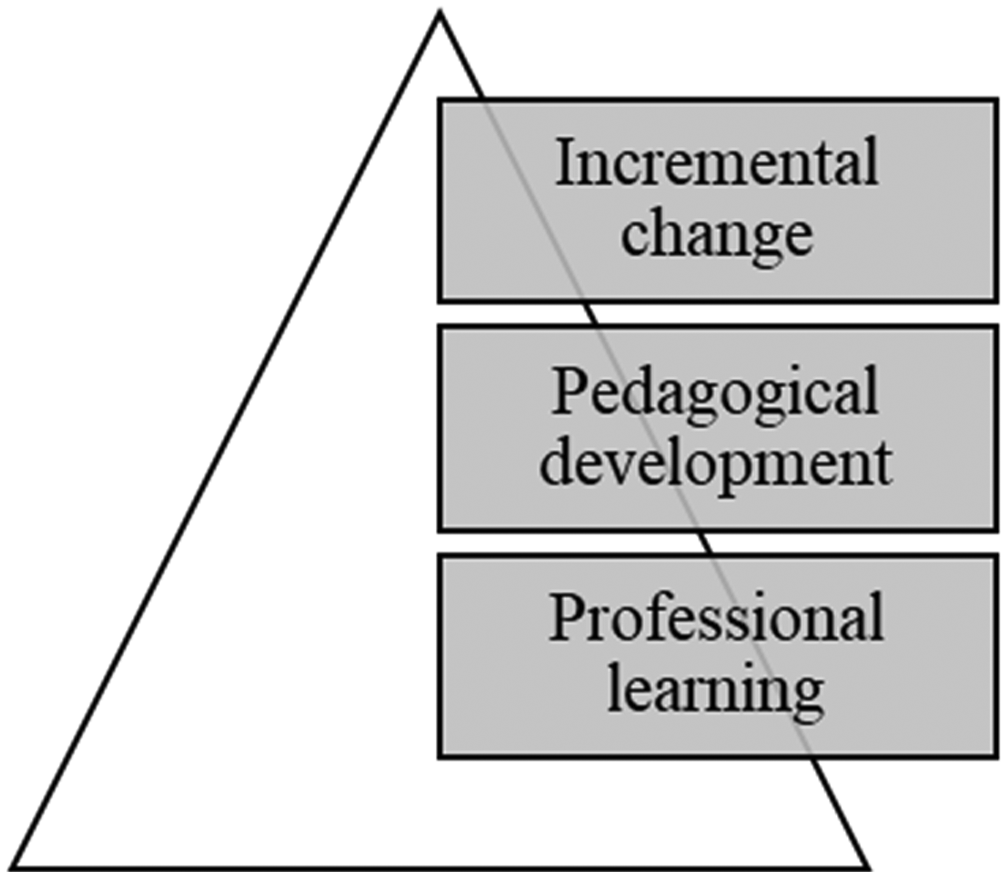
Incremental change, pedagogical development and professional learning through collaborative action ethnography.
Incremental change: Sycamore Close Academy
Although I had no prior connection with Sycamore Close Academy, it quickly emerged as the school with which I developed the closest collaborative relationship. Because pupils had three music lessons per fortnight I visited Sycamore Close more frequently than other schools and spent at least an hour each week in conversation with Mrs Pinehurst after lessons. I also got to know the other classroom music teacher and visited Year 7 geography and art classes.
However, despite a fruitful sense of collaboration with Mrs Pinehurst, Sycamore Close was the most challenging school at which to initiate action research cycles. Although it was nominally open to professional and pedagogical development, the school's ‘rigorously academic and knowledge-rich’ curriculum meant that teachers in all subjects were expected to prepare lessons following a set format, using direct instruction aligned with pupils’ knowledge organisers while also adhering to the strict behavioural policy. Mrs Pinehurst therefore felt she had few opportunities for autonomy or creativity in her teaching, and often grappled with pupils’ apparent vulnerability to distraction, disengagement and resignation.
Since Mrs Pinehurst was acutely aware of these perceived restrictions and susceptibilities, she was quick to devise her own research questions during Phase 2, asking:
How does a ‘knowledge-rich’ curriculum affect pupils’ musical creativity? How does a ‘knowledge-rich’ curriculum affect pupils’ growth mindset?
We began to address the first research question when Mrs Pinehurst's Year 8 class were composing pieces of music inspired by English folksong. As summarised in Table 3, pupils were given precise, prescriptive instructions for planning their compositions. In some lessons, Mrs Pinehurst removed any elements of choice – often instructing pupils to copy from the whiteboard – so that they would not fall behind while making creative decisions. During other lessons, she reintroduced limited choices through scaffolded examples, such as offering pupils choices of modes or accompaniment styles. But in further lessons – such as when the class moved to work on laptops or when pupils Emma and Miriam spent time exchanging and evaluating their ideas – Mrs Pinehurst allowed pupils to progress at their own pace, making their own creative decisions with minimal intervention.
Pupils’ musical creativity (Sycamore Close Academy).
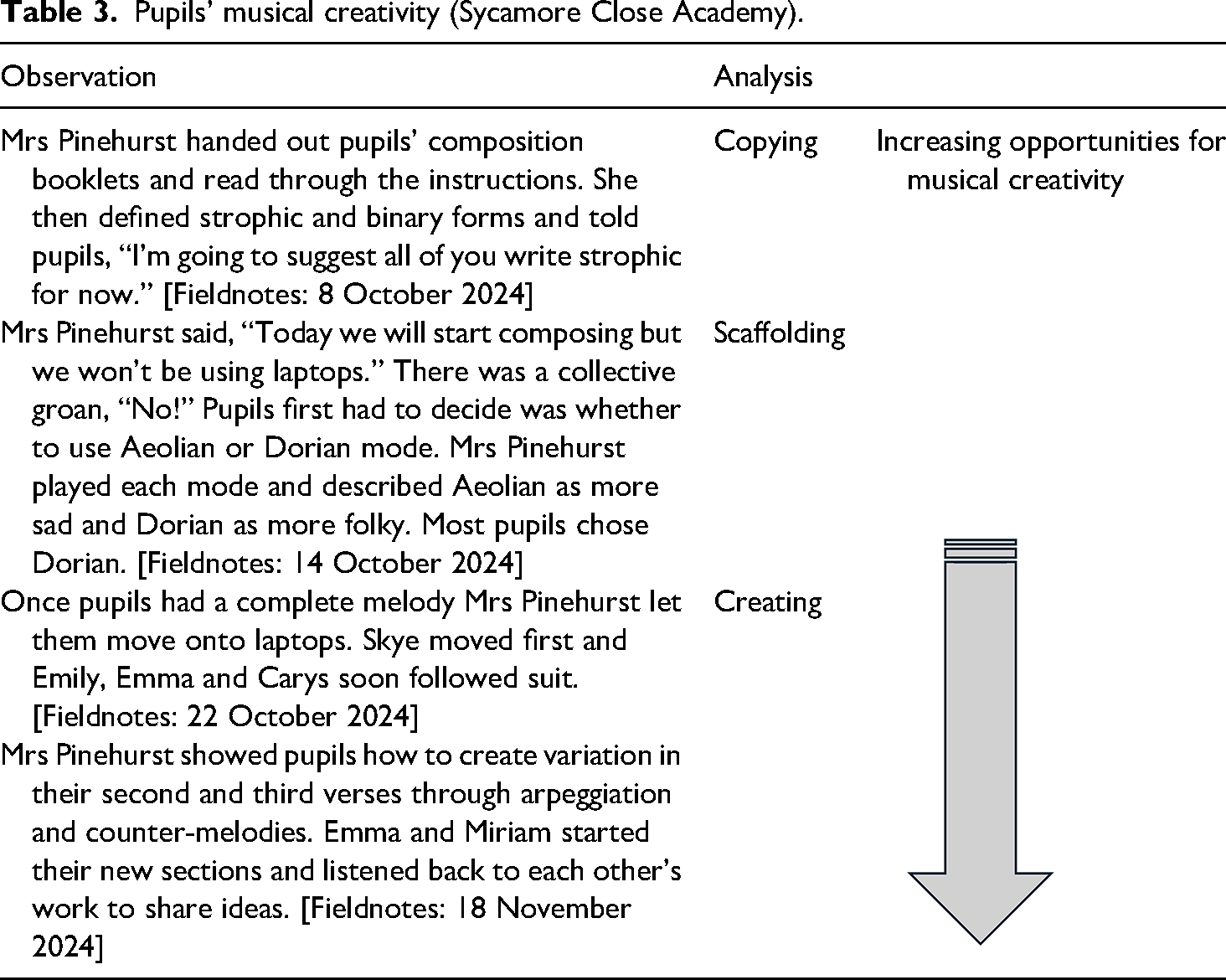
At the beginning of Phase 3 – when Mrs Pinehurst and I analysed our observations of how pupils’ musical creativity in the classroom related to the knowledge-rich curriculum – we were struck by the clear progression from copying to scaffolding to creating that was evident during pupils’ composing. Mrs Pinehurst explained that within this framework she could see how some pupils – such as Skye, Emily, Emma, Carys and Miriam (see Table 3) – learnt quickly through the knowledge-rich emphasis on concepts like modes and accompaniment styles, and could progress to make autonomous creative decisions. Yet she recognised that the preceding stages of copying and scaffolding were necessary to reinforce this learning, especially for pupils who were less confident with the theoretical content.
Although our analysis offered valuable insight, Mrs Pinehurst and I could not see an obvious way forward for implementing a pedagogical action research cycle during Phase 3. This was in part because of the school's inflexible curriculum structure, in part because of Year 8’s forthcoming topic on keyboard skills (rather than composition), and in part because of the behaviour of the specific class. Instead, we decided that it was more likely that incremental changes in the terminology used in the classroom might make the biggest impact upon pupils’ musical creativity. Mrs Pinehurst wanted pupils to understand that copying, scaffolding and creating were all valuable aspects of creative decision-making, requiring different degrees of theoretical knowledge and experimental risk-taking. By making each of these processes more explicit, we hoped that, in their musical vulnerability, pupils would become more receptive towards musical learning that was similar to learning in other subjects (such as copying and scaffolding to retrieve knowledge) and that was different to learning in other subjects (such as subjective creating based on aesthetic taste).
Pedagogical development: Northgate Girls’ School
Establishing a collaborative action ethnography at Northgate Girls’ School felt in many regards opposite to using the same methodology at Sycamore Close Academy. The school context itself was different: the all-female classes were polite and enthusiastic; pupils often engaged in practical music-making with keyboards, djembes, samba instruments and steel pans; and the music department had relative autonomy over its curriculum and assessment. However, Mrs Brown and I rarely had the chance to meet outside lessons, so we recorded separate reflective accounts and analysed them together during school holidays.
Based on our reflections during Phase 1, in Phase 2 we decided to focus on three research questions offering the potential for pedagogical development during Phase 3:
What is the relationship between pupils’ musical enthusiasm and musical progress? What is the relationship between pupils’ prior musical experience and musical progress in different topics? How does pupils’ musical enthusiasm and musical progress in class singing change over time?
It was the third research question that Mrs Brown and I first sought to address during Phases 2 and 3. During observations, I had noted that pupils enjoyed singing together during Year 7, which they did for several minutes at the beginning of every lesson. The quality of their singing was impressive and they were particularly receptive to the challenge of entering the end-of-year inter-form song competition. In one lesson, I recorded how, much of the class was excited and enthusiastic about the upcoming song competition: almost 20 pupils wanted to be in the front row, and 16 were keen to sing a solo. Only two or three expressed a preference to be in the back row, but they continued to join in. The class were supportive of those who trialled for a solo part, clapping and cheering for each other. There was extra support for quieter girls like Ellie, Fleur who seemed flustered, and Aidha whose beautiful voice surprised her friends. [Fieldnotes: 3 May 2024]
However, when Mrs Brown explained to me that classes usually stopped singing in Year 8, we wondered whether it would be possible to support this class to keep on singing together. So as they began Year 8, Mrs Brown kept introducing new songs – but we soon noticed pupils becoming increasingly susceptible to distraction and disruption: the class were perhaps less focussed and diligent than they had been the previous year. They did not stand in neat rows and they kept talking over Mrs Brown even when she was teaching them the new song. Some pupils were distracted by Maya, who was singing loudly and out-of-tune, seemingly on purpose. [Fieldnotes: 18 October 2024]
To begin Phase 3, we therefore decided to introduce new approaches to singing that might encourage the receptivity and progress that pupils had made while preparing for the song competition. We considered how engaging pupils in choosing warm-ups or songs could foster motivation through a sense of agency and self-direction (Allsup, Westerlund, and Shieh, 2012; Green, 2008; O’Neill, 2016), and how learning more challenging solos or harmonies could stimulate feelings of competence, achievement and flow (Csikszentmihalyi, 2002; Evans, McPherson, and Davidson, 2013). Initially, encouraging the class to take ownership over their singing by letting them choose the warm-up helped boost their enthusiasm. The same was true of asking for volunteers to perform extracts of the piece to refresh people's memories: several pupils excitedly volunteered and there was a congenial and supportive atmosphere when Lizzie and Solène sang their solos. [Fieldnotes: 8 November 2024]
However, these positive outcomes were not consistent across the year. In some subsequent lessons the class was so disruptive that Mrs Brown had to call a halt to their singing altogether. This suggested that in further action research cycles we needed to evaluate how class singing could be more responsive to pupils’ receptivities and susceptibilities: accounting for their shifting cultural preferences and musical identities (Allsup, Westerlund, and Shieh, 2012; Lum and Marsh, 2012), varying practical activities depending on their moods (MacGregor, 2025; Spruce and Matthews, 2012), and incorporating familiar, popular songs to maintain their focus and enthusiasm (Green 2008; Kruse, 2016).
Professional learning: Kenslowe Park Manor
For Mrs Fitzpatrick at Kenslowe Park Manor, participating in a collaborative action ethnography proved to be valuable for her professional learning as an early-career teacher. When I began visiting Kenslowe Park Mrs Fitzpatrick was still completing her teacher training and had no teaching experience in any other settings. The research questions that emerged as important to her were therefore closely linked to fundamental issues of how to adapt her practices to capitalise upon pupils’ diverse previous musical experiences. These issues were particularly pertinent because although the Year 7 and Year 8 classes she taught were small, pupils’ past encounters with music – and their associated positive receptivities and negative susceptibilities – were wide-ranging. As an independent, fee-paying school, some pupils were from socioeconomically privileged backgrounds and had engaged in formal music tuition for many years, while others had had less exposure to music-making at home. Mrs Fitzpatrick and I therefore wanted to ask:
How do pupils’ attitudes and contributions in the classroom relate to their previous musical experience? How can pupils be encouraged to develop resilience and perseverance in their attitudes and contributions in the classroom?
As shown previously in Figure 1, at the beginning of Phase 3 Mrs Fitzpatrick and I met to analyse our Phase 2 observations. Figure 3 shows two extracts of the mind-mapping exercise we undertook in response to our two research questions. The first extract describes a lesson where Mrs Fitzpatrick engaged the class in a singing exercise to practise using dynamics. Pupils had to notate changes in volume to accompany well-known songs and then perform them together. I observed, Mrs Fitzpatrick played through the melody once before the class sang. But pupils were clearly really reluctant to sing. Jake was joking that he was going to use his “deep voice,” and Samson seemed worried that his voice sounded squeaky. […] The class mumbled along until the crescendo, when they started shouting and bellowing. [Fieldnotes: 2 October 2024]
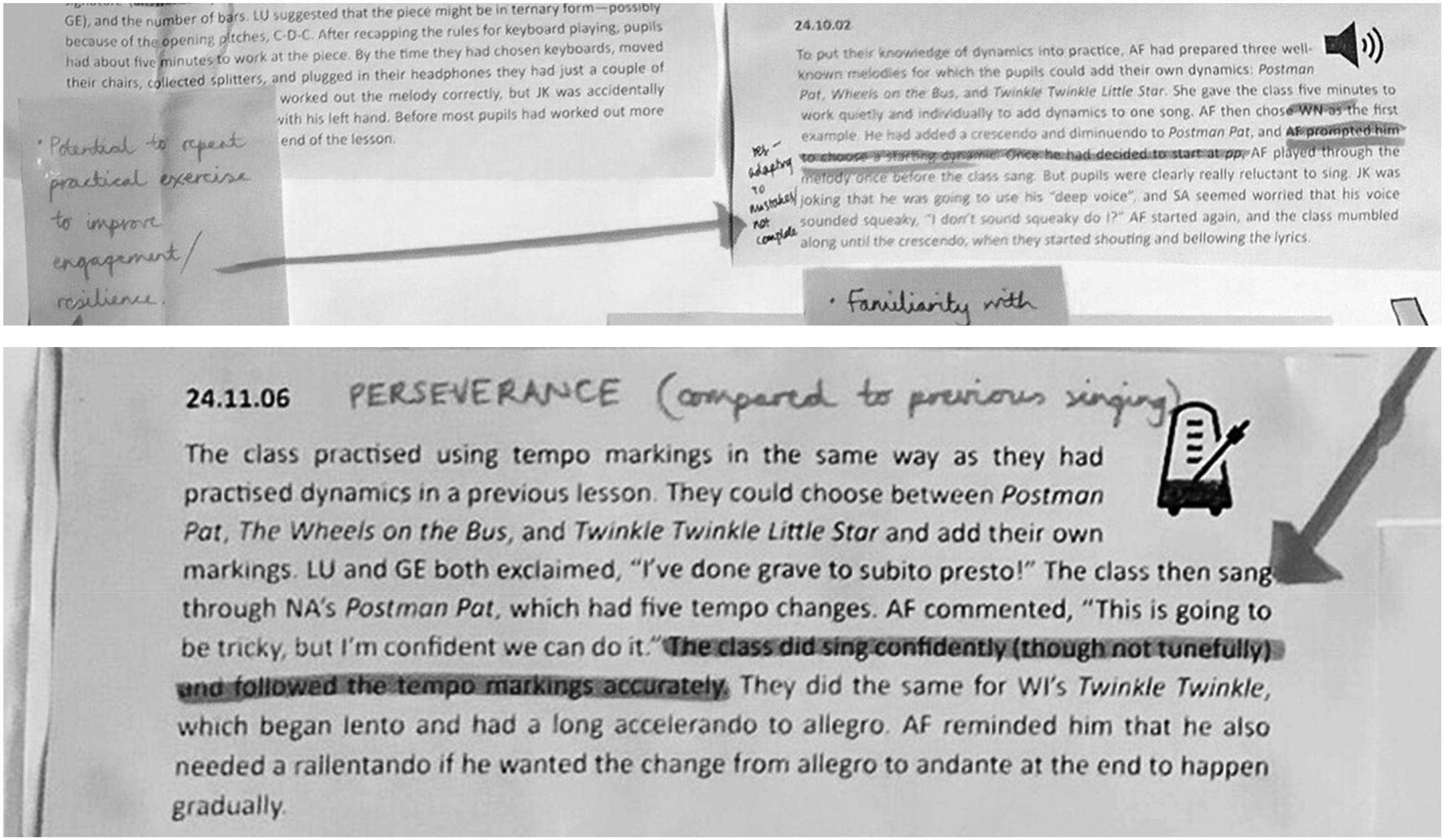
Extracts from Phase 2 analysis (Kenslowe Park Manor).
Although this exercise was not as polished as Mrs Fitzpatrick would have liked, she returned to a similar task in a later lesson. On this occasion the class tried using tempo markings rather than dynamics, and as highlighted in Figure 3, ‘the class did sing confidently (though not tunefully) and followed the tempo markings accurately’ [Fieldnotes: 6 November 2024]. When analysing these two contrasting outcomes, Mrs Fitzpatrick and I noted how the opportunity to repeat the same exercise across two lessons seemed to improve pupils’ receptivity. In response to the second research question, in Phase 3 we therefore aimed to incorporate practical music-making (such as singing or playing keyboards) into every lesson, but repeating some exercises to grow pupils’ familiarity with each task, secure their basic musical skills, and enable them to progress further than in a single lesson. We hoped that this would promote resilience and perseverance, and account for pupils’ different musical backgrounds by embedding foundational skills for less experienced pupils and extending advanced skills for more experienced pupils.
Evaluating a collaborative action ethnography
My experience of designing and implementing a collaborative action ethnography across three contrasting school settings demonstrated to me its potential as a responsive, participatory research method, especially within post-pandemic music classrooms. As a method foregrounding the distinct contributions of professionals working together in equal partnership (Bruce, Flynn, and Peterson, 2011; Erickson, 2006), I found it helpful for collaborating with teachers, each of whom had differing priorities and responsibilities. Unlike emancipatory research frameworks that aim towards equal participation from both researchers and co-researchers (Schubotz, 2020), adopting a collaborative approach helped me negotiate the differences in roles between myself as researcher and my teachers as participants. Although I wanted my research agenda to be driven primarily by teachers’ questions, I knew that I – as the full-time, salaried researcher – would ultimately retain the responsibility for designing and refining the study and collecting and curating the data. Though I spent many hours collaborating directly with my participants in observation, reflection and analysis, these hours were relatively few in comparison to the rest of the time that I spent researching and that my participants spent teaching.
Nevertheless, the necessary separation between my own role as researcher and my participants’ roles as teachers did not negate the immense value of the cultural immersion offered by collaborative action ethnography. Compared to school-based research during the COVID-19 pandemic – restricted by physical distancing and isolation – the importance of being able to make fieldwork visits to more than one school, more than once a week, and for more than one year cannot be underestimated. Regularly working alongside teachers and pupils offered me an insight into the everyday vulnerabilities of populations who are often hidden from public view, misrepresented in social media (Fine and Abramson, 2020), and subject to stringent curriculum regulation and performance accountability (Bacchi, 2023; Young, 2023). For this reason, collaborative action ethnography can be understood to be a powerful research methodology for investigating complex experiences, such as musical vulnerability, within varied sociocultural and sociopolitical international contexts. Its flexible accommodation of different researcher and participant roles may be especially valuable within global settings where research partnerships are not well-established or prove challenging to maintain, and could help better serve under-represented participants in future research.
Using collaborative action ethnography to co-construct pedagogies of vulnerability
At present, I have grown to appreciate the potential for collaborative action ethnography to foster strong collaborative partnerships and realistic expectations between researchers and participants, and to enable longitudinal and multilocational ethnographic immersion within school settings that was impossible during the pandemic. However, I have also become increasingly aware of the complex and sometimes unexpected ways in which incorporating aspects of action research may impact upon changing classroom practice.
My case study at Northgate Girls’ School demonstrated that – in some well-resourced departments where teachers maintain high levels of professional agency – collaborative action ethnography can draw attention to issues such as musical vulnerability and offer a framework within which to design, implement and evaluate iterative pedagogical development. Working alongside Mrs Brown to observe pupils’ receptivity towards singing together helped validate my previous theorisation around the importance of music's institutional mediation (such as the normalisation of a positive whole-class singing culture) and music's interpersonal mediation (such as pupils’ validation of each other's achievements) (MacGregor, 2025). As Phase 3 progresses we should be able to consider how to adapt classroom singing pedagogy to foster openness and co-learning between teacher and pupils, and to help the class progress even if they become more self-conscious or socially reticent during adolescence (Bull, 2019; Man, 2013).
It is likely that Mrs Fitzpatrick and I will be able to plan similar action research cycles at Kenslowe Park Manor as we negotiate how pupils’ contrasting personal musical experiences and vulnerabilities mediate their classroom music-making (MacGregor, 2025). During Phase 3, the collaborative action ethnography approach should enable us to evaluate practical music-making activities from week to week, ensuring that they meet the needs of the whole class. So far, we have discussed examples such as learning to play a simple keyboard melody, learning to play the same melody in canon, and learning to play the same melody with accompaniments in different styles. Pupils such as James (who plays the viola da gamba) might master varied accompaniments, whereas Wyatt (who has less instrumental experience) might master the original melody.
It remains to be seen, however, whether any pedagogical change will be possible (or desirable) at Sycamore Close Academy. The collaborative action ethnography methodology has enabled me to build a positive, reciprocal relationship with Mrs Pinehurst and gain an insight into everyday teaching and learning at her school. However, without the institutional support or professional agency required to drive pedagogical change, it is unlikely that such development will be enacted at Sycamore Close. Nevertheless, while substantial changes may feel unattainable, it is possible that the incremental changes already being made in Mrs Pinehurst's classroom will have a cumulative impact over time. In the same way that positive receptivity towards singing has been cultivated at Northgate through the unspoken normalisation of whole-class singing, it is possible that small changes in terminology – such as creative ‘decision-making’ or ‘risk-taking’ – could make big differences in the attitudes of teachers and pupils at Sycamore Close. It is for that reason that collaborative action ethnography – and the long-term rapport-building it supports – remains well-placed to sustain positive change in pedagogical practice, even in the most challenging contexts.
Footnotes
Acknowledgements
The author wishes to thank all the participants in the present study for their valuable contributions, and the two anonymous reviewers who provided constructive feedback on an earlier draft of this article.
Data availability
Pseudonymised datasets for the study can be made available by the author upon reasonable request.
Declaration of conflicting interests
The author declared no potential conflicts of interest with respect to the research, authorship and/or publication of this article.
Ethical approval
This study received ethical approval from the Social Sciences and Humanities Interdivisional Research Ethics Committee of the University of Oxford (R90676/RE001) on 5 December 2023. After receiving information about the study, all participants gave their informed consent to take part and were made aware of their right to withdraw at any time. For purposes of confidentiality, all names and locations have been pseudonymised.
Funding
The author disclosed receipt of the following financial support for the research, authorship and/or publication of this article: this study was funded by the Joanna Randall-MacIver Junior Research Fellowship (2023–25) at Somerville College, University of Oxford.

Author Biography
Elizabeth H MacGregor is currently the Joanna Randall-MacIver Junior Research Fellow at Somerville College, University of Oxford. She works alongside teachers and pupils to investigate experiences of 'musical vulnerability' in the secondary music classroom, and her research has most recently been published in her first monograph, Musical Vulnerability (Routledge, 2025).