



Abstract
‘Poetics of ordinary talk’ covers a wide range of conversational phenomena including sound patterns, prosody, puns and alliterations. Our paper focuses on the development of this topic pioneered by Harvey Sacks and later elaborated by Gail Jefferson, as well as its marginalisation in the contemporary landscape of qualitative research and ethnomethodology/conversation analysis (EM/CA). Using published and archival resources, and focusing on transcription practices as a way of dealing with the ‘wildness’ of poetics, we aim to disentangle its relative neglect. We argue that the original recognition of poetics in talk-in-interaction was linked to Sacks’ specific attitude of indifference towards the possibility of seeing it in empirical materials, rather than an upfront rejection of it as improbable or implausible. We conclude by proposing that in addition to considering specific poetic phenomena, it might also be productive to view ‘poeticity’ as a ubiquitous and pervasive feature of all social life.
Keywords
Introduction
In an outline of a naturalistic inquiry of social life, Sacks (1984) advocates for an alternative way of doing social science. He recommended that instead of drawing on examples and cases conjured within the professional world of scientific theories, researchers turn to the real world and closely observe actual situations and their details which may escape the reaches of scientific theorising. In this manner, one could avoid the trap of ‘reasonability’ to which traditional modes of social science may be subject: “I want to argue that, however rich our imaginations are, if we use hypothetical, or hypothetical-typical versions of the world we are constrained by reference to what an audience, an audience of professionals, can accept as reasonable” (Sacks, 1984: 25). Reasonability – or as Sacks would have it, ‘believability’ – and its consequences for actual and potential social sciences is a theme he would frequently revisit in his lectures (see Schegloff, 1992: xxxv). And the way Sacks approached the problem was to confront the audience with actual occurrences of things that seemed hard to believe, bringing them to light for examination.
One of these topics is the ‘poetics’ of ordinary talk, a gloss for a range of phenomena such as sound patterns, rhythm, prosody, puns, and alliterations. Sacks attempted to show that the features of poetics, which traditionally fell into the scope of literary studies, could be constitutive of the organisation of conversational interaction in ways that were overlooked due in part to its believability as an orderly social phenomenon. The question was whether interaction could really be organised in and around the ‘aesthetic’ qualities of sound and such liminal aspects of language. This paper examines the development of the topic of poetics in early conversation analytic work pioneered by Sacks and elaborated by Jefferson, as well as its eventual marginalisation in the contemporary landscape of qualitative research. We attribute the lack of uptake to the difficulties of taming these wild phenomena for analyses and of containing, preserving, and reproducing them for naturalistic study. Taking transcription as a point of departure, given its central role as an analytic procedure in qualitative research (Davidson, 2009), we offer a review of various transcription conventions invented and adopted in recent studies on the poetic phenomenon of sound patterning in ethnomethodology and conversation analysis (EM/CA). Ultimately, we demonstrate how the practice of transcription for poetics can be seen as an exercise in indifference – i.e., an indifference to the possibility of a phenomenon that is made feasible by an indifference to transcription as a formal method. Our paper concludes with a suggestion that poetics may not be restricted to specific moments that could be captured in singular transcripts in the first place – instead, it may be an aesthetic, rather than a rational (see also Liberman, 2024), order of social life – and thus that one might entertain the notion of ‘poeticity’ as a property of language and social interaction more broadly.
Encountering wilderness: Naturalistic studies of the social
The notion of sociology as a “natural observational science” (Sacks, 1992, Vol. I: 803), developed in EM/CA, aims to radically depart from studies of social life that are grounded in imagination or recollection. One of the limitations of methods based on recollection (i.e., ‘quantitative’ surveys as well as ‘qualitative’ interviews), or approaches based on imagined situations and examples, is that they cannot provide access to the constitutive details of produced orderliness that are, for participants, “seen but unnoticed” (Garfinkel, 1967: 37), “normally thoughtless” (Garfinkel, 2022a: 153), and “acknowledged but tacit and unexamined” (Garfinkel, 2022b: 21). This is because the routines of competently produced social activities depend on members’ indifference to the origins of the social objects that constitute these activities. To competently engage in social life, one must – as part of the engagement – leave behind the details of its ceaseless, endogenous social accomplishment. This then enables treating the produced structures as commonly shared, publicly available, stable, and exogenous social objects (see, e.g., Liberman, 2018). In this sense, EM's ‘breaching’ tutorials and exercises allow for realisation and explication of what is otherwise not talked about amongst members. These exercises, as Garfinkel (1967: 38) would put it, reusing a phrase from Spiegelberg's discussion of Husserl's phenomenology, were intended as “an aid to our sluggish imagination” (Spiegelberg, 1960: 151). But the issue is not only that our imagination might not be sufficiently ‘rich’; Garfinkel's argument (as formulated in his later writings – e.g., Garfinkel, 2002, 2022b) is more radical. The phenomena of EM/CA can, in fact, never be fully retrieved from imagined or remembered accounts of social life. They can only be discovered in situ: “Orderings of ordinary activities are unimaginably extensive phenomena; they are essentially other than we do imagine or could ever imagine them to be, and they await discovery. They are available only to the work of discovery” (Garfinkel, 2022a: 157, our emphasis). Therefore, EM/CA's phenomena are not available to a priori imagining for two reasons. First, they are unimaginable because they are systematically ‘forgotten’ by members as part of their work. Second, they are unimaginable because they need not ordinarily be known at the level of embodied detail that is required for their skilled production.
So where, and how exactly, can these unimaginable “orderings of ordinary activities” be discovered? How can one encounter them and turn them into topics of disciplined study? In this regard, the findings of EM/CA consist of reminders (addressing the ‘seen-but-unnoticed’) and discoveries (addressing the ‘unimaginable’) as two alternative and mutually complementary accents. This establishes productive “heuristic tensions … between analytic detachment and practical involvement” (Sormani and vom Lehn, 2023: x) related to the balance between CA's notion of ‘naturally occurring data’ and EM's interest in ‘naturally organised ordinary activities’ (Lynch, 2002). In principle, the natural organisation of ordinary activities can be studied and explicated by closely analysing naturally-occurring data, but the production of this ‘data’ as a set of researchables – e.g., through the procedures of recording or transcribing – is itself reflexively entrenched in the natural organisation that is being studied (Psathas and Anderson, 1990; Schwartz, 2002).
Our paper suggests that these issues can be explored by attending to the notion (and metaphor) of ‘wild(er)ness’ as employed in naturalistic studies of social activities that encourage journeys ‘into the wild’ (as opposed to, e.g., experimental studies; see Brown et al., 2011). What does this notion tell us about the work of an ethnomethodological recovery of the lived orderliness of ordinary actions? What kinds of things are there to be discovered in the wilderness? EM/CA brings out, and accounts for, the order in the wilderness – the wilderness of actual social events is not chaotic but orderly, and it is precisely the extant orderliness that is being discovered. 1 With its distinctive indifference to what counts as a phenomenon of order, EM/CA aims “not to arrange things conveniently but to find out how they are arranged” (Sacks, 1975: 66). In this respect, it comes close to naturalistic endeavours – ‘primitive natural sciences’ (Bjelić, 2023; Lynch and Bogen, 1994) that look for an order in the wild, explicating an order that has always already been there “awaiting discovery” (Garfinkel, 2022a: 157). 2
It seems to be generally agreed that this order can be accessed through various kinds of ‘fieldwork’, a notion that is part of EM/CA's ethnographic legacy. The concept of fieldwork implies a researcher venturing into the wild, in a faraway place, gathering materials for processing and inspection back home. Such ‘field specimens’ are transformed in the process of collection and preservation, as Barker and Wright (1951) put it: “… parts of the original have been altered and other parts have been lost … A pressed flower in an herbarium is not the same as a flower in bloom. It is useful for botanists nonetheless” (p. 1). But still, as Heidegger (1962) cautions, “[t]he botanist's plants are not the flowers of the hedgerow; the ‘source’ which the geographer establishes for a river is not the ‘springhead in the dale’” (p. 100). In EM/CA, the procedures of producing ‘field specimens’ that can stand as proxy and “elaborate reminders” (Coulter, 1983) of original phenomena are often tied to ways of working with ‘data’ such as transcription in indifferent ways – rather than formulated hypotheses based on presumed knowledge, one is looking for “unmotivated observables” (Garfinkel, 2022b: 42; see also Sacks, 1984) and grounding the analytical insights in members’ own practical knowledge. Ultimately, the phenomena of EM/CA are the blooming ‘flowers of the hedgerow’ and the ‘springhead in the dale’, but unlike botanists’ or geographers’ objects, the objects of social science are only available for investigation through the field specimens of ‘data’. They cannot be encountered and studied in the wild, because the wilderness (i.e. the ‘actual society’) itself conspires against the direct investigability of EM/CA's topics. Therefore, materials obtained through fieldwork serve the purpose of being available for revisiting as captured and preserved exemplars of the original wildness and its lived constitutive detail. 3
But can life really be captured in stills? And what needs to be done to preserve them as adequately meaningful? Are there, after all, indeed possibilities in dealing with naturalistic empirical materials that allow one to move beyond evocations of already (and inevitably) familiar “organisational objects” (Garfinkel, 2002: 173)? And how can one make the wilderness accessible – as adequately as possible, if at all – through ‘excerpts’ and ‘specimens’ taken out of it? Does the very procedure not also mean that the captured phenomena are necessarily tamed, and that their character is therefore substantially changed – like wild animals kept in a zoo? How can Garfinkel's insistence on discovery opposed to imagination and recollection be more than an essentially unachievable, albeit noble, ideal? In this article, we propose that the intricacies of these questions can be explored in an instructive way by attending to the study of ‘poetics’ in ordinary talk as an early, productive, and to this day underdeveloped topic in EM/CA. As we will show, the neglected and somewhat problematic standing of poetics might be connected to its characteristic resistance to the established procedures of ‘specimenisation’ such as the work of transcription – which is not only representing data but co-producing the possible objects of analysis.
Reproducing ‘the wild’: Transcription in EM/CA
Professional analyses of naturally occurring social events ‘in the wild’ not only take more time than these interactions themselves but also are necessarily temporally subsequent to, and displaced from the original phenomena. This raises a practical problem for a naturalistic investigation of social activities: how to capture and preserve, and thus reproduce wild phenomena in a way that enables a sustained study of them? A pragmatic solution that Sacks (1984) sought was to start working with tape recordings and their transcripts as data: “Such materials had a single virtue, that I could replay them. I could transcribe them somewhat and study them extendedly – however long it might take” (p. 26). By recording what are inevitably fleeting, transient moments in the wilderness of everyday life, analysts captured and rendered them accessible for repeated observations and analyses. Transcription is a practice of transforming the recordings into a written form, the work consisting of producing a text using a set of agreed-upon conventions (e.g. Jefferson, 2004; Mondada, 2018). In earlier times, these conventions did not yet exist in their contemporary form, so transcripts were either verbatim or had mark-ups invented on the fly. Over time, however, these conventions have increasingly been reified as manuals for proper transcription and reproduced in appendices of various publications. The finished transcript then stands as a ‘document’ of, and a ‘proxy’ for, the lived work of the participants in the scene. In this respect, there is also a risk that “a method of analysis can hide the lived-orderliness of a phenomenon that the use of that method was specifically intended to illuminate” (Livingston, 1987: 59). However, here we are not so much pointing out accuracy in terms of the transcript being an objective or exhaustive account for reality out there, but rather how the transcript can retain the orderliness of a scene in the wild as accomplished and produced by its members, just there and then. In this section, we discuss how the transcript as an adequate and relevant account of the transcribed ‘data’ is a reflexive achievement, constantly reproduced in and through the praxeological work of transcribing as an identificatory professional activity in EM/CA (Psathas and Anderson, 1990).
Contexted in the professional workplaces of EM/CA, a transcript is not only a written account of the lived scene but also a “residue account” (Garfinkel, 2021: 35) of the ‘lived work’ of transcribing by the analyst, while the contingent and circumstantial detail of that work is not recoverable from the transcript alone. This ‘lived work’ consists largely of two ways in which the transcript is crafted as an analytic device. On the one hand, there is the work of transcribing as an estrangement device for the analyst who deals with a phenomenon through the exercise. By repeatedly and closely watching the recordings to capture and preserve details of the scene in a transcript, the analyst reaches a point where they can view the ‘seen but unnoticed’ details that constitute everyday practical activities. At this level, the analyst transcribes in order to reproduce – for themselves – the participants’ production and experience of the scene. On the other hand, there is the work of transcribing as a familiarisation device, whereby the analyst produces a transcript to make a phenomenon accessible and recognisable to an audience. Accompanied by analytical commentaries, transcripts are designed to include relevant, constitutive features of the focal phenomena so that the audience can see for themselves whether the accompanying analysis is an adequate account for the phenomenon presented in the given manner. In this regard, the analyst transcribes to reproduce – for the audience – the analyst's experience of examining the scene. In and through these professional practices of transcribing, a transcript is produced and treated as a good-enough, faithful, accurate, relevant, sufficient, etc., representation of the transcribed events. The transcript, as a form of description, is then to be “mis-read” as instructions (Garfinkel, 2002: 149) for both the analyst and the audience to reproduce – for themselves – the transcribed scene. In this respect, the “wonder of data” appears “in their capacity to enter into relation with researchers” (MacLure, 2013: 231).
Attuned to the practicalities of transcribing, we now turn to the role and implications of existing specialised transcription conventions in EM/CA. Despite their differences, they all consist of a set of symbols and mark-ups that correspond to select aspects of organisational objects in social interaction, such as silence and its length, overlaps, cut-offs, gestures, gaze, etc. The leading assumption is that when there are several distinct silences in a conversation, for example, they can be demarcated using the same symbol for a pause as a recognisable entity in itself. 4 The conventions not only provide a means for the analyst to sufficiently reproduce participants’ lived experience of the social situation but also ensure that the analyst's reproduction can be repeated by the audience mobilising the same means, i.e., the conventions, to reproduce for themselves the original appearance of the scene from the analyst's reproduction. 5 This reproducibility achieved by using shared conventions is key to the underpinnings of making sociology a ‘natural observational science’, as Sacks envisioned it: “If you read a biological paper, it will say, for example, ‘I used such-and-such which I bought at Joe's drugstore’. And they tell you just what they do and you can pick it up and see whether it holds. You can re-do the observations” (Sacks, 1992: 27).
The specialised transcription conventions of EM/CA have therefore advanced and expanded the horizon and granularity of phenomena available for its analyses, providing for the reproducibility of orderliness in varied social realms. However, what about the aspects of wilderness that escape reproduction by established means of transcription? Taking it a step further, what if their resistance to reproduction is their constitutive feature? In that case, what are the alternative means, if any, by which one can capture such phenomena? To explore these issues, we now turn to the case of ‘poetics’, attesting to how its marginalisation as a topic of inquiry in contemporary EM/CA research is, in part, due to its resistance and even indifference to more conventional forms of transcription.
Locating orderliness in the wild: The case of the ‘poetics’ of ordinary talk
As mentioned above, Garfinkel (1967) pointed out the “seen but unnoticed” (p. 37) features of concerted activities that constitute the foundation of social life. The ethnomethodologist's task is to recover them and make them visible and noticeable, thus treating such taken-for-granted features as topics of inquiry, transcription being one such procedure. While transcripts in EM/CA developed to this day have indeed been optimised to make certain recurrent features (e.g. turn-taking, silences, gaze) noticeable for systematic investigation (Psathas and Anderson, 1990), it has been at the unintended expense of overlooking the possibility of other features. Such is the case for the class of phenomena that has become known by the gloss ‘poetics’. After first providing a brief historical introduction to this lesser-known domain of research, we will review some exemplary transcription conventions that have been developed to locate and represent the kind of orderliness that is the poetics of ordinary talk.
The early work of Sacks and Jefferson and recent developments
Some of the earliest inquiries into the domain of ‘poetics’ are captured in Jefferson's text (1996, based on a 1977 lecture) and in Sacks’ (1992) lectures (delivered between 1964 and 1972) that have been edited by her and labelled with this term. It is already noteworthy that both resources are based on lectures and talks that were given decades before their official publication in text form. The history of Sacks’ and Jefferson's interest in poetics can be illuminated by a grant proposal located at the Sacks archive at UCLA, 6 which provides an apt document for an exploration into early work in this sort of phenomena. The one-year project, submitted by Sacks in 1968 to the US Department of Health, Education, and Welfare, was titled “Sound Patterning in Natural Conversation”, and includes some examples of what Sacks calls sound patterning for both intra-turn and inter-turn constructions of talk.

Extracted from the grant proposal submitted by Sacks in 1968.
Figure 1 is a reproduction of one of these examples. Using this segment of talk, and a few similar ones, Sacks proposes a ‘possibility’. 7 The possibility is to see whether and how speaker A's word selections, namely, the words ‘going’, ‘get’, and ‘good’, could be pointing to an emerging row of [g] sounds. The same applies to speaker B in the sense of whether there is a possibility that B's word selection, ‘goody goody’, amongst many other alternatives, could arise from A's turn-final ‘good’ as well as the [g] sound-row. And indeed, much of Sacks’ interest in such phenomena was an interest in possibilities, something he recurrently accounts for in his lectures on similar materials.
During one of his lectures, in which Sacks entertains the possibility of words being selected by reference to sounds, a student asks: “Couldn’t that be carried too far?” (Sacks, 1992, Vol. II: 325). Sacks responds: “The whole problem is that it's nowhere in the first instance. And the issue is to pull it out and raise the possibility of its operation” (Sacks, 1992, Vol. II: 325, emphasis added). It was not that anything – everything that is ‘imaginable’ – could be a possibility. Rather, a possibility was “an extremely strong kind of relationship” that “takes some sort of proof” (Sacks, 1992, Vol. II: 251–252). The phenomena of ‘sound patterning’ outlined in the grant proposal were, in fact, subject to this very same analytic mentality (Schenkein, 1978) that Sacks and his early collaborators applied to other fundamental topics, such as speaker sequencing and membership categorisation. All these topics were empirically observable and it was thus ‘possible’ to notice and explicate them as organised in a “detailed order” (Sacks, 1992: 484). In the introduction to Sacks’ lectures, Schegloff (1992) recounts Sacks having told him of a “‘wild’ possibility” (p. xvi) that the organisation of talk could be so detailed in its design to allow callers to a suicide prevention centre to avoid giving their names without doing it manifestly. In retrospect, this seemingly wild idea has clearly been groundbreaking and foundational for a sequential analysis of social activities and thus for CA as a field. In a sense, the wildness of the suggestion was related to the indifference in Sacks’ attitude to the possibility of seeing a phenomenon in any kind of empirical material, rather than an a priori rejection of it as impossible, nonsensical or improbable.
In the absence of published early work, the archived grant proposal on ‘sound patterning’ is a significant piece of material that contributes to refining existing historical accounts of the emergence of poetic phenomena in early CA. While Sacks’ interest in phenomena later glossed as poetics has been hinted at here and there, and is present in his lectures starting in 1970, the proposal, dated as early as 1968, is compelling evidence that he was seriously interested in such phenomena earlier and in a much more systematic fashion than has been previously known. With Sacks’ untimely death in 1975, it was mostly Jefferson who took over the work on poetics. One of her contributions was to establish the very label for this class of phenomena – the footnote at the first occurrence of the term in Lectures says: “The term ‘poetics’ doesn’t occur in the lectures; it is used in this and several subsequent lecture-heads to capture such phenomena as ‘sound-related’ terms, puns, etc.” (Sacks, 1992, Vol. II: 261). It was Jefferson who added the gloss ‘poetics’ to the headings of several of Sacks’ lectures on varied phenomena, which took place from the spring of 1970 to the autumn of 1971. On the one hand, the gloss ‘poetics’ allows for a unified formulation of a topic that Sacks was systematically working through, instead of leaving the readership with observations and analyses that could be perceived as disconnected or disparate. On the other hand, the fact that only certain features of talk and its organisation fall under this gloss could have motivated a sceptical attitude to anything ‘poetics’ before actually looking closely at the details of the empirical materials. 8
Another of Jefferson's significant contributions to the establishment of poetics as a potential domain of study was her 1977 talk at Boston University entitled “On the poetics of ordinary talk”. 9 The talk was later published as a paper in 1996 (though the introduction of the paper begins with “[t]his is not a paper” (Jefferson, 1996: 2)). 10 In this talk, Jefferson describes a set of categories classifying poetic phenomena, which is something that Sacks himself did not do apart from the distinction between intra-turn and inter-turn design. However, when Jefferson presented the categories, they were not meant to be reified. Instead, she explains how the categories are simply names for “sub-heaps” (p. 2) of data as a way of starting to work on such materials.
While Jefferson's lecture certainly did not lead to poetic phenomena taking centre stage in EM/CA literature, it did spawn what remains, to this day, the famous phrase: ‘the wild side of CA’. This phrase first appears in the foreword to her publication, almost 20 years after the original talk, in which she refers to her talk as “an expression of the wild side of CA” (Jefferson, 1996: 2). In this foreword, she also elaborates on how her explication of poetic phenomena was meant to be “an antidote” (p. 2) to the paper on the simplest systematics for the organisation of turn-taking for conversation published three years earlier (Sacks et al., 1974). The popularity and impact of this publication had, in her opinion, resulted in a “drastically constricted version of the field” (p. 2) – indeed, the turn-taking paper is still “widely regarded as the foundational paper” of CA (Fitzgerald, 2024: 2, original emphasis). Jefferson further spells out that the wildness of her talk was “not only in its content but in its lack of organisation or development” (Jefferson, 1996: 2). In principle, content and organisation/development might be seen as two separate dimensions, but in practice, they are closely intertwined. The legitimacy of content is largely induced by the legitimacy of organisation/development and vice versa. In other words, science is scientific insofar as it is conducted in ways considered to be scientific, which also includes the appropriate and relevant identification, selection and representation of the subject matter.
Despite the constant struggle to find adequate ways of dealing with the wild possibilities, there have been, and continue to be, attempts to analyse poetic phenomena. Around the time that Jefferson's (1996) paper was published, other studies related to this domain of speech organisation emerged (e.g. Auer, 1990; Couper-Kuhlen and Selting, 1996; Schegloff, 2003a, b). Moreover, the more contemporary uses of the term ‘poetics’ in empirical research over the past 20 years certainly do not show absolute neglect either. Nevertheless, the study of poetics is far from a systematically developed ‘field’ that would be comparable to, e.g. the body of work on membership categorisation (e.g. Bilmes, 2022; Fitzgerald and Housley, 2015; Schegloff, 2007), which is also an ‘offshoot’ of Sacks’ early work developed in parallel with the focus on sequential organisation. 11 So far, poetics seems to have escaped both systematic incorporation into existing EM/CA program(s) and establishment as a separate domain of inquiry.
Nevertheless, one of the aspects picked up in CA from the range of phenomena that can be glossed as poetics is prosody. 12 This could be related to the structure of linguistics as a discipline, in which subdisciplines like phonetics and phonology are already long established. Features of poetics that are recognisably related to prosody can perhaps be more straightforwardly incorporated into the established study of language. There have also been recent significant contributions to the development of ‘poetics’ within EM/CA, such as the edited collection by Person, Wooffitt and Rae (2022) that commemorates Jefferson's work and offers programmatic possibilities for an overlap of CA and literature studies. While this volume revisits poetics by providing a historical account and implementing the methodology on literary texts, some recent work develops poetics by using natural conversational data, as initially envisioned by Sacks and Jefferson (e.g., Bassetti and Liberman, 2021; Cekaite and Aronsson, 2004, 2005; Fasulo et al., 2002; Hopper et al., 2005; Kim, 2022; Tao, 2022). Overall, based on our review of several publications that cite Jefferson's (1996) paper, the recurrent analytic contexts of its employment are word selection, errors and slips, creativity and playfulness (e.g. in language learning), and humour (puns and jokes). Likewise, there is indeed a corpus of literature that notes, acknowledges, and develops poetics as a subject for EM/CA study. Nevertheless, we note that in most texts that refer to Jefferson's paper, poetics is not the main topic but is mostly footnoted – that is, acknowledged marginally (e.g. Ford and Fox, 2010: 361).
To summarise, it seems that poetics is a domain of social phenomena that are somehow troublesome to deal with. In the remainder of this text, we propose some possible reasons for this marginalisation, or troublesome position, that poetics as a topic of inquiry has in the current field of EM/CA, focusing in particular on the reproducibility of its wild possibility as orderly phenomena in the form of transcription. For this purpose, of the range of phenomena glossed as poetics, we consider the transcription practices for ‘sound patterning’ specifically. Reaching back to Sacks’ 1968 grant proposal, it is one of the most stable categories of poetic phenomena that does not readily find a home in other known terms and topics.
Transcribing sound patterns
One of the earliest records of how sound patterns were examined in and through transcripts is documented in an appendix to Jefferson (1996). The appendix contains a replica created by Jefferson of how Sacks went about identifying and examining sound-row sequences, which took the form of “a doodling” (p. 56) that marked, with circles and lines, the focal sounds and their possible relationships.
In the transcript above (Figure 2), there are circles around not only entire words but also syllabic parts of words, which are then connected to each other with a line. For example, the fun in the word ‘fungus’ is circled and a line is drawn to connect this to the word ‘fun’, also circled. This is a particularly noticeable case of how Sacks uses circles to almost take the reader out of a more familiar and vernacular reading of the transcript – although the combination of the letters, f, u and n, compose the form fun, its role in the words ‘fungus’ and ‘fun’ is not grammatically comparable insofar as in the former, it is a syllable, and in the latter, a free morpheme. However, with its juxtaposition of what would formally be two different categories of grammatical units, the transcript encourages a novel reading and view of how talk might be organised in its interactive real-time production. It is only by looking in this way that one can properly read the transcript to see the phenomenon of sound patterning. While these markings are technically not part of the transcript itself, but rather laminations on it, the idea is that the circles and lines are instructions for a novel seeing and reading, making the sounds of interest more visibly prominent so that they can be viewed in relation to each other despite the array of words and phrases that sequentially come in between them.
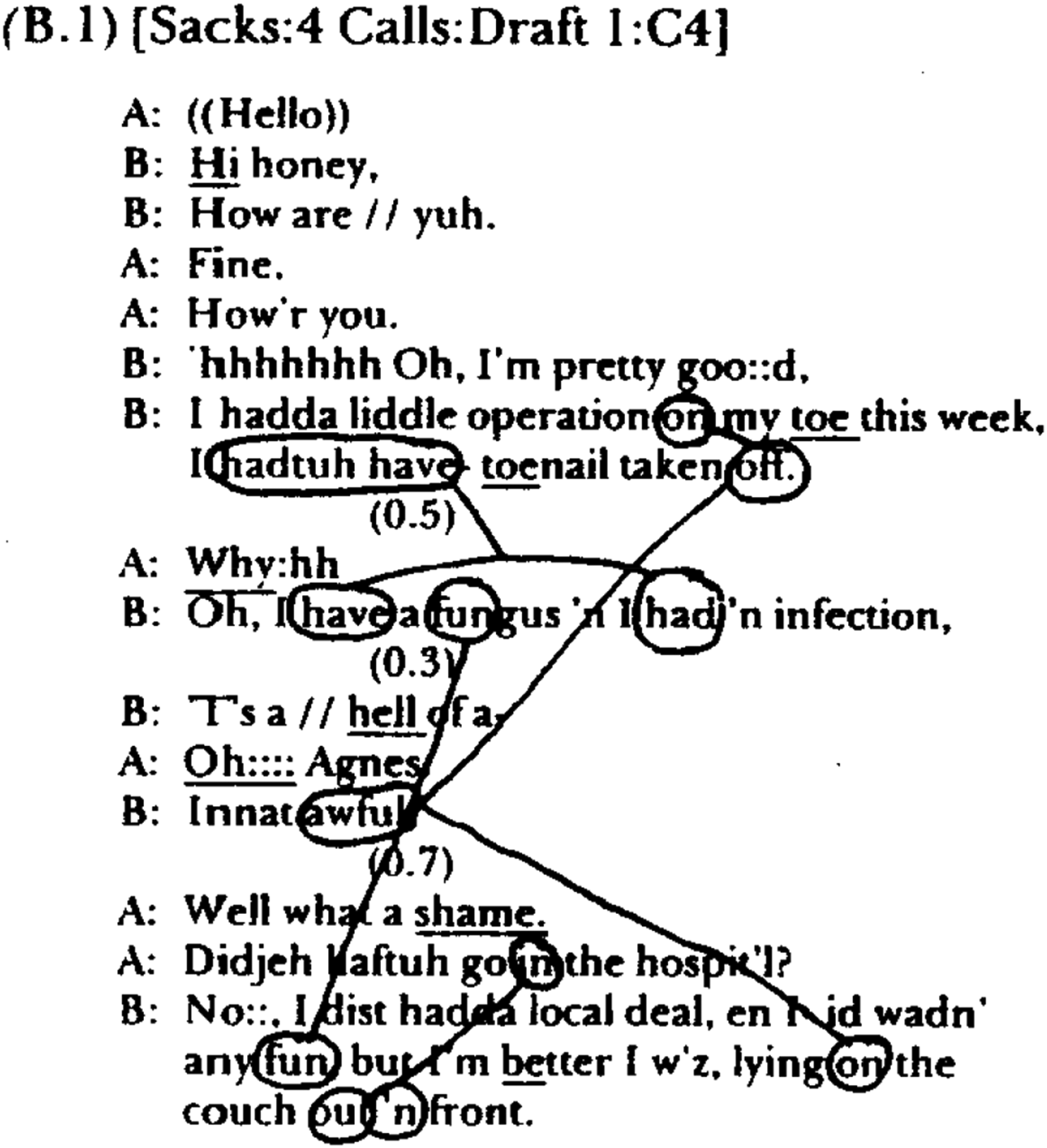
Replica of Sacks’ markings for sound-rows (Jefferson, 1996: 56).
Sacks’ early attempts, such as this one, have since been elaborated and followed up in a handful of studies focusing on the phenomenon of sound patterns. Their interest took the form of a diversification of transcripts in which new mark-ups and conventions were introduced to make the phenomenon observable. Hereafter, we examine some of the exemplary practices with which previous studies have tackled the challenge of transcribing sound patterns, and which arguably demonstrate their efforts to subvert the “ordinary sensibilities” (Schenkein, 1978: 5) of the reader, including the acquired sensibility of reading CA transcripts.

Excerpt from Jefferson (1996: 5).
The first case is Jefferson (1996: 5; Figure 3), the excerpt being the first excerpt under the heading of ‘sound-formed errors’, introducing examples in which sound-rows are central to troubles in speech. Here, the focus is on the cut-off sound ‘kuh-’, which Jefferson suggests is brought about by the [k] sound-row in the ongoing turn, possibly being the word ‘country’, but is treated as an error by the speaker and self-repaired to ‘areas’. To encourage the reader to hear the patterned run of a certain sound, Jefferson mobilised square brackets as a form of visual highlighting. The brackets surround the letter pertaining to the sound in question, but their orthographic representation is retained. There is no explicit account for the choice of the square brackets apart from a footnote in which she describes them as a “display device … intended as pointers to the phenomenon under consideration” (Jefferson, 1996: 57). 13 While the brackets are used to highlight the relevant sound, it is also a technique allowing the transcriber to preserve the original transcript but embed these brackets as a lamination, akin to Sacks’ doodles. With this approach, in the end, what is presented as an excerpt for the phenomenon still consists of a single transcript.
Decades later, with the increasing sophistication of the technical resources available for transcription, more recent studies have turned to what could be called a multi-tier system. Here, excerpts include an original transcript followed by a number of modified versions that guide the readers’ attention. 14 The next illustration is from Cekaite and Aronsson (2004), who examined playful recycling by young learners of Swedish as a second language in an immersion classroom, and how such practices create opportunities to subvert traditional roles and norms associated with the classroom. The excerpt below is presented as a case of “intertextual joking” (Cekaite and Aronsson, 2004: 378) that occurs in a daily, routine class activity in which everyone sings together. During the activity, a nine-year-old boy, Miran, replaces a name (Alice) in the lyrics with the phonetically similar name of one of his classmates (Ali), and this is playfully repeated by some of the other classmates and by Miran himself (lines 2, 5, 9). To invite the readers to focus on this language play, the authors present the excerpt in two parts: first a conventional transcript (Figure 4), followed by a shorter version that only contains the focal sound phenomena (Figure 5).
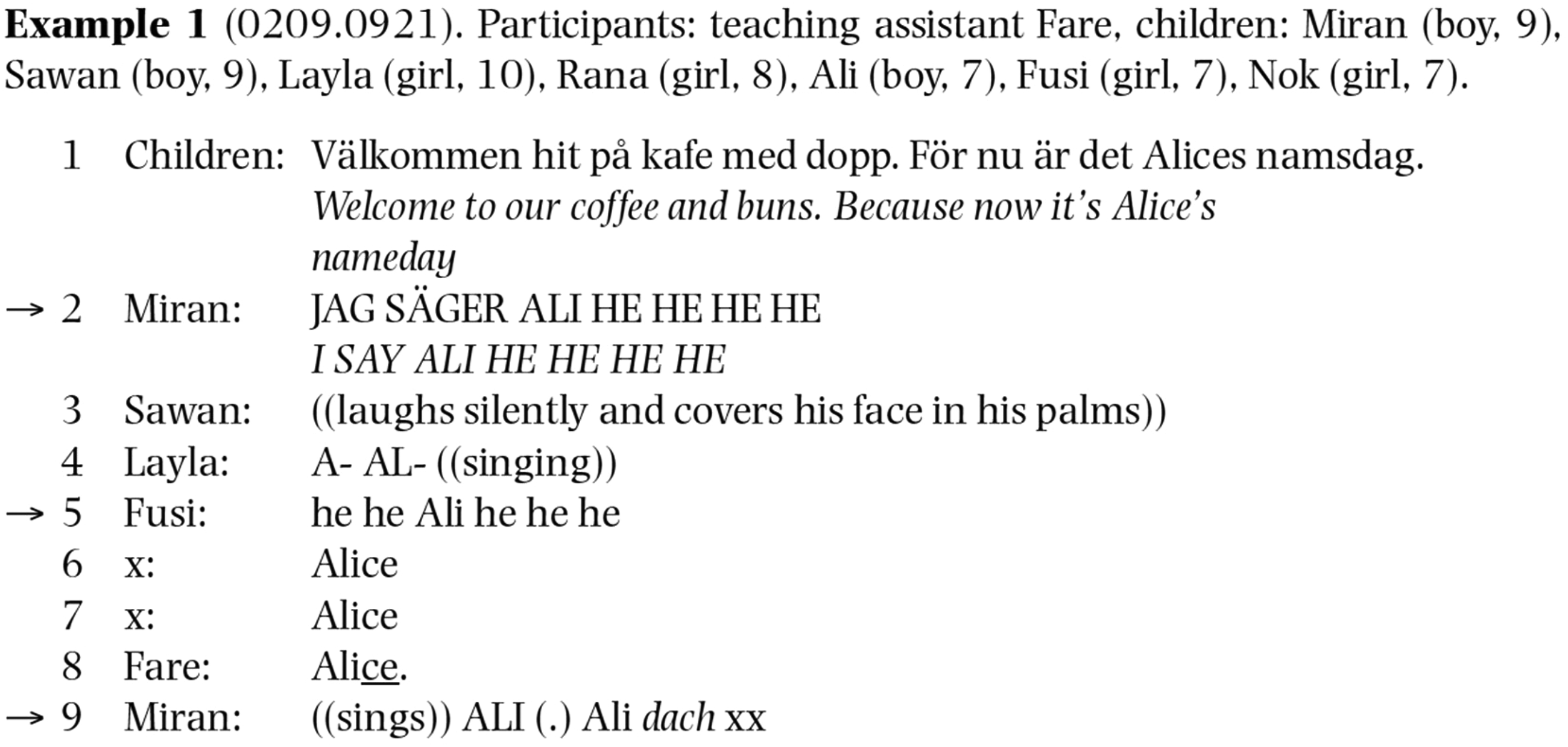
Excerpt from Cekaite and Aronsson (2004: 378).
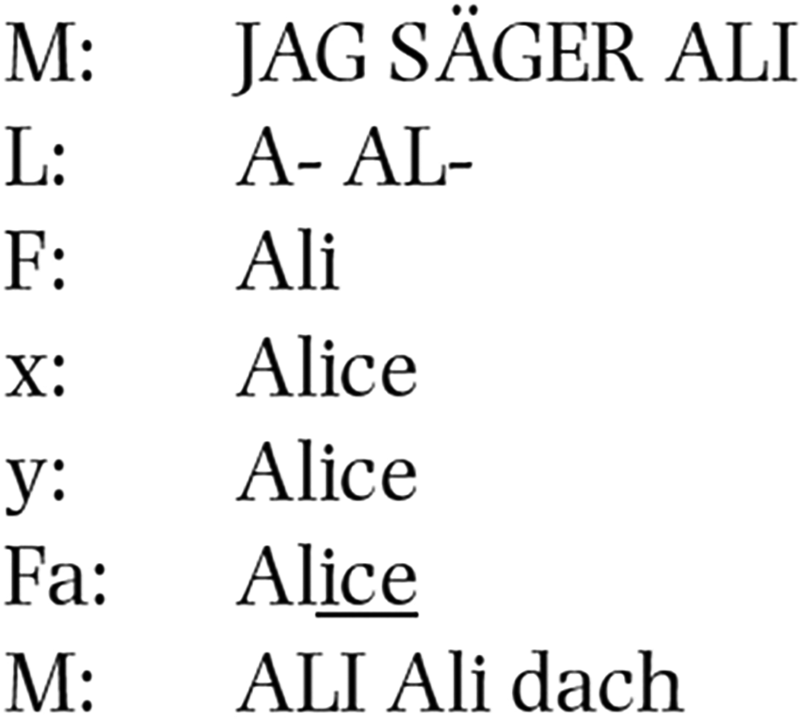
Excerpt from Cekaite and Aronsson (2004: 379).
In the original text, the modified version is followed by the authors’ description of the language play as a case of “‘cross-speaker poetics’ in that it involves alliteration and sound parallelism across speaker turns” (Cekaite and Aronsson, 2004: 379). Instead of leaving it to the readers to go back to the original transcript, the authors provide a condensed version. In this version, certain details (i.e. speakers’ full names, embodied conduct, non-lexical vocalisations, English translations) are redacted, leaving only the details of verbal talk in which the names Alice and Ali are produced. To some extent, reusing a quote we gave above, “parts of the original have been altered and other parts have been lost” (Barker and Wright, 1951: 1). This way, the reader is prompted to observe and compare only those forms and the sound patterning between them, something that may be more readily witnessable when decontextualised in such a manner.
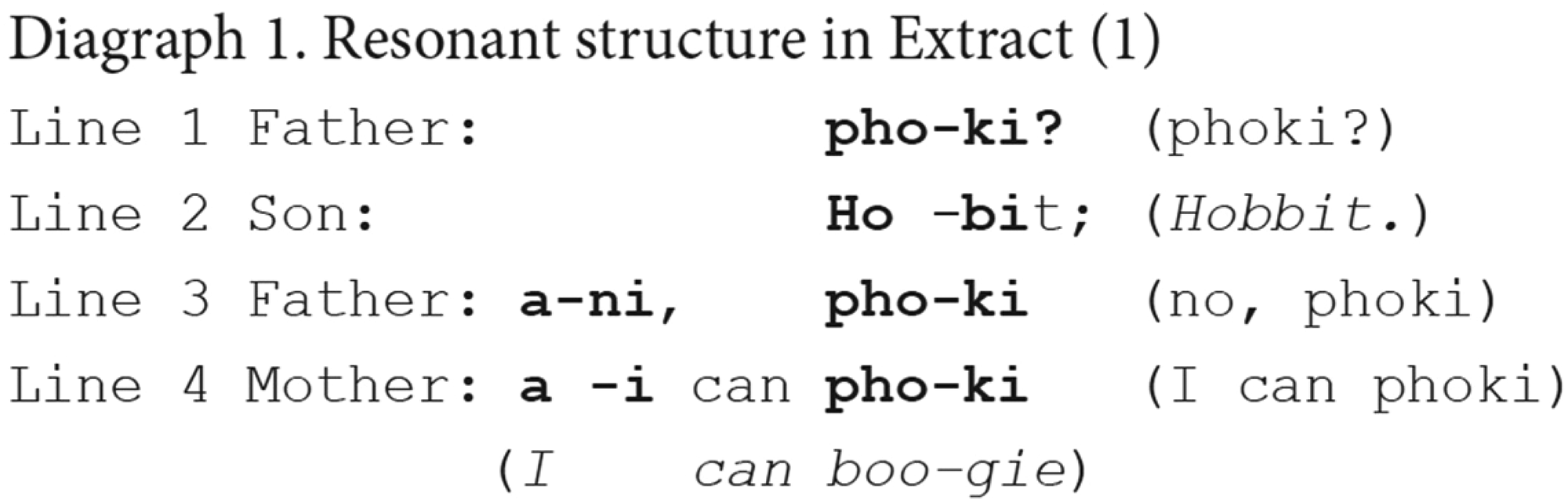
A similar technique, namely a two-tier excerpt, is employed by Kim (2022) in his study on the practices of syllabic-matching to create resonant sound sequences in Korean ordinary talk-in-interaction. In the original text, the following example is the first excerpt presented as exhibiting a “sound-formed word play” (Kim, 2022: 462). The analysis centres on how the syllabic and sound structure of the Korean word phoki (line 1) is oriented to for the production of the English word hobbit (line 2) and as a substitution for the word boogie (line 4) in an English song, as well as how the Korean word ani (line 3) is resonant with the English pronoun I (line 4). Like Cekaite and Aronsson (2004), Kim (2022) first offers a full-fledged, conventional transcript (Figure 6) which is then followed by a modified version (Figure 7), for which he adopts a ‘diagraph’ (Du Bois, 2014). Again, the Jeffersonian transcript is offered as primary ‘data’ on which further analytic operations are done, underscoring phenomena that could be overlooked in a conventional transcript, should the readers not be attuned to their possibility.
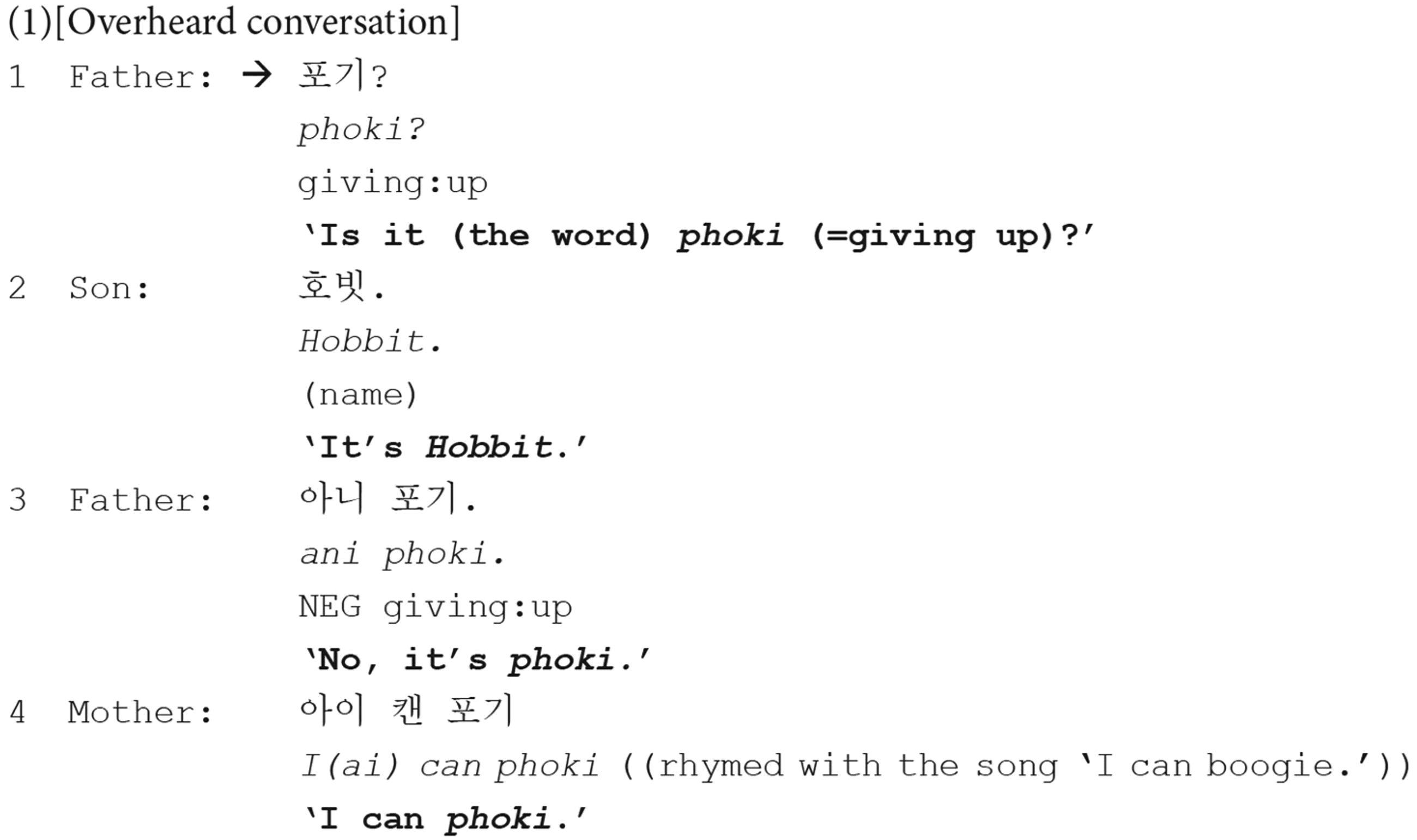
Excerpt from Kim (2022: 461).
Excerpt from Kim (2022: 462).
In an endnote, Kim (2022) explicitly accounts for the use of diagraphs as an aid for seeing the phenomenon at hand: “For each fragment of transcribed conversation, a diagraph was added to highlight the resonant relationship identifiable in the structural parallelism that holds between the utterances in turns and sequences” (pp. 485–486). Compared to the conventional transcript (Figure 6), the diagraph in Figure 7 does not include the original Korean orthography or its grammatical glosses. Instead, the author bold-faces the forms in question, for instance, leaving in plain print the letter ‘t’ in hobbit that is not part of the resonant sequence. Moreover, the forms are presented with hyphens that demarcate syllabic boundaries, and they are placed in two columns so that the two different resonant sequences can be seen in each column.
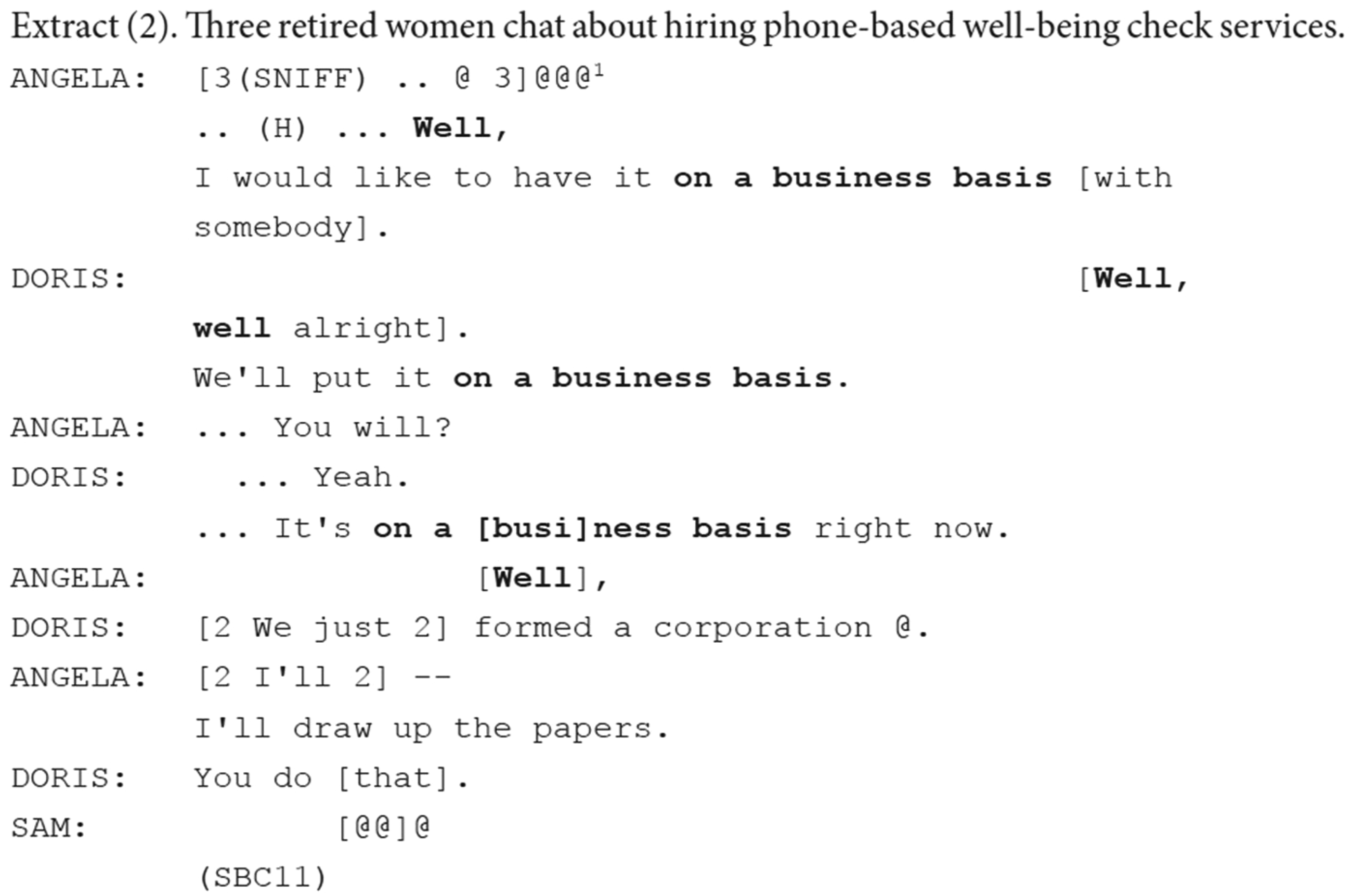
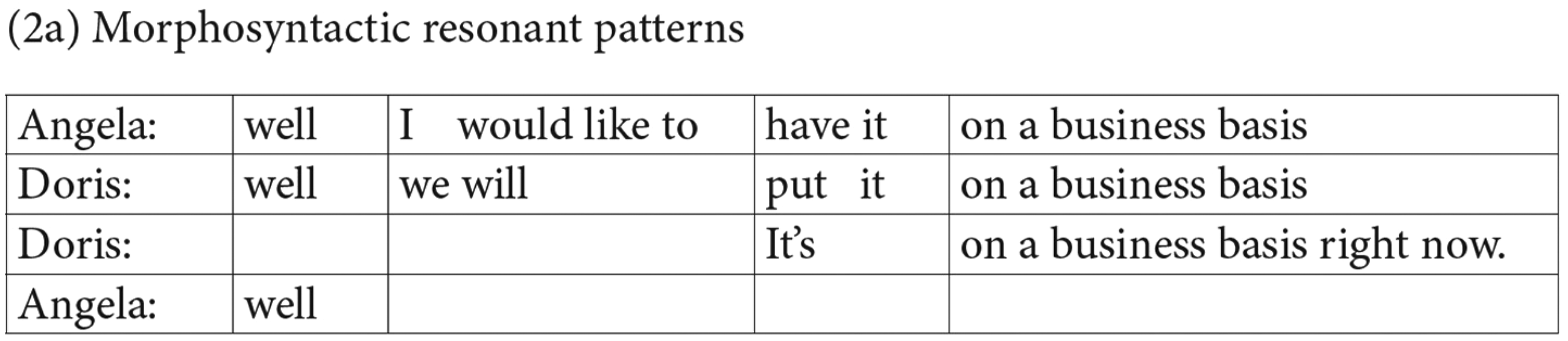
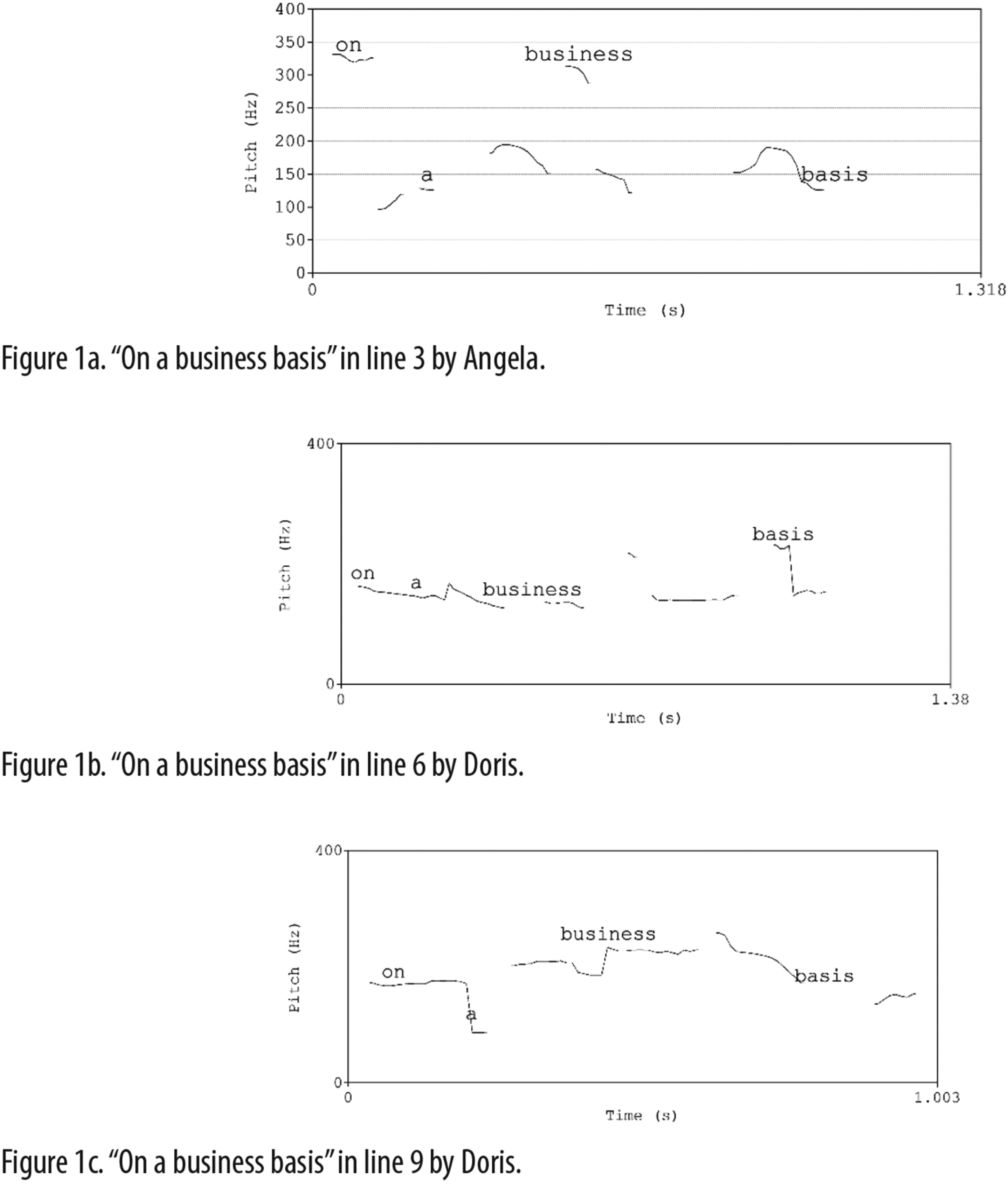
Our final case is from Tao's (2022) study on multimodal resonance as a device for conversational humour in talk-in-interaction in Mandarin Chinese and English. As an illustration of what counts as a “multimodal amusement resonance” (Tao, 2022: 336), the author presents the following extract – a conversation between three retired women in which the focal phenomenon involves the recycling of morpho-syntactic structures as well as convergent prosodic patterns to achieve humorous effects.
Excerpt from Tao (2022: 337).
Excerpt from Tao (2022: 338).
Excerpt from Tao (2022: 338).
This time, compared to the previous cases, the excerpt is presented in three tiers (Figures 8–10). The original transcript (Figure 8) already has the focal forms in bold, but it largely retains the conventional style of CA transcripts. What follows, in Figure 9, is a diagraph formatted as a table, which omits line numbers as well as other talk, but places certain forms in columns so that they are seen as structurally parallel with each other. It is the repetition of these larger parallel structures that are attested as achieving resonance across speaker turns. The third and final tier (Figure 10) are Praat-generated pitch graphs of a select phrase (‘on a business basis’) that is repeated three times in the transcript with the apparent aim of leading the audience to notice how the rhythmic and prosodic properties of the three productions are comparable and thus also resonate at the phonological level.
These cases of transcribing sound patterns clearly show that transcription is an analytic exercise. A transcript is not what is analysed but how an analysis takes place. Therefore, depending on the objects of analysis, transcripts can naturally undergo transformations from their more conventionalised modes. When it comes to the investigation of sound patterning, the aforementioned examples indicate that a conventional transcript is not sufficient to make visible the granularity and realm of orderliness that provides for the hinted-at ‘poetic’ relationship between sounds. In fact, the familiar transcript is not only inadequate for this purpose but arguably even disturbing for the target audience, who are keen to read transcripts skilfully, as informed by their professional training. It is this professional sensibility that must be disrupted to encourage a radically indifferent attitude that could entertain the possibility of an organisation of talk-in-interaction like sound patterning. The invention of multi-tier excerpts observed in previous studies, with a relatively conventional transcript followed by its various modifications, can be seen as an endeavour in this direction.
Of course, the creation and design of symbols and mark-ups for transcripts are not unique to the phenomenon of sound patterning, and various manipulations of transcription conventions have been introduced to make witnessable an array of phenomena that are on the fringe of more developed topics in EM/CA studies. This includes Atkinson (1984) on techniques for inviting applause in public speech where applause density and duration are exhibited in graph form together with a displacement of verbal units in list form, and the thread of works by Auer on transcribing conversational rhythm and tempo, which mobilise musical notes as well as other graphic symbols to show rhythmic isochrony, interval, and so on (e.g. Auer and Di Luzio, 1992; Auer et al., 1999). What is common to these phenomena, and poetic phenomena as well, is their resistance to a unified conventional system for their transcription, which is not the case for other kinds of topics which the transcription system is better designed to fit. In the next section, we propose that the wildness of poetic phenomena makes them uncapturable by established analytic means, conventional modes of transcription being one primary tool, and we discuss how the current neglect has to do with the difficulty of containing, describing, and reproducing such evanescent, whimsical features of social activities.
Transcription as an exercise in indifference
Proposing poetics as an expression of the ‘wild side’ of CA, Jefferson (1996) offers two interrelated understandings of what it means for the ‘stuff’ to be ‘wild’ – the phenomenon itself and its analytical treatment. As for the former, the wildness of poetics may have to do with the kind that Robillard (1999: 61) reports: Garfinkel talks about the “‘wild’ nature of social structures”, which means that “social events … could not be idealised before you, the investigator, observe them”. Here, the ‘wildness’ is related to ‘unimaginability’ – details of social practices can only be discovered (like a new species of animal), not imagined in advance or reconstructed from memory. Adopting the latter sense of ‘wild’ as a “lack of organization or development” (Jefferson, 1996: 2), which is also the reading developed by Rae et al. (2022: 8), seems to establish a hierarchy between the ‘wild’ and the ‘domesticated’ (the un/controlled, the un/known). For poetics, we do not have the ‘domesticated’ version, i.e. the organised and well-developed procedures for dealing with it, established conventions for transcription being one. It seems to be this wildness, both in the phenomenon and its representation, that makes poetics captivating but at the same time worrying – one does not know what to do with it, it does not fit into the established ways of working or into the overviews, textbooks or manuals of methods.
Indeed, early formulations of poetic phenomena were often accompanied by remarks concerned with their reasonability. In an undated note that Sacks wrote to Jefferson proposing an elaborate analysis of a poetic phenomenon, the final line reads: “not for circulation; they’ll think we’re both batty” (Gail Jefferson's archive at UCLA, box 23, folder 5). 15 Sacks’ apparent orientation to the wildness and potential controversiality of poetics was retained later by Jefferson (1996: 49) in Appendix A, entitled “The unlikely case”: “I’ve always figured that this case is so improbable that presenting it would simply impeach anything else I might say. Even at the Boston conference, where my aim was to show the loopy side of CA, I left it out”. The work of analysing poetic phenomena has thus constantly involved considerations on taming their wild character to make them presentable to scholarly audiences.
The various forms of transcription reviewed above in contemporary studies are efforts in the same spirit. The attitude is one which takes seriously the notion of ‘possibilities’ as an analytic discovery. For Sacks, a ‘possibility’, however unlikely it seemed, was a good enough reason to consider a particular aspect of the orderliness of social phenomena. As we noted earlier, he saw his work as consisting of proving possibilities, and he saw possibility as a strong kind of relationship. For Sacks, a possibility was not the beginning of a research project, it was not ‘just an idea’, but rather a proper research finding or outcome with some kind of proving attached to it (Sacks, 1992, Vol. II: 251–252). In this strict sense, ‘possibility’ is distinct from ‘plausibility’ in that the latter is what needs to be ‘pierced’ for the possibility of the phenomena to ‘emerge’ (Jefferson, 1996: 5). The ways of transcription above are thus an invitation for the audience to exercise indifference to any plausibility before seeing the data and instead to come face to face with the possibility of sound patterning as a phenomenon. This means that transcription as a means for representation is not simply a matter of manufacturing and presenting the data for subsequent analysis. Instead, the work of representation in the professional practice of transcription in EM/CA lies in providing access to the possibility of a phenomenon. In this light, the varied efforts of representing poetic phenomena as transcripts are themselves analytic endeavours to prove its possibility as an orderly feature of social life.
Moreover, one of the striking observations from our review of existing transcription practices is the heterogeneity in how authors invent mark-ups and adopt ad hoc conventions to transcribe the phenomenon of sound patterns. There may be several reasons for this, for example, the cases above glossed as ‘sound patterns’ may also be too different from each other to be captured with a single transcription convention. However, this would not explain how various, seemingly more distinct, phenomena in numerous studies still adhere to a few select mainstream transcription conventions. 16 The divergence from more conventional forms of transcription may be a testament to another kind of indifference, this time exercised by the authors themselves: an indifference to conventions as formal methods. In EM, as a principle, methods are required to be adequate to the phenomenon, rather than the other way around. Discovering methods for its study is an inherent part of grasping and describing the phenomenon (Button, 1991; Lynch et al., 1983). It is perhaps this requirement that transcribing with multiple tiers aims to fulfil – to find a method that fits the nature of poetics and makes it investigable.
The field of EM/CA is ‘indifferent’ to formal methods, and that is what makes it radical and distinct from other approaches in the social sciences (Button et al., 2022). When it comes to transcription, it may be more likely to be misunderstood as a formal method than other policies (e.g., the use of naturally occurring data, or the unique adequacy requirement of methods – see Eisenmann and Mitchell, 2024; Hofstetter, 2024; Smith, 2024) because there exist conventions and guidelines for transcribing. The misunderstanding may be aggravated by the fact that transcription is an oft-used method not just in the field of EM/CA but in qualitative research at large. However, what our review of transcription practices for poetic phenomena reveals is that transcription is a proxy for the analytic mentality of EM/CA and it is indeed more akin to a ‘theory’ (Ochs, 1979) that cannot be understood decontextualised from the analytic underpinnings of EM/CA. In this paper, we have tried to establish a connection between transcription and the broader policy of ‘ethnomethodological indifference’ (see Lynch, 1997) in which transcription is conceptualised as an invitation for both the audience and the researcher to exercise indifference to plausibilities and professional sensibilities that exist prior to seeing the data and to look instead at its possibilities, as wild as they may be. If the validity of any transcript is to be judged in any light, it should not be juxtaposed with how accurately it has adhered to the manual and its conventions but rather considered according to what it reveals about the phenomenon – or as Duranti (2006) puts it, “[v]alidity must be measured on the basis of payoffs, and payoffs are theoretical beasts” (p. 308).
Conclusion
A 1952 manuscript written by Garfinkel at Princeton and published in 2008 starts with this confession and warning: “Having just come out of a jungle, I can’t promise you that in leading you in to show you what I’ve found that I won’t lose the way for all of us” (Garfinkel, 1952/2008: 101). A foundational insight of EM/CA has been that the order discovered in the apparent wilderness of social life is constantly achieved and reproduced, and thus also fragile, for members as well as analysts: the paths previously located ‘in the jungle’ can easily disappear. In this paper, we used the metaphor of wild(er)ness to approach the topic described as the ‘wild side’ of CA, namely the poetics of ordinary conversation, and to explore how the wildness of poetics might elucidate its relative marginalisation in the current field of naturalistic studies of practical action and practical reasoning. We have learned that poetic phenomena, resisting the unproblematic encapsulation in transcribed texts to be analysed as ‘data’, allow for revisiting of the purpose of transcription procedures as techniques for, simultaneously, estrangement and familiarisation. It also reminds us that transcription is not reducible to a routine manual activity but instead is an analytic exercise in indifference that ought to be treated more as a policy rather than a formal method. In this way, we have tried to account for the relative neglect of poetics in EM/CA, and other fields of qualitative inquiry, by looking at the analytical practices of capturing these wild phenomena as possibly orderly, recurrent, and systematically describable organisational objects. The emergent professional practice of using multi-tier transcripts that highlight poetic aspects of talk by lifting them from their immediate sequential and embodied environments encourages the reader to see (in)differently – it provides grounds for seeing poetically.
But there seems to be more: our inquiry into poetic phenomena also leads to a certain far-reaching and more radical possibility, which we offer here by way of conclusion. It may be that the ultimate danger (and potential promise) of poetics’ wildness lies in the possibility that ‘poetic phenomena’ – the linguistic or interactional features such as sound patterning, rhymes, puns, alliterations, word plays, etc., might be more than a concrete range of ascribable features of ways of talking that have some recognisably ‘poetic’ quality. In poetics, we are arguably encountering phenomena that belong to the ‘aesthetic’, which is an attribute that can indeed be reasonably claimed and perhaps even intersubjectively available, but not always accountably produced as such. This possibility makes relevant an alternative conception of ‘the natural’ and its appreciation guided by an aesthetic rather than a rationalistic view, and it connects poetics of ordinary talk to “everyday aesthetics” (e.g. Leddy, 2012; Saito, 2007, 2017). In other words, poetics brings in matters of aesthetics as grounds for social action (see Sacks, 1992, Vol. II: 324). As formulated by Albert (1964), whose work Sacks often discussed in his lectures, “‘poetics’ … refer to the aesthetic criteria that govern discourse” (p. 36).
Then we may ask: what if the troubles with capturing and domesticating these aspects of talk-in-interaction indicate that there is a domain of social reality that does not fit the established systems of professional analysis? Rather than being only somewhere and sometime, is it that poetics is everywhere and all the time, sometimes more and sometimes less? Could one rather consider poeticity – alongside indexicality or reflexivity – as a ubiquitous and pervasive feature of all language and social action that is just more visible in puns, rhymes, or sound patterns? And how could such a proposal be incorporated in contemporary EM and CA? A move from poetics to poeticity would then acknowledge the phenomena as belonging to a distinctive layer of social order, endogenously produced nonetheless, that escapes containment in singular transcripts, collections, and other conventional analytic moves. By opening up a radical investigation of the possibility of an omnipresent and inherent poeticity of social life, pointing to these future research directions, our paper potentially invites an ethnomethodological misreading (Garfinkel, 2021) of Heidegger's remark that “dwelling rests on the poetic” (Heidegger, 1971: 214) – just what does this ‘resting’ consist of, in concrete lived detail?
Footnotes
Acknowledgements
The first version of this paper was presented in May 2023 at the New Developments in Ethnomethodology workshop at the University of Gothenburg, Sweden. We would like to thank Oskar Lindwall for inviting us to the event, and all the participants for their insightful comments. We received valuable feedback in June 2024 from the CORE-ILCA reading group ( ), particularly from Donald Bender, Uwe-A. Küttner, Kristjan Peik, and Minttu Vänttinen. We are also grateful to two anonymous reviewers for their thoughtful and constructive comments on an earlier version of this paper. Many thanks to Elisabeth Lyman for proofreading the final manuscript. Finally, we would like to thank the following authors for granting us permission to reproduce their materials: Karin Aronsson, Asta Cekaite, Kyu-hyun Kim, and Hongyin Tao. Any remaining errors or imperfections are, of course, our own.
Declaration of conflicting interests
The authors declared no potential conflicts of interest with respect to the research, authorship, and/or publication of this article.
Funding
The authors disclosed receipt of the following financial support for the research, authorship, and/or publication of this article: Funding for Yeji Rieser's research was provided by the Doc.Mobility@Unibas funding, the Hermann Paul School of Linguistics Fellowship, and the Research Fund for Excellent Junior Researchers from the University of Basel, Switzerland.