



Abstract
In March 2020 when the COVID-19 pandemic was rife and global lockdowns were implemented research restrictions were also put in place curtailing established research practice with children. These restrictions required researchers to reflexively navigate the interplay between responsiveness and responsibility to ensure that ethical processes continued to be fluid and co-produced. Teasing out the ethical dilemmas, this article examines the enforced online research experience with children during this time to show its complexities and idiosyncratic nature. It draws upon data examples from a pilot case study project with ten 7- to 11-year-olds investigating how children maintained their friendships during lockdown in the United Kingdom. Data were collected through a range of creative participatory research methods accompanied by an open-ended online unstructured interview. This article has implications for researchers and educators for future online data collection with children as it reflects on the ethical maze of doing research with children online. Reflections provide new insights into how allowing children to choose their creative method facilitated the production of agentic knowledge.
Introduction
It has been argued for a number of years that research should be done with rather than on children (Bell, 2008; Clark, 2017; Davis, 1998; Hill, 2005; Maguire, 2005) and that children should be involved in research projects as active research participants co-constructing knowledge with adult researchers (Barley, 2020; Barley, 2021; Milstein, 2010). Social restrictions that were enforced during the COVID-19 pandemic created a number of ethical dilemmas in relation to how best gain children's perspectives during this unprecedented time as well as presenting new challenges to researchers seeking to engage children in participatory research. These restrictions required researchers to reflexively navigate the interplay between responsiveness and responsibility to ensure that ethical processes continued to be fluid and co-produced.
While current research ethics guidelines from UK-based university ethics committees are starting to make reference to children's rights to participation in research projects as outlined under Article 12 of the UN Convention on the Rights of the Child, which states that children have ‘the right to express [their] views in all matters affecting [them]’ (Lansdown, 2011: 1), these explicit references to rights to participation within research contexts are at best patchy (lacking clear guidance on implementation), disputed or fail to address other aspects of social justice and essential human rights principles (Bell, 2008; Cuevas-Parra, 2020; Hill, 2005; Russell and Barley, 2020). In addition to this, ethics committees at universities in the United Kingdom pay little or no attention to child-centred research practices making the ethical processes required of by universities feel far removed from the in situ research situations that childhood researchers find themselves in (Flewitt, 2022). As Bodén (2021) argues, ethics need to be understood within a specific context rather than being pre-defined as ethical or unethical.
This article reviews established good practice when doing research with children and looks at how these principles can be adapted to an online research context. The article draws on examples from our pilot study with KS2 children (ages 7–11) exploring their experiences of lockdown in the United Kingdom (Carter et al., 2023a) and considers the agentic way that knowledge can be produced in an online research context as a way to navigate the ethical maze.
Established good practice when doing research with children
The use of visual and creative methods has been heralded as a tool that researchers can use to reduce power differentials between adult researchers and child researchers when reflexively employed (Barley and Bath, 2014a; Barley and Bath, 2019; Clark, 2017; Johnson, 2008; Lomax, 2012; Punch, 2002; Russell, 2007). Giving children control over the type of creative methods they engage in and ensuring familiarity with the research tools are seen as being good practice as is giving children time to start the activity with the researcher present but not initially involved to build rapport before engaging in, for example, an informal interview to elicit children's views on their artefact (Barley and Bath, 2014a, 2019; Carter et al., 2023b; Russell, 2007).
In order to achieve full participation when doing research with children, researchers have also argued that it is good practice to engage in a reflexive process of familiarisation, including a face-to-face familiarisation period, before starting data collection (Albon, 2021; Barley and Bath, 2014b; Busher, 2019; Frödén, 2019; Gelir, 2020). Engaging in such a process allows the researcher to become familiar with the research context and potential participants as well as allowing potential participants to become familiar with the researcher and the research project (Barley and Bath, 2014b). As Gauntlett (2007) describes an ‘embodied approach’ that involves the construction of an artefact can also enable participants to engage more deeply with the project as they are given time to consider the topic while being creative before they are asked questions about it. Allowing participants to become familiar with the research project as well as the researcher is thought to be an important component of familiarisation (Barley and Bath, 2014b).
When working with children, particularly in settings that traditionally require children to obey or conform to adults’ wishes such as in a school, this slow process of familiarisation is important to ensure that informed consent to participate is given to avoid a participant feeling obliged to take part without having the opportunity to ask and receive fully answers to any questions that they may have. Utilising arts based or visual research approaches can also open up opportunities for children to ask questions about the research project (Barley, 2021).
As well as building relationships with potential participants to enable children to give their informed consent to participate in a study (Barley, 2021), engaging in a period of familiarisation also allows the researcher to become acquainted with the social beliefs and (often unspoken) rules of the group, learn the ‘language’ of the group (as in Edwards et al.'s (1998) concept of ‘the hundred languages of children’ or Corsaro’s (1988) concept of ‘peer culture’) to become fully immersed in the research setting, establish positionality, and ‘map’ the research setting enabling the researcher to structure and focus their data collection techniques (Barley and Bath, 2014b).
Adapting good face-to-face practice to online research contexts
While these principles of engaging in a face-to-face familiarisation process when doing research with children are considered by many as good practice (Albon, 2021; Barley and Bath, 2014b; Busher, 2019; Frödén, 2019; Gelir, 2020) what should researchers do when the option for such a face-to-face familiarisation process is not possible, for example due to a global pandemic when university ethics committees halted face-to-face research (due to health, social and political requirements)? Where does the balance of ethics lie when undertaking research in less-than-ideal circumstances? Is it more ethical to pause research until best practice can be implemented or is it more ethical to access participants’ voices on important and unfolding situations as circumstances best allow? These questions became more than purely theoretical in March 2020 when the global COVID-19 pandemic caused (multiple) lockdowns in many countries around the world restricting social interactions).
Due to the social and resulting research restrictions during the COVID-19 pandemic, researchers problematised the effectiveness of available research tools to engage research participants in online participatory research as co-constructors of knowledge (Rudd and Hwang, 2021) with some drawing on community-based participatory research principles while recognising current inequities in access to online technology and as a result unequal access to research projects and opportunities to have their voices heard (Nguyen et al., 2020; Salma and Giri, 2021). Researchers have been creative in adapting and developing established participatory tools for working online in this context for example using smartphones to facilitate remote participatory video methods (Marzi, 2023). However, some question if it is inevitable that online research tools will limit the rapport and equitability that participatory approaches aim to foster (Hall et al., 2021) while others reflect on the challenges of creating research connection and connectivity in online qualitative research (Tarrant et al., 2021).
As well as problematising online participatory approaches when working with adults from diverse groups, such as participants with autism (Rudd and Hwang, 2021); ethnic minority communities (Salma and Giri, 2021) and participants with specific health needs (Nguyen et al., 2020) researchers such as Cuevas-Parra (2020), Milstein et al. (2022) and Lomax et al. (2022) have reflected on involving children in online participatory research. Cuevas-Parra (2020) and Milstein et al. (2022) argue that including children as research partners and co-researchers became more pertinent during COVID-19 lockdowns with Milstein et al. (2022) also arguing that research ethics needed to be considered in situ as a constant reflection process to ensure that participation was not hindered by technological tools and that co-participants’ constructions of knowledge were fully illuminated. In his inter-generational research project Cuevas-Parra (2020) engaged young people (aged 12–17) as co-researchers to design and undertake online semi-structured interviews with their peers. The young people were part of the Young Leaders Advocacy programme and had received research skills training prior to being involved in this piece of research. Cuevas-Parra (2020) argues that the availability of an established, active network of young researchers was key to the success of this research project.
In their online ethnographic project, Milstein et al. (2022) matched child participants (aged 6–12) globally and set up a pen-pal network to allow children to compare experiences of lockdown in different parts of the world. Children were encouraged to communicate with their pen-pal via written letters, drawings, photographs, voice and video recordings or another medium of their choice while the ethnographers observed their interactions. The ethnographers also asked the children to reflect on their experiences of taking part in this study and the research tools that were used.
Lomax et al.'s (2022) paper considers the use of digitally mediated participatory researcher tools for child-centred research practice problematising how to centre children within the research process without the options to meet face-to-face. They asked children (aged 9–10) to record their lived experiences of the pandemic using a variety of visual techniques, such as drawings, animation, collage, photographs and video. In total children were asked to produce six creative artefacts focussing on different prompts or themes from the project. These artefacts were coupled with asynchronous research conversations posted online on a private platform. The researchers responded individually to each child's online post.
Our article builds on this research, by reflecting on our own experiences of adapting participatory visual tools that we have previously used in face-to-face projects (Barley, 2021; Barley and Bath, 2014a; Barley and Bath, 2019; Carter and Nutbrown, 2016) to an online project exploring children's experiences of maintaining peer friendships during lockdown in the United Kingdom. This article problematises how the ethical maze can be navigated in an online context where face-to-face interactions are not possible.
Ethical processes and considerations
Ethical approval was sought through University procedures and informed consent was gained from gatekeepers/guardians as well as the children themselves (Cohen et al., 2011; Harcourt and Conroy, 2011). Before returning the written consent forms, parents (acting in the role of gatekeepers) were responsible for informing their child about the study and asking them if they wished to participate. The research team were available to answer any questions that potential participants had about the project. We are aware of at least one child, who was initially interested in the project but decided not to take part after having their questions answered as they thought that speaking about their COVID experiences would be too upsetting. In this instance the parent, in their role of gatekeeper, communicated the child's decision not to participate to the research team.
Ethical considerations were ongoing throughout this pilot study but were particularly pertinent whilst interviewing the children (Carter et al., 2023a). Before starting the online interview, the researcher sought verbal consent from the parent/carer and also directly from the child. As well as using a gatekeeper as part of our recruitment process we were also mindful that agreed consent can fluctuate, especially with children. To ensure anonymity, pseudonyms are used throughout.
Building rapport with children is an essential part of the research process (Groundwater-Smith and Mockler, 2016). Ordinarily, our usual practice of building rapport with child participants includes sessions of face-to-face familiarisation before data collection commences. We were conscious that in an online research context some children might feel wary talking to an unfamiliar adult (Cooke et al., 2018). With this in mind, the opportunity for unrecorded conversations was factored in at the start of each interview to set children at ease and develop rapport. These centred around personal interests, likes and dislikes (e.g. favourite books, food and hobbies). These conversations lasted for a few minutes. Some children shared what they were doing briefly while others went into more detail describing where they did their activity and who with. In some cases, children went to get something to show the researcher, for example a football medal or a photograph of them doing the activity, which they proudly shared with us. These conversations acted as an ice breaker and helped to build rapport between the child participant and adult researcher.
Online zoom interviews were audio recorded and took place in the presence of a parent or career for safeguarding reasons. While the presence of other adults in a research context, such as school staff and parents, has been problematised due to power differentials that might impact on children's ability to freely express their views on the given research topic (Barley and Bath, 2014a; Flewitt, 2005; Mandell, 1988; Mannay, 2016; Milstein, 2010) safeguarding took priority in this research context. Parental guidance clearly stated that we were seeking children's experiences of lockdown, not their own.
We anticipated that the COVID restrictions may have been an upsetting topic for some children, so in addition to the safeguarding reasons, we felt children should be able to see their parent/carer and be able to seek their parent's support whenever they felt the need (Cooke et al., 2018). We felt that having a familiar adult present was also important as we had been unable to undertake the tried-and-tested face-to-face familiarisation sessions that we ordinarily would do to build rapport. We also gave families the information of support services they could turn to if they needed support after the interviews. Some children did find the topic unsettling. During the interviews, the presence of parents/carers was both enabling and hindering. This will be elaborated further in the findings section.
While the ethical processes required by our institution were adhered to, the ethical dilemmas that we faced required continual monitoring and responding to in situ throughout the lifetime of the project (as advocated in our previous work, see Russell and Barley (2020, 2022) for more details). We conceptualised managing ethics as a reflexive and iterative process in response to the needs of our research participants (Carter et al., 2023a).
Recruitment and sample
As the project, including recruitment, had to be conducted online we were not able to use our familiar face-to-face recruitment practices via our professional networks. At the time that the project was being developed in March 2021 the majority of pupils were returning to school. Due to the pressure schools faced during the ongoing pandemic restrictions, we felt it important not to recruit participants through our tried-and-tested process of using school networks. Therefore, the children were recruited via social media (Twitter) using their parents as gatekeepers (Figure 1).
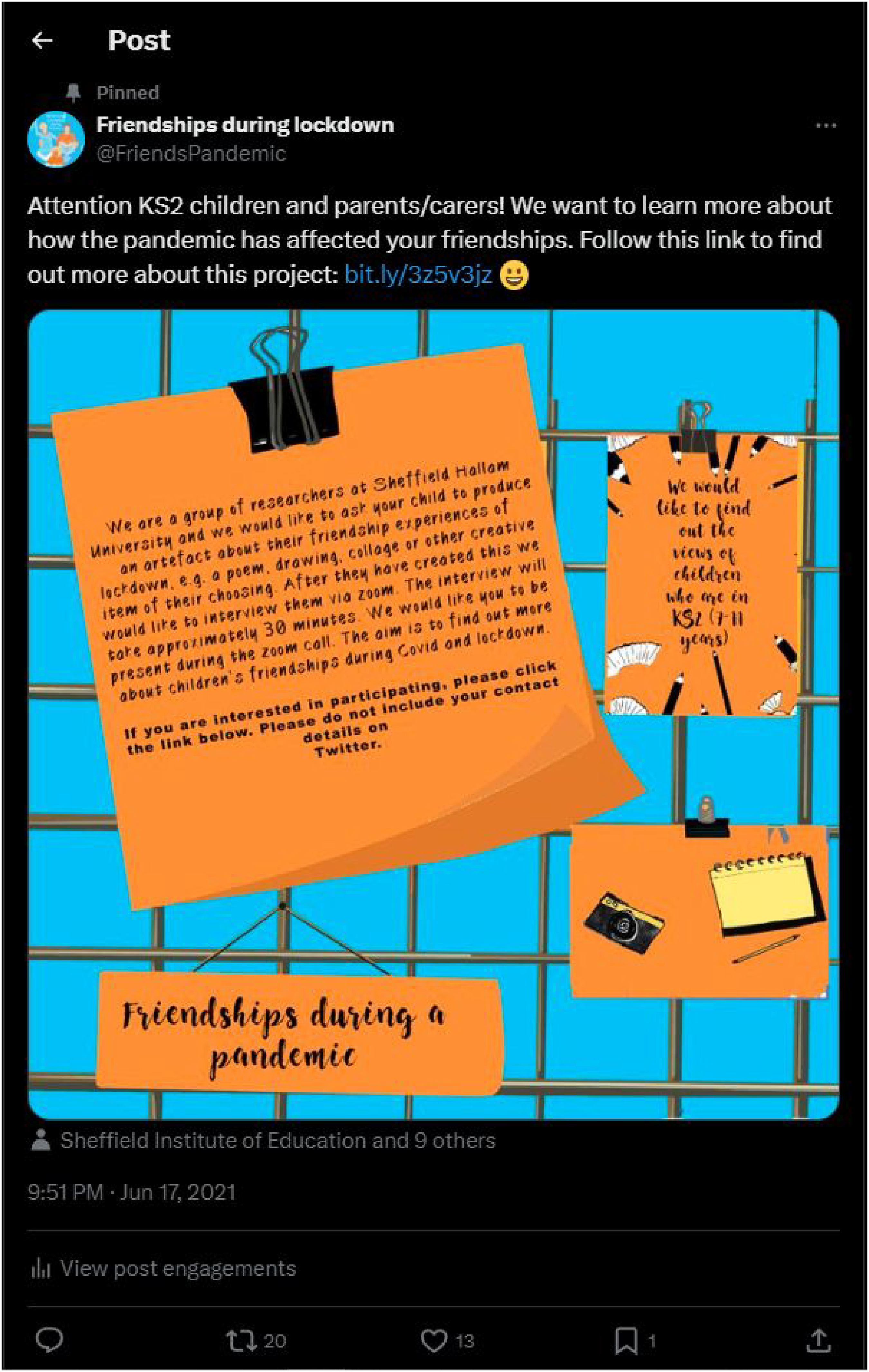
Recruitment tweet.
Research on the use of Twitter to recruit participants highlights the potential of a single tweet to reach a wider audience. However, having an established online Twitter presence with many followers makes this most effective (Wasilewski et al., 2019). We had institutional approval to use personal and professional networks (both online and in person) to recruit participants but made the decision to use a project account on Twitter rather than a personal one. The reason for this was that a personal account might have the potential to influence respondents (Quickfall, 2022). Our recruitment tweets were retweeted via our own, and our colleagues’ online professional networks. This included being retweeted by a well-known children's author with a large number of followers. Despite the advantages of using social media to reach a wide range of potential participants, similar to other studies conducted during the pandemic (e.g. David and Roberts, 2021 and Keen et al., 2022) online recruitment was slower than our experiences of recruiting face-to-face. The pandemic put pressure on families in a range of ways, from the requirement to home school while simultaneously working from home, loss of employment and income for those on zero-hour contracts, additional working hours and work-related pressures for those on the frontline as well as abnormal caring responsibilities and concerns for family members directly affected by the pandemic (Chu et al., 2021; Kalil et al., 2020; Rodrigues et al., 2023). These pressures would have impacted on the capacity of families to take on additional activities such as participating in a research project such as ours. This informed our decision to reduce our sample size.
To overcome a lower rate of recruitment via the initial tweets, we used known networks, such as recruiting parents via colleagues at a number of UK-based universities, to alert and engage further participants. Our inclusion criteria required that children were in Key Stage 2 (between 7 and 11 years old) and attending a UK primary school. We aimed to recruit 20 participants to the study but after we had exhausted our online networks we felt that the 10 participants that we had recruited were sufficient for a pilot study (see Figure 2 for list of participants).
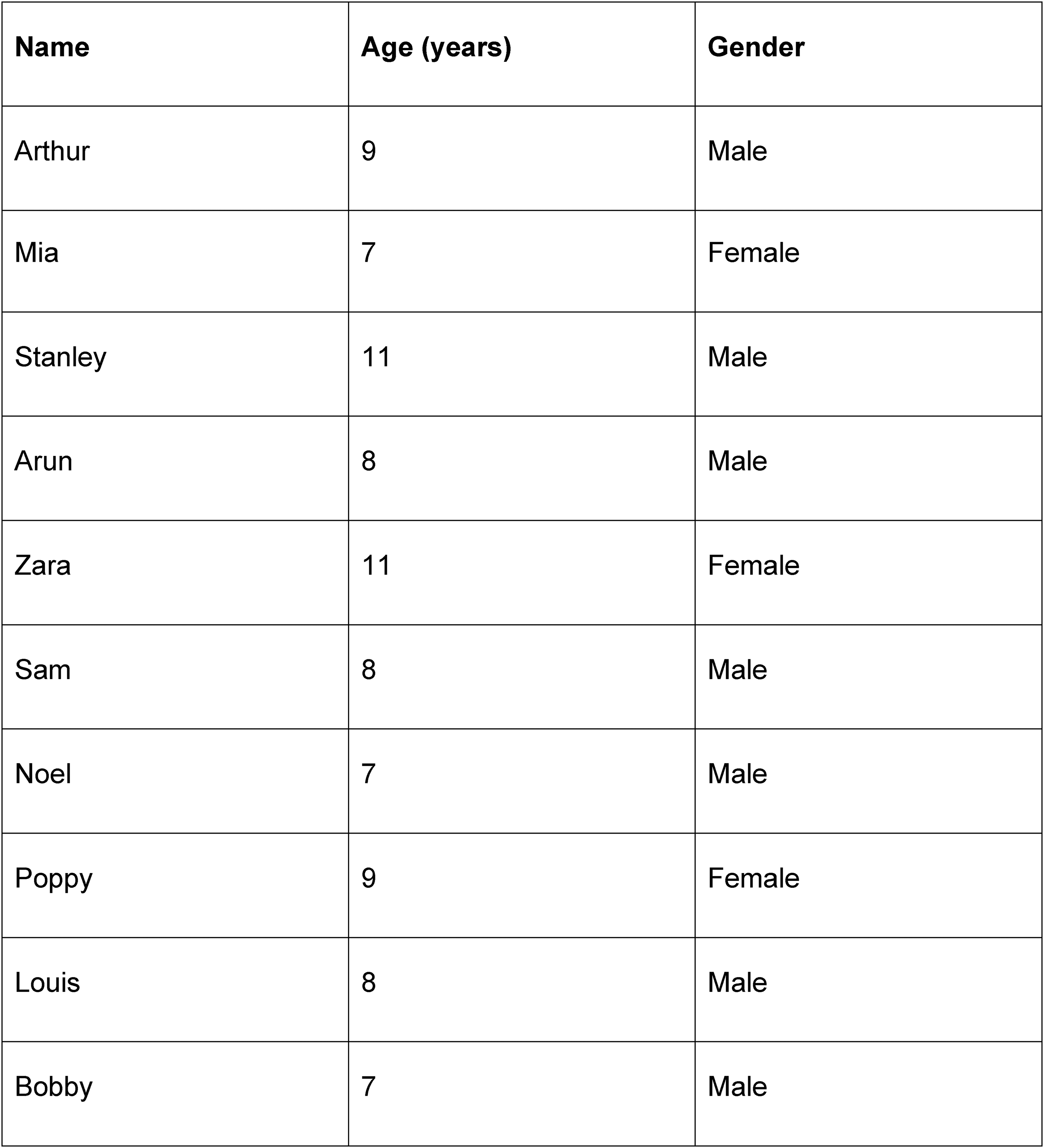
Participant sample (adapted from Carter et al., 2023a: 4).
As can be seen from Figure 1 there were seven boys and three girls in the sample.
The tweet specifically asked parents/carers to respond via email to retain anonymity and confidentiality rather than replying to the public facing tweet (Quickfall, 2022). Potential participants were then sent information letters, informed consent forms and a brief questionnaire including details about the child's name, school year group and age to inform the online interviews. Parents and guardians then returned signed written consent forms, for both themselves and their child, before the interviews were conducted and the artefacts shared. Acting in the role of gatekeeper, parents were responsible for sharing information about the project with their child and seeking their interest to participate. They were also responsible for communicating the information about the artefact to the child and arranging a suitable time for the online interview. Before the interview started, the researcher asked the child if they were happy to take part in the project both in terms of sharing their artefact and taking part in the interview.
Given the constraints placed on face-to-face interactions during the pandemic, we decided to use creative participatory methods with an accompanying online interview as our previous research has shown that arts-based approaches can reduce power differentials between adult researchers and child participants while allowing the researcher to gather child-generated perspectives of children's lived experiences (Barley and Bath, 2019).
Creative, participatory methods
The notion of whether research methods for children should be the same or different from adults has been questioned for many years (Punch, 2002). Therefore, it was important for us as researchers to make sure that the methods we offered to the children in this online project were appropriate for our intended participants (Clark, 2017). Data were collected after the second UK lockdown (March–July 2021). While schools were reopening at this time and limited the UK government started to permit limited social interactions in other contexts, face-to-face research was still prohibited by our university due to wider COVID restrictions on socialising. This meant that the research had to take place online (Figure 3).
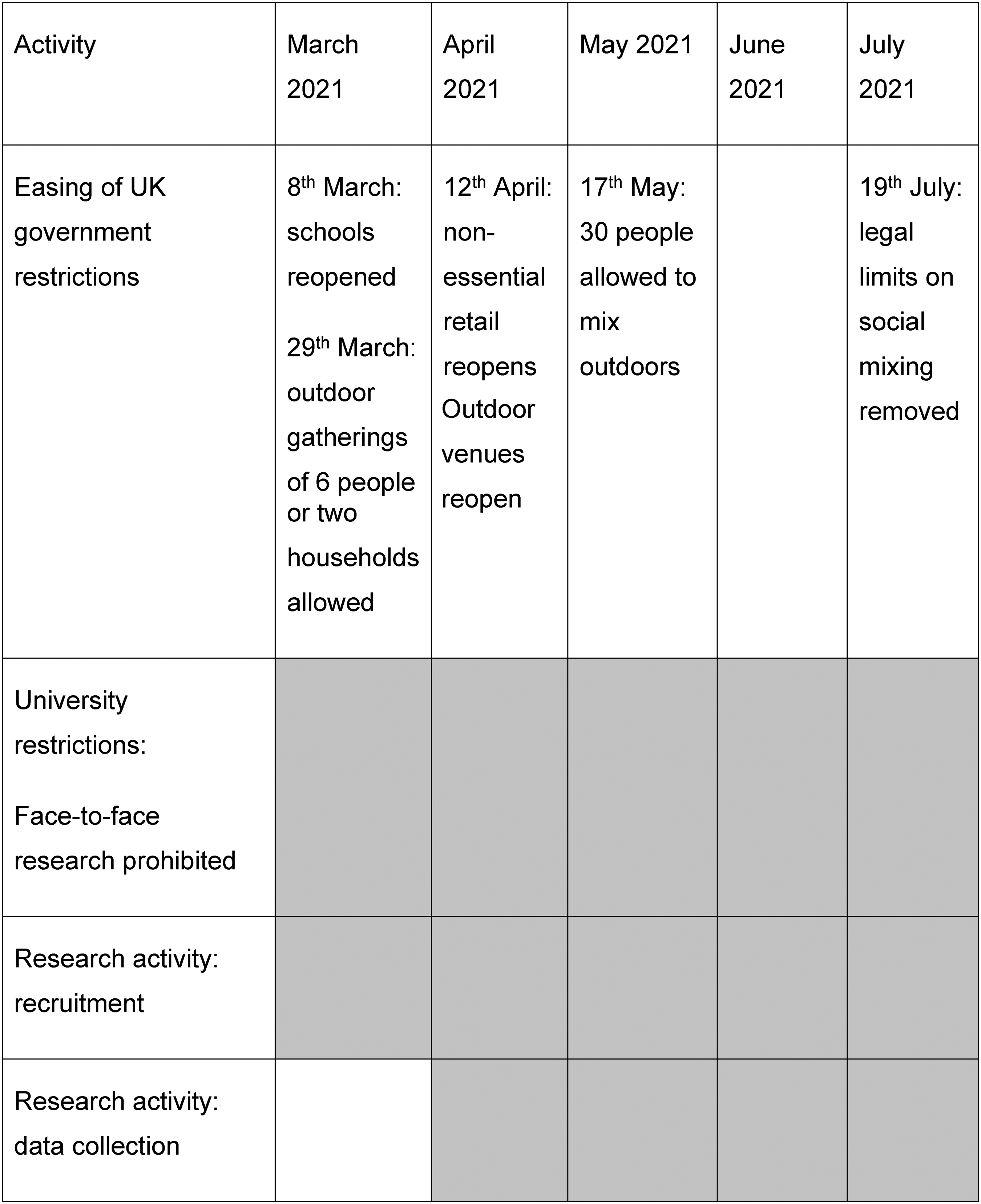
Lockdown and research timeline.
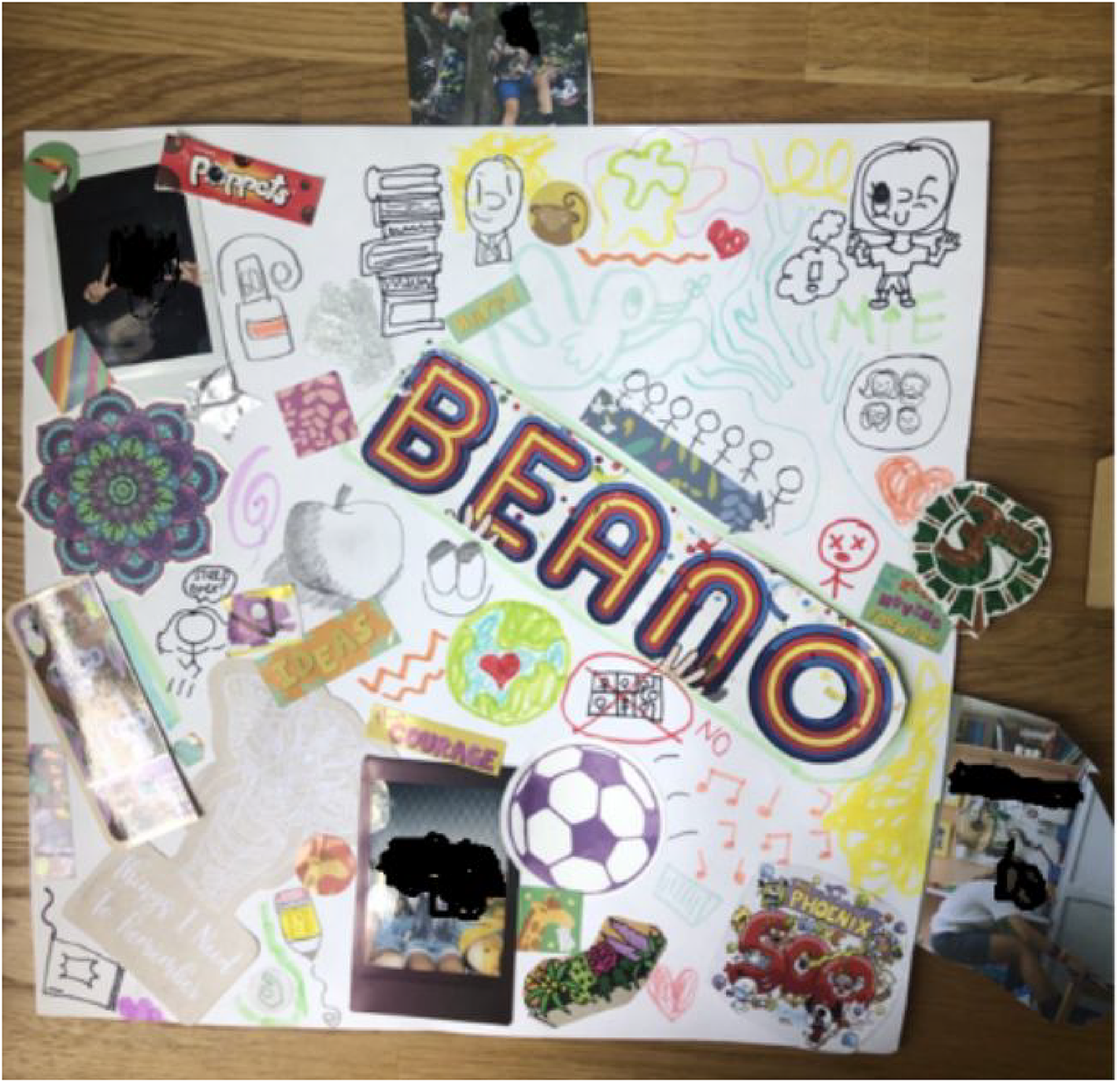
Poppy's artefact with combined collage, drawing and photography.
Consequently, the methods needed to provide opportunities to build familiarity and trust with the children, recognise interests, preferences for expression and consideration of the resources available in the home especially during the COVID-19 context. Therefore, a flexible multi-method approach was employed, and each method was critically reflected upon to consider the positives and any potential issues that may have arisen, particularly in relation to the online experience (Groundswater-Smith et al., 2015). Children were provided with a range of creative methods for participation, including creating a drawing (Carter and Nutbrown, 2016), a poem, friendship map (Author, 2014), use of photography or another creative medium of their choice. The examples of creative methods that we gave children required few resources enabling access to children from a range of backgrounds. We chose to give children a variety of options through which they could participate allowing them to draw on their agency when deciding how to take part in the study. This agentic way of producing knowledge is one way that we responsively navigated the ethical maze. This was followed up with an open-ended online unstructured interview with children (via zoom) so they could share their artefact and provide commentary upon it (Barley and Bath, 2019). Completing the artefact in advance of the interview allowed participants to become familiar with the research project and topic before being directly asked about it.
Open-ended online unstructured interviews
Open-ended online unstructured interviews were an essential part of the research for listening to children's perspectives and gaining emic perspectives about the artefact that each child had produced (Barley and Bath, 2019; Clark, 2017; Russell, 2007). Another purpose of the interview was to check meaning and to avoid misinterpretation or adult interpretation of the artefact (Darbyshire et al., 2005; Barley and Bath, 2019). The interviews focused upon what the children had to say about the artefacts they had produced rather than the artefact per se allowing children's voices and their interpretations of the artefact to be heard (Russell, 2007). Children and parents logged on via a number of different devices, computers, smartphones and iPads. As mentioned, parents were present for safeguarding reasons. Some sat at the back of the room while others were clearly visible on the camera.
The interviews were short in length and therefore appropriate for the age range of these children. The majority of interviews (seven) lasted between 18 and 34 minutes though one was substantially shorter (lasting for 4 minutes) and two were longer (48 and 54 minutes long). Two of the interviews included siblings while the others were all individual. Prompts focused upon what children wanted to share about their artefact and as advocated by Kyritsi (2019) children were permitted to take the interview in a direction of their choice. Before the interview started children were given time to familiarise themselves with the researcher and were encouraged to talk about themselves and their interests. These discussions lasted for a minute or two. Although this process was not as long or in-depth as it had been in our previous face-to-face projects it allowed participants to develop some familiarity with the researcher before the research interview commenced. Some children responded enthusiastically during these exchanges sharing their favourite toys and games with the researcher. Other children gave short answers and only offered fuller answers after further probing by the researcher. Parents were present during the online interview and as will be seen below some also prompted children by suggesting aspects that they could share with the researcher. All questions were directed to the children and while parents were asked to be present it was made clear to them in the participant information sheet that the interview was seeking the views of children. Questions started by focusing on the child's artefact and moved onto discuss children's friendships before during and after lockdown. Example questions that were asked included ‘Were you able to keep in touch with your friends during lockdown?’ or ‘How do you feel about not being able to see your friends in person?’ While each interview discussed friendships during the aforementioned time period each conversation followed its own direction.
The following findings section shows how the children responded in different ways to the online interviews. Some gave full and rich answers while others were more hesitant and did not respond to the prompts by the researcher. The Research Findings also show the role that parents played in these interviews and how some enabled their child to build rapport with and interact with the researcher when they were initially reticent.
Research findings
As we have highlighted so far in this article a process of familiarisation to build rapport with participants is an important part of qualitative research, particularly when working with children and young people where wider societal power relations are at play. The previous section highlighted the ways we adapted best practice in this area to an online context. This section discusses some methodological and ethical aspects that arose during the project relating to the agentic nature of the artefacts, the challenges of building rapport online and the role of parents in the online interviews.
The agentic nature of the artefacts
Two children selected to make an artefact using a method of their choice. They both chose to produce a collage. One of the two children, Poppy, made a collage but also incorporated two other suggested methods, namely drawing and photography. This indicates this child felt comfortable to exercise agency and produce an artefact that aligned with their own preferences (Barley and Bath, 2019; Milstein, 2010). Having the freedom to participate in a medium of their choice, including options not suggested by the researchers, is an important tool in ensuring that a participant, especially a child participant who is often considered by ethics committees to be ‘vulnerable’, actively gives their informed consent to take part in a research project (Johnson, 2008). The agentic way that knowledge is produced in these research instances is one way that the ethical maze can be navigated responsively (Artefact 1).
Great, so tell me about it. Tell me about what you created?
Well, I just sat and drew like things that represented what I did in lockdown. So, I took a couple of pictures, and, yeah!
Good. Yes, so you’ve got a picture that you tried to put in all of the things or rather some of the things that you’ve done during lockdown. Yeah? And so, what was the first thing that you actually put down there when you created it?
Well at first I put down two photos of my friends, and we met up in lockdown, because the first photo that I put down was when we had my party, and we had just come out of lockdown, so it's lucky that we could do the party but I've introduced the picture of my friend Gemma The other picture is taken a bit more recently, and it's my friend Megan and Gemma, and Megan . And that wasn’t really in lockdown, but I stuck it there anyway.
Okay, thank you, that sounds really interesting…Tell me a little bit about your friends?
(Interview extract 1: Poppy)
In response to this question Poppy told the researcher about her two key friends and the different ways that they stayed in touch during lockdown including becoming ‘pen pals’ and calling each other on zoom. She described these ways of maintaining contact with her friends in detail.
As can be seen above, Poppy's collage artefact emerged as she thought about the research questions. She started by including two photographs of her friends, then drew pictures and stuck down images to represent her experience of lockdown. The open research brief gave her agency over the ways in which she chose to participate in the research project. The conversation with Poppy above also reveals how her artefact helped to create an online research space that produced rich visual and textual data.
The challenges of building rapport online
While the creative visual methods helped to build rapport with some child participants, as in the case of Poppy's contribution above, this was still a challenging part of doing this project online. In other interviews it was more challenging to build this rapport and trust with participants. Two out of the 10 participants who were interviewed were reluctant to share their artefact with the researcher at the start of the interview though two agreed to share this at a later stage. A further three participants decided not to produce an artefact for the interview. A mother of one of these participants, Arthur, told the researcher that he didn’t know what to produce as he played on his PS4 during lockdown and used this tool to keep in touch with his friends. This participant was hesitant during their interview and gave a lot of one-word answers throughout:
Was it easy to stay in touch with your friends during lockdown?
No.
No? What did you do? Did you stay in touch with them at all?
Just a tiny little bit.
How did you do it? How did you stay in touch with them?
Because one of them normally stays on PS4 and he doesn't play any games, he just wants to talk.
So, you've been using PS4 not just to play games but to also call each other?
Yeah.
Is that easy to do?
Yeah, it's quite easy.
Do you find that the easiest way to stay in touch or do you use anything else to stay in touch with them?
Normally just that.
(Interview extract 2: Arthur)
As can be seen Arthur's responses are much shorter and not as rich as Poppy's responses in the first interview extract above. We found it more difficult to build rapport in an online forum than during face-to-face research with children that we have undertaken in the past. While asking children to produce an artefact was a way-in for most interviews, opening up a discussion about the research topic, the quality of interview data was still variable with some participants giving full answers, as shown in Poppy's extract above, while others, such as Arthur, gave much shorter responses that were only briefly elaborated on after prompting from the researcher. While it was necessary for our interviews to be conducted online, this online forum did restrict the building of rapport for some participants.
The role of parents in the online interviews
Although all child participants completed a consent form (in addition to the parental consent form) and verbally agreed at the start of the interview to take part in the research project hesitancy during the interview raised ethical dilemmas in the project around the voluntary nature of research online with a parent present. While in face-to-face projects we are experienced in reading children's body language and the different strategies that children can use to block the researcher (Barley and Bath, 2014a) this is more challenging to read and therefore to respect the privacy of participants in an online setting. Additionally, in an online setting in the home other family members (other than the safeguarding adult) may have been within hearing range. This has further potential implications on privacy and accessing children's voices.
There was also a fine line in relation to parental involvement in the interviews with two parents taking on the role that Mannay (2016) describes as ‘intrusive others’. The example below which is in relation to the second lockdown highlights this point:
How did that make you feel?
I was a bit annoyed because it meant I would have to go through being bored again.
I think you coped with it really well, the second one. … studious. Because the school put a lot more stuff in place, there was a lot more proactively getting kids …. Meetings and so there was like two or three meetings a day with the class and I think that really helped.
(Interview extract 3: Zara)
As this example shows it can be difficult to gain a child's own perspective when a parent intervenes in the interview. This only happened in one of our interviews. It can be similarly difficult to disentangle a child's answer from a parent's when the parent contradicts the child or reflects their own concerns or perspectives in the interview. While parents’ perspectives on the impact of lockdown on children's wellbeing are an important topic this was not the focus of our research project. One strategy that we used in instances such as these was to repeat the question but explicitly direct it to the child. Our guidance to parents before the interview clearly stated that we were seeking children's views. In hindsight though, we should have restated this to parents at the start of each interview to remind them of their role.
In contrast to this, other parents took on a more enabling role:
Arun's parent sat further back in the room. Part of him could be seen visibly on zoom (no face). On a few occasions, Arun turned around to ask the name of something or for an idea or prompt. This seemed to provide scaffolding and the odd word, phrase or sentence was enough for Arun to independently get into his stride.
(Extract from Researcher's reflective notes)
What about feeding the birds?
Oh, on the first lockdown they were like – we used to put food for the birds … but they came and suddenly different animals or something like a fox, a badger, and all the different animals. So, there was like a competition in my school for when there was lockdown and they said to draw something you did in lockdown, so I drew that picture where all the animals are and me feeding them.
Ah, so you put food out for the birds in the porch, and then you got birds, but also other animals.
Yes. A fox and a badger. And mice, mouses. Rats, yes.
(Interview extract 4: Arun)
Here the parent enabled the child without putting words into their mouth or telling them what to say. The parent's interjection was a way of jogging the child's memory. In this instance, it also helped the child be at ease and feel more comfortable to elaborate. Sometimes children want to talk to adults but are unsure of what to say or their mind goes blank. This was especially important with us not being able to set children at ease in person and undertake a full familiarisation process as we have done in previous projects (see Barley and Bath, 2014b for more details). However, as seen above, we acknowledge that parental input can at times be intrusive as well as enabling as it is in this instance.
Discussion
This article started by arguing that to facilitate children's full and active participation in a research project a reflexive process of face-to-face familiarisation is considered to be good practice (Albon, 2021; Barley and Bath, 2014b; Busher, 2019; Frödén, 2019; Gelir, 2020). As we have seen though, methodological and ethical questions were raised due to the COVID-19 pandemic and resultant lockdowns, when research practices were forced online curtailing established research practices with children. Researchers were required to reflexively navigate the interplay between responsiveness and responsibility to enable ethics to be managed in situ in this largely unexplored research environment.
The right to be heard
The first ethical quandary that we considered as a research team was how best to ensure that children's voices were heard so that their experiences of lockdown and the curtailment of another of their rights, that is, the right to mix freely with their friends, was not silenced amidst the wider public health narrative (Lomax et al., 2022).
As Bell (2008) argues researchers have an ethical obligation to incorporate respect for human rights that are placed on society at large in their research practices, including children's rights to participation and have their voices heard on matters affecting them irrespective of external circumstances as outlined by Article 12 of the UN Convention on the Rights of the Child. While COVID-19 lockdowns created challenges for researchers in relation to this, researchers had an ethical obligation to develop participatory approaches that complied with the restrictions, as we did in this project, allowing children's voices to be captured as effectively as possible given the restrictive circumstances we were all living and working under during the pandemic. In doing so, we adopted a multi-ethical approach, as called for by Bodén (2021), to ensure that ethics was considered both in terms of inclusion (in capturing children's voices that were noticeably absent in government policy at the time) and fairness (by utilising an open research brief).
Responsively navigating the ethical maze using creative research methods
Giving children an open brief to design their own creative/visual research artefact enabled them to communicate their ideas and feelings in a medium of their choice and ensured that they were comfortable with and had experience of using the chosen research tool while also reducing power differentials between adult researchers and child participants (Johnson, 2008). The agentic way that knowledge was produced by this open brief was one way that the ethical maze was navigated responsively throughout this project.
Undertaking this participatory activity alongside the use of open-ended online unstructured interviews to gain children's perspectives allowed us to enlist children's cooperation in the research process and helped to create, what Milstein (2010) describes as, ‘horizontal relationships’ between adult researchers and child participants. The timing of these research activities was also important to ensure that children were able to collaborate in these processes. Children were asked to produce their artefact before having a conversation with the researcher allowing them to become familiar with the research project and the topic that the interview was going to cover. Given the constraints that we were working within due to the COVID-19 pandemic and resultant restrictions regarding face-to-face research being creative to children's participation online was an important consideration in our research design. The data examples in this article have shown that building rapport online with children was challenging and produced varying levels of engagement. Developing further strategies to build relationships with child participants online, for example through a series of online activities and accompanying interviews, is recommended to build stronger rapport in future projects.
The role of other adults
Our experiences of having parents present online for research activities were mixed. While we experienced a minority of parents taking on the role of ‘intrusive others’, as described by Mannay (2016) we also found other parents taking on a supportive and prompting role that facilitated their child's fuller participation in the research activities without taking over the interview or putting words into their child's mouth. To achieve this enabling role in future projects we advise that researchers give parents and other adults specific guidance on how to undertake this supportive stance both in written participants information sheets that participants receive before agreeing to take part in the project and at the start of all data collection exercises.
Concluding thoughts
While our research reveals that there are ethical quandaries to undertaking research online with children and families it also shows that online research can be a useful tool when face-to-face research is not possible. While this research was conducted in an unprecedented lockdown situation due to a global pandemic there are other situations where online research with children may be required or even be the best option, such as research with children who are immunosuppressed, hospitalised or have mobility challenges, projects where research funding and travel budgets are restrictive, research with geographically isolated communities or research with children in disaster zones. Online research can also enhance international projects where international travel is not possible for a variety of reasons. As Keen et al. (2022) argue the opportunities for online research should not be overlooked even when face-to-face research is permitted. While issues of access to resources need to be carefully considered when doing research online to ensure that potential participants are not excluded, doing research online can, when reflexively managed, increase access for participants who are not able to take part in face-to-face research for a range of reasons associated with health, mobility and geographical contexts.
Returning to Article 12 of the UN Convention on the Rights of the Child, which states that children have ‘the right to express [their] views in all matters affecting [them]’ (Lansdown, 2011: 1), online research with children and families can be a useful tool that researchers can use to gain children's perspectives of their social worlds in situations where more traditional approaches are not possible. Being responsive to ethical challenges in situ (as advocated by Russell and Barley, 2022 and Milstein et al., 2022) and ensuring that ethical process are fluid and co-produced is an important ethical journey that all researchers need to actively engage in. As Milstein et al. (2022) point out, the meta-ethics involved in this process must underpin both the theoretical and methodological strategies that we adopt in our research projects to allow ethical challenges to be responded to reflectively facilitating collaboration between researcher and participants.
Footnotes
Declaration of conflicting interests
The authors declared no potential conflicts of interest with respect to the research, authorship, and/or publication of this article.
Funding
The authors received no financial support for the research, authorship, and/or publication of this article.

Author biographies
Ruth Barley is a Reader in Sociology at Sheffield University. Her research interests lie within the area of cultural diversity, identity and inclusion and more specifically in relation to how children conceptualise and operationalise identity and the impact that this has on their development.
Caron Carter is a Senior Lecturer in Childhood & Early Childhood Education at Sheffield Hallam University. Her work focuses on children's friendships and well-being. She is an Assistant Editor for the International Journal of Pastoral Care in Education.
Arwa Omar is a PhD student at Sheffield Hallam University. Her doctoral research focuses on the overlapping relationship between theory of mind, executive functions and mathematics achievement.