




Abstract
Zines have recently emerged as methodological tools in qualitative research seeking to deploy arts-based approaches that foreground agency, collaboration, creativity, affect and critique. This article reflects on the use of zine-making as method in a project focused on Kingston and Arthur's Vale Historic Area, Norfolk Island. The article analyses seven methods used in making zine content: sticky notes, memory prompts, story completion, letter writing, interpretive text, conversations and participatory mapping. The article positions the project's multi-method approach to zine-making as a form of critical cultural justice inquiry. We discuss zine-making in terms of its sociable qualities, as well as its capacity to support representational belonging and a sense of ownership among participants over project outputs. As part of critical cultural justice inquiry, zine-making can enable ‘doing research otherwise’ – resisting extractivism and instead emphasising building relationships, engaging in dialogue and co-creating resources for hope and action.
Keywords
Introduction
Zines are self-published magazines, with a do-it-yourself ethos and cut-and-paste aesthetic. Historically, zines have been produced as part of fandoms, musical subcultures and social movements. Such zines enabled their makers ‘to record their stories, share information and organise’ (French and Curd, 2022: 78) and to ‘affectively and materially draw[] the personal and political together on the page’ (Lupton and Watson, 2021: 470). While zines vary in terms of their purpose, themes and aesthetics, zine cultures tend to be rooted in an ‘anti-institutional’ ethos (Fife, 2019: 229) or opposed to what readers and makers consider to be ‘mainstream, repressive’ or ‘exclusionary’ (Watson and Bennett, 2021: 118). Zine-making enables its creators to be transformed from ‘passive observer[s] into active participant[s]’ in cultural production (Worley, 2015: 81), documenting and circulating their stories on their own terms. In recent years, zine-making has also emerged as a methodological tool in research projects seeking to deploy arts-based approaches that emphasise agency, collaboration, creativity, affect and critique.
This article reflects on the use of zine-making as method in the Australian Research Council-funded project, ‘Reimagining Norfolk Island's Kingston and Arthur's Vale Historic Area’ (2021–2024). Kingston and Arthur's Vale Historic Area (KAVHA; also referred to as Kingston or, in the Norf’k language, Daun’taun or Taun) is a UNESCO World Heritage Listed site on Norfolk Island, a small island in the South Pacific Ocean approximately 1600 km east of Sydney, Australia. KAVHA is 1 of 11 Australian Convict Sites in the World Heritage listing. After the British penal settlement of 1825–1855 was abandoned, Kingston became home for the Pitcairn Islanders. In 1856, the entire population of Pitcairn Island relocated to Norfolk Island. The 194 descendants of Polynesian women and British men (including mutineers of the HMS Bounty) who settled Pitcairn in 1790 brought with them to Norfolk their own language, culture and traditions (Hayward, 2006).
The Pitcairners were of the understanding that Queen Victoria had ceded Norfolk Island to them. However, in the years that followed their arrival, the Pitcairners’ right to self-determination became increasingly tenuous. With the Commonwealth of Australia passing the Norfolk Island Act 1913, the island was declared a Territory under Australia's authority. The Pitcairn settler descendants continued to fight for self-determination, and a revised Norfolk Island Act 1979 eventually offered a degree of self-government and included a preamble that recognised the importance of Pitcairn traditions. However, this Act was overturned by the Commonwealth in 2015, the preamble repealed and self-government abolished (Wettenhall, 2018). At the time of writing, a process was in place to devise a new governance model for the island with the purpose of restoring democracy (Joint Standing Committee on the National Capital and External Territories, 2023). As Gonschor and Nobbs (2021: 228) have detailed: Since the Islanders have their own unique mixed Polynesian-European language and culture, did not displace or oppress any people who lived on the island prior to their arrival, were later subjected to the colonial rule of a third country, and define themselves as Indigenous, the [Pitcairn descendants of Norfolk Island] meet all international requirements to be recognized as an Indigenous people.
Injustices are felt deeply by Pitcairn settler descendants and others with long and deep connections to Kingston because it is a site of living heritage; that is, it is a place where Pitcairners have had ongoing associations, physical presence and ‘inherent obligations’ to care for the site since becoming custodians of the area in 1856 (Poulios, 2011: 150; see also Evans, Baker and Cantillon, 2024). With a focus on living heritage, the Reimagining KAVHA project took a critical cultural justice inquiry approach – a conceptual, methodological and practical framework for addressing cultural injustices in research and practice – to explore how cultural injustices are reinforced or resisted in relation to heritage management and interpretation in KAVHA. Key to this work has been a concern for accessible, timely outputs and an open-access data set that can be utilised by community members when advocating for self-determination in Kingston. Central here has been the co-creation of zines with Norfolk Islanders, inviting community members to reimagine KAVHA in ways that amplify Pitcairner experiences and heritage. The Reimagining KAVHA zine series includes a total of eight zines published from 2021 to 2023, all of which are downloadable on the project website (see https://reimaginingkavha.com) as well as having a limited print run for distribution to participants, archival repositories and other locations on Norfolk Island.
The article begins by introducing and defining what we mean by critical cultural justice inquiry, followed by an overview of zine-making as a participatory, arts-based method within qualitative multi-method research. We unpack seven methods used in making content for the Reimagining KAVHA zine series: sticky notes, memory prompts, story completion, letter writing, interpretive text, conversations and participatory mapping. The article discusses zine-making in terms of its sociable qualities, which emphasise agency and collaboration. We stress that striving for cultural justice is an ongoing process, and that the multi-method approach to zine-making enables the kind of accessibility and flexibility necessary to support representational belonging and a sense of ownership among participants. The article concludes with a reflection on how critical cultural justice inquiry entails ‘doing research otherwise’ – resisting extractivism and instead emphasising building relationships, engaging in dialogue and co-creating resources for hope and action.
Critical cultural justice inquiry
Cultural justice refers to ‘doing justice to and through culture – valuing cultural infrastructure, rights, identities, materialities, institutions and work, and attending to matters of power, representation, participation and access’ (Cantillon et al., 2024: 472). Critical theorists and cultural studies scholars have conceptualised cultural justice in relation to the politics of representation as implicated in recognition, respect, dignity and equity (Denning, 2004; Fraser, 1995; Ross, 1998). Like other forms of justice (social, environmental, racial, distributive, creative), cultural justice is concerned with power and inequalities, but ‘offers a more precise lens through which to consider the cultural dimensions’ and expressions of justice (Cantillon et al., 2021a: 75). A focus on cultural justice can expand critical understandings of the symbolic and material consequences of cultural practices, processes, products and policies. For example, in a heritage context, an emphasis on the cultural dimensions and expressions of justice can reveal how politics of recognition and representation signify who is valued in society, who belongs in which spaces and whose stories will be transmitted to future generations. Cultural justice operates alongside other forms of justice but shifts attention to the processes and actions through which cultural domination, nonrecognition and disrespect ‘are resisted, subverted and challenged through discursive and material practices’ (Cantillon et al., 2021a: 75).
Sarah and Zel have been developing cultural justice as a conceptual and methodological framework over the course of several collaborative research projects in the field of critical heritage studies (Cantillon et al., 2021b; Long et al., 2017, 2020). Sarah and Zel initially proposed three key tools for application in a heritage context: preservation (e.g. archiving, collecting, protecting built heritage); storytelling (e.g. through heritage interpretation, exhibitions, tours); and community mobilisation (e.g. coming together for activism, protests, fundraisers, education) (Cantillon et al., 2021a). Based on a three-year study of popular music heritage in deindustrialising cities, Sarah and Zel developed 16 principles for heritage practitioners seeking to embed cultural justice values into their work. Broadly, these principles encompassed a commitment to accessibility; an aim to capture diverse voices, identities, expressions and experiences; the building of community relationships and development of trust; the reinstatement of dignity and respect through education; a sensitivity to cultural diversity; fostering an inclusive environment for participation; the cultivation of civic pride; and working toward social change (Baker et al., 2023b).
In more recent years, Sarah and Zel in collaboration with Chelsea have been further developing cultural justice conceptually, methodologically and practically through the Reimagining KAVHA project. The research team brings together two residents of Norfolk Island (Sarah and Chelsea) and one resident of the Gold Coast, Australia (Zel). Chelsea is a Pitcairn settler descendant. Sarah and Zel are of British (Sarah) and European (Zel) descent, with Sarah settling on Norfolk Island in 2019. Analytically, the project's research design is concerned with addressing the ‘symbolic annihilation’ (Caswell et al., 2016) of Pitcairn Settler descendants in KAVHA's heritage management and interpretation. Methodologically, cultural justice considerations inform how we engage with participants in ways that enable ‘representational belonging’ (Caswell et al., 2016). The project's use of zine-making is not only intended as a means ‘to collect data about cultural injustices but to equip participants with practical tools and processes to reflect on, discuss and resist these injustices’ (Baker and Cantillon, 2022: 545). As we have noted elsewhere, the project strives ‘to implement cultural justice as a methodological approach through zine-making workshops that maximise agency and collaboration to create co-produced public history outputs that have the capacity to act as community archive’ where representational belonging can be realised (Baker and Cantillon, 2022: 545). Here, the quest for cultural justice resides in addressing a community's marginalisation in heritage management and interpretation, working with participants to return them to ‘the fabric of time and space’ (Ware, 2017: 176) in KAVHA, and providing a creative means for participants to recall and reclaim past, present and future custodianship of Taun.
We propose critical cultural justice inquiry as an approach that attends to cultural justice as: (a) a conceptual orientation for analysing cultural institutions, products and practices; (b) a methodological approach that prioritises collaboration, multiplicity and reflexivity in research design; and (c) a practical strategy that offers resources, tools and guidance for cultural practitioners, activists and community members. A critical approach necessitates that cultural justice is not a pre-given outcome; cultural justice is not something that can be ‘achieved’, but an ongoing process ‘that involves continuous effort and engagement with different stakeholders, attending to their specific (and sometimes conflicting) needs, desires and interests’ (Baker et al., 2023b: 64). In this article, we consider how critical cultural justice inquiry might unfold methodologically through the specific case study of zine-making in the Reimagining KAVHA project.
Qualitative multi-method research and arts-based research practice
‘Qualitatively driven multimethod research’ is defined by its use of more than one qualitative method in research design (Hesse-Biber et al., 2015: 6). In the Reimagining KAVHA project, multi-method research design is underpinned by a primary qualitative method: the participatory, arts-based research method of zine-making. Zine-making is one of a multitude of representational forms that arts-based research can draw on to enhance engagement at all stages of the research process both in relation to project participants and research audiences (Chilton and Leavy, 2020: 407). Chilton and Leavy (2020: 407–408) note that the results of arts-based research can be ‘emotionally and politically evocative because of the aesthetic power’ of this form of public scholarship, while also being ‘congruent with social justice goals’ through providing ‘ways of knowing’ that ‘liberate[] voice and embrace[] a pluralist community of inquiry’. Finley (2011: 443) argues that arts-based research enables people to ‘imagine new visions of dignity, care, democracy and other decolonizing ways of being in the world’. It is a research paradigm ‘committed to democratic, ethical and just research methodologies’ leading to outcomes that have ‘usefulness to the community in which the research occurs’ (Finley, 2011: 435), being a ‘tool’ which ‘a community can use in their performance of community-based activism’ (436).
Zines can spark community conversations by offering a multitude of ‘voices and perspectives’ (Chidgey, 2014: 101). Being ‘spaces of dialogue, learning, and hope’, zines ‘encourage readers to become participants by putting thought into action’ (Chidgey, 2014: 108–109). As such, zines have been described as enabling the democratisation of knowledge – creating spaces where a broad range of publics can document their lives and ‘counter the hegemonic stronghold of cultural production and expression’ (Ramdarshan Bold, 2017: 226). As a method, researchers have turned to zines to support an array of qualitative inquiries related to phenomena such as family life history research (Ghorbani, 2017), toxic poisoning (Velasco et al., 2020), location-based virtual reality experiences (Nash et al., 2022), sexual harassment in the night-time economy (Lamond et al., 2023) and older punk women's conceptualisation of punk (Way, 2024). What the literature on zines as method tends to have in common is an understanding of zines as productive tools for both data collection and analysis as well as an emphasis on the participatory dimensions of zine-making.
In regard to heritage specifically, the potential for zines to capture marginalised cultural narratives has played a part in the recognition of the value of zines as historical records (see e.g. Lymn, 2013, 2014), but also led to debates around their place in institutional collections given zines are usually not created with the intention of being archived (see e.g. Brett, 2022; Fife, 2019; Poletti, 2019). When used as a research method, zine-making can be devised with participants as an intentional heritage practice for lodgement in archives, but zines can also function as a form of community archive. Baker and Cantillon (2022) illustrate how zine-making can purposefully capture the community archiving principles of participation, shared stewardship, multiplicity, archival activism, reflexivity (see Caswell, 2014), affect (see Caswell, 2020) and collaborative reminiscence. In a museum context, French and Curd (2022: 90) have detailed how zines, as part of a participatory action research toolkit, ‘possess capacities that cut to the heart of key issues within contemporary museology’ including ‘diversity, power and representation’. They note in their research that zines ‘acted as visionary tools to articulate, rearticulate, imagine and reimagine how things could be done differently’ in museums (French and Curd, 2022: 91).
The Reimagining KAVHA project supports zine-making as arts-based method by using a plethora of auxiliary qualitative methods from the humanities and social sciences, each of which is outlined in detail below. McKendrick (1999: 41–43) identifies eight goals of tactical and pragmatic multi-method research that ‘are not mutually exclusive’: (1) address ‘weaknesses in existing data resources’; (2) ‘breadth of understanding’; (3) ‘gain the confidence of an audience’; (4) identify case studies for ‘subsequent detailed examination’; (5) ‘situate case study findings in a broader context’; (6) confirm ‘a research conclusion with supporting evidence’; (7) ‘tease out meaningful inconsistencies’; and (8) ‘address different aspects of the same research question’. In the Reimagining KAVHA project, the multi-method design reflects, in particular, McKendrick's (1999) goals 2, 3 and 8 whereby multiple methods are deployed tactically to approach the research question from different angles and in ways that enhance the credibility of the data set. The status of each auxiliary method is not fixed, with Hesse-Biber et al. (2015: 6) noting that methods ‘may be afforded equal, adjunct, or greater status’ in their service to addressing a project's ‘evolving set of research questions’. As such, the value of multi-method research is its capacity to draw researchers’ attention to ‘the numerous decision points of research’ around the question(s) being asked and the purpose of the question's answer (Hunter and Brewer, 2015: 619).
The multi-method approach to the reimagining KAVHA zine series
We facilitated six zine-making workshops on Norfolk Island between 2021 and 2022, each lasting 2–3 hours with 3–6 participants. We held an open call for participation for the first two workshops, with Chelsea, a Pitcairn descendant, recruiting participants for the remainder of the workshops, targeting people who had lived in buildings in Kingston (workshops 3–5) and younger islanders who were known to utilise the site in different ways (workshop 6). The workshop structure was consistent across all six workshops. We commenced with an overview of the project and an introduction to zines, three to four writing activities (with participants sharing results between each activity), and finally the making of zine pages using the writing produced during the workshop. The activities drew on a variety of methods detailed below – sticky notes, memory prompts, story completion, letter writing and interpretive text. The majority of participants were fully engaged with every aspect of page creation – writing content, selecting images, cutting, pasting, arranging on the page, and so forth. Some participants asked for our assistance in designing their pages. While those participants wrote their own content, they would provide us with direction on its placement on the page or what images and decorations should accompany it. Guiding our engagement with the participants was the understanding that the zine pages were to be produced on the participant's own terms. At the end of the workshop, participants decided which of their pages they wanted published in the zines and what content would be discarded. Participants were also aware that the workshops were being audio-recorded and that extracts from these recordings would be used in research publications.
Material for the zines also emerged from outside the zine-making workshops, including from solicited and unsolicited submissions by four contributors and from edited transcripts of interviews to which the project had various approaches – semi-structured, photo elicitation, place-based and walking. We included content from these interviews in the zines as ‘conversations’. Conversations were revised through the process of transcription. Aspects of the conversation that were outside the project's focus on KAVHA were removed from the transcript and an abridged ‘zine edit’ was presented to participants for checking. Participants were then invited to add to the conversation or remove sections. In some cases, multiple checks were undertaken before a participant was satisfied the conversation was ready for publication. We then created the zine pages for the conversation. If images were not provided by the participant, we selected archival images or contemporary photographs we had taken of KAVHA that reflected the content of the conversation. A total of 22 interviews were undertaken involving 26 participants. Extracts from 20 interviews were included in the Reimagining KAVHA zine series.
In addition to the zine-making workshops and interviews, we held a separate series of workshops in September 2022 focused on participatory mapping (see Baker et al., 2023a). Three workshops held over three consecutive days, each three hours long, were run on a ‘drop-in’ basis so participants could choose the length and depth of their engagement. We reproduced all of the resulting collaborative and individual maps in the zines. A total of 27 participants attended the workshops and 11 of those had previously been interviewed or been involved in a zine-making workshop. Overall, the project engaged 69 participants. Beyond the participant-generated content for each zine, the research team created cover and back pages, front matter sections, editorials (contextualising the zine's content in terms of the project's key themes, conceptual frameworks and quotes from participants, alongside images taken during fieldwork), filler pages and acknowledgement pages.
Below, we provide an overview of each method used to create zine content with participants: sticky notes, memory prompts, story completion, letter writing, interpretive text, conversation, participatory mapping. A common structure is used for each subsection – in most cases, beginning with an introduction to the method, followed by an outline of how the method was applied in the project, and what the outcomes of the method were.
Sticky notes
Sticky notes are deployed by researchers to invite participants to contribute ideas on specific topics, often with the intention to gather together and display participants’ ideas thematically to prompt further discussion. Peterson and Barron (2007: 144) argue that sticky notes are a useful addition ‘to the qualitative researcher's toolbox’ for ‘eliciting honest opinions from reluctant’ participants in group settings such as workshops, ‘enhancing’ participant ‘engagement and involvement’ in the data collection process. Sticky notes can be used for ‘identifying misconceptions’ (Peterson and Barron, 2007: 144) and ‘checking understanding, as well as … grouping and sorting ideas’ (Duarte et al., 2018: 3.18). Used in group settings, sticky notes have the capacity to ‘generate a shared outcome’ (Peterson and Barron, 2007: 144) with the collection of sticky notes offering assurance that all participants’ ideas are being acknowledged (Duarte et al., 2018: 3.18).
The Reimagining KAVHA project used sticky notes in two distinct ways. Firstly, in project information sessions held with community groups, we used sticky note exercises to give attendees a ‘taster’ of the types of activities that are involved in the zine-making workshops (see Figure 1). Attendees were asked to write on sticky notes words which ‘come to mind when asked: how does Kingston make you feel?’ and ‘that come to mind when you think of Kingston's Paradise Hotel’ (the focus of the first zine in the series, see Cantillon and Baker, 2022 for more detail on the significance of this site). Attendees were given a few minutes to write on one or more sticky notes and these were then handed back to us. At this point, we would randomly select a sticky note from the pile, read the word(s) aloud and ask if anyone would like to explain if and why the word(s) resonated with them. This would spark a series of comments from attendees with different associations with the word(s) – a kind of collaborative reminiscence (see Baker and Cantillon, 2022). The sticky notes collected from these community workshops were subsequently curated by us and produced as zine pages that capture the various feelings highlighted by attendees.
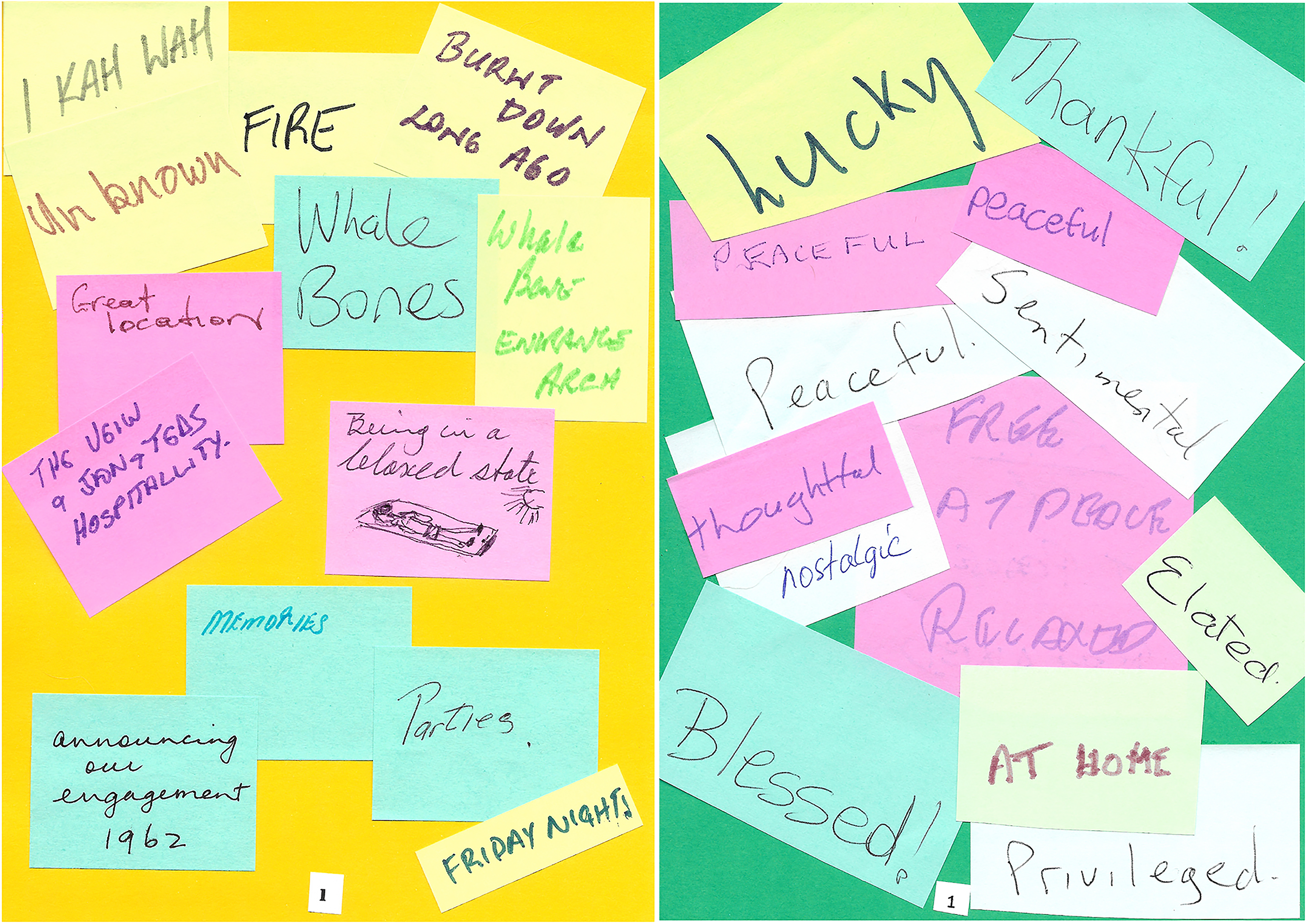
Pages from See You at the Paradise/Ketch Yorlye Daun Paradise (left) and Mais Daun’taun: Volume 1 (right) featuring collections of sticky notes.
Creating points of connection between people also informed the second-way sticky notes were deployed. In the zine-making workshops, we used sticky notes in an ice-breaker exercise to ease participants into thinking about their connections to place and to start the process of writing down their thoughts. In workshop 1, focused on the Paradise, Ken produced four sticky notes – ‘big fights’, ‘camaradery’ [sic], ‘amazing band nights’, ‘great open nights’ – which he later stuck on a single page using newspaper clippings as a backdrop (see Figure 2). Sticky notes were also added to pages as a kind of caption to provide personal resonance to an accompanying image or as an accompaniment to longer forms of writing. Koliin, for example, presented the words from the opening sticky note activity on a page which included a photograph of a sweeping view of Kingston and a piece of writing that emerged from a later ‘memory prompts’ activity (see below). The sticky note ‘MAI'S BAEK YAAD’ 1 summarised Koliin's selected image, while also positioning the memory in relation to her connection to place (see Figure 2). In the workshops, sticky notes offered insights into participants’ initial feelings or thoughts and often inspired deeper discussion and reflection. The use of sticky notes aligns with the principles of critical cultural justice inquiry as it makes the project more accessible at the outset, bringing participants into the research process in an inviting and low-stakes way.
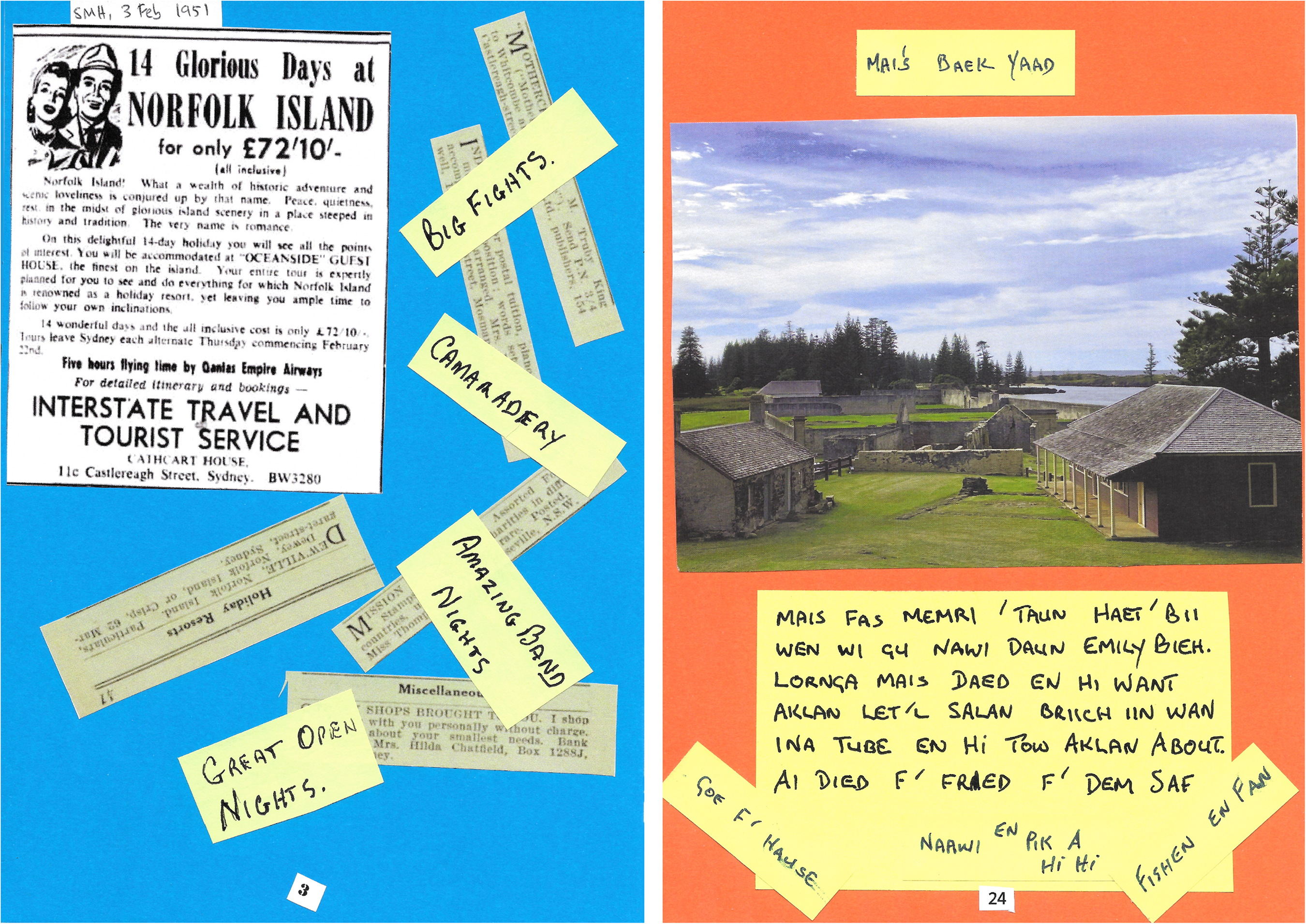
Pages from See You at the Paradise/Ketch Yorlye Daun Paradise (left) and Mais Daun’taun: Volume 1 (right) showing how sticky notes were incorporated into pages created by individual participants.
Memory prompts
Memory work 2 seeks to capture ‘processes of activating, eliciting, reflecting, framing, articulating, maintaining, inventing, communicating and “performing” memory’ (Marschall, 2019: 1661). It is not a single method per se but rather ‘can entail many different research strategies, [and] a multiplicity of methods to elicit, activate and “work” with memories’ (Marschall, 2019: 1661–1662). In our project, memory work involves activities that use memory prompts to elicit personal and collective memories. In the context of heritage research, this is an approach that understands participants as ‘a living, integral part of the heritage resource itself’ rather than ‘merely as sources of historical and cultural information’ (Marschall, 2019: 1664).
We included memory prompts in workshops 2–6, usually after the sticky note activity as a way to expand on initial word associations. Memory prompts varied per workshop but included two or more of the following: ‘My strongest memory is…’; ‘My favourite memory is…’; ‘My first memory is…’; ‘My most vivid memory is…’; ‘My happiest memory is…’; ‘My most beloved memory is…’; ‘My scariest memory is…’. Such prompts were crafted to elicit memories of place with different emotional resonances (positive, negative and ambivalent), capturing a diversity of experiences from across a participant's lifetime. Participants were given a choice of which prompt to complete. When participants worked through the activity quickly, many would go on to also write about the alternate prompt. In workshop 4, the participants resonated strongly with the activity; after completing the first two prompts, they requested additional types of memories to recall on paper – ‘alright, come on Sarah, what's another one?’ probed Alma.
Regardless of the prompt, the majority of memories were connected to participants’ childhoods. Time spent swimming with parents or grandparents at Emily or Slaughter Bays were recalled as strongest, first and happiest memories. Catching sand crabs with family members appeared as favourite and happiest memories. Other memories included walking dogs through the long grass and alyssum flowers at Cemetery Bay (strongest), riding on a motorbike with a parent to All Saints Church (first), attending Bounty Day with a parent (first), spending time with a grandparent under the pines at Slaughter Bay (happiest), a mishap with a horse (vivid), and scratching one's name on the family pew at All Saints Church (vivid). The memory prompts underscored that personal, everyday experiences constitute intangible heritage that is worthy of documentation.
Story completion
Story completion is a method emerging from narrative inquiry in which participants are provided with a brief opening ‘story stem’ that sets up a hypothetical scenario combined with a set of completion instructions (Clarke et al., 2019; Gravett, 2019; Lenette et al., 2022). Story stems are often designed to be in third person, distinguishing this method from traditional forms of self-reporting like interviews or diary writing that feature first-person accounts (Clarke et al., 2019: 2). With story completion, ‘participants do not have to disclose personal details about their circumstances’, and the method allows for creative approaches to the interpretation of and response to the provided story stem (Lenette et al., 2022: 2). Story completion has emancipatory potential for participants, with researchers gaining access to participants’ meaning-making and insight into ‘what discourses inform participants’ understanding’ (Lenette et al., 2022: 2). While story stems are usually fictional, Watson and Lupton (2022: 691) observe that the completed narratives ‘inevitably draw on story writers’ own embodied experiences and feelings as well as their acculturated understandings of the world’.
Workshops 1 and 2 were focused on a beloved former hotel, the Paradise, where locals and tourists could congregate on a Friday night to dance, drink and listen to live music (see Cantillon and Baker, 2022). Participants were provided with the story stem ‘It was Friday night down at the Paradise and…’. They were asked to complete the story either based on a particular memory, a combination of personal experience and observation, or, for participants who had not experienced the Paradise first hand, a story based on what they had heard about the hotel or what they imagined might unfold there. Participants were given three minutes to draft their story, with an additional one minute provided to tidy up the ending.
Though short, the stories provide insights into the importance of the Paradise in the social life of Norfolk Island as experienced by those who were there or imagined by those who were not (see Figure 3). Anona's story highlighted the Paradise as a place for romance and dancing. Merv recounted a bar fight. Clare's story was presented as dot points and directed attention to the staff (‘Merv behind the bar … Colleen cooking in the kitchen’), the mingling of locals and tourists, and music and laughter. Allan's story provided additional context for those themes: ‘Walking in the dark up the driveway, I could hear the music playing, and hum of many voices talking, laughing’. Taken together, the stories evoke the atmosphere of a night at the Paradise. Despite being an important part of the cultural infrastructure of Norfolk Island, the Paradise was demolished in the 1980s following the Australian Government's determination that the buildings detracted from the historic environment of Kingston (Commonwealth of Australia, 1985). Focusing the storywork activity on Friday night at the Paradise highlighted the injustice of the hotel's demolition, as well as the project's recognition of the Paradise as central to island life and its cultural value for being included in the historical record.
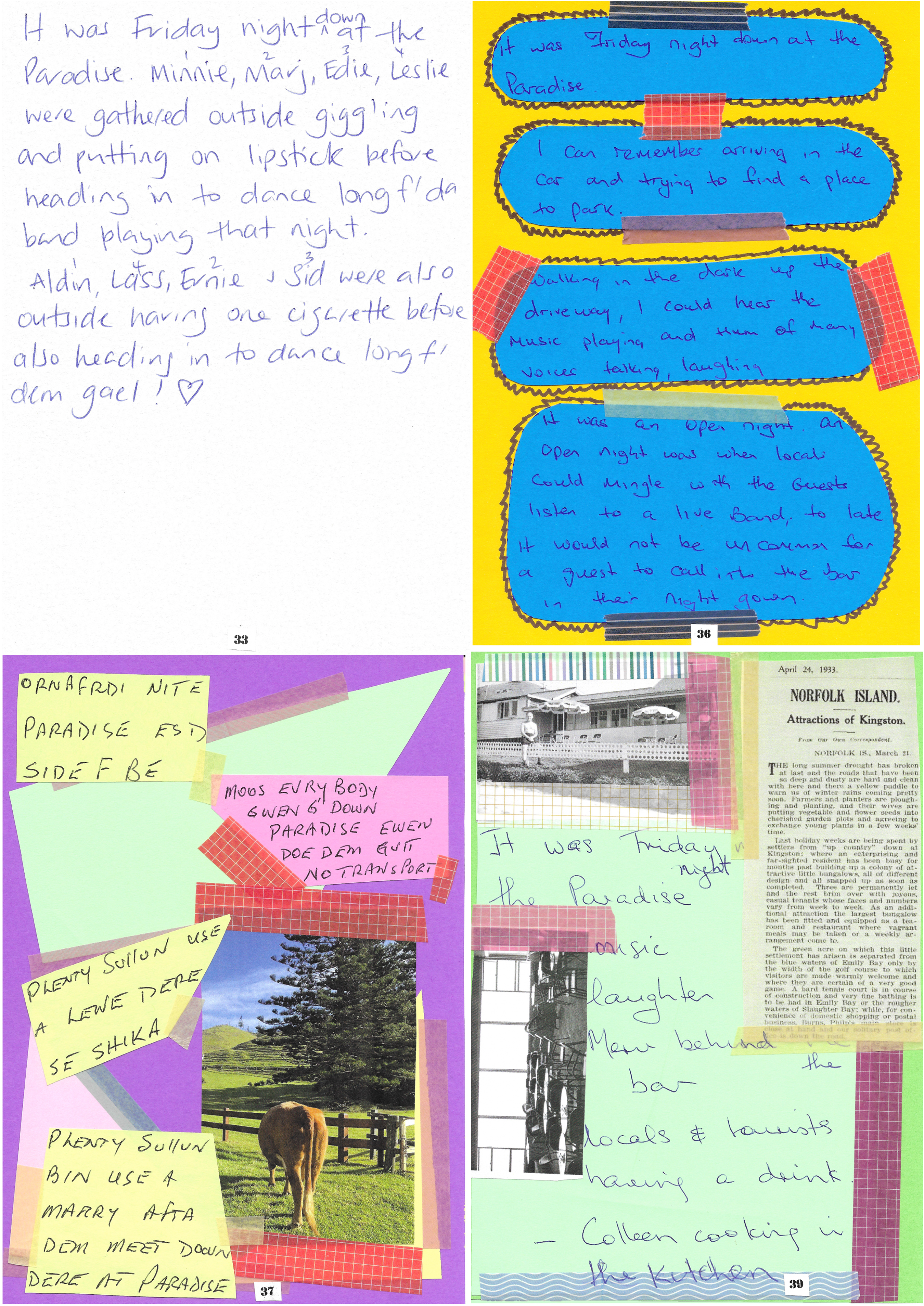
Examples of story completion from See You at the Paradise/Ketch Yorlye Daun Paradise.
Letter writing
Letter writing has long been used in therapeutic interventions as a technique for having patients ‘reflect on a problem, recording desired changes or conversations that they would like to have, but which they may be unable to verbalise face to face’ (Day et al., 2023: 2). In qualitative research, solicited letter writing can draw on many of the strategies already explored in the therapeutic context, including ‘changing the author of the letter (e.g. current self, future self), the addressee of the letter … and the temporal dimensions (i.e. past, present, future)’ (Day et al., 2023: 2). In their application of the letter writing method, Day and colleagues (2023: 12) note that the researchers’ role is to ‘provide opportunity and motive to write’. These authors emphasise that letter writing is a method that invites participants ‘to find their own space to open up their story’ and, ‘unprompted’, to think creatively about how to present ‘the thoughts, emotions, and lives’ they want to document (Day et al., 2023: 2).
We incorporated a letter-writing activity into workshops 3, 4 and 6 to explore participants’ intergenerational understanding of Kingston, with a total of 12 letters being published in the zines. In workshops 3 and 4, participants were invited to write a short letter to someone from a few generations back, such as a great-great-great-grandparent, and describe to them the Kingston they would find today. Prompts included what has changed, what has stayed the same and what would surprise them. Workshop 6 shifted the temporal dimension of the addressee of the letter, with participants invited to write a letter to a future generation about what Kingston means to the participant and what their hopes are for how the place might be experienced many years from now. Prompts included thinking comparatively about what Kingston looks like, feels like, its uses and its governance.
While letters to the future were all directed to a generic reader – ‘watawieh yorlye’ 3 – the letters to the past were often written with a specific person in mind: a deceased parent(s), a grandparent, a great-grandparent, a great-great-grandparent or other deceased relative. The focus was often on things that had changed in Kingston, particularly concerning how the area was managed. Each letter to the past captured the nuances of feeling for the author – ‘some great changes and some not so great ones’ – or what the author imagined the addressee would feel encountering the changes (see Figure 4). For example, Alma's letter to their Aunty Helen emphasised how Helen ‘would be so sad fe see een Taun now … yu lucky yu nor yuh fe see et’. 4 Colleen highlighted in a letter to her parents that the Cemetery extension had been consecrated ‘so wi gwen be el join yorley’. 5 These writers often connected past and present – for example, George detailed for Leonard, his great-grandfather, how the house Leonard was removed from in the 1908 evictions eventually became a museum. Letters also referenced the authors’ hopes for the future (see Figure 5), such as ‘when es time yorli es about that Daun’taun en Norf’k still es awas’, 6 and ‘yu still getten es much joy out’et as wi bin yuus’. 7 These letters often incorporate Norf’k, conveying connections to place and familial links. Our encouragement of participants to use Norf’k in the workshops attended to critical cultural justice inquiry's concern for facilitating matters of representation, participation and access in the research process and products. The Norf’k language allowed for the letters to offer rich insights into the everyday experiences of Pitcairn descendants and others with long and deep connections to Kingston, doing justice to their cultural heritage via cultural expression in their own language.
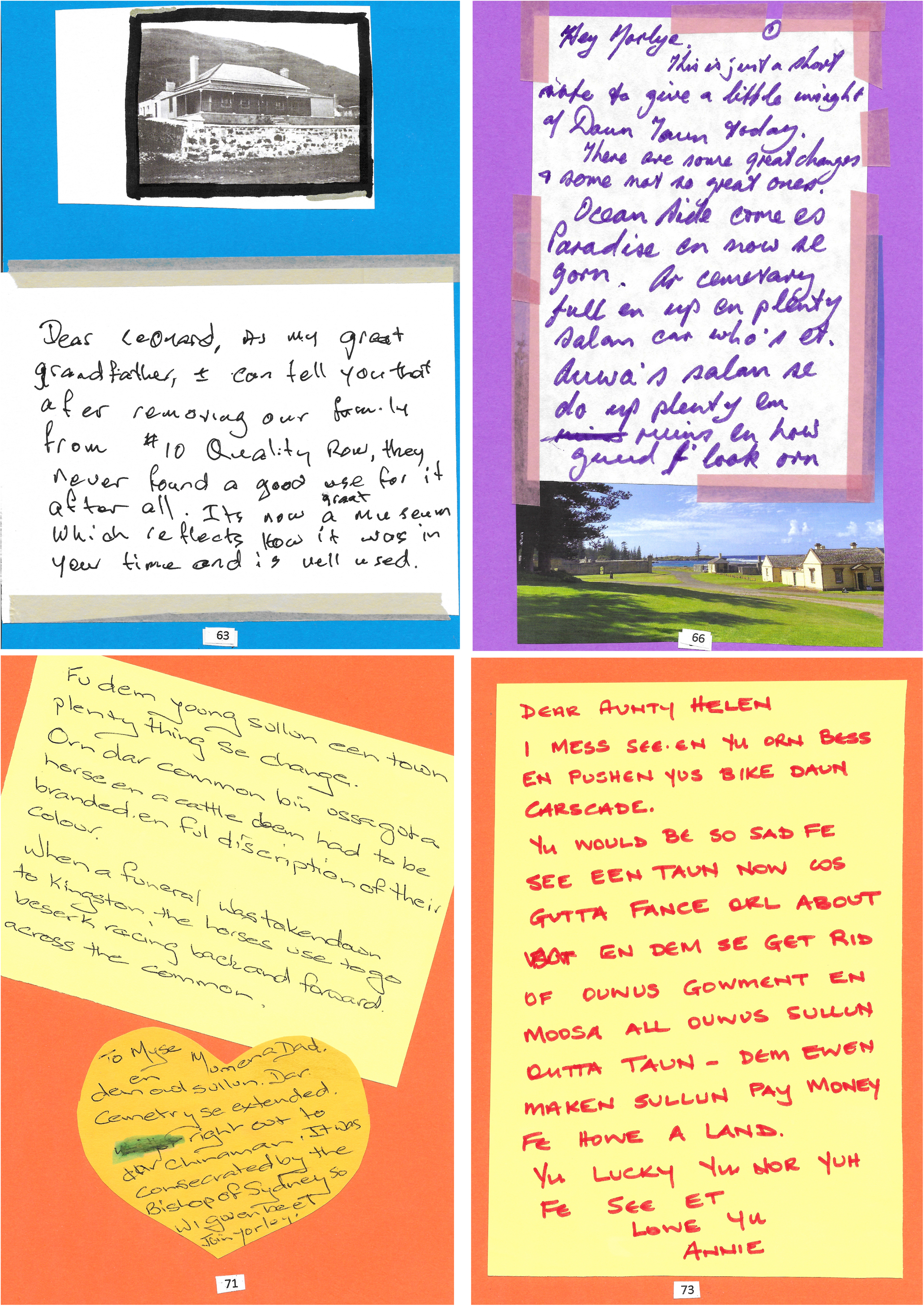
Letter writing activities in Mais Daun’taun: Volume 1.
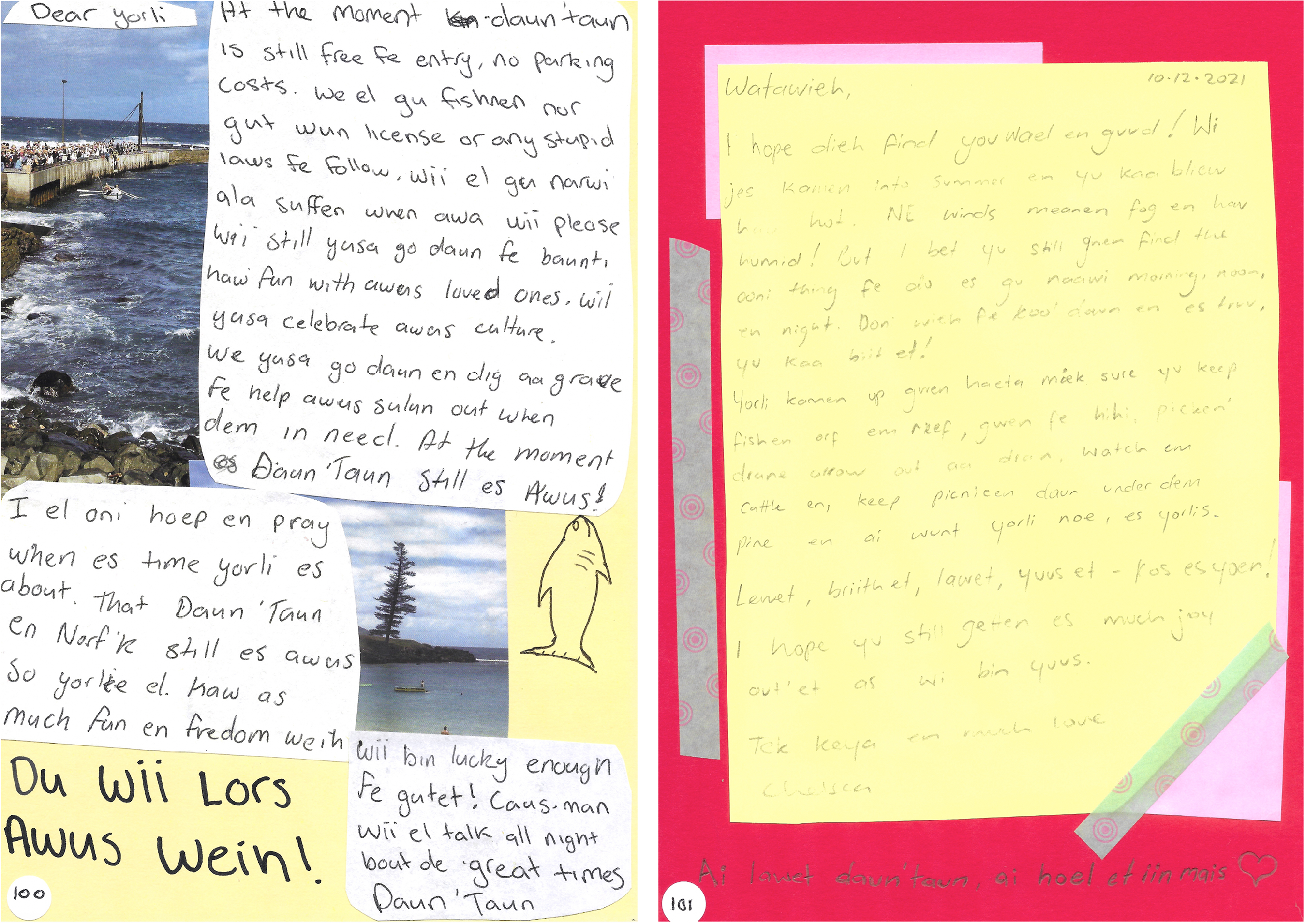
Letter writing activities in Mais Daun’taun: Volume 4.
Interpretive text
The interpretive text method involves prompting participants to critique existing heritage interpretation (e.g. on panels, signs, brochures) or to undertake counter-interpretation through writing text that offers alternative ways of understanding heritage places, practices and artefacts. There is limited literature on the use of this method, with it being distinct from participatory interpretive signage creation where researchers or heritage practitioners work with stakeholders to co-create panels (see e.g. Higgins et al., 2015).
We included interpretive text activities in workshops 2 and 4–6. In workshop 2, which focused on the Paradise Hotel, the research team posed: ‘If there was going to be an interpretive sign at the old Paradise site, what would it say?’ The focus of the fifth workshop was also narrow, with the participants all siblings who had lived in No. 11 Quality Row. They were invited to ‘write an interpretive sign that is out the front of No. 11’. Prompts included: ‘think about what might surprise the reader, someone from the community or a tourist. What are some of the stories that could be revealed? How could the sign speak to you and your experiences of the place?’ There was a slightly broader focus in workshops 4 and 6, with participants being asked to ‘pick a location in Kingston and think about what could be written on an interpretive sign for that site. What story could be included on the sign that could surprise the reader? What are some hidden stories that could be revealed?’ Participants found this to be the most challenging activity in the workshops. After the activity was proposed, Colleen responded ‘Nop. Ai dena whetha ai wanta duu daa wan’, 8 with Koliin agreeing ‘Too hard anieh’. 9 Lynette was concerned about how to express her feelings on a sign, saying ‘I loved it down there … because of freedom. But I don’t know how to put that into an interpretive sign’. Pat expressed some worry about her capacity to create a sign on the basis of ‘not [being] very good at place names and info’. In the final workshop, we provided additional scaffolding to help ease participant trepidation, framing the activity as a change from thinking about memories (in the preceding memory work activity) to imagining themselves as involved in the management of Kingston. We asked these participants to reflect on the signage they have seen in Kingston and consider how that signage could better reflect their own understanding of the site. The additional scaffolding resulted in the participants thinking first about what images of Kingston were available to them for the creation of zine pages and then what they might write about the image they selected. However, participants still struggled to put words to the chosen images, with comments like ‘I’m not vibing with the photos’ (Nicole) and ‘sorry, the signage is a big thing’ (Ivy) – in other words, too big to be neatly contained as a short activity within the multi-method workshop format. Another participant disagreed with the very basis of the activity: ‘Nature is good. No sign is a good sign’ (Joshua).
Despite the challenges with the task, some signs were produced (see Figure 6). Koliin selected the Royal Engineers Office as the focus of her interpretive sign. Koliin had lived in this building as a child and it formed a backdrop for many of the memories shared in the workshop prior to the interpretive sign activity. The sign included a picture of the building and its name with the text reading ‘Gud said f’lew ewen ef es fraidi an plenti salan bin sti daun deya’. 10 Alma chose to create interpretive text for a sign to be located at the Cemetery, with an image of the site accompanied by the words ‘Das es ouwus cemetery ewen dough es fraidy side orl ouwus sullen se lay to rest en es important cultural site’. 11 Such signs emphasise the living heritage of these sites. Reference to these places as fraidi/fraidy is likely due to the earlier memory prompt activity which teased out their scariest memories. In one of the Paradise workshops, Pat wrote text for a sign that focused on the loss of the Paradise and spent the remaining time in the workshop creating a page that reflected what an interpretation panel might look like (see Figure 7). Pat's panel included the title ‘Paradise Lost’ and a potted history put together during the activity (its construction, its role as tourist accommodation, its place in the social lives of islanders, and the reason behind its removal). To this Pat added images, additional text that emphasised the site being ‘the perfect place’ for a hotel and a personal connection (‘I went home with my future husband’), and a fragment from a government report condemning the building.
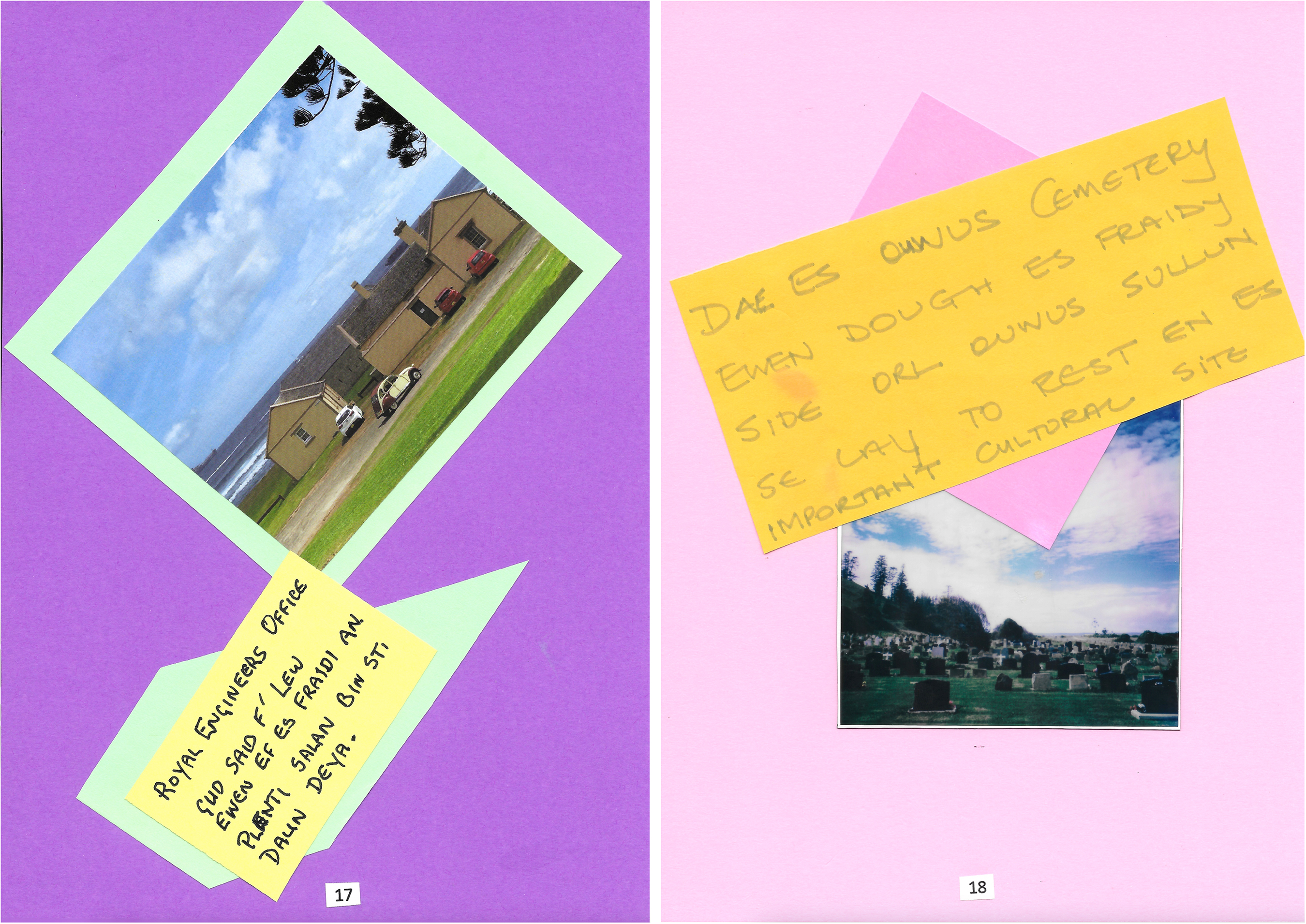
Interpretive sign text created by participants for Mais Daun’taun: Volume 2.
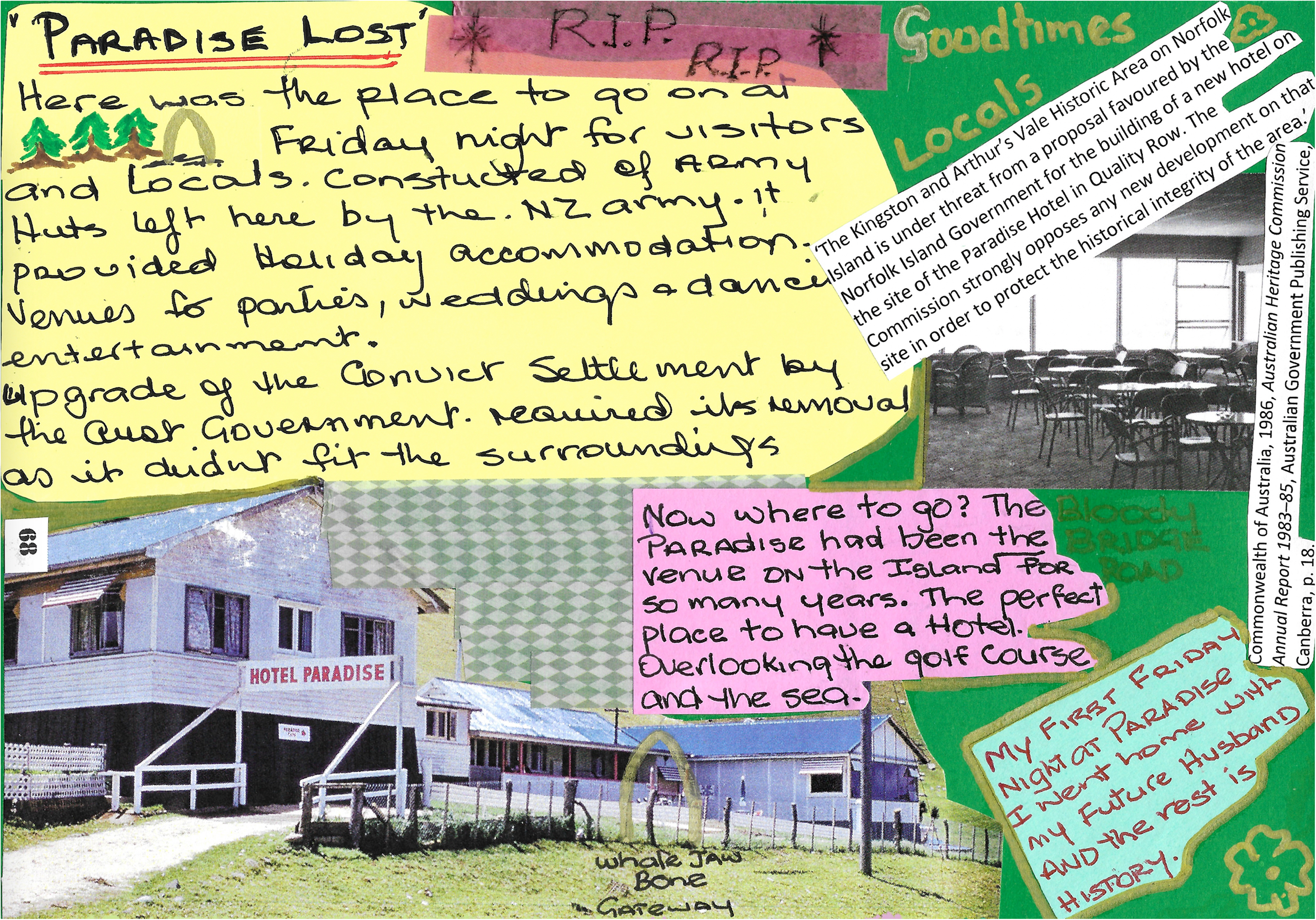
Text for an interpretive sign created by a participant for See You at the Paradise/Ketch Yorlye Daun Paradise.
The interpretive text method highlighted our participants’ sense of positioning in relation to KAVHA's heritage management, their perspectives on existing signs and their value, and revealed some of the more intimate and personal insights on place that are not usually captured in authorised heritage practice. The method also challenged the participants to move from generating memories to thinking about their own personal experiences in a heritage context and how the transmission of memories to others might offer something valuable in KAVHA's interpretation. As a method in the critical cultural justice inquiry toolbox, interpretive text is an activity that can challenge cultural domination participants might experience in heritage signage, particularly for sites that have strong personal and/or collective meaning.
Conversations
We approached interviews as ‘contextualized conversations’ (Stage and Mattson, 2003: 97). The conversational approach differs from more formal ethnographic interviewing in that these conversations are ‘informal and emergent’ (Stage and Mattson, 2003: 98). The emphasis on conversation positions the participant as a topic expert and therefore a co-producer of knowledge; this in turn allows for the topic under discussion to be ‘framed by a larger social context’ than a set of researcher-led questions might allow (Stage and Mattson, 2003: 100).
The spatial contexts of the conversations were important due to the project's interest in participants’ sense of place (see Cantillon and Baker, 2022). Place-based and walking interviews have been shown to reveal spatial relations and experiential understandings of place due to the resonance afforded by being in situ (Holton and Riley, 2014: 60). The location was always determined by the participant, including where the walk would begin and end. The participant selected the route and also determined the means (walking, driving, etc.) to get to different areas in Kingston they wanted to speak about. Some interviews involved photo-elicitation in which participants selected images that formed the basis for a discussion (van Auken et al., 2010) (see Figure 8). For example, a conversation with siblings Ngaire and Russell revolved around a slideshow of digitised images from Ngaire's personal collection. A conversation with Pat and her son Kane was guided by photo albums of Pat's late husband, a former manager of the Kingston site, which recorded years of restoration work in KAVHA. A conversation with Russell and Eddie brought together place-based interviewing and photo elicitation. Seated at the former site of the Oceanside Guest House, Russell used a black and white photo from the 1950s to reflect on where different buildings would have been located, including where he lived as a child. Being in place and having the photo as a reference led Russell to conclude that the contemporary site ‘doesn’t look big enough now to contain all the buildings that used to be here’.
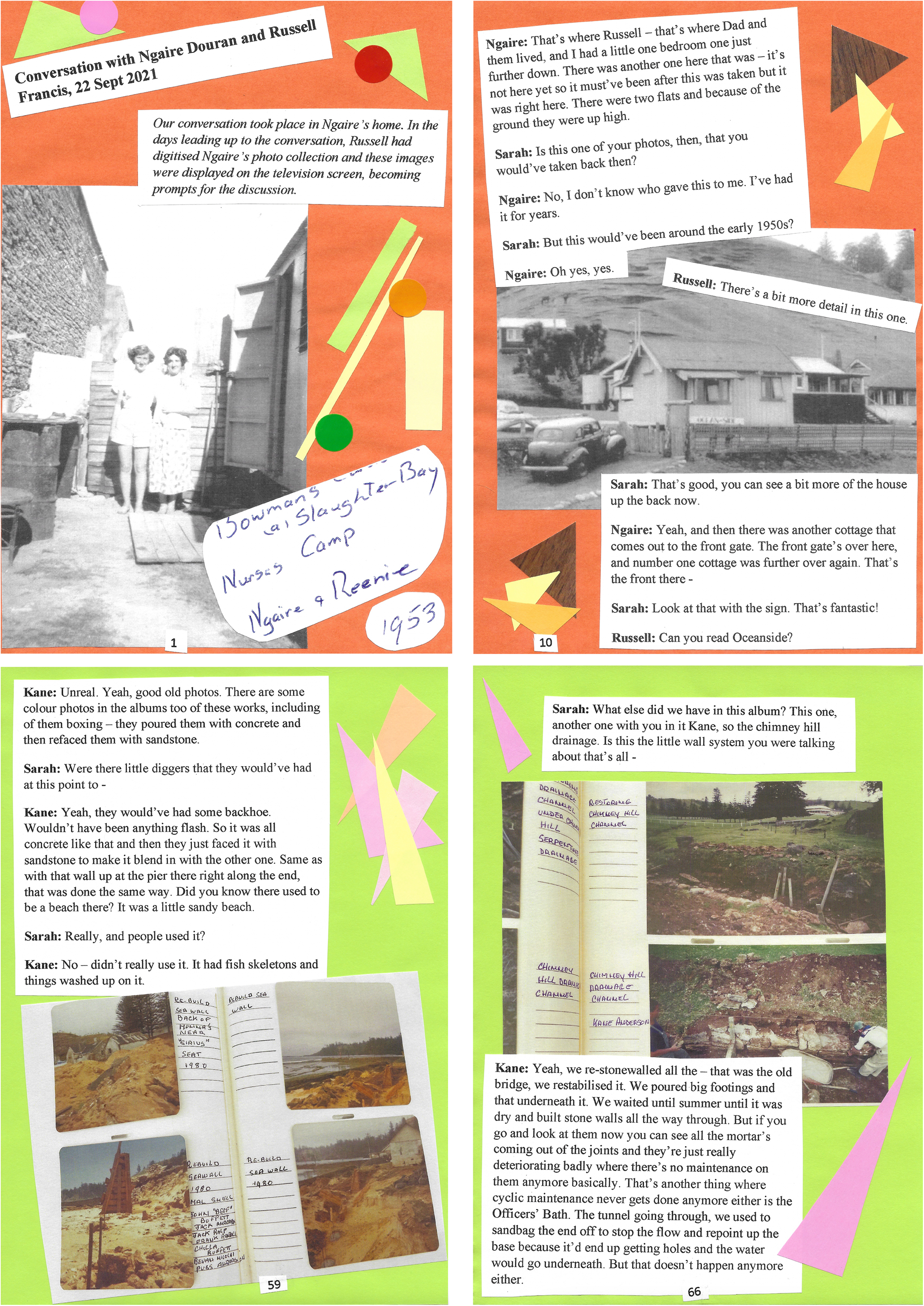
Excerpts of conversations appearing in Mais Daun’taun: Volume 3 (top) and Mais Daun’taun: Volume 2 (bottom).
Conversations that engage directly with Kingston through being in place or by way of photographs act as a mechanism for reminiscence and reflection. By incorporating different approaches to interviewing, the conversations take a critical cultural justice approach to reveal how the value and meaning of a place is not static or fixed in a particular historical moment or determined by a singular source (e.g. heritage experts/professionals), but is fluid, changing and pluralistic. The conversations enabled us to draw out these multiple attachments, highlighting the complexity of place and the dynamism of living heritage – representing Kingston as it is remembered, felt and lived by the community.
Participatory mapping
Work on counter-mapping, sketch mapping and participatory mapping (see e.g. Boatca, 2021; Boschmann and Cubbon, 2014; Campos-Delgado, 2018; Sletto, 2009) recognises that traditional maps are not neutral representations of the world, but shaped by power relations. Participatory mapping challenges the ‘production and representational politics associated with traditional or scientific maps’ (Baker et al., 2023a: 535). As a research method, participatory mapping enables researchers to document ‘subjective spatial experiences’ (Reitz, 2022: 328) and narratives that may be concealed or ‘veiled’ by traditional maps (Campos-Delgado, 2018). In a heritage context, De Nardi (2014: 6) suggests that creating maps with participants helps to re-present places as ‘lived-in cultural landscape[s]’, not just static archaeological sites.
Our project used participatory mapping to create maps that documented memories, relationships, sites, activities and feelings that are typically not captured in authorised heritage practice (see Cantillon et al., 2024). We organised the workshops around four activities that invited participants to contribute to hard copies of a simple, line-drawn base map of KAVHA. Participants contributed to three large collaboratively-produced maps and their own smaller individual maps. The collaborative maps were focused on routes, customary practices and emotions. The individual map involved recording other memories or locations that were important to participants. Reitz (2022: 327–328) notes that maps, being a visual form, have limitations in terms of documenting the ‘[a]bstract qualities of space’ such as ‘the passing of time, flows and rhythms, memories, values, and interests’. To address these challenges, participants agreed to the audio recording of the workshops, with participants invited to elaborate on their contributions to the maps. Excerpts from the recordings were then used in zine editorials and to create zine pages (see Figure 9).
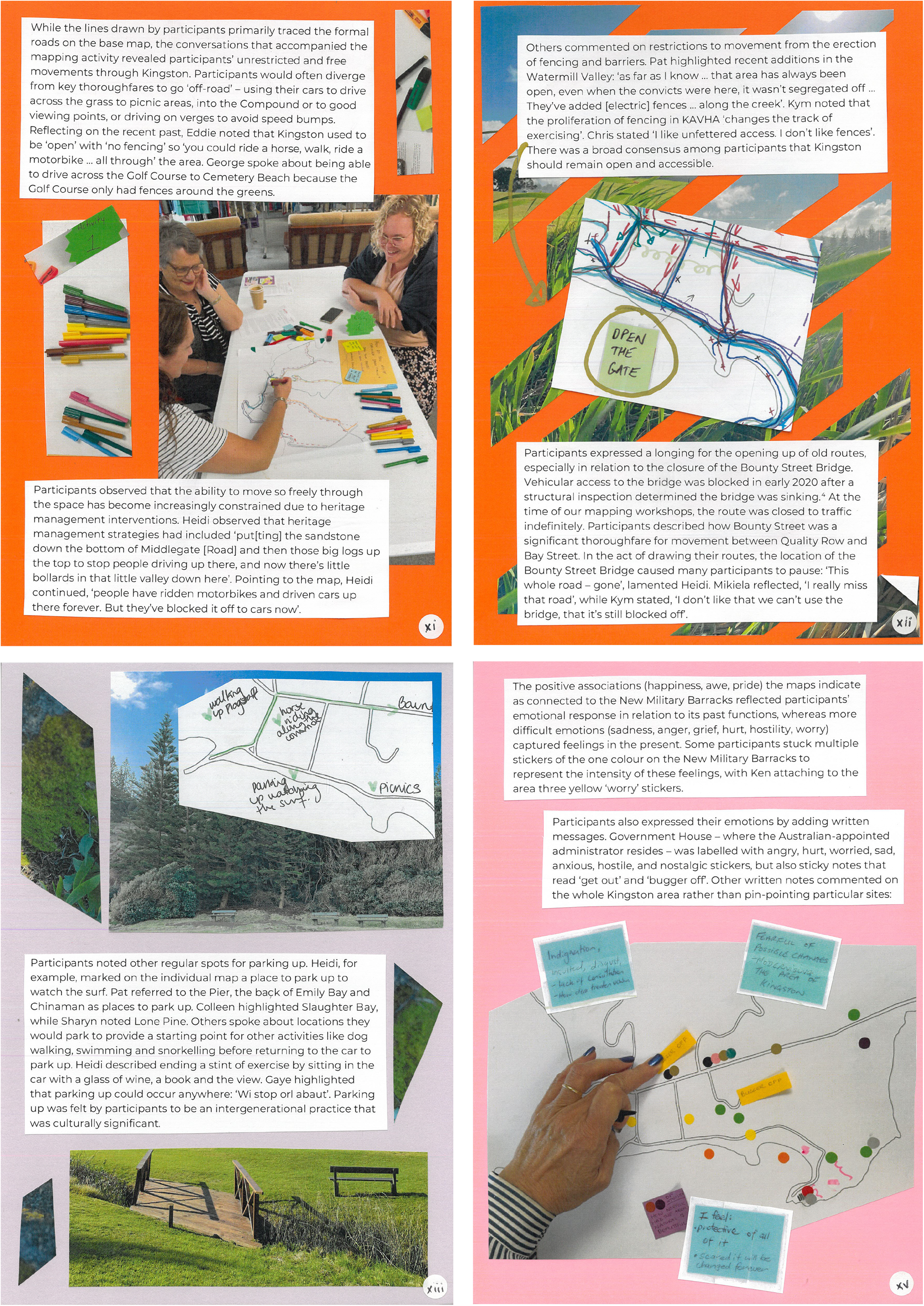
The editorials for Defi ala Daefi?: Mapping Routes in Kingston (top), Wathing yu bin Duu?: Mapping Customary Practices in Kingston (bottom left) and Watawieh yu fFilen?: Mapping Emotions in Kingston (bottom right) include quotes from workshop participants.
We published three zines based on the mapping workshops: one focused on each collaborative activity. The routes maps captured how participants move through Kingston using different modes of transport (e.g. driving, walking, horse riding) and in different time periods. Although the maps revealed key thoroughfares, they also illustrated how participants value going ‘off-road’ and the capacity for unbounded mobilities not restricted by the addition of fencing and road closures, as has been the case in recent years. The customary practices maps feature stickers with symbols representing a diverse range of activities spread across Kingston. These maps highlight variations in how participants interpreted ‘customary’ practice, capturing what might typically be considered traditional enactments of cultural heritage according to authorised heritage discourses (Smith, 2006) as well as more contemporary, everyday practices. The emotions maps feature coloured stickers representing common emotions, as well as feelings that had come up regularly during interviews, as associated with different spaces across Kingston. These maps showcase how senses of pride, happiness and love are mixed with worry, sadness and anger due to issues with heritage management and a lack of agency in the Island's governance more broadly, which impacts a sense of custodianship. Individual maps appeared throughout the three zines, curated by us according to how the maps aligned with the overarching theme of that zine. Collectively, the collaborative and individual maps offer a visual representation of how participants understand, relate to and engage with Kingston as a deeply meaningful heritage place and a space for more routine, everyday practices. As part of a critical cultural justice approach, the participatory mapping offered participants the opportunity to represent their cultural heritage, knowledge and attachments to place in ways that are not typically recorded in more formal maps and heritage interpretation methods.
Sociable methods and the multi-method approach to zine-making
The multi-method approach for critical cultural justice inquiry can be characterised as ‘sociable’ (Sinha and Back, 2013). Zine-making encompasses the researchers and contributors ‘travelling alongside in dialogue’, with each zine valuing the multiple, divergent voices of participants (Sinha and Back, 2013: 482–483). For Sinha and Back (2013: 486), an orientation to justice is inherent in a more sociable research process in that it values ‘hearing the injustice buried by noise or hidden in silence and bringing it into public conversation’. Sociable methods, then, are committed to transforming the production of knowledge through an emphasis on co-construction (Sinha and Back, 2013: 483). For example, through the use of multi-methods, our project provided participants, as zine contributors, ‘a choice or set of choices of what to record or observe for research’ (Sinha and Back, 2013: 477) and also how to present these textually and visually. Moreover, the workshop process and the resulting zines fostered ‘collaborative reminiscence’, a principle of community archive discourse that ‘captures the collective and dialogic memory-work enabled by creating, sharing and reading zines’ (Baker and Cantillon, 2022: 558). The sociable, multi-method approach to critical cultural justice inquiry provided spaces for participants to engage in ‘participatory learning and critical thinking’ (French and Curd, 2022: 84). This approach facilitated a move beyond ‘a nostalgic looking back on the past’ to instead create ‘web[s] of remembrance’ and connection, with participants and researchers working together to ‘contextualise[] the past in the present and the future’ (Baker and Cantillon, 2022: 557).
While the multi-method, sociable approach to zine-making works to enhance the experience of cultural justice for participants (and others who engage with the zines as products of the research), injustices remain both in the research process and, of course, in the lived realities of the research site. For instance, decisions about which methods are included – and how they are framed to participants – are determined by us, the researchers, and our interests. This potentially explains the difficulties experienced by participants when undertaking some of the tasks in the zine-making workshops. For example, while interpretive panels are of interest to the researchers as heritage artefacts that make symbolic annihilation tangible, the interpretive text activity we designed to reassert representational belonging in heritage narratives did not resonate with many participants. However, the value of the multi-method approach to zine-making is that it offers opportunities for participants to have multiple points of entry to engage with the research. To further mitigate injustice in the research, it is essential for researchers to be reflexive about their choices and power dynamics in the field, to collect feedback from participants, and to be flexible in adapting methods and outputs to be more aligned with cultural justice principles. A key moment early in the project was changing the name of the first zine to incorporate the Norf’k language based on feedback on social media from a member of the Norfolk Island community, with Norf’k then incorporated in all future zine titles.
Concluding thoughts
Critical cultural justice inquiry is a process that emphasises the pursuit of cultural justice, rather than an approach that necessarily offers cultural justice as an outcome of the research. In that pursuit, this article has demonstrated how a sociable, multi-method approach to the participatory, arts-based method of zine-making enhanced our participants’ agency to collectively tell their stories on their own terms. In doing so, participants had the opportunity to challenge the dominant narratives they encountered in KAVHA which too often silenced their cultural expressions and experiences. During a challenging time on the island, politically and culturally, engagement with the project – whether through zine-making workshops, mapping workshops, interviews or a combination of these – reinforced for participants that their perspectives are worthy of preservation and respect. Presenting participants with an array of methods with which they could recall memories, story their experiences, express emotion and outline their desires for the future, followed by the publication of their contributions in the zines, worked to amplify their voices in ways that draw attention to cultural injustices that have been and continue to be experienced in KAVHA. What zine-making for critical cultural justice inquiry facilitated for participants is agency in the process and a sense of ownership over the output. This sense also extended to the wider community who were not direct participants in the research, but were able to see themselves and their heritage in the zines – confirming the zines as community archives, providing representational belonging that announces ‘I am here’, ‘We were here’ and ‘We belong here’ (Caswell et al., 2017: 20). The contribution of the zine series to Norfolk Islanders’ quest for cultural justice was captured in a ‘letter of appreciation’ we received from the Norfolk Island Council of Elders, which expressed, ‘On an island which is struggling to maintain its culture and identity, these resources are extremely valuable’ and ‘a significant contribution to the protection and promotion of our culture’ (David Buffett, President, 2021, personal communication). What this article has revealed is how zine-making as a method supports critical cultural justice inquiry by way of fostering agency, accessibility and collaboration through creative practice and emphasising respect, recognition and belonging in representational outcomes.
Critical cultural justice inquiry is ultimately about ‘doing research otherwise’ – resisting extractivist, exploitative approaches that have so often underpinned social science research in the Global North (Rodriguez Castro, 2022; Tilley, 2017). To work towards cultural justice or ‘social transformation’, relationships between researchers and the communities they research must be ‘based on care, solidarity, respect, mutual support and generous knowledge exchange’ (Red de Organizaciones Femeninas del Pacifico Caucano Matamba y Guasa et al., 2022). Moreover, the outcomes of such research must be a ‘resource in the service of hope’ for communities (Back, 2021: 4). Undertaking this kind of research is ‘not necessarily just about the methods we use, but also about the conversations, the recognition of those we are working with, and the process that lead[s] us to arrive at shared goals and expectations’ (Red de Organizaciones Femeninas del Pacifico Caucano Matamba y Guasa et al., 2022). Particular methods – such as those that are arts-based and participatory – and an emphasis on a multi-method approach may be more aligned with cultural justice principles, but what really matters is how such methods are negotiated and carried out. Core to this form of inquiry is the need for researchers to be reflexive about their own subjectivity, institutional and epistemic contexts, and the impacts of our research on the lives of participants. What the example of the Reimagining KAVHA project highlights is that the multi-method approach to zine-making enables critical cultural justice inquiry to unfold in ways that are responsive, dialogic and sociable.
Footnotes
Declaration of conflicting interests
The authors declared no potential conflicts of interest with respect to the research, authorship and/or publication of this article.
Funding
The authors disclosed receipt of the following financial support for the research, authorship and/or publication of this article: This work was supported by the Australian Research Council [grant number SR200200711].

Notes
Author biographies
Sarah Baker, PhD, is a Professor of Cultural Sociology at Griffith University, Australia. Sarah has published extensively in the fields of critical heritage studies, museum and archival studies, with her most recent research exploring cultural justice as concept, method and practice. She is Chief Investigator on the Australian Research Council project ‘Reimagining Norfolk Island's Kingston and Arthur's Vale Historic Area’. Her recent books include Community Custodians of Popular Music's Past: A DIY Approach to Heritage (Routledge, 2018), Curating Pop: Exhibiting Popular Music in the Museum (Bloomsbury, 2019) and Popular Music Heritage, Cultural Justice and the Deindustrialising City (Cambridge University Press, 2023).
Zelmarie Cantillon, PhD, is a Senior Research Fellow at the Institute for Culture and Society, Western Sydney University, Australia. Her research focuses on the intersections of heritage, tourism and cultural policy, with a particular interest in cultural justice and cultural infrastructure. She is Chief Investigator on two current Australian Research Council projects: ‘Reimagining Norfolk Island's Kingston and Arthur's Vale Historic Area’ and ‘The Collaborative Museum: Embedding Cultural Infrastructure in the City’. Her books include Resort Spatiality: Reimagining Sites of Mass Tourism (Routledge, 2019) and Popular Music Heritage, Cultural Justice and the Deindustrialising City (Cambridge University Press, 2023).
Chelsea Evans is a Norfolk Islander of Pitcairn descent living on Norfolk Island. She is currently undertaking a PhD in the field of critical heritage studies at Griffith University, Australia where she was previously a Research Fellow on the Australian Research Council project ‘Reimagining Norfolk Island's Kingston and Arthur's Vale Historic Area’. Her research foregrounds the different layers of heritage on Norfolk Island, with an emphasis on Norfolk Island peoples’ special relationship to place through an understanding of kamfram (heritage). In October 2023, she was elected as a community representative for the Norfolk Island Governance Committee.