




Abstract
Senses of place are strongly intertwined with senses of heritage and cultural identity. Heritage places are distinctive not only for their tangible dimensions, but also the intangible qualities which give them meaning. The conservation of heritage places, however, has often emphasised the materiality of place rather than its symbolic significance. This article explores issues surrounding sense of place and heritage management through a focus on the former site of the Paradise Hotel in Norfolk Island’s Kingston and Arthur’s Vale Historic Area. Drawing on interviews and a zine co-created with Norfolk Island residents, the article unpacks various ways participants articulate connections to the Paradise via their memories and recollections of the past as well as their present interpretation of and engagement with the site. Through a localised case study, the article provides insight into transnational challenges for the relationship between sense of place, heritage value and heritage management and interpretation.
Keywords
Introduction
Senses of place are strongly intertwined with senses of heritage, belonging and cultural identity. Place, heritage and identity are not separate or static phenomena but continuously produced and reproduced, adapted and transformed, in dynamic interaction with one another. Heritage – as the present interpretation and articulation of the past – is often tied to physical locations, including buildings, landscapes and other spaces that have been significant to individuals or communities. Such heritage places are distinctive not only for their tangible, material dimensions, but also the intangible, symbolic qualities which give them meaning and enmesh them with cultural practices and identities (see Smith, 2006). Heritage management practices, however, do not always align with a community’s sense of place, particularly as conservation efforts have not typically prioritised intangible meanings in the assessment of heritage value.
This article explores transnational issues surrounding sense of place and heritage management through a focus on a particular localised case study: the former Paradise Hotel (c.1930–1987) in Norfolk Island’s Kingston and Arthur’s Vale Historic Area (KAVHA), one of 11 sites in the Australian Convict Sites property inscribed on the UNESCO World Heritage List in 2010. Norfolk Island is located in the South Pacific Ocean, approximately 1,600 km northeast of Sydney, Australia. It is a small island with an area of about 35 km2 and a population of over 1,700 (Australian Bureau of Statistics, 2016). KAVHA, a delineated heritage site in the southeast of the island, holds significance for all four of the island’s distinct human settlements: a Polynesian settlement (c.1150–1450); a British agricultural settlement (1788–1814); a British penal settlement (1825–1855); and the Pitcairn settlement (1856–present). Visually, KAVHA is dominated by the ruins and restored structures of the penal settlement – impressive Georgian buildings set against a bucolic landscape of green pastures, towering Norfolk pines and vivid blue seas. While the Pitcairn settlement ‘extend[s] for well over a century longer than the convict phase and continu[es] in various forms through to today’, this heritage has had ‘limited recognition or visibility’ in KAVHA’s interpretation (Gibbs et al., 2017: 96). The focus of this article, the site of the former Paradise Hotel, is an example of a place in KAVHA that holds cultural significance associated with the Pitcairn settlement. Originally situated opposite the Stipendiary Magistrates Quarters (No. 1 Quality Row) and next to the Superintendents of Convicts Duplex (No. 2/3 Quality Row) (see Figure 1), today the site is a picnic area that features very little indication of what once stood there, including no interpretive signage (see Figure 2).
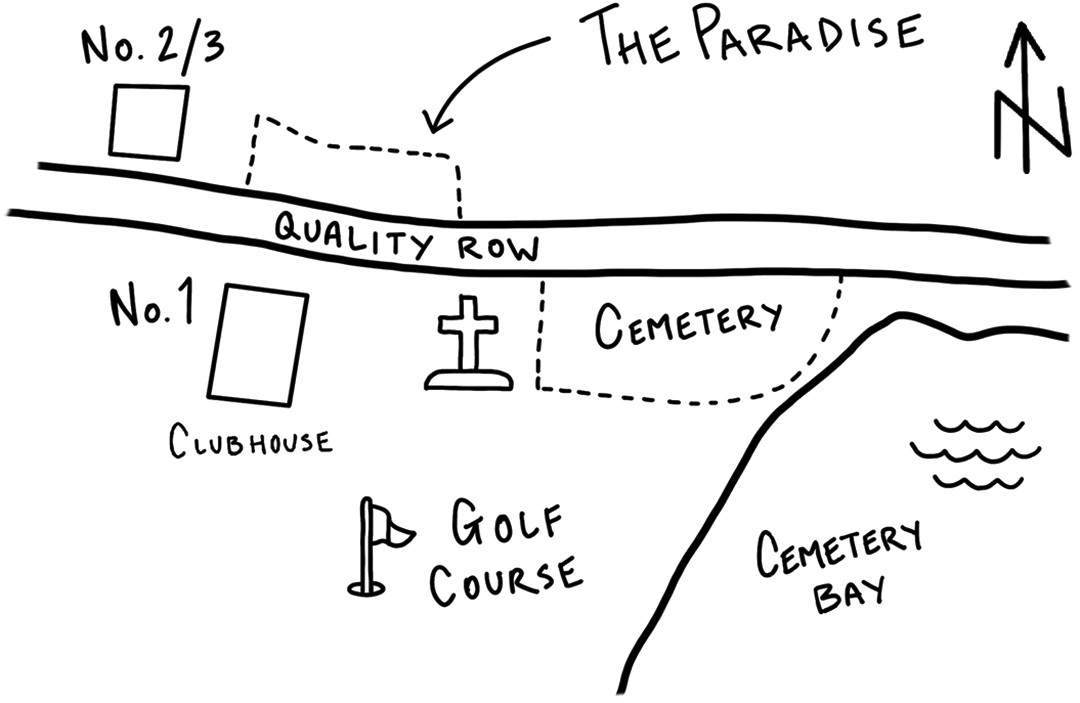
Map of surrounding area of the Paradise Hotel. Illustration by Rogan Sharpe.
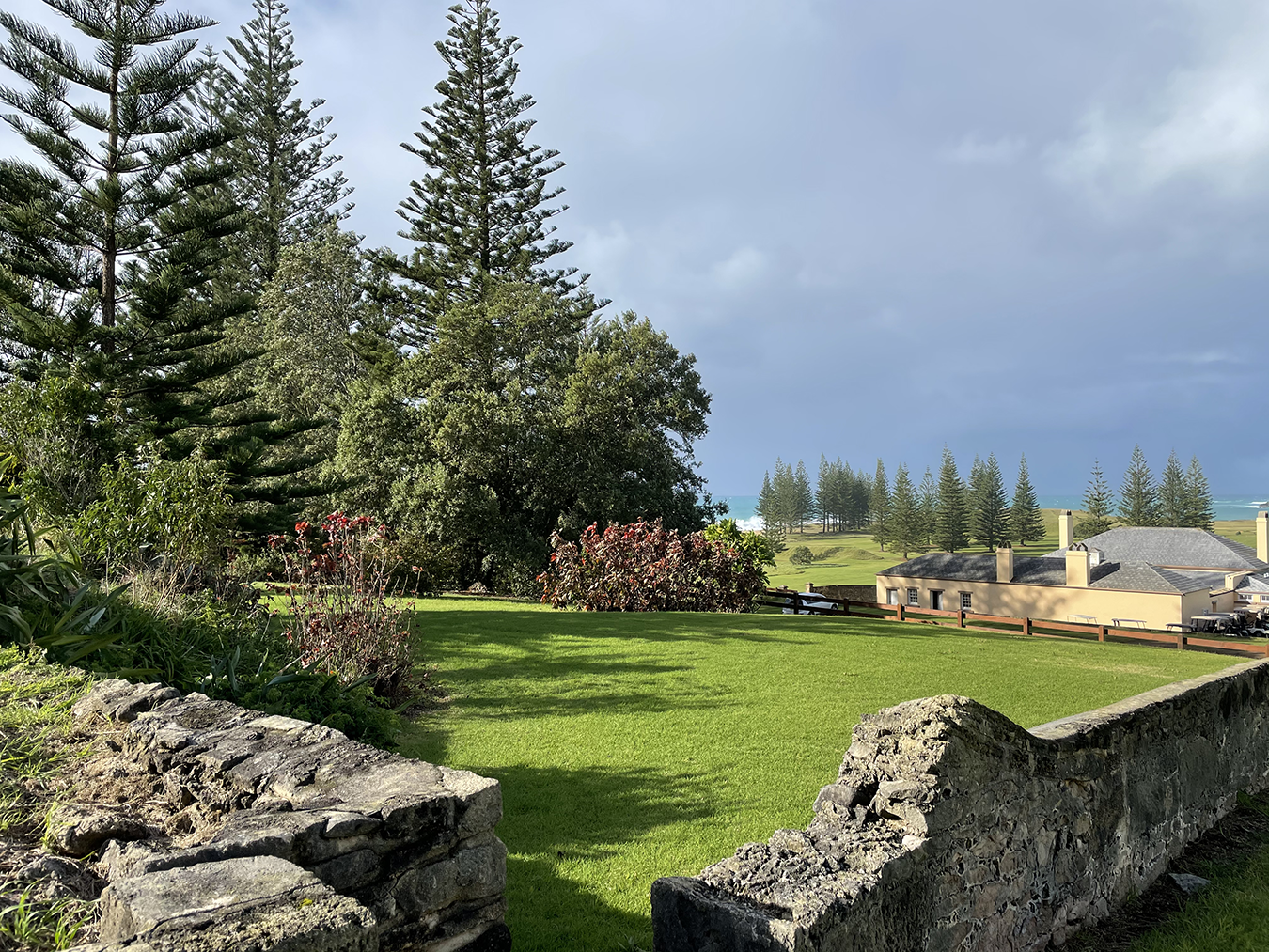
Green space where the Paradise once stood, 2020. Image taken beside the shared wall with No. 2 Quality Row, overlooking No. 1 Quality Row. Photograph by Sarah Baker.
Our focus in this article is on the ways in which the Paradise mattered (and continues to matter) to Pitcairn Settler descendants and others in the community with long and deep connections to Norfolk Island. The Paradise began as Dewville, a guest house constructed in the early 1930s. Dewville was an early example of tourist accommodation on the island and over time underwent various expansions and name changes (e.g. Oceanside). By the late 1950s, and until its demolition, it was known as Hotel Paradise, Paradise Hotel, or simply ‘the Paradise’ (see Figure 3). It became a popular hotel for locals and tourists to congregate, drink, dance and listen to live music. For a significant period of its operation, the lease of the site was held by Travelodge Australia, who planned to redevelop the property. As the heritagisation of Kingston got underway in the 1960s, the Paradise was increasingly viewed unfavourably by Australian heritage organisations, consultants and the Australian Government, and the Travelodge proposals were rejected (Joint Standing Committee on the National Capital and External Territories, 2004). The presence of the hotel was said to mar the heritage value of Quality Row, an area otherwise occupied by an ‘outstanding collection of fine Georgian buildings’ (Richards et al., 2019: 15). The Australian Council of National Trusts (1971) identified the Paradise as ‘the greatest intrusion into the historic environment of Kingston’ (p. 55), noting the ‘building should have been demolished and the site cleared’ (p. 28). By the early 1980s, and with the Australian Government looking toward the bicentenary celebrations planned for Norfolk Island in 1988, urgency to demolish the Paradise had intensified: ‘As the conservation and enhancement of the Kingston and Arthur’s Vale area on Norfolk Island proceeds, the incongruity of the existence of the Paradise buildings has become apparent and their removal more urgent’ (Commonwealth of Australia, 1985: 10–11). By 1988, the Paradise buildings had been removed from the site.
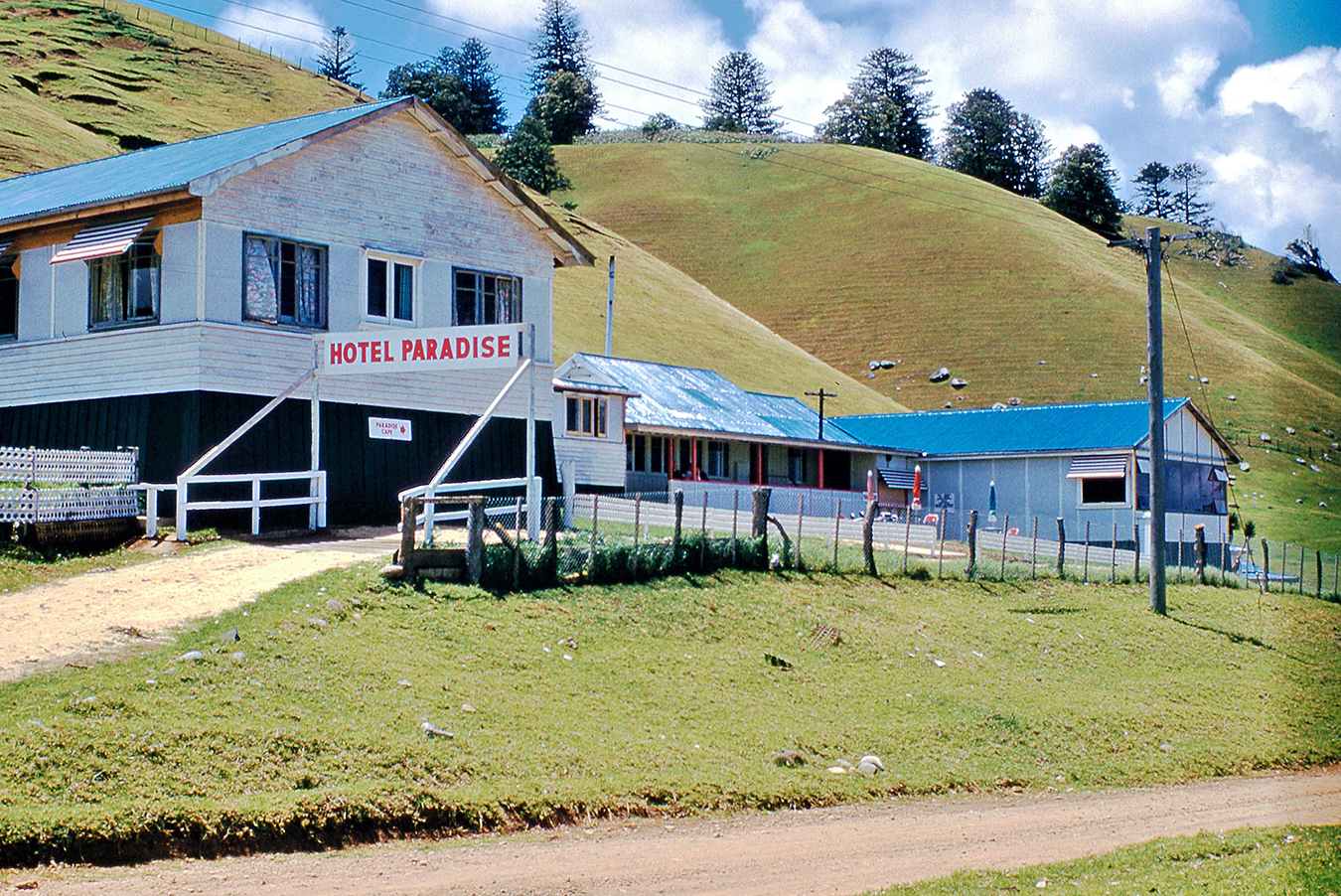
Paradise Hotel exterior, 1960. Photograph from the Earle Viénet Collection courtesy of Trevor Viénet.
Drawing on interviews and a zine created with Norfolk Island residents, this article highlights the complex dynamics between tangible and intangible facets of heritage places and the politics of preservation and destruction. Firstly, it considers aspects of the ‘person-to-place bond’ (Nelson et al., 2020: 237) evident in the community’s remembrance of the Paradise, unpacking a multitude of ways participants articulate connections to the Paradise in the past and present. Secondly, in establishing elements that constitute this sense of place, the article questions the effects of a dominant ‘authorised heritage discourse’ (Smith, 2006) in the Australian Government’s oversight of KAVHA. Specifically, the article explores how the removal of the Paradise impacts participants’ relationships to the site and considerations of its interpretation. Finally, the article concludes by reflecting on the various ways that heritage value and sense of place is constructed and maintained despite the hotel’s physical absence in Kingston.
Place: A contested concept for heritage
Informed by the work of Massey (2005: 9), we understand place as heterogenous, pluralistic and ‘always under construction’ – the ‘product of interrelations’ at the level of both the local and the global. Massey (1994: 155) advocates for a ‘progressive concept of place’ that rejects traditional understandings of it as closed, fixed or possessing a ‘single, unique’ identity; rather, places are ‘full of internal conflicts’ and linkages to elsewhere, and their specificity is constituted by multiple elements, actors and processes. Broadly, we take space/place to be made up of three intertwined components: material elements (e.g. built environment, landscape, geographic location, objects); symbolic qualities (e.g. myths, meanings, representations, mental mappings, imaginaries, memories); and lived experiences (e.g. spatial practices, social relations, everyday rhythms and mobilities, affective and embodied engagements) (Cantillon, 2019; Soja, 1996; Lefebvre, 1991 [1974]).
As places are ‘in a continuous state of becoming’, they are closely linked to senses of time via heritage (Ashworth and Graham, 2005: 4). Likewise, Lesh (2020: 439) argues that place is ‘an essential building block of heritage’ and highlights how ‘heritage value can never truly be contained within’ a site’s physicality, which, as we note above, is only one dimension of many to consider. Yet the practice of heritage conservation has tended to ‘prioritise materiality and fabric’ and ‘de-emphasise communities and their sense of place’ (Lesh, 2020: 433). This tendency is reflected in what Smith (2006) terms an authorised heritage discourse that has long underpinned professional heritage practice in the West. Smith (2006: 3) notes that the authorised heritage discourse: emphasize[s] the material basis of heritage, and attributes an inherent cultural value or significance to these things. Furthermore, the sense of gravitas given to these values is also often directly linked to the age, monumentality and/or aesthetics of a place.
What, then, is a sense of place in relation to heritage? Smith (2006: 75–6) observes that while ‘site’ was often traditionally used in heritage contexts – particularly in the fields of archaeology and architecture – there has been a shift to the use of ‘place’, which is thought to better capture senses of belonging and cultural attachments. Sense of place has become a familiar phrase in heritage practice and heritage studies (see, e.g., Malpas, 2008; Ashworth and Graham, 2005; Waterton, 2005), but has not always been explained in detail or deployed with a consistent meaning. Brakman (2016: 121) uses ‘sense of place’ and the term ‘genius loci’ (or ‘spirit of place’) interchangeably, with both referring to ‘the typical nature or atmosphere of a place that leaves an impression’. For Schofield and Szymanski (2016), sense of place is relative and cumulative, developed over generations. It provides ‘reference points’ that come to be embedded in ‘memories and affections’ that inform our orientation to the world around us (Schofield and Szymanski, 2016: 3). They suggest that sense of place has multiple entry points in a community, with each individual having views shaped by their knowledge, experience and the extent to which their ‘memories and stories [have been] woven into’ the fabric of place across time and space (Schofield and Szymanski, 2016: 4). What therefore becomes important in assessing an historic environment or determining heritage value is not simply ‘a set of features, sites or buildings’, but also ‘people’s engagements with and understandings of them’ (Townend and Whittaker, 2016: 68).
Madgin and Lesh (2021: 7) observe that while sense of place has been ‘influential within heritage practice’, its presence in conservation protocols and declarations ‘has not coalesced into a coherent conceptual framework’ for heritage places. Brakman (2016) similarly raises questions over the difficulties faced by heritage conservators or managers who seek to apply ideas like sense of place when assessing heritage significance or determining heritage policies and plans. For Brakman (2016: 121), what is needed is a greater understanding of characteristics that can point to when a sense of place emerges and, subsequently, ‘why a place has this sense’. In research on the Cornish Mining World Heritage Site, Orange (2016) considers how sense of place is understood by local residents and the possible implications of these understandings for heritage professionals. While it was determined that there was no ‘single understanding of what sense of place means’ among respondents, local understandings could be grouped according ‘to four major themes: the intrinsic character and atmosphere of place, a sense of belonging, emotional response, and knowledge and understanding’ (Orange, 2016: 115). Madgin and Lesh (2021: 2) have called for heritage studies and practice to move away from using the term ‘sense of place’, arguing that ‘place attachment’ better encapsulates ‘the emotional relationships between people and place’ and the ways in which people invest heritage places with meaning and value. However, we take emotion and attachment to be particular components of sense of place.
Clearly, the term sense of place is multi-faceted and contested, much like place itself. To approach this complexity in the analysis that follows, we begin with Nelson and colleagues’ (2020: 256) suggestion to consider the question: ‘What connects or attaches someone to a place?’. We strive to emphasise the ‘social, affective, emotional and experiential aspects of place in order to overcome the enduring privileging of fabric and materiality’ (Lesh, 2020: 433) in heritage conservation, management and interpretation. Following Smith (2006), we explore not just what our research participants’ memories and stories can tell us about the significance of the Paradise Hotel, but also what they reveal about belonging within the Norfolk Island community and the politics of heritage management.
Methodology
This article arises from the Australian Research Council-funded project ‘Reimagining Norfolk Island’s Kingston and Arthur’s Vale Historic Area’ (2021–24), which examines KAVHA as a living heritage site. In particular, we focus on the experiences of Pitcairn Settler descendants – and other residents with long and deep connections to the island – and their relationships with Kingston. The project also explores the politics, policies and processes related to KAVHA’s heritage management and site interpretation. Underpinned by a ‘cultural justice’ lens (Cantillon et al., 2021), the project pays specific attention to how cultural injustices – including underrepresentation, disrespect and nonrecognition – are reinforced or resisted in KAVHA. Data collection for this project involves unstructured and semi-structured interviews with residents and other key stakeholders, as well as using zine-making as an arts-based method to collect data while creating co-produced public history outputs. The analysis in this article emerges from the first of these zines: See You at the Paradise / Ketch Yorlye Daun Paradise (Baker and Cantillon, 2021).
Zines are self-published booklets, DIY in style and with a cut-and-paste aesthetic, ‘resembl[ing] a photocopied scrapbook’ (Fife, 2019: 229). They have often been associated with countercultural or activist social movements (e.g. Riot Grrrl) (see Watson and Bennett, 2021). Fife (2019: 229) notes that zine culture has typically been marked by a ‘disrespect for institutional rules, professional techniques and the re-writing of majority and mainstream culture to reflect subcultural and often subversive values’. Very recently, there has been growing interest in zines as a methodological tool for participatory research (see Baker and Cantillon, 2022; French and Curd, 2021; Velasco et al., 2020; Watson et al., 2018). French and Curd (2021) observe that zine-making can be useful for how it supports varied creative expressions, enables learning and sharing via participation with others, places emphasis on counter-narratives and everyday experiences, and fosters democratisation and plurality. Moreover, we note that zine-making is a valuable means through which to bring research participants together to engage in an embodied, affective, creative activity that requires no specialised skills and capitalises on their existing vernacular knowledge, local expertise, lived experiences and memories. In the Reimagining KAVHA project, the zine-making workshops are data collection points designed to facilitate the reflection, discussion and resistance of cultural injustices experienced in the heritage management and interpretation of Kingston (for a more in-depth analysis of our use of zines as a methodological tool in this project, see Baker and Cantillon, 2022).
We chose the Paradise as the focus for the project’s first zine following a series of initial conversations with Norfolk Islanders about which facets of KAVHA’s history were underrepresented in its heritage interpretation. Contributions to the zine were sourced via interviews with four Norfolk Island residents who had a connection to the Paradise, as well as two three-hour zine-making workshops. There were 12 participants across both workshops, aged from 12 through to their 80s. The zine workshops involved guiding participants through writing and reminiscence exercises, sharing and discussing items (e.g. photo albums, newspaper clippings) brought along by participants, and facilitating a zine-making session using their written responses, printed photographs, printed policy excerpts and other materials. The authors of this article then collated these pages into a final zine, which also included an editorial, four abridged interview transcriptions (‘conversations’), and two additional written contributions – one from a staff member of Norfolk Island Museums and another from an individual who provided images to be used in the zine.
Analysis of the interviews, zine contributions and transcripts of the workshop recordings were guided by the Thesis Eleven special issue brief to address ‘how place shapes social life’. The data was coded manually with a view to capture the practical functions of the Paradise, as well as to tease out the different ways participants engaged with the site in regard to the ‘social, affective, emotional and experiential aspects of place’ (Lesh, 2020: 433). Emergent themes within and across those dimensions were identified in the first coding pass by Sarah, and codes were then audited and refined by Zel. Our approach to coding and theme identification was guided by an orientation towards ‘analytic inspiration’ which, in ethnographic research, ‘places conceptual imagination at the center of the research process’ (Gubrium and Holstein, 2014: 35). The coding of the data was systematic but at the same time attuned to ‘empirical excitement’ where the data seemed to ‘coalesce in an unexpected way’ (Gubrium and Holstein, 2014: 37), offering a moment ‘of insightful understanding’ (p. 47) and shifting how themes were imagined. Much of the data analysed for this article can be found in its original context in the published zine See You at the Paradise / Ketch Yorlye Daun Paradise (Baker and Cantillon, 2021; see reimaginingkavha.com/see-you-at-the-paradise/), indicated below by the inclusion of page numbers.
Participants’ real names are used in this article in accordance with the ethical clearance for our project. Norfolk Island is a small community with a strong sense of familiarity among residents and strong bonds within and across Pitcairn Settler descendant families. As such, the use of pseudonyms in a project like this would not ensure anonymity, with participants’ responses, stories and experiences likely making them identifiable. The project’s informed consent package explains that participation in the research is ‘on the record’ and that if participants want to share something in confidence, they can request a segment of the interview to be ‘off the record’ (i.e. statements made may continue to inform the project but will not be quoted verbatim or be attributed to a participant in any outputs). Interview participants are provided with a transcript of their interview to offer them an opportunity to check what they have shared and to request that parts of the transcript be removed from the record or not be included in the project zines.
A note on language
Nash and Low (2015: 386) observe that language and ancestry ‘are the strongest discourses used to validate and locate belonging’ and senses of place on Norfolk Island. In our project, participants were invited to use the Norf’k language in their interviews and contributions to the zine and these are presented in this article without English translation. Norf’k is recognised by UNESCO to be an endangered language and its use in interviews, the workshops and zine contributions is an important expression of Pitcairner identity. Presenting participants’ words without translation is a purposeful ethical and methodological choice informed by approaches taken by Pasifika scholars (see e.g. Oliveira and Wright, 2016) in recognition that, for many Norfolk Islanders, Norf’k is an embodied practice of intangible cultural heritage. Not presenting the translation enables the research to (a) amplify the presence of the Norf’k language in the scholarly field and (b) exercise a decolonising approach to research focused on a site of Polynesian historical significance as well as one where many people experience contemporary life as colonial subjects (Nobbs, 2017, 2021). Our approach acknowledges that Pitcairn Settler descendants have voiced concerns that governance changes on the island continue to pose a threat to the culture and language of Pitcairn Settler descendants and their identity as Norfolk Islanders. Readers are therefore invited to explore the Norf’k language present in this article and the zine with reference to the language dictionaries of Alice Buffett (1999) and Beryl Nobbs-Palmer (1986).
Sense of place in recollections of Hotel Paradise
Below, we outline the dynamic sense of place surrounding the Paradise that emerged in our interviews and participants’ discussions during zine-making workshops. This section is structured according to the following dominant themes: a place for tourists, a place for locals, a place to work, a place for love, a place called home, and the Paradise repurposed.
A place for tourists
Located in Kingston among the penal settlement ruins and overlooking the natural beauty of Emily Bay, the hotel was an ideal base for those visiting the island. As Merv put it: ‘Paradise had d baas side f’ one hotel’ (p. 65). Robyn explained that guests would stay for two weeks due to the fortnightly flight schedule from New Zealand and Australia, and ‘accommodation included breakfast, lunch and dinner, morning and afternoon tea and all tours, plus entertainment at night’ (p. 40). The hotel was therefore central to guests’ experience of Norfolk Island and anchored their relationship to Kingston.
Anona brought to the workshop ‘a photo album from 1950’ that had been bequeathed to her mother by Miss Edwards, a past guest at Oceanside (Anona, workshop 1, 13 June 2021). Carefully flicking through the pages, Anona observed that Miss Edwards ‘kept everything’ from her visit, including the Oceanside menu (workshop 1, 13 June 2021). The album included annotations of the memorabilia contained within. The other workshop participants huddled around Anona while she worked her way through the album (see Figure 4). Comments were made as participants recognised relatives in the photos and other memorabilia. For example, Anona explained her connection to ‘Mr Nicolai’ who picked guests up from the airport, and Russell recognised his mother’s name as an owner of one of the horses in the New Years horse race held opposite the guest house (workshop 1, 13 June 2021). The tourism mementos that the album contained acted as a trigger for participant memories, reinforcing their relationships to the Paradise and its immediate vicinity.
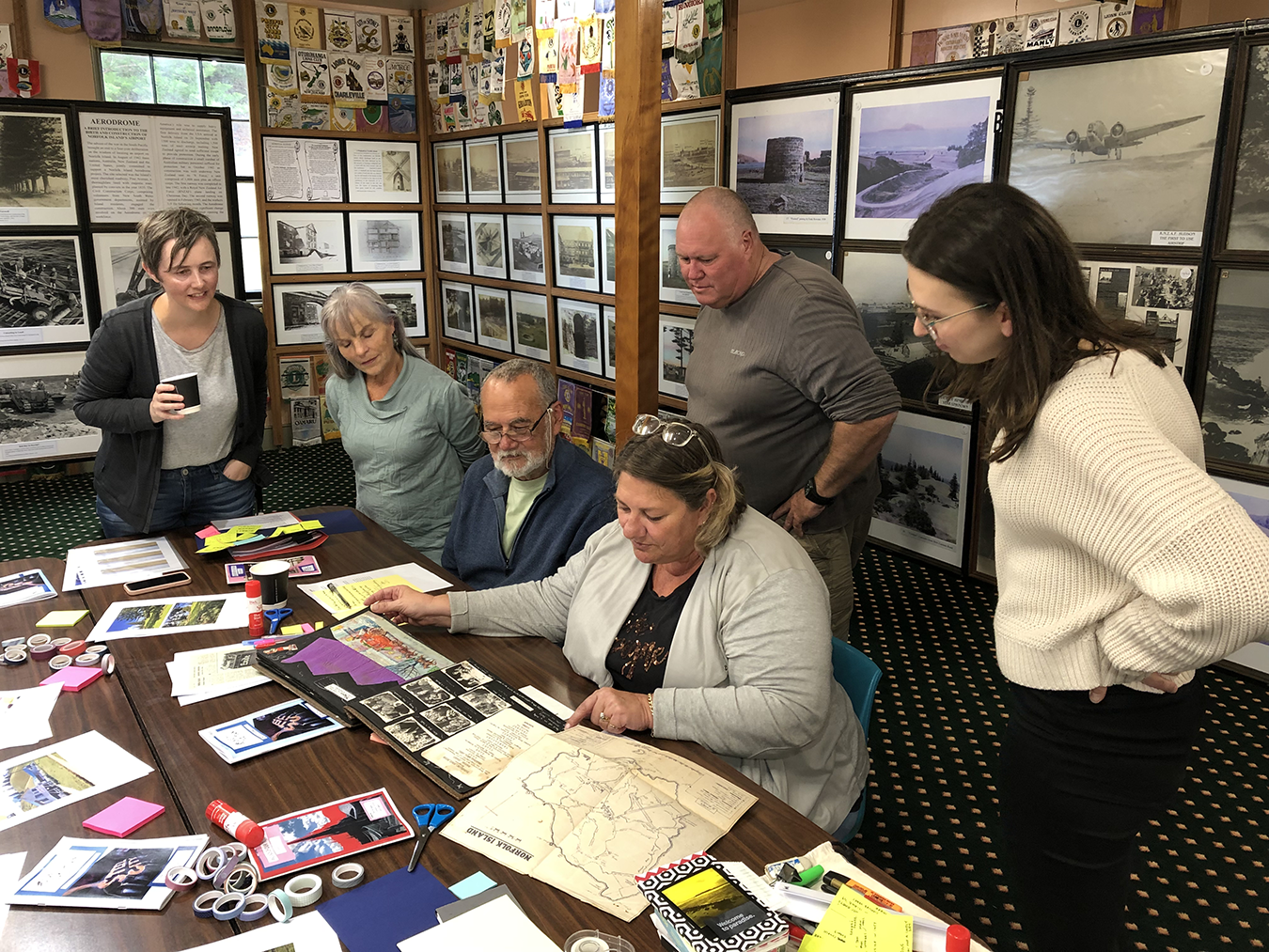
Workshop participants and researchers look at a photo album together. Photograph by Rogan Sharpe.
A place for locals
Although tourism was its core business, the Paradise was also an important place for locals. As Russell pointed out, the Paradise ‘became a central hub when any activity went on down town’ (workshop 1, 13 June 2021). This included being ‘a focal spot after funerals’, with the cemetery located across the road beside the golf course (Allan, workshop 1, 13 June 2021). The primary narrative to emerge about the Paradise, however, was its centrality in the social lives of locals on Friday nights: ‘moos evry body gwen g’down Paradise’ (Merv, p. 37); ‘Just about all the young people used to come down here to meet your mates you haven’t seen during the week’ (Edward, p. 8). Allan set the scene, reminding us that Kingston was very dark at night and ‘the lights coming from the Paradise were basically the only lights’ illuminating the area (workshop 1, 13 June 2012).
Russell explained how liquor licensing laws contributed to Friday nights at the Paradise being part of a weekly rhythm for Norfolk Island drinkers; ‘open nights’ were the only evenings locals could drink at an establishment on the island without signing a logbook. Friday nights provided greater freedom and less surveillance: ‘Friday night was a sort of release…the night we were entitled to come and drink [at the hotel] without all having to sign one of these registers’ (Russell, pp. 9–10).
On open night at the Paradise, ‘locals could mingle with guests and listen to a live band ‘til late’ (Allan, p. 36). Allan described the sound of the Paradise on open night: ‘music playing and the hum of many voices talking, laughing’ (p. 36), and Gaye recounted songs played by the band (p. 53). Friday nights were for ‘flirting’, ‘gossiping and carrying on’ (Edward and Russell, p. 12). Edward remarked that ‘Sometimes it used to get a little out of hand’ (p. 8), with Russell being one of many participants who recalled regular fights: ‘I got thrown out one night for fighting with somebody down here’ (p. 12). The Paradise was a place that brought locals together; even if these were not always harmonious experiences, participants remembered them fondly.
A place to work
The Paradise had a significant role to play in the island economy. Beyond its function as a hospitality venue, our participants described the hotel as supporting local farmers. Ken talked about his Dad supplying vegetables (workshop 1,13 June 2013), Robyn noted that her ex-husband’s family’s dairy delivered milk (p. 45), and Dids explained that his family’s butcher shop would store meat in the hotel’s commercial freezers (interview, 17 June 2021). In this way, the Paradise was sustained by and supported labour activities across the island.
A hotel of its size also meant the Paradise ‘was a source of employment for many people, whether they be working in the house or working behind the bar, or picking up visitors to take them on a tour, or working in the kitchen, or doing maintenance’ (Dids, p. 64). Robyn observed that in the 1960s, there were ‘a lot of staff’, including housemaids, cooks and waitresses (p. 42), some of whom lived on site. Others lived across the island, and Robyn recalled that her father, as manager, would ‘get up in the morning and start the generator up and then he’d go and pick up the staff, because a lot of people didn’t have vehicles or modes of transport then’ (p. 42).
Jane spent four years working at the Paradise as a cleaner and had fond memories of time spent with the other employees. She recalled how ‘we used to have breakfast every morning together…[the cook] would make us breakfast, it was nice’ (workshop 1, 13 June 2021). The end of the day could be equally social – once work had finished, ‘all the staff’ would go down to Emily Bay ‘with a big bottle of summer wine’ (Jane, workshop 1, 13 June 2021). Jane was one of the participants who described the hotel as ‘homely’, with the social, family-like atmosphere among the staff contributing to that feeling. However, as Merv – a former bartender at the Paradise – noted, not all aspects of working life at the Paradise were pleasant: Myse less favorite memory of Paradise is that when the night revelry has come to its end and all the patrons have left, the two people that worked the bar had to do all the cleaning up…We washed the ashtrays last of all because of their smell and that smell gets ingrained into your hands. (p. 27)
A place for love
Another prominent theme to emerge was the Paradise as a place for romance. As Merv stated, ‘Plenty sullen bin use a marry afta dem meet down dere at Paradise’ (p. 37), including Pat, who wrote on her zine page: ‘My first Friday night at the Paradise I went home with my future husband and the rest is history’ (p. 68). Robyn, recounting her time living at the Paradise, said that finding love was a common experience of the Paradise waitresses, many of whom had come from New Zealand for work and would then partner with island men: ‘that’s some of the ones that’ll tell you about their love stories’ (p. 42).
Stories were told of engagements being announced and weddings being held. Jane and Allan married each other at the Paradise and brought their wedding photos to the workshop. They described how their wedding in 1983 was the last to be held at the hotel. Jane, reflecting on all the people whose names had popped up over the course of the workshop, said: Ken, everybody you’ve mentioned today was at our wedding. Because I hadn’t been on Norfolk for long and I didn’t really know a lot of people, or have friends here, everybody that was [at the wedding] either worked there [at the Paradise] or were drinkers at the bar. (workshop 1, 13 June 2021)
A place called home
A number of our participants in the zine workshops described the atmosphere of the Paradise as ‘homely’ (pp. 2, 28). However, for two of our participants – Russell and Robyn – the hotel was, at different times, their actual childhood home, which shaped their sense of place in distinctive ways as compared to other participants. Russell, whose parents managed the property in the early 1950s when it was the Oceanside Guest House, included in the zine a photo of him aged ‘about five’ sitting with his dog Buddy on the upturned boat that sat on the lawn at the front of the guest house (p. 7). Around that age, he has memories of ‘being in the storeroom’ among jars and bottles (p. 18) and ‘tearing down’ the hillside behind the buildings on ‘a little wooden sledge’ made by his father (p. 14), of being hospitalised after eating rat poison under one of the Oceanside’s Prickly Pears, and collecting kindling from the ‘little valley’ above the guest house to feed Oceanside’s chip heaters (interview, 22 September 2021). In thinking back to the time he called Oceanside home, Russell puzzled over the location of buildings, including the one his family lived in, and other features of the guest house, such as the tennis court. Sitting at the picnic table on the site of the hotel with Sarah and his friend Edward, Russell looked at a black and white photo of the Paradise taken around the time he had lived there, reflecting that the site ‘doesn’t look big enough now to contain all the buildings that used to be here’ (p. 7). Such comments reflect the disjunctures that can exist between how place is imagined and how it is experienced in its physicality, as well as how sense of place shifts over time.
Fast forward to the early 1960s and the Oceanside was now called Hotel Paradise and managed by Robyn’s parents. Robyn was 11 years old when the Paradise became her home. She recalled how all she ever wanted growing up was a pig and a horse, and at the Paradise ‘we had a paddock full of horses…and it was just wonderful’ (p. 40). Robyn described how much she ‘loved’ growing up at the Paradise: ‘I had a ball’ (p. 42). The Paradise was where she learnt to dance, regularly attending the Friday night entertainment from the ages of 12 to 16. The Paradise also provided opportunities for making friends and engaging in play. ‘There’d be lots of kids’ coming with their parents on holidays (p. 41), and some would ‘come back every year, so we’d have a wonderful time just galloping around and off to the beach…we’d go and play in the cemetery at night, we played in the ruins’. Here, Robyn demonstrates how a sense of place relating to the Paradise also encompasses nearby spaces in Kingston.
The Paradise repurposed
When the Paradise was closing down, much of its contents, including parts of the buildings, were sold off. Pieces of the Paradise are, therefore, now scattered across the island. Dids and Robyn both spoke of the removal of buildings and materials from Kingston. Dids explained that Robyn purchased whole sections of buildings, while the remainder was ‘disassembled, and I took truckloads and truckloads of timber that had just been denailed and then was reused to build other structures’ around the island (p. 63). Robyn showed us photographs that had been taken of the disassembling process at Kingston (see Figure 5), featuring trucks rolling out along Quality Row with sections of buildings on board (p. 48). Other images depict these sections being offloaded in different locations on the island to form the structures of new homes (which were named things like Paradise Regained and Paradise Lost, paying tribute to the hotel) (pp. 46–7).
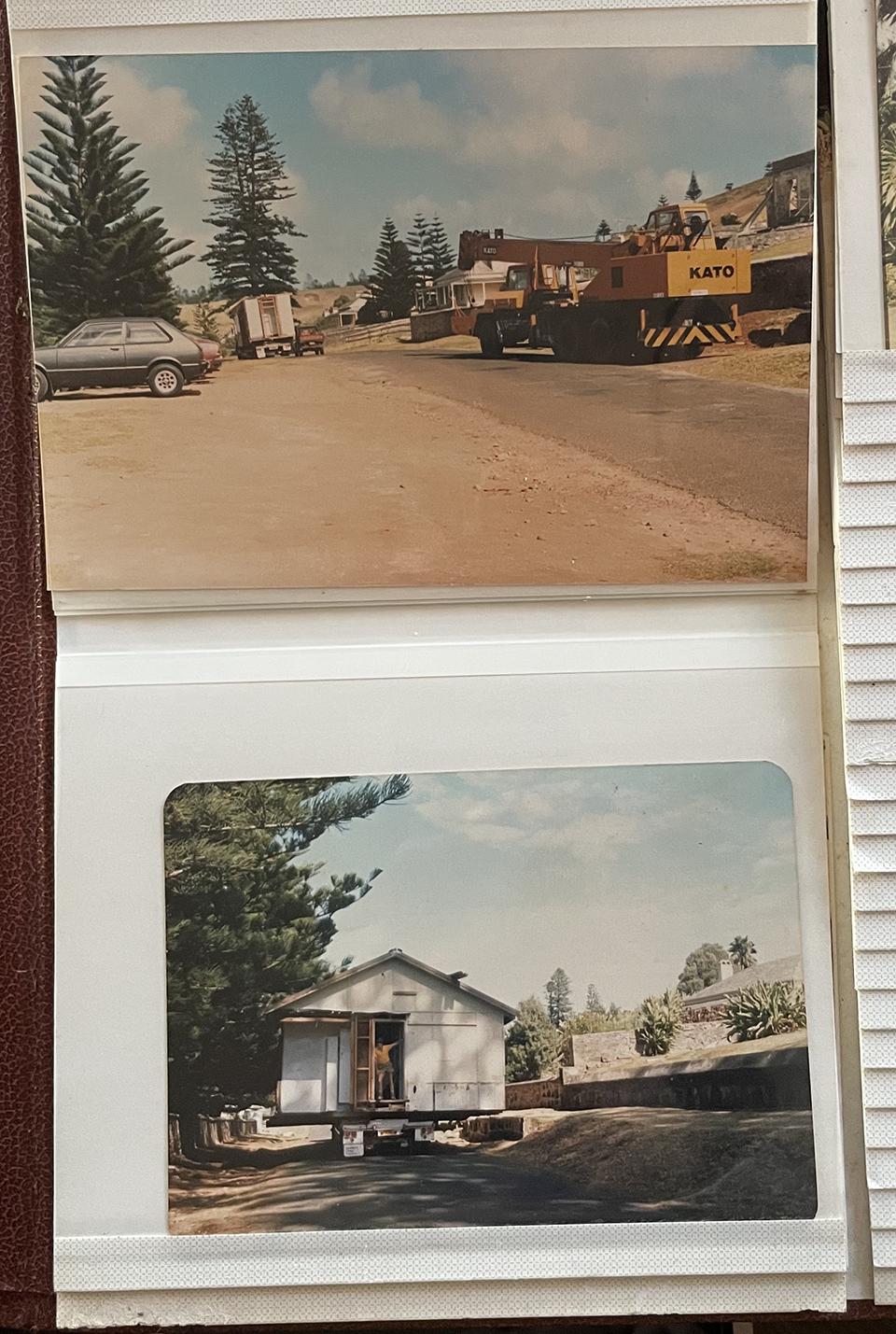
Images of the Paradise Hotel being removed from its original site in Kingston. Photograph by Zelmarie Cantillon of images from Robyn Tavener’s personal collection.
Our interview with Robyn took place in her home. Sitting in the living area, she showed us photographs of the home being built: ‘So this [image] is June 2003, so that’s what the house looked like before we started working on it which is – both sections of that is Paradise’ (p. 49). These images were then put into context as Robyn gave us a tour of her home: ‘if you come back in here, this part here, that piece of building is part of Paradise…that actual building part was brought here [from Kingston] and put there’ (p. 49). In addition to the Paradise being incorporated in the structure of her home, Robyn has various other Paradise artefacts throughout the house, including doors, ashtrays, a safe, a tea trolley and ‘big chunky china’ (p. 51). As Robyn described it, there are ‘bits of the Paradise sitting around’ that she uses ‘every day’ (p. 52).
The Paradise may no longer be at Kingston, but its significance lives on in different forms in people’s lives. Robyn continues to live among the Paradise – it was ‘a big part of [her] life’ growing up as a child living in the hotel, and it continues to be today (p. 52). Likewise, Dids described the Paradise as having been significant in his life: ‘I grew up there. Bubby, my father, was always – it had Bubby’s Corner branded on one side of the bar, you know. So as a child I spent a lot of time there. I knew each and every one of the managers’ (p. 61). In addition to having been involved in the removal of building materials from the Paradise, Dids purchased items from the hotel which have been given new lives elsewhere. Out at his farm on the west side of the island, Dids mentioned having ‘the old desk out of the Paradise…You can’t see it because it’s actually buried under stuff’ as well as ‘the old trough from the Paradise’ in ‘the men’s loo’ (p. 61). Dids also secured ‘big commercial kitchen pots’ (p. 62), which have cultural importance for being ‘really good for Bounty Day’, the anniversary of the Pitcairner arrival to the island. Dids explained the pots were useful for ‘when you’re going down [to Kingston] and feeding a hundred people or whatever’ (p. 62). The afterlives of the Paradise’s material remnants illustrate how sense of place is not bound to a singular geographic location, as well as how sense of place continues to be shaped in the present.
Capturing sense of place in heritage interpretation
The material collected for the zine highlights that the Paradise site held a dynamic, vital place in the heart of the Norfolk Island community during the period of its operation, but also that it continues to do so now, over 30 years since the hotel’s closure and dismantlement. The findings illustrate the varied engagements that people had with this place – as visitors, patrons, workers, residents – which not only forged their attachment to it but contributed to constructing its sense of place as somewhere lively, sociable, homely, special. Beyond these memories and emotional attachments, the data emphasises the hotel’s place or role within the wider community, as a particular node in a network of exchanges that supported Norfolk Island’s tourism and agricultural economies. In short, the sense of place attached to the hotel reached far beyond the physical location in Kingston. The zine workshops also demonstrated how sense of place extends to participants’ own locatedness within a particular space, time and community – telling stories and enacting ‘collaborative reminiscence’ (Baker and Cantillon, 2022) draws participants together based on shared experiences and collective memories of the Paradise. This point resonates with Smith’s (2006: 75) conceptualisation of sense of place, which invites us to consider not just meanings associated with physical spaces but one’s own position within a community or history: Heritage, particularly in its material representations, provides not only a physical anchor or geographical sense of belonging, but also allows us to negotiate a sense of social ‘place’ or class/community identity, and a cultural place or sense of belonging.
Although our discussions with participants focused primarily on their stories of the Paradise while it was still in operation, we also invited them to reflect on the place today – a picnic area with no heritage interpretation to indicate what else was once there. In the second zine-making workshop, participants were invited to respond to the prompt: ‘If there was going to be an interpretive sign at the old Paradise site, what would it say?’. This elicited a back and forth between participants as they attempted to establish the historical facts – names of managers and the dates of their involvement, the date the Paradise finally closed, the date it was dismantled, the date-span for when it was leased by Travelodge, where the whale bones that framed the hotel’s entrance now reside. Such responses align with the ‘pragmatic and rationalised’ approach to heritage conservation, management and interpretation which prioritises tangible aspects of a heritage place (Lesh, 2020: 431), an approach which dominates the interpretive signage in KAVHA that the participants were familiar with. What was missing from this initial discussion was all the aspects of sense of place that had been revealed in the workshop up until that point – the nuanced experiences of the Paradise that had emerged from participants’ sharing of stories and memories, the ‘cultural place or sense of belonging’ referred to by Smith (2006: 75).
After we drew participants’ attention back to the writing exercise, they wrote and read aloud statements that went beyond the preliminary discussion of historical facts to reveal the Paradise’s role as an ‘anchor’ of community identity and connection (Smith, 2006):
This is the site where the Paradise Hotel stood…This hotel was a place where Islanders and visitors could meet and enjoy music and a drink. Closed by the Commonwealth of Australia because they could not read a map. (workshop 2, 16 June 2021; see p. 66)
I’m not very good at place names and info, but I’ve said ‘the Paradise Hotel, a place that holds many memories for the Norfolk Island people and those who visited the Paradise Hotel over many years. A hive of music, fun, joy and laughter, it lives on in many places all over the island. Visit the Pier Store Museum to see some of these pieces’. (workshop 2, 16 June 2021; see p. 57)
Paradise Lost. Here was the place to go on Friday night for visitors and locals. Constructed of army huts left here by the New Zealand Army – is that right? – It provided holiday accommodation, venues for parties, weddings and dancing and its entertainment. Upgrade of the convict settlement by the Australian Government required its removal, as it didn’t fit the surroundings. (workshop 2, 16 June 2021; see p. 68)
Day es side dah Paradise Hotel bin use a be. Day hotel supplied 3 meals every day and a daily bus trip up to Bun Pine, as in dem days had no rental cars, very few restaurants and no tourist busses. Ef you wunt a si Norf’k you hire one riden horse, en had 2 or more sullen dart bin use a hire dem out. Paradise had d baas side f’ one hotel en es still d’ bass side. (workshop 2, 16 June 2021; see p. 65)
An interpretive sign on the Paradise site would need to be explicit and in-depth with photos, because Paradise means so much to so many people. (workshop 2, 16 June 2021; see p. 67)
What appears in these statements is a mixture of pragmatic details about the site’s history (some factual, others not) and its significance as a social and affective space. Pat and Clare make political comments on the removal of the Paradise – ‘Closed by the Commonwealth of Australia because they could not read a map’, ‘the Australian Government required its removal, as it didn’t fit the surroundings’ – that speak to a more difficult layer of the site’s history, indicating the plurality and contestations implicated in that place and its heritage. Gaye opts not to draft a sign, recognising that such a task would involve careful research to do justice to the special place that the Paradise continues to have for people on Norfolk Island. In our interview with Dids (cited in Baker et al., 2021: 8), he similarly reflected on the challenges with capturing the dynamic qualities that constitute a sense of place and living heritage: post-1856 needs more interpretation, you know? And sometimes it’s difficult, because – I can’t think of the right word. When you just know it? Intangible! The intangible things that are so much a part of KAVHA, you know. You’ve got so many tangible things, but there are also many, many, many intangible things. And they’re hard to put onto a sign. They are hard to portray to someone unless that person actually sees a Bounty Day parade. It’s very hard to explain a Bounty Day parade without saying, ‘Oh well, they get dressed up in period costume and they march from the pier to the cemetery’. It doesn’t paint the picture. You’ve actually got to experience it. One of the saddest days: I can remember when Travelodge proposed to build the hotel on that Paradise site, and the Norfolk Islanders were quite happy with that, because it was a design that was quite sympathetic to the general environment. They’d [Travelodge] respected the convict heritage…Then the National Trust of Australia stepped in, and suddenly we became hostage to someone else’s opinions about what Kingston should be. (Mary, cited in Baker et al., 2022: 3)
As suggested by Smith (2006: 79), the authorised heritage discourse promotes a ‘consensual view of the past and its meanings in the present’, downplaying contestations and the plurality of meanings and experiences that constitute place. The interpretive signage text produced by workshop participants, and the See You at the Paradise / Ketch Yorlye Daun Paradise zine more broadly, offers a counter-narrative to this discourse, amplifying the symbolic, intangible and pluralistic qualities of place. At the same time, the participants’ contributions capture the extent to which ‘Heritage is something vital and alive. It is a moment of action, not something frozen in material form’ (Smith, 2006: 83). As Lesh (2020: 433) observes, ‘historic fabric is not any more or less important than the social meanings of a place’ and heritage processes therefore need to treat both equally in order ‘to achieve positive heritage and social outcomes’.
Conclusion
Although the Paradise may have been considered, by some, to be an ‘ugly blot on the landscape’ (Russell, p. 18), it nonetheless holds heritage value for those with long and deep connections to it. The participants’ stories and memories demonstrate the Paradise’s significance goes beyond aesthetics and materiality, but there was also a suggestion that, if it were standing today, the Paradise would have had value as a ‘twentieth-century heritage place’ (Marsden and Spearritt, 2021) in the Pitcairn settlement. Indeed, Ken went so far as to express that he ‘would have liked to have seen it [the outside structure] kept as was…I think it would be great if it was still there’ (workshop 1, 13 June 2021).
Although the loss of that physicality has impacted on the specificities of the sense of place associated with the Paradise (or Dewville or Oceanside), it has not decimated the sense of place entirely – remnants of that materiality still exist, as do the intangible, imaginary dimensions. As Massey (1994) observed, places are always linked to and constituted by what is beyond or outside them. Our participants’ ‘meanings and memories’ of the Paradise are as much shaped by their ‘contemporary interactions’ (Smith, 2006: 77) with the Paradise – with the green space where the Paradise once stood, the items from the Paradise they encounter in everyday life, and the stories that are told as people reminisce about their shared past with the hotel – as they are by the physical structure that is now long gone. Likewise, our participants’ articulations of the sense of place of the Paradise are informed by experiences of past and present heritage management and interpretation strategies in Kingston. These strategies are, in turn, connected to global heritage processes, with the authorised heritage discourse being a transnational force with local resonance for the experience of Kingston’s living heritage. These contemporary interactions with the Paradise, including those facilitated by the workshop process, work to revive, restore or remake meanings and memories. In doing so, they bind the community once more through the collective (re)discovery and (re)construction of the site’s sense of place (Smith, 2006: 77) in a moment in time where there is much at stake for the people of Norfolk Island in relation to their political autonomy and sense of belonging to and custodianship of where they live (Nobbs, 2017, 2021).
Understanding place as always in-process and constituted by multiple elements and relations, we can see that the Paradise is not something that only existed in the past, while it was in operation. This article captures how, in both material and symbolic ways, the sense of place of the Paradise remains strong despite its physical absence in Kingston. Indeed, the loss of the Paradise, and the contributing factors to this loss, have been powerful in shaping the sense of place that persists today. With the physical structures of the hotel long gone from their original location, the sense of place associated with the Paradise is characterised by an absent presence – where its significance and meaning still linger in participants’ individual and collective memories, reinforced by their engagement with the Paradise through material forms now repurposed across the island. Inasmuch as the Paradise is characterised by an absent presence, what is also apparent is its present absence – where the passing of time since the building’s removal, inflected by very real changes to governance and people’s relationships to place, has served to amplify a need for collective remembrance. Taken as such, the expressions of longing for the sense of place of the Paradise Hotel captured in See You at the Paradise / Ketch Yorlye Daun Paradise speak to more than the loss of the physical and social space of the hotel. Rather, the absent presence/present absence of the Paradise in many of the participants’ memories, stories and reflections are suggestive of how governance changes and political disenfranchisement – including shifts in Norfolk Islanders’ involvement in the heritage management of KAVHA – have affected Kingston’s sense of place more broadly and related expressions of belonging and cultural identity. In this way, the case study of the Paradise Hotel highlights the local effects of transnational heritage policies and discourses that seek to define heritage value and manage heritage sites without appropriate engagement with communities and their sense of place.
Footnotes
Declaration of Conflicting Interests
The author(s) declared no potential conflicts of interest with respect to the research, authorship, and/or publication of this article.
Funding acknowledgement
The author(s) disclosed receipt of the following financial support for the research, authorship, and/or publication of this article: This work was supported by the Australian Research Council [SR200200711].