




Abstract
Researching migrant and multilingual parents’ literacy practices with their children is ethically complex due to the dominant discourses of language and literacy which devalue such practices as irrelevant or deficient. Translanguaging theory and the related concept of translanguaging space offer opportunities to consider dialogue with multilingual parents differently, valuing their literacy practices in the interview space. Drawing on data from an artifactual literacies study with multilingual parents, the paper discusses three aspects which contributed to reframing the interview as translanguaging affirmative space: the value of artefacts brought by the parents in relating their lived experiences; the role of semantic maps as shared multilingual writing; and the use of multilingual transcribing. It is argued that through these practices, a translanguaging affirmative space was co-produced which contributed to reducing the power imbalance inherent in research. It is further argued that such translanguaging space can be co-produced by researcher and participant, even when they do not share a home language.
Keywords
Introduction
Research with migrant and multilingual participants is ethically complex, requiring ongoing and iterative processes of reflection and renegotiation of access and priorities (De Costa, 2016). The increasingly stringent ethical guidelines and approval processes for institutions steer the focus of research ethics away from these priorities and towards a more etic approach dominated by concerns of protecting the institution (Connor et al., 2018; Hammersley, 2010; 2018; Hammersley and Traianou, 2016). Such emphasis on the bureaucratic and etic can lead to overlooking the more specific challenges and risks of harm which can arise from ‘reinforcing dominant depictions’ of migrant and multilingual participants (Phipps, 2017: 9). Reinforcing such depictions is becoming a dominant reality as it is represented at the macro level in UK government policies on migration and asylum seeking (e.g. Illegal Migration Act, 2023). The impact of such reinforcement of negative depictions on researching with migrant and multilingual participants is the increased risk of harm through othering (Flewitt, 2022) or through the reification of cultural and historic practices and knowledge (González et al., 2005; May and Sleeter, 2010).
Addressing this issue, research on cultural and co-productive work with migrant and multilingual participants emphasises the need for research practices to focus on social justice first and on knowledge production second (Chan, 2020; Parsons, 2021; Phipps, 2017). Responding to this, in establishing research practices which are rooted in migrant participants’ framings of realities, Pahl and Rowsell (2010) demonstrate the value of objects which carry cultural or emotional value for participants, thus moving away from traditional interviewing and to a dialogic process of reflecting on lived experience. In their work with migrant participants, Karam et al. (2021) similarly use an artifactual literacies lens to create dialogic opportunities located in the participants’ knowledge and experiences.
However, less considered in research with multilingual participants are the ways in which such dialogic opportunities are further dependent on how diverse linguistic forms, such as home languages, are given space in the research context alongside the dominant language. In this sense, the notion of language appropriateness (Flores, 2013; Flores and Rosa, 2015) is key in research practices with migrant or multilingual users as a way of understanding how power imbalance is inherent in language use. Work on creating translanguaging space has engaged with this issue by highlighting the value of enabling multilingual users to draw on their full linguistic and communicative repertoire in meaning making (García and Li, 2014; Li, 2018).
This paper examines opportunities for the qualitative interview to provide an inclusive and ethical language space. Drawing on the findings from research with multilingual parents’ early literacy practices with their children, the paper provides evidence of the value of enabling multilingual users to engage in fluid language and communication practices. This included the use of translanguaging and multimodal expression by parents to describe in authentic and culturally responsive ways their early literacy practices with their children, the use of semantic maps which enabled translanguaging in the written mode, and engaging in multilingual transcribing as a form of member checking and valuing of the participant's funds of knowledge. The evidence presented demonstrates the value of creating the conditions for establishing the interview as a translanguaging space, in this way gaining more culturally diverse and responsive insights into the early literacy practices of multilingual families. This minimises the risk of harm through othering and reification of dominant linguistic, cultural and historic knowledge, thus opening up opportunities to consider translanguaging as ethical research practice.
Literature review
A number of authors have criticised institutional ethics guidance and procedures as falling short of addressing the needs of qualitative research, particularly with participants who are vulnerable to othering (Connor et al., 2018; De Backer, 2022; Flewitt, 2022; Pascoe Leahy, 2022). Qualitative research with marginalised populations requires an evolving rather than a fixed approach of reflexive ethical practice within which there is space for jointly developing knowledge with participants (Kara, 2017; Kirkham and Mackay, 2016; Phipps, 2017). One example of this is the need for research with multilingual and migrant parents to engage with the ways in which their literacy practices with their children are frequently positioned as lacking or deficient. Policy-facing research in England concerning children with English as an additional language (EAL) focuses primarily on the attainment gap, acknowledging value in home literacy practices only where these lead to full proficiency (Demie, 2018; Strand and Lindorff, 2020). This marginalises the value of home literacy practices which involve cultural learning or translanguaging (García and Li, 2014) and the use of funds of linguistic knowledge (González et al., 2005). Impacted further by an overall policy focus in literacy curricula in England on rectifying the ‘word gap’ (Cushing, 2023), this has led to viewing migrant and multilingual parents’ literacy practices through a lens which is monocultural, monolingual and decontextualised from the spatial and relational contexts in which it develops (Green, 2023; Hackett et al., 2021).
This suggests that when an understanding of the literacy practices of migrant and multilingual families is located in a research context, there is a need for a shift in the agenda of research, making it ‘about social empowerment first, knowledge gaining second’ (Connor et al., 2018: 401). Adding to this, Copland and Creese (2016) examine the inherent imbalance in linguistic ethnography between multilingual participants and the ethnographer who speaks from a position of power and scientific knowledge often inadvertently silencing the participants. In this context, ‘flattening the relationship between the researcher and the researched’ (Copland and Creese, 2016: 188) becomes a primary focus of the ethical research process. As part of flattening this relationship, recognition of the rich funds of knowledge which migrant and multilingual parents bring to the dialogue is needed (González et al., 2005).
Such recognition has been embedded in practice through the funds of knowledge approach, where, in collaborative dialogue, teachers and parents co-construct ways of drawing on the cultural knowledge and resources accumulated by families (Chesworth, 2016; González et al., 2005; Kelley, 2020; Moll et al., 1992). Recognising these funds of knowledge and embedding them in teaching practices and spaces legitimises parents’ knowledge, repositioning parents by affirming and acknowledging how their home language practices are ‘worthy of pedagogical notice’ (González et al., 2005: 42). These approaches bridge the divide between school and home contexts and take strides towards reframing what is considered legitimate knowledge in the classroom context. They speak to post-colonial ethics in research through positioning parents and their practices as legitimate voices in school and classroom, traditional institutional contexts.
Work on artifactual literacies with refugee families builds on the concept of funds of knowledge (Karam, 2018; Karam et al., 2021). In this approach, artefacts which refugee families bring to the research become a form of non-verbal articulation of identity. Through such objects, participants can express aspects of their identity not only relating to their home country but also aspects which express their new identity in the country of settlement. The mediating power of artefacts creates opportunities for dialogue anchored in the participant's beliefs, value system and personal narratives (Pahl and Rowsell, 2010). The dialogue is thus grounded in and originating from the participant's personal experience rather than in the researcher's agenda. Artefacts can ‘empower meaning makers into sharing what matters to them with their audience’ (Karam et al., 2021: 532). By situating migrant parents as meaning makers and affirming the knowledges generated through artifactual literacies, an ethics of knowledge exchange that is more flattened between researcher and participants is produced.
Why language matters when creating ethical research practices with multilingual parents
Artifactual literacies and funds of knowledge inform both pedagogical practices and research methodologies (Gonzalez et al., 2005; Grenfell et al., 2013; Moll et al., 1992; Pahl and Rowsell, 2010). Both approaches further work towards bridging established dichotomies of home and school. They do this by paying particular attention to positioning multilingual families’ knowledge as legitimate, particularly in institutional contexts where traditionally, attempts to introduce knowledge of culture and history end up reifying cultural knowledge (May and Sleeter, 2010; Rhedding-Jones, 2010). However, a body of research points to the need to consider how language matters when trying to establish a more power equal space (Flores and Rosa, 2015; García et al., 2021).
Starting from a raciolinguistic perspective, Flores and Rosa (2015) reveal the ways in which the diverse linguistic practices of migrant and multilingual groups are considered less appropriate, particularly in formal institutional and academic contexts, where research interviewing is usually positioned. The authors point to the inherent racism and marginalisation which result from such appropriateness-based approaches to language practices. In appropriateness-based models of communication, individuals from racialised communities are compelled to model their communication on the practices of white monolingual language users. Similarly, the interview space emerging from academic and institutional contexts is delimited by the ethical guidelines of institutional research (Kirkham and Mackey, 2016). As such, it is inherently situated in the dominant language, knowledge structures and ideologies and perpetuates the values of the ‘white listening and speaking subject’ (Flores and Rosa, 2015: 152). This signals that building in co-production alone as a methodology for the research study is insufficient in addressing key ethical issues of power imbalance. The research space itself is not neutral when considering how the dominant language is foregrounded from the outset through consent forms, participant information sheets and unspoken agreement on the official language of exchange. The cultural and linguistic knowledge of migrant and multilingual parents, in their experience and historically, has often been minoritised in institutional and academic contexts (Cru, 2015; Flores, 2013; Jang and Brutt-Griffler, 2019). Therefore, in inviting migrant parents to share such knowledge, considering how their language practices are valued in the research space becomes the researcher's responsibility. As García and Li state, language is ‘enmeshed in systems of power and thus can be oppressive or liberating, depending on the positioning of speakers and their agency’ (García and Li, 2014: 8).
This leads to the consideration that to establish the research interview as an ethical space requires an acknowledgement of the speaker's agency (Mora et al., 2022). Central to the process becomes the need to make space for participants’ diverse language practices (Becker, 1991; García and Li, 2014).
Meaning making within translanguaging space – towards an ethical approach to research with multilingual parents
As discussed above, enabling diverse language practices within the research context is essential to co-constructing a more power equal research space for migrant and multilingual participants. Translanguaging, referring to the use of both/ all languages by the multilingual speaker in everyday conversations and situations (García and Li, 2014), is a natural communicative practice shaped by social interaction. Within such social interaction, multilingual users move fluidly between and beyond languages to create new meaning. Li (2018) builds on this idea by defining the concept of translanguaging space – referring to the social and interactional spaces created by multilingual users, in which they practice languaging through the use of a variety of meaning making resources (García, 2019; Mary and Young, 2017). Not only is such translanguaging space an opportunity for social interaction and connection, it is an essential mechanism for positive identity development for migrant and multilingual speakers (Li, 2011). Multiple meanings enmeshing identity are created within a translanguaging space. In the process of using more than one language and engaging in meaning making, multilingual users create new forms of expression. It can be argued that creating the conditions for translanguaging space within a research interview context would work towards a more power equal space in which migrant and multilingual parents are more fully supported to create and communicate meaning.
A relevant critique of translanguaging theory, however, is that it has frequently been positioned as exploring multilingual users’ full access to their linguistic repertoires while placing less emphasis on the broader ways in which communication and meaning making take place, not only through linguistic, but also in embodied and multimodal ways (Kusters, 2021; Pennycook, 2017). Kusters discusses the limitations of the linguistic repertoire and highlights that multiple modes are at play in communication. This diversity of communicative forms is referred to as a semiotic repertoire. For Kusters, translanguaging forms part of the semiotic repertoire. This is supported by Li's definition of translanguaging as a practice in which ‘Human beings think beyond language, and thinking requires the use of a variety of cognitive, semiotic, and modal resources of which language in its conventional sense of speech and writing is only one’ (Li, 2018: 18), an acknowledgement that translanguaging happens not only through language, but through multiple modes. This is important as it opens up opportunities for translanguaging space to be created between researcher and participant, even when they do not share a home language.
In other current research, the relationship between translanguaging and multimodality is further explored (Lin, 2019; Mora et al., 2022; Suresh Canagarajah, 2013). Multilingual users construct meaning by drawing on all available resources, including multiple languages, semiotic and modal resources. Such modal resources could include, but are not limited to gesture, movement, changing the direction of gaze, tone of voice and ‘sounding for’ others (Cantarutti, 2022: 205). These modal resources are used in a variety of combinations by the speaker to communicate meaning. The use of multiple languages, semiotic and modal resources is also evident in Li's articulation of translanguaging as a social semiotic practice (Li, 2018). The social semiotic perspective on multimodality maintains that signs are not merely used; they are actively created by the meaning maker, who draws on their cultural and historical knowledge and resources in order to create new meaning (Kress and van Leeuwen, 2001). In the case of research with migrant and multilingual parents, it is essential within an interview situation to enable the participants to draw on their cultural and historical knowledge. Supporting this, Kress (2010) highlights that, from a social semiotic perspective, an ethical approach to communication involves giving all participants access to the full range of linguistic, semiotic and cultural resources in the social and communicative contexts.
Within a translanguaging interview space, where migrant and multilingual parents make use of their full semiotic repertoire, artifactual literacies as an approach become relevant. Pahl shows the ‘potential of objects to call up stories’ and explores multiple ways in which literacies are ‘embedded within everyday material culture’ (2017: 30). Similarly, through enabling participants to bring objects of cultural, historical or linguistic significance to the interview, opportunities become available for participants to draw on the full translanguaging and social semiotic potential of these objects in communicating aspects rooted in their own, rather than the researcher's priorities. Rarely has research engaged with translanguaging as a research tool in itself or focussed on the potential of translanguaging space within research to create opportunities for dialogue located in the participants’ knowledge and priorities.
The following section presents the context and artifactual literacy methodology of the study with migrant and multilingual parents, exploring their literacy practices with their children in early childhood. The focus of this discussion is to describe and more fully understand the conditions for creating translanguaging affirmative space with participants, which is understood as opportunities for participants to draw on their full semiotic repertoire. The extent to which such translanguaging space is more inclusive of different forms of knowledge being shared between researcher and migrant multilingual participants is explored.
Creating close-to-practice and translanguaging affirmative research interview spaces
Informed by the principles of critical multiculturalism (May and Sleeter, 2010), this study set out to explore multilingual parents’ literacy practices with their children (0–8 age range) in home and community contexts. Critical multiculturalism recognises the interpersonal and material inequalities which multilingual children and families face. As discussed above, these inequalities can originate in the way language and meaning making resources are dichotomised in public and private spaces as well as in school and home contexts (García et al., 2021). As a second language user of English and a migrant, I have repeatedly encountered such dichotomising of culture and languages in institutions and public spaces and have observed and experienced the learnt silencing effect it has on multilingual speakers. With this in mind, and in an attempt to break the monolingual code (García, 2019), adopting an artifactual literacies approach to exploring a multilingual early childhood literacy context was considered an appropriate choice. In this methodology, artefacts chosen by the participants are seen as an expression of identity (Pahl and Rowsell, 2010), including the identity shifts which form under the pressure of migration. As Pahl and Rowsell discuss, artefacts brought by participants have substantial story telling potential, yet do not over rely on fluent monolingual articulation. Placing the focus on the discussion of artefacts rather than on fluent monolingual articulation was intended to help shift the discourse shaping within the interview, from dominant monolingual framings of literacies to exploring the counter narrative (Karam et al., 2021) and in this way gaining a fuller understanding of the lived experiences of multilingual parents.
In its rationale, this study further aligned with the principles of close-to-practice research (Parsons, 2021) aiming to close the gap between formal research knowledge and the practical knowledge of families and children. Institutional research knowledge and processes originate in the dominant culture, knowledge and language and align with structuralist and colonial framings of research (Cru, 2015; Flores, 2013; Jang and Brutt-Griffler, 2019). Therefore, valuing the practical knowledge and experience which multilingual families bring to research entails establishing a space where knowledge is constructed more collaboratively between researcher and participants, drawing on practical as well as research knowledge. In the context of this study, practice constituted the informal literacy approaches which parents adopted in introducing their children to the heritage language and culture. Further, the interview ‘space’, which I aimed to co-produce with participants, was one which aligned with the principles of translanguaging space – enabling participants to engage in fluid uses of languages and communicative repertoires, in this way being supportive of participants’ identity expression (Li, 2018).
Research study context and participants
This research was carried out in a city in the north of England, focussing on the experiences of multilingual and migrant parents with their children's early literacies. The focus was on the experiences of families with children (0–8 years old) and their children's transitions from the home linguistic and cultural contexts to an early years setting or primary school, where English was the dominant language. Such transitions can pose challenges to multilingual families and children due to the dominant language policy and practices emphasising standard English as a priority in literacy teaching and learning (DfE, 2013) and focusing narrowly on closing the ‘word gap’. These priorities have been widely criticised as promoting a deficit view of children's and families’ language practices (Figueroa, 2024; Green, 2023; Snell and Cushing, 2022). The drive towards standardisation of young children's language and communication is further compounded by a weakening of support for multilingual children in settings (Early Education, 2023), signalling a de-prioritisation of migrant and multilingual families in the education system. For migrant and multilingual children and families, such policies and practices devalue the culturally rich and diverse language and literacy practices evolving in homes and communities (Little, 2020).
In this context of devaluing and deprioritising the experiences and practices of migrant and multilingual families, research which explores these experiences gains relevance. It further raises the question of how such research can be conducted towards an ethics which invites these parents’ funds of cultural and linguistic knowledge into the research space as valid and appreciated, countering the devaluing and silencing effect produced by institutional contexts.
In this paper, I report on the experiences of two of the parents interviewed and focus on how the conditions were created within the interview for these parents to share aspects of their early literacy practices with their children while making use of their full communicative repertoire. Two parents’ experiences are reported here, from the broader sample of seven, chosen in particular as they were actively engaged in introducing their home language to their children.
Figure 1 presents an overview indicative of the two parents’ linguistic background, socioeconomic status and level of education. In both families, Mandarin was prioritised as the language spoken with the children at home, and emphasis was placed on learning about the heritage culture surrounding this. Both families visited their home country during summer holidays, allowing the children to be immersed in the culture and language for a sustained period. These visits were also an opportunity to collect literacy materials – many of which formed part of the artifactual literacy interviews discussed in this paper. In both families, there were relatives and grandparents who primarily spoke Chinese, which acts as an important motivating factor for home language maintenance (Little, 2020; Spolsky, 2012). The two families knew each other well through the pre-school and the primary school which the children attend. They frequently met socially, with the children engaging in fluid multilingual conversations in Chinese and English. The families jointly organised an informal voluntary Tai Chi group on weekends which was attended by members of the local community. The group had a social and health purpose, but the parents also introduced knowledge of Chinese culture in the sessions.
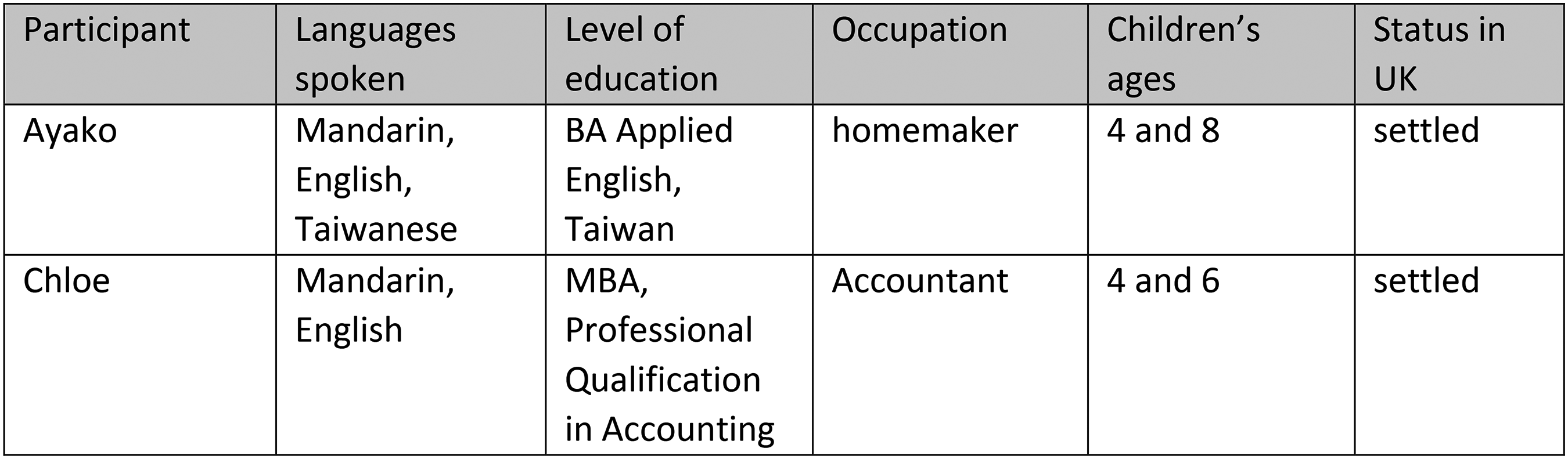
Participants’ characteristics.
Both parents had direct and frequent experience of the phenomenon of interest to the research study – the fluid use of both languages in everyday social and literacy interactions with their children. In both cases, the parents brought a wealth of literacy and cultural artefacts to the interview. In the course of the interview, they used these artefacts to support their narrative, drawing on multiple modes of meaning making and on the fluid use of Chinese and English in communicating about their children's literacies.
The two families were known to me from the local primary school which our children attend. While I do not share a home language with the families, I am multilingual, and, like the two families’ children, I experienced a challenging transition into a primary school setting where the dominant language (Bulgarian) was different from the language spoken at home (Armenian). I, therefore, have some early childhood experiences of how such transition feels and have empathy with the two families’ children. My own early experiences have shaped my interest in researching the positioning of languages within formal and informal settings. Despite the fact that I am not actively introducing a heritage language to my children, my own experiences of being a migrant and multilingual parent provide shared points of reference, which contributed to a certain reciprocity in the interview process.
Creating the conditions for establishing a translanguaging affirmative space
The examples explored in this paper are drawn from the interviews with these two parents. Each interview lasted an average of 1 h, with the first 40 min dedicated to the artifactual literacy approach and the latter part taking a more traditional semi-structured approach. In addition, I took photographs of the literacy and cultural artefacts which parents brought to the interview. Each interviewee was provided with a semantic map which they could use ongoing through the interview to capture in written form aspects of our conversation (see Figures 3 and 4). During the artifactual literacy part of the interview, multiple modal resources besides the dominant one (monolingual speech) were used by the parents to communicate about their children's developing literacies. The social semiotic theory places an emphasis not only on the distinct contribution each mode of communication makes to meaning making, but also on ‘which mode was foregrounded, which mode carries major informational weight’ (Kress, 2010: 60). Figure 2 illustrates the number of instances in which modes of communication other than monolingual speech were foregrounded during the artifactual literacy part of each interview.
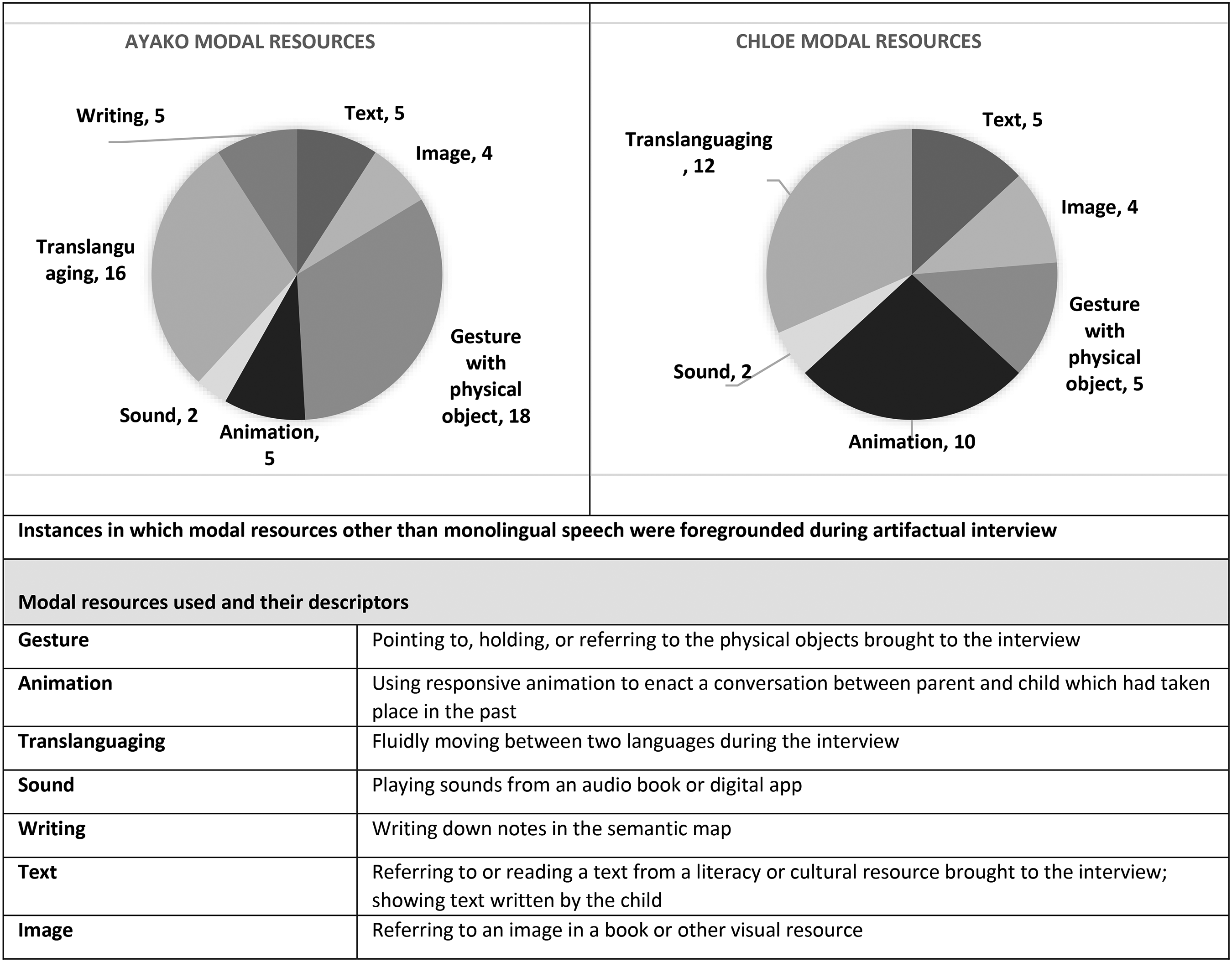
Modal resources foregrounded by the participant during the artifactual interview.
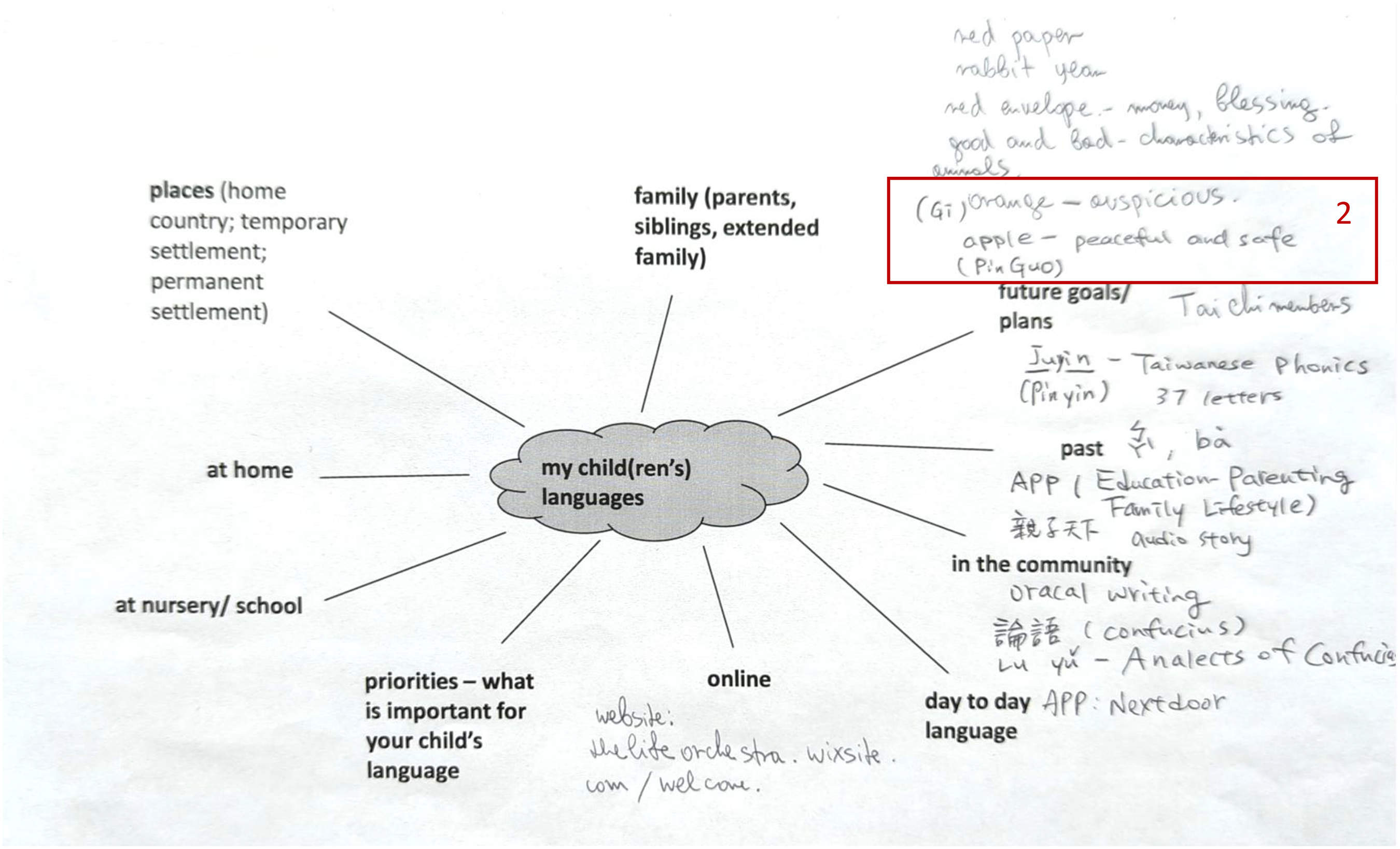
Ayako's semantic map.
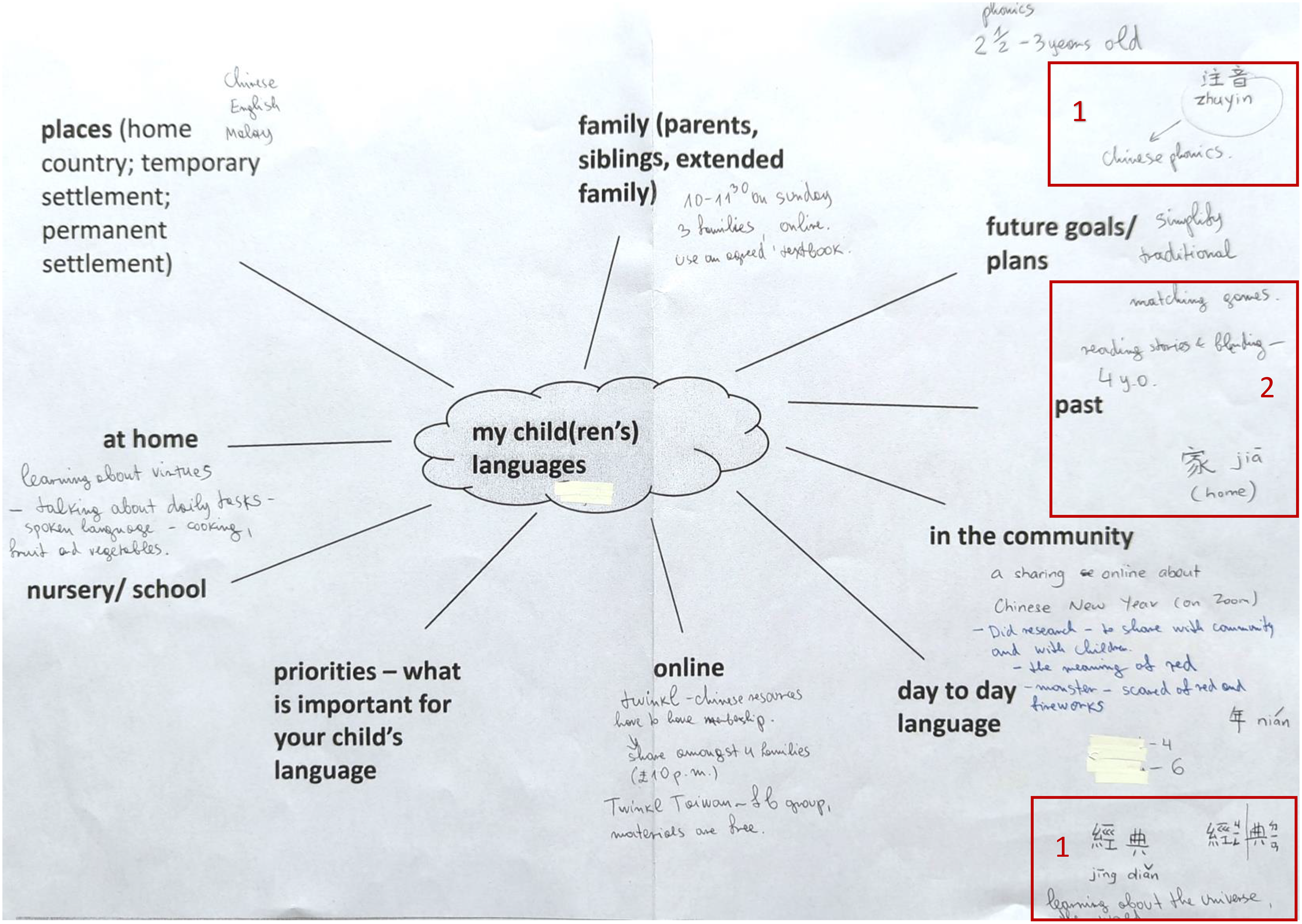
Chloe's semantic map.
In both interviews, there were a significant number of instances of translanguaging, indicating that both parents felt the need to fluidly move between their home language and their language of settlement. In addition to translanguaging, in Ayako's interview, there was frequent use of gesture – pointing to, holding, or referring to the physical objects brought to the interview. In Chloe's interview, there was frequent use of responsive animation (Cantarutti, 2022) – sounding for the child to enact a conversation between parent and child which had taken place in the past. The frequency with which they were used in the artifactual literacy part of the interview suggests that meaning making for these participants was unlocked through the freedom to use modes which enabled more than the affordances of monolingual speech.
There were several aspects of the interviews which created the conditions for establishing a translanguaging affirmative space – a space in which parents were able to draw on their full linguistic and communicative or semiotic (Kusters et al., 2017) repertoire, as well as a space where they were encouraged to draw on their funds of knowledge (Moll et al., 1992). These aspects included:
use of semantic maps co-produced with participants and enabling translanguaging in the written mode; use of literacy artefacts selected by the parents as examples of early literacy practices with their children; gesturing with the artefacts; speaking with the voices of others; and multilingual transcribing, collaborative with the parent, following the initial transcription of the interview.
The subsequent sections will discuss these conditions for creating a translanguaging affirmative space and providing some examples of the parents’ responses and behaviours which evidence that the space was welcoming to parents’ use of their full semiotic repertoire.
Use of semantic maps – translanguaging in the written mode
Identity semantic maps have been used in previous research with migrant and refugee participants as a form of identity brainstorming tool. In Karam et al.'s ethnographic work with a refugee family (2021), an identity semantic map was used to capture temporal aspects, connecting identity to history, current beliefs and future goals. Similarly, in Daniel and Eley’s work (2018), semantic maps were used with refugee adolescents to develop discussion from the broad question of ‘What is identity?’ to personalised accounts of identity. In both studies, the semantic map was an evolving document which captured the unfolding of the conversation. In this research, the use of semantic mapping was adapted to capture participants’ lived experiences of linguistic identity. The research was concerned with how these practices changed and adapted in relevant spaces; therefore, community, home, school and online were offered as prompts. In line with the examples of previous research, temporal aspects connecting experiences with children's languages in the past, present and concerning future aspirations were also given as prompts (see Figures 3 and 4).
One significant difference was that the semantic maps featured both the participants’ and my own writing, therefore being co-produced and an expression of the researcher's and participants’ shared understanding. Writing on the map was at times initiated by the participant and at times by me when seeking clarification on words and phrases which were significant in the discussion and which I felt needed to be captured in writing. I often annotated the map when an example of early language practice was mentioned which related particularly well to one of the categories on the semantic map. Conversely, the participants annotated the map where an aspect they considered particularly salient was mentioned or when significant words or phrases were mentioned in Chinese which they felt needed clarification. Putting these thoughts in writing further provided a form of member checking – an opportunity to check with the participant that I had understood meanings in the way they were intended.
The co-produced nature of the semantic maps is also evident in the dialogue captured through the shared writing. In some instances, the semantic maps show my annotations as a researcher building on the participant's writing (marked as (1) on Figure 4) and, in other instances, they show participants’ annotations building on my initial writing (marked as (2) on Figures 3 and 4). These examples can be seen as a form of written dialogic exchange and provide evidence of the co-produced nature of the discussion which evolved.
The written mode in this way afforded a form of ethical member checking or interpretation of meanings, as well as a space for capturing identity insights. In Li's articulation (2018), translanguaging space offers opportunities for openness and the sharing of different perspectives, enabling ‘the voices of Others to come to the forefront’ (p. 24). The co-constructed sharing of ideas through the semantic maps arguably contributed to creating such a space.
Use of artefacts to communicate lived experiences of early literacy practices with children
Besides the use of co-produced semantic maps, a key aspect which created the conditions for translanguaging affirmative space was the parents’ frequent use of artefacts within the interview. Within the artifactual part of the interview, parents used the literacy and cultural objects they had brought to the interview in a variety of ways to communicate aspects of their early literacy practices with their children. The possibility to refer to and gesture with the objects gave the participants access to their funds of knowledge (Moll et al., 1992), which enabled them to demonstrate expertise and knowledge of the historical and cultural meaning embedded in the objects. From an ethical research perspective, it contributes to evening out the power imbalance between researcher and research participant by placing the participant in the position of the knowledge holder (Duff and Abdi, 2016; Parsons, 2021).
In the following example, taken from the interview with Ayako, she described how cultural objects representing Chinese New Year were made and assembled for the Tai Chi community group (Figure 5). One of these objects, the orange, was discussed as a traditional symbol of prosperity gifted at Chinese New Year. Below, Ayako discusses how the phonetic similarity of the word for orange and the word for auspicious have led to the orange fruit becoming a symbol of auspiciousness:
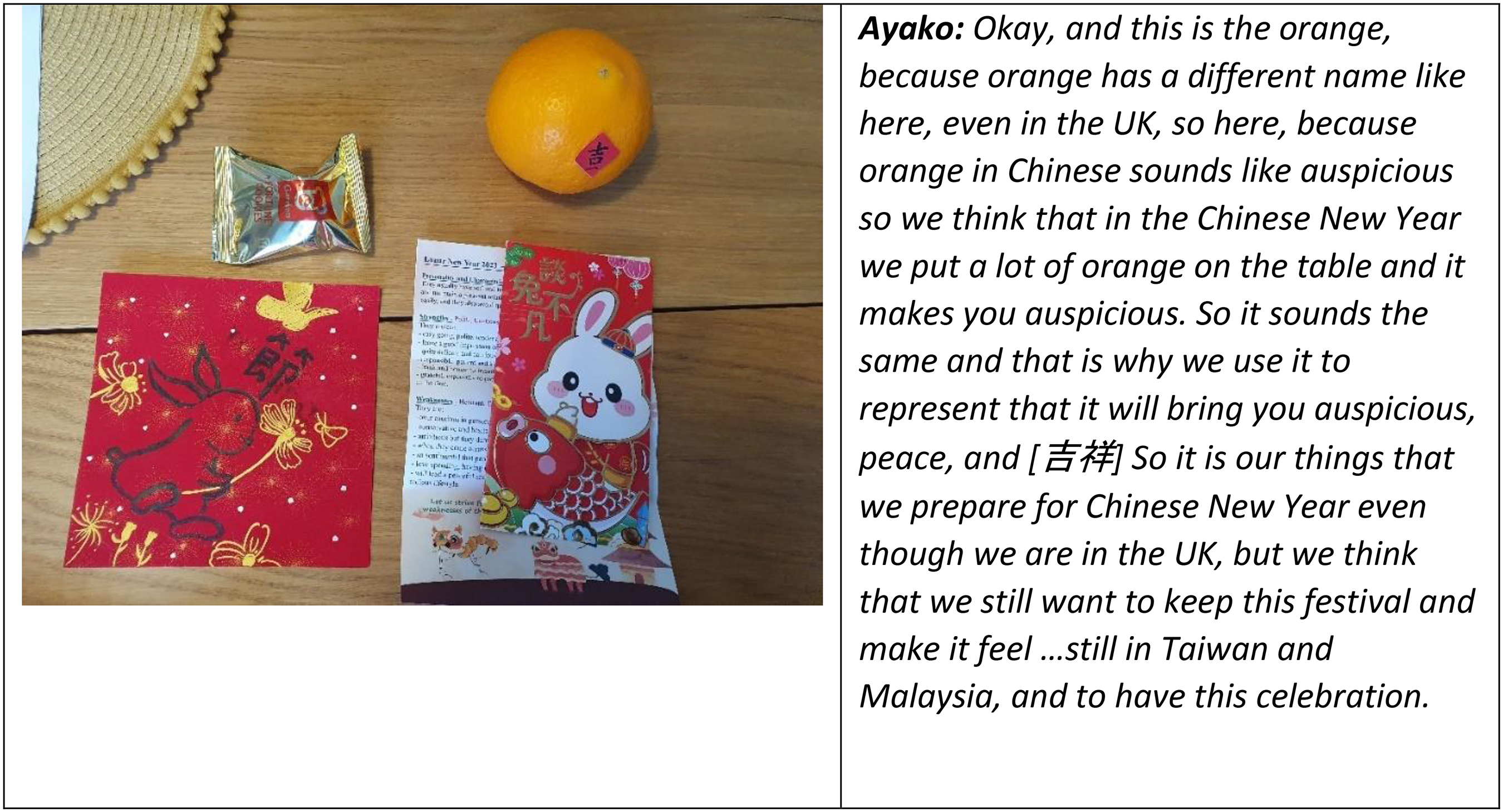
Cultural objects traditionally gifted for Chinese New Year.
The ‘auspicious orange’ [吉祥] [橙子] is shared with the children and packaged as part of a gift for the members of the Tai Chi club, with Ayako's daughter Eiko (8 years old), recounting the historical and cultural significance of these objects to the Tai Chi group members:
And they put their sticker and put everything into their bag and you’ve got a sticker here, so they just get involved and I take Eiko to this two hour Tai Chi members, so she introduced these Chinese background stories to them and so she can understand more about it.
Okay, so Eiko talked about the story.
All that, yes.
In this example, the material object became a semiotic resource for the parent in articulating literacy practices with the children. As in Pahl's articulation of artifactual literacies, Ayako is drawing on ‘the potential of objects to call up stories’ (2017: 30) and through this to communicate knowledge in forms beyond the monolingual and linguistic. In Pahl's articulation, objects can ‘speak’ and hold dialogic potential. In this example, objects spoke in multiple languages as well as through their material qualities.
Similarly, in the following example, Chloe interacted with a Chinese sound book (Figure 6) to recollect a literacy practice with her son.
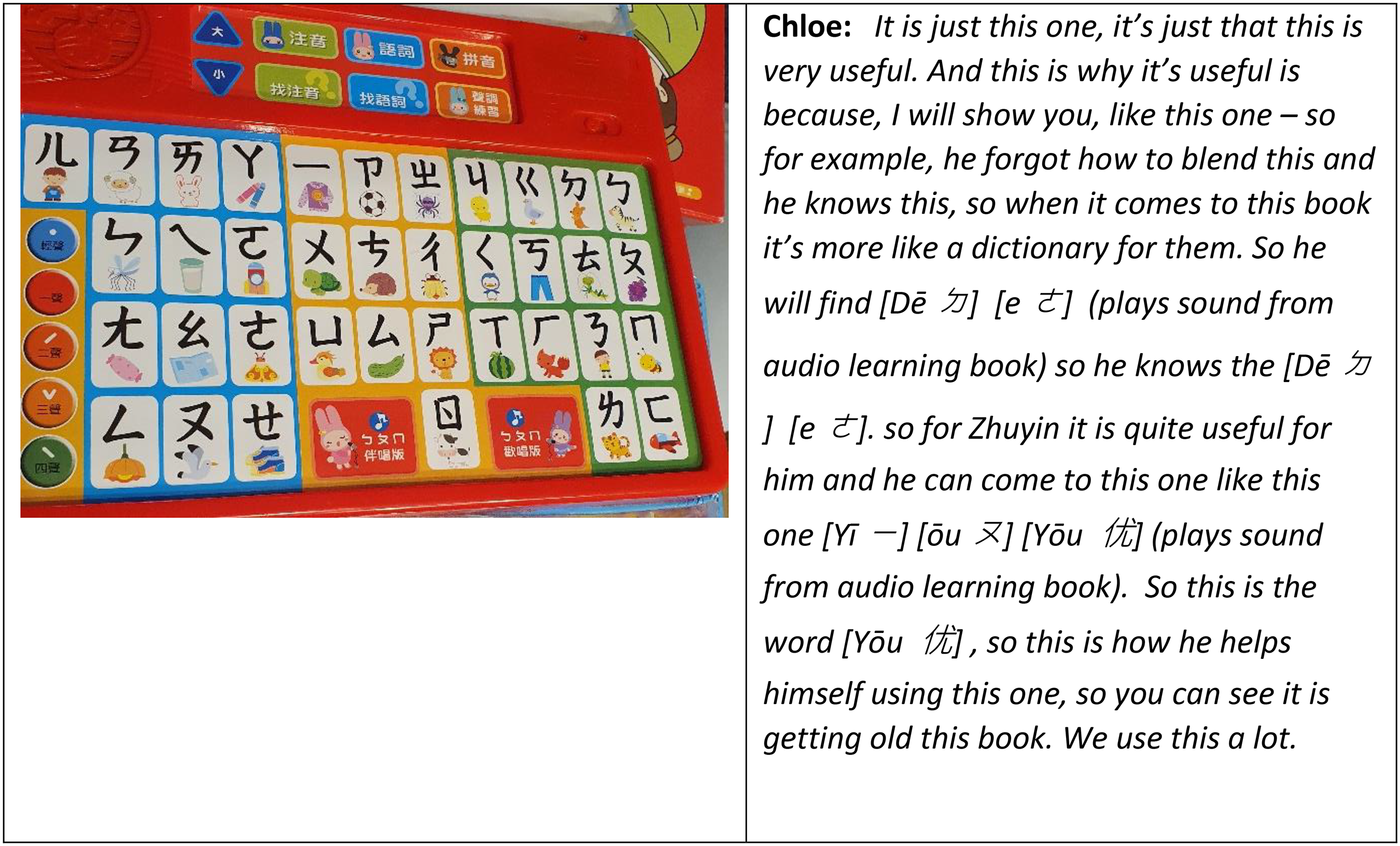
Chinese sound book supporting blending of sounds.
In the process of recollecting the practice, Chloe interacted with the object through gesture. The interaction encouraged her to go between languages and relate the episode in a way that was closer to the practices of translanguaging that she was elaborating in response to the researcher's questions. It is significant that she referred to the material qualities of the object, which supported her recount of how this book in time had become worn out from frequent use. The ‘invisible thread’ (Pahl, 2017: 30), which connects the material qualities of the object with the memory of how the object was used with her child, supported the parent in meaning making. As in the previous example, the parent used multiple modes to communicate close to practice knowledge (Parsons, 2021). In this case, there was use of translanguaging as well as use of sound from the audio learning book. This provides an insight not only into the parent's preferred way of articulating, but also into the multimodal nature of the child's early literacies – to communicate this clearly in an interview, the parent utilised similar modes to those used by the child in learning.
Speaking with the voices of others (animation)
In both interviews, the parents frequently used responsive animation (Cantarutti, 2022) to enact past conversations with their children (see Figure 2, Animation). Cantarutti discusses this as a form of ‘doing being’ (2022: 205), which is the speaker's attempt to provide ‘opportunities for mutual appreciation of what embodying such experience is like’ (p. 218). This enacting mode seemed to be used particularly when the parent wanted to describe some of the child's feelings towards the literacy activities, such as reluctance at trying harder material. The following extracts illustrate this point:
He will be like ‘Mummy, I don’t know how to read this’ and I'm like ‘Okay, get this book, check it yourself and if you're not sure then come to mummy’ and then I always like during the playtime, their free time they read this, so before bed I will come and read this with them again so just focus on this one, yeah. This is how we read, how we blend the words.
Sometimes she finds it is difficult, she always say ‘Oh Chinese is much more difficult than English because you can just put words together and make the sentence’, but for Chinese words, if you don’t practice you won’t remember it easily, so you need to practice until you know ‘Oh, that means You, this word’ so every time when she looks at that.
For both parents, responsive animation seemed to be a way of describing the interactional context which was closer to their lived experience of the literacy practices. This mode of communication had the further benefit of allowing me to experience empathy towards being in that situation. For both parents, it was notable that reactive animation only happened in the artifactual part of the interview. This suggests that the qualities of the translanguaging space created – less driven by formal language structures, supported by the literacy artefacts brought by the parents, multimodal and multilingual in nature – encouraged a more emotive and personal account to emerge from the parents.
Collaborative multilingual transcribing
The interview data were initially transcribed using a transcription service. However, due to the frequent use of translanguaging and reference to physical objects in the two interviews, it became apparent that further transcription was necessary. As part of ethical practice on participants’ use of time (BERA, 2024), I made it clear that participation in multilingual transcribing and transcript checking was optional, and that participants had a right to opt out. As a result, only one of the two participants whose data are discussed in this paper, Chloe, agreed to take part. Chloe's contribution was essential to ensuring that the Chinese script was accurately represented in the transcript as well as ensuring the use of correct links with photographs taken and with the semantic map. In retrospect, multilingual transcribing needed to be built in the study design and a form of compensation for the participants’ time provided.
This second wave of transcription can be seen as an ethical mechanism for member checking and a way of ensuring that the cultural, historic and literacy contexts communicated by the parent had been authentically represented in the resulting transcript. Mero-Jaffe (2011) similarly identifies that key motivations for collaborative transcribing with participants include co-constructing the narrative represented in the transcript with the participant and accurately representing the participant's voice within this narrative. There is recognition in this practice that interview transcripts are not merely factual accounts of a discussion, but socially constructed, interpretive accounts (Turnbull, 2000). As such, they involve a series of decisions regarding which aspects of data to transcribe and how to transcribe these (Mero-Jaffe, 2011). The process of multilingual transcribing with the participant addressed to some extent the issues of power imbalance in making such decisions. More importantly, the migrant and the multilingual participant were placed in a position where their linguistic knowledge was foregrounded and valued, enabling them to draw on their funds of knowledge (Moll et al., 1992) as well as to feel respected in the research process.
It can be argued that the collaborative multilingual transcribing which developed demarcates these interactions as translanguaging space (Li, 2011; 2018). Within this space, different perspectives and skillsets interacted – mine as a researcher interested in capturing the early literacy practices of multilingual parents and Chloe's as the language expert in this context, communicating how cultural and linguistic aspects were introduced to her children. These interactions contributed to breaking down linguistic and knowledge boundaries. Working with the initially generated transcript, I guided the interaction in specifying the modes (written, visual, spatial) which would be useful to yield a transcript suitable for data analysis. On this initial basis, Chloe led the interaction by adding and connecting the relevant modal elements (visuals and Chinese characters), as well as contributing with explanations where I was unclear of the cultural or linguistic significance of her original contributions in the transcript. Through the interaction of our different linguistic and practical skillsets, we used the shared transcript as a canvas for capturing culturally embedded meanings and structural aspects of language. Within this space, the power dynamic was more often weighed in favour of Chloe, as she skilfully navigated several websites concurrently to source the relevant Chinese characters and clarified linguistic aspects discussed in the interview (e.g. the difference between simplified and traditional characters, the challenges of accessing meaning when a Zhuyin word is not available and the importance of reciting as practice to learning the traditional Chinese characters).
Discussion
In the context of a research interview, creating the conditions for a translanguaging space opens up opportunities for participants to use their full communicative repertoire, going not only between, but also beyond languages (Li, 2011; 2018). This articulation suggests that translanguaging space is not solely located in language, but invites interaction beyond language, engaging multiple modes of meaning making. The empirical literature often provides examples of such translanguaging space being created between speakers who share a home language. However, the evidence and examples presented in this paper demonstrate that such translanguaging space can also develop in interaction between speakers who do not share a heritage language, still inviting the openness for creating new meaning, drawing on the speakers’ full semiotic repertoire (Kusters, 2021) which is characteristic of translanguaging space. Based on artifactual literacy interviews with two migrant and multilingual parents, this paper has identified three aspects of interview practice which created the conditions for reframing the interview as a translanguaging affirmative space. These aspects are:
use of semantic maps co-produced with participants and enabling translanguaging in the written mode; use of literacy artefacts selected by the parents as examples of early literacy practices with their children; gesturing with the artefacts; speaking with the voices of others; and collaborative multilingual transcribing, following the initial transcription of the interviews.
The use of semantic maps in the interview provided opportunities for a form of multilingual written dialogic exchange to take place between the participant and the researcher. In terms of contributing to creating the conditions for translanguaging affirmative space, use of semantic maps afforded access to the written mode, and through this, enabled a dialogue to take place between participant and researcher, resulting in shared meaning making. Current literature making this connection between translanguaging and multimodality refers to considering how linguistic and multimodal forms of communication interact to contribute to ‘breaking these traditional boundaries of what languages, writing and research look like’ (Mora et al., 2022: 273). The multimodal semantic maps provide opportunities to consider the value of a different form of dialogic and multilingual writing which breaks down preconceptions that writing featuring multiple languages can only happen between speakers who share the same heritage languages.
A significant aspect of the interview as an ethical translanguaging space was unlocked through the discussion of cultural and literacy artefacts. The value of artefacts in research contexts as a nonverbal articulation of identity (Karam, 2018; Karam et al., 2021; Pahl and Rowsell, 2010) has been shown to hold particular benefits for migrant or multilingual participants in research. Pahl's research particularly discusses the story telling potential or artefacts and describes the ‘invisible thread’ (2017: 30) which connects artefacts to stories as well as draws our attention to the ways on which the material qualities of the artefact can evoke these narratives. Instances presented here of parents’ interactions with the literacy artefacts illustrate how these parents frequently chose gesturing with the artefacts and referring to their material qualities in meaning making.
The pedagogies of artifactual literacies and funds of knowledge connect to recognise the value of cultural and historical knowledge (Gonzalez et al., 2005). Both funds of knowledge and artifactual literacies approaches have demonstrated the potential to bridge the divides between school and home settings (Pahl and Rowsell, 2010). The examples presented in this paper demonstrate the ways in which, facilitated by the use of artefacts, these parents drew on funds of knowledge to support their children in developing an understanding of literacies in a broader sense. Such literacy learning extended to a community context, thus acting on broadening beliefs and cultural knowledge on a macro level (Winstone, 2019) – characteristic of the capacity of translanguaging space to break down the dichotomies of home, school and community inherent at these levels of social interaction (García et al., 2021; García and Li, 2014).
From a social semiotic perspective, Kress affirms that an ethical approach to communication entails access for all participants to the full range of semiotic and cultural resources in the social and communicative context, as well as making all participants part of ‘the design and production of representation’ (Kress, 2010: 18). Making the cultural and literacy resources which parents brought to the interview central to the discussion of early literacies enabled parents to actively choose the relevant semiotic and cultural resources, as well as to determine ways in which meaning and representation were shaped in the interview space. In the intermixing of translanguaging and the use of artefacts, it became clearer in the interview how parents drew on both the linguistic and the material as social semiotic resources.
The dialogic practices which unfolded in the interviews with these two parents also foreground the importance of communicating about early literacies in ways which were close to practice. The modal density and seamless use of responsive animation in the interviews (Figure 2) indicated that parents considered this mode of communication an important way of relating their early literacy practices with their children. In ‘sounding for’ the children (Cantarutti, 2022: 205), the parents evoked an embodied appreciation of the experience being described.
In research with migrant or multilingual participants, the qualities of the research space as a listening as well as a speaking space need to be considered. Of relevance here is Flores and Rosa's argument that the power inherent in ‘the white listening subject’ (2015: 152) represents a racialised ideology of othering minority language speakers. The power of the white listening subject is inherent in the ethical and methodological practices of academic research (Cru, 2015; Flores, 2013; Jang and Brutt-Griffler, 2019). The practice of multilingual transcribing described in this paper enabled the multilingual parent to speak from a position of strength and for researcher and interviewee to co-produce knowledge (Chan, 2020; De Backer, 2022; Parsons, 2021). Positioning the researcher as a listener and empowering the interviewee to engage in fluid forms of communication, characteristic of their everyday interactions, contributed to flattening the power imbalance inherent in traditional research contexts.
Conclusions
This paper set out to consider ways in which the conditions for translanguaging affirmative space can develop within an interview context and the reasons why this can be considered ethical practice when researching with multilingual and migrant parents. Through the introduction of cultural and literacy artefacts chosen by the participants and through the use of semantic maps as a form of shared multilingual writing, the study enabled the participants and the researcher to co-produce the interview as an ethical translanguaging affirmative space. This was evidenced through the frequent translanguaging in both interviews, as well as through the respondents’ frequent use of multiple modes of communication beyond verbal to communicate their lived experience of literacy and cultural practices with their children. The instance of multilingual transcribing further contributed to positioning the participant as knowledgeable and to flattening the power imbalance between researcher and participant.
It is worth noting that while the participants and myself as the researcher had some similar experiences of being migrant and multilingual, we did not share a home language. Yet, in the context of sharing artefacts and using multiple modal resources, new meanings emerged within a shared translanguaging affirmative space. These examples have implications for finding common ground and ways to value the languages and lived experiences of migrants without reliance on shared home languages.
Finally, the evidence presented here draws on limited data emerging from two in-depth interviews with multilingual parents. Further research could explore in more depth the aspects of the interview context and the interaction between the researcher and the participant which either encourage or inhibit the use of translanguaging, as well as the role of artefacts in supporting multimodal expression and translanguaging in the interview context.
Footnotes
Declaration of conflicting interests
The author declared no potential conflicts of interest with respect to the research, authorship, and/or publication of this article.
Ethics approval
The study design was approved by the Sheffield Hallam University Ethics Committee.
Funding
The author received no financial support for the research, authorship, and/or publication of this article.
Rights retention
For the purpose of open access, the author has applied a Creative Commons Attribution (CC BY) licence to any Author Accepted Manuscript version arising from this submission.

Author biography
Ester Ehiyazaryan-White is a Senior Lecturer in Childhood and Early Childhood. Her area of research is children and parents' literacy practices in early childhood focussing on the role of translanguaging and multimodality in early literacies.