



Abstract
Background:
The focus on translanguaging practices in multilingual classrooms can be seen, by and large, as responding to risks of violence entailed in diverse contexts of language use, including the teaching and learning of mathematics. However, the practice of translanguaging alone cannot counteract the hegemonic authority of our relation to language curricula being present through interactions among teachers, students, and researchers, as well as material resources.
Purpose:
Drawing on Bakhtin’s philosophy of language, we discuss dialogicality as a critical and democratic organizing principle for the pervasive polyphony that characterizes every utterance constituting heteroglossia. Dialogicality reconstitutes our relation to language through the “other” and the need to see any utterance as a nonteleological process among subjects and objects. As such, the aim is to explore how acts of dialogicality may address the potential risks of onto/epistemic violence in translanguaging practices. Focusing on either emergent or orchestrated translanguaging in three European states: Greece, Catalonia and Sweden, we discuss how dialogicality allows for alternative accounts of language use in complex classroom events.
Method:
Methodologically, we start by encountering the sociopolitical context of monolingual and monologic curricula in Europe, where the three cases we theorize take place, along with our considerations for dialogicality in the realm of translanguaging. Our theorizing-in-practice unfolds a double effort in reading. First, what can we read today as risks of onto/epistemic violence in each of these cases? And second, what is the potential of dialogic translanguaging across the cases and within the boundaries of state monolingual policy and monologic discursive culture of school mathematics?
Findings:
The present article contributes by discussing dialogicality as a relational onto/epistemology toward addressing translanguaging practices. Concerning the first question, our theorizing-in-practice shares evidence of the inevitable presence of onto/epistemic violence in every utterance. The limited scope of a crude mathematisation process through language appears continuously in mathematics classrooms, serving to place either the object or the subject into fixed narratives. Regarding the second question, our dialogical reading of translanguaging denotes the importance of the importance of minor responding(s) to such moments of violent risk. We understand them as “cracks” in the authoritative status of monolingual and monologic mathematics curricula; we argue that such minor, yet crucial, cracks are of great significance for creating acts of dialogicality from “below,” disrupting the hegemonic authority of an assumed neutral mathematical language.
Conclusions/Recommendations:
The risk of onto/epistemic violence is inevitable in any discursive and embodied encounter in multilingual mathematics classrooms, including the translanguaging practices. The study suggests that acts of dialogicality become minor responses to violence in ways that both counteract oppressive monologic discourse and open toward a relational onto/epistemology with mathematics, children, teachers, material resources, and researchers. Remembering how Bakhtin insisted that “language is never unitary” and “dialogue” is not a panacea, we emphasize the need for a continuous focus on creating acts of dialogicality with language and discourse.
Keywords
The Prison of Language
In 1977 at the College of France, Roland Barthes gave his inaugural lecture as chair of semiology by making the statement: “Language is fascist.” He explained language’s legislative and coding nature by denoting how the hegemony of bourgeois languages oppresses human relations and defines subjectivity (Barthes, 1978). Indicative is how patriarchy and coloniality violate indigenous, illiterate, female, and queer subjects through a binary language (Irigaray, 1985; Spivak, 1988) that determines even mathematical theory itself (Rubel, 2016). Through education, language is being subjected to universals of “development,” regenerating masculine and imperial grammars weaved into discourses of epistemic certainty and ontological fixity that, in turn, sustain instrumentally dominance, otherness, and subalternity (Chronaki, 2011b). Despite its regenerative force, language draws violent fascist, racist, or sexist borders, compelling people to perform, un/consciously, inscriptions of who is (or not) considered literate, active, critical, or even a viable citizen.
Diverse multilingual mathematics classrooms worldwide have become the testbed of such violent perils and struggles for subversion (Adler, 2001; Planas, 2021; Trinick, 2015). Specifically, Jill Adler’s work in postapartheid South Africa denotes the political significance of opening up mathematics teaching to the diverse languages of learners despite the enormous dilemmas and impossibilities of such a move. Tony Trinick’s work, among that of others working with indigenous communities, emphasizes the epistemic potential of revitalizing both the minor language and the mathematical register through curricula co-creation. And recently, translanguaging has been explored as a response to dilemmas of multiple language use in mathematics classroom discourse (Planas & Chronaki, 2021; Ryan et al., 2021).
Barthes could not see an escape from the “prison of language,” but Mikhail Bakhtin has argued for the uneasy, yet possible, thought liberation from implicit violent acts that bourgeois authority inflicts on language use. By advancing a philosophy of language from below, he offers dialogism as a relational stance that bridges life, nature, culture, discourse, and politics, allowing the move beyond monologic ideologies of language.
Bakhtin’s work has influenced current projects such as dialogic pedagogy (Matusov, 2009) and dialogism (Linell, 2009) and has inspired researchers to discuss the dialogic potential in science and mathematics education (Barwell, 2014; Chronaki, 2009, 2011a; Kazak et al., 2015; Roth, 2009; J. Williams & Ryan, 2020). Although a detailed review is desirable (but not possible) here, we denote briefly that research contributions discuss dialogism; explore convergences and divergences among a dialogic or dialectic approach to the history of ideas; and exemplify the embodied, corporeal, and carnivalesque element of dialogic pedagogy as well as the nonteleological nature of concept formation.
In our work, dialogicality was discussed as combating essentialism in language, discourse, and identity (first author), and subsequently a dialogic perspective on translanguaging has been encountered (first and second author). This article builds on prior work and considers how acts of dialogicality in the context of translanguaging practices may respond to risks of onto/epistemic violence across multilingual mathematics classrooms. Next, we start by discussing onto/epistemic violence, dialogicality, and translanguaging for mathematics education, and we follow by presenting the methodology. We then move toward theorizing-in-practice acts of dialogicality grounded in episodes of translanguaging across multilingual mathematics classrooms in three European states: Greece, Catalonia, and Sweden.
Onto/Epistemic Violence, Dialogicality, Translanguaging
Matusov and Sullivan (2020) discussed “pedagogical violence” as the “infliction of physical, social, emotional, or psychological pains, or threat of such pains that is either the means for or non-accidental by-products of education used on a systematic basis” (p. 438). They traced its endemic relation to pedagogy back to Freire’s (1970) “pedagogy of the oppressed” and his urge for nonviolent pedagogy through combating coercion. Yet, when discussing pedagogic violence as part of schooling, certain ambivalences are noted. First, a sociohistorical perspective makes apparent that although the shamed example of school corporeal punishment is gradually fading, and physical violence seems less frequent (but has not disappeared), the everyday psychosocial violence grows. This is evident through incidents of aggressive behavior in the realm of overt or covert racism, sexism, or ableism. Second, when taking into account the neoliberal politics of institutionalized schooling, we note how diverse forms of violence circulate, disguised within the “good intentions” of teachers, parents, students, and school administration in the name of promoting quality learning and moral behavior. It is pertinent to ask how these incongruities take place in multilingual mathematics classrooms and how we may counter them. In the next sub-sections, we discuss violence in mathematics education, along with Bakhtin’s perspective on violence and dialogicality, and their relevance for the phenomenon of translanguaging in mathematics classrooms.
Onto/Epistemic Violence and the Ethics of Mathematics Education
Violence retains both an ontic and epistemic nature as it is discursively reproduced through knowledge (including mathematics), becomes ethically embodied in our everyday encounters, and in turn produces the knowing subject in academic and educative contexts. Ontological and epistemological assumptions interweave and influence our ethical work as teachers, authors, listeners, or readers of utterances in mathematics education. While epistemology refers to “systems of knowing” that determine what is the known, who is the knower, and how knowing can be achieved, valued, and circulated, ontology considers how being, becoming, reality, facts and truth are co-constituted (St. Pierre et al., 2016). Epistemology is often prioritized in mathematics education through a strong emphasis on content learning, while its links with ontology are systematically overlooked. This is also understood as the dominance of patriarchal, colonial, and racial perspectives prevailing in mathematics education, with threatening effects for certain subjects in mathematics classrooms (Gutiérrez, 2013).
Mathematics education is an exemplary case of how a certain onto/epistemic paradigm on knowing (i.e., learning oriented to competitive outcomes) is being valued at the expense of others that become delegitimized, repressed, or ignored, or fail. This is apparent in the ways curricula, assessment, and material resources are designed and delivered around “standards” that tend to homogenize content and praxis. In multilingual mathematics classrooms, this is engulfed in certain “politics of representation” that assumes neutrality around diverse practices of language use (Chronaki & Planas, 2018). In this realm, deficit discourses of who is able to perform mathematics are often woven with normative mathematical activity and language use, making violence subversion an impossible endeavor.
A blind focus on “episteme”—a notion that Foucault (1972) equated with “modern science” and is often related with direct applications of mathematical algorithms, modeling, or political arithmetic—serves to establish the hegemony of positivism grounded in the idea of an easily “mathematized” world. In this, certain knowing subjects and objects are violated as “other” (via measuring, categorizing, or modeling procedures), as illiterate, poor, savage, indigenous, uncivilized, migrant, female, and, thus, ranked as cognitively and culturally disadvantaged and in need of development (Chronaki, 2011b; Chronaki & Swanson, 2017). Such phenomena escalate in contemporary mathematics classrooms worldwide, urging the need to confront them. Next, we turn toward Bakhtin’s view on violence in relation to dialogicality.
Dialogicality and Violence with Bakhtin
Bakhtin argues that there is always already a dialogical appropriation of the world that exists independent of human experience and is routed in the historical materiality of social facts, relations, boundaries, spaces, bodies, and nature. Although situated phenomena are constructed via communicative rituals, their construction transcends prevailing ideologies, traditions, discourses, and politics of culture (Bakhtin & Holquist, 1981; Bakhtin et al., 1993). Bakhtin negates language as a formal grammar or an abstract system that serves monologue (i.e., the tendency to impose with authority one’s worldview over another). Monologism can be seen as part of a major tradition in Western philosophy of science that prioritizes the rational individual thinker, viewing society as an ensemble of individuals and language as a pregiven knowledge system. Dialogism counters monologism by emphasizing its intersubjective, interactive, contextual, and historical consciousness. Bakhtin argues that the social registers of language always permit “a multiplicity of social voices and a wide variety of links and their interrelationships” (Bakhtin & Holquist, 1981, p. 263).
With Bakhtin, dialogicality is a critical and democratic organizing principle for the pervasive polyphony and heteroglossia constituting every utterance. Polyphony denotes how participants enter the discourse with maximum freedom to express ideas granting the presence of heteroglossia. As such, the act of dialogicality reconstitutes our dialogic relation to language by encountering the “other” and the need to see any utterance as a nonteleological relational process among subjects and objects, humans and nonhumans, and past, present, and future. Bakhtin discusses violence as an aesthetic cognitive force of a continuous epistemic and ontic nature. He argues that every creative work engenders overt or covert forms of violence in its attempt to bring the cognitive and aesthetic forms of bodily experience, narrative and orality to textual genres of language representation. He sees violence being explicitly present when the aesthetics of knowing and knowledge organization (i.e., cognition) is directed exclusively toward the limit thing (i.e., focusing work toward the limits of representing the object representing the object of knowing in creation) as an enforced monologic discourse (Bakhtin, 2017). Violence is, thus, the deadening effect of this process for the knowing subject who works toward a blind reification of representing the knowing object through words, sounds, and images.
Bakhtin’s discussion of cognition considers the perils of distinguishing between, on the one hand, the thing or the object of knowing (i.e., epistemic), and, on the other hand, the self or the knowing subject who relates to knowing objects in the world (i.e., ontic). He explains that when the cognizing act of representation is directed toward the limit thing, it then becomes a unidirectional and a teleological act of mastering that aims to “examine exhaustively” its object. In this realm, the “thing” is trapped into a monologue that delimits its growth or transformation at any cost—and thus risks onto/epistemic violence. In mathematics teaching, violence around the “limits” of the “thing” or the “limit thing” could be noted when mathematical concepts, theories, or real-life problem mathematization are being taught toward a fixed finalization of a meaning-making process that excludes the subject of the knowing self as relevant to the process of creating the knowing object.
In contrast, when cognition encounters the limits of both the “object” or the “subject,” it allows for a dialogic relation among subject, object, and the surrounding context. However, Bakhtin warns how concrete cognitive acts are easily directed toward either an unbridgeable separation among object and subject, or perpetuating binaries of pure categories. Fixed conceptual categories of knowing often subjectify the knower and/or the known via deficit or privileged discourses. These can easily fall into a monologue that perpetuates one dominant voice suspending the potential for “other” voices to be heard. Bakhtin sees violence as engendered in monologic utterances, especially when the cognizing subjects use language that closes the represented object or subject into fixed identities. As such, subtle or unconscious acts of silencing, categorizing, or othering create onto/epistemic violence. The aesthetic force of violence is seen by Bakhtin as inevitably embedded in every cognizing act that aims for creativity. However, its presence is particularly vulnerable when engaged authors or readers do not grant freedom of thinking, either for objects or for subjects. We argue that the scope of a crude mathematization can be always present in mathematics classrooms, serving to place either the object or the subject into fixed narratives, and needs to be disturbed, problematized, and, potentialy subverted.
Translanguaging as Response to Violence?
Translanguaging practices can be seen as responses to utterances of “violence” in the context of language revitalizing projects (C. Williams, 1994) understood as moving beyond shifting monolingual codes referred to as “two solitudes” (Cummins, 2007). These practices often involve transversing (not merely translating) discrete languages, idiolects, registers, or modalities resourcing the multilingual classrooms (García & Kleyn, 2016; Li & Ho, 2018). As theory and pedagogy, translanguaging becomes a creative transformative process in language (and knowledge) sharing, exchanging, and inventing. It aims to disrupt the authority of language hierarchies, to reconstitute language use beyond named languages and monolingual ideologies, and to address injustices of symbolic and systemic violence faced continuously by minor language groups.
Although synthesizing languages for enriching learners’ linguistic repertoire is core, the minor or marginalized languages and idiolects mostly contribute toward enriching the first order or state language repertoire (Thibault, 2011) without addressing situated injustices. We cannot ignore how the authorial status of curricular language risks the reproduction of onto/epistemic violence through its emphasis on monologic discourse. And we note the danger of ignoring the force of monologic ideologies in language use on learners and teachers of mathematics as they enact language across first-order, state, official, or major languages and named, marginal, or minor languages, including languages of mathematics.
Our turn to Bakhtin is based on his philosophy of language that not only serves to critique language use and monologic discourse, but also offers ways to think beyond critique. Dialogic translanguaging was addressed in Planas and Chronaki (2021) as a process in which learners respond to a multiplicity of words, grammars, and meanings across multiple language systems. Translanguaging on its own cannot trouble the hegemony of monolingual and monological mathematics curricula. Bakhtin alerts us that the risk of onto/epistemic violence becomes inevitable in any aesthetico-cognitive process of creating knowledge. It is our conjecture that alongside risks of violence in acts of creation, acts of dialogicality emerge, opening up to ethical encounters with mathematics, materials, children, teachers, and researchers.
Methodological Considerations for Dialogic Analysis
We start by discussing the sociopolitical context of the monolingual and monologic curricula in Europe, where the three cases we theorize take place, along with our considerations for theorizing-in-practice acts of dialogicality in specific episodes of translanguaging.
The Sociopolitical Context: Monolingual and Monologic Curricula
Europe is constituted by a diverse language geography that draws borders across country-states, cultures, educational policies, and everyday communication. As a way of protecting the right to use the diverse language of linguistic minorities, a nondiscrimination act was approved in 2018 by the European Union even though the English, French, German, and Spanish languages dominate all others, with English surpassing them all. Monolingual ideologies remain predominant in most European education systems (Busch, 2011). Although a European state sometimes opens up for multiple languages, the minority language groups in schools need to adjust to the state policy, and the multilingual classroom has to work toward the official language. Our cases are grounded on monolingual curricular norms. Although in Catalonia, both Spanish and Catalan are co-official and people have the right to use Spanish publicly, Catalan is the prevailing norm, making the use of Spanish as a language of instruction rare. In Greece, the language of demotiki (δημοτική) refers to people’s vernacular and is today the official public language. The use of δημοτική as state language has replaced the pure language (καθαρεύουσα)—a bourgeoisie genre dissociated from people’s everyday orality. However, the move from καθαρεύουσα to δημοτική was taken at the expense of minor language groups, such as Romani, Vlachika, Pontiaka, and Arvanitika. In Sweden, Swedish is the official language and the language of instruction even though Finnish, Meankieli, and Sami, as well as Yiddish and Romani, are recognized minority languages, and Arabic is the most common home language in school after Swedish. Swedish policy texts state that students’ languages are to be viewed and treated as resources for learning (Norén & Källberg, 2018), but in practice, things remain complex.
In all three contexts, formal classroom practice is mostly grounded in monolingual and monologic norms. However, our studies indicate examples where translanguaging practices emerge or become orchestrated in classrooms, denoting stories of participants’ agency as dialogicality. Next to prevailing monolingualism, mathematics education in all three contexts operates within monologic norms set around curricular “standards.” These norms guard the development of skills in competitive terms and prioritize textbook use, national testing, and summative assessment. Within this monologic ideology, minority language students are constantly exposed to risks of onto/epistemic violence. Students whose home language is different from the official curriculum language are produced as children with deficits, lacking the qualities inscribed by monolingual state policies and thus are easily turned into the voiceless others who “cannot speak,” think, or do mathematics. But, contrary to such engulfed risks of violence, we also witness the presence of small-scale local initiatives that allow for liberatory openings in the multilingual mathematics classrooms—such as emergent or orchestrated spaces of translanguaging where the potential of moving beyond a language-based monologue can be discerned.
Theorizing-In-Practice: Research Conjecture, Episodes, and Questions
For Bakhtin, a continual tension exists in language use between “centripetal” forces of monologic mathematics curricula aiming for a unitary discourse (i.e., formal vocabulary, strategies, concepts), and “centrifugal” forces of heteroglossia and polyphony experienced in classrooms (see also Barwell, 2014). It is within this tension, also present in translanguaging practices, that the risk of onto/epistemic violence rests alongside liberatory acts of dialogicality (see also Chronaki, 2009). It is our conjecture that translanguaging in multilingual mathematics classrooms can allow for a theorizing process of potential acts of dialogicality. We theorize by referring to episodes from prior case studies that took place in Greece (Chronaki, 2009, 2011a), Catalonia (Planas & Ngoepe, 2019), and Sweden (Ryan et al., 2021). Although differences exist across these states in how society and education respond to issues of multilingualism historically and politically, we denote a common denominator of monolingual and monologic curricular context. Our analysis exemplifies acts of dialogicality with different interlocuters (i.e., knowing subjects, the object of mathematics, and third “others”), allowing us to theorize across multiple cases, actors, and issues involved.
Marková et al. (2020) discussed generalizability in single cases and argued “that this ought to be viewed as an effort to resituate knowledge and its dialogical features” (p. 4), which involves a theoretical reading of episodes as a self-in-relation-to-others and not as a single person or classroom in isolation. Similarly, our cases can be seen as “utterances” where learners and teachers transverse language borders. For Bakhtin (1993), the utterance is not simply a speech act but an event full of concrete meaning and refers to specific situations in time and space. Thus, we approach our theorizing as living events of meanings situated in the diverse European contexts of our contemporaneity. When reading an “utterance,” Bakhtin alerts us that one should attend to how language as words, images, or silences “joins the historical unrepeatability and unfinalized totality of the logosphere” (Bakhtin, 1999, p. 134). He argues that an utterance can be anything from a “short (single-word) rejoinder in everyday dialogue to the large novel or scientific treatise” (Bakhtin et al., 1986, p. 71).
This means that the utterances we study are not just the voices of students or teachers; they are populated with multiple images from others, those directly present but also third others, like the monolingual state norm and the monologic mathematics curricula, but also the plurality of languages and cultures creating intertextual levels of dialogic relations. All these forces create tensions because certain utterances within translanguaging practices always run the risk of becoming a deadening monologue, and they remain continuously in need of becoming dialogic and of troubling closures in onto/epistemic violence. Together with Bakhtin’s notion of violence, we also find helpful the focus on reading the “utterance” as a sphere of communication responsive to a variety of meaning making. It allows us to view the continuous presence of polyphony, heteroglossia, and dialogism as the counterpart of onto/epistemic violence. While polyphony stands for unmerged voices, heteroglossia is not necessarily only about the coexistence of diverse languages but can be an intra/language differentiation and stratification. The notion of dialogism applies to any situation in which two or more orientations of the world (voices, discourses) come into contact with each other.
Taking this into account, our aim is to explore how violence always inherent in any attempt to translanguage can be troubled or subverted by suggesting that a focus on dialogicality can allow us to move beyond a deficit approach that reproduces violence. Thus, we ask: (1) What can we read today as risks of onto/epistemic violence in each one of the episodes? (2) What is the potential of dialogicality acts in episodes of translanguaging across cultural borders of state monolingual and monologic school mathematics? These questions will be unfolded in the following sections through analysing three acts of dialogicality.
Act I: Dialogicality with Knowing Subjects
The two episodes described here are part of classroom-based research in a primary school located in a lower socioeconomic Roma neighborhood. Roma children’s home tongue is the oral language of Romani (or tsigganika), and while they understand Greek, they encounter difficulties in reading and writing. Hence, language becomes a surface for potential risks of onto/epistemic vilence. One student, Panagiotis, explained in Greek, “We can only speak our language during breaks. But even then, teachers think we shout or swear to each other. And they get angry at us. They tell us to stop speaking tsigganika at school” (Chronaki, 2011a, p. 211). The non-Roma children disclosed how families prohibited social interactions with the Roma students for the fear of being robbed or hit. Such deficit discourses of othering Roma children call attention to the deadening and violent effects of working at the limits of the knowing subject. This is a context in which and write This is a context in which children experience the learning of mathematics. The two episodes that follow discuss the act of dialogicality with the knowing subjects (i.e., learners and teachers).
The first episode involves Maria and Giannoula, two Roma girls, working with word problems in which they had to face themes of selling and buying, commonly considered “funds of knowledge” for Roma people. However, their experience in markets along with peers and parents differs greatly from school. It involves relational situated strategies in which error, approximation and estimation are central elements of solving problems and contradict the curriculum focus on one precise and true solution. This is the product of monologic curricular practices of a “situated but decontextualized” nature prevailing our dialogically constituted world (see Linell, 2009). As such, Maria and Giannoula could not perform well because they felt confused within a process in which their “struggle over signs” (i.e. what does it mean to solve a market related problem) was read by the teacher as their refusal to participate in school mathematics. Efforts were made to keep the girls focused on the task that aimed to exhaust the “limit thing” of arithmetic operations by placing emphasis on solving the problem with precision regardless the effects of humiliation upon the two girls. Examples of onto/epistemic violence in this context included: asking the girls to discipline their bodies while solving the problems, not to dream of marriage and food, to use the correct mathematical words, not to utilize their hands when counting, and to express good moral behavior when selling and buying in role playing with word problems (see Chronaki, 2011a). How can one respond to such onto/epistemic violence that serves to humiliate the participant students? The two girls did not respond to the teacher, remained silent and could react further.
Reflecting on this episode and, specifically, taking into account the girls’ silence and impossibility to react through language a second episode was orchestrated where Romani language was set to pay a core role in teaching. It can be seen as a responsive utterance of dialogicality to an unfinished dialogue where ‘its beginning is preceded by the utterances of others, and its end is followed by the responsive utterances of others’ (Bakhtin et al., 1986, p. 71). It involved a pedagogic experimentation foregrounding Romani language around the theme “mathematics in tsiggano words.” Orchestrating this space of translanguaging aimed to disturb language hierarchies by by turning, temporarily, Romani from an invisible to a visible element. In three 40-minute slots, Panagiotis taught his peers the Romani words for numbers, arithmetic operations, and selling/buying problems. Even from the first teaching slot, children managed to learn Romani number words to compose numbers in a context of creative playing with problems of selling and buying. Having students practicing, Panagiotis moved the class into role-playing with word problems. The class was a fourth-grade primary and comprised 21 children; four, including Panagiotis, were Roma, five were Albanian, and one was Bulgarian. The typical age for fourth graders is 9, but the Roma children’s ages ranged from 11 to 18 because of persistently inconsistent school attendance due to their families’ nomadic life that was deficiently interpreted as Roma families not valuing education. However, experimenting with translanguaging revealed children’s forceful energy into transversing languages and experiences to work with word problems. This, moreover, exposed how children’s performed inertia or silence was, in fact, a sign of refusing the monologic school curricular norms. The carnivalesque nature of this translanguaging event allowed for “contact between people” in which bodies and minds could potentialy break essentialist boundaries of fixed identity histories as they transgress borders and open up for hybridity, heteroglossia, and polyphony (Bakhtin & Holquist, 1981). In this vein, we acknowledge how an act of dialogicality with children as knowing subjects allows for disruption of the monolingual monologue of normative mathematical curricular tasks by encountering multiple alterity in social languages.
Act II: Dialogicality with Mathematics
This episode draws on lesson data from a secondary school classroom in Barcelona, where the language of instruction was Catalan, and some learners had Spanish as their home language. The teacher asked for ways of solving the given task, first in small-group work and then in whole-group sharing. The utterance that follows reveals how three learners are involved in converting an algebraic expression into word texts. Roberto, a Spanish speaker born in Ecuador, is discussing with Joana and Miquel an alternative to “any odd number” for 2x+1. He initiates a geometrical meaning as the junction of two areas by drawing a rectangle with two sides of length x and 2, and a square with side 1. The meaning for 2x+1 is then expanded, and they all come to reason geometrically around the numerical set of values for the unknown. Joana and Miquel are from Catalan-speaking families and had not attended the so-called special classes in the school for linguistic immersion of newly arrivals, as Roberto had. Such a system, despite the good intentions of the state to support children in learning the official language, can exercise onto/epistemic violence by othering migrant learners as language deficient and thus unable to do regular mathematics. During the group work, the learners, however, translanguaged between Catalan (nonitalic) and Spanish (italic), as seen in the following transcript (see Planas & Ngoepe, 2019, pp. 104–106; Table 1).
A translanguaging episode of Spanish and Catalan.
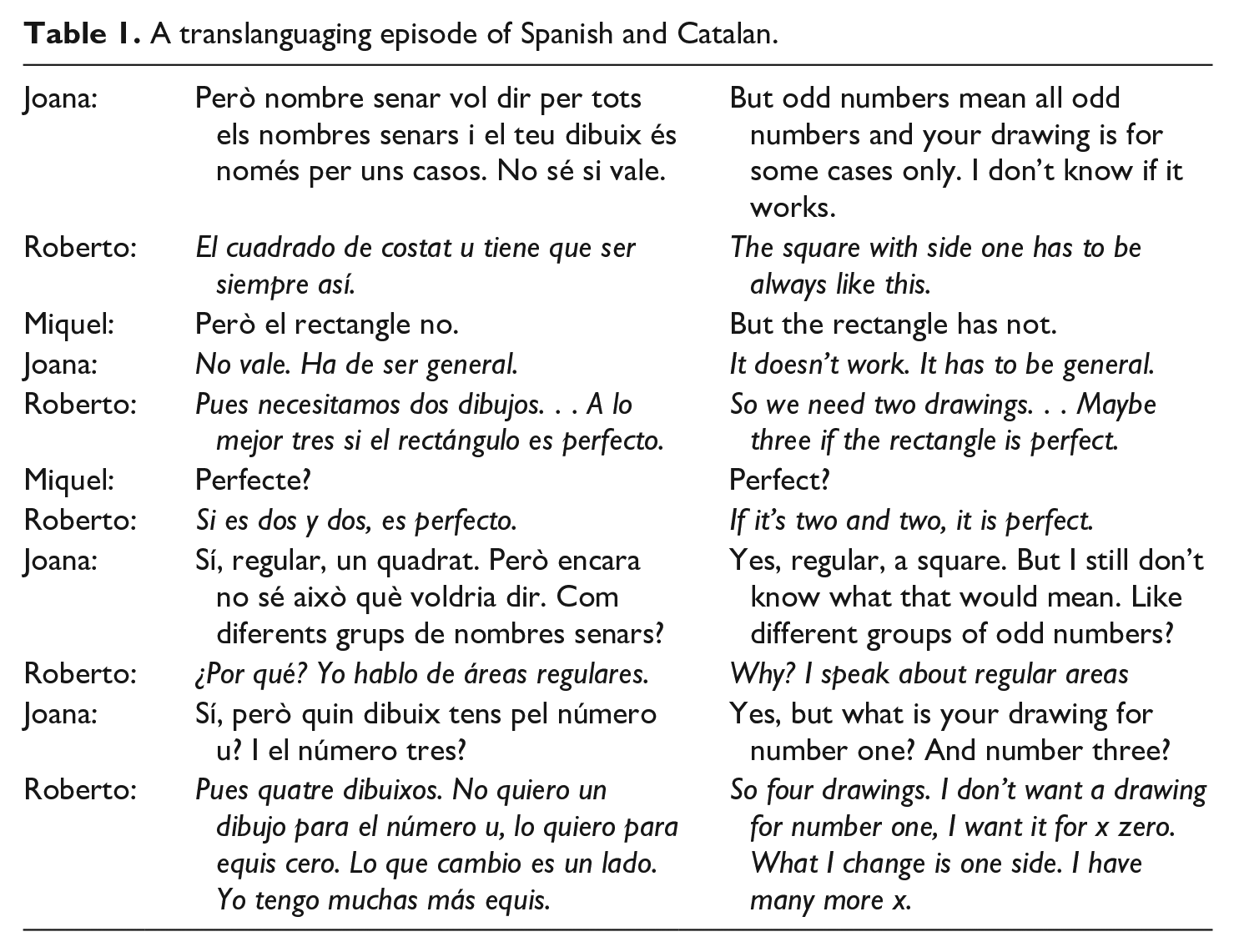
In the preceding utterance, learners translanguage to share their thinking with peers, which happens in the realm of prevailing monolingual instruction and deficient discourses of migrant learners. Such third other voices call attention to onto/epistemic violence risks toward fixing children into certain ways of being and becoming. They work toward fixing children into certain ways of doing and knowing school mathematics that do not align with expected school genres (colloquial vocabulary, offhand drawings, and invented names for properties). These learners constantly have to confront the monologic mathematics curriculum in the authority of assigned tasks for moving between arithmetic and algebra. However, by revealing nonarithmetic ways of interpreting the algebraic tasks and raising geometric meanings for 2x+1 and “any odd number,” Roberto provides opportunities for dialoguing with school mathematics in the small group.
Even though learners’ languages of mathematics resist the monolingual curricular norm, we need to acknowledge that dialogic relations are not always possible. For example, we noted how Joana aligned with Miquel in evaluating Roberto’s language of mathematics. In addition, Roberto excluded himself from resolving the task, and Miquel insisted on retaining the normative naming of mathematical properties. All these indicate risks of onto/epistemic violence that can not only interrupt but also close the reasoning path initiated by Roberto, regardless of experiencing moves across languages in the group. Translanguaging cannot safeguard by itself the emergence of dialogic mathematical activity. What learners do and say in response to their questioning of words that do not fit into “the” language of school mathematics retains both dialogic and monologic potential. But, responsiveness contributes toward attending how mathematical thinking evolves in novel ways when the pervasive monologue in curricula and practice is resisted. Resistance to the risks of violence emerging from discourses other than “one language at a time” takes place together with problematizing what counts as mathematics and who can learn mathematics. This act of dialogicality, as they listen to each other responsibly and aiming to respond, allows for a different reading that has the potential to counter the hegemonic voices of “third others,” inscribing them in deficit discourses. By denoting the potentiality of mathematical reasoning in dialogical terms, their utterance illustrates the capacity of learners to transverse a number of oppressive discourses that violate knowing. The generative force of dialogic translanguaging is moving beyond sharing home languages and everyday registers and contributes toward reviving mathematics itself from within.
Act III: Dialogicality with third Others
A mathematics teacher participated in a school development project on translanguaging arranged by an urban municipality in Sweden in classrooms where approximately two thirds of children were of migrant backgrounds and spoke many different languages (Ryan et al., 2021). The project encouraged teachers to enact translanguaging so that to open up the possibility of using multiple languages in their lessons. At that time, children in the teacher’s classroom spoke eight different languages. The school voluntarily applied to participate in this project addressing the issue of multilingualism by indicating a will to respond to the needs of students who could not access the official curriculum language.
The mathematics teacher, a middle-aged male with Arabic as his home tongue and fluent in Swedish, orchestrated a translanguaging lesson with eighth-grade students for the first time when visited by the researcher. He planned the lesson and started by welcoming students with “good morning” in Swedish and then encouraged them to say “good morning” in their home languages. The students responded initially with some hesitancy and surprise, but soon the atmosphere became joyful. Then, he arranged students in groups according to their home languages to work on curriculum mathematics. He wrote tasks on fractions on the whiteboard and then asked all students in Swedish to use both Swedish and their home languages when solving the tasks in the groups. Upon completion of this group work, he invited students from different groups to the whiteboard to write their solutions and orally explain them using their home language. Again, students seemed to enjoy the activity. This orchestrated translanguaging lesson has a performative carnivalesque character of pedagogic experimentation (Chronaki, 2011a) in which the teacher attempts to open up the public sphere of the mathematics classroom in the unknown. Immediately after the lesson, the teacher in our discussion referred to a newly arrived Arabic-speaking boy from Syria, who has been silent for several months despite being good in mathematics, was now able to speak during this lesson. The utterance that follows reveals the teacher’s move with dialogicality by stressing the relational ontology created in the mathematics class around the student’s capacity to publicly perform mathematics despite his lack of Swedish.
You saw the boy, he does not know Swedish, he has been in Sweden for four months. He was up at the whiteboard and talked [in Arabic] since he saw that others were talking in the same language. It is the first time he says he can come up [at the whiteboard] and talk.
He did it, for the first time, he did it because some others had stood up and talked in Arabic. He might think: Why not me? I can present myself. He knows. He knows mathematics, very good but only missing language. . .
It is important to note how the teacher sensed the risk of onto/epistemic violence for the Syrian boy who, despite being able to do mathematics, remained silent because he didn’t have the chance to speak and perform in front of the class or in small-group work. The teacher valued translanguaging as a dialogic response because it permitted the student to perform publicly, in his home language (Arabic) as a learner who knew and spoke mathematics. In this situation, we might envision the teacher taking the opportunity to talk mathematics in Arabic with the newly arrived boy, but he did not. The only word he said in Arabic was “Tell,” first in Swedish and then in Arabic, asking him to orally explain his solution. The teacher used, almost exclusively, Swedish during the lesson. We ask what it is that prevents the teacher from moving freely across the two languages, Arabic and Swedish. One might easily judge the teacher as nonexpert in translanguaging practices, pertinent to traditional mathematics teaching (i.e., following the textbook, testing), or complicit in his professional role as teacher in a Swedish school.
However, we wish to acknowledge that the preceding utterance is in dialogic relation with multiple forces coming from diverse third others, related to family, curriculum, or market, requiring approval of children’s competence of mathematics mainly in the Swedish language. These “other” voices tend to unify around emphasizing the importance of “knowing” in Swedish as cultural capital in a country of immigration and are reflected in the teacher’s comment:
We want to continue but it (translanguaging) takes time. It takes a long time, they did only three, four tasks or something in the lesson that lasts an hour, they should do at least 20 tasks. So, they lost some time here. I will replace it.
We conjecture that a unified third-other voice urged him to focus on covering the content area as required by the Swedish mathematics curriculum:
It (translanguaging) affects. There is little impact when they talk together, some do not understand but with the help of their friends it may happen that they understand what they say and then only replace it with Swedish. They may succeed. And on the one hand we come to this part that we have the core content (in the curricula) we must follow, we have goals, and we have to do all the parts in mathematics.
The dialogic encounter with multiple third-other voices creates a dilemma for the teacher, who can be trapped between centripetal (i.e., a unified school discourse in Swedish coming from varied third-other voices) and centrifugal forces (i.e., a translanguaging space allowing students to speak and perform in the public sphere of the class) when trying to find a way to work in the multilingual mathematics classroom. According to Bakhtin, the self is dependent on the Other, the self is dependent on the Other as the authority where the voice of multiple others converge into consent. Thus, being subjected to the gaze of the Other (e.g., the gazes of colleagues, the principal, the researchers, parents, students), the teacher must balance how he sees himself as a mathematics teacher and how he imagines others see him. At the same time, he must be able to perform publicly and professionally at varied layers while ensuring both migrant and Swedish students’ progress in mathematics. It seems to us that the teacher is captured in ethical dilemma dilemma that, that evokes feelings of being under the continuous influence of third-other voices.
Conclusionary Remarks
Addressing violence is a strategic matter of language use itself as a struggle over signs or a cognizing act toward defining, healing, and reconfiguring what remains of violence as an ontic and epistemic experience of pain, harm, or disturbance that is often trapped in silence, unintelligibility, and fear. Such sad affects prevail in mathematics classrooms, as we have noted (Chronaki, 2018). The present research contributes by exploring the relational onto/epistemology of dialogism through theorizing-in-practice how violence and dialogicality interweave in translanguaging episodes across multilingual mathematics classrooms. The guiding questions were to read risks of onto/epistemic violence in episodes of translanguaging and to denote the dialogic potential of such reading within the boundaries of state monolingual and monologic culture of school mathematics.
Concerning the first question, our theorizing shares evidence of the inevitable and continuous presence of onto/epistemic violence in episodes that, while exemplifying a striving toward an aesthetico-cognitive process of learner or teacher development toward the “limit” of mathematics or the “limit” of the knowing subject, do not question the monologic ideology of what such a limit may signify for the subjects. The teacher who directs Maria and Giannoula to solve the word problems correctly (despite the risk of humiliating them) can be realized as having “good intentions” to support children develop in the state mathematics curriculum; Miquel and Joana’s derogative evaluation of Roberto’s mathematical language as lacking precision could be seen as their subjected behavior to curriculum norms; and the hesitancy expressed by the teacher in Sweden toward enacting translanguaging could be a matter of his relation to the pressure of third-other voices such as teachers, parents, and school administration affecting his professional life. As such, the onto/epistemic violence exercised in the realm of monolingual and monological state policies enters the translanguaging practice in subtle ways. With Bakhtin (Bakhtin et al., 1986), we move beyond an either positive or negative evaluation of language use and see language as as dialogic agent of both liberatory and violent risks. Subjectifying with experiences of violence in school obliterate cultural distinctions and destruct both perpetrators and victims. There is a need for ethical collective recognition of violence in both its symbolic and systemic substance in the mathematics classroom, the state, and globality where violence and violation of rights co-construct subjects as inferior/superior through language.
Concerning the second question, it is noted how translanguaging episodes allows for the denoting of acts of dialogicality as sequential attempts for respondings to ‘unfinished dialogues’ as potential moments of violence. Specifically, the orchestrated translanguaging space where Romani, as a minor language, was on stage for math word-problem-solving provided a carnivalesque hybrid space for Roma students to move beyond the espoused limits of “self” and “other” and to perform mathematics through language differently. The children working in groups over mathematical tasks move across Spanish and Catalan, creating their own translanguaging space at the borders of formal classroom teaching. In addition, the Arab teacher takes the risk of experimenting with an offhand translanguaging space, allowing students to use orally their mother tongues even though Swedish is the prevailing norm. We understand all these minor openings in state formal schooling as crucial “cracks” in the authoritative status of monolingual and monologic mathematics curricula. We argue that these minor yet crucial cracks are of great significance for creating acts of dialogicality from “below,” countering the hegemonic discourse of an assumed neutral mathematical language in our three European contexts and globally. However, Bakhtin has insisted that “language is never unitary.” This urges us to work against “language” itself in ways that potentially subvert the violence of its normative monologic force via disturbing its abstract grammatical system of mathematical registers or via embracing mathematical language as a multiple living becoming.
Our theorizing-in-practice of relational acts of dialogicality in translanguaging practices across mathematics classrooms in three European countries exemplifies that this, although uneasy, is possible. While translanguaging is commonly accepted today as good practice, it is not a politically neutral process; instead, it is a space where language use engulfs the risk of violence. The realization of its potential for mathematics teaching and learning importantly resides in the dialogic capacity of acknowledging the polyphony and heteroglossia of mathematics classroom utterances and encountering others as speakers, authors, and learners of mathematics. Our work suggests a move toward countering and, potentially, subverting monologic translanguaging. Still, dialogicality is not a panacea. An idyllic hold on “dialogue” as form of interactions of polite nonviolent turn-taking without conflicts or breaks is, in fact, a normative approach to dialogism. Bakhtin (Bakhtin & Holquist, 1981; Bakhtin et al., 1986) urges for an analysis of dialogue and dialogic relations that unfolds inherited contradictions, silences, corporeal, and embodied communicative genres, exemplifying the complexity of life itself.
The transformative power of a dialogic approach to translanguaging for mathematics education is co-created among interlocutors. Its affirmative potential is not permanent, but is always in need for renewal because dialogic and monologic utterances become responsive to each other through interaction. The violent “prison of language” is always present in how we use qualifiers for certain learners, teachers, or mathematical content and in efforts to communicate research. And, it is in this ‘prison’ that the relational intervals between experiences onto/epistemic violence and dialogic transformation remain complex and in continuous flow. Thus, we need to ask how we, as researchers, but also as teacher educators, teachers, and learners in initiatives of mathematics curricula and teaching renewals, co-create dialogic relations within mathematics classrooms and mathematics education discourse.
Footnotes
Declaration of Conflicting Interests
The author(s) declared no potential conflicts of interest with respect to the research, authorship, and/or publication of this article.
Funding
The author(s) received no financial support for the research, authorship, and/or publication of this article.