



Abstract
In this paper, we explore the monolingual assumptions enacted in qualitative methodological practice, which often render multilingual linguistic phenomena invisible or frame them as barriers to valid research. We discuss the conceptualization of language in qualitative methodological literature and explore how a theoretical lens of translanguaging might inform us in methodological practices. In particular, we address this question from three aspects: (1) channeling the critique of named languages into the ontological consideration (ways of being and becoming) in qualitative research; (2) making methodological decisions informed by multilingual and, specifically, translanguaging awareness; and (3) breaking down linguistic boundary-keeping and embracing critical and reflexive multilingual practice. By drawing on examples from our empirical research and methodological instruction, we demonstrate that researchers across disciplinary and inter/transdisciplinary fields—including but not limited to migration studies, bilingual education, comparative research, public health, and anthropology—can benefit from such a critical methodological orientation.
Keywords
I was born in the Northeastern area. My family immigrated to the United States in the 1980s. They’re both from a region of China called Taishan. My language skills are not very good—I grew up around Cantonese and Taishanese, but I do not really speak either very fluently. I interact a lot with my family in both languages though. A lot of them don’t know pinyin, 1 so actually they wouldn’t be able to write a lot of things. They’d have to either rely on the audio transcribing that's built into apps, or they would use just a voice recording feature. Because of that, actually, I usually don’t use any text message or even social media apps. My family uses WeChat, and I tend not to use that with my father. If I need to communicate with him, I just do it over the phone, and we both understand the extent to which I’m able to speak. As an adult, I’m able to go like, “I don’t understand what you said,” and then we’ll work around it. But growing up, that was very difficult. In general, my family prefers to leave real conversations not in text but at the dinner table or something like that. […] my father was a restaurant worker, and his formal education pretty much ended around the fourth-grade level in China. Since then, he's had to work. When he came to the States, he got a job, you know, dishwasher and then line cook and things like that. But his experiences were very limited with his community. […] He worked six days a week and often came home very late at night, like ten or eleven. With my father, with the language barrier in place, or just the nature of his work or how he was present throughout my childhood, we didn’t really communicate much. (Reconstructed from an interview with Andrew)
Above, we shared with you an excerpt from a life history that we reconstructed based on an ethnographic interview. Pengfei (Author 1) and her colleagues conducted the critical ethnography to bear witness to transnational Chinese families’ experiences during the COVID-19 pandemic. This first-person account offers us a glimpse into an immigrant family's life from the perspective of the younger son in the family. Just like many other immigrant families, the dynamic of this family is shaped by the use of language, or more accurately, languages. Beyond standardized languages such as English and Mandarin Chinese, the family communicated with each other in two dialects: Taishanese 2 and Cantonese. The son's lack of linguistic skills in these dialects and the father's limited formal education in either Mandarin or English produced unique dynamics in how they engaged with each other, not only in what languages they chose to speak or whether written or spoken languages were used, but also how often they spoke and on what aspects of life they communicated. Furthermore, languages are not merely the tools they use to convey messages; their linguistic experience has profoundly shaped who they were as father and son, and who they became as they aged or grew up in such a family. It is perhaps in this sense that Homi Bhabha (2012 [1994]) suggests that some immigrants’ experiences are fundamentally untranslatable.
Now, imagine we were doing a participant observation that documents their family dynamic. The way we look at language enacted in their family life would have implications for the methodological decisions we make. For instance, if we consider languages as the carriers of messages, then we would engage in translation to seek the equivalence of information between the original and the translated languages under the assumption that such a procedure would not lead to altering the meaning of the qualitative data. If we believe that the meaning of linguistic symbols cannot be separated from the culture into which the language is interwoven, then we would be cautious in translating any data, as we would know misrepresentation and miscommunication prevail in transplanting linguistic expressions from one culture to another. If, in a third hypothetical scenario, we think that the everyday linguistic practice that the family enacts is constitutive in forming their immigrant, minoritized subjectivities against the backdrop of the English-dominant United States, we would pay meticulous attention to the fleeting moments at the family dinner table when language shifts take place, or to the members’ use of audio recording, automatic transcription, and machine translation on social media.
As qualitative researchers and instructors who work with multilingual 3 research participants and graduate students/novice researchers, we have found this case, and other similar research encounters, both inspiring and thought-provoking. Centrally, this example raises questions regarding the roles language(s) play in qualitative research and how our understanding(s) of language informs methodological practices. These questions are, of course, not new. In fact, they have been a central concern of qualitative research methodology since its debut as an interdisciplinary field. For the past two decades, the conversation on language has largely revolved around issues of voice(s), silence, and the crises of representation (Denzin, 2002; Mazzei, 2003; Mazzei and Jackson, 2012; MacLure, 2013). This discussion has been richly informed by theoretical resources such as phenomenology, hermeneutics, critical theories, poststructuralism, postmodernism, postcolonialism, and new materialism, yielding productive discussion on the meaning-making process, power structures, and legitimate forms of knowledge in qualitative research practice (e.g. Carspecken, 2003; Denzin, 2002; Freeman and Vagle, 2013; MacLure, 2013). At the heart of these conversations is an interrogation of representational and instrumental conceptualizations of language (Denzin, 2002; Freeman and Vagle, 2013), as well as the critical problematization of the correspondence theory of truth that such views of language often entail (Carspecken, 2003; MacLure, 2013).
These long-standing questions take on new significance and urgency when we replace “language” with its plural form, “languages,” for by discussing language in a general form, we risk invisibilizing the unique decisions that multilingual researchers must make, as well as the challenges they may encounter in the research process. Even when researchers themselves are multilingual or work within multilingual contexts, we must interrogate what underlying assumptions about language are enacted in qualitative research and how these assumptions have crystallized into normative methodological practices. Closely connected to this is the question of what pedagogical approaches instructors of research methodology should leverage to support novice researchers navigating multilingual contexts.
We address these questions by reflecting on our own experiences and perspectives, while also drawing on our multiyear dialogue and collaborative learning about multilingualism, translanguaging theories, and critical qualitative methodologies. Before delving into this discussion, we would like to share how we have grounded ourselves in writing this piece, in particular, the significant linguistic encounters that compelled us to engage with multilingual issues in qualitative research. Pengfei grew up in a small rural town in North China, and Mandarin Chinese is my primary language. Later, through education and travel, I was exposed to a wide range of Chinese dialects and accents. For the past 15 years, as a qualitative researcher and a methodologist, I have mainly used Chinese and English in my fieldwork and writing. Additionally, I studied German briefly to engage with German critical and cultural theories, and since I moved to Quebec, Canada, I have been learning Canadian French for everyday communication.
Amber (Author 2) has been working in multilingual learner education and language teacher education for more than 20 years. While I grew up as a monolingual English speaker in the southeastern United States, I have lived and worked in a range of locations both inside and outside my home country, and these experiences along with my interest in language(s) generally, have afforded the opportunity to study several additional languages both formally and informally, including Spanish, Thai, Korean, and Albanian. In particular, my opportunities to reside outside the United States have deepened my understanding of language fluidity and languaging practices.
Drawing on conceptualizations of translanguaging (e.g. García and Li, 2014; Li, 2022) and critical multilingual language awareness (CMLA; e.g. García, 2017), which have emerged from applied linguistics and language education, we explore these methodological questions through our perspectives as critical researchers and instructors of qualitative inquiry. Reflecting on our own experiences with translanguaging and using examples from our research and teaching, we examine what a multilingual and, specifically, translanguaging shift might mean for qualitative researchers. We interrogate the ideologies of monolingualism and linguistic purism that qualitative research explicitly or implicitly perpetuates and consider some practical and pedagogical implications of such a conceptual proposal for translanguaging qualitative research methodology. A significant contribution of our proposal lies in fostering CMLA by moving away from deficit-oriented frameworks and instead centering the linguistic plurality of multilingual researchers as an essential dimension of their scholarly identities and methodological approaches—not as something to be idealized or commodified, but as a fundamental right to be recognized and honored in research spaces. We also call for researchers from various disciplinary, interdisciplinary, and transdisciplinary fields to engage in this conversation, as its implications have the potential to profoundly shape our methodological practice in multiple fields, including but not limited to migration studies, comparative research, multilingual education, public health, anthropology, and sociology.
Language in research on language
Scholarship in the field of English language education has long noted the colonial and hegemonic relationship of the English language to the contexts in which it is taught (e.g. Canagarajah, 1999; Pennycook, 1998). By treating languages as separable and distinct, we overlook the ways in which languages are politicized and even weaponized; the ways they are mediated and influenced by nationalist ideologies; and the ways they are promoted, de/legitimized, and embedded within sociohistorical processes (Gurney and Demuro, 2022). While language is commonly understood to be an instantiation of culture, critics observe that the treatment of this linkage as unproblematic belies histories of raciolinguistic essentialism in which only certain racial groups are treated as legitimate speakers of that language (Flores and Rosa, 2015; Kubota, 2023; Pennycook, 2006). Furthermore, it tends to treat monolingualism as the default, while overlooking the ways in which language usage is a semiotic and dynamic process (Kubota and Miller, 2017; Pennycook and Otsuji, 2015).
On the other hand, centering a view of languages as sociohistorical and political constructs helps to make visible the hegemonic dynamics of “linguistic purism” (i.e. a belief that there are “pure” or “standard” forms of language that should be prioritized and valued over other language practices). This in turn “shape[s] the educational opportunities, experiences, and outcomes of multilingual learners” (Donley, 2022: 2). Recognizing the hybridized and dynamic nature of language practices, rather than viewing them as fixed, autonomous systems, is important because it makes visible the ways that sociopolitical power structures influence the legitimization or marginalization of certain linguistic practices, which in turn has significant consequences for multilingual students, scholars, and research participants, who may have their language use and knowledge devalued within dominant systems. Recently, applied linguistics and language researchers have proposed the importance of CMLA as part of both researching and teaching languages (e.g. García, 2017). Building on critical language awareness (Fairclough, 2014), CMLA specifically focuses on how language practices intersect with power structures, identity, and ideology in multilingual contexts. It encourages educators and students to examine and challenge dominant language ideologies in the service of promoting more equitable linguistic practices (e.g. De Costa and Van Gorp, 2023; Deroo and Ponzio, 2023).
Still, despite widespread recognition of language practices as hybrid and dynamic (e.g. Blommaert, 2010; Pennycook and Otsuji, 2015; Havlin, 2022), languages continue to be treated as separable and individual in research and practice—bounded within themselves and bound to particular research practices. In turn, the myth of linguistic purism perpetuates research and pedagogical practices that encourage linguistic separation, uncritical and unproblematic views of translation, and the treatment of multilingual practices in research processes as fragmented or compartmentalized rather than as holistic and interconnected, failing to account for the fluid, contextual nature of language-in-use.
Translanguaging
In response to such critical observations regarding language racialization, prioritization, and marginalization, the fields of applied linguistics and language education have extended efforts to move away from established theoretical perspectives on multilingualism. These efforts have led to the development of a range of new concepts designed to shift the focus from separate linguistic systems to the practices of language users in context. Stemming from this, translanguaging is one such effort to describe the hybridized language practices of multilingual language users living and learning in a global, plurilingual world. As García and Li (2014: 2) describe, translanguaging “considers the language practices of bilinguals not as two autonomous language systems as has traditionally been the case, but as one linguistic repertoire with features that have been socially constructed as belonging to two separate languages.”
A translanguaging perspective, thus, orients to multilingual language practices as the flexible, integrated use of features traditionally categorized as belonging to different “named languages” (i.e. socially and politically constructed language categories such as English, Spanish, or Mandarin). This perspective invites a shift toward viewing users of multiple languages as drawing from a unified set of linguistic resources, seamlessly combining elements to serve communicative functions in fluid, shifting contexts. Translanguaging's emphasis is discernible from its morphological parts: “trans” (across) and “languag(e) + ing” (the active act of meaning-making), highlighting a focus on the dynamic processes and practices language users engage in. Thus, the development of translanguaging as a concept is an effort to unite “different dimensions of the multilingual speakers’ linguistic, cognitive, and social skills, their knowledge and experience of the social world and their attitudes and beliefs” (Li, 2014: 160) and to view these practices as a “window to human sociality, human cognition, social relations, and social structure” (Li and Zhu, 2013: 520). Yet a translanguaging perspective also acknowledges how language practices are embedded within broader linguistic, cultural, and transnational contexts, as well as within sociohistorical structures and ideologies tied to monolingualism and the nation-state. It does not deny the structural reality of language borders, but rather illuminates how language users engage in creative, hybrid, and multilingual meaning-making practices that transcend these imposed boundaries.
Through this (re)theorization of what languaging is and can be, translanguaging seeks to provide ontological and epistemological grounds for re-interpreting “the standardized, political, and socially constructed borders of languages themselves” (Donley, 2022: 2). For qualitative researchers, this conceptual recalibration offers a way to more fully understand the contextualized social practices of language-in-use. Rather than focusing on how people combine or alternate between discrete linguistic structures and repertoires, translanguaging directs our analytic gaze toward how people deploy language in communicative contexts to achieve aims that are action-oriented, creative, fluid, and hybrid. In this way, our introduction of translanguaging extends far beyond the “merely” terminological and is nothing short of an effort to radically reconceptualize our descriptions of, and understanding of, language use in practice.
Translanguaging as methodology?
Within the fields of applied linguistics and language education, there is a burgeoning discussion regarding the need to not only understand translanguaging as a linguistic phenomenon and social practice but to explore the viability of translanguaging methodologies. We propose to expand this conversation by considering the implications of this approach for qualitative research across a wide range of research fields. For example, nascent scholarship has already begun to explore the integration of translanguaging with existing theoretical frameworks. Donley (2022) proposes “plugging in” (Jackson and Mazzei, 2013), translanguaging into perspectives such as symbolic interactionism, Foucauldian discourse analysis, and agential realism to examine social, cultural, and power dynamics in multilingual contexts. He argues that thinking across these multiple frameworks might lead to innovative methodological approaches and new understanding regarding knowledge production, which, in turn, may generate new lines of multidisciplinary research interested in language and multilingualism in practice. Similarly, Robinson (2019) explores connections between translanguaging and feminist poststructuralism, finding that both challenge dominant structures and privilege historically marginalized voices. Robinson emphasizes the potential for both perspectives to support the challenging of “foundational epistemologies, ontologies, and methodologies” (49 in abstract). Work like this underscores the potential of translanguaging as a perspective for interrogating taken-for-granted boundaries, centering multilingual perspectives, and redefining what constitutes valid data and representation in research.
The methodological implications of translanguaging extend to how researchers approach multilingual data. For example, Li (2022) highlights a critical choice researchers face when encountering “mixed language data”: they can either “identify and separate the elements into different named languages first” or “focus on meaning-making through the assemblage of diverse elements” (Li, 2022: 3). For Li, the latter constitutes a translanguaging approach, challenging conventional methods of linguistic boundary-keeping. This shift in perspective aligns with earlier calls for fundamental changes in how we conceptualize (and study) multilingual practices. In his foundational argument, Li (2011: 1224) argues that the analysis of multilingual practices “requires a paradigm shift, away from frequency and regularity-oriented, pattern-seeking approaches to a focus on spontaneous, impromptu, and momentary actions and performances of the individual.” While Li's argument originates within the field of applied linguistics, we posit that its significance transcends disciplinary boundaries. His critical point regarding the need to shift attention beyond the framing of languages as separate entities with predictable (or instructable) patterns for alternation is equally pressing in qualitative research. Such a shift enables us to move away from viewing multilingual research practices as systematically instructable phenomena and, instead, embrace the dynamic, context-dependent nature of meaning-making as a social and interactional phenomenon.
To illustrate the implications of this proposal, let us consider one aspect of researching multilingually: the act of translation. Traditionally, in methodological literature, translation (when it has been considered at all) has been framed as a discrete process occurring between two (or more) languages at designated points during data collection and analysis (e.g. Abfalter et al., 2021; Espinosa et al., 2022; Gawlewicz, 2016; Inhetveen, 2012). This approach may prescribe explicit protocols for handling the collection and translation of multilingual data (e.g. Lor and Gao, 2020; Santos et al., 2015; Yunus et al., 2022). On the other hand, a translanguaging-as-methodology approach centers the undeniable fact that the researcher and the research participants, as multilingual individuals, can make agentive and in-the-moment determinations regarding when and how to translate or translanguage to convey meaning and emotion, to provide context, or to serve a host of other communicative purposes. As such, this phenomenon is not only of potential interest to qualitative researchers, but also offers a valuable perspective for examining the social, cultural, and power dynamics inherent in multilingual research and in research involving multilingual participants. By embracing this approach, researchers may move beyond rigid linguistic boundaries and consider the nuanced, impromptu nature of multilingual communication in research contexts.
Considerations for qualitative methodology
While the existing literature offers valuable insights, it has primarily situated translanguaging within the fields of applied linguistics and language education. As we facilitate the cross-disciplinary travel of translanguaging theory, we aim to cultivate a productive conversation between translanguaging theories and critical qualitative methodologies, which seeks to honor the full potential of multilingual qualitative research not as an idealized asset but as an essential dimension of methodological practice. Much like any journey, we believe it is helpful to establish a few signposts as we navigate and expand the discursive terrain of qualitative methodology. In what follows, we elaborate on three key signposts that we have identified: the critique of named languages and their sociopolitical construction, the interrogation of under-examined monolingual assumptions embedded in methodological traditions, and the undoing of various linguistic-boundary-keeping practices that constrain multilingual researchers and participants.
Channeling the critique of named languages into the consideration of qualitative research's philosophic foundations
As named language is a political, social, and historical construct often used to demarcate the center–periphery relationship, it is important to consider how this relationship is folded into the self-constitutive process of subjectification/identity formation of research participants. In other words, if linguisticality is still the ontological “homeland” that anchors our beings and becoming as social and cultural creatures (Freeman and Vagle, 2013), then what does it mean to acknowledge that the homeland on which we anchor ourselves is in fact a hegemonic construct shaped and constrained by state power, ethnocentrism, and coloniality? Metaphorically, perhaps we could make a distinction between two types of homelands: “homeland” as isolated islands floating on the ocean and bounded by varying named languages, and “homeland” as expansive continents with web-like routes for mingling and trespassing across boundaries. The grounds for isolated islands are shaky, but the potential for the traveling routes of the expansive continent is abundant. The interrogation of what our named language is and how we perform languaging can thus lead to a reconsideration of the fuzzy boundary between self and the other, and shed light on the lived experience of the social groups dwelling in between.
Indeed, in the context of doing qualitative research, we are familiar with the words that the nation-states put into our mouths and, as a result, we risk neglecting the social groups characterized by cultural hybridity and linguistic phenomena that hardly fall into the categories defined by the states. For instance, in Pengfei's work with the transnational Chinese and Chinese diasporic population, one of the first questions that she and her research collaborators often need to address is this: Who is counted as “Chinese” anyway? Mandarin Chinese speakers’ experience is often centered, and sometimes the major dialects, such as Cantonese, are acknowledged, but dialects spoken by smaller groups are rarely included, as are the words and experience of those multilingual speakers who self-identify as ethnic Chinese but do not use Chinese as their primary language. More importantly, as Andrew's example shows, the proficiency of communicating with larger named languages often comes with receiving years of formalized school education, whereas older generations and working-class societal members are less versed in these languages.
For centuries, nation-states have been building their “imagined community” (Anderson, 1983) through standardizing languages. This puts local histories, dialects, and other diverse ways of speaking at risk. If we continue to reinforce the linguistic boundaries hegemonically constructed by the states in our research, we might also risk recruiting a less diverse group of participants or flattening their lived experiences. Consequently, we are reinforcing the self—the other relationship through taking this state view toward languages. At some point, we see the need to turn this imagination on its head: Rather than starting from the words that the nation-states put into our mouths, starting, instead, from the concrete individuals and languaging moments that we encounter in our journey, or to be more accurate, from the very tension when our cognitive frames fail to explain what we encounter. In other words, we as qualitative researchers need to recognize that multilingual research practice does not exist in a vacuum but is deeply embedded within multicultural, transnational, and hybrid cultural contexts. The system of nation-states, together with its monolingual ideologies, has profoundly shaped research practice, and we need to intentionally work against the long shadow that it casts (Zhao, 2023).
Making methodological decisions informed by multilingual and translanguaging awareness
Channeling the theoretical lens of translanguaging into qualitative research not only impacts how we approach its ontological foundations (i.e. what is language and who are the research participants) but also what methodological decisions we make in our practice and how these decisions relate to our underlying epistemological assumptions. This leads to our second point of consideration, practicing new methodologies. On this topic, several important thinkers, such as Li (2022), Lee (2022), and Ndhlovu (2018), have critiqued the rigidity of conventional methodologies, which perpetuate deeply seated assumptions about language(s) that impede the study of translanguaging. For instance, Li (2022) argues that conventional research methodologies are rooted in assumptions that view languages as separate and bounded systems. This perspective, which Ndhlovu (2023) describes as the “coloniality of universalism” (451), prioritizes Western European and Anglocentric knowledge traditions, perpetuates a “one-nation-state-one-language” mindset (Li, 2022: 3), and essentializes language through the imposition of artificial boundaries between languages. Moreover, they argue that the traditional emphasis on objectivity, replicability, and quantification has been ill-suited to capturing the dynamic and fluid nature of translanguaging, suggesting instead a move toward methodologies that embrace the complexity and fluidity of language-in-use and that are able to capture both its inherent subjectivity and context-dependency (Li, 2022; Tai, 2023).
In addition to embracing the new methodologies that these authors suggest, we propose that qualitative researchers may also want to revisit and reinvigorate existing methodologies, as it would be hard to maintain the dualist distinction between the new and the conventional. For instance, autoethnography might be considered a new approach in relation to realist ethnography and in response to the crisis of representation (Denzin, 2002), but Carolyn Ellis has explicitly traced the development of autoethnography back to the 1970s, and the approach has built a tradition of its own since then (Ellis, 2004). This is also true with some other approaches—such as critical participatory inquiry (Call-Cummings et al., 2023)—that would be considered as “new” and have gained popularity. Moreover, given the diversity of literature in methodology, it might be harder to maintain the alignment between conventional methodology and post-positivism on the one hand, and new methodology and critical approaches on the other hand.
In other words, instead of making a binary distinction between the new and conventional methodologies, it might be more productive to look at methodological traditions as continuous articulation, re-articulation, and transcendence of tenets and commitments through research practice. As such, we need to reflect upon not only the unspoken power relationship but also the unacknowledged onto-epistemological assumptions in all types of qualitative research. Recent efforts in this vein have expanded conventional approaches in productive ways. For instance, while conversation analysis emerged from studies of monolingual telephone conversations (Sacks, 1992), it has recently been used to examine the spontaneity and improvisation inherent in everyday translanguaging practices (e.g. Tai and Dai, 2024). Emerging contributions to the literature suggest its usefulness as a tool for researching multilingualism and translanguaging in interaction (Tai, 2023; Waring, 2021). As we expand the conversation on translanguaging and move it to the interdisciplinary field of qualitative methodology, we note that our divergence with applied linguists is not located on the onto-epistemological level: In fact, taking a critical and anti-Western-centric perspective, we agree with translanguaging theorists’ critique of positivism and post-positivism, in particular, its presumed universality under the name of objectivity and value neutrality (Ndhlovu, 2018). However, we would like to propose a refinement and rethinking of the relationship between epistemology and methodology in qualitative inquiry. We argue that decoupling the two allows us to reimagine how researchers bring forward methodological innovations. More specifically, in the next section, we introduce the concept of “linguistic boundary-keeping” to problematize the existing practices that reinforce the artificial boundaries among languages and to illuminate possible alternatives.
Breaking down linguistic boundary-keeping and embracing asset-based multilingual practice
By “linguistic boundary-keeping,” we refer to the methodological practices that intentionally or unintentionally consolidate and codify the boundaries of named languages. As knowledge production and mobilization in qualitative research are deeply embedded in research institutions in an era of globalization, we notice that linguistic boundary-keeping is both institutionalized and guarded by gatekeepers, and, at times, enacted through individual researchers’ daily research practice. Moreover, as we elaborated in our following discussion on translation, although linguistic boundary-keeping takes place primarily in monolingual research practices, multilingual research literature sometimes also implies such a tendency in articulating the relationships among different languages.
Institutionalized linguistic boundary-keeping still prevails in the English-speaking academic world. It would be clichéd to repeat how many academic journals, citing English's lingua franca status, only publish research articles written in English, or how research impact is measured in the forms of indexes or impact factors that are systematically biased toward journals and articles written in English. For instance, the committees on research ethics often assume that the default working language for researchers is English, and if a researcher communicates with their participants in other languages, they need to do the extra work to justify either their proficiency in those languages or the appropriate procedures they undertake to handle translation.
Compared with institutionalized linguistic boundary-keeping, individual practices on the pragmatic and pedagogical levels can be much less visible and therefore require more reflection. For instance, current literature on multilingual qualitative research remains focused on practical guidelines such as procedures on how to “cross the language bridge” (Meyer and Estable, 2017) or methods that check the validity of translation (Larkin et al., 2007; Lopez et al., 2008). If a researcher engages more than one language in their research practice, the use of different languages is often framed as a question of translation. Qualitative researchers raise questions on meaning-making in their translational practice (e.g. Temple and Young, 2004; Wong and Poon, 2010; Zhao et al., 2024, 2025), the timing and strategies of translation (e.g. Abfalter et al., 2021; Gawlewicz, 2016; Inhetveen, 2012; Turhan and Bernard, 2021), and language choices in qualitative research (e.g. Cortazzi et al., 2011). When this framing is carried into the teaching of qualitative methodology, students often view the choice of research languages as an either/or question: Use either this language or that language to interview their research participants. When students do not share the same linguistic repertoire with their instructors or advisors, they need to translate the data or the findings to communicate with each other.
As crucial as the literature on translation is, we think it is also important to point out that translation is not the only mode through which qualitative researchers navigate multilingual research contexts. For example, Sato and García (2023) observe that translation and translanguaging often coexist in the speech acts of linguistically minoritized groups, but that translation is “a more restricted type of multilingual practice compared to translanguaging” (330). While translation usually refers to a process of transferring a pre-existing message from one named language to another with a clear direction, translanguaging, with its emphasis on critiquing named languages, embracing a speaker's full linguistic repertoire, and blurring language boundaries, does not presume such a directionality between source and targeted languages, nor does it ask for researchers/speakers to separate elements of different languages. It is based on this distinction that we propose that qualitative researchers expand the current conversation on multilingual research beyond translation-focused discussions to the much more diverse and hybrid process of translanguaging.
To sum up, our interrogation of monolingual assumptions in linguistic boundary-keeping spans multiple levels, from hegemonic to institutional to pragmatic and pedagogical. We have also highlighted how practices that appear to be multilingual often operate through an underlying monolingual logic (two monolinguals in one researcher, so to speak, or multiple monolinguals on a research team). When left unquestioned, these monolingual assumptions crystallize into a pervasive monolingual logic, which sediment itself through research practices, eventually naturalized as “unmarked” 4 or standard methodological practices.
Empirical examples
In this section, we use two empirical examples from the contexts of our research and teaching, respectively, to illustrate the theoretical arguments discussed above. Example 1 is drawn from a multisited critical ethnography that Pengfei conducted with collaborators to document the educational experience of transnational Chinese families during the COVID-19 pandemic. It demonstrates that while translanguaging is an everyday experience for transnational communities, it often remains invisible to qualitative researchers. Example 2 is drawn from an ongoing self-study of Amber's pedagogy as a teacher educator. This reflection is part of the author's diaristic accounts of re-designing a qualitative research course from a multilingual perspective.
In the first example, we focus on a picture that I (Pengfei) took while conducting ethnographic fieldwork in a Chinatown area in a metropolitan city in the Northeastern US. The picture offers a glimpse into an interior scene of a Chinese bakery. A mixture of English, modern Chinese, and classical Chinese is written, printed, or inscribed on the signs and artifacts in this picture. At the front and center is a handwritten English/modern Mandarin Chinese bilingual notice on a piece of dark pink paper: Please don’t enter inside. Thank you!/请不要进入里面。谢谢! (see Figure 1). On top of the refrigerator is a box with the English label “California Strawberries.” Right next to the box hangs a shrine to the Chinese god of wealth. The characters inscribed on the shrine are in classical Chinese, a form of Chinese that was widely used in formal writing in pre-modern China. Then, next to the shrine is a calligraphy piece in small seal (小篆), an older form of classical Chinese, which can be translated into “Diligence brings harmony and the thriving of the business.”
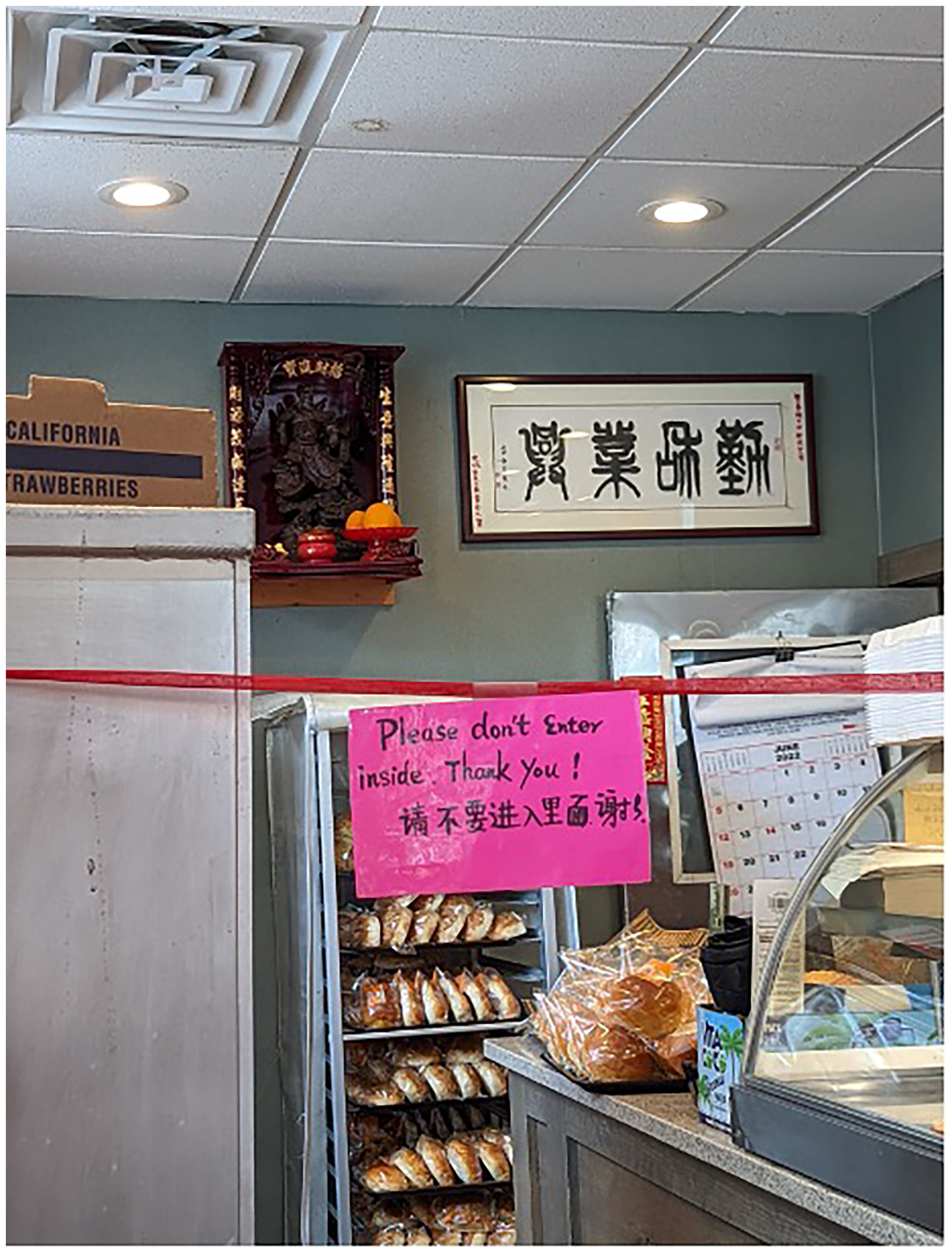
Inside a Chinese bakery (Photograph taken by Pengfei Zhao, June 2022).
Stepping into the interior of this bakery is a profound translanguaging moment. How can we make sense of a space like this, brimming with what Li Wei calls “elements from different named languages” (Li, 2022: 3)? In fact, merely identifying the named languages included in this translanguaging scene, English and Mandarin Chinese, would reduce the layers of rich meanings that this interior scene has to offer. If the linguistic signs were confined within those of the named languages, we would have to turn the classical Chinese inscriptions and calligraphy into simplified Chinese, that is, the standardized writing system in contemporary mainland China. As researchers of China Studies have demonstrated, the creation of the modern Chinese language was “a quest for linguistic modernity” (Tsu, 2016: 210), one that involved not only Chinese nation-state-builders, language policy makers, and intellectuals, but also the general public and Western missionaries (Tsu, 2016; Zhong, 2019). The engineering of the simplified Chinese script, in particular, has been intimately interwoven with the nationalist pursuit of collective identity and state power (Zhong, 2019; Zhou and Sun, 2004). Creating an English/Chinese bilingual and binary analytic framework based on named languages impedes us from asking questions about why different forms of Chinese were presented in this scene and how these various forms, with their varying ways of representation, are associated with the artifacts and place-making in this particular context.
To be more specific, there are at least three different forms of Chinese in this scene, and each has a different function as well as a different audience. The sign asking people not to step into this bakery addresses primarily the customers of the bakery and demarcates the bakery's interior space. One may wonder why there is a need for an interior within the bakery store. The answer may seem straightforward: As crowded as the space in this historical and increasingly gentrified neighborhood is, people working here designated this corner of the store as a space for storage, as indicated by the refrigerator, the baking shelf full of loaves of bread, the strawberry box, and so on. However, the shrine, the incense, and the fresh fruit, the calligraphy, together with the classical Chinese, remind us that this “interior Chinatown” is a place-in-the-making, far beyond a workspace, where people practice their spiritual rituals and appreciate their traditional forms of artwork. We understand the cultural “depth” of the interior Chinatown from the inscription of classical Chinese writing and the aesthetics of an even older form of the language, an understanding that cannot be achieved if we stick with the standardized, named languages.
As a reader and viewer of the scene, I also feel compelled to acknowledge the blurring boundary between reading and viewing. For instance, although I was trained to read classical Chinese, I could not read the small seal characters in the artwork and had to ask my expert friend for help. When reading merges with viewing, and when a form of writing is only accessible to highly trained eyes, our distance from the culture is put to the test. In a way, each person stepping into the interior of this bakery is creating their own place: some may only recognize the English words, whereas others may be able to read one or another form of the Chinese writing.
The second empirical example examines the practical and pedagogical challenges that naturally arise in contexts where teachers do not share all the linguistic repertoires of their students (Canagarajah, 2011; García and Kleyn, 2016; Hornberger and Link, 2012; Ticheloven et al., 2021). Building upon the challenges outlined above (see the “Breaking down linguistic boundary-keeping and embracing asset-based multilingual practice” section), the methodological challenges extend beyond linguistic logistics, encompassing nuanced considerations of research design and engagement with multilingual novice researchers undertaking qualitative projects.
In the following account, I (Amber) share a brief narrative of one experience navigating such a context, in order to outline some of the complexities that arise and highlight the importance of thinking deliberately about these issues as qualitative researchers and methodologists. In no way is this narrative intended to describe “best practices”; rather, it is offered as an exploratory and provisional reflection on some of the complexities that arose during an intentional navigation of the task of advising and guiding novice researchers through a qualitative research project while maintaining a deliberately multilingual perspective.
As a qualitative research instructor who did not share linguistic backgrounds with my students, I encountered a critical pedagogical challenge: how to weave together structured learning goals about qualitative research methodology with fundamentally inductive, bottom-up research design approaches. My central concern became creating an instructional space that could simultaneously introduce course participants to particular research practices and approaches, support their developing capacity to engage in these practices, and center a translanguaging stance that embraced students’ leveraging of their full linguistic repertoires throughout the research process.
Tasked with teaching a qualitative research course to master's students in a multilingual language education program, I wanted to create a class that not only offered them a chance to explore qualitative methods in multilingual education but was itself designed from within the culturally and linguistically sustaining, humanizing, and justice-oriented perspectives emphasized within our program (e.g. del Carmen Salazar, 2013; Lucas and Villegas, 2013). As a class project, one student, a native speaker of Mandarin Chinese, proposed to interview EFL teachers in rural China, presenting a unique opportunity to investigate the experiences of teachers in a critically under-explored area of language education. While it was possible to conduct the interview exclusively in English, given that both my student and her participant were proficient in this language, we felt that artificially restricting their communication to English could potentially limit the research outcomes and undermine the authenticity of the interaction, a limitation that would not only be antithetical to the principles of multilingualism but could also constrain the depth and richness of the data collected (Li and Miao, 2025).
Still, the decision to maintain a translanguaging perspective and encourage the student to do the same by drawing on all her linguistic resources when designing and conducting the research study introduced additional complexities into the research mentoring process. Furthermore, this choice necessitated both openness to uncertainty and a collaborative stance, wherein it was paramount to understand all participants in every interaction as both knowledgeable and knowledge-creators (Bucholtz, 2021). My student and I worked together to develop questions that were linguistically and culturally resonant, a process that involved extensive discussions on the nuances of language and meaning, ensuring that the phrasing of questions would elicit rich, authentic responses. Similarly, the data-coding process required innovative solutions to accommodate the multilingual nature of the data. To preserve the authenticity of the responses, we agreed on a dual-language coding scheme wherein initial codes were applied in both Mandarin and English. Subsequently, the student and I met to talk through her coding scheme and agree on language to describe the codes in English, which allowed for a reflective dialogue between us. This coding strategy not only maintained the integrity of the data but also fostered a rich, collaborative learning experience. Selections from the transcript were chosen for inclusion in the research paper, and the student shared them in the original language(s) and also provided a translation in English for the final intended audience.
I have provided the foregoing description to illustrate how we co-created a qualitative research experience that actively engaged the student in both conducting research and learning research processes. However, it is not intended as a prescriptive account. Rather, I share this experience to emphasize the importance of maintaining a flexible, creative, and collaborative approach when mentoring novice researchers, particularly in the context of maintaining a pro-multilingual stance. It is the stance toward creativity, innovation, and flexibility that we, as authors, wish to emphasize—a translanguaging perspective that enabled the student to engage deeply with the data while allowing the instructor to maintain a role as mentor, while striving to center linguistic heterogeneity both as a methodological tool and a learning opportunity.
These two vignettes shed light on multilingual speakers’ experience with qualitative research. These experiences have long existed at the margin of qualitative researchers’ field sites as well as in academia. For a long time, qualitative methodological literature has seemingly overlooked these speakers, offering little support for multilingual researchers to reflect upon their unique positionality, the various ways they can engage their research participants, their differential languaging practices, and the impact of their work in different linguistic worlds. Similarly, participating in research activities multilingually rarely emerges as a legitimate choice, constraining multilingual participants from utilizing their full linguistic repertoires. What these vignettes illustrate is how the lens of translanguaging enables us to read, view, and do language differently. In the following section, we present methodological and pedagogical provocations built upon our discussion above and invite others to join this discussion from their respective cultural, linguistic, racial, and gender perspectives.
Provocations
We elaborate on our provocations from the perspectives of performing and teaching qualitative methodology, respectively. They aim not to prescribe concrete proposals for action but rather to offer some initial consideration of what translanguaging might afford us in regard to expanding the methodological possibilities of qualitative research (Elfreich and Dennis, 2022; Kuntz, 2016).
Provocation I: Translanguaging research methodology
At the center of our inquiry are these questions: By enacting a certain type of monolinguistic, multilingual, or translanguaging qualitative research practice, who is included and who is excluded (Kubota, 2016)? What kinds of practices and modalities are taken for granted as the standard or normalized practice?
As much as we problematize monolingual practice, it is worth noting that some multilingual practices also perpetuate the view of languages as bounded, self-contained, and apolitical systems. For instance, sometimes researchers tend to label multilingual issues in our research practice as “practical questions” such as “When should I translate my interview—during transcription or afterwards?” “Should I analyze my data in the language I used to generate them or the language I will use to publish my findings?” “How should I transcribe my interview if my interviewee switches back and forth between two languages?” As helpful as they are in explicating the unique challenges that multilingual researchers need to navigate, the nuanced answers to these questions cannot be fully grasped without delving into the underlying conceptualization of language, languages, and languaging. Translanguaging, in this sense, serves as one of the theoretical lenses for qualitative researchers to “think with” (Jackson and Mazzei, 2013) as they address issues related to transcription, translation, and interpretation in their practice.
Meanwhile, opportunities are abundant for multilingual researchers or researchers who work with multilingual participants to explore theoretical possibilities beyond translanguaging. What is more fundamental, for us, the two authors, is the cultivation of CMLA among qualitative researchers. We understand CMLA as a heuristic that may help to raise awareness of linguistic diversity as well as problematize the “concept of language itself” (García, 2017: 1). Qualitative researchers can leverage this awareness to problematize the ongoing sedimentation of monolingual assumptions and the methodological practices that these assumptions perpetuate. Raising CMLA also empowers researchers to interrogate languaging issues, especially when they are situated in contexts that can hardly be categorized or captured using existing identity categories sponsored by nation-states.
One insight that translanguaging theory offers is the importance of staying within the liminal space of messiness. Propelled by an ideology of linguistic purity, researchers sometimes attempt to draw clear-cut boundaries among languages and related practices. However, as we have shown in the empirical examples, the impetus of wanting to be clear-cut can render hybrid lived experiences invisible and erase the voices that never fully fall into specific categories. In other places, qualitative methodologists have also highlighted the importance of messiness, as well as its implications on interpreting data and presenting research findings (Rubinstein-Ávila, 2013). The methodological conversation can be expanded to consider what we can call “translanguaging messiness.” Staying with this messiness, however, differs from sticking in the messiness. It is through staying with that we can interrogate various forms of language-based marginalization and further tease out how linguistic marginalization intersects with other equity-related issues.
Staying with the translanguaging messiness also allows us to see the shifts in our senses of how representation and meaning-making “happen” from one modality to another. In the empirical examples, we have shown how the modality of words can shift between linguistic symbols for reading and visual arts for viewing, and how oral communications can slip from voices for communication to acoustic sounds. The blurring boundaries of translanguaging mean that translanguaging qualitative research has to be simultaneously multisensory and multimodal. As translanguaging expands our horizon of communication, it is worth noting that it is at the same time both situated in intersubjective relationships and rooted in social materiality.
Provocation II: teaching qualitative methods
For multilingual novice researchers encountering qualitative research for the first time, questions regarding research procedures are common (Havlin, 2022; Meyer and Estable, 2017). For these students, their relative positions as both novice and expert are additionally at play. Specifically, while they may be relatively novice researchers, they are experts in the languages they use and in using them fluidly to “shuttl[e] between the languages brought by the other to co-construct meaning” (Canagarajah, 2011: 4). Thus, various tensions may emerge as instructors seek to support multilingual novice researchers in researching multilingually while learning about qualitative research. One central tension lies in providing foundational methodological frameworks that support students’ learning while simultaneously avoiding the imposition of a single linguistic approach. This challenge is especially pronounced when guiding students through complex processes of drafting, thinking, coding, and reflection. Additional complexities include the co-construction of meaningful processes of support for novice researchers in translanguaging throughout the research process, especially when instructors and students may not share the same linguistic repertoires. As qualitative methods instructors, what might it mean if we began “paying attention to the tension to set intention[s]” (Avineri, 2024: 41) related to methodological translanguaging in our teaching? Our work suggests that doing so will, at the very least, allow us to begin to engage with and explore emergent possibilities for co-creating workflow systems with students that open spaces for translanguaging. By embracing the inherent complexities of this, while simultaneously working alongside our students to develop contextually responsive approaches, we might begin to navigate this productive tension in ways that enrich our collective research practices.
As teachers of qualitative methods, we may use CMLA to provide one framework to help reconceptualize how we approach our pedagogy, specifically related to translanguaging in the research process. In other words, rather than simply viewing students’ linguistic repertoires as assets to be leveraged, this perspective can push us toward a capacity-oriented approach that recognizes students in qualitative methods courses as co-producers of research knowledge. Such a shift may afford more than just an openness to multilingualism; it may help us move beyond a commodified approach that continues to view these languages as bounded and only valuable at moments of translation, and toward an approach that centers justice and transformation in the teaching of research methods. Such an approach not only acknowledges students’ linguistic capabilities but also honors their multilingual practices as integral to expanding and enriching qualitative research methodologies.
Conclusion
Though translanguaging practices are woven throughout research practices, from field notes to literature reviews, to transcription, to presentation of findings, they frequently remain in the shadows, unacknowledged in methodological accounts. By drawing on examples from our empirical research and methodological instruction, we hope this discussion opens up new methodological possibilities, with implications for both research practice and teaching methodology. What might it mean to illuminate these “hidden” practices? How do our own methodological choices and assumptions reinforce or disrupt linguistic hierarchies? How shall we bring multilingualism from the margins into the center of our methodological conversations? These questions invite us to come together in conversation as qualitative researchers, to consider how our own methodological choices and assumptions reinforce or disrupt linguistic hierarchies, offering fertile ground for methodological innovation, challenging us to develop approaches that honor partial understanding and translingual meaning-making.
Such questions invite us to reimagine our methodological practices, embracing rather than smoothing over the tensions inherent in multilingual research. What this might look like is initiating critical conversations oriented toward refining methodological approaches in order to query and move beyond both hegemonic monolingual research practices and reductive frequency-oriented, pattern-seeking approaches that catalogue and bind participants’ and researchers’ language practices. Ultimately, we offer this piece not as a definitive statement but as an opening—a gesture toward more nuanced methodological conversations and an affirmative letter of love and caring for multilingual researchers and participants. This letter is an invitation to meet them/you where they/you are, on their/your liminal and shifting ground, in their/your translanguaging messiness, with a commitment to honor the generative possibilities inherent therein.
Footnotes

Ethical considerations and informed consent statements
The empirical examples discussed by Pengfei were from a critical ethnographic project approved by the University of Florida Institutional Review Board (Approval No. 202100370). The empirical example discussed by Amber was from the self-study component of a Trajectories in Learning to Teach project at Vanderbilt University (Approval No. 091220).
Funding
Pengfei Zhao disclosed receipt of the following financial support for the research, authorship, and/or publication of this article: The data used in this article are from a project sponsored by the College Research Incentive Fund (CRIF) from the College of Education, University of Florida, and the Spencer Racial Equity Research Grant from the Spencer Foundation.
Declaration of conflicting interests
The authors declared no potential conflicts of interest with respect to the research, authorship, and/or publication of this article.
Data availability statement
The participants of this study did not give written consent for their data to be shared publicly, so due to the sensitive nature of the research, supporting data is not available.