



Abstract
Scholars have increasingly highlighted the usefulness of new materialist theories and methodologies in attempts to address the perceived shortcomings of conventional theories inspired by social constructionism and post-structuralism. Contributing to these discussions, we utilize a new materialist theory which rests on a monistic ontology drawn from Spinozian and Deleuzian assemblage theory to examine the constitutive role of material elements (e.g. audio recorders, video cameras, and dress/shirts worn during interviews), spatial, and discursive forces in co-creating fluid nonstatic researcher positionalities in qualitative research process. This article is part of a larger ethnographic study conducted by the first author among fisherfolk in Ghana's coastal fishing communities. Our results show that the researcher's fluid positionalities during interview encounters were brought to bear and sustained in space and time through the joint effort of material, discursive, and spatial forces. As qualitative researchers seek ways to ensure better understanding of their study communities through intimate interactions, an attention to the assemblage of material-discursive forces in interview encounters may highlight some of the opportunities and obstacles in qualitative inquiry beyond human agency and negotiations.
Introduction
Qualitative researchers pay considerable attention to their position in data production or collection—two terms that have been keenly contested by different scholars (Crang and Cook, 2007; Guba and Lincoln, 2005). Whether data is simply “collected” or “produced” is a key contention in the shift from representationalism toward a performative ontology that avoids foundationalist categories, suggesting that research is a performance by which data is produced rather than pregiven to be collected (Coffey, 1 999; Pennycook, 2004). Conventionally, there are two opposing discourses about the position and role of the researcher in the research process—the positivist and the constructivist's accounts. First, positivists argue that “humans and objects preexist meaning and reality” (Nordstrom, 2015: 389), and interviews are neutral encounters in which a value-free researcher collects and analyses data from respondents (Marn and Wolgemuth, 2017). In addition, the tools such as audio-recording devices, notebooks, and cameras used in data collection are considered as mere “device[s] interposed within a sequence of research operations” (Lee, 2004: 879). For positivists, researchers are totally objective, impartial observers, unaffected by meanings and results collected using research tools such as recorders as gestures toward objectivism (Hammersley, 2003; Lee, 2004).
On the other hand, social constructivists question such researcher-value-free claims and consider the researcher as an active part of the research design process, who affects and is affected at various stages including data collection, interpretation, and analysis (Creswell, 2009; Haraway and Teubner, 1991; Mullings, 1999). They argue that researchers focus on what is relevant for the research objectives, determine the appropriate tools to be used, and rely on their own understanding of the data to make them visible or invisible, which affects the outcomes or meanings generated from the research (King et al., 2018). As argued by Mullings (1999: 337), “a researcher's knowledge is always partial because his or her positionality…influence how the world is viewed and interpreted.” Such positionalities and researcher's inherent identities as insiders or outsiders are assigned through various “signifiers of difference” such as age, social status, educational background, gender, race, and language (Mullings, 1999: 339). The existing literature has thoroughly examined the positionalities of researchers, interviewees, and their existing power relations in the interview encounters and its impact on research outcomes (Ellis et al., 2021; Merriam et al., 2001; Mullings, 1999). Anthropological and sociological research shows that a researcher does not necessarily occupy a fixed insider or outsider positionality on the field (Adjei, 2017; Merriam et al., 2001). However, these studies have been largely human centered, and privileged human agency by focusing on how the researcher and respondents negotiate power dynamics between them to create different positionalities (Merriam et al., 2001). While these scholars recognize the important roles of research tools, research locations, and participants in the research process (Briggs, 2002; Hammersley, 2003), discussions of positionality dynamics of both researchers and their informants have mainly highlighted the human agency exerted by both researcher and their informants in the data collection processes (Merriam et al., 2001; Ellis et al., 2021), leaving their material dimensions (human and nonhuman) in the background (Marn and Wolgemuth, 2017). Extant research from new materialist framing shows that the role of materialities (human and nonhuman) in research could impact on the overall research methodological processes, but the specific roles of such materialities on researcher's positionality dynamics is still unclear.
In this article, we use a new materialist framing to examine researchers’ positionality dynamics to show that there is much to be gained in the research positionalities if this line of inquiry were expanded to accommodate an awareness of the role played by materialities in interview encounters during fieldwork. At the core of new materialism, we find an insistence on “the critical role of the body and material things in all social affairs” (Nicolini, 2012: 4). This means that in terms of understanding the positionality dynamics of the researcher, we focus on the assemblage of the material (i.e. objects and bodies), spaces and social forces (i.e. discourses, research ethics, etc.) that make up interview encounters of the first author during his fieldwork. Specifically, we explore how, for instance, what were conventionally considered as mere research tools (e.g. audio recorders, cameras, and notebooks) can combine with other social forces to co-create fluid, nonstatic positionalities of the researcher, and how these can impact on the research process and results. As the results would show, the assemblage material-discursive-spatiotemporal forces co-created opportunities for the researcher to access information from informants which may not have been possible without such assemblage of forces. In other instances, the researcher's ability to interview and access information from informants was foreclosed through different material-discursive assemblages. In the next section, we provide a brief account of the conventional theoretical debates on research methodology and design, including researcher positionality dynamics in the research process. We then briefly discuss the main theoretical arguments of the new materialist approach inspired by Spinozian flat ontology and Deleuzian assemblage theory, after which we will discuss how this theoretical lens could explain the first author's positionality dynamics during his interview encounters.
Theoretical approaches in qualitative inquiry
Social scientists including cultural and feminist scholars have long questioned positivists assumption of researchers as value-free and impartial observers, and research tools as gestures toward objectivism (Hammersley and Atkinson, 2007; Haraway and Teubner, 1991; Lee, 2004). These scholars have highlighted the dilemmas posed by research methodologies, tools, and the subjectivities that are inscribed in our work (Mullings, 1999). For instance, a notable feminist scholar, Donna Haraway argued that researchers undertake research with their “maps of consciousness,” influenced by their gender, age, social class, and other social signifiers (Haraway and Teubner, 1991: 337). These social structures, discourses, and identities affect the research process such that what is considered an interpretation of the world results from the researcher's “limited” understanding and interpretation of what is observed. A recognition of the role of social discourses and structures in determining research outcomes could help question claims of objectivity and to deconstruct/contest structures that work to create unequal power relations between researchers and their participants (Bodén, 2015; Hammersley, 2003; Lee, 2004).
Social constructionist and positivists are the strongest discourses in the field but have not been the only available departure points for discussion. Existing research reveals that a focus on social structures in interpreting the world is equally restrictive (Braidotti, 2013; Fox and Alldred, 2018; Grosz, 1994). Specifically, within the social constructionist approach, one would struggle to find ways to incorporate the active roles of the physical human bodies (researcher and informants) as well as the nonhuman research tools such as audio recorders and video cameras in co-creating fluid and dynamic subjectivities in the research process (Nordstrom, 2015). These problems partly reflect the critiques of feminist scholars such as Butler (1990, 1993), whose works have been criticized for its preoccupation with language, discourse, and signification in explaining gender inequality (Butler, 1993; Doucet, 2013).
Thinking with matter in qualitative research
A philosophical framework which has gained popularity within the last decade is generally termed as new materialisms. This theoretical approach has several names including the “material turn,” the “posthuman turn,” the “ontological turn” and the “relational turn” (Barad, 2003, 2007; Bennett, 2010; Braidotti, 2013; Grosz, 1994; Kirby, 2017). New materialists have different ontological and historical roots, but what they generally share is a theoretical and empirical concern for the production of meaning through the entanglement of matter and discourse, rather than an underlying structure (Fox and Alldred, 2018; Barad, 2003; Braidotti, 2013, 2006, 1994; Bennett, 2010). Thus, new materialisms have become a critical stance for researchers who find materiality of great importance without prioritizing one stratum over another to explore various encounters in the research process (Andersson et al., 2020). This theoretical framing entails Deleuzian idea of immanence which means that there are no underlying structures, mechanisms, or systems at work governing the world from the outside. Instead, there are events comprising assemblage of human and nonhuman bodies within which the realms of nature and culture together produce the world (van der Tuin and Dolphijn, 2010). These relations of human and nonhuman forces are described as “apparatus of knowing” in the research process which enables or shuts down ways of producing a different becoming in interview encounters (Bodén, 2015: 195). This means that the research process and the methodologies for researching and understanding positionalities are always entangled and can only be distinguished from each other through an artificial process known as “agential cuts” (Barad, 2012: 46). Agential cut can be described as a temporary freezing process which allows researchers to analyze the different forces affecting the phenomenon under study (Bodén, 2015; Van der Tuin and Dolphijn, 2010). Thus, agential cuts cannot be predetermined in the research process. Rather, they are treated as temporary demarcations which allow us to understand the various research encounters which emerge from the different material-discursive forces at work (Barad, 2003, 2007). Such cuts are undertaken not necessarily because the researcher dominates the research process. Rather, they emerge from the larger material-discursive assemblages of which researchers are part (Bodén, 2015). Different researchers are likely to provide different cuts and different cuts will produce different realities—What we present in this article as cuts from our field notes may be different when the same data is given to another researcher for analyses. Their results will depend on the extent of their entanglement with the data, their immersion in the research process and what forces come to play during their interview encounters.
In qualitative research, there has been growing empirical studies in explaining how the new materialist framing may alter the research methodological processes (Mazzei and Jackson, 2012; Jackson and Mazzei, 2013; MacLure, 2013; Marn and Wolgemuth, 2017; Nordstrom, 2015). For instance, in her exploration of multicultural encounters and experiences of living together, Peterson (2020) examined the opportunities and challenges associated with objects in focus groups. She highlighted how touchable materials such as pens and papers facilitated relational experiences across identities, experiences, and communications across verbal and nonverbal barriers. The study provided an important account by paying attention to objects in qualitative research as they “open up sensitive areas of discussions [and interviews]” (Peterson, 2020: 25). However, her centralization of objects as the “medium” of research encounters through which participants express and share their views (Peterson, 2020: 24), commits similar blunder as social constructionist focus on language and discourses. Nordstrom (2015) utilizes Baradian framework to examine the performative and entangling work of recording devices with other forces including age, gender, and culture. In her paper, Nordstrom shows how recording devices intra-act with other forces to generate entangled meanings and knowledge of family history genealogy. She argues that recording devices are not mute entities that simply record interviews, but rather material-discursive practices in the research assemblage (Nordstrom, 2015).
From the above studies, research methodology is thought of as a “web of forces and encounters” (Braidotti, 2006: 41) or set of interconnected machines which form a particular understanding of the events to be researched, the research tools (such as recording devices and data analysis technologies), data collection methods, interview encounters, and theoretical frameworks, research literatures, reviewers (e.g. supervisors) and the researcher (Fox and Alldred, 2015). This also suggests that the interview process is not an objective process but a fluid, nonstatic encounter where material and discursive forces combine to achieve specific methodological objectives (Jackson and Mazzei, 2013; Fox and Alldred, 2018).
Our conception of new materialism is not antihumanism, but rests on a monistic ontology drawn from Spinozian flat ontology (where all forces are of equal relevance) and Deleuzian assemblage theory which focuses on the composition of transversal, multiple, and collective practices of becoming (Braidotti, 2013, 2006, 1994). We recognize the different theoretical strands within the new materialisms and the fact that some new materialists (e.g. Latour, 2004) have been critiqued for elevating the relevance of matter over other forces (See Bodén, 2015; Fairchild and Taylor, 2019). We also believe that an elevation of matter over other forces is equally questionable. As such, following scholars such as Fairchild and Taylor (2019) (Fox and Alldred, 2015, 2018), and Feely (2020), our article takes a subtler position by focusing on the intersection of materiality and discourse to highlight the fluid and nonstatic positionality of the researcher in the research process. “Everything is already in relation …matter and discourse and co-constitutive” (Fairchild and Taylor, 2019: 1). Hence, we do not prioritize materiality over discourse or other forces of relations, but proposes a flat ontology where material, human, spatial, and other social forces are equally active and relevant in explaining the research process and the interview encounters which co-created fluid positionalities of the researcher (Fox and Alldred, 2015, 2018a).
Conventional qualitative studies have long argued that the relative insider and outsider positional spaces of the researcher during fieldwork impact the overall data collection process and results (Mullings, 1999). How a new materialist lens could further our understanding of researcher's positional dynamics during interview encounters is still unclear. In doing so, we further conventional interpretive and representational approaches in qualitative inquiry which mostly privilege participants’ voices and researchers’ self-reflexivity (Hammersley, 2003; Lee, 2004), toward examining how the different human and nonhuman material, and spatial forces entangle with such social signifiers of difference to cocreate fluid positionalities of the researcher at different point in time of the interview encounters (Barad, 2007; Jackson and Mazzei, 2013). Specifically, we discuss how the first author's body, participants’ own material bodies, nonhuman objects, locations of interviews, as well as social forces (e.g. gender norms) cocreated fluid positionalities of the researcher. In some instances, such material-discursive assemblages cocreated a seeming insider positionality which giving rise to opportunities for participants to share their views openly, while in other instances such outcomes were foreclosed due to the researcher's seeming outsider position. Thus, paying attention to the effects of human and nonhuman objects in the research process allow us to produce more complex maps of knowing beyond positivist and constructions understandings (Braidotti, 2013; Barad, 2007; Feely, 2020) as further discussed in the next section. In the next section, we provide a brief account of the study context after which we will discuss how human bodies (i.e. the researcher and participant's bodies) combined with other factors to co-create different positionalities for the researcher and influenced the research process.
Study context and methodology
This article is based on a study conducted by the first author in three notable fishing communities in the southwestern coast of Ghana—Axim, Sekondi, and Dixcove, between July 2019 and January 2020. The main study examined gender inequalities in household and community-based fishery decision making and practices in Ghana. In his original study, the first author employed an ethnographic approach which combined a quantitative survey with qualitative methods such as in-depth interviews, participant observations, photo elicitation, and vignettes. The study involved 400 surveyed respondents and 38 in-depth interviews. Ethnographic design has been one of the most preferred methodological approaches in new materialist framework (Feely, 2020; Fox and Alldred, 2015, 2018a; Ringrose and Rawlings, 2015; Lyttleton-Smith, 2015; Youdell and Armstrong, 2011), and was crucial for the original study of the first author to capture the contexts in which different events of fishing decision making and practices occurred. The ethnographic method was adopted due to its capacity to provide deeper understanding of the everyday lives of the fisherfolk to examine how even the taken-for-granted gendered roles could be observed and analyzed (Adjei, 2021; Adjei and Chan, 2023). It made it possible to examine the social and material intra-activity as it occurred, and for capturing the messiness of lived experiences as well as the different “material-discursive agential flows” affecting women participation in community-based and household fishery decision making (Lyttleton-Smith, 2015: 99).
As an important traditional economic activity, recruitment into the small-scale fishery industry in Ghana is based on family labor, but roles are highly gendered; men are generally responsible for fishing while women oversee processing and trading activities (Kraan, 2011; Overå, 2003). Using a new materialist framework, the study highlighted how the co-implication of the material, discursive, spatial, and temporal forces co-determined the extent of women's participation in household and community-based fishery decision making and practices. The study showed how focusing on any of the individual forces affecting women's participation in household and community-based fishery tasks and decision making was inadequate in explaining the gendered outcomes observed.
In our call for the need to embrace more materially engaged qualitative research, this article explores the possibilities of considering how “matter and meaning are mutually constituted” in the production of knowledge (Barad, 2007: 152). Thus, in terms of the researcher's positionality dynamics, we focus on the relations and capacities produced through the assemblage of human and nonhuman forces in the interview encounters which co-created fluid, nonstatic plane of possibilities for the researcher to become temporary insider and outsider at different times and locations (Dernikos, 2019; Renold and Mellor, 2013). We recognize the challenge in dealing with traditional ethnographic approach from a new materialist perspective and concepts such as assemblage and immanence (Gravett et al., 2021; Van der Tuin and Dolphijn, 2010). However, it will be dishonest on our part to ignore what happens to researcher's positionalities from the traditional ethnographic perspective which served as the foundation of the main study before our orientation to new materialist perspective due to the important roles that such materialities played in the overall research process. We suggest that we need to understand the situation where traditional ethnographic methodology encounter immanence through all the components involved in the research event, and not decide in advance what really matters and what does not (Bodén, 2015; Gravett et al., 2021). In the sections that follow, we discuss how the first author and participants’ physical bodies, the nonhuman research tools such as video cameras, audio recorders, clothes worn during interviews among others combined with social signifiers such as researcher and participants’ age, gender, marital status among others to co-create different positionalities in the data collection assemblage and produce different research outcomes.
Assemblage of researcher and respondents’ bodies and discursive forces in interview encounters
First, the researcher's body entangled with the interview participants (including participant's bodies—male and female) and other social forces co-created different positional spaces for the researcher and the participants in the interview process. The first author's body combined with social expectations of masculinity and femininity to co-create the interview encounters and his ability to participate in the different fishery activities during fieldwork. For instance, his inability to fully participate in fishing and related activities such as pulling heavy fishing nets and canoe as done by the fishermen was greeted with laughter from both the male and female fisherfolk as shown in the field note below.
Fieldnote, 14 August 2019 After agreeing to my participation in their daily fishery activities, I followed Saa and Kweku to the beach as they prepared their first canoe for the next trip. Saa could be seen busily carrying food and other items needed for the trip to be sent to the canoe while Kweku and his crew were undertaking “few patches” on the fishing net. Although Kweku was not part of the fishing trip, he was actively directing the crew members on what needs to be done. I fully participated in the pulling of the fishing net and the subsequent pushing of the canoe into the water as more ‘men’ were required to undertake such activities. This was indeed an arduous task - the net was wet and heavy, with some sand particles and pulling required not only strength, but a special skill where we were lined up from the beach to where the canoe was docked. Then the net was pulled at a very fast pace which I found daunting. My heavy breath after the job resulted in laughter from the crew members. However, Kweku asked the fishermen to know that I am only a student who does not have fishing experience, skill, and strength. ‘You have soft skin and muscles like a woman, touch mine and see’ let me teach you how to pull it, he said to me. Right after pushing the canoe, I enquired from Saa why she would not help us push the canoe, which she indicated ‘I have done my part…I can’t pull the net, I give them food’.
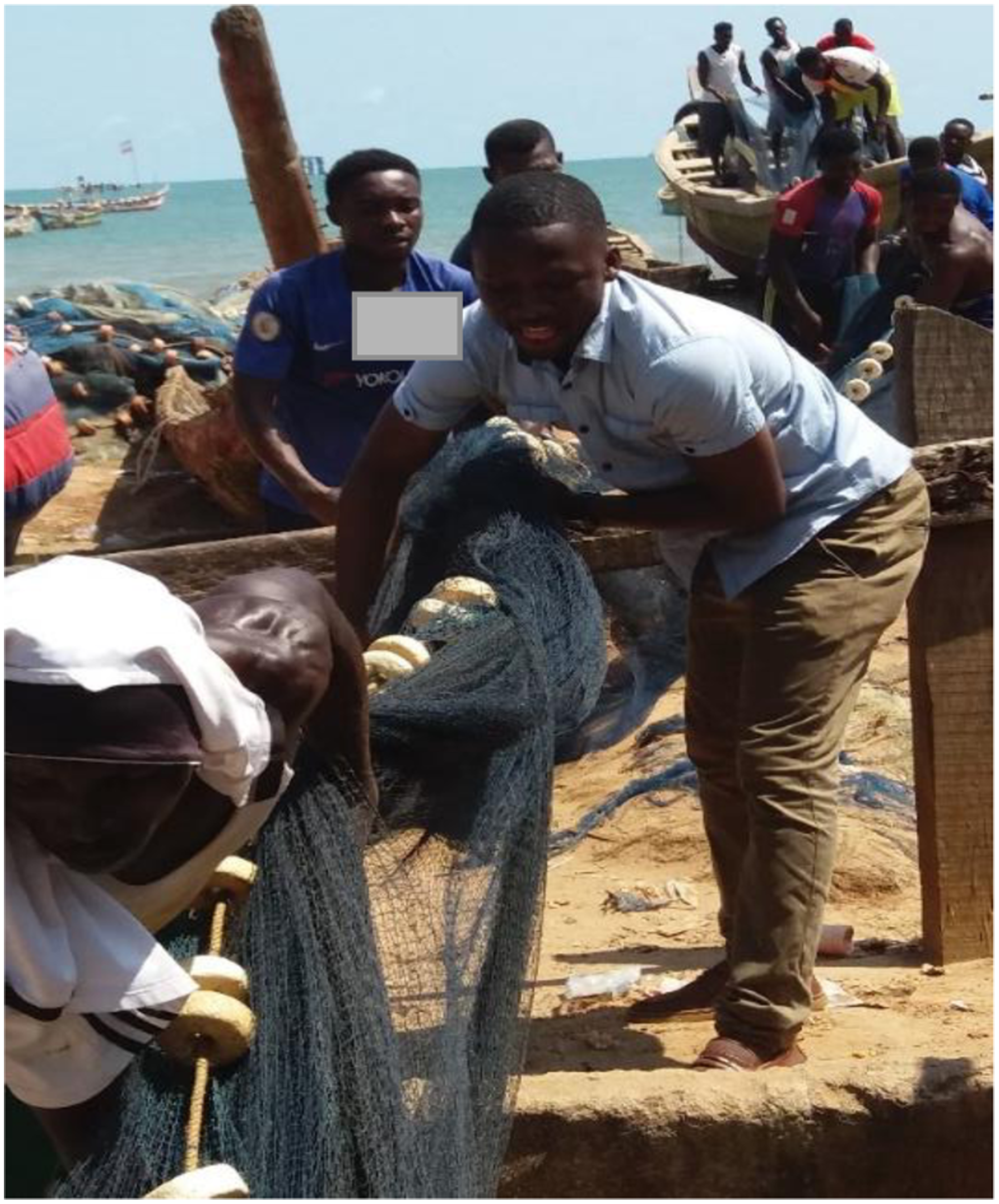
Helping fishermen to pull net into canoe.
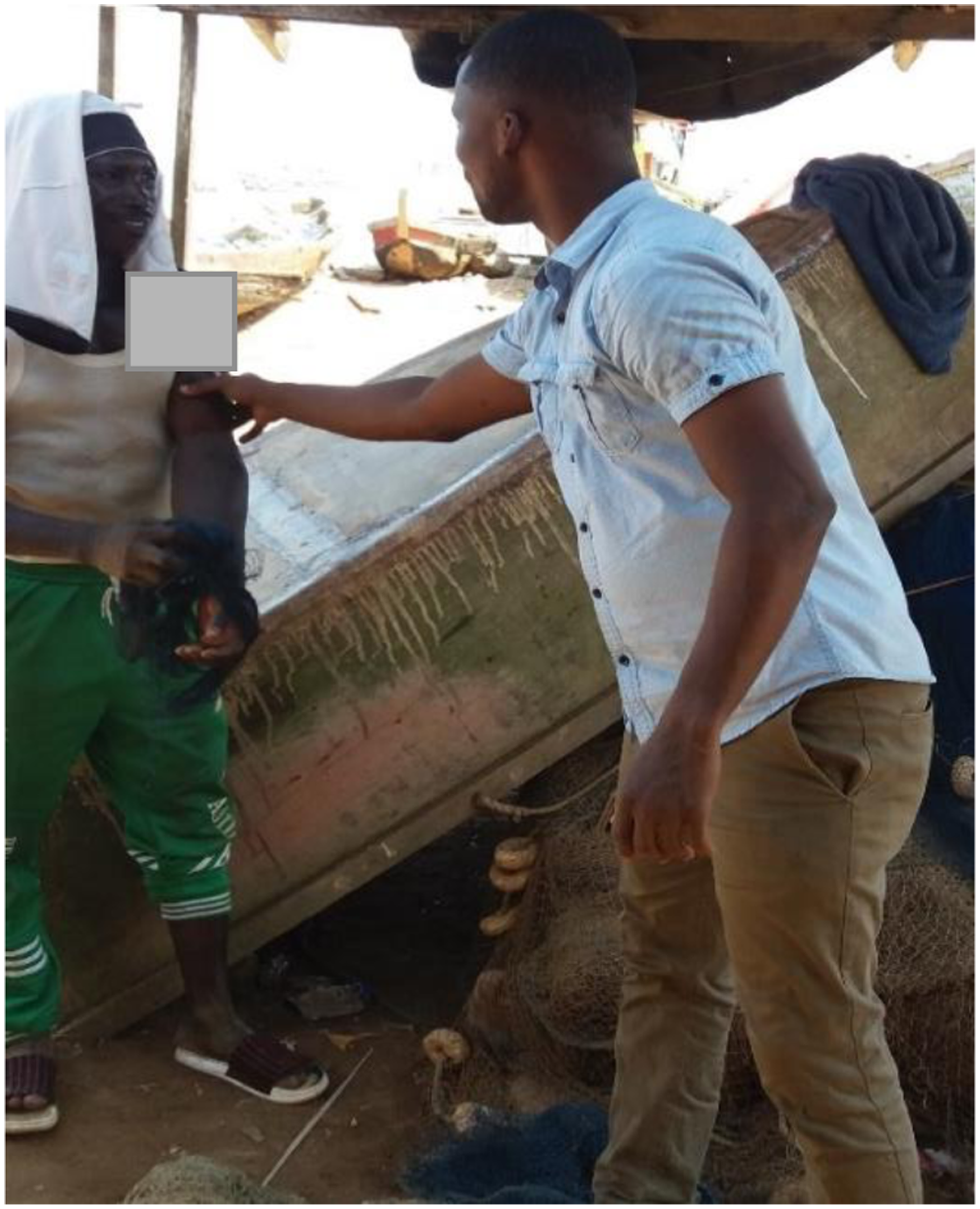
Fisherman asks that researcher feels his muscles.
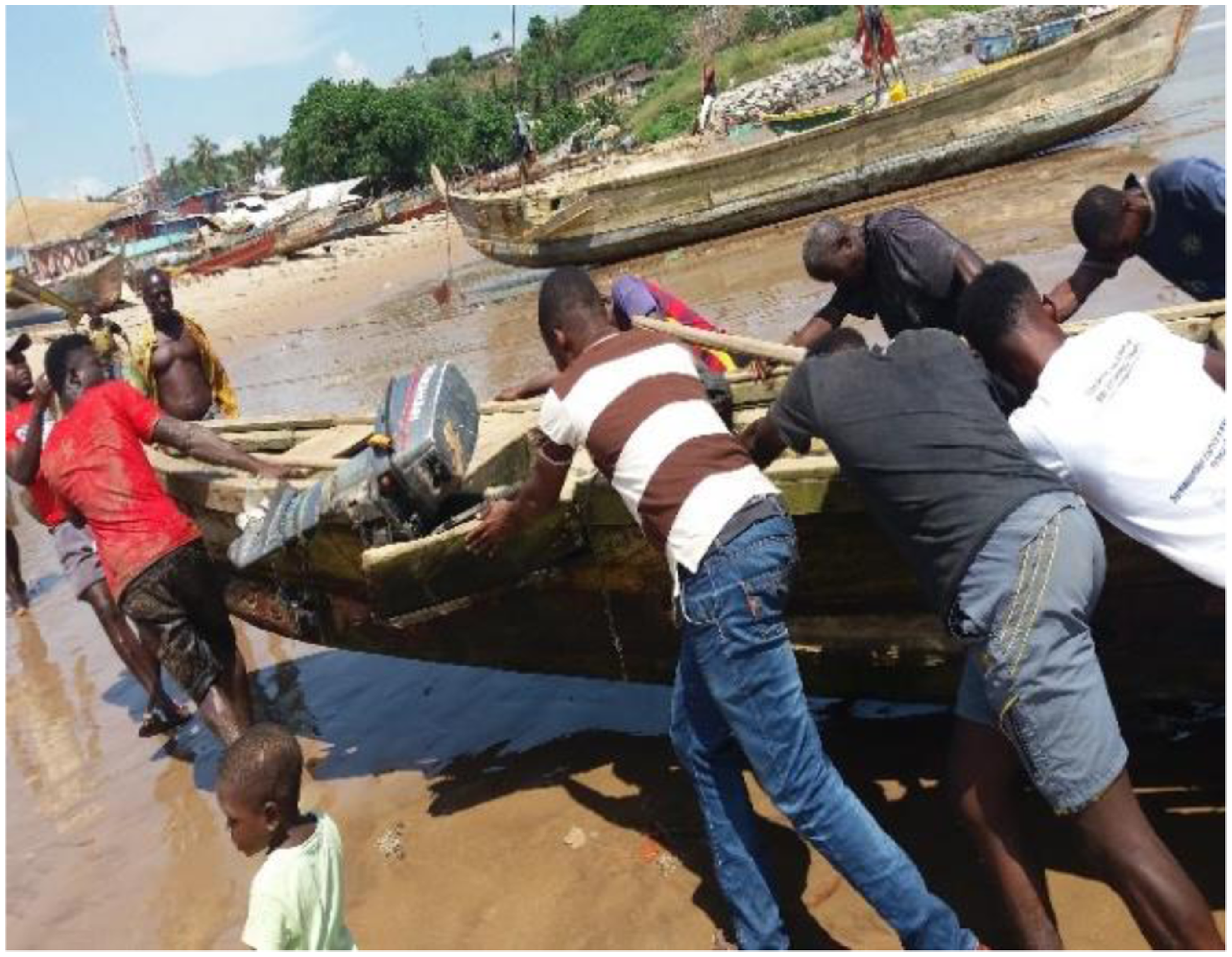
Helping fishermen push their landed canoe at shore.
Researcher's “wedding ring” entanglements with social forces
Interview as a situated practice indicates a collective emergent capacity to interview and be interviewed, a knowing-in-practice accomplished as ongoing, adaptive, open-ended responses to interview encounters (Bodén, 2015). Such encounters do not only involve the negotiations between researcher and the respondents, but also their physical appearances (e.g. clothes worn, age, and social status), the medium of interview or means of capturing the data, interview locations, and other forces which influence the interview encounters. In this section, we discuss encounters between these human and nonhuman forces and how they co-created different positionalities of the researcher and thus the interview encounters and results. The following field note excerpts captures an interview encounter between the first author and fisher couple in their home as it was a no fishing day.
Fieldnote, 30 August 2019 Different fishery tasks and decisions were performed by Kojo and his wife Esi (pseudonyms). Though Kojo was not part of the fishing crew, he was mainly in charge of the fishing related decisions and tasks (e.g., mending nets, buying canoes, fixing outboard motors, etc.) whilst his wife (Esi) processed and sold the fish. In an interview, I asked the couple why the woman seemed to take a subordinating position in the fishery decisions despite her important roles. Esi indicated “you would understand my point if you were married …you would know that marriage goes beyond money”. Then the husband quickly prompted her to check my wedding ring on my finger. Esi smiled and said, “So you know, as a wife I cannot say that because my husband does not have money, I will take all the decisions. He is the head of the family and I need to respect him… For me I am a woman, so even if he does not involve me in decisions, I may not be happy, but I need to respect his decision as the head.”
From the foregoing field note excerpts, Esi was hesitant to speak in detail about the reasons for her limited decision-making roles despite her crucial contributions to the fishery business. Her hesitation emerged because she felt that the interviewer (first author) was a bachelor who did not understand marriage roles and expectations. However, seeing the wedding ring on the interviewer's ring finger prompted her of the interviewer's marital status—he is married! In Ghanaian culture as in many societies, wearing a wedding ring on the ring finger symbolizes marriage. As such, the wedding ring became a powerful force which opened the possibility for Esi to further share her reasons for not leading decisions regardless of her crucial contributions. As the field note illustrates, the ring changes the role of the researcher's finger as it entangles with the social symbol of marriage. However, the capacity of the ring to create such social symbol and meaning does not reside in the ring alone, but the researcher’s ring finger and the culture of the people. In short, it is the assemblage of the ring, the researcher’s ring finger and the cultural norms for marriage which worked to co-determine the marital status of the researcher and the opportunity to discuss marital issues with the couples. Putting the same ring on another finger would have a different connotation and possibly changed Esi's perception about the researcher's marital status.
The discussions above illustrate how the interview encounters go beyond the researcher's reflexivity and power negotiations between the researcher and the respondents. Interview as a situated practice emerges from the assemblage of different human, nonhuman, and social forces which co-determine the relationship between the researcher and respondents including their positionalities (Brewer, 2000; Briggs, 2002). Whether a researcher occupies an insider or outside position is complex and emerges from the co-implication of the complex human, nonhuman and social forces at work.
Interviewer/respondents’ dress differences and spatial intra-actions
In this section, we show the crucial role of other nonhuman objects in the interview encounters. These include the researcher's clothing worn during fieldwork as well as research tools such as the audio recorder, photographs/camera, and the interview guide/questions. These tools were neither distinct nor mute, but active part of the data collection process in which interview encounters, meanings and validity emerged, and sometimes foreclosed (Nordstrom, 2015). For instance, at the early stages of the fieldwork, the researcher was easily identified as an outsider among the fisherfolk, especially during his visits to the canoe landing beaches partly due to his dress as described in the fieldnote below.
Fieldnote, 18 November 2019 While most of the male workers were either bare chested or in their working attire (working gear) at the beach, I realized that I looked different with my well-ironed shirt. Some of the fishermen thought that I was a journalist by asking which radio station I worked for. Others thought I was a government fishery official or a local NGO official. It is mostly these groups of people who usually came to the shore in such an appearance. They denied my first attempt to help them push the canoe at the beach because they felt my dress would be dirty or get wet. After informing them that I was a researcher, they wondered how I would better understand their work in my “gentle dress” and most fishermen still felt uncomfortable around me as I looked too neat for the job. Realizing this on my first day, I started putting on more casual wears which made it easier to mingle with the fishermen in their work.
From the field note excerpts, the dress worn by the first author played a territorializing role by limiting the extent to which he could participate in the pulling of canoes and interacting with the fishermen at the beach. The capacity of the sea to wet his clothes and the sandy coast to make it dirty played a limiting role. However, as the researcher changed into more casual ones, it enabled him to participate more in their fishery tasks and was more accepted by the fishermen. In addition, the beach as a workspace is associated with a dress code, and shared social expectations of observing this dress code makes it easy to distinguish between fishers and nonfishers (Coole and Frost, 2010; Jackson and Mazzei, 2013). The reduced skepticism about the first authors status at the beach was partly facilitated by his change in outfits, which made it easy for him to penetrate different activities of the fisher groups without recourse to the possibility of getting wet or dirty just like the fishermen at the beach.
However, the situation was different during home visits and interactions. Dressing well (e.g. well-iron dress) to the homes of potential participants was an important means to make a good first impression because it reassured participants that the researcher was not a dubious character, as the following fieldnote excerpts illustrate.
Fieldnote, 2 September 2019 After interacting with some fishermen at the beach and participating in net pulling tasks, I decided to visit a fisher couple that I had contacted via phone call. I met the husband who asked me a series of questions at his gate with a rare look at me when I indicated I was a researcher. In fact, I was not allowed into the house until the wife, whom I had spoken to and met at the beach the day before, came out to welcome me. Personally I felt very uncomfortable because my outfit did not match their neat home. The wife later indicated that her husband thought I was a member of a fishing crew she had sacked. Then, I realized that dressing properly in the homes of potential respondents was crucial.
From the above, it is possible that the husband denied the researcher access to his home not necessarily because of his dress. He may only have been concerned about the security of his home for seeing a stranger at his entrance. However, his rare gestures at the first author's dress and the researcher's uncomfortable outlook inserted themselves like a cutting edge and a territorializing moment which limited the researcher's ability to enter the home for interview initially. These effects were produced in a situation where various materialities—human (including emotionality) and nonhuman (e.g. the dress worn by the researcher and gate of the home) met each other at a particular location—the home of an unknown respondent. If the researcher had dressed differently, the situation could have been different such that the researcher may not be considered as a crew member who had been sacked from work.
Here, the spatial context is very crucial. Earlier discussions showed that wearing neatly ironed shirts to the shore attracted skepticism just as wearing messy clothes to homes attracts suspicions. These relations also materialize power (Gravett et al., 2021). For instance, a homeowner at his gate, a researcher outside the home seeking to enter the home, other materialities such as the home gate, and dress of the researcher which translated into boundary creation and the encounter between the researcher and the homeowner. In addition, the researcher's positionalities appeared temporary and fluid with uncertain and indeterminate dimensions emerging from the different material (e.g. dress), spatial (e.g. beach or home) together with social significations attached to these forces.
Audio recorders, cameras, and field notebook intra-activities
As many conventional researchers may have done, at the early stages of the fieldwork, the researcher mainly considered the role of nonhuman material objects in the research such as the audio recorder, interview questions, field notes, photographs used in the interview as tools for capturing data (Brewer, 2000; Lee, 2004). However, in analyzing his interactions with the fisherfolk, we found these research tools to be more-than research tools. A new materialist lens enabled us to see their active roles in the interview encounters and the entire research process through their entanglements. For instance, although the audio recorder and camera allowed for rich and easy capturing of interview events and observations, the first author was not allowed to use them in some instances, as he recounted.
Fieldnote, 20 September 2019 I just had a very interesting interview with a fishing couple (Efo and Esi pseudonyms) in Axim. One interesting thing I found was that the husband was actively involved in the fish (shrimp) processing. He was doing almost everything with the wife in their kitchen. Though I had been told this was a normal practice in the community, this was my first time seeing such extensive involvement of a husband in fish processing. So I asked if I could take a picture of the husband working but he declined. He also requested that I turn off my recorder during the interview for some comments to be made off-the-record.
A key import from the excerpts above is that Efo did not allow the researcher to capture his involvement in a fishery activity he was undertaking with his wife. Perhaps, the fisherman was aware of the potential harm that such photographs could cause him and his home. In the Ghanaian context, a man's participation in female-dominated fishery activities such as fish processing and sale usually results in public ridicule and name-calling (see Adjei, 2021, 2023; Overå, 2003). Hence, even though it was a normal practice in the fishing community for a man to support the wife in fish processing such tasks was usually undertaken indoors (the enclosed kitchen). Some participants who declined to being photographed or recorded indicated that such recordings may expose aspects of their lives which would come back to haunt them, even after the researcher's assurance of their anonymity and protection of the data. As Nordstrom (2015) rightly indicates, the audio recorder and camera may capture important information and images during data collection but the cultural dynamics that come with their use need to be addressed. This is why it is very important to equally pay attention to cultural and other discursive forces even as we highlight the active roles of materialities in co-creating fluid researcher positionalities.
In response to these participants’ concerns, the researcher resorted to writing their responses in a field notebook. The field notebook created a possibility for data collection which could not have been allowed with audio recorder or video camera. Whilst a video camera had the capacity to visually expose participant's deviation from the socially accepted gender roles in fisheries, the notebook could only capture the informant's activities in words, which he could easily deny. We see the important role of the camera and audio recorder working together with other factors such as gender role expectations of men to prevent the researcher from capturing certain audio-visuals during the interviews. Thus, the field notebook and video cameras became important material actors which co-determined the relationship between the researcher and researched as well as the extent and the form of data captured. Without the notebook, some relevant interview details may not have been captured as the camera was not allowed. However, the potency of the notebook emerged from the man's negative feelings in the fieldwork context of being studied. These feelings were brought out by the presence of the video camera which could expose his subversion of the gender appropriate roles in the community. While the male body–gender norms–video camera assemblage intra-acted to limit the researcher's ability to obtain some data, the assemblage of male body–gender norms–notebook opens possibilities for the researcher to obtain similar information.
The above shows that data recording devices are “not mere observing (or recording) instruments, but boundary drawing practices—specific material (re)configurings of the world, [which] came to matter” in the interview encounters (Barad, 2007: 140). They played an active role in the interviews and co-created different positional spaces for the researcher as well as what data could be generated. As such, what participants were able to talk about, what the researcher was able to capture, the power dynamics involved and the outcomes of interviews resulted from the complex intra-actions of material forces, gender norms, the human bodies of researchers, and participants working together to territorialize research outcomes in some contexts and deterritorialize them in others. This perspective confirms that human intentionality such as researcher and participants negotiations and social expectations of gender appropriate roles played important part of the interview encounters. We highlight these further in the next section.
Making a difference with matter
Conventional qualitative literature and methodologies have mainly focused on discourses, language, researcher self-reflexivity, and other human-centered approaches in the research process, whilst the active roles of materialities including the physical human bodies and nonhuman objects involved in the research process have been sidelined (Gravett et al., 2021; Murris, 2020). As Barad argues, “language has been granted too much power…language matters, culture matters, discourse matters…the only thing that seem not to matter anymore is matter” (Barad, 2003: 801). Thus, Barad, like other new materialists, highlights the important but often neglected role of material agents as they intra-act with other forces in understanding social processes and outcomes including research participants’ behaviors and the research outputs (Fox and Alldred, 2018).
In this article, we show the consequences of paying attention to materialities (human and nonhuman) such as audio-recording devices, fieldnote books, video cameras, the shirts/dress worn in co-creating fluid, nonstatic researcher positionalities during interviews and participant observations. We shift the attention from conventional research methodologies which focuses on discursive forces such as the self-reflexivity of researcher in the research process (Mullings, 1999), toward an examination of the relational flows between such discursive forces as well as objects, bodies, and spaces (Fox and Alldred, 2013). Our analysis focuses on the entanglements of forces and the fluid, nonstatic outcomes they co-produce (Feely, 2016; Ringrose and Coleman, 2013). Like other new materialists, we attempt to “break with the assumptions of a methodological positivism” and social constructionism (Clough, 2004: 45) by offering an entangled material-discursive practice in the research process. However, we do not disregard the equally important role of language and discourse as they were equally important in the interview encounters.
Some new materialist scholars consider representational and interpretivist approaches which dwell on human actions, voices, experiences, and reflexivity as irretrievably humanist, hence not suitable for new materialist qualitative inquiry (DeLander, 2005; Lather, 2013; Lather and St Pierre, 2013). However, following scholars such as (Fox and Alldred, 2018; Feely, 2016; Ringrose and Coleman, 2013), we are less critical of such conventional approaches on the grounds that researching a social world requires attention to methods that can address both the material and the linguistic aspects that humans contribute to assemblages through thoughts, feelings, among others. In this way, we open to the world's liveliness, “allowing ourselves to be lured by curiosity, surprise, and wonder” (Barad, 2012: 207) of the material-discursive, spatial, and temporal intra-actions.
As our article reveals, nonhuman objects such as audio recorders, video cameras, and notebooks had crucial effects on the data production process in our study. The capacities of the video camera and audio recorders to capture participants’ image and voice, respectively, created a limiting role in the researcher's ability to capture certain essential data during fieldwork. However, the capacity of the notebook to capture same data in words, a capacity that the camera or audio recorder did not have, created a possibility for the same information to be captured. While these nonhuman materialites are important, we see that their relevance emerge in a context—a gender structure context. Our findings reveal that the men declined being photographed during their involvement in female-dominated activities such as smoking or frying fish. Men's participation in these fishery tasks contradicted existing Ghanaian gender norms of appropriate male and female roles and often resulted in public mockery. A video camera or audio recorder could expose a man who engages in such fishery tasks to the public by providing an actual image and voice of the man as he performs such tasks, an outcome the man may find difficult to deny, hence his resistance to being captured using such devices. However, for the notebook which only captures words of the participant who could easily deny and may be difficult for a reader to trace the actual speaker. What we wish to highlight here is that while the nonhuman forces above play important agentic roles, their relevance emerge when discourses of appropriate gender role and participants intentionality are considered.
As we refer to it as data production, it is a process that emerges from the entwinement or intra-actions of the actual materiality—human bodies (researcher and researched), the nonhuman objects (audio recorders, the camera, the shirts worn, the field notes) and discourses (appropriate gender roles in community, research ethical principles, etc.) (Barad, 2003). These forces could no longer be thought apart from each other in the research process. These arguments have been further highlighted by Mazzei (2013) who argues that there is no strict distinction between what we ask as researchers, what respondents tell us, the places we inhabit, research narratives constructed after interviews as well as researchers and their respondents. Rather these forces act upon each other simultaneously to co-create a particular understanding of the world (Mazzei, 2013). It is important to reflect on the impact of researchers’ positions on the researcher–participants’ power relations and how these relations might shape how the interview is conducted and data is generated (Ergun and Erdemir, 2010; McNess et al., 2015; Mullings, 1999). However, such outcomes should not be seen as solely produced by a self-reflexive researcher who determines what tools to use to generate a research outcome (Hammersley and Atkinson, 1995). Rather, we need to map the connections, intra-actions, and assemblage of forces at work in co-creating such different positional spaces and outcomes for the researcher.
These findings also buttress the argument that the researcher does not occupy a fixed position in the field as found in conventional qualitative studies (Mullings, 1999; Adjei, 2017). Researcher's positionalities are fluid and usually indeterminate and it is out of these fluid positional spaces that new opportunities, obstacles, and discoveries emerge (Ringrose and Rawlings, 2015; Feely, 2020). Paying attention to matter in the research process also blurs the researcher/researched dichotomy and the conventional view of unequal power relations between researcher and researched—a flat relationship where we (the researcher, respondents, recorders, photographs, among others) are all part of the research process (Bodén, 2015; MacLure, 2013). Thus, the decision on what data to produce as research result is not solely determined by a self-reflexive researcher but co-determined by the researcher/researched relationships, coupled with the material-discursive entanglements is these relationships (King et al., 2018; Nordstrom, 2015).
Notwithstanding, paying attention material-discursive relations may never provide a complete map of knowing (Bodén, 2015; Feely, 2020; Peterson, 2020). We argue that a new materialist framing provides an important path for understanding the complexity of the research methodological processes (Nordstrom, 2015; Murris and Bozalek, 2019). It provides researchers with the ability to analytically move beyond dichotomies like researcher/researched, subject/object, and animate/inanimate, and instead map the forces of relations between these dichotomies to co-create a dynamic process of knowing (Bennett, 2010; Clark and Thorpe, 2020; Fox and Alldred, 2015). As argued by Nordstrom (2015: 399), a new materialist lens in qualitative methodologies may lead to unanticipated thinking that pushes researchers into methodological spaces that opens new ways of thinking about and doing research. Our article speaks to debates which argue that more can be done with exploring the use new materialist approaches in qualitative research (see Peterson, 2020; Bennett, 2010; Barad, 2007; Braidotti, 2013). This involves developing practices that enable researchers to engage in research encounters with “fleshy bodies, objects, social structures, discourses, and spaces,” and “an openness [to] ethical question[s] that destabilizes the [unequal power] relations [between researchers and their participants” (Lobo, 2010: 104; Peterson, 2020). Such an approach can open up sensitive areas of discussions, which are not possible with social constructionists’ and other humanistic approaches (Peterson, 2020).
As qualitative researchers seek ways to ensure better understanding of their study communities through intimate interactions, an attention to assemblage of material-discursive forces in interview encounters may highlight some of the opportunities and obstacles in qualitative inquiry beyond human agency, and how such assemblage could be intervened (Nail, 2017). We argue that the effects of researchers and participants’ agency in interviews be rethought as entangling in a way that elicits and complicates researcher's positionalities (Mazzei and Jackson, 2012). This is crucial for interview encounters where what is included or excluded from mattering opens or forecloses ways of producing different becoming of research process.
Footnotes
Acknowledgement
We thank the fisherfolks in Ghana who shared their time and experiences with us and the anonymous reviewers for their valuable comments.
Declaration of conflicting interests
The authors declared no potential conflicts of interest with respect to the research, authorship, and/or publication of this article.
Funding
The authors disclosed receipt of the following financial support for the research, authorship, and/or publication of this article: This work was supported by the Lingnan University Research Postgraduate Scholarship (grant number RPG 1134482).

Author biographies
Moses Adjei is a Postdoctoral Fellow with the Environmental Policy Group, Wageningen University & Research, The Netherlands. His research focuses on women and gender studies, marine resource governance, and fisheries. His studies have been published in Journal of Comparative Family studies, Gender, Place & Culture, Journal of Urban Affairs, Ocean and Coastal Management and The Extractive Industries and Society, Coastal Management. His current research focuses on improving the performance of EU marine governance.
Chan Hau Nung Annie is Retired Associate Professor at the Department of Sociology and Social Policy, Lingnan University. Her research on motherhood, single women, adolescent dating, and policewomen have been published in Gender, Place and Culture, Sexualities, Journal of Sociology, Journal of Youth Studies, and Palgrave Macmillan. She is currently researching on image-based sexual violence and single men and women's experiences in Chinese cities. Her collaboration with CHOI Wing Yee Kimburley and CHAN Kit Wa Anita on Hong Kong housing has been published in Urban Studies and Journal of Consumer Culture.