




Abstract
Increasingly, journal editors are requesting researchers to include positionality statements in submissions and publications of manuscripts. These statements are a step in the right direction to help consumers of research identify, make sense of, critique, and understand researchers’ roles in race research. However, we stress the need to build positionality framing throughout qualitative research methods, processes, and dissemination. We argue a need for and demonstrate how researchers might construct positionality as a data point for consumers throughout a research process as a form of “me-search” centering race—before, during, and after research.
Increasingly, journal editors are requesting or requiring researchers to include what they call positionality statements in the submissions and publications of manuscripts (see, for instance, Journal of Diversity in Higher Education, School Psychology, and Journal of Educational Psychology). Especially where race is concerned, while these statements are indeed a step in the right direction in the journey to help consumers of research identify, make sense of, critique, and understand researchers’ roles in research, it is essential for researchers to build more robust positionality framing (Boveda & Annamma, 2023)—beyond a statement or two—through qualitative research methods, processes, and dissemination. Holmes (2020) expressed: Positionality is integral to the process of qualitative research, as is the researcher’s awareness of the lack of stasis of our own and other’s positionality. . .identifying and clearly articulating. . .positionality in respect of the project being undertaken may not be a simple or quick process, yet it is essential to do so. (p. 8)
We argue positionality is an essential dimension to the work of qualitative research because of our ethical responsibility to do no harm to individuals and communities we are studying. Cleton (2022) reminded researchers to work deliberately to avoid possibly wronging or misrepresenting research participants and their communities.
In our efforts to engage in ethical and moral practices and to do right by those we study with in research, positionality necessitates a level of “me-search” where researchers engage in deep, robust, and intentional introspection in the work of qualitative research. Nash and Bradley (2012) stressed “me-search” as a process of acknowledging the “me” involved in research. Altenmüller et al. (2021) described “me-search” as “researchers studying a phenomenon out of a particular personal affection by (or connection to) [a] phenomenon” (p. 2). Madkins and Nazar (2022) described “me-search” as “a critical sensemaking of [our] own cultural, linguistic, and even religious experiences” (p. 1123). We recognize “me-search” as research that centers the lived experiences of researchers themselves and how those experiences and related perspectives emerge in and inform all aspects of research processes. We argue “me-search” can be understood as an Indigenous-based methodology (Montes, 2022) and as a critical tool-centering experiences, worldviews, biases, privileges, and marginalization of researchers as they make sense of—and often contest—oppression(s) and affordances they have experienced vis-à-vis race, language of origin, gender, sexuality, (dis)ability, and other identities (Curiel, 2023; Madkins & Nazar, 2022; Nachman, 2022). We argue “me-[re]searchers” share their own stories or counterstories (Milner, 2007, 2008; Milner & Howard, 2013) as data points through research in relation to the populations and focal areas of research being conducted.
Although increasingly researchers are acknowledging the importance of positionality and by proxy “me-search,” we need to know more about what positionality development is and how positionality is constructed with researchers and co-constructed with research teams. Indeed, as Pope and Patterson (2019) wrote: Positionality statements provide important insights into the researcher’s stance relative to a perceived issue and can inform both researcher and reader as to potential biases. Despite this value, little structured guidance exists for education researchers interested in crafting high-quality positionality statements. (p. 81)
We agree with Pope and Patterson; however, we want to stress that positionality must involve much more than a statement (see, for instance, Boveda & Annamma, 2023, for a powerful discussion). In this article, we argue positionality should be designed as an additional layer of research and as a data point in the process and representation of knowledge construction.
We argue a critical analysis of positionality should be part of every aspect of research—from any methodological approach although we focus on qualitative research in this paper. We posit this article as a contribution to how all researchers—including “me-[re]searchers”—can analyze how their identities and lived experiences affect every aspect of their research.
Specifically, we attempt to address the following interrelated features and arguments with a goal to advance what we know about the importance, salience, and process of positionality and “me-search” as an essential element of research processes:
Author positionality should be viewed as a data point in research where researchers share aspects of their positioning as a space of evidence that helps readers know more about their identity, worldview, experiences, and relation to the researched community and topic under study. Author positionality is essential in research papers and conceptual arguments where empirical data are not presented.
Because of intricate and complex contexts of race research across disciplines, researcher positionality should be conceived as a process designed for and carried through a research process from the inception.
Positionality should be framed and enacted as far more than a statement (Boveda & Annamma, 2023) or two that is retroactively constructed in a manuscript submitted for publication.
Consumers of research learn more about themes, patterns, and overall findings of research when researcher positionality is more than an afterthought, but instead is robustly constructed to help tell the story of what is learned from research.
Drawing from the work of Jackson (1968), who conceptualized educator planning through three phases, we discuss race-centered reflective questions that support researchers in deliberately designing positionality through the research process. We make the case for more intentional positionality in studies of race research, discuss how researchers might frame and position themselves in research studies, and outline essential features of positionality through “me-search” in manuscripts that endeavor to construct and share findings from studies about race through outlet dissemination.
In subsequent sections of this article, we provide a snapshot of themes that have emerged from the existing literature on researcher positionality in qualitative research. Then, we situate, define, and make the case for the centrality and need for positionality informed by “me-search” methodologies in studies that examine race as a unit of analysis. We understand that, although we are stressing race research in this study, other dimensions of race may also be interrogated, such as racism, anti-Black racism, and Whiteness. After we define and conceptualize race, we turn our discussion to ways reflective questions may be used as a proxy for deliberately designing qualitative studies that critically examine positioning and positionality. Our goal in providing reflexive questions is to push beyond a critical analyses of what should be as researchers grapple with how to engage and study race to construct knowledge across several fields of study. The final section of the paper offers some summative insights and conclusions for future motivation for positionality in race studies.
Researcher Positionality in Qualitative Research
Much is known about researcher positionality and positioning in qualitative research (Cleton, 2022; Kamlongera, 2023; Milner, 2007; Pope & Patterson, 2019). Although not the focus of this article, we also believe our reflective questions are potentially transferable and relevant to quantitative research studies that examine race and analyses that are not empirical. To be clear, researchers are not objective beings whose identities, biases, perceptions, challenges, oppressions, worldviews, privileges, and preferences disappear in a research process. To the contrary, researchers from different paradigmatic ways of knowing must consider their own positionality in the research process to aid what we know and come to know in the sharing of research studies. As Supski and Maher (2023) explained, researcher positionality involves “generative and transformative research moments, often unpredictable and uncomfortable” (p. 743). Although unpredictable and uncomfortable, the goal of attending to positionality is not to know for sure what will emerge from the process of coming to know oneself in relation to another individual or community. Rather, the aim of researcher positionality must be the ever-evolving process of coming to know oneself repeatedly as new and developing research questions and findings emerge. Thus, a “me-search” approach that centers researchers’ positionalities, including the recursive process of coming to know oneself as a racialized being, is critical to knowledge generation. Kamlongera (2023) argued the importance of coming “to terms with. . . positionality as a researcher and how this [coming to terms]. . .influence . . .research design, data collection, analysis and outcome knowledge” (p. 651).
Milner (2007) conceptualized what he called dangers seen, unseen, and unforeseen when researchers do not pay careful attention to their own and others’ racialized and cultural systems of coming to know, knowing, and experiencing the social world. Showcasing examples of the ways in which seen, unseen, and unforeseen dangers emerge in education research when positionality is ignored or underdeveloped, Milner introduced a nonlinear framework that may be transferable to other academic disciplines through “me-search”: researching the self, researching the self in relation to others, engaged reflection and representation, and shifting from the self to system.
Researcher positionality has also been concerned with ecological conditions connected to researchers. Brisbois and Almeida (2017) focused on researcher positionality in and through geographic fieldwork—“accounting for the researcher’s embodied social locations” (p. 198). In this way, researcher positionality has been situated in relation to the social contexts in which researchers live, study, design, and carry out studies. Because people move from one geographic region to another, researchers account for their varied experiences across space, place, and time in studying and conceptualizing research with participants and communities. Understanding relationships between place and researcher insists on a “self-appraisal process in which the gaze is turned onto the researcher to assess situatedness within the research and their effect on the research process” (Manganda, 2021, pp.180–181).
Often, researcher positionality has been discussed as a process related to identity alignment, experiential connections, and cultural congruence. Bukamal (2022) explained: The researcher is an active, not passive, agent in acquiring knowledge of the processes, histories, events, language and biographies of the research context. Because of the importance of the nature of the relation between the researcher and research participants, the researcher’s background—including class, gender, ethnicity, sexuality, age, ideas, commitments and national identity—needs to be made explicit. (p. 328)
Chen et al. (2021) similarly noted that “researchers’ identities are fluid, hybrid, and socially constructed” (p. 8). Olukiun and colleagues (2021) explained, “Engaging in self-reflexive praxis allows researchers to identify areas of tension in the research process that need to be further deconstructed” (p. 141). In studying Indigenous communities and centering identity and Indigeneity, Manganda (2021) maintained that “Indigenous research needs to have the active participation of all parties involved, benefit both the researcher and the researched, represent without caricaturising, acknowledge as well as define Indigenous aspirations for research” (p. 187).
Identity, experience, and culture were most often recommended to build positionality through the mechanism of reflexivity. For instance, in their positionality work centering religion, Kapinga et al. (2022) introduced what they called “positionality meetings” to “enhance reflexivity in qualitative research projects” (p. 103). Sharing aspects of their reflexivity through collaboration, researchers “illustrate how collective deliberative reflexivity enriched or changed our understanding of data, knowledge production, and research encounters” (Kapinga et al., 2022, p. 103). Romano and Arms Almengor (2024) noted how anlaysis and feedback from researchers indirectly involved with research participants – what Herr and Anderson (2015) referred to as “critical friends” – can help researchers uncover personal biases and expand their perspectives. Furthermore, Holmes (2020) stressed how “novice researchers should engage in reflexivity to develop and embrace their positionality, recognizing that it is not fixed and will necessarily change over time” (p. 8).
In addition, much of the recent literature discussing positioning and positionality considers ways in which researcher’s insider and outsider stances influence research endeavors (Bukamal, 2022). Attending to insider (emic) and outsider (etic) dimensions of research, Chen and colleagues insisted that cross-cultural researchers address tensions and alignment across studies, analyses, and roles in qualitative research (Chen et al., 2021), and that researchers are attending to ethical considerations as they work through insider and outsider perspectives, analyses, interpretations, and qualitative studies. Furthermore, Kamlongera (2023) described complexities of “negotiating power in co-creating knowledge with participants while navigating the insider/outsider/in-between researcher positions” (p. 654). Critical reflections about power and insider/outsider stances are key for a researcher to consider as they design, conduct, and analyze studies about race.
In the next section, we conceptualize what we mean by race and attempt to make a case for positionality as more than a statement.
Conceptualizing Race, Making the Case for Positionality
Much of the established research about positionality is situated within the context of reflecting on, more deeply understanding, interrogating, and framing identity in relation to people, ideas, insights, and places under study. Race as an identity marker is an essential space for reflexivity in the work of building researcher positionality. Although race (and racism) is often referenced in scholarly discourse, it is too often undertheorized and under-conceptualized (Ladson-Billings & Tate, 1995; Milner, 2023). In fact, Milner (2015, 2020a, 2023) found that many people equate race mostly, if not solely, to skin color. As we discuss below, race is far more than skin color.
Although it is understood that race is phenotypically and physically constructed (Mcgee et al., 2016; Milner, 2015, 2020a, 2020b, 2023; Monroe, 2013), race is also socially constructed (Best & Milner, 2023; Farinde-Wu, 2018; Milner, 2017). That is, in constructing race, people socially examine and interpret the physical, embodied, and outside markers of individuals. Race is also contextually, geographically, and spatially constructed (Alvarez, 2017; Tate, 2008; Williams, 2018). For instance, race is conceptualized differently across continents, place, and space. Race is also legally constructed (D. Bell, 2004; Haney-Lopez, 1996; Harris, 1993; Lynn & Dixson, 2022), as laws and policies influence what we know and do in society. In addition, race is historically constructed (Alridge, 2003; Anderson, 1988; Siddle Walker, 1996), as historical moments and movements such as slavery, eugenics, reconstruction, Jim Crow, redlining, desegregation, and busing influence policy and practice.
When researchers limit understandings of race to phenotype when reflecting on their positionality, they miss important opportunities to understand the much more dynamic, layered, deep, and systemic ways in which race operates in society and through the research process (see Singer, 2005). Berman and Paradies (2010) define racism as “that which maintains or exacerbates inequality of opportunity among. . . groups. Racism can be expressed through stereotypes (racist beliefs), prejudice (racist emotions/affect), or discrimination (racist behaviours and practices)” (p. 217). Moreover, racism is a practice of injustice and discrimination that works to maintain White supremacy and the White status quo. It is important to note that racist acts through power may emerge intentionally or unintentionally (Carter, 2007). Whether intentional or unintentional, racism is a vicious practice and cycle that can leave people of color in their schools, workplaces, or society marginalized and damaged, whereas White people are assumed to be the norm by which others should be compared or measured. In the construction of positionality, researchers must reflect on their own beliefs, values, and practices that have intentionally (and unintentionally) perpetuated injustice and the status quo.
Similar to racism, Whiteness must also be considered in the work of researcher positionality construction. In discussing the topic of Whiteness and reflexive research practices, Vadeboncoeur and colleagues (2021) suggested “a move is needed beyond individual reflexivity,” which “means to not only practice self-introspection, but also active exploration of intersubjective dynamics, collaborative engagement, dynamics of the researcher-participant relationship, and a deconstruction of the epistemological and rhetorical structures that frame our work” (p. 34). They argued that this move beyond individual reflexivity will allow all researchers, but particularly White researchers who are often “in positions of conceptual, empirical, and methodological, as well as cultural and racial power, to acknowledge and work toward a more meaningful point of consciousness in conducting sport management research” (p. 30). Thus, reflexivity is a process that must involve more than individual self-exploration. We argue for the need for broader reflexivity that considers various dimensions of reflexivity, including the self, other, the self in relation to others, and community, systems, and institutional reflections (Milner, 2007). These reflexive processes are especially important for White researchers who are studying other racial and racialized communities, and for White researchers studying other White participants.
Phillippo and Nolan (2024) investigated White participants’ positioning on Whiteness through “empirical examples of white researcher positionality among white participants, and by interrogating its role in the research process” (p. 546). Whiteness may profoundly shape a research process, and the intentional reflexivity required to construct researcher positionality may mitigate potential negative effects and impacts of whiteness.
Phillippo and Nolan (2024) wrote: As we work to uproot racism in the academy, it is not enough for our institutions to create diversity and inclusion committees or paid positions. Our scholastic work can and must extend these efforts. Truly socially just qualitative research requires us to dig deeply, look closely, and question our research motives, opportunities, and actions. Most centrally, we must deeply interrogate ourselves. In white-on-white research, this essential work is doubly demanding of the researcher. (p. 559)
We argue the need for researcher positionality to interrogate the role of the individual regarding race, racism, and Whiteness among White researchers and researchers of color. Moreover, we stress the need for deep, cross-racial introspection (between researchers and communities under study) to address racist subjectivities that may pervade the research process.
Often, researchers engage in “me-search” to identify, make sense of, and combat oppressions that they have personally experienced (Carrillo, 2024; Curiel, 2023; Madkins & Nazar, 2022; Nachman, 2022). Moreover, the intersection of “me-search” and a deep understanding of researcher positionality may allow researchers to “humanize groups of people…who are often note seen as individuals with rich and developed lives and experiences (Huerta et al., 2023; Huerta & Rios-Aguilar, 2018). We encourage “me-[re]searchers” and all researchers to examine the reflective questions we present in the section below. Before doing so, however, we believe it is important to offer a brief snapshot into each of our researcher positionalities as authors of this article. Given space limitions, we unfortuantely were unable to delve into how our respective positionalities show up at the different phases of the research process discussed below. Instead, the point here is to provide readers some insight into who we are as race researchers and why this work is important to each of us.
Rich
I am a Black man, husband, father, son, brother, and professor of education. As a former high school English teacher, substitute teacher across PreK-12, and community college instructor in Developmental Studies, I have spent hundreds of hours observing and interviewing teachers, young people, caregivers, policymakers, and leaders about their work in education since 1998. I have attempted to systematically study racial and other aspects of identity, in particular, over the years.
John
I am a Black man, husband to a Black woman whose work focuses on universal design for learning (UDL) with an equity lens, and father of two wonderful little Black girls, Journey Justice and Jordyn Truth. As a scholar and educator in the field of sport management, my work has been primarily concerned with matters of race and racism at the intersections of sport, education, and society. I have embraced a critical-interpretivist approach in centering the experiential knowledge of my research participants/co-creators of knowledge (e.g., athletes, coaches, administrators), particularly those from minoritized communities.
Laura
As a white, cisgender woman, I am aware of the harm that whiteness, racism, and anti-black racism have created and perpetuated. I believe that if you are a part of the problem or are benefiting from an injustice, it is your responsibility to be part of the solution. I call on myself and other researchers with race privilege to recognize the harm that we can cause in our research, to mitigate that harm as much as possible through critical analysis of our positionality and partnership with our colleagues.
Ira
As a cisgender Black man, son, brother, husband and father, my life and work have been informed by often racialized and gendered life experiences. Both paradoxical and intersecting, these identities have shaped my commitment to more deeply understand how race impacts and shapes ways people experience and interpret the world, particularly how racialized systems oppress, exploit, and marginalize communities of color. Thus, I have spent my entire adult life working in and with racial minoritized communities to improve conditions and bring to fore their voices, talents, and aspirations.
Dena
As a Black woman and scholar-practitioner, my identity informs my approach to research, teaching, leadership, and advocacy. I recognize the multifaceted dynamics of privilege and the transformative power of education. My scholarship and professional work are rooted in advancing racial justice policies and practices in education, and I aim to dismantle systemic inequities and create inclusive educational opportunities for marginalized students.
Positionality in Designing, Enacting, and Interpreting Research
It is important to note that we rely primarily on three major practices of qualitative research methods: interviewing, observing, and document analyzing. We draw framing from Jackson’s (1968) work, which served as a forerunner in the research on educator planning. Jackson identified cognitive and conceptual differences in planning of educators before (preactive), during (interactive), and after (postactive or reflective) classroom interaction. Similarly, we know research study design and implementation follow similar phases of planning, preparation, and enactment. The preactive phase—the early aspects of research and design feature of research—involves the process of institutional review of human “subjects,” constructing research teams, systematically reviewing the literature of a topic, identifying research questions, and recruiting research participants.
The interactive phase of research concerns the process of implementing and carrying out the research. This interactive work may include the analyses of documents, interviewing, (participant/researcher) observations through video, and field notes. The interactive phase of research is where data collection is taking place and researchers are making concretized decisions about questions they pose in interviews, which questions to reorganize and revise based on what they learn from observations, and what documents would be essential for them to study.
The postactive and reflective phase of research includes the iterative process of organizing, analyzing, and interpreting data from the data collection phases, the interactive phase of research. The postactive phase of research often involves the systems researchers put in place to organize, sort, and write up findings from a study. It is important to understand that these phases of research design and enactment are interrelated. Furthermore, the postactive phase of one research study informs the preactive phase of another where new questions are posed and carried forward in the same or a new study.
In addition, we urge White people and other people with race privilege, in particular, to listen to the voices of minoritized communities (Best & Milner, 2023). Throughout the before (preactive), during (interactive), and after (postactive or reflective) phases, we urge White researchers and other researchers with race privilege to engage the following reflective question: to what degree am I willing to listen to the voices of minoritized groups in collecting, analyzing, and writing about them in my research?
Preactive Phase
As discussed, preactive research designs involve the planning and preparation of researchers before they execute or carry forward a research study. Preactive design planning focuses on the organizing and preparation that researchers do in foresight of the actual study they wish to see come to fruition. We argue this preactive phase should include aspects of researcher positionality that might be included in the dissemination (postactive) phases of knowledge construction. For reflexivity sharing to manifest in the writing up of findings in the postactive phases of research, researchers must meticulously and carefully document their positionality and positioning in the preactive and interactive phases of the research enterprise.
As researchers are designing and planning for a study, they engage in preactive work where they not only think about and mentally plan to advance their study but also write and sketch outlines for the work ahead. Although positionality may not be a requisite for Institutional Review Board approval, we argue the positionality framing is necessary in building a research team, establishing shared values, and designing practices that center race, racism, anti-Black racism, and Whiteness. Rather than part of a hidden agenda, positionality framing in the preactive phase of research necessitates writing out dimensions of preactive planning as living documents that allow those on the research team and others to examine, build on, refine, revise, and adapt designs that maximize the potential of a liberatory research design.
Several questions should be considered in the preactive phase of research as discussed below.
Research Collaboration, Partnerships, and Teams
What is the racial composition of our research team?
Who is—and is not—included on the research team, and in what phases of the research will these research partners engage in the process of the design, enactment, and analysis of the research?
Have I attempted to recruit a racially diverse research team for my study? Why or why not?
What is preventing or enabling my capacity to have a racially diverse research team and research participants?
How will my research team and I co-construct a racialized understanding of our experiences as individuals and as a collective that may influence the design, enactment, and interpretation of our research?
What are potential racist blind spots that perpetuate Whiteness and anti-Black racism among our research team?
How do we address and attend to potential racist worldviews and challenges among those on our research team?
What racial demographics must be well represented on the research team for optimal racial diversity in the research process?
Research Questions
How do my own—and our collective—biases, beliefs, values, and experiences influence the research questions we pose throughout our study?
What roles do our race and racial experiences play in how we construct questions for the study?
What questions should be revised to avoid racialized deficit framing of particular communities, conditions, and people?
How do I attend to research questions not posed and explored in the research being conducted?
Participant Recruitment and Selection
How are racially diverse participants and communities represented in the study?
What is necessary to recruit and retain a racially diverse cadre of participants and communities for the study?
How do we attend to our own racial privileges in communicating with and recruiting participants for the study?
What benefits do research participants receive from participating in the research study?
How do I/we build meaningful and necessary relationships with research participants and communities while maintaining professional ethics in the research process?
What will I/we do to develop interview guides, observation values and principles, and analysis processes that address, confront, and disrupt racism, Whiteness, and anti-Black racism?
Indeed, there are other aspects of reflexivity necessary during the preactive phase of the research, and we offer these questions as a heuristic for other questions that should be explored during this phase of the research process.
Interactive Phase of Research
In addition to positionality and positioning before a research study is implemented (preactive), researchers must also consider positionality and positioning during the actual enactment or carrying out of the study design. Interactive planning concerns the work of researchers while they are moving the study forward—that is, while they are conducting the study. Reflexivity will help researchers make mental and cognitive shifts during the actual research study since there is no way for researchers to know for sure what research participants might share during an interview or what they might observe in a research study. When they witness areas of misunderstanding, when there is stark disagreement among those they are observing, or when there are needs for shifts in the direction of questions posed, researchers need to be well prepared to pose introspective questions to help them pivot to maximize humanizing research.
Because much of the framing of positionality questions in this phase involve mental introspection, we offer several questions below that might assist researchers as they are planning to execute studies with a focus on race. Indeed, we focus on three widely used methods qualitative researchers enact in collecting research with and in communities: document analyses, interviews, and [participant] observations.
Document Analyses
How does my own racialized experiences shape and influence what documents we select to analyze, study, and make sense of?
For how long and for what benefit will the documents be analyzed?
How will I analyze and attend to racialized patterns observed in documents that are de-contextualized from human experiences?
What questions must be posed about/from the documents that illuminate racial (in)justice and racial (in)equity?
Interviews
What is necessary to convey to interview participants about your own racialized experiences that might affect the questions posed?
How do I attend to my own racialized privileges during research interviews with participants?
How will I establish relationships with people inside and outside of my own race and why?
When will I know to revise my interview questions due to racial tensions that might emerge?
(Participant) Observations
In what ways might my racialized body (physical construction of race) affect the behavior or actions of those I am observing?
How will I document potential shifts in behavior due to my racial background in a naturalist environment?
How will I understand and address racist practices in the environment in which I am studying?
What will I do if I observe a racist or anti-Black racist behavior? How will I handle such acts as an observer in an environment?
To what degree (if any) am I willing to call out, name, and work to address racism when I see it or experience it myself during a research observation?
There are likely other important areas to ponder during the interactive phase of the research. We have outlined several reflexive questions as a guide for researchers to consider as they are planning to execute studies with a focus on race, and we encourage researchers to use these questions as a jumping-off point for emergent reflection during the interactive phase of their research.
Postactive Phase of Research
In addition to the planning and designing necessary before a research project (preactive) and conceptualizing reflexivity during race-central research projects (interactive), researchers should also engage in positionality work and planning after data have been collected—the postactive phase. Furthermore, postactive and reflective planning feed into the next phase and stages of preactive research design within a particular study and in future (new) studies. Thus, the postactive phase of research is much like the preactive phase of planning insofar as researchers draw from past, similar, and analogous experiences to make decisions and interpretations of the data collected.
Several questions should be considered in the postactive, reflective phase of research as discussed below.
Interpretations of Findings
How does my racial identity influence my interpretation of the findings in the study?
What racialized affordances and privileges must I consider in making sense of the data collected?
What conceptual and theoretical frameworks do I use to analyze findings from my study?
To what degree do I know, understand, and build from critical and racialized frameworks to explain phenomena, situations, interventions, people, and communities I study?
What are the racialized stories that can be told from the data collected?
What racialized stories are missing in the data collected?
Knowledge Construction
How does my racial identity inform the way I construct the stories/knowledge from my study?
How do I address and account for the member checks and reflections from communities in which I have collected data?
What data interpretation tools will I use to develop themes, categories, and insights from the data?
What is missing—in terms of race—in the tools I use to construct the stories constructed from the data?
To what degree is there racial diversity in the analysis and construction of the findings from my study?
Knowledge Dissemination
In what ways does my racial identity influence the way I tell and report the story in publication outlets?
How might my racialized ways of knowing inform the venues that I select in sharing the research in this study?
What role will the participants in the study play in the modalities used to share the stories from the research?
How will I work in community with research participants to disseminate the findings from the research?
How will I write up and tell my racialized positioning and positionality in dissemination of the research?
What is necessary to include in this positioning and positionality? In what sections of the paper will I explicate and illuminate my racial positionality in the dissemination? Why?
What racialized lessons did I learn from this research that must inform new and expanded research questions I pose in future phases of this and new research? Why?
Similar to the preactive and the interactive phases of research, the postactive phase of research will necessitate other important areas for reflexivity. The questions and themes in this section are designed to help researchers think about focal areas and types of questions essential for positioning and positionality framing. Certainly, each of these phases of research (preactive, interactive, and postactive) relates and connects to the others and are part of a cyclical process where reflexive questions should be adapted to best support positionality for studies focused on race.
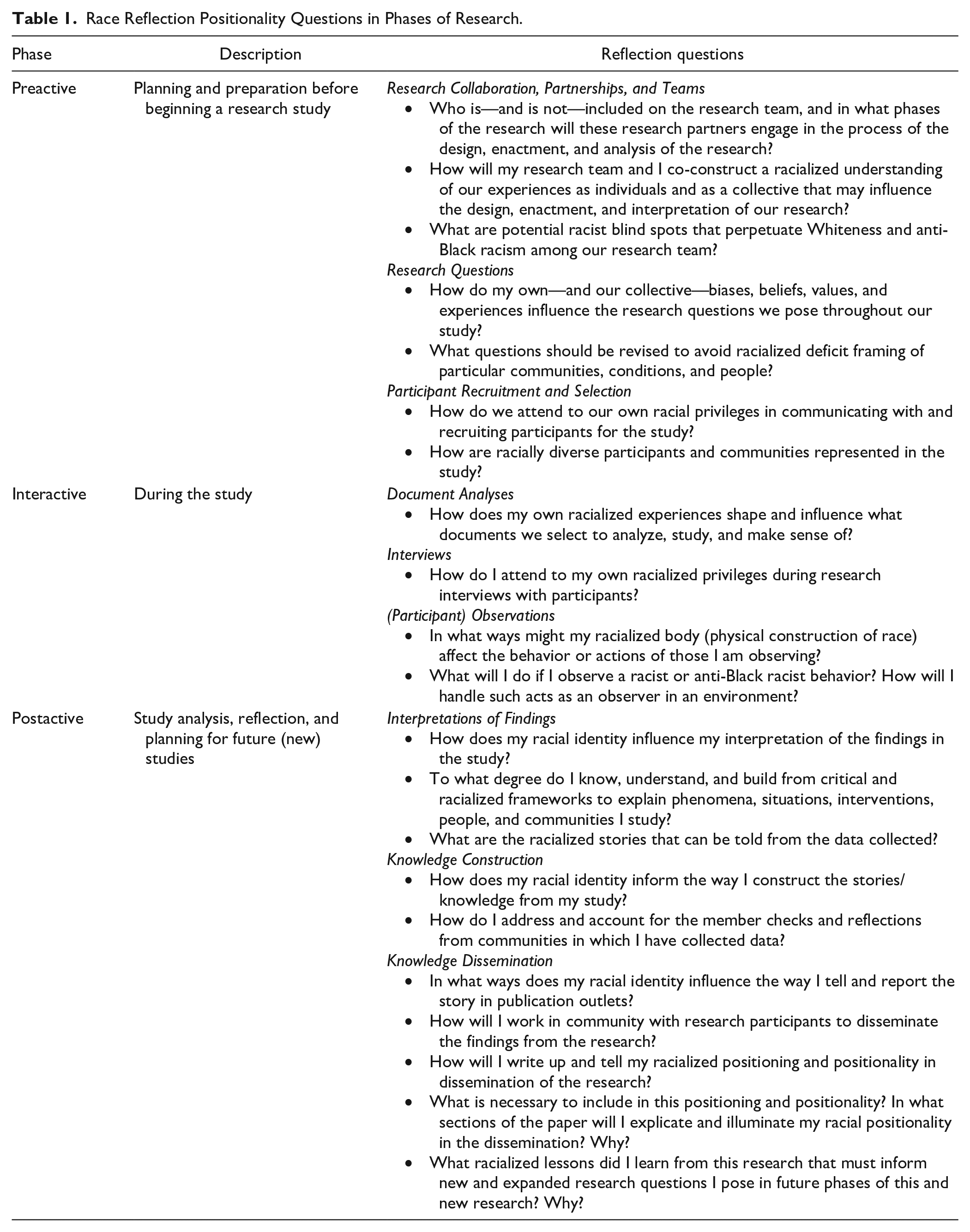
Table 1 highlights exemplar reflection questions presented above that can guide research processes through the preactive, interactive, and postactive phase of inquiry.
Race Reflection Positionality Questions in Phases of Research.
Summary and Conclusion
In this article, we have stressed the need to amplify positionality framing and the necessity to engage in “me-search” in the process and dissemination of research about race. We stress the importance of journal editors requiring and expecting researcher positionality in the reporting of research findings in qualitative research, with implications for quantitative studies as well. We urge “me-[re]searchers” and all researchers to critically examine how their identities affect their research. We stress that a researcher positionality statement or two (Boveda & Annamma, 2023) is insufficient for deep and robust ways in which researchers influence the design (preactive), enactment (interactive), and interpretation and writing up (postactive) of research.
We encourage researcher positionality be seen as a data point within itself—a space where consumers of research can learn from and draw implications based on what positionality of researchers reveals. For researchers engaged in “me-search” and positionality framing, we stress the need for reflection and examination of oneself that asks and answers important questions at the preactive, interactive, and postactive phases of research, such as those questions raised in previous sections of this article. Not only do we support and advocate deep, robust, and ongoing introspection among researchers in empirical studies, we also believe those constructing thought papers, systematic literature reviews, and conceptual arguments should engage in the work of positionality and “me-search.”
Rather than solely critiquing the current state of researcher positionality, where we challenge studies that omit researcher positionality or encourage more than a sentence or two describing positionality, we offer guidance and reflective questions in this article that might aid researchers as a heuristic in the research process to build framing for researcher positionality and concurrently “me-search.” Indeed, we understand that for many researchers, the work of positionality and reflection may seem outside of their repertoire, especially as researchers are too often educated with the fallacy that they must be “objective” beings completely disconnected from the research they conduct and people with whom they study.
To the contrary, we find and argue that we can know and understand more about researcher biases, misconceptions, stereotypes, and problematic worldviews when researcher positionality is made manifest through processes of “me-search.” Boveda and Annamma (2023) shepherded researchers through some essential questions to understanding, exposing, and making sense of power and positioning: What theoretical framing and intellectual foundations will you draw from? What do these theories suggest about ways of knowing? What does that framing say about how power relations are reproduced? What do these theories require of you regarding positioning? How does this theoretical framing account for being in a relationship with others and with those with less power than you? What do these theories say about who is qualified to produce knowledge? How do your theories explicitly address racism, ableism, cisheteropatriarchy, and other oppressions? If your theories do not address or center these oppressions, how will you consider them? (p. 311)
In this article, we highlight three main aspects and phases of the research enterprise—the preactive, interactive, and postactive phases—with reflective questions to examine the ways in which race, racism, and other forms of oppression might influence research design, research enactment, and interpretation and dissemination of research. Unapologetically, this article is a call to action for researchers to develop deeper and more robust positionality and “me-search” in empirical and other analyses. Although our discussion centers race as an essential unit of analysis, we believe engaging in self-reflections of race and positionality is also essential in studies not focused explicitly on race. D. A. Bell (1980) has made it clear that racism will never end. However, although difficult, we know racism can be addressed and disrupted as the status quo of racism and Whiteness persists (Milner, 2023). Ultimately, we hope the work of positionality and “me-search” contributes to collective efforts dedicated to addressing, disrupting, and pursuing projects and agendas to end racism in all its forms.
Footnotes
Declaration of Conflicting Interests
The author(s) declared no potential conflicts of interest with respect to the research, authorship, and/or publication of this article.
Funding
The author(s) received no financial support for the research, authorship, and/or publication of this article.
