




Abstract
Although gaining ethical approval is a conventional and established requirement for academic scholarship, institutional approaches remain subject to sustained critique. While not questioning the legitimacy of institutional ethical procedures, the dominance of legal frameworks and a focus on entry to ‘the field’ is inflexible and irresponsive to ethical complexities in practice. This is particularly evident in situations where participants experience ongoing trauma, marginalisation, and social and political precarity, or settings that we refer to in this paper as ‘fragile contexts’. Responding to such ethical dilemmas, this article draws on Guillemin and Gillam’s (2004) notions of ‘ethics-in-practice’ and ‘ethically important moments’ to examine how doctoral candidates and their supervisors navigate the compliance requirements of institutional ethics vis-à-vis the requirements of ethics-in-practice. Our findings foreground the need to attend to the linguistic and discursive challenges associated with research in fragile contexts, the temporalities of vulnerability, the management of community expectations, and a humbling of researchers and their institutional research ethics committees to avoid compounding injustices and power imbalances.
Keywords
Introduction
Gaining institutional ethical approval (IEA) for undertaking research with human participants is a mandatory milestone for research projects, and particularly high stakes for higher degree by research students (henceforth, HDRs) in the social and health sciences. 1 Such processes necessitate considered articulation of methodological decisions, dialogue with inter/national ethical guidelines, and careful navigation of institutional systems and schedules. Consequently, IEA processes require significant time, patience, and energy from HDRs and supervisors, as well as significant investment and service labour from universities and their staff. These costs, both tangible and intangible, are magnified when the research is conducted in ‘fragile contexts’, or ‘settings where participants have experiences of past or ongoing trauma, marginalisation, and socio-political precarity’ (Burke et al., 2024), such as forced migration, gendered violence, marginalisation by language or cultural isolation.
Despite the requirement for careful reflection on the potential impact of an inquiry on both participants and researchers, IEA processes are subject to sustained critique in the academic literature (e.g. see Van den Hoonaard and Hamilton’s (2016) edited collection) for being overly rigid (Beach and Arrazola, 2019), and too concerned with the university's legal duty of care and prioritising the reduction of potential litigation (Dingwall, 2016). This places human research ethics committees (HRECs) 2 with ultimate power and control within institutions, and arguably without the checks and balances for self-reflection they seek to impose on applicants (Adler and Adler, 2016).
Specifically, there is concern that IEA processes fuel ‘procedural’ approaches to ethics (Guillemin and Gillam, 2004), disproportionately focusing attention on ‘passing the ethics test’ and ‘getting in’ to the field to start data collection. As such, a key critique of IEA processes is that they promote engagement with the paperwork, rather than engaging more holistically and enduringly with an ‘ethics-in-practice’ approach (Fox et al., 2020; Guillemin and Gillam, 2004). Moreover, there are also concerns that designing utilitarian IEA processes fails to recognise the nuance of the circumstances of living in fragile contexts. As Hammersley and Traianou (2014) argue, this represents a missed opportunity for participants from fragile contexts to potentially inform and reframe the application of justice and care in ethical procedures. This would require open-minded HRECs; open to being informed. All these challenges are argued to result in diminished engagement with broader understandings of ethics by HRECs (Fox et al., 2020) and, by implication, for institutional support for HDRs.
This is particularly problematic for HDRs undertaking research in fragile contexts, because the consequences of not being adequately trained to undertake ethical research in complex or fragile contexts can be far-reaching – for participants, researchers, and institutions – with legal, emotional, social, and relational implications. For example, in Butler-Rees and Robinson’s (2020) autoethnographic exploration of their own doctoral research training experiences, Nick reflects, …this training was often very basic and generic … avoiding how we may address the experience of different emotions (such as anxiety, disappointment or disillusionment) during our time in the field … [and] common instances of rejection or feelings of failure during fieldwork are usually covered up or overlooked. (p. 2)
Similarly, Webber and Brunger (2018), researching in issues of sexuality, suggest that risks to researchers should be a matter for university training, and not the purview of the HREC. While the importance of developing ethical awareness and processes of ethical oversight is not in question, we contend that there is a need to consider how HDRs learn to ‘do ethics’ – thinking ethically, feeling confident to make ethical decisions in situ and respond to emergent ethical dilemmas.
This article reports on an Australian study of HDRs and supervisors undertaking research in fragile contexts. We write as a team of researchers who work in the fragile context of forced migration, both as supervisors and as a recent HDR graduate. We draw on interview data to examine how HDRs and their supervisors describe navigating the requirements of IEA, as well as developing ‘ethics in practice’ approaches to respond to ethical dilemmas in the field. We also examine misalignments that students and supervisors perceive regarding the application of care and justice (Hammersley and Traianou, 2014). While our focus is on forced migration, we will argue that similar considerations are applicable to other fragile contexts, such as which include topics such as trauma, mental and physical health, sexuality, violence, and community detention. To this end, two research questions (RQs) frame our inquiry:
How do HDRs and supervisors doing research in fragile contexts such as forced migration view their interactions with institutional ethics committees? In what ways do HDRs and their supervisors navigate emergent ethical dilemmas in the context of researching forced migration?
Methodology
In this article, we draw on data gathered as part of a study focused on HDRs and supervisors’ experiences of navigating IEAs and developing an ethics in practice (EiP) approach to undertaking/supervising research projects in fragile contexts. All our participants were involved in research (as HDRs or supervisors) that included participants with histories of marginalisation and trauma; all our student-participants’ studies were related to forced migration, but supervisors’ research areas also include studies of sexuality, homelessness, and mental and physical well-being.
On gaining HREC approval, we conducted semi-structured interviews with HDRs (n = 8), and supervisors (n = 10) based at 10 different Australian universities. Participants were invited to engage in a semi-structured interview regarding their experiences with procedural ethics and EiP in research in fragile contexts, either as HDRs or as supervisors. All semi-structured interviews were conducted with individual participants, except for one triad of one student (Amber) and two supervisors (Frankie and Delia) who elected to undertake a group interview to allow for shared discussion of their experiences. Table 1 provides an overview of our participants’ fields of research and role (student or supervisor). All names are pseudonyms chosen by the participants or the researchers.
Overview of participants.
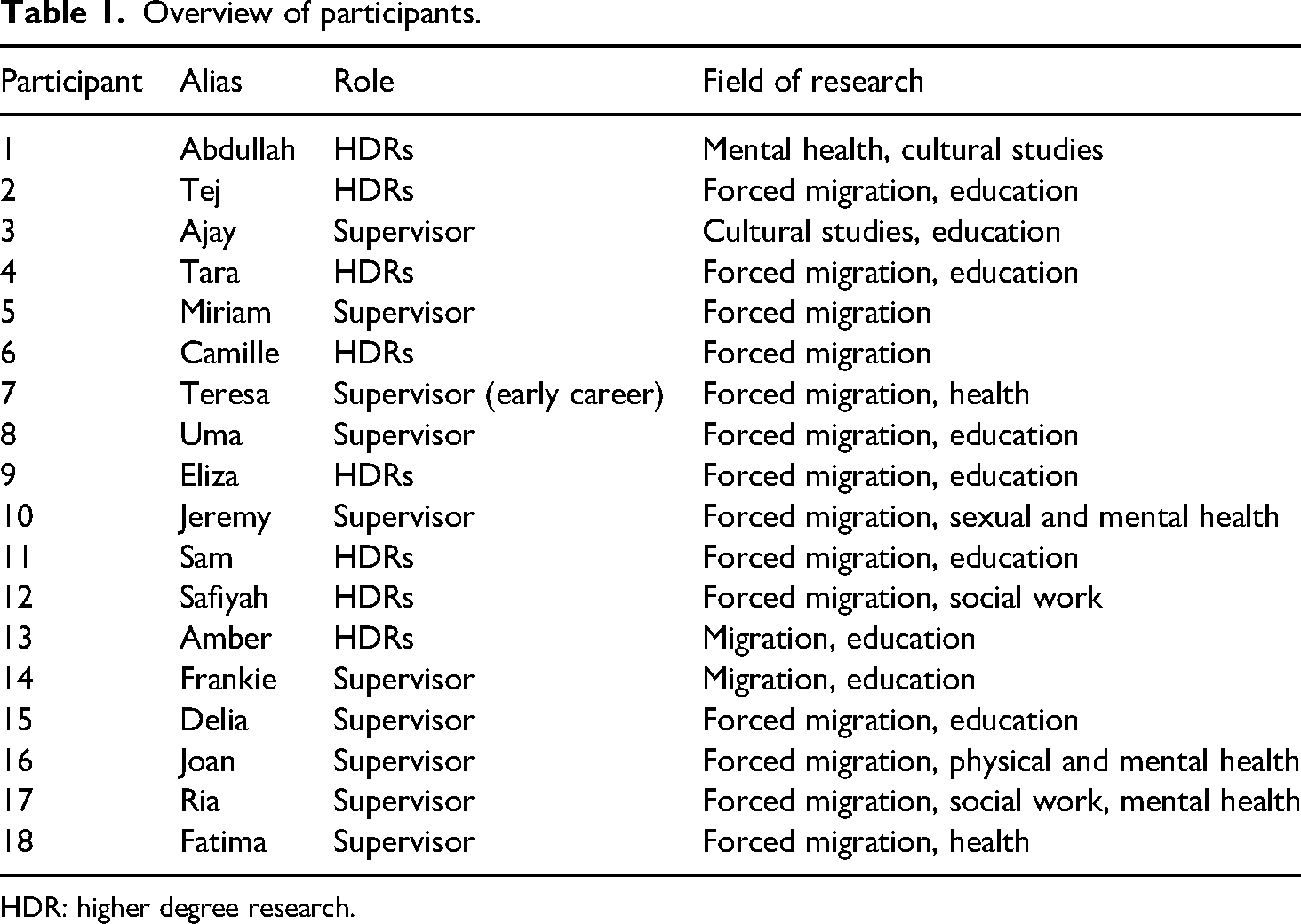
HDR: higher degree research.
In the interviews, we asked participants about their perceptions of ethics, their experiences of engaging with both IEA and EiP, their awareness of supports to assist emerging researchers and supervisors to engage with ethical complexities, and recommendations for providing other research-informed resources to offer greater support. We also asked participants to give an example of an ethical dilemma that they had either experienced themselves, or that their student/s had experienced.
In this article, we have selected three ‘telling cases’ (Mitchell, 1984) to illustrate key ethical dilemmas that students faced in navigating between IEA and EiP in their research experiences. It is important to note the debate that circulates the concept of telling cases and typicality; as Andrews (2017) argues, its legitimacy is weakened by its invisibility in case study methodological discussions, it appears to be exclusively an anglophone concept, and being promoted by a constellation of scholars at a particular institution. All these issues considered, we utilise Mitchell's methodological construct of ‘telling cases’ because they illustrate ‘particular circumstances surrounding a case, [which] serve to make previously obscure theoretical relationships suddenly apparent’ (Mitchell, 1984: 239); as such, they offer important lessons for colleagues, particularly in terms of developing confidence to engage ethically in practice.
Conceptualising research ethics
Procedural ethics
Being largely built on a western-modernist paradigm that values objectivity and predictability, Australian human research ethics guidelines and IEA processes and protocols are predominantly procedural. This presents challenges for researchers who need to work in more fluid and responsive ways (Drake, 2014). Indeed, scholars have argued that tacit positivist, biomedical roots of contemporary human research ethics guidelines have ‘been imposed on qualitative research from outside’ (Guillemin and Gillam, 2004: 268), which can be ‘inappropriate’ (Perry, 2011) for those who work with interpretive research traditions.
While we note these critiques and have experienced the limits of these ontological assumptions with our own research, we also note that IEA policies and processes have evolved to more open and fluid understandings of what needs to be considered for research to be given ethical approval for so-called ‘vulnerable’ groups. For instance, in Australia, clear ethical protections have been implemented to protect First Nations communities from the violence of settler-colonial research practices (Lowitja Institute, n.d). There are clear national guidelines on how to undertake culturally sensitive research with First Nations peoples, which include additional ‘protection’ such as needing to demonstrate that community consultation has taken place, and by having the option of alternative mechanisms. These include completing the ethics process established by Australian Institute of Aboriginal and Torres Strait Islander Studies 3 – instead of standard IEA processes. Additional domain-specific ethical clearance may also be imposed; for example, in New South Wales, health researchers must obtain Aboriginal Health and Medical Research Council 4 approval, and educational researchers need to undertake the State Education Research Applications Process. 5
These cohort-specific amendments to standard IEA processes demonstrate that if there is significant political currency and leadership, alternative ethics processes could be designed for other ‘vulnerable’ groups. However, these are still characterised by procedural approaches, with the focus predominantly on securing pre-fieldwork approval, rather than the ongoing, habitual approach of ethics in practice.
Ethics in practice
In contrast to the planning focus of procedural ethics, Guillemin and Gillam (2004) propose the notion of EiP, which conceives ethics as part of everyday, habitual research practices, or what Darling (2014: 203) calls ‘situated judgements’. Rather than being oppositional to procedural ethics, EiP builds on the planning and prediction of IEA, foregrounding the everyday engagement with micro-ethics (Doná, 2007) that constitute research activities (such as fieldwork, developing and sustaining relationships, disseminating findings). An EiP extension of procedural ethics recognises the importance of planning in the pre-data collection phase to prefigure a smooth transition to ‘the end’; however, it also pays careful attention to what happens during and after fieldwork (Krause, 2017). This involves researcher engagement with micro-ethics (Doná, 2007), which refers to the everyday, individual-level responses to emergent ethical dilemmas. EiP therefore rests on the researcher's ability and readiness ‘to reflexively explore ethically important moments, what they tell about the appropriateness of procedural ethics, the role of the researcher in the research site and in relation to research participants’ (Tomkinson, 2015: 8).
Ethical reflexivity is therefore an important component of EiP with researchers expected to remain vigilant to power and status dynamics, to create conditions that permit flexibility and looseness to the research design and permit responses in situ to ethical dilemmas that emerge through the course of research. However, as our research shows, shifting to acknowledgement of differential and flexible ethical processes and taking an EiP approach to entering, remaining in, and leaving the field is unsettling and requires support, especially for HDRs.
Temporal distinctions and influences
These two conceptual distinctions have significant temporalities and agency. Procedural ethics has a narrow temporal range, with IEA viewed as an activity concerned with predicting and planning, restricted to the period pre-data collection and mostly in the future tense. There are also minimally demanding annual monitoring requirements, requiring a once-a-year update on whether a project is ongoing or completed. Procedural ethics is marked by the rhythms of the protocols and deadlines of the institution (operationalised by an HREC), with the bulk of responsibility front-loaded into the early stages of research (before data collection begins). In contrast, ethics in practice offers a conceptualisation of ethical behaviour as responding to ongoing ‘ethical dilemmas’, which require immediate ethical decision-making (or noticing ‘ethically important moments’; Guillemin and Gillam, 2004: 265) across the life-course of a project (and beyond). As a more holistic take on ethics, which is primarily focused on practices and relationships, this expansive temporality extends beyond planning to conduct and reflect on data collection/engagement with participants and includes maintaining relationships with/representation of participants after the ‘final report’ has been published.
The tempo of research, in terms of funding and deadlines, also creates challenges and delays that complicate ethical engagement. For instance, research conducted in the context of Aboriginal and Torres Strait Islander peoples and communities require negotiation and careful processes and considerations. Depending on researcher positionality and the conditions of research, the necessary processes, including engagements and relationships, entail a significant amount of time (see, e.g. Kwaymullina, 2016). Consequently, this poses challenges to the completion of projects with quick turnaround, which can require a research output within one calendar year of funding being allocated. If a project is tied down in protracted ethical approval processes, it becomes less feasible under such conditions and researchers may eventually lose appetite to conduct research in such contexts.
However, diminishing the ethical protections is not the answer to resolving such delays. Fox and Busher (2022) suggests two options for revising IEA processes. Firstly, streamlining ethics committee processes, so that the same level of robust checks can be made faster, or offering multi-stage approvals which recognises the need for negotiation through dialogue between researchers and those in their research context (through community boards where they exist; Fox and Busher, 2022). The latter expects amendments to come through the HREC as learning informs ethical practice, rather than seeing revisions as in-field firefighting. Secondly, the resulting recommended protocols and practices being brought back to inform researchers, their supervisors and ultimately the IRBs (Fox and Busher, 2022).
Where does the conversation about ethical research in fragile contexts stand? There is a growing line of scholarly engagement with ethics in fragile contexts, particularly around the tenets of justice and fairness, which are key to the conceptual basis and enactment of human research ethics. At a basic level, this requires researchers to ensure that all participants are treated fairly, and which builds in thinking about how to recognise the knowledge and values in the voice of others. In these ways epistemic justice needs to be embedded in all stages of research. For people from forced migration backgrounds, language barriers to participation can be responded to by providing instructions and information in their first language, by using interpreters and cultural mediators. However, for much more profound issues of inequity – such as violations of human rights they may have experienced/may be experiencing, or their subordinate positioning in neoliberal, hyper-competitive systems, and societies – researchers must be prepared to challenge normative expectations and tread even more carefully. This might mean being prepared to circumvent the usual gatekeepers, by finding alternative supporters of the intended participants and challenging their advice about which participants would represent the community (Jack, 2017).
Shifting towards a shared commitment to the EiP approach is particularly important when researching with – and critically not on – people experiencing fragility. This means privileging co-creation and co-production in research designs, a feature in Indigenous research, and challenging hierarchical power relationships between researcher and participants, entrenched in traditional research approaches. For example, Halilovich (2013), writing about researching forced migration, reminds us that research with communities like refugees ‘can never be apolitical or “objectively neutral”’ (p. 131), and we contend that this point needs to be extended to all ethical and empirical concerns. However, we also acknowledge that researching forced migration can be entangled with broader political advocacy work, which should also be reflexively addressed by researchers in their research design and delivery (Shultz and Kajner, 2013). When people experience fragility, researchers need to be mindful of the complex intersection of assumptions that can expose them to harm. These include beliefs that there is an inherent and shared value in doing research, an understanding that consent given once is sufficient, a belief that people's lives are stable enough for continued participation, and a lack of awareness of how some methods may trigger past injustices and human rights violations.
Researchers conducting research in regions of protracted armed conflict compounding poverty and vulnerability to violence such as the Lake Chad region (central Africa; Ebubedike et al., 2023) call for sensitivity to historic past experiences in fragile contexts. This sensitivity means researchers need to be cognisant of the possible traumas they could trigger through insensitive questioning, or through probing participants’ pasts, and for refugees, asking questions of their journeys to exile. BenEzer and Zetter (2014) argue that although interviewing can offer therapeutic benefits, in the right dynamics, the utmost caution must be taken: As researchers, we should be aware that our interviewee has to navigate between painful memories and thresholds of memory which they cannot be sure how to cross, and which we are unlikely to have experienced ourselves. Thus, great sensitivity is needed. (p. 314)
Findings of the study
We engaged in iterative, reflexive thematic analysis (Braun and Clarke, 2019). We, the authors, are all closely involved in our topic of inquiry; Sally and Rachel are experienced researchers and supervisors in the field of languages education, often engaging with issues related to education and forced migration/resettlement. Bonita is an early career researcher who undertook her doctoral studies on the schooling experiences of students from intensely diverse cultural and linguistic backgrounds. Alison brings experience of supporting research across disciplines and contexts both as experienced doctoral supervisor and as chair of an institutional HREC. Tebeje is a researcher in educational equity and forced migration and supervises HDRs investigating refugee education. Our experiences – as supervisors and HDRs, researchers, and educators in higher education – are highly pertinent to our (a) construction of the project; (b) our co-construction of interview data through data collection; and (c) analysis of our participants’ voices. In reflexively considering our own positionalities and experiences, we strengthened our iterative engagement with our data, which in turn helped to challenge our assumptions and recognise the different perspectives, values, and agendas of others.
Moreover, as this study sits firmly within the interpretive socio-constructivist paradigm, we make no claims to generalisability of our findings. Instead, using analytical induction in keeping with the use of ‘telling cases’ (Mitchell, 1984) we point to salient experiences that amplify the patterns and stories within the data, supporting the relating of these to our own research experiences. While we acknowledge the critique levelled at the notion of telling cases, we follow Andrews’ (2017) contention that in focusing on generative richness as opposed to typicality, the ‘quality of the analysis and the clarity of the narration … shifts responsibility for generalisation from the researcher to the reader’ (p. 458). We focus on selecting cases that can generate deep insights into IEA and EIP with respect to research in fragile contexts.
RQ 1: How do HDRs and supervisors experience IEA processes?
Researchers can also be categorised as vulnerable, particularly new researchers (Clay and Treharne, 2022), and especially when researching in fragile contexts. Many scholars recognise this vulnerability as situated (Baker et al., 2023; Shaw et al., 2020; Stahlke, 2018), resulting from challenges such as complex negotiation of power imbalances and a sense of responsibility to participants, and supervisor to student (Clay and Treharne, 2022), emotional labour (Shaw et al., 2020), and IEA assumptions about ‘researcher safety’ (Stahlke, 2018). What is needed are the tools, spaces, and guidance for empowerment.
We asked our participants about their perceptions and experiences of engaging with ethics as part of their studies or supervision. There was an overwhelming pattern of critique of procedural ethics. For some student-participants, IEA processes created an acute anxiety. For example, Safiyah (HDR, Social Work) explains her reactions to ethics: Safiyah: … I’m quite critical of procedural ethics. I don’t think that benefited me at all. I just feel really anxious. I’m constantly worried someone's gonna come and, like, audit me and be, like, “You didn’t do things exactly the way you said you were gonna do them.” I was, like, “I know.” [Laughs] It was 3 years ago that I wrote that ethics thing, things have changed.
Safiyah's anxiety is described in terms of the surveillance she anticipates: what happens if she doesn’t do things as she promises? Will she get in trouble for responding ethically in situ? This was also true for Sam (HDR, Education), who described her fear of ‘doing the wrong thing’ with participant recruitment: Sam: … it's like I’m expected to know exactly how people are going to react or what they’re going to do. And, I’m at this point still, because I’m a new researcher where I’m, like, what if I don’t follow process? Am I gonna get in trouble…? I remember [the HREC] were, like, “you can’t speak to participants through social media, it has to be through e-mail”. And I’m like, “well, okay, that's fine”. And then I e-mail [potential participants], and they don’t respond. And they message me on social media because that's what they want to do … and I’m like, “do I do that?” I don’t want my research to be ripped out from under me because they messaged me on social media, even though I’m, like, can you please e-mail me.
These perceived risks, culminating in the fear that a research project will be found invalid for contravening the HREC's decision, arguably stymie the development of EiP approaches. Camille (HDR, Forced Migration) described a similar sense of pressure when she reported asking herself ‘Who's watching? You know, who's there on the ground?’ However, as her research progressed, she realised that no one is actively watching or scrutinising her ‘performance’ as a researcher, realising that monitoring of her progress was restricted to an annual ‘tick a box’ activity that generated no additional discussion, nor identified any new training needs. This reality threw the utility of the surveillance exercise into sharp relief and helped Camille to relax a little about her perceptions of the HREC as having a punitive function. At the same time, Camille commented that the lack of oversight regarding everyday ethical practices in the field was concerning.
Not only do IEA processes create inhibiting affective conditions, but this anxiety is also unhelpful; as Safiyah described, the ethical dilemmas she predicted were not the ones she faced. Similarly, Tej (HDR, Education) also noted this inefficiency in the IEA process: Tej: The comments, the content of the ethics applications, all those things, not really helpful to me, because the issues [I faced in the fieldwork] were not anticipated in the ethics application.
Our student-participants identified the importance of engaging with ethics throughout the entire project, not simply at the start when HREC approval is gained. This disconnect between what is written as part of IEA processes before entering the field, and what actually happens once in and then on leaving the field, was a strong theme of contention, and exposed the partial, future-focused purview of HREC activities.
There is an established argument for more proactive guidance during graduate or even undergraduate training, or the establishment of more formalised support structures, typically framed as relevant methodological training (Butler-Rees and Robinson, 2020) or occupational health and safety (Dickson-Swift et al., 2008). Although HDR training is a core part of doctoral programmes, this is not necessarily fit-for-purpose for developing an EiP approach for research in fragile contexts (Grady, 2014). Moreover, we make the case that this nuanced training should extend to supervisors (Butler-Rees and Robinson, 2020) because, as Ratnam (2019) notes, this can involve ‘listening to sensitive stories and dealing with my own emotions and my participants’ well-being is regularly discussed’ (p. 23). Supervisor-participants spoke of their affective challenges with engaging with IEA processes when supporting doctoral candidates who are undertaking doctoral projects involving fragile contexts. Their commentary largely focused on the specific challenges generated by lack of HREC experience and hence understandings of fragile contexts; as Ria (supervisor, physical and mental health) described, ‘Honestly, if you went to my ethics board and said to them something about fragile contexts, I don’t even think they would know what you meant’.
While we acknowledge that specific language choices (fragile, sensitive, vulnerable) can interpolate differently depending on audience and context, our supervisor-participants expressed a strong sense that HRECs had limited understanding of their areas of research, which translated into questionable and demoralising decisions that were demonstrated as be particularly disheartening for HDR candidates who were learning to navigate micro-ethical complexities of research. As Ria explains, ‘it's a minefield, and it's a pain in the neck. Yeah, I mean, look, I don’t want you to think that I’m really against the ethics process, because I’m not … [but] there's this kind of lack of understanding at their end that it just makes it really hard for researchers, and for the students that you’re supervising’. Jeremy (supervisor, sexual health) gave an example of this from his experience of supervising research with transgender people: Jeremy: Being told by a committee of cisgender people that what they're doing isn't safe and isn't fully considered is deflating … it tempers students’ enthusiasm and I think is somewhat offensive.
Other supervisors noted how the anxiety caused by the legalistic-surveillance model of IEA processes, and limited, if any, nuanced attention to the specifics of fragility, are exacerbated by the ways that HRECs are perceived to operate. For instance, Joan (supervisor, physical and mental health) lamented how her students ‘really feel like the ethics office is often unapproachable’, with their anxiety enhanced by ‘having to fill in a form and then you get feedback, and then you send it back off again and then you get a yes or a no’, as opposed to making a phone call and discussing in person. Jeremy (supervisor, sexual health) described the process of engaging with HREC processes as ‘burdensome’, adding ‘I feel like I have a fairly meagre research allocation and I feel like I spend the large majority of my research allocation dealing with ethics committees’. PhD supervision is often a significant part of an academic's workload, and ethics-related work – producing or supervising the production of documentation, engaging with HREC feedback, and associated administration – represents a significant commitment that arguably impedes the time and space to discuss, design, develop, and evaluate EiP approaches once ‘in the field’.
Our analysis above offers a critical view of how students and supervisors described their engagement with IEA processes; however, some participants also spoke positively about ethics and their HREC. For example, Teresa (early-career supervisor, health), described how attending a training session on ethics changed her perception of IEA processes: Teresa: The ethics training that I had was … actually debunking something that, as a new researcher, I'd heard a lot as well around the corridors. So that workshop, I think, they were aware of that, and it was very much about, you know, these are the reasons we have the ethics process, you know, we're here to support you when anything's difficult, you know, it's a liability thing as well, like, it's useful for you to have us approving your research and those kinds of things.
Teresa's recounting of her experience at the HREC workshop illustrates the importance of opportunities to engage with the core values/intentions of procedural ethics processes – rather than exclusively focusing on the functional elements such as required documentation and digital platforms for submission. This shows how there is potential for procedural ethics to support, rather than always acting as barriers to EiP.
RQ 2: Navigating emergent ethical dilemmas
To explore the dilemmas encountered from the field and how these may inform the approaches to ethics-in-practice, we draw from the narratives of two HDRs and one supervisor as ‘telling cases’, described earlier as episodes or events that are illustrative of the need to further deliberate on ethically engaging practices in fragile contexts. Through the cases of Camille (forced migration), Ria (supervisor, physical and mental health), and Sam (education), we examine three themes – relating to linguistic complexities, temporalities of vulnerability, and community expectation management – to highlight the different ways that HDRs (and their supervisors) navigate IEA processes and work towards ethics-in-practice approaches.
Camille and the linguistic complexities of gaining participant consent and using interpreters
Obtaining informed consent is the most common form of preventative action against harm. However, as others have noted, what counts as informed consent differs when assumptions cannot be made about a person's cultural understanding and/or language proficiency, and the ‘voluntariness’ of informed consent thus becomes ‘impaired’ (Drake, 2014; Halilovich, 2013; Hugman et al., 2011a; Mackenzie et al., 2007). An issue foregrounded in the literature is the static nature of informed consent according to procedural ethical approaches. Rather than collecting a signature before data collection starts, filing the form, and moving on, Hugman et al. (2011b) argue for the practice of ‘ongoing consent’ – similar to Mackenzie et al.’s (2007) notion of ‘iterative consent’ – underpinned by a notion of ‘relational autonomy’, which ‘enables researchers to think in more subtle ways about their obligations’ and strongly aligns with an ethics of care approach (p. 1280). Ongoing consent recognises the dynamic nature of participation and acknowledges the ongoing relationship between researcher and participant beyond the direct contact of the data collection process.
However, issues are encountered in articulating and gaining ongoing participant consent. A key challenge is created by linguistic assumptions inherent in IEA processes. Camille's dilemma, which she faced while undertaking her doctoral research with a small community of refugees in an Australian urban setting, highlights the complexities of navigating consent protocols while working with non-English/ pre-literate participants. She needed to find a way to gain consent (including the completion of ethical paperwork) with people who were unfamiliar with English language, who had variable literacy, and who were wary of official paperwork. In particular, the challenges were not just in translating the literal participant information statement and consent form, but also in transmitting culturally appropriate, context-specific translations of what research means, and what is involved: Camille: But it really, you know, it's (the procedural ethics form is) very generic, it doesn’t really ask about anything specific to non-English participants or anything like that. And so, you have to make sure you’ve included that.
In Camille's case, gaining ongoing consent was complicated by her participants’ print literacy levels, meaning that Camille had to talk though the process, which she perceived as having resulted in a ‘loss’ of key information. Camille's reflections also highlight that, in addition to literacy-related issues, the process of gaining informed consent relies on shared cultural understandings about what is meant by research participation. This reinforces the importance of consultation and community involvement in research design, and, when possible, recruitment and engagement in the field. Moreover, Camille's narratives support the argument that consent needs to be continuous rather than limited to filling out consent forms at the beginning of the research project (see also Burke et al., 2024). This is particularly crucial for fragile contexts like forced migration, where linguistic barriers are often encountered between researchers and participants, and thus, the need to enlist interpreters or translators who are not specifically bound by the researcher-participant confidentiality. An example can be gleaned in Camille's narratives below illustrating the problem of maintaining participant confidentiality when interpreters mediated the interviewers or conversations: Camille: Because it's a small community, a lot of the interpreters aren’t trusted because they, you know, talk and they don’t maintain confidentiality. … you want to tell the researcher, you don’t want to tell the interpreter as well, so it's a barrier…
For Camille, issues arose with notions of confidentiality and assuring her participants, who she also counted as friends after a long-term engagement with the community, that their contributions would not be shared more widely: Camille: One thing I did to get around that was to make sure that I really stressed the non-participant confidentiality agreement in the interview context, or in the focus group context, and really stress, and actually, do it in front of them, and stress that this means you are not to talk about this interview with anyone else, none of the content, you know, don’t even tell anyone that this interview existed…
Evidently, the consent procedure positions languages other than English (LOTE) participants in deficit (McMillan, 2020), reproducing this in practice through silence and ignoring linguistic and cultural pluralism. These challenges cannot be ‘solved’ by employing interpreters; in many ways, this further complicates consent processes, and opens other anxieties for participants and researchers.
Standard IEA procedures tacitly assume uniformity and singularity in their treatment of attaining participant consent. Perry (2011) highlights the need for HRECs to be informed and proactively attend to the problematics of language use in researching in linguistically diverse contexts. As it stands, the burden to consider languages sits squarely with the researcher and, in the case of HDRs, assumes that students have supervisors who have experience of research in plurilingual contexts. Perry (2011) emphasises language proficiency is not a dichotomy but a continuum, and there is therefore, a need to develop a more nuanced language of description for linguistically diverse populations (ensuring that those who speak LOTEs are not positioned as incapable or excluded because of their language background).
Ria and the temporalities of ‘vulnerability’
Whilst the concept of vulnerability is often attached to those living in fragile contexts or with circumstances that indicate relative precarity, there is a need to recognise the temporal dimensions of this concept. As elaborated earlier, there are complexities involved in working with those often labelled as ‘vulnerable’ groups or individuals, and attention is needed in terms of the diverse and complex nature of their needs (Bracken-Roche et al., 2017; Perry, 2011). In the context of research, these include, among others, ethically attending to the gaps between researchers’ and participants’ lives (e.g. values, languages, cultural practices, living arrangements, visa status), and more importantly, addressing researchers’ own biases about other contexts, cultures, and languages.
Building on these arguments, narratives from Ria, an academic whose research and advocacy focus on refugee-background youth and social and cultural inclusion in resettlement, illustrate an additional conundrum to this issue on vulnerability that speaks to the tensions related to participants’ positionality: Ria: [HRECs] are very big … on the idea of vulnerability … particularly a lot of the feedback on my ethics applications are always about this idea of vulnerable … And I just always write back to them and kind of say things like, no, refugees aren’t vulnerable. I mean, for a start, to be a refugee is an experience, it's not an identity, and it's the same with vulnerability. You’re not, you know, to be vulnerable is not an identity, you are experiencing vulnerability, that's quite a different thing. …
Ria's contentions above highlight the temporal nature of the concept of ‘vulnerability’. Arguably, as Ria asserts, these individuals have experienced vulnerable moments, but these do not define their identities. Vulnerability, therefore, needs to be understood as an experience rather than a marker of difference. Having a temporal lens can help to address the reductive, limiting, and often discriminatory frameworks and processes towards individuals who have experienced challenging circumstances and conditions. Ria went on to argue how a more expansive view of fragile contexts should inform participants’ positionality: Ria: And I’m just kind of saying, “Well, you know, maybe you should be rethinking that, because, you know, these people have walked across four countries, and they’ve managed to get Australia and they’re building lives here. And yes, they are experiencing vulnerability at different points in their life, but they also have great agency, they also have great resilience”.
Ria's perspective here captures a strengths-based approach to understanding vulnerability as a temporary state, rather than a condition that essentialises fleeting experiences into longer-term categories. This nuanced view of vulnerability and its attendant temporality is rarely considered in IEA processes, perhaps because the focus is on pre-entry/access to ‘the field’, which marginalises (if not ignores) ‘being in’ and ‘leaving’ the field. As we have previously discussed (Burke et al., 2024; Fox et al., 2020; Fox and Busher, 2022), inadequate attention to the durational aspects of field work leaves researchers without the ethical tools needed to make longer-term decisions and respond to dilemmas when they arise and opens researchers to harmful practices (Baker et al., 2023).
Likewise, well-intentioned yet narrowly defined notions of vulnerability can restrict the potential for participants to take up more agentic roles within research in fragile contexts. As Ria described, HREC requirements that participants be deidentified in the dissemination of project findings can limit possibilities for voice, particularly for those who ‘see participating in research as a bit of a political act’. While due care to ensure participants make informed decisions about their representation in project findings is essential, universal protocols that prevent participant identification can imply paternalistic judgements about individuals’ capacity to determine associated risks.
Sam and the ‘management’ of community expectations
To minimise risk, adhering to institutional codes of ethics is a key part of an institution's duty of care, protecting all parties from harm (and litigation). However, this adherence can also inhibit meaningful engagement with communities, and can thus impair researchers’ capacity to undertake fieldwork, and to create impactful research. We must ask, ‘whether our fear of doing something wrong limits our opportunities to do good’ (Bannister, 2018: 37). Ongoing ethics mentorship is important because prescriptive procedural ethics cannot fully anticipate situational ethical dilemmas that HDRs might face in the fieldwork. For instance, while it may seem intuitive to think that a researcher with prior experiences and networks in the research setting will have an easier path towards recruitment, this is not always the case. This is illustrated by Sam, an HDR who had prior work experience in a refugee detention area, and was recruiting for participants in a community she had long been involved in. After distributing a general invitation via the channels approved by the HREC, Sam encountered an unforeseen complexity that impacted an established relationship. Sam: So, I know her, and I had a message from (a community member) saying how hurt she was that she got a message from someone else about my research, and that I hadn’t asked her directly, and it was really rude and would have been a lot nicer if I’d spoken to her and she felt kind of used, because hearing it from a third party.
Sam sought to repair the relationship by immediately writing to apologise, acknowledge the community member's perspective, and admit to not having considered the possibility that indirect recruitment – an expected research protocol for the HREC – might be offensive to her existing contacts. Sam: And I said maybe I should have actually told you first with my other hat on as friends that this is what I'm doing, and this is the process. She knew that I was doing research, but I suppose that's why she was shocked, too, because she knew about it, and she thought that obviously I would talk to her about it.
While ultimately Sam was able to salvage the relationship, this example suggests how, to follow HREC protocols, engagement with community members may be impacted negatively. Whilst being an ‘outsider’ in the field is challenging and needs mediation from a ‘cultural broker’, being an ‘insider’ and having existing networks may require a more relational approach guided by situated judgements which exceed procedural models of ethics.
Our findings underscore the importance of rethinking vulnerability. A theme that cuts across the scholarship on ethics in fragile research is the question of how to anticipate, assess and respond to conditions of ‘vulnerability’ that may occur during the research project. While it is important to remain mindful that some situations create a higher risk of harm, and thus features strongly as discourse in IEA guidelines and processes, vulnerability is rarely defined (Bracken-Roche et al., 2017; Perry, 2011); instead, there is an implicit suggestion of ‘an inability to provide free and informed consent’ (Bracken-Roche et al., 2017: 16). Thinking about vulnerability has moved beyond medical terms to sociohistorical context, albeit still based on p/maternalistic assumptions of protection that disempower participants by denying their autonomy and agency. From this perspective, all participants have the potential to be vulnerable not just those who belong a priori categories such as pregnant women, children, and prisoners (Perry, 2011: 901).
Moreover, without careful, situated consideration of the concept, vulnerability often gets applied to groups, rather than recognising the intersecting factors and contexts that create vulnerable circumstances, which therefore essentialises particular groups (such as refugees, survivors of abuse, disaster, illness; see Bracken-Roche et al., 2017; Doná, 2007; Perry, 2011). It is in these circumstances where individuals or family groups find they have insufficient resources to access their entitlements as human citizens and, in the most unstable environments, their livelihoods are affected by multiple structural factors further limiting these resources and hence their resilience (Ribot, 2017). As Smith and Waite (2019) elaborated, the lack of careful examination of the concept of vulnerability, or who are considered as ‘vulnerable’, can facilitate policy frameworks and implementation used to distinguish categories or hierarchies of participants that overlook individual differences in lived experiences and ultimately lead to inequitable access to government supports and resources. Such deficit, reductive thinking also ignores the temporality of vulnerability, which is perhaps better understood as a temporary rather than permanent state; or, as Perry (2011: 906) argues, ‘not a characteristic inherent … but is rather an interaction between the participant's characteristics and the nature of the study’ (p. 909). For Block et al. (2012), this highlights the need for ethical reflexivity with taken-for-granted notions such as vulnerability because ‘when researchers and research participants have disparate lifeworlds … the most disempowered participants are the most vulnerable to being subjected to symbolic violence through research’ (p. 71). One such form of symbolic violence is the erosion of autonomy and agency (to give informed consent, to co-design) through deficit-laden, p/maternalistic assumptions.
In the context of forced migration, for example, these notions of vulnerability are particularly prevalent in research emanating from the Global North with Global South communities (Behnam and Crabtree, 2019). These imbalances sit within a wider landscape of funded ‘aid’ flowing from the North to the South, using ‘vulnerability’ in the South to justify ‘Western interference and intervention’ from what was once termed ‘development’ towards what is more recently known as ‘relief’ (Bankoff, 2001). This colonial stance is compounded by cultural and linguistic biases. In Perry’s (2011) exploration of where refugees feature in IEA processes in 32 North American universities, she found no university identified refugees as a vulnerable population. This, Perry argues, illustrates how IEA checklists are insufficient; working from the idea that all human participants are potentially vulnerable, she argues for better description of all potential participants, the types of existing or potential situational vulnerability, and researchers’ strategies ‘to address and mitigate those potential vulnerabilities’ (p. 909).
Other fragile contexts may need to grapple with different sets of circumstances that create situational vulnerability, such as emotional sensitivities when discussing domestic or sexual violence, or trauma responses from disaster survivors. While we do not wish to homogenise vulnerabilities across fragile contexts, we do see common challenges when designing and delivering research projects in such settings. The implication is that, as we discuss below, research institutions should acknowledge the diverse unique vulnerabilities present in fragile contexts and support research students and supervisors to navigate the demands of ethics-in-practice with care and sensitivity, without inadvertently compounding marginalisation and vulnerability, and considering the vulnerability of entering these contexts as early career researcher.
Towards a decolonial approach to EiP
In this paper, we have presented telling cases derived from speaking to colleagues working in the fragile context of forced migration, where participants may be (erroneously) classified as ‘vulnerable’, and whose treatment at the hands of the authorities may have left them with an understandable distrust of the bureaucracies and official procedures. There is a need to illuminate the complex intersections of factors affecting the access of others to their entitlements and access to livelihoods, and qualitative case studies are considered the evidence base needed to inform future directions (Ribot, 2017), in this case for researcher support. This should include acceptance of the injustices enacted by the Global North on these unstable Global South contexts through, first, labelling of these contexts as ‘vulnerable’ and then using this as an invitation to ‘relieve’ the situations, without acknowledging their roles in the geopolitical creation of such ‘fragility’ (Bankoff, 2001).
As privileged researchers working in Australian higher education, there are many lessons here for researchers entering and working in such contexts. We have highlighted significant misalignments between standardised IEA processes and emergent or ‘fragile’ ethical issues, which corresponds with accounts in the scholarly literature of researching in fragile contexts (Fox et al., 2020). Our data suggest that operating within normative IEA frames creates acute challenges for HDRs and their supervisors working in forced migration, creating situational dilemmas that require researchers to carefully navigate between what they promise to the HREC, and what needs to happen as an EiP response in the field. The anxiety that our participants describe regarding gaining IEA and avoiding ‘getting into trouble’ if they fail to predict all the microethical challenges of engaging with other humans create significant blocks to the development of confidence to enact EiP approaches. What they need are open-minded and supportive HRECs which invite dialogue (Mustajoki and Mustajoki, 2017), which offer a mentoring approach to build capacity building and confidence in early career researchers, whilst also offering opportunities for mutual learning for the HRECs about appropriate research approaches to contexts which they might not previously have experienced themselves (Fox and Busher, 2022). This humbling of HRECs is needed as part of the decolonisation of the work of universities.
Moreover, the significant workload and time spent on IEA stymies supervisors’ capacity to help students develop EiP, although these workload pressures arguably ease when ethical approval has been granted. This highlights a key need for time and space to be dedicated to developing ethical training for research in fragile contexts, including field-specific (but non-identifiable) microethical experiences and dilemmas to offer worked examples for new researchers (whether students or supervisors who are new to a research area). Irrespective of career stage, there is an ethical lesson to learn; indeed, if researchers pretend to have all the answers, we potentially will do more harm.
The ethical tenet of non-maleficence (or ‘do no harm’) is particularly significant with research communities who have experiences of past or ongoing trauma, marginalisation, and socio-political precarity. However, the notion of ‘harm’ needs to be examined. Some of the risks that exist in fragile contexts are removed once a person changes their circumstances (being resettled, seeking aid, engaging with the authorities, once a disaster has ended) and previous anxieties are mitigated. However, other risks remain, such as engagement with high status bureaucracy (such as with government agencies, welfare organisations, and the immigration system). As such, notions of ‘harm’ that might be applied to other populations need some reframing in fragile contexts. Harm can be extended to seemingly benign practices, such as completing a form or being asked to speak with an unknown (powerful) researcher in an unfamiliar room. These practices can trigger prior trauma and can thus impact on the data collected. We argue that researchers working in fragile contexts need to do a better job of considering the peripheral harm that can come from institutions, human research ethics committees, and colleagues applying ethical practices without considering the power dynamics and particularities of fragile contexts.
A key consideration for researchers working in fragile contexts is to balance the benefits for participation to be an emancipatory engagement, as well as a risky activity. It is therefore important to unpack assumptions that researchers may hold about participants’ familiarity with research processes, and make sure the implications are clearly outlined. This does not mean adopting p/maternalistic and/or protectionist approaches; as Drake (2014) reminds us, we need to ‘promote access and acknowledge the context of participants’ lived experience’ (p. 314) – especially when people have previously experienced coercion. This reminds us of Hugman et al.’s (2011a) advocacy for iterative and collective processes of informed consent, but only if researchers are committed to sharing control and strengthening participant autonomy. These represent significant shifts in researchers’ conceptions of research legitimacy, their own autonomy (or academic freedom), and their identity as the principal knower and decision-maker. They also require researchers to become comfortable with the (destabilising) discomfort of engaging in ‘messy’ research (Askins, 2009) that does not conform to the reassuring prescriptions of a procedural ethics approach. These are unsettling changes, and thus require time and resources for the academy to adapt its practices.
The participant experiences discussed in this paper illustrate the clear need for an epistemological shift to a collective conception of decision-making shaped by the individual's social contexts – family ties, community obligations, and so forth. As a proposition, this challenges the existing ethical orthodoxy regarding the management of ethical risk. Such an approach may allow for more flexibility in terms of research protocols and greater input from community representatives.
This paper has shown that to support HDRs (and indeed all researchers, particularly in fragile contexts), dialogue needs to take place both with and in the ethical review boards and with and in the field (Dennis, 2019). The key contribution to this conceptualisation of the relative roles of institution and field researcher is the foregrounding of ethics-in-practice, previously conceptualised by Dennis (2019) as ‘open’ and ‘responsive in situ’.
We need to respect differences in the characteristics of the two spheres of ethical review and action: one procedural and strategic, and one in-practice and responsive. We approached this article as a provocation; the start of a dialogue with interdisciplinary colleagues across Australia and beyond, with a view to encouraging discussion and exchange of ideas and experiences. One key recommendation is the joining of dialogues between researchers with growing experience and expertise of engaging with those in fragile contexts, and HRECs to find ways of learning from inclusive, local, and less formalised ethical dialogue to inform the formalised work of these committees. This will need challenging exclusivity and technocracy where it is found and experienced, as has been evidenced in some of the telling stories reported in this paper. It is also a call to action to take responsibility for the paternalistic, colonial heritages of the Global North, including Australia, which have contributed to the fragility of contexts with a role for HRECs and researchers in avoiding adding to the injustices and power imbalances.
Footnotes
Declaration of conflicting interests
The authors declared no potential conflicts of interest with respect to the research, authorship, and/or publication of this article.
Funding
The authors received no financial support for the research, authorship, and/or publication of this article.

Notes
Author biographies
Sally Baker is an Associate Professor of Migration and Education at the Australian National University. Sally's work centres on policy and practice related to equity in higher education, particularly with students with forced migration backgrounds, focusing on transitions, employability, student supports, and language. Sally is actively involved in developing, researching, and evaluating ‘complementary’ refugee pathways.
Rachel Burke is an Associate Professor of Applied Linguistics in the School of Education at the University of Newcastle, Australia. Rachel's research, teaching, and advocacy focus on linguistic and cultural rights, with emphasis on strengths-based, trauma-informed language education in migration contexts. Rachel is an affiliate researcher with the UNESCO Chair for Refugee Integration through Education, Languages, and the Arts (RIELA).
Bonita Cabiles is a sociologist of education whose work engages with the qualitative approach to research. Her research examines ‘schooling,’ as a social practice, to examine issues of disadvantage and marginalization. Through this work, she aims to illuminate the conditions of possibilities for equity and social justice in education.
Alison Fox is currently Associate Head of the School of Education, Childhood, Youth and Sport for Research and Knowledge Exchange at the Open University. Alison has been involved in the development and revision of both the 4th and 5th editions of the British Educational Research Association ethical guidelines and is Chair of The Open University's Human Research Ethics Committee.
Tebeje Molla is an ARC Future Fellow and Senior Lecturer in the School of Education at Deakin University, Australia. His research focuses on educational disadvantage and policy responses at systemic, sectoral, and institutional levels. His interdisciplinary research draws on critical sociology and the capability approach to social justice and human development.