




Abstract
There has been much debate around the ‘voice’ of the child in qualitative research. This paper contributes to these discussions by drawing on the philosophy of Reggio Emilia, which emphasizes dialogical encounters that recognize the value of children's subjectivities. The paper critically reflects on a qualitative study of primary education during the COVID-19 pandemic that involved children aged 5–7 (n = 30), teachers (n = 6) and parents and carers (n = 18) in Wales. The study generated data using creative methodologies, field notes and qualitative interviews. The philosophy of Reggio Emilia was utilized to be reflexive about the processes of research design, fieldwork, data analysis and dissemination, questioning tensions between voice and silence and how research teams can face and respond to the challenging issues that complicate the intent of respecting children's subjectivities and perspectives. A key lesson from this process of reflection and questioning was the need to be attentive to and attuned with the subtleties of children's paralanguage and to maintain a level of flexibility in research design and processes that respected children's requirements and preferences. While the study focussed on children's experiences, the lessons learnt from evaluating the study in relation to the philosophy of Reggio Emilia have value for wider qualitative projects with diverse communities.
Keywords
There has been much attention on the ‘voice’ of the child in qualitative research. This has been influenced by changes in legislation, policy and the ways in which children have been conceptualized within the social sciences. In the United Kingdom, the United Nations Convention on the Rights of the Child (UNCRC) was signed in 1990, ratified in 1991 and it came into force in 1992. This engendered significant changes in attitudes to children's involvement in decision-making (Dale and Roberts, 2018). In Wales, the context for this study, the Welsh Government's formal commitment to children's rights has further strengthened the national basis for children and young people's direct participation in research studies (Welsh Assembly Government, 2004). Accordingly, there is an emphasis on involving children in research and consultations, so that policy can respond directly to the requirements of children themselves.
Alongside this rights-based perspective, the emergence of the sociology of childhood positioned children as competent social actors with their own cultural and social world, which is worthy of study in its own right (James, 1993; Prout and James, 1997; Qvortrup, 1994). For Sutton (2009: 278), this child centred approach ‘affords an insight into the different culture that children inhabit compared to adults and the importance of studying children's experiences directly’. From this position, there is a ‘socially constructed reality within which multiple interpretations of a single phenomenon are possible by both researchers and participants (Kindon et al., 2007: 13). However, there have been debates around the role of the researcher in advocating for ‘voice’, since children already have a voice, and a methodology cannot simply ‘give voice’ to participants (Chadwick, 2021; Lomax, 2012). Furthermore, participatory and child centred techniques continue to be fraught with silences, and the perspectives of children are often missing in the transfer from research activity to analysis, and then later in the dissemination of the findings and contributions to policy change, raising the question of whether there is any value in voice if no one is listening (Alexandra, 2015; Mannay and Morgan, 2015).
Therefore, it is important to consider whose voice is spoken and whose voice is being heard, and reflect on how we conduct research with children, and also with adults, from study design to data generation, frameworks of analysis and strategies of impact. These tensions have been explored in earlier models, such as the ‘Ladder of Participation’ (Hart, 1992) and adaptions of this model (Reddy and Ratna, 2002). However, this paper contributes to these debates by drawing on the philosophy of Reggio Emilia. With its roots in the social democratic movement, the pedagogical approach witnessed within settings of the northern Italian city of Reggio Emilia was formally initiated in infant-toddler and preschool centres in the post second world war era (Chicken, 2023). Provision for young children is structured around the infant-toddler centres for children aged 0–3 and pre-schools for children aged 3–6 before they attended more formal schooling.
Consequently, while commonly applied in relation to pedagogy in early years’ settings, the approach has had little direct application to the design and evaluation of qualitative fieldwork. The philosophy of Reggio Schools emphasizes dialogical encounters that recognize the value of children's subjectivities (Rinaldi, 2005) and the centralisation of their perspectives. Accordingly, it can be a useful foundational base from which to examine qualitative studies that centralize collaboration, participation and co-production, particularly those involving young children, as was the case in this study.
Pedagogy within Reggio settings is underpinned by a theoretical position which broadly resonates with socio-constructionist principles adopted in studies within the sociology of childhood (James and James, 2004). Central to Reggio Emilia pedagogy is the explicit construction of the young child as a curious and competent meaning maker who from the moment of birth actively seeks out meaning through social interaction with others (Malaguzzi, 1993). A strong construction of the child, who is ‘rich in potential, strong, powerful and competent’ (Malaguzzi, 1993: 10) has significant implications for both pedagogy and educational research. The philosophy of Reggio Emilia engenders a shift from a teacher-novice model of education where the child is constructed as the tabula rasa to a relationship defined by a ‘partnership of learning’ (Gandini, 1993: 6) between children and teachers. Accordingly, the philosophy of Reggio Emilia can be beneficial in considering the relationship between children and researchers in fieldwork settings.
Furthermore, in the philosophy of Reggio Emilia, predetermined curricula models are rejected and instead, learning is planned around progettazione. Although this term is frequently translated as ‘project work’ (Chicken, 2023) this is not a literal translation. For Rinaldi (2006: 26): The concept of progettazione … implies a more global and flexible approach in which initial hypotheses are made about classroom work (as well as about staff development and relationships with parents) but are subject to modifications and changes of direction as the actual work progresses.
Within the complex process of progettazione, both children and adults are viewed as co-researchers as they explore their developing fascinations, and children play an instrumental role in deciding on areas of interest (Rinaldi, 2006). Within progettazione trained artists (atelierista) support children to explore their developing group understandings of areas under exploration through the use of symbolic languages including play, mime, shadow work, painting, drawing and clay work (Vecchi, 2010). Reggio Emilia pedagogy consequently resonates with visual, creative and participatory approaches that feature in social research with children, young people and adults.
As the progettazione develops, ideas continue to be re-examined through different artist media forms, allowing children to re-explore and then re-conceptualize their thinking. This idea of defamiliarization through art is also a key reported benefit of creative research where participants come to understand their experiences and lives in new ways (Mannay, 2010; Kara et al., 2021). In creative research studies, dialogue is often encouraged in elicitation interviews and focus groups and in the progettazione the visual representations created by children are documented though the process and viewed as, ‘partial findings, subjective interpretations which, in turn must be re-interpreted and discussed with others’ (Rinaldi, 2006: 57). The accompanying peer discussions can entail a ‘conflict of ideas and argumentation…not a cosy search for consensus’ (Dahlberg and Moss, 2004: 16). However, conflicting perspectives are viewed as a mechanism for group learning based on an epistemological position which embraces subjectivity since ‘knowledge construction’ is viewed as a ‘tangle of spaghetti’ (Malaguzzi no date, in Moss, 2006: 131), which is ‘rhizomatic’, shooting off in diverse and frequently unexpected directions (Dahlberg et al., 2007). The multidimensional process of documentation attempts to make sense of the learning taking place (Forman and Fyfe, 1998), drawing on analysis of annotated representations, observations and transcripts of dialogues by groups of teachers who together formulate a theory of the thinking of children. This work of understanding what children think is also a path taken by the social researcher in their analysis of data produced with participants.
Given the resonances between creative and participatory research methods and the philosophy of Reggio Emilia, the study discussed in this paper can be usefully evaluated in relation to the Reggio Emilia principles of subjectivity, creativity, dialogic encounters, listening and pedagogical documentation. The following sections will illustrate how the philosophy of Reggio Emilia was utilised to reflect critically on the processes of research design, fieldwork, data analysis and dissemination. However, for contextualization the next section first offers an overview of the study.
The study
In March 2020, the COVID-19 pandemic instigated a nationwide lockdown in Wales (Welsh Parliament, 2020), and its impacts were felt across the UK and internationally. Lockdown measures restricted contact and directed people to stay within their own households, and children in Wales experienced a range of impacts including restricted movement and changes within education provision (Institute for Government, 2020). This included the closure of schools during the national lockdown periods of March 2020 to June 2020, and January 2021 and March 2021. Between these periods schools operated a ‘bubble’ system, whereby children were only allowed to mix with a small number of predetermined classmates and teachers and were subject to local lockdown measures. An international review of the mental health of children during the COVID-19 pandemic reported that these social distancing restrictions led to increased cases of anxiety, depressive symptoms and behavioural difficulties (Williams, 2020).
In exploring the impact of the COVID-19 pandemic on early years’ education, this study sought to offer a platform for the voices of children and provide opportunities for them to share their experiences of the pandemic. The data and methodological reflections presented in this paper were generated as part of a study commissioned by the Welsh Government to explore the experiences of children who were aged 3–6 during the COVID-19 pandemic in Wales (Tyrie et al., 2023).
Ethical approval for this study was provided by Swansea University and in developing the study design, the researchers considered best practice guidance around involving children in research (Alderson and Morrow, 2004). A qualitative multi-site case study design was employed and four schools in Wales were purposively recruited to ensure a diverse sample of children. From these schools, eligible classes were pragmatically self-selected by the schools based on age of the children, as well as class and teacher availability. For inclusion in the study, children needed to be aged 3–6 years during the pandemic and be enrolled in a primary school in Wales.
Teachers selected children based on their perceived suitability to be involved in the research activities and therefore, we acknowledge, acted as gatekeepers. In the selection of participants, gatekeepers are often in a position of power to grant or deny access to young children's participation (Kay, 2019). However, teachers were asked to select a diverse group of children and consider representation from minority ethnic communities, different socioeconomic backgrounds, children with disabilities or known underlying medical conditions, whenever possible. These guidelines helped teachers to identify a diverse range of children. Teachers suggested participants based on their knowledge of the school community, and their relationship with children and their families. Participation was then subject to parents’, carers’ and children's consent, ensuring ethical and inclusive research with children as experts of their own educational and live experiences (Morrow, 2008).
Across the four schools, 30 children (girls n = 14; boys n = 16), aged 3–6 years at the time of the first lockdown, were included. Additionally, six teachers, and 18 caregivers, who had been involved in the participating children's lives during the COVID-19 pandemic, were included in the study. Data production was completed between 27th January and 8th March 2022. The research included a familiarisation visit to schools and creative activities with children in school settings. All of the creative activities were developed to be completed in the classroom, and then taken home and shared with parents and carers.
After each of the activities, children were offered an individual ‘informal’ interview with a researcher. Following completion of all the creative activities, interviews were conducted with teachers face-to-face in schools and online interviews were conducted with parents and carers and their children, who were invited to the first part of the parent and carer interviews. These teacher and parent interviews were semi-structured and enabled participants to direct the conversation and share their perspectives on children's experiences of education during the COVID-19 pandemic.
All the research conversations were audio recorded, transcribed intelligent verbatim and coded in NVivo by the research team alongside photographs of the drawings and other crafts created by the children in the activities. Thematic analysis of the data generated insights into the importance of peer relationships, the sense of loss during the COVID-19 restrictions and the process of adjustment when young children returned to the space of the school (Tyrie et al., 2023). However, this paper is interested in the methodological journey and the challenges and issues that complicated the intent of respecting children's subjectivities and perspectives.
The following sections evaluate different stages of the study in relation to the philosophy of Reggio Emilian. It is important to note that the study itself was not designed as an undertaking that would fully embrace the principles of Reggio Emilia since it was situated in a different cultural policy context and was a project of social research rather than one focussed on pedagogy. However, a Reggio Emilia approach to amplifying the voices of young children was deemed as a useful point of reference for the overall project design. This led to emphasis on creative ways of generating data, the importance of respecting children's multimodalities and working in an ethically respectful way. This approach was appropriate as the Welsh Government was interested in the subjective experiences of young children. Additionally, the research team had combined experiences in different fields including working in early years’ education, drawing on participatory and creative approaches in previous studies, and engaging with the principles of Reggio Emilia in direct pedagogical encounters with children. Therefore, the study does not claim to be a Reggio Emilian undertaking, rather it aspired to aligned principles. Accordingly, the paper reflexively questions the extent to which the philosophy of Reggio Emilia can both inform qualitative research and be applied in practice.
Designing the study
The research team had intended to create opportunities for dialogical encounters that recognized the value of children's subjectivities and adopted principles of listening, which would have resonated with the philosophy of Reggio Emilia. Following best practice models from previous studies (Staples et al., 2019), the initial plan was to consult with a research advisory group of young children. This would have enabled a consideration of young children's advice in the development of the research design and its activities, piloting ideas and positioning children ‘experts by experience’ (Preston-Shoot 2007), or in Reggio's term recognising children as ‘competent’ contributors (Malaguzzi, 1993: 10).
Unfortunately, the external contingencies of the COVID-19 pandemic continued to make the research design unstable in terms of whether the research could take place in person or if remote communications would be necessary. The project was also constrained by tight deadlines, like many short-term projects that can prevent researchers from indulging in ‘slow science’, which engenders flexibility and serendipity – as the qualitative researcher is expected to condense their time in the field (Mannay and Morgan, 2015; Leigh, 2021). Therefore, children were absent in the development of the research design, representing silence rather than an active contributing voice of the child.
The absence of children's perspectives at this point was unavoidable, but it was recognized, and to address this absence we drew on best practice examples informed by children in previous studies. The study took place during the COVID-19 pandemic, so research was undertaken to identify projects where the methods were designed to centre the perspectives of children or were designed in collaboration with children in the pandemic, with them taking a lead in creating, adapting and critiquing activities and techniques (Boffey et al., 2021a, 2021b; Lomax et al., 2022). The input of children in designing activities and acting as an advisory group to create activities that they felt other children would like to engage with, was a particularly useful aspect of the work by Boffey et al. (2021a, 2021b), and as illustrated in Figure 1, we adopted and adapted creative activities that were developed in this project.
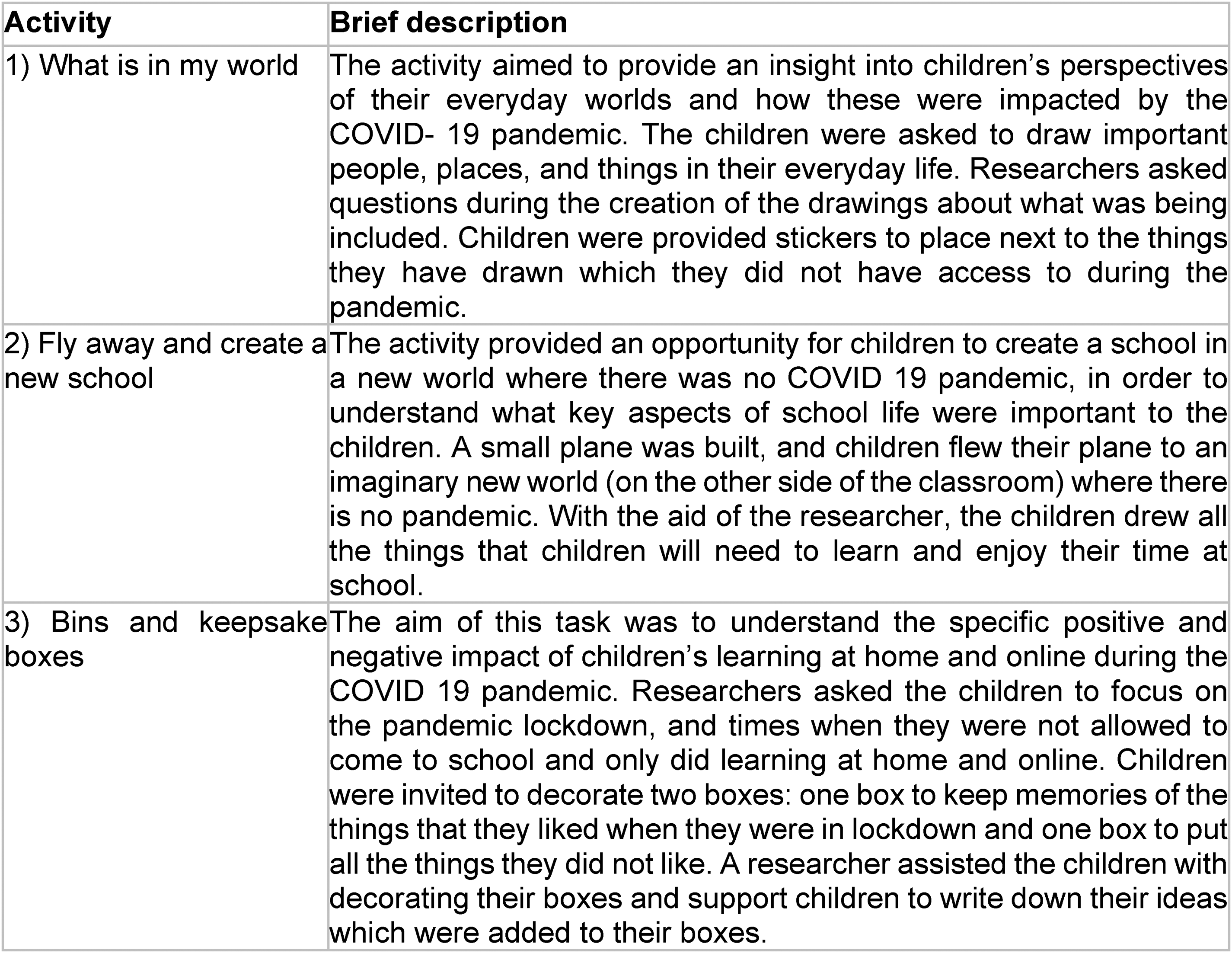
Activities.
Additionally, aligning with the Reggio Emilia principles of listening and pedagogical documentation, the Mosaic Approach appreciates the importance of designing creative and participatory methods when undertaking research with young children. The Mosaic Approach recognises children as competent and active subjects, capable of providing information about themselves (Clark and Moss 2011), and the multi-method approach does not simply rely only on oral language to recognise children's voices. This engagement with drawings, mapping, photos, role playing and other techniques that are helpful to communicate the different languages of children is centralised in the philosophies of Reggio Emilia (Edwards et al., 2011), as they can enable young children to express their perspectives despite potential limitations with spoken communication. This was a further consideration in the adoption of creative activities in this study.
Another aspect of interest in this study was how each technique of creative data production contributes to a Mosaic of perspectives and voices that develop dialogue and reflection (Clark and Moss 2011). The Mosaic Approach encourages a method of listening that can include perspectives of children and adults. The inclusion of online interviews with children and their caregivers, foregrounding the creative outputs developed in school-based sessions, and the interviews with teachers, aimed to generate dialogue, and recognise the ways in which adults surrounding children perceive their world.
Therefore, the design stage did not directly engage with the views of children, and it lacked the foundational building blocks to be a fully participatory study, as such the study can only be positioned as partially participatory (Mannay, 2015; Mannay and Morgan, 2015). Nonetheless, there was an acknowledgement of previous work that had created a suite of activities with children, an intention to align with some of the tenets of the philosophies of Reggio Emilia, and a commitment to offering a range of activities. Accordingly, the study was designed to facilitate opportunities for children to share their views, and to provide a platform for the perspectives of near adults, caregivers and teachers, that could work in dialogue with the voices of children to provide nuanced insights into the impacts of the COVID-19 pandemic. Of course, there is always a slippage between the design intentions and the journey of fieldwork, and this will be explored in the following section.
In the field
Building trust with communities is an essential aspect of qualitative research (Costas Batlle and Carr, 2021) particularly when researching with young children (Barley and Bath, 2014). Punch (2002) advocates for a ‘slow process’ of familiarisation to enable young children to engage within the research process. Accordingly, the initial visits to the school field sites were familiarisation events, where it was hoped that the research team could become more acquainted with the setting and the children involved in the project. However, these familiarization visits did not provide the sustained level of engagement to forge a relationship where all children felt comfortable with the researcher. On reflection, the team felt that the sessions should have taken place over a longer period of time. Furthermore, some children were absent during the familiarisation sessions, which meant that the first time that they met the researchers was in a data generation session. This was problematic as it hindered any opportunity for relationship building and was at odds with a Reggio focus on a ‘pedagogy of relationships’ (Chicken, 2023; Chicken and Tyrie, 2023).
Some children were only happy to engage with the creative activities if one of their class teachers was present, and in one of the sessions when the class teacher was away and a replacement teacher joined, these children were reluctant to engage with any activities. This appeared to illustrate the importance of relationships for the children. Conversely, during the three activity sessions, some children forged a strong attachment to the researchers. For example, Harriet, who had experienced change and instability in relation to the care system, did not want to leave any of the creative sessions and tried to remain with the researcher when the research activities came to an end. There were concerns about Harriet oversharing information and about the impact on Harriet when the project came to an end. The researchers were reliant on the gatekeepers of the schools to ensure that children were suitable to take part and they needed to trust the knowledge of these gatekeepers. However, for the research team, entering and leaving the research sites was fraught with questions because the impacts of being involved in research can be ‘minimal, or significant, or even transformative … in good and bad ways’ (Braun and Clarke, 2021: 26). This example raised an ethical dilemma as developing relationships was an important part of the research process, but these research relationships were inevitably transient. The team were careful to effectively communicate with the children and reiterate that their interactions with researchers would soon come to an end.
It was also important to ensure that all children were willing participants who understood the purpose of the research and their involvement. There were a number of challenges including, gaining meaningful informed consent from young children, which has been noted by other researchers (Christensen and James, 2008; Harcourt, 2011), and it would have been useful to have longer familiarisations sessions, and meetings dedicated to discussions of ethics and consent with the children. However, the research team were constrained by the deadlines of the project and did not have an opportunity to dedicate an entire visit to a creative range of activities based on communication of consent as in best practice model of ‘the case of ethics’ (see Edwards 2019; Timperley 2020). Nonetheless, time was made to have individual conversations with all the children to ensure their questions were answered such as Ethan's interest in the use of recording equipment and how his voice would be stored and contribute to the project.
Children's understanding of their choice about whether to participate was also demonstrated in some of the activities. For example, during the third activity, Bins and Keepsake Boxes, Harriet was observed putting several words and pictures into one of the boxes labelled ‘things to get rid of’ and then taking them out one by one, reading these and ripping some of the representations up with gusto whilst replacing others. The researcher asked if Harriet had changed their mind about including these and their guarded body language suggested that they did not want the researcher to have sight of these particular words and pictures. This suggests that children did understand the nature of consenting and withholding data, as Harriet exercised agency in relation to which elements of the activities, they were comfortable with sharing.
Nonetheless, the activities necessitated an ability to work sensitively with children and to be attentive and responsive to situated ethics (Ebrahim, 2010). For example, Hetuwa, a child with English as an Additional Language was not present at the initial familiarization session or the first activity session. In the second activity session, consent was explained, and they agreed their participation in the project. However, the spoken agreement was in conflict with the subtlety of the child's body language, which suggested that they did not want to be involved but they did not vocalize their desire to leave. The researcher noted the signs of guardedness in Hetuwa's facial expressions and sensitively asked if they would like to leave the session and return to the classroom. Hetuwa nodded their head, and this non-verbal gesture represented their voice and their preference. In a later activity session, Hetuwa wanted to engage in decorating boxes. While other children orally verbalized their thoughts in conversation with their peers and the researcher, Hetuwa chose to voice their opinions through the written word and only offered some one-word answers to the points of discussion.
Hetuwa may have placed an emphasis on the written word because of them being a child with English as an Additional Language, or because they were shy about speaking, or because they enjoy communication in this mode. In line with the approach of Reggio Emilia, it was not as important to have any explanation of Hetuwa's reasons, as it was to ensure that researchers were carefully attuned to children's presence, their body language, and facial expressions so that children could communicate (or choose not to communicate) through their preferred forms, whether these were drawings, written words or spoken words (Aden and Theodotou, 2019). As noted earlier in the introduction to this paper, the different languages of children are central to the philosophies of Reggio Emilia (Edwards et al., 2011). However, this appreciation of the value of different ways of contributing was challenged when working with Evan.
Evan was a non-verbal child who could not engage with discussions or with the planned creative research activities due to fine motor dexterity. The underlying philosophy of Reggio Emilia is the construction of the child as a curious and competent meaning maker (Malaguzzi, 1993) and the Mosaic Approach encourages the introduction of multiple-methodological techniques, which do not simply rely only on oral language to recognise children's voices (Clark and Moss, 2011). Accordingly, the research team were keen to find a way to recognise Evan as capable of providing information about themself and for them to contribute their perspectives. To foster an opportunity for symbolic language, a new activity with a range of photographs was designed and Evan was able to interact with their class teacher acting as an interpreter through the use of a Sign Language and meeting Evan with their parents also enabled further engagement with the study.
Reggio Emilia philosophies are rooted in the significance of relationships, which recognize the contribution of children and adults. However, there were challenges with ‘listening’ to non-verbal languages through the added layers of interpretation of adult interpreters, and questions around the extent to which Evan was included in the study. In the interview with Evan's father, he noted the issue of interpretation and explained ‘my wife is Evan's voice’. The parents’ role in being a ‘voice’ for Evan necessitates a layer of interpretation, however, this was built on a nuanced understanding of Evan's non-verbal communication. There was no opportunity for the research team to build a relationship with Evan and his parents where they could adequately understand and interpret Evan's subjective meaning making. There have been best practice studies with children with no or limited language. For example, Pickering (2021, 2022) used photographs and diaries as techniques of data production, carefully noting children's non-verbal responses, and developing relationships with children's caregivers. The Pickering study was discussed by the research team, in relation to the adaptions made in working with Evan, but the time needed to engage in child directed photography and establish comprehensive relationships with parents and carers was not available within the project timeframe. Accordingly, the limitations of time discussed in the research design section (Mannay and Morgan, 2015) also had an impact on the fieldwork. These curtailments prevented the research team from working with Evan and their family more extensively, which could have enabled an opportunity to better address these challenges and gain a more nuanced understanding of Evan's perspectives.
There were forms of silencing children witnessed in the project and members of the research team noted that children were sometimes shut down in sessions if teachers felt that their contributions were not relevant or appropriate. There were also differences between the ways in which children interacted in the school setting and the online interviews where their parents were in attendance. For example, in the school setting Daniel was very clear that the researchers needed to communicate their perspectives, experiences and ideas to the Welsh Government, and they were talkative in the school-based activities. However, when Daniel took part in the online interview with their parent, they withdrew from the conversations and refused to share their thoughts with the researcher.
This change in Daniel's engagement could be interpreted as an indication of Daniel's enactment of voice, deciding when and how to contribute, or the influence of the presence of the parent, or that Daniel was bored in the online session, which did not include the creative activities experienced in the school. The researcher also considered that Daniel had wanted to show them their favourite part of the school, but there was no time to do this in the activity sessions, which may have contributed to this reluctance to speak. The reason was not provided by Daniel, but this example emphasizes the relational aspect of research, and its complexities.
The intrusive presence of real and imagined others, has been examined previously, and arguments have been made that ‘if social science serves as a prerequisite for a multiplicity of understandings of the complexities of lived experience, which are continuously configured… rather than trying to exclude ‘intrusive voices’, perhaps it would be more useful to examine the ways in which they can act to further our understandings’ (Mannay, 2013: 144). The layers of interpretation of Evan's account, the teachers who discouraged the discussion of some children and the presence of parents and children in the online interviews could be considered as forms of intrusion, but also as ways to understand the worlds of children in a more nuanced way. In Reggio Emilia philosophy, the multidimensional process of documentation attempts to make sense of the learning taking place in the progettazione (Chicken, 2020; Tur Porres, 2020; Forman and Fyfe, 1998). In the same way, in the analysis of the data it was important to consider what was recorded in the interview transcripts and the art created by the children, and the other interactions in the field. However, as will be discussed in the following section there were limitations to this level of documentation when there was a dispersed team of researchers who had differential access to, and committed time to, the fieldwork and analysis process.
Analysis
Reggio Emilia's ‘pedagogy of listening’ (Rinaldi, 2006) focuses on centralising children's perspectives. However, reflections from this research study highlight that this is easier said than done and this centralization proved problematic within the data analysis. This study utilized reflexive thematic analysis, which is flexible and capable of befitting philosophical and theoretical assumptions which inform the analysis (Braun and Clarke, 2021). The process of reflexive thematic analysis in this study also centralized children's perspectives. However, as the study was only informed by the approach of Reggio Emilia, it lacked the sustained level of pedagogical documentation, meaning there were limitations to the extent that the analysis could be aligned with the ‘pedagogy of listening.’
In Reggio Emilia pedagogy, children's ‘voice’ refers to 100 languages as a metaphor of ways in which children express themselves (Edwards et al., 2011). However, when analysing data, the adult researcher can knowingly or unknowingly, be drawn towards the voices which more closely match a language they are familiar with, the language of adults. Accordingly, initial readings of the transcripts became akin to the researcher being in a room with some people speaking a foreign language and some people speaking their native language. The researcher was able to hear their native language (adults’ accounts) above other people speaking a different language that the researcher could not always easily understand (children's perspectives).
The data generation took multiple formats including drawing, pictures, craft materials, transcripts of ‘informal’ interviews with the children, observational notes from researchers and interviews with caregivers and teachers. Despite children receiving the same guidance during the data generation phase, this was interpreted differently by children and the data produced with children varied considerably. Flexibility was prioritized to support children's preferred modes of representation. However, the construction of the child as rich and strong with multiple perspectives became filtered through the lens of the adult interpreter during data analysis.
Whilst including an adult perspective (in this case caregivers and teachers) is recommended within the Mosaic approach (Clark, 2005), it is important this is used as secondary data in a study interested in the views and experiences of children. Adult voices may be far more familiar to the analyst than the voices of children, and it can be easy to fall into the trap of using the adult data to ‘make sense’ of the children's perspectives. Reflexive thematic analysis, like other thematic analysis approaches, is anchored in reflexive practice, acknowledging researcher biases (Braun and Clarke, 2019; Trainor and Bundon, 2021). Accordingly, it was important to be reflexive about this tendency to privilege accounts due to their familiarity and return to the data to enable more clarity to be formed in relation to the abstract and the underlying meanings within the data set. Whilst there is no way to remove the bias of being the adult interpreting the children's world, returning to the data with this appreciation enabled the analysis to move closer the principles of Reggio Emilia, which centre children's perspectives.
As part of the project planning, researchers worked in pairs to collect data in different schools (researcher and research assistant). Data collected was recorded with children's consent, and researchers’ observation notes were written after working with children. All information including audio recording, transcriptions, pictures and researchers’ observation notes were part of the data analysis and was accessible to the researchers. However, the practicalities of team members’ capacity, competing commitments and hours dedicated on this project meant that not everyone who generated data could have a central role in the analysis of this data and this is acknowledged as a limitation. This poses some interesting considerations for the philosophy of Reggio Emilia and the Mosaic approach, as the analyst is only viewing various pieces of the puzzle, which lack the in-situ nuances present during the fieldwork process. Within the philosophy of Reggio Emilia, this can mean it is difficult to fully ‘listen’ to what the children are saying (Rinaldi, 2006), as the data analyst is only privy to selected aspects of the processes and interactions catching a few snippets of a full movie.
However, this limitation was addressed to some extent by engaging with the field notes taken by researchers in the school-based activities and online interviews. Reading and re-reading researchers’ field notes alongside analysing the data provided the necessary context to clarify children's data. This was especially important when trying to interpret data produced with children who had little or no verbal communication, as in the interactions with Evan, as small gestures, such as head nodding or a facial expression would not be accessible without this form of documentation, and the sharing of this documentation in the research team. In the philosophy of Reggio Emilia careful documentation is an essential aspect of making sense of the learning taking place (Forman and Fyfe, 1998), and in social research the detailed form of documentation undertaken by researchers in the field was essential for making sense of children's experiences and perspectives.
A further key consideration within Reggio Emilia philosophy is multiple listening (Clarke, 2005; Rinaldi, 2006). As noted in the introduction to this paper, activities in the progettazione are viewed as, ‘partial findings, subjective interpretations which, in turn must be re-interpreted and discussed with others’ (Rinaldi, 2006: 57), and these discussions can entail a ‘conflict of ideas and argumentation … not a cosy search for consensus’ (Dahlberg and Moss, 2004: 16). In the fieldwork, these discussions were apparent with researcher, children, teachers and caregivers, and an important part of the analysis was to continue to discuss these accounts and interpretations with members of the research team. The iterative process of interpreting the data and going back to other team members to listen and create a dialogue provided new perspectives that then contributed to the outputs of the research.
Impact
In educational applications of Reggio Emilia principles, there are opportunities to build on learning and instigate cycles of change and development overtime, as educators and children continue to work together. However, in qualitative research studies there is a ‘social process of withdrawal’ from fieldwork, interviewing and analysis (Bloor and Wood, 2006: 112). Nonetheless, impact can continue beyond the study. This is important because there are key tensions between listening and hearing and the extent to which the experiences, perspectives and recommendations generated by children can and do influence policy and practice (Mannay et al., 2019). The question of whether there is any value in voice if no one is listening (Alexandra, 2015) needs to be carefully considered in planning strategies of impact and Lundy (2007) argues that creating opportunities where children can express their views and opinions to an audience are fundamental, as without these processes notions of children's voice are likely to remain tokenistic.
Earlier in the paper it was noted that one of the children, Daniel, was very clear that the researchers needed to communicate their perspectives, experiences and ideas to the Welsh Government. The findings of this study were presented to the Welsh Government, who commissioned the study, but at this point the extent to which they will impact on educational policy and guidance is not established. The findings of the study will also be, and have been, shared in conference events, and academic papers, and this paper has been concerned with another form of sharing in the hope that the methodological limitations, and their accompanying modifications will be useful to other researchers. Additionally, as Pole and Hillyard (2017: 108) contend the ‘field remains part of the repository of experience upon which the researcher may draw throughout their career’, and the research team have learnt lessons from the children they worked with, the challenges faced, and what principles from Reggio Emilia can and cannot be applied to qualitative research.
Concluding discussion
Reggio Emilia philosophy is applied in relation to pedagogy in early years’ settings, and it is concerned with learning and development not the practices of qualitative research. Therefore, the approach has had little direct application to the design and evaluation of qualitative fieldwork, but research is also concerned with learning and development, albeit with different objectives and aims. The focus on centralising the perspectives of children and of drawing on creative multi-modal approaches is common to Reggio Emilia philosophy and the study considered in this paper. This research study could not follow the Reggio Emilia philosophy, but in embracing this philosophy as a lens to evaluate the practice of research, it is argued that this study has a spirit of Reggio Emilia, even when the principles that the research team wanted to follow were not always practicable or possible. Adopting this philosophical approach enabled the team to position young children as competent social actors who are experts in their own lives, whilst the reflective stance inherent in the approach facilitated reflection on the challenges of ‘listening’ to children who are often silenced in research.
In an ideal world of research, it would be useful for all studies to have the time required to engage children on their own terms and for them to be involved from the design of the project until the dissemination of the findings. However, while it was not possible to involve children directly in the design of the study, careful work was undertaken to draw from earlier work that had dedicated time to collaborate with children to design activities that they felt were appropriate, useful and engaging. The design of the study also privileged the multi-modal and creative approach emphasized in both the principles of Reggio Emilia and Mosaic work.
Evaluating these qualitative research practices against the principles of Reggio Emilia also highlighted the barriers created by the limited time in the field, the challenges of enabling all children to engage, and the relational and contextual aspects that both hindered and facilitated the stages of data production. A key lesson here was the need to be attentive to and attuned with the subtleties of children's paralanguage and to maintain a level of flexibility that respected children's requirements and preferences. While there may be advantages to systematic approaches where all children complete the same research activities in the same way, this can generate exclusion for some children as well as problematizing the recognition of children's agency. Accordingly, in this study flexibility was emphasized and enacted.
The analysis of the data brought new challenges as the data was multimodal and created by participants and a team of researchers, meaning that those analysing the data were not necessarily in situ when the data was produced. In responding to these challenges reflexivity was key, as was an ongoing dialogue with the data and researcher field notes. Furthermore, following the principles of Reggio Emilia it was essential for the research team to make space for discussion and listen to each other in relation to the data produced from children's perspectives, and the ways in which it had been interpreted.
Research studies cannot always be conducted in the ways that we would hope as they are constrained by time, funding and researcher capacity. However, in this study by being reflexive and making small adaptions, the research team were able to produce research that respected children's perceptions, experiences and concerns. Drawing on the philosophies of Reggio Emilia as a lens to examine this study generated new understandings and assisted in questioning the tensions between voice and silence. This paper has made recommendations for how research teams can face and respond to the issues that complicate the intent of respecting children's subjectivities and perspectives, and in doing so enable the recognition of children as ‘rich in potential, strong, powerful and competent’ (Malaguzzi, 1993: 10). The lessons learnt from evaluating this study in relation to Reggio Emilia philosophy have value for others working with young children. However, the commitment to dialogical practice, flexibility and reflexivity has wider relevance for qualitative projects with children, young people and adults from diverse communities.
Footnotes
Acknowledgements
The authors of this manuscript want to acknowledge the work of all persons that contributed to the research project funded by Welsh Government. Amy Bond; Ellie Grout; Bridget Handley; Dr Cathryn Knight (Swansea University at the time research was conducted); Tegan Waites (Children in Wales); Dr Jane Waters–Davies (University of Wales Trinity Saint David's); Anna Westall (Children in Wales). They would also like to thank all of the children, parents and teachers who engaged with this project.
Declaration of conflicting interests
The author(s) declared no potential conflicts of interest with respect to the research, authorship, and/or publication of this article.
Funding
The author(s) disclosed receipt of the following financial support for the research, authorship, and/or publication of this article: This work was supported by Welsh Government.

Author biographies
Sarah Chicken is a Senior Lecturer in the Department of Education and Childhood. Sarah has an interest in social justice and participatory research with groups who are often viewed as marginalised. Her research also explores dialogic curriculum models where the voice of the young learner is foregrounded, including Reggio Emilan pedagogy.
Gisselle Tur Porres is a Programme Director for the BA in Early Childhood Studies that sits in the Department of Education and Childhood Studies at Swansea University. Gisselle is convenor of the International Research Network (IRN) of the World Education Research Association (WERA): ‘Promoting and supporting children's agency and participation in Early Childhood Education and Care (during the COVID-19 pandemic and beyond)’. Her research interests focus on supporting learning and teaching practices in the early years from emancipatory pedagogical perspectives and participatory research approaches; doing research with children, families, teachers/practitioners and communities.
Dawn Mannay is a Reader in Social Sciences (Psychology) and Director of Postgraduate Research at Cardiff University's School of Social Sciences. Dawn has an interest in inequalities, identity, culture, class and the everyday experiences of care experienced children and young people. Dawn uses creative and art-based methods of data generation with participants and extends the impact of research findings through the use of film, art work, music and a range of other participatory and co-produced multimodal materials.
Jade Parnell is a Research Fellow for the Centre for Appearance Research in the School of Social Sciences at the University of the West of England. Jade's research primarily focuses on promoting positive inclusion and diversity practices within educational settings, in order to reduce appearance-related stigma.
Jacky Tyrie is a Senior Lecturer in Early Childhood Studies and programme director on the MA Childhood Studies. Dr Tyrie's research explores early childhood from sociological and geographical perspectives and focuses on research around children's rights and participation, she is interested in research with children and participations examining their perspectives of rights in the early years. Dr Tyrie is a national leader in children's rights and co-ordinates the Children's Rights in Early Years Network (CREY) and the COVID and Children Research Network (CCRN).